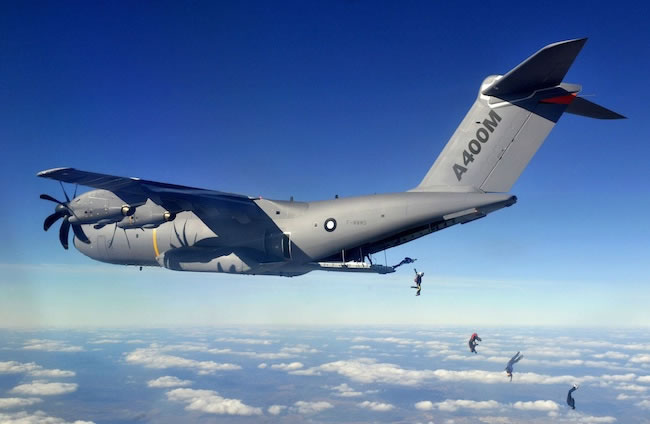
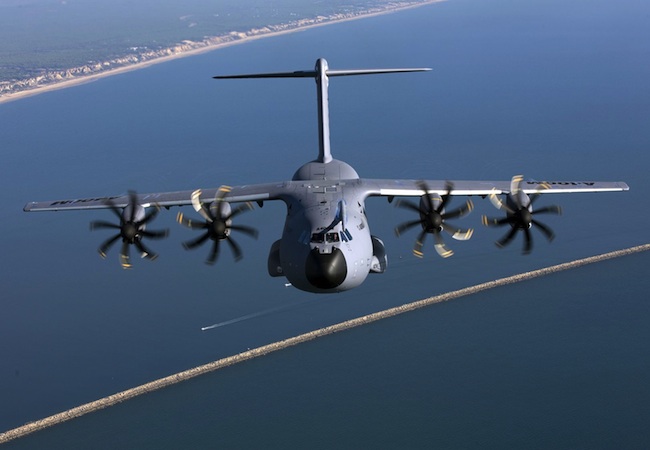
The A400M is designed for the transportation of all types of heavy military or civil loads such as vehicles, containers or pallets, as well as troops. It will enable the air forces to upgrade their airlift capability for both humanitarian and peace-keeping activities as it will have more than twice the payload and volume of the aircraft it will replace.
A400M is a high-speed transport aircraft powered by four turboprop engines. It is designed to meet the harmonised needs of European NATO nations and which equally fulfils the requirements of other air forces around the world. Photo: Airbus
Less than 40 months after its maiden flight, the A400M today received full Type Certification by the European Aviation Safety Agency (EASA). This achievement marks a critical step towards delivery of the first aircraft to the French Air Force. The award of the Type Certificate makes the A400M the world’s first large military transport to be designed and certified to civil standards from its inception. Military Initial Operating Clearance is ongoing, paving the way towards first delivery.
“Certifying the A400M to civil as well as military standards has been a huge challenge for us, our suppliers and EASA itself. But by providing a firm framework for certification from day one, to globally accepted standards, both we and the operators will see important benefits as the aircraft matures in service and new customers join the programme.” Cedric Gautier, Airbus Military Head of A400M programme said.
During the certification programme the A400M has undergone exhaustive testing of its handling qualities throughout the flight envelope in normal and failure conditions; demonstrated outstanding performance in the heat of the Gulf, cold of Sweden and Canada, and at the high altitude of La Paz, Bolivia; and satisfactorily completed more than 300 hours of function and reliability testing to demonstrate the robustness of its TP400 engines and systems.
Additionally it has begun tests of more advanced military functions such as air-to-air refuelling, air-dropping of supplies and paratroopers, and low-level flight – all with highly encouraging results. The five-strong fleet of “Grizzly” development aircraft has now completed some 4,800 hours in the air during more than 1,600 flights and will continue intensively to expand the A400M’s military capabilities.
Airbus designed the A400M airlifter to combine both tactical and strategic/logistic missions. With its cargo hold specifically designed to carry the outsize equipment needed today for both military and humanitarian disaster relief missions. According to Airbus, the multipurpose approach enables the A400M to deliver missions with smaller fleets and less operational investment.
The A400M is designed for the transportation of all types of heavy military or civil loads such as vehicles, containers or pallets, as well as troops. It will enable the air forces to upgrade their airlift capability for both humanitarian and peace-keeping activities as it will have more than twice the payload and volume of the aircraft it will replace. Photo: Airbus
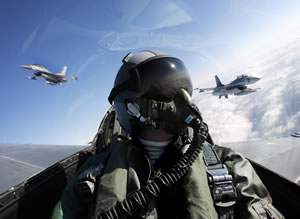
New assets for the F-16 office. Photo: Eric Vorstenbosch
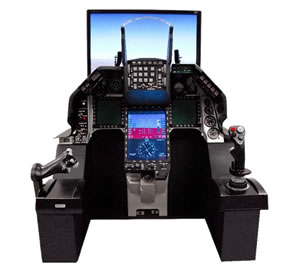
The CDU replaces legacy analog instruments with digital ones, leaving a large area of digital display real estate for useful situational displays. Photo: Raytheon
Raytheon’s Center Display Unit (CDU) being fitted as part of the upgrading of US Air Forces’ Air National Guard F-16s has been endorsed by the Air Force as a primary flight reference (PFR) for the fighter. A PFR is a requirement in all aircraft and must include airspeed, altitude and attitude data, as well as flight path information for the pilot. “This endorsement means F-16 pilots can now use our CDU as their sole primary flight reference,” said Rudy Lewis, vice president of Customized Engineering and Depot Support for RTSC.
As shown in the video below, the CDU provides the pilot much more than flight data. The Center Display Unit (CDU) being fitted as part of the upgrading of US Air Forces’ F-16s has been endorsed by the Air Force as a primary flight reference (PFR) for the fighter.
The CDU replaces multiple legacy, analog flight instruments with a compact digital display leaving premium area for an ultra-large digital screen that can be used to present high resolution imagery from sensors, digital maps, or detailed situation displays – a cockpit layout common in generation 4.5 fighters.
Following the endorsement late last year, the Air Force awarded Raytheon a contract for full-rate production of the first 100 CDUs. The initial $3.1 million contract, awarded in 2010 Raytheon covered the delivery of 120 systems. Raytheon’s Technical Services Company LLC (RTSC) will perform engineering and the current low rate initial production (LRIP) on the system at its site in Indianapolis under the initial contract. The contract includes five optional years of full rate production with systems delivered to the Air Force logistics centers for the upgrade.
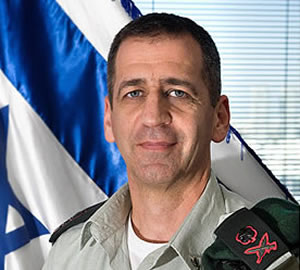
Maj. General Aviv Kochavi, Director, Israel's Military Intelligence. Photo: IDF
“Assad continues to assert his control Syria’s chemical weapons, air force, and military hardware. Assad is making advance preparations to use chemical weapons. He did not give the order yet, but preparing for it.”
Maj. Gen. Aviv Kochavi, IDF Director of Israel Defense Forces (IDF) Military Intelligence said today in his speech today, before 4000 attendees at the 13th annual Herzliya conference. In his presentation, Kochavi analyzed the impact of the changes in the Middle East and reviewed key threats to Israel’s security in 3 central arenas: Syria, Iran and the Palestinian Authority.
Kochavi discussed the rise of radical Islam in the Middle East, saying that “these Muslim Brotherhood movements work to promote their agenda of Sharia states, as well as to achieve more strategic goals and to strengthen their hold in the power, including in the Gaza strip and Turkey.”
Kochavi referred to Syria as a disintegrating state, and expressed his worry of the deterioration in governance and Syria’s ability to control its territories. While Assad is losing control of many parts of Syria, Kochavi said,
“The damages of the imminent fall of Syria are very high for both Iran and Hezbollah. Iran is losing a sole ally in the region surrounding Israel. It will lose the ability to transfer weaponry through Syria to Hezbollah.
Iran and Hezbollah established a 50,000 man army operating in Syria. The damages of the imminent fall of Syria are very high for both Iran and Hezbollah.
Iran and Hezbollah are both doing all in their power to assist Assad’s regime. They support Assad operationally on the ground, with strategic consultation, intelligence, weapons, … Most recently, they are establishing a popular army trained by Hezbollah and financed by Iran, currently consisting of 50,000 men, with plans to increase to 100,000. Iran and Hezbollah are also preparing for the day after Assad’s fall, when they will use this army to protect their assets and interest in Syria.”
On Iran, Kochavi told participants: “Iran’s nuclear program is advancing slower then they planned, but it is moving. At their current pace of enrichment of 14 kilograms of uranium per month, Iran would be able to manufacture 5-6 nuclear bombs, if the order is given. Iran is making sure not to cross any international red lines because the survival of the regime is the biggest priority.” He added, “Iran does not see a high likelihood of an attack on its nuclear facilities by the international community.”
Addressing the calm on the Gaza border he said: “The relative peace and quiet that we have experienced in the past few months are only observed because Hamas wishes it. Following the Pillar of Defense operation Hamas has been deterred, they need to time rehabilitate and need to uphold their deep commitment to Egypt who fostered the agreement.”
In Judea and Samaria, Kochavi said that “the Palestinian street has been turbulent…The economic crisis is a major motivator in this development, and the issue of Palestinian prisoners is genuine as well, in addition to the “price tag” incidents and the lack of hope for a diplomatic solution. However, most events included less than 4000 people. There is no third Intifada potential here.”
Challenged by the ever growing scale and capabilities of China’s People’s Liberation Army (PLA), Taiwan must develop its air defense capabilities fielding more capable fighter planes in greater numbers, a requirement aired in a recently published released quadrennial defense review. Taiwan’s Ministry of National Defense (MND) claims that China is deploying many of its newest weapons its Nanjing and Guangzhou military regions, both of which are adjacent to Taiwan, in recent years. Moreover, Many of the training programs and live-fire exercises played by the PLA have focused on seeking a speedy end to island conflicts in an apparent effort to prevent foreign intervention in the event of such a standoff.
According to the MND’s quadrennial defense review, the military is also planning to develop unmanned aerial vehicle (UAV) capable of carrying out combat and reconnaissance missions to beef up the country’s air defense muscle.
Given the reluctance to deliver advanced fighter aircraft as expressed by Taiwan’s main ally – the US – Taipei is determined to develop its own advanced air power, based on new generation, stealth-capable fighters capable to meet the modern Chinese fighter planes in battle. Other capabilities recommended for such fighters include long-range flight and aerial refueling abilities, as well as the capability to launch ground and anti-ship weapons.
In the 1980s Taiwan has embarked on an indigenous defense fighter (IDF) aircraft project also known as F-CK-1A/B Ching-kuo, developed and built by Taiwan’s Aerospace Industrial Development Corporation (AIDC). It was designed to replace US built F-5 and F-104 jet fighters, after the US refused to supply Taiwan newer generation fighters (Taiwan was interested in the Northrop F-20 Tigershark or F-16 at the time). The aircraft entered service in 1994 and production of 130 aircraft has continued until the year 2000. Since 2010 these aircraft are undergoing enhancement into the F-CK-2C/D.
The need for an advanced manned fighter receives a special emphasis due to Taipei’s reiterated commitment to Missile Technology Control Regime (MTCR) which is now part of Taiwan’s trade law, preventing the proliferation of missile and unmanned aerial vehicle technology.
The ministry expects the development and construction of indigenous submarines and warplane will cost an estimated NT$500 billion.
MND spokesman Luo Shou-he said Tuesday March 12, 2013 that the decision to build indigenous warplanes does not mean that the military has ruled out the option of procuring F-16 C/Ds or even more advanced types of jet fighters. “We have struck a deal with the United States on upgrading our F-16 A/B fighters and will continue evaluate our need for advanced warplanes,” Luo added. According to the MND’s budget plan, there are still nearly NT$500 billion (US$16.89 billion) worth U.S. weapon procurement projects to be executed over the next five to 10 years.
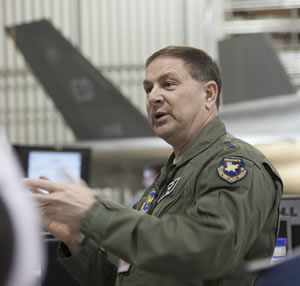
Lt. Gen. Christopher C. Bogdan talks with members of the F-35 Integrated Test Force during his first visit to Edwards Air Force Base, Calif., Jan.22. Bogdan assumed the role of program executive officer for the F-35 Lightning II Joint Program Office in December 2012. (U.S. Air Force photo/Paul Weatherman)
Lt. Gen. Christopher C. Bogdan is the Program Executive Officer for the F-35 Lightning II Joint Program Office in Arlington, Va.
Addressing some of the main challenges of the F-35 program, Air Force Lt. Gen. Christopher C. Bogdan F-35 program executive officer (PEO) said his main goal now is meeting the remaining program goals on time and within the remaining budget.
“Particularly for two significant deadlines — 2015, when the Marine Corps is scheduled to have combat-ready aircraft; and 2017, when development is scheduled to end… Those two dates are extremely important,” Bogdan said, “because if I don’t get to those two dates or I don’t reach the finish line there, then we will continue to produce airplanes that don’t have the capability that the warfighter needs.”
The development program ends in 2017, he said, and is about 90 percent complete, with about $6 billion left in the budget. “That last 10 percent is the real hard 10 percent,” Bogdan said. “So, what I have told the enterprise is, relative to development, we have no more time, and we have no more money.”
This requires a change in mindset, the general said. Additional expenses have to be offset by a reduction elsewhere, and that, he said, may mean a reduction in end capability. “That has profound implications for the warfighter. I can honestly tell you that the warfighter does not like me standing up saying that,” Bodgan said.
“we’re still doing basic testing on the airplane. So for someone to assess that the visibility behind the airplane is such that it will ‘get gunned down every time,’ [is] a little premature.”
Referring to recent criticisms about technical issues and allegations of limited aft visibility and training deficiencies, Bogdan said it is premature to address those issues at such an early stage. “There are known solutions for all of the known issues with the aircraft”, he added.
“We have yet to fly a single air-to-air engagement with another F-35 or another airplane,” he said. “The airplane’s not ready to do that. We’re still doing basic training on the airplane, [and] we’re still doing basic testing on the airplane. So for someone to assess that the visibility behind the airplane is such that it will ‘get gunned down every time,’ [is] a little premature.”
In a speech at the McAleese/Credit Suisse Defense Programs Conference at the Newseum, Bogdan told attendees that he and his predecessor, Navy Vice Adm. Dave Venlet, worked with Lockheed-Martin and Pratt & Whitney to reform the problem-plagued development program. Today, the PEO said the program’s affordability is his leading concern.
Lt. Gen. Christopher C. Bogdan talks with members of the F-35 Integrated Test Force during his first visit to Edwards Air Force Base, Calif., Jan.22. Bogdan assumed the role of program executive officer for the F-35 Lightning II Joint Program Office in December 2012. (U.S. Air Force photo/Paul Weatherman)Since 2009, when the troubled F-35 program received those six billion additional funding and three years ‘grace’ to meet goals, the Joint Strike Fighter (JSF) program has been making slow and steady progress and is on track, Bogdan said.
Avoiding the ‘Death Spiral’
F-35 production is “the shining star” of the program, the general said. About 30 aircraft are being built each year, and the cost per unit has come down with each successive low-rate initial production (LRIP) lot. Between LRIP 4 and LRIP 5, there was a 4-percent decrease in build costs, Bogdan said, a trend he said he believes will continue until per-unit costs approach the original 2001 estimate of $69 million.
“we have to continue to see Lockheed-Martin and Pratt & Whitney investing in making the production line more efficient, squeezing the costs out, and getting the unit cost of this airplane down”
“I think we can get there,” he said. “Lockheed-Martin and Pratt & Whitney are doing a pretty good job of coming down that cost curve. They’re getting more efficient in their production line [and] their quality is going up, … and that is a good thing, because I promise you the one thing that our partners care most about is how much this airplane’s going to cost.”
Eight nations have committed to participate in the development program, and another three may buy F-35s, with nearly 3,000 aircraft expected to be produced. With such a large order and so many partners invested in the aircraft, it’s essential to keep costs down to avoid what Bogdan called the “death spiral,” something he said he’s seen kill off many programs.
The death spiral is when increasing costs lead to a reduction in the number of units purchased, which in turn leads to further per-unit cost increases, and so on.
“I don’t think that’s the fate of this program,” Bogdan said, “but the proof is in the pudding, and we have to continue to see Lockheed-Martin and Pratt & Whitney investing in making the production line more efficient, squeezing the costs out, and getting the unit cost of this airplane down. I think they can do it, but we have to wait and see.”
Affordability Over Life Time
Production costs are only part of the puzzle, however. About 70 to 80 percent of any program’s costs are in the long-term operation and sustainment phase, the general said. What’s unique about the F-35 is that the Defense Department has never had to estimate the costs of a 50-year aircraft life cycle, he said. Adding to the complications of producing such a cost estimate is that the department hasn’t had an aircraft program this large since World War II, Bogdan said.
“There is already interest from industry in a competitive bidding to produce, deliver and operate support equipment, pilot and maintenance training centers, administer the logistics and information technology systems and manage the global supply chain”
“So, lots of airplanes over a very long period of time, with inflation added in, you can understand how the [Office of the Secretary of Defense] guys come up with a number like $1.1 trillion,” he said. “That’s an astronomical number; it’s based on a lot of assumptions. I’m not saying that that’s a bad number; I’m just saying we need to take that number with a grain of salt.”
What he does know, he said, is that action must be taken soon to reduce the F-35’s long-term sustainment costs. Without it, the general said, a time will come when the services decide that the aircraft is no longer affordable.
“So we have to start doing things today,” Bogdan said. He said there is already interest from industry in a competitive bidding process to produce, deliver and operate support equipment and pilot and maintenance training centers, administer the logistics and information technology systems and manage the global supply chain.
“The other thing is we’ve got to work on the reliability and the maintainability of the airplane,” he said, a process he described as ‘Whack-a-Mole.’ “You’ll take care of those first 10 or 20 cost drivers in reliability and maintainability, and then the next 20 will show up,” he explained. “You keep doing that until you get to a point where the reliability and maintainability of the airplane is up where you expected it to be, and in the long term, you can reduce the costs on the airplane.”
Improving Project Management
As part of the program’s improvements linked to the 2009 rescheduling, Venlet introduced a more radical change in the engineering process. Previously, design reviews were conducted by the program office, Bogdan reminded. Design review boards are now chaired by government executives from throughout the Defense Department who are seasoned engineers with experience developing successful aircraft programs. “They draw on the expertise of all the people underneath them at those organizations to help us decide, technically, ‘Are we ready to move forward?’” he added, noting that the change has paid great dividends.
“I have a good program office, but I don’t have the resources, nor do I have the expertise that the entire Department of Defense has when it comes to building airplanes”
Some of the program changes have been painful, the general said, but were necessary. For example, until 2010 the program was operating without an integrated master schedule, so it was difficult to track the systemwide effects of a change in any part of the program. The schedule has been built, and now tracks about 16,000 items, he said. It’s a small thing that makes a big difference in how a program is managed, he noted. “We can actually track each of those events and see how they affect the end timeline,” Bogdan said.
Bogdan summarized his expectations. “We are trying to instill a level of discipline in this program such that there are no surprises, we have predictable outcomes, [and] when we have problems, we have ways of solving those problems,” he said. “[This is] very hard to do on a very big, complex program that has lots and lots of decision-makers [and] lots and lots of pots of money, but I think that’s an absolute necessity to get the program moving in the right direction.”
This article is based on review by Claudette Roulo of the American Forces Press Service.
The Indian Ministry of Defense is about to introduce a major change in its defense procurement policy, giving a priority to local companies through rating ‘Buy and Make’ (Indian production of goods) as the top category for procurement. This ‘India First’ policy will provide first opportunity in all contracts to Indian companies, from the public and private sector, while placing procurement from foreign suppliers as the last option.
The Indian Ministry of Defense has also excluded software and consultancy services from the approved offset list, meaning that international companies selling defense systems to India will not be able to acquire offset credit buying services from Indian software services or consultancies. The exclusion of software and consulting services from the list of recognized defense offsets is the resulted from VVIP helicopter scandal, after Italian investigators found that middlemen involved in the VVIP helicopter scandal routed kickbacks into India through a phony software contract. (The Economic Times)
The move would be a historic shift from existing priority given to acquisitions from foreign companies, which today accounts for 70 percent of purchases. Most of the remaining is procured from Indian public sector units and ordnance factories while Indian private sector only gets a very limited number of defence contracts. These private sector companies will now get a significant boost opening new opportunities for supplying equipment as well as establishing joint ventures with foreign producers of military systems.
The proposals have already been discussed in a few rounds of discussions and is set to be approved by the Defence Acquisition Council headed by AK Antony in the next few weeks, the Times of India said.
‘Buy’ and ‘Make’ privileges mean Indian private sector companies will become much more attractive for joint ventures with foreign producers seeking to secure deals supplying defense systems to the Indian military.
Under this category, the procurement would be made from an Indian vendor, including a private Indian company that forms a JV or even has a production arrangement with a foreign firm. Under Buy and Make (Indian) there must be a minimum of 50 percent indigenous content.
Until now, the primary protection for the local market was the offset requirement. Under Defence Procurement Procedure, in any purchase over $60 million from a foreign company, 30 percent of the contract value has to be ploughed back into India through offset – buyback from Indian suppliers, encouraging foreign suppliers to team up with Indian suppliers acting as subcontractors. While the majority of buybacks were related to the defense programs, some are suspected to have masked illegal kickbacks. The VVIP helicopter scandal threatens to exclude software and consultancy services from the industry fields approved for defense offset, the Times of India reports.
As a result, the Indian Ministry of Defense is considering to exclude software and consulting services from the offset list after Italian investigators found that middlemen involved in the VVIP helicopter scandal routed kickbacks into India through a phony software contract. In its list of about a dozen offset partners, AgustaWestland, which supplied the VVIP helicopters under the controversial 2010 contract, listed IDS Infotech as a partner. It has emerged in Italian court filings that middleman Guido Haschke had got AgustaWestland to source phony software from IDS Infotech to move a few million euros into India in the name of software outsourcing. And more payment was to be routed to IDS Infotech as an offset partner. Sources said IDS Infotech ploy was the key reason for the decision to look at options available under offsets. “Software and consultancies are difficult to value. The value of offsets should verifiable and credible” a source explained to the Times of India. The proposed amendments would result in defence offsets being mostly clustered around engineering services that are universally quantifiable.
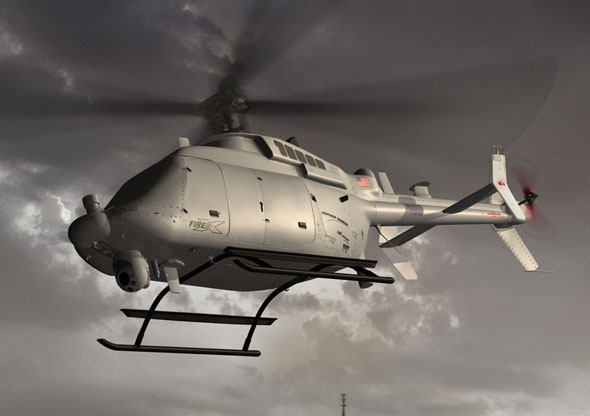
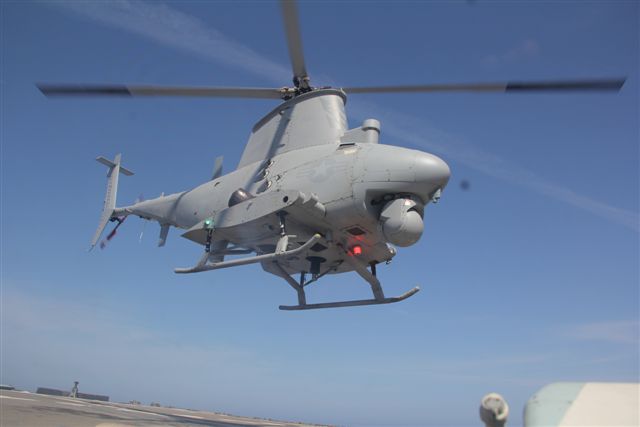
Northrop Grumman awarded Cubic a $3.7 million development contract for a new multi-band digital datalink for the MQ-8C unmanned helicopter UAS. Photo: Northrop grumman
The U.S. Navy has awarded Northrop Grumman Corporation a contract valued at more than $71 million to produce six additional next-generation Fire Scout unmanned helicopters. The Navy plans to purchase a total of 30 aircraft under a rapid development effort. Northrop Grumman is currently under contract to produce 14 Fire Scouts that are scheduled to begin deploying in 2014. The Fire Scout endurance upgrade, designated the MQ-8C and based on Bell Helicopter’s 407, will provide ship commanders with increased range, endurance and payload capacity over the current MQ-8B variant. Manufacturing and assembly operations of the new Fire Scout variant are well under way across the USA, with airframe modifications being made at Bell’s facility in Ozark, Ala., and final assembly being completed at Northrop Grumman’s Unmanned Systems Center in Moss Point, Miss.
Meanwhile the current variant, MQ-8B continues operations, maritime intelligence, surveillance and reconnaissance (ISR) operations. Last week the fleet exceeded the 8,000-flight-hour mark operating under the U.S. African Command area of responsibility, in the Red Sea, Eastern Indian Ocean and the Mediterranean Sea. Fire Scouts routinely flying 17-hour days while providing 12 hours on station ISR coverage.
After exceeding the 8,000-flight-hour mark Friday, an MQ-8B Fire Scout assigned to Helicopter Sea Combat Squadron 22 Detachment 5 prepares to land aboard USS Robert G. Bradley for a “hot pump” and re-launch while conducting maritime intelligence, surveillance and reconnaissance (ISR) operations in the Mediterranean Sea March 11. Fire Scouts aboard Bradley are routinely flying 17-hour days while providing 12 hours on station ISR coverage in the U.S. Africa Command area of responsibility. (U.S. Navy photo)
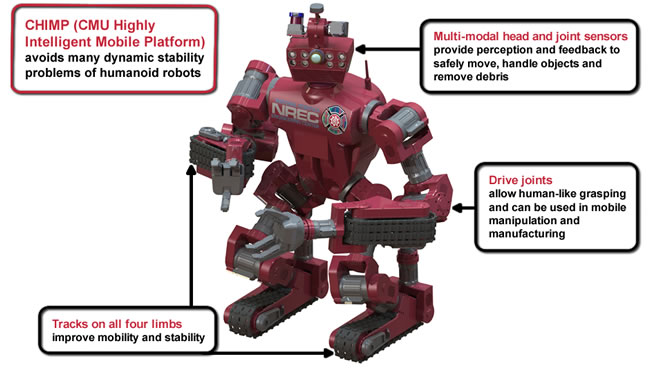
Quickly transforming from erect from two to four-limbed movement, CHIMP will be able to climb stairs and ladders, or drive rapidly on and off-road. Photo: NREC
A team from Carnegie Mellon University’s National Robotics Engineering Center (NREC) is building a human-size robot that moves, not by walking, but on rubberized tracks on the extremities of each of its four limbs. With this unique robot the CMU team hopes to win the Defense Advanced Research Projects Agency’s (DARPA) Robotics Challenge.
This ‘CMU Highly Intelligent Mobile Platform’ (CHIMP) will use all four rubber tracks for normal ground movement. The limbs carrying these tracks will also be able to move, enabling the robot to move on two limbs at a time, thus being able to cross rough terrain, obstacles and debris. The limbs will also enable the robot to manipulate objects or operate tools when necessary.
“Humans provide high-level control, while the robot provides low-level reflexes and self-protective behaviors,” said Tony Stentz, NREC director and Tartan Rescue Team leader. “This enables CHIMP to be highly capable without the complexity associated with a fully autonomous robot.” The NREC entry, Tartan Rescue Team, is one of seven selected by DARPA for the Robotic Challenge Track A, in which each team will develop its own hardware and software. The human-centered nature of DARPA Robotics Challenge would seem to favor a dynamically stable humanoid robot, the choice of five of the seven Track A teams, Stentz acknowledged. But his team’s focus on simplicity and dependability led them to choose tracked locomotion.
Like a chimpanzee, each extremity is equipped with a manipulator that enables it to grasp objects;
Near-human strength and dexterity. On-board sensors build a texture-mapped, 3D model of the environment that CHIMP uses to maintain stability and prevent collisions. The same 3D model enables the operator to visualize the location and orientation of CHIMP and evaluate possible actions. Controlling the CHIMP the operator will use an immersive interface of a large screen monitor, keyboard and mouse, where he will be able to choose from multiple modes that blend manual and autonomous control of the robot.
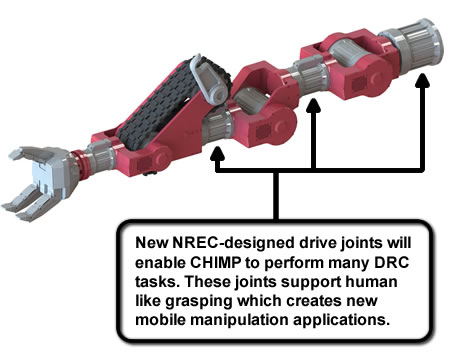
Each of the four limbs of the CHIMP has a grip, hook, track and multiple joints supporting complex positioning and object manipulation. Photo: NREC
“This type of robot has tremendous potential,” he added. Such a robot would be suitable for a variety of tasks for which NREC now develops wheeled, tracked and other conventional robots, such as remote inspection and monitoring of hazardous industrial facilities. A unit of Carnegie Mellon’s Robotics Institute, NREC performs advanced applied research and prototyping for commercial and governmental clients.
CHIMP will have to do that and more during the competition, in which robots will have human-like capabilities to respond to calamities such as the 2011 Fukushima nuclear plant disaster. Climbing ladders and driving vehicles are among the obstacles robots will face in environments engineered for people.
CHIMP will be able to perform complex, physically challenging tasks through supervised autonomy. A remote, human operator will make high-level commands controlling the robot’s path and actions, while the robot’s on-board intelligence prevents collisions, maintains stability and otherwise keeps the robot from harm. The robot also will be pre-programmed to execute tasks such as grasping a tool, stepping on a ladder rung or turning a steering wheel without step-by-step direction from the human controller, circumventing the lag between command and execution.
“When we walk or stand, our brains are actively controlling our balance all of the time,” Stentz noted. This dynamic balance makes people nimble and enables them to run. But it also greatly increases the complexity, computational requirements and energy consumption of a machine. So CHIMP is designed with static stability; it won’t fall down even if it experiences a computer glitch or power failure. When necessary, however, the operator can control CHIMP’s individual joints, enabling it to adapt its motion to particular circumstances or extricate itself from tight spots.
NREC’s CMU Highly Intelligent Mobile Platform (CHIMP) is designed with four limbs and track motion devices, thus avoiding many dynamic stability problems humanoid robots are facing. Photo: NREC
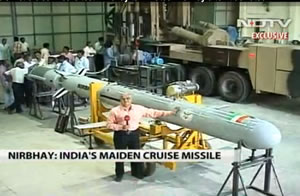
A test flight of India’s Nirbhay cruise missile failed today. “The missile blasted off from a mobile launcher positioned in the launch pad — 3 of the ITR missile test range at Chandipur, Odisha. at about 11:54 a.m.” DRDO announcement said. However, after a successful lift-off, about 17 minutes into the flight the missile had deviated from the planned flight path and the mission was terminated. Nevertheless, DRDO claims the missile “successfully” met the basic mission objectives and performed some of the manouveres satisfactorily before being terminated midway.
Under the planned test, Nirbhay (Fearless) will be required to complete a flight of 1,000 km, representing the weapon’s operational range. Originally, the test was scheduled for late 2012 but was delayed. Once development is completed Nirbhay will become part of India’s nuclear triad and an important complement in the country’s nuclear retaliatory capability, establishing viable ‘second strike’ through submarine-launched K-15 ballistic missiles and Nirbhay cruise missiles. A conventional armed variant will also improve the naval strike capability beyond the range of the current BrahMos.
The Aeronautical Development Establishment (ADE), a DRDO facility in Bangalore, has designed Nirbhay as a derivative of the Lakshya unmanned target drone. It is designed for deployment from land, air and sea. As a cruise missile, Nirbhay can fly autonomously or under remote control. The weapon is launched from road mobile launcher, using a booster for acceleration. After the booster separates, the turbo-jet engine kicks in, powering the missile for the cruises phase. Nirbhay will fly at an altitude of 500 – 1000 metres at a speed of 0.67 Mach. It is equipped with autopilot maintaining constant altitude from the ground, thus enabling the missile to avoid detection by flying ‘under the radar’. ADE is also referring to the missile as a ‘loitering weapon’, as it can fly around te target until instructed to attack. However, it has not been disclosed whether the missile is equipped with sensors to obtain images to provide the intelligence for such attack. Other attributes mentioned in the past were multiple warheads, although it is not clear if each weapon will have multiple attack capability or the family of weapons will offer a choice (for example, conventional, anti-ship or nuclear.)India plans to field two versions of Nirbhay – the nuclear armed cruise missile, to be carried by up to 20 specially modified Su-30MKI fighters. The booster-equipped naval version will deploy with the three Arihant class ballistic missile submarines (SSBN). Carry a warhead weighing 250 kg this variant will be capable of striking targets at a range of 1,200 km, utilizing a hybrid Ring Laser Gyro/Global Positioning Navigation (RLG/GPS). Cruising at a speed of 0.7 Mach and using terrain following navigation the missile is designed to maintain a 10 meters height above water or 30 meters above land.
A conventionally armed variant carrying a warhead of 450kg, will have a range of 750km. It will deploy with Jaguar strike fighters and Rafale MMRCA and used for land and naval surface attack applications. Using the same hybrid RLG/GPS navigation the missile will offer combined attack accuracy of about 20 meter CEP, which could be further improved using radar-based terminal-guidance. Most of the avionics used for the Nirbhay program are derivatives of avionic modules developed for the BrahMos missile.
Pakistan has already developed two versions of cruise missiles – the Raad and Babur, that has a range of 700 km. Pakistan developed its cruise missiles after recovering two US Tomahawk cruise missiles lost over its territory in the 1998.
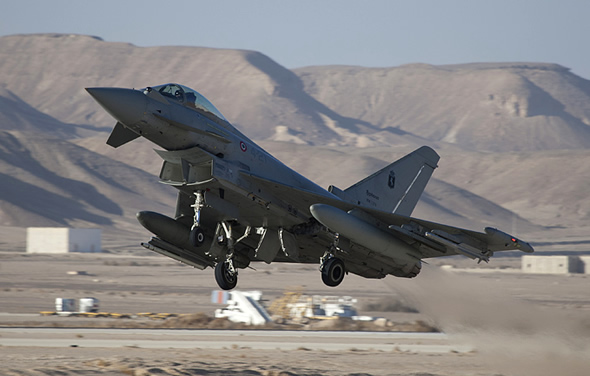
Italian Air Force Typhoon takes off from IAF Base Ovda. The aircraft carries two IRIS-T air/air missiles. Photo: Nehemia Gershuni, www.ngphoto.biz
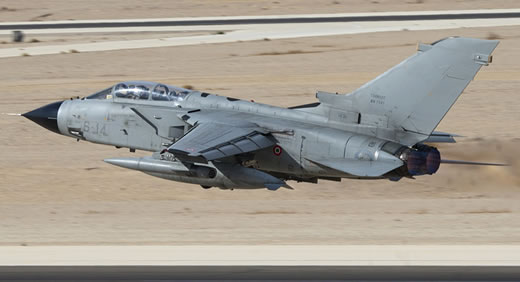
Italian Air Force Tornado strike fighter takes off from Ovda air force base in the Southern Negev. Photo: Nehemia Gershoni, www.ngphoto.biz
Panavia, the European consortium responsible for the multinational Tornado program has been awarded an upgrading contract under the long-term support and capability upgrades of the Tornado Strike Fighter platform. The objective of current contract is the integration of the two new Weapons – the Advanced – Anti Radiation-Guided- Missile (AARGM) and the Small-Diameter-Bombs (SDBs). AARGM, also designated AGM-88E is an enhancement of the current High Speed Anti-Radiation Missile (HARM).
new missile has new RF seekers that can ‘memorize’ a target signature and location, therefore pursuing attacks even when the target ceases to emit (switched off). It also has the ability to employ a selective aimpoint, by attacking the target’s most vulnerable parts (i.e. the processor rather than the emitting elements – such as radar antennae). The weapon’s geolocation capability enables the AARGM to memorize Impact Avoidance Zones (IAZ), eliminating much of the risks of fratricides and collateral damage typically restricting the use of standoff weapons in close proximity to friendly forces or in situations where the risk of collateral damage is too high for the standard AGM-88. Such weapons would be employed with the ECR’s Suppression of Enemy Air Defense (SEAD) mission.
The Small Diameter Bomb has been in service with the US Air Force and Navy since 2006. The weapon packs a guidance kit and a wing set enabling the bomb to glide over significant distances (60 miles), and penetrate hard targets, thus providing strike aircraft essential standoff attack capability while maintaining high precision and low collateral damage. SDB is currently offered with basic GPS/INS (GBU-39) or with Laser/GPS/INS (GBU-54) for enhanced precision and the capability to engage mobile targets.
The Italian Air Force currently operates 62 Tornado Strike Fighters (IDS) and 16 Electronic Combat & Reconnaissance variants (ECR). The two weapons will be integrated on aircraft of two latest variants: Tornado RET 7 and RET 8 Mid-Life Upgrade (MLU) configurations. Italy expects to have 58 aircraft upgraded to the MLU RET8 standard by 2015, with the delivery of the last 25 aircraft currently undergoing modernization. These aircraft are designed to remain in service beyond 2025. According to Panavia, RET 8 configuration added improved display systems, digital video and data recording, multi-mode receiver, digital maps, MIDS (Link 16) inserts, and support for RAFAEL’s RecceLite reconnaissance pods. The implementation of the current weapons upgrade will include integration and flight test activity; the integration of both Weapons in a common Software load will be included with one unique Panavia Service Release Recommendation (PSRR) to be issued by December 2015.
While the upgrade is focused on the Italian Air Force Tornado fleet, all the Panavia Partner Companies will be involved, mainly Alenia Aermacchi and CASSIDIAN as well as the weapons suppliers Boeing (SDB) and ATK (AARGM).
The U.S. administration made the first steps in implementing export control reforms, by rebuilding the export control lists, moving less-sensitive items controlled by the State Department under the Department of Commerce, more efficiently equipped to maintain such activities. The U.S. administration notified Congress of the first in a series of changes to the U.S. Munitions List (USML) in Category 8, which covers aircraft, and Category 19, which covers engines. “The items being moved under the jurisdiction of the Commerce Department are not being decontrolled,” a senior administration official stressed “They are simply moving to a different set of export control rules.”
Traditionally, the Commerce Control List, (CCL) controls dual-use items, such as commercial products with possible military applications, and some less-sensitive military items. The USML controlled by the State Department, lists items, services and related technology that the federal government designates defense- and space-related.
During a March 8 conference call with reporters, senior administration officials speaking on background described progress made in implementing reforms for a complex export control system that’s spread across seven main departments and whose items and technologies are accounted for on two control lists that have different structures and purposes.
The first step in moving forward with the initiative was an executive order that Obama signed March 8 to update delegated presidential authorities over the administration of some export and import controls that have not been comprehensively updated in 36 years. This action makes changes needed to implement the new export control system, a senior administration official said, replacing one issued in 1977 by President Gerald R. Ford.
Changes include:
Consolidating all brokering responsibilities with the State Department. A broker is a person who acts as an agent for others in negotiating contracts, purchases, sales or transfers of defense articles or services.
Establishing a notification process at the Commerce Department to notify Congress about approved export licenses for a subset of items that are moved or that may move from the State USML to the Commerce CCL.
Making other administrative updates, mainly delegating to the attorney general rather than the Treasury secretary functions previously assigned by Executive Order 11958, reflecting the 2003 move of the Bureau of Alcohol, Tobacco, Firearms and Explosives to the Justice Department from the Treasury Department.
Eliminating possible doubling licensing requirements because of duplications on the State Department’s USML and the Commerce Department’s CCL.
“Today, State licenses entire systems, including all the spare parts and components that go with it,” one of the administration officials said. “But if we move those spare parts and components to the Commerce list, [a U.S. ally or a company] might end up having to get a license both from State and Commerce.” This update to the executive order, he added, “provides a limited delegation so that between the State and Commerce agreement, State will still be able to license an entire package that may include some items that are on the Commerce list.”
The second step accomplished last week in the export control reform initiative involves the cornerstone of Obama’s reform effort — rebuilding the two main export control lists. These are the State Department’s USML and Commerce’s CCL.
Specifically, on March 7, the administration notified Congress of the first in a series of changes to the USML in Category 8, which covers aircraft, and Category 19, which covers engines.
“This is the first pair in a series of final rules that put in place the rebuilt export control list that represents a significant step in our reform efforts,” another senior administration official said. “These notifications and a subsequent publication of final rules will occur on a rolling basis and will represent the final phase of our efforts to deploy the rebuilt USML.”
This is the beginning of putting in place the nation’s new export control system that basically implements what then-Defense Secretary Robert M. Gates outlined when he announced the results of the president’s national security review in April 2010, the official added.
The problem is that by law, everything on the USML is controlled equally, whether it’s an F-18 jet fighter, or a bolt that has been modified for use on that F-18, according to a White House fact sheet. And each item — fighter or bolt — requires an individual license.
This system creates obstacles and delays in providing equipment to U.S. allies and partners for interoperability with U.S. forces and harms the health and competitiveness of the U.S. industrial base, the fact sheet explained.
“We all want to stress that the items being moved from the jurisdiction of the State Department to the jurisdiction of the Commerce Department are not being decontrolled,” a senior administration official said in the conference call. “They are simply moving to a different set of export control rules.”
Rebuilding the export control lists and moving less-sensitive items from the State to the Commerce list will provide the flexibility to more efficiently equip and maintain our partner’s capabilities, the fact sheet said, while allowing officials to focus on preventing potential adversaries from acquiring military items that they could use against the United States.
Relevant committees include the House Foreign Affairs Committee, the Senate Foreign Relations Committee and the Senate Banking Committee, whose members have 30 days to pass a committee rejection or allow the proposal to go through.
“The tremendous amount of time and effort we’ve put into consulting with Congress makes us very optimistic that this formal notification period will be a very collegial and straightforward process,” one of the senior administration officials said. “There is strong and clear bipartisan support for export control reform, and there is certainly eagerness in industry.”
The entire purpose of arms control reform is to better protect national security, another administration official noted. “But in today’s world a lot of technologies that were protected during the Cold War era are now common in commercial use,” he added. “Better protecting national security means focusing on the most sensitive technologies while allowing the types of technologies that are easily obtained to move to the Commerce Department list, where there are more nuanced protections.”
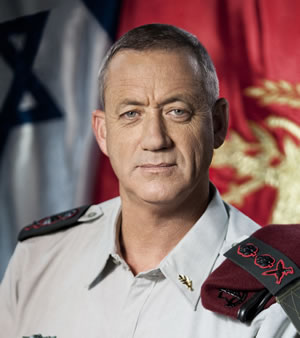
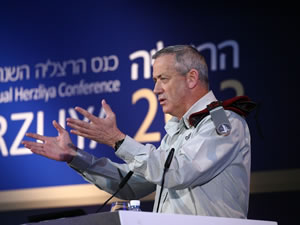
Lt. General Benny Gantz, IDF Chief of Staff. Photo: Herzlia Conference
Lt. Gen. Benny Gantz, Israel Defense Forces (IDF) Chief of the General Staff, provided a briefing on the “Challenges to Israel’s National Security.” earlier this evening at the 13th annual Herzliya Conference. “In the past 2 years we’ve learned that if there’s one constant, It’s that there are no constants” said Gantz. “We have a multi-arena challenge with different features … The influence appears different in operational form. Gantz said, “The chances of war against us in the visible future are low but there is a high probability of deterioration … Not a week goes by, not to say hardly a day, when I don’t have to deal with an issue that you didn’t even hear about, that could have resulted in a strategic threat. He said that Syria is one type of threat, Lebanon another, Sinai a third and Gaza “has always been there and always will.”
Looking ahead to potential future conflict, Gantz said, “We will need to go into “the tunnels of Gaza, into the fox holes and the villages … We can’t only play video games … it requires physical presence on the ground and that’s what we need to prepare our forces for … We need to make sure we are flexible enough and are able to adapt ourselves to the new situation.” While the IDF’s latest five-year plan waits approval by the new Israeli government, Gantz said proposed investment would focus on improved capabilities for precision attack and ground maneuvering warfare. Gantz cited seven priorities for the upcoming multiyear plan:
Intelligence
Precision Strike (Air, land and sea based)
Air and missile defense
Ground manoeuvring capabilities, (focused on rapid response and urban operations)
Protection of Israel’s Exclusive Economic Zone (EEZ)
Improved C4 and logistics.
Cyber
Touching on the topic of the size of the army, Gantz said that the army would be streamlined and made leaner and stronger. “It’s not a question of the size of the army but the magnitude of the challenge. We need to adapt the organization to the challenges that faces it. We need a “Faster army, a quicker army, a more lethal force, better equipped, better trained and more suitable in size.” The most important principle, he said, was not to have a ‘hollow army’.
The IDF is expected to reduce its manpower,
discharging career soldiers and officers by “tens of thousands.”
Forced by budget cuts, the IDF is expected to reduce its manpower, discharging career soldiers and officers by “thousands.” over the next five years; “We have to ensure that the right people are in the right places at the right times,” he stressed, referring to the recruitment of ultra-orthodox jews, being a highly debated and political charged issue. Gantz said this process should be done through a slow and gradual process which has sofar proved positive to the army.
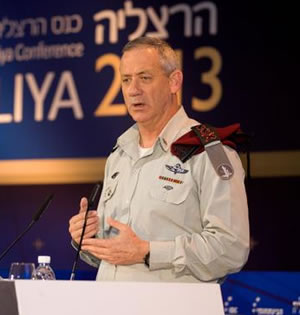
Lt. General Benny Gantz, IDF Chief of Staff. Photo: Herzlia Conference
Referring to the threats Israel is facing, Gantz noted that in the past Israel had seen Lebanon and Syria as “one arena, two fronts,” and followed the idea of “why fight with each of the terrorists when you can impact them” via Assad. But today Syria is “liquid, unstable, dangerous.” Lebanon, on the other hand, is more stabilized than before, “There is the same instability there that was there all along.” He added “The state responsibility that Hezbollah has taken upon itself is not something I’d dismiss lightly…”“The Syrian army is attacking itself in huge numbers … at the same time we see the terror organizations which are gaining footholds in the territory.” He noted that these organizations are currently fighting against Assad but “Guess what, we are the next inline … We are liable to be the next challenge of those organizations … Amazing strategic capabilities in the hands of Syria can end up in the hands of the terror organizations” and if they have these capabilities, there is a “a very big chance they can use them against us in the future.”
Security is also deteriorating along the Egyptian border. After 40 years of quiet, Gantz said that Egypt was a “situation in the making … Sinai is fertile ground for activities against us … Fertile ground for terrorists.” He said that a future danger of a military threat can gain momentum at any moment. “We didn’t fall asleep on the job, we have prepared the infrastructures.” Gantz stressed, “Egypt has an interest to maintain security in the Sinai … Not for us, for them … We will do whatever we can to maintain quiet in the area but we must understand that area in a state of flux.”
As for Gaza, following an intolerable prior situations, four months after Operation Pillar of Defense it was clear that “the goal of that operation was completely achieved” as could be seen from the absolute quiet in the south, save for one incident which was under investigation. “We have to distinguish very, very clearly between the inflammatory declarations and what it’s actually doing,” said Gantz. “We are prepared just as we were to act should it become necessary.” Gantz concluded.
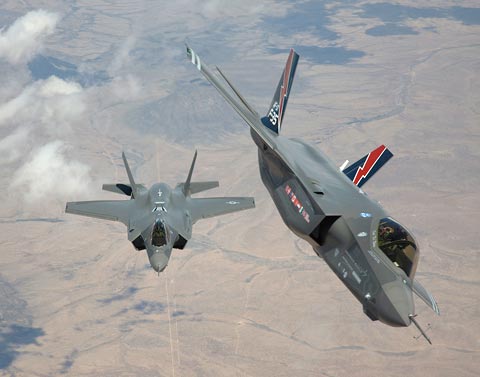
F-35 AF-1 & AF-2 Arrival at Edwards Air Force Base. Photo: Lockheed Martin
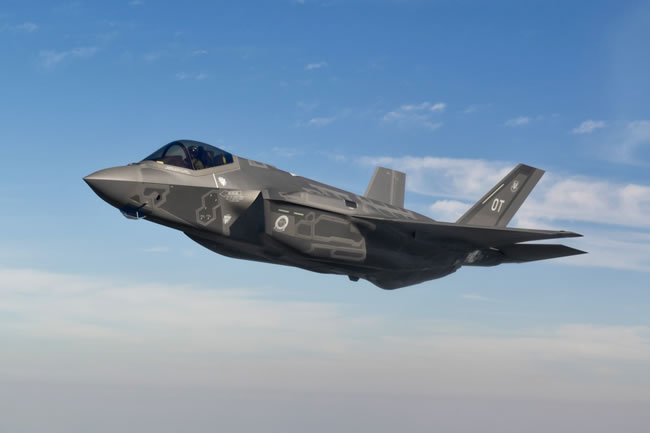
An F-35A aircraft slated for Operational Test at Nellis AFB, Nev., completes a check flight from the Fort Worth, Texas, F-35 factory Oct. 15, 2012.Current Outlook Is Improved, but Long-Term Affordability Is a Major Concern
A report prepared by the Government Accountability Office (GAO) in response to the National Defense Authorization Act of 2010 paints an overall positive picture for the F-35 program, despite various reports that took a different view regarding specific deficiencies in testing, training and operability. (The report was publicly released April 17, 2013)
For a program that suffers continuous bad publicity the GAO report is a relief. According to this report overview the F-35 program achieved 7 of 10 key management objectives for 2012 and made substantial progress on one other. Two objectives on aircraft deliveries and a corrective management plan were not met.
The report indicated that the program conducted more developmental flight tests than planned for 2012 and made considerable progress in addressing critical technical risks, such as the helmet-mounted display. With about one-third of development flight testing completed, much testing remains to demonstrate and verify F-35 performance.
Software management practices are improved, but with significant challenges ahead as software integration and testing continue to lag behind plans. Another report, released by the Pentagon test and evaluation comptroller provided a more pessimistic view of the training and operational limitations of the new fighter.
Manufacturing and supply processes are also improving — indicators such as factory throughput, labor efficiency, and quality measures are all positive. While initial F-35 production overran target costs and delivered aircraft late, the latest data shows labor hours decreasing and deliveries accelerating.
The report highlights the fact that the program is working through the continuing effects from its concurrent acquisition strategy that overlapped testing and manufacturing activities. For example, the program is continuing to incur substantial costs for rework to fix deficiencies discovered in testing, but the amount of rework needed on each aircraft is dropping. Nevertheless, retrofits of Low-Rate Initial Production (LRIP) batch F-35 fighters could cost over $1.7 billion over the life of the program. Of that amount, $900 million would be added to the first four batches of jets already built or in production at Lockheed Martin’s. That amount is almost triple the estimate ($373) GAO provided for the additional costs incurred over the same four batches, published in the 2010 report. About $827 million will be incurred over the next six batches.
The reduced cost reflects Lockheed Martin’s cost sharing scheme, under the fifth LRIP contract the company agreed to pay for 55 percent of any cost overruns up to a certain ceiling, and all cost overruns beyond that. Until then, retrofit costs are shared equally by the Pentagon and the contractor.
Going forward, ensuring affordability—the ability to acquire aircraft in quantity and to sustain them over the life cycle—is of paramount concern. With more austere budgets looming this will require a long-term sustained funding commitment. Funding requirements for the F-35 acquisition would average $12.6 billion annually through 2037, reflecting a total U.S. investment of close to $400 billion to develop and procure 2,457 aircraft through 2037. Additional 10.5 billion will be spent annually on sustainment.
In fact, acquisition spending are expected to top that average over the 10 years beginning 2018. That increase results from the surge in acquisition baseline that incorporates the Department of Defense’s (DOD) positive restructuring actions taken since 2010, that provided more time and funding for development and deferred procurement of more than 400 aircraft to future years.
With fifty-two aircraft delivered through 2012, and the restructuring actions the F-35 program is now placed on firmer footing, although aircraft will cost more and deliveries to warfighters will take longer. The program continues to incur financial risk from its plan to procure 289 aircraft for $57.8 billion before completing development flight testing. Meanwhile, the services are spending about $8 billion to extend the life of existing aircraft and to buy new ones to mitigate shortfalls due to F-35 delays.
Integrated into a light vehicle – to be seen here a "Wolf"-class car – Cassidian's multifunctional jammer can explore the electromagnetic spectrum and at the same time counter attacks with radio-controlled roadside bombs. Photo: Cassidian
Cassidian, the defence and security division of EADS, has developed a new-generation multifunctional jamming system that significantly enhances the protection of vehicles against radio-controlled improvised explosive devices (RCIEDs). Defense Update reports.
The new mobile jammer combines the smart jamming functionality with signals intelligence (also known as Electronic Support Measures – ESM), allowing detailed understanding of the threat, thus significantly improving mission planning and force protection.
According to the company, the multifunctional jammer analyses the signal spectrum around a vehicle and is thus in a position to jam the radio signals intended to trigger a roadside bomb in a targeted manner rather than by barraging noise over a wide spectrum, blocking friendly communications or operating over specific bands, leaving vulnerable gaps that could be exploited by insurgents.
Cassidian’s multifunctional jammer features the new, ultra-fast Smart Responsive Jamming Technology to substantially enhance the level of protection. This system detects and classifies radio signals intended to ignite roadside bombs. It then transmits jamming signals in real-time, which are tailored exactly to the hostile frequency band. Thanks to the new digital receiver and signal processing technologies it is thus possible to achieve reaction times of well below a millisecond.
The new jammer also employs the SMARTscout extension, providing signal intelligence battlespace picture – a task that previously could only be accomplished by relatively complex systems which are difficult to deploy and consume a lot of energy. SMARTscout allows the user to deploy numerous sensors in theater, at relatively low cost, and to obtain an ‘electronic order of battle’ of radio communication threat situation in less time. This new capability assists the user in gaining force protection and the intelligence essential for planning of further operations.
“Lessons learnt in recent conflicts prove that the enemy often changes the type of radio transmission used for triggering signals in asymmetric scenarios,” explains Elmar Compans, head of the Sensors & Electronic Warfare unit at Cassidian. “Continuous analysis of threats and the resulting adaptation of countermeasures are therefore indispensable. Using our SMARTscout system, both of these tasks can be done faster and with reduced effort.”
Integrated into a light vehicle – to be seen here a “Wolf”-class car – Cassidian’s multifunctional jammer can explore the electromagnetic spectrum and at the same time counter attacks with radio-controlled roadside bombs. Photo: Cassidian
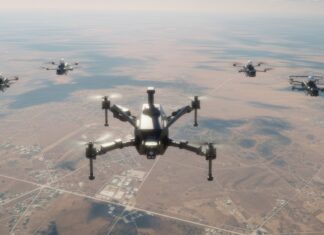
Lockheed Martin Skunk Works® and XTEND have achieved a major milestone in JADC2 by integrating the XOS operating system with the MDCX™ autonomy platform. This technical breakthrough enables a single operator to simultaneously command multiple drone classes, eliminating the friction of mission handoffs. From "marsupial" drone deployments to operating in GPS-denied environments, explore how this collaboration is abbreviating the data-to-decision timeline and redefining autonomous mission execution.
As traditional defense primes face mounting competition from agile “neoprimes” such as Anduril, Palantir and Helsing, the balance of innovation is shifting toward software-defined warfare and scalable, dual-use technologies, while global industry consolidation—marked by Boeing’s integration of Spirit AeroSystems and other strategic mergers—signals an intensified race to secure control over the defense technology value chain. Our Defense-Tech weekly report highlights these trends.
In early October 2025, a coordinated wave of unmanned aerial system (UAS) incursions—widely attributed to Russia—targeted critical infrastructure across at least ten European nations. The unprecedented campaign exposed the fragility of Europe’s air defenses...
Executive Summary
The past week (September 18-25, 2025) represents an inflection point where strategic defense concepts have transitioned from doctrine to tangible reality. An analysis of global events reveals four primary, interconnected trends shaping an...
At the 2025 Air, Space & Cyber Conference, U.S. Air Force and Space Force leaders unveiled major updates on next-generation fighters, bombers, unmanned systems, and space initiatives, highlighting both rapid innovation and critical readiness challenges as the services race to outpace global competitors. A short version is available here, with a more detailed version for subscribers.
The Taipei Aerospace & Defense Technology Exhibition (TADTE) 2025 crystallized around four dominant strategic themes that collectively illustrate Taiwan's comprehensive approach to defense modernization amid escalating regional tensions. Based on a detailed report by Pleronix (available upon request). Includes a Podcast discussion on TADTE 2025's highlighting Taiwan's four strategic themes beyond the post's coverage.
Israel’s Iron Beam 450 high-power laser system has completed final testing, marking a major leap in air defense. Developed by Rafael, it offers precise, cost-effective interception of rockets, UAVs, and mortars, and is set for IDF deployment by 2025.