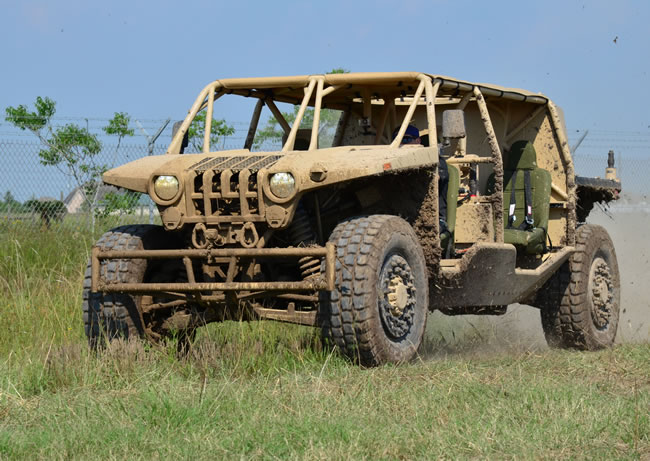
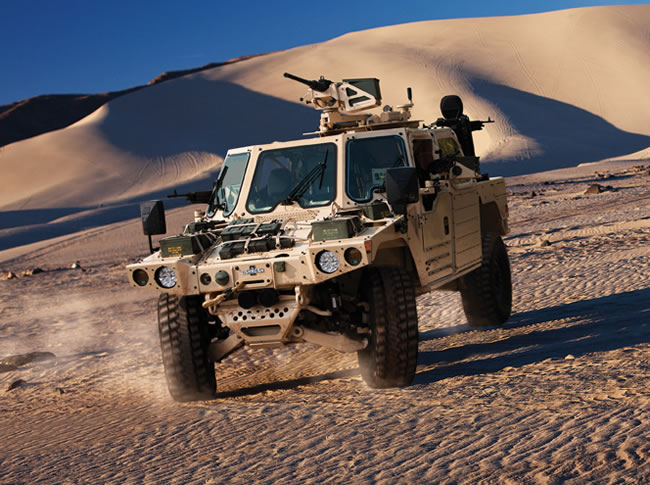
MAV-L was designed with a ‘clean sheet approach’ to meet special operations requirements. Photo: Northrop grumman
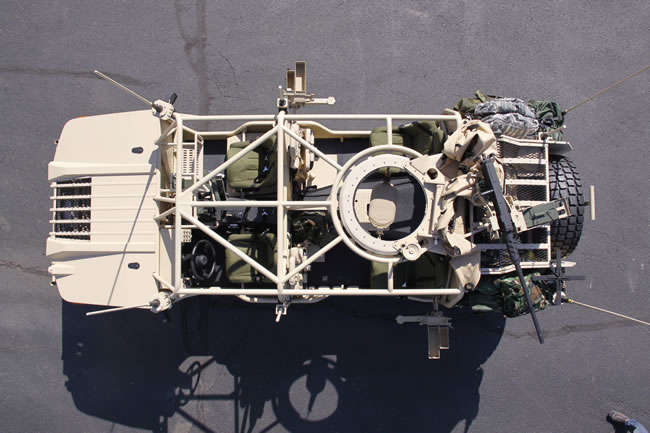
Northrop Grumman, BAE Systems and Pratt & Miller Engineering team celebrated the debut of the MAV-L at AUSA 2012, the team’s entry into the GMV 1.1 pursuit. MAV-L is a modular vehicle, built to transports up to seven operators and easily reconfigured to fit specific missions. Defense-Update reports from Washington DC.
Despite its spacious size it can be air transportable internally in MH/CH-47 Chinook helicopters, thanks to height compression technique reducing the vehicle’s height to fit the Chinook’s cabin. Motor racing specialist company Pratt & Miller Engineering is signed on the unique design, brought from idea to fully functional prototype in few months. A respected industry leader in the defense, automotive, motorsports and powersports industries, Pratt & Miller is renown for their innovative, high-performance engineering and manufacturing solutions.
A top view of the new MAV-L custom designed special operations vehicle. Photo: Northrop Grumman
“Our clean-sheet approach and purpose-built solution applies innovation from across our industry team. We deliver an affordable solution that meets the warfighter’s mission requirements and a great new capability,” said Tom Vice, corporate vice president and president, Northrop Grumman Technical Services. “We’re fully committed to providing the Special Operations Command with the most modular and agile vehicle capable of top performance in any operational environment.” While MAV-L was designed to meet SOCOM GMV 1.1 requirements, the team considered it has applications beyond SOCOM. For example, such vehicles could be suitable for US Army and Marine Corps recon teams, forced entry teams operated by the Air Force, or for international customers. designing the vehicle for maximum adaptation and ample growth.
BAE Systems provides the experience of military vehicle manufacturing, and sustainment for the program. If MAV-L is selected, it will be produced at the company’s Sealy, Texas, facility where MRAPs and tactical trucks where produced in recent years.
“The capabilities of our partners combined with Northrop Grumman’s decades of experience integrating C4ISR systems into land forces sustainment and military platforms, ensure that our customers receive a vehicle as capable and flexible as their mission requirements,” said Frank Sturek, deputy director of land forces sustainment and MAV-L program manager, Northrop Grumman.
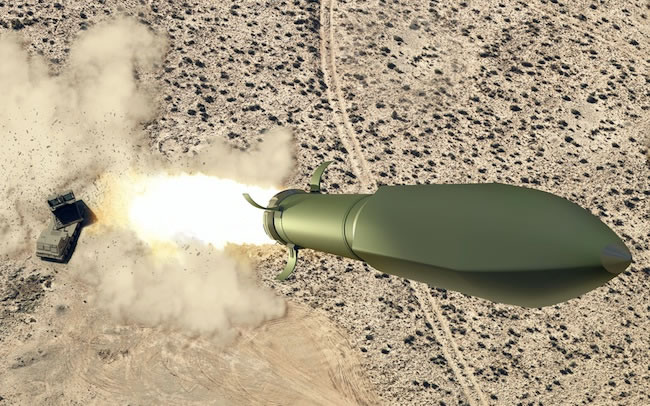
The conceptual Ground Launched Small Diameter Bomb (GL-SDB) will utilize the MLRS rocket to boost the SDB to a trajectory from where it will be able to continue gliding to its target like it was dropped from a manned aircraft. Photo: Boeing
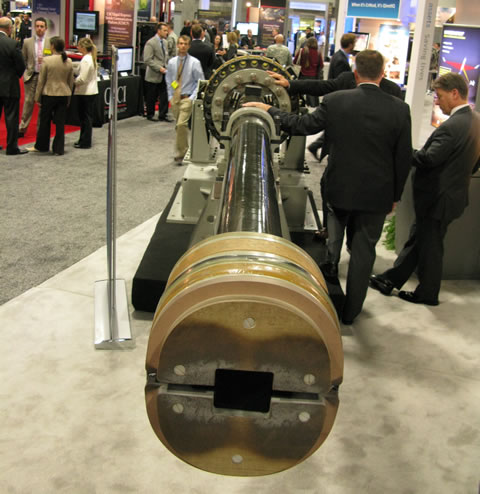
The Blitzer Electromagnetic Railgun shown at AUSA 2012 was developed by General Atomics for testing by the US Navy. Photo: Tamir Eshel, Defense Update
In recent years the role of armaments and weapons in military exhibitions is diminishing, reflecting the diminishing role of kinetic effects and the complex public perception as to their role in modern asymmetric warfare. Hence, the armaments and munitions presented at AUSA and the Modern Day Marine Expo emphasized focused precision effect and low collateral damage as outstanding qualities. This reflected the concern of manufacturers and users alike to those issues.
Examples included sniper rifles with precision fire control enabling the shooter to achieve higher precision at long range; weapons offering ‘man in the loop’ control, and ‘clean’ artillery projectiles or aerial munitions providing effective area saturation effect without the hazardous duds (unexploded ordnance – UOX), complying with the limitations derived from the Convention on Cluster Munitions (CCM).
IMI 454 Super HE artillery round. Photo: Tamir Eshel, Defense Update
Two manufacturers are offering new versions of munitions designed to cover a wide area but leave no UXO after the attack. At AUSA 2012 IMI unveiled at AUSA 2012 a new M-454 Super-High Explosive (S-HE) round, a 155mm artillery projectile fitted with two fuses. According to IMI, the M454 is more efficient than standard HE rounds, requiring less ammunition to complete each mission, thus reducing logistics footprint. The new round is compatible with all NATO 39, 45 and 52 Caliber Guns. Textron Systems is offering a new area attack weapon system that is highly effective against soft targets including light vehicles, enemy combatants and air defense sites. Textron Systems is also using the AP-BLU as a unitary warhead for the Guided Clean Area Weapon (CLAW), designed to engage soft targets in open area, attacked form an unmanned aerial vehicle.
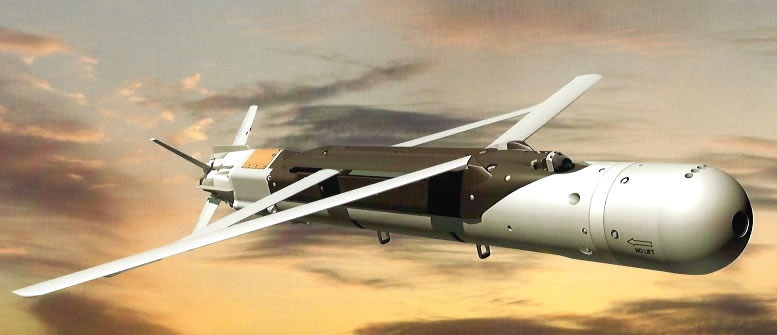
Armies using the MLRS or HIMARS systems could find the new Ground-Launched Small Diameter Bomb (GL-SDB) an interesting prospect to modernize combat capabilities in compliance with the CCM. Boeing, the producer of SDB is planning to strap its bombs on existing M29 rockets emptied from their DPICM bomblets. Using the rocket motor to accelerate the bomb into a trajectory bringing it to an altitude and speed from where it can deploy its wings and glide to hit the designated as it would do when launched from an aircraft.
Boeing is developing a laser-guided version of the Small Diameter Bomb for use with SOCOM AC-130J gunships. Photo: Boeing
To enhance precision, while maintaining low cost, Boeing is developing the ‘Laser SDB’, utilizing the Laser JDAM guidance kits. ‘With the laser SDB pilots can now prosecute moving, relocateable and maritime targets travelling at highway speeds’ Boeing officials said. The first application of Laser SDB will be with the Air Force Special Operations Command (AFSOC) as the US Air Force plans to equip the new AC-130W ‘Stinger II’ gunships with this capability.
Boeing is also promoting new ideas about future weapons supporting expeditionary naval and ground forces. Among these conceptual designs is the Joint Air-Breathing Multi-role Missile (JABMM), extending the strike range of ground-launched weapons well beyond the range of rocket-propelled weapons. Such weapons could be deployed on surface combatants such as the Littoral Combat Ship (LCS) or carried on tactical vehicles supporting expeditionary ground forces, airborne or Marine Corps.
Joint Air Breathing Multi-role Missile is proposed by Boeing as a future stand-off attack weapon supporting expeditionary forces. Concept drawing: Boeing
Supporting future amphibious assault, the Marine Corps will have to rely on precision artillery fire delivered from the sea, by the Navy warships. However, today’s destroyers are armed with 5“ (127mm) guns that are not designed to provide precision fires. Such capability will be fielded with the Zumwalt class (DDG-1000) guided missile destroyers currently under construction, that will be equipped with 155mm Advanced Gun Systems (AGS) firing specially developed Long Range Land Attack Projectiles (LRLAP). Both are developed by BAE Systems. With an effective range of 60 nautical miles, these guns will be capable of supporting Marine Corps units on the ground, from positions over the horizon. The 155mm LRLAP is a rocket assisted precision attack projectile using GPS/INS guidance techniques. The AGS is designed to fire up to 10 rounds per minute and has a storage capacity of 600 rounds.
While the AGS and LRLAP offer great future capabilities, the Navy plans to have only three such vessels. Hence the need to upgrade the current Mk45 Mod 4 5” gun system operational on DDG 51 guided missile destroyers and CG-47 guided missile cruisers. BAE Systems is developing such capability under the 5” Standard Guided Projectile (SGP) program. A sabot version of the 5” SGP projectile will also be compatible with the 155mm howitzers, enabling Marine and Army Artillery Corps to engage targets with high precision.
A futuristic weapon that has already passed the concept definition is the electromagnetic rail gun. A prototype developed by General Atomics Electromagnetics system (GA-EMS) group for the Office of naval Research has successfully performed initial firings at the Naval Surface Warfare Center at Dahlgren, VA. And at the Army Dugway Proving Ground in Utah. The gun is designed to deliver significantly higher muzzle energies that ever demonstrated in a tactical relevant configuration. The full scale ‘Blitzer’ EM Rail Gun System is currently undergoing a series of full energy tests and evaluation by the navy.
DARPA OneShot TX
You don’t always need a big bang to win a fight. Sometime, all it takes is one bullet fired by a trained sniper, to deal with a serious situation. But snipers activities are often limited by weather conditions to medium or short range. In few years, snipers will be able to double their range and improve accuracy, therefore becoming even more useful in combat, as DARPA’s ‘One Shot’ system is fielded.
The conceptual Ground Launched Small Diameter Bomb (GL-SDB) will utilize the MLRS rocket to boost the SDB to a trajectory from where it will be able to continue gliding to its target like it was dropped from a manned aircraft. Photo: Boeing
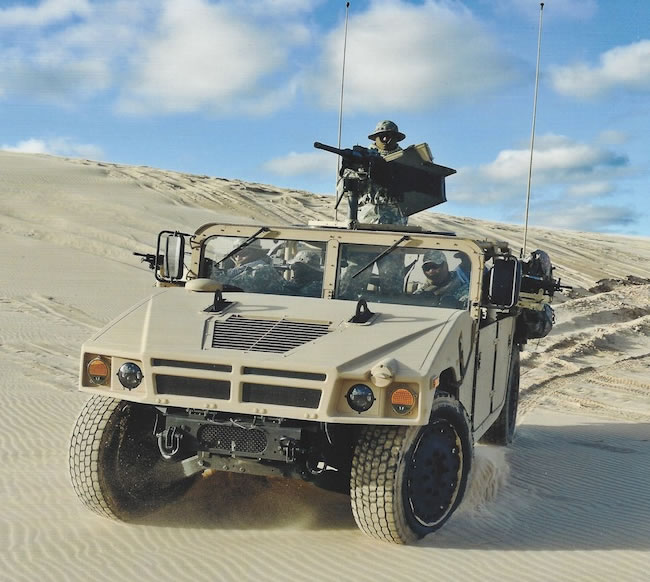
AM General is offering a beefed-up variant of the HMMWV, optimized for Special Operations. Photo: AM General
MAV-L special operations vehicle is one of five candidates to replace SOCOM’s HMMWV based Ground Mobility Vehicle (GMV). Photo: Northrop Grumman
As heavy combat vehicle programs are idling, modernization of the tactical vehicles is in progress, as the Army, Marine Corps and Special Operations Command plan to replace and reset their fleet of High Mobility Multipurpose Wheeled Vehicles (HMMWV). Two vehicles classes are currently underway – the Joint Light Tactical Vehicle (JLTV), equipping the Army and US Marine Corps, and the Ground Mobility Vehicle (GMV) 1.1 – replacing the HMMWVs operated by the Special Operations Command.
JLTV is currently underway, as the services await the delivery of 22 vehicles from three competitors. Following the scheduled testing the Army will select a single vendor to produce 55,000 vehicles or more, replacing HMMWVs currently in service. Since the Army has stressed cost limitations as its highest consideration, all three competitors are offering conventional, diesel powered vehicles, leaving more exotic hybrid electric drives for future upgrades. To reduce cost while meeting weight and size restrictions, manufacturers are employing advanced engineering and manufacturing techniques to minimize weight, while adhering to conventional materials over advanced, high performance composites (reducing material and production costs). For example, in the prototypes Lockheed Martin plans to deliver in about 10 months, the company is using thinner but stronger steel, rather than the lighter but expensive and hard to process aluminum alloys previously used, saving cost and also enabling easier repair in the field. The weight gain resulting from the use of heavier materials was balanced by optimizing design, engineering and manufacturing, therefore limiting the weight increase. The JLTV has already demonstrated helicopter sling-load carriage.
AM General is offering a beefed-up variant of the HMMWV, optimized for Special Operations. Photo: AM General
Even when the JLTV is fielded, HMMWVs will still be around, and require ongoing sustainment and support. AM General, the vehicle manufacturer and one of the three finalists for JLTV is also offering a new version of the HMMWV designed for special operations. The HMMWV based GMV, positioned by the company as the ‘next generation vehicle’, which takes the original GMV 1.0 (SOCOM HMMWV) to the next level of performance, mobility and transportability (it is designed for internal transportation in the CH/MH-47 Chinook). This HMMWV is powered by a GEP Optimizer 3200 diesel supporting 300 miles operating range. This version has a lower curb weight and higher gross vehicle weight (GVW), compared to the GMV 1.0. It has full independent suspension for all-terrain mobility, off-road and on road. The vehicle has six articulated weapon mounts and greater stowage capacity, and, along with sustainable highway speed of 80 mph and high dash speed, is well positioned to answer special ops requirements.
AM General is not the only company showing vehicles for the GMV 1.1 selection. In fact, all the competitors that are still among the qualified finalists for the programs were there – GDLS, with the Specter, Oshkosh defense unveiled the S-ATV at the Modern Day Marine event, Navistar Defense displayed their pick-up sized ‘Special Operations Tactical Vehicle (SOTV) at AUSA and the BAE-Northrop Grumman team that launched the new MAV-L, ccustom built prototype developed specifically for the GMV 1.1 program by racing specialist Pratt Miller.
Absent of other new starts in the Army tactical vehicle arena, SOCOM is attracting much interest among tactical vehicle manufacturers. Apart from the GMV 1.1 program that sees the acquisition of at least 1,300 vehicles over the next seven years, SOCOM also plans to buy hundreds of additional special purpose off-road vehicles for long range recon missions, personnel extraction and other special missions. Required to be even more maneuverable and agile than the GMV, these vehicles are attracting specialty vehicle providers such as HDT, Flyer defense (teamed with General Dynamics) and Polaris Defense – all were present at this year’s AUSA and MDM. Designed as a ‘low profile’ vehicle, Navistar’s SOTV could be applied for several SOCOM programs – including GMV 1.1.
The S-ATV from Oshkosh is one of several vehicles competing for SOCOM’s future GMV 1.1 program. Photo: Oshkosh defense
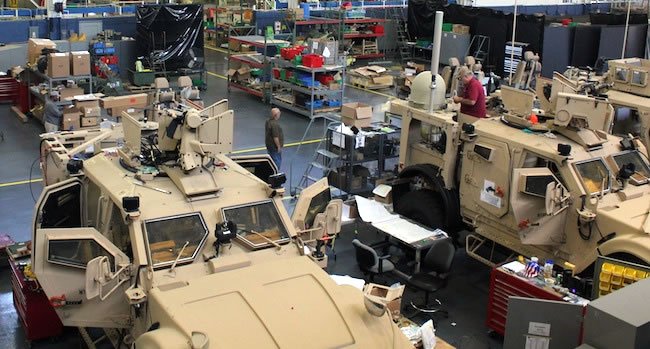
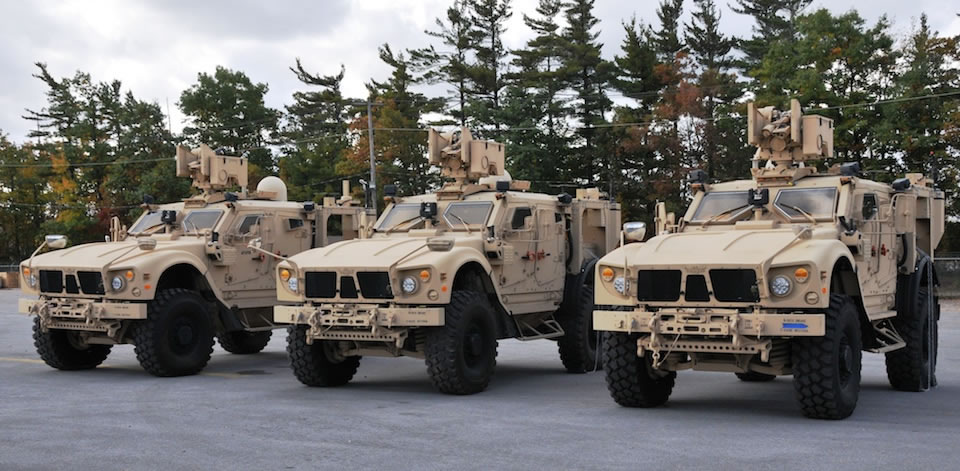
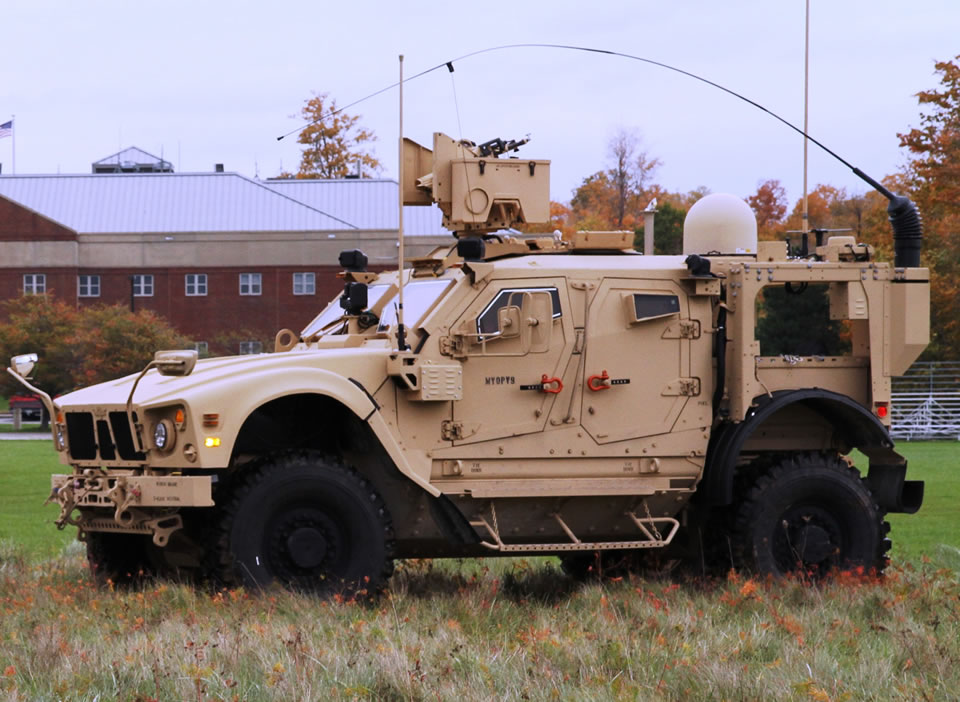
Two of the first five prototypes undergoing installation and testing at the Prototype Integration Facility at the U.S. Army Tank Automotive Research, Development and Engineering Center. These "super configuration" M-ATVsare equipped with Capability Set 13 (CS 13) assets. CS 13 is the first integrated group of networked technologies - radios, sensors and associated equipment and software - that will deliver an integrated voice and data capability throughout the entire Brigade Combat Team formation, from the brigade commander to the dismounted soldier. Photo: Katie Cain, US Army
Capability Set (CS) 13 equipment and software was integrated into five Mine Resistant Ambush Protected (MRAP) vehicle variants prior to delivering the vehicles and systems to the 3rd and 4th Brigade Combat Teams from the 10th Mountain Division to begin new equipment training prior to deploying with CS 13 assets in 2013. Photo: Claire Heininger, US Army
In October 2012 the US Army embarked on an ambitious upgrade of its tactical command and control system, introducing new radios, networking and satellite communications systems to modernize the command and control layers of its infantry brigade combat teams. The new equipment is fielded through a broad modernization process implemented throughout the brigade and its subordinate units, in ‘Capability Set’ delivered and installed with brigade combat teams, through all their command elements and subordinate units. The current upgrades implemented in the CS 13 phase addresses 11 critical areas outlined in ‘Operational Need Statements’ submitted by theater, giving commanders and soldiers vastly increased abilities to communicate and share information. These capability enhancements include mission command on the move, allowing leaders access to network capabilities currently available only at stationary Tactical Operation Centers (TOC). With CS 13 gear these services will be available to commanders while operating on the halt or on the move in combat vehicles; other applications are delivering the network to individual soldiers at the squad level.
The backbone of this system is internet-like network supporting forward command posts over broadband satellite links. Capability sets are distributed through the brigades’ combat formations, supporting elements from the brigade command post to the commander on the move and the dismounted soldier. In addition to deploying military equipment the Army is also evaluating and introducing commercial systems, particularly in the networking elements, to achieve cost reduction and performance improvement in its network capabilities.
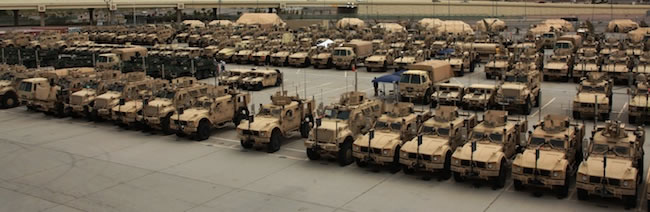
More than 360 vehicles preparing for Network Integration Evaluation NIE 13.1 parked at the Integration Motor Pool (IMP), located at Fort Bliss, Texas. Photo: Travis McNiel, US Army
Following the fielding of Capability Set 13, the Army will program to field up to six BCT sets of network equipment per year for the fiscal year s14-18 Program Objective Memorandum (POM) in order to better synchronize its platform and network modernization efforts. Beginning in October 2012, These Capability Sets will be fielded to eight Brigade Combat Teams (BCTs) over a period of two years. Six of these brigades are scheduled to deploy to Afghanistan until 2014. The seventh brigade to receive CS 13 is part of the 8th Army Korea forward deployed BCT. The light formations – Infantry, airborne, airmobile and mountain brigades will be equipped first and the last to roll in will be the armored brigades, currently scheduled to receive the equipment in 2019.
The main elements included in CS 13 are the General Dynamics C4 (GDC4S) Warfighter Information Network-Tactical (WIN-T) Increment 2, Joint Capabilities Release (JCR) Blue Force Tracker 2 from Northrop Grumman, Joint Battle Command-Platform (starting 3Q FY13), Company Command Post capability, Mission Command Common Operating Environment v1.0 and Harris tactical radios that include the AN/PRC-117G with Advanced Network Waveform 2 (AWN2), the GDC4 AN/PRC-154 Joint Tactical Radio System (JTRS) Rifleman Radio and Handheld Manpack Small Form Fit (HMS) radio and Harris AN/PRC-152A Soldier Radio Waveform (SRW) appliqué radios. For dismounted operations, yet to be awarded Nett Warrior dismounted C2 kits will provide situational awareness and networking down to the squad leader level, while individual Soldiers will be connected with the Rifleman Radio.
The Army’s System of Systems Integration (SoSI) Directorate is synchronizing this complex modernization process, implemented for the first time as a fully integrated Capability Set upgrade. To evaluate these upgrades the Army developed the phased ‘Agile Process’, ensuring technical maturity and integration synchronization while creating more responsive and quick procurement cycle. The 2nd Brigade 1st Armored Division based at Fort Bliss supports these evaluations and testing experimenting with new equipment through phased Network Integration Evaluation (NIE) exercises conducted twice a year at Ft Bliss and White Sands Missile Range. More testing is done at the by laboratory analysis at Aberdeen Proving Grounds.
The Agile Process evolved from these tests helps in identifying requirements and potential solutions, assessing those solutions in the laboratory and operational environment and preparation new solutions for fielding within the Army Force Generation cycle (ARFORGEN). Part of these solutions are eventually integrated into future ‘Capability Set’ network upgrades.
NIE exercises are currently entering the fourth semi-annual experimentation, at Ft. Bliss TX and White Sands Missile Range in NM., where NIE 13.1 took place in October – November 2012. The Army test and Evaluation Command (ATEC), Brigade Modernization Command, and the Systems of Systems Integration (SOSI) Directorate – all survivors of the Army’s grand Future Combat Systems program are managing these experiments.
Seven tests on local and distributed sites and 24 different systems, part of the upcoming ‘Capability Set 14 (CS 14) were evaluated in the exercise by 3,800 Soldiers of the 2nd Heavy Brigade Combat Team, 1st Armored Division (2/1 AD). Their role was assessing the integration of new equipment across the heavy brigade assets, supporting the convergence of Network Operations (NETOPS) and Operations-Intelligence (Ops-Intel) workflow, a process to be fully tested in the next evaluation cycle (NIE 13.2). Future evaluations will also include commercial off the shelf (COTS) smartphone-based communications and computing systems, paving the way of commercial systems into the Army’s Nett Warrior wearable equipment set. Other areas of interest are routers and computers, which the Army wants to evaluate as part of its alignment to use affordable COTS systems. The next cycle of NIE scheduled for 2013 will evaluate the entire battle command network, from the basic level, represented by Nett Warrior wearable systems to the higher echelons, linking the brigade, division and corps in a joint/coalition operations environment.
Newly delivered M-ATV fitted with all Capability Set (CS) 13 integrated equipment and software. 3rd and 4th Brigade Combat Teams from the 10th Mountain Division are scheduled to begin new equipment training prior to deploying with CS 13 assets in 2013.
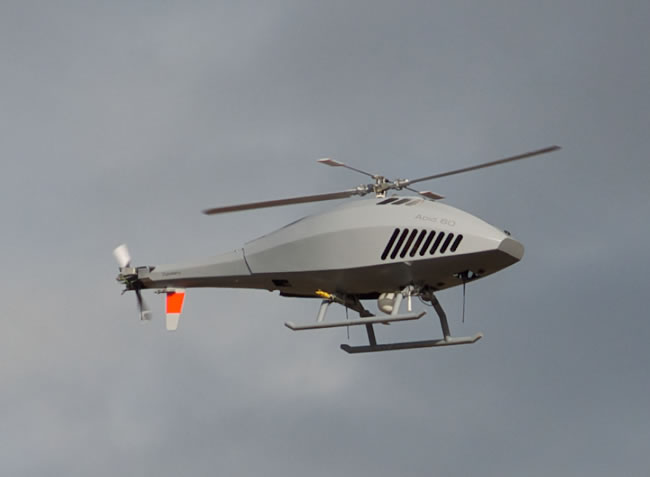
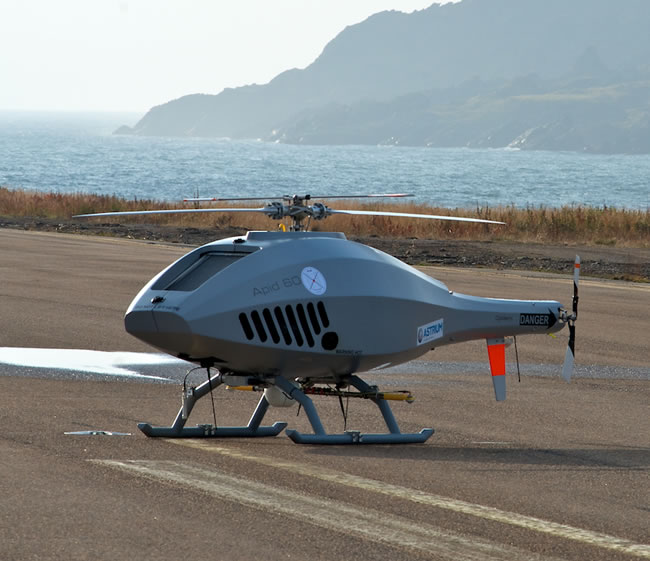
CybAero APID 60 'Tier II' unmanned Vertical Take off and Landing Unmanned Aerial System (VTUAV). Aerovironment now plans to market this system in the US, positioning it to fulfil new requirements for responsive ISR in support of land and naval forces. Photo: CybAero
CybAero APID 60 unmanned VTUAV. Photo: CybAero
AeroVironment, Inc. announced it has entered into a strategic relationship with Sweden-based CybAero AB to develop and distribute a Tier II vertical takeoff and landing (VTOL) unmanned aircraft system in response to unmet requirements from multiple customers. Defense-Update reports. The relationship gives AeroVironment exclusive rights to provide CybAero AB systems to United States customers and to government customers in NATO and other countries. AeroVironment has agreed to purchase up to $3 million in convertible notes from CybAero to facilitate the company’s growth.
CybAero APID 60 ‘Tier II’ unmanned Vertical Take off and Landing Unmanned Aerial System (VTUAV). Aerovironment now plans to market this system in the US, positioning it to fulfil new requirements for responsive ISR in support of land and naval forces. Photo: CybAero
“We are working with CybAero to integrate their product into our system solution and will invest to add critical capabilities required to bring the most competitive offering to market,” said Roy Minson, AeroVironment senior vice president and Unmanned Aircraft Systems general manager. “AeroVironment and CybAero have been working together very effectively to incorporate capabilities required to meet the requirements of United States government and other customers.” he added.
United States military customers typically segment the numerous types of unmanned aircraft systems they employ by size, weight, endurance and range into different tiers. Man-portable, hand-launched systems such as AeroVironment’s RQ-11B Raven, RQ-20A Puma AE and Wasp AE that weight less than 20 pounds comprise the Tier I segment. Tier II UAS include heavier, larger and longer endurance systems with longer range, such as CybAero’s VTOL offering. The Marine Corps has selected the RQ-21A Integrator for this role. Tiers III and IV include air vehicles of increasing size, such as the MQ-7B Shadow and Firescout, capable of even longer endurance and range and requiring larger support teams and infrastructure requirements.
“CybAero is a pioneer and leader in the Tier II VTOL market. Our joint team has demonstrated this reliable, cost-effective Tier II UAS solution that will build on AeroVironment’s family of small UAS, expanding our customer offering,” Minson continued, “With its significantly greater endurance and payload capacity, small footprint and ease of use, this new system will join our family of UAS and deliver a robust vertical takeoff and landing capability to current and new customers seeking that Tier II solution.” Leif Erlandsson, CybAero’s chief executive officer added, “We believe that AeroVironment possesses the experience, relationships and systems integration skills to bring all the benefits of our VTOL system to customers in the United States and beyond.”
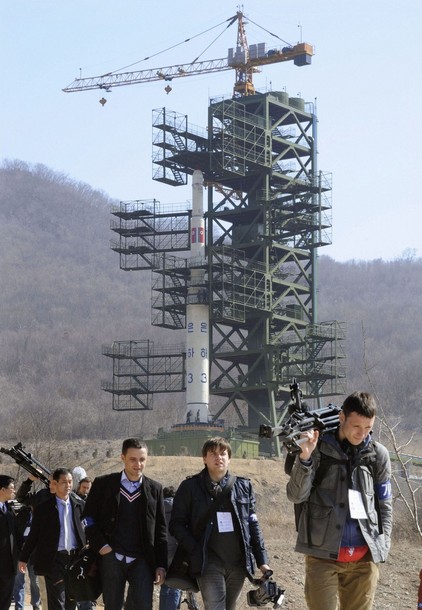
Rumors have been swirling throughout international news media outlets in recent days indicating that North Korea would attempt another satellite launch in the near future. On 1 December Pyongyang confirmed that the rumors are true.
The Korean Central News Agency (KCNA), the North’s official state-run news service, announced that the reclusive nation would make another launch attempt to place a satellite in Earth orbit atop a three-stage rocket sometime between 10 and 22 December. The North’s announcement stated that the rocket would follow a “safe flight path” to the south along a route between the Korean Peninsula and the Chinese mainland.
Pyongyang’s announcement did not come as a complete surprise; satellite images disclosed the movement of suspected rocket components from Pyongyang to the North’s Sohae launch site on the northwest coast in November fueling a flurry of media speculation that another rocket launch was in the offing.
Should this launch attempt become a reality, it would represent Pyongyang’s fourth attempt to place a satellite into orbit. This latest announcement comes a mere eight months after a highly-publicized failure in April that heightened tensions throughout the Pacific region.
The announcement included quotes from the Korean Committee for Space Technology claiming that the North’s scientists and technicians had identified and corrected the shortcomings that caused an attempted launch to fail in April 2012. Some Western analysts have expressed the opinion that eight months between launch attempts did not allow sufficient time to identify and fix whatever it was that caused the April failure.
South Korea, the United States, and other Asian-Pacific nations have long considered such launches by the North to be nothing more than a “cover” for long-range missile testing and a clear violation of North Korea’s international agreements. A formal UN resolution also prohibits North Korea from engaging in any long-range missile testing.
KCNA’s announcement identified the satellite as being a second Kwangmyongsong-3 to be carried aloft by another Unha-3 rocket. The rocket and satellite carry the same names as the vehicles used in the April launch failure. KCNA reported that the satellite is a polar-orbiting vehicle intended for Earth observation and reiterated the North’s position that they had every right to pursue a peaceful space program.
This launch attempt will be Pyongyang’s second effort under the leadership of Kim Jong-un. KCNA’s announcement also claimed that this launch was being readied at the request of the nation’s late leader, Kim Jong-il. December 17 will mark the one year anniversary of Kim Jong-il’s death and Kim Jong Un’s eventual ascension to power.
The timing of this planned launch follows a well-known historic pattern almost routinely practiced by Pyongyang’s leaders in recent years. The North has often made use of rocket and missile launches, nuclear tests, and other provocations during times of political leadership changes. In 2009, following President Obama’s election, Pyongyang engaged in a nuclear test and a rocket launch in the span of only four months. These activities might be seen as an attempt to test the willpower of new leaders or could be an attempt to gain some form of concessions not achieved before.
A North Korean launch now, with South Korea’s presidential election scheduled for 19 December, could add a new dimension to a close contest between the South’s liberal candidate Moon Jae-in and the ruling conservative party’s candidate Park Geun-hye. Pyongyang is naturally inclined to prefer a liberal leader in the South, a leader more willing to negotiate contentious issues of common interest to both nations. Moon Jae-in has publicly supported a resumption of aid to the North and resurrection of joint economic endeavors that were cancelled by the South’s current conservative president, Lee Myung-bak. Should Ms. Park be elected, she is likely to continue the hardline policies implemented by President Lee much to Pyongyang’s detriment and displeasure.
Should the North proceed with this scheduled launch, it may prove to further complicate Pyongyang’s precarious international position. South Korean voters are known to be an unpredictable bunch and a rocket launch could swing the election in favor of the conservatives thus defeating the North’s efforts to have a liberal national leader in place in Seoul.
Japan has also scheduled parliamentary elections for 16 December at a time when nationalistic fervor is sweeping the nation with strong encouragement from the ousted Liberal Democratic Party (LDP) looking to return to power after suffering an unexpected defeat in 2009 at the hands of the Democratic Party of Japan (DPJ). Shinzo Abe, leader of the LDP, has been advocating a return to a more hardline, nationalistic stance for Japan especially in its relations with China and both Koreas. A North Korean rocket launch would likely strengthen the LDP’s chances of returning to power and would further harden Japan’s stance toward Pyongyang.
A successful launch would go far in solidifying Kim Jong-un’s leadership position. It would also raise tensions throughout the Pacific and lend greater urgency to international efforts to reign in the North’s ambitious program to develop long-range ballistic missiles capable of reaching as far as the continental United States. Another launch failure would be a blow to the North’s prestige and to Kim Jong-un, a scenario that itself would heighten security concerns throughout the region.
Of some surprise is the fact that Kim Jong-un met with a Chinese delegation only one day before the launch announcement was made public. Some analysts believe the Chinese delegates were in Pyongyang to convince Kim to cancel the launch. If this is true, then the launch announcement can be viewed as an emphatic rejection of China’s political guidance and Kim’s disregard of the North’s only ally, a public humiliation China’s new leaders are not likely to forget.
Of some note is the fact that North Korea has not yet, to anyone’s knowledge, notified the International Civil Aviation Organization or the International Maritime Organization of its plans to proceed with this launch. The North provided notification to both organizations prior to previous launches, but not this time. Pyongyang has also not filed documentation identifying the frequency the satellite would be using for communications.
Also of note is the cancellation of South Korea’s scheduled satellite launch only two days prior to the North’s announcement. South Korean specialists cited “technical difficulties” as the reason for scrapping an attempt to launch its first satellite from its own soil.
Whatever the underlying reasons may be for this launch, much is at stake for the North and for Kim Jong-un. From a practical standpoint, there is little for Pyongyang to gain and much to lose.
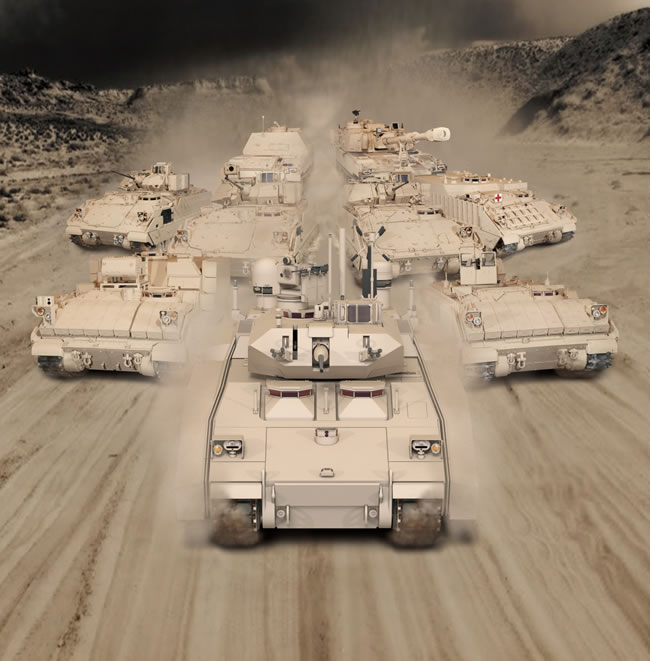
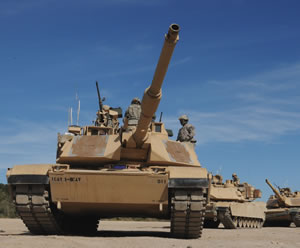
The M-1A2 Abrams tank, Various Bradley variants, GCV, M88 Hercules and M-109 Paladin SP Howitzers will form the future Heavy Brigade. Photo: BAE Systems
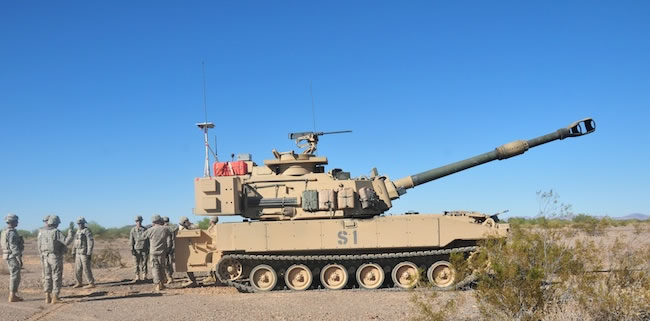
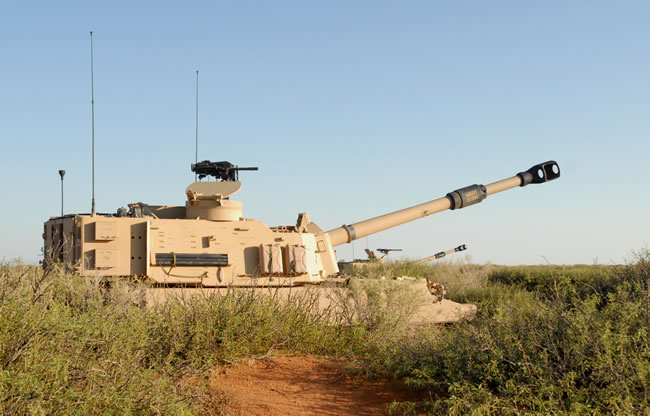
Soldiers of Battery A, 4th Battalion, 27th Field Artillery Regiment, 2nd Brigade Combat Team, 1st Armored Division, conduct an after actions review after an iteration of firing with the M109 Paladin Integrated Management Howitzer system, a proposed upgrade to the current M109A6 Paladin that is being tested for reliability, availability and maintainability. Photo: Sgt S. Harriman, U.S. Army
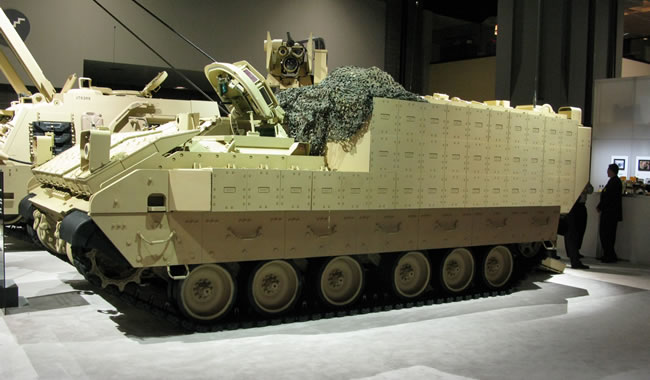
The absence of new programs provided exhibitors an opportunity to highlight improvement to existing platforms. Among the combat vehicles displayed at AUSA were the M-109 Paladin Improved Mobility (PIM) and Bradley, both included in the US Army’s Enhanced Capability Programs (ECP). Neither BAE its partner Northrop Grumman nor their competitor General Dynamics Land Systems and Lockheed martin provided much information on the next big thing for the Army – the Ground Combat Vehicle (GCV) although BAE did shed some light on the innovative hybrid electric propulsion system proposed for their GCV candidate.
Another Army program capturing much attention is the Advanced Multi-Purpose Vehicle (AMPV) – the planned replacement of the M-113, scheduled for the 2020. This program attracts significant interest in the US and abroad, with the potential for selling up to 3,800 tracked or wheeled vehicles to equip up to 15 Brigade Combat Teams (BCT). Improvements for the Stryker are also underway, following the introduction of the Double-V-Hull (DVH) modification, offering much improved protection.
BAE Systems is proposing a turretless configuration of the Bradley for the AMPV program. Photo: Tamir Eshel, Defense-Update
The DVH increases the vehicles’ weight and to gain back performance, the engine, suspension and power generation systems will be upgraded. The Army might also consider another modification, converting the vehicle into electrically driven platform, by switching the current axle-drives with hub-in-wheel electrical motors. Parker unveiled such concept at AUSA 2012 and is planning to demonstrate this capability in the near future. The upgraded DVH Stryker is also considered as a future M-113 replacement as one of the AMPV candidates. To beat the Army’s notional bias towards tracked platforms, GDLS displayed a tracked Stryker-TR concept vehicle at AUSA 2012. This vehicle used standard M-113 tracks mated with a Stryker body, without too much optimization. If the Army expresses interest in such option, the company would further optimize the vehicle, GDLS executives said, stressing that the upgraded wheeled Stryker can fully meet the AMPV requirements in terms of performance, sustainability and operating cost.
Other companies courting the Army for the AMPV included Textron Systems that recently rebranded its armored vehicle family as ‘Commando’. At AUSA the company had three variants of Commando on display. The Commando Advanced (formerly designated M-1117 ASV, where it was one of the first combat vehicles to have a V-shaped hull. Thousands are in service with the US and Iraqi Army. The new Commando Select was an upgrade of the ASV, offering MRAP-class mine and blast protection. 440 are currently built to equip the Afghan National Army mobile strike force. The Canadian Army recently selected the Commando Elite for the TAPV program. The vehicle offers MRAP Type-2 protection. Under this contract Textron will deliver 500 such vehicles between 2014 and 2016 and Canada has an option to buy 100 additional vehicles if needed. In October Rheinmetall Canada acting as the prime subcontractor was awarded C$205 million sub-contract for its share of the program. With more than a thousand M-1117s operational with the US Army, the Commando could prove a logical entry for the AMPV.
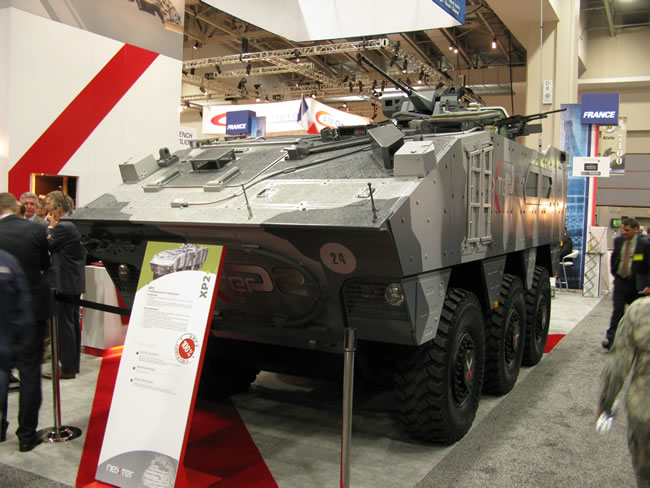
Nexter displayed the XP-2 technology demonstrator at AUSA 2012 Photo: Tamir Eshel, Defense-Update
The French vehicle manufacturers Nexter and Renault (through local affiliate Mack) are also proposing relevant vehicles. Although Nexter promoted its vehicle development capabilities through the XP2 technology demonstrator platform, one of two candidates for the French Army next generation APC. While Nexter can only hope to sell its XP2 TD to the US, the more likely goal for Nexter is to introduce its automatic cannon firing 40mm Caseless Telescopic Ammunition CTA40, developed under cooperation with the British company BAE Systems.
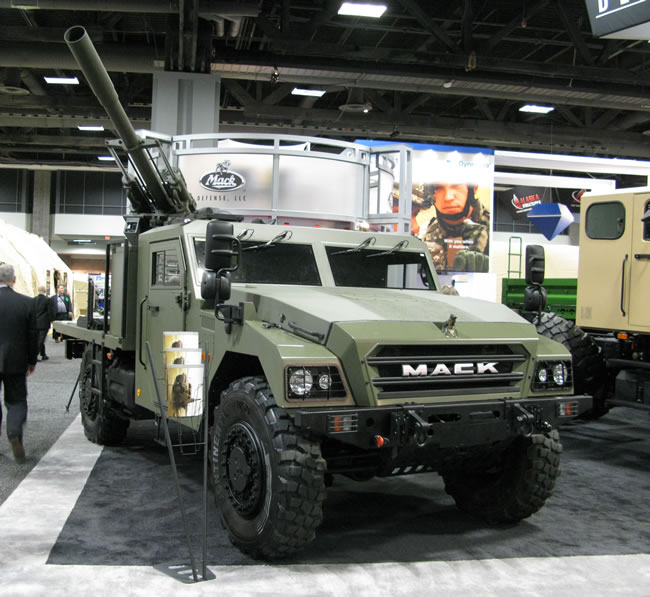
Mack displayed at AUSA the Renault Sherpa carrying the 105mm lightweight howitzer. Photo: Tamir Eshel, Defense-Update
The British and French Armies have already adopted the new cannon for their future combat vehicles and potential penetration of the US market, for example, as the primary weapon for the Ground Combat Vehicle (GCV), could have significant implications on the acceptance of this advanced weapon worldwide. Renault, a subsidiary of the Volvo group, promoted here a 105mm SP gun mounted on a Sherpa. Yet the company also has a broad range of armored vehicles that could fit a future US requirement.
BAE Systems is focusing on the Bradley for the AMPV, offering five new derivatives as successors for the M-113s. The company is also prepares wheeled vehicles for a parallel Marine Corps requirement for the Marine Personnel Carrier (MPC) program. The company is teaming with Iveco to promote the amphibious SuperAV 8×8 troop carrier for the BAE Systems is not the only bidder offering a foreign design for the MPC program. In fact, all the platforms considered for the program are foreign – The Italian SuperAV will compete against Lockheed Martin’s Havoc 8×8 (based on Patria AMV from Finland) and the Swiss developed Piranha V, a heavier and more powerful version of the LAV-25 currently used by the corps, produced GDLS.
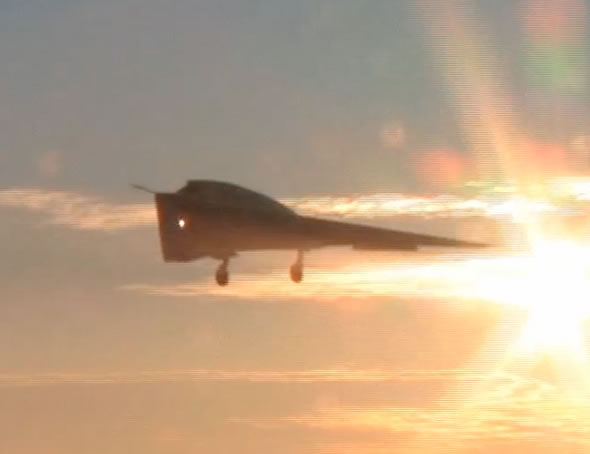
nEUROn on its first flight. Photo: Dassault Aviation
nEUROn on its first flight. Photo: Dassault Aviation
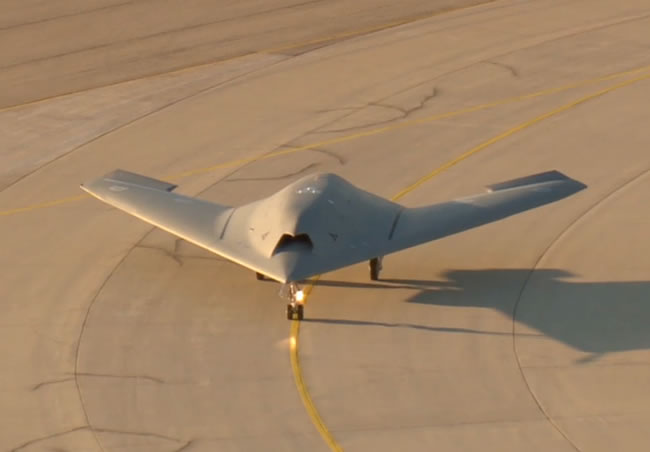
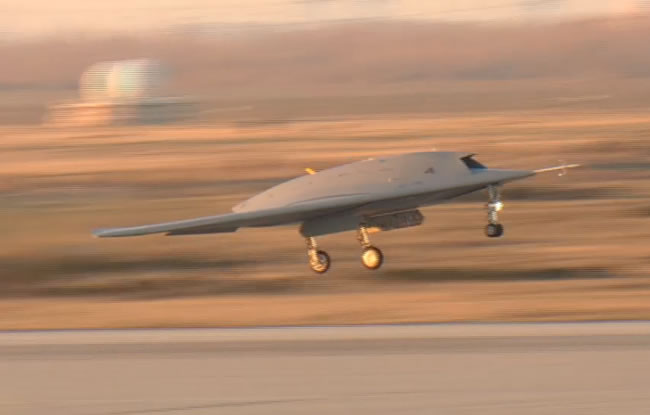
Dassault aviation carried out the first flight of the nEUROn, Europe’s unmanned combat air vehicle (UCAV) stealth technology demonstrator. The unmanned aircraft successfully completed its maiden flight from the Dassault Aviation flight test base in Istres, in collaboration with the flight test personnel of the French defense procurement agency (DGA).
nEURON taxi on the runway at Isters after landing. Photo: video via Dassault Aviation
Following this maiden flight nEUROn will continue to undergo testing in France until 2014, at which time it will be sent to Vidsel in Sweden for a series of operational trials. It will then go to the Perdadesfogu range (Italy) for further tests, in particular firing and stealth measurements.
At a length of 10 meters, and wingspan of 12.5 meters, nEUROn has an empty weight of only 5 tons. It is powered by a Rolls-Royce Turbomeca “Adour” engine.
The nEUROn technology UCAV demonstration program was launched in 2005 by the customer, DGA, and involves France, Italy, Sweden, Spain, Greece and Switzerland. It defines a future for the aeronautic excellence of Europe. With Dassault Aviation as prime contractor, the program was designed to pool the skills and know-how of Alenia Aermacchi (Italy), Saab (Sweden), EADS-CASA (Spain), HAI (Greece), RUAG (Switzerland) and Thales (France).
nEURON takes off on its first flight from Isters, December 1, 2012. Photo: video via Dassault Aviation
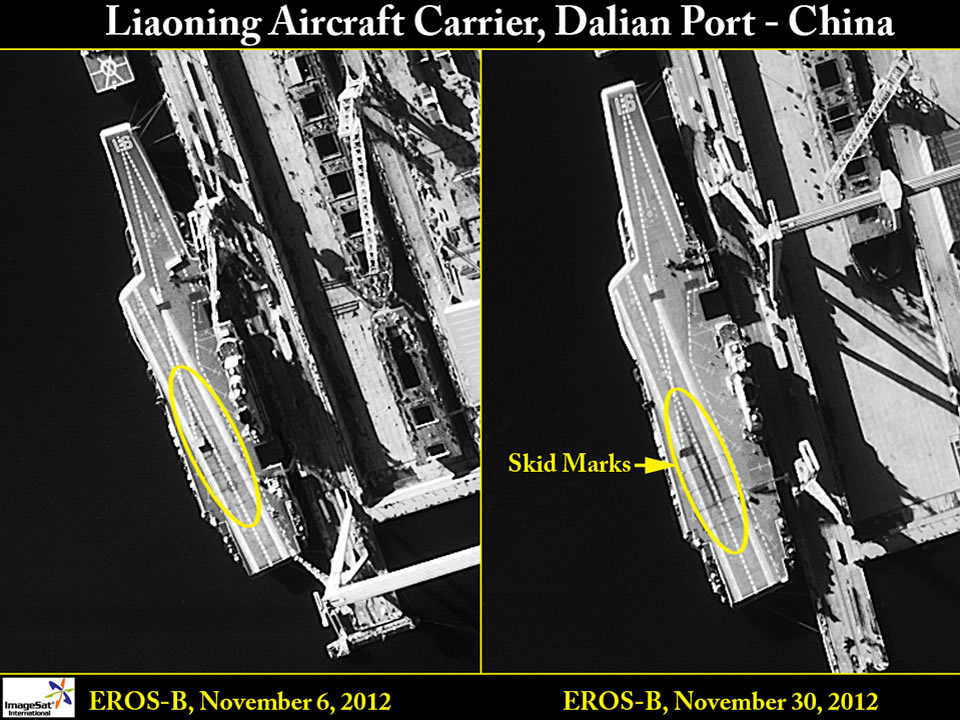
Skid marks left on the flight deck of Chinese aircraft carrier Liaoning could verify the recent operations of J-15 naval fighter jets during the vessels’ recent mission in November 2012. as seen on this Eros B satellite images taken November 6 and November 12, 2012. Photos: Imagesat
China’s Xinhua News Agency, commonly recognized as the nation’s official news service, announced on 25 November that a J-15 carrier-based fighter-bomber of the People’s Liberation Army Navy (PLAN) made a successful landing aboard the nation’s first aircraft carrier, the Liaoning. This landing represents the first known landing of a jet aircraft aboard China’s one and only aircraft carrier and marks a major stride forward in Beijing’s efforts to field a combat-capable aircraft carrier.
The Shenyang J-15 is a Chinese-built carrier-borne multi-role fighter-bomber based on Russia’s Sukhoi SU-33. The Xinhua News Agency claims that the J-15 is capable of carrying air-to-air, anti-ship, and air-to-ground missiles as well as an array of precision-guided munitions. According to Xinhua, the J-15’s performance is comparable to that of the Russian SU-33 and the American F-18.
In all, the Xinhua News Service reported that five J-15 fighters successfully landed aboard the Liaoning after conducting touch-and-go exercises on 4 November. Other news sources reported that a new two-seat J-15S completed its first test flight on 3 November.
According to the Xinhua News Service, this operation symbolizes the debut of the J-15 and claimed that the aircraft and ship demonstrated “good compatibility.” Xinhua also provided several undated high-resolution photographs of the landing and the Internet is now featuring several videos of the event as well.
A video broadcast by the China Central Television network clearly shows a J-15 landing on the Liaoning, dropping a tailhook, catching a deck-mounted arrestor cable, and slowly coasting to a halt.
Chinese pilots have been preparing for carrier operations for years. Particularly, pilots were trained on a land-based carrier mock-up runway built at the Chinese Carrier Aviator Center at Huludao, in the Liaoning provinde shown in this Eros B satellite image. Photo: Imagesat
After the successful landing, the aircraft is seen folding its wings and horizontal stabilizers as it taxis forward on the flight deck. Folding wings are crucial capability for aircraft operating within the restricting confines of an aircraft carrier. Additional video and photos also show a J-15 performing a successful take off from the carrier. Until now, many analysts were skeptical that China possessed the technical know-how to field an operational arrestor-cable system capable of withstanding the rigors of multiple carrier landings. Chinese pilots have been preparing for carrier operations for years. Particularly, pilots were trained on a land-based carrier mock-up runway built at the Chinese Carrier Aviator Center at Huludao, in the Liaoning provinde.
In addition to the international surprise expressed following the successful landings, many analysts were also taken aback by the appearance of a functioning arresting gear system aboard the Liaoning. Arresting gear technology is highly prized and closely guarded. Only a very few nations possess the technology to produce a functioning system and none of them have ever expressed the slightest willingness to share this technology. The question now being asked is how China was able to produce a functioning arresting-gear system in such a short time and seemingly without any previous experience in such a difficult engineering feat?
The Liaoning was initially laid down as the Admiral Kuznetsov-class multi-role aircraft carrier Riga in Mykolav, Ukraine in 1985 for the Soviet Navy and was formally launched in late 1988 and renamed the Varyag in 1990. Work on the ship was discontinued in 1992 at a time when the ship was structurally complete, but lacked electronics and other necessary equipment.
When the Soviet Union dissolved, ownership of the ship was transferred to the Ukraine. At this time she was laid up, stripped of most vital equipment, and allowed to languish with no maintenance being performed. By 1998, she was little more than a hulk lacking engines, without a rudder or required onboard operating systems, and in a deplorable state of disrepair.
The ship was bought from the Ukraine in 1998 for $20 million by a Chinese firm ostensibly for the purpose of transforming her into a floating hotel and tourist attraction. After being towed to the Dalian Shipyard in northeastern China, she underwent an extensive refit and emerged in 2006 in the form of a PLAN aircraft carrier. The Liaoning was formally inducted into the PLAN in September 2012. This event marked China’s first foray into the rarified world of aircraft carrier operations, a highly complex endeavor mastered by only a handful of nations. Only five other nations are presently able to deploy full-size aircraft carriers capable of conducting sustained fixed-wing flight operations.
In its present configuration, Liaoning is believed to be capable of operating an air wing of 30 fixed-wing aircraft and as many as 24 rotary-wing aircraft.
A cursory glance at the new J-15 leaves little doubt that the aircraft is a close copy of the Russian Sukhoi-33. Negotiations between Russia and China for the sale of an undisclosed number of SU-33s for use by the PLAN collapsed in 2009 as a result of Russian concerns that China intended to reverse-engineer the aircraft and produce a domestically-manufactured clone. Unfortunately for the Russians, China was able to obtain an SU-33 prototype from the Ukraine and now we have an operational Chinese J-15.
Chinese representatives have adamantly denied that the J-15 is an SU-33 clone. While China admits the J-15’s airframe is similar to that of the SU-33, Xinhua claims that the J-15 is the result of Chinese ingenuity and innovation.
With the PLAN’s first carrier landings and take-offs, China has taken a critical step forward in its efforts to develop a credible naval force able to project Chinese power far beyond its own shores – a “blue-water” Navy so to speak. Although this latest development does not, by any means, indicate that China is now prepared to carry out full-scale naval operations combining all elements of a “traditional” carrier strike group, it does represent a significant step in that direction. Carrier-borne operations combine some of the most complex seaborne activities known to man with intricate shipboard maneuvers that sometimes seem to move with lightning speed and China still has much to learn before she will be able to deploy a combat-ready carrier strike force.
As a side note, the China-based SINA website reported that Luo Yang, the senior engineer in charge of research and development of the J-15, died suddenly of a heart attack while aboard the Liaoning for the test flight operations. Yang was chairman and general manager of AVIC Shenyang Aircraft Corporation and devoted most of his time to the development of the J-15 according to SINA.
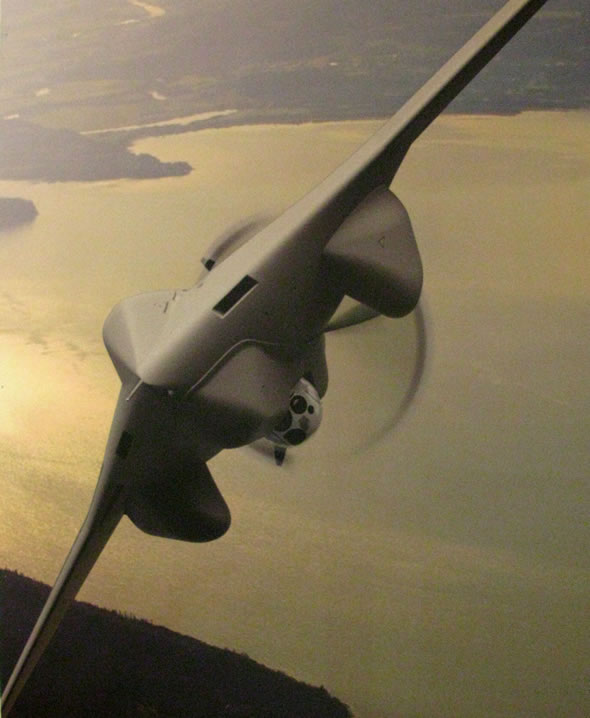
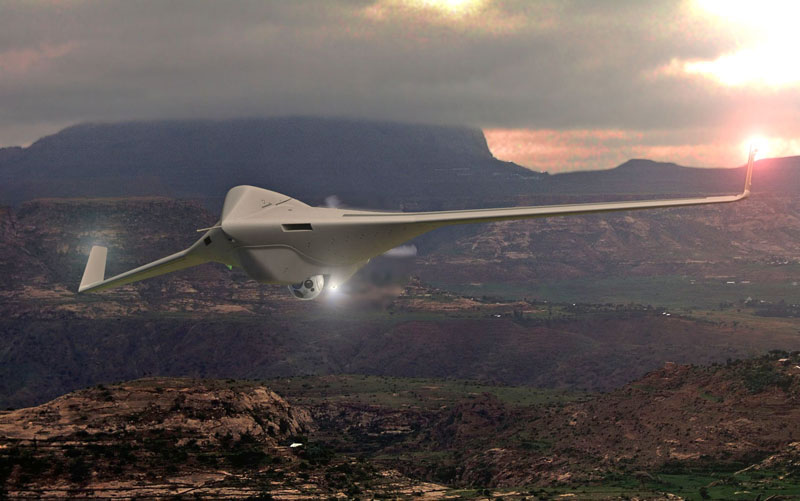
The Fury 1500 UAV. Photo: Tamir Eshel, Defense-Update
The Fury 1500 UAV. Photo: Chandler/May
Lockheed Martin today announced the acquisition of Chandler/May, Inc., a developer and producer of specialized unmanned aerial vehicle systems. The company also developed and produced fully integrated mission critical systems for unmanned aerial systems (UAS). As a subcontractor to AAI, Chandler/May has delivered hundreds of integrated command and control shelters and portable ground control stations in support of U.S. Army UAS programs. They also produced over 2,200 unmanned aerial vehicles (UAVs), including the Desert Hawk UAV, a program for which Chandler/May, Inc. is a supplier to Lockheed Martin. Another system developed by Chandler/May is the ‘stealthy looking’ Fury flying wing UAV, the SharkFin Mission & Flight Control System and Tactical Air Vehicle Control System (TACS) ground control station.
Subscribe now to get a broader perspective about this acquisition
Lockheed Martin has two main operating divisions focusing on UAS – the Skunk Works, focused on black programs and rapid prototyping and Mission Systems & Sensors (MS2). Officially, Chandler/May will become will become part of MS2 business, ‘a division that has already acquired experience with other unmanned systems, including the K-MAX unmanned helicopter, Desert Hawk UAV, and Persistent Threat Detection System (PTDS) aerostats’, the corporate announcement said. MS2 is also managing the activities of Procerus, UAS avionics specialist acquired in January 2012.
The Fury 1500 UAV. Photo: Tamir Eshel, Defense-Update
“This acquisition expands our offerings in support of our customers’ increased emphasis on advanced unmanned systems for the C4ISR missions,” said Bob Stevens, Lockheed Martin Chairman and CEO. “This acquisition is consistent with our goal to maintain a portfolio of technologically advanced options that will generate value for both our customers and our shareholders.”
Chandler/May, Inc. is a privately owned company currently operating from Huntsville, Ala, and San Luis Obispo, Calif. “Joining Lockheed Martin is a logical step to expand our current offerings and provides opportunities to reach additional customers.” Jesse May, Chandler/May, Inc. President said. Terms of the agreement were not disclosed and are not material to Lockheed Martin’s results of operations.
The Cyber Security panel taking place in Tel-Aviv this week at the HLS 2012 event is attracting considerable interest on the backdrop of the recent revelations of massive Iranian cyber attacks crippling the networks of Aramco Oil Company in Saudi Arabia. It was one of the most destructive attacks ever on a single company, erasing three quarters of the company’s hard disk drives. The panel addresses the vulnerability of organizations and infrastructures to such attacks, both are regularly targeted by hackers, cyber criminals and terrorists. While the attack on Aramco was directed at its computer network, companies and organizations are also vulnerable to terror attacks against their infrastructure; such attacks have the potential to inflict physical damage just like any other terror attack – creating explosions, hazardous material spills, create flooding or traffic accidents, all that by using untraceable, yet highly effective cyber attacks.
Since the creation of cyberspace and the internet Israeli security experts and scientists have positioned the country at the forefront of cyber defense, developing everything from the basic building blocks of network security, data encryption and information protection to integrated system providing monitoring, simulation and rapid response in the event of cyber attacks. The Israeli government has recently established a national cyber center, with the goals to coordinate the research, development, legislation and preparedness among the academy, private and public sector, to enhance the protection and minimize vulnerability of the country’s commercial, industrial and public sector to hacking, cyber crime and cyber attacks.
Protecting networks and infrastructure is a methodical, comprehensive and expensive process that begins with vulnerability assessment and proceeds with mitigating these vulnerabilities, beginning with the weakest links. Some countermeasures address changes in procedures, while others require implementation of new countermeasures and security systems. This article is highlighting several new cyber-security measures introduced at the Israel Homeland Security exhibition and conference, taking place in Tel Aviv this week.
Threats Kept Out while Data Flows in
Three companies at HLS-2012 are highlighting security measures aimed at infrastructure protection are Arilou, Waterfall and Votiro. Arilou’s products are designed for integration into existing systems, adding additional security to the systems. The company also offers hardware privacy solutions for modern smartphones, disabling possibilities to use the phone camera without permission. Another company focusing on industrial and infrastructure systems is Waterfall Security, providing unidirectional gateways deployed through critical infrastructure networks. Waterfall’s systems support most industrial protocols including solutions and GE OSM remote monitoring platforms, as well as OPC, Modbus, DNP3, ICCP and other industrial protocols.
Votiro is also providing Uni-Directional Links (UDL) for organizational networks. Its UDLs are employed to bridge between networks isolated from one another to maintain high security levels. Such systems enable users to maintain different security levels for different departments in organizations, where some levels are blocked from high security and sensitive networks while maintaining system integrity.
Securing the Privileged Accounts
Cyber-security specialist protecting the network’s most sensitive asset – its ‘privileged accounts’ is Cyber-Ark. Authorized to access to all system resources, these accounts are the primary attack vector for enterprise cyber-assaults. In addition to systems keeping network secure from external attacks, Cyber-Ark considers attacks can also come from the inside, thus adding an internal wall around those premium assets, safeguarding the access and management of such accounts, through identity management.
Opening an organization to the world means data has to move to and from employees. Such data could be infected with viruses, malware and other threats and, therefore, must be ‘sanitized’ before it enters your network. Votiro Secure Data Sanitization Device (SDSD) provides such sanitation, by integrating a hardened operating system, along with physical read-only barriers, embedded anti-virus scanners and zero-day threat cleaning mechanism.
Integrating Mobiles into Secured networks
Mobile smartphones are becoming an indispensable tool for all businesses and organizations are themselves vulnerable to attacks and are used as proxies carrying on malware into the organizational intranet. For many years, high security organizations such as defense, government and critical industries banned smartphones completely, but such action is only delays the unavoidable outcome, and places the unprotected network at risk from stealth attacks. Employing certain security measures on the devices and networks could help opening organizations to smartphones without compromising security. For example, Lacoon’s SpyPhone provides a multi-layered, network and client based protection against advanced mobile threats, preventing mobile malware, and targeted attacks while offering actionable visibility into data leaked by malicious apps. The solution supports all mobile platforms including iOS and Android without rooting or jailbreaking the device.
Another concern is the use of smartphones sensors (audio recording, data recording and camera) for spying, without the User’s knowledge or intention. Mitigating this risk is possible withWise-Sec’s Secured location-based policy enforcement embedded as an app on the mobile device.
Securing Websites with Clouds
The modern rush to ‘the cloud’ is offering hackers and defenders new opportunities for both attack, and defense. In particular, websites can now gain new levels of protection by employing Content Delivery Networks, (CDN) distributing the served files through thousands of servers. Beefed with Foresight-Air security layer, keeping the master website relatively protected and inaccessible to direct attacks. Such systems ensure companies can withstand diverse cyber attacks and continue operating unaffected. Another company, Reblaze is offering a cloud-based web security platform, positioned specifically to protect organizations against DDOS and intrusion. Such defenses dynamically manage services while filtering out requests from suspicious or malicious sources that would otherwise choke the protected network.
Tracking Hostile Behavior
E-commerce and financial systems that do not have the privilege of disconnecting from the Internet must employ special protection measures. The classic risk mitigation systems commonly follow static rules and credit card tracking to identify potential threats. However, these methods are limited in their ability to identify sophisticated, advanced threats. Identifying potential attacks based on behavior, rather than identifying them by known signature could offer a broader solution. Hybrid Telepath is one of the companies following this track. It profiles all behavior characteristics of web users, using advanced Artificial Intelligence algorithms, analyzing behavioral models based on user history profiles and general population behavior. The system learns the business logic of each unique web application, and, while monitoring normal user behavior, can accurately spots suspicious user and various fraud scenarios. Within a couple of days, the system is already capable of producing intuitive alerts based on the acquired knowledge-base.
Defense Update will follow HLS2012 with more reviews this week. Subscribers can also benefit from premium coverage and direct links to company websites. You can subscribe to Defens-Update by following our Subscription Link.
WIN-T Increment 2 gear tested on an M-ATV during the Network Integration Evaluation exercise, 2011.
Part of the gear tested during NIE Exercises uses commercial, off the shelf systems, integrated into networks where available. This photo shows a company command post which is empowered by new capabilities provided by the WIN-T Increment 2 gear. Photo: US Army
In October 2012 the US Army embarked on an ambitious upgrade of its tactical command and control system, introducing new radios, networking and satellite communications systems to modernize the command and control layers of its infantry brigade combat teams.
The system enabling this service is the Warfighter Information Network – Tactical (WIN-T). WIN-T is the Army’s mobile battlefield network providing mission critical voice, video and data to soldiers. WIN-T Increment 1 is now fully deployed, provides soldiers with high speed, high capacity communications down to battalion level at the quick halt. It is now fully fielded to 210 active duty, reserve and National Guard units. The new WIN-T Increment 2 adds ‘Broadband on the move’ via networking radios, pushing network connectivity further to the company level, integrating situational awareness and enhancing Network Operations (NetOps) for network planning and monitoring.
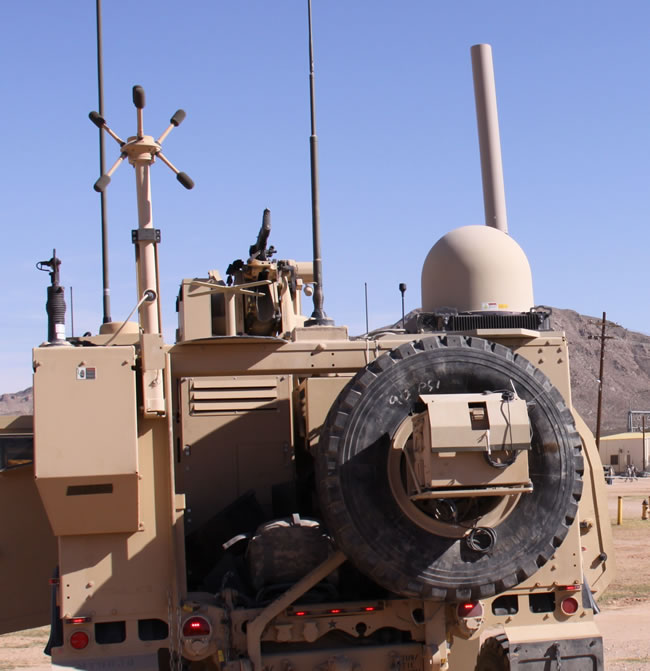
WIN-T Increment 2 gear tested on an M-ATV during the Network Integration Evaluation exercise, 2011. The radome mounted on the back of the vehicle houses the satellite communications antennae. Photo: US Army
Warfighter Information Network-Tactical (WIN-T) and its latest incremental upgrade known as Increment 2 (WIN-T Inc 2) are a central part of CS-13. It will also provide all Army units a common networking baseline layer, enabling full connectivity between units utilizing new generation systems (JTRS, AWN2, etc) and those that still rely on legacy systems (SINCGARS etc), allowing each unit to use its equipment with utmost efficiency and capacity.
General Dynamics C4 is currently supplying these sets for the Army under a $346 million contract awarded in October 2012. The first systems were delivered to two brigade combat teams and Division HQs of the 10th Mountain Division following a successful field evaluation during NIE 12.2 earlier this summer. The WIN-T Inc. 2 hub introduces high-speed communications, providing mission critical voice, video and data to support the lower echelons. “WIN-T Increment 2 has shown the value of high-speed communications for commanders who need robust, reliable communications and situational awareness,” said Chris Marzilli, president of General Dynamics C4 Systems. “Commanders can now make faster, more informed decisions using real-time information while moving with their soldiers, rather than being tethered to command posts.”
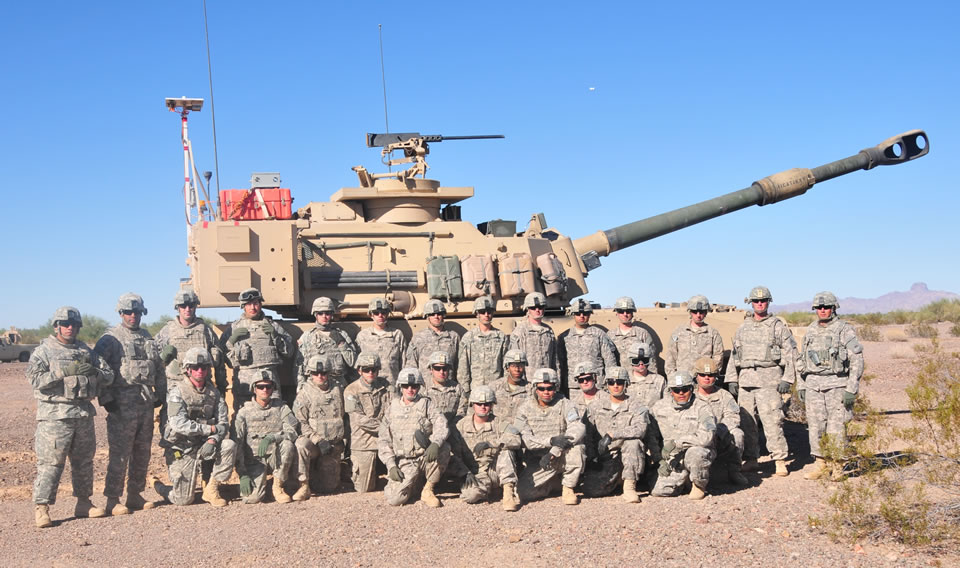
A group photo of the M-109A6 PIM testers – Soldiers of the 4th Battalion, 27th Field Artillery Regiment, 2nd Brigade Combat Team, 1st Armored Division. The soldiers of 4-27 FA conducted the systems Limited user Test (LUT) while at at Yuma Proving Ground, Ariz. Photo: Sgt Sean Harriman, US Army
Eying to sustain the strength of its remaining heavy force, the Army is embarking on upgrading programs to regain the performance levels these combat vehicles were originally designed for. Such Engineering Change Proposals (ECP) currently underway for the M-1 SEP-2, Bradley and M-109 are addressing those Space, Weight and Power-Cooling (SWaP-C) gaps.
An ECP that has already matured into production is the product improvement of the M-109A6 Paladin self-propelled artillery system. Under the PALADIN Integrated Management (PIM) program, this self propelled howitzer and its ammunition carrier will receive new chassis standardizing many M-109A6 parts with the Armored Brigade Combat Teams’ Bradley vehicles. Unlike past upgrades, ECP modifications would not result in capability enhancements beyond the level originally planned for each vehicle. The ECP is expected to ‘buy back SWaP’, by redesigning and modernizing certain elements of the vehicles.
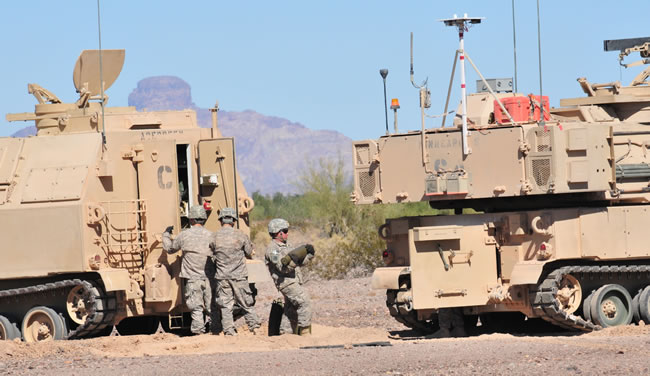
The Field Artillery Fire Support Vehicle delivers ammunition to the Paladin howitzer. Both vehicles now ride on new chassis derived from the Bradley. Photo: Sgt S. Harriman, US Army
PIM mates the main armament and cab structure of the M-109A6 PALADIN with a new chassis comprising newer components, common with the Bradley family of vehicles. The chassis introduces a more powerful powertrain, including a stronger engine (V903 675 horsepower), transmission and steering system, and wider tracks, improving ground pressure for better mobility. The hydraulic turret drive will be replaced with a new electrical drive. Utilizing a 70 kW, 600 Volt converter this system is derivative from the beyond line of sight cannon, one of the few remnant of the Future Combat Systems program. This new drive system will improve reliability, sustainability and survivability. An improved electric ramming system will also be added.
The improved chassis structure provides greater survivability and commonality with existing systems in the Armored Brigade Combat Team, reducing operational sustainment costs by replacing obsolete components. The upgrade also includes integration of a ‘digital backbone’ databus and increased power generation, supporting more advanced computers, communications and C-IED jammers.
The Army currently have 950 M-109A6 sets and, according to plans, 580 will be improved through the PIM program. Currently five modified PIMs and two upgraded Forward Artillery Fire Support Vehicles (FAFSV) are undergoing testing; PIM is slated to begin fielding in late FY17 as part of the Army’s modernization to its self-propelled howitzer fleet.
BAE Systems is supporting the program under a public/private partnership between the Army’s Project Manager-HBCT, Anniston Army Depot and BAE Systems. The PIM production would be performed at Anniston Army Depot, Alabama and BAE Systems facilities in York, Penn.; Minneapolis, Minn.; Sterling Heights, Mich.; Endicott, N.Y.; and Elgin, Okla. In December 2012 the company plans to complete low-rate initial production (LRIP). “BAE Systems’ plan to expand the Elgin facility will mean more jobs for the area as the PIM program provides improved technology for our Army artillery personnel.” said U.S. Sen. Jim Inhofe (R-Okla.) “This announcement means that jobs will be moved to Elgin two to three years sooner than they otherwise would have under the old plan.” Infofe said.
PIM is the first ECP upgrade to enter production. According to BAE Systems, the PIM LRIP award is slated for the third quarter in 2013 and follows the successful design and development work at BAE Systems’ York facility and recent Limited User Tests (LUT) conducted by the company and the Army in Yuma, Ariz. As part of the PIM LRIP program, BAE Systems will focus on the final integration, assembly and test of 72 PIM systems. The LUT was conducted in October 2012 by soldiers from Alpha Battery, 4th Battalion-27th Field Artillery, 1st Armored Division, of Fort Bliss. The test provided proof of the new systems’ suitability, effectiveness and survivability of the platform. According to Lt. Col. Dan Furber, product manager for Self-Propelled Howitzer Systems, the Army will complete the Reliability, Availability, and Maintainability (RAM) growth curve as required prior to the Milestone C Low Rate Initial Production decision scheduled to occur in June 2013. “If the PIM meets expectations the Army will begin Low Rate Initial Production in 2013, with the full production to follow in early 2017,” added Furber.
An M109A6 Paladin Self Propelled Howitzer of Alpha Battery, 4th Battalion, 27th Field Artillery Regiment use the terrain of McGregor Range to hid from “enemy forces” during Network Integration Evaluation 12.2 at Fort Bliss, Texas, May 12, 2012. NIE 12.2 is a series of semi-annual evaluations designed to integrate and mature the Army’s tactical network. Photo: Sgt. R. Larson, U.S. Army
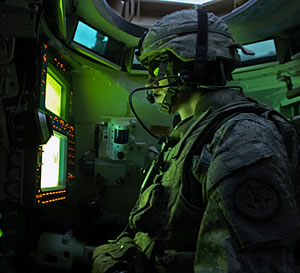
Tank Commander Sgt. David Newland of Heavy Company, 3rd Squadron, 3rd Armored Cavalry Regiment from Fort Hood, Texas, monitors his work station in his M1A2 Abrams Tank the evening of Feb. 14, in Mosul, Iraq. Photo: Sgt J. Crosby, US Army
In September 2012 GDLS was awarded a contract worth $395 million to support the first phase of Engineering Change Proposals (ECP) for the M-1A2 SEPv2 Abrams tank upgrade, the initial phase includes research, development and testing. The value for the first year is around $80 million. “Right now the electrical power is in short supply on the tank.” Said Lt. Col. William Brennan, product manager for the Abrams tank, “The centerpiece of the ECP 1 upgrade will be to restore lost power margin through the integration of a larger generator, improved slip ring, battery management system and a new power generation and distribution system,” he explained.
The work includes miniaturization of electronics, through line replaceable module (LRM)- based electronics architecture and increasing electrical generation capacity, distribution and management. Low-rate initial production (LRIP) of ECP1 upgrades-equipped Abrams tanks is expected to start in 2017 and complete by 2020. Communications and networking upgrades considered under the M-1A2 ECP also include the replacement of SINCGARS type radios with the new JTRS HMS types, better serving high capacity data communications. To distribute this data through the platform, the tank will be equipped with Gigabit-Ethernet databus and new, high capacity slipring connecting the turret to this high-speed network. At the AUSA 2012 exhibition General Dynamics also displayed a new diesel engine proposed for the Abrams tank that would increase its combat range by nearly 50 percent from 205 miles to about 300miles.
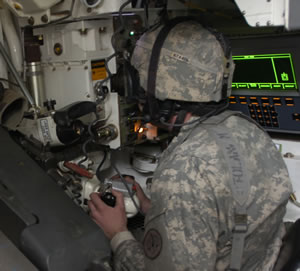
M1A2 Abrams Tank Gunner Sgt. Matthew Tolan of Heavy Company, 3rd Squadron, 3rd Armored Cavalry Division from Fort Hood, Texas, mans his work station during movement through Mosul, Iraq, Feb. 14. Photo:Sgt J. CrosbyThe MTU 833 engine and new Allison transmission could reduce the Abrams’ cost per mile by 14% compared with its current turbine-powered engine. “Through the development of an Abrams diesel engine that is significantly more efficient than a turbine, we can reduce the cost per mile, increase the tactical range, lower maintenance costs and reduce the number of fuel and cargo trucks needed,” said Mike Cannon, General Dynamics Land Systems’ senior vice president, Ground Combat Systems.
Eying to sustain the strength of its remaining heavy force, the Army is embarking on upgrading programs to regain the performance levels these combat vehicles were originally designed for. After years of continuous patchworks, applying new armor and electronic equipment to better protect against new threats, most of these platforms have already exceeded their design specs. For example, applique armor and SLAT cages have exceeded the physical envelopes and load margins of vehicles, limiting mobility. Lack of engine power and overloaded electrical supplies are further reducing their performance. In addition to the ECP for the M-1 SEP-2 the Army has also embarked on ECP upgrades for the Bradley and M-109 are addressing those Space, Weight and Power-Cooling (SWaP-C) gaps.
ECPs to be implemented with each of the remaining platforms are expected to ‘buy back SWaP’, by redesigning and modernizing certain elements of the vehicles. Unlike past upgrades, ECP modifications would not result in capability enhancements beyond the level originally planned for each vehicle.
A tank crew from the 1st Battalion, 8th Cavalry Regiment, 2nd Brigade Combat Team, 1st Cavalry Division, at Ft. Hood, Texas fires a 120-mm round from its main gun at a target for crew qualification during a Gunnery Table IV live-fire exercise at Clabber Creek Multiuse Range. Photo: Staff Sgt. Johnathan Hoover, 2BCT, 1st Cav Div US Army
Practicing strategic and tactical mobility is part of the readiness maintenance and qualification of armored formations. One such exercise was conducted in October 2012 last month To practice operations with landing crafts, the Army
Lockheed Martin Skunk Works® and XTEND have achieved a major milestone in JADC2 by integrating the XOS operating system with the MDCX™ autonomy platform. This technical breakthrough enables a single operator to simultaneously command multiple drone classes, eliminating the friction of mission handoffs. From "marsupial" drone deployments to operating in GPS-denied environments, explore how this collaboration is abbreviating the data-to-decision timeline and redefining autonomous mission execution.
As traditional defense primes face mounting competition from agile “neoprimes” such as Anduril, Palantir and Helsing, the balance of innovation is shifting toward software-defined warfare and scalable, dual-use technologies, while global industry consolidation—marked by Boeing’s integration of Spirit AeroSystems and other strategic mergers—signals an intensified race to secure control over the defense technology value chain. Our Defense-Tech weekly report highlights these trends.
In early October 2025, a coordinated wave of unmanned aerial system (UAS) incursions—widely attributed to Russia—targeted critical infrastructure across at least ten European nations. The unprecedented campaign exposed the fragility of Europe’s air defenses...
Executive Summary
The past week (September 18-25, 2025) represents an inflection point where strategic defense concepts have transitioned from doctrine to tangible reality. An analysis of global events reveals four primary, interconnected trends shaping an...
At the 2025 Air, Space & Cyber Conference, U.S. Air Force and Space Force leaders unveiled major updates on next-generation fighters, bombers, unmanned systems, and space initiatives, highlighting both rapid innovation and critical readiness challenges as the services race to outpace global competitors. A short version is available here, with a more detailed version for subscribers.
The Taipei Aerospace & Defense Technology Exhibition (TADTE) 2025 crystallized around four dominant strategic themes that collectively illustrate Taiwan's comprehensive approach to defense modernization amid escalating regional tensions. Based on a detailed report by Pleronix (available upon request). Includes a Podcast discussion on TADTE 2025's highlighting Taiwan's four strategic themes beyond the post's coverage.
Israel’s Iron Beam 450 high-power laser system has completed final testing, marking a major leap in air defense. Developed by Rafael, it offers precise, cost-effective interception of rockets, UAVs, and mortars, and is set for IDF deployment by 2025.