Sept 20, 2011: Azerbaijan’s armed forces will take delivery of 60 Orbiter and Aerostar unmanned air vehicles (UAVs) by the end of this year, the Azerbaijan Press Agency (APA) said on Monday quoting military sources.
Photo: MDA
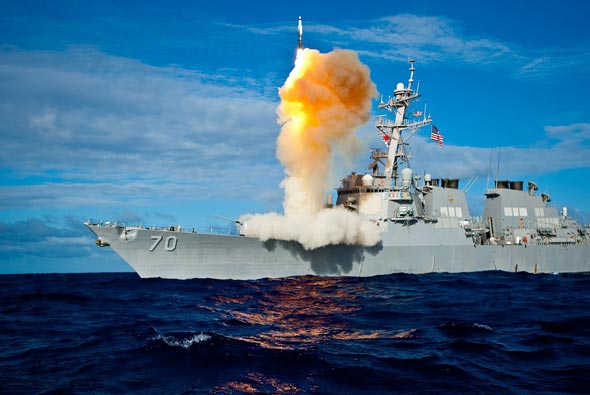
U.S. Delays SM-3 Block 2A Development
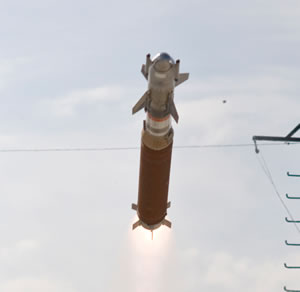
Sept 20, 2011: The development of the Standard Missile SM-3 Block 2A ballistic missile defense interceptor could be delayed by two years, due to setbacks in warhead testing, the U.S. has notified japan on the delays last week. Japan and the U.S. are jointly developing the missile, originally planned for deployment around the year 2018. The U.S. is developing the kinetic interceptor and guidance system for the new missile while Japan focuses on the nose cone and rocket motor.
Su-30MK for belarus
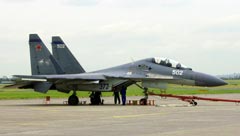
Ex-Indian Su-30Ks Delivered to Belarus
Sept 20, 2011: Eighteen Su-30K fighter jets delivered to India as part of the first production batch were recently returned to Russia. Representing a downgraded avionic standard, compared to the full fledges Su-30MKI, Russia agreed to replace the aircraft for production versions of the Su-30MKI, in a ‘buy back’ transaction. Interested in refurbishing these pre-owned fighter planes, to the Su-30KN standard, Belarus has offered about $15 million per aircraft to get these fighter planes. Sofar ten aircraft have arrived in Belarus for refurbishment with the remaining eight to arrive by November this year.
Malaysia Interested in Joining the U.K. Type 26 Frigate Program
Sept 20, 2011: Malaysia is considering joining Britain in developing the Type 26 ‘Global Combat Ship‘ new generation frigates. The U.K. is seeking international partners for the Type 26 program, offloading some of the financial pressure associated with the development costs. Brazil, India, Turkey and Australia have also expressed interest in participating in the program. A ship with a displacement of 6,000 tons Type 26 is supposed to replace Type 22 and Type 23 frigates and is expected to form the backbone of the UK Navy’s fleet from about 2020.
Photo: Lockheed Martin
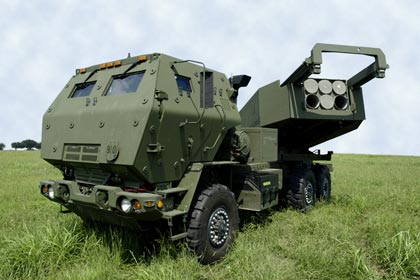
Singapore’s HIMARS Unit Operational
Sept 20, 2011: The first High Mobility Artillery Rocket System (HIMARS) unit of the Singapore Army artillery was announced operational earlier this month, at the base of the battery at Khatib Camp, Singapore. The HIMARS, which will be operated by Bravo battery, 23 SA, provides artillery forces with precision fire power, enhanced mobility and advanced networking capabilities.
Washington to upgrade Taiwan's F-16A/Bs
U.S. Proposes Upgrades for Taiwans’ F-16s
Sept 20, 2011: After dragging Taiwan’s request for 66 new F-16C/Ds for five years, the U.S. administration seems to agree to upgrade the island state’s 140 F-16A/B fighters. The U.S. government is obligated under the Taiwan Relations Act of 1979 to provide for Taiwan’s defense. Backing Taipei has been the thorniest bilateral issue between Washington and Beijing. With China becoming a superpower, no other country is supplying the island for fear of angering Beijing. France and the Netherlands are among countries that have suffered economic and diplomatic retaliation for having armed Taiwan in the past.
Photo: USFK
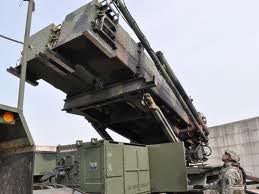
Lack of Spares Render South Korean Patriot Systems Inoperable
Sept 20, 2011: Part of the South Korean air-defense defense’ Patriot batteries have been suspended for months due to malfunction in their radars. Seoul inducted the Patriot systems in 2009 as part of the establishment of a new air and missile defense system capable of intercepting ballistic and cruise missiles. For the fire units Seoul acquired the PAC-3 missiles from the U.S., matched with radars of PAC-2 GEM+ systems acquired from German military surplus. Part of the problem is the low levels of spare parts maintained for these radars; in July 2011 only 10 percent of the spares were available, extending repairs of Patriot radar failures over several months. (Chosun)
BrahMos for Vietnam?
India Offers the BrahMos to Vietnam
Sept 20, 2011: India and Vietnam are discussing a possible sale of the BrahMos supersonic anti-ship missile developed jointly under a Indo-Russian cooperation. Indian sources confirmed Vietnam is one of 15 countries approved by the Indian government for the missile’s export.
Thailand Undecided about German Type 206 Submarines
Sept 20, 2011: Thailand’s defense minister denied the approval of 7.5 billion Bhat for the acquisition of six Type 206A submarines from German Navy surplus. The Thai defense security committee recommended evaluating other options for buying submarines from Russia, China and South Korea. The German Navy’s offer was attractive in terms of cost, availability and operability as training platforms but the deadline set by the Germans for September 30 was too short for the Thai response. (Bangkok Post)
Recep Tayyip Erdogan, the Prime Minister of Turkey
Recep Tayyip Erdogan, the Islamic prime minister of Turkey, may not be a nice person, regarded by most Israelis as an unfriendly bully strutting the already highly turbulent Mid Eastern neighborhood. But no one in his right mind can dismiss his shrewd, yet capable talents, being demonstrated over the last years in his own political domain. Through a series of very clever and successful political but legal manipulations, he established himself as the undisputed Islamic leader of over eighty million people-certainly no mean achievement by itself, in a secular nation which was for decades virtually under the boot of the Kamalist military. But Mister Erdogan has far more ambitious plans in his agenda- his notorious “Israel Bashing” might be the immediate target, bringing high dividends from his already enticed Muslim public, but his sight is set on far more ambitious objectives- the revival of Turkish hegemony over the ‘ Arab Spring” outcome, whatever may emerge from the present shambles.
With Turkey flexing its muscles, we may soon face a renascent neo-Ottoman Empire. This vast ancient and ruthless empire, an Anatolian dynasty established on the ruins of the Byzantine Empire, the Ottomans were the standard-bearers of Islam after their conquest of Constantinople (now Istanbul) in 1453. For nearly half a millennium, the Turks dominated the eastern world, spreading Islam faith and its culture to millions. The climax culminated under the reign of “Suleiman the Magnificent” with the Turkish empire engulfing southwestern Asia, the Eastern Mediterranean countries and North Africa and even extending deep into Central Europe, including Bulgaria, Serbia, and Hungary, only to be stopped at the gates of Vienna in 1529. The long declining Ottoman Empire finally came to its end, as a regime under a Muslim caliphate in November 1922, following the defeat of Turkey in WW1. On 29 October 1923, the Republic of Turkey was proclaimed by Mustafa Kemal Atatürk who became its first president of the transformed Turkish society, the former Muslim part of a vast Empire becoming a modern, secular nation-state, with the Grand National Assembly (GNA) at the heart of the new secular modern democracy. For eighty years Kemal Atatürks secular legacy was upheld in Turkey, with the armed forces being the undisputed guardians. All that ended in 2003, when the Islamist Justice and Development Party, known as the A.K.P under the leadership of Recep Tayyip Erdogan, a devout Muslim, was elected prime minister. Erdogan’s aim was to turn secular Turkey into a Mulsim Islamic nation, but he faced an enormous challenge, as Turkey’s 1982 constitution proclaimed the nation’s system of government as democratic, secular and parliamentary, while the country’s original Constitution by Kemal Atatürk makes the military the guardian of Turkey’s secular rule. Under the circumstances it took Erdogan and his AKP several years to achieve their goal- to rid Turkey from the dominating military Kemalists, who attempted to overthrow his government and save it from the Islamists, The largely secular Turkish military has historically been the Praetorian Guards of the Turkish state; a check on both Islamist and Leftist elements in the country being the real power of the nation. But by finally winning over the constitutional courts, Erdogan cleverly checkmated the Kemalist generals, in the September 2010 referendum on constitutional amendments, removing the remaining obstacles to the Islamist’ absolute power, by shrewdly targeting both the courts and the military, by legal means. Promoting AKP loyalists in the legislature and top army positions ensured that the Turkish military would no longer be the guardian of secularism. As result the entire military staff resigned and was replaced by Islamic officers, loyal to the now virtually absolute leader Recep Tayyip Erdogan.
Having achieved his first target in his home domain, the Turkish Premier now is set to exploit the present leaderless turmoil in the so-called “Arab Spring” to become the predominantly leading power among Muslim states in the Middle East and North Africa. If he succeeds, then the stage will be set for a neo-Ottoman hegemony over the entire Sunni Middle East. But things might not happen that fast, as his empiric visit to Egypt showed.
interference in Egypt’s local affairs?
To promote his Islamic “messianic” message, Erdogan embarked on a highly publicized tour of the “Arab Spring” along the Mediterranean. First in line was Cairo, where he initially received an enthusiastic welcome, by the masses, mainly the younger generation of the Muslim Brotherhood, regarding him as their saviour. However, looking closer on the event, the visiting Turkish minister, displaying a powerful, but highly arrogant actor, clearly hinting for hegemony in a turbulent, rapidly changing region, must have caused some painful memories among the still sensible segment of the Egyptian population, still very much aware from the days when an oppressive regime of the Ottoman Sultanate ruled over Egypt from Constantinople.
The Egyptian military Junta was even more reluctant, fearing further backlash from Washington and still chafing from the aftershock from the ransacked Israeli Embassy affair in Giza. Matters became even more hectic for the Turkish megalomaniac, when he started preaching his proposal for a secular constitution to the Muslim Brotherhood assembly. This was probably the last thing that the hard line Islamists expected from their “hero”. Accordingly, Dr Mahmoud Ghuzlan, the spokesman of Egypt’s Muslim Brotherhood soon slammed back declaring that the MB considered Erdogan’s comments as interference in Egypt’s local affairs. It is long known that Turkey and Egypt are bitter rivals for influence in the Muslim world and whatever leadership emerges in Cairo, it will remain determined to defend this role. What probably irked the proud Egyptians most, was Erdogan’s strutting attitude around Cairo streets is not an Arab at all, and his lecturing to Cairo listeners in the Turkish, rather than Arabic language, virtually sermonizing how to conduct their future, must have been scathing to most. The fact that the Turkish language became first known in written records dating back nearly 1,300 years, while Arabic was first spoken during the 6th Century, must have further caused affront in the Egyptian capital- the cradle of Muslim heritage. To sum up: neo Ottoman Prime Minister Tayyip Erdogan’s visions from his first state visit proved far from being a victorious tour of, what he aspires to be a revival of long gone Turkish hegemony. Apart from his unbounded ambition to degrade Turkey’s former ally, Israel, Erdogan’s speeches in Cairo, seem to have achieved only meager response to form a strategic alliance between the two nations, still very much dependent on US goodwill.
Erdogan’s carefully prepared “state” visit, seems to have reaped even lesser results in Libya, where his appearance was overshadowed by visiting Sarkozi and Cameron. In Tunesia there was only a repeat performance of “Israel Bashing” and little else besides. Based on his misstep in Cairo, it looks as if his vision for a revival of the Ottoman hegemony in the “Arab Spring” countries will have to wait for a better opportunity, if at all.
Meanwhile on his return home, Mr Erdogan will have his hands full dealing with the Kurdish question, which could probably escalate sharply, if the Palestinians receive their UN recognition in New York. The PKK has already conducted a series of lethal ambushes and bombings that have killed scores of Turkish soldiers in mid-2011. In August itself at least 11 Turkish troops were killed in a bombing attributed to the PKK in the southeastern province of Hakari. There is also rising discontent among the Kurds in South Eastern Turkey, which could signal serious trouble for the Islamic government. Although Erdogan, has promised an end to the three-decade war, he recently toughened his line last August by ordering his new military staff to prepare a massive offensive on northern Iraq’s Kandil mountains, the stronghold of the Kurdish Workers Party and Peshmerga fighters. To prevent any possible flare up by the Kurdish population inside Turkey itself, Erdogan has ordered special forces sent to the southeastern provinces of Diyarbakir, Hakari and Sirnak, reports said. The entire operation will probably come under command of the new Chief of Staff Gen. Necdet Ozel, promoted from Gendarmerie chief to military commander. The ordered offensive might allow him to demonstrate his skills in conducting large scale military operations.
Erdogan’s Turkey is no economic powerhouse either! According to latest estimates, the annual budget deficit of 9.5% is expected to reach 10%, with the external debt doubling itself in the past 18 months. Turkey’s unemployment rate is 13% and the local currency continues to plummet vis-à-vis the dollar. Once that bubble explodes, then Tayyip Erdogan might no longer be so glib in his arrogant rhetoric spreading regional leadership ambitions. His score might then be settled by a long line of his opponents, judged and incarcerated on imaginary charges. His ultimate fate might then become not much different, from the ousted autocrats, he wishes to replace.
Prime Minister Reccep Tayyip Erdogan might feel that the ongoing “Arab Spring” is his golden opportunity to rekindle the long defunct Ottoman Islamic hegemony over the entire Sunni region. However, based on the his recent disdainful rhetoric in Cairo and elsewhere, Erdogan’s supercilious and world shaking ambitions could still end in his unltimate defeat at home.
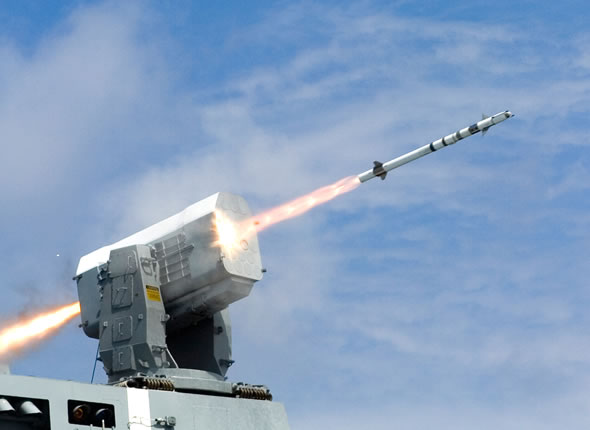
RAM has been continually improved to stay ahead of the ever-evolving threat of anti-ship missiles, helicopters, aircraft and surface craft. RAM Block 1 incorporated a new image-scanning seeker with the added capability of autonomous IR all-the-way guidance, thus countering advanced anti-ship missiles that do not employ on-board radar seekers. Enhanced digital signal processing further provides increased resistance to countermeasures and superior performance in severe IR background conditions. An advanced optical target detection device is incorporated to detect very low sea-skimming threats. The Block 1A configuration incorporated additional signal processing capabilities to defeat helicopters, aircraft and surface craft. Block 1A is in rate production for the Consortium countries and the other countries procuring RAM. Photo: Raytheon
Raytheon Company and its German industry partner, RAMSYS, completed missile upgrades and integration testing as part of the Rolling Airframe Missile Block 2 program. The partnership completed five control test vehicle flights and met all upgrade requirements for Block 2. The missile is expected to begin guided flight tests later in 2011, followed by the program entry low rate production in late 2012.
RAM has been continually improved to stay ahead of the ever-evolving threat of anti-ship missiles, helicopters, aircraft and surface craft. RAM Block 1 incorporated a new image-scanning seeker with the added capability of autonomous IR all-the-way guidance, thus countering advanced anti-ship missiles that do not employ on-board radar seekers. Enhanced digital signal processing further provides increased resistance to countermeasures and superior performance in severe IR background conditions. An advanced optical target detection device is incorporated to detect very low sea-skimming threats. The Block 1A configuration incorporated additional signal processing capabilities to defeat helicopters, aircraft and surface craft. Block 1A is in rate production for the Consortium countries and the other countries procuring RAM. Photo: Raytheon
RAM Block 2 features enhanced kinematics, an evolved radio frequency receiver, a new rocket motor and an upgraded autopilot system. These improvements enable the missile to outpace evolving threats.
RAM is a supersonic, lightweight, quick reaction, fire-and-forget missile providing defense against anti-ship cruise missiles, helicopter and airborne threats, and hostile surface craft.
Block 2, the next step in the spiral development of the Rolling Airframe Missile, is a kinematic and RF receiver upgrade. A larger, more powerful rocket motor and advanced control section make the missile three times more maneuverable with twice the effective intercept range. This provides the Block 2 missile with the capability to defeat high-maneuver threats as well as the ability to intercept crossing threats. An enhanced RF receiver allows detection of anti-ship missiles that employ low probability of intercept radars. Photo: Raytheon
Lockheed martin has outlined new activities in the field of Ground Combat Vehicles it is developing as a prime contractor or under cooperation with other primes. Among these activities are the developments of lethality and electronic architecture for the British Scout Specialist Vehicle, and Ground Combat Vehicle (GCV) on both programs Lockheed martin has joined forces with General Dynamics Land Systems (GDLS). For the US Marine Corps Medium Personnel Carrier (MPC) program Lockheed Martin is also offering a derivative of the Patria 8×8 AMV, designed for amphibious operation.
Lockheed Martin is involved with land systems developments for over three decades, with most of the work focused on tracked and wheeled platforms supporting the MLRS program and its derivatives (MLRS, HIMARS, MLRS repair and recovery vehicle. The company is also involved in two major equipment programs in the U.K., namely the Scout SV program, for which they design and develop the turret, weapon systems and electronic architecture, and the Warrior Capability Sustainment program (WCSP) the later program is still awaiting UK MOD approval as Lockheed Martin remains the sole bidder on this program. The Warrior and Scout SV will share the same turret, saving considerably on development logistics and training costs.
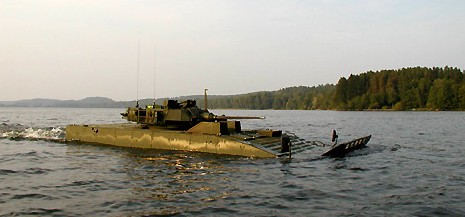
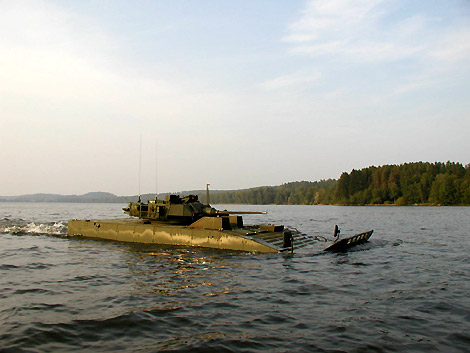
Lockheed Matrin and Patria are offering an amphibious version of the Advanced Modular Vehicle (AMV) for the U.S. marine corp Marine Personnel Carrier (MPC) program. A marinse corps request for proposal is expected within by year's end. The photo above was taken in Finland in 2002, as part of the vehicle's amphibious capability demonstrations.
Tarian was developed as a lightweight modular system designed to replace the traditional bar or slat armor at a weight saving of up to 98%. Photo: Tamir Eshel, Defense-Update
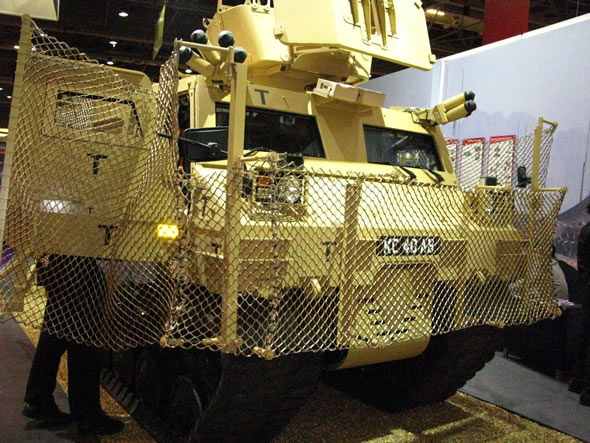
Singapore Technologie’s Kinetics (ST Kinetics) has teamed with AmSafe, the developer and producer of Tarian RPG protection system, to offer the lightweight, textile-based RPG protection system on its Warthog all terrain armored vehicles. The Warthog is currently in service with the British Army in Afghanistan. A lighter version – the Bronco – is in service with the Singapore land forces. The two companies announced today their intention to join forces in marketing the Tarian counter-RPG solution worldwide. The Memorandum of Understanding outlines plans for both companies to collaborate with the aim of ST Kinetics to offer AmSafe’s RPG protection as an option on its vehicles and market the product in certain territories where they already have a strong presence.
Tarian was developed as a lightweight modular system designed to replace the traditional bar or slat armor at a weight saving of up to 98%. Photo: Tamir Eshel, Defense-Update
Tarian was developed as a lightweight modular system designed to replace the traditional bar or slat armor at a weight saving of up to 98%. The technology has been tested in the UK and US, enduring over 650 firing shots, verifying the system’s performance and multi-hit capability. Arizona based AmSafe, the producer of the Tarian system specializes in safety and securement products for the aviation industry, providing seat belts, cargo and barrier net restraints and air bags. Its military products also include the textile armor and various cargo restraints systems.
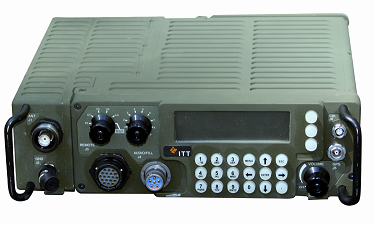
ITT's new Sprearhet HF multiband radio, supporting HF/VHF wave bands. Photo: ITT
ITT is expanding the Spearhead family of tactical radios, the company is releasing today the Spearhead HF Radio at the DSEi 2011 exhibition in London. The new software defined radio (SDR) is a multiband HF/VHF system offering long range communications, with the high frequency (HF) segment overcoming range line of sight and terrain limitations restricting communications in the higher bands (VHF/UHF). According to ITT the new Spearhead HF offers communications interoperability with existing legacy SINCGARS systems, including export versions such as RT-1702, in addition to integration with other Spearhead family VHF radios. Spearhead HF is offered as a ruggedized 20W manpack radio or a 150W vehicular or base station unit.
As an SDR the system supports specific waveforms including advanced data waveform, digital voice, GPS and communications security (COMSEC), encryption and counter-countermeasures (ECCM). The unit also has cross-band repeater function bridging between HF and VHF networks as a communications repeater.
ITT's new Sprearhet HF multiband radio, supporting HF/VHF wave bands. Photo: ITT
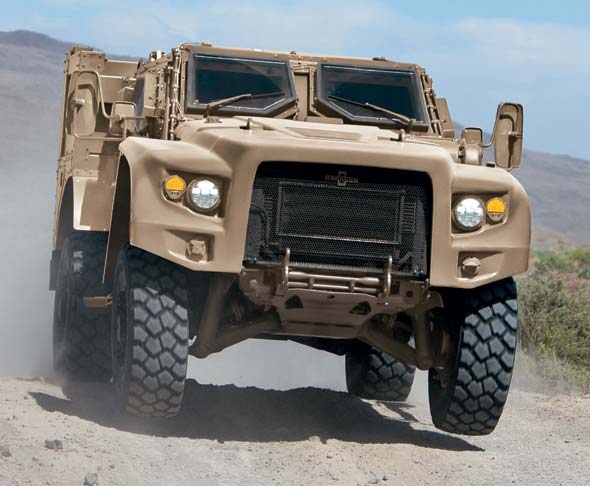
The L-ATV’s engine delivers expanded power capabilities, greater fuel efficiency and integrated communications for improved diagnostics and maintenance over legacy engine technologies currently fielded Photo: Oshkosh Defense
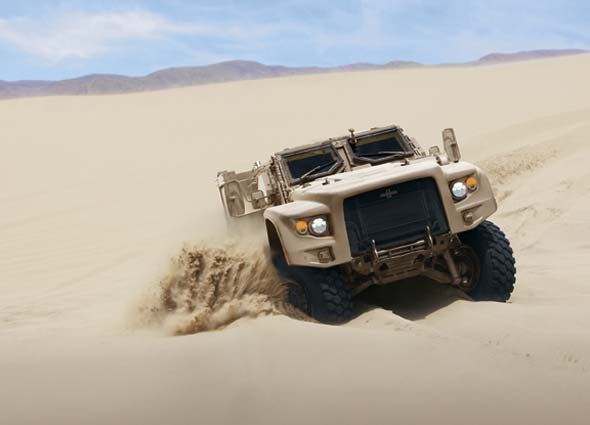
Oshkosh Defense has unveiled today the Light Combat Tactical All-Terrain Vehicle (L-ATV), a new class of vehicle designed to meet the military’s new trend toward lighter, deployable yet highly protected tactical vehicles. Based on its extensive experience with and Mine Resistant Ambush Protected (MRAP) and the medium weight variant, (M-ATV), comprising a major part of teh U.S. Army vehicle fleets in Iraq and Afghanistan, Oshkosh anticipates the next generation of light combat military vehicles require new levels of mobility and protection to operate effectively in remote, rugged and hostile landscapes.
The L-ATV’s engine delivers expanded power capabilities, greater fuel efficiency and integrated communications for improved diagnostics and maintenance over legacy engine technologies currently fielded Photo: Oshkosh Defense
“We designed the L-ATV to address the rapidly evolving threats and provide troops with greater ability to navigate through extreme driving conditions,” said Ken Juergens, vice president and general manager of Joint Programs for Oshkosh Defense. “Battlefields have changed – threats are more dangerous, operating environments are more rugged and fuel efficiency is more important than ever. The L-ATV is designed to meet these challenges, today and well into the future, just as our M-ATV continues to meet evolving battlefield threats without comprising its payload and off-road mission profile.” He added the new L-ATV incorporates field-proven technologies, advanced armor solutions and expeditionary levels of mobility, to set to redefine safety and performance standards for the U.S. Armed Forces and international militaries.
The L-ATV’s armored capsule is scalable and can accept multiple armor configurations to protect troops from IEDs and today’s other prevalent battlefield threats. Photo: Oshkosh Defense
Key for the vehicle’s off-road mobility is the Oshkosh TAK-4i independent suspension system, the next generation of Oshkosh’s TAK-4 suspension system currently used with the M-ATV. Employing this advanced suspension. The TAK-4i technology uses a proprietary technology to deliver 20 inches of independent wheel travel – 25 percent more wheel travel than any vehicle in the U.S. military’s fleets. The L-ATV’s armored capsule is scalable and can accept multiple armor configurations to protect troops from IEDs and today’s other prevalent battlefield threats. The capsule is optimized for protection, weight and mobility, and its modular and flexible design allows the vehicle to accept a greater range of upgrades and continuous enhancements.
The L-ATV’s engine delivers expanded power capabilities, greater fuel efficiency and integrated communications for improved diagnostics and maintenance over legacy engine technologies currently fielded. Oshkosh also prepared the vehicle to employ the ProPulse diesel-electric hybrid powertrain, providing a powertrain option that can be readily implemented to maximize the vehicle’s efficiency through improved fuel economy, high levels of exportable power for use in stationary positions or on the move and lower life-cycle costs.
Anticipates a growing demand for the new class of vehicles and has set, Oshkosh defense counts on its large scale manufacturing capabilities, which has ramped up to exceed 1,000 vehicle deliveries per month for the M_ATV program. Addressing military requirements for rapid modifications, the line was designed for flexible production, allowing the company to quickly incorporate production changes or retrofit vehicles with additional armor or upgrades as needed.
Maj. general Gershon HaCohen, Commander, UDF Northern Command. Photo: IDF
Maj. general Gershon HaCohen, Commander, IDF Northern Command. Photo: IDF
In a briefing at the recent Land Warfare conference held in Latrun, Israel earlier this month, the commander of the IDF Northern Command, Major General Gershon HaCohen, examined maneuver and fire alternatives and their role against the evolving hybrid warfare challenges. “It is obvious land maneuver is not a goal in itself. Classic maneuver should shake an enemy force out of balance, however, maneuvering against irregular, ‘disappearing’ forces is difficult due to the lack of clear center weights” said HaCohen.
In a previous article we examined the evolution of the Syrian army and Iranian backed insurgent organization Hezbollah into a semi-irregular military organization specializing in hybrid warfare. This type of operation offers several advantages to such formations, particularly in their ability to sustain overwhelming odds and survive. However, it practically eliminates their ability to conduct meaningful offensive operations.
How can a conventional, technologically superior army like the IDF can degrade the fighting capability of such ‘hybrid’ forces and how do one assess the wear, remaining combat capability and operational potential of such irregular forces? In the linear war, where ‘battalions’ ‘brigades’ and ‘divisions’ form the main fighting power, clearly defined numerical data is available, sensing groups of fighting vehicles, and translating the information into clearly defined targets which are ‘dead’ or ‘live’. Under such conditions, having destroyed military formations could be regarded as final, or at least temporary, until enemy reinforcements could arrive to replace the losses, which would take time and further opportunities for targeting. However such clear definition cannot be attributed to a small commando unit, irregular guerrilla element or remotely controlled rocket site being activated at will.
Eliminating the threat of rockets has also become a major concern for the Israeli Army. Sustaining continuous rocket attacks (launching ‘flow’) is a critical capability the Hezbollah developed and maintained through the duration of the conflict, achieving a kind of ‘strategic parity’ with the Israelis. “Fighting against rocket launchers is different from operating against the regular military” HaCohen admits, “You cannot take such arrays out of balance.” While known targets can be eliminated by an opening, or deliberate strike conducted with precision fires and air attacks. “Ongoing precision engagements throughout the campaign are gradually eroding the enemy’s launching capability, but are depending on human-intensive intelligence analysis processes, but remain only effective operational guidance as long as they are real-time assets.” HaCohen explained.
Even this highly sophisticated phase gradually loses momentum, as the enemy adapts and find ways to avoid our attacks. In fact sporadic or unreliable information becomes virtually worthless and limits or even denies precision engagement capability. “Once the precision engagement phase loses momentum, it is time to consider the land maneuver to achieve its massive effect by exposing the enemy and eliminating its combat elements with superior firepower and rapid movement, in concentrated action.” he stressed.
General Hacohen is warning of the military tendency to shift from understanding the art of war and mastering it in complex operations, towards virtual management systems, using modern technology to monitor events from afar, rather than keeping abreast in personal directing critical phases during the mission. He stresses, that hi-tech systems, used as tools of command are highly effective means to monitor real-time situation awareness, preventing fratricide, but cannot replace the commander’s authority in directing combat itself.
Overusing technology in complex combat situations (like the 2006 Lebanon War) can cause a so-called ‘production line’ process, in which the commander is depending on highly effective information process, streamlined towards execution of precision engagement, seemingly achieving maximum yields. However, in understanding the merits of effective land warfare maneuvers, constant involvement of the higher command level with the subordinated units becomes crucial in sudden changes in the battle-plan. The commander’s personal intervention in the right moment can create the opportunities for winning wars.
“Unlike precision engagement processes that depend on intelligence and targeting to achieve their goals, land maneuver forces can operate autonomously, employing its integral assets to obtain the updated information necessary in targeting, to engage the enemy directly, or create the opportunities for other elements in engaging that enemy, if placed in superior firing locations. Ground maneuver forces can respond rapidly and contain unexpected situations, defeat the enemy and create adequate conditions toward achieving the conflicts’ ‘end phase’. However, in retrospect of recent conflicts, seizing enemy territory is no longer the ideal solution to reach a long term end of campaign.” HaCohen said.
Following the 2006 war the political leadership became reluctant to employ land maneuver, as primary means for armed conflict. This indecisiveness proved dangerous during the 2009/10 Operation ‘Cast Lead’ and prevented achieving a strategic victory, with long term benefits. The political leadership turned down several proposals from the military to seize and retake the 1994 agreed ‘Philadelphi’ line southwest of Rafah, along the international border with Egypt. In securing this highly strategic line, would have cut once and for all the umbilical cord feeding the vital weapon supply line into the Gaza strip, which inevitably would eventually dry up the weapons caches of Hamas. Unfortunately, the IDF preferred to go after irregular forces in the Northern part of the Gaza strip, in an effort to apply more pressure and eradicate rocket launchers, which, if the former solution would have been chosen, would have stopped, due to lack of supplies, for an unspecified term, forcing Hamas to find alternatives.
A crucial element, which is currently dominating modern warfare is high precision fire, hitherto never available to ground commanders.
Presenting a relatively new phenomena in 21st Century warfighting, is often blurring between the definition of ‘offense’ and ‘defense’, particularly when addressing those precision fires. In a rapidly moving offense, lack of clearly defined targeting makes it hard for a conventional military force to direct an offensive move against an invisible enemy, particularly after an opening phase has eliminated the pre-allocated ‘target bank’ prepared in advance. Superior precision fires that depend on high quality and precise intelligence and real-time targeting information is slow to catch up, and with the absence of clearly defined fighting formations, what and who are you attacking?
Employing maneuver forces at this phase could rout out and reveal these hidden elements, forcing them to react and expose themselves, by fighting back or trying to escape. At this phase planners should ask themselves what is the purpose of their action: is it to seize and dominate the occupied territory? clear a location from enemy forces? Destroy the enemy’s fighting capability or stop them from firing at you? The answer is both difficult and highly complex in modern counter insurgency and ‘hybrid’ warfare, the latter only being in its first steps.
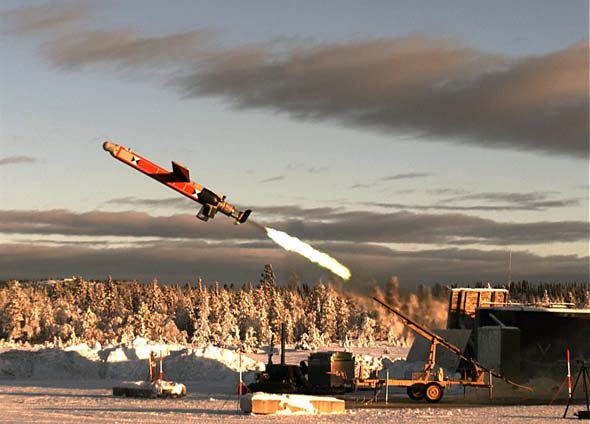
The first of these firing, using a complete weapon system, was carried out on 21st November 2010 at Vidsel, Sweden to demonstrate system integration, launch, stable flight, waypoint navigation and data-link function which supports the maturation of the munition and its control. The munition flew for several tens of kilometres and its trajectory included a number of manoeuvres, such as a loitering pattern.
The Fire Shadow loitering weapon system is maturing toward a planned initial deployment in Afghanistan with the British Army next year. MBDA has performed several successful tests recently, the latest system-wide trial was conducted in Sweden in May 2011. According to MBDA, the demonstration trials and firings tests pave the way for a planned entry into service next year with the British Army. The Army plans to deploy the new weapon in Afghanistan, significantly extending the reach, coverage and persistent of current artillery fires.
The first of these firing, using a complete weapon system, was carried out on 21st November 2010 at Vidsel, Sweden to demonstrate system integration, launch, stable flight, waypoint navigation and data-link function which supports the maturation of the munition and its control. The munition flew for several tens of kilometres and its trajectory included a number of manoeuvres, such as a loitering pattern. Photo: MBDA
The first of these firing tests, using a complete weapon system, was carried out on 21st November 2010 at Vidsel, Sweden to demonstrate system integration, launch, stable flight, waypoint navigation and data-link function which supports the maturation of the munition and its control. The munition flew for several tens of kilometres and its trajectory included a number of manoeuvres, such as a loitering pattern. A second test followed a year later, on May 13th 2011 at the same location, employing a more complex trial scenario, exercising the ‘Man-In-The-Loop’ functionality. Throughout the flight the operator was able to select and successfully engage a representative target.
The Fire Shadow loitering weapon performed demonstrated a full system firing test on May 13th 2011 at Vidsel, Sweden, employing a complex firing scenario exercising 'Man-In-The-Loop' functionality, operators demonstrated how targets can be detected, acquires and engaged in flight. Photo: MBDA/Vidsel Test Range RFN“Fire Shadow fills a gap in the capabilities needed by the Armed Forces“ says Steve Wadey, Executive Group Director Technical and MBDA UK Managing Director, “The system’s potential is such that it lends itself to new roles and has been designed to adapt and evolve to ensure that weapon provides an operational edge now and for the future.“ he added saying the new capability will be ready for delivery to the UK early 2012.
British Army personnel also had a chance to experience the new weapon “hands-on” at the MBDA integration lab at Filton and Bedford, tailored to provide the “look and feel” of the system. The lab enables the military to refine Tactics, Techniques and Procedures (TTPs) and prepare for formal training later in 2010. The system was also demonstrated to operate seamlessly within a modern battlespace HQ context at the Coalition Warrior Interoperability Demonstration event.
Loitering weapons captured the imagination of the UK MOD in the 1990 after an operational analys examining artillery fires capabilities concluded that the artillery required greater precision at range. Better responsiveness and persistent capability to attack individual and groups of manoeuvring and mobile land targets in cluttered environment was required, as an element of the future Indirect Fire Precision Attack (IFPA) programme. Following many iterations, the analysis recommended the loitering munition capability as a key element of any IFPA mix of weapon systems. After more than a decade, this revolutionary concept has matured into the Fire Shadow weapon system, a concept offering the land component an organic, flexible fires effects capable of timely, precisely and persistently support at appropriate ranges, allowing simultaneous attack in deep, close and rear operations throughout the spectrum of conflict.
Fire Shadow provides a precision capability to engage high value targets in complex scenarios. Surface launched, the munitions have a range of about 100 km and can conduct a direct transit to target or be positioned to loiter in the airspace for a significant time (about 6 hours). A Man-In-The-Loop decision then enables a precise and rapid attack against a selected target.
Fire Shadow can be targeted by a range of ISTAR (Intelligence, Surveillance, Target Acquisition and Reconnaissance) systems, for example a forward observer with binoculars or a sophisticated system such as a UAV. If required, the Fire Shadow could loiter in the target area for about 6 hours and will be particularly effective in complex environments such as urban areas. After launch, Fire Shadow may receive real-time target information from a range of sources in a potentially networked environment.
British Army personnel also had a chance to experience the new weapon “hands-on” at the MBDA integration lab at Filton and Bedford, tailored to provide the “look and feel” of the system. The lab enables the military to refine Tactics, Techniques and Procedures (TTPs) and prepare for formal training later in 2010. Fire Shadow can be targeted by a range of ISTAR (Intelligence, Surveillance, Target Acquisition and Reconnaissance) systems, for example a forward observer with binoculars or a sophisticated system such as a UAV. If required, the Fire Shadow could loiter in the target area for about 6 hours and will be particularly effective in complex environments such as urban areas. After launch, Fire Shadow may receive real-time target information from a range of sources in a potentially networked environment. Photo: MBDA
The Husky vehicle mounted mine detection system equipped with the Advanced Ground Penetration Radar (AGPR) from Chemring. Adjacent to the Husky, a Talon UGV is seen, equipped with a light GPR-Electromagnetic Inductance (EMI) sensor. Photo: Tamir Eshel, Defense-Update
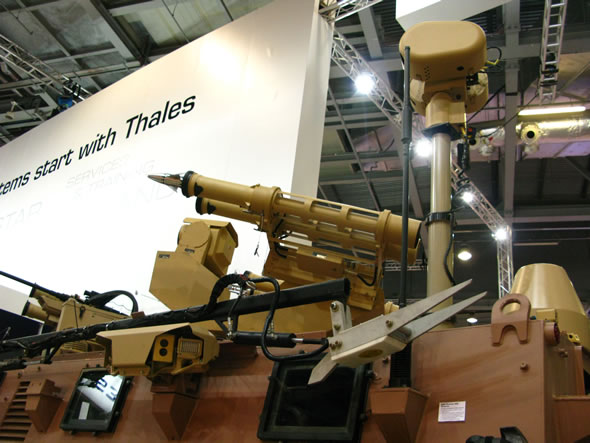
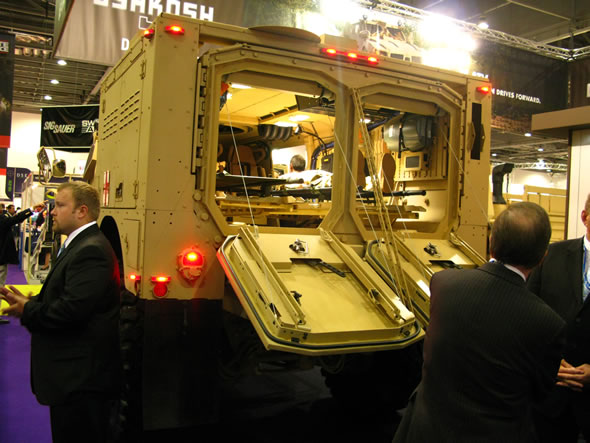
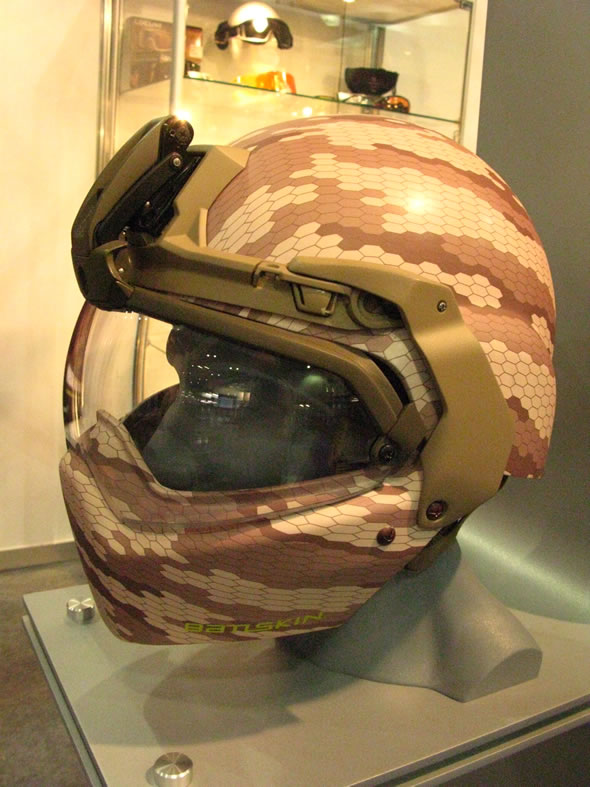
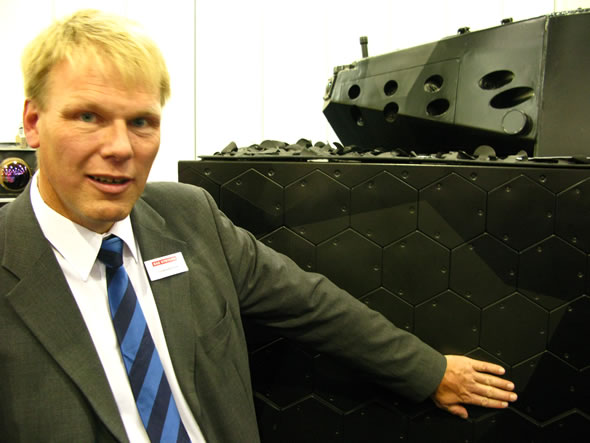
Force Protection Europe is displaying here the new Ocelot Weapons Variant of the light protected patrol vehicle. Photo: Tamir Eshel. Defense-UpdateThales is displaying a wide array of add-on systems installed on the Bushmaster protected vehicle. Visible in this picture are the counter-IED manipulator arm, mast mounted EO payload, multi-purpose missile launcher, remotely operated weapon station and side camera. Photo: Tamir Eshel, Defense-UpdateThe Husky vehicle mounted mine detection system equipped with the Advanced Ground Penetration Radar (AGPR) from Chemring. Adjacent to the Husky, a Talon UGV is seen, equipped with a light GPR-Electromagnetic Inductance (EMI) sensor. Photo: Tamir Eshel, Defense-UpdateAn MATV configured as an armored, mine protected ambulance is displayed at the Oshkosh stand. Photo: Tamir Eshel, Defense-UpdateThe new Batkskin line of ballistic protection helmets, offered with integrated visor and face protection mandible guard introduced by Revision. Photo: Tamir Eshel, Defense-UpdateHaken Karlsson demonstrates the ADAPTIV system's operation on the CV-90-120. A complete vehicle protection system would include about 1500 hexagon shaped panels, each controlled by the system to heat or chill to display a thermal pattern blending with the background or mimicking other vehicles. We could easily feel the different temperature of individual panels by touching them. Photo: Tamir Eshel, Defense-Update
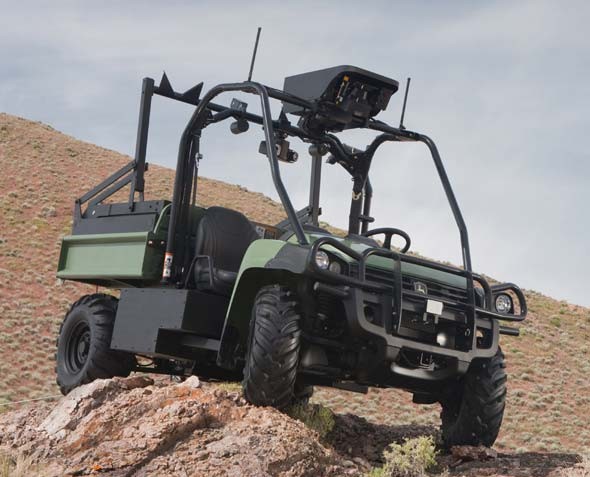
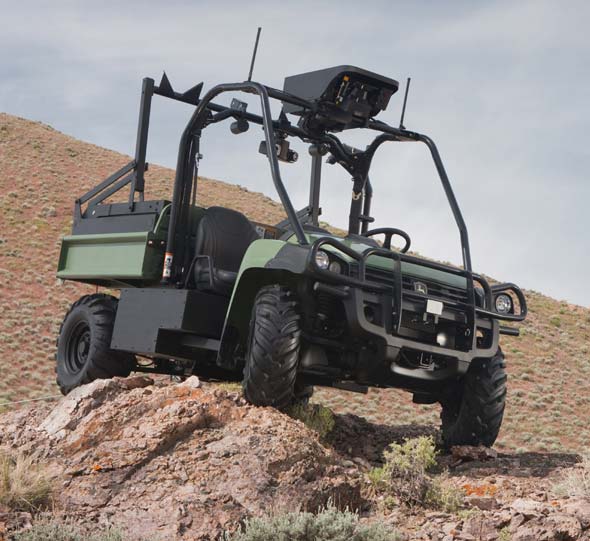
The R-Gator ACS, developed by Boeing Defence UK in partnership with John Deere, is a highly mobile, heavy-duty cross-country vehicle that is capable of keeping up with soldiers over rough terrain. Photo: John Deere/Boeing
A robotic load carrier developed by Boeing UK in cooperation with utility vehicle manufacturer John Deere and Boeing UK is unveiled today at DSEi 2011. The robotic vehicle called R-Gator A3 Assisted Carriage System (ACS) is based on John Deere’s R-Gator robotic utility vehicle.
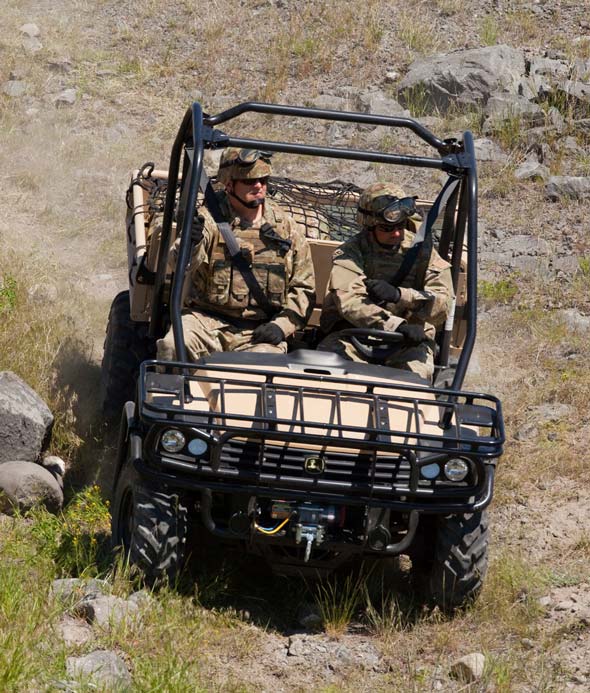
The R-Gator ACS, developed by Boeing Defence UK in partnership with John Deere, is a highly mobile, heavy-duty cross-country vehicle that is capable of keeping up with soldiers over rough terrain. Photo: John Deere/BoeingThe ACS can support an infantry section of up to eight men by allowing them to offload up to 635kg of individual equipment. Photo: John Deere/Boeing
It is designed to help reduce the amount of weight they have to carry in the field – often as much as half their own body weight in equipment, armor and supplies. The ACS can support an infantry section of up to eight men by allowing them to offload up to 635kg of individual equipment. It can also carry an increased level of combat ready supplies for more effective patrolling and re-supply operations. It can be reconfigured to meet a multitude of ground support needs.
The R-Gator ACS supports the dismounted teams with offering a highly capable cross-country mobility platform capable of keeping up with soldiers over rough terrain. The system utilizes John Deere’s proven M-Gator platform, with modified based on feedback received from soldiers and marines. According to Boeing, the modified vehicle can better perform tactical support functions, and meet the heavy-duty hauling requirements of military applications. For example, the A3’s has multiple tie-down points for sling loading, underbody skid plates, a front cargo rack and a rifle mount system to carry military specific loads. The vehicle implements precision guidance, navigation and obstacle avoidance technologies derived from John Deere’s field proven agricultural product range. R-Gator ACS can operate autonomously or be driven manually in day and night.
Both the R-Gator and the new M-Gator A3 have adjustable four-wheel independent suspension, high ground clearance and an enclosed clutch for improved fording capabilities, and a top speed of 32mph. John Deere claims the M-Gator A3 is the fastest commercial off-the-shelf diesel utility vehicle on the market.
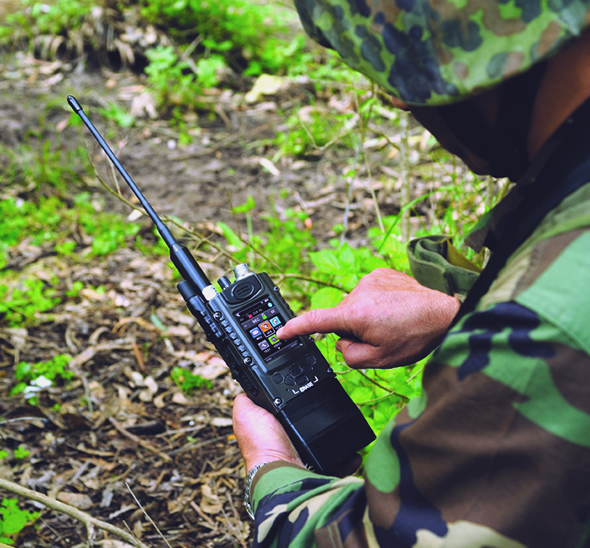
Tadiran SDR-7200 HH (hand held), a compact, lightweight SDR fitted with an integral, high resolution 2.8” color display capable of displaying live video streaming. Photo: Elbit Systems
Elbit Systems is unveiling today two advanced hand held tactical radios at DSEi 2011. The SDR-7200 HH multiband, software defined radio and the Personal Network Radio PNR-1000A personal communicator, both supporting advanced voice, data and video transfer capabilities.
Tadiran SDR-7200 HH (hand held) is the newest member of Elbit Systems’ Tadiran SDR-7200 Software Defined Radio family (SDR), a compact, lightweight SDR fitted with an integral, high resolution 2.8” color display capable of displaying live video streaming. The new radio was specifically designed for dismounted operations, offering both voice and data communications with command and control (C2) applications, seamlessly connecting to a variety of sensors.
Tadiran SDR-7200 HH (hand held), a compact, lightweight SDR fitted with an integral, high resolution 2.8” color display capable of displaying live video streaming. Photo: Elbit Systems
The new radio provides real-time situational awareness on-the-move, multi hop ad-hoc networking and advanced routing supporting hundreds of users in a network. SDR-7200 is designed to support commanders at the platoon level, communicating over both narrowband (NBWF) and wideband (WBWF) waveforms. The system supports data connectivity over a broad VHF/UHF spectrum, carrying up to 115 Kbps in 25 kHz channels over V/UHF bands and up to 1 Mbps over wider channels in the UHF bands).
The system also features integral counter-countermeasures (ECCM) and communication security (COMSEC) supporting operational networks and Special Forces operating ad-hoc networks. Its distinctive automatic routing and relay capability dramatically extends its reach even over harsh field conditions, while mobile ad-hoc networking (MANET) provides continuous IP networking connectivity throughout any mission.
The versatile Tadiran SDR-7200HH combines voice capability with advanced video streaming on the same network channel simultaneously. The radio also has an integral video camera to support video conferencing over tactical networks. Built-in digital video recorder (DVR) offers recording and playback of video streams, enabling users to study video feeds, maps, reports and targeting information on demand.
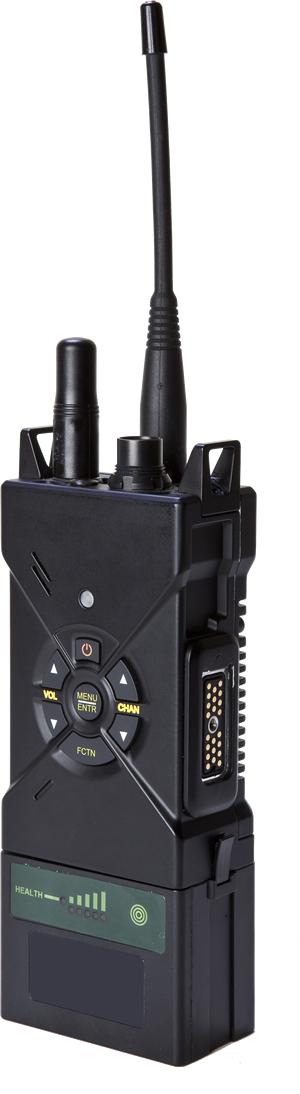
A new hand-held Personal Network Radio (PNR) from Tadiran. The new PNR-1000A radio provides high-quality intra-team voice, data video communications extending squad level radio communications with advanced C4I capabilities. Photo: Elbit Systems
PNR-1000A Personal Network radio
Another new tactical radio from Tadiran is the Personal Network Radio (Tadiran PNR-1000A), a miniature hand-held radio that continues the line of Tadiran’s proven PNR-500 line. The new set provides high-quality intra-team voice, data video communications extending squad level radio communications with advanced C4I capabilities. According to Tadiran, the new radio employs communications technologies to maintain uninterrupted connectivity in urban terrain.
PNR-1000A features full duplex voice communication, dynamic network architecture, priority mode communication and interconnectivity to long-range radio networks. Utilizing a proven, proprietary self-synchronizing technology which has already been implemented in previous PNR models, PNR-1000A’s dynamic network architecture eliminates the need for a central control unit or master station with no point of failure. This unique technology maximizes communication dependability while minimizing the network’s vulnerability. The radio can also connect directly to a vehicle intercom system, enabling personnel to dismount from a vehicle and to move freely while maintaining full connectivity while interconnecting with long range VHF/HF/UHF networks, via the vehicle’s mounted tactical radios. In the intra-team wireless conferencing mode the system shares up to six speakers.
PNR-1000A is designed as a scalable and upgradable system, the system uses an intuitive man machine interface with audible indication, enabling hands-free and blind operation supporting infantrymen and Special Forces operatives.
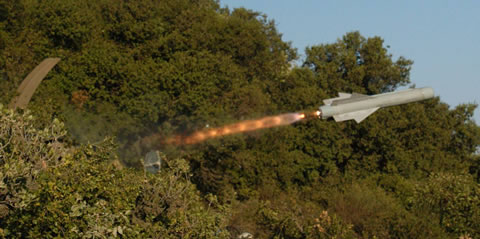
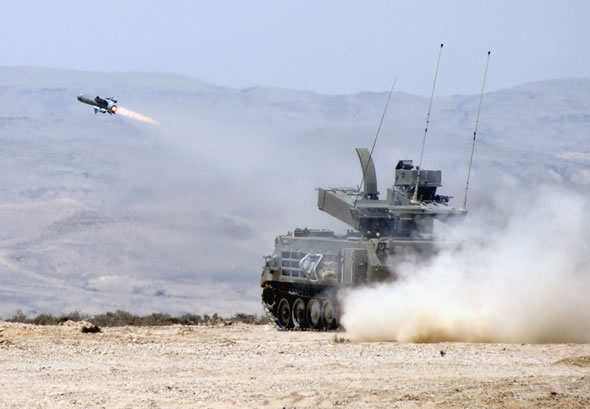
The Tamuz precision guided beyond line of sight (BLOS) guided weapon was developed by RAFAEL Advanced Defense Systems since the late 1970s and has been fielded by the Israeli artillery corps since the early 1980s. The weapon is operated from specially modified M-113 armored personnel carriers known as ‘Hafiz’. The system evolved into a larger family of EO weapons called Spike. In 2009 RAFAEL introduced the Spike NLOS, (Non Line of Sight) considered to be an advanced export version of the Tamuz.
The Tamuz has been used in 2012 – 2013 by the IDF in response to sporadic Syrian firing at Israeli patrols and military posts along the border of the Golan heights. By using this weapon’s long range and rapid response capability, high precision and minimal risk of collateral damage the IDF could relay a warning to the Syrians without risking unwanted and excessive effect that could be caused by heavier guided weapons or statistical weapons (artillery, mortars).
RAFAEL Tamuz EO Guided missile
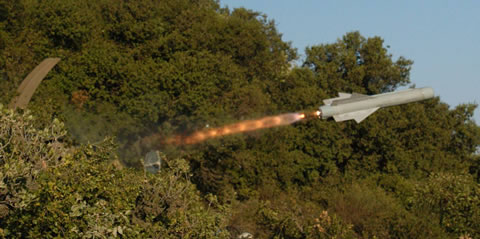
Tamuz was designed as an anti-tank weapon, equipped with a powerful shaped-charge warhead. Similar to other EO guided weapons in Israeli inventory, Tamuz can be autonomously guided with ‘man in the loop’ control, enabling maximum control and flexibility through the engagement. The missile operates in both day and night time and under limited visibility conditions. The advantages of the EO targeting and guidance system is the ability of the weapon to acquire the target in flight, based on partial targeting information. The operator can acquire the desired target as it becomes visible via the missile’s seeker, as the missile approaches the target area.
Its range exceeds 20 km and the speed is over 220 m/sec, significantly reducing the acoustic signature of an approaching missile. Although the weapon was designed as an anti-tank weapon it was successfully employed in combat against enemy irregular dismounted targets in open terrain and built-up areas. Over 600 of the missiles were fired in combat during the Second Lebanon War. Officially, the weapon’s high cost military prevents users from spending such high priced weapons on secondary important targets, however, the IDF apparently approved expending the weapons anticipating the approaching expiration (the first Tamuz systems were fielded in the early 1980s).
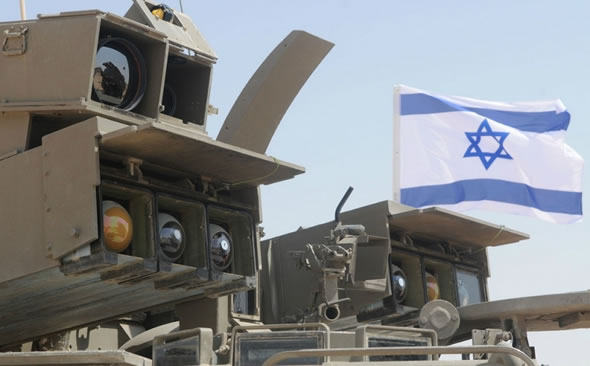
The Hafiz M-113 based mobile missile launcher carries siz Tamuz missiles, target acquisition system employed in line-of-sight modes and a datalink maintaining non-line-of-sight (NLOS) communications with the missiles through its flight. Photo: IDF
The Tamuz, an extended-range electro-optically guided missile was developed to meet the IDF 'deep attack' strategy in the 1980s, eliminating enemy second echelon forces before they reach the front line. Photo: IDF.
An interesting debate was held recently at the Latrun International Land Warfare conference, as the commander of the IDF Northern Command, Major general Gershon Hacohen detailed the evolution of Arab armies and irregular forces into semi-irregular formations, challenging the Israeli domination of the battlefield with hybrid warfare concepts. Defense Update covers this topic in two parts, one outlining the transformation of the Syrian land forces. A follow-on article will examine the evolution of similar doctrine by Hezbollah and Hamas and how such methods are challenging a technological superior military power like the IDF.
The Tamuz, an extended-range electro-optically guided missile was developed to meet the IDF 'deep attack' strategy in the 1980s, eliminating enemy second echelon forces before they reach the front line. Photo: IDF.
In 1991 the Syrian Army began a shift toward irregular warfare that continues today. Instead of modernizing its armored vehicles, fighter aircraft and naval vessels, the Syrian army allowed massive buildup along the border lines, expanded its commando battalions (fugs), massively equipped with advanced Kornet and Metis anti-tank missiles and tandem RPGs. Syria went on a shopping spree buying medium rockets and ballistic missiles, and the technologies required to enhance, modify and mass produce such weapons. The idea behind this new trend was to counter uncontested air fighting supremacy, demonstrated in all Arab-Israeli conflicts.
A similar change took place in Iran, where the majority of military investment went into the development and deployment of ballistic missiles, rockets special forces and also high speed armed naval systems to dominate the Persian Gulf.
The change was dramatic, as until then, these countries, particularly Syria, invested great efforts in building its force structure, manning, training, equipping and deploying armored and mechanized divisions, reaching a force level that could maintain four divisions in constant readiness to enter into battle against Israel at short notice.
The Syrian Army’s 1st Corps, facing Israel south of Damascus close to the Jordanian border maintained five divisions, four of which were deployed in constant battle readiness. Four divisions was Syria’s ‘magic number’, expecting their military to face the order of battle they estimated Israel would mass against Syria in Northern Israel. Meeting this requirement kept Syria in maintaining strategic parity with the Israeli Army, after its repeated defeats in the 1967, 1973 and 1982 wars.
Parallel to the Syrian military buildup in the 1980s Israel has drawn other conclusions, challenged with meeting numerically superior enemies with its small regular force, Israel had to ‘buy time‘ for its reserve forces to mobilize. The Israelis have built their forces to defeat the Syrian army, but be prepared for a possible two-front war with both Syria and Egypt – a case that actually happened three times in 1948, 1967 and 1973.
Tamuz extended range PGM can be fired from stand off range at targets beyond line of sight.
The Israelis managed to build a formidable offensive power that could successfully deal with the first echelon forces of both armies. However, relying the IDF was required to defeat the first echelons quickly and decisively, with or without its large reserve component, since maintaining a prolonged high friction combat with second echelon forces, arriving from afar in support was unacceptable for the small Israeli army. Of particular concern were reinforcements and fresh forces that would come from Iraq, tipping the balance of power against the fledgling Jewish state, as has actually happened in 1948 and during the 1973 Yom Kippur War.
The maturation of stand-off guided weapon technology in the 1980s opened new opportunities for the IDF, fielding a number of weapon systems that could interdict such reinforcements, at long range, before they actually reached the battlezone. One of these missiles was the Tamuz electro-optical guided weapon, recently declassified and now even approved for export. Although the specific weapons were guarded with secrecy, Syrian intelligence became aware of the Israeli capabilities, but failed to realize the decisive scope of this threat until 1991.
The change of mind in the Syrian Army came after the 1991 first Gulf War (Operation Desert Storm), where Syria became part of the U.S. lead coalition forces, sending the 9th division to fight the Iraqi invasion of Kuwait along with other coalition forces ( But eluded entering into actual combat). The Gulf War was an ‘eye opener’ for the Syrian high command, becoming exposed to the high lethality of western modern weaponry and tactics, so far being entirely geared to Soviet combat doctrine and its inferior weapon technology. This earth shaking experience triggered Syrian General Ali Aslan, then Army Chief of Staff to begin the transformation.
The strategic shift was not exclusive to Syria. Iran has also implemented a similar move, by gradually expanding its reach and influence in South Lebanon through their Hezbollah proxy. Hezbollah developed its forces as independent fighting units each dug into a specific location, equipped with personnel, weapons, supplies and fortifications capable of operating continuously for days, independent of communications, supply lines or even command and control.
With several such domains dominating key locations in South Lebanon, the small semi-irregular force, trained to fight in virtually ‘hybrid’ style, was deployed to contain an Israeli land maneuver, by posing continuous fighting capability deployed throughout the theater, denying the Israelis the ‘luxury’ in attacking strategic ‘weak points‘ in an attempt to overwhelm the entire enemy array by massive surge operations. Operating such multiple domains in and around the villages and cities of South Lebanon in 2006 enabled relatively small forces of Hezbollah to deny the Israeli army dominating the battle areas, constantly keeping the Israelis at risk, despite repeated efforts to clear certain areas and vital supply routes. What seemed to be Israeli hesitation and indecision was actually an unsuccessful attempt of the northern command to seize the initiative pushing the enemy off balance.
The IDF could employ different land maneuver campaigns. One option was a deep, decisive push north, through the enemy interior, in a move that would isolate the battle area and eliminate any escape of Hezbollah northward, weeding out enemy forces by exposing their hideouts. Alternatively, a series of local operations, closer to the border, could methodically wear out enemy forces by a series of local engagements, backed by massive support fires from the Israeli side of the border, exposing minimal forces to enemy attack. Both concepts were partly tried in 2006, without much success, using insufficient force concentrations, and failing to apply continuous pressure, due to political hesitation.
The different concepts have inherent drawbacks. The deep penetrating maneuver required massive forces to go simultaneously after all enemy hideouts throughout the combat area, including locations bypassed during the initial move, in a highly organized and closely controlled operation that would seep up large IDF forces and risk significant casualties and collateral damage. On the other side, the ‘local’ alternative would not help in eliminating rocket attacks on the Israeli rear area, which inevitably raises a political issue, questioning the overall purpose of the campaign from a national viewpoint.
Lockheed Martin Skunk Works® and XTEND have achieved a major milestone in JADC2 by integrating the XOS operating system with the MDCX™ autonomy platform. This technical breakthrough enables a single operator to simultaneously command multiple drone classes, eliminating the friction of mission handoffs. From "marsupial" drone deployments to operating in GPS-denied environments, explore how this collaboration is abbreviating the data-to-decision timeline and redefining autonomous mission execution.
As traditional defense primes face mounting competition from agile “neoprimes” such as Anduril, Palantir and Helsing, the balance of innovation is shifting toward software-defined warfare and scalable, dual-use technologies, while global industry consolidation—marked by Boeing’s integration of Spirit AeroSystems and other strategic mergers—signals an intensified race to secure control over the defense technology value chain. Our Defense-Tech weekly report highlights these trends.
In early October 2025, a coordinated wave of unmanned aerial system (UAS) incursions—widely attributed to Russia—targeted critical infrastructure across at least ten European nations. The unprecedented campaign exposed the fragility of Europe’s air defenses...
Executive Summary
The past week (September 18-25, 2025) represents an inflection point where strategic defense concepts have transitioned from doctrine to tangible reality. An analysis of global events reveals four primary, interconnected trends shaping an...
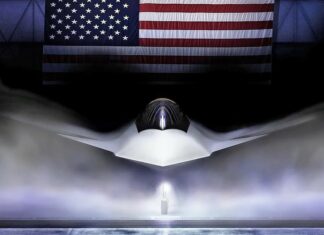
At the 2025 Air, Space & Cyber Conference, U.S. Air Force and Space Force leaders unveiled major updates on next-generation fighters, bombers, unmanned systems, and space initiatives, highlighting both rapid innovation and critical readiness challenges as the services race to outpace global competitors. A short version is available here, with a more detailed version for subscribers.
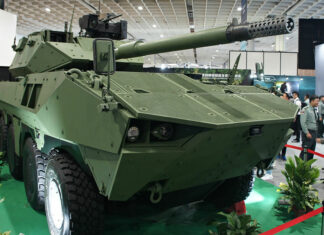
The Taipei Aerospace & Defense Technology Exhibition (TADTE) 2025 crystallized around four dominant strategic themes that collectively illustrate Taiwan's comprehensive approach to defense modernization amid escalating regional tensions. Based on a detailed report by Pleronix (available upon request). Includes a Podcast discussion on TADTE 2025's highlighting Taiwan's four strategic themes beyond the post's coverage.
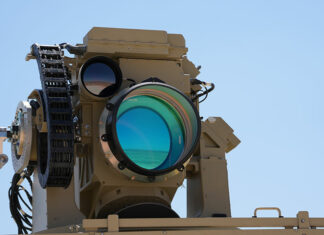
Israel’s Iron Beam 450 high-power laser system has completed final testing, marking a major leap in air defense. Developed by Rafael, it offers precise, cost-effective interception of rockets, UAVs, and mortars, and is set for IDF deployment by 2025.