Saturday, December 27, 2025
More
    Home Blog Page 250

    Top-10 Aerospace & Defense Stocks of the Week

    China Analyst reviewing the 10 best-performing Defense stocks for the past week earmarks ITT Corporation (NYSE:ITT) as 1st best-performing stock in th defense & aerospace market market segment for the week ending January 17, 2011. It was up 12.69% for the past week. ITT’s price percentage change was 13.80% year-to-date.

    Brazil’s Embraer SA (ADR) (NYSE:ERJ) is the 2nd best-performing stock last week in this segment of the market. It was up 12.36% for the past week. Its price percentage change was 12.24% year-to-date.

    Spirit AeroSystems Holdings, Inc. (NYSE:SPR) is the 3rd best-performing stock last week in this segment of the market. It was up 11.11% for the past week. Its price percentage change was 11.97% year-to-date.

    Cubic Corporation (NYSE:CUB) is the 4th best-performing stock last week in this segment of the market. It was up 8.49% for the past week. Its price percentage change was 5.41% year-to-date.

    Israel’s RADA Electronic Industries Ltd. (NASDAQ:RADA) comes 5th on the list of best-performing stock last week in this segment of the market. It was up 6.59% for the past week. Its price percentage change was 11.34% year-to-date.

    Herley Industries, Inc. (NASDAQ:HRLY) is the 6th best-performing stock last week in this segment of the market. It was up 5.64% for the past week. Its price percentage change was 3.81% year-to-date.

    LaBarge, Inc. (AMEX:LB) is the 7th on our list of top defense market performers. It was up 4.61% for the past week. Its price percentage change was -3.25% year-to-date.

    Curtiss-Wright Corp. (NYSE:CW) is the 8th best-performing stock last week in this segment of the market. It was up 4.48% for the past week. Its price percentage change was 5.99% year-to-date.

    CPI Aerostructures, Inc. (AMEX:CVU) is the 9th best-performing stock last week in this segment of the market. It was up 4.48% for the past week. Its price percentage change was 4.40% year-to-date.

    Anaren, Inc. (NASDAQ:ANEN) is closing the list at the 10th place among best-performing stock last week. It was up 4.05% for the past week. Its price percentage change was 5.95% year-to-date.

    Embraer to Overhaul 43 AMX Fighters for Brazil’s Fighter Modernization Program

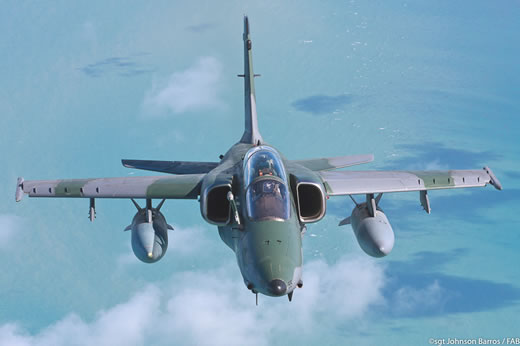
    The first fully modernized AMX flewin early 2012. Photo: Sgt. Johnson Barros, FAB

    Embraer will overhaul 43 AMX jet fighters for the Brazilian Air Force, under a new contract signed with the air forces FAB (Comando da Aeronáutica – COMAER). The current contract complements a previous one signed in 2003, for the modernization of the AMX fighters.
    According to Orlando José Ferreira Neto, Commercial Vice President, Embraer Defense and Security, the overhaul work will prepare the AMXs for their subsequent modernization, leading to more efficient and steady flow for the fighters. The original A-1phase of the modernization contract focuses on an upgrade of the electronic systems of the AMX jets. The new plan will focus on structural overhaul and necessary repair and replacement of obsolete equipment. The first fully modernized AMX is expected to fly in early 2012 and will undergo flight testing through the year, aimed at scheduled first delivery by the end of 2012. Deliveries will span over two years.

    The first fully modernized AMX is expected to fly in early 2012. Photo: Sgt. Johnson Barros, FAB

    In November 2008 Elbit Systems was awarded a $67 million subcontract to design the avionics kits for the AMX upgrade. The modernized avionics suite for the AMX will comprise new cockpit displays, an improved central mission computer and new stores management system. New self-protection systems will also be provided by Elbit’s EW subsidiary Elisra. Once production is approved, the companies are expected to enter the production phase, which Elbit estimates to be worth approximately $187 million for the company. The work will be performed in cooperation with Elbit Systems’ wholly-owned Brazilian subsidiary Aeroeletronica S.A. (AEL), located in Porto Alegre, Brazil.

    Photo: Sgt Johnson Barros, FAB

    U.S. Army Expand CROWS II Contract to Cover More Spares, Repairs

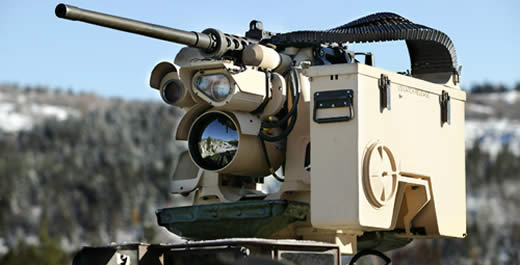
    CROWS II. Kongsberg Group

    The US Army has increased the ongoing framework contract for Common Remotely Operated Weapon Station II (CROWS II) with about US$77 million (451 million Norwegian Krones) for the purchase of spare parts. Of this amount, the company received purchase orders for valued $62 million for spares and repairs.
    The U.S. Army initially selected Kongsberg for the CROWS II program in 2007, to provide a common solution for its light and medium armored vehicles.

    The U.S. Army initially selected Kongsberg for the CROWS II program in 2007, to provide a common solution for its light and medium armored vehicles. Photo: Kongsberg Group

    Iraq, UAE & Saudi Arabia Lead the Middle East’s Defense Growth

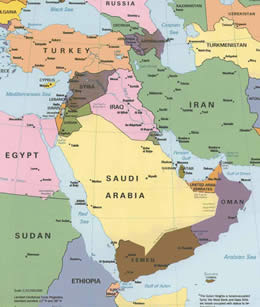
    The Middle East defense spending binge is set to grow further in coming years as Gulf Arab nations embark on military modernization programs. The region’s biggest defense spenders are Saudi Arabia and the United Arab Emirates. In its annual Middle East market analysis, Business Intelligence & research ‘Forecast International’ expects defense investment across the region to expand by 14 percent over the next five years.

    Medium-term regional defense growth will stem from Saudi-Arabia, the UAE – both core members of the Gulf Cooperation Council (GCC) members, as well as Iraq. Faced with internal security challenges, plus the need to solidify its borders, Baghdad will invest an average of $12.5 billion annually through 2015 towards the advancing development of the Iraqi Security Forces (ISF). Iraq’s military procurements are based almost exclusively on U.S. systems, acquired through the U.S. Pentagon’s government-to-government Foreign Military Sales (FMS), ensuring U.S. defense companies are the beneficiaries. Since 2005 the U.S. Department of Defense has allocated about $19.1 billion to the fund.


    The principle area of Iraqi investment going forward will be in bolstering the Iraqi Air Force (IQAF). The IQAF plans to field 500 fixed- and rotary-wing aircraft by 2020; its pressing needs include advanced jet trainers and combat aircraft.

    The withdrawal of U.S. forces from Iraq, combined with a broad range of equipment requirements means that the pace of fitting-out the ISF will have to accelerate if the central government is to capably provide security. Such progress may be hindered if Pentagon investment in the Iraqi Security Forces Fund dries up due to Washington’s own budgetary pressures at home.

    “Although the Iraqi government would like to diversify its supply chain, the U.S. remains its principal provider of military equipment,” says Forecast Middle East defense analyst Dan Darling. “So long as U.S. funding towards the development of the new Iraqi Security Forces continues, this is unlikely to change. Should Washington turn off the tap, others will surely step into the void, including France, Russia and suppliers from Eastern Europe.”

    While Iraq provides a robust market opportunity due to the ongoing ISF rebuilding process, the scale of investment in the Gulf region is higher. Spearheaded by a $60 billion package of approved FMS agreements, Saudi Arabia aims to upgrade its air fleet with new and refurbished F-15 jet fighters and new helicopters including up to 70 Boeing AH-64D Apaches, 36 Boeing AH-6i Little Birds and 72 Sikorsky UH-60M BlackHawks. In addition there is mention of a major Royal Saudi Navy upgrade program also being pursued through Pentagon FMS channels that could be worth up to $30 billion.

    Mirroring the Saudi efforts, the UAE is also undertaking a modernization of its Air Force. This modernization includes an approved FMS agreement for the purchase of 60 AH-64D Apache helicopters. The UAE is also in the process of considering successors for its fleet of Mirage 2000 jet fighters in what may ultimately prove to be a 60-unit buy worth up to $10 billion. Additional areas that the UAE may seek to upgrade include littoral protection and air defense.

    Concrete defense cooperation amongst the six GCC members continues to be elusive, leaving each nation to pursue their needs independently. Thus the UAE, Kuwait and possibly Qatar are each contemplating a buy of the Dassault Rafale combat aircraft while the Saudis and Oman seek U.S.-built solutions to their jet fighter needs. But despite the lack of progress within the GCC in terms of a common procurement approach, the one constant is that at the national level defense investment remains robust, generally representing between 10-20 percent of total state expenditure annually. For 2010 combined GCC defense/security investment was $68.3 billion. Forecast International expects that total to increase to $73.4 billion in 2011 and continue growing to $82.5 billion by 2015.

    “Fearing Iran’s regional strength the GCC states continue to seek a distinct qualitative military-technological edge over Tehran,” Darling says. “But Iran’s manpower and missile strengths camouflage some serious weaknesses, such as command-and-control shortcomings, a combat aircraft fleet falling into disrepair and an armored vehicle inventory of questionable capability. Other than its long-range missiles, Iran is limited for now in its ability to project conventional military power across the Gulf. In other words, some GCC countries may be susceptible to over-buying for a certain kind of threat that is not readily apparent.”

    Though it may lack the modern material seen in most Tier 1 militaries, this is not indicative of reluctance by Iran to improve and expand its weaponry or invest in defense. Tehran spends around $9.3-9.5 billion annually, a trend Forecast expects to continue in the near-term. This level of expenditure places it amongst the five highest defense spenders in the region, behind Saudi Arabia, Israel, Iraq and the UAE. Much of Iran’s defense investment goes towards personnel costs, missile programs, upgrading existing platforms and developing indigenous hardware.

    Because of the myriad threats it faces, Israel continues to place a premium on military funding. Aided by U.S. Foreign Military Financing (FMF) of $3 billion, the country continues to invest in modern jet fighters, its multi-layered anti-missile air-defense network, unmanned aerial vehicles, the Namer heavy infantry fighting vehicle and a slew of other projects. Impending purchases include a new advanced jet trainer and two large missile corvettes. Egypt is also a beneficiary of generous U.S. FMF allotments, receiving about $1.3 billion per year. Forecast expects Egyptian defense spending defense over the next five years to reach around $16 billion, with Israeli spending coming to over $64 billion during that same timeframe.

    “The major defense markets of the Middle East continue to be dominated by the U.S.,” Darling says. “Russia has footholds in Syria and Yemen and is making efforts to help equip the Lebanese Armed Forces. But its regional market share pales in comparison to that of the U.S. With President Medvedev signing a decree back in September banning the supply of a variety of Russian armaments to Iran, the other major market for which Moscow was the principal supplier is now likely to be ceded to China.”

    India Seek To Expand AEW Fleet to Extend Airspace Coverage

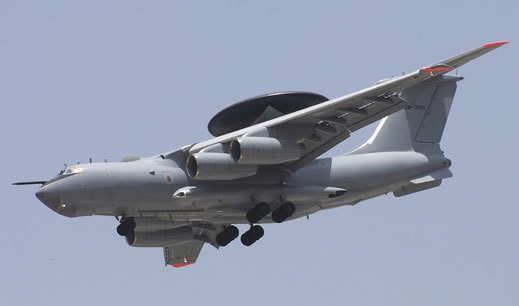
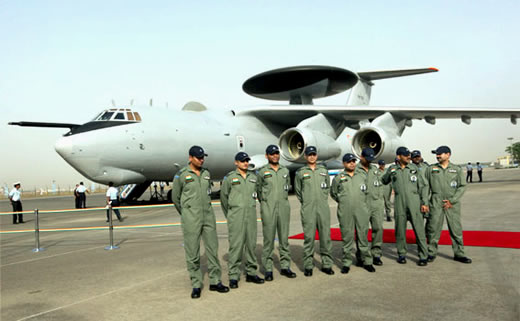
    IL-76TD fitted with the Airborne Early Warning dome hosting the Israeli EL/M-2075 Phalcon radar comes to a landing at Ben-Gurion Airport in Israel, on one of its test flights in 2008. Photo: Rami Mizrachi
    Airshow-Live sponsor: IAI

    India is integrating several versions of airborne early warning and control (AEW&C) systems, integrated on board Russian and Brazilian aircraft, providing the Indian Air Force (IAF) a capability to detect targets and manage air operations beyond the range of conventional ground-based radars and tethered radars currently used by the Air Force.

    Under a parallel program the Indian Air Force has inducted two IL-76TD AEW since 2009 with the third being completed at IAI in Israel. These aircraft are integrated with the IAI/Elta EL/M-2075 radar and complimentary ESM system.

    IL-76TD fitted with the Airborne Early Warning dome hosting the Israeli EL/M-2075 Phalcon radar comes to a landing at Ben-Gurion Airport in Israel, on one of its test flights in 2008. Photo: Rami Mizrachi

    India and Israel are reportedly discussing the delivery of three additional IL-76TD based AEW planes. The IL-76 AEW is designed for mission extending over 9 hours, IAI is also eying Indian prospects for smaller, more affordable AEW platforms that could sustain five-seven hour missions, keeping operating costs at the minimum without compromising AEW capabilities. IAI also offered the Gulfstream G5 based EL/M-2085 Conformal AEW (CAEW) which can remain on a mission for 11 hours, but deemed too costly for the Indian requirement.

    Next month Embraer is planning to roll out the first of three Airborne Early Warning and Control (AEW&C) aircraft, modified to equip the Indian airborne early warning radar system developed by the Indian Centre for Airborne Systems (CABS). Built around a modified version of the Brasilian EMB-145 from Embraer, the new system was integrated by the Indian company addressing IAF’s specifications. Flight trials are expected to begin by the end of 2011. CABS is a laboratory under the Defence Research and Development Organisation (DRDO). Embraer and DRDO embarked on this cooperation in 2008, for the modification of the EMB145, preparing the passenger plane to carry the dorsal active array antenna. Flight testing of the modified aircraft will be performed in Brazil, to follow by the delivery of the aircraft to India around August 2011.

    India Refloats Tender for Six new Flying Tankers

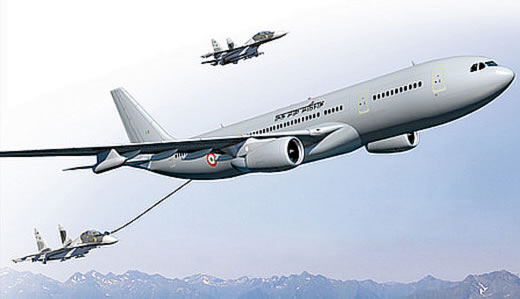
    Two years ago the Indian Air Force selected the Airbus A-330 MRTT for its future tanker but failed to win support for the program from the ministry of finance. The current round is expected to increase the cost by 15-20 per cent . Photo: EADS-Airbus
    Airshow-Live sponsor: IAI

    The Indian Air Force (IAF) is seeking to buy six new flying tankers to augment its existing aerial refueling capability. The two companies are competing on this tender, expected to cost around 9,000-crore (US$2 billion) include Russia’s United Aircraft Corporation (UAC) and EADS. Both offers include the planes they put forward for the first tender. U.S. aircraft maker Boeing considered its new-generation 767 model as a possible contestant, but missed the January 12 deadline to submit its bid. Boeing cited uncertainty with the U.S. Air Force’s order for 179 aerial tankers as a reason for not entering the competition for the Indian order, which is estimated at $2 billion.

    Two years ago the Indian Air Force selected the Airbus A-330 MRTT for its future tanker but failed to win support for the program from the ministry of finance. The current round is expected to increase the cost by 15-20 per cent . Photo: EADS-Airbus

    EADS is offering the A-330 Multi-Role Tanker Transport currently being delivered to Australia. The company said it will be able to deliver the first A330 MRTT within three years of signing the order, with the remaining five to be supplied up to 15 months later. The IAF currently operates 6 Ilyushin IL-78MKI. These planes are customized variants of the Il-78ME built in Uzbekistan, designed specifically for the Indian Air Force. They are fitted with a aerial refueling system designed by IAI Bedek, capable of refueling 6-8 Su-30MKIs on each sortie.

    In September 2009, the Indian Finance Ministry had rejected the Indian Air Force/MoD selection of the A330 MRTT as too costly. Reports at the time suggested the final price of the A330 MRTT package for six aircraft was Rs 8,000-crore (around $1.8-billion), compared with Rs 5,000-crore ($1.12-billion) paid for the previous IL-78MKI package. However, these planes have experienced serviceability issues with the IAF, which led the service to cancel the bid, raising its requirement for the new tender.

    As a side route for the Boeing 767, Israel proposed to equip India with used 767 planes, modified into military flying tankers, but the Indian Air Force insists on buying new aircraft, therefore shelving the Israeli proposal.

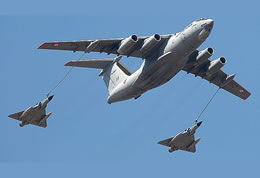
    Indian Air Force IL-78MKI refueling two IAF Mirage 2000.

    The Russian offer likely to be the least costly, has also gained another advantage, since it is likely to integrate the Israeli system that already has proven to work with all Medium Multi-Role Combat Aircraft (MMRCA) contenders during recent flight testing carried out last summer in India. EADS is likely to offer their own refueling systems, already integrated into their respective platforms.

    Plasan

    Plasan is an international company engaged in the design, development, and manufacture of state-of-the-art, lightweight, ballistic armour protection products and integrated survivability systems. It has rapidly become a key global manufacturer and integrator of armour systems designed from composite materials for up-armour appliqué kits used on various light military vehicles, APCs, personal protection equipment, rotary and fixed-wing platforms, as well as for naval vessels.

    Website link: Plasan.com

    Plasan’s state-of-the-art survivability suites offer a unique optimization between protection, payload and cost by combining in-house R&D, design, prototyping, and manufacturing capabilities. Plasan’s products endure the trials of combat, saving the lives of countless troops. The company translate their “front line” feedback into improved designs and better survivability products. Plasan’s engineers are unique in terms of their military backgrounds and hands-on experience. They bring to the product design process unique insights to soldiers’ needs in combat, which we then translate into hundreds of design decisions. Some of them are even users of Plasan’s products. Through the military background of many key Plasan personnel, Plasan’s people share a common language with their customers and the war fighter, resulting in close and invaluable relationships.

    Through more than 20 years of activity Plasan has acquired expertise in production for programs of varying scopes.  Infrastructure currently in place has enabled manufacture of over 1200 kits per month (Including ceramic parts), involving deliveries for a variety of programs, each with its own requirements.

    Utilizing a flexible supply chain, which includes multiple sources for key components, rapid ramp-up a required by customer’s delivery schedule, and on-line logistics tracking of parts, work-in-progress (WIP) and completed parts. This has been made possible by:

    • Expansion of supplier / subcontractor base in Plasan’s supply chain.
    • Smart utilization of suppliers and subcontractors
      which are close to customer’s delivery site.

    Plasan Group currently operates subsidiaries in France and the U.S.A. Plasan North America (PNA) has two subsidiaries in the USA – Plasan USA Inc. and Plasan Carbon Composites (PCC). In September 2010 the company launched a JV with TPI Composites Inc.,  PNA is the leading manufacturing authority for the armor component for Oshkosh’s M-ATV project, producing and delivering 1,000 ballistic protection kits a month. The addition of a 73,000-sq. foot facility with dedicated equipment and a combined production staff of 240 have greatly expanded our manufacturing capacity.

    In 2007, Plasan acquired LSI Group, a French holding company for AMEFO and BERARD. Both firms are manufacturers of high hardness steel hulls and metal equipment for the automotive and military industries.

    Plasan Israel is Located in Kibbutz Sasa in northern Israel, Plasan Sasa is a privately owned company by the kibbutz. Plasan has several production, storage and development sites including Kibbutz Sasa – the main production and development site; an additional fabric preparation site; and a logistics center and kitting site. Plasan’s production line is based on the Job Shop concept – a process-designated functional formation. Plasan has mechanized production lines (a unique line in the armor protection industry) as well as production lines based on skilled labor. In 2010 the Plasan Group established TorTech Nano Fibers Ltd under a Joint Venture with U.K. Q-Flo for the production of carbon nanotube fibre for the enhancement of body armor and composite armour systems for vehicles .

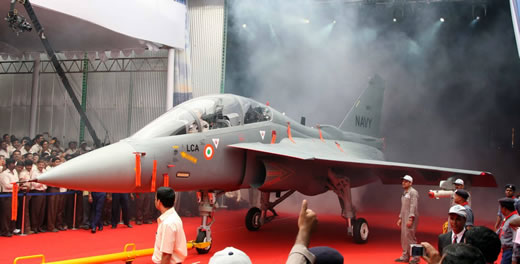
    Tejas – India’s First Indigenous Combat Aircraft Cleared to Operate by Indian Air-Force Pilots

    After 28 years in development, Tejas is finally certified operational, although not nearly a nearly 100% Indian, ADA is still formally committed to full indigenization of the program, with the introduction of locally designed engine in a fully indigenized aircraft by 2014.
    Airshow-Live Sponsor: RAFAEL

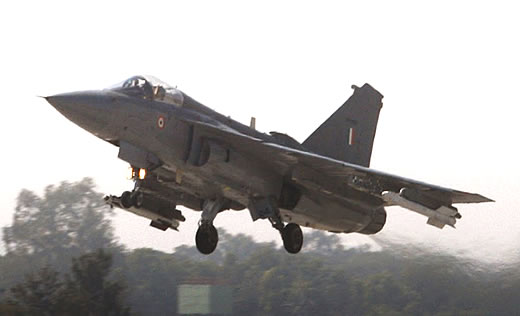
    On January 10, the Indian Air Force (IAF) formally announced the country’s new, indigenous fighter, the Tejas Light Combat Aircraft (LCA) was received ‘initial operational clearance’ (IOC). Once its entire flight envelope and weapons are cleared for operation, the new aircraft, developed for the past 20 years, will equip the first fighter squadron operating 20 aircraft in about two years.

    Tejas, is the first fighter aircraft ever to be developed by India and was designed by the Bangalore based Aeronautical Development Agency (ADA) under the Defence Research and Development Organization (DRDO). Final assembly of the aircraft and flight testing are performed at Hindustan Aeronautics (HAL) plant at Bangalore. Originally launched in 1983, India’s Light Combat Aircraft project expanded far beyond the projected schedule and cost, with an estimated budget of Rs 560 crore (about $5.6 billion). Sofar about US$3.8 billions were invested in the program.

    After 28 years in development, Tejas is finally certified operational, although not nearly a nearly 100% Indian, ADA is still formally committed to full indigenization of the program, with the introduction of locally designed engine in a fully indigenized aircraft by 2014.

    When it reaches full operational capability, the current Tejas is claimed to be comparable with Sweden’s Gripen, the Chinese-Pakistani J-17 Thunder and the South Korean T-50 jets. But some in the Indian Air Force reluctantly relate to their newest plane as ‘not more than an upgraded MiG-21’. But Tejas is a ‘work in progress’, and, if the ADA roadmap will progress as expected, Tejas Mark II could become a ‘4+ generation’ fighter. Once completed, and given support from the cabinet, the aircraft could be produced in large numbers if the Indian Air Force will select the Tejas to fulfill its plans for 200 fighters, replacing the MiG-21s being withdrawn from operational use, after several decades of service. However, at present the Air Force considers buying only 83 Mk-II aircraft, hence the likely production lot to about half of the projected volume. The Indian Navy is still committed to the program, expecting 40+ aircraft to replace its Sea Harrier FRS-51 and two-seater Sea-Harrier T-60.


    The long Way to Indigenous design production

    It took the Indian government 14 years to agree on the plan to develop an indigenous aircraft administration. The design team operating under ADA control took 18 more years to mature the design into a flying prototype, and additional 10 years have passed since its first flight, until the Tejas has reached IOC. Beside the Indian nature of moving at a slow but steady pace, part of the complexity of this program was, that ADA was mandated with a huge challenge – to develop a fighter aircraft consisting entirely of Indian technology. While the end product is not nearly 100% Indian, ADA is still formally committed to full localization of the program, with the introduction of domestically designed engine fitted into a fully locally produced aircraft by 2014.

    Taking a more pragmatic view of the program DRDO is preparing an alternative path, with 60% level of Indian content. VK Saraswat, DRDO chief, explained that complete indigenous design and production would instead end up with the unit cost going up several times more than the present Rs180 crore apiece (about US$42 million).

    The IAF plans to base the first squadron in Bengaluru and eventually position Tejas in Sulur in the south Indian state of Tamil Nadu. The first squadron is expected to become operational in 2013, along with full operational certification of the aircraft.

    The IAF’s does not consider indigenous design and production as its utmost priority, and insists that the new fighter should be rated ‘fourth generation’ status for full acceptance – which is now scheduled for December 2012. The next version, Tejas Mk II will be integrated with Indian systems utilizing foreign technologies, adhering to India’s strict technology transfer rules. The GE-414 engine is one such example. The first flight of the Tejas Mk II is expected in 2014 followed by planned service entry in 2016.

    The development of the engine clearly demonstrates how India has met this ambiguous challenge. As part of this program, India was already developing an indigenous engine known as Kaveri, which experienced major hurdles throughout its development. In 2004, after realizing their Kaveri jet engine could derail the entire program, India selected the General Electric F404-GE-IN20 engine as an interim solution for the first production batches, powering the first 40 production aircraft. In 2010, following an international tender that included the Eurojet, M88 and F-414, the General-Electric GE-414 was selected to power 99 of the next phase “Tejas Mk II” variants. This engine is also required to power the naval version. The prototype of the Indian Navy Tejas two-seat variant NP-1 rolled out in July 2010, the Indian Navy has a requirement of 50 such aircraft. The two-seater trainer variant prototype flew in November 2009.

    The naval version Tejas NP-1 prototype rolled out in July 2010.

    In the area of flight controls, the airframe design and construction ADA managed to overcome the obstacles associated with computing and materials – elements made of carbon fiber composite make over 40% of its weight.

    The ‘glass cockpit’ comprises three 5×5 Multi-Function Displays (MFD) and DASH helmet mounted display and sight (HMDS). The level of indigenous design and production is also evident in the avionics suite. Out of a total of 35 major avionics components and line-replaceable units (LRUs), only three involve foreign systems. The MFDs are imported from Sextant in France and Israel’s Elbit Systems, which also provides the HMDS. Israel’s Rafael also provides the Rafael “Litening” targeting pod for the aircraft. Other avionic systems developed in India include self-protection systems and radar. Yet both systems were not ready for production, necessitating integration of foreign systems in the first production aircraft. These include derivative of the Elta EL/M-2032 radar and self protection system from Elisra.

    IWI – Israel Weapons Industries

    Israel Weapon Industries (IWI) Ltd. It was established after privatization of the  former Israel Military Industries (IMI) Small Arms Division, which has been the leading weapon manufacturer in Israel for over 70 years.

    Micro Tavor, Negev LMG in IDF service

    Company Website: israel-weapon.com

    IWI Product Line:

    IWI's Tavor assault rifle is shown here equipped with Meprolight NOA X4 scope. Photo: Meprolight

    Today, IWI is part of a group of companies specializing in the development, manufacturing and marketing of defense products for the local,  and international market, offering equipment to customers, including military forces and law- enforcement agencies.

    Employing state of the art design, development and manufacturing technologically, IWI has consistently provided weapons favored by the best military and police forces around the world – from the legendary UZI SMG to IWI’s latest addition, the TAVOR, X-95 Assault Rifles and NEGEV Light Machine Gun.

    Development, manufacturing, testing and quality assurance, specified to the most stringent military standards, are carried out in-house at IWI’s facilities, enabling the company to operate efficiently, maintain highest quality standards, while rapidly adapting to customer- requirements and market trends.

    IWI’s firearms are developed in close collaboration with the IDF. IWI and the IDF established joint Research and Development (R&D) teams,  to create the weapons, whose ultimate configuration is the product of ongoing interaction, field tests and modifications, applied from most recent combat requirements.

    IWI Product Line:

    IWI is one of the world’s leading producers of combat proven small arms for over 70 years. The company’s range of weapon systems include:

    TAVOR line of assault rifles

    The Tavor was developed by IWI in cooperation with the IDF. Its compact rifle and long barrel are key attributes for its excellent usability for modern, asymmetric combat. The weapon has an integral, advanced and accurate sighting system attached directly to the barrel. Designed with optimal ergonomics Tavor increases the user’s comfort and confidence level.

    NEGEV Light Machine Gun

    The standard LMG of the Israel Defense Forces. High reliability and versatility that suits a large variety of operations. NEGEV can optimized for dismounted operations. It can also be used as vehicle mounted weapon, on helicopters or naval crafts.

    ACE and GALIL Assault Rifle

    Galil is a lightweight, air-cooled, gas-operated, magazine fed multi-purpose personal weapon. It is designed for firing from the shoulder or hip. The Galil was combat proven as a highly reliabile weapon, proving itself in difficult and extreme conditions. The ACE is based upon the reliable mechanism of the GALIL. It is perfectly suitable for modern battle field, with enhanced human engineering. The five Picatinny rails allow adding an array of optical devices and accessories. The ACE is easy to use and simple to maintain.

    Galil Sniper Rifles

    This is a semi automatic sniper rifle, designed for high accuracy, ease of operation and convenient carriage under tough operating conditions. The weapon is offered with a folding stock for use by special units and law enforcement. Galil Sniper Rifle is in service with military and government agencies worldwide.

    UZI Submachine gun

    The first and leading SMG. The legendary UZI has been the most popular weapon for over 50 years. Since the introduction in 1956 over 2 million units were sold worldwide. The combat-proven UZI has proved itself as the most reliable SMG to date.

    JERICHO and BARAK handguns

    IWI is offering two types of handguns – the Jericho and Barak. Jericho is built on a high quality, all steel construction. Its barrel has polygonal rifling for greater accuracy and longer barrel life. Among the ergonomic features are the forward-positioned center of gravity providing for reduce barrel jump, polymer stock and safety on slide. Barak Is a lightweight, ergonomically designed handgun offered for self-defense and law enforcement needs. It is available in 3 cal: 9mm, .40 S&W, .45 ACP.

    The company also offers a wide range of weapon accessories such as telescopic sights, reflex or Tritium sights, night vision sights, flash lights, and more…

    Contact Israel Weapon Industries (I.W.I.) Ltd.

    Phone: +972-3-7606000
    Fax: +972-3-7606001
    P.O Box 63 Ramat-Hashron 47100 Israel
    E-mail: [email protected]

    Rada Electronic Industries. Company Profile

    RADA Electronic Industries Ltd is a defense electronics system house specializing in the design, development, production and sales of advanced electronic systems for airborne and land applications. RADA provides complete system solutions designed primarily for the aerospace and defense market.

    Website link: rada.com


    RADA’s product lines include:

    RADA offers advanced Software Defined, Pulse-Doppler, AESA radars for Force and Border protections. These multi-mission radars introduce hemispheric spatial coverage, with excellent performance-to-price ratio. RADA’s Radar technology provides compact and affordable sensors for APS and Perimeter Surveillance.

    RADA is also a recognized world leader in the field of airborne video and data recordings. The company’s INS solutions, based on Fiber Optic Gyros (FOG) or Micro-Electro Mechanical Sensors (MEMS), are highly affordable and are suitable to a wide range of airborne and land military applications .

    Based on its product range and extensive engineering experience, the company also offers complete system solutions, primarily in video and data recording and management systems, and avionic upgrade suits for military and aircraft and Mission (ISR) aircraft .

    RADA’s customers include leading air forces the world over and prime integrators such as Lockheed Martin, Boeing, General Electric, Israel Aerospace Industries (IAI), Hindustan Aeronautics Ltd (HAL), Rafael Advanced Defense Systems, Embraer, Israel Military Industry (IMI) and many others .

    RADA was founded in 1970 and has been traded on the NASDAQ stock exchange since 1985. RADA’s Chairman and President is Maj. Gen. (Ret.) Herzle Bodinger, who served as the Israeli Air Force Commander prior to joining the company.

    RADA is certified to ISO-9000: 2000, AS9100B, and ISO-14001 standards.
    Radar Sensors for Force Protection Systems

    Compact, lightweight – yet armored – pulse-Doppler Digital Radars, for Active Protection Systems (APS) for armored vehicles and tanks, and Perimeter Surveillance Radars (PSR) for stationary and HLS applications.

    Data Recording and Management

    Digital Video Recorders, Flight Data Recorders, HUD Video Cameras, and Post-Mission Ground Debriefing Solutions.

    Inertial Navigation Systems (INS)

    FOG-Based Navigation Grade EGI and IMU (the R-100F family), MEMS-Based INS and IMU compact solutions (the R-200M family), for airborne and land applications.

    Avionics Solutions

    Aircraft Avionics Upgrades, ISR Aircraft Upgrades, and a wide variety of Avionics Subsystems for manned and unmanned vehicles.Defense Update posts about RADA:

    CONTROP Precision Technologies Ltd. Company Profile

    CONTROP specializes in the development and production of Electro-Optical and Precision Motion Control Systems. The company’s specialists have over 35 years of experience in Electro-Optical / Infra-Red (EO/IR) products for surveillance, defense and homeland security.

    Company website: controp.com

    CONTROP’s main product lines include automatic passive intruder detection systems for coastal surveillance, port and harbour security, border surveillance, security of sensitive sites, perimeter security surveillance and ground troops security; High performance stabilized observation payloads used for day and night surveillance on board UAVs, mini UAVs and aerostats/balloons, helicopters, light aircraft, maritime patrol boats and ground vehicles; Thermal imaging cameras with high performance Continuous Zoom Lens and state-of-the-art image enhancement features, and more. The company’s range of surveillance, defense and homeland security systems include:

    Controp’s Main Product Lines

    CONTROP’s specialists design and assemble optical lenses (zoom), in high accuracy mechanical subsystems. The company’s products are also supported by in-house electronic design, of both analog and digital systems, software design and implementation, inertial stabilization, servo-loops design testing, with inertial and GPS-aided INS systems expertise.

    CONTROP’s main product lines include: Automatic passive intruder detection systems for coastal surveillance, port and harbor security, border surveillance, securing sensitive sites, perimeter security surveillance and ground troops security; High performance stabilized observation payloads are used for day and night surveillance on board UAVs, mini UAVs and aerostats/balloons, helicopters, light aircraft, maritime patrol boats and ground vehicles; thermal imaging cameras with high performance Continuous Zoom Lens and state-of-the-art image enhancement features, and more. CONTROP’s products are in daily operational use by many of the most critical homeland security and defense programs worldwide.

    The company has a vast in-house knowledge base in all technological fields related to inertially-stabilized electro-optical payloads, and their applications for airborne, land or naval applications. The company also has the required design, simulation and testing tools and equipment supporting the product’s life cycle, from CONTROP has mastered all critical technological aspects required for successful implementation and integration of technological advances in electro-optical systems, including system-level design, analysis and simulation of electro-optical and Infra-red (thermal) sensors – both cooled and uncooled thermal imaging cameras. The company’s R&D teams specialize in real-time image enhancement and image processing, video tracker hardware / software design, implementation and integration of laser systems.

    CONTROP has mastered all critical technological aspects required for successful implementation and integration of technological advances in electro-optical systems, including system-level design, analysis and simulation of electro-optical and Infra-red (thermal) sensors – both cooled and uncooled thermal imaging cameras. The company’s R&D teams specialize in real-time image enhancement and image processing, video tracker hardware / software design, implementation and integration of laser systems.

    Main Products:

    Stabilized EO / IR Payload Systems

    CONTROP’s payloads are gyro-stabilized in two or three axis, using 3, 4 or 5 gimbals for applications in helicopters, aircraft or ground surveillance vehicles, Unmanned Aerial Vehicles, Unmanned Ground Vehicles, land vehicles or naval vessels, as well as sensors protecting fixed sites. These payloads can carry multiple sensors or a single camera, according to the user’s requirements. They come in different weight and performance levels, from 46 kg to 0.75 kg. Back

    Scanning & Observation Systems

    CONTROP was one of the world pioneers in the development of Scanning & Observation Surveillance Camera Systems. These sensors are providing both observation and panoramic scan capabilities using a single camera observation system. The company has been delivering such systems since the late 1990’s, meeting a wide range of operational requirements with numerous military and governmental agencies. Typical applications are Intruder Detection for border protection, perimeter security for air bases and other strategic sites, coastal defense and air defense applications. Back

    Thermal Imaging Cameras

    CONTROP developed a range of cooled and uncooled, high performance thermal cameras, providing night, daylight and adverse weather visibility. Typical applications of these cameras are for military, homeland security uses. CONTROP’s FLIRs are used throughout the company’s product range and also by other manufacturers and are also provided as an OEM sensor. Back

    Stabilized Gimbals and Antenna Pedestals

    The company offers Gyro Stabilized Gimbal Assemblies and Antenna Pedestals applicable for various optronic payloads and directional datalink antenna assemblies used on UAVs, aerial, naval and land-based systems. Back

    Flat Panel TV Monitors

    CONTROP also offers high brightness, ruggedized flat panel monitors for use with air, land and naval platforms and applications, including fixed and rotary wing aircraft, sea vessels and ground vehicles. These Super VGA displays are available in 15″, 10.4″ or 8.4″ LCD active matrix (TFT) screen sizes and are compatible to operate at altitudes of up to 20,000 feet. Back

    Defense Update posts about Controp:

    Mobius Protection Systems

    mobiusMobius Protection Systems (PS), a designer, engineer and manufacturer of survivability products – from crash and blast protection in combat vehicles and aircraft to car safety products in vehicles. The company’s products implement innovative and unique, patent pending energy absorption techniques facilitating flexible and simple safety and survivability solutions assuring flawless performance under the most demanding conditions.

    Company website: mobius-ps.com

    The patent pending EA technology was developed by Mobius PS team of expert engineers, having the insight, knowledge and operational experience in designing and developing blast protected combat platforms and shock absorbing systems. Many of the company’s expert engineers are veterans of Israel’s Defense Forces Merkava tank program.

    Mobius PS proven technology is based on a simple approach, utilizing a single, factory tunable element, manufactured to meet preset EA characteristics. The fixed Profile Energy Absorption element performs its mission with continuous self-adjusting dynamic attenuation, providing maximum protection to full range of occupants weights, from light 5th percentile female up to heavy 95th percentile male and beyond. This implementation provides a straightforward attachment of crew seats, passenger seats or benches, to the floor or to the walls, without the need for motion guides, rails or complex suspension and isolation techniques. Using light, strong seat frames and attachments the seats are validated to face multi-directional impacts, from blast or accident and crash scenarios. To restrain the occupants to their seats, 4-5 point safety belts, all-belts-to-seat, adjustable head-rest (available with side supports) are also provided.

    Mobius PS offers its EA technology as off-the-shelf products, ready for integration in new vehicles, as add-on upgrade for legacy seats, as well as custom designed kits. The EA systems can be provided both with original seats as well as Add-On for legacy seats, meeting the most stringent requirements and minimum physical space claim available. Mobius PS also offers complete system integration for maximal protection and has been cooperating with a number of international companies in the field.


    The unique EA technology developed by Mobius PS  is integrated in various blast protection mechanisms employed in modern military vehicles, designed to protect soldiers from mines and Improvised Explosive Devices (IED). The technology developed by Mobius PS rapidly dissipates the energies experience by the vehicle in multi-hit scenarios. Unlike other EA techniques relying on complex assemblies, suspensions rigs or moving parts, susceptible to degradation by environmental conditions and corrosion, the AE developed by Mobius PS protects from IEDs mines without compromising on performance, safety, ergonomics and user comfort.

    Mobius Protection Systems’ product lines includes the following systems:

    Floor and Wall Mounted Blast Protected Seats.

    Floor and Wall Mounted Blast Protected Seats

    The floor-mounting Blast and Crash Protection Energy Absorbing mechanism can be implemented as a standalone system and can be incorporated with legacy seats. FMVSS certified, the seat is available in three different height configurations, with an adjustable or fixed frame, fore and aft adjustment and ergonomic foam structure. The seat retains four or five attachment points for safety belts. Wall mounted configurations also has Foldable pan and back for access to the wall. Back

    These FMVSS certified seats are available in different height configuration as-well-as custom design for special requests. The seats are compatible with standard fore/aft adjustment slides. Mobius PS EA technology is also available with original GSS seat or as an Add-on system for legacy seats. Integral feet protection is also optional for floor mounted seats, where the EA element effectively keeps the occupant’s feet away from the floor during an explosion event. Back

    Confined Space Blast Protection Applications from Mobius PS

    Confined Space Blast Protection Applications

    For applications where available space is limited, Mobius PS provides effective EA solutions employing compact wall-mounted front-facing EA and bench alternative blast protected seating system. The wall mounting assembly has Pan and back that fold flat against the wall, using a snap-lock to open into a seating position. The blast protected bench introduces a unique, light and survivable alternative to seat an entire squad. The bench comprises a series of sectioned personal EA seats grouped together into a single unit that Pan folds flat against the wall. In case of an explosion, each seat acts individually to provide maximum protection to each individual.

    Mobius PS can also adapt the EA assembly to meet limited space requirement or upgrade existing attachments, such as implementing floor mounted devices over wall mounted brackets or Wall-mounted seats over floor-mounting brackets. In special circumstances where floor-mounted configuration cannot fit, Mobius PS provides a low profile EA assembly integrated with height adjuster, offering the crew uncompromised protection and ride comfort. Back

    Energy Absorbing Mounts and Sockets

    To prevent objects from tearing out of their mountings by the blast effect, thus becoming life threatening fragments, Mobius has developed energy absorbing mounts that replace standard mountings used for the attachment of internal equipment such as radios, ammunition boxes, batteries etc. Under all operating conditions these mounts perform as the original mount, but deform to absorb the blast forces when exposed to extreme accelerations. Back

    Seat Accessories

    The company also offers different accessories for the seats, including height adjusters, for/aft adjustment, special installation brackets, etc. Back

    Kinetics Ltd. Company Profile

    Kinetics Ltd. established in 1985, is a world leading developer, manufacturer and supplier of life support, auxiliary power, filtration and hydraulic systems for land systems and armored vehicles.

    Kinetics develops, qualifies, produces and fields systems and components for a wide range of tracked, wheeled, stationary and airborne military platforms, including Main Battle Tanks (MBT), Self Propelled Howitzers (SPH), Armored / Infantry Fighting Vehicles (AFV / IFV), Armored Personnel Carriers (APC), Mines Resistant Ambush Protected Vehicles (MRAP), Tactical & Tactical Support Vehicles (TV / TSV), Utility & Utility Support Vehicles (UV / USV), Rocket Launchers, Shelters and Tents. Specific applications are also tailored for helicopters and aircraft.

    Kinetics’ main product lines includes the following systems:

    The company has been the principal supplier of the Nuclear, Biological, Chemical (NBC) protection system and Individual Crew Cooling Systems (ICES) for Israel’s Merkava main battle tank, from the first model to the current Merkava Mk4 tank. The company has also developed and produces an integrated system, combining air conditioning, NBC protection and auxiliary power generation into an integrated Life Support System (LSS). The system combines the functions of NBC/CBRN protection and detection, heating, ventilation and air conditioning (HVAC), providing individual crew and equipment cooling (ICECS), with automatic fire suppression (AFS). An evolution of Kinetics’ LSS also accommodates an Auxiliary Power Unit (APU).

    Tailoring each solution to meet the specific requirement of both the platform and customer, based on qualified and fielded solutions, Kinetics maintains the collective experience, technical skills and know-how necessary to introduce sophisticated, integrated systems, meeting the harsh operating environment and the toughest environmental conditions, military platforms are expected to meet in combat.

    Website link: www.kinetics.co.il

    Kinetics Fields of Activity:

    Kinetics customizes life support systems (LSS) and Heating Ventilation & Air Conditioning (HVAC) for a wide range of wheeled and tracked armored fighting vehicles, MRAPs, self propelled guns and other vehicles.

    Kinetics Life Support Systems (LSS)
    These systems also comprise Environmental Control Systems (ECS) providing Heating Ventilation & Air Conditioning (HVA) for operations in conventional warfare. These systems fully support filtration of dust, smoke and potentially hazardous agents that could be encountered by the warfighter in asymmetric warfare. Back

    Kinetics NBC / CBRN Protection (CBRN)
    The company also produces collective NBC protection systems designed for NATO-AEP-54 standard. Such systems were developed and produced for the Piranha 3 and 4 vehicles, Pandur 2 and Armored Modular Vehicle (AMV) AIFVs, as well as in the NEMO self propelled mortar system. The system has also been integrated into the JLTV technology demonstrators
    developed by Lockheed Martin. Back

    Auxiliary Power Units such as those are integrated in main battle tanks like the M-1A2 Abrams and Merkava Mk4.

    Kinetics Auxiliary Power Units (APU)
    Kinetics has developed and fielded a ange of APUs for external and internal installation on military vehicles. These APUs are provided as standalone systems or integrated with Kinetics’ Life Support Systems (LSS-APU), providing auxiliary power, NBC/CBRN Protection and Heating, Ventilation & Air-Conditioning (HVAC). Back

    APUs can be used to support the individual platform on a ‘silent watch’ with the engine shut down, keeping low noise and thermal signatures. To support the increased power demand for add-on high power electronic equipment, the APU can be used as a ‘co-generator’, operating in parallel with the platform main engine, while stationary or on the move. It can also be used to power off-board consumers. Back

    Hydraulic Systems & Components
    Other fields of activity at Kinetics include hydraulic systems and components, used in armored vehicles for various roles, such as transmission and braking and track tension mechanism.

    Among the military hydraulic systems developed and produced by Kinetics are hydraulic elements for control systems supporting turrets, gun or missile launchers, and enhanced suspension systems for military vehicles. Such products are currently integrated in Merkava and M-1A2SEP main battle tanks, HIMARS mobile rocket system and the M-109A6 Paladin self-propelled gun. Back

    Diehl BGT Demonstrates Mutual Active Protection System (MAPS)

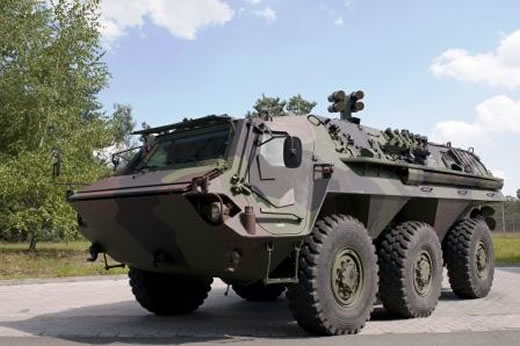
    The MAPS active protection system was installed for the testing on a Fuchs 6x6 armored vehicle. Photo: Diehl BGT

    A new active protection system was successfully demonstrated two months ago in Germany, by Diehl BGT Defence. The system known as Mutual Active Protection System (MAPS) was demonstrated on two days test series conducted 10-11 November, 2010, at the Federal Armed Forces Technical Centre WTD 91 Meppen, Germany. Representatives from the German military and international representatives from allied and international armed forces also attended the test.

    The MAPS active protection system was installed for the testing on a Fuchs 6x6 armored vehicle. Photo: Diehl BGT

    For the tests the Active Protection System mounted on a FUCHS 6×6 armored transport vehicle defeated incoming anti-tank rockets and guided missiles including those equipped with advanced tandem warheads.

    MAPS includes active and passive sensors for situational awareness, threat detection and fire control as well agile interceptors which consist of ‘blast effectors’ which destroy incoming threats by shock wave deflection, at safe distance from the defended vehicle. In addition to effective vehicle protection, MAPS accurately localizes enemy firing positions enabling rapid and precise counterstrikes by the armoured vehicle thus actively countering repeated attacks.

    The system employs a single or dual high speed launcher, mounting four interceptors each. This agile launcher can be aligned extremely rapidly to minimize system response. The modular system employs sensors (radar, IR) or soft kill countermeasures such as IR jammers to address customer specific requirements. For the recent tests MAPS employed sensors and interceptors already proven in foreign test programs.

    The system can be connected to other on-board systems such as weapon stations via the Battle Management System (BMS) or C4I systems. In addition to the system‘s protective function the sensors can also be employed to provide rapid localization of threats and situational awareness for the crew.

    Related posts: Active Protection Systems from Germany

    Skunk Works and XTEND Simplify Multi-Drone Command

    0
    Lockheed Martin Skunk Works® and XTEND have achieved a major milestone in JADC2 by integrating the XOS operating system with the MDCX™ autonomy platform. This technical breakthrough enables a single operator to simultaneously command multiple drone classes, eliminating the friction of mission handoffs. From "marsupial" drone deployments to operating in GPS-denied environments, explore how this collaboration is abbreviating the data-to-decision timeline and redefining autonomous mission execution.

    From Ukraine to Taiwan: The Global Race to Dominate the New Defense Tech Frontier

    0
    As traditional defense primes face mounting competition from agile “neoprimes” such as Anduril, Palantir and Helsing, the balance of innovation is shifting toward software-defined warfare and scalable, dual-use technologies, while global industry consolidation—marked by Boeing’s integration of Spirit AeroSystems and other strategic mergers—signals an intensified race to secure control over the defense technology value chain. Our Defense-Tech weekly report highlights these trends.

    Europe’s “Drone Wall”

    0
    In early October 2025, a coordinated wave of unmanned aerial system (UAS) incursions—widely attributed to Russia—targeted critical infrastructure across at least ten European nations. The unprecedented campaign exposed the fragility of Europe’s air defenses...

    Weekly Defense Update & Global Security Assessment

    0
    Executive Summary The past week (September 18-25, 2025) represents an inflection point where strategic defense concepts have transitioned from doctrine to tangible reality. An analysis of global events reveals four primary, interconnected trends shaping an...

    U.S. Air and Space Forces Push Next-Gen Programs at the AS&C 2025 Conference and...

    0
    At the 2025 Air, Space & Cyber Conference, U.S. Air Force and Space Force leaders unveiled major updates on next-generation fighters, bombers, unmanned systems, and space initiatives, highlighting both rapid innovation and critical readiness challenges as the services race to outpace global competitors. A short version is available here, with a more detailed version for subscribers.

    TADTE 2025: Reflecting Taiwan’s Strategic Themes

    0
    The Taipei Aerospace & Defense Technology Exhibition (TADTE) 2025 crystallized around four dominant strategic themes that collectively illustrate Taiwan's comprehensive approach to defense modernization amid escalating regional tensions. Based on a detailed report by Pleronix (available upon request). Includes a Podcast discussion on TADTE 2025's highlighting Taiwan's four strategic themes beyond the post's coverage.

    Iron Beam 450 Completes Testing, Soon to Join With Operational Air Defense Units

    0
    Israel’s Iron Beam 450 high-power laser system has completed final testing, marking a major leap in air defense. Developed by Rafael, it offers precise, cost-effective interception of rockets, UAVs, and mortars, and is set for IDF deployment by 2025.