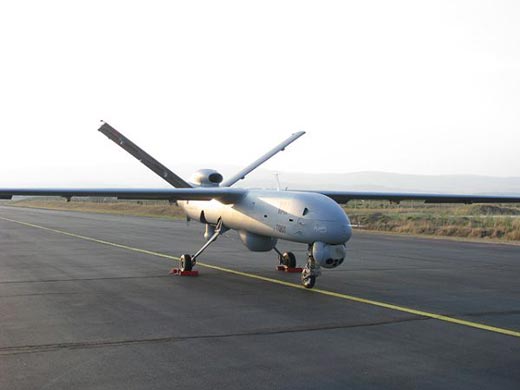
Turkish Aerospace Industries ANKA UAV Unmanned Aerial Vehicle. Photo: TAI
Turkey’s first indigenous Medium-Altitude, Long-Endurance (MALE) Unmanned Aerial Vehicle designated ‘Anka’ made its first test flight December 31, 2010. Anka is Turkey’s first entry into the MALE system category. Sofar the the Turkish industry has produces only the smaller Unmanned Aerial Systems. The drone went through extensive flight testing program and on January 5, 2012, the Undersecretariat for the Defense Industry (SSM) and Defense Industry Executive Committee decided to award TUSAŞ Aerospace Industries a production order for 10 aircraft to equip the Turkish Air Forces UAV unit.
The new UAV is designed to fly at an altitude of 30,000 feet for 24 hours.Anka has a wingspan of 17.3 meters and is powered by a diesel engine rated at 155-hp, It’s eight meter long fuselage is mad of composite.
Anka uses the locally developed ASELFLIR 300T payload developed by Aselsan. This payload includes a multi-sensor electro-optical system comprising a day TV, and Thermal Camera (IR-Infrared) / Laser Range Finder / Laser Designator (LRF/LD) and Laser Spotter. The Anka also carries a Synthetic Aperture Radar / Moving Target Indicator (SAR/MTI) which also supports with Inverse SAR ISAR operating mode for maritime missions.
Turkey is aiming at gaining self sufficiency in unmanned systems in upcoming year. The Turkish military was introduced to UAS through the use of UAVs leased from Israel, and the procurement of Israeli IAI Heron UAVs – a delivery recently completed, despite the deteriorating relations between the two countries. Turkey’s military has used these UAVs in its war against Kurdish separatists operating in the country’s southeast bordering Iraq and Iran.
Along with its quest for self sufficiency, Turkey embarked on the development of the new system in 2005. A prototype designated Turkish Indigenous MALE UAV (TIHA) unveiled in May 2010
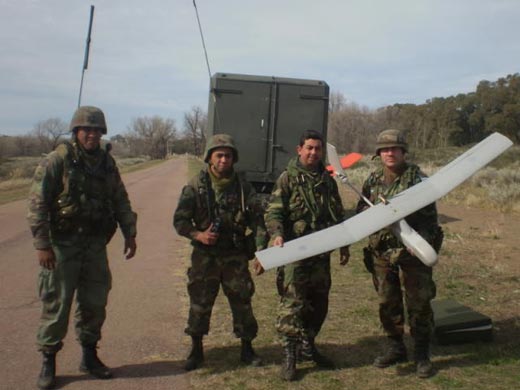
The Argentinian company Nostromo Unmanned solutions has completed the first flight test series of a pre-production version of the Cabure III Unmanned Aerial Vehicle, a short range electrically-powered tactical UAV. The current test phase qualified the UAV’s avionics integration, performance and tactical capabilities.
Cabure III is the latest version of Cabure UAV family launched in 2006 by Nostromo Defensa. The new model responds to specific requirements developed with close cooperation with the Argentine Marine Corps. The Argentine Marines have tested the current model – Cabure II – and recommending certain design changes through experimentation in several training exercises. Among the areas undergoing improvement were expanded operational envelope, reducing acoustic signature, extended range and endurance and over-water recovery.
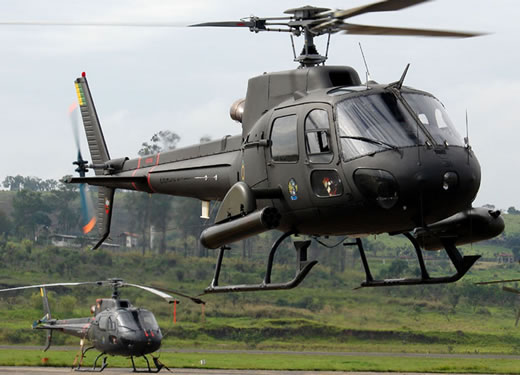
Eurocopter’s Helibras subsidiary to modernize 36 AS350 Ecureuil helicopters operated by the Brazilian Army Aviation Command. Photo: Guilherme Wiltgen - Forças Terrestre
The Brazilian army fleet of AS350 Ecureuil helicopters is to undergo modernization by the Brazilian subsidiary of Eurocopter. Upgrading of 36 aircraft will span over 7 years and is expected to be completed in 2018. Work will be performed at Eurocopter’s Helibras facilities in Brazil (Helicopteros do Brasil) in the state of Minas Gerais.
“Technology has made huge leaps since the first AS350 entered service, with the use of digital avionics and computers providing better safety and performance, along with a lower workload for pilots,” said Helibras President Eduardo Marson. “The application of our modernization package to the AS350 will significantly improve this helicopter’s versatility for the Brazilian Army Aviation Command, and we are offering these enhancements for other Ecureuil operators in Brazil as well.”
AS350 (Eagle 6) of the São Paulo State Military Police
The single-engine, multipurpose AS350 entered service with the Brazilian Army Aviation Command more than two decades ago and the current upgrade program will extend their lifespan for at least 25 additional years. The modernization includes the installation of a glass cockpit with three large liquid crystal displays, the integration of an Automatic Flight Control System with autopilot, and the use of improved seats for pilots for better visibility and enhanced protection.
The new avionics suite employing displays from Sagem Avionics Lic. (Safran Group) and computer systems from Aeroeletronica, to be integrated by Helibras in Brazil. The displays will be supplied by Sagem Avionics Inc.
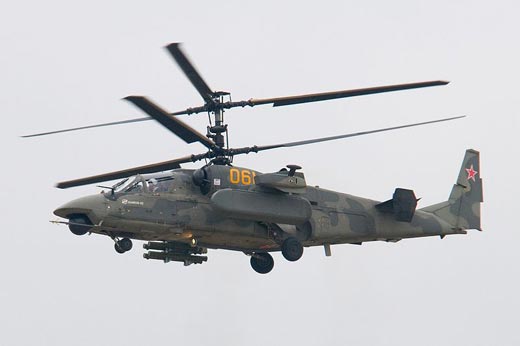
Russia’s Defense Ministry plans to start procuring Ka-52 Alligator helicopters for the Russian Naval Air Arm. The new helicopters could be deployed on the French built Mistral-class helicopters carriers. The Ka-52 is a modification of the Ka-50 Hokum attack helicopter; it is armed with 30-mm cannon, Vikhr (Whirlwind) laser guided anti-tank missiles, unguided rockets and bombs. Its primary sensors include a ground target search radar and an air/air radar search radar. For the target acquisition the Alligator uses the Samshite day/night equipped with thermal imaging system. The development of the Ka-52 began in 1994 with serial production commencing 14 years later. In 2009, Russia closed the first three export orders for the KA-52.
aero-india 2011 airshow live - from defense-update.com
aero-india 2011 airshow live - from defense-update.com
Defense Update is introducing its latest online project – Airshow-Live, providing on-site coverage of major airshows and defense exhibitions and conferences. Airshow-Live will debut at Aero-India 2011 providing fresh reports from the airshow, including news highlights and ‘buzz’ from the exhibition halls, press conferences, national pavilions, flight line and aerial displays.
Airshow-Live for Aero-India 2011 will be launched January 12 and will be updated twice a week, with reports focusing aerospace business and news highlighting India and Asia. On February 8 our releases will shift to live, daily releases, available online, via email, or by smartphone, through our new ‘Mobile Edition’. We recommend readers interested in the event or in the Asian market in general to subscribe to our RSS or our regular email service to receive the updates in a timely manner.
Following the Aero India event in Bangalore Airshow-Live is set to cover the Latin American Aerospace and Defense show (LAAD) in Rio de-Janeiro, April, Paris Airshow (Paris, June), AUVSI (Washington DC, August), DSEi (London, September) and AUSA (Washington, October).
Sponsorship and News Distribution
Airshow Live is provided free online and is optimized for smartphones including iPhone, Android, Blackberry, Palm and iPad. If you would like to join our sponsors, or use Airshow Live to distribute news prior or at the show, please contact us ASAP.
Published January 2011, and updated twice a week, covering aerospace highlights, international tenders, modernization plans etc.
On-site News
Published daily, and updated streight from Bengaluru, bringing you the insight on current developments
National Pavilions
Reporting from the main national pavilions
Featured Exhibits
Highlighting new products, interesting trends etc in short photograpic reports
Business Highlights
Announcements, joint ventures and alliances, roumors etc.
Event Summary report
Summary report to be published on Defense-Update.com, providing a wrap-up insight into the trends, developments and impressions from the show, including photos, images etc.
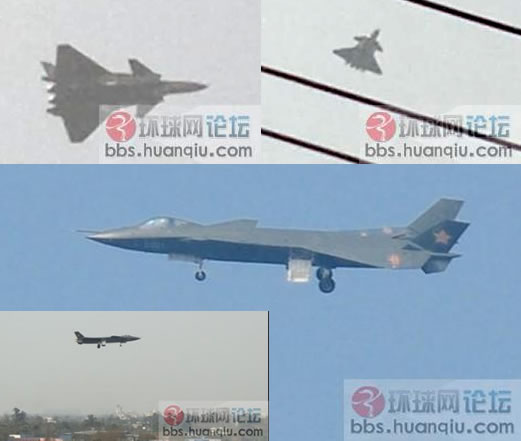
A collage of images taken by Chinese aviation enthusiasts showing the J-20 'Black Silk' 5th Generation stealth fighter flying a low level flypast over Chengdu on the end of its maiden flight, today at 13:50 Beijing time. Photos via huanqiu.com
After two weeks of hot debates whether China’s J-20 fighter is real or virtual, the mystery was solved today at Chengdu, as the new J-20 took off on 12:50 Beijing time on its first 18 minute test flight. The J-20 was followed by two J-10 escort planes on its flight. Defense Update will continue providing photos, video and updating details as they become available online.
Since the J-20 sudden appearance western defense analysts and generals doubted the Chinese ability to develop such a plane, nevertheless fly it, and commented that even if such plane would fly, it will be years away from becoming a potential threat. However, today’s flight substantiates the claims that China could have passed the technological barrier enabling the country to develop advanced military aircraft.
The J-20 landing back at Chengdu after the short maiden flight.
Moreover, flying the new prototype on the same day as U.S. defense secretary Robert Gates is visiting China could hardly be taken as a peaceful welcome – It seems that China’s pragmatic approach to bilateral defense relations with the U.S. has turned into a hard line, building on Beijing’s growing self confidence in its military and economical power and the narrowing of its military gap with the United States…
The aircraft was unveiled unofficially two weeks ago, as enthusiasts were allowed to watch and take photos of the new plane conducting ground inspections and high speed taxi tests prior to its first flight today. The unusual loosening of security restrictions enabled the Chinese authorities to create a ‘buzz’ without officially discussing the new development or its strategic implications.
A collage of images taken by Chinese aviation enthusiasts showing the J-20 'Black Silk' 5th Generation stealth fighter flying a low level flypast over Chengdu on the end of its maiden flight, today at 13:50 Beijing time. Photos via huanqiu.com
While commercial applications are driving miniaturization and computing power for personal communications, digital cameras and digital controllers used in modern automobiles and electrical appliances, defense electronics applications dictate the state of the art electronics in space, high precision navigation (GPS and inertial), and digital circuits performing massive processing for imaging, signal processing, high level encryption etc.
The huge cost difference between the commercially available components, such as Application Specific Integrated Circuits (ASIC) and their military specific equivalents brought developers of military equipment to rely on commercially available equipment, leading to certain compromises in reliability, or performance.
The new high-throughput maskless tool developed at DARPA, achieves high throughput through the simultaneous deployment of 1 million parallel electron beamlets. Illustration: DARPA
The primary cost factor associated with the high cost of these military components is the low production series used for development and serial production. Today’s Integrated Circuits (IC) are produced through complex lithographic processing batches, spanning over weeks. IC Lithography is currently performed by inserting a complex mask between a deep ultraviolet light source and a silicon wafer, projecting a circuit pattern onto that wafer.
“As feature sizes on integrated circuits have decreased to below 65 nanometers, the cost of these mask sets has become an overriding factor for small-lot fabrication of only a few wafers,” said Joseph Mangano, DARPA program manager. “By eliminating expensive mask sets, the Nanowriter tool will provide the cost benefits of large-scale IC manufacturing in quantities of one wafer.”
Small-batch applications suitable for military uses require an individual ‘painting’ of every IC through ‘direct drive’ lithography, one-by-one, rather than processing batches of millions at a time. However, high throughput in direct-write lithography is difficult to achieve since each feature is written serially as opposed to conventional lithography where millions of features are written in parallel.
To help meet a critical need for high-resolution lithography for cost-effective fabrication of application specific integrated circuits (ASIC), DARPA’s Maskless Nanowriter program is developing a massively parallel, direct-write electron-beam (eBeam) lithography tool with a write speed more than 100 times faster than current single-column eBeam tools. The program recently achieved two important milestones when it demonstrated a micro-lens array to pattern a beam into a million electron beamlets, and showed a second-generation eBeam column designed to significantly reduce pattern blur.
The new high-throughput maskless tool developed at DARPA, achieves high throughput through the simultaneous deployment of 1 million parallel electron beamlets. The new Nanowriter tool is targeted at the 45-nm lithography node with technology scalable to 32 nm and beyond. If successful, this program will eliminate the need for expensive mask sets and will increase economic viability of small-lot production for custom, ASICs and micro-electromechanical systems.
Defense Update launches iPad-optimized mobile edition.
Defense Update today released a news edition optimized for smart phones. The new edition currently supports iPhone, iPad, Blackberry (9500-9800 series), Android, Palm and Samsung S8000 phones. More devices will be supported later. Our system can detect the type of phone used and adjust the display accordingly. If you would like to use the standard design, do so by clicking the link at the bottom of the page.
Defense Update introduces ‘Defense-Update Mobile Edition’, optimized for smart phones and iPad tablet computers.
The navigation system we use is simple and friendly. You can access all the new functions from the button positioned at the top-right. Feel free to explore the site and tell us your experience. As common with Defense-Update, the mobile edition will be improved continuously to provide you the best, most efficient service and information.
If you have a phone you would like to use which is not currently supported, please comment to this post with the type of phone. If you encounter a problem operating the new site, please use the comment to inform us.
Defense Update launched today the iPad-optimized mobile edition. The application supports the iPad's advanced features and provide readers with all the site's interactive functionality in a faster, user friendly way. The service is offered free of charge at: Defense-Update.com/wp
The new service includes all recent news and commentary (analysis) published in the past quarter, selected and industry profiles. More content will be added continuously, in line with our upcoming on-site coverage of major shows events – in Aero-India, LAAD, Paris Airshow, AUVSI, DSEi, and AUSA. These event coverage will focus on live reports on-site, unique to our mobile edition.
According to our strategy, all the content and services provided by Defense-Update, including our mobile edition, are provided free of charge and without restriction. Comments are welcome, but moderated, as we post only the comments that, based on editorial judgement, are valuable and relevant to our readers.
We wish you happy new year and interesting reading online – wherever you are
Tamir Eshel – Editor
and the Defense-Update team
iPad and iPhone are trademarks of Apple Computers.
Blackberry is a trademark of Research in Motion (RIM)
Palm is a trademark of Palm/HP Inc.
Samsung is a trademark of the Samsung Group
Android is a trademark of Google Inc.
Lt General George Flynn, Commanding General, Marine Corps Combat Development Command (MCCDC)
“We ought not to look back, unless it is to derive useful lessons from past errors and for the purpose of profiting by dear bought experience.” (George Washington)
Written By LtGen. George Flynn, Commander, Marine Corps Combat Development Support.
Expeditionary Fighting Vehicle at sea, during technical trials. Photo: GDLS
There is no guarantee we will learn from the bloody combat lessons of the last century. The current penchant by some for questioning the Marine Corps’ need for an amphibious tracked vehicle suggests an ignorance of history and a lack of understanding of the future; it is unsupported by hard lessons learned, world trends, and a security environment characterized by a high degree of uncertainty. Our Nation will most certainly require continued global access from the sea, and just as certainly there are forces at work that are actively and aggressively attempting to deny us that much needed access.
Lt General George Flynn, Commanding General, Marine Corps Combat Development Command (MCCDC)
The Secretary of Defense clearly stated that his decision to cut the Expeditionary Fighting Vehicle program does not call into question the amphibious assault mission of the Marine Corps. Moreover, he stated the requirement of developing a more affordable and sustainable amphibious tractor to provide the Marines a ship-to-shore capability into the future.
As America’s expeditionary force in readiness, the Marine Corps specializes in rapidly deploying anywhere in the world to develop access through partnership building activities, to create access in response to crises, and to provide the ability to force access to deter and/or defeat threats. The Corps will never be defined by a program, but rather by the capabilities we bring to the fight.
As a maritime Nation the tyranny of distance, geography, and topography remain constant challenges to our global influence. As demonstrated countless times, our ability to come from the sea and overcome the challenges of natural and manmade barriers allows us to protect and defend U.S. interests. Our continued ability to respond is dependent on our ability to operate in uncertain environments, create opportunities and ensure freedom of action regardless of access challenges.
The Marine Corps has learned that amphibious operations should avoid fixed defenses whenever possible. This option is not always available, however. In such cases the amphibious tracked vehicle is essential to success. The tracked amphibious vehicle provides the ability to perform three critical tasks: ship-to-shore movement, breakout from the beach and protected land mobility and firepower. As a result, the amphibious tracked vehicle has been a mainstay of amphibious capability. It has often proven the indispensible, enabling capability that Marines employ to both solve the sea/land mobility challenge and to gain advantage over our enemies.
Recent operational experience and history attest to the effectiveness of amphibious tracked vehicles in providing the capability and capacity demanded by numerous operating environments—permissive, uncertain, or hostile. Most recently, amphibious tracked vehicles assisted in overcoming the devastated infrastructure in Haiti. These same vehicles were used to rescue stranded citizens and deliver relief supplies following Katrina’s devastation of the U.S. Gulf Coast in 2005. In the 1990s these vehicles enabled relief efforts in Somalia during Operation RESTORE HOPE and subsequently provided the key capability necessary to safely withdraw U.N. forces in UNITED SHIELD. During the Korean War they allowed us to project power from the sea at Inchon to reverse the looming defeat of U.S. forces trapped at Pusan. Given the proliferation of area denial weapons among both state and non-state actors, we believe that future operations—even those conducted for benign reasons—will be conducted under uncertain and highly dangerous conditions.
Amphibious tracked vehicles employed from ships at sea provide the means to assure littoral access that no other capability can provide. They are the only combat vehicles built to operate effectively in the littorals: a complex environment of salt and fresh water, muddy marshes and estuaries, and dry land; rural, suburban and urban landscapes; wildly varying terrain; high to low population densities; and temperature extremes. They can quickly and seamlessly transit from ship-to-shore as well as swim rivers and negotiate inland water obstacles, providing the ability to achieve tactical and operational surprise. They protect their occupants as they maneuver on sea and land to a position of advantage and can close with an enemy or rescue our friends. Their known presence off shore historically has been a powerful deterrent and effective capability across the range of military operations.
A modern amphibious tracked vehicle uses the sea as maneuver space, creates opportunities in the littorals, optimizes employment of amphibious forces, and enhances survivability in the face of area denial threats. An amphibious tracked vehicle is the proven means to overcome access challenges, natural or manmade, ranging from tsunami-ravaged infrastructure to an armed aggressor seeking to oppose our maneuver. Amphibious tracked vehicles empower a flexible, ship-borne force to wait off shore for the opportunity to shape the security environment or alter an outcome. This unique capability provides our Nation with a critical power projection asset.
There is no doubt that the sustainment and further development of our Nation’s amphibious capability is important for continued access to strategically vital regions of the world. We see a clear mandate to be ready to shape, influence, deter, and if necessary defeat would be forces that seek to deny us access. Meeting this mandate will allow us to profit “by dear bought experience” rather than repeat the errors of the past.
This article was provided by the Marine Corps Combat Development Command, Quantico, Va.
Cutting over $100 billion in U.S. defense spending in the next five years could be an opportunity to turn the Defense Department into a leaner, more efficient organization, eliminating fat, dust and rust that developed through the system in decades. At least this is what Defense Secretary Robert Gates is hoping for, however, as Gates will leave office soon, someone else will have to bring this hope into reality.
Bowing under budget pressure across all government levels, the Defense department, intelligence and military services are called to share this effort, mainly through streamlining operational logistics and support, shedding unnecessary positions, improving information and communications systems through modern enterprise networks, and eliminating redundant command levels that are not suitable for today’s operations.
The Air Force was asked to save about $34 billion, the Navy $35 billion and the Army will share $28 billion of the saving costs. 0f 70% of these cuts will be reinvested in procurement of new equipment, modernization and reset of existing systems and new development programs.
Sharing the Burden
The Air Force plans to saving its share by consolidating two air operations centers in the U.S. and two in Europe, reducing fuel consumption within the Air Mobility Command, improving supply chain and business processes at depots centers and reducing the cost of communications infrastructure are parts of these measures.
The Army proposes eliminating over 1,000 civilian and military positions, and consolidating six installation management commands into four, saving billions in construction costs and sustainment. Consolidation of the service’s email infrastructure and data centers is also planned.
The Navy plans reducing manpower ashore and reassigning 6,000 personnel to operational missions at sea; shifting new airborne surveillance, jamming, and fighter aircraft procurement to multi-year programs that could yield $1.3 billion in saving and disestablishing staffs for submarine, patrol aircraft, and the destroyer-squadrons plus one carrier strike group staff. The Navy also proposes to disestablish the headquarters of Second Fleet in Norfolk. During the Cold War, this command had distinct and significant operational responsibilities. Today its primary responsibility is training and mission preparation, a function that will be transferred to the Navy’s Fleet Forces Command. This change would affect approximately 160 military positions. And no ships will depart Norfolk as a result.
Trimming at the Top
Cuts will also affect the highest level of command at the Joint Staff and DoD, eliminating 11% of the current 900 general officer and flag officer positions. Some of these positions were created in the past decade to support the wars in Iraq and Afghanistan, and will be reduced as major troop deployments wind down. Other positions will be downgraded to save costs and streamline command structures, along with 200 civilian Senior Executive Service or equivalent positions out of a total of 1,400 civilian executives. Gates said that the primary purpose behind this shift is to create fewer, flatter, more agile, and thus more effective organizations. These commands will be reduced to the three star-level, with concurrent streamlining in the headquarters and personal staff. The change to U.S. Navy Europe will take place over a longer period because of that command’s unique role in the NATO transformation effort.
Gates said that the proposed elimination of the Norfolk based Joint Forces Command has been reviewed, and according to Gates, a number of missions should be retained in the Norfolk/Suffolk, Virginia area, while roughly half of the command’s capabilities will be assigned to other organizations.
The DoD-wide freeze on the number of civilian positions and government-wide freeze on civilian salaries has yielded about $54 billion in additional savings over the next five years. “Overall, we will cut the size of the staff support contractor cadre by 10 percent per year for three years and realize nearly $6 billion in total savings.” gates said during a briefing at the Pentagon today.
Reshuffling Intelligence Responsibilities
Following comprehensive review of national intelligence services DOD Intelligence services will also experience downsizing and budget cuts for the first time since 9/11. The U.S. government as a whole has seen a proliferation of new intelligence organizations, many that are excess and duplicative, many that are spread out among the different services, agencies, task forces of various kinds, and combatant commands. Gates emphasized that the proposed cuts will downsize the new intelligence organizations that have grown up around a number of the combatant commands in recent years – most of which are not directly engaged in the post-9/11 military conflicts. “In place of having a large, permanent organic apparatus staffed on a wartime level, the department will transition to an arrangement that can surge intelligence support as needed from the Defense Intelligence Agency (DIA).” Gates explained. The department is also proposing to consolidate activities of multiple intelligence organizations operating under different commands and focusing on counter-terrorism and terrorism finance. These activities will consolidate into two task forces operated within DIA.
Introducing Enterprise IT Infrastructure
DOD spends over $37 billion each year on information technology. Each service runs an independent “our bases and headquarters have their own separate IT infrastructure and processes, which drive up costs and create cyber vulnerabilities” Gates explained “the department is planning to consolidate hundreds of data centers and move to a more secure enterprise system, which we estimate could save more than $1 billion a year.
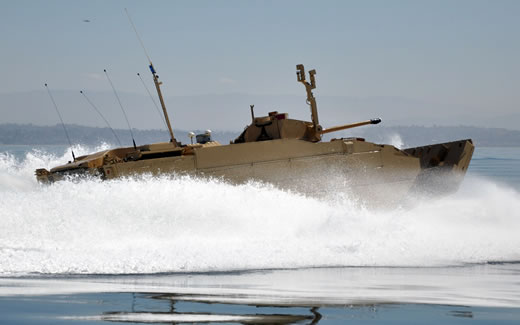
The Marine Corps $13 billion amphibious 'Expeditionary Fighting Vehicle' (EFV) program. As this plan is currently at a crossroad, transitioning into production, terminating it at this phase represent a 'bargain' to the bean counters, as everything spent on the program is sunk cost while future year-outlays are still minimal. Photo: U.S. Marine Corps
Defense Secretary Robert Gates is recommending to cancel the procurement of the Marine Corps $15 billion amphibious ‘Expeditionary Fighting Vehicle’ (EFV) program. After spending $3 billion in the development of this vehicle, the program is currently at a crossroad, transitioning into production, terminating it at this phase represent a ‘bargain’ to the bean counters, as everything spent on the program is sunk cost while future year-outlays are still minimal.
The Marine Corps $13 billion amphibious 'Expeditionary Fighting Vehicle' (EFV) program. As this plan is currently at a crossroad, transitioning into production, terminating it at this phase represent a 'bargain' to the bean counters, as everything spent on the program is sunk cost while future year-outlays are still minimal. Photo: U.S. Marine CorpsDr. Robert M. Gates Secretary of Defense
The EFV’s aggressive requirements list has resulted in an 80,000 pound armored vehicle that skims the surface of the ocean for long distances at high speeds before transitioning to combat operations on land. Meeting these demands has over the years led to significant technology problems, development delays, and cost increases. Gates mentioned that the EFV will cost about $12 billion to build – all for a fleet with the capacity to put 4,000 troops ashore. “If fully executed, the EFV – which costs far more to operate and maintain than its predecessor – would essentially swallow the entire Marine vehicle budget and most of its total procurement budget for the foreseeable future.” Secretary Gates warned.
Gates mentioned recent analysis by the Navy and Marine Corps suggests that the most plausible scenarios requiring power projection from the sea could be handled through a mix of existing air and sea systems employed in new ways along with new vehicles – scenarios that do not require the exquisite features of the EFV. “As with several other high end programs cancelled in recent years, the mounting cost of acquiring this specialized capability must be judged against other priorities and needs. ” said Gates. In 2009 Gates instructed the U.S. Army to cancel the Future Combat Systems’ program along with seven types of armored vehicles, destined to become the core of the Army’s Future Force.
“This decision does not call into question the Marine’s amphibious assault mission.” he added, “We will budget the funds necessary to develop a more affordable and sustainable amphibious tractor to provide the Marines a ship-to-shore capability into the future. The budget will also propose funds to upgrade the existing amphibious vehicle fleet with new engines, electronics, and armaments to ensure that the Marines will be able to conduct ship-to-shore missions until the next generation of systems is brought on line. It must be judged against other priorities and needs.”
Other land systems program cancellations mentioned in today’s briefing included the SLAMRAAM surface to air missile the Non-Line of Sight Launch System, both programs were already ‘announced dead’ several months ago.
The Army plans to use the available funds from these cuts to fund the modernize its M-1A2 Abrams tanks, Bradley Fighting Vehicles, and Stryker wheeled vehicles. The Army is also planning to accelerate fielding of a soldier level tactical communications network. The Navy will use part of the money to reset and repair Marine equipment returned from Iraq and Afghanistan.
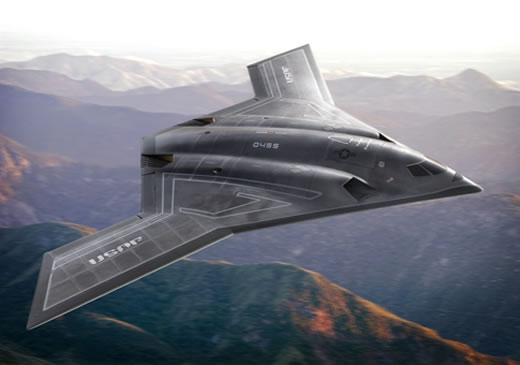
The next generation bomber designed by Boeing and Lockheed Martin will have a 'global reach' operating as a piloted or an unmanned platform, on nuclear or conventional attack missions. Photo: Boeing
As part of the Pentagon’s wide scale budget cuts reducing military spending by over $100 billion over five years, the Air Force expects to share $34 billion of the total amount, mostly by improving operating efficiencies. Consolidation of two air operations centers in the U.S. and two in Europe, reducing fuel consumption within the Air Mobility Command, improving supply chain and business processes at depots centers and reducing the communications infrastructure costs are part of these measures.
The next generation bomber designed by Boeing and Lockheed Martin will have a ‘global reach’ operating as a piloted or an unmanned platform, on nuclear or conventional attack missions. Photo: BoeingDr. Robert M. Gates Secretary of Defense
The cuts will finance future development, modernization and procurement plans, including the development of a new long-range, nuclear-capable penetrating bomber, enabling the Air Force to establish flexible force projection into the future. According to Gates, this ‘optionally piloted’ bomber will be designed and developed using proven technologies, an approach that should make it possible to deliver this capability on schedule and in quantity. “It is important that we begin this project now to ensure that a new bomber can be ready before the current aging fleet goes out of service. The follow on bomber represents a key component of a joint portfolio of conventional deep-strike capabilities – an area that should be a high priority for future defense investment given the anti-access challenges our military faces.” Gates said.
Bill Sweetman has commented in Aviation Week Ares Blog: “The bomber program could well follow the lines set out in the Center for Strategic and Budgetary Assessments (CSBA) report issued in September. It is very likely to draw on next-generation stealth research carried out in the classified world in the past decade, and represents a major success for bomber advocates, who have been pessimistic about their chances of overcoming high-level preference for smaller aircraft and missiles. Gates and Pentagon leadership have apparently settled a number of controversial issues about the bomber – manned versus unmanned, nuclear-capable or not, and penetrating versus standoff-missile carrier.”
The savings will enable the Air Force to get more of the most advanced Reaper UAVs, moving essential Intelligence, Surveillance and Reconnaissance (ISR) programs from the temporary war budget to the permanent base budget. It will also get the funding for the modernization of F-15 radars into AESA types, contributing to further operating cost saving, and buy more simulators for JSF air crew trainers.
“Going forward, advanced unmanned strike and reconnaissance capabilities must become an integrated part of the Air Force’s regular institutional force structure.” Gates stressed. The Air Force will also increase procurement of the Evolved Expendable Launch Vehicle (EELV) to assure access to space for both military and other government agencies.
The Navy is also expected to cut $35 billion by reducing manpower ashore, shifting new airborne surveillance, jamming, and fighter aircraft procurement to multi-year programs that could yield $1.3 billion in saving and disestablishing staffs for submarine, patrol aircraft, and the destroyer-squadrons plus one carrier strike group staff.
These savings will be used to support the accelerated procurement of littoral combat ships and destroyers, and accelerate the development of several aviation related programs including the Next Generation Jammer, improving the Navy’s ability to fight and survive in an anti-access environment, and fund the development of a new generation of sea-borne unmanned strike and surveillance aircraft. They will also buy more F/A-18E/Fs and extend the service life of 150 of F/A-18 aircraft, as a hedge against more delays in the deployment of the Joint Strike Fighter.
These resources will also support several Army Aviation programs. These include embarking on the development of a new vertical unmanned air system to support the Army in the future, sustain the procurement of MC-12 type special mission aircraft (EMARSS?) and Gray Eagle UAVs.
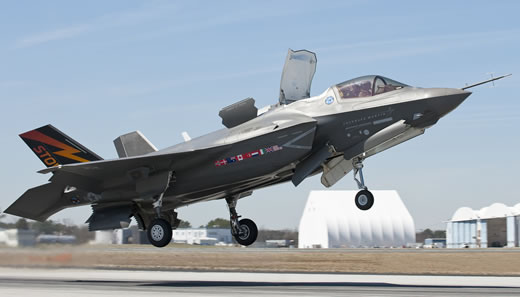
Gates: "As a result, I am placing the STOVL variant on the equivalent of a two-year probation. If we cannot fix this variant during this time frame and get it back on track in terms of performance, cost and schedule, then I believe it should be cancelled. We will also move the development of the Marine variant to the back of the overall JSF production sequence." Photo: Lockheed Martin
In an effort seen as a way to head off attempts by the White House and some in Congress to cut defense spending in a time of extreme budget pressure, Robert Gates is expected to announce major cuts in arms procurement. These measures follow the plan outlined by Gates in June 2010, cutting about $101.9 billion between fiscal 2012 and fiscal 2016. As expected, the Marine Corps will bear much of the fire in terms of program cancellation or delays while other services will focus savings on reducing command, manpower and infrastructure – eliminating civilian positions and contractors, flag and general officers, shouldering the majority of savings.
Gates: "As a result, I am placing the STOVL variant on the equivalent of a two-year probation. If we cannot fix this variant during this time frame and get it back on track in terms of performance, cost and schedule, then I believe it should be cancelled. We will also move the development of the Marine variant to the back of the overall JSF production sequence." Photo: Lockheed Martin
While the development of the air forces’ F-35A and carrier variant F-35C is proceeding well, the Marine Corps’ short take-off and vertical landing variant is experiencing significant testing problems. This troubled aircraft was pushed forward to fulfill the most urgent needs of the corps, will now move to the back of the JSF production sequence. “I am placing the STOVL variant on the equivalent of a two-year probation” gates announced. ” If we cannot fix this variant during this time frame and get it back on track in terms of performance, cost and schedule, then I believe it should be cancelled.
Such delay will further erode the Marine Corps air support capability, as the corps needs the new fighter the most, to replace aging AV-8B and F-18C/D fighters. To fill this gap the Marines will get more Navy F/A-18s. It is still unclear if these will be ex-Navy Hornets or new Super Hornets which the Corps don’t currently operate. The Navy expects to add more Super Hornets paid for by the budget savings implemented through these cuts.
Terminating the alternative engine program for the F-35 - the General Electric-Rolls Royce-built F136 engine encountered stiff opposition among lawmakers. Photo: General Electric
In August 2010, Gates announced plans to eliminate the Joint Forces Command, which is responsible for setting training requirements and doctrine for multiservice operations. He also recommended terminating the F-35 alternative engine program, the General Electric-Rolls Royce-built F136 engine. Both plans encountered stiff opposition from lawmakers.
Troops Draw Down Ordered
While cancellation of few expensive programs could trim spending in the short term, draw down of forces, following the planned withdrawal from Afghanistan by 2014 could complement these saving. As part of the planned cuts the Army and Marine Corps each have been ordered to draw down as many as 49,000 soldiers by 2015. The Army cuts include a reversal of a temporary 22,000-soldier increase announced in 2009 and an additional 27,000-troop cut. The Marine Corps’ cut could range from 15,000 to 20,000 Marines. The Army currently has about 570,000 soldiers. The Marine Corps completed a 27,000-service member increase to 202,000 personnel last year.
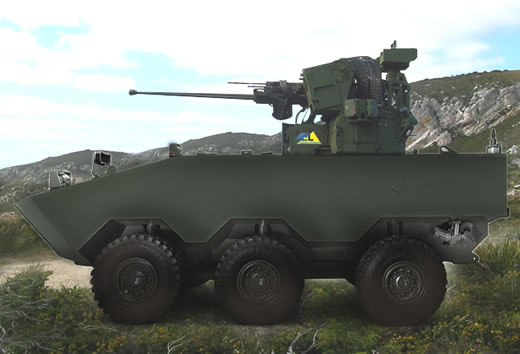
The UT-30BR comprises a low profile, armored, unmanned turret comprising the gun mount, target acquisition and fire controls, along with coaxial mount for machine gun (7.62 mm). The system also features an advanced fire control system with automatic target tracking, ballistic computing, sensors management and displays. The target acquisition system includes a dual-axis stabilized gunner’s sight, integrated laser rangefinder, video daylight and thermal cameras. Photo: Elbit Systems
Brazil’s ministry of Defense awarded Aeroeletronica (AEL) was a multi-year framework contract by worth up R$440 million Brazilian Reais (approximately $260 million), for the delivery of ‘several hundreds’ UT30BR unmanned gun turrets. The new turrets mounting 30mm automatic cannons will be integrated on VBTP-MR Guarani 6×6 armored vehicles developed by IVECO.
The UT-30BR comprises a low profile, armored, unmanned turret comprising the gun mount, target acquisition and fire controls, along with coaxial mount for machine gun (7.62 mm). The system also features an advanced fire control system with automatic target tracking, ballistic computing, sensors management and displays. The target acquisition system includes a dual-axis stabilized gunner’s sight, integrated laser rangefinder, video daylight and thermal cameras. Photo: Elbit Systems
Starting in 2012 the Brazilian Army is planning to buy 2,044 Guarani armored vehicles over 20 years, under a multi-year program valued at R$6 billion (about US$3.5 billion). The pre-production series of 16 will enter testing in 2011. These vehicles will be assembled in Brazil from imported components and subsystems. Eventually, the program is planned to include 60% domestic content, aiming to reduce production costs and maintenance. The Guarani will replace the obsolete 6×6 Urutu vehicle currently used by the Brazilian armed forces.
AEL is a fully owned subsidiary of Elbit Systems (NASDAQ: ESLT), Israel’s largest defense company. This award follows an award of a contract to Elbit Systems in 2009 to supply several Unmanned Turrets in an open tender in which leading global manufacturers took part. Deliveries of the unmanned turrets will be determined according to a schedule and a multi-year funding profile to be defined by the parties.
UT30 turrets have already been integrated in a number of vehicles, and delivered to several European armies, among them the Belgian Piranha, the AMV for Slovenia and Portuguese Pandur II.
Lockheed Martin Skunk Works® and XTEND have achieved a major milestone in JADC2 by integrating the XOS operating system with the MDCX™ autonomy platform. This technical breakthrough enables a single operator to simultaneously command multiple drone classes, eliminating the friction of mission handoffs. From "marsupial" drone deployments to operating in GPS-denied environments, explore how this collaboration is abbreviating the data-to-decision timeline and redefining autonomous mission execution.
As traditional defense primes face mounting competition from agile “neoprimes” such as Anduril, Palantir and Helsing, the balance of innovation is shifting toward software-defined warfare and scalable, dual-use technologies, while global industry consolidation—marked by Boeing’s integration of Spirit AeroSystems and other strategic mergers—signals an intensified race to secure control over the defense technology value chain. Our Defense-Tech weekly report highlights these trends.
In early October 2025, a coordinated wave of unmanned aerial system (UAS) incursions—widely attributed to Russia—targeted critical infrastructure across at least ten European nations. The unprecedented campaign exposed the fragility of Europe’s air defenses...
Executive Summary
The past week (September 18-25, 2025) represents an inflection point where strategic defense concepts have transitioned from doctrine to tangible reality. An analysis of global events reveals four primary, interconnected trends shaping an...
At the 2025 Air, Space & Cyber Conference, U.S. Air Force and Space Force leaders unveiled major updates on next-generation fighters, bombers, unmanned systems, and space initiatives, highlighting both rapid innovation and critical readiness challenges as the services race to outpace global competitors. A short version is available here, with a more detailed version for subscribers.
The Taipei Aerospace & Defense Technology Exhibition (TADTE) 2025 crystallized around four dominant strategic themes that collectively illustrate Taiwan's comprehensive approach to defense modernization amid escalating regional tensions. Based on a detailed report by Pleronix (available upon request). Includes a Podcast discussion on TADTE 2025's highlighting Taiwan's four strategic themes beyond the post's coverage.
Israel’s Iron Beam 450 high-power laser system has completed final testing, marking a major leap in air defense. Developed by Rafael, it offers precise, cost-effective interception of rockets, UAVs, and mortars, and is set for IDF deployment by 2025.