
Friday, December 26, 2025
More
    Home Blog Page 263

    Smaller, More Powerful Snake Robot Demonstrated by Technion Lab

    Snake Robot
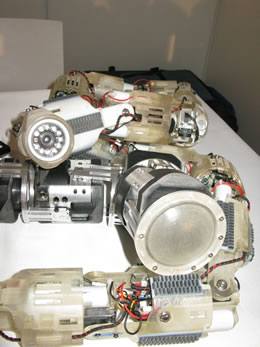
    Two of the 'Snake Robots' developed at the BioRobotic Biomechanics lab at the Technion, the first generation (tan colored) and larger, second generation seen in silvery color. Photo: Tamir Eshel, defense Update
    Snake Robot
    Two of the ‘Snake Robots’ developed at the BioRobotic Biomechanics lab at the Technion, the first generation (tan colored) and larger, second generation seen in silvery color. Photo: Tamir Eshel, defense Update

    Researchers at the BioRobotics and BioMechanics Labortory (BRML) or Israel Technion are working on an improved, more robust and agile snake robot that will enhance the performance already demonstrated by an earlier BRML ‘robotic snake’ in 2009. Unlike the previous robot, that used a centralized processor to control the individual elements, the new model employs independent links built as common elements, each packing the logic and control processors, inertial sensors, servo actuators, power source, communications and sensors. The new robot will soon enter testing at the lab, and will eventually be tested by the Israel Defense Forces, as part of the Defense Research & Development Directorate’s urban terrain robotics program.

    According to Lt Col. Gabi Dobresco, head of UGV and Advanced Concepts Branch at the Land Systems Division, DDR&D, the IDF is evaluating the snake robot as part of biologically-motivated structures dealing with challenging scenarios.

    According to Dobresco, the robotic snake could be useful in urban and subterranean warfare, enabling the inspection and surveillance of sewage systems, narrow tunnels, or culverts, inaccessible by other systems. Another advantage of such robots is the fact that the entire robot acts as highly flexible arm having multiple Degrees Of Freedom (DOF).

    The vision for snake robots, outlined by Dobresco includes highly maneuverable snake shaped robot that can maneuver through difficult terrain, ‘sneak’ stealthily inside buildings, use its sensors to scan their interiors. The robot will be able to carry disposable sensors that could be separated and left behind to monitor activity inside buildings. When suspicious activity inside buildings is detected, the stealthy robot will be able to identify specific targets while remain virtually unnoticed, and leave behind delayed activated explosive charges for employing lethal effect.
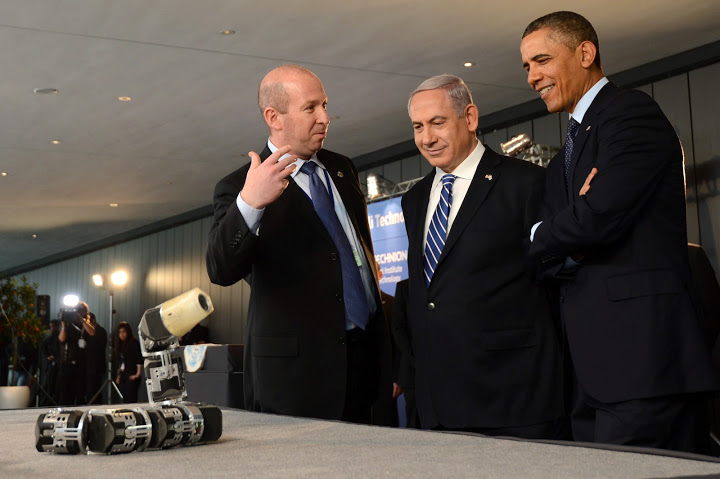
    At the beginning of the second day of United States President Barack Obama's visit to Israel, the American president viewed technological innovations and said Israeli high-tech was "inspiring." One of these was the Technion 'Snake Robot'. Photo: Kobi Gideon/GPO
    At the beginning of the second day of United States President Barack Obama’s visit to Israel, the American president viewed technological innovations and said Israeli high-tech was “inspiring.” One of these was the Technion ‘Snake Robot’. Photo: Kobi Gideon/GPO

    As primary sensors, the robot will be equipped with a thermal imager, miniature cameras or low-light TV sensors, and possibly laser scanners operating as laser radar (LADAR). As each of the links is embedded with cameras, the entire group provides redundant, instant multiple 360 degree view of the surrounding while mapping of indoor and subterranean areas by laser radar.

    The new snake developed at BRML represents a major step in the DDR&D direction. Unlike the previous snake having a single DOF for each link, requiring 16 links to form sufficient flexibility and maneuverability, each of the new robot links has two joints, providing 2 DOF per link, hence, the number of links per ‘snake robot’ can be reduced to eight. The motors embedded in the new design have significantly higher moment /weight ratio. Each link is equipped with its own inertial system, reporting its relative position (to other elements), enabling the automatic motion and maneuver control to determine the position of the entire robot, and determine the next move to bring the robot closer to its objective, through difficult terrain and along the movement path selected for movement.

    This 7kg prototype uses elements made of aluminum to meet the level of ruggedness required for field operation. However, for a production models Technion researchers expect the weight to drop by half, below four kg, as much of the aluminum parts with durable composite materials.

    BRML displayed the new robot today at the Israeli Conference on Robotics (ICR) held today in Herzelia.

    The video below depicts he first generation snake robot developed at the Technion lab.

    Israel Delays Deployment of Iron Dome

    Rafael has planning to introduce a very low cost surface/surface derivative of the Iron Dome missile system named 'Iron Flame'. This low cost missile will perform as a high precision surface-to-surface rocket, utilizing part of Iron Dome's Tamir missile guidance systems. The 'Iron Flame' missile will weigh several tens of kilograms, carrying a variety of warheads, including blast fragmentation and penetrating warheads, it will be able to deliver pinpoint attack with an effect of an artillery projectile at the ranges currently covered by tube artillery.

    While the first Iron Dome battalion continues its training toward achieving Initial Operational Capability, the military is reluctant to deploy them in positions protecting population centers near the Gaza strip as originally planned. Instead, the single system currently available will be stored at a central IAF base, ready for dispatch at short notice, to protect strategic targets or population centers that may come under attack by enemy short range rockets.

    Preparation of the Iron Dome battalion has taken more time than originally planned, as training the crew manning these new systems has proven more complex than anticipated. The IDF has ordered two Iron Dome batteries, and the U.S. has agreed to fund the procurement of nine additional batteries.

    While public debate in Israel has focused on the system’s inability to defeat salvos of short range rockets or mortar bombs, fired from ranges of few kilometers, the Air Force is more concerned with the fewer longer range rockets that could hit air force bases with relative high precision, limiting the air forces’ operational tempo and putting combat aircraft and other assets at risk. Equally important is the protection of strategic sites located throughout the country, primarily along the coastline.

    As Iron Dome is well positioned to defeat such threats, in day, night and under inclement weather conditions, the IAF would better keep such assets under control rather than deploy them to forward positions protecting forward townships, from where it would be practically impossible to remove, once enemy missiles start falling…

    Rafael, on its part  continues to develop the Iron Dome system, today introduced a surface/surface derivative of the system named ‘Iron Flame’. This low-cost, autonomous weapon system employs an Iron Dome interceptor stripped off its advanced proximity intercept seeker, retaining the high maneuverability, precision guidance and in-flight update capability. Packed with modular warhead and a variety of seekers to fit specific missions, ‘Iron Flame’ will carry  fragmentation or penetrating warheads, providing precision attack capability to engage targets and answer calls for fire support by forces operating within its ‘circle of fire’. Rafael unveiled the new development at the ‘Fire and Combined Arms Warfare in Urban terrain’ international conference held this week by Israel’s Artillery Corps association in Zikhron Yaakov in Israel.

    U.S. Defense Exports Amount to $31.6 Billion in FY2010

    U.S. military sales overseen by the Defense Security Cooperation Agency (DSCA) were $31.6 billion in the Fiscal Year 2010 (ending September 30), topping $30 billion for the third consecutive year. Sales under the government-to-government sales program called Foreign Military Sales (FMS) were $25.2 billion.  Non-FMS security cooperation cases managed by DSCA under various security cooperation authorities were $6.4 billion.

    The DoD program for support of Afghanistan’s security forces using the Afghanistan Security Forces Fund (ASFF) made up the majority of non-FMS security cooperation cases in fiscal year 2010 and totaled some $4.7 billion.   Non-FMS security cooperation cases also provided support to other foreign governments, including Iraq and Pakistan. Israel received $4.0 billion leading the FMS customer list with the highest value in sales followed by the Government of Egypt at $2.6 billion.  (Israel and Egypt are also the largest recipients of Foreign Military Financing (FMF) funds appropriated by Congress through the State Department to be used to pay for purchases of U.S. defense articles and services.) The Kingdom of Saudi Arabia at $2.5 billion and the Government of the United Kingdom at $1.8 billion rounded out the top four FMS customers in terms of the value of sales.

    German Air Force Deploys an Israeli MultiInt System Fusing Manned, Unmanned Aircraft ISR

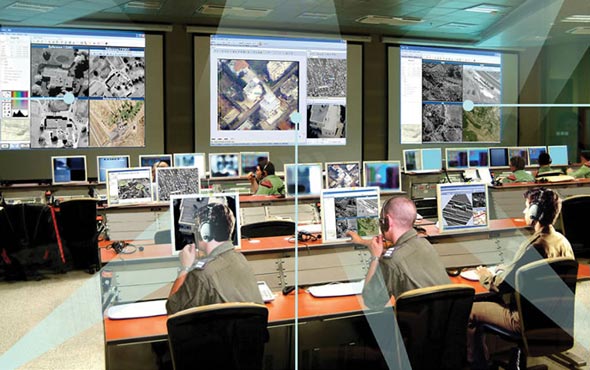
    The German Air Force became the first international customer for Rafael’s new ImiLite multi-intelligence Intelligence Surveillance and Reconnaissance processing system. The Luftwaffe will be using the system to process and fuse real-time video and imagery obtained from Rafael’s Reccelite pods, flown on Tornado recce planes and Infra-red/video provided by the new IAI Heron UAVs recently deployed to Afghanistan. Until the introduction of ImiLite, ISR sensors operated as ‘stovepipes’, each monitored and controlled by its own control system, feeding processed feeds to central ISR facility, a process that typically accumulates significant delays.

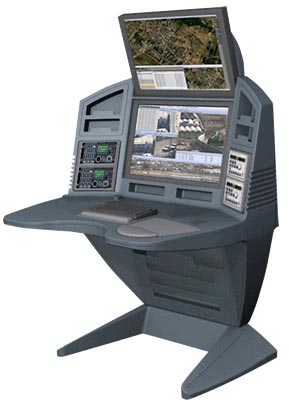
    Rafael ImiLite Workstation uses COTS hardware to handle and process multiple real-time video sources. Photo: Rafael

    According to Haim Jacobovits, Corporate VP and General Manager of Network Centric Warfare Sector at Rafael, ImiLite links directly to these ISR feeds, and is capable of processing multiple sources in parallel, fusing the different feeds into multi-source real-time ISR products. One of the systems’ main advantages is the analyst’s ability to ‘peel’ off layers of information, to uncover hidden details and clues at specific layers captured by each of the different sensors coupled to the system. Such analysis can be performed in real time on live video, or by tracking back past events through a forensic analysis, to identify and track back relevant objects or events yielding intelligence value. Rafael’s ImiLite solution is also addressing future Persistent Wide Area Surveillance (PWAS) capabilities. Rafael plans to base its PWAS solutions on field proven technologies, such as the RecceU reconnaissance pod optimized for Unmanned Aircraft Systems.

    To perform ISR processing ImiLite employs built in real-time services performing mosaicing, change detection, video motion detection, geo-referencing etc, to exploite live feeds into valuable intelligence, disseminated as tactical mission reports or targets data, or provide treat warning to supported forces. Beyond its operation as an ISR exploitation asset, the system can also facilitate targeting for close support operations, and manage of remotely operated sensors.

    Rafael is introducing the ImiLite next week at the Land Warfare Conference in Australia. The company is hopeful that by gaining experience through the successful deployment with the Luftwaffe, other Reccelite operators engaged in contingency operations will also select the system. The system can be deployed on contingency missions packed in two truck or air mobile shelters. Beyond current ISR exploitation and future PWAS applications, Rafael positions the new system for various homeland security applications, such as border control or ‘safe city’ programs.

    Warship Plan: When Does A Split Buy Make Sense?

    The Navy is proposing a change in its plan to acquire a new class of warship called the Littoral Combat Ship. Until this week, the plan of record was to select a winning design from one of two competing teams, with the victorious team producing ten ships and then another source being selected in 2012 to produce five more. Now the Navy says it wants each of the two competing teams to build ten ships based on their very different designs, so it can accelerate purchase of the new class while maintaining competition during the production phase. It plans eventually to buy 55 Littoral Combat Ships for conducting shallow-water missions such as antisubmarine warfare currently performed by frigates.

    If you examine the production profile for the revised shipbuilding strategy, it isn’t all that different from the previous plan. Under the old plan, the service would have bought four warships based on the winning design each year after 2012 — two from the lead shipyard, two from a second source. Under the new plan it will be buying the same number of ships each year from the same number of sources, but there will be two different designs. The “new” approach is actually what the Navy was considering doing a few years ago, until the high cost of initial ships in the class convinced planners they would need to economize by selecting a single design. The designs were so different — one was a steel monohull, the other an aluminum trimaran — that each seemed like it might be better suited to particular warfighting scenarios.

    Now the Navy says that price reductions offered by contractors as they learn more about how to produce their respective designs have enabled the service to buy both types. That may increase the cost of maintaining the Littoral Combat Ship fleet at sea — economies of scale will be lost — but it also maximizes the operational versatility of the fleet. Once there is more experience with both designs, the service can make an informed decision about what mix of ships would be optimum. But if the new approach is such a smart idea, then doesn’t that bolster the case for a split buy of other military systems, like fighter engines or aerial refueling tankers?

    Here’s why it doesn’t. The military marketplace isn’t like other markets. There’s only one customer — the government — so that one customer has to pay all the costs of creating and sustaining competing military suppliers. In the case of General Electric’s proposed “alternate engine” for the F-35 fighter, both the Bush and Obama Administrations decided there was no guarantee the government could ever recoup the billions of dollars required to qualify a second engine supplier. Competition might reduce some costs and enhance some performance features, but not enough to cover the bill for supporting two production lines, two supplier bases, and two maintenance systems. That’s why the government doesn’t compete any other item on the F-35, or compete the engines on its bombers and cargo planes.

    The late Congressman Jack Murtha proposed splitting the buy of future aerial refueling tankers as a way of ending the political impasse over tanker modernization. But the problem with a split buy of tankers was that the government only had enough money to buy 15 tankers per year, and each of the competitors was offering a modified airliner for which commercial demand was likely to disappear in the future. The government thus would have ended up as the sole customer for two different production lines, each of which would have produced a handful of planes each year at astronomical prices. The high price of the planes would have slowed the pace of tanker modernization at a time when planners were worried about the safety of continuing to operate 50-year-old tankers. So in the case of fighter engines and tankers, splitting production is likely to hurt warfighters and taxpayers, not help them. Apparently the situation is different with the Littoral Combat Ship.

    This news analysis written by Loren B. Thompson, Ph.D. was first published by the Lexingon Institute,  November 4, 2010.

    LCS Warship Plan: When Does A Split Buy Make Sense?

    The U.S. Navy is proposing a change in its plan to acquire a new class of warship called the Littoral Combat Ship. Until this week, the plan of record was to select a winning design from one of two competing teams, with the victorious team producing ten ships and then another source being selected in 2012 to produce five more. Now the Navy says it wants each of the two competing teams to build ten ships based on their very different designs, so it can accelerate purchase of the new class while maintaining competition during the production phase. It plans eventually to buy 55 Littoral Combat Ships for conducting shallow-water missions such as antisubmarine warfare currently performed by frigates.

    If you examine the production profile for the revised shipbuilding strategy, it isn’t all that different from the previous plan. Under the old plan, the service would have bought four warships based on the winning design each year after 2012 — two from the lead shipyard, two from a second source. Under the new plan it will be buying the same number of ships each year from the same number of sources, but there will be two different designs. The “new” approach is actually what the Navy was considering doing a few years ago, until the high cost of initial ships in the class convinced planners they would need to economize by selecting a single design. The designs were so different — one was a steel monohull, the other an aluminum trimaran — that each seemed like it might be better suited to particular warfighting scenarios.

    Now the Navy says that price reductions offered by contractors as they learn more about how to produce their respective designs have enabled the service to buy both types. That may increase the cost of maintaining the Littoral Combat Ship fleet at sea — economies of scale will be lost — but it also maximizes the operational versatility of the fleet. Once there is more experience with both designs, the service can make an informed decision about what mix of ships would be optimum. But if the new approach is such a smart idea, then doesn’t that bolster the case for a split buy of other military systems, like fighter engines or aerial refueling tankers?

    Here’s why it doesn’t. The military marketplace isn’t like other markets. There’s only one customer — the government — so that one customer has to pay all the costs of creating and sustaining competing military suppliers. In the case of General Electric’s proposed “alternate engine” for the F-35 fighter, both the Bush and Obama Administrations decided there was no guarantee the government could ever recoup the billions of dollars required to qualify a second engine supplier. Competition might reduce some costs and enhance some performance features, but not enough to cover the bill for supporting two production lines, two supplier bases, and two maintenance systems. That’s why the government doesn’t compete any other item on the F-35, or compete the engines on its bombers and cargo planes.

    The late Congressman Jack Murtha proposed splitting the buy of future aerial refueling tankers as a way of ending the political impasse over tanker modernization. But the problem with a split buy of tankers was that the government only had enough money to buy 15 tankers per year, and each of the competitors was offering a modified airliner for which commercial demand was likely to disappear in the future. The government thus would have ended up as the sole customer for two different production lines, each of which would have produced a handful of planes each year at astronomical prices. The high price of the planes would have slowed the pace of tanker modernization at a time when planners were worried about the safety of continuing to operate 50-year-old tankers. So in the case of fighter engines and tankers, splitting production is likely to hurt warfighters and taxpayers, not help them. Apparently the situation is different with the Littoral Combat Ship.

    BAE Systems offer Bradley Variants for M113 Replacement

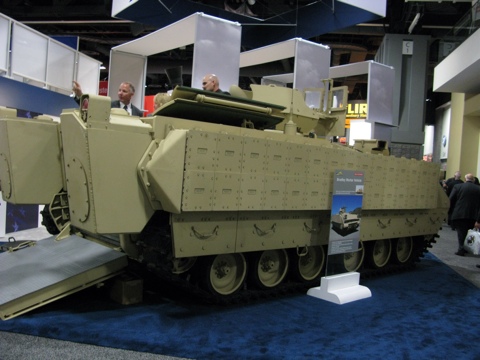
    After more than five decades in service, the M113 is finally reaching the point where the Army looks for the replace this aging fleet. While originally the Manned Ground Vehicle (MGV) and Ground Combat Vehicle (GCV) were considered as possible platforms, BAE Systems is offering a new solution – the Bradley family of vehicles. The company has developed mission specific Bradley variants to fulfill and enhance the combat mission role of the M113. While such a proposal is sensible from a logistical point of view, it remains to bee seen how the new variants address the Bradley’s inherent survivability and interior space limitations. The Army considers its current version of Bradley ‘the most survivable platform in the force, next to the Abrams tank’, but this title comes with significant additional weight. The vehicles will be available at a vehicle gross weight ranging from 55,000 to 64,800 without tile armor and will be prepared to carry 11 soldiers.

    The proposed family of vehicles expands the range of M2/M3 types with five new variants based on the bradley A3 – a command post vehicle, an armored medical evacuation vehicle (AMEV), armored medical treatment vehicle (AMTV), a mortar carrier and general purpose tracked vehicle.

    BAE Systems is displaying the command vehicle at AUSA 2010, while the mortar carrier mounting the Israeli mortar (in use on the U.S. army Stryker) is displayed at the Elbit Systems stand.

    Update: Israel Changes Rules in Gaza, Targets Terror Activist Affiliated with al Qaeda

    A Palestinian activist affiliated with Al Qaeda was targeted and killed today by an Israeli attack. According t Israeli sources Mohammad Namnan was planning an attack on Israelis and American forces in Sinai. Photo: AP
    A Palestinian activist affiliated with Al Qaeda was targeted and killed today by an Israeli attack. According t Israeli sources Mohammad Namnam was planning an attack on Israelis and American forces in Sinai. Photo: AP

    Israel claimed responsibility of the killing of Muhammad Jamal al-Namnam, resident of Shati-suburb of Gaza. According to an Israel Defense Forces (IDF) announcement Namnan, age 25 was a senior leader

    of the “Army of Islam”, (AOI) an extremist militant organization operating in Gaza and East Sinai. He was killed when his car exploded in front of the police headquarters in Gaza, around noon. The explosion wounded three more persons. By evening Israel confirmed Namnam was ‘targeted’ in a coordinated operation that involved the IDF and Israel’s Internal Security Agency (ISA). According to Hamas sources the explosion was caused by a missile strike.

    According to a source in Gaza quoted by Ynet, Namnam was killed while travelling in a new Hyundai vehicle which recently arrived in the Gaza Strip from Israel, as part of the easing of the blockade. Israel has allowed dozens of such vehicles to enter Gaza. Hamas interior ministry had called

    on Palestinian buying the new cars, but to have them checked thoroughly, “for fear that Israel could have planted listening devices or even booby-trapped them.”

    On 17 November Israel acted again, targeting a senior AOI operative – 30 year old Aslam Yasin, a resident of Jabelia Palestinian refugee camp located near the city of Gaza. Yasin was a close assistant of Mumtaz Durmush, the current leader of AOI.

    This Salifist terror organization was identified with the cause of “Global Jihad” and believed to be affiliated with Al Qaeda. Al Namnan was personally involved in directing several terror attacks against Israeli targets in recent years. More recently, he was involved with conspiring and directing a terror attack against American and Israeli targets throughout the Egyptian Sinai Peninsula and along the Egyptian-Israeli border, in cooperation with Hamas elements in the Gaza Strip. Otherwise, his organization, “Army of Islam” is known to be hostile to Hamas, as its members have already clashed with Hamas forces in the past. The Army of Islam has been involved in several high-profile abductions, including involvement in the capture of Israeli soldier Gilad Schalit and the kidnapping of British reporter Alan Johnston in 2007. Schalit is still being held, while Johnston was released after nearly four months in captivity.

    In past years Israel has diligently ‘targeted’ Palestinian militants as part of its anti-terror campaign. Air attacks were often used, as well as direct assaults by special operations squads. Targeting terror leaders, particularly in Gaza, managed to suppress terrorist activity but has, so far not achieved ‘decapitation’ of these organizations, as new leaders rapidly took charge and continued to fight, alas less effectively.

    In the Palestinian West Bank, targeting terror activists has successfully diminished these organizations to a level where most of the activists who managed to remain alive agreed to cease fire and abandon terror only to be removed from the ISA’s ‘most wanted’ list.

    Israel ceased such targeting operations in the West Bank and Gaza in recent years, and maintained this policy despite the continuous armed conflict with Hamas in Gaza. The recent act is considered a warning to Hamas and other Palestinian activists in Gaza, meaning that Israel can be setting new rules in pursuing extremist activists in Gaza and beyond.

    Distributed Aperture System Tracks Ballistic Missiles from 1,300 km Away

    Manned and unmanned aircraft equipped with omni-directional ‘Distributed Aperture System’ (DAS) imaging infrared systems could be used effectively to provide early warning on missile launches. Such systems covering a full hemisphere, can spot missiles as they break over the horizon and automatically track their hot flame from long distance, throughout their ascent phase. With such capability the system could offer early warning advantages beyond current ‘non traditional ISR’, in missile defense and counter rocket, artillery and mortar (C-RAM) defense. The only aircraft currently equipped with Northrop Grumman AN/AAQ-37 DAS is the F-35 Lightning II. However, other platforms could get such capabilities if their missile defense capabilities are proven, to provide early warning triggering other sensors to track ballistic missile after their launch.

    The capability of these staring sensors to detect and track ballistic missiles distances beyond a thousand kilometers was demonstrated during a test flight of the BAC-111 test-bed aircraft. During a test flight conducted earlier in 2010, the sensors detected a two-stage target missile from a distance of 1,300 kilometers (800 miles). “DAS is an omni-directional infrared system that can simultaneously detect and track aircraft and missiles in every direction, with no practical limit on the number of targets it can track. DAS truly revolutionizes the way we think about situational awareness,” said Dave Bouchard, program director for F-35 sensors at Northrop Grumman’s Electronic Systems sector. “In recent testing, DAS has proven to have applications and capabilities beyond its initial requirements for the F-35, including ballistic missile detection and tracking, and counter-rocket, artillery and mortar (C-RAM) capabilities.”

    The video generated by DAS during the flight test has been magnified 10 times to allow clearer viewing of the rocket. Unlike other sensors, DAS detects and tracks the rocket at horizon-break without the aid of external cues. DAS algorithms continuously track the rocket through first-stage burnout, second-stage ignition, across DAS sensor boundaries, and through the rocket’s second-stage burnout at a distance of more than 800 miles. The video also shows DAS’ detecting and tracking the rocket’s first-stage re-entry.

    Head of Israel’s ‘Shin Bet’ Outlines Israel’s Joint Counter-Terror Strategy

    Yuval Diskin, Director General, Israel Security Agency (ISA). Photo: ISA
    Yuval Diskin, Director General, Israel Security Agency (ISA). Photo: ISA

    Israel’s security services required time to adjust and develop new and effective countermeasures to combat the new threat of suicide bombers. The results were remarkable: Compared to 452 suicide attacks carried out by the Palestinians in 2003, only two such attacks occurred since 2007. (Read the full article… )

    According to Yuval Diskin, Director, Israel Security Agency (ISA – Shin Bet), the winning formula developed by Israel’s security services is based on jointness – the ability of all services to work together, sharing operational concepts (CONOPS), with a clear definition of the combined objective for all the organizations engaged in homeland security and defense. Multidisciplinary intelligence activity, based on advanced technological and human intelligence, tailored and channeled through processing and dissemination, means to turn intelligence from raw data into an operationally valuable, real-time asset. “Operational systems must be adapted and learn to operate as efficiently as possible with such real-time intelligence assets” said Diskin.

    Such adaptation is enabled by introducing technological means to improve connectivity, interoperability and joint operations by combined task forces, composed of elements from different organizations, such as ISA, National Police, Army and Air Force. Under such a cooperation umbrella, different organizations must share common counter-terror techniques, tactics and procedures (TTP), optimizing for rapid response, based on real-time intelligence. According to Diskin, the main advantage of the joint-operating concept is by combining the unique capabilities and characteristics of each of the participating organizations. “The main challenge is not integrating the technologies, but overcoming leadership and human nature obstacles” Diskin added. One of the keys to establishing jointness was the setup of inter-service command posts, manned by representatives from all the services and organizations involved in operations.

    Diskin considers the legal infrastructure a critical element in the success of Israel’s counter-terror campaign. “It took Israeli lawmakers 14 years to agree on the legal framework for the ISA, until the so-called ‘ISA Law’ was completed in 2002. Once implemented, this legal foundation became instrumental for the success of Israel’s counter-terror campaign.” Said Diskin.

    Diskin warns that cyber terrorism is becoming a growing challenge. Since such activities are performed over cyberspace, the location of the perpetrators is irrelevant to their ability to cause harm, get support or access their targets. The global internet provides terrorists with many advantages, including recruitment, indoctrination, and training tools. Terrorist’s cybernetic capabilities also exploit the information services made available for peaceful purposes, such as GPS and geospatial intelligence, real-time communications via Internet, cellular phones or messaging devices, powerful encryption devices etc. These capabilities are added to the determination and willingness of terrorist organizations to carry out ‘mega-terror’ actions, regardless of the casualties or damage they cause.

    According to Diskin, successful counter-terror strategy must rely on international cooperation among intelligence agencies, establishing an agreeable legal framework among nations to eliminate potential loopholes that are exploited by terrorists. Formulating cooperation among homeland security and counter-terror organizations from different countries is also imperative, for joint operational capabilities. “The is a growing understanding and openness to these cooperative principles among the countries facing terror threats” Diskin concluded. Read the full article

    Suicide Bombers as Weapons

    A scene from the Paradise Now describing a dispatcher preparing a suicide bomber for his mission. (a Warner Brothers film)

    A scene from the Paradise Now describing a dispatcher preparing a suicide bomber for his mission. (a Warner Brothers film)
    A scene from the Paradise Now describing a dispatcher preparing a suicide bomber for his mission. (a Warner Brothers film)

    Tel Aviv, November 1, 2010: About 1,200 Israelis were killed and almost 8,000 wounded during the 2000-2003 ‘Intifada’ Palestinian terror campaign. Almost half of these casualties were caused by suicide bombers, wearing explosive vests under their clothing, or carrying bombs cached in bags. In addition, 80 were killed by suicide attacks conducted by one, or more terrorists that went on their missions knowing they will not survive.

    Suicide terror of the scale of the Islamic terror is relatively a new phenomenon. According to Dr. Lt Col (res) Anat Berko, Criminologist from the Institute for Counter Terrorism (ICT), the Interdisciplinary Center Herzliya, the Palestinian terror groups developed a sophisticated method for identifying, recruiting, and indoctrinating potential suicide bombers by exploiting personal hardships and cultural weaknesses of traditional Arab society.

    “We are looking for sad people” Berko quoted one of the dispatchers she interviewed for her research. Berko claims that suicide bombers are not acting like anarchists, religious zealots, nor are they motivated by poverty, injustice or revenge, but manipulated by their dispatchers to carry out their act. “The suicide bomber does not act out of suffering or inferior economic status, but rather out of a desire to win social recognition” Berko explains, “These are likely to be socially marginalized people, lacking self-esteem and power to resist. “They are easily spotted by recruiters, considered figures of authority” Berko added.

    The reasons driving suicide bombers to their acts are less glamorous – an attempt to redeem clan’s honor, sometime they are totally obsessed by ‘shohada’ thoughts, leading them to seek those who can help them do such an act. Typically, suicide bombers are ‘launched’ to their targets like robots. Sometime the obsessive thoughts turn such a person to perform such a despicable act almost automatically. However, if the process is disrupted – they can ‘wake up’, and regret their act.” Berko added. However, as dispatchers are aware of such ‘risk’, suicide bombers are often equipped with backup communications, enabling the activation of the explosives they carry by remote control.

    Dr. Anat Berko works on the subject of Palestinian Suicide Terrorism (Male and Female Suicide Bombers and their Dispatchers). Alongside this, Dr. Berko studies imprisonment and the imprisonment process in both military and civilian prisons. Furthermore, Dr. Berko also researches on women in the IDF, as well as criminology. Dr. Lt. Col. Anat Berko spoke at the First International Homeland Security Conference held in Tel Aviv Israel this week.

    Photos: Profiling potential suicide bombers is difficult. Recruiters don’t hesitate to exploit women and children, willingly manipulated to carry out suicide terror acts. The woman above shows the explosive belt, below, a young boy wearing explosive belt intercepted at an Israeli road block north of Jerusalem.

    Aerospace Israel 2010

    Aerospace Israel 2010 will take place in November 2010 in Jerusalem, joining together top defense and aerospace decision makers and officials from Israel, with leading international participants. The event will also include an exhibition demonstrating Israel’s breakthrough in Air and Space technologies.

    Aerospace Israel 2010

    Location: ICC Jerusalem International Conference Center, Israel

    Event’s dates: 15th November 2010

    The Israeli International Aerospace Conference & Exhibition is an annual event that brings together global exhibitors, business and professional attendees from around the world. The event will feature discussions dedicated to major trends and changes facing the global Aviation Industry. The Israeli International Conference for Aerospace Technologies provides an opportunity for defense officials, military personnel, aviation industry leaders, and academics from around the world, to meet and exchange ideas and views on current concerns. The conference will be held during the Israeli Aerospace exhibition.

    The upcoming event named ‘Aerospace Israel 2010’ will take place on 15 November 2010 at The International Convention Center (ICC) – Binyanei HaUma, Jerusalem. The event will include an exhibition of air and space technologies, and a conference on Space and Aviation technologies.

    The upcoming event follows the successful International Aerospace Conference & Exhibition 2009. The conference hosted industry exhibitors and over 2,500 industry participants. It was opened by Israel’s Minister of Defense Ehud Barak, and was closed by the Prime Minister Benjamin Netanyahu. During the event, PM Netanyahu chaired a closed-door session about the Technological answers to the ballistic threats facing Israel, with 30 leaders of the Israeli Air & Space Industries.

    Conference main topics:

    • Air & Space technologies
    • Air Defense
    • Active Defense
    • Civil Aviation

    Conference Chairman: Col. (res.) Amnon Ben-David
    Tel (int.): +972-52-5208111 or email: [email protected]

    Japan Completes Upgrading Four of its Destroyers for Ballistic Missile Defense

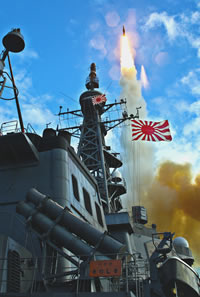
    Standard Missile (SM)-3 Block IA missile is launched by JS Kirishima, the 4th Japanese AEGIS BMD destroyer, to intercept a target missile outside the Earth's atmosphere, during a ballistic missile intercept test conducted in the Pacific Ocean, October 28, 2010. Photo: U.S. NavAir, Pt. Mugu.
    Standard Missile (SM)-3 Block IA missile is launched by JS Kirishima, the 4th Japanese AEGIS BMD destroyer, to intercept a target missile outside the Earth's atmosphere, during a ballistic missile intercept test conducted in the Pacific Ocean, October 28, 2010. Photo: U.S. NavAir, Pt. Mugu.

    Japan has completed testing of its upgraded AEGIS Ballistic Missile Defense (BMD) system with the 4th Kongō class destroyer, JS Kirishima, equipped with the Aegis Ballistic Missile Defense (BMD) system, successfully intercepted and destroyed a ballistic missile target above the atmosphere during an international test event.

    The Kirishima detected and tracked the separating medium-range ballistic missile target. It then developed a fire control solution and launched and guided a Standard Missile (SM)-3 Block IA missile to intercept outside the Earth’s atmosphere. In another test earlier this month, Kirishima demonstrated her ability to interoperate with the Navy for BMD operations. In a test event, Kirishima acquired a separating target passed from the U.S. destroyer with her own sensors and performed a simulated engagement against the target.
    Two U.S. Navy Aegis BMD ships, the USS Lake Erie (CG 70) and USS Russell (DDG 59) also participated in the test. Russell, a BMD equipped destroyer, tracked the target and performed a simulated engagement. Lake Erie, equipped with the second-generation Aegis BMD Weapon System — which provides greater on-board discrimination capability — tracked the missile target and post-intercept debris using its advanced signal processor.

    The U.S. Missile Defense Agency and the U.S. Navy are jointly developing Aegis BMD as part of the United States’ Ballistic Missile Defense System. Currently, a total of 25 Aegis BMD-equipped warships – 21 in the U.S. Navy and four in the Japanese Maritime Self-Defense Force – have the certified capability to engage ballistic missiles and perform long-range surveillance and tracking missions. Twelve additional ships have been identified for modification to perform BMD capabilities by 2014.

    Related Posts:

    JS Myoko Completes Conversion into BMD Vessel

    Lockheed Martin Gyrocam Wins Additional Order for VOSS

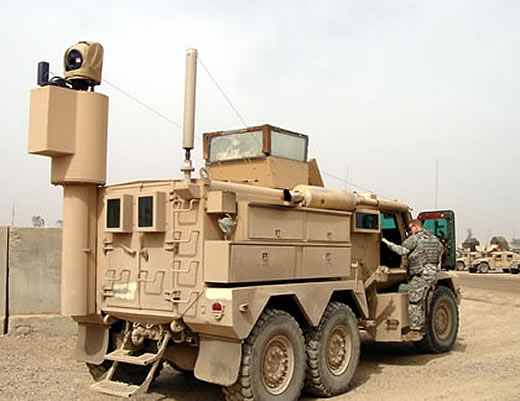
    VOSS mast mounted EO payload installed on a MRAP vehicle.

    Lockheed Martin has received delivery orders totaling $138 million from the U.S. Army Communications-Electronics Command Acquisition Center for additional 200 Vehicle Optics Sensor Systems (VOSS). These delivery orders are new releases against a multi-year Indefinite Delivery-Indefinite Quantity contract awarded to Gyrocam in 2008. The company was acquired by Lockheed Martin in 2009.

    The vehicle-mounted sensor system, can be mast-mounted on virtually any land vehicle or expeditionary system for remote surveillance needs, and it provides high-resolution color, night vision and thermal sensors in a 15-inch class gyro-stabilized gimbal. Sofar more than 800 VOSS camera systems are operational on Mine Resistant Ambush Protected vehicles throughout Afghanistan and Iraq. These systems provide Warfighters with crucial capabilities to conduct threat surveillance missions in the harshest environments.

    VOSS mast mounted EO payload installed on a MRAP vehicle.

    “The Lockheed Martin Gyrocam VOSS is a field-proven solution that provides the Warfighter with capabilities to identify and engage in the fight against threats and insurgents,” said Jay Pitman, general manager of Lockheed Martin Gyrocam Systems, LLC. “With the rugged design of the Gyrocam VOSS and our strong in-theater support team, we have sustained a 99 percent operational readiness rate that supports the U.S. Army in its Warfighting mission.”

    Gyrocam Systems was recognized during the “Army Top 10 Greatest Inventions of 2007” program as part of the Reconnaissance Vehicle System and was also nominated by Defense Update Magazine as a “Most Innovative Defense Technology of 2008.”

    Skunk Works and XTEND Simplify Multi-Drone Command

    0
    Lockheed Martin Skunk Works® and XTEND have achieved a major milestone in JADC2 by integrating the XOS operating system with the MDCX™ autonomy platform. This technical breakthrough enables a single operator to simultaneously command multiple drone classes, eliminating the friction of mission handoffs. From "marsupial" drone deployments to operating in GPS-denied environments, explore how this collaboration is abbreviating the data-to-decision timeline and redefining autonomous mission execution.

    From Ukraine to Taiwan: The Global Race to Dominate the New Defense Tech Frontier

    0
    As traditional defense primes face mounting competition from agile “neoprimes” such as Anduril, Palantir and Helsing, the balance of innovation is shifting toward software-defined warfare and scalable, dual-use technologies, while global industry consolidation—marked by Boeing’s integration of Spirit AeroSystems and other strategic mergers—signals an intensified race to secure control over the defense technology value chain. Our Defense-Tech weekly report highlights these trends.

    Europe’s “Drone Wall”

    0
    In early October 2025, a coordinated wave of unmanned aerial system (UAS) incursions—widely attributed to Russia—targeted critical infrastructure across at least ten European nations. The unprecedented campaign exposed the fragility of Europe’s air defenses...

    Weekly Defense Update & Global Security Assessment

    0
    Executive Summary The past week (September 18-25, 2025) represents an inflection point where strategic defense concepts have transitioned from doctrine to tangible reality. An analysis of global events reveals four primary, interconnected trends shaping an...

    U.S. Air and Space Forces Push Next-Gen Programs at the AS&C 2025 Conference and...

    0
    At the 2025 Air, Space & Cyber Conference, U.S. Air Force and Space Force leaders unveiled major updates on next-generation fighters, bombers, unmanned systems, and space initiatives, highlighting both rapid innovation and critical readiness challenges as the services race to outpace global competitors. A short version is available here, with a more detailed version for subscribers.

    TADTE 2025: Reflecting Taiwan’s Strategic Themes

    0
    The Taipei Aerospace & Defense Technology Exhibition (TADTE) 2025 crystallized around four dominant strategic themes that collectively illustrate Taiwan's comprehensive approach to defense modernization amid escalating regional tensions. Based on a detailed report by Pleronix (available upon request). Includes a Podcast discussion on TADTE 2025's highlighting Taiwan's four strategic themes beyond the post's coverage.

    Iron Beam 450 Completes Testing, Soon to Join With Operational Air Defense Units

    0
    Israel’s Iron Beam 450 high-power laser system has completed final testing, marking a major leap in air defense. Developed by Rafael, it offers precise, cost-effective interception of rockets, UAVs, and mortars, and is set for IDF deployment by 2025.