
Friday, December 26, 2025
More
    Home Blog Page 262

    U.S. Army set for Operational Testing of Ground, Foliage Penetrating Airborne Radar

    Lockheed Martin has begun testing the TRACER penetrating SAR radar on the NASA Ikahana UAV, a modified General Atomics MQ-9 unmanned aircraft. The radar depicted in this drawing employs the latger UHF antenna carried on the right wing. The unpressurized radar pod is carried on the left wing. The radar is slated to begin operational evaluation in 2011. Image: Lockheed Martin.

    Lockheed Martin is discussing potential operational deployment of foliage penetrating synthetic aperture radar (SAR) next year. The UHF-band Tactical Reconnaissance and Counter-Concealment-Enabled Radar (Tracer) has completed approximately 100 test flights through 15 months testing on an Army C-12 aircraft and is currently undergoing flight testing on a NASA-operated Ikhana (Predator B derivative) unmanned aircraft.

    Lockheed Martin has begun testing the TRACER penetrating SAR radar on the NASA Ikahana UAV, a modified General Atomics MQ-9 unmanned aircraft. The radar depicted in this drawing employs the latger UHF antenna carried on the right wing. The unpressurized radar pod is carried on the left wing. The radar is slated to begin operational evaluation in 2011. Image: Lockheed Martin.

    By the end of 2010 Lockheed Martin is expected to deliver the last of four radars ordered under the U.S. Army contract. One of the four systems will be deployed for operational evaluation. Pending positive results of the evaluation, Lockheed Martin could enter low-rate production under a new contract.


    The TRACER radar can spot targets under camouflage or buried underground objects. The initial operational application of the radar would be on a manned aircraft such as C-12, designed to perform automated, wide area surveillance detecting changes in the scene being inspected. TRACER will be able to deliver high resolution images to ground units in all-weather, day or night conditions, when operating in various collection modes. “When deployed, this ‘hunting’ sensor can use the penetrating rafar capability to provide ground commanders with intelligence not available from a traditional optical sensor” said Jim Quinn, vice president with Lockheed Martin’s Information Systems & Global Solutions-Defense.

    The purpose of the current test flights is to demonstrate the system’s ability to operate the radar remotely on long endurance missions. The TRACER configuration aboard the MQ-9 utilizes an external unpressurized pod to house the RF subsystem with antennae installed on the other wing. The tests aboard the NASA-operated Ikhana is currently underway. The Ikhana performed as a surrogate for the Army’s “Gray Eagle” (MQ-1) unmanned aerial system, which was not available because of current mission critical needs. According to the manufacturer, the flight tests on the Ikhana focused on the radar’s performance in the harsh environment of the unpressurized pod, and are intended to mitigate risk for eventual installation on the Army UAS.

    TRACER was developed as a dual-band system, enabling effective ground and foliage penetration using UHF and VHF frequencies. The compact UHF antenna has been integrated on the unmanned aircraft while the VHF antenna began flying on a surrogate manned platform in October 2010. Packing the antenna into more compact module is already underway, matching medium size platforms such as the C-12, Predator and Gray Eagle UAVs.

    Future Enhancements

    Future enhancements to TRACER are also planned, including integration of ground moving-target indication (GMTI) capability and a “circle-SAR” feature, enabling the radar to sharpen the image processed from a target by frequently repeating scans.
    Next Generation Air Dominance Missiles

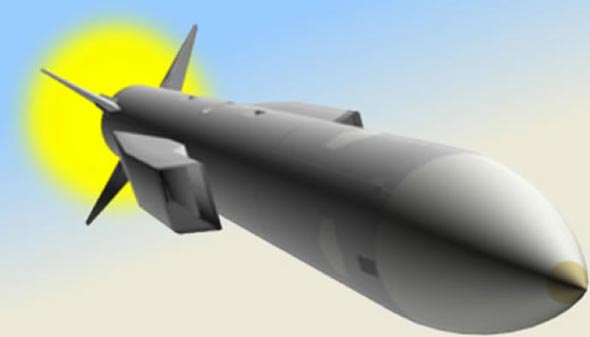
    An illustration depicting the Triple Target Terminator (T3) Future multi-mission missile, an initiative led by DARPA to provide 5th Generation figters and unmanned combat aircraft with common air/air and defense supression weapon.

    Triple Target Terminator (T3); DRADM

    DARPA has awarded two competitive development contracts to Boeing and raytheon, to conduct conceptual design and development of a multi-mission air/air and air/ground missile dubbed ‘Triple Target Terminator’ (T3). The program, part of the agency’s advanced weapons initiative, is pursuing a high speed, long-range missile that can engage enemy aircraft, cruise missile and air defense targets. T3 will be designed for internal carriage on stealth aircraft like the F-35, F-22 and F-15SE, or externally on fighters, bombers and UAVs.

    An illustration depicting the Triple Target Terminator (T3) Future multi-mission missile, an initiative led by DARPA to provide 5th Generation figters and unmanned combat aircraft with common air/air and defense supression weapon.

    T3 would allow strike fighter aircraft to rapidly switch between air-to-air and air-to-surface (counter-air) capabilities. The missile is likely to be equipped with multi-mode seeker and network-centric data links, providing high level of target discrimination, employment of kinetic network-centric applications and human-in-the-loop control. An advanced multi-purpose warhead will be required to engage the wide range of targets with maximum lethality.

    Raytheon and Boeing were each awarded $21.3 million contracts in November 2010, for the development of T3. The companies are expected to deliver conceptual designs within a year, and continue developing the future weapon, providing prototype missiles for flight demonstration by 2014.

    Parallel to DARPA’s T3 program the U.S. Air Force Research Laboratory (AFRL) is also examining new technologies for a future air/air weapon known as ‘DRADM‘. Boeing was awarded contracts for the demonstration of a vector thrust propulsion and control, terminal guidance sensors, shaped-charge warhead and fuse mechanism for such a missile. In 2010 DARPA has also funded technology tradeoff studies associated with similar aspects of T3. It has yet to be determined whether the two programs will compete or supplement each other in a common design. ATK, Lockheed Martin and Northrop Grumman have teamed up to pursue future, dual-role missile development to date, but none of these companies were awarded contracts for T3 or DRADM.

    Whatever the future missile will be, it is expected to replace current AIM-120 AMRAAM and AGM-88 HARM ‘air dominance’ missiles currently in service with U.S. air Combat Command, U.S. Navy, Marines, and many allied air forces.

    More on the Next Generation Missiles:

    OH-58F Represents Another Round Of Upgrades Keep The Armed Scout Fighting

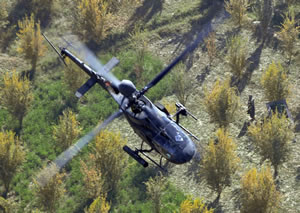
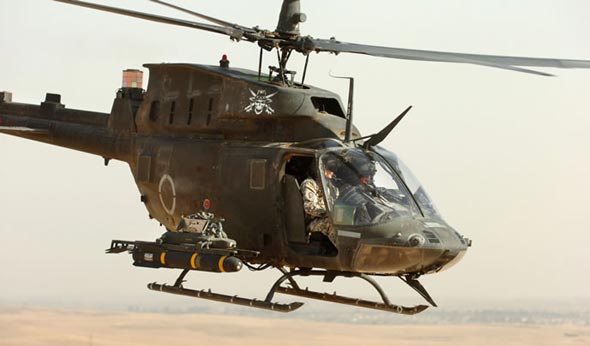
    Armed with Hellfire missiles, Col. A.T Ball, the 25th Combat Aviation Brigade Commander flies a Kiowa (OH-58) during a recent mission in the area of Kirkuk, Iraq. The 25th CAB provides air support for ground forces throughout most of Iraq. Photo by Spc. Bryanna Poulin

    Kiowa Warrior is Back in the Fight

    The U.S. Army fielded the OH-58D scout helicopter in 1983 and its ‘Kiowa Warrior’ armed reconnaissance derivative in 1991 as a single-engine, two-seat reconnaissance and direct-fire support helicopter. While this aircraft is considered obsolete by today’s terms, a replacement of the original model is not yet in sight and the Army plans to keep them as an integral piece of the Combat Aviation Brigade for years to come. To support the helicopters, a Sustainment Maintenance Program (SMP) and Survivability Enhancement Program (SEP) were required to improve flight safety and survivability, reduce platform sustainment costs and contain the expense of replacing aging helicopters. However, these upgrades will not solve the OH-58’s main deficienc – limited capability to operate in high altitude and hot climate, characteristic of the Afghan theater of operation. To improve performance in such conditions, re-engining the current platforms or fielding a new armed scout helicopter.

    Armed with Hellfire missiles, Col. A.T Ball, the 25th Combat Aviation Brigade Commander flies a Kiowa (OH-58) during a recent mission in the area of Kirkuk, Iraq. The 25th CAB provides air support for ground forces throughout most of Iraq. Photo by Spc. Bryanna Poulin
    A Task Force Destiny, 101st Combat Aviation Brigade OH-58D Kiowa Warrior helicopter conducts aerial reconnaissance Nov. 8, 2010, in southern Afghanistan. Photo: U.S. Army

    While the Army has yet to determine which armed scout it would like to field, the current armed reconnaissance helicopters known as Kiowa warrior (OH-58D) is going strong. Under the current modification program 371 helicopter are being modernized Safety Enhancement Program (SEP) configuration.

    Under a follow-on program Bell will convert OH-58A helicopters into the OH-58D Kiowa Warrior, under the “A2D” program, recently awarded by the U.S. Army. This conversion intends to replace wartime losses and battle damage suffered by the OH-58D Kiowa Warrior. As part of the initial phase of the program Bell will convert eight cabins; the Army has an option to take ten additional converted Kiowas under this contact, to be followed by fulfilling additional conversions on demand, to replace wartime losses.

    Bell is also working on an avionic modification designated Cockpit and Sensor Upgrade Program (CASUP), to be implemented with Kiowa warrior, under the new designation OH-58F. According to Colonel Robert Grigsby, Army’s Armed Scout Helicopter program manager, the low-risk upgrade is based on non-developmental items and systems fielded on other aviation. The primary change introduced with CASUP is the installation of nose mounted sensor, replacing the complex mast mounted system.

    The cockpit instrumentation includes three full color multi-function displays and digital inter-cockpit communications. Dual-redundant digital engine controller will improve engine safety. The CASUP upgrade will also include redesigned wiring harnesses, setting the infrastructure for future upgrades of the weapon system and electronic countermeasures. The cockpit and avionics will fully integrate with the capabilities of Level 2 Manned Unmanned Teaming, already available in AH-64 Apache helicopters. Additionally, the F model will fully integrate the capabilities of Level 2 Manned Unmanned Teaming, Common Missile Warning System (CMWS), Health and Usage Monitoring (HUMS), and enhanced weapons functionality via 1760 digital interface.



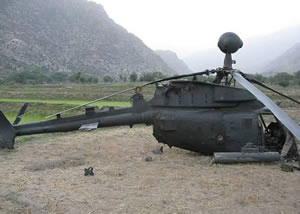
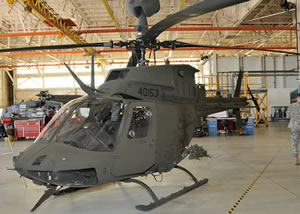
    Above: The crash battle damaged OH-58D helicopter before its Nov. 2008 induction into Corpus Christi Army Depot. It was refurbished, readied for action, and rolled out Oct. 14, 2010 (on the right) Photos: Photo by Ervey Martinez, U.S. Army

    To improve the Kiowa Warrior’s performance in high-hot conditions, Bell is proposing to replace the current Rolls-Royce Model 250-CR30 engine with Honeywell’s HTS900-2 offering up to 50% power increase. This modification and other improvements could be part of the OH-58 Block II ‘fleet representative demonstrator’ Bell is developing to address U.S. Army future requirements.

    A more radical modification of the Kiowa Warrior is proposed by AVX, a small aeronautical design company from Texas. As part of the proposed modification the tail rotor will be eliminated and the main rotor assembly will be replaced with coaxial rotor system. According to AVX, this radical change will dramatically improve the performance, flight safety and survivability of the helicopter. According to AVX the new compound helicopter could be 25% faster. The modification could also be cheaper than re-engining the helicopter, as Bell porposed.

    If the Army would consider a new platform, EADS North America and Lockheed Martin are likely to offer an armed version of the UH-72 Lakota utility helicopter. The team has already produced three AAS-72X demonstrators for this purpose. AgustaWestland is likely to offer a militarized variant of the AW119 while Boeing is likely to submit the AH-6 which recently won its first international orders in the Middle East. As such Request for Proposal is likely to materialize in 2014 or later, the S-97 Raider under development at Sikorsky could also be considered by the Army.

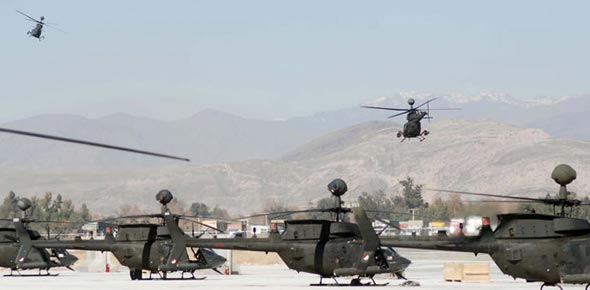
    Several OH-58 D Kiowa Warrior helicopters sit on the flight line of Jalalabad Airfield in Afghanistan Feb. 17, 2008, as two others depart on a mission. (U.S. Army photo by Spc. George Welcome)

    Sikorsky Forms a Team to Develop the X2 Raider Armed Scout Helicopter

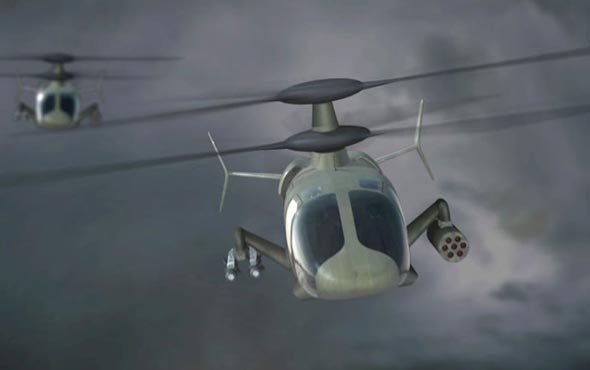
    An artist rendering of the S-97 Raider light recce and transport helicopter (LUT) Image: Sikorsky

    Sikorsky has launched the development of a prototype light tactical helicopter based on the X2 rigid coaxial rotor technology designated S-97, and named ‘Raider X-2’. The company plans to produce two prototypes and fly them toward 2014, in time for a future request for proposals (RfP) for an Army Armed Aerial Scout. The new design is larger than the X2 demonstrator aircraft that recently achieved 250 knots. The development will prove the military application of the rigid, coaxial rotor configuration. At the AUSA 2010 annual meeting last month Sikorsky unveiled a mock-up of the Raider X2.

    An artist rendering of the S-97 Raider light recce and transport helicopter (LUT) Image: Sikorsky

    Sikorsky director for light tactical helicopters Douglas Shidler said the company was currently looking at potential suppliers and is expected to finalize the team in 2 to 3 months.

    Like the X2 Technology demonstrator (seen in the photo on the left ) that broke the helicopter speed record, flying at 250 knots (287 mph), the X2 Raider prototypes will feature twin coaxial counter-rotating main rotors (in place of one main rotor and a tail rotor) and a pusher propeller. Raider will be designed to reach cruise speeds of 200 to 220 knots, significantly faster than current armed scouts. In addition to high speed, Raider will also be more maneuverable than conventional helicopters, offer greater endurance, reduced turning radius and lower acoustic noise signature. In addition to flying at nearly twice the speed of a conventional helicopter, the X2 Raider prototype will incorporate other key performance parameters critical to combat operations – increased maneuverability, greater endurance, and the ability to operate at high altitudes.

    “These attributes will enable the X2 Raider aircraft to meet or exceed the potential U.S. Army requirements for its next armed reconnaissance helicopter,” Shidler added. “If selected by the Army, the X2 Raider aircraft design will enable high performance flight operations in high altitude regions that currently pose challenges to light military helicopters.”

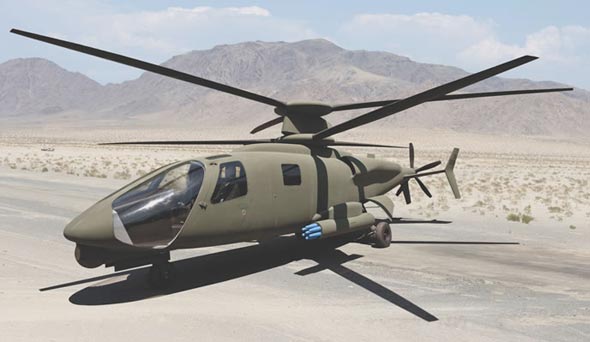
    The new helicopter will measure 35 feet length, and have a rotor diameter of 33 ft. The helicopter cockpit features side-by-side seating for a crew of two with identical flight systems in each position. For the armed reconnaissance mission, the X2 Raider helicopter will have space aft of the cockpit for armament and auxiliary fuel. In an assault configuration, the cabin affords space to accommodate up to six troops.

    In March 2010, Sikorsky submitted an X2 aircraft design to the Army’s Armed Aerial Scout (AAS) program in response to a request for information. The AAS program is currently conducting an analysis of alternatives for the Army’s next armed reconnaissance helicopter. The company expects to conduct its first major program milestone – a preliminary design review – in 2011.

    The Raider S-97 helicopter is developed by Sikorsky in anticipation of an ongoing U.S. Army requirement for a Light Transport, recce and attack helicopter. Image: Sikorsky.

    DARPA to Test new Lightweight Armor Solutions from Kairos

    Kairos Partners, Inc announced today it was selected by DARPA to participate in the “Armor Challenge for Vehicles” with its new lightweight vehicle armor. The solution proposed by Kairos uses cutting edge technologies which combine metal matrix composites (MMCs) and three-dimensionally woven fiber composites into a uniquely effective passive armor solution that can be produced in any shape or thickness. The new lightweight material can be produced in high volume production, offering cost effective protection for current vehicles, as well as for future land, air, sea, and space platforms.

    A ‘breeding ground’ supporting development and testing of innovative vehicle armor solutions, ‘DARPA Armor Challenge’ is identifying promising new armor concepts for military vehicles. Among the goals of Armor Challenge DARPA is seeking to identify advanced, lighter and cheaper vehicle armor, capable of defeating certain armor piercing rounds and fragment projectiles. The Vehicle Armor Challenge is primarily designed for inventors and small organizations that have limited resources to initiate full-scale armor development programs. “DARPA has given us a chance to prove our technology, and truly presents us with opportunity.” said Don Akers, President and CEO of Kairos Partners.

    ‘C2 Core’ – Linking Information Across Networked Applications

    U.S. DOD Introduces A New XML-Like Military Standard
    Linking Information Across Networked Applications

    A new information exchange standard designed to improve interoperability among U.S. Department of Defense (DoD) services and coalition partners was released for testing in October 2010.

    Known as ‘C2 Core’ the new standard is derived from the popular, commercial ‘extensible markup language’ (XML)-based data exchange, and DoD Universal Core (UCore) standard. It provides a common, open standard for the definitions of sets of rules for encoding machine-readable information. C2 Core supports tenets of the DoD’s Net-Centric Data Strategy by making data understandable across networks and services, supporting joint and coalition warfighters by improving interoperability at the data and information layer.


    The new standard represents same types of data with commonly agreed definition, regardless of the source it’s coming from. This commonality simplifies data interpretation and integration between different systems. The current version is used primarily for test and evaluation while the next version is expected to be qualified for implementation in programs of record beginning in fiscal year 2012. While the C2 Core is a U.S. initiative, NATO’s Command, Control and Consultation Board is evaluating their future data approach are now considering a proposed NATO Core that would be similar to the U.S. Universal Core and C2 Common Core. Work with France, Canada, the Netherlands, and other coalition forces are also underway through NATO’s Allied Command Transformation (ACT), to familiarize coalition partners with the new protocol.

    According to Leslie Winters, Joint Data and Services Division chief, once completed, C2 Core will benefit warfighters and their ability to gather, understand, integrate, and analyze information rapidly. “Right now, most data sharing is basically point-to-point, often proprietary interfaces between every kind of data source we use. It’s costly to develop new interfaces and it takes a lot of time.” Explained Winters, “Combined with open interfaces such as web services, the C2 Core should make the development and data integration process more agile and enable delivery of more information to the warfighter in a shorter period of time.”

    C2 Core represents the first major DoD Common Core that builds on the foundation of the UCore version 2.0, a federal information sharing initiative co-sponsored by the DoD, the director of National Intelligence, the Department of Homeland Security, and the Department of Justice. The initiative is sponsored by U.S. Joint Forces Command (USJFCOM) and the Office of the Assistant Secretary of Defense (Networks and Information Integration).

    U.S. Teams Grab All Prizes at Magic 2010 – Australian Robotic UGV Competition

    Team Michigan prepare the robots for their final mission at Magic 2010. Photo: Magic2010

    With a squad of 14 robots that worked together autonomously in a complicated mapping exercise, a team from the University of Michigan has won the inaugural Multi Autonomous Ground-robotic International Challenge (MAGIC 2010) in Australia. MAGIC 2010 featured some of the world’s most ground-breaking robotics technologies as the teams deployed a total of 43 robots to navigate a 250,000 square-meter indoor and outdoor course over three-and-a-half hours. Teams were judged on a number of factors including the maps they produced and the time they took to complete three increasingly complex challenge phases. Teams were penalized for the amount of time they manipulated their robots manually. The announcement of the winning team was made during the Land Warfare Conference taking place in Brisbane, Australia this week.

    Team Michigan prepare the robots for their final mission at Magic 2010. Photo: Magic2010

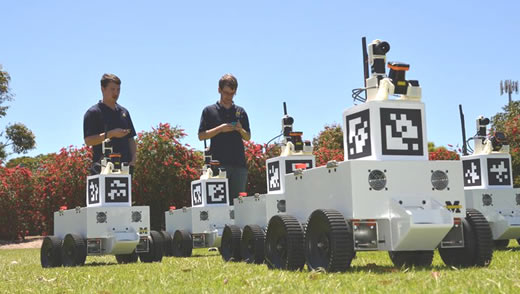
    14 Team Michigan robots ready to start. Photo: Magic 2010
    14 Team Michigan robots ready to start. Photo: Magic 2010

    “Behind Team Michigan’s robots was an amazing group of students who spent countless hours building, programming and testing the entire team of robots – and they also dealt with the formidable logistical challenges of putting everything together and shipping it 10,000 miles away,” explained Assistant Professor Edwin Olson, team lead from the Electrical Engineering and Computer Science Department at the University of Michigan. “MAGIC 2010 gave us a chance to show that our research translates to the real world.”

    A joint initiative of Australia’s Defence Science and Technology Organisation (DSTO) and the U.S. Army Research, Development and Engineering Command’s Tank Automotive Research Development and Engineering Center (TARDEC), MAGIC 2010 spanned more than two years with a stated goal of furthering the development of robot teams that could operate autonomously in dangerous situations, keeping Soldiers out of harm’s way.

    Five teams from the United States, Turkey and Australia were selected by the U.S. and Australian defense departments after a two-phase down select to compete in an effort to develop the next generation of fully-autonomous ground robots. Team Michigan and partner SoarTech (Ann Arbor, Mich.) earned a grant of $750,000 (USD). A team from the University of Pennsylvania (Philadelphia) came second and the third place was won by another U.S. group – ”Team Reconnaissance and Autonomy for Small Robots’ – RASR – from Gaithersburg, Md. Rounding out the top five teams were teams Cappadocia (Ankara, Turkey) and MAGICian (Perth, Australia).

    Team RASR Talon robots
    Team RASR robots await the starter's gun at the Phase One course of the MAGIC Grand Challenge. Photo: Magic 2010

    Falcon is Healthy, Few Tweaks Will Suffice to Fly the Next Mission in Late 2011

    While the smaller AHW is designed to fly at five times the speed of sound (Mach 5), The Falcon HTV-2 hypervelocity vehicle aimed at four times that speed (Mach 20), thus reaching targets 4,000 nautical miles away in 30 minutes. Image: DARPA

    Six months after the first test flight of the Falcon Hypersonic Technology Vehicle’s (HTV-2) which failed to meet its objective, an independent Engineering Review Board (ERB) identified the anomaly that caused the vehicle to exceeding the design flight control envelope. “No major changes to the vehicle or software are required to mitigate the first flight anomaly” said David Neyland, DARPA Tactical Technology Office director, “Engineers will adjust the vehicle’s center of gravity, decrease the angle of attack flown and use the onboard reaction control system to augment the vehicle flaps when HTV-2 flies next summer” Neyland added.

    The Falcon HTV-2 hypervelocity vehicle could glide at a speed at Mach 20, reaching targets 4,000 nautical miles away in 30 minutes. Image: DARPA

    DARPA is planning to repeat the test in late 2011 trying to complete a 30 minute hypersonic flight at speeds reaching Mach 20, covering about 3,000 nautical miles over the Pacific Ocean. The first flight was terminated prematurely, about 9 minutes after launch.

    Detailed analysis conducted by the ERB revealed that the most probable cause of the HTV-2 flight anomaly was higher-than-predicted yaw, which coupled into roll thus exceeding the available control capability at the time of the anomaly. “The HTV-2 flight anomaly is characterized as a slow divergence about the longitudinal axis (in roll) which continued until the roll rate reached a threshold where the autonomous flight system commanded flight termination.” The report explained. The review acknowledges data on the relevant aerodynamic parameters for this specific flight regime were limited.

    Despite the early termination of flight, DARPA claims the first flight demonstrated significant accomplishments in the area of hypersonic flight. During the most challenging segment of flight, before the flight terminated, HTV-2 transmitted telemetry data on aerothermal, aerodynamic, thermal protection, navigation, guidance and control in the hypersonic flight regime – all critical areas of interest to the program. The flight also demonstrated successfully the first ever use of an autonomous flight termination system. Additionally, the flight represented the inaugural launch of the Minotaur IV booster. The booster demonstrated the ability to fly at extreme angles of attack up to 89 degrees to meet stringent release requirements for the HTV-2.

    When developed into mature weapon systems, Falcon type vehicles could introduce new category of weapon enabling a rapid reaction global strike capability against time critical threats, employing platforms that could not be confused by Russia or China as intercontinental ballistic missiles, thus triggering offensive response by other nuclear powers.

    Boeing X-51 test vehicle loaded on a B-52 bomber, prior to the 26 May 2010 test flight. The X51 WaveRider have set a world record for the longest Scramjet burn time.

    A parallel technology currently in development is the X-51 WaveRider, developed by Boeing and Rocketdyne (Pratt & Whitney). This vehicle will demonstrate capabilities similar to the FALCON, and could be a competitor to Lockheed Martin, on a future USAF requirement for global strike with the hypersonic atmospheric vehicles. The WaveRider integrates a scramjet engine developed by Pratt & Whitney, a boost rocket motor derived from an ATACMS missile matched with an airframe built by Boeing. In May 2010 WaveRider performed the first flight, flying at a speed of Mach 5 for 200 seconds (short of the 300 second goal). In subsequent flight tests Waverider will accelerate from this Mach 5 speed to demonstrate cruising at Mach 6 -7 speed.

    Elbit Systems Unveil Hyperspectral Imaging System for Aircraft, UAVs and Satellites

    A hyperspectral (HS) intelligence payload system known as ‘Chariot of Fire’ was developed by Elbit Systems Electro Optical subsidiary El-Op. The system is currently deployed on aircraft or UAVs but could be enhanced in the future to support satellite platforms. As a dual-use payload, the ‘Chariot’ has already been deployed in Israel and abroad on various missions, such as tracking uranium contamination from mining activity, oil spills and monitoring efficiency and spillage from water  treatment facilities. ElOp is already developing a multi-spectral imaging sensor for a satellite under the French-Israeli VeNUS program.

    Hyperspectral data is useful in a wide variety of applications relating to the classification or identification of properties of objects with high precision and resolution. Elbit Systems’ Electro-optics Elop has been assigned by the Israeli government as a national center of excellence for this field. The current technological solutions are focused on HS airborne sensors employing continuous sensing through multiple, very narrow spectral bands covering Visual, Near Infra-Red (VNIR) and Short Wave Infra-Red (SWIR) domains (0.4-2.5 micron).

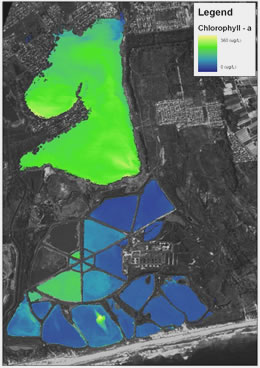
    Hyperspectral sensing has many military applications in Measurement and Signature Intelligence (MASINT). Many such applications are also relevant to commercial uses, positioning these instruments as dual-use sensors. For example, environmental mapping of aquatic areas, or monitoring pollution levels (see photo above left), in the civil applications, could translate into tracing specific chemicals related to Weapons of Mass Destruction (WMD). Geologic mineral mapping could translate in the military to tracking of underground activity. Agriculture applications like precision farming, growth monitoring, yield prediction, and soil classification are paralleled in the military world as identification of weapon caches, fortification, mining, camouflage discrimination, terrain and mobility assessment, etc.

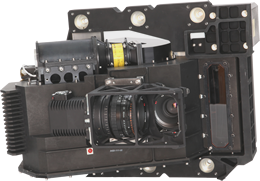
    The payload (seen in a bottom view on the left) includes a special purpose hyperspectral camera integrating multiple sensors simultaneously gathering reflected radiation in 215 spectral bands in the 0.35 – 2.5 nm range. The camera is fitted with on-board GPS/INS sensor providing geo-referencing for every pixel. The payload also includes a panchromatic imaging system providing high resolution coverage of the area under surveillance. The HS sensor’s resolution is two meters. The new payload has an aerial coverage capacity of 100 square kilometers per hour and would typically operate in daylight, for about eight hours. The operational concept calls for flight to the target at night, and data collection during daylight hours. Designed for operation at altitudes up to 25,000 meters, at a velocity of up to 120 knots, clearly indicating a usage profile of a high flying UAV.

    The ‘Chariot’ operates fully autonomously, following a mission defined at the ground control segment. The sensor will follow a pattern visiting specific points of interest, following the flight course and camera angles defined by the mission plan. In Operators determine the targets for visit, the spectral bands recorded, data collection and integration schedules. The data collected automatically processed by the system include a Digital Surface Model (DSM) map, aerial photo and thematic maps. To process the map within reasonable time, the ground segment utilizes a 16 core processor, 10 terabyte of memory and geographical database (GIS) server, feeding multiple mission operators workstations.

    Related Item: Israel’s Next Generation Spy Satellite could be Operational by Late 2012

    Israel’s Next Generation Spy Satellite could be Operational by Late 2012

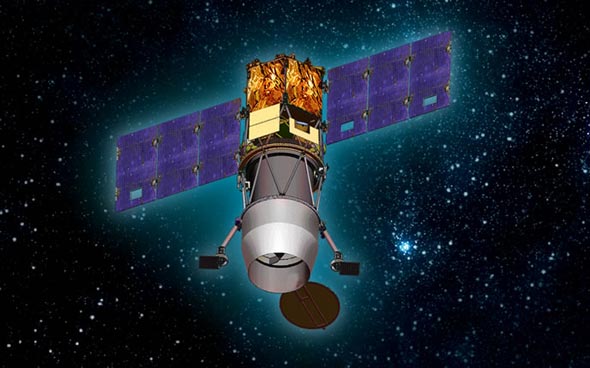
    IAI unveiled more details about Israel’s next generation spy satellite, expected to be ready for launch by late 2012. The satellite known as ‘OpSat 3000’ is assumed to become the next in the Israeli Ofeq series of spy satellites, supposedly ‘Ofeq 10’. The 400 kg satellite will orbit at an altitude of 600 km, incl. 98.23 deg. heliocynchronous orbit, with a period of 99 min. It will carry 30 kg of fuel to sustain maneuvering for at least six years in orbit. Despite the increased weight IAI confirms OpSat 3000 satellites can be launched into orbit by current Shavit satellite launchers or by other launchers. The current satellite leading Ofeq series in space is Ofeq 9, launched in June 2010.

    The new satellite employs IAI generic satellite bus system, which has already been used with the Tecsar SAR satellite. OpSat 3000 will provide a vast improvement in performance over previous generations of EO imaging satellites in all principal system characteristics. The same bus is already employed on the IAI Tecsar (Ofeq 8?) satellite, and will also be utilized on the next generation Eros C – the future high resolution satellite planned by space imagery provider Imagesat International.

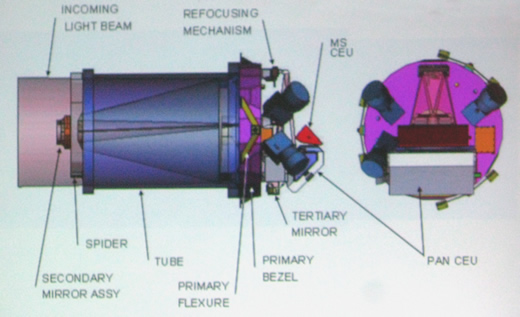
    The new satellite will carry a new multi-spectral EO payload known as ‘Jupiter’ developed by Elbit Systems’ electro-optical division El-Op. The payload integrates PAN and multi-spectral (MS) imaging cameras, sharing a common optical assembly and capable of simultaneous operation (enables creating PAN-sharpened images). The payload is strapped to the satellite platform, and line-of-sight is controlled by maneuvering the satellite with Reaction/Momentum Wheels. The satellite can also change altitude, further refining the images captured at its orbit when at the lowest point above earth. Propellant storage on board has also been increased, extending the satellite’s lifespan over 50% over current platforms, exceeding six years.

    The Jupiter payload will cover a swath 15 km wide, comprising a 30,000 pixel panchromatic Time Delay and Integration (TDI) sensor offering resolution of 50 cm from an altitude of 600 km (compared to 70 cm in current generation satellites). The payload will also operate a parallel 7.5 Megapixel multispectral sensor capturing color images at a resolution of 200 cm. The Jupiter camera characteristics are an aperture of 70 cm, fixed focal length of 15.6 meters with F# 22.3.

    This high performance space camera will be designed to capture dozens of targets in a single satellite pass. On board data storage with over half a terabyte memory will increase the number of images captured in orbit. Download speed will also increase, dumping this huge storage in a short time as the ground station enters the satellite’s communications footprint. Mission responsiveness will be shortened dramatically, with users receiving new targets within less than three hours from planning to image download.

    While current satellite imagery supports intelligence gathering at the strategic level, the high resolution to be provided by the new payload can also support users at the tactical level. The fine resolution enables differentiation between similar looking objects, discriminating specific types of weapons, such as surface-to-surface missiles, rocket launchers or air defense missiles. Analysts can identify entrances to underground facilities, identify doors or windows and other openings in small urban structures or spot individual people from space. These images could provide a useful tool for battle damage assessment as well as an information gathering means for counter-terrorism warfare.

    More on new technologies showcased at the recent Aerospace Israel 2010 convention:

    ‘Charriot of Fire’ Hyperspectral imaging payload for aerial recce, and earth observation satellites from Elbit Systems

    Indonesia Selects the Armed Super Tucano as Bronco Successor

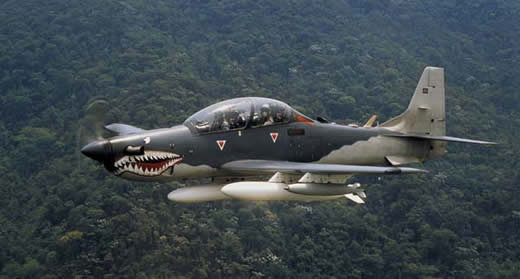
    The U.S. Air Force selects A-29 Super Tucano for the Light Attack Aircraft Program. Photo: Embraer
    Defense Update Aerospace Channel 11/2010

    Indonesia will be the first Asia-Pacific country to order the Super Tucano. Indonesia plans to field eight Embraer EMB-314 Super Tucano light-attack aircraft to replace its aging Rockwell OV-10 Broncos. Indonesia was planning to buy 16 aircraft but will settle for the near term on eight. The Broncos were built in the 1960s and most are no longer operational. The Indonesian Air Force will receive the first Super Tucanos in 2012. Indonesia evaluated the Super Tucano against a derivative of the KT-1 trainer from Korea Aerospace Industries, already in service with the Indonesian Air Force as a trainer.

    Indonesia is the first Asian country to operate Super Tucano in a COIN role. Photo: Embraer

    Indonesia is the first Asian country to operate Super Tucano in a COIN role. Photo: Embraer

    BAE Systems to lead Industry Team Supporting British Training Aircraft

    Defense Update Aerospace Channel 11/2010

    BAE Systems will lead a team comprising Gama Group Limited, Babcock Aerospace Limited and Pilatus Aircraft Limited, positioned to supporting training aircraft for the UK armed forces through the Ascent Flight Training program. MOD is positioning Ascent to become the Fixed Wing Aircraft Service Provider (ASP) for the UK Military Flying Training System (MFTS) program for a period of 25 years. Under MFTS the UK MOD has a requirement to have a range of aircraft platforms and systems available to train aircrew across the Royal Navy, Army and Royal Air Force. BAE Systems is working with its partners to submit a proposal to Ascent in January 2011.

    HMS Ark Royal Set on its Last Voyage before Decommissioning

    The Ark Royal is expected to remain at the Clyde for five days, in order to deammunition at Glen Mallan Jetty on Loch Long. Photo: Crown Copyright

    After celebrating 25 years in the fleet commission at a special ceremony attended by HM The Queen in Portsmouth on November 5, the British Royal Navy’s aircraft carrier HMS Ark Royal is sailing into the Clyde on her final voyage. The Invincible class carrier was considered in the Fleet reductions required under Strategic Defense and Security Review (SDSR) and Ark will now retire gracefully having delivered a quarter of a century of proud and sterling service to the country. Her role as the current Royal Navy flagship will initially be taken on by amphibious assault ship HMS Albion in early December. Royal Navy carriers will again lead the navy as the new Queen Elizabeth class carriers become operational.

    The Invincible class carrier was considered in the Fleet reductions required under Strategic Defence & Security Review and Ark will now retire gracefully having delivered a quarter of a century of proud and sterling service to the country. Her role as the current Royal Navy flagship will initially be taken on by amphibious assault ship HMS Albion in early December. Photo: Crown Copyright
    The Ark Royal is expected to remain at the Clyde for five days, in order to deammunition at Glen Mallan Jetty on Loch Long. Photo: Crown Copyright

    At the Clyde the ‘Mighty Ark’ will dispense its ammunition at Glen Mallan Jetty on Loch Long. Her farewell voyage will take her around the north of Scotland, before she makes a short journey down the north east coast of England and into Newcastle, where she was built by Swan Hunters at Wallsend.

    “There is no question that there is a certain amount of sadness attached to this final deployment,” said Commanding Officer, Captain Jerry Kyd. “But it is also an opportunity for us to celebrate the Silver Jubilee of this fine ship and for us to show her off once more. “She has played a very important role throughout her history and we have always been lucky enough to draw great affection and support from the British public wherever we go. Capt. Kyd said his very first job after finishing my initial officer training 25 years ago at Dartmouth was in the then brand new HMS Ark Royal.

    The fifth vessel to bear the proud name, Ark Royal was launched by Her Majesty Queen Elizabeth the Queen Mother on 20 June 1981, accepted into service on 1 July 1985 and commissioned on November 1985. During her busy life the ship has seen service around the globe and has shown her adaptability from the original role as an anti-submarine helicopter carrier designed for the Cold War through to the Commando helicopter and carrier strike role of recent years. Ark’s operations have included playing a pivotal part of the NATO campaign during the Bosnia conflict and, in early 2003, leading the UK’s naval forces during Op Telic – the invasion of Iraq, with a fleet of helicopters embarked.

    In 2010, HMS Ark Royal has led a large multi-national task force during Operation Auriga – a two months deployment simulating fighting off the eastern seaboard of the United States. During this mission the carrier and its air wing have demonstrated the versatility operating a wide range of aircraft, including Joint Force GR9 Harrier jets, US Marine Corps AV8B Harrier jets, as well as Chinook, Apache, Sea King, Merlin and Lynx helicopters.

    U.S. Challenges Iran, Equipping Gulf States with More Ballistic Missiles

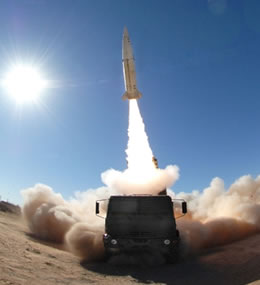
    ATACMS missile fired from HIMARS rocket launcher. Such vehicles are currently operational with Bahrain and reportedly have been delivered to the UAE. Photo: Lockheed Martin
    ATACMS missile fired from HIMARS rocket launcher. Such vehicles are currently operational with Bahrain and reportedly have been delivered to the UAE. Photo: Lockheed Martin

    Bahrain and Dubai are expecting to get more MGM-164 Army Tactical Missile System (ATACMS) manufactured by Lockheed Martin. Last week the Defense Security Cooperation Agency notified the U.S. Congress about the planned sale of 130 ATACMS missiles carrying Unitary Warheads T2K (MGM-164), equipping the two gulf states with medium range ballistic missile capability for the first time. The new warhead also offers improved penetration and optimized fragmentation coverage, thus reducing collateral damage.

    According to the agency, the United Arab Emirates’ Army will get 100 ATACMS missiles while Bahrain buy additional 30. The recent announcement includes only missiles, but no launchers, as both countries already have the High Mobility Artillery Rocket Systems (HIMARS) in service.
    UAE will also order 60 ‘Low Cost Reduced Range Practice Rockets’ (LCRRPR) to support the training and demonstration of the new weapon’s capabilities. UAE is investing $140 million while Bahrain’s acquisition is expected to amount to $70 million, reflecting the proportionally higher cost of setup and support systems.

    The UAE has initially requested acquiring tactical missile systems from the U.S. – in 2006, as the U.S. agency announced an intended sale of 20  HIMARS vehicles, 100 ATACMS missiles and 130 Guided Multiple Launch Rocket Systems (GMLRS) carrying Dual Purpose Improved Conventional Munitions (DPICM) and an equal number of ATACMS and GMLRS carrying unitary warheads. The total value of the 2006 package was $752 million. While the deal was never publicized, the U.S. is known to operate a training facility in the country to establish a the cadre for the HIMARS school training local crews in the operation of GMLRS and ATACMS. Bahrain is also operating HIMARS and ATACMS missiles for several years. The new acquisition will be able to replace those missiles carrying DPICM – as they are phase out of service, in compliance with the new international treaty banning the export and use of cluster munitions, which came into effect in 2009.

    The ATACMS can be fired from MLRS launchers, including the M270, M270 IPDS, M270A1, and HIMARS. Block 1A Unitary Missile warhead is the latest addition to the ATACMS family of munitions. This variant is designed to launch precision attack under all weather conditions, from ranges of 300 kilometers. The missile has a unique "vertical impact" capability, designed to

    Four years later, on December 20, 2010 the Pentagon awarded Lockheed Martin an order worth over $900 million, for the delivery of 226 ‘tactical missiles’ and 24 launcher modification kits, plus logistical support under Foreign Military Sale (FMS) to the UAE and Taiwan. It is yet unclear whether this order traces back to the original sale announced in 2006, since the first missile regiment has already been established by the Emirate, trained by U.S. instructors. As for Taiwan they currently don’t have ATACMS, nor do they posses MLRS, GMLRS or HIMARS so the actual identity of these missiles is still a mystery…

    So the big question is – which tactical Missiles Lockheed Martin will be delivering to Taiwan, or – how the ATACMS order inflated from $140 to over $700 million?.

    The new sales can also be considered part of the gulf states’ force modernization, expanding their existing architecture to counter major regional threats – namely an attack by Iranian air power, ballistic missiles or naval forces. While Iran could potentially devastate the gulf states’ air forces, the presence of highly mobile medium range missiles could provide these small states a ‘Second Strike’ potential, presenting a deterrent effect against an Iranian strike. The range of these missiles put strategic Iranian shoreline facilities at risk, including the port of Bandar Abas and the nuclear sites at Bushehr.

    Skunk Works and XTEND Simplify Multi-Drone Command

    0
    Lockheed Martin Skunk Works® and XTEND have achieved a major milestone in JADC2 by integrating the XOS operating system with the MDCX™ autonomy platform. This technical breakthrough enables a single operator to simultaneously command multiple drone classes, eliminating the friction of mission handoffs. From "marsupial" drone deployments to operating in GPS-denied environments, explore how this collaboration is abbreviating the data-to-decision timeline and redefining autonomous mission execution.

    From Ukraine to Taiwan: The Global Race to Dominate the New Defense Tech Frontier

    0
    As traditional defense primes face mounting competition from agile “neoprimes” such as Anduril, Palantir and Helsing, the balance of innovation is shifting toward software-defined warfare and scalable, dual-use technologies, while global industry consolidation—marked by Boeing’s integration of Spirit AeroSystems and other strategic mergers—signals an intensified race to secure control over the defense technology value chain. Our Defense-Tech weekly report highlights these trends.

    Europe’s “Drone Wall”

    0
    In early October 2025, a coordinated wave of unmanned aerial system (UAS) incursions—widely attributed to Russia—targeted critical infrastructure across at least ten European nations. The unprecedented campaign exposed the fragility of Europe’s air defenses...

    Weekly Defense Update & Global Security Assessment

    0
    Executive Summary The past week (September 18-25, 2025) represents an inflection point where strategic defense concepts have transitioned from doctrine to tangible reality. An analysis of global events reveals four primary, interconnected trends shaping an...

    U.S. Air and Space Forces Push Next-Gen Programs at the AS&C 2025 Conference and...

    0
    At the 2025 Air, Space & Cyber Conference, U.S. Air Force and Space Force leaders unveiled major updates on next-generation fighters, bombers, unmanned systems, and space initiatives, highlighting both rapid innovation and critical readiness challenges as the services race to outpace global competitors. A short version is available here, with a more detailed version for subscribers.

    TADTE 2025: Reflecting Taiwan’s Strategic Themes

    0
    The Taipei Aerospace & Defense Technology Exhibition (TADTE) 2025 crystallized around four dominant strategic themes that collectively illustrate Taiwan's comprehensive approach to defense modernization amid escalating regional tensions. Based on a detailed report by Pleronix (available upon request). Includes a Podcast discussion on TADTE 2025's highlighting Taiwan's four strategic themes beyond the post's coverage.

    Iron Beam 450 Completes Testing, Soon to Join With Operational Air Defense Units

    0
    Israel’s Iron Beam 450 high-power laser system has completed final testing, marking a major leap in air defense. Developed by Rafael, it offers precise, cost-effective interception of rockets, UAVs, and mortars, and is set for IDF deployment by 2025.