Friday, December 26, 2025
More
    Home Blog Page 264

    1st Israel HLS Conference

    Over 600 participants, of whom 250 senior experts, are expected in Israel next week for the First Israel HLS International Conference, a two-day seminar organized by the Israel Export and International Cooperation Institute to be held 31 October – 2 November, 2010. Among the highlights are introduction of innovative methods and technologies for the protection the safety of cities (safe city projects) and airports security.
    Yuval Diskin, director of Israel’s Security Agency (Shin Bet) will be the keynote speaker on the first day, followed by a discussion of the international terror threat, opened by a keynote by Federal Minister Thomas De Maziere – Ministry of Interior, Germany. Another session will address the challenges of suspect identification, covering an analysis of suicide bombers’ origins and development, the threat of air terror and optimal response from the regulator’s point of view. This topic will be addressed by the ISA head of Direction & Regulation department.

    A session on airport security will focus on the current and future security strategy guiding the evolving security system at the Ben Gurion International Airport. Israel Airport Authority officials will cover plans for implementing new baggage screening systems and self-service biometric security systems being implemented at the airport.

    Another session will cover evolving new technologies for applications in security and homeland defense. The second day will focus on ‘Safe Cities’, with keynote speech by Mr. Roberto Maroni, Minister of the Interior, Italy, and Riccardo de Corato, Seputy Mayor of Milan, introducing plans for the hosting of Expo 2015 in Milan. Another session will cover opportunities in Brazil.

    Defense Update will attend the event and provide news updates from selected sessions. To get the updates please sign up for our email news feed.

    Click here for the Conference Program

    KMW to Deliver 20 Dingo-2 Vehicles to Equip Norwegian Forces in Afghanistan

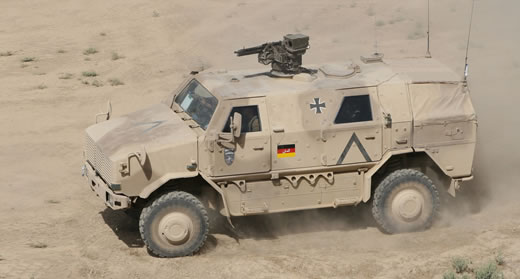
    The Norwegian Army will get 20 new Dingo 2 armor protected vehicles to equip ISAF member forces operating in Afghanistan. Photo: KMW

    The Norwegian Army has ordered 20 Dingo 2 vehicles to equip its forces operating as part of NATO forces in Afghanistan (ISAF). The manufacturer, Krauss-Maffei Wegmann (KMW) will deliver the first 10 vehicles will be delivered by the end of November 2010 with the remaining 10 to ship to Afghanistan in February 2011.

    The Norwegian Army will get 20 new Dingo 2 armor protected vehicles to equip ISAF member forces operating in Afghanistan. Photo: KMW

    ATK Offers Miniature Precision Guided Weapon for Unmanned Aerial Systems

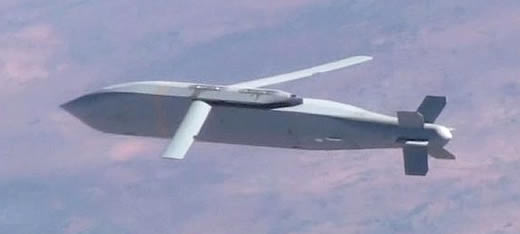
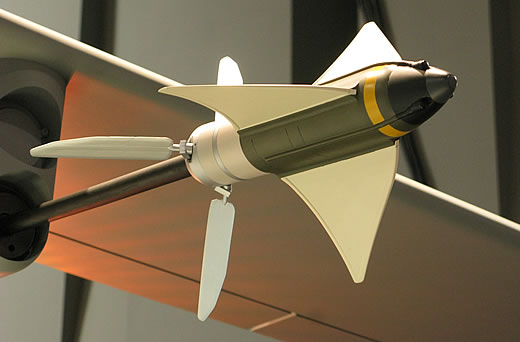
    The miniature guided weapon from ATK weighs about six pounds. Fitted with three folding air surfaces and moving tail fins for flight control, the weapon uses laser and GPS to home in on targets designated by the UAV or by supported ground forces. Photo: Tamir Eshel, Defense Updatets,

    ATK is developing a lightweight precision guided munition, compact and light enough to be carried by the dozens or even hundreds by unmanned aerial aircraft. The new glide weapon is packed into a conformal container launcher carried under the wing of the Shadow, fitted on top of the strut root. Upon release the weapon’s fins are extracted and three airfoils pop into place, as the weapon glides on its path to the ground. As the three laser detectors are activated, they seek laser signals reflected from the designated target. Once the laser spot is detected, the weapon’s flight control processor computes the necessary corrections and activates the tail fins to point the weapon on the course homing in on the spot, hitting the target with high precision.

    The miniature guided weapon from ATK weighs about six pounds. Fitted with three folding air surfaces and moving tail fins for flight control, the weapon uses laser and GPS to home in on targets designated by the UAV or by supported ground forces. Photo: Tamir Eshel, Defense Updatets,

    The weapon weighs about six pounds (2.7 kg). Its hand-grenade size warhead makes more than half that weight (about four pounds or 1.8 kg). The resulting effect offers maximum lethality against exposed targets, with minimal collateral damage to their surrounding.

    Persistence and immediate response close air support based on such weapons has the potential to transform combined air/ground operations, as UAVs loitering above a ground combat element could continuously support ground forces through sustained combat engagements, without the logistical and operational burden when rotating through rearmament or replenishment cycles. Brigades could rely on their own Small UAVs assets like the Shadow, each carrying four weapons in addition to the standard ISR and radio relay payloads. Larger drones will employ multiple ejector racks packing 12 weapons or more, each loaded rack could be carried under a pylon currently carrying Hellfire missiles. Therefore, an MQ-1A Predator currently carrying two Hellfires will carry 24 of the new weapons. A similar load will be carried by the MQ-5B Hunter, while the MQ-1C Grey Eagle will be able to carry twice that load. The Air Forces’ MQ-9 Reaper will be able to carry 72 units and the A-160 destined for the Special Operations Command will haul over 200 such weapons.

    The miniature guided weapon currently under development could, potentially, replace current cluster weapons banned by international treaties. When employed in weapon systems, individually targeted guided weapons could be directed to scatter over the area to focus on specific target location, guided by GPS – or disperse over a specific area in a pattern maximizing the desired effect. Optional carriers such as new cruise missiles, or loitering weapons, will be able to employ such guided submunitions to attack multiple targets along their flight path, on a single mission.

    U.S. Army to Demonstrate Full Manned-Unmanned Operations Next Year

    The U.S. Army is planning to test a combined operation of manned and Unmanned Aircraft Systems (UAS), as part of the demonstration of advanced capabilities enabled with current and future systems and technologies.

    The demonstration called ‘Manned Unmanned Systems Integration Concept’ (MUSIC) will take place at Dugway Proving Ground, Utah, in September 2011. MUSIC will demonstrate the interoperability between manned and unmanned systems, including ‘level-4’ UAS interoperability enabling air crews of AH-64D Apache Block III Attack helicopters to control, and monitor the video captured by the EO payloads of RQ-7 Shadow UAS.

    During the exercise, the MQ-1C ‘Gray Eagle’, MQ-5B ‘Hunter’, RQ-7 ‘Shadow’, RQ-11B ‘Raven’ and the AH-64D ‘Apache’ Block III will all be exchanging information and exchanging command and control while in flight. The images will also be transferred over One Station Rover Video Terminal (OSRVT) video datalink to other participants, including OH-58D Kiowa warrior and ground control stations.

    GDLS Selected to develop Namer Armored Personal Carriers for Israel

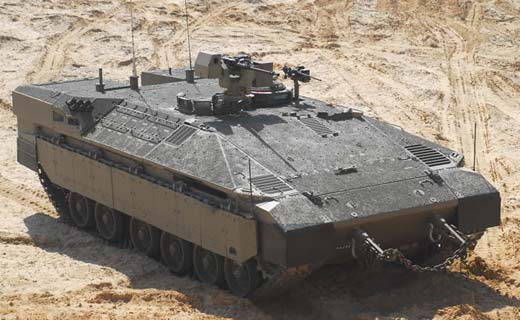
    The 13th Infantry Battalion of the Golani Brigade was the first Israel Defense Forces (IDF) unit to convert from the T-55 based Achzarit armored infantry carrier to the new Infantry Combat Vehicle – the Namer.

    Israel’s Defense Ministry has awarded General Dynamics a contract to build 600 Namer (leopard in Hebrew) armored personnel carriers (APC) over the next eight years.
    The competitive procurement process was for the production of Merkava APC hulls, material kit sets and integration of the kits to the vehicle chassis. General Dynamics expects to complete contract negotiations by the end of this year.
    Production will be performed at the Joint Systems Manufacturing Center in Lima, Ohio. The base contract will be completed by March 2015 or extend to November 2019 if all options are exercised.


    The 13th Infantry Battalion of the Golani Brigade was the first Israel Defense Forces (IDF) unit to convert from the T-55 based Achzarit armored infantry carrier to the new Infantry Combat Vehicle – the Namer.
    Battalion 13 of the Golani Brigade has already been outfitted with the Namer and a senior Defense Ministry official said that the remaining three Golani battalions would receive the APC over the next three years.
    The decision to issue the Namer tender in the US was made due to budgetary constraints.
    If the Namer is made in the US, the IDF will be able to pay for the production with the foreign military financial aid it receives annually from the US and most of which needs to be spent in America.

    The Namer has advanced defensive systems and an internal air-conditioning unit which enables the vehicle to continue operating in areas contaminated by nonconventional weapons. The Namer carries a number of machine guns, missile launchers, and reconnaissance equipment.
    The IDF plans to equip the Namer with a locally built active protection system. The IDF has already fielded the Trophy APS on it’s Merkava 4 tanks. System comes as an integral part of the tank and the IMOD plans to follow the same path with the Namer.
    The vehicle is equipped with a 0.5" heavy machine gun mounted on the weapon station; a secondary, manually operated 7.62mm machine gun and a 60mm mortar are also included.


    Relevant posts:

    Stryker Turns Stealthy with Armorworks’ TactiCam 3D camouflage

    ArmorWorks is introducing at AUSA an innovative 3D camouflage applique called TactiCam that has the potential to reduce vehicle signature in radar, infrared and visual spectrum.
    The new material has already demonstrated effective signature reduction in tests and is undergoing optimization. The outer layer of the TactiCam material is shaped in randomly generated three-dimensional pattern displaying varying geometric shapes, in different depth levels.
    This digitally generated random pattern surface reflects energy from the vehicle in an irregular pattern, disrupting the detection of the vehicle by electro-optical and millimeter-wave radar sensors.
    The material can be applied with infra-red or radar absorbing suppressing materials, and be filled with insulation that can both suppress emissive spectral frequencies, while reducing solar heat gain.

    The outer layer of the TactiCam material is shaped in randomly generated three-dimensional pattern displaying varying geometric shapes, in different depth levels.

    According to Gary Sopko, Director of vehicle programs at ArmorWorks, the new, lightweight material operates passively, and as an insulating layer, also contributes to reducing the thermal signature emitted by the vehicle’s surface, wheels and engine.
    Visual camouflage can be applied over the outer layer matching camouflage patterns used by the military or adapted to operational requirements. Sopko added that the TactiCam could eventually be integrated into armor panels in production, or as retrofit to any ground vehicle.
    The company plans to include the material with a ceramic basis layer, providing additional ballistic protection to the vehicle. TactiCam was displayed at AUSA 2010 applied onto the improved Stryker wheeled armored vehicle at the General Dynamics Land Systems (GDLS) stand.

    Industry Preparing for the HMMWV recap

    Among the heavier tactical vehicles on display were new versions of the BAE Systems’ Caiman Multi-Terrain Vehicle (MTV), configured to support Command and Control On-the-Move (C2OTM) assignments and ambulatory operations. Oshkosh displayed the latest reconnaissance version of the MRAP All Terrain Vehicle (MATV) . This vehicle carries crew of six plus gunner. The recce variant is equipped with mission specific technologies designed for missions such as route, zone and area reconnaissance. Recent models introduced with the M-ATV family of vehicles also includes SOCOM, Utility and Ambulance variants.

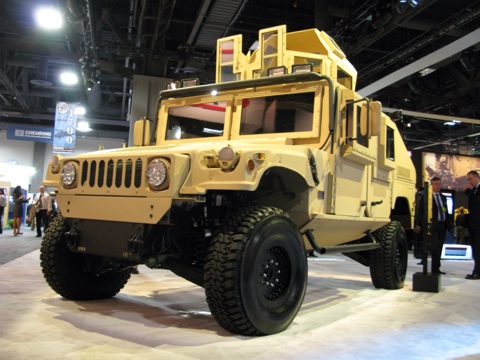
    As the U.S. Army establishes its right mix of vehicles across the light, medium, and heavy vehicle fleets, new acquisition programs and recapitalization (recap) programs are weighed, assessing a cost effective mix that could meet the services’ planned budget cuts. As light vehicles are concerned, the army is still moving on two parallel paths,acquisition long term strategy developing the joint light tactical vehicle (JLTV) while pursuing low-cost recap of existing High Mobility Multipurpose Wheeled Vehicle (HMMWV) for the near term.


    Several companies at AUSA are addressing the planned HMMWv Recap opportunity, among them BAE Systems and Oshkosh. BAE is offering the application of it’s ‘Integrated Smart V’ (ISV) program coupled with lightweight monocoque V-hull and mine protection improving survivability through relatively cost high investment in modernizing the fleet of high-mobility multipurpose vehicles expected to remain in service for the long term. Oshkosh is also seeking HMMWV recap opportunities, offering the TAK-4 independent suspension for improved mobility. the new suspension also contributes to increased payload capacity needed for the survivability enhancement. In addition to its advanced suspension, Oshkosh incorporates a V-shaped hull and engine and powertrain upgrades to improve soldier survivability as well as off-road mobility and payload capacity.
    AM General also displays he an armored HMMWV variants designed in association with Plasan. Unlike other upgrade designs that use monocoque capsules, Plasan designed the vehicle with a ‘kitted armor’, which does away with unused structures and material, therefore reducing the weight of the protected vehicle. As many of the components previously spliced in the center body are now moved from the protected cabin, significant weight sis offloaded from the frontal wheels and moved back, and well below the axles’ load level, enabling the armor protected vehicle to demonstrate very high protection while retaining the efficient off road mobility of early HMMWVs.

    BAE Systems offer Bradley Variants for M113 Replacement

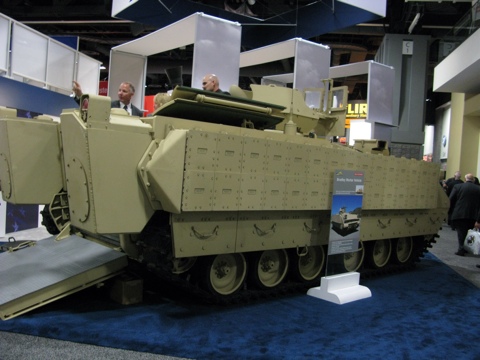
    After more than five decades in service, the M113 is finally reaching the point where the Army looks for the replace this aging fleet. While originally the Manned Ground Vehicle (MGV) and Ground Combat Vehicle (GCV) were considered as possible platforms, BAE Systems is offering a new solution – the Bradley family of vehicles. The company has developed mission specific Bradley variants to fulfill and enhance the combat mission role of the M113. While such a proposal is sensible from a logistical point of view, it remains to bee seen how the new variants address the Bradley’s inherent survivability and interior space limitations. The Army considers its current version of Bradley ‘the most survivable platform in the force, next to the Abrams tank’, but this title comes with significant additional weight. The vehicles will be available at a vehicle gross weight ranging from 55,000 to 64,800 without tile armor and will be prepared to carry 11 soldiers.

    The proposed family of vehicles expands the range of M2/M3 types with five new variants based on the bradley A3 – a command post vehicle, an armored medical evacuation vehicle (AMEV), armored medical treatment vehicle (AMTV), a mortar carrier and general purpose tracked vehicle.

    BAE Systems is displaying the command vehicle at AUSA 2010, while the mortar carrier mounting the Israeli mortar (in use on the U.S. army Stryker) is displayed at the Elbit Systems stand.

    AUSA 2010 Preview

    Defense Update is reviewing the upcoming Association of the U.S. Army Annual Meeting & Exhibition with extensive coverage focusing on the wide scope of land warfare.

    In particular, the areas we have traditionally covered, included armored vehicles, survivability and  protection; this time we plan to expand this theme with a wider scope, addressing threats and defensive techniques against blast, mine protection, as well as fire, CBRN and hazardous materials – resulting from the potential risks of fighting insurgency in modern, urban warfare. New active protection and ‘soft kill’ solutions will also be covered. In addition to the discussion of personal protection, we’ll review dismounted applications, including C4ISR, load carrying, personal gear, weapons, robotics and accessories.

    Non lethal weapons will be discussed, as well as the various aspects of kinetic effects. Our coverage will address new trends of precision guided weapons, particularly the downsizing of missiles and rockets and grenades, enabling the use of highly effective, specialized weapons by the lowest echelon tactical forces – mounted and dismounted.

    Technologies combating IEDs will be discussed in various aspects, from road clearing devices and jammers mounted on vehicles to the latest capabilities employed against IED support networks.

    Another field of interest is robotics and unmanned systems – both micro and mini platforms, EOD and aerial systems will be presented, as well as the upcoming cargo carriers, manned and unmanned.

    Army aviation issues will be discussed with focus on helicopters, aerial ISR, aerostats and airships, manned-unmanned teaming and cargo UAVs. Air defense will also be included, with the aspects ranging from cruise and ballistic missile defense to C-RAM.

    We also plan to focus on the new field of area persistence, which includes the means for gathering intelligence and manipulating data into actionable, targeting intelligence – remote sensors, radars, UGS, seismic, acoustic and IR and new, promising technologies pursued by DARPA.

    If you are exhibiting at AUSA 2010 and would like to meet our team, please email to “editor” at defense-update.com or sms: +972-544-508028. We plan to review many of the exhibitors, some of which are listed below:

    • ADS Inc.
    • Aerojet – propulsion
    • AeroVironment Inc. – UVS
    • Agilent Technologies
    • Agusta Westland – helicopters
    • Airborne Systems – air delivery
    • Aitech Defense Systems – electronics
    • Alcoa Defense – metals
    • Allison Transmission Inc. – vehicles
    • AM General Corp. – vehicles
    • AMTANK Armor – armor
    • Amtech Corp
    • Armorworks – armor
    • Arotech – vehicle armor
    • ATI Defense
    • ATK – energetics, ammunition, composites
    • Autoflug GmbH – blast protection
    • AxleTech International – vehicles
    • Aydin – Displays
    • BAE Systems –
    • Barco Federal Systems – displays
    • Barrett – firearms
    • Bates Uniform Footwear – gear
    • Battelle
    • Bell Helicopter – helicopters
    • Beretta – weapons
    • Blackhawk Products Group – gear
    • Boeing
    • Bose Corp. – hearing protection
    • BrenTronics – power
    • L-3 Com
    • Navistar Defense – vehicles
    • CamelBak – gear
    • Carl Zeiss Optronics – EO
    • Caterpillar Inc. – engineer
    • Ceradyne Armor Systems – armor
    • CeramTec (ETEC GmbH) – armor
    • Chemring Group
    • Cobham
    • Colt Defense
    • CoorsTek
    • Cumminc Inc.
    • Curtiss Wright Controls
    • Cypress Int.
    • Daimler Trucks
    • Defenshield
    • Deschamps Mat Systems
    • Diehl Defence Holdings
    • DRS Technologies
    • DSM Dyneema
    • DuPont Co.
    • DynCorp
    • Dytecna
    • EADS
    • Eagle Ind.
    • Elbit Systems
    • Energizer
    • EnerSys
    • Ensign Bickford A&D
    • EOD Technology
    • ESS
    • Esterline Defense Technologies
    • Eurenco
    • Falck Schmidt Defence Systems
    • Finmeccanica
    • First Choice Armor & Equipment
    • FLIR Systems
    • FNH
    • Force Protection
    • Fraser Volpe
    • GE Intelligent Platforms
    • General Atomics
    • GD OTS
    • GD Combat Systems
    • GD IS&T
    • General Kinetics Engineering
    • Gentex
    • Global Seating Systems (GSS) – blast seats
    • Harris Corp.
    • HDT Engineered technology (BASE X)
    • H&K
    • Hesco Military Products
    • HGH Infrared Systems
    • High Impact Technology
    • Honeywell
    • IAI
    • IbisTek
    • ICx Technologies
    • Intevac Photonics
    • iRobot Corp
    • IMI
    • ITT
    • Kracher Futuretech
    • KBR
    • Kearfott Corp.
    • Kongsberg Protech
    • KMW
    • KVH
    • L-3 Com
    • Lacroix Defense & Securite
    • Lasershot
    • Leupold & Stevens
    • Lockheed Martin
    • McLane Advanced Tech
    • Meggitt Defense Systems
    • Microvision
    • Mistral
    • MPRI
    • MTU Detroit Diesel
    • NACRE
    • Nammo Talley
    • Navistar Defense
    • Nexter Group
    • Northrop Grumman
    • NP Aerospace
    • Oakley
    • Olin Corp – Winchester Ammunition
    • OSG Armor
    • Oshkosh Defense
    • Otis Products
    • Panhard
    • Parker Hannifin
    • Pearson Eng.
    • Pelican Products
    • Phantom Products
    • Physical Optics Corp.
    • Plasan
    • Point Blank Solutions
    • PPG Ind.
    • Protonex
    • QinetiQ
    • Rafael
    • Raytheon BBN
    • Raytheon
    • Raytheon Elcan
    • Revision Eyewear
    • Rockwell Collins
    • Runflat Int.
    • Saab
    • Sagem
    • SAIC
    • Sarnoff Corp.
    • Secure Rugged Portable
    • Sekai Electronics
    • Selex Electronics
    • Serco
    • SFC Smart Fuel Cell
    • Sierra Nevada Corp
    • Sig Sauer
    • Sikorski
    • Sofradir
    • SRC
    • SRI
    • Streamlight
    • Surefire
    • Tactical CommGear
    • Tactronics
    • Taser Int.
    • Teijin Aramid
    • Telephonics Corp.
    • TenCate Advanced Composites
    • Textron Systems
    • Thales
    • Trijicon
    • Tyco
    • Ultra Electronics
    • Ultralife Corp.
    • Under Armor
    • US Ordnance
    • Vectronics
    • ViaSat
    • VSE Corp
    • VT Group
    • VT Miltope
    • Wiley X Eyewear

    Australia’s Super Hornet Tests JSOW Guided Weapons

    Australian Super Hornet. Photo: Australian Defence

    Super Hornet aircraft from No. 1 Squadron conducted their first live weapon trials at the Woomera Test Range, north of Adelaide. The JSOW test is part of Australia’s new Super Hornets testing their deployment capabilities.

    Five F/A-18F Super Hornets and about 100 aircrew, maintenance and support personnel from No. 1 Squadron will operate from RAAF Edinburgh during the squadron’s first deployment away from their main operating base at RAAF Amberley, Queensland.

    Saudi Arabia to Order 180 New Helicopters for a New National Guard Aviation Regiment

    The recently announced acquisition of more than 180 helicopters for the Saudi Arabian National Guards (SANG) provides the first major step in expansion of the SANG Aviation Command, established in 2006. The announced package worth well over $25 billion equals the modernization of the Royal Saudi Air Force’s F-15 force.

    As part of this package the U.S. will supply 36 new AH-64D attack helicopters, upgrading of existing Apaches, delivery of 36 AH-6 Little Bird light attack helicopters. The package also includes 72 Sikorsky UH-60M Black Hawk assault helicopters and 12 MD530 scout/liaison light helicopters.

    The SANG aviation regiment will field 36 AH-64D (Apache Block III) attack helicopters, of which up to 20 will be equipped with mast mounted targeting systems, comprising the AN/APG-78 Fire Control Radars and AN/APR-48A Radar Frequency Interferometer sets. The 36 AH-6i light attack helicopters will carry Wescam MX15Di EO targeting systems, and be armed with GAU-19A 12.7mm Gatling guns and launchers for the firing of AGM-114R HELLFIRE II Missiles.

    In addition to the RSNG Apache acquisition the Royal Saudi Land Forces (RSLF) will also invest $3.3 billion acquiring 24 additional Block III Apaches, under a separate order. 10 of these helicopters will be fitted with the mast mounted target acquisition kit. For these gunships the Saudis opted for a weapons mix comprising of AGM-114R Hellfire, 30 mm automatic gun and 70mm laser guided rockets. The helicopters will be equipped with airborne satellite communications terminals. In addition, the Saudi Arabian Royal Guard will also buy 10 Apache Block IIIs, on a third order worth $2.2 billion. The configuration and weapon’s mix on these helicopters is almost identical to that of the Saudi Army.

    Better F-15SA Eagles for the Royal Saudi Air Force

    Updated: October 21, 2010: The U.S. and Saudi Arabia have finalized an arms package that shadows even the large arms mega-sales in the region. The arms sales package includes several packages worth about $60 Billion, which include mostly platforms produced by the Boeing Company. The main element is the modernization of the Royal Saudi Air Force, with the acquisition and modernization of more than 150 F-15S/SA fighters as part of a $30 billion multiyear investment. This package includes the acquisition of 84 new F-15SA fighter jets, replacing the Kingdom’s aging F-15C/D fighters, and the upgrading 70 existing F-15S strike fighters in service with the RSAF, bringing them to the same level of the new F-15SA. The procurement contract was signed between the US and Saudi Arabia a year later, in December 2011 at a cost of $29.7 billion. Three months later the US Air Force awarded the prime contractor Boeing $11.4 Billion contract funding the development, retrofit and manufacturing of 84 F-15 aircraft with systems and munitions. This firm-fixed-price, cost-plus-fixed-fee, time-and-materials contract is expected to be completed October 2020. The associated work will take place in locations including El Segundo, Calif., Ocala, Fla., and Cedar Rapids, Iowa.

    The new F-15SA and the upgraded F-15S will include the APG-63(v)3 radar from Raytheon, the latest AESA radar developed for the Eagle. These aircraft will also carry the AN/AAQ-33 Sniper Targeting pod and Tiger Eye Navigation Pod (3rd Generation LANTIRN). On reconnaissance missions the DB-110 Reconnaissance Pod will be used. The Saudi acquisition represents the first application of DB-110 on the F-15 platform.

    To further improve air combat capability the new Saudi Eagles will be equipped with Joint Helmet Mounted Cueing Systems (JHMCS) and AN/AAS-42 Infrared Search and Track (IRST) Systems. The Saudis will also receive the latest version of the Sidewinder AIM-9X short range air/air missiles and AIM-120C/7 AMRAAM missiles. For air/surface attack the new Eagles will carry mostly precision guided weapons, including AGM-84 Block II Harpoon anti-ship missiles, AGM-88B HARM anti radiation missiles, 500 and 2,000 lb versions of enhanced Paveway II and III Dual Mode Laser/Global Positioning System (GPS) Guided bombs, 2,000 lbs JDAM GPS guided weapons, and CBU-105D/B Sensor Fuzed Weapons (SFW) utilizing Wind Corrected Munitions Dispensers (WCMD).

    Through the Wall Radar Sensors at ISDEF 2010

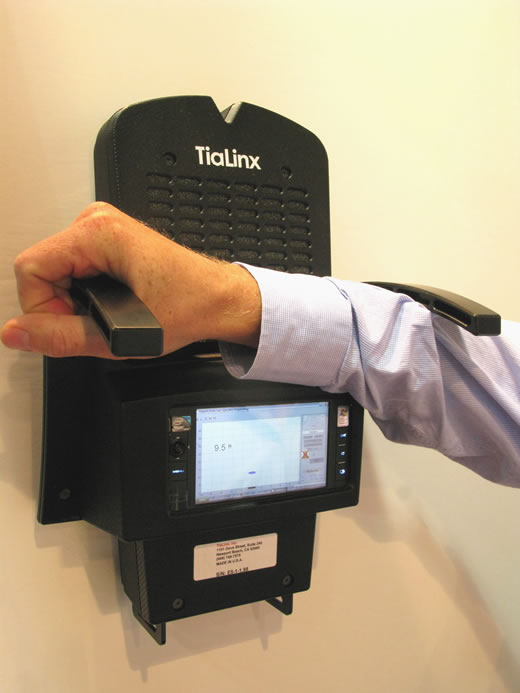
    Tialinx Eagle 5P hand held RF imager is designed to detect culvert and tunnels. Photo: Noam Eshel, defense-Update
    Tialinx Eagle 5P hand held RF imager is designed to detect culvert and tunnels. Photo: Noam Eshel, defense-Update

    Two companies are demonstrating Ultra-Wide Band (UWB) radar systems providing through the wall sensing. Israel-based Camero is showing the Xaver 800 and 400 products and is unveiling a prototype design of the miniature hand-held Xaver 100, that fits into a soldier’s pouch. These systems can effectively detect the presence of people behind a wall, indicating their movements, relative positions and, in some systems, the distance to the target.

    U.S. based TiaLinx Inc. has developed a different system, also utilizing a low-power UWB design. Actually, TiaLinx’ Eagle 5 family of radars can be used as ‘dual-use systems’ – for spotting and tracking targets behind walls, but due to its high sensitivity, the sensor can also detecting living people trapped under rubble, by spotting their breathing movements. The system can also detect underground cavities associated with weapon’s caches and IED emplacements inside walls.

    Camero is offering the Xaver 800 for through the wall sensing, the radar can identify, track and measure distance to occupants behind walls, alerting assault teams before entering the room. Photo: Noam Eshel, defense-Update

    The imager ‘illuminates’ the target area with rapid, wide-band high frequency (nano sec.)
    pulses that penetrate glass, wood, concrete, dry wall and bricks. The pulses echoed from underground objects and ‘anomalies’ are processes to create a two-dimensional image of the target. The radar can detect objects buried 30 ft deep into the ground or covered by 20 cm concrete slabs.

    TiaLinx offers two versions of the Eagle 5 – the Eagle 5P hand held RF imager for culvert and tunnel detection, and -5B model, designed for the detection of underground buried motion. Other models developed by the company are designed as hand held sensors, utilizing a helmet mounted display.

    RiotBot – Armed For Close Combat

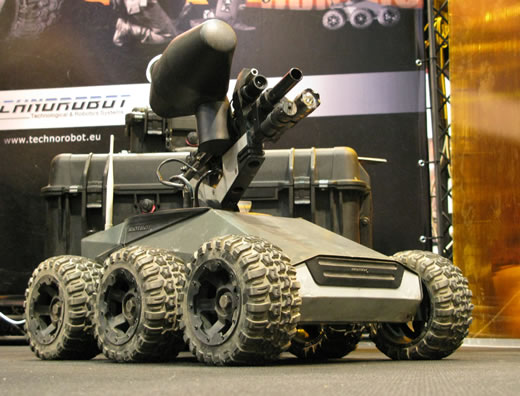
    RiotBot comes with remotely controlled non lethal weapon, to effectively counter threats in high intensity, potentiality violent engagements. Photo: Noam Eshel, Defense-Update

    The Spanish company TechnoRobot has introduced here the RiotBot – a new class of unmanned platform designed for intervention in riots, prison disturbances, or other civil disorders, where neutralization of specific elements is required by law enforcement agents, avoiding direct contact with the crowd. By operating with effective non lethal means to suppress, or deactivate a target without the presence of personnel, RiotBot can eliminate potential threats while minimizing escalation typically caused by police intervention.

    RiotBot comes with remotely controlled non lethal weapon, to effectively counter threats in high intensity, potentiality violent engagements. Photo: Noam Eshel, Defense-Update

    The Riotbot platform comprises a six-wheel electrically driven automotive system, fitted with rechargeable lithium batteries to last for two hours of continuous operation. Turnaround tasks include recharging the weapon’s compressed air tank, replacing batteries and reloading ammunition is performed in less than five minutes.

    The riotbot weighs about 18 kg (40 pounds) and can travel at a speed of 20 km/h (12 mph), and its weapon are controlled from a game-style hand controller and portable console, monitoring and controlling the vehicle from a distance of one mile. The weapon mount employs a PepperBall TAC700 carbine customized and adapted for safe use on the robot. A video camera is attached to the mount, monitoring the weapon’s aiming line in its field of view. RiotBot packs 450 PAVA balls of ammunition feeding at 700 rounds per minute. The carbine is designed with safety measures enabling it firing only by remote control, therefore preventing hostiles from turning it against the operators.  The weapon can tilt at elevations of 30 degrees or depression of -15 degrees, and turn 150 degrees to each side. It is effective at distances from zero of 60 ft.

    Skunk Works and XTEND Simplify Multi-Drone Command

    0
    Lockheed Martin Skunk Works® and XTEND have achieved a major milestone in JADC2 by integrating the XOS operating system with the MDCX™ autonomy platform. This technical breakthrough enables a single operator to simultaneously command multiple drone classes, eliminating the friction of mission handoffs. From "marsupial" drone deployments to operating in GPS-denied environments, explore how this collaboration is abbreviating the data-to-decision timeline and redefining autonomous mission execution.

    From Ukraine to Taiwan: The Global Race to Dominate the New Defense Tech Frontier

    0
    As traditional defense primes face mounting competition from agile “neoprimes” such as Anduril, Palantir and Helsing, the balance of innovation is shifting toward software-defined warfare and scalable, dual-use technologies, while global industry consolidation—marked by Boeing’s integration of Spirit AeroSystems and other strategic mergers—signals an intensified race to secure control over the defense technology value chain. Our Defense-Tech weekly report highlights these trends.

    Europe’s “Drone Wall”

    0
    In early October 2025, a coordinated wave of unmanned aerial system (UAS) incursions—widely attributed to Russia—targeted critical infrastructure across at least ten European nations. The unprecedented campaign exposed the fragility of Europe’s air defenses...

    Weekly Defense Update & Global Security Assessment

    0
    Executive Summary The past week (September 18-25, 2025) represents an inflection point where strategic defense concepts have transitioned from doctrine to tangible reality. An analysis of global events reveals four primary, interconnected trends shaping an...

    U.S. Air and Space Forces Push Next-Gen Programs at the AS&C 2025 Conference and...

    0
    At the 2025 Air, Space & Cyber Conference, U.S. Air Force and Space Force leaders unveiled major updates on next-generation fighters, bombers, unmanned systems, and space initiatives, highlighting both rapid innovation and critical readiness challenges as the services race to outpace global competitors. A short version is available here, with a more detailed version for subscribers.

    TADTE 2025: Reflecting Taiwan’s Strategic Themes

    0
    The Taipei Aerospace & Defense Technology Exhibition (TADTE) 2025 crystallized around four dominant strategic themes that collectively illustrate Taiwan's comprehensive approach to defense modernization amid escalating regional tensions. Based on a detailed report by Pleronix (available upon request). Includes a Podcast discussion on TADTE 2025's highlighting Taiwan's four strategic themes beyond the post's coverage.

    Iron Beam 450 Completes Testing, Soon to Join With Operational Air Defense Units

    0
    Israel’s Iron Beam 450 high-power laser system has completed final testing, marking a major leap in air defense. Developed by Rafael, it offers precise, cost-effective interception of rockets, UAVs, and mortars, and is set for IDF deployment by 2025.