Location: American Institutes of Architects, Washington, D.C.
Dates: 12-13 February 2020
Organizer: DSI Event Website Link
The 8th Annual Automated ISR and Battle Management Symposium highlights the advances in technology and systems to collect and process actionable intelligence in support of decisionmakers and warfighters.
With potential enemies continually improving their aerial denial capabilities, the US will have to develop and field ISR capabilities able to collect in degraded and denied areas at the speed of need.
Location: Changi Exhibition Center, Singapore
Dates: 11-14 February 2020
Organizer: Experia Event Website Link
Every two years, high-level government and military delegations, as well as senior corporate executives around the world, attend the Singapore Airshow to forge partnerships and seal deals in this region.
As Asia’s largest Airshow, this is the place to be for leading aerospace companies and budding players eager to make their mark in the international aerospace and defense market!
The event offers a unique platform for industry thought leadership through its high-level conference, forums and co-located events. Leading industry players, government and military chiefs gather here bi-annually to contribute to dialogues, exchange ideas and seek solutions and strategies to advance the interests of the global aerospace and defense sector.
Location: Crowne Plaza Rome, St Peter’s Hotel & Spa, Rome, Italy
Dates: 11-12 February 2020
Organizer: SMI Event Website Link
In its thirteenth year, the Border Security Conference has established itself as a market leader in this sector, covering the most pertinent topics in border security year on year.
With the migrant crisis ongoing in the Mediterranean, issues emerging surrounding the return of foreign fighters and the ever-present threat of cross border criminality, Border Security stands at the forefront of planning for countries and international organizations.
Border Security 2020 will bring together military staff, government figures and key individuals involved in enhancing border security capabilities of nations on a global scale.
Location: Camp Pendleton, CA, USA
Dates: 6-7 February 2020
Organizer: Marine Military Expo (Emerald Expo) Event Website Link
The event West showcases the latest technology and prototypes aimed at preparing today’s Marines for the opportunities and challenges of the 21st century. The theme for the upcoming event is logistics and expeditionary energy.
Held annually at Marine Corps Base, Camp Pendleton, the Marine West event serves delegations to visit this annual exposition from marine commands throughout Southern California.
Location: Vrindavan Yojna, Lucknow, Uttar Pradesh, India
Dates: 5-8 February 2020
Organizer: Department of Defense Production Event Website Link
DefExpo 2020, India’s largest defense exhibition will take place at the town of Lucknow in Uttar Pradesh, India will cover the complete spectrum of the country’s aerospace, defense and security interests.
The event provides an excellent platform to establish contacts, promote defense-related businesses, interact with decision-makers and policy-makers.
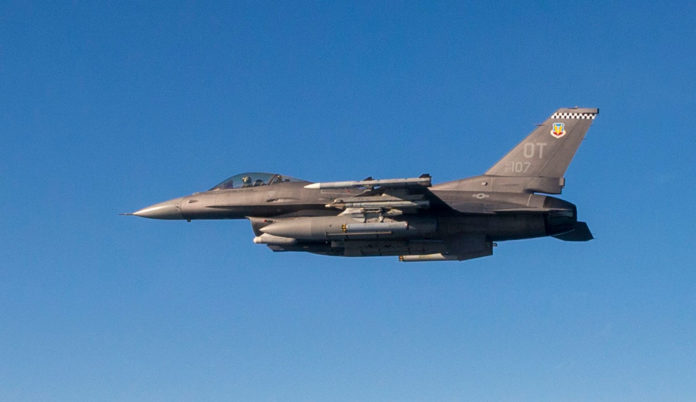
On that mission, the aircraft was loaded with two pods each carrying seven guided rockets, plus four AIM-120 AMRAAM air/air missiles. Photo: TSgt John Raven, US Air Force
The US Air Force successfully demonstrated the intercept of an aerial target using the AGR-20A Advanced Precision Kill Weapon System (APKWS) laser-guided rocket. The test was carried out by the US Air Force Air Combat Command’s 85 Test and Evaluation Squadron Eglin Air Force Base, Fla., on December 19, 2019, providing a proof of concept for using rockets queued from an F-16 targeting pod as viable munitions to perform cruise missile defense.
The BQM-167 target drone that represented a cruise missile was intercepted over the Gulf of Mexico water range using cueing from the targeting pod carried by the F-16. On that mission, the aircraft was loaded with two pods each carrying seven 2.75″ (70 mm) guided rockets, plus four AIM-120 AMRAAM air/air missiles. The test successfully demonstrated shooting a small drone at low altitudes. A single APKWS was required to down the target.
“The test was unprecedented and will shape the future of how the Air Force executes CMD,” said Col. Ryan Messer, commander, 53d Wing. “This is a prime example of how the 53d Wing is using resources readily available to establish innovative ways that enhance combat capabilities for our combat units.” Moving forward, the method could be used to defeat multiple targets representing a more realistic cruise missile attack. “This proof of concept can have implications for homeland defense missions, Combined Defense of the Arabian Gulf, and beyond,” said Messer.
Originally developed as a low cost, low collateral damage air-to-ground weapon for use in Afghanistan and Iraq, adapting the AGR-20A for counter-air use is momentous. At a cost of $30,000, the AGR-20A is about four percent of the cost of an AIM-120 missile commonly used for cruise missile defense. Due to its limited range, Unlike the AMRAAM that can be fired from a long-range, AGR-20A can be used only at short range and in good weather conditions. However, using Millimeter-Wave seekers could enhance its operability at inclement weather conditions. APKWS-II was developed and is produced by BAE Systems.
Other advantages of the AGR-20A are the bigger loadout (more missiles carried by each aircraft) and the ability to load weapons faster than an AIM-120. In 2016 the rocket has been integrated with F-16 and A-10 and US Marine Corps F/A-18D under an urgent operational need and was deployed in Operation Inherent Resolve (fighting ISIS in Iraq and Syria) since 2017. Other fixed-wing integrations include the Airbus AC-235 (the Jordanian gunship) and Embraer Super Tucano (for Lebanon and Nigeria). The weapon has also been exported to or ordered by a number of Middle Eastern countries including Jordan, Lebanon, Qatar, UAE, and Saudi-Arabia, as well as Nigeria.
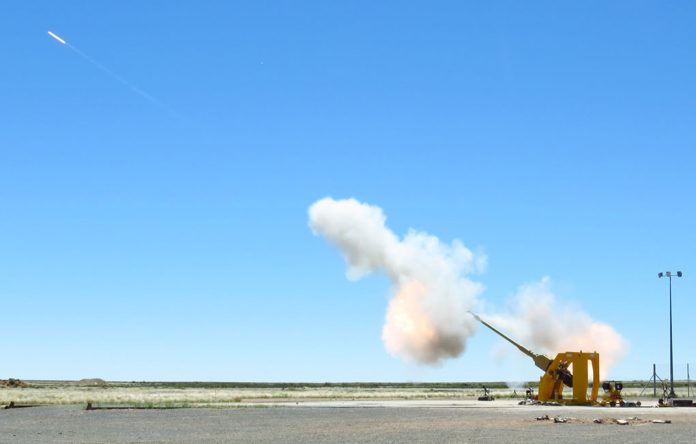
DM-52-2l gun fires 155mm Very Long Artillery Projectile (V-LAP) to a record range of 67 km. Photo: RDM
In a recent firing series held in South Africa, the German-South African joint-venture Rheinmetall Denel Munitions (RDM) demonstrated a dramatic increase in the range of its artillery firepower. The demonstration employed three 155 mm cannons with 52 and 39 caliber lengths, which scored three world records – firing at ranges of 76, 67 and 54 km.
The South African G6 built by Denel scored the longest shot in those tests, firing to a range of 76 km, the longest shot ever scored by a 155mm cannon. To achieve this shot RDM used a Zone-6 charge to propel an inert M9703 Velocity Enhanced Long-Range Artillery Projectile (V-LAP). The G6 is not restricted by the NATO accepted Joint Ballistics Memorandum of Understanding (JBMoU) and has a larger chamber, packing more propellant charge accelerating the Assegai to the longest range possible. The propellant manufacturer Nitrochemie is preparing a new top-charge for this non-standard 25-liter chamber that could exploit the system’s dimensions to maximize performance. The new top-charge will be tested next year. The G6 is used by the South African Army, as well as the UAE and Oman.
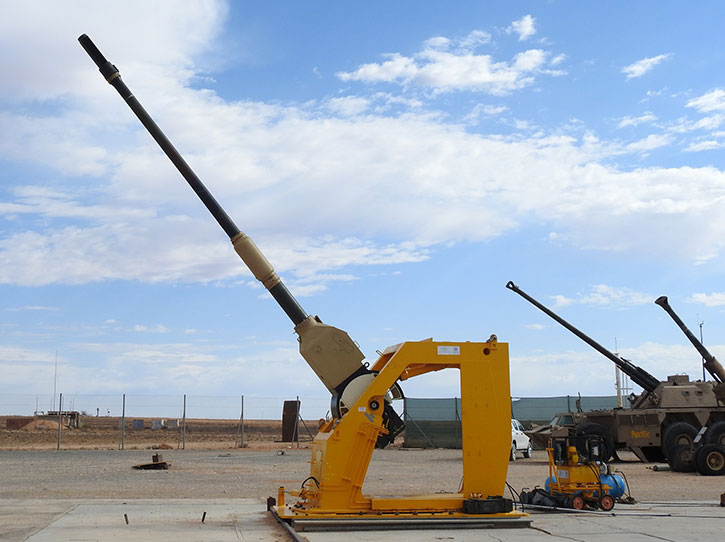
Other shots used the NATO standard L52-23l cannon that was mounted on a firing rig. This is the same gun used by seven NATO countries on the PzH2000 self-propelled howitzer. This gun lobbed 67 km range firing Rheinmetall Dennel’s Assegai M2005-V-LAP ammunition with a special top-charge produced by Nitrochemie. This top-charge complies with the gun’s JBMoU-compliant 23-liter gun chamber. PzH 2000 is one of the most common artillery systems in NATO, used by Germany, Italy, Netherlands, Greece, Lithuania, Croatia and Hungary. In 2015 Qatar became the first non-NATO as a PzH 2000 user.
Even the 155/39 mm scored an impressive shot reaching a range of 54 km firing the Assegai high explosive M2005-V-LAP, an unprecedented record for the system, that fires rocket-assisted rounds at much shorter ranges.
The German-South African joint venture Rheinmetall Denel Munition (RDM) hosted the event, welcoming participants from several NATO nations. “Our goal is to be a true partner to the military. That’s why transparent cooperation and trust are so important to us.” RDM Managing Director Jan-Patrick Helmsen said, “Tube artillery can provide defensive and offensive fire support. It’s cheaper and faster than rockets or air support, can operate around the clock, and engage targets with great precision using indirect fire anywhere within its range. Of course, range has proved to be a limiting factor in recent years, giving rise to the need for increased operational reach.” Helmsen added.
“We’re known for the Assegai family and our V- LAP round, the longest-range conventional artillery projectile. The combination of South African technology and German expertise has already resulted in enhanced range, effectiveness, and precision. When it comes to artillery, Rheinmetall takes a totally holistic approach”, Helmsen noted.
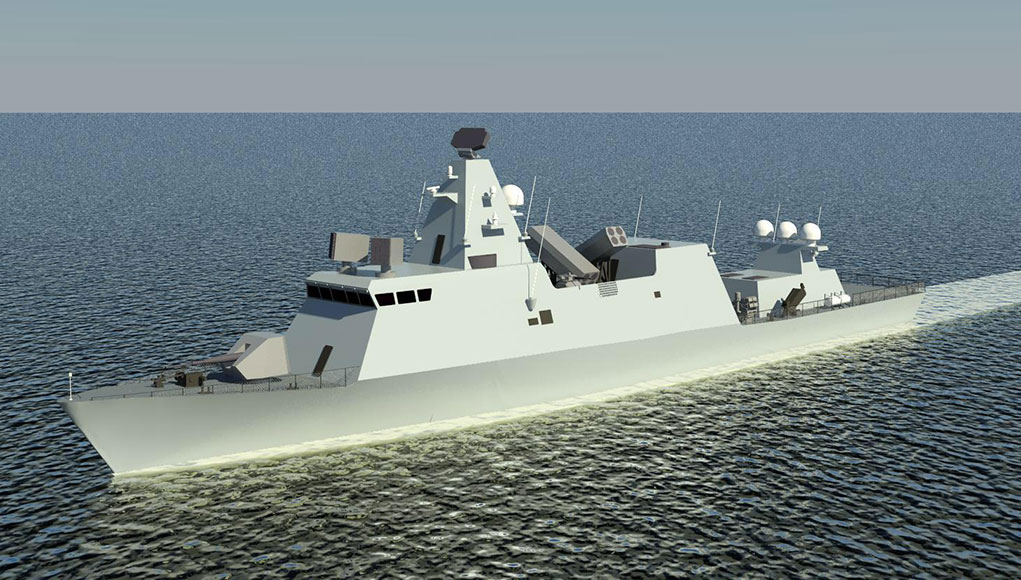
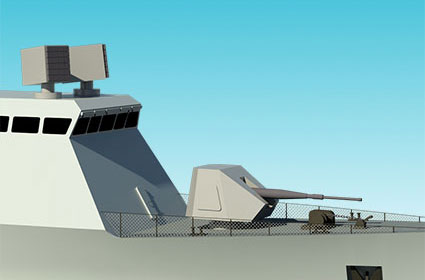
Israel Ministry of Defense (IMOD) has signed an agreement with Israel Shipyards Ltd. (ISL) for the design of an advanced combat vessel for the Israel Navy (IN). The initial design phase will take over a year and is expected to follow with the construction of eight ships at ISL through the 2020s.
The new 76 m’ long vessel will replace the 30-year-old Hetz class missile boats (62 meters) and join four new Saar 6 Magen Class corvettes, and three Saar 5 Eilat Class corvettes, meeting the evolving challenges Israel is facing in the East Mediterranean and the Red Sea.
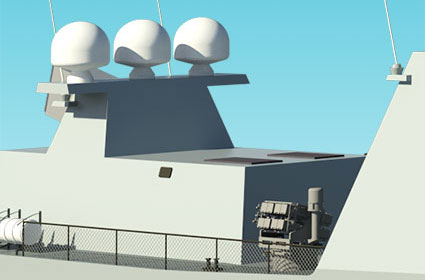
At a displacement of 850 tons, the Reshef Class mini-corvettes will be based on an extended version of Israel Shipyard’s extended S-72 design, becoming the largest combat vessel to be built by the shipyard. The propulsion system consists of a hybrid comprising diesel or a gas-turbine, combined with electric propulsion, providing high agility at high and low speeds.
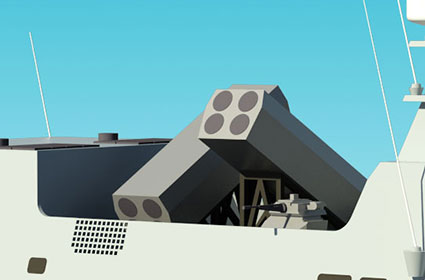
As the larger Magen corvette, Reshef will likely carry a combination of air defense missiles including IAI Barak 8 and RAFAEL’s C-Dome. Such a combination improves the vessel’s self-protection and extends its area defensive capability defending the vessel itself and neighboring platforms against anti-ship missiles and ballistic threats. Another layer of defense consists of three trainable countermeasure launchers replacing the complex array of fixed and trainable decoy launchers currently used on the Hetz missile boats.
As with other IN combat vessels, most of the combat systems onboard will be of Israel’s defense industry produce. A dense weapon package is characteristic of the Israel Navy approach, which defined the Saar class among the most heavily armed vessels in the world.
Since the 1990s Israel refrained from building naval vessels in Israel, except for small patrol crafts. Funding the project under Israel’s local budget emphasizes the importance of naval operations as part of the 2020-2025 strategic plan.
“In our joint effort, we have succeeded in raising a NIS budget, which will keep the work in Israel, in spite of budgetary constraints,” Head of the Department of Production and Procurement in the Israel Ministry of Defense, Avid Dadon said.
The investment in the design and construction of main platforms to local defense industries marks a major shift in the IMOD policy. The project requires direct multiyear investments from IMOD local budget, rather than relying on foreign financial support (previous projects received generous funding from the US and Germany). With ongoing domestic procurement of naval weapon systems for Magen corvettes and Dolphin submarines, and growing export opportunities, naval programs become an important growth opportunity for Israel’s defense industries.
In addition to the design of the new corvettes, Israel Shipyard will build a large floating dock that will be able to maintain Israel Navy’s Dolphin submarines (2400 tons) and Saar 6 corvettes (1900 tons). This floating dock will enable raising the ships above sea level to enable the installation of Israeli combat systems onto the vessels and perform regular maintenance work on the vessels. The construction of the floating dock will span over two years at a cost of about $26 million (NIS90 million). The dock will enable the installment of Israeli combat systems onto the ships, following their arrival to Israel. The agreement also includes support and maintenance work for approximately ten years.
A Preliminary Analysis of the Reshef Class Corvette
Orion E MALE UAV was displayed in a full scale model by the developed by the Russian Kronstadt Group. Orion-E is the first MALE drone produced in Russia, that is capable of carrying weapons.
The Russian Air Force has begun testing the medium-altitude long-range drone Orion Medium Altitude, Long Endurance (MALE) strike-reconnaissance drones, Tass news reported.
the user testing follows the manufacturer test phase and state trials culminated with weapons tests with several drones deployed to Syria. Following those tests, the Ministry of Defense is expected to make the final procurement decision. In the strike-reconnaissance configuration, Orion-E can carry four missiles. The Orion was developed by the Kronstadt group.
The Russian Air Force plans to deploy MALE drones in a mixed formation of manned and unmanned reconnaissance and attack platforms. These are expected to use MALE drones such as long loitering but slow Orion, and fast, long-range strike aircraft such as the S-34.
A typical E-Lynx Software Defined Radio set is comprised of a radio, tactical router and vehicle intercom units. Photo: Elbit Systems
Switzerland has selected Elbit Systems to replace vehicular tactical radio equipment currently used by the Swiss military. An initial contract award for the supply of E-Lynx software-defined radios, vehicle intercoms, and headsets is expected to be worth several hundred-millions of Swiss Francs and is subject to Swiss Parliament approvals.
The Swiss Federal Council is expected to submit the procurement to parliament approval as part of the armaments program 2020. “Switzerland is a strategic market for us and we will continue with our efforts to support the Swiss Armed Forces and expand our cooperation with the Swiss industry.” Bezhalel (Butzi) Machlis, President and CEO of Elbit Systems, commented.
The decision followed four years of evaluations of 15 offerors. The last phase included technical testing, troop trials and commercial evaluations of the two foreign finalists – Israel’s Elbit Systems and the German company Rhode & Schwartz, represented by its local subsidiary Roschi Rohde & Schwarz AG. Elbit Systems’ winning offer was determined as “the best value for money… attributed to a slightly better fulfillment of performance and a considerable difference in the commercial sphere,” the Swiss defense ministry announced. Other procurements in the Armed Forces Telecommunications project are still in competition.
The F-35 Joint Program Office and Lockheed Martin finalized a $34 billion agreement for the production and delivery of 478 F-35s in three models at the lowest aircraft price during the history of the Program. This contract includes all U.S., International Partners, and Foreign Military Sales aircraft in low-rate initial procurement (LRIP) Lots 12, 13, and 14. Follow-on orders are expected to run under full-rate production. For the first time, the cost of an F-35 fighter jet and its engine drops below US$80 million in Lot 13 and 14.
The sub $80 million per unit for recurring flyaway cost for an F-35 represents an integrated acquisition price for the 5th Generation Weapon System. With embedded sensors and targeting pods, this F-35 unit price includes items that add additional procurement and sustainment costs to legacy 4th Generation aircraft.
According to Lockheed Martin, the agreement reflects the F-35 Enterprise goal to meet its long-stated cost reduction targets for each variant. “Driving down cost is critical to the success of this program. I am excited that the F-35 Joint Program Office and Lockheed Martin have agreed on this landmark three-lot deal. This agreement achieves an average 12.7 percent cost reduction across all three variants and gets us below $80 Million for a USAF F-35A by Lot 13 – one lot earlier than planned,” said Air Force Lt. Gen. Eric Fick, F-35 Program Executive Officer. “This $34 billion agreement is a truly historic milestone for the F-35 Enterprise.”
Under the agreement, the Pentagon awarded a US$7 billion modification to the firm-fixed-price, fixed-price incentive firm target cost-reimbursable contract F-35 procurement contract reflecting the procurement of 114 aircraft under Lot-12 buy, for the Air Force, Marine Corps, Navy, and Foreign customers. Specifically, the modification procures 48 F-35A aircraft for the Air Force, 20 F-35B aircraft for the Marine Corps, nine F-35C aircraft for the Navy, 12 F-35A aircraft for the government of Norway, 15 F-35A aircraft for the government of Australia, and eight F-35A and two F-35B aircraft for the government of Italy. The above U.S. aircraft quantities are inclusive of fiscal 2019 (Lot 13) plus up aircraft.
The total multi-year buying agreement includes 291 aircraft for the U.S. Services, 127 for F-35 International Partners, and 60 for F-35 Foreign Military Sales customers.
Price details include:
Variant
Lot 12
Lot 13
Lot 14
%Reduction from Lot 11*
F-35A
$82.4M
$108.0M
$103.1M
12.8%
F-35B
$79.2M
$104.8M
$98.1M
12.3%
F-35C
$77.9M
$101.3M
$94.4M
13.2%
* Final prices for F-35 variants following adjustments for Congressional plus-ups and other contractual settlements are as follows: F-35A – $89.3M; F-35B – $115.5M; and $108.8M
“With smart acquisition strategies, strong government-industry partnership and a relentless focus on quality and cost reduction, the F-35 Enterprise has successfully reduced procurement costs of the 5th Generation F-35 to equal or less than 4th Generation legacy aircraft,” said Greg Ulmer, Lockheed Martin, F-35 Program vice president, and general manager. “With the F-35A unit cost now below $80 million in Lot 13, we were able to exceed our long-standing cost reduction commitment one year earlier than planned.”
More than 450 F-35 aircraft are operating now from 19 bases around the globe. Eight nations have F-35s operating from a base on their home soil, and seven Services have declared Initial Operating Capability (IOC). More than 910 pilots and 8,350 maintainers have been trained, and the F-35 fleet has surpassed more than 220,000 cumulative flight hours.
The F-35 program includes 1,500 direct suppliers, 1,400 of them are in the USA, and 100 located internationally.

IAI Drone Guard ELI-4030 deployed at the peer alongside Portuguese Navy OPV Figueira da Foz (P361). Drone Guard was evaluated as part of the harbor defense capability during the REPMUS19 NATO exercise, defending against potential hostile drone attacks. Photo: IAI
Dozens of unmanned underwater, surface and air vehicles from NATO countries have gathered in Portugal for two weeks in September, testing new technological advances in unmanned maritime systems networks. To beef up its Port defense capability the Portuguese Navy invited IAI to bring its Drone-Guard C-UAS system that provided unprecedented situational awareness and drone defeat capability during the exercise.
The “Recognized Environmental Picture Atlantic” (REP) Maritime Unmanned Systems (MUS) 2019 Exercise – #REPMUS19 Exercise was held in the Sesimbra and Troia Peninsula area in the south of Lisbon. Ever since its first edition in 2010, REP tests innovative networked vehicle systems through large-scale experimentation and cooperation involving academia, industry and the naval operational community across the NATO alliance.
The exercise provided an opportunity to test the interoperability of aerial, and technologies and the procedures and tactics for Maritime Unmanned Systems used by NATO countries.
800 personnel from the Portuguese Navy, Belgium, Italy, Poland, Turkey, the United Kingdom, and the United States, and the NATO Centre for Maritime Research and Experimentation participated in the exercise, along with support from academia and industry.
REP(MUS)19 In Pictures
1 of 6
Harris L-3 Com C-Target-9 Unmanned Surface Vessel patrols the harbor during REP(MUS)19. Photo: NATO
Pacific950 unmanned RHIB at REP(MUS)19. Photo: NATO
Portuguese Marines examine real-time drone surveillance of the harbor before the attack. Photo: NATO
A sensor buoy is taken off the Portuguese Navy survey vessel NRP Dom Carlos I during REP(MUS)19. Photo: NATO
An unmanned aerial vehicle, the UAVision Ogassa V, prepares to take off in Troia, Portugal during REP(MUS)19. Photo: NATO
Wave Glider, an unmanned system operated by the NATO Center for Maritime Research and Experimentation rises from the sea during REP(MUS)19. Photo: NATO
New maritime unmanned systems technologies can be a game-changer in countering multiple threats in the maritime domain. Unmanned systems also become a major risk for navies, defense forces and authorities, which should be understood, and countered effectively. For the forces operating unmanned systems, operation under degraded Position Navigation Timing and Communications (PNT-C) communications conditions is mandatory in a challenging operational environment.
Some of these capabilities were provided at REP(MUS)19 by the latest generation of IAI Elta Systems Drone-Guard multi-layered counter-UAS system that was deployed there by the invitation of the Portuguese Navy. Drone Guard was evaluated by the Portuguese forces in parallel to the exercise, in line with the port defense challenge.
The system comprised of Elta’s ELM-2026B X-band radar that also integrates into a VSHORAD point-defense capability, the radar detects all types of aerial targets, from aircraft and drones to small, slow low-flying or hovering multirotor drones. The radar provides automatic identification of targets.
Passive COMINT-ELINT sensor provides a second detection layer, detecting drones by their characteristic emissions. The system can identify and differentiate between drones and other emitters, such as Wi-Fi hot spots, and identify specific drone types by their electronic signature. These sensors can detect a drone even before it takes off, providing an early warning on hostile intent. Drone Guard can also detect ‘silent’ autonomous drones that do not rely on communications or GPS for their operation since it monitors a wide frequency spectrum that may also detect the signals of sensors used for the vehicle’s autonomous flight.
A third layer is a visual identification by electro-optical (EO/IR) sensors providing positive identification of a drone target.
An active jammer integrated into the system enables operators to engage a target of choice or multiple targets. Due to the high efficiency of the system, Drone Guard jammer needs focuses its power at a narrow lobe to defeat targets at a significant range. Therefore, the system minimizes the transmitted power and interference to other systems.
All sensors were managed on a unified control unit, that tracked and engaged multiple targets during the exercise. The system tracked small drones and tactical UAS deployed against the port by Portuguese Navy commandos in day and night, from the sea and inland. Using automatic classification and identification, Drone Guard detected those drones at significant ranges and provided situational awareness and early warning operating in a challenging electromagnetic noisy environment involving aerial traffic and extensive communications activity.
The need for such capability became clear after the surprise attack on Saudi oil facilities. While air defense radars provide effective early warning from enemy aircraft, those radars often ignore targets flying very low or very slow since they masked in the ground clutter or filtered as birds. A Drone Guard system added to existing radars would enhance existing air defense radars, such as Elta’s MMR, to improve small, slow low (SSL) target detection.
The Drone Guard was set up to establish 360° coverage, to detect and simultaneously track high and low flying airborne threats over land and sea. Portuguese special forces launched a raid against the port, launching single drones and a swarm of drones against the target. These included mini UAS and multirotor drones as small as a Mavic-Pro quad. Controlled by the forces on rubber boats, the drones simultaneously attacked the harbor from both the land and sea. The Drone Guard effectively detected and tracked those targets at a long-range, automatically classified the threats and provided a situational picture in real-time. The system successfully intercepted and neutralized the drones through jamming and brought them to the ground.
Drone Guard comprises three detection layers, the radar and passive communications-electronic intelligence (COMINT-ELINT). With the integrated Electro-Optics sensor, Drone Guard provides multi-sensor, multi-spectral C-UAS capability to detect, identify and analyze drone targets. The combination of passive and active sensing systems enables the detection of drone activity, including drone swarm. “The Drone Guard system performed flawlessly during the event.” Abish Asher, Regional Director of Marketing and Sales at ELTA commented following the exercise. “The system provided an advance and innovative awareness display of integrated surface and air situation picture while simultaneously auto classifying different types of targets.”
“C-UAS units must be able to detect and classify both hostile as well as civilian drones that mistakenly enter sensitive areas as they too can cause unintended damage to a facility’s infrastructure,” Asher added, “The Drone Guard was successful in providing a protective dome around the harbor against the tested air threats. The Portuguese Navy expressed their appreciation and satisfaction with the results.”
Raytheon displayed the new radar it developed for the LTAMDS at the AUSA 2019 exhibition in Washington DC. Photo: Raytheon
LTAMDS uses three AESA arrays to provide complete 360-degree coverage. This image shows the two rear panels sized almost as the main array pointed forward.
The Raytheon Company announced it has been selected to provide the US Army with its next-generation, 360-degree capable radar – known as the Lower Tier Air and Missile Defense Sensor (LTAMDS).
Raytheon’s solution is designed to be fully operable with the U.S. Army’s existing architecture. As such, it will operate on the Army’s Integrated Air and Missile Defense network Battle Command System (IBCS). According to Raytheon’s officials, when the first LTAMDS radar rolls off the assembly line, the Army will be able to turn it on and it’ll connect automatically.
As a 360-degree sensor LTAMDS expands battlespace coverage to detect and engage air and missile threats coming from various directions, not only the forward arc traditionally covered by Patriot systems, including at very low altitude. Based on Raytheon’s radar design experience, the new system represents a ‘clean sheet’ approach, that enables the new sensor to automatically connect to the network upon deployment, without the need for network or system retrofit or upgrades.
The selection comes after the completion of a ‘Sense-Off’ competition held by the Army, in an effort to accelerate the development and fielding of the Patriot replacement radar and complete a modernization program as early as 2022. Under the current program, Raytheon will develop and supply six radar systems. Fielding plans call for the delivery of additional sensors to equip 15 Patriot battalions through 2031, though the Army maintains the option to evaluate and buy other sensors by that time. During the ‘Sense-Off,’ the Army also evaluated operational radar systems from Northrop Grumman and Lockheed Martin/IAI-Elta.
The vulnerability of sectorial air defense systems was clearly demonstrated by the failure of Saudi Air Defenses to detect and warn of an air attack by Iranian cruise missiles and loitering weapons, that targeted oil refineries in Abqaiq and Khurais in Saudi-Arabia on the night of September 14, 2019. those weapons have flown bypassed the Saudi defenses by coming from the northwest, whereas the air defenses were pointed eastward, toward Iran. Deployment of sensors like LTAMDS is expected to close this gap, replacing the two sectorial covering types with full 360-degree coverage and higher sensitivity that improve the detection of small, agile and low signature targets.
A model of the Raven non-kinetic APS as displayed at the AUSA Global Force convention in April 2019. Photo: Defense-Update
A model of the Raven non-kinetic APS as displayed at the AUSA convention 2019, on the Robotic Technology Demonstrator. Photo: Defense-Update
BAE Systems unveiled its next-generation active protection system called raven today, at the US Army (AUSA) convention. Raven uses a unique, non-kinetic InfraRed (IR) countermeasure system to defeat guided missiles fired at the protected platform. Raven has already demonstrated its effectiveness against guided missiles in several tests. The system was tested and proved capable of operating in harsh battlefield conditions, against dst, smoke, and fog.
In 2018 the RAVEN Countermeasure system participated in a six-week ‘Soft Kill Rodeo’ and was selected by the Army to proceed for the next phase of testing. In that Rodeo, three countermeasure systems were challenged, redirecting anti-tank guided missiles. The Army tested the Raven again in September 2019, installing it on an M2 Bradley alongside a kinetic countermeasure system, (most likely the Iron Fist) for a layered demonstration. The system combines BAE Systems 360MVP sensors and one of two Raven laser-based effectors. Subscribe to access our analysis
Raven non-kinetic active protection system – principles of operation. Infographics: BAE Systems
Lockheed Martin Skunk Works® and XTEND have achieved a major milestone in JADC2 by integrating the XOS operating system with the MDCX™ autonomy platform. This technical breakthrough enables a single operator to simultaneously command multiple drone classes, eliminating the friction of mission handoffs. From "marsupial" drone deployments to operating in GPS-denied environments, explore how this collaboration is abbreviating the data-to-decision timeline and redefining autonomous mission execution.
As traditional defense primes face mounting competition from agile “neoprimes” such as Anduril, Palantir and Helsing, the balance of innovation is shifting toward software-defined warfare and scalable, dual-use technologies, while global industry consolidation—marked by Boeing’s integration of Spirit AeroSystems and other strategic mergers—signals an intensified race to secure control over the defense technology value chain. Our Defense-Tech weekly report highlights these trends.
In early October 2025, a coordinated wave of unmanned aerial system (UAS) incursions—widely attributed to Russia—targeted critical infrastructure across at least ten European nations. The unprecedented campaign exposed the fragility of Europe’s air defenses...
Executive Summary
The past week (September 18-25, 2025) represents an inflection point where strategic defense concepts have transitioned from doctrine to tangible reality. An analysis of global events reveals four primary, interconnected trends shaping an...
At the 2025 Air, Space & Cyber Conference, U.S. Air Force and Space Force leaders unveiled major updates on next-generation fighters, bombers, unmanned systems, and space initiatives, highlighting both rapid innovation and critical readiness challenges as the services race to outpace global competitors. A short version is available here, with a more detailed version for subscribers.
The Taipei Aerospace & Defense Technology Exhibition (TADTE) 2025 crystallized around four dominant strategic themes that collectively illustrate Taiwan's comprehensive approach to defense modernization amid escalating regional tensions. Based on a detailed report by Pleronix (available upon request). Includes a Podcast discussion on TADTE 2025's highlighting Taiwan's four strategic themes beyond the post's coverage.
Israel’s Iron Beam 450 high-power laser system has completed final testing, marking a major leap in air defense. Developed by Rafael, it offers precise, cost-effective interception of rockets, UAVs, and mortars, and is set for IDF deployment by 2025.