Saturday, December 20, 2025
More
    Home Blog Page 54

    Russia, Iran Highlight Combat Tested Hardware at the Russian MAKS Airshow

    Su-30SM and Kak-130 at the final assembly line at Irkutsk Aviation Plant in Siberia. The plant produces Su-30МК and Su-30SM multirole fighters besides Yak-130 new-generation combat trainer aircraft and Yak-152 primary trainer along with the new MC-21 jetliner. Photo: Irkut

    MAKS 2017, the biennial Russian air show opened for business today in Zhukovsky near Moscow, hosting President Vladimir Putin as the guest of honor. Customary to Russian aerospace and defense shows, Putin and other senior delegations visited a special display reserved only for VIPs, where they could see some of the latest military products currently in development. Other guests were impressed with over a hundred aircraft at the static park and on the flight display.

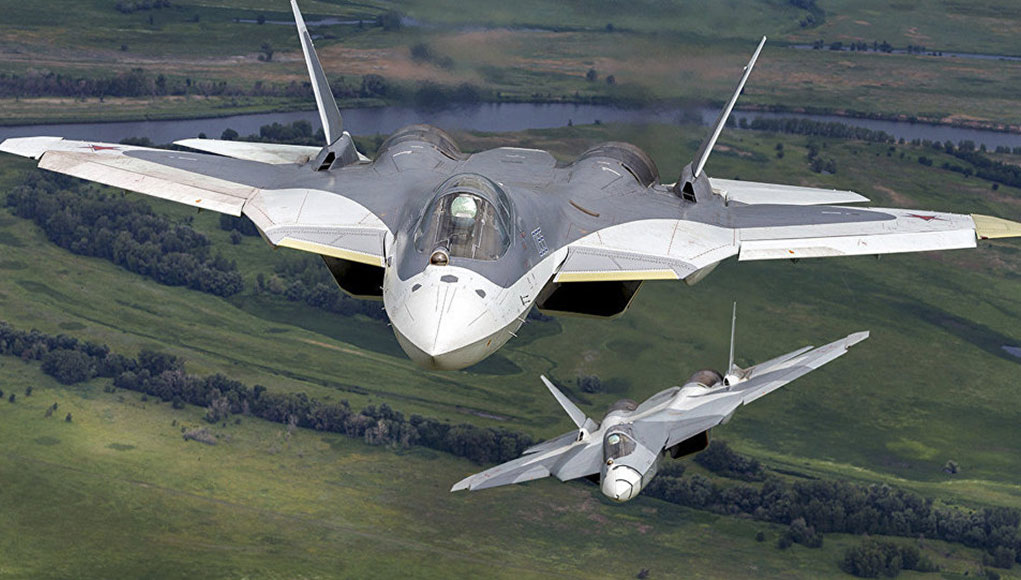
    The T-50 is scheduled to complete the first phase of test and evaluation in 2018. Photo: Russian MOD
    Several Russia’s Sukhoi T-50 5th Generation fighter planes arrived at Zhukovsky for MAKS, but were not shown on the static display. Two participated in the flight display though. Currently undergoing flight testing the T-50 (PAK FA) is expected to finish the first phase of tests in December, Russian Aerospace Forces Commander Col. Gen. Viktor Bondarev said on the show. The aircraft currently flies with two Saturn 117S (AL-41F1S) engines, which also powers the Su-35S. This is a temporary fit. Next year the new stealth fighter will get a new type of engine expected to improve its available power, fuel consumption, and reduce heat signature. Among the unique capabilities of the T-50 are super maneuverability and supercruise, enabling the aircraft to fly faster and outmaneuver its adversaries in close air combat. Equipped with distributed multi-band active electronically scanned array (AESA) radar and ‘virtual co-pilot’, the T-50 is operated by a single pilot, yet provides a superior capability in both in air-to-air and air-to-ground operation, over current two-seaters. The aircraft has four internal weapon bays maintaining the aircraft low-observable characteristic while carrying combat loads. Six external hardpoints can also be used to maximize combat load when stealth is not mandatory.

    MAKS is mainly a Russian show, featuring over 500 companies from Russia and about 150 from foreign countries. Despite the sanctions imposed by the West, European countries are the largest exhibitors here, represented by almost 100 companies from France, Germany, Czech Republic, Belgium, and Italy. 10 US companies also participated. Other large exhibitors were Iran (16), China (10) and Belarus (10). The main military oriented exhibits featured Russian products developed for Russian customers and export. While European exhibitors displayed hardware for space, commercial and general aviation, China and Iran also featured military hardware, particularly such products designed to complement, replace or augment Russian equipment.

    This year’s event highlights many systems recently used in combat in the Middle East, combat aircraft, helicopters, aerial weapons, and countermeasures, unmanned systems, payloads, missiles and air defense systems. Among the advanced systems employed in Syria in recent months were the Su-30 fighter and Su-32 strike fighter, attack helicopters including the Mi-28 and Ka-52 and assault helicopters, among them the latest models of Mi-17 fitted with electronic warfare and missile countermeasures. While all these models were on display in previous events, this year the exhibitors are more open to discuss their successful employment in combat.

    “Aviation export accounts for the lion’s share in our export,” said Rosoboronexport director general Sergey Ladygin. The Russian arms exporter recorded aircraft sales worth US$2 billion in the first half of 2017, and, according to Ladygin, new orders expected to be promoted here at the show “will add to our backlog, paving the way for future deliveries.” Rosoboronexport expects to sign at least 10 contracts and cooperation agreements during MAKS 2017 this week, with foreign governments, companies, and Russian equipment manufacturers.

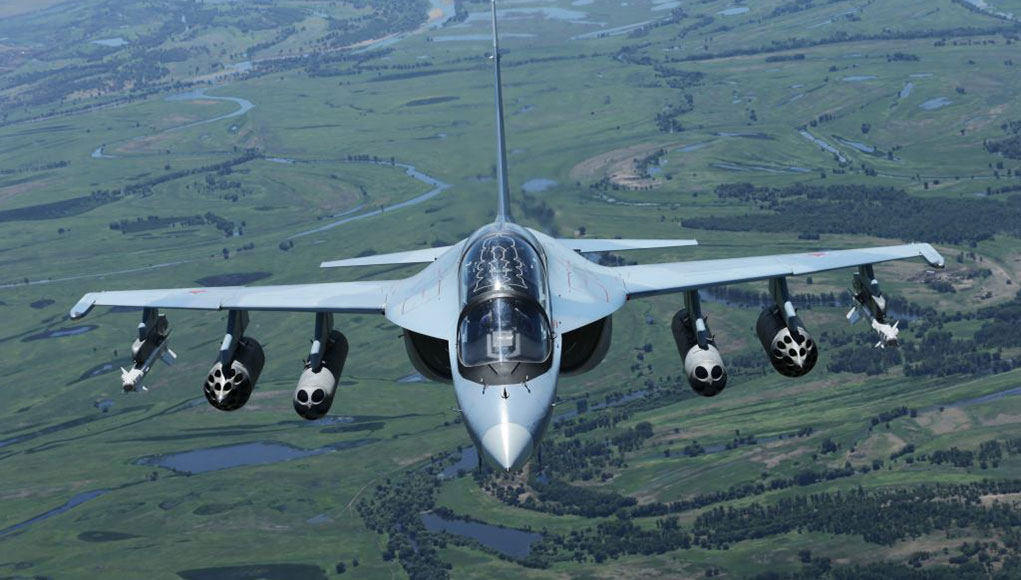
    YAK-130 advanced trainer can also be used for light attack missions. Photo: Irkut
    Another successful program is the Yak-130 advanced trainer. Last month the aircraft manufacturer Irkut announced it delivered 80 such combat trainers since it was first delivered to training units in Russia in 2013. Yak-130 provides performance level similar to modern fighters at a subsonic flight speed, thus improving pilots training for 4+ and 5 generation aircraft.

    The company expects delegations from 50 countries at its booth. The main attractions are expected to be the combat proven Su-30, Mi-28NE, and Ka-52 helicopters, Mi-35M, Mi-17, Mi-26T2, as well as the brand new Su-35 and MiG-29M/M2. Air defense systems are also drawing much interest; The S-400 SAM and Pantsir S1 gun-missile system received special interest here, following their recent combat deployment to Syria. The S-400 is becoming a hot export item, with its reported selection by India and Turkey. Other air defense systems highlighted here are Tor M2E, BuK-M2E. “Our specialists prepared presentations including clips and data attesting to successful operations of the Russian combat aviation in real combat fighting terrorists in Syria,” Ladygin noted.

    The Russian airshow featured many unmanned systems from domestic and foreign makers, reflecting their growing role in recent conflicts. Drone countermeasures of different types were also on display, addressing the growing concern of the imminent threat such systems pose on the battlefield and for homeland security.

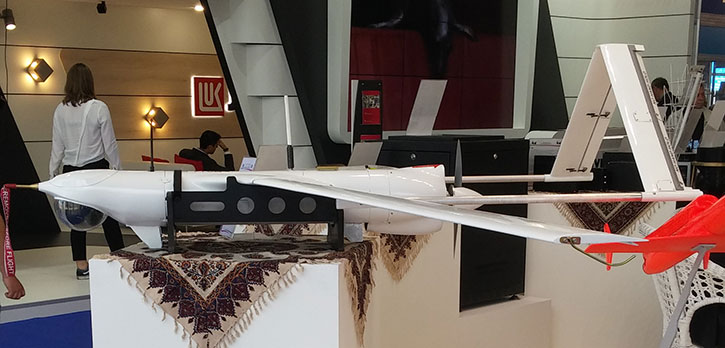
    The Iranian Yasir tactical drone displayed at MAKS 2017. Photo: Defense-Update
    The war in the Middle East provides an important sales opportunity not only for the Russian arms exporters but also to the Iranians. Iran showcases here its locally developed drones, and weapons designed for use by drones and small helicopters. Of particular interest are unmanned aerial vehicles and associated weapon systems specially designed for them. Among the systems on display at the Iranian pavilion was the Yasir drone – this drone is likely based on a Boeing ScanEagle. Few such drones were lost over the Persian Gulf since 2010, some were recovered by the Iranians and were likely reverse-engineered to become the Yasir. Iran hasn’t kept all the technology for itself – in 2013 they delivered one of the captured Scan Eagles to Russia for technical evaluation.

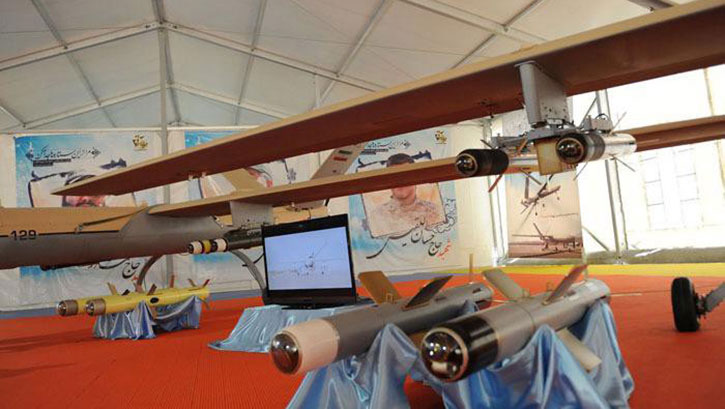
    Sadid guided weapons were developed to match the limited payload weight of small helicopters and unmanned aerial vehicles. This photo shows the weapons displayed earlier this year at an exhibition in Iran. Photo: IRNA
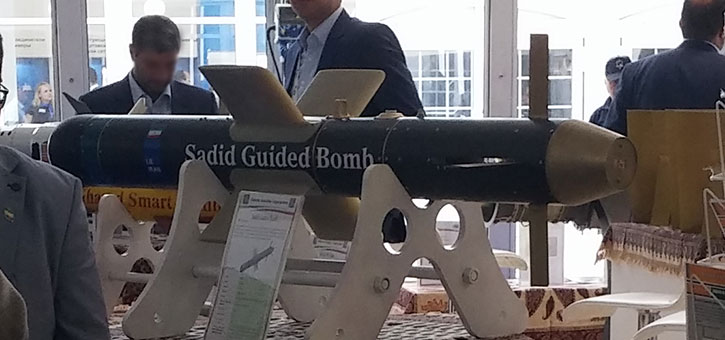
    Iran also displayed the new Sadid guided weapon, designed for use with unmanned aerial vehicles and small aircraft. Sadid is a family of seven small precision bombs and missiles sharing some components. The smallest weapon of this family is Sadid-L which carry a five-kilogram warhead to a range of four kilometers. Sadid-345 smart bomb is designed for use on tactical UAVs, such as the Shahed 129. Both were extensively used in Syria.

    The Sadid 345 smart bomb displayed at MAKS 2017. Photo: Defense-Update
    Iran displayed the new Sadid guided weapon, designed for use with unmanned aerial vehicles and small aircraft. Sadid is a family of seven small precision bombs and missiles sharing some components. The smallest weapon of this family is Sadid-L which carry a five-kilogram warhead to a range of four kilometers. Sadid-345 smart bomb is designed for use on tactical UAVs, such as the Shahed 129. Both were extensively used in Syria.

    The weapon can glide to a distance of about six kilometers to strike small targets with high precision. The largest variant in the Sadid family is Model-636, a guided bomb with a warhead weighing 20 kilograms.

    Defense Innovations Spotted at ISDEF 2017

    The ISDEF 2017 exhibition held June 6-8, 2017 in Tel Aviv was Israel’s largest defense event held in Israel. As in previous years, the focus of the exhibition was on interoperability and the diverse use of products by end users for various purposes.

    With more than 14,000 attendees and almost 300 exhibitors – 42 percent were Israeli companies, and 58 percent came from 24 countries with national pavilions from India, the USA, Czech Republic and China. The event featured advanced products and technologies from leading domestic and international companies to small startups.

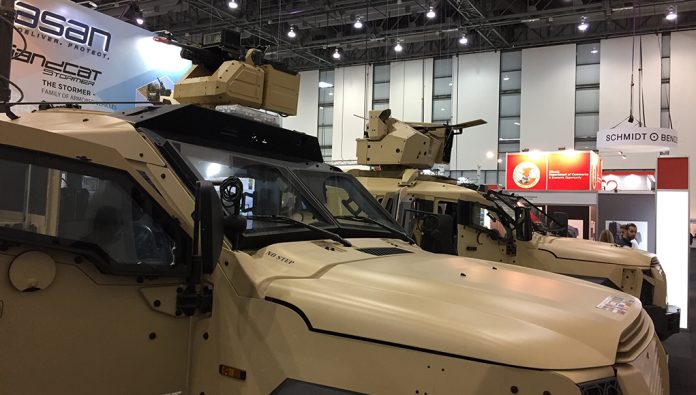
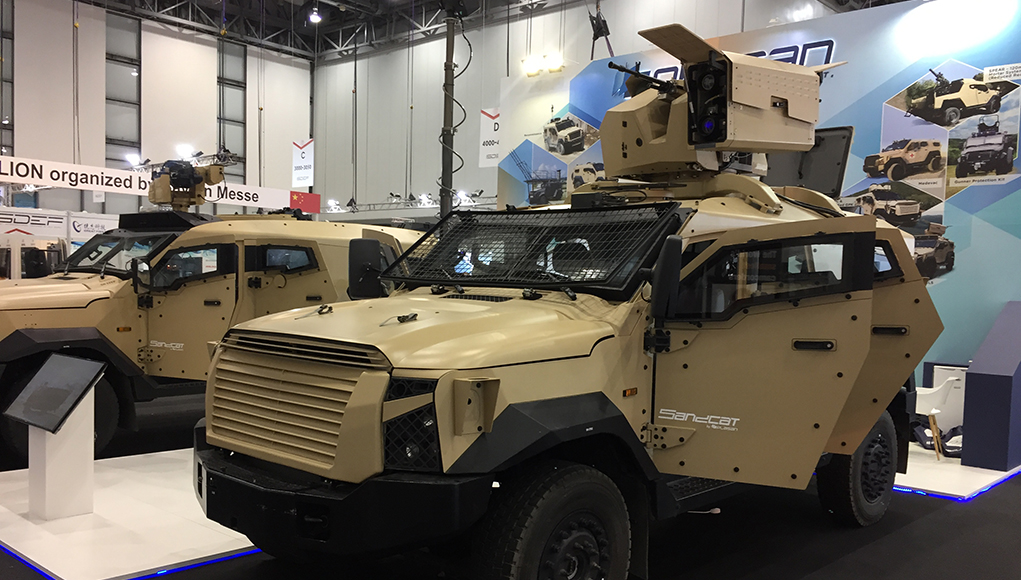
    The Sandcat from Plasan seen at ISDEF 2017 carrying the Samson remotely operated weapon station mounting a machine gun and two Spike missiles. Photo: Tamir Eshel, Defense-Update

    Plasan displayed two of its latest configurations of the Sandcat (Stormer) at ISDEF, one version demonstrated here was the security vehicle carrying a mast mounted surveillance package comprising radar and electro-optical system. The other vehicle carried the Samson remotely operated weapon station mounting a machine gun and two Spike missiles.

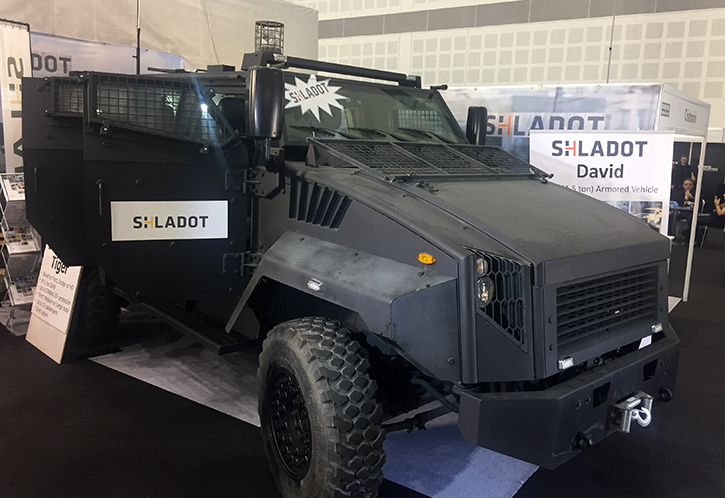
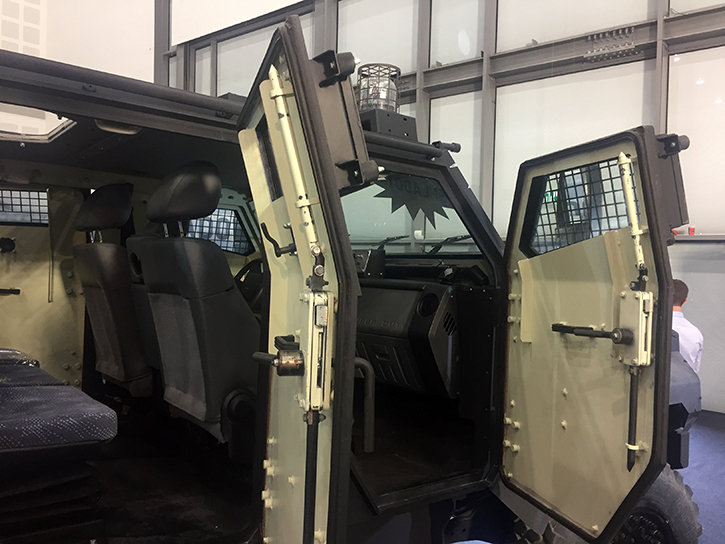
    Shladot, the Israeli armored vehicle manufacturer that builds the David light armored vehicle for the IDF displayed here the highly protected Tiger Mk II. The vehicle shown was recently delivered to the Mexican police.

    Tiger Mk2 from Shladot
    A peek into the protected cabin of the Tiger Mk 2. Photo: Tamir Eshel, Defense-Update
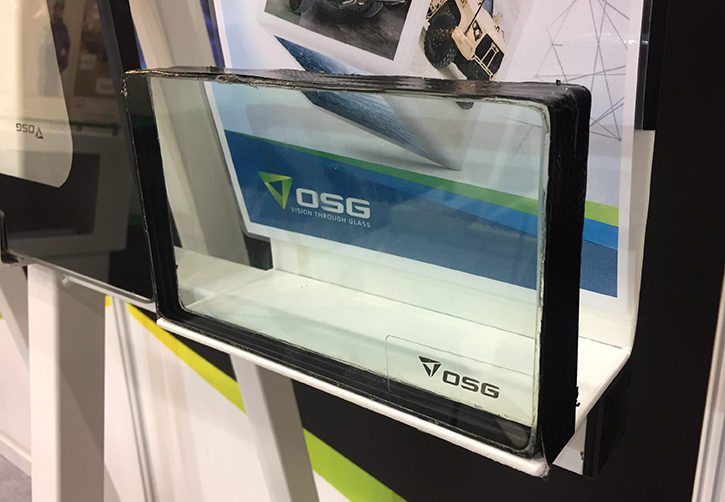
    OSG displayed its new lightweight transparent armor system meeting B6 level (7.62×51 mm) at a thickness of 30mm. Photo: Tamir Eshel, Defense-Update

    Transparent armor is a key aspect of armored vehicles, especially security vehicles. Israel’s transparent armor manufacturer OSG unveiled at ISDEF a new, lightweight transparent armor system meeting B6 level (7.62×51 mm) at a thickness of 30mm. OSG’s windows defeating threats at BR7 level (7.62×51 AP) are 60 mm thick.

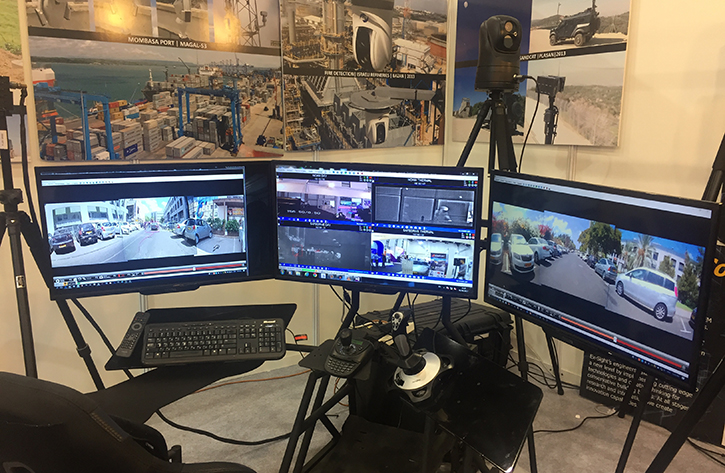
    ExSight displayed here the Safedrive, its latest dual-sensor vehicle camera improving the driver’s view into ‘blind spots’ to detect obstacles and hazards before they come into sight. The camera enables the driver to ‘drive by video’, with high confidence even in bad visibility conditions. Maintaining full situational awareness in high-risk zones, the system uses video content analysis (VMDBOX) providing peripheral situational awareness by monitoring the vehicle’s surrounding, reporting abandoned objects, loitering and other video motion triggers predefined by the user.

    Safedrive, from ExSight is a vehicle camera that improves the driver’s field of view. It also offers enhanced situational awareness using video analytics. Photo: Tamir Eshel, Defense-Update
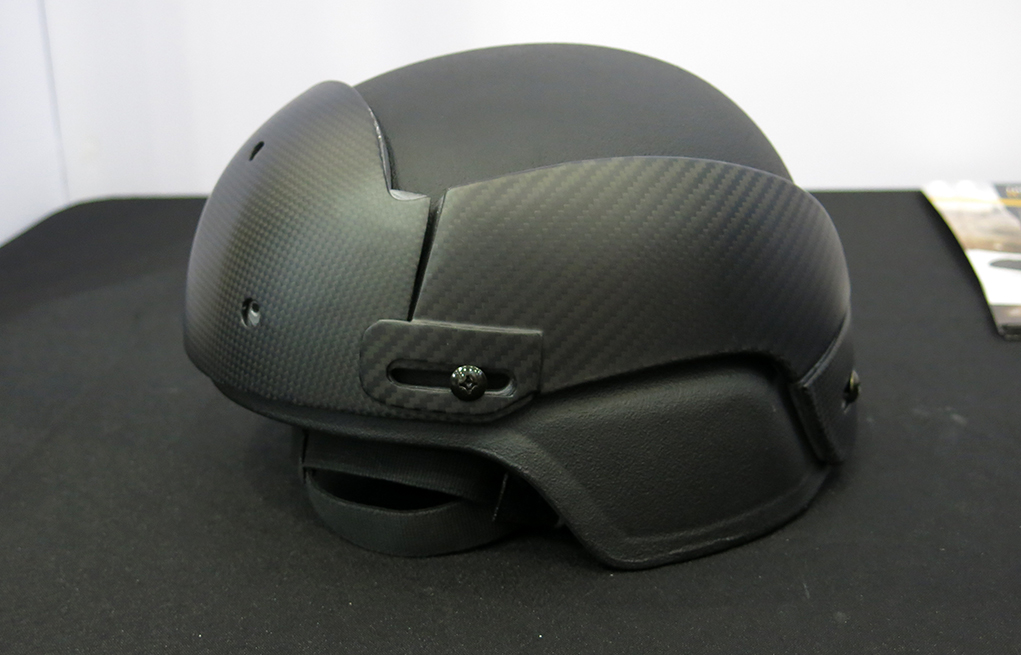
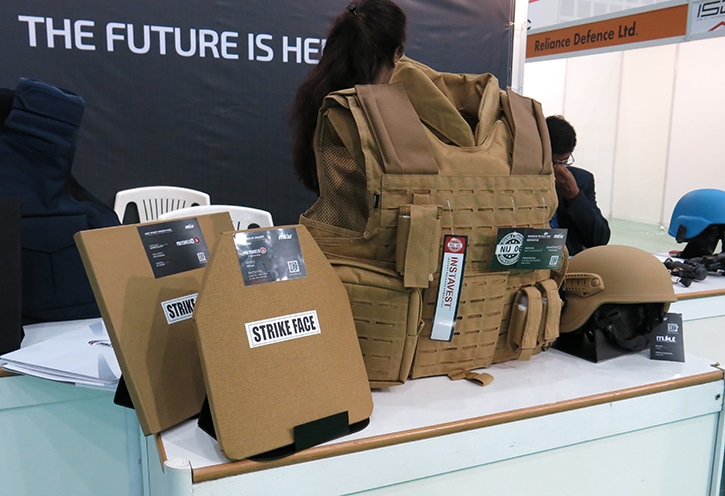
    The Bastion helmet from Diamondage uses an applique armor kit made of ultralight carbon fiber reinforced by ceramic strike face.

    Innovations in the field of personal protection included applique armor kits for helmets, made of ultralight carbon fiber reinforced by ceramic strike face. The Bastion helmet design was based on thorough analysis of battlefield epidemiological data and casualty statistics, is designed to improve protection where it is needed most. The helmet comes with padding system designed to add comfort and safety, absorbing the high impact of rifle rounds. applique armor can be removed in the field. The protective armor applique was designed for standard helmets, augmenting the helmet’s capability to defeat armor piercing rounds. With the additional armor, the Bastion helmet can defeat all common rifle rounds, including 5.56mm M855 (M4, green-tip) and the 7.62mm PS Ball (AK-47). The helmet provides multi-hit performance and spall mitigation.

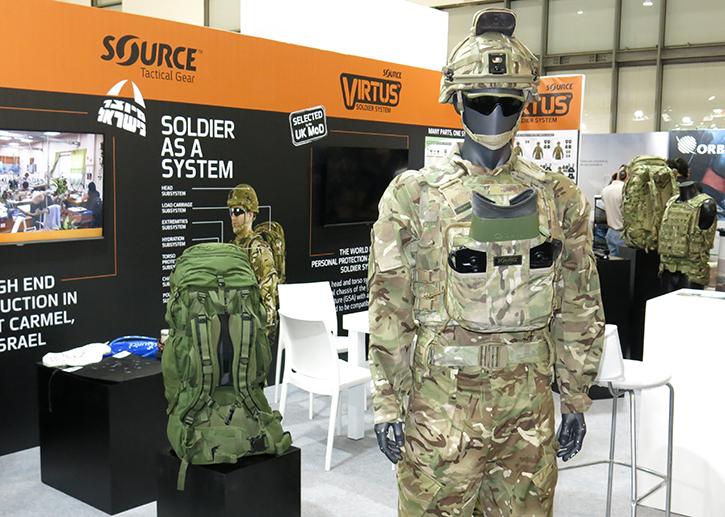
    The Virtus system comprises a modular kit made of 50 different units, that can be configured to equip the British combat and combat support troops. Photo: Tamir Eshel, Defense-Update

    The Source Tactical Gear company displayed in Israel the Virtus combat gear developed by the Israeli company for the British Army. The Virtus system comprises a modular kit made of 50 different units, that can be configured to equip the British combat and combat support troops.

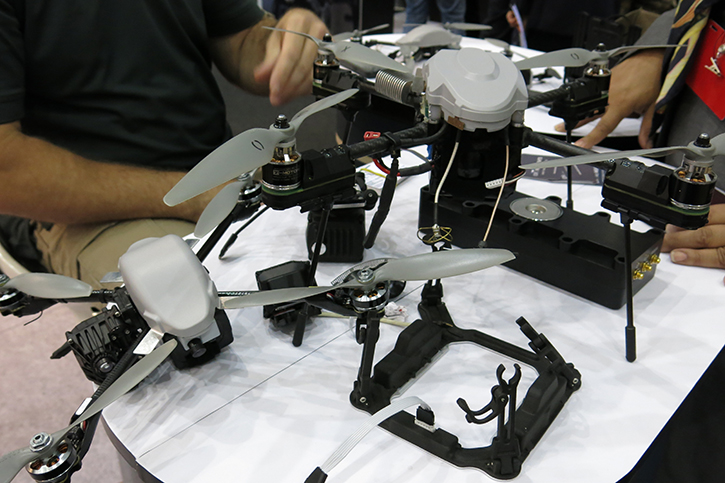
    Unmanned aerial systems were also an interesting topic at ISDEF, with several new systems displayed. One of the hot products was Instanteye, developed by the US company PSI Tactical. This miniature drone was displayed in Israel for the first time, addressing the Israel Defense Force interest in miniature drones. In recent months the IDF has purchased large stocks of commercial off the shelf mini-drones from DJI and has also contracted Elbit Systems to develop a militarized quadrotor.

    InstantEye micro drones on display at ISDEF 2017. Photo: Tamir Eshel, Defense-Update


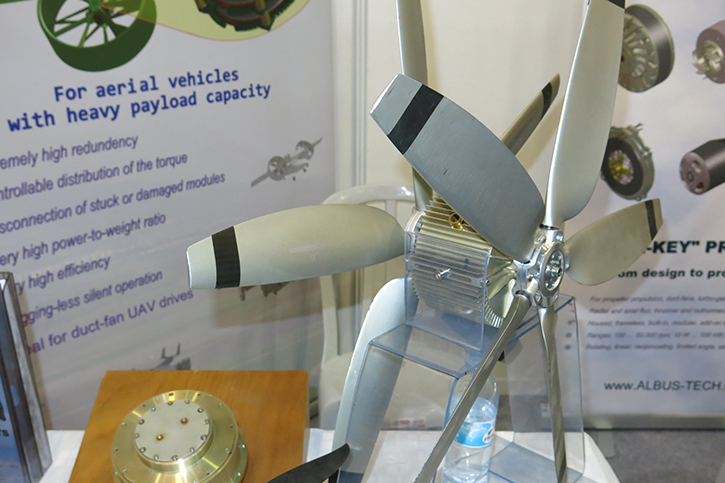
    Albus Technology developed an axial flux electric motor that stacks several motors on a single axis, increasing the propulsion power with minimal added weight. Photo: Tamir Eshel, Defense-Update

    Innovative electrical propulsion solutions for UAVs were displayed by Albus Technology. Among the systems showcased here was an independent, modular drive based on four axial flux electrical motors, each delivering 12.5 kilowatts power at 6000 RPM. The complete powerplant with an optional 1:3 reduction gearbox weighs only 3.3 kg. One of the applications for this system is a twin-rotor propulsion system that doubles the lift of a quadrotor, at a fraction of the weight.


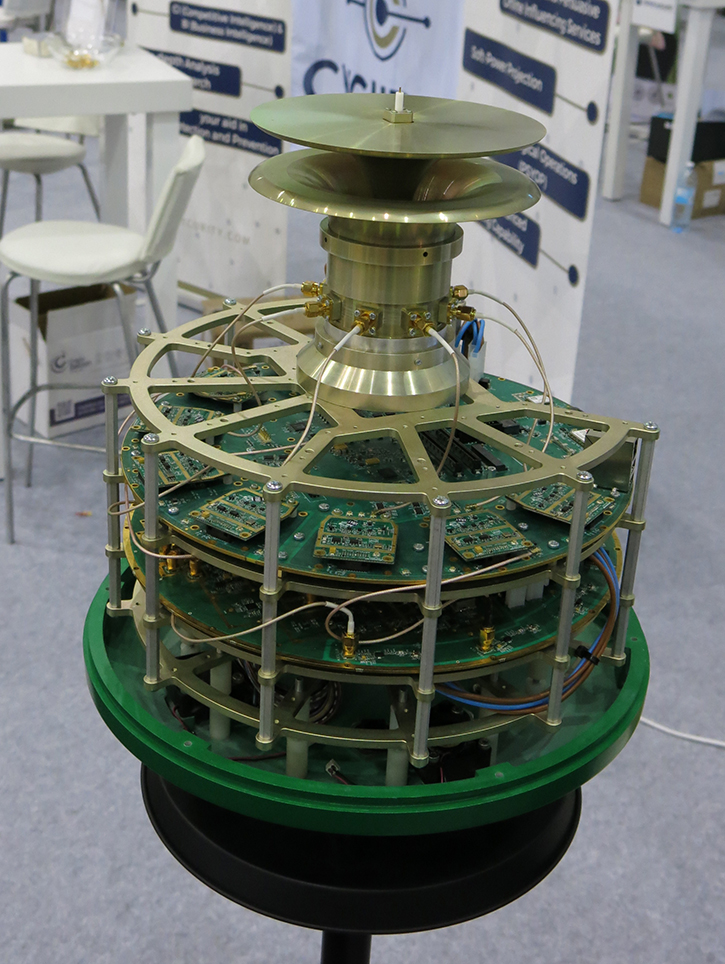
    ARTSys uses a patented system to scan 360 degrees without antenna motion. Photo: Tamir Eshel, Defense-Update

    As battlefield uses of drones increase so does the demand for drone detection and countermeasures. ARTSys, a startup company specialized in counter-UAV systems introduced here its RS360-400 Physical Intrusion Detection (PID). This system employs the company’s patented, non-rotating radar system, continuously covering 360 degrees in azimuth along range without creating dead spots.

    ISDEF 2017 was also the main event celebrating 25 years of diplomatic relations between Israel and India. This manifested in the presence of official Indian delegations at the diplomatic level, including as an Indian national pavilion of 400 Square meters. In addition to the Indian pavilion, ISDEF also featured national pavilions on an unprecedented scale; including Czech Republic, China and U.S pavilion with 30 exhibitors.

    MKU displayed its line of body armor and helmets. Photo: Tamir Eshel, Defense-Update

    THAAD Succserfully Intercepts an IRBM Target from Alaska

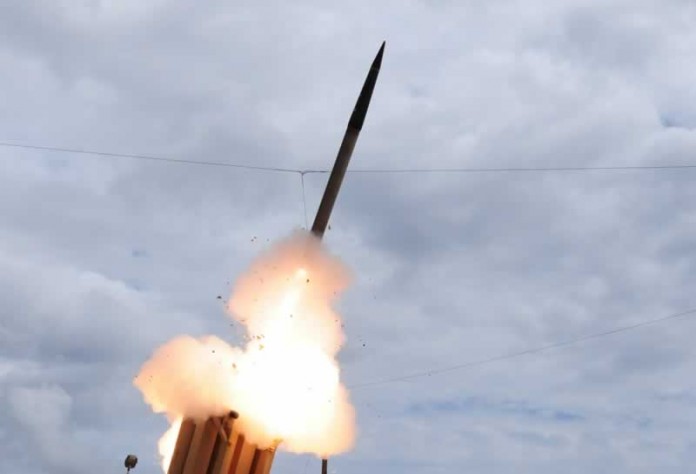
    THAAD interceptor seen here launched on its tenth test flight. Photo: MDA

    U.S. missile defense capabilities were demonstrated today in a first of a kind intercept of an Intermediate-Range Ballistic Missile (IRBM) target by the Terminal High Altitude Area Defense (THAAD) system. The intercept took place 2,500 miles south of Alaska, near Hawaii, demonstrating THAAD’s strategic defense capabilities, particularly against the threat types currently presented from North Korea.

    “The successful demonstration of THAAD against an IRBM-range missile threat bolsters the country’s defensive capability against developing missile threats in North Korea and other countries around the globe and contributes to the broader strategic deterrence architecture,” MDA said in the statement. Although the test was planned months ago, the U.S. missile defense test has gained significance following North Korea’s July 4 launch of an intercontinental ballistic missile (ICBM) that raised concerns about the threat from Pyongyang.

    The successful intercept was part of a test led by the U.S. Missile Defense Agency, supported by the the U.S. Army, which operates the THAAD. Through the test event the THAAD system, located at Pacific Spaceport Complex Alaska in Kodiak, Alaska, detected, tracked and intercepted a threat-representative IRBM target. This was the first test where THAAD attempted to challenged an IRBM. This was the 14th successful intercept in 14 attempts for the THAAD system since 2005.

    During the test site’s SPY-2 radar detected, acquired and tracked the target. Based on that input The THAAD system then developed a fire control solution and launched an interceptor that destroyed the target’s reentry vehicle with the sheer force of a direct collision.

    The Kodiak site is not new to missile defense tests but has not been used since 2014. The current test was part of renewed activity on the site, under a $90 million contract awarded by MDA. Upcoming missile defense activities also include a planned test of an Arrow 3 interceptor, expected to verify the systems’ full capacity, which could not be tested in the confines of Israel’s coastal test range on the Mediterranean Sea.

    The system can operate as a self-sustained unit or as part of a larger, multi-tier missile defense layout. It is rapidly deployable, mobile and also interoperable with other Ballistic Missile Defense System (BMDS) elements, including Patriot/PAC-3, Aegis, forward-based sensors and the Command, Control, Battle Management, and Communications system.

    THAAD has been deployed since 2009, in the USA, the Middle East, and South Korea. The system has also been on the US export list, for UAE and Saudi Arabia, the later facing constant missile attacks from Iranian-supported Houties from Yemen.

    North Korea Launches Its First ICBM

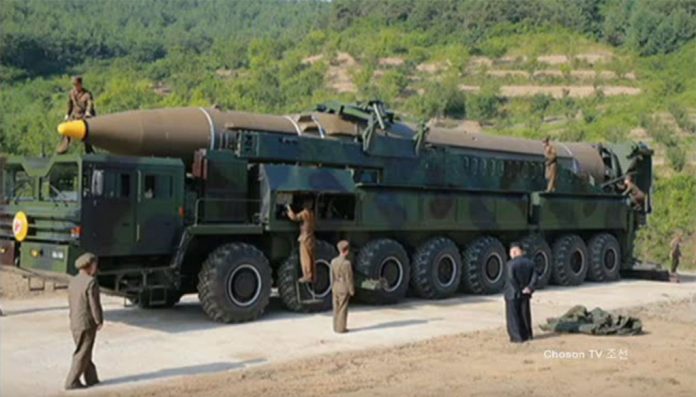
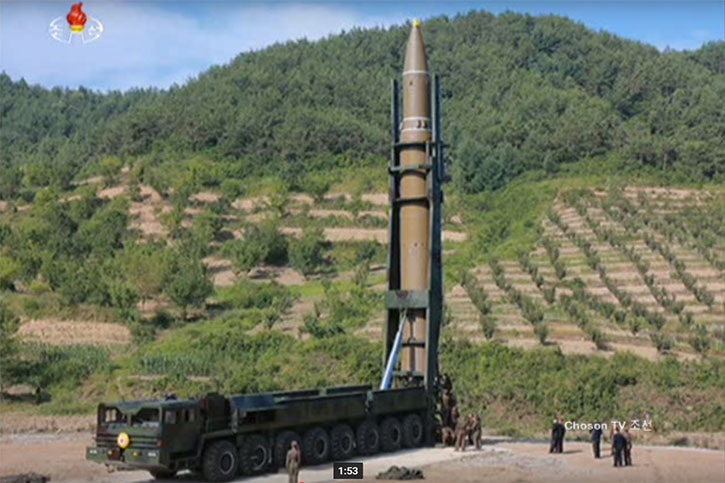
    KN-14 arriving on its transporter-erector vehicle at the launch site at Panghyon,

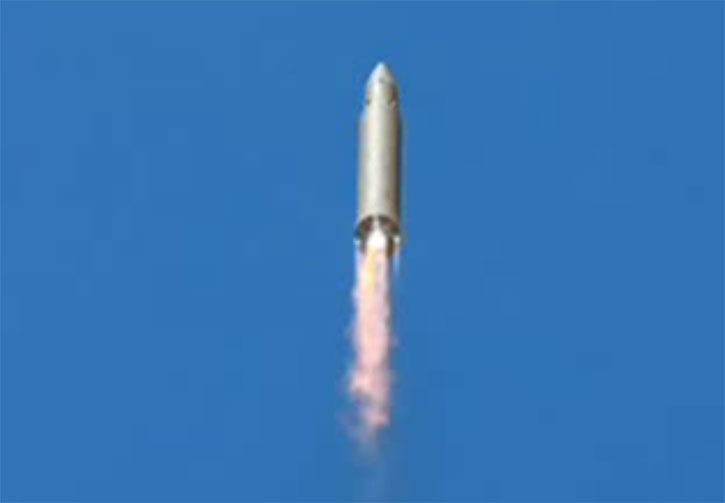
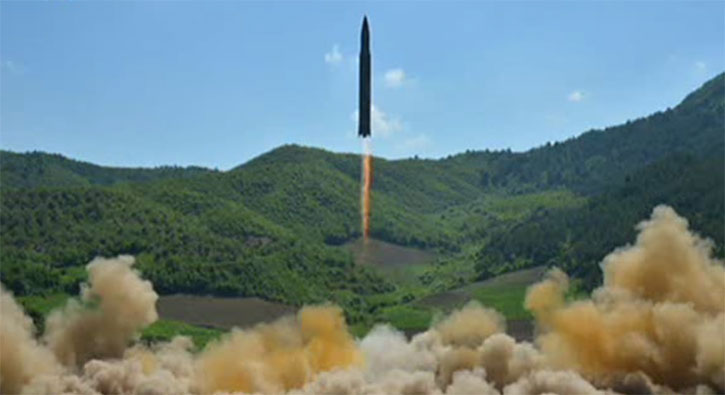
    North Korea tested today the largest ballistic missile developed by the rough country. The missile believed to be the KN 14 (Hwasong 14). The missile was launched from the Panghyon test site, located in the north-western part of the country. With a range of 7,000 km, the missile covers the entire Asian continent and can reach any target from Hawaii to Australia, India and Scandinavia.

    Pyongyang claimed the missile reached a height of 2,802 km (1,741 miles). Launched at a very high ballistic trajectory, the missile flew for 40 minutes and splash in the Sea of Japan, 933 kilometres (580 miles) from its launch site. But, if such a missile would be launched at a minimum energy (maximum range) trajectory it would have travelled about 7,000 kilometres (4,350 miles), formally becoming North Korea’s first Intercontinental Ballistic Missile (ICBM – defined as a weapon with a range exceeding 5,500 km (3,417 miles).

    At this range, the KN-14 will cover the entire area of Alaska and parts of Hawaii. On May 14, this year North Korea proved the capability to launch the KN-12 Intermediate Range Ballistic Missile (IRBM) to an altitude of 2,100 km (1,300 miles), and range of 700 km (435 miles), thus can reach the US base on the Pacific island of Guam.

    The KN-14 uses liquid fuel for its main engine, as well as the four steering engines visible in this image. Picture Choson TV.

    North Korea developed several missiles designed for strategic, long range attack. KN-12 and KN-14 are both use liquid fuel and are likely using the same main engine, which uses four steering rockets for stabilisation. The KN-12 has a single stage while KN-14 has two stages, thus the added range. KN-14 hasn’t been launched before, but its rocket engine was tested several times since its first public appearance in 2015.

    KN-14 launched from Panghyon. Picture Choson TV.

    Analysts believe the KN-14 can reach a maximum range of 8,000 km, meaning it could reach Hawaii, Alaska and almost all the Washington state in the North-Eastern USA. The missile’s warhead uses a reentry vehicle that can carry a nuclear device that Pyongyang has already displayed. North Korea five tests, the most recent was last year, with a yield estimated at 20-30 kilotons.

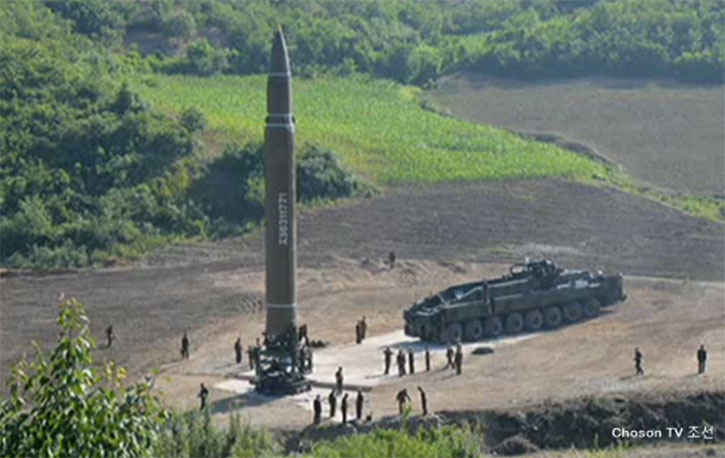
    Hwasong-14 ICBM erected at its launch site at Panghyon, North Korea, minutes before its first launch, July 4, 2017. Picture Choson TV.
    An aerial view of the Korean ICBM launch site. Picture Choson TV.

    Events_2018

    DGI Europe 22-24 January Lancaster London, UK https://dgi.wbresearch.com/
    INTERSEC Safety, Security & Fire Protection 21-23 January International Convention & Exhibition Centre, Dubai
    SO/LIC 2018 February 26-28 Crystal Gateway Marriott, Arlington VA http://www.ndia.org/events/2018/2/26/29th-annual-solic
    Ilan Ramon Aerospace Conference January Herzlia, Israel
    Shot Show January 23-26 Sands Expo Center, Las Vegas, NV http://shotshow.org/
    IAV 2018 International Armored Vehicles 22-25 January 2018 London UK https://www.internationalarmouredvehicles.com/
    Marine West 1-2 February MCB Camp Pendleton, CA, USA http://www.marinemilitaryexpos.com/marine-west.shtml
    Cyber Defence & Network Security January 25-26 Etc. Prospero House, London, UK http://cdans.iqpc.co.uk
    International Military Helicopters January 30-31 London, UK https://militaryhelicopter.iqpc.co.uk
    Asia Milisim January 30-31 Marina Bay Sands, Singapore https://www.asia-decs.com/mtsa/
    UDT Asia January 30-31 Marina Bay Sands, Singapore https://www.asia-decs.com/udta/
    EW Singapore January 30-31 Marina Bay Sands, Singapore https://www.asia-decs.com/ewa/
    Maritime defence Asia January 30-31 Marina Bay Sands, Singapore                   https://www.asia-decs.com/mda/
    Naval Training & Simulation January 24-28 Hilton London Kensington, London UK https://navaltraining.iqpc.co.uk
    Surface Ships January 30-31 London UK https://surfacewarships.iqpc.co.uk
     Maritime Reconnaissance & Surveillance Technology 30-31 January Rome, Italy https://www.smi-online.co.uk/defence/europe/conference/Maritime-Reconnaissance
    Singapore Airshow 6-11 Feb Changi Exhibition Center, Signapore http://www.singaporeairshow.com/trade/
    Unmanned Systems Defense, Protection & Security AUVSI Feb 2-8 Gaylord National Resort & Convention Center,  National Harbor, MD http://www.thedefenseshow.org
    UMEX Unmanned System February 25-27 ADNEC Abu Dhabi, UAE http://www.umexabudhabi.ae/
    FSIE Fire & Security India February 22-24 BIEC Bangaluru, India http://www.fsie.in/
    GPEC International Exhibition & Conference for Police and Special Equipment February 20-22 Frankfurt Exhibition Center, Frankfurt, Germany https://gpec.de
    Mobile Deployable Communications February 1-2 Marriott Hotel Warsaw, Warsaw, Poland https://www.smi-online.co.uk/defence/europe/conference/mobile-deployable-communications
    Heli Expo 27 Feb – March 1 Las Vegas http://heliexpo.rotor.org/
    ISC Brasil International Exhibition & Conference for Security March 6-8 Expo Center Norte, Sao Paulo, Brazil
    ISNR International Expo for National Security & Resilience 6-8 March ADNEC, Abu Dhabi, UAE
    Future Soldier Technology 13-14 March Compthorne Tara Hotel, London, UK https://www.smi-online.co.uk/defence/uk/conference/FUTURE-SOLDIER-TECHNOLOGY
    Defexpo March 2018 Goa, India http://defexpoindia.in/
    DIMDEX Doha International Marine & Defence Conference 12-14 March Qatar National Convention Center, Doha, Qatar http://www.dimdex.com
    Coastal & Maritime Surveillance Africa March 19-20 Accra, Ghana https://coastalsurveillanceafrica.iqpc.ae
    Police K9 March 6-8 Las Vegas, NV tps://policek9magazine.com
    IWA March 9-12 Nurnberg, Germany https://www.iwa.info/en
    ENFORCE TAC Police Equipment, Security & Tactical Solutions March 7-8 Nurnberg, Germany https://www.enforcetac.com
    FIDAE April 3-8 Santiago, Chile https://www.fidae.cl/
    Marine South 12-13 April Camp Lejeune, NC http://www.marinemilitaryexpos.com/marine-south/home/
    Secutec India International Security Expo 5-7 April Mumbai, India
    Border Security Expo January 31 – February 2 Harry B. Gonzales Convention Center, San Antonio, TX http://www.bordersecurityexpo.com/
    SPIE DSS Defense, Security & Sensing April 15-18 Gaylord Palms Resort & Convention Center, Orlando, FL https://spie.org/conferences-and-exhibitions/defense–commercial-sensing
    FireExpo Fire & Safety Expo Korea April 25-27

     EXCODaegu, South Korea

    Secutech + Fire & Safety Fire & Security Expo April 25-27

    Nangang Exhibition Center

    , Taipei, Republic of China

    http://secutechfiresafety.tw.messefrankfurt.com/taipei/en
    DSA 16-19 April Kuala Lumpur, Malaysia http://www.dsaexhibition.com
    Security & Policing – Home Office Event 6-8 March Farnborough International, UK
    Counter Terror Expo 6-7 March Olympia, London https://www.counterterrorexpo.com/
    Marrakech Airshow Marrakech, Morrocco http://www.imas-aero.com
    Security Expo March 16-19 Inter Expo Center, Sofia, Bulgaria
    Securex West Africa Commercial, Homeland and Cyber Security & Fire protection 20-21 March Lagos, Nigeria https://www.securexwestafrica.com/
    QUAD A 25-27 April 2018 Nashville http://www.quad-a.org/
    Xponential (AUVSI) April 30 – May 3 Colorado Convention Center, Denver http://www.xponential.org/xponential2018/public/enter.aspx
    SOFIC May 22-24 Tampa FL
    SOFEX 7-10 May Amman, Jordan http://sofexjordan.com/
    IDEB 9-11 May Expo Arena, Bratislava, Slovakia
    Police Expo May 17-18 Pragati Maidan, New Delhi, India http://internationalpoliceexpo.com/
    Sea Air Space April 9-11 Gaylord National Convention Center, Maryland USA http://www.seaairspace.org/
    ICS West International Security Conference West April 13-14 Sands Expo Center, Las Vegas, NV http://www.iscwest.com/
    Intelligence Analytics May 28-30 Washington DC, USA https://intelligenceanalyticssummit.iqpc.com
    Fires 2018 May
    Securex South Africa Commercial, Homeland and Cyber Security & Fire protection 22-24 May Gallagher Convention Center, Johannesburg, South Africa https://www.securex.co.za/
    Future Armoured Vehicles Eastern Europe
    Rapid+ Accelerating 3D Manufacturing April 23-26 Fort Worth Convention Center, Fort Worth, TX http://www.rapid3devent.com/
    Expo Seguridad & Expo Seguridad Industrial Security Expo April 24-26 Citibanamex, Mexico City, Mexico http://www.exposeguridadindustrial.com/
    GISEC Gulf Information Security Expo & Conference May 1-3 Dubai World Trade Center, UAE http://www.gisec.ae/
    ITEC May 15-17 Stutgart, Germany https://www.itec.co.uk
    Heli Russia May 24-26 Crocus Expo IEC, Moscow, Ruissia http://www.helirussia.ru/en/
    CIEPE Asia Pacific China Police Expo 15-18 May China National Convention Center, Beijing, China http://www.cpexhibition.com/police/
    fUTURE aRTILLERY London, UK
    BSDA Black Sea Defense & Aerospace May 16-18 Romexpo, Buccarest, Romania http://bsda.ro/
    Homeland Security Expo 17-18 May Pragati Maidan, New Delhi, India http://homesecexpo.com/India/
    Military Airlift & Air/Air Refueling London, UK
    Security Israel May, 2018 Israel
    Cansec 30-31 May Ey Centre, Ottawa, Canada https://www.defenceandsecurity.ca/CANSEC/
    HEMUS Bulgarian Defense, Antiterorism & Security Expo 30 May – 2 June International Fair Plovdiv, Belgrad, Bulgaria http://www.hemusbg.org/en
    KADEX 23-26 may Astana, Kazakhstan http://www.kadex.kz/eng/main/
    Milsatcom May Singapore
    C4ISR Summit UAE
    ILA 25-29 April Berlin Messe, Berlin, Germany https://www.ila-berlin.de/en
    Port Security Technology
    UDT Global 26-28 June SEC Glasgow, UK https://www.udt-global.com/#/
    Aerospace A&DM May 15-18 Sevilla, Spain
    MAST Europe Maritime/Air Systems & Technology May 15-18 Bristol, UK https://mastconfex.com/
    Eurosatory June 11-15 Parc des Exposition, Paris, France http://www.eurosatory.com
    IFSEC International Fair and Security Conference & Exhibition June 19-21 ExCel, London UK http://www.ifsec.events/
    MCT Mission Critical Technologies June 13-14 Excel, London, UK https://tmt.knect365.com/mission-critical-technologies/
    UGS Show Unmanned Global Systems June Paris Nord, Villerpinte http://www.ugsevent.com/
    EW Europe June 5-7 Congres Beaulieu, Lausanne, Switzerland https://www.eweurope.com/
    Cyber Security for Defense June 25-27 Washington DC, USA https://cybersecurityfordefense.iqpc.com
    RIAT Air Tatoo – RAF 100 Years July 13-15 Fairford, UK http://www.airtattoo.com/
    Farnborough International 16-22 July Farnborough, UK https://www.farnboroughairshow.com/
    MSPO Sept. 2018
    ICAP International Association of Chiefs of Police October 6-9 Orlando, FL
    Army 208 21-26 August 2018 Patriot Expo Center, Kubinka, Russia http://www.rusarmyexpo.com/
    Land Forces Australia 4-6 September Adelaide, Australia https://www.landforces.com.au
    MS&D Maritime Systems & Technology September 4-7 Hamburg Messe, Hamburg, Germany http://www.smm-hamburg.com/programm/msd/
    DVD
    AAD African Aerospace & Defense 19-23 September Tshwane, South Africa http://www.aadexpo.co.za/
    SECPROTEC Security & Protection Technology September Nairobi, Kenia
    AUS&R Auonomous Systems & Robotics September Rishon Le’Zion, Israel
    AIREX Istanbul Airshow September 27-30 Istanbul Ataturk Airport, Istanbul, Turkey https://www.istanbulairshow.com/
    Modern Day Marine September Quantico, VA
    ADEX Azerbaijan Defense Expo 25-27 sEPTEMBER Baku Expo Center, Baku, Azerbaijan http://www.adex.az
    Sobra Aerospace & Defense Expo October 2018 Slovenia
    ADAS Asia Defense, Security & Crisis Management Expo 26-28 September World Trade Center Metro, Manila, Philippines http://www.adas.ph/
    AUSA US Army Association Annual Meeting
    African Air Expo Ghana
    Air Defense Asia – Japan
    Interpolitex Means of State Security October VVC Moscow, Russia http://www.interpolitex.ru/en/
    Euronaval October 22-26 Paris, France http://www.euronaval.fr
    Airshow China 6-11 November Zhuhai, China http://www.airshow.com.cn/en/
    Expoprotection International Safety, Security, Firefighting & Rescue Expo November 6-8 Parc expo Porte de Versailles, Paris, France http://www.expoprotection.com/
    BIAS Bahrain International Airshow November 14-16 Sakhir Air Base, Bahrain http://www.bahraininternationalairshow.com
    Indodefense November Jakarta, Indonesia
    Israel Homeland Security November International Convention Center, Tel Aviv, Israel
    MAST Asia Maritime Systems & Technology November 28-30 New Delhi, India https://mastconfex.com/
    I/ITSEC December
    IDEAS November Karachi Expo Center, Karachi, Pakistan
    BIDEC Bahrain International Defense Exhibition & Conference December Bahrain
    Exponaval December Valparaiso, Chile

    Apache Helicopter Fires High-Energy Laser Against a Ground Target at White Sands

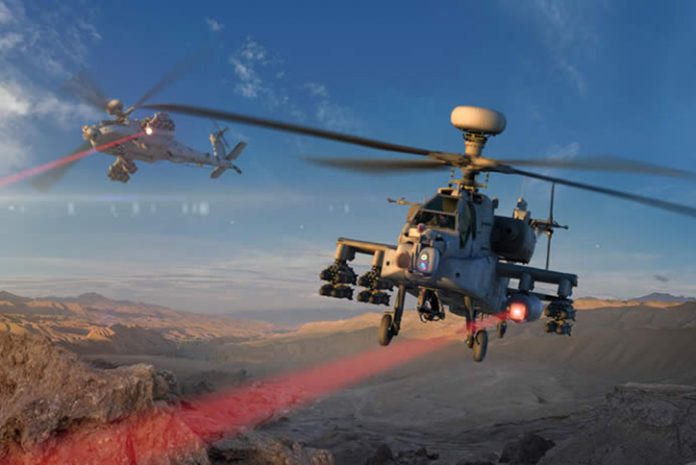
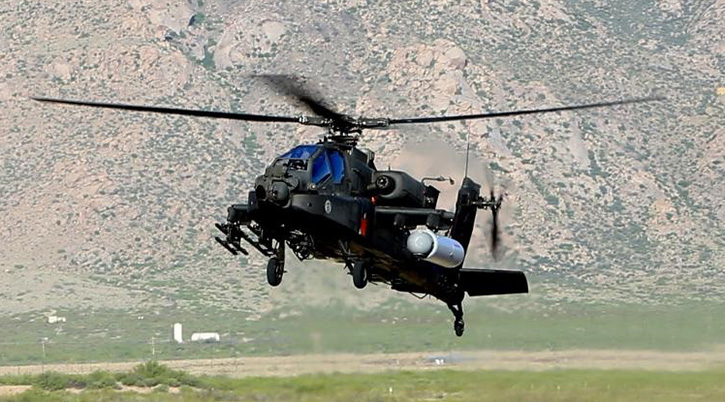
    A high-energy laser mounted on an Apache AH-64 attack helicopter acquired and hit an unmanned target during a recent firing test at the White Sands Missile Range in New Mexico. The test was conducted by Raytheon and the U.S. Army Apache Program Management Office, in collaboration with U.S. Special Operations Command. Illustration: Raytheon

    A high-energy laser mounted on an Apache AH-64 attack helicopter acquired and hit an unmanned target during a recent firing test at the White Sands Missile Range in New Mexico. The test was conducted by Raytheon and the U.S. Army Apache Program Management Office, in collaboration with U.S. Special Operations Command.

    For the test, Raytheon coupled a variant of the Multi-Spectral Targeting System, an advanced, electro-optical, infrared sensor, with a laser. The MTS provided targeting information, situational awareness, and beam control.

    The system tracked and directed energy on a stationary target at a slant range of 1.4 kilometers. It was the first time a fully integrated laser system successfully shot a target from a rotary-wing aircraft over a wide variety of flight regimes, altitudes, and airspeeds, proving the feasibility of laser attack from Apache.

    For the test the laser was coupled with a variant of the Multi-Spectral Targeting System (MTS) to form a laser weapon pod that could acquire, track and engage the target. Photo: Raytheon

    The data collected from the test, including the impact of vibration, dust and rotor downwash, will help shape future high-energy laser systems.

    Modern, solid-state lasers are more useful for military applications as they become more powerful and compact. Podded versions such as the one tested on the Apache could be used on other helicopters in the future, enabling special operations forces and other operators to use kinetic effects with higher precision and lower risk of collateral damage.

    Israel Tests Sea-Launched LORA Missile

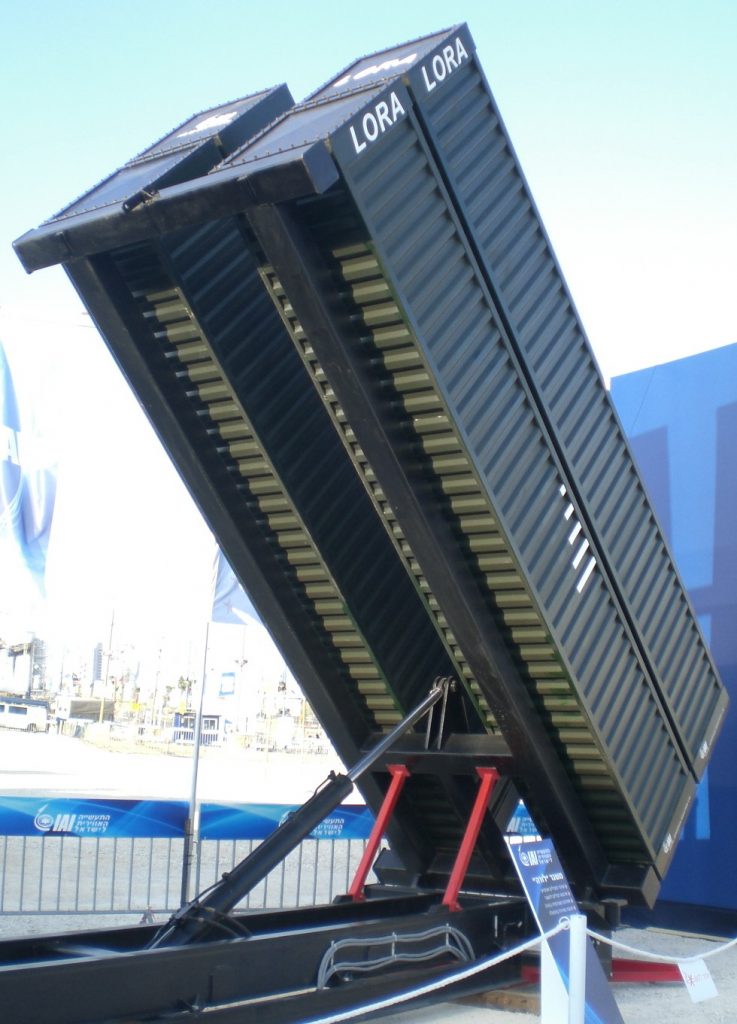
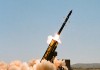
    Israel Aerospace Industries (IAI) has successfully completed a firing trial with the Long-Range Artillery weapon system (LORA), marking as part of the demonstration and validation phases of the system, under a number of procurement programs involve the system. On this experiment, the missile was launched from a cargo ship toward a target at sea.

    LORA is an artillery weapon system which consists of a long-range, tactical ground-to-ground missile developed by IAI’s MALAM division. It is intended for strike scenarios with a range of up to 400 km and boasts a precision range better than 10 meters.

    The version tested was an operational, ground launched version, tested on a vessel to enable the Israeli company to demonstrate the weapon’s full range, in compliance with safety requirements for trials of this kind. The system on board consists of a command trailer and ground launcher. Following the launch, the missile has navigated its course to the designated location, striking the target with high precision. Both the weapon system and the missile have successfully met all objectives.
    “This was one of the most complexed trials we held over the past few years” Boaz Levi, Executive Vice President and General Manager of Systems, Missiles and Space Group commented. The trial was held according to a full operational outline, including an assessment of the system’s manoeuvring, terminal attack and precision. According to Levi, the impressive results attest for the system’s maturity and advanced capabilities.”

    Leonardo Adds an M346 Variant Dedicated to Air and Ground Attack

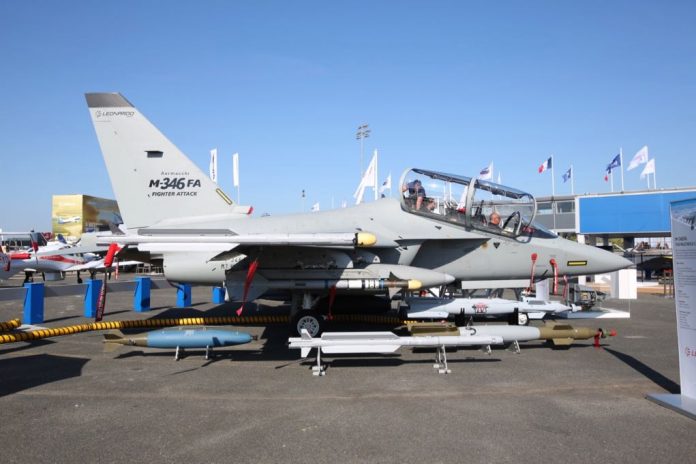
    Leonardo M-346FA is the new variant the company unveiled at the Paris Air Show at Le Bourget. According to Leonardo, several air forces have already expressed their interest in the new variant. Photo: Leonardo

    The Italian-based international defense company Leonardo is introducing a new, Fighter Attack (FA) variant of their M-346 trainer, dedicated to combat missions. The new variant will be shown this week at the Paris Air Show at Le Bourget. According to the manufacturer, the new fighter-attack version is an evolution of a family concept of the M-346 Master, designed to create a common baseline, able to adapt and meet different requirements of air forces. Several air forces have already expressed their interest in the new variant, Leonardo said.

    The new M-346FA version comes in addition to the Advanced Jet Trainer, already operational with several air forces, and the multi-role M-346FT that can assume advanced training role with operational training units (OTU).

    The M-346 Fighter Attack differs from the baseline M-346 in its avionic configuration. The aircraft will retain all seven pylons for external loads, which will include a wider ordnance and pod capabilities including air-to-surface, air-to-air and tactical reconnaissance systems. The aircraft will be equipped with a dedicated variant of the Grifo-346 multi-mode fire control radar, designed and manufactured by Leonardo. The Grifo is a mechanical scan, multi-mode radar that supports multiple operating modes for air-to-air and air-to-surface.

    The antenna will be optimized for the aircraft and incorporate the radar emitters and IFF dipoles. The Grifo-346 will be able to track up to 10 targets simultaneously in Track-While-Scan (TWS) mode, will have a maximum range beyond 50 NM (92 km) in the Look-Up mode and a sub-metric resolution in the Synthetic Aperture Radar (SAR) mode. The radar will feature seven Air-to-Air modes, six Air Combat modes, thirteen Air-to-Ground modes (including, for example, SAR, Inverse SAR, Ground Moving Target Indicator on SAR, Sea Moving Target Track) and three Navigation modes.

    The company has already carried out the studies on the FA’s radar installation and its mechanical integration with the aircraft. The Rafael RecceLite reconnaissance pod is already integrated on the M-346.

    Subscribe to read the full article

    Maiden Flight for Gripen E

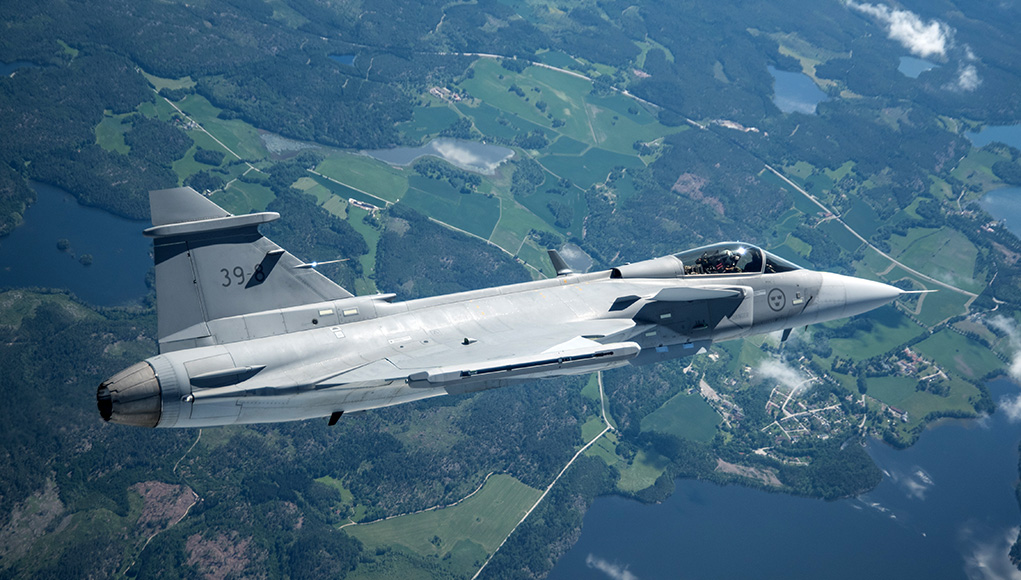
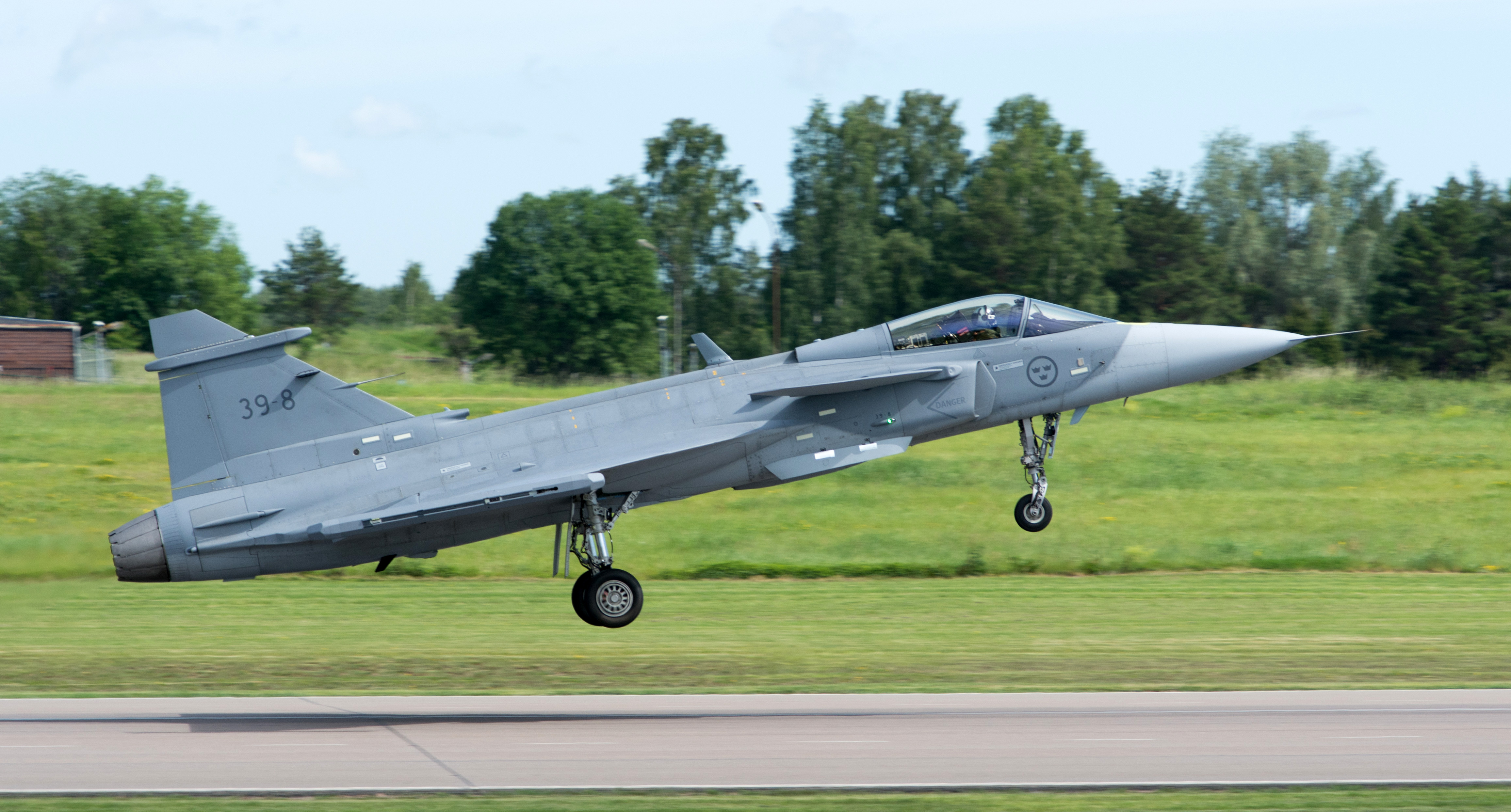
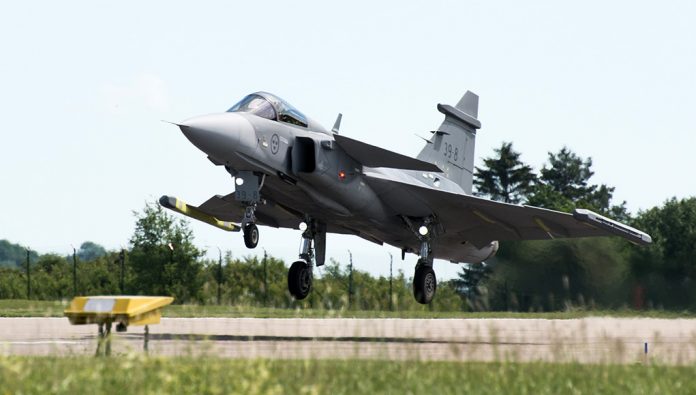
    Gripen E takes off on its maiden flight, from Saab’s airfield in Linköping, Sweden. Photo: SAAB
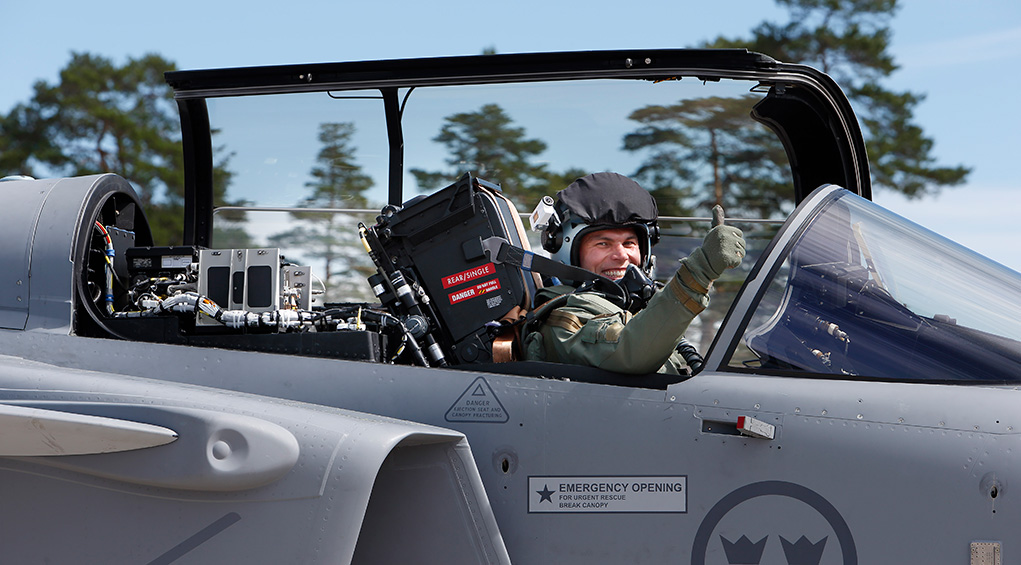
    Marcus Wandt, Experimental Test Pilot, Saab was flying the Gripen E on its first flight. Photo: SAAB

    Defense and security company Saab today completed a successful first flight of the next-generation smart fighter, Gripen E. The flight launched from Saab’s airfield in Linköping, Sweden and lasted 40 minutes, flown by Marcus Wandt, the company’s experimental test pilot. During the flight, the aircraft carried out a number of actions to demonstrate various test criteria including the retracting and extending of the landing gear.

    Gripen E flew for 40 minutes, up to an altitude of 13,000 ft. AFter a short testing of landing procedures the pilot retracted the landing gear for the remaining duration of the flight. Photo: SAAB

    According to Jonas Hjelm, Senior Vice President and Head of Saab Business Area Aeronautics, the aircraft that flew today is equipped with the fully qualified software for the advanced avionics developed for Gripen E. “This is about giving our customers a smart fighter system with the future designed in from the start.” Hjelm said, “The flight test activities will continue to build on this achievement with the program on track to achieve the 2019 delivery schedule to our Swedish and Brazilian customers,” Hjelm added. On its maiden flight, Wandt took the Gripen E to an altitude of 13,000 ft. but the new fighter will be able to reach a ceiling limit of 52,000 ft.

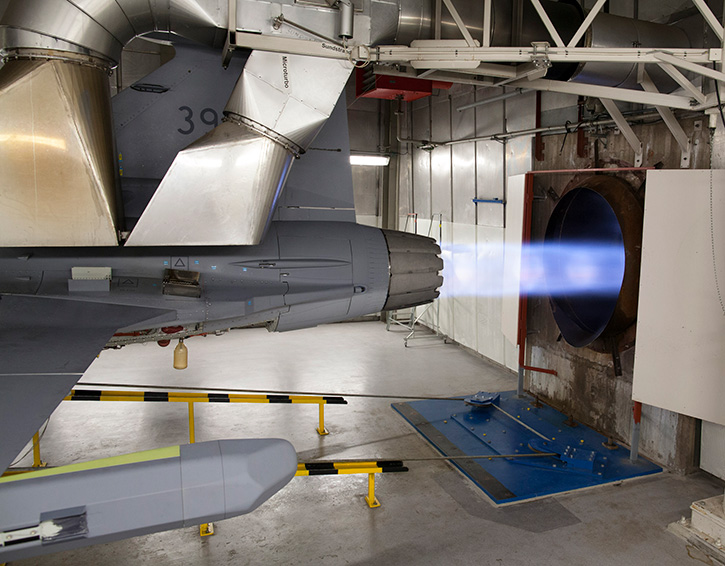
    The new aircraft uses the General Electric GE 414G turbofan engine rated at 22,000 lb (98 kN). With this powerful engine, Gripen E can fly up to a speed of Mach 2 or 1,400 km/h at sea level, its main advantage is the ability to cruise at supersonic speed without afterburner, thus saving fuel and achieving longer mission endurance.

    The General Electric GE-414G turbofan engine undergoing static tests.Developing up to 22,000 pounds of thrust, this engine takes the Gripen E to supersonic without the use of afterburner. Photo: SAAB

    Higher thrust is translated to better performance – at an empty weight of 8,000 kg, Gripen E is rated for maximum takeoff weight of 16.5 tons can carry over five tons of ordnance carried on 10 hardpoints, plus 3,400 kg of fuel on a mission. Defined by Saab as the ‘smart fighter’, Gripen E uses newly designed avionics and software package designed for quick modification and upgrading. These include a new and agile Active Electronically Scanned Array (AESA) radar and infraRed Search Track, and advanced Electronic Warfare (EW) capabilities.

    Brazil and Sweden placed orders for 36 and 60-70 of these advanced jets, Brazil will receive newly built aircraft beginning in 2019 and Sweden will modernize 60 Gripen C models. Saab expects other opportunities in India, Finland, Belgium which already announced their plans to buy modern fighter jets. Saab has not given up hope on Switzerland, that has canceled plans to buy 22 Gripen Es in the past.

    The Gripen E prototype (39-8) touches down at Linköping on the end of the 40 minute flight. Photo: SAAB

    Israel’s All Seeing SkEye – Persistent Surveillance Countering Terror

    Combining several high-resolution sensors operating in parallel, SkEye provides continuous and simultaneous monitoring and recording of a wide area. With the entire area ‘captured’, several users at different control centers can independently look into several regions of interest, either in real time or ‘back in time’, via recorded imagery. Such performance prevent any event from going unnoticed. Photo: Elbit Systems

    Elbit Systems unveiled today an advanced capability that has been operational for several years with the military forces of several nations, in homeland security and the war on terror.

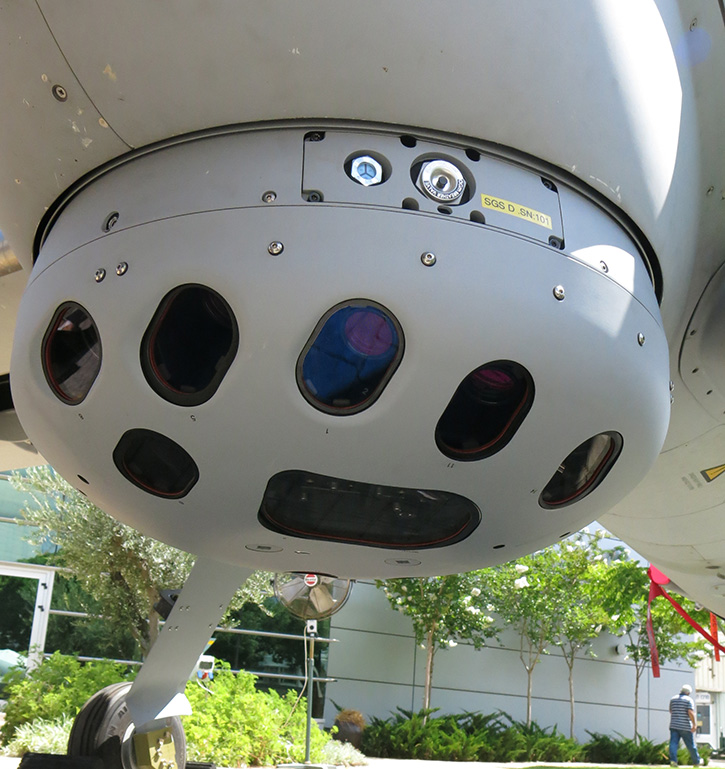
    The system known as SkEye performs Wide Area Persistent Surveillance (WAPS) video surveillance by airborne manned and unmanned platforms. SkEye is a unique, new system that enables security or military forces to constantly and closely monitor an area of interest up to 80 square kilometers large. (the actual size of the area is determined by the sensor’s height). The system uses a single payload integrating multiple cameras that together provides an image of one billion pixels in size.

    SkEye provides real-time, high-resolution monitoring of the entire area, providing up to ten simultaneous areas of interest in real time. In addition, it also provides operators and analysts ‘backtracking’ capability tracing events back in time to detect the origins of related movements and events.
    Unlike conventional EO payloads that record and display imagery in specific resolution and magnification as it was obtained at the time of vision (real time) SkEye enables users to simultaneously look at up to 10 Regions of Interest (ROI), using different viewing angles and magnifications (zoom in or out). At any time they can ‘look back in time’ to analyze how a situation unfolds.

    SkEye uses a single payload integrating multiple cameras that together provides an image of one billion pixels in size. Photo: Tamir Eshel, Defense-Update

    “SkEye is not positioned to replace traditional payloads, but provide a new capability we know as WAPS – it provides a clearer picture in less time, thus exponentially increasing trust in the decision-making process” explain Yair Ganor, business development manager, for persistent surveillance and WAPS at Elbit Systems’ Intelligence & C4ISR division. “While looking over a large Area-of-Interest (AOI), operators can zoom into multiple Regions of Interest (ROI) simultaneously and understand the connection between them. This is achieved without neglecting the rest of the area, which is still being recorded and constantly analyzed.”

    At the heart of the system is the airborne segment consisting of the EO sensor unit, an advanced image processing unit, a large mass-storage unit and analysis applications enhancing the imagery with geolocation anchoring of video imagery, video motion detection (VMD), adhering to safe zones and application of multiple target trackers.

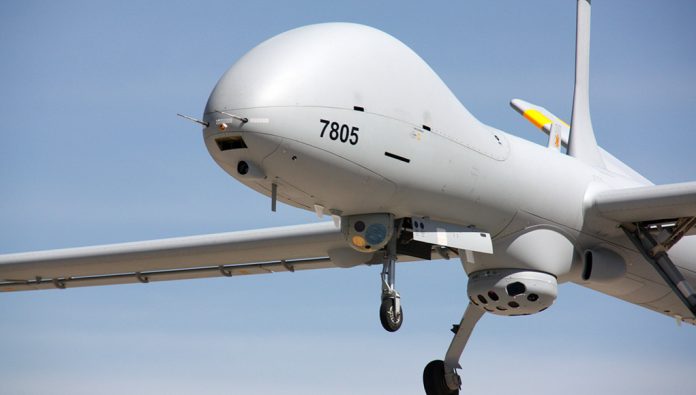
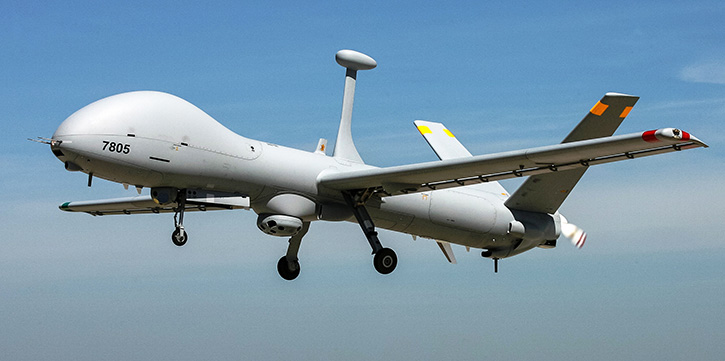
    Elbit Systems’ Hermes 900 carries the SkEye payload on a test flight. The system can also be operated on light manned aircraft and tactical UAVs such as the Hermes 450. Photo: Elbit Systems.

    Via an embedded data link, the relevant information is transmitted from the aircraft to the SkEye, Control, and Management Center (SCMC) that can be located at a fixed site, or transported in a standard 20 foot ISO shelter. The ground segment includes the communications, processing and display systems, as well as a local database saving a short version of history. The fixed installation would have access to longer history for deeper analysis. The ground segment can operate independently or integrate with the customer’s other Command & Control (C2) solutions. The system can also operate with the Ground Eye surveillance system, that provides ground-level surveillance with multi-sensor units covering arcs of 70 to 90 degrees providing similar capabilities – a high resolution ‘all seeing eye’ supporting eight areas of interest and video backtracking capability through the entire area.

    SkEye WAPS features a fully-programmable alerting system that allows commanders to be notified of specific/unusual events through a customized alert mechanism. These capabilities complement and enhance SkEye WAPS’ unparalleled persistent surveillance functions, providing operators with an exceptional solution for locating and monitoring different situations.

    The solution is operational in several countries, utilizing unmanned platforms such as the Hermes 900 and Hermes 450, as well as various light manned aircraft including Cessna C208 Caravan and Viking Air Twin Otter DHC-6. The aircraft installations are often used over urban areas where access to unmanned systems is limited. Such platforms are more suitable for border and infrastructure security, as well as military persistent surveillance in combat theaters where permissive environment enable continuous loitering of drones.

    Elbit Systems will reveal at the 2017 Paris Air Show in Le Bourget, taking place this week, an innovative wide area persistent surveillance solution – SkEye WAPS.

    GroundEye persistent surveillance system can cover an arc of 70 degrees, providing continuous coverage of a wide area of interest. It can be operated by a single user. Photo: Elbit Systems

    Fake or true? Intriguing Intercept Video

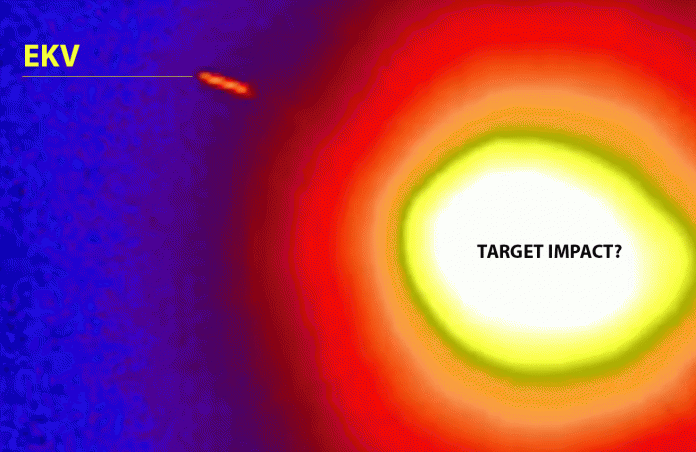
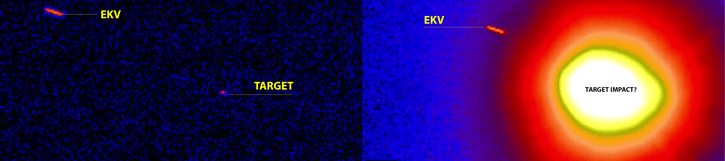
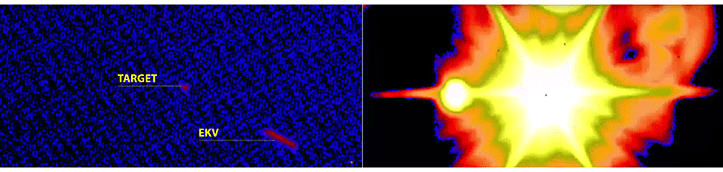
    Carefully inspecting the video that provided evidence of the successful intercept, one cannot ignore the anomaly visible on 00:59, showing an object closing in rapidly from the left and surviving the explosion.

    Travelling at a speed of 10 km/sec (22,500 mph) the Exoatmospheric Kill Vehicle seeks out its target using multi-color sensors, a cutting-edge onboard computer and a rocket motor that helps it steer in space. 

    It hones in on the target and, with pinpoint precision, destroys it using nothing more than the force of a massive collision. No traditional warhead is necessary.

    On 00:59 the target blasts in a glowing fireball, with an object, likely the Exoatmospheric Kill Vehicle (EKV) interceptor that would have caused the explosion on impact – seemingly continue flying into the fireball. Photo: MDA Video
    The second shot from a different angle (01:04) does not show this anomaly. Photo: MDA Video


    Even if we misinterpreted the objects, and the EKV is the small, cooler dot on the right, there is no reason for it to explode before impact, since the kill mechanism is kinetic, not explosive. 

    Defense-Update consulted missile experts about this anomaly. We were assured that these anomalies do happen in tests, particularly at extremely high speed and long ranges. 

    “Although it seems intriguing, visual tracking of such high-speed events, particularly in thermal vision, is challenging, particularly in the high resolution and high speeds required for exoatmospheric intercept of such fast targets. The high energy released on impact would also saturate the sensors and could cause the ‘smear’ in the infrared. It is likely that Boeing and MDA do not rely their assessment on visual evidence, but on other data, including telemetry from the interceptor and target, that would cease at the same time, to indicate an impact.”

    U.S. Air Force Awards Lockheed Martin $413 Million for JASSM-ER Production

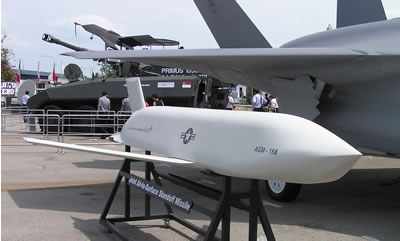
    Lockheed Martin received a $413.8 million contract from the U.S. Air Force for Lot 15 production of the Joint Air-to-Surface Standoff Missile (JASSM)-Extended Range (ER) version. The production lot that includes 360 JASSM-ER missiles, brings the total JASSM-ER missiles under contract to 910, and to more than 3,000 missiles for JASSM and JASSM-ER combined. 2,150 JASSMs have been delivered to date from Lockheed Martin’s automated manufacturing facility in Troy, Alabama.

    Effective against high-value, well-fortified, fixed and relocatable targets, JASSM is integrated on the U.S. Air Force’s B-1B, B-2, B-52, F-16 and F-15E. The B-1B also carries JASSM-ER. Internationally, JASSM is carried on the F/A-18A/B and the F-18C/D aircraft.

    These 2,000-pound cruise missiles employ an infrared seeker and enhanced digital anti-jam GPS receiver to dial into specific points on targets. Armed with a penetrating blast-fragmentation warhead, both missiles can be used in all weather conditions. Both types share the same powerful capabilities and stealthy characteristics, though JASSM-ER has more than two-and-a-half times the range of JASSM for greater standoff range.

    Australian Forces Select Aerovironment’s Wasp-AE Mini-UAVs

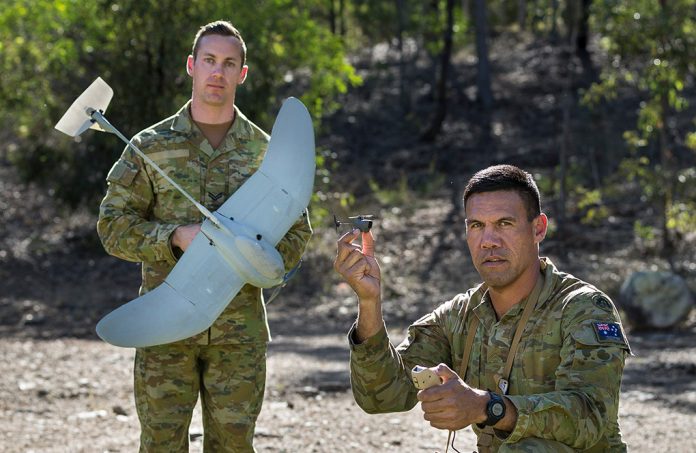
    Australian Army soldiers Corporal Doug Coombs (left) and Corporal Matthew Molloy (left) from 2nd/14th Light Horse Regiment (Queensland Mounted Infantry) with a Wasp AE and a PD-100 Black Hornet unmanned aircraft vehicle at Gallipoli Barracks, Brisbane, on 5 October 2016. Photo: Sgt. Janine Fabre, Australian Defence

    The Australian defense department selected AeroVironment’s Wasp AE small unmanned aircraft system for use by the Australian Defence Force (ADF). The Australian order will deliver mini-drones within a period of three-year period, and support the systems for ten years. The contract is worth A$101 million(USD 74.6 million), of which the about half (US$36.5 million) will be the original manufacturer’s share.

    This is the largest Australian order for Wasp-AE to date. In 2014 XTEK placed an initial order worth A$7.7 for Wasp AE for the evaluation and training of Australian forces. The current order will support full-scale fielding of the systems.

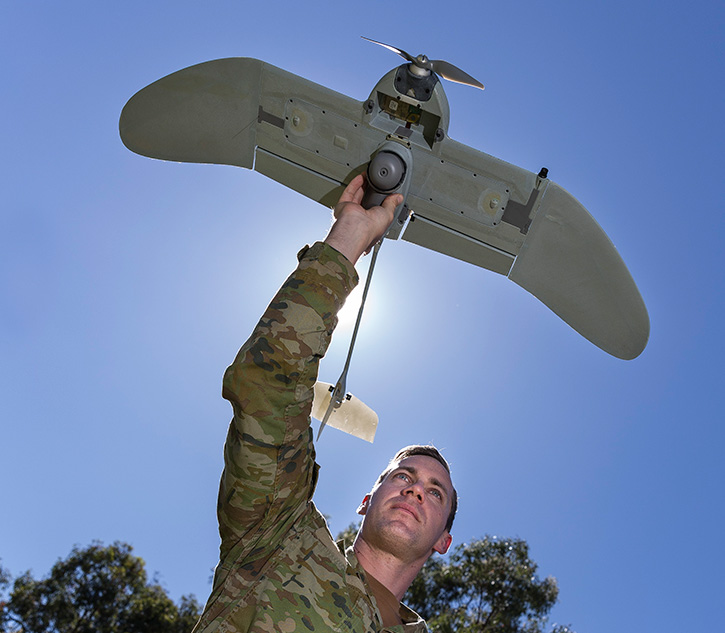
    The Wasp AE weighs 2.8 pounds, operates for up to 50 minutes at a range of up to five kilometers and delivers live, streaming color and infrared video from its pan-tilt-zoom Mantis i22 AE gimbaled payload. Launched by hand and capable of landing on the ground or in fresh or salt water, the Wasp AE provides portability and flexibility for infantry, littoral or maritime reconnaissance operations.

    AeroVironment is working closely with Australian partners XTEK, GD Mediaware and Sentient Vision to modify and introduce the WASP AE solution for Australian requirement. XTEK and AeroVironment will provide local maintenance, training, and field support to serve the immediate needs of ADF while expanding AeroVironment’s global support capabilities.

    The Wasp AE weighs 2.8 pounds, operates for up to 50 minutes at a range of up to five kilometers and delivers live, streaming color and infrared video from its pan-tilt-zoom Mantis i22 AE gimbaled payload. Launched by hand and capable of landing on the ground or in fresh or salt water, the Wasp AE provides portability and flexibility for infantry, littoral or maritime reconnaissance operations. Photo: Sgt. Janine Fabre, Australian Defence

    U.S. Navy Accepts Its Newest Aircraft Carrier

    An image of Pre Commissioning Unit (PCU) CVN-78 Gerald Ford leaving Newport News shipyard in April, for the first series of shipbuilders' sea trials. Photo: US Navy

    The U.S. Navy accepted delivery of first aircraft carrier of the new Ford class – the future USS Gerald R. Ford (CVN 78), at a ceremony at Newport News, Virginia, May 31, 2017.

    Ford is the lead ship of its class and the first new-design aircraft carrier delivered to the Navy since USS Nimitz (CVN 68) in 1975. It is also the first aircraft carrier to join the fleet since USS George H. W. Bush (CVN 77) delivered in 2009.

    Compared to the current Nimitz class carrier the next generation of Ford-class has a larger flight deck, and hangar capacity to host more aircraft, additional weapons and aviation fuel storage. Another innovation is the Electromagnetic Aircraft Launch System (EMALS) and Advanced Arresting Gear, replacing the steam catapults used on current carriers. EMALS will be able to increase sortie rates by one-third, when compared to the Nimitz class and enable deployment of lighter aircraft and unmanned aerial systems (UAS) which cannot withstand steam catapults’ loads.

    Further, the Navy’s newest aircraft carrier generates three times the amount of electricity as previous classes and is designed to rapidly add capabilities as new systems become available over the course of its projected 50-year service life.

    Ford will be commissioned into the fleet this summer, formally placing the ship into active service. Following this, there will be a “shakedown” period where the ship will conduct several at-sea events to provide longer underway periods for the ship’s crew to operate and train on ship’s systems. In addition, planned deferred work will be performed, and any deficiencies identified during trials will be addressed during in-port periods.

    Ford is expected to be operational in 2020 following achievement of initial operational capability.

    Skunk Works and XTEND Simplify Multi-Drone Command

    0
    Lockheed Martin Skunk Works® and XTEND have achieved a major milestone in JADC2 by integrating the XOS operating system with the MDCX™ autonomy platform. This technical breakthrough enables a single operator to simultaneously command multiple drone classes, eliminating the friction of mission handoffs. From "marsupial" drone deployments to operating in GPS-denied environments, explore how this collaboration is abbreviating the data-to-decision timeline and redefining autonomous mission execution.

    From Ukraine to Taiwan: The Global Race to Dominate the New Defense Tech Frontier

    0
    As traditional defense primes face mounting competition from agile “neoprimes” such as Anduril, Palantir and Helsing, the balance of innovation is shifting toward software-defined warfare and scalable, dual-use technologies, while global industry consolidation—marked by Boeing’s integration of Spirit AeroSystems and other strategic mergers—signals an intensified race to secure control over the defense technology value chain. Our Defense-Tech weekly report highlights these trends.

    Europe’s “Drone Wall”

    0
    In early October 2025, a coordinated wave of unmanned aerial system (UAS) incursions—widely attributed to Russia—targeted critical infrastructure across at least ten European nations. The unprecedented campaign exposed the fragility of Europe’s air defenses...

    Weekly Defense Update & Global Security Assessment

    0
    Executive Summary The past week (September 18-25, 2025) represents an inflection point where strategic defense concepts have transitioned from doctrine to tangible reality. An analysis of global events reveals four primary, interconnected trends shaping an...

    U.S. Air and Space Forces Push Next-Gen Programs at the AS&C 2025 Conference and...

    0
    At the 2025 Air, Space & Cyber Conference, U.S. Air Force and Space Force leaders unveiled major updates on next-generation fighters, bombers, unmanned systems, and space initiatives, highlighting both rapid innovation and critical readiness challenges as the services race to outpace global competitors. A short version is available here, with a more detailed version for subscribers.

    TADTE 2025: Reflecting Taiwan’s Strategic Themes

    0
    The Taipei Aerospace & Defense Technology Exhibition (TADTE) 2025 crystallized around four dominant strategic themes that collectively illustrate Taiwan's comprehensive approach to defense modernization amid escalating regional tensions. Based on a detailed report by Pleronix (available upon request). Includes a Podcast discussion on TADTE 2025's highlighting Taiwan's four strategic themes beyond the post's coverage.

    Iron Beam 450 Completes Testing, Soon to Join With Operational Air Defense Units

    0
    Israel’s Iron Beam 450 high-power laser system has completed final testing, marking a major leap in air defense. Developed by Rafael, it offers precise, cost-effective interception of rockets, UAVs, and mortars, and is set for IDF deployment by 2025.