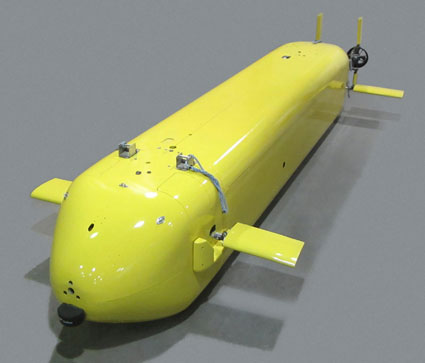
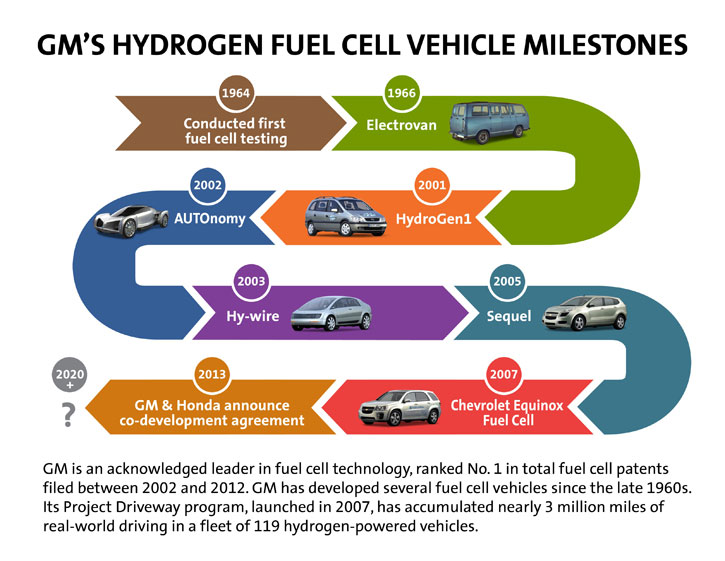
General Motors, the Office of Naval Research and the U.S. Naval Research Laboratory announced Thursday, June 23, 2016, they are cooperating to incorporate automotive hydrogen fuel cell systems into a next-generation of Navy unmanned undersea vehicles, or UUVs. Hydrogen fuel cells convert high-energy hydrogen efficiently into electricity, resulting in vehicles with greater range and endurance than those powered with batteries. (Photo: US Navy, ONR)
The US Navy is using General Motor’s (GM) hydrogen fuel cell technology to power its latest underwater vessel. Hydrogen fuel cells convert high-energy hydrogen efficiently into electricity, resulting in vehicles with greater range and endurance than those powered with batteries. Under the ONR’s Innovative Naval Prototype program for Large Displacement UUVs (LDUUV), energy is a core technology in the Navy’s goals for vehicles with more than 60 days endurance. Besides the GM fuel cell, the Navy has evaluated alternative power generation solutions from General Atomics, Lynntech and NexTech Materials.
The Naval Research Laboratory recently concluded an evaluation of a prototype UUV equipped with a GM fuel cell at the heart of the vehicle powertrain. The tests, a key step in the development of an at-sea prototype, were conducted in pools at the Naval Surface Warfare Center in Carderock, Md. The Navy plans to test the LDUUV in the open sea this year and could field a first squadron of the robotic submarines by 2020.
“Our in-water experiments with an integrated prototype show that fuel cells can be game changers for autonomous underwater systems,” said Frank Herr, ONR’s department head for Ocean Battlespace Sensing. “Reliability, high energy, and cost-effectiveness — all brought to us via GM’s partnering — are particularly important as Navy looks to use UUVs as force multipliers.”
Hydrogen fuel cell propulsion technology helps address two major automotive environmental challenges: petroleum use and carbon dioxide emissions. Fuel cell vehicles can operate on renewable hydrogen from sources like wind and biomass stored for later use. Once converted to electricity, water vapor is the only emission. Recharging takes only minutes.
GM’s fuel cells are compact and lightweight and have high reliability and performance. Lower cost is achievable through volume production supporting automotive applications. These attributes match the goals of the Navy to develop reliable, affordable systems.
“The collaboration with the Navy leveraged what we learned in amassing more than 3 million miles of real-world experience with our Project Driveway fuel cell program,” said Charlie Freese, executive director of GM Global Fuel Cell Activities. “Our customers will benefit from additional lessons we learn about the performance of fuel cells in non-automotive applications that will be useful in GM’s drive to offer fuel cells across consumer markets.”
India’s Ministry of Defence (MoD) issued a letter of request (LoR) to the United States on 17 June to procure 22 multi-mission General Atomics Guardian unmanned aerial vehicles (UAVs) for the Indian Navy. The Guardian is a maritime variant of the Predator B. India is requesting the sale of these drones via the Foreign Military Sales (FMS) route.
The move follows India’s application to join the 35-nation Missile Technology Control Regime (MTCR). The Guardian will offer the Indian Navy an extended range capability, with platform carrying heavier payloads, (alas, on shorter missions, compared to the Heron currently used by the Indian Navy). India is also seeking to but the Israel Aerospace Industries Heron-TP, whose export was limited by MTCR ruling. Earlier this month India also expressed interest in acquiring the General Atomics Avenger C turbofan propelled semi-stealthy drone for its air force.
On June 27, 2016 India gained admission to the MTCR, a group that is aimed at preventing the unchecked proliferation of missiles and their delivery systems. The MTCR restricts the proliferation of missiles, rocket systems, unmanned air vehicles, or drones, and technology for systems capable of carrying a 500-kilogram (1,100-pound) payload for at least 300 kilometers (185 miles), as well as systems intended for the delivery of weapons of mass destruction.
Designed for reconnaissance and strike missions the Avenger can carry payloads weighing 2.9 tons in internal and external loads. While the Avenger’s endurance Is shorter than that of the Guardian, it has a higher cruising speed thus capable of covering a larger mission area.
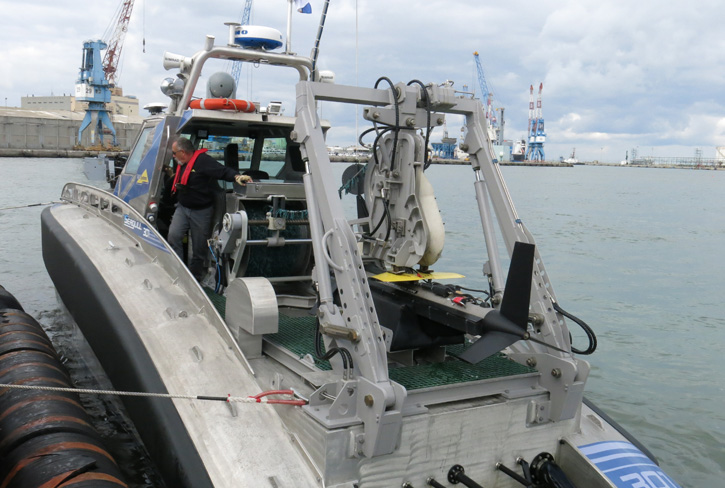
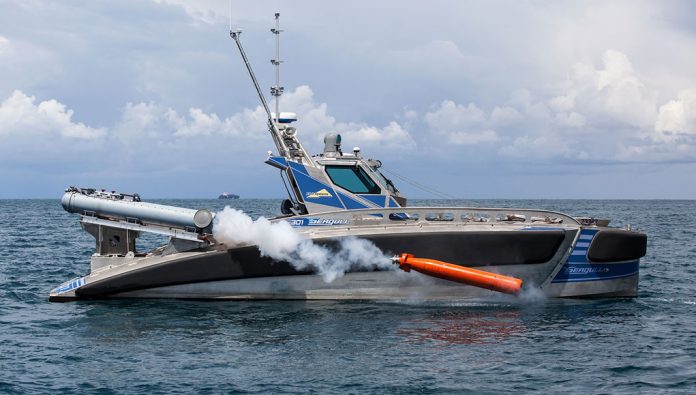
A lightweight torpedo is launched from Elbit Systems' Seagull USV. The success of the first torpedo launch is a major milestone, confirming the USV’s capability to incorporate anti-submarine weapons, in addition to its unique submarine and mine detection capabilities. Photo: Elbit Systems
Elbit Systems completed recently a trial test torpedo launch from its Seagull multi-mission, autonomous Unmanned Surface Vessel (USV) system. Performed out of Israel’s Haifa port, the trial demonstrated the capability of Seagull to install and launch lightweight torpedoes, adding to the platform’s sensory capabilities. The Seagull is designed to carry out unmanned maritime missions, such as anti-submarine warfare (ASW) counter-mine operation, protecting high-value assets inshore and offshore. Lightweight torpedoes are often used by anti-submarine vessels, helicopters, and aircraft against submarines located in shallow waters. This is the first instance where such weapons are used from unmanned platforms.
“The success of this test demonstrates Seagull’s modular mission system capability, enabling a highly effective ASW configuration of high-performance dipping sonar using two single tube torpedoes,” said Ofer Ben-Dov, Vice President Naval Systems Business Line at Elbit Systems’ ISTAR Division. The test highlighted Seagull’s capacity to detect and engage submarines, in addition to its ability to detect and destroy sea mines – all using the same multi-mission USV system in modular configurations. “This new and important capability has, to date, only been available to navies through manned vehicles.” Ben-Dov added.
Introduced earlier this year, Seagull is a 12-meter long multi-mission USV system equipped with one or two vessels that can be operated and controlled in concert from manned ships or from shore. Seagull provides multi-mission capabilities and can be employed for ASW, MCM, EW, maritime security and other related missions, leveraging modular mission system installation and offering a high level of autonomy. In its basic configuration, the Seagull was armed with remotely operated weapon station mounting a 0.5” machine gun.
In its full configuration, the advanced USV system delivers unmanned end-to-end mine hunting operation capability, taking the man out of the minefield. It features inherent C4I capabilities for enhanced Situation Awareness (SA) and has a large fuel capacity that allows it to remain at sea for several days. Seagulls are designed to operate in pairs, with one carrying the sonars that detect and locate the targets and the other operating devices such as counter-mine robots, depth charges and ASW torpedoes to neutralize the threats.
Seagull uses a specially designed mount optimized for remotely controlled operation. Photo: Tamir Eshel, Defense-Update
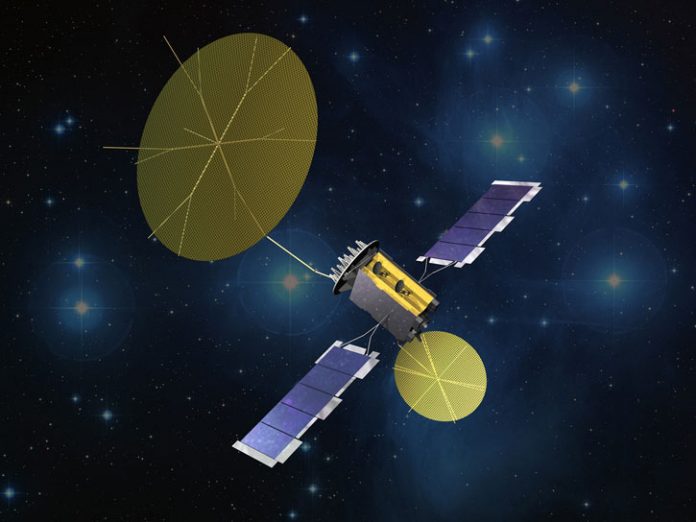
The 7.5 ton MOUS satellite is based on Lockheed Martin's A2100 satellite bus powered by with two five-panel solar array wings. Its dual payload comprises the WDCMA and legacy channels, using 14 and 5 meter diameter reflecting mesh antennae. Image: Lockheed Martin
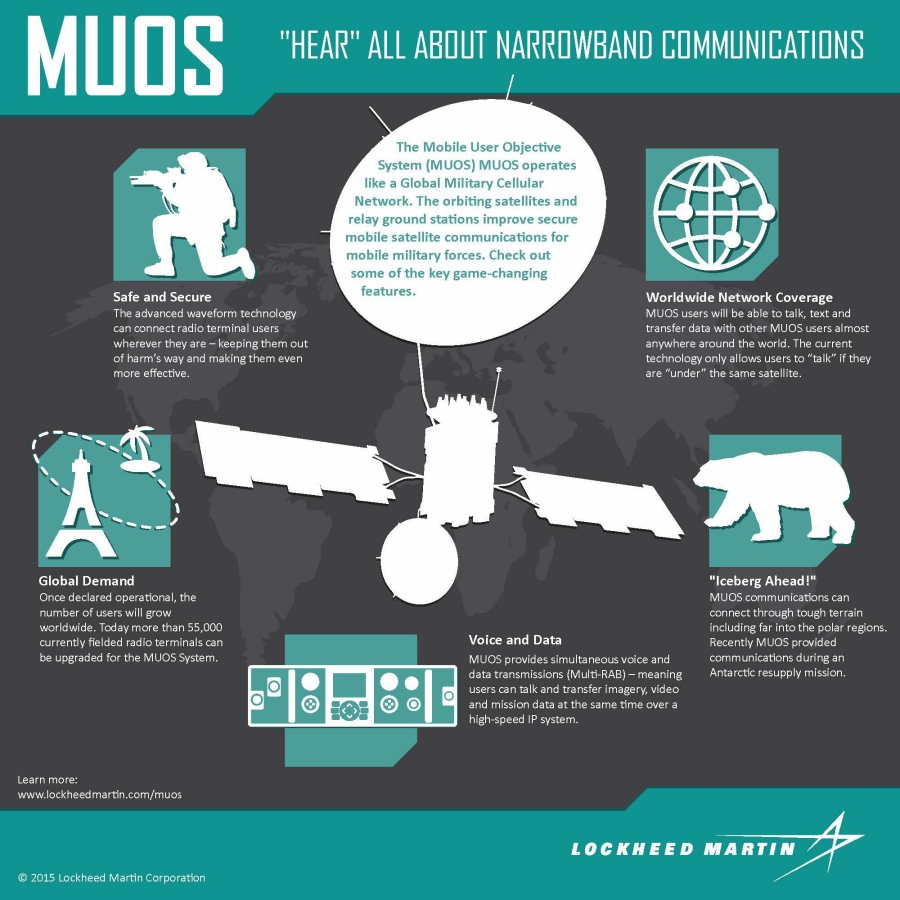
The US Navy’s fifth and last Mobile User Objective System (MUOS) satellite was launched June 24, 2016, aboard a United Launch Alliance Atlas 5 rocket. MUOS is an Internet Protocol (IP)-based system designed to provide improved communications capabilities to users around the world, regardless of where they are in relation to a satellite, and will provide greater than ten times the bandwidth capacity compared with the current ultra-high frequency (UHF) constellation. With near global coverage, the MOUS network will support remote computer access, e-mail, short digital messaging, file and image transfer, and provide an interface for remote reception of sensor data.
Subscribe to get the full version.MUOS offers 16 times the number of access points over the legacy system ensuring availability for prioritized calls while more users are on the system. once fully operational, the demand for MUOS is expected to grow rapidly. While more MUOS-compatible terminals are in development, over 55,000 currently fielded radio terminals can be upgraded to be MUOS-compatible, with many of them requiring just a software upgrade.
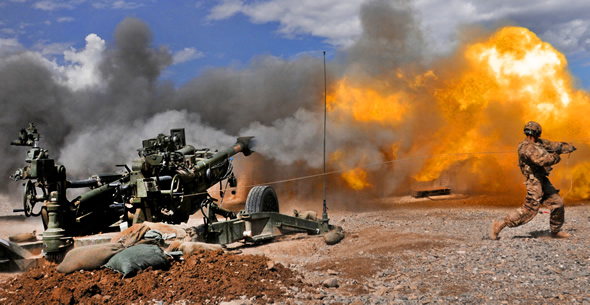
An M-777 155mm howitzer fires at a low ballistic trajectory in Afghanistan. Photo: U.S. Army
India’s Defense Acquisition Council (DAC) approved the acquisition 145 M777 ultra light weight howitzers from the United States. 25 of the howitzers will be delivered from the US and 120 delivered from an Indian assembly and integration facility created in India by Mahindra. The contract is expected to be worth about $750. DAC also approved serial production of the indigenous 155mm Dhanush self-propelled howitzers, comprising the Bofors FH77 howitzer mounted on a self-propelled platform. The procurement marks the first time the Indian Army is buying new artillery systems in three decades, following the Bofors acquisition scandal in 1987.
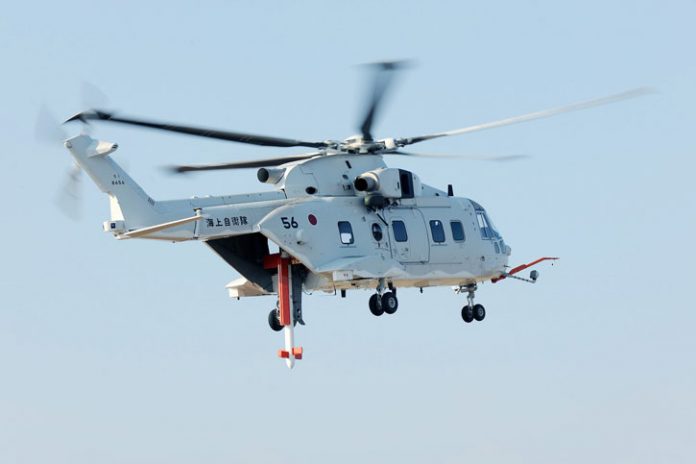
Leonardo Helicopters AW101 is operated by Japan's Self Defense Air Force in minesweeping/anti-submarine warfare roles.
Leonardo Helicopters is in talks with the Japan Maritime Self-Defense Force for a follow-on order of 12 AW101 helicopters. Tokyo already operates seven of an eventual 11-strong fleet of the heavy helicopters configured for minesweeping missions, designated as the MCH-101, plus two of an eventual three CH-101 utility transports.
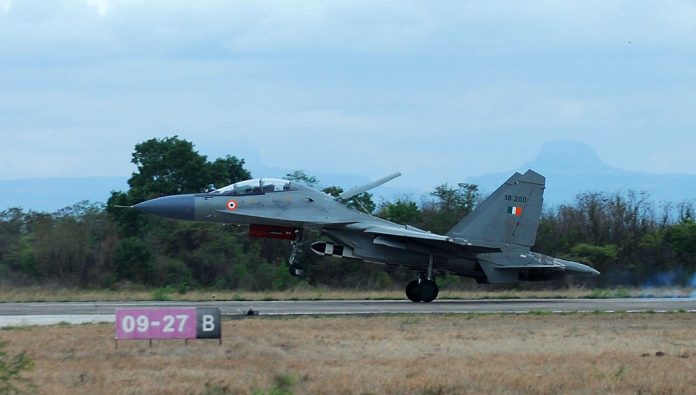
Su-30 MKI lands after first carraige test of the BrahMos A missile, June 25, 2016. Photo via Anantha Krishnan, Twitter
India tested today an air-launched version of the BrahMos-A supersonic attack missile on an Indian Air Force (IAF) Sukhoi Su-30 MKI aircraft. The missile was not launched on this test, as the carriage flight was designed to test the weapon’s aircraft integration.
Following the initial flight tests on board the Su-30 MKI aircraft the first air-launch of the BrahMos-A missile is expected later this year. If successful, this planned flight test will verify the developer’s simulations, assuring the safe separation and initiation of the missile. “A single test-fire from the aircraft will be enough. BrahMos has demonstrated its capability multiple times and once it is test-fired from the IAF jet once, it will be ready for integration on all other Su-30s immediately.” BrahMos Aerospace CEO & MD Sudhir Kumar Mishra said.
Once operational, the air-launched BrahMos will provide the IAF with extended range, supersonic, standoff attack capability, that penetrates deep inside defended enemy territory. BrahMos Aerospace plans to deliver 200 missiles to the IAF beginning in 2017, where it is expected to arm at least three squadrons.
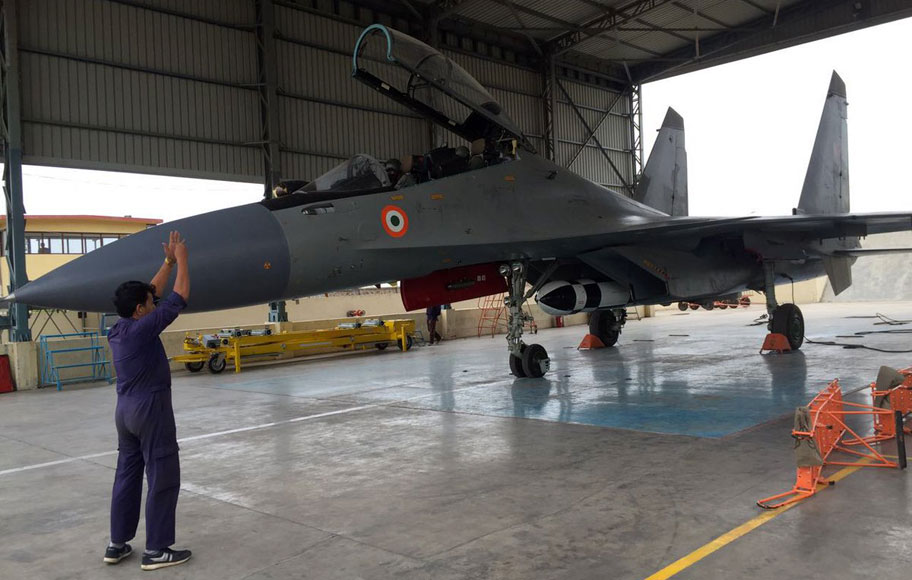
BrahMos integrated on an Indian Air Force Sukhoi Su-30MKI fighter jet prepared for the first test flight, June 25, 2016.
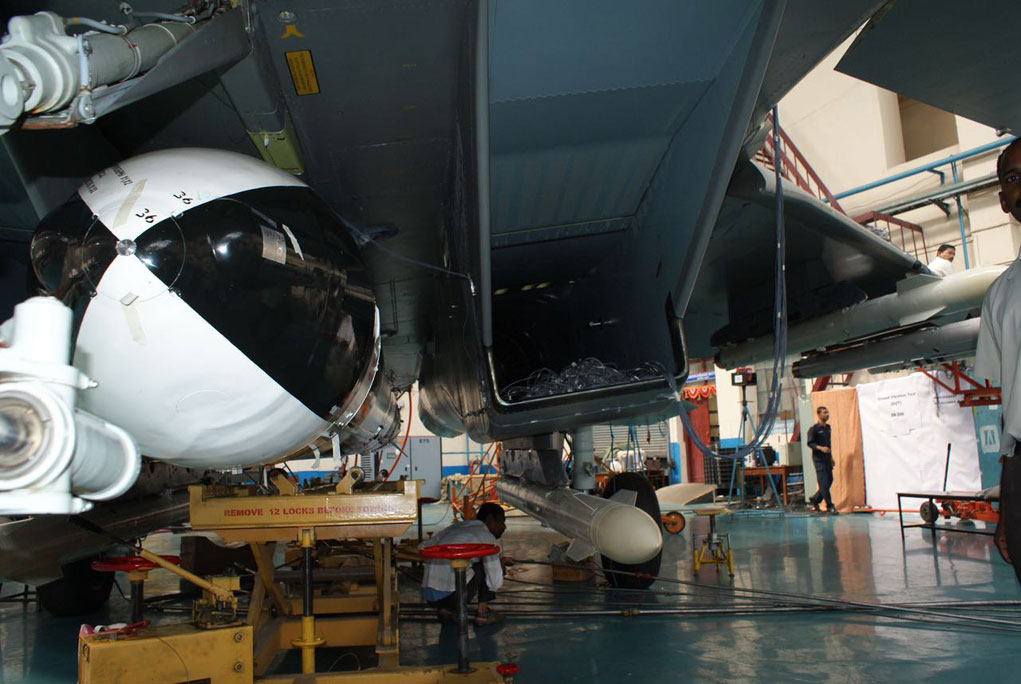
With a maximum speed of Mach 2 and a gross takeoff weight of 38.8 tons (85,600 lbs), Su-30 MKI carried the 2.55 tons air-launched BrahMos-A missile on its centerline hardpoint. The Su-30 MKI carries the missile on a special pylon, tucked between the engine bays, attached to the centerline hard points, under the fuselage.
Adapting the surface-launched missile to air-launched mode required significant modifications, particularly with the flight laws and dynamics related to the weapon’s release and ignition phases. Weight saving required the use of a smaller booster; fins were added to improve stability after launch and umbilical connectors relocated to fit the pylon design. The air-launched BrahMos can be released from heights up to 46,000 ft (14,000 meters) and as low as 1646 ft (500 m’). After ejection, the missile descends in a free fall of 100–150 meters, its booster ignited after ensuring safe separation. Once the booster kicks in, the missile accelerates to supersonic speed and climbs to a cruising altitude of 46,000 ft. Near the target area, which can be up to 290 km away from the launch point, the BrahMos-A descends to a low altitude of 50 ft above the surface on the terminal phase of its flight.
he Su-30 MKI carries a single BrahMos missile on a special pylon, tucked between the engine bays, attached to the centerline hard points, under the fuselage.
The recent test flight and forthcoming missions are operated from HAL’s Nasik unit where the two aircraft destined for the program were modified by HAL to accommodate the outsized air-launched missile. Two variants of the missile are developed – an anti-ship missile and land attack version. A smaller variant of the missile will eventually enable the missile to deploy on other aircraft types, such as the IAF/Dassault Mirage 2000. Originally, the Indian Air Force and Navy wanted to deploy the BrahMos on Il-38 and Tu-142 maritime warfare aircraft, but these platforms were found unsuitable for the weapon.
The 58-minute flight was piloted by Wg Cdr Prashant Nair with Wg Cdr Raju being the Flight Test Engineer. The first flight examined the missile’s adaptation to the aircraft. In the next flights the missile will be fitted with sensors to evaluate its characteristics in flight. forthcoming tests will bmove to the Balasore test range will test dummy missile’s clearing release and separation tests, toward the final launch and engagement test of a real target, planned for October-November 2016.
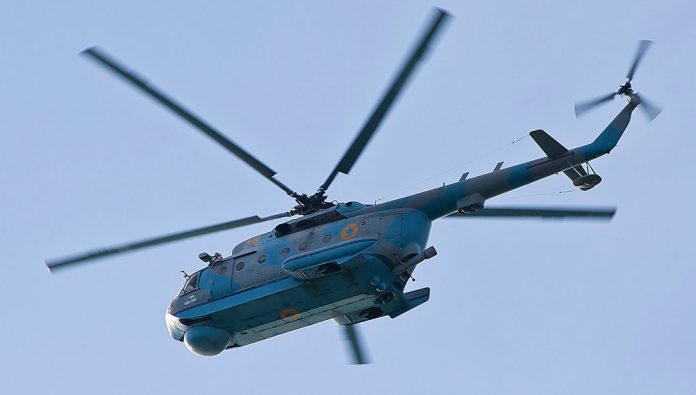
The Russian Navy is activating the Mi-14 in the submarine hunting mission after the helicopter was decommissioned from this role in 1996. Back then the helicopter was tasked with depth charges and massive nuclear weapons used in anti-submarine warfare. On its new mission, the helicopter will receive lighter, conventional armed Zalon-2 guided anti-submarine weapons.
The Russian Navy is activating the Mi-14 in the submarine hunting mission after the helicopter was decommissioned from this role in 1996. Back then the helicopter was tasked with depth charges and massive nuclear weapons used in anti-submarine warfare. On its new mission, the helicopter will receive lighter, conventional armed Zalon-2 guided anti-submarine weapons.
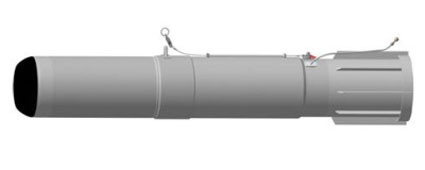
Zagon-2 (Corral) anti-submarine weapon.
This weapon is designed to engage submarines on the sea surface, under water at periscope level and at depth. Developed by the Scientific Research Institute of Engineering (Techmash) the 120 kg Zagon-2 was originally intended for use with ship-based Ka-28 helicopters. It can also be dropped from Il-38 and Tu-42M anti-submarine planes. Its use is now extended to the larger, shore based Mi-14. When dropped on underwater targets the 150 cm long bomb descends on a parachute, which is released at the moment the bomb splashes down. The bomb then sinks down, steered on its descent towards the target using active sonar for target location and a motion control system for guidance. The weapon can detect enemy submarines from a distance of 450 meters, at cruising depths of up to 600 meters.
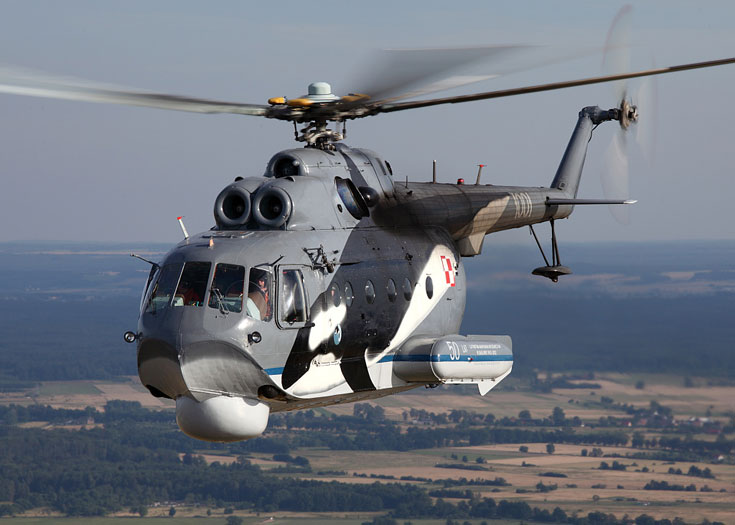
The Mi-14 (Nato Code Name ‘HAZE’) features a watertight weapons bay allowing internal carriage of a single torpedo or eight depth charges and search radar fitted under its nose. Dubbed as “a killer of submarines” the Mil Mi-14 is a shore-based amphibious helicopter armed with a torpedo, twelve 64kg or eight 120kg depth bombs. Unique to helicopters of this class, the Mi-14 can also carry a nuclear weapon – one kiloton nuclear anti-submarine bomb weighing 1,600kg, capable of scuttling any underwater target within a radius of 800 meters. The Zalon-2 will compensate this capability with a conventional, more accurate and effective sonar-homing weapon.
The Mi-14 gained its nickname of “a killer of submarines” in the late 1980s when it found and sank a NATO sub which had strayed into Soviet territorial waters. Under intense pressure from the United States, all of Russia’s Mi-14 helicopters were decommissioned in 1996. With the Russian Navy undergoing massive re-equipment, the Defense Ministry plans to renew the production of Mi-14 nuclear-capable amphibious anti-submarine helicopters in Kazan.
Russian Helicopters is scheduled to resume the production of navalized Mi-14 helicopters, in anticipation for growing demand from the Russian Navy and export customers. This helicopter is in service with the Polish navy.
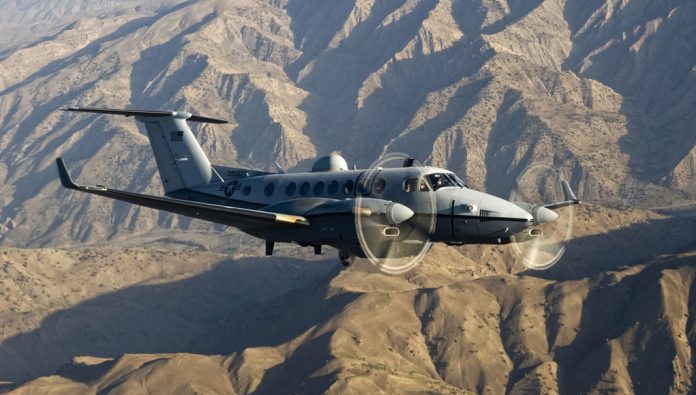
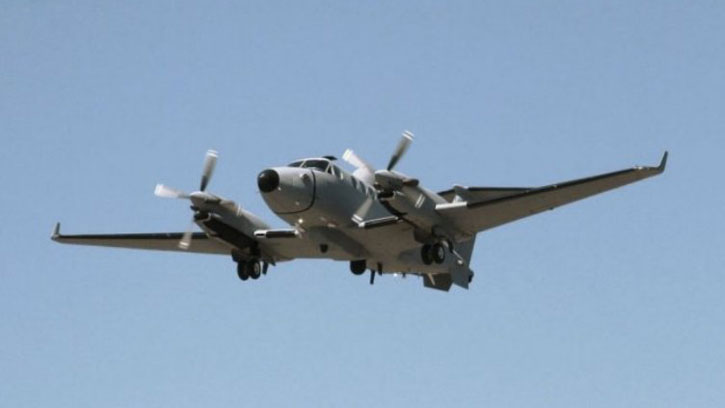
The King Air 350 was first deployed with the US Air Force Project Liberty, as MC-12W.
L-3 Mission Integration has conducted the maiden flights of the first Beechcraft King Air 350ER aircraft to be converted into a special mission platform under the US Army’s Enhanced Medium Altitude Reconnaissance and Surveillance System – Multi-Int (EMARSS) program.
The Army contracted L-3 in March 2015 to convert one MC-12W Project Liberty aircraft into the EMARSS-M configuration. This configuration includes the integration of electro-optic/infra-red (EO/IR) sensor, communications intelligence (COMINT) collection system, an aerial precision geolocation system, line-of-site tactical and beyond line-of-site (SATCOM) communications suites, two Distributed Common Ground System-Army (DCGS-A) workstations and a self-protection suite.
Under the wider contract L-3 is already contracted to modify three additional platforms and could re-process or modify up to 36 aircraft.
The new EMARSS-M seen on its maiden flight, June 2016. Photo: L-3
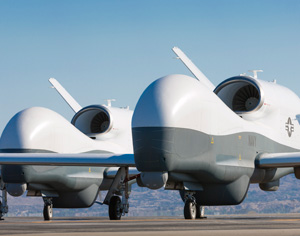
The first MQ-4C Triton maritime surveillance drones were recently delivered to the US Navy. Photo: Northrop Grumman
Extending the use of its intelligence, surveillance, and reconnaissance (ISR) the US military is evaluating new capabilities of its Global Hawk platforms, including the US Navy’s MQ-4C Triton and Air Forces’ Block 30 MQ-4. The Triton recently demonstrated its ability to share the video with the navy’s P-8A Poseidon, as both platforms were airborne and far away from each other. The Air Forces’ Block 30 Global Hawk was also updated, to carry new mission payloads.
The exchange of live video between an MQ-4C Triton Remotely Piloted Aircraft System and P-8A Poseidon maritime warfare aircraft was demonstrated in flight on June 2, 2016. An MQ-4C Triton and P-8A Poseidon successfully exchanged full motion video for the first time in flight, via a Common Data Link (CDL), marking another interoperability step for the program. The test demonstrated Triton’s ability to track a target with its electro-optical/infrared camera to build situational awareness for a distant P-8 aircrew.
“In an operational environment, this would enable the P-8 aircrew to become familiar with a contact of interest and surrounding vessels well in advance of the aircraft’s arrival in station,” said Cmdr. Daniel Papp, Triton integrated program team lead. The MQ-4C Triton’s ability to perform persistent intelligence, surveillance, and reconnaissance within a range of 2,000 nautical miles will allow the P-8A aircraft to focus on their core missions.
Last week also marked the completion of Triton’s first heavyweight flight that will expand Triton’s estimated time on station significantly. Triton operated in the 20,000 foot altitude band in the heavyweight configuration for the first time and completed all test objectives. A second heavyweight flight on June 14 had Triton operating in the 30,000 foot altitude band. “The heavyweight envelope expansion work will enable Triton to realize its long dwell capability and become the unblinking eye for the fleet,” Papp added.
Triton is designed to fly missions of up to 24 hours at altitudes over 10 miles high, allowing the system to monitor two million square miles of ocean and littoral areas at a time. Since its first flight in 2013, Triton has flown more than 455 flight hours. The Navy will continue testing Triton at Patuxent River to prepare for its first planned deployment in 2018.
Another enhancement designed for the US Air Force Block 30 RQ-4 Global Hawk enables the platform to carry new mission payloads that were not originally designed for the Global Hawk.
“The IPA allows the RQ-4 to adapt and go beyond its current sensor capabilities. An example is the recent successful flight, for the first time, of an Air Force legacy system, the Senior Year Electro-Optical Reconnaissance System-2 (SYERS-2) intelligence gathering sensor, on the Global Hawk,” said Col. Darien Hammett, the Global Hawk program director.
With the success of the SYERS-2 flight, there are now plans to demonstrate the optical bar camera sensor, and fully integrate the next generation UTC Aerospace Systems MS-177 on the Global Hawk.
“The IPA allows vendors to use some or all of the 17 physical attachment points on the IPA, know how much power is available, and make crucial data exchanges with the aircraft. Everything needed to design, build and mount a sensor on a Global Hawk,” Hammett said. “Opening up the architecture of the air system will provide added sensor technology opportunities through increased competition, which is our goal.”
“This flexibility permits us to communicate to potential future interested vendors how to physically and electronically connect sensor platforms to the Global Hawk — allowing adaptability in payloads, increased range and the achievement of the highest National Imagery Interpretability Rating Scale available. With the development of the IPA, our Block 30 airframes will gain further capability in supporting future and current information gathering sensor systems availability.”
The current Global Hawk Block 30 aircraft is capable of carrying systems such as the Enhanced Integrated Sensor Suite, Airborne Signals Intelligence Payload. These electro-optical, infrared, radars, and signals intelligence sensors enable remotely piloted aircraft to detect movements, assist with humanitarian operations, and find the enemy.
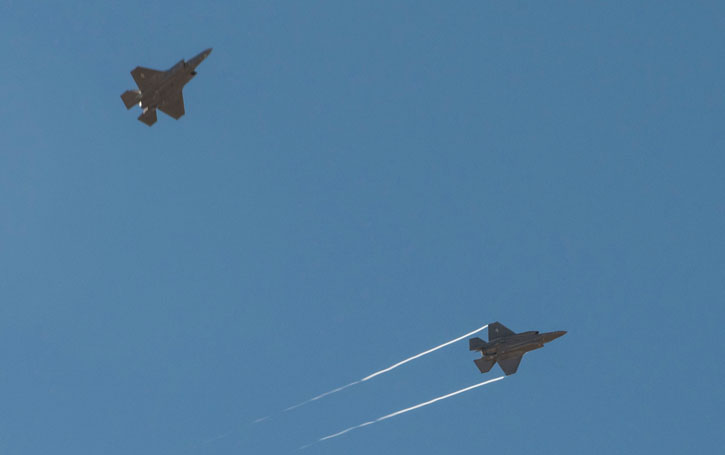
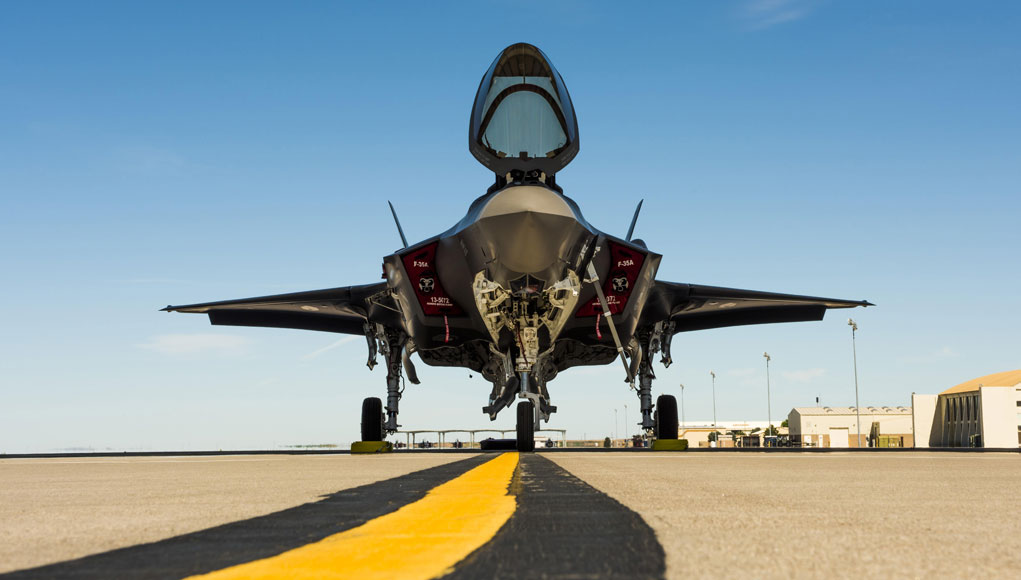
Two F-35A jet fighters return to Mountain Home AFB, Idaho after a training flight simulating a combat mission from austere base. Photo: U.S. Air Force by Airman Alaysia Berry
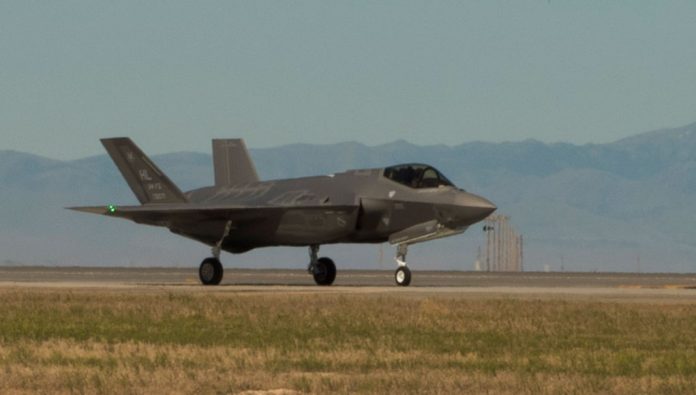
Almost a year after the US Marine Corps declared its F-35B fighter jets operational, the US Air Force Air Combat Command is on track to declare its F-35As’ Initially Operationally Capable’ (IOC). Such a decision could be announced as early as August or as late as December this year. This will be the first step the US Air Combat Command will take in bringing the F-35 online, as the latest fifth-generation multirole fighter. Under this status, the F-35A will be able to penetrate areas with developed air defenses, provide close air support to ground troops and be readily deployable to conflict theaters.
The requirements for IOC were established in 2013, and include a group of 12-24 aircraft with trained and equipped Airman to be ready to conduct basic close air support, interdiction and limited Suppression/Destruction of Enemy Air Defense (SEAD/DEAD) in a contested environment and operating from a deployed location. Preparing for this goal, the US Air Combat Command is likely to meet the minimum of 12 aircraft, Col. David Chace is the F-35 systems management office chief and lead for F-35 operational requirements at Air Combat Command said. “There are currently 12 aircraft available at Hill Air Force Base, Utah. Some of those are going through the last few modifications required to support IOC. We will have additional aircraft in the modification process beginning in August.” Chase said, adding that, depending on the actual IOC date, modifications may be complete on the additional F-35s. “There are no known technical issues today that would prevent us from reaching IOC in our August-December timeframe.” Col. Chace said
Simulating the operation of Lightning II from forward air bases. The deployment was supported by 188 operations and maintenance personnel. The deployment that spanned over 11 days beginning June 6, proved that the aircraft could successfully operate away from its home base against a variety of threats.
“The F-35 recently deployed from Hill to Mountain Home where crews, maintenance, and support personnel conducted a number of missions.” Chase said, “During that deployment, crews attained a 100 percent sortie generation rate with 88 of 88 planned sorties and a 94 percent hit rate with 15 of 16 bombs on target. These numbers provide a positive indication of where we are when it comes to stability and component performance.” Through these flights the F-35s were challenged by F-15E aggressors, but the F-35s managed to complete all their missions with zero losses. The missions included Offensive Counter-Air (OCA), Air Interdiction (AI), Suppression of Enemy Air Defense (SEAD), Defensive Counter-Air (DCA) and Close Air Support (CAS).
Col. Chace confirmed that the weapon range to be cleared for post-IOC phase will be limited to a small part of the ordinance planned for the future use. “At the time we declare IOC we will focus on three mission sets that will concentrate on the number and type of weapons the aircraft can carry. Those weapons include two GBU-31s and two GBU-12s, or two AMRAAMs.” Additional weaponry will be cleared for operational use in the future. Chase added that “We’re looking at delivering the first increment of modernization to the F-35 in late 2020 or early 2021.”
During these missions, the aircraft operated with the most recent 3i software version completed for the IOC. The positive experience with the recent version represented a significant improvement from previous months when pilots reported they had to reboot their systems after system ‘freeze.’
The IOC decision is based on the assessment of many inputs received from units assigned to operational testing and evaluation at Mountain Home Air Force Base, Idaho and Nellis Air Force Base, Nevada and Edwards Air Force Base, California. “We’re looking for the ability to deliver combat power and the instruments that go into supporting that, such as aircraft stability and the capability to generate sorties,” Chase said, adding that testers are also providing feedback on the functionality of the F-35’s Autonomic Logistics Interface System (ALIS) to support the high sortie generation required for operational use.
Feedback from the events at Mountain Home will feed into the overall evaluation of F-35 capabilities. The second evaluation will take place in the operational test environment with F-35 mission sets the Air Force intends to execute after IOC. All reports will be delivered in July and feed into the overall F-35 capabilities report.
An F-35A lands on the runway at Mountain Home Air Force Base, Idaho, June 3, 2016. The mock deployment to Idaho marks the first out-of-state training mission for Hill Air Force Base’s operational 5th generation aircraft. (U.S. Air Force Photo by Airman Alaysia Berry
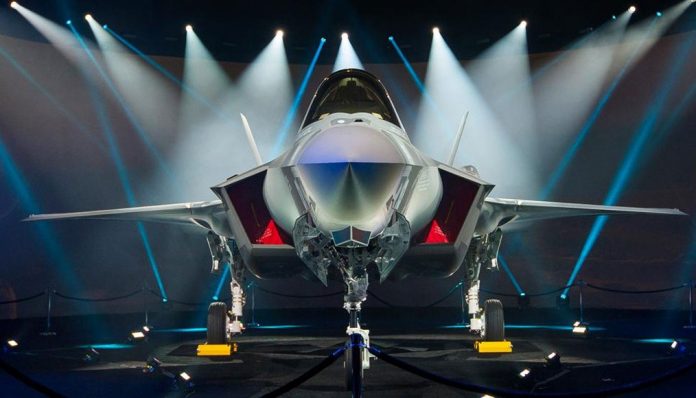
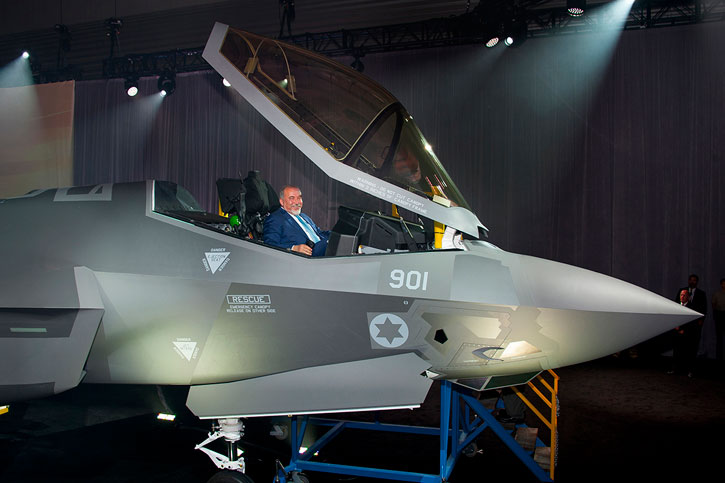
Israel's first F-35, tail number 901 seen on the official rollout ceremony at Ft. Worth, June 22, 2016. Photo: Lockheed Martin
Israel officially received today the first of 33 F-35A ‘ADIR’ joint strike fighters ordered for the Israel Air & Space Force (IAF). The new aircraft will be one of two F-35A fighters expected to arrive in Israel before year’s end. The advanced capabilities maintained by the new fighter jet will provide means Israel will be able to continue maintaining air dominance in the region, despite the growing threat of advanced air defenses.
Of the original nine partner countries – Australia, Canada, Denmark, Italy, the Netherlands, Norway, Turkey, the United Kingdom and the United States – six have received their first jets and had pilots and maintainers in training. Israel, one of three Foreign Military Sales (FMS) customers, received its first F-35A today. Japan, the second FMS customer, is also expected to take delivery of its first jets this year.
Suppliers in all nine of the program’s partner countries are producing F-35 components for all aircraft, not just those for their country. And in addition to the Fort Worth plant, there are two Final Assembly and Check Out (FACO) facilities outside the United States: one in Cameri, Italy, where the first jet was delivered in December 2015; another facility in Nagoya, Japan, will produce the first jets for Japan. Israeli suppliers are responsible for parts of the helmet display system and also produce the outer wings for Lockheed Martin.
Israel became the first country to select the F-35 through the United States government’s Foreign Military Sales process on Oct. 7, 2010. The Israeli Air Force gave the F-35 the Hebrew name Adir which, according to the Times of Israel, denotes awesomeness in modern Hebrew.
Israel’s first F-35A Adir (AS-1) tail number 901 seen on the official rollout ceremony at Ft. Worth, June 22, 2016. Photo: Lockheed Martin, by Beth Steel.
The aircraft rolled out today is the first of 33 F-35A fighters ordered by Israel at an average cost of US$110 million per plane. The first two will arrive in Israel in December 2016. Aside from the two that will arrive in Israel in December, six ADIRs are expected to arrive there through 2017. The Nevatim Airbase in the Negev Desert will serve as the home for the first Adir squadron. with additional six each in 2018, 2019, 2020 and 2021. Israel also received a generous industrial cooperation package worth $5.4 billion, of which Israeli industries have already received $775 million orders. The Israel Air Force is already asking for additional 17, bringing the total number ordered to 50. If this request will be approved by the Israeli government and US administration, deliveries could commence in the years 2022-2024.
The Israel Air Force is already asking for additional 17, bringing the total number ordered to 50. The Israel defense Forces’ (IDF) Chief of the General Staff, Lt. Gen. Gadi Eizenkot approved the IAF’s recommendation to raise the number of Israeli F-35 jets to 50. If this request will be approved by the Israeli government and US administration, (as part of the increase in US military aid to Israel, planned for 2019-2029), deliveries could commence in the years 2022-2024.
The Head of the IAF Chief of Air Staff, Brig. Gen. Tal Kelman, sees the first 50 jets as an intermediate phase. “We want to reach 75 jets”, Kelman said, “The Israeli F-35 is the first 5th generation fighter to arrive in the Middle East, and it will allow us to open a significant gap in our abilities when facing all of the elements in the area”. According to Kelman, the IAF is also examining the F-35B model equipped with the capacity to take off from very short runways and land vertically. “We want the first 50 jets to be A models, but beyond this, we are examining the options. The F-35B may be limited relatively to the A model regarding a number of munitions it can carry, but has other advantages that may aid us in different scenarios”.
Unique adaptations have been made to facilitate the integration of Adir with the IAF operational fleet. One of the most critical elements was the introduction of command, control and communications applications necessary to operate the new fighter within the IAF indigenous Command and Control environment. The development of this application has been completed at IAI’s labs and is now in production for the aircraft destined for Israel.
As first batch of 19 aircraft Israel is expected to receive will be the standard model operated by the US Air Force and other partner nations, it is expected to carry a limited weapon’s load comprising of two Boeing GBU-31s (JDAM) and two Lockheed Martin GBU-12s (Paveway laser guided bombs) or two Raytheon AMRAAM beyond visual range (BVR) air/air missiles. All will be carried internally.
Further adaptations expected to mature for the second batch will include the integration of certain ordnance types operated by the IAF, such as the Rafael Spice 1000 guided weapons. The more complex task is the integration of weapons carried in the internal weapon bay, thus maintaining full stealth capability of the aircraft. Other types can be taken as external stores, must also go through the lengthy integration process.
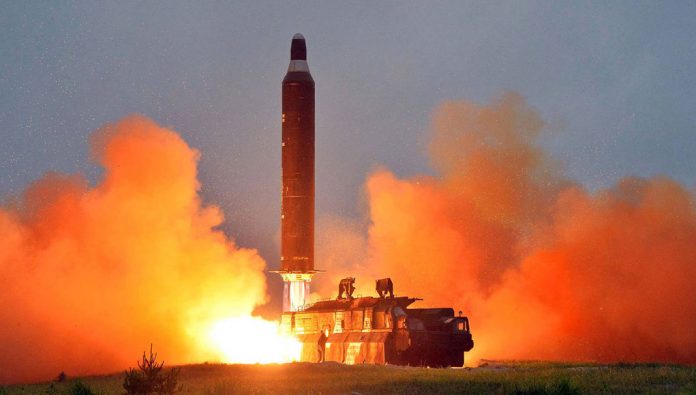
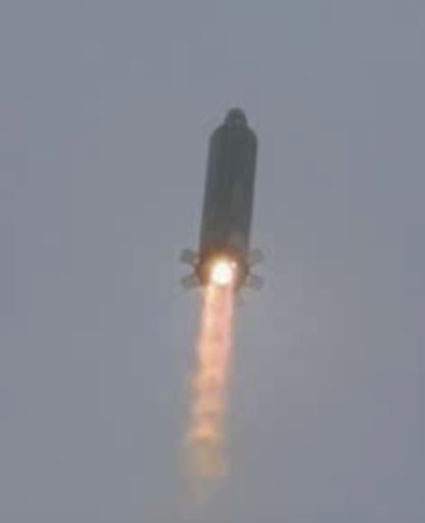
An official image released by the North Korean news agency shows the Hwasong-10 (Musudan) missile launched from a mobile launcher.
North Korea launched two Musudan intermediate-range ballistic missiles from its east coast early Wednesday morning, the South Korean Joint Chiefs of Staff (JCS) said. Both launches were successful. The first test terminated after a short flight but in the second attempt, the missile ascended in a steep trajectory that managed to reach apogee at an altitude of 1,000 km and impacted at sea, about 400 km from its launch point. Both flights represent a significant improvement over previous attempts, where the missile failed seconds after liftoff.
“The North launched one missile presumed to be Musudan from areas near Wonsan at around 5:58 a.m., but it is assumed to be unsuccessful,” the JCS said in a brief release. The missile was launched successfully, but disintegrated mid-air after a flight of about 150 km (95 miles). A follow-on launch of another missile took place about two hours later; on this test, the missile succeeded to ascend to an altitude of 1,000 km (620 miles) Japanese Defence Minister Gen Nakatani said, indicating North Korea had made progress. That missile plunged into the Sea of Japan, about 400 km (250 miles) from its launch point. “We don’t know whether it counts as a success, but North Korea has shown some capability with IRBMs (intermediate range ballistic missiles),” Nakatani told reporters in Tokyo.
The Musudan is shown as it ascends from the mobile launcher. Following previous failures, the North Korean scientists added a set of eight grid fins around the base, which weren’t present in previous satellite or parade photos or in the old Soviet R-27 missile on which the Musudan is based, adding extra aerodynamic control during the initial phase of the flight.Leader Kim Jun Il points to the test area used for the recent test. The launch profile is indicated on the left side of the screen, showing an exceptionally steep trajectory.
According to western analysts, the flight parameters of the recent test indicate that the flight profile used for the second flight was intentionally short and steep, thus challenging the missile to consume the entire propellant in its fuel tank within the international water surrounding the Korean peninsula. Using such trajectory the Koreans could test the missile and its propulsion system to its limit, including reentry and high-speed endo-atmospheric flight, within the relatively short distance.
״North Korea’s latest Musudan (Hwasong-10) missile test finally demonstrated the full performance of the missile’s propulsion system, and at least a minimally functional guidance system. The trajectory was not representative of an operational launch, and so leaves open questions about the performance of the reentry vehicle. Perhaps more importantly, two launches only a few hours apart and with one missile breaking up in flight, gives the North Koreans little chance of understanding what went wrong. The Musudan is not a reliable weapon, and Pyongyang does not seem to be trying to make it a reliable weapon. But even if this is just a propaganda stunt and the Musudan is to be quietly abandoned, this partial success increases the likelihood that North Korea’s KN-08 and KN-14 road-mobile inter-continental ballistic missiles (ICBMs) will reach operational status early in the next decade.״ John Schilling at the 38north.org website stated.
The Musudan has an estimated range of anywhere between 2,500 and 4,000 kilometres (1,550 to 2,500 miles). On its latest test flight the missile was launched at an estimated angle of 78-80 degrees, compared to 45 degrees which would yield the maximum range. The lower range covers the whole of South Korea and Japan, while the upper range would include US military bases on Guam.
So far, North Korea has attempted to test-fire the Musudan missile four times – first on April 15, two more on April 28 and the latest on May 31 this year – but all ended in failure, with the missile exploding in midair shortly after launch or on a mobile launcher or crashing seconds after launch.
The U.N. Security Council condemned the launches as violations of Council resolutions.
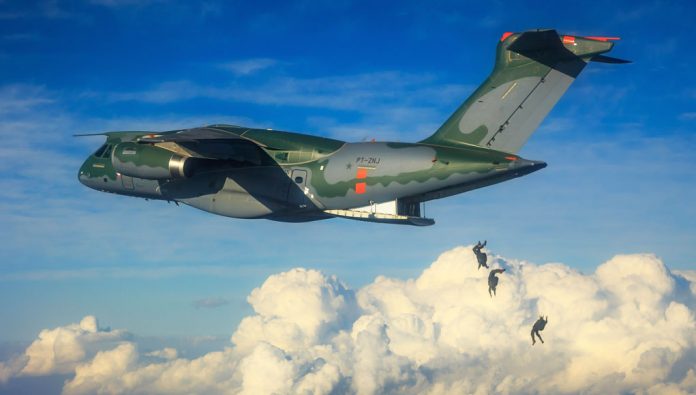
The program completed a major phase recently, dropping 18 parachutists in free fall from the aircraft from 12,000 ft. The parachutists initially used both the rear ramp and side doors to exit the fuselage. Photo: Força Aérea Brasileira
The Brazilian Air Force and KC-390 designer Embraer continue to test the new Brazilian tactical transport plane. The program completed a major phase recently, dropping 18 parachutists in free fall from the aircraft from 12,000 ft. The parachutists initially used both the rear ramp and side doors to exit the fuselage. The Brazilian air force has begun operational testing of the Embraer KC-390 transport / tanker aircraft at Campo Grande air base.
Lockheed Martin Skunk Works® and XTEND have achieved a major milestone in JADC2 by integrating the XOS operating system with the MDCX™ autonomy platform. This technical breakthrough enables a single operator to simultaneously command multiple drone classes, eliminating the friction of mission handoffs. From "marsupial" drone deployments to operating in GPS-denied environments, explore how this collaboration is abbreviating the data-to-decision timeline and redefining autonomous mission execution.
As traditional defense primes face mounting competition from agile “neoprimes” such as Anduril, Palantir and Helsing, the balance of innovation is shifting toward software-defined warfare and scalable, dual-use technologies, while global industry consolidation—marked by Boeing’s integration of Spirit AeroSystems and other strategic mergers—signals an intensified race to secure control over the defense technology value chain. Our Defense-Tech weekly report highlights these trends.
In early October 2025, a coordinated wave of unmanned aerial system (UAS) incursions—widely attributed to Russia—targeted critical infrastructure across at least ten European nations. The unprecedented campaign exposed the fragility of Europe’s air defenses...
Executive Summary
The past week (September 18-25, 2025) represents an inflection point where strategic defense concepts have transitioned from doctrine to tangible reality. An analysis of global events reveals four primary, interconnected trends shaping an...
At the 2025 Air, Space & Cyber Conference, U.S. Air Force and Space Force leaders unveiled major updates on next-generation fighters, bombers, unmanned systems, and space initiatives, highlighting both rapid innovation and critical readiness challenges as the services race to outpace global competitors. A short version is available here, with a more detailed version for subscribers.
The Taipei Aerospace & Defense Technology Exhibition (TADTE) 2025 crystallized around four dominant strategic themes that collectively illustrate Taiwan's comprehensive approach to defense modernization amid escalating regional tensions. Based on a detailed report by Pleronix (available upon request). Includes a Podcast discussion on TADTE 2025's highlighting Taiwan's four strategic themes beyond the post's coverage.
Israel’s Iron Beam 450 high-power laser system has completed final testing, marking a major leap in air defense. Developed by Rafael, it offers precise, cost-effective interception of rockets, UAVs, and mortars, and is set for IDF deployment by 2025.



 “The success of this test demonstrates Seagull’s modular mission system capability, enabling a highly effective ASW configuration of high-performance dipping sonar using two single tube torpedoes,” said Ofer Ben-Dov, Vice President Naval Systems Business Line at Elbit Systems’ ISTAR Division. The test highlighted Seagull’s capacity to detect and engage submarines, in addition to its ability to detect and destroy sea mines – all using the same multi-mission USV system in modular configurations. “This new and important capability has, to date, only been available to navies through manned vehicles.” Ben-Dov added.