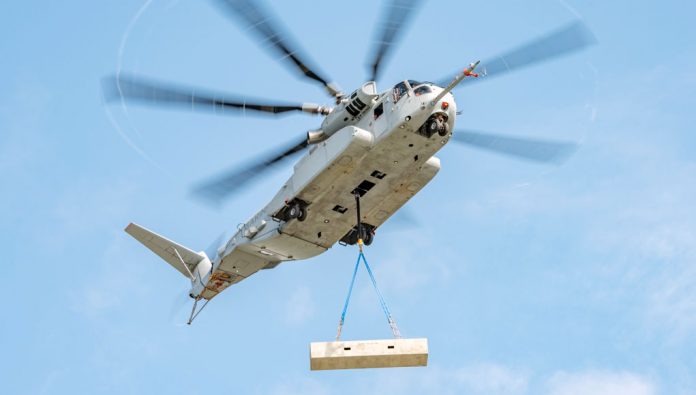
The CH-53K King Stallion successfully completed an external lift of a 27,000 pound payload at Sikorsky’s Development Flight Test Center in West Palm Beach June 17, 2016. Photo: Lockheed Martin, Sikorsky
The Marine Corps’ new heavyweight lifter CH-53K King Stallion completed an external lift of a 13 tons (27,000 pounds) payload at Sikorsky’s Development Flight Test Center in West Palm Beach June 17. The aircraft executed an “out of ground effect” (OGE) external load test at 100 feet above the ground while performing hover maneuvers to demonstrate its excellent control authority in this flight regime. An OGE load is the most stressful of lift conditions for a helicopter from a power-required standpoint. OGE is defined as an altitude greater than the helicopter’s main rotor diameter (79 feet, in the King Stallion’s case) where power demand significantly increases due to loss of the benefit of ground effect.
“Lifting 27,000 pounds in OGE conditions is another key milestone for the program, which further confirms our confidence in the design and performance of the aircraft,” said Col. Hank Vanderborght, U.S. Marine Corps Program Manager for the Naval Air Systems Command’s Heavy Lift Helicopters Program. “This is the most strenuous condition we had to demonstrate from a performance standpoint prior to achieving Milestone ’C’ and entering production.” A Milestone C decision is part of the acquisition process that provides approval to enter production phase.
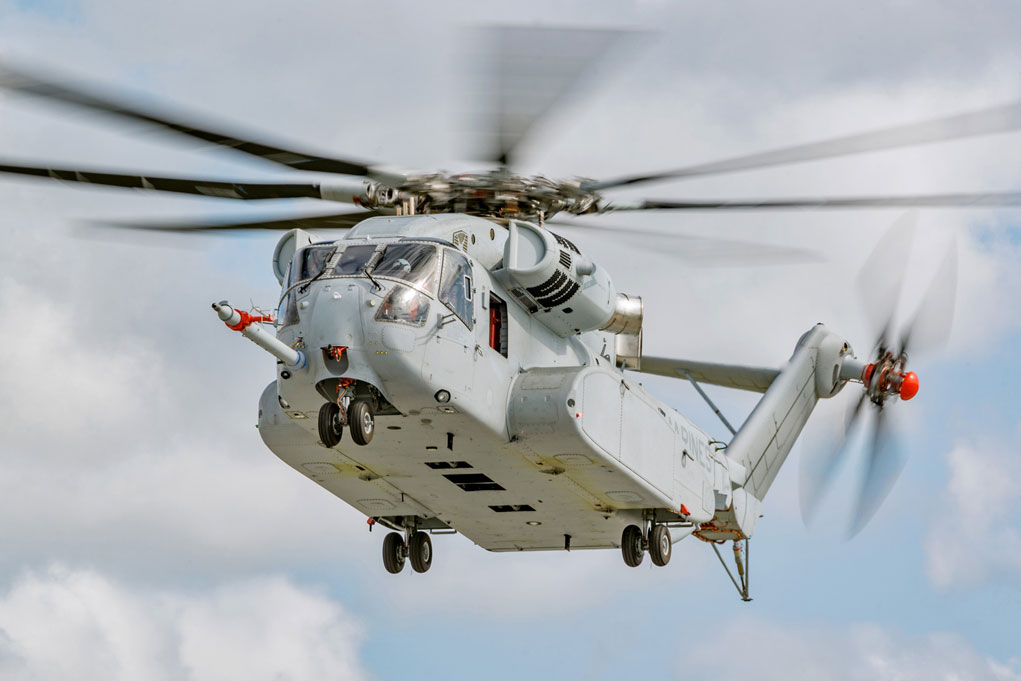
The first two aircraft have already verified the King Stallion’s capabilities well in excess of the predecessor CH-53E. The CH-53K has already achieved speeds exceeding 140 knots, and a third CH-53K King Stallion helicopter has joined the flight test program thereby accelerating the pace to full aircraft maturity and production. A fourth King Stallion is currently in final preparation for flight status and on track to join the flight test program this summer.
The first two aircraft have already verified the King Stallion’s capabilities well in excess of the predecessor CH-53E and a third King Stallion helicopter has joined the flight test program thereby accelerating the pace to full aircraft maturity and production. A fourth King Stallion is currently in final preparation for flight status and on track to join the flight test program this summer. Photo: Lockheed Martin/Sikorsky
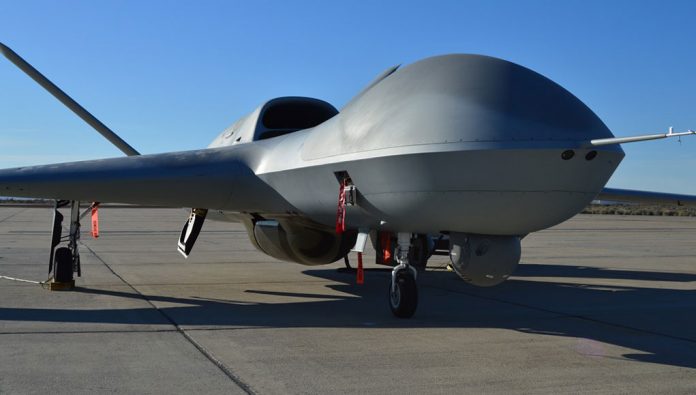
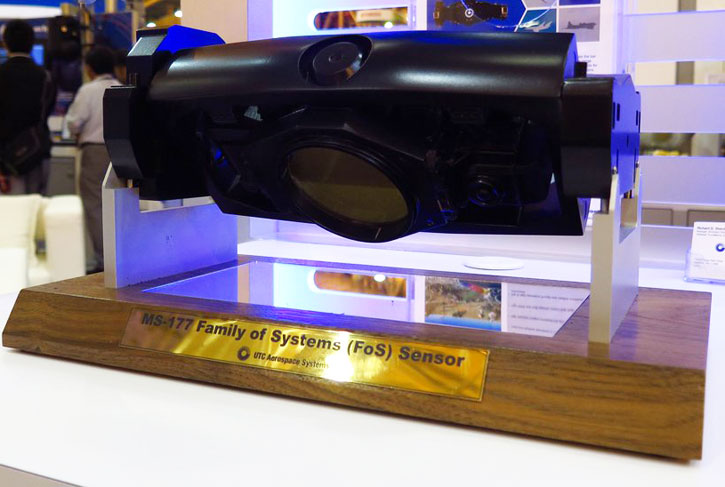
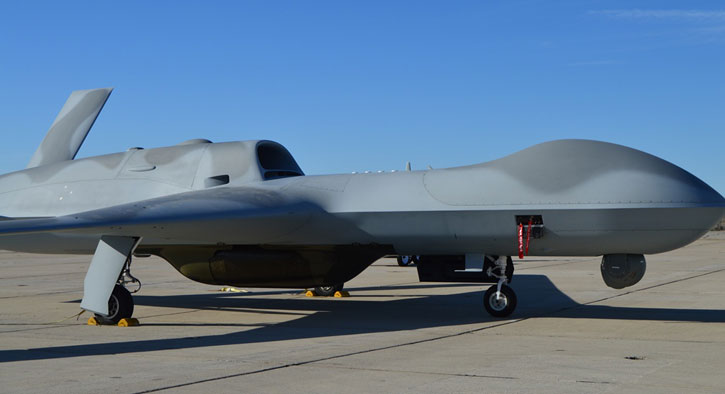
Sensors Unlimited's SYRES family MS-177 EO/IR multi-spectral reconnaissance payload was installed on General Atomics (GA-ASI) 'Predatoc C' Avenger drone for flight tests in January - February 2016. Photo: GA-ASI
General Atomics Aeronautical Systems Inc. (GA-ASI) will begin flight testing of an Improved Avenger in October 2016. This enhanced version of the semi-stealthy drone will enhance the Avenger’s capabilities on long endurance intelligence gathering missions carrying the new MS-177 Electro-optical/Infrared (EO/IR) sensor recently demonstrated in flight. With an increased wingspan of 23 meters (76 feet), the improved Avenger will extend the aircraft’s endurance from 15 hours to 20 hours, thus increasing the utility of this strategic reconnaissance collector over a longer period and extended range.
The Avenger that first flew in April 2009 is powered by a single Pratt & Whitney Canada PW545B turbofan engine. Its airframe has some stealth features, including an internal weapons bay that can carry up to 1,600 kg (3,500 pounds) of internal payloads. This payload bay accommodates the new reconnaissance sensor. In addition, the Avenger has six external hardpoints carrying additional ordnance for a total weight of 2,900 kg (6,500 lbs) payload total. With a maximum speed of 740 km/h (460 mph), the Avenger is significantly faster than other propeller-powered Predator family drones (482 km/h – 300 mph).
According to GA-ASI, the Improved Avenger will provide an optimal balance of long loiter ISR and precision strike capability, supporting a wide array of sensors and weapons payloads to perform fast, long-endurance, multi-mission ISR and ground support missions.
According to UTAS, the MS-177 is more technically advanced than the SYERS 2 flying on U-2 aircraft and also is significantly more affordable to manufacture. The sensor is a 7-band multispectral system that can be upgraded to a 10-band system to enhance target detection for maritime applications. The MS-177 has a wider field of view than its SYERS-2 predecessor. With a 90° roll and 25° pitch, it covers 37,000km² (14,300 miles²) per hour of flight.
Apart from the recent Avenger tests the sensor have also demonstrated compatibility with the Global Hawk, P-3, Boeing P-8A Poseidon and at least one business jet.
MS-177 multispectral payload. Photo: James Drew, Flight Global via TwitterWith wider field of view than its SYERS-2 predecessor the MS-177 covers 37,000km² (14,300 miles²) per hour of flight in seven spectral bands. Photo: GA-ASI.
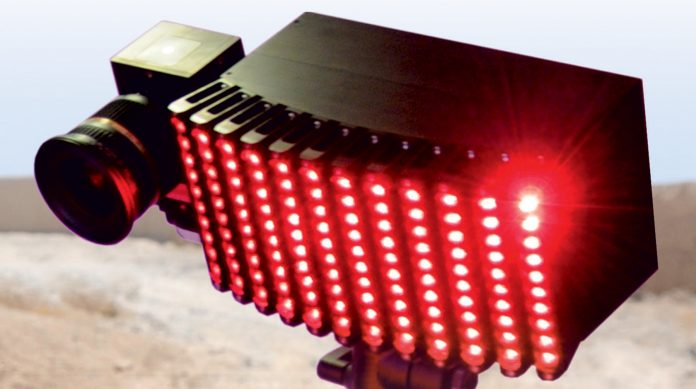
Raytheon UK's new Counter-IED sensor 'GroundEye' combines an imaging sensor with a laser array to measure ground disturbances and changes created by IEDs. Photo Raytheon.
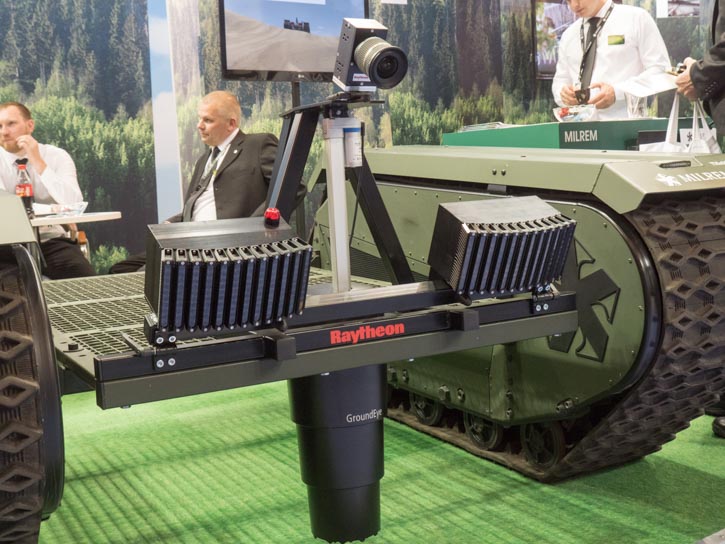
Raytheon UK and Estonian UGV developer Milrem unveiled at Eurosatory 2016 an IED detection platform based on Raytheon’s GroundEye sensor system, integrated on the THeMIS Unmanned Ground Vehicle (UGV) developed by Milrem in Estonia.
GroundEye represents a new approach to IED detection, bringing the ability to confirm and diagnose buried threats. The sensor combines several sensing methods, covering a large field of view, to detect, confirm and diagnose the existence of a suspected IED over a large area. The GroundEye performs such mission using a compact, lightweight system, compared to existing Ground Penetration Radars (GPR) that require large antennae operating close to the surface. Each object detected is geotagged and marked for further action. As a modular sensor and open architecture, it can be integrated with existing sensors and concepts of operations (CONOPS), including GPR, Non-Linear Junction Detectors (NLJD) or command Wire detection systems, allowing gradual induction into existing, operational C-IED methodologies.
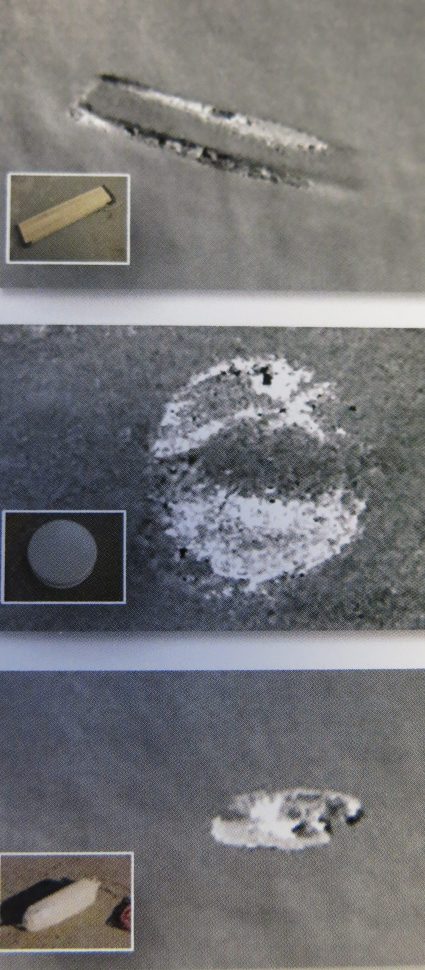
The sensor Provides a real-time imaging capability that can show the size, shape and orientation of explosive ordnance threats, including camouflaged or buried IED’s, without disturbing the ground. It is independent of any physical attributes of the emplaced device and is equally effective against targets that contain high, low or zero metal content.
The GroundEye IED sensor mounted on the MILREM robot. The sensor comprises a two laser arrays and high resolution camera, and near surface sensor, all sweeping the path forward and below the robot over a wide area. Photo: Noam Eshel, Defense-Update
THeMIS (Tracked Hybrid Modular Infantry System) is a modular, hybrid unmanned ground vehicle capable of carrying payloads of 750 kg. Carrying the GroundEye sensor, THeMIS assumes a C-IED (Counter Improvised Explosive Device) role.
Processing the sensor data, GroundEye provides a clear, simple to understand depiction of potential threats in real time. Photo: Raytheon UK
An autonomous UGV such as THeMIS is an ideal vehicle for the deployment of GroundEye. According to THeMIS sources, the fuel and energy on board supports a C-IED mission of 10 hours. “GroundEye offers a solution to the confirm and diagnose capability gap experienced on explosive ordnance and IED clearance operations”, said Andy Gibson, head of Land Systems, Defense, Raytheon UK: “It is a significant step forward in manoeuvre support capability allowing for the maintenance of momentum and reducing unnecessary dismounted exposure. The system can be used in several forms and is platform agnostic.”. According to Gibson the integration onto Milrem’s UGV provides the opportunity to demonstrator this capability.
“Detecting and disarming IED’s is a natural role for unmanned vehicles. With its innovative modular and flexible approach, THeMis makes it possible to use the same UGV platform for multiple purposes,” explains Kuldar Väärsi, Milrem Chief Executive Officer.
Other military uses include as an armed tactical defense weapon, remote reconnaissance platform, MEDEVAC vehicle and supply delivery device. Milrem has successfully conducted initial running tests for the THeMIS prototype, and THeMIS will be ready for production by the end of this year.
The intuitive operating system of GroundEye enables clear and simple analysis of potential explosive devices. Photo: Raytheon UKThe MILREM robot configured for counter-IED operation. Photo: Noam Eshel, Defense-Update.
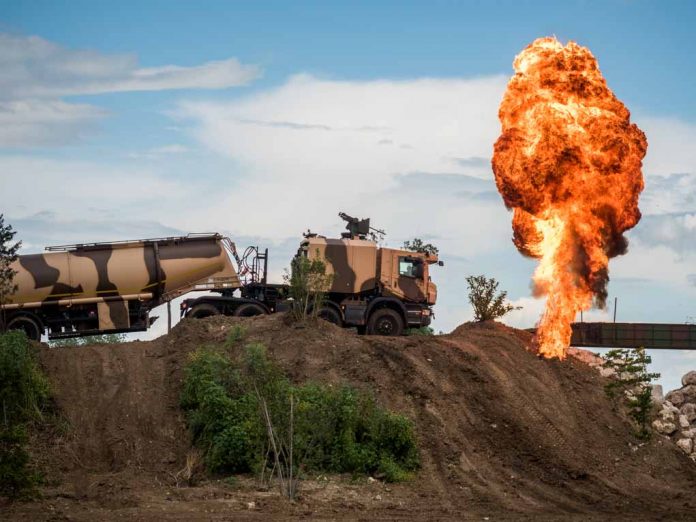
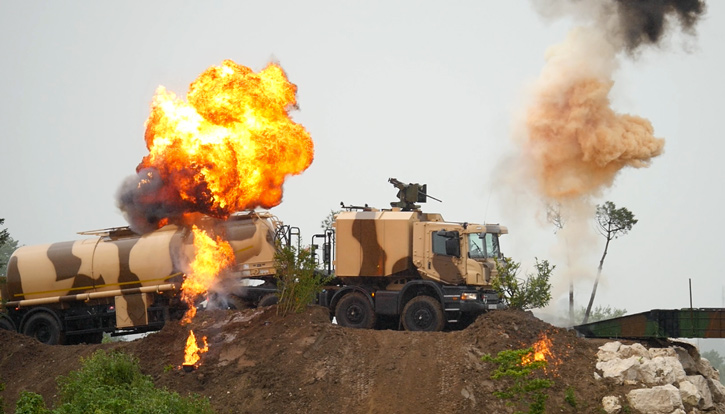
Protecting fuel distribution lines in support of military operations in hot danger zones is a major concern for military planners. The French Army has recently deployed the Carapace, a highly protected fuel lorry designed to survive an ambush attack, fight back and cpress on delivering the fuel to the front lines.
Carapace is a cooperative effort to protect French logistical vehicles, demonstrated this week at Eurosatory. The long distance petrol supply lorry is in service with the French Army logistics corps.
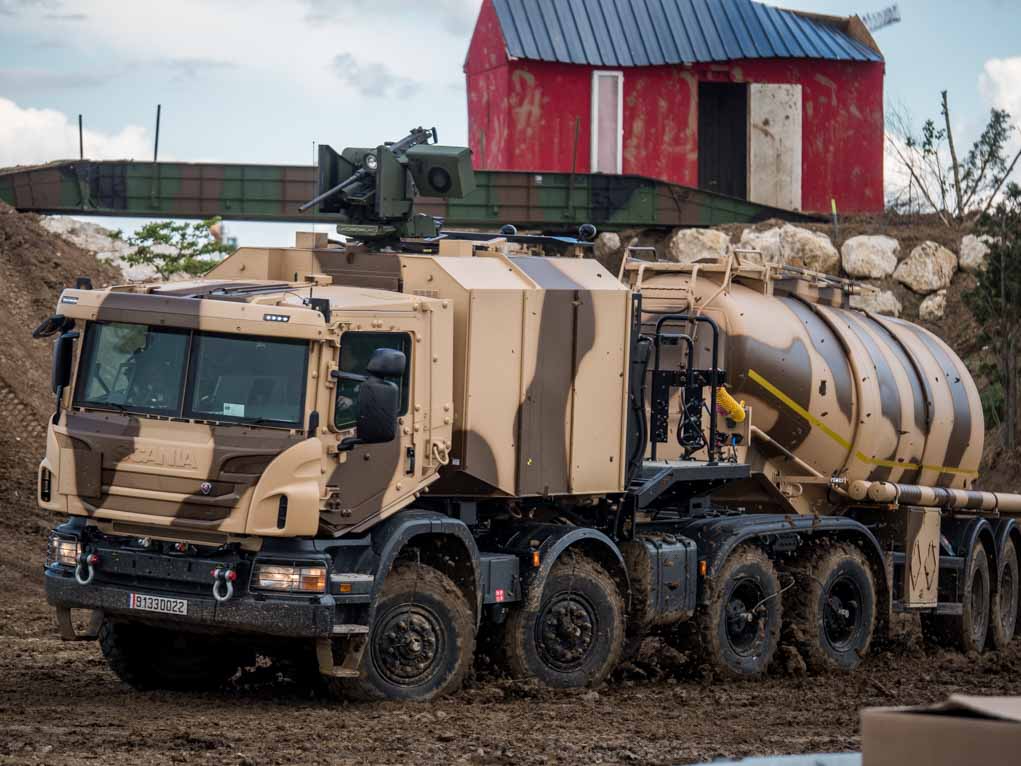
The lorry produced by Scania, and protected with an armored cab developed by Essonne Securite, is fitted with a ballistic armor kit and remotely operated turret mounting a 0.5″ Cal machine gun operated from the protected cab. It is also equipped with a number of removable active and passive elements.
Carapace protected fue lorry. Photo: Noam Eshel, Defense-Updatelogistics
The weapon station is also equipped with day/night cameras and laser rangefinder. A jammer offers protection against remotely controlled IEDs. Runflat system enables the truck to escape a danger zone even after the tires were punctured.
Carapace carries a fuel tank with maximum load capacity of 22,000 liters. It is displayed in a tanker configuration, pulling a fuel tank and ground fuelling system provided by Desautel and Maisonneuve.
The Carapace – Protected fuel lorry used by th eFrench Army logistics corps. Photo: Noam Eshel, Defense-Update
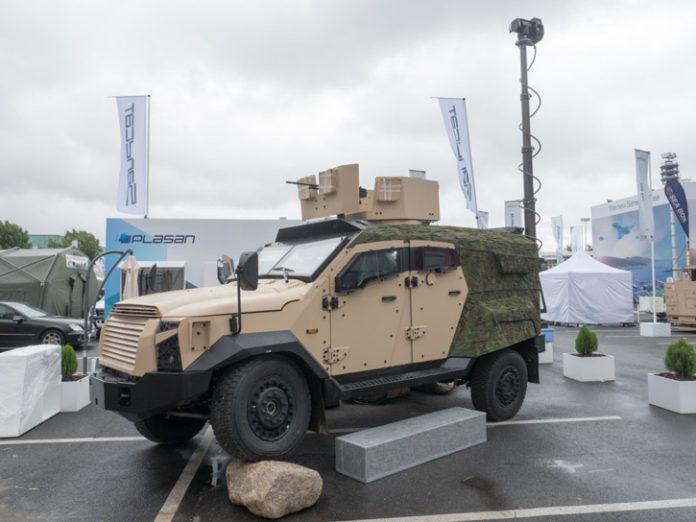
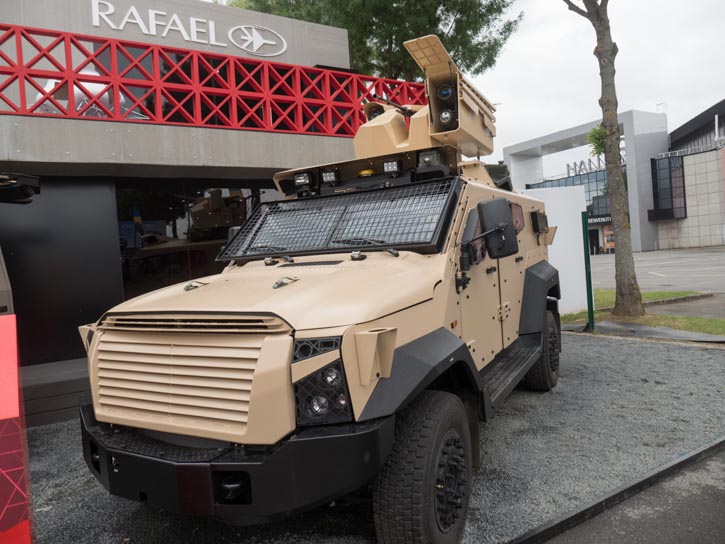
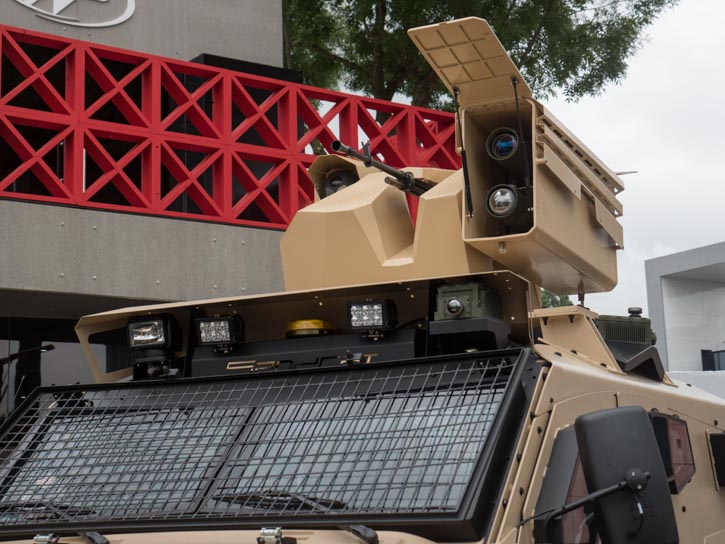
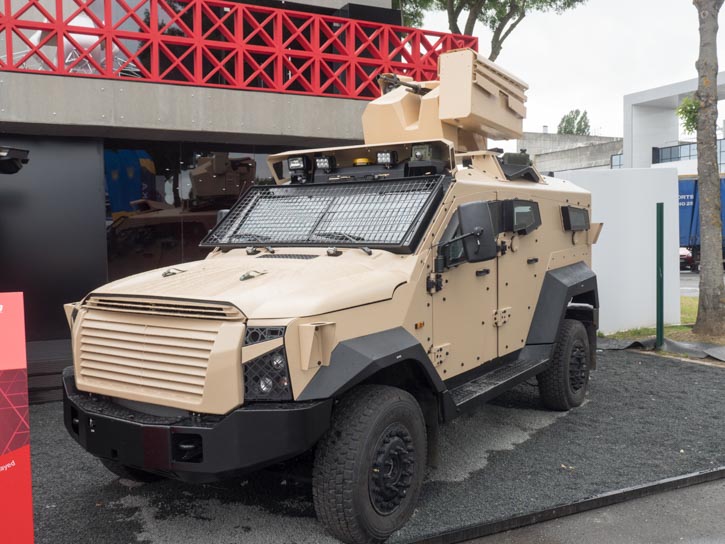
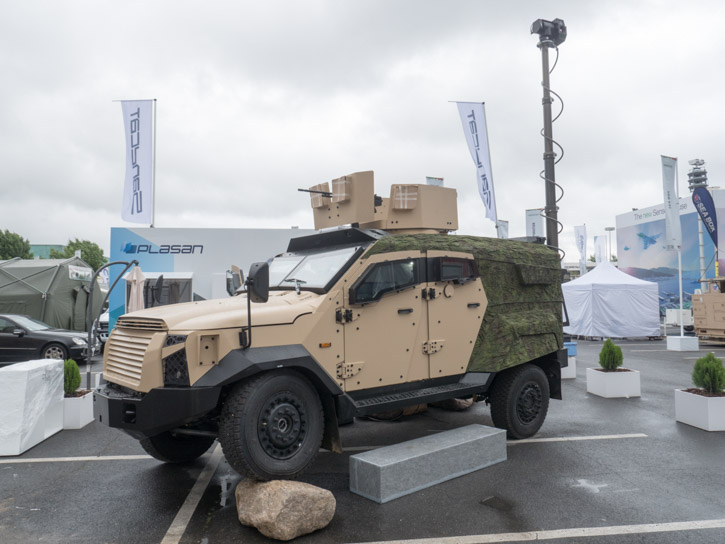
Israel’s Plasan is showcasing a new model of the Sandcat light armored vehicle at Eurosatory 2016. Two versions of the vehicle are on display here: the Sandcat Stormer, shown in an ISR version, and a light combat vehicle carrying Rafael’s Samson remote weapon station (RWS), mounting a machine gun, Spike missiles and optronics.
The 4×4 Sandcat is currently operational with 15 user nations worldwide. Plasan has launched a production line of the Sandcat in Israel, addressing the growing demand for such light, yet highly protected and affordable combat vehicle. The latest version unveiled by the company at Eurosatory was redesigned with streamlined shapes that improve survivability and protection, especially in seams that require extra protection against small arms and sniper fire coming from high elevations.
The protection available with the vehicle’s baseline configuration comply with STANAG Level 3. extensive use of lightweight composites and ceramics within the kitted hull protection enabled the designers to maintain full protection within the limits available by the vehicle’s curb weight. Plasan implemented similar protection designs in other programs, including the Australian Hawkeye from Thales and the JLTV from Osjhkosh. The main advantage of Plasan’s kitted hull concept is the efficient weight management and flexible upgrading of armor protection, acording to the precieved threat.
The Sandcat displayed at Rafael’s booth, carrying the Samson weapon station. Photo – Noam Eshel, Defense-UpdateThe Samson RWS integrates a heavy machine gun, two Spike LR missiles and optronic system. The vehicle is also fitted with Spotlite M IR hostile gnshot detection system and panoramic cameras. Photo – Noam Eshel, Defense-Update
To maintain the mobility and responsiveness of the vehicle, Plasan extended the standard Ford 550 high performance chassis, shortened and strengthened to take the maximum allowed GVW. Inside the vehicle the Sandcat offers a spacious cabin for the transportation of troops and mission equipment, with full mission information presented to the vehicle commander, depicted on a tactical screen.
Another innovation introduced here at Eurosatory is the improved dashboard, utilizing part of the original systems with a digital display system linked to the vehicle’s electronic hub, previously known as V-BOX. This new ‘brain’ is an automotive electronic processor that integrates and networks all the vehicle’s systems and sensors with mission systems on board. When fully integrated, upon customer requirements, the hub integrates communications, ISR package, panoramic vision systems and remote weapon stations, providing full situational awareness to the vehicle and crew. The electronic hub aso supports safety and maintenance functions, assisting the vehicle’s operation and support in the field.
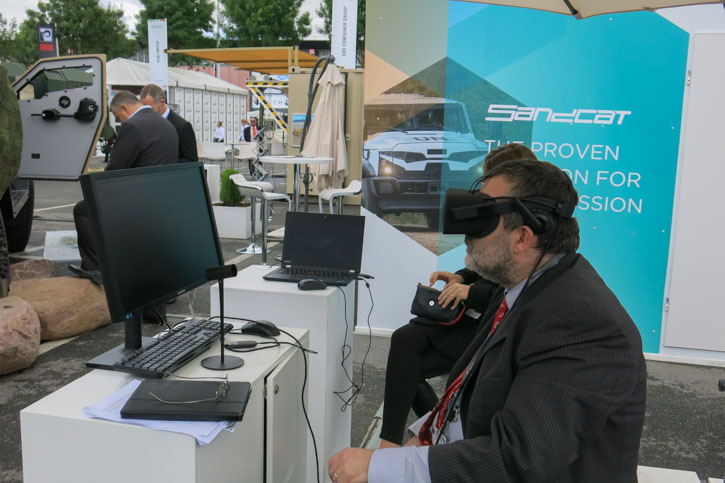
Plasan is illustrating these new capabilities in a Virtual Reality (VR) experience that also made its debut at the show.
Visitors could experience Plasan’s integrated vehicle electronics through an immersive Virtual reality experience. Photo Tamir Eshel, Defense-Update
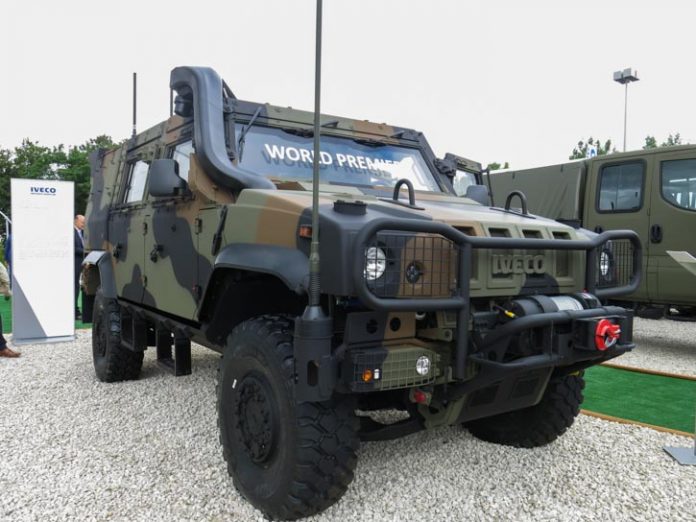
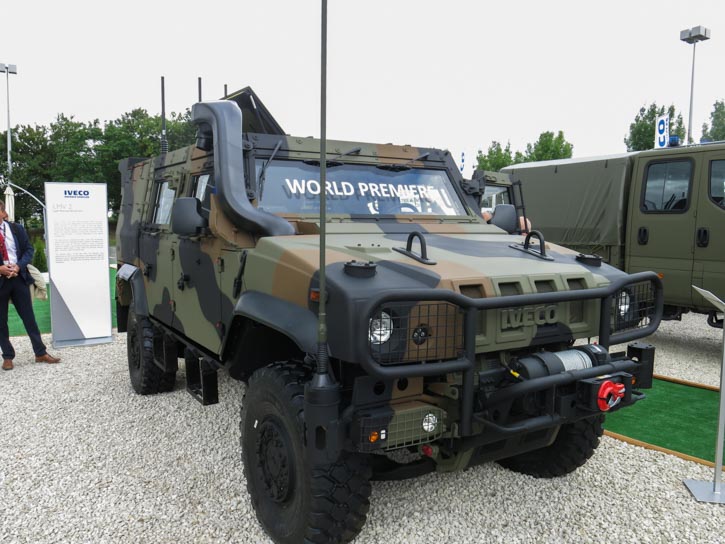
Iveco introduced at Eurosatory 2016 an improved, higher performace new variant of its Light Multirole Vehicle (LMV) family of light tactical vehicles. Sofar Iveco delivered over 4,000 LMVs to 13 customers worldwide. The largest fleets are operating in Italy, Belgium, UK, Russia and Spain. The new vehicle designated LMV 2 is a major improvement over the original LMV, that has been modified and adapted through the years, adding more protection, capacity and electronics to meet user demand.
LMV 2 increases the baseline platform to better meet new demands, for higher performance, greater reliability and increased crew comfort. The result is a growth of about 40 percent in payload capacity from 800 up to 1500 kg, depending on vehicle configuration and armor suite. The previous model was limited in its payload carrying capacity, especially with some configurations required to carry over half a ton of electronic equipment to support combat missions. In such circumstances, electrical power supply has also been an issue with past versions.
The new version is powered y a 220 hp diesel engine coupled to an upgraded driveine capable of managing increased power levels. The air filtration has also been enhanced to cope with the increased engine intake. A new automatic eight speed gearbox (adding two speeds over the previous transmission). This change is making gear transitions smoother, particularly off-road. The vehicle is also equipped with a new, automatic drive management (ADM) system to support optimized performance in off-road mobility. Another improvement is the addition of electrnic stability control (ESP) that also helps manage off-road mobility and enhance driving safety on road.
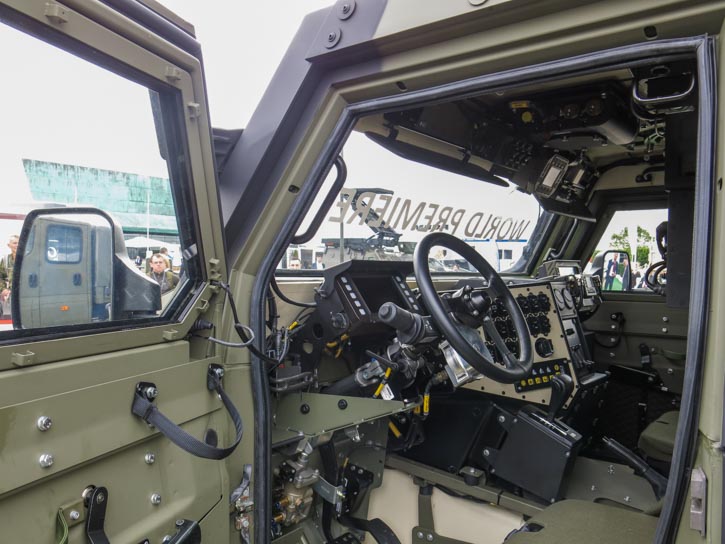
One of the main improvements in the new LMV-2 is the digital dashboard, providin the driver a clear indication of the driving condition plus maintenance information required for scheduling maintenance work. Photo: Noam Eshel, Defense-Update.
The protected crew cell is supports five fully equipped soldiers with body armor and combat webbing. Protection level has been improved in the new model, particularly in the IED protection, by using an extra hinge to the ballistic and blast protected side doors. The new hard top ‘dual role’, mae of a ballistic steel monocoque framework with lightweight aluminum/steel roll bar, allows the vehicle to carry a manual or remote weapon station turrets. Using new, advanced passive protection in the side doors enables the designers to maintain the door weight by increasing the level of protection.
The vehicle is designed to carry more electronic a dn mission systems, including radios, computers, battle management (BMS) systems, intercome, jammers, satellite communications, remote weapon stations and optronic sensors. Carefull design of the vehicle’s electronic networking and power distribution systems minimizes electromagnetic interference (EMC). Subsystems integration has also been eased through the implementation of a new vehicle digitised electronic architecture and an improved power supply.
Maintenance has been simplified by reducing the number of replaceable systems and improving the type and location of components that have been hard to access in the past. Furthermore, the digitised dashboard provides maintenance data and indications on demand, allowing the crew to accurately review and schedule maintenance tasks, instead of predicting and scheduling preventive maintenance.
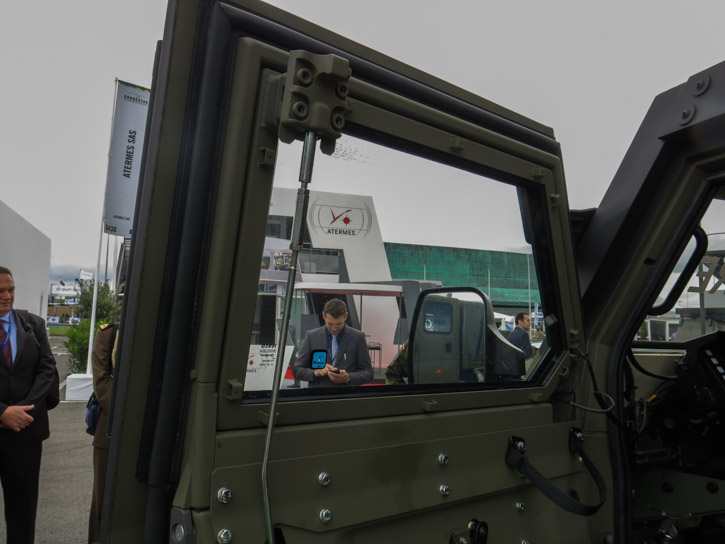
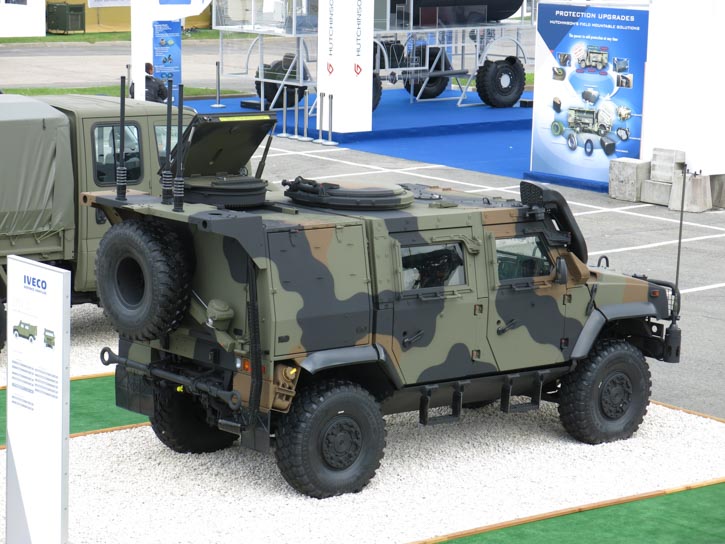
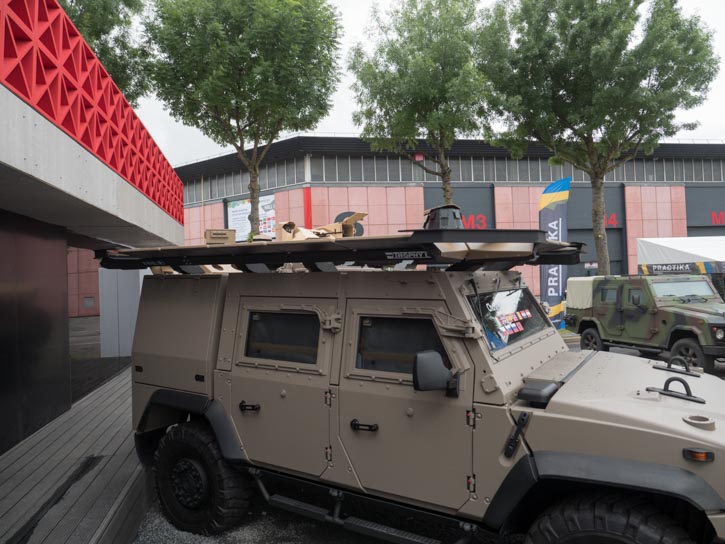
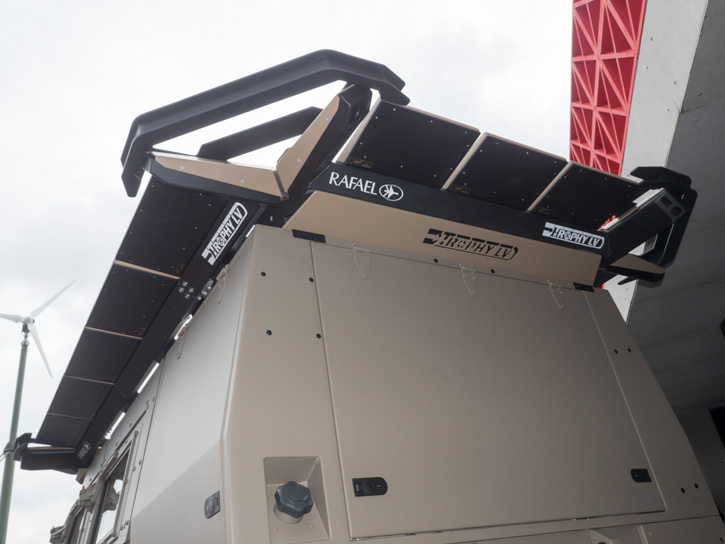
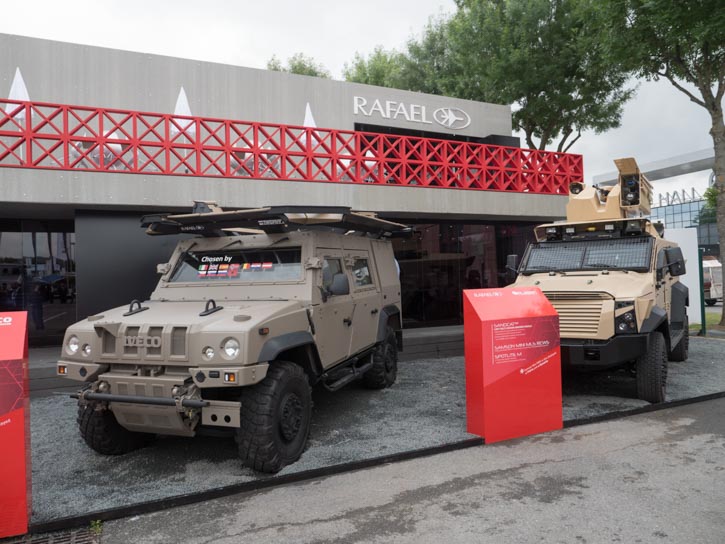
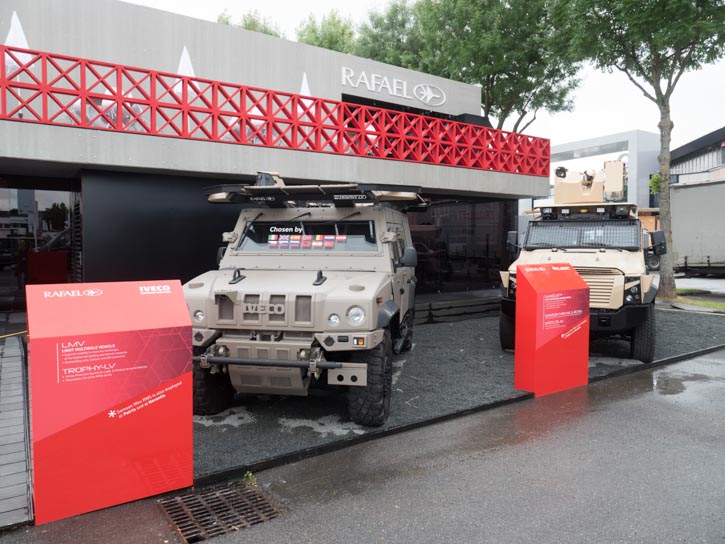
The doors are built of lighter, stronger materials to increase protection from IEDs. Additional durability is provided with the additional hinge added to each door. Photo: Noam Eshel, Defense-Update.The cabin of the new LMV-2 is configured to accommodate five fully equipped and protected soldiers and their gear. The roof is made of steel hardtop augmented with Aluminum rollbar, with openings accommodating a gunner hatch, and fittings for gunner protection ki or remote weapon station. Photo: Noam Eshel, Defense-UpdateThe LMV-2 from Iveco looks similar to the original LMV, but can carry almost 40 percent more payload. Photo: Noam Eshel, Defense-UpdateRafael displayed the LMV-1 fitted with the Trophy Light (LV) Active Protection System (APS) kit, providing the light vehicle an effective, close-in protection from RPG attack. Photo: Noam Eshel, defense-UpdateA vew from below, showing Rafael’s Trophy LV ‘crown’ installed around the LMV. The corners can also accomodate gunshot detection systems. A different system using Rheinmetall’s ADS active protection has been configured for this vehicle in the past. Photo: Noam Eshel, defense-UpdateTwo new light armored vehicles displayed a Rafael’s booth – the LMV from Iveco and Sandcat, from Plasan. Photo: Noam Eshel, Defese-Update
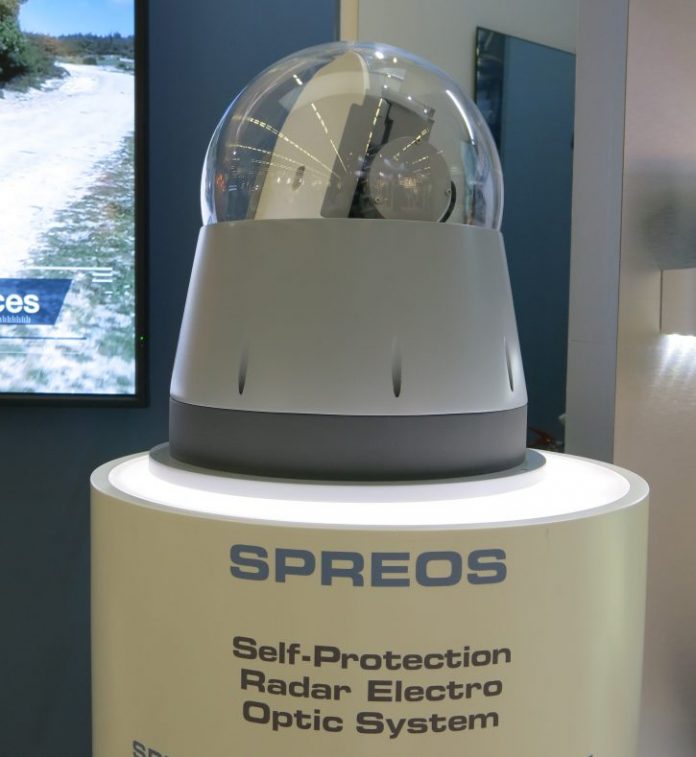
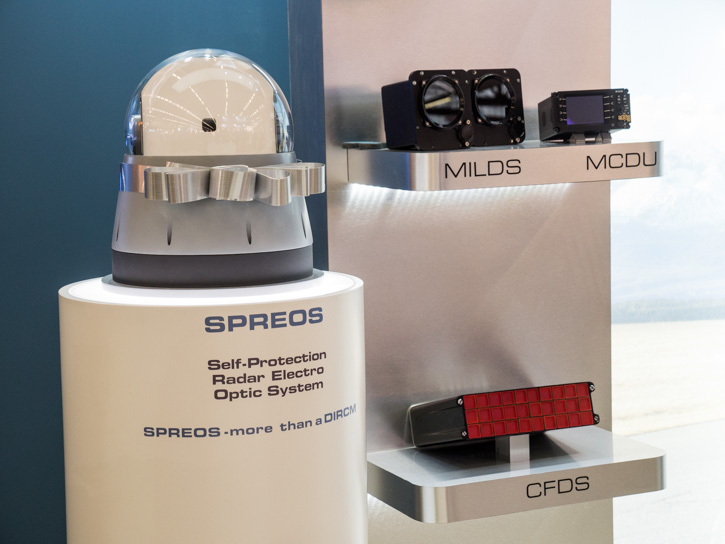
SPREOS combines a radar based verification sensor and an active laser (DIRCM), mounted on the same optical path. In fact, the laser 'fires׳ right through the center of the radar panel, enabling significant cost saving in maintaining separate aiming devices. Photo: Tamir Eshel, Defense-Update
Bird Aerosystems unveiled today an innovative laser-based Directional Infra-Red CounterMeasures (DIRCM) system that offers high level of protection for aircraft, from attack by Infra-red guided missiles. The Self-Protection Radar EO System (SPREOS) represents a growth of the company’s fielded Airborne Missile a Protection System (AMPS) and AMPS -MV (target verification) system. AMPS and AMPS-MV are installed on multiple platforms, and certified on Airbus Helicopters and Russian Helicopters’ Mi-17 platforms. The new system is suitable for use with fixed wing aircraft and helicopters.
Unlike existing DIRCM systems that rely primarily on RF and electro-optical (EO) sensors for threat detection, identification and tracking, Bird’s SPREOS consists of the proven AN/AAR-60 MILDS (the principal sensor of the AMPS system), that operates as a passive UV sensors, providing the initial missile threat warning. Upon such event the system’s Missile Approach Verification System (MACS – which is part of the AMPS-MV) is activated. Employing a KU band radar to detect and localize and track. SPREOS improves on MACS in continuously tracking the target, providing the information for successful countermeasures.
Once the countermeasure game plan is selected the SPREOS employs a dual-band laser effector embedded into the radar antenna to deliver an appropriate, directional IR jamming signal to deceive the target’s seeker. Since the system’s radar continuously tracks the target, the effectiveness of the countermeasures employed is constantly assessed in real time, thus enabling the defense system to employ scalable defenses along the engagement. Throughout the process, the system’s AAR-60 sensors continue to watch out for new threats and could engage them with more traditional flares, if such countermeasures are available on board.
SPREOS was developed by Bird under cooperation with a large European Company. Previous versions of the system were developed with Airbus – the original manufacture of the MILDS missile warning UV sensor. The system can be used in a wide-range of airborne platforms, ranging from small helicopters to large transport aircraft. SPREOS integrates into a single Line Replaceable Unit (LRU) multiple functions, including threat confirmation, tracking and jamming of advanced IR guided missiles.
According to Shaul Mazor, Bird’s VP Marketing and Business Development, the new system is a ‘game changer’ in the market, due to its inherent false alarm rejection capability, ensuring enhanced protection of aircrafts against any type of MANPADS launch, with zero activation as a result of false alarms. “We developed the SPREOS based on the vast experience BIRD gained in hundreds of projects that have already been implemented in recent years.” Mazor added, saying the new system, currently in advanced phase of development would be more affordable, than current laser based DIRCMS, enabling more platforms, both military, paramilitary and civilian, to be protected by Bird’s the new lifesaving system.
Bird Aerosystems’ DIRCM unveiled at Eurosatory yesterday complements the company’s existing Airborne Missile a Protection System (AMPS), applying flare countermeasures.
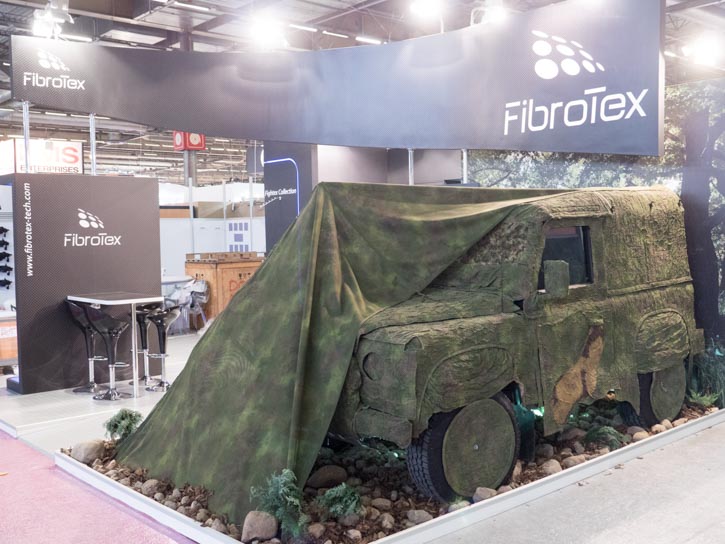
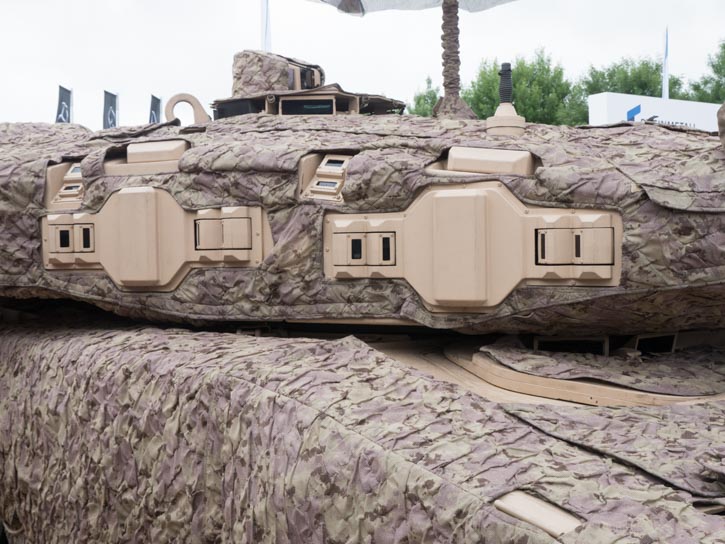
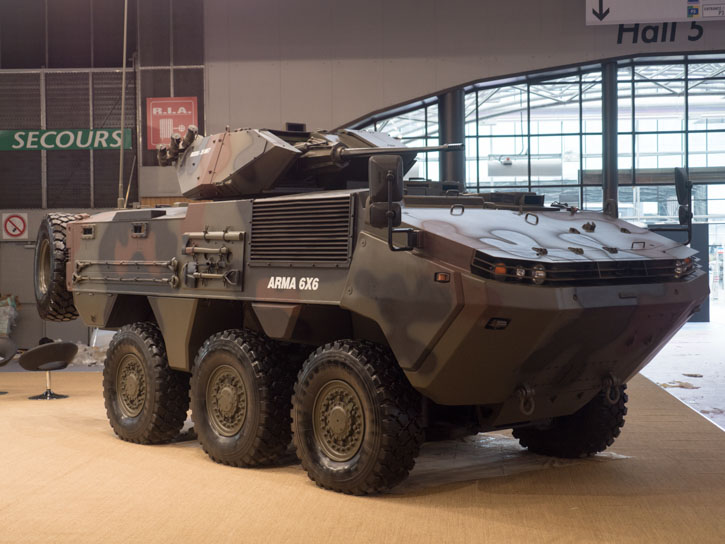
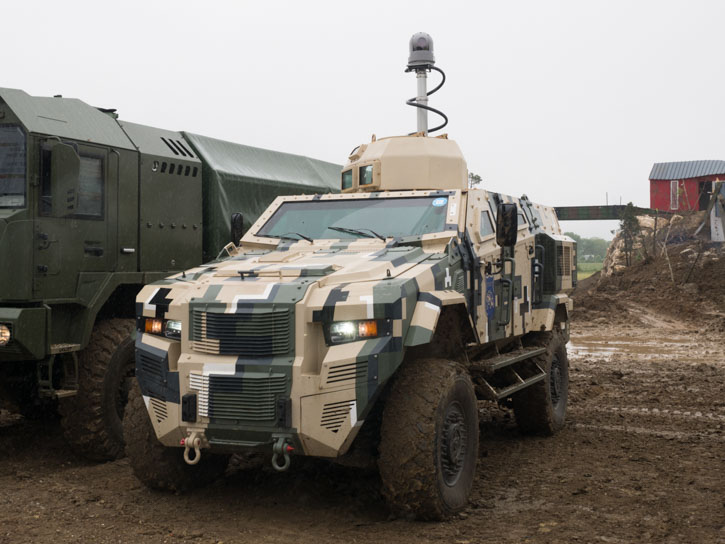
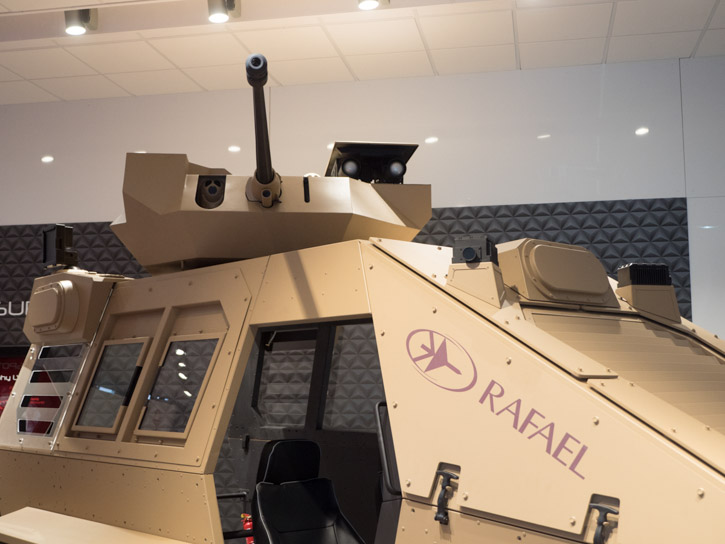
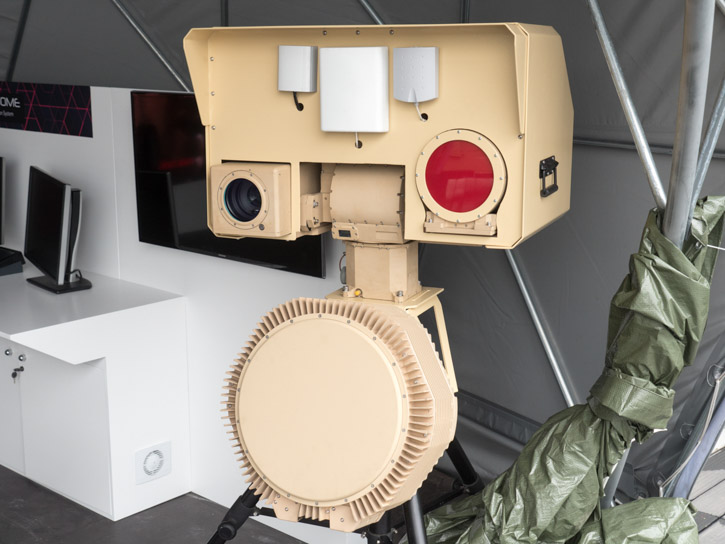
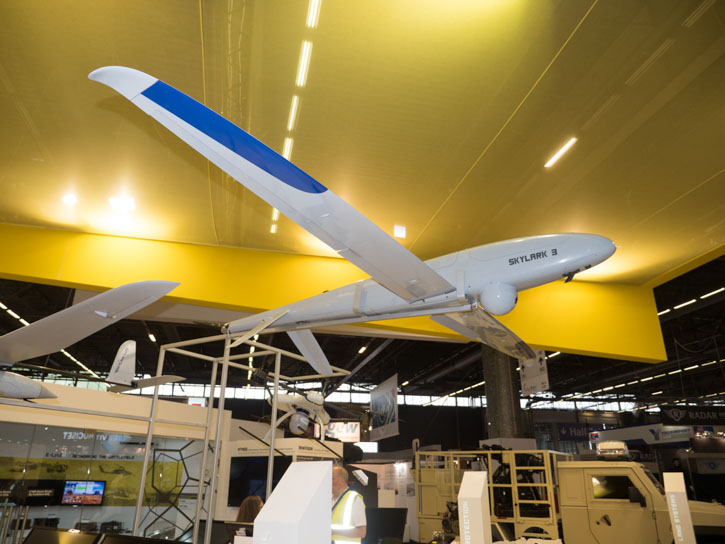
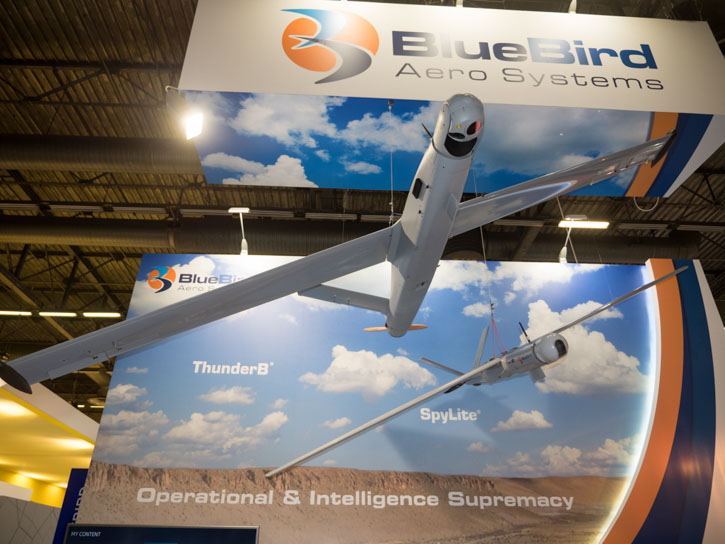
Two versions of IAI Harop loitering missiles – the Harpy NG on the right, and HAROP on the left. Photo: Noam Eshel, Defense-UpdateFibrotex unveiled at The exhibition their latest mobile camouflage system. A complete camouflage can be applied on a small vehicle within ten minutes. Photo: Noam Eshel, Defense-UpdatePlasan’s Sandcat was displayed here with Rafael’s remote weapon station, mounting a machine gun, two Spike missiles an a canisters and an Optronics system. Photo: Noam Eshel, Defense-UpdateRAFAEL also displayed the Trophy LV active protection system, configured on a Light Multirole Vehicle (LMV) from Iveco Oto-Melara systems. Photo: Noam Eshel, Defense-UpdateRheinmetall’s Leopart Advanced Technology demonstrator was displayed at Eurosatory 2016. Photo: Noam Eshel, Defense-UpdateAmong the technologies being evaluated are the wall mounted Active Defense System (ADS) attached to the turkey’s sides and ceiling, and the signature management system, wrapping the tank to reduce its thermal, radar and visual signature. Photo: Noam Eshel, Defense-UpdateOtolaryngology displayed two variants of the Arma, this is the 8×8 version. Photo: Noam Eshel, Defense-UpdateOtolaryngology displayed two variants of the Arma, this is the shorter, 6×6 version. Photo: Noam Eshel, Defense-UpdateThe Scorpion MRAP from the Streit Group, shown with an ISR mast. Photo: Noam Eshel, Defense-UpdatePlasan displayed their new Sandcat Stormer configured for ISR intelligence and collection, carrying an elevated EO payload and Gunner Protection Kit (GPK). Photo: Noam Eshel, Defense-UpdateThis notional vehicle demonstrated some of Rafael’s systems developed for modern combat systems, including active protection, situational awareness and remotely operated turrets. Photo: Noam Eshel, Defense UpdateRafael’s Drone Defender system combines RaDA’s MHR RPS-42 radar, an EO/IR identification system from Controp and Netline’s jammer, providing an effective countermeasure system against small drones. Photo: Noam Eshel, Defense-UpdateAn auto loading 120mm mortar system from Ruag, on display at Eurosatory 2016. Photo: Noam Eshel, DefenseUpdateElbit System’s electrically powered Skylark 3 was selected to provide organic brigade ISR support for the IDF. Photo: Noam Eshel, Defense-UpdateThunderB and Spylite are two of BlueBird’s Aero Systems’ latest mini- tactical drones. Photo: Noam Eshel, Defense-UpdateIAI’s RoBattle UGV fitted with remotely operated weapon station and ISR Kit. The diesel powered robot uses hydrostatic propulsion to drive the articulated wheels to provide enhanced autonomy and mobility over rough terrain. Photo: Noam Eshel, Defense-Update.
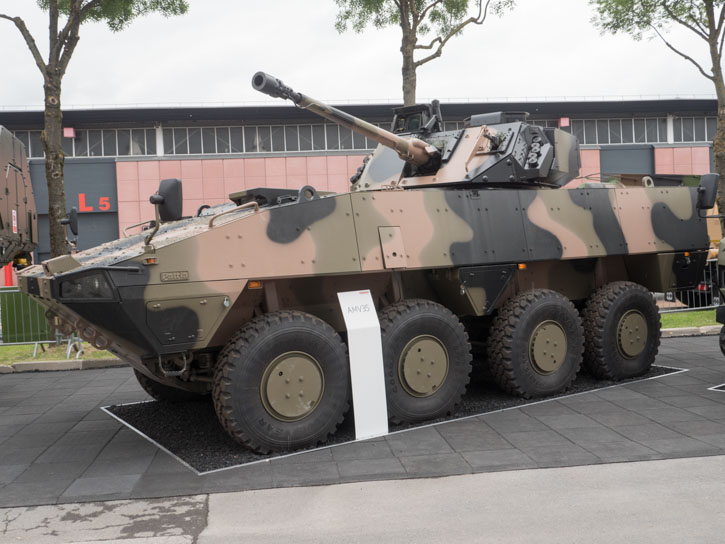
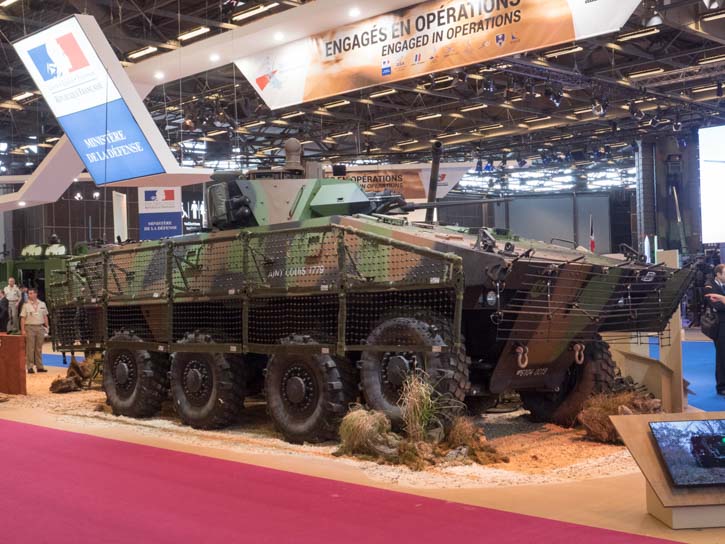
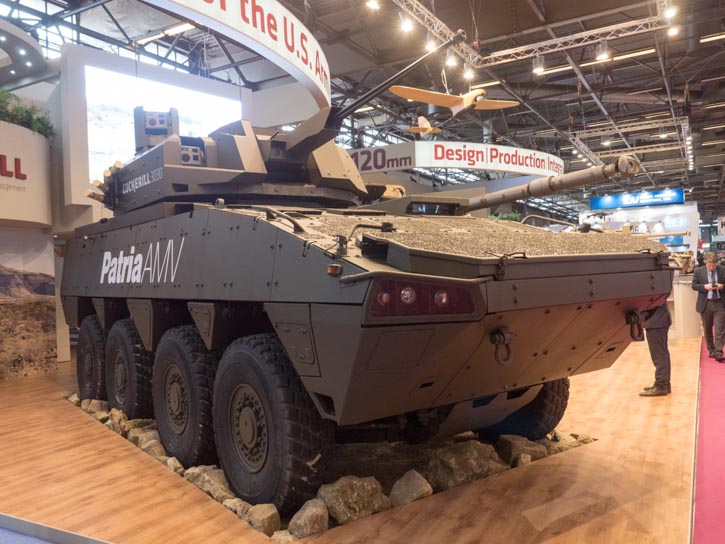
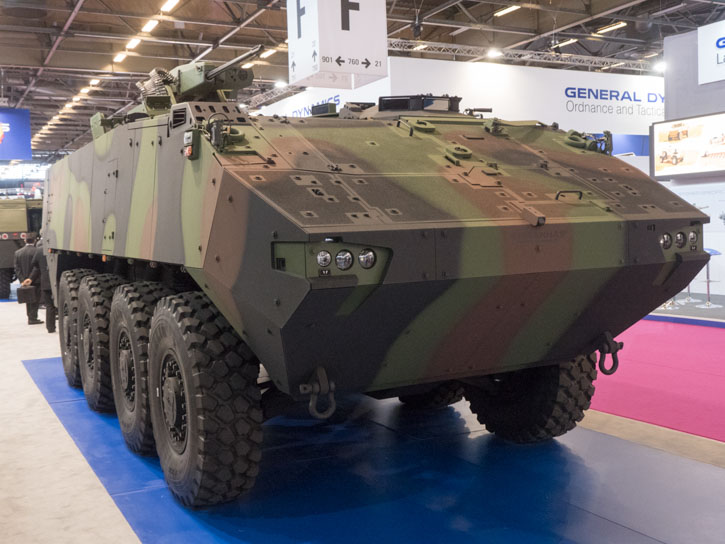
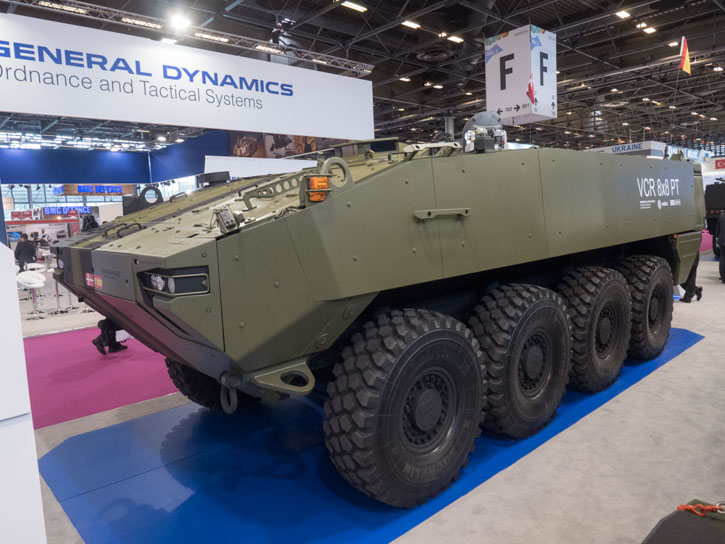
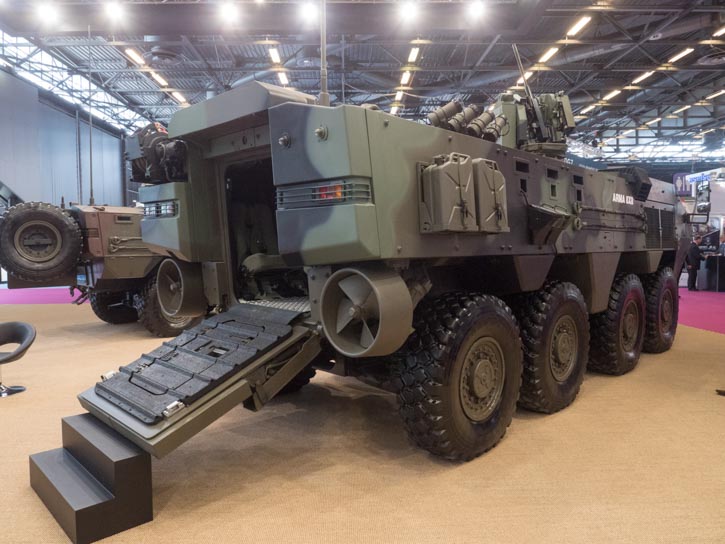
AMV35 is one of the candidates for the Land 400 project in Australia, modernizing the Australian’s armored scout vehicles. The vehicle combines two combat proven systems – the 8×8 wheeled Finnish AMV chassis from Patria and the CV-90 turret mounting 35 mm canon, from BAE Systems Haggunds in Sweden. Photo: Noam Eshel, Defense-UpdateThe VBCI from Nexter was displayed here by the French Army, mounting a new anti-RPG protection system. Photo: Noam Eshel, Defense-UpdateVBCI is also available with a new turret mounting two new MMP missiles and the powerful 40mm cannon firing the case telescpic ammunition system from CTA. The gun is already used on the British Ajax and is selected for the French Jaguar wheeled armed scout. Photo: Noam Eshel, Defense-Update.A new version of Patria AMV mounting the Cockeril 30mm turret. Photo: Noam Eshel, Defense-UpdatePiranha 5 from GDLE Europe has been selected by the Danish Army as a successor of the M113 that will soon complete 50 years of service. The vehicle employs an advanced protection system developed by Plasan. Photo: Noam Eshel, Defense-UpdateAnother Piranha variant on display is this Piranha III VCR, fitted with improved automotive and protection kit. Photo: Noam Eshel, Defense-UpdateThe Arma 8×8 armored vehicle from the Turkish Otokar company is prepared for amphibious operation. Photo: Noam Eshel, Defense-Update
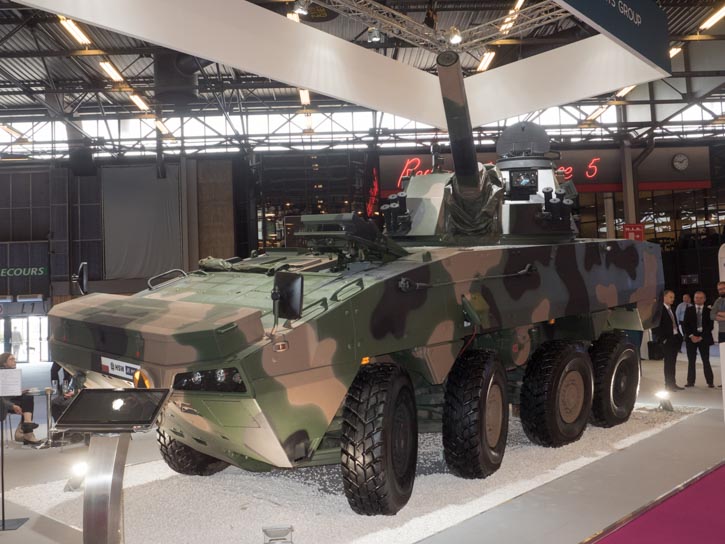
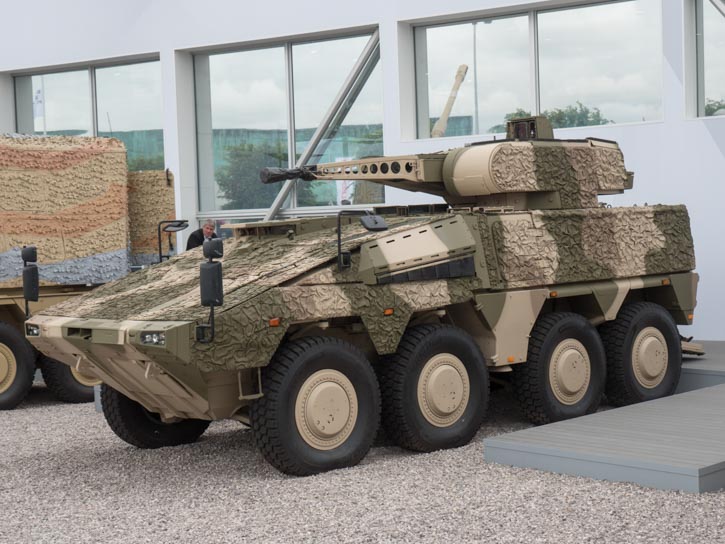
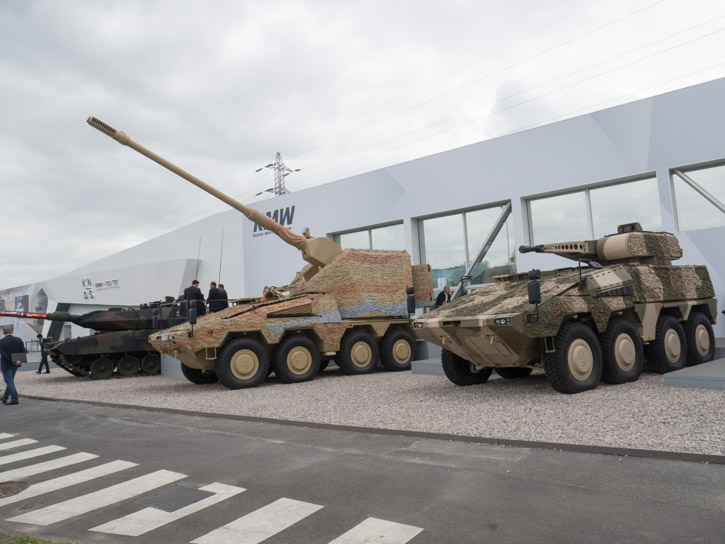
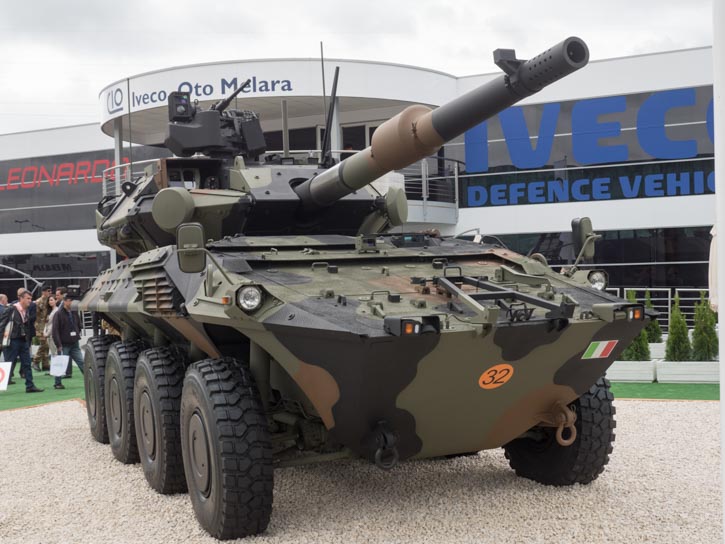
Another AMV variant, the Polish Rosomak, is fitted with a turreted 120mm mortar system designed by the Finnish NAMO company. Photo: Noam Eshel, Defense-UpdateThe Boxer, displayed by the German company KMW, mounts a new mission module carrying a turret with 30mm gun. Photo: Noam Eshel, Defense-UpdateAnother variant of the 8×8 Boxer is shown with the Modular Gun System, an automated, self-propelled artillery piece developed by KMW. Photo: Noam Eshel, Defense-UpdateCentauro II from the Iveco Oto Melara Consortium (CIO) was unveiled today at Eurosatory, as the first variant of the improved, more powerful and family of 8×8 wheeled vehicles developed for the Italian Army. Centauro II is armed with a new turret mounting a 120/45 mm gun, with integrated muzzle break and semi-automatic loaing system. The chasis has improved protection against mines and IEDs. Photo: Noam Eshel, Defense-Update.
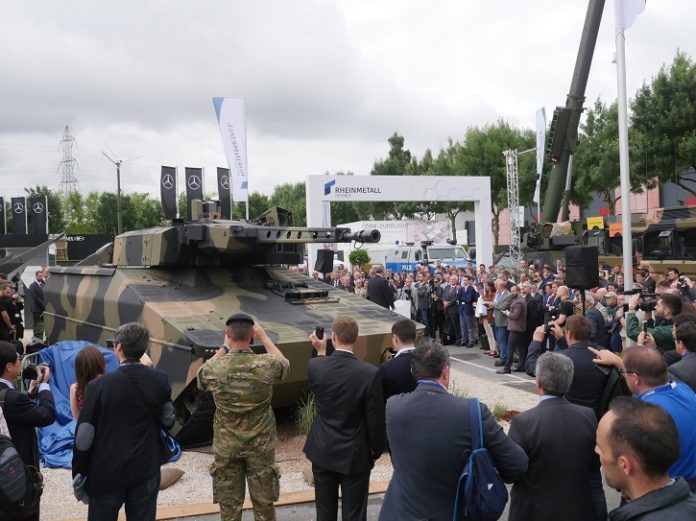
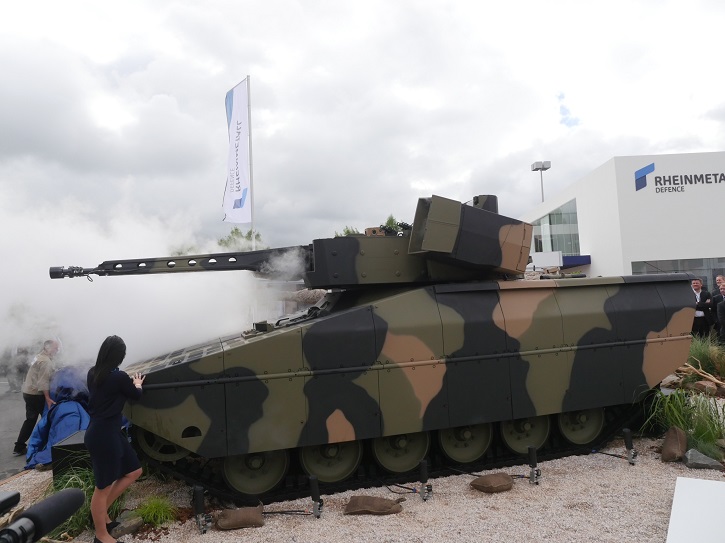
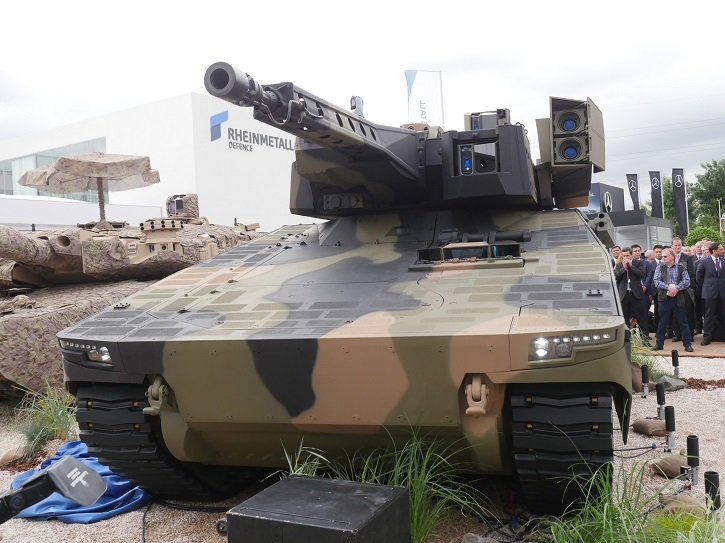
Rheinmetall unveilled today the Lynx, its latest tracked combat vehicle at the Eurosatory defense exhibition in Paris. The new vehicle is one of two models developed by the German company, positioned as an independently developped, tracked combat system aimed primarily to compete in export markets.
Rheinmetall already offers a similar Armored Fighting Vehicles (AFV)- the Puma, developed and produced in partnership with its main local competitor/partner Krauss Maffai Wegman (kmw). KMW now joined forces with the french prime Nexter one of Rheinmetall’s main rivals in the international arena.
While the Puma is designed to address the specific (and uncompromised) requirements of the German Army, the Lynx is designed as a more flexible and affordable platform, availabe in two hull sizes. One is designed as the Puma, to carry six ad eight infantrymen while the other is longer and adaptable to internatoinal standards.
The variant unveiled today at Eurosatory is the Kettenfahrzeug (tracked vehice in German) KF31 that can carry a squad of six, along with three crew members. The longer variant designated KF41 can carry eight soldiers. Both are equipped with the Lance turret system, an off the shelf Rheinmetall product, mounting a 30/35mm cannon with firing anti-tank and high-explosive airburst ammunition, providing the crew with firepower, effective up to a distance of 3,000 meters, even on the move.
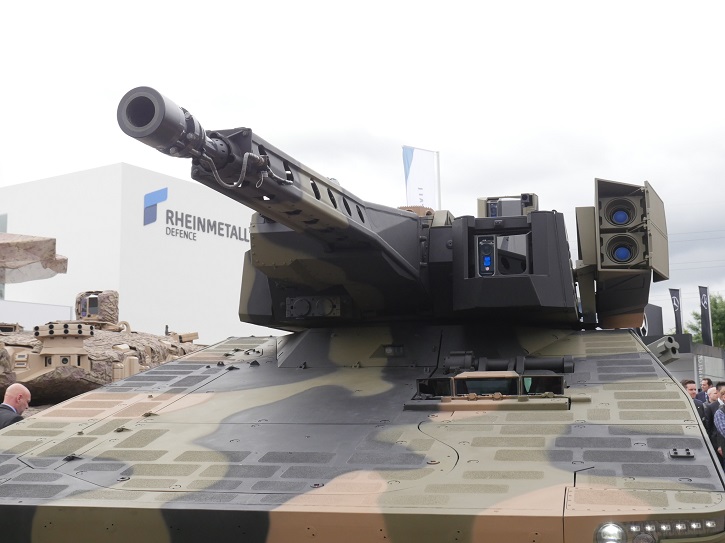
The Lance is a manned turret mounting Rheinmetal’s 35mm cannon, a machine gun with three replaceable barrels and a launcher pod carrying two Spike LR missiles. Photo: Noam Eshel, Defense-Update
The manned turret also has a coax 7.62 machine-gun fitted with a unique barrel replacement system that can sustain continuous firing over extended period, by replacing the machine gun barrels on demand. This innovative system enables the crew to continue fighting under armor without exiting the protected vehicle to replace barrels.
The optronic systems consist of off-the-shelf Stabilized, EO Sight System (SEOSS) from Rheinmetall, which consiss of TV/IR optical system integrated with laser rangefinder and fire control computer. The system combines a gunner sight module with an independent, panoramic commander’s sight. Laser warning sensors and acoustic sniper detection systems provide effective warning from battlefield threats, while rapid countermeasures dispensers provide instant smoke coverage masking the vehicle from potential threats.
The protection system defends the Lynx from various threats, including ballistic, RPG and mine or IED blast. Spall liner is emplaced inside the vehicle, reducing vulnerability to ballistic or chemical attack. The company also offers the use of hul-mounted active defense systems (ADS), improving the vechicle’s survivability againt RPGs and other tandem, High-Explosive Anti-Tank (HEAT) attack.
Lynx uses a new hull configured with a track system using rubber links. The front mounted engine is coupled with an exhaust system that runs through the sides of the vehicle, to the rear mounted exhausts, thus reducing the thermal signature of the vehicle. Photo: Noam Eshel, Defense-Update.
The Lynx can also be equipped with another remotely operated weapon attached to the commander’s independent, panoramic sight, providing the commander with the option to engage targets in sight independently of the gunner’s aiming. (in what company officials call ‘killer-killer’ capability – an evolution of traditional ‘hunter-killer’ function of standard independent commander’s sights. The turret also mounts a launcher with two Spike multi-purpose guided missiles, for long range engagements.
Lynx is designed with its rear area reserved for mission equipment and carrying space for an infantry squad. This means that the engine is positioned in the front of the vehicle. Nevertheless, tIt is fitted with a wide access ramp for rapid access and dismounting. Two hatches are provided for infantrymen to be able to secre the vehicle’s rear area. The engine exhaust is channelled backwards, diluted with colder air to reduce the vehicles’ thermal signature. The acoustic signature of the diesel engine is also reduced to levels considerably lower than standard AFVs.
KF31 Lynx mounting the Lance turret with 35mm cannon. Photo: Noam Eshel, Defense-Update
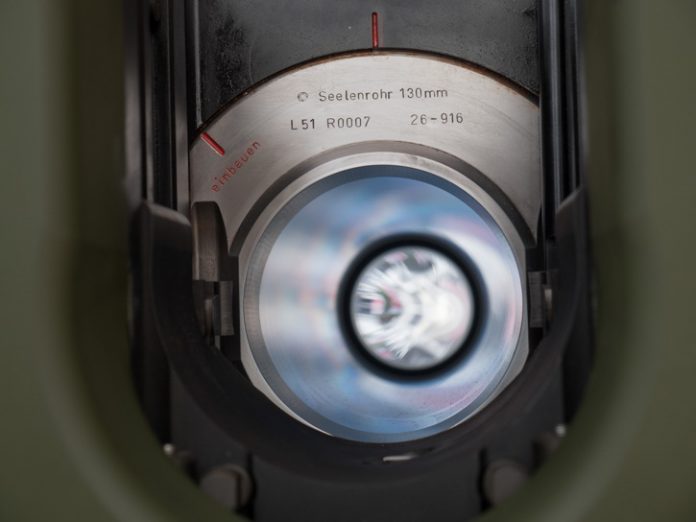
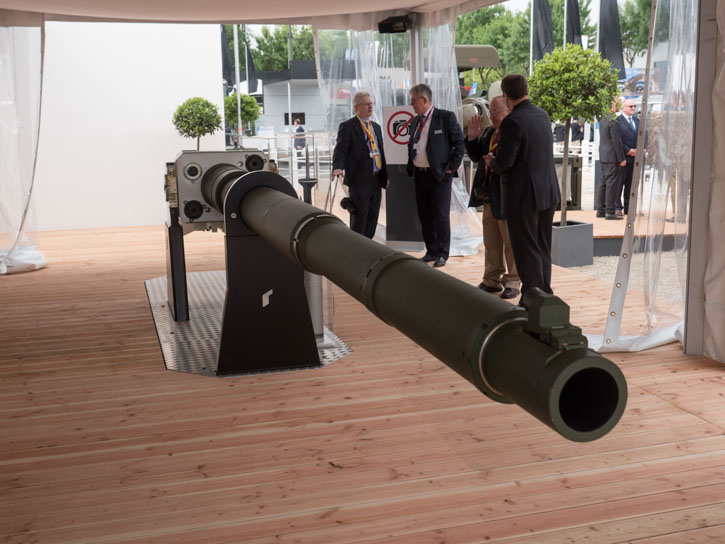
The new 130 mm gun is a precondition for the future tank, known as ‘Main Ground Combat System’ (MGCS) being developed by Germany. MGCS is currently being developed by Germany and France as a future replacement for the Leopard 2 and Leclerc main battle tanks, considering the increasing threat posed by Russian systems such as the Armata (T-14) MBTs.
Rheinmetall unveiled the new weapon at Eurosatory 2016.
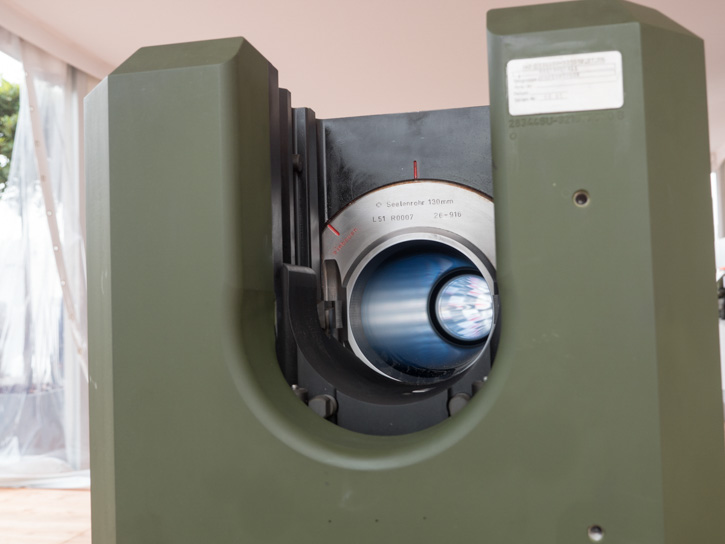
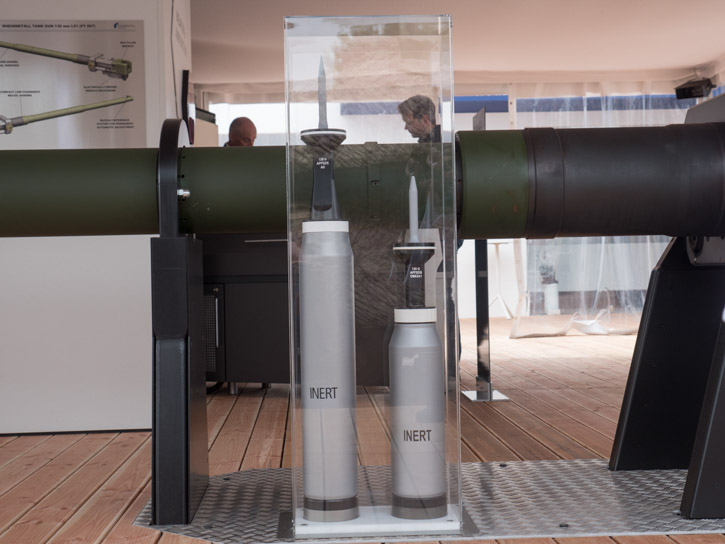
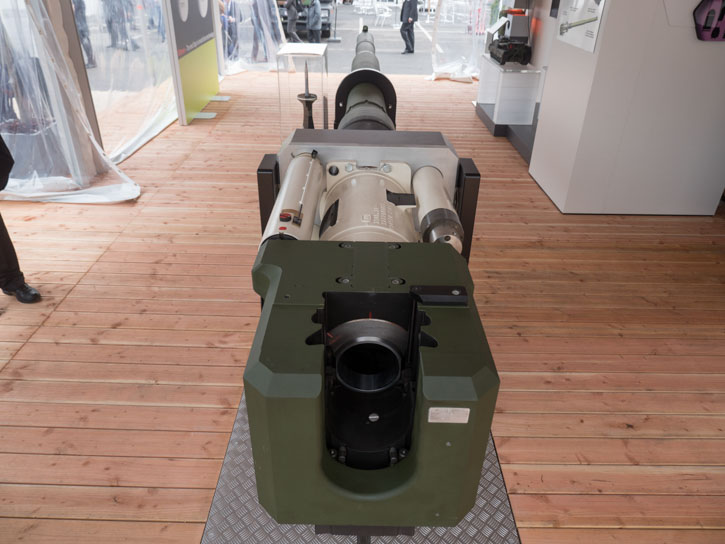
Rheinmetall unveiled the new L/51 130mm tank gun currently undergoing company testing. The new weapon provides 50 percent improvement in performance, over the current 120 mm cannon. It is intended for use in a new class of main battle tanks. Photo: Noam Eshel, Defense-UpdateThe new cannon is designed for integration in new main battle tanks. It has a vertical sliding breech mechanism and increased chamber volume handling larger, more energetic kinetic ammunition. The breech mechanism with the recoil system weighs about three tons. The barrel weighs 1,400 kg and has chrome lined smooth bore. Photo: Noam Eshel Defense-UpdateNew ammunition designed for the L/51 cannon include high performance kinetic rounds – Armor Piercing Fin Stabilized Discarding Sabot – (APFSDS), and high explosive, air-bursting munitions (HE-ABM). Both are derived from existing types designed for the L44/55 120mm guns. Photo: Noam Eshel, Defense-UpdateThe breech, and recoil mechanism of the new L/51 130mm cannon. Photo: Noam eshel, Defense-Update
ThunderB small tactical UAS. Photo: BlueBird Aerosystems
Four unmanned systems developers from Israel are introducing new versions of Small Tactical Unmanned Aerial Systems (STUAS) at Eurosatory, addressing the growing interest in tactical UAS among military forces worldwide.
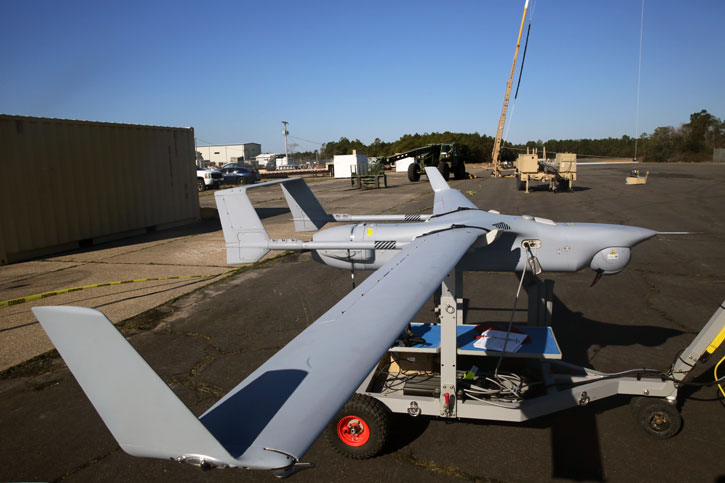
An RQ-21A Blackjack belonging to Marine Unmanned Aerial Vehicle Squadron 2 sits on the flight line of Marine Corps Outlying Field Atlantic, March 21, 2014. The Blackjack is eight feet long with a wing span of 16 feet and can hold payloads up to 25 pounds. U.S. Marine Corps photo by Lance Cpl. Joshua R. HeinsThis new category was pioneered by Boeing InSitu with the RQ-21 Blackjack drone developed for the US Marine Forces. The Blackjack offers a platform significantly lighter and agiler than the current RQ-7B Shadow. With a catapult launched system that has a Gross Takeoff Weight (GTOW) of 61 kg (135 lbs.) that carries 18 kg (39 lbs) of payloads which currently are limited to a small range of EO/IR sensors. Future systems will also include wide area surveillance, radar, and electronic monitoring.
The Skyhook, a unique retrieval system used by the Blackjack enables recovery of RQ-21A drones anywhere on land and at sea, without dependence on a landing strip. The drone can stay airborne for 16 hours at a service ceiling of 19,500 ft.
Despite its operational versatility, the RQ-21A is quite limited in its mission configurations, as it is dependent on specific payloads to carry out its tasks.
Watch the playlist of all four platforms above.
Smaller and lighter tactical drones that have evolved in Israel in recent years support such capabilities. Most systems weigh about half the weight of the Integrator; the latest versions are capable of fulfilling most of the missions carried by the new US drone.
The Orbiter 3, an electrically powered UAV developed by Israel’s Aeronautics Systems, is available in two variants that pioneered the STUAS category – a platform that can deploy and operate at the battalion and brigade level, perform missions at altitudes of 5,000 – 10,000 ft. for several hours and carry payloads weighing up to 10 pounds.
The Orbiter 3, an electrically powered UAV developed by Israel’s Aeronautics Systems, is available in two variants that have pioneered the STUAS category – a platform that can deploy and operate at the battalion and brigade level, perform missions at altitudes of 5,000 – 10,000 ft. for several hours and carry payloads weighing up to 10 pounds. Electrical propulsion provides the drone acoustic stealth capability, particularly at night, when the familiar signsture of piston-engines is clearly heard.
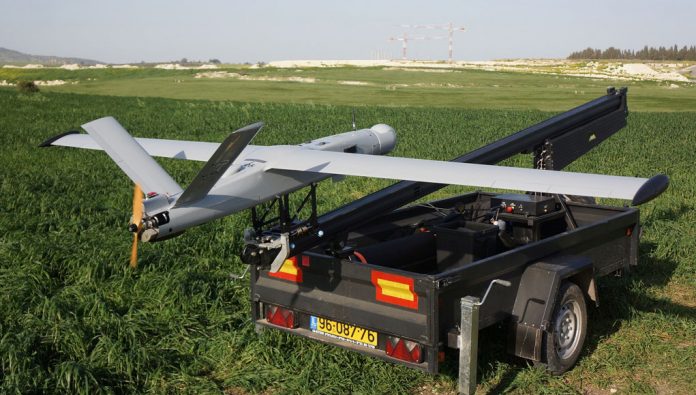
Israel showcases not less than four new or upgraded drones designed for the STUAS category. Four companies – IAI, Elbit Systems, Aeronautics, and BlueBird Aerosystems, display such platforms. All have roughly the same dimensions (about four-meter wingspan), weighing 30-40 kg.
All Four systems presented by the Israeli companies are launched from a catapult and retrieved by parachute and airbag cushion.
All reflect recent redesigns aimed to better position these platforms to address new requirements that evolve from the intensive hybrid warfare events that are shaping modern military operations.
The similar dimensions derive from the sensors these drones are designed to carry – stabilized, multi-sensor EO/IR payloads weighing 3-5 kg, electronic monitoring packages, and RF jammers, weighing up to one kilogram each, are all designed to support the potential missions of such platforms.
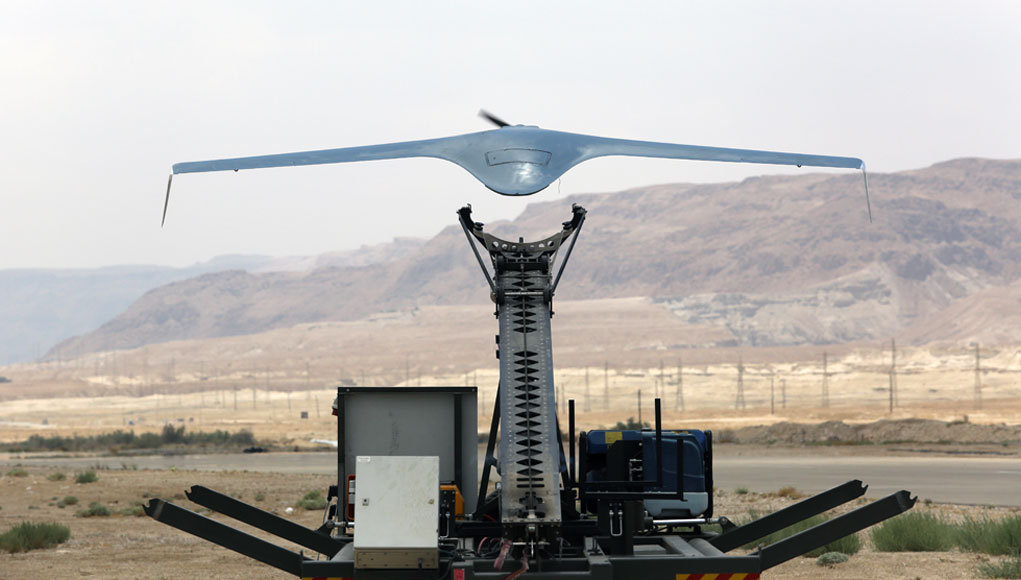
Elbit Systems’ Skylark 3 electrically powered mini-tactical UAS. Photo: Elbit SystemsElbit Systems is introducing at Eurosatory 2016 a new, electrically powered version of its Skylark 3, Mini-Tactical UAS. While the company’s current Skylark 1-LEX often operated at the battalion level, the larger and more robust Skylark 3 is designed to serve the brigade. With GTOW of 40 kg, the new drone can carry multiple payloads of up to 10 kg (22 lbs) in weight. This electrically-powered platform can sustain a mission of up to six hours, at an operating ceiling of 15,000 ft.; the Skylark 3 can operate at a range of 100 km. Typical sensors carried by the Skylark 3 include EO/IR day/night payloads, electronic monitoring (ELINT) and communications intelligence (COMINT).
Aeronautics Systems had fielded its version of Mini-Tactical drone – the Orbiter 3. This drone has evolved through the development process, and is currently in the Orbiter 3B version, an electrically powered flying wing, with a gross takeoff weight of 30 kg, carrying payloads up to 5.5 kg weight. The remaining payload is reserved for batteries, providing an endurance of 7 hours. To extend its mission Aeronautics developed the Orbiter 3LE and Orbiter 4, powered by internal combustion engines. Orbiter 4, currently in development, will have a GTOW of 50 kg, and operating ceiling of 18,000, enabling line-of-sight control beyond 250 km and mission endurance beyond 24 hours.
IAI’s BirdEye 650 also began its way as an electrically-propelled platform. Shifting to internal combustion gasoline engine, IAI squeezed more endurance form its newly designed BirdEye 650D, a flying wing shaped STUAS that weighs 30 kg on takeoff.
The BirdEye 650D, designed for military and paramilitary intelligence, surveillance and reconnaissance (ISR) can conduct autonomous missions including point takeoff, point recovery, at an altitude of 15,000 ft.; the drone can operate at ranges of up to 150 km and endurance of more than 15 hours.
Designed to support mobile land forces the ‘650D operates from a dedicated vehicle that packs all the support systems required for operation, including multiple packed drones, launch rail, communications link and operator controls. IAI designed it as a generic platform that can quickly reconfigure with different payloads of up to 5.5 kg weight, including electro-optical gimbaled payloads covering different spectral bands, and Passive RWR/RWL electronic countermeasures (ECM). Bird Eye 650D can conduct precision electronic warfare by deploying communications jamming (COMJAM) close to the enemy, thus minimizing interference with friendly forces.
The latest Israeli entry in the Small, Tactical UAS category is the ThunderB from BlueBird Aerosystems – the most recent upgrade implemented with this drone made the thunder the first Israeli STUAS to achieve the goal of 24-hour operation with such small platform. The small drone has already passed its first combat test in April, during hostilities that erupted between Armenia and Azerbaijan. One of the ThunderB drones operated by the Azeri side crashed and fell into Armenian hands, thus revealing its use in the Caucasus.
“We have developed the ThunderB in response to the need for a field-launched, long-range, long-endurance UAS, capable of complex missions that, until now, required the use of significantly larger platforms, logistical footprint, and higher life-cycle-cost.” Said Mr. Ronen Nadir, Bluebird’s CEO. The ThunderB, with its automatic field launch by a small pneumatic launcher and automatic field recovery utilizing a parachute and an airbag, can be deployed and operated from a small vehicle or trailer, eliminating the need for costly infrastructure such as runways, hangars, etc.
The ThunderB’s extended mission range to 150km and endurance of 24h to enable around-the-clock support for tactical ground forces. Such functions can provide forward observer, pre-mission Intelligence collection, persistent surveillance, and Battle Damage Assessment (BDA).
ThunderB is a tactical-sized UAS, weighing 28kg, with a wingspan of 4m, undetectable to the naked eye even when cruising at altitudes as low as 3000 ft. The system’s unprecedented reliability and endurance are based on an advanced computerized electronic fuel-injected (EFI) engine, coupled with multiple system redundancies throughout the UAS.
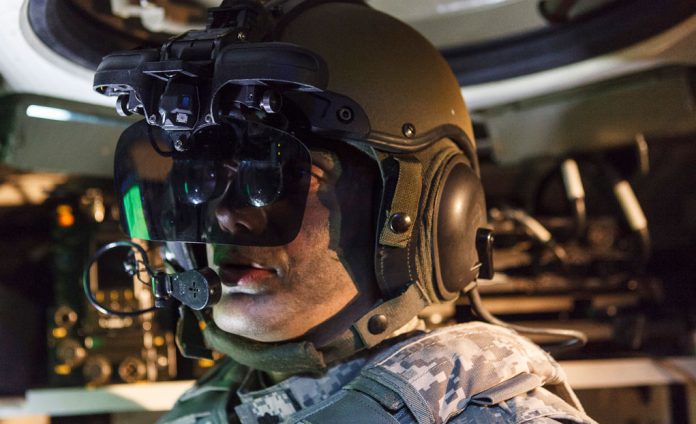
IronVision’s 360-degree, high-resolution imagery is projected in full color and zero latency to the wearer's visor, offering a bright and vivid display of the surroundings in both day and night and all types of weather. Photo: Elbit Systems
Elbit will unveil next week at Eurosatory the IronVision, the first Helmet Mounted Display (HMS) designed for crewmembers of combat vehicles. Part of the company’s See-Through Armor (STA) architecture, IronVision is a 360-degree panoramic situational awareness system that enables tank and infantry crewmen to ‘see-through’ their vehicle’s armor in real-time, creating a complete and clear visualization of the battlefield, even under close hatches.
IronVision’s 360-degree, high-resolution imagery is projected in full color and zero latency to the wearer’s visor, offering a bright and vivid display of the surroundings in both day and night and all types of weather.
The helmet support system collects information from different digital sources within and around the vehicle, displays and tracks the positions of various features of interest ranging from a single person standing or crawling several meters near the vehicle to a moving vehicle located 150–300 meters away. By using the helmet, the wearer obtains the complete freedom of movement and can shorten the sensor-to-shooter cycle, all while remaining protected, under closed hatches.
The IronVision fits all types of Main Battle Tanks (MBTs) and Infantry Fighting Vehicles (IFVs).
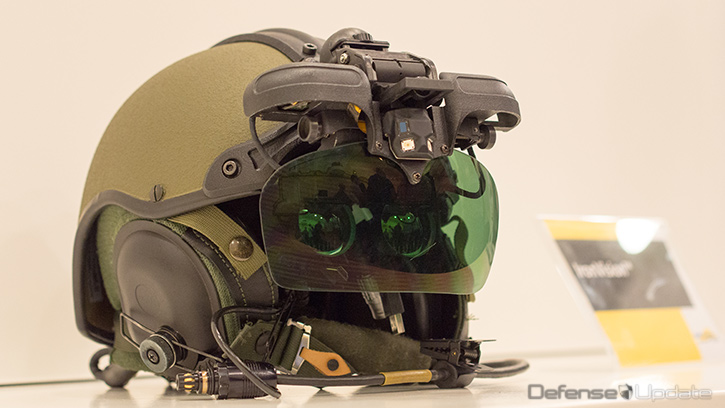
Elbit Systems IronVision Helmet. Photo: Noam Eshel, Defense-Update
The new HMS is based on the proven sensors and system architecture that is already integrated with thousands of fixed and rotary-wing aircraft HMSs, systems that are being used by most modern air forces worldwide. IronVision incorporates advanced See-Through Armor (STA) technology that lets wearers ‘see through’ the armor of their vehicle to obtain full, real-time, Situational Awareness (SA) through which they can locate, identify and track enemy forces or capabilities.
Through its user-friendly interface, IronVision leverages the digital infrastructure of the vehicle by seamlessly integrating STA technology with existing C4I and warning systems, which creates a powerful cognitive simplifier for the commander, enabling him to make complex situation-dependent decisions within split seconds, and also leads to more freedom and fewer distractions for the driver.
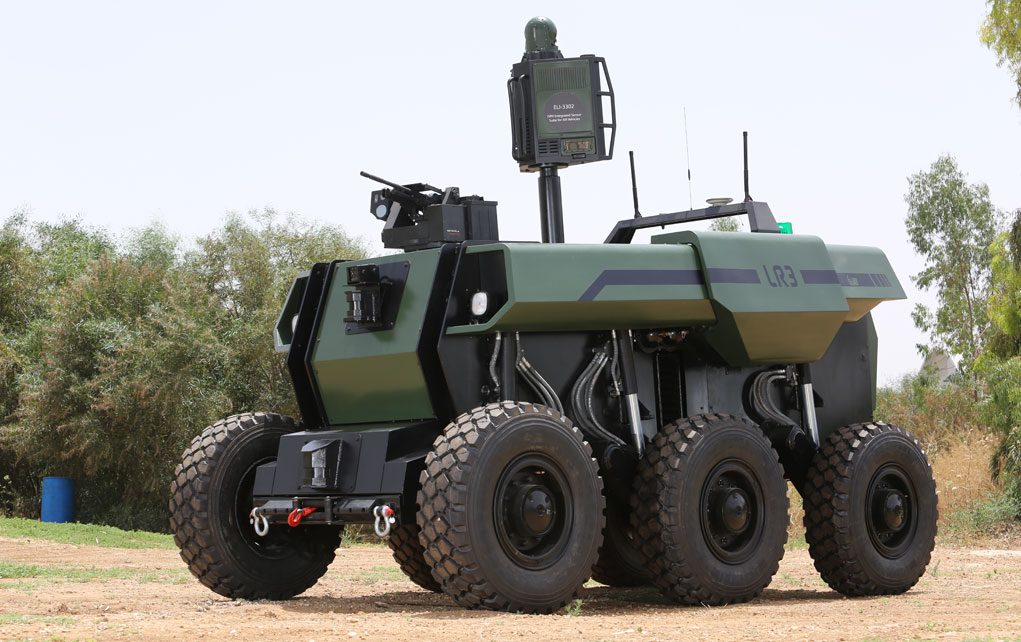
IAI is introducing the RoBattle, a new combat robot it has developed. A member of a growing family of Unmanned Ground Vehicles (UGV) that evolved from the company’s robotics center in recent years. RoBattle will make its debut at the Eurosatory exhibition in France next week.
Designed for modern ground combat, RoBattle is built to operate independently or to support manned formations with the most dangerous, extreme tasks that soldiers had to do before. Performing armed scout and advance guard, ambush and attacks that ‘stimulate the area’, or penetrate deep into contested areas, including deception (acting as a decoy), RoBattle formations are also designed to gather intelligence and surveillance covertly, and assist convoy protection.
The combat ready RoBattle has a vehicle gross weight of seven tons, including three tons of payload. The diesel powered 6×6 articulated vehicle can also use tracks for improved all-terrain mobility.
As a combat-ready platform, RoBattle is designed to survivability to endure battle damage, provided with protection and redundancy for sensitive areas. The robot carries the ultra-light Pitbull – Remote Weapon Station (RWS) developed by General Robotics. The Pitbull weighs only 50 kg, and includes a set of sensors enabling operations in day, night and under limited visibility conditions,, providing the carrying platform advanced situational awareness and hostile fire indication, enabling the robot to respond effectively, in few seconds to threats around it, by maneuvering, deploying countermeasures or suppressive fire.
General Robotics’ Pitbull Remote Weapon Station (RWS) weighs only 50 kg, and includes a set of sensors enabling operations in day, night and under limited visibility conditions, providing the carrying platform advanced situational awareness, enabling the robot to respond effectively, in few seconds to threats around it. Photo: Noam Eshel, Defense-Update
Other mission payloads include the Black Granite sensor sets, collecting battlefield intelligence (imaging sensors, radar, and COMINT), counter-IED systems that can detect explosive charges from a distance, manipulator arms handling such explosives, etc. The system builds around a new, modular robotic kit developed by IAI that comprises the vehicle control, perception means (sensors, including real-time mapping), navigation and path planning, mission management and decision support that are essential for the system’s autonomy. The system can be operated autonomously in several levels and be configured with wheels or tracks, to address operational needs.
Operators can equip RoBattle with different payloads including manipulator arms, Intelligence, Surveillance and Reconnaissance (ISR) sensors and radars, and remotely controlled weapons.
The system is designed to be integrated with tactical forces in mobile, dismounted operations and supports a broad range of missions including intelligence, surveillance, and armed reconnaissance; convoy protection, decoy, and ambush and attack.
The system design follows an open, modular ‘robotic kit’ methodology that enables the manufacturer and user to tailor the robot for various mission and system configurations. IAI equipped their new robot with advanced military-standard LTE network (Tac4G) providing consistent communications coverage across a wide area, with broadband connectivity supporting both control and sensor feeds. RoBattle is controlled from a tactical controller that is carried by operators operating from armored vehicles or dismounted. The operating console supports training mode, enabling affordable operator training and skills maintenance.
The new robot is the newest member of the growing family of Unmanned Ground Robotics Systems from IAI.
The RoBattle LR-3 is seen here configured with battlefield intelligence collection payload comprising ground surveillance radars and electro-optical payload. This kit operates independently from the weapon station and platform’s sensors, maintaining the platform’s autonomous control. Photo: IAI
Lockheed Martin Skunk Works® and XTEND have achieved a major milestone in JADC2 by integrating the XOS operating system with the MDCX™ autonomy platform. This technical breakthrough enables a single operator to simultaneously command multiple drone classes, eliminating the friction of mission handoffs. From "marsupial" drone deployments to operating in GPS-denied environments, explore how this collaboration is abbreviating the data-to-decision timeline and redefining autonomous mission execution.
As traditional defense primes face mounting competition from agile “neoprimes” such as Anduril, Palantir and Helsing, the balance of innovation is shifting toward software-defined warfare and scalable, dual-use technologies, while global industry consolidation—marked by Boeing’s integration of Spirit AeroSystems and other strategic mergers—signals an intensified race to secure control over the defense technology value chain. Our Defense-Tech weekly report highlights these trends.
In early October 2025, a coordinated wave of unmanned aerial system (UAS) incursions—widely attributed to Russia—targeted critical infrastructure across at least ten European nations. The unprecedented campaign exposed the fragility of Europe’s air defenses...
Executive Summary
The past week (September 18-25, 2025) represents an inflection point where strategic defense concepts have transitioned from doctrine to tangible reality. An analysis of global events reveals four primary, interconnected trends shaping an...
At the 2025 Air, Space & Cyber Conference, U.S. Air Force and Space Force leaders unveiled major updates on next-generation fighters, bombers, unmanned systems, and space initiatives, highlighting both rapid innovation and critical readiness challenges as the services race to outpace global competitors. A short version is available here, with a more detailed version for subscribers.
The Taipei Aerospace & Defense Technology Exhibition (TADTE) 2025 crystallized around four dominant strategic themes that collectively illustrate Taiwan's comprehensive approach to defense modernization amid escalating regional tensions. Based on a detailed report by Pleronix (available upon request). Includes a Podcast discussion on TADTE 2025's highlighting Taiwan's four strategic themes beyond the post's coverage.
Israel’s Iron Beam 450 high-power laser system has completed final testing, marking a major leap in air defense. Developed by Rafael, it offers precise, cost-effective interception of rockets, UAVs, and mortars, and is set for IDF deployment by 2025.