Thursday, December 25, 2025
More
    Home Blog Page 107

    A miniature drone made of styrofoam help protects airbases in Afghanistan

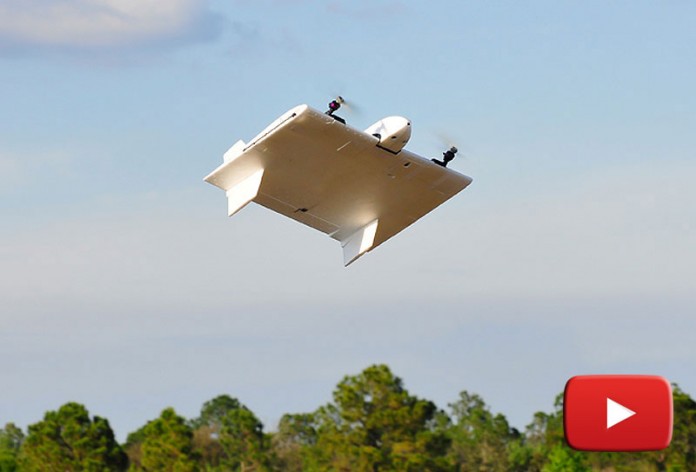
    Designed to operate by the soldiers in the field, Skate is   simple to assemble, operate and repair. Operation is autonomous and intuitive, with the vehicle managing all flight control functions autonomously. Photo: Aurora
    Designed to operate by the soldiers in the field, Skate is simple to assemble, operate and repair. Operation is autonomous and intuitive, with the vehicle managing all flight control functions autonomously. Photo: Aurora Flight Sciences

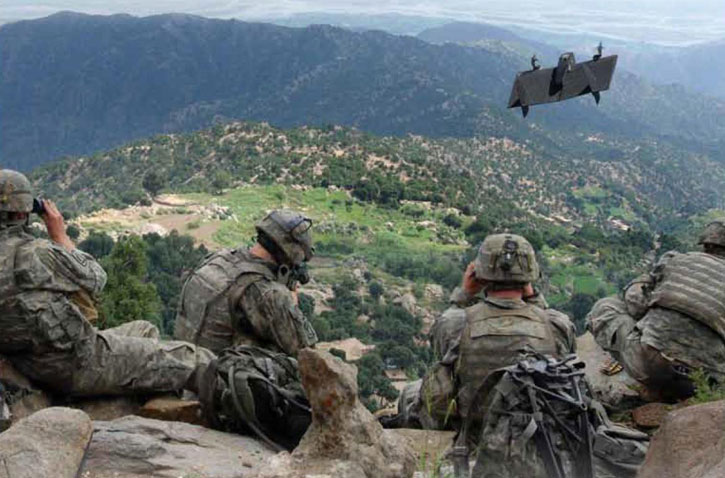
    The Skate Small UAV has recently completed an evaluation with US Air Force expeditionary forces in Afghanistan, providing ‘situational awareness’ around Afghan villages close to US bases, without human presence. The Skate, developed by Aurora Flight Sciences Corporation as portable, man-portable system designed for field operation. “Skate is a force multiplier that provides the warfighter with immediate eyes-on-target and real-time situational awareness” said Douglas Szczublewski, the Air Force program manager.

    A Skate system comprises two electrically-powered air vehicles made of Expanded Polypropylene (EPP) styrofoam stored folded in the carrying case, payload modules including streaming video or infrared infrared imaging sensors, batteries, an intuitive, hand-held user interface and the a sling enabling hand-launching from confined areas. A variant of the system also offers a capture hook for automated launch and recovery and charging from power sources on the ground.

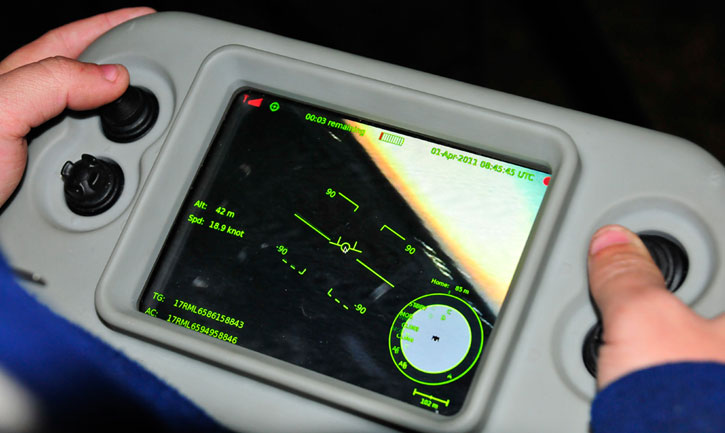
    In addition to autonomous missions Skate's flight can also be controlled by the operator, using the hand held monitor. Photo: Aurora
    In addition to autonomous missions Skate’s flight can also be controlled by the operator, using the hand held monitor. Photo: Aurora Flight Sciences

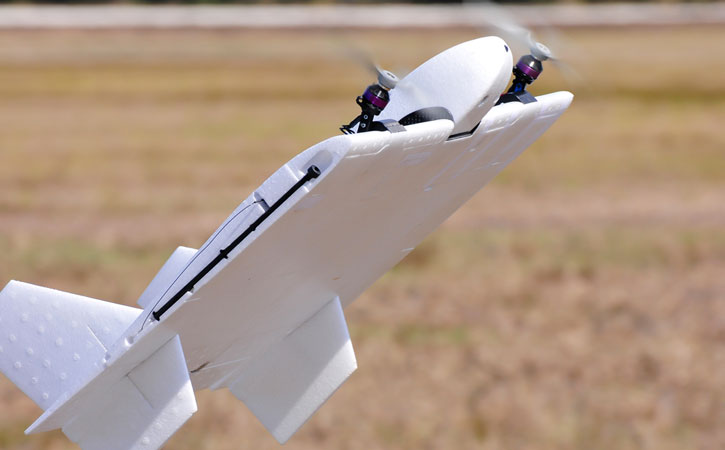
    Skate’s unique capability to autonomously manoeuvre and navigate in urban or crowded environments enables this lightweight air vehicle to deliver long endurance on quiet electric power. By using articulating motor pods Skate merges the simplicity and endurance of a fixed wing platform with the manoeuvrability and mission flexibility of a vertical take off and landing (VTOL) asset.

    GoldsidebarMore coverage available to members.

    skate725
    Independently articulating motor pods allow the Skate UAS to rapidly transition between vertical and horizontal flight. Transferring from hovering to wingborne flight increases the endurance and range of the system to levels characteristic of a fixed wing platform and far beyond those of a traditional VTOL asset. It is also key to the drone’s manoeuvrability in confined spaces and urban environment. Photo: Aurora Flight Sciences

    US Navy demonstrates carrier-based manned-unmanned cooperation

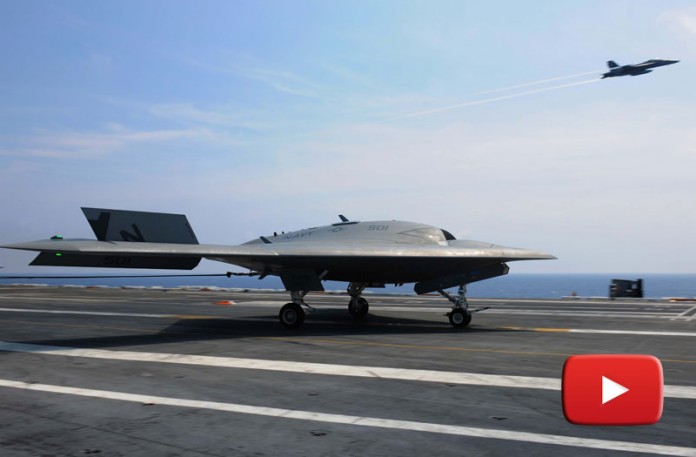
    "The X-47B's air vehicle performance, testing efficiency and safety technologies and procedures developed and tested throughout the program's execution have paved the way for the Navy's future carrier-based unmanned system capability," Rear Adm. Mat Winter, PEO for Unmanned Aviation and Strike Weapons said. Photo: Northrop Grumman by Alan Radecki
    “The X-47B’s air vehicle performance, testing efficiency and safety technologies and procedures developed and tested throughout the program’s execution have paved the way for the Navy’s future carrier-based unmanned system capability,” Rear Adm. Mat Winter, PEO for Unmanned Aviation and Strike Weapons said. Photo: Northrop Grumman by Alan Radecki

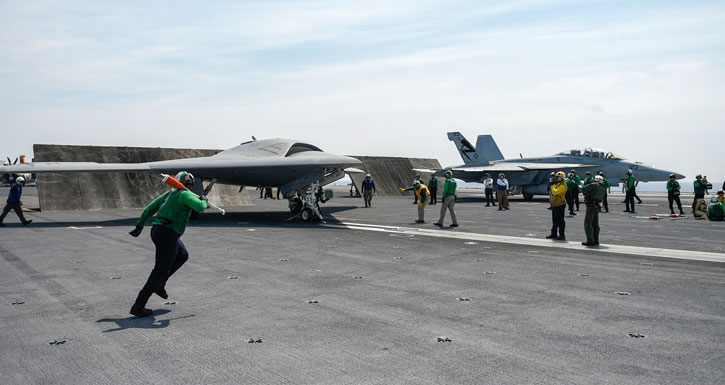
    Testing of the X-47B completed an important test series this week aboard USS Theodore Roosevelt (CVN 71). On Aug. 17, 2014 the drone demonstrated that it can operate safely and seamlessly with manned aircraft. The flights – the first time manned and unmanned carrier aircraft have operated together in the same carrier controlled landing pattern at the same time – took place in the Eastern Atlantic. They offered Northrop Grumman and the Navy an opportunity to collect data that will help reduce risks associated with integrating unmanned aircraft with conventional manned carrier operations.

    Building on lessons learned from its first test period aboard the Roosevelt in November 2013, the X-47B team is now focused on perfecting deck operations and performing maneuvers with manned aircraft in the flight pattern.

    Today we showed that the X-47B could take off, land and fly in the carrier pattern with manned aircraft while maintaining normal flight deck operations. This is key for the future Carrier Air Wing.

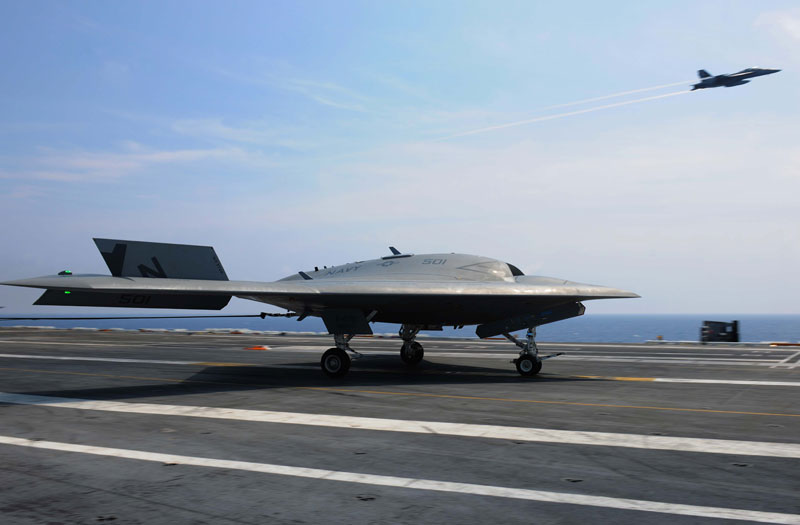
    Demonstrating key parts of flight integration of an unmanned system into the carrier air wing, an X-47B followed an F/A-18 Hornet taking off from the carrier deck. Soon after as the two were coming to land, the Hornet flew 90 seconds behind the X-47B in all but standard carrier recovery pattern. The 90 second lapse would enable the X-47B to land, raise its hook, fold its wings and be taxied out of the landing area to clear the deck for the F/A-18 to follow, just like any other manned aircraft does.

    GoldsidebarMore coverage available to members.

    x47_landingwfa18onroosevelt800
    “Today we showed that the X-47B could take off, land and fly in the carrier pattern with manned aircraft while maintaining normal flight deck operations. This is key for the future Carrier Air Wing.” Capt. Beau Duarte, program manager for the Navy’s Unmanned Carrier Aviation office. Photo: US Navy by Alex Millar

    US Army, Lockheed Martin Test Collaborative Robotics at Ft Benning

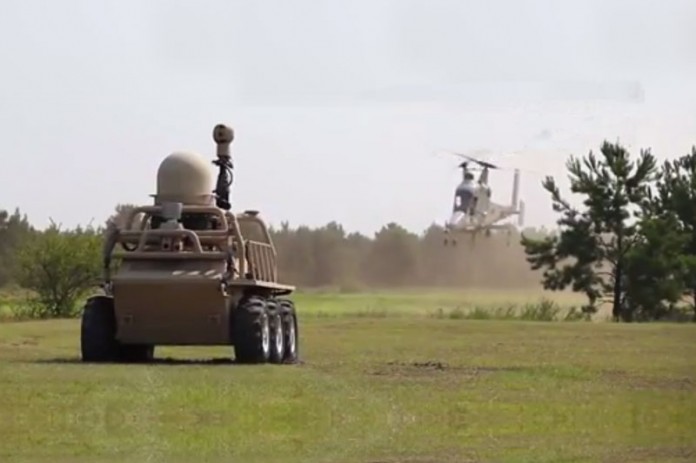
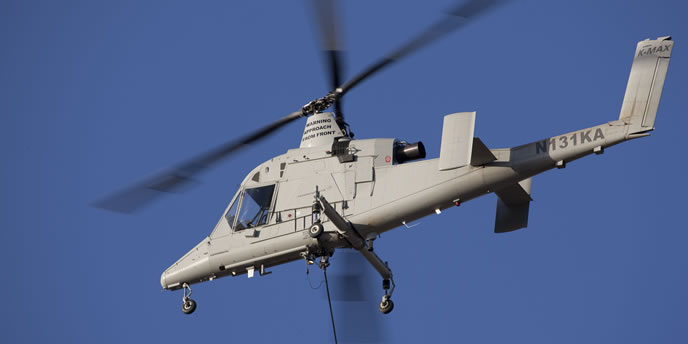
    The autonomous K-MAX unmanned helicopter  will provide air transportation for the UGV, which will independently continue the mission relying on its integral sensors and situational understanding. Photo: Lockheed Martin
    The autonomous K-MAX unmanned helicopter will provide air transportation of the UGV and will also provide an aerial watch of the target area. Photo: Lockheed Martin

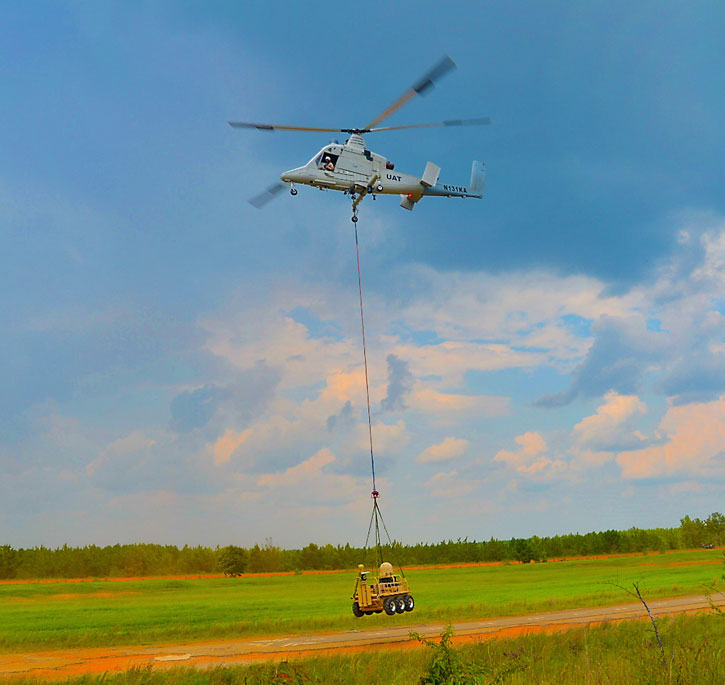
    An SMSS carrying SATCOM and mast-mounted Gyrocam M9 stabilized EO sensor sling loaded by KMAX unmanned helicopter (the safety pilot is seated in for emergency only) Photo: Lockheed Martin
    An SMSS carrying SATCOM and mast-mounted Gyrocam M9 stabilized EO sensor sling loaded by KMAX unmanned helicopter (the safety pilot is seated in for emergency only) Photo: Lockheed Martin

    The U.S. Army Robotics Technology Consortium has funded a test employing an unmanned ground vehicle (UGV) and unmanned aerial system (UAS) tasked to perform a combined,  autonomous reconnaissance, surveillance and target acquisition (RSTA) mission. The ‘Extend the Reach of the Warfighter through Robotics’ (ERWR) demonstration that took place at Ft Benning GA on August 7 joined two systems produced by Lockheed Martin – the Squad Mission Support System (SMSS) acting as the ground segment and the K-MAX unmanned air vehicle providing the aerial segment.

    “Fully autonomous capabilities as we’ve just demonstrated will allow service members to focus on important missions and remain out of harm’s way,” said Scott Greene, vice president of Ground Vehicles for Lockheed Martin Missiles and Fire Control. “This successful demonstration with both unmanned air and ground vehicles shows us that these missions are not only possible, but can be available much sooner than you would expect.”

    According to Joe Zinecker, director of combat maneuver systems at Lockheed Martin Missiles and Fire Control added that the technology demonstrated in the tests could lead to expanded missions, such as remote sensing and monitoring of suspected chemical, biological, radiological, nuclear and explosive threats or events. “This level of mission cooperation between unmanned air and ground vehicles of this size, controlled beyond line-of-sight, is an industry first” – Zinecker added.

    During the test held at Ft Benning August 7, 2014 a K-MAX autonomous rotorcraft transported an SMSS via sling load into a simulated “area of interest” deemed too risky for human presence. The SMSS was equipped with a mast-mounted EO sensor (Gyrocam) and satellite communications (SATCOM) terminal providing the datalink. Its primary mission sensor was to deploy the mast-mounted Gyrocam EO payload for area surveillance. After deploying the UGV the The K-MAX monitored the area, positioning itself over the intended release point and autonomously set down, releasing the SMSS upon command from a remote operator.

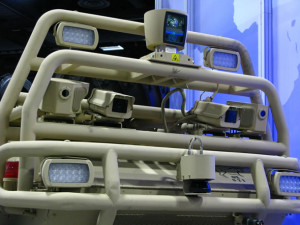
    The autonomous sensor and driving system integrated in the SMSS enables the vehicle to perform autonomous movement or respond to simple user commands. Photo: Tamir Eshel, Defense-Update
    The autonomous sensor and driving system integrated in the SMSS enables the vehicle to perform autonomous movement or respond to simple user commands. Photo: Tamir Eshel, Defense-Update

    Once delivered, the sensor-laden and satellite communications-equipped SMSS continued to assess the area using a combination of autonomous capabilities and tele-operation that was managed from a remote site, while the K-MAX returned to base.

    The demonstration followed a 2012 exercise at Camp Grayling, Mich., in which a Gyrocam-equipped SMSS, operated via satellite from more than 200 miles away, successfully conducted a simulated reconnaissance mission. In this new scenario, the Gyrocam reconnaissance, surveillance and target acquisition sensor onboard the SMSS were used to locate, observe and obtain coordinates of targets and other objects of interest. The coordinates and sensor imagery were passed back through a satellite communications system to a remote operations center hundreds of miles away for analysis.

    The current test was conducted in collaboration with the U.S. Army Tank Automotive Research, Development and Engineering Center (TRADEC).

    Two Lancaster Bombers fly together for first time in 50 years

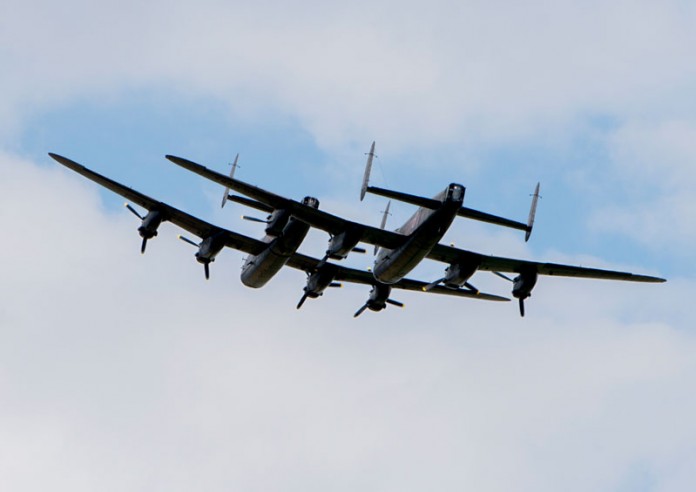
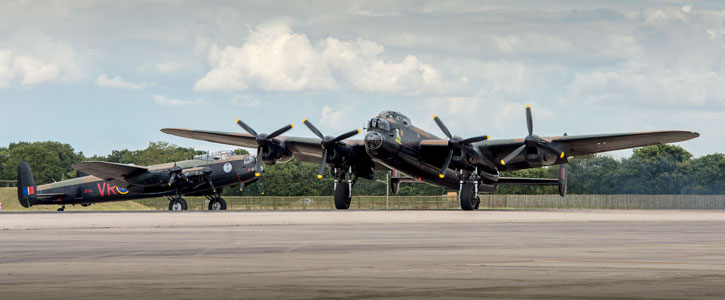
    The Lancaster “Thumper”, which is part of the RAF Battle of Britain Memorial Flight has been joined by the Canadian Lancaster “Vera” from the Canadian Warplane Heritage Museum in Ontario. Photo: UK MOD Crown Copyright
    The Lancaster “Thumper”, which is part of the RAF Battle of Britain Memorial Flight has been joined by the Canadian Lancaster “Vera” from the Canadian Warplane Heritage Museum in Ontario. Photo: UK MOD Crown Copyright

    At RAF Coningsby in Lincolnshire two Lancaster Bombers took to the skies today for the first formation flight of this aircraft type since the 1960s. Stay tuned for a video coverage of this historic flight, aired later tonight on Defense-Update.

    The two Lancasters will visit some 60 air shows and public events across the UK over the next 5 weeks.

    The two Lancasters will visit some 60 air shows and public events across the UK over the next 5 weeks and today’s flying was in rehearsal for tomorrow’s first public engagement at the Bournemouth Air Show this weekend. Photo: UK MOD Crown Copyright
    The two Lancasters will visit some 60 air shows and public events across the UK over the next 5 weeks and today’s flying was in rehearsal for tomorrow’s first public engagement at the Bournemouth Air Show this weekend. Photo: UK MOD Crown Copyright

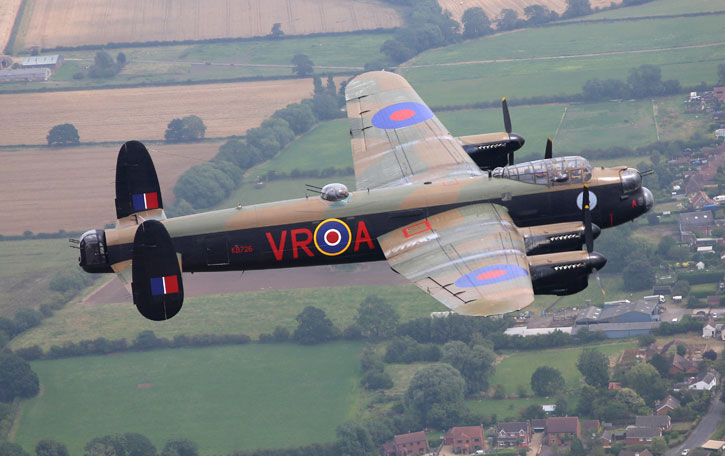
    Although 7,377 Lancaster aircraft were produced between 1941 and 1946, only two remain airworthy. One (a Mk 1 nicknamed ‘Thumper’) is maintained by the RAF’s Battle of Britain Memorial Flight (BBMF), and the other is the Mk X, maintained by the Canadian Warplane Heritage Museum (CWHM) in Ontario, the Canadian aircraft is dubbed “Vera” for its markings “V-RA”.

    “Thumper” and “Vera” will visit some 60 air shows and public events across the UK over the next 5 weeks. Today’s flying was in rehearsal for tomorrow’s first public engagement at the Bournemouth Air Show this weekend.

    The Lancaster MK X "VRA" is one of two Lancaster bombers that remain in airworthy condition today. The bomber, maintained by the Canadian Warplane Heritage Museum flew a cross atlantic flight from Ontario to Coningsby, Lincolnshire in the UK, to join the Battle of Britain Memorial Flight MK I on a five week road show in the UK. Photo: MOD, Crown Copyright.
    The Lancaster MK X “VRA” is one of two Lancaster bombers that remain in airworthy condition today. The bomber, maintained by the Canadian Warplane Heritage Museum flew a cross atlantic flight from Ontario to Coningsby, Lincolnshire in the UK, to join the Battle of Britain Memorial Flight MK I on a five week road show in the UK. Photo: MOD, Crown Copyright.

    Based on ‘Night Bombers’ documentary, this edited video describes a mission flown by Lancaster bombers in WWII.

    US Navy to test powerful, mobile laser weapon against drones

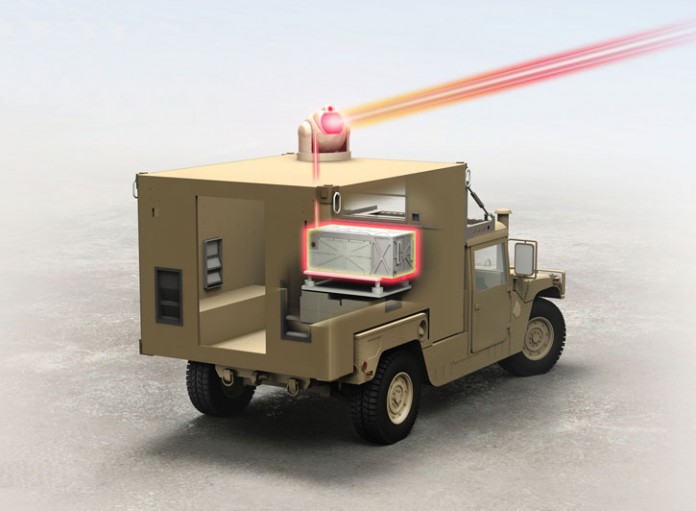
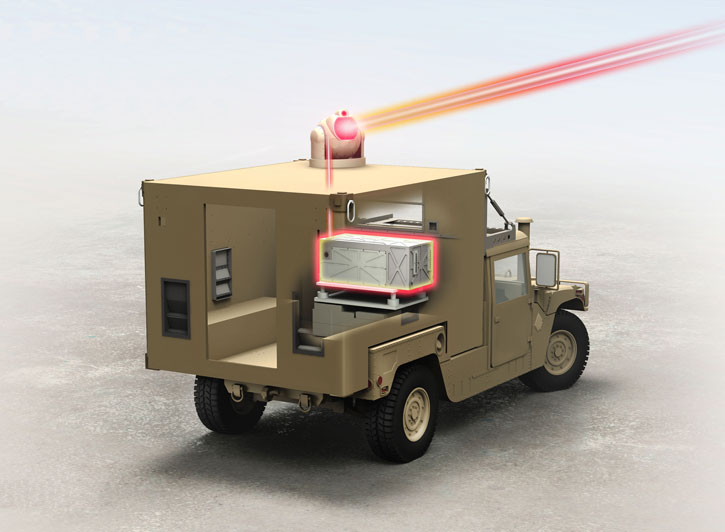
    The Ground Based Air Defense (GBAD) Directed Energy On-the-Move Future Naval Capabilities program calls for a field demonstration of a Humvee-mounted short-range laser weapon system with a minimum power output of 25kW. The Raytheon-built laser will be packaged to meet the U.S. Marine Corps' demanding size, weight and power requirements. Illustration: Raytheon
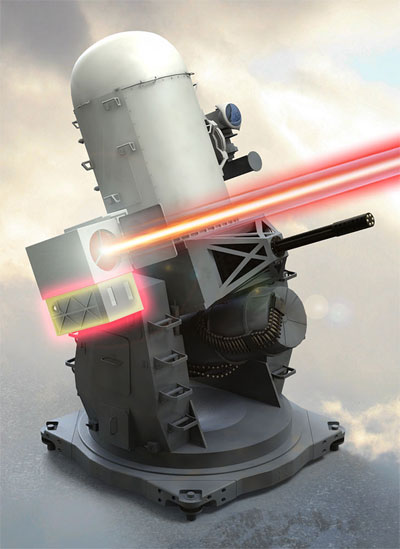
    Raytheon's laser architecture is implemented in a number of directed-energy weapon applications, including the Laser-Phalanx derivative of the classic naval Close-In Weapon System. Illustration: Raytheon.
    Raytheon’s laser architecture is implemented in a number of directed-energy weapon applications, including the Laser-Phalanx derivative of the classic naval Close-In Weapon System. Illustration: Raytheon.

    The US Navy Office of Naval Research has awarded Raytheon US$11 million adapt a tactical laser weapon systems to a vehicle-based laser device, capable of defeating low-flying threats such as enemy drones. For the field demonstration planned by ONR Raytheon will integrate a short-range laser weapon system on a HMMWV. When systems are fielded they are likely to deploy on the future Joint Light Tactical Vehicle (JLTV). Some of the system’s components have already been tested under the ‘Ground Based Air Defense (GBAD) Directed Energy On-the-Move Future Naval Capabilities’ program, demonstrating detection and fire control functions of the system, with the compact phased array radar detecting and tracking UAVs of all sizes. Later in the year, researchers will test the entire system against targets using a 10kW laser as a stepping stone to a 30kW laser. Raytheon will deliver a laser with a minimum power output of 25kW will be used. According to ONR, the 30kW system is expected to be ready for field testing in 2016. Tests will evaluate the complete intercept process, from detection and tracking to firing, all battle-damage assessment, all based on sensors and effectors integrated on the test vehicle.

    According to raytheon, the patented Planar Wave-Guide architecture enables the implementation of single aperture optical design; without the use of complex optical beam combining elements, delivering high beam quality, and scalability beyond 200 kW output power. The design also features efficient heat removal and thermal management capability, yielding compact size, light weight and modularity. Photo: Raytheon
    According to Raytheon, the patented Planar Wave-Guide architecture enables the implementation of single aperture optical design; without the use of complex optical beam combining elements, delivering high beam quality, and scalability beyond 200 kW output power. The design also features efficient heat removal and thermal management capability, yielding compact size, light weight and modularity. Photo: Raytheon

    “Raytheon’s laser solution generates high power output in a small, light-weight rugged package ideally suited for mobile platforms,” said Bill Hart, vice president of Raytheon Space Systems. Raytheon’s planar waveguide (PWG) technology is the key to its unique approach to high energy lasers. Using a single PWG, the size and shape of a 12 inch ruler, Raytheon high energy lasers generate sufficient power to effectively engage small aircraft. According to Hart, the technology implemented for the test is scalable to more powerful systems. “Our PWG laser architecture is scalable: we can achieve increasingly higher power levels with the same compact design we’re using for GBAD.” he said. With the proliferation of UAVs in the modern battlefield, the Marine Corps expect that units increasingly will have to defend themselves against adversaries trying to perform reconnaissance, surveillance and attack from the air by unmanned systems. According to Col. William Zamagni, head of ONR’s Expeditionary Maneuver Warfare and Combating Terrorism Department, GBAD will give the Marine Corps a capability to counter those UAV threat efficiently, sustainably and organically with austere expeditionary forces. “GBAD employed in a counter UAV role is just the beginning of its use and opens myriad other possibilities for future expeditionary forces.”

    The Ground Based Air Defense (GBAD) Directed Energy On-the-Move Future Naval Capabilities program calls for a field demonstration of a Humvee-mounted short-range laser weapon system with a minimum power output of 25kW. The Raytheon-built laser will be packaged to meet the U.S. Marine Corps' demanding size, weight and power requirements. Illustration: Raytheon
    The Ground Based Air Defense (GBAD) Directed Energy On-the-Move Future Naval Capabilities program calls for a field demonstration of a Humvee-mounted short-range laser weapon system with a minimum power output of 25kW. The Raytheon-built laser will be packaged to meet the U.S. Marine Corps’ demanding size, weight and power requirements. Illustration: Raytheon

    Valor and Defiant to race for future Army $100 Bn helicopter replacement program

    Bell Helicopters' V-280 Valor tilt-rotor aircraft
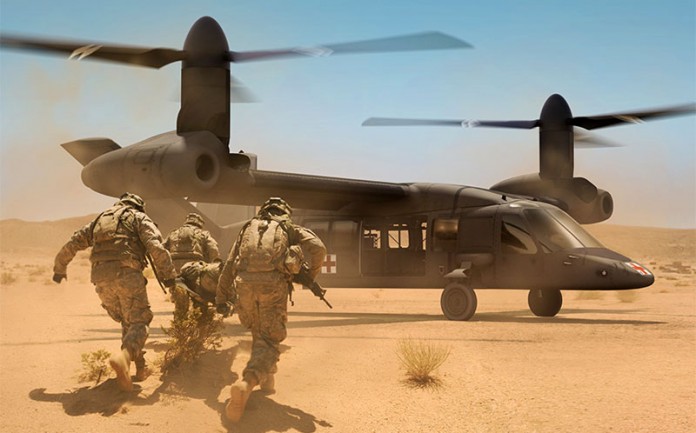
    Sikorsky and Boeing will develop the Defiant, utilizing the X2 technology, combining counter-rotating rotor design with pusher prop providing the forward speed. Photo: Tamir Eshel, Defense-Update
    Sikorsky and Boeing will develop the Defiant, utilizing the X2 technology, combining counter-rotating rotor design with pusher prop providing the forward speed. Photo: Tamir Eshel, Defense-Update

    The US Army has selected two contractors to design and build future helicopters under the service Joint Multi-Role Technology Demonstrator JMR-TD). The two contractors selected for the Phase I stage of the program are Bell Helicopters with the V-280 Valor tilt-rotor design and the Sikorsky-Boeing team, that will develop a future multirole helicopter based on the SB>1 defiant. First flights of these new demonstrators are expected in 2017. Two of the smaller bidders – AVX that offered the compound helicopter, and Karem Aircraft optimum-speed tilt-rotor, were both eliminated.

    The Defiant aircraft will feature counter-rotating rigid main rotor blades for vertical and forward flight, a pusher propeller for high-speed acceleration and deceleration and an advanced fly-by-wire flight control system. According to Sikorsky, The Defiant aircraft packages evolutionary technologies in a new, innovative and affordable design that flies faster, farther and with more payload.

    “Defiant will use Sikorsky’s proven X2 technology to overcome aircraft design challenges, which will be critical requirements on future vertical lift aircraft,” said Mick Maurer, Sikorsky president. “The Sikorsky-Boeing team’s integrated approach has created a unique blend of expertise, innovative spirit and customer commitment that are unmatched in the industry. The complementary capabilities of each team member have delivered a design that will provide the best future vertical lift solution to the U.S. Army, and the flexibility of our design makes it suited for naval applications as well. This is a major leap forward.”

    The V-280 Valor builds upon Bell’s proven tiltrotor technology which delivers high speed and agility to perform a multitude of missions. Bell Helicopters is proposing the Bell V-280 as a ‘clean-sheet design’, which reduces complexity and improves reliability, maintainability and sustainability, while reducing total ownerships cost. According to Bell the helicopter is expected to fly twice as fast and reach twice the range of today’s assault helicopters. Bell has teamed with Lockheed Martin on this program. The role of Lockheed Martin will focus on integrated avionics, sensors, and weapons. Bell has invited more companies to join as team members.

    The JMR TD program supports the Department of Defense’s Future Vertical Lift (FVL) program to deliver the next generation of vertical lift aircraft with greater performance, reliability and affordability. The project is the precursor to the Army’s future helicopter platform that will be replacing some 4,000 helicopters in US military service by the 2030s. at a cost that could top $100 billion.

    Bell-360-Valor

    Global Hotspots Report – 8/2014

    RAF C-130 Hercules air dropping emergency aid over northern Iraq. Photo: Cpl Neil Bryden RAF

    Overnight the RAF has deployed three missions delivering emergency supplies to Yazidi refugees on Mt. Sinjar, in north west Iraq. The UK has put together a package of emergency humanitarian assistance to get lifesaving aid to tens of thousands of people across northern and central Iraq, who have fled ISIL militants. The humanitarian aid drops by RAF C130 aircraft, which took place early this morning, included nearly 9,000 5-litre water bottles and 816 solar lanterns. The aircraft deployed from RAF Brize Norton in Oxfordshire England. Later today the RAF dispatched a number of Tornado GR4 strike aircraft, fitted with Litening III targeting pods. They will be positioned in Cyprus, available to fly over the crisis area at short notice to provide vital intelligence to assist the delivery of the UK aid. So far, three consignments of aid, provided by the Department for International Development, have been delivered to the area by the RAF using Hercules aircraft.

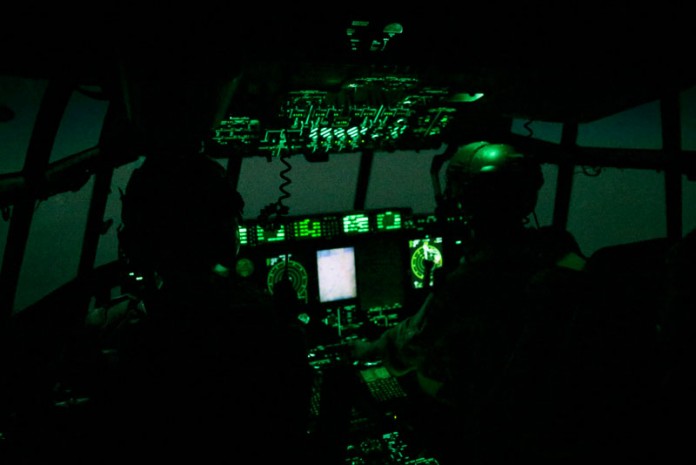
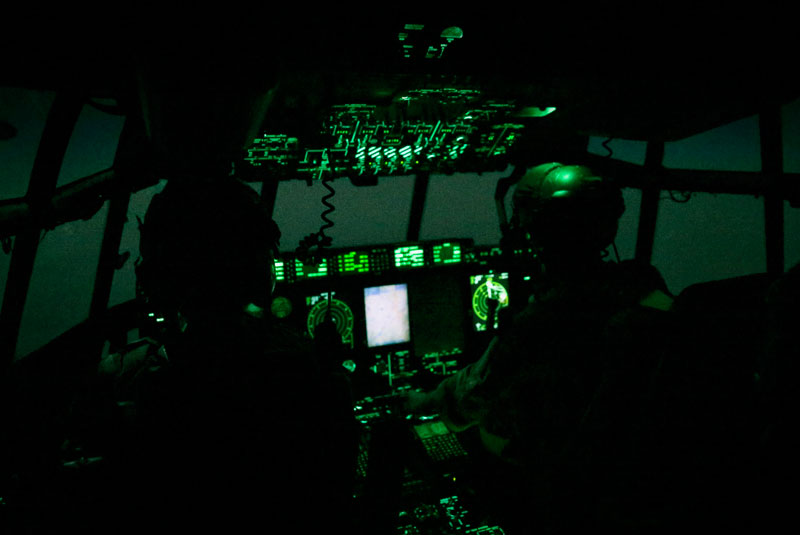
    Royal Air Force Hercules C-130J aircraft from RAF Brize Norton in Oxfordshire England carry out aid delivering humanitarian assistance to thousands of people stranded on Mt. Sinjar in Iraq. The missions performed at night involved aerial refuelling from an Royal Air Force Voyager (A330) (right photo) and a night airdrop from low altitude over the target area (left photos). The cargo delivered included jerry cans filled with clean water, tents and tarpaulins to provide basic shelter and solar lights that can also recharge mobile phones and enable communication. Photo: Cpl Neil Bryden RAF
    Royal Air Force Hercules C-130J aircraft from RAF Brize Norton in Oxfordshire England carry out aid delivering humanitarian assistance to thousands of people stranded on Mt. Sinjar in Iraq. The missions performed at night involved aerial refuelling from an Royal Air Force Voyager (A330) (right photo) and a night airdrop from low altitude over the target area (left photos). The cargo delivered included jerry cans filled with clean water, tents and tarpaulins to provide basic shelter and solar lights that can also recharge mobile phones and enable communication. Photo: Cpl Neil Bryden RAF

    RAF C-130 Hercules air dropping emergency aid over northern Iraq. Photo: Cpl Neil Bryden RAF
    RAF C-130 Hercules air dropping emergency aid over northern Iraq. Photo: Cpl Neil Bryden RAF
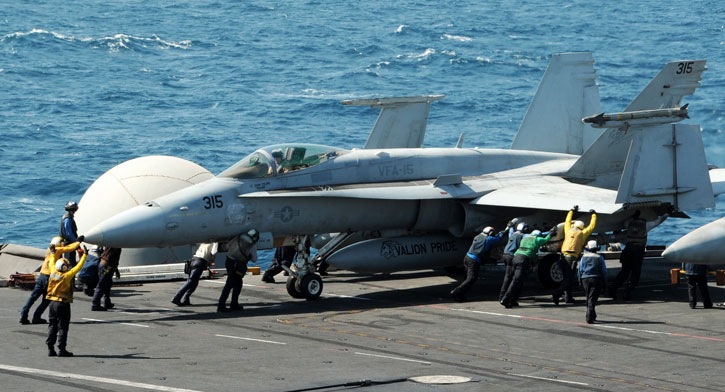
    An F/A-18E from the VFA-15 "Valions", CVN 77 George H.W. Bush prepared for takeoff on a strike mission in Iraq, August 8, 2014. The aircraft were carrying an AG/M-54 Laser JDAM laser/GPS guided bombs and Maverick guided missile. Photo: US Navy by M. Keith
    An F/A-18E from the VFA-15 “Valions”, CVN 67 G.H. Bush prepared for takeoff on a strike mission in Iraq, August 8, 2014. The aircraft were carrying an AG/M-54 Laser JDAM laser/GPS guided bombs and Maverick guided missile. Photo: US Navy by M. Keith

    The following report aggregates news abstracts covering current news from conflict areas from around the Middle East. Flip on to read the latest news items. These news items are arranged in chronological order and include related locations and maps, images or videos. Links to the sources are also provided for further reading. We are currently experimenting this format and will appreciate receiving your comments.

    August 2014 briefs: Kurds, Iraqi forces supported by US strikes take control of the Mosul dam | AQAP militants execute 14 soldiers in Hadarmout, amid sectarian fighting in Yemen | Overloaded Iraqi Mi-17 crash on a rescue mission to Sinjar | West provide air support, sending arms and advisors to assist Iraqi Kurds | ISIL regain grip of Deir el-Zor rural area in East Syria | US conducts air strikes against ISIL near Erbil | White House authorise humanitarian support to Iraqi minorities, air strikes targeting ISIS | US missile cruiser enrout to the Black Sea | 40,000 stranded on Sinjar mountain under ISIS death threats | France to speed up arms for Lebanon | Pakistan air strikes hit militants in Datta-khel, North Waziristan | US Maj. General Harold J. Greene. killed by Afghan ‘insider attack’ | Egypt, Algeria align against Libyan extremists | 32 Strike Tunnels Destroyed in Gaza | Lebanon: ISIS Takes the town of Ersal | AQAP jihadists kill 9 Yemeni soldiers | Two Terror attacks rock Jerusalem | Iraqi Air Force to assist Kurds fighting ISIS | 23 Syrians killed by barrel bombs in Idlib

    As Defense-Update has reported on the developments concerning the Islamic State in Iraq and the Levant, following is a video presentation published by “Vice News”, describing ISIL’s strategy in the Islamic State it has established and how the group is indoctrinating children and youth to fight its battles.

    Part 1 of 5

    Part 2 0f 5

    More parts to follow…

    OWL ammo will be all tracers but invisible to the enemy

    red_tracers725
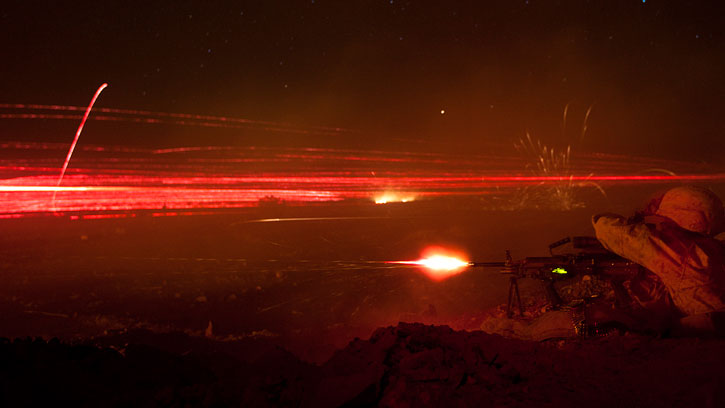
    The ultimate goal is to replace the tracer rounds with the OWL rounds and, potentially, put OWL on the back of every ball round. Since it is anticipated that OWL will be applied to all ball rounds, effectively making ball rounds trace without the need of a cavity, they will all have the same trajectory. And since the shooter can see the exact trajectory of where their round is heading, they can quickly make adjustments to get on target faster. Photo: US Army by Reece Lodder.

    Engineers at Picatinny Arsenal are researching a way to develop a tracer round that will be visible to the shooter in daylight and night time but would remain invisible to the enemy at night.

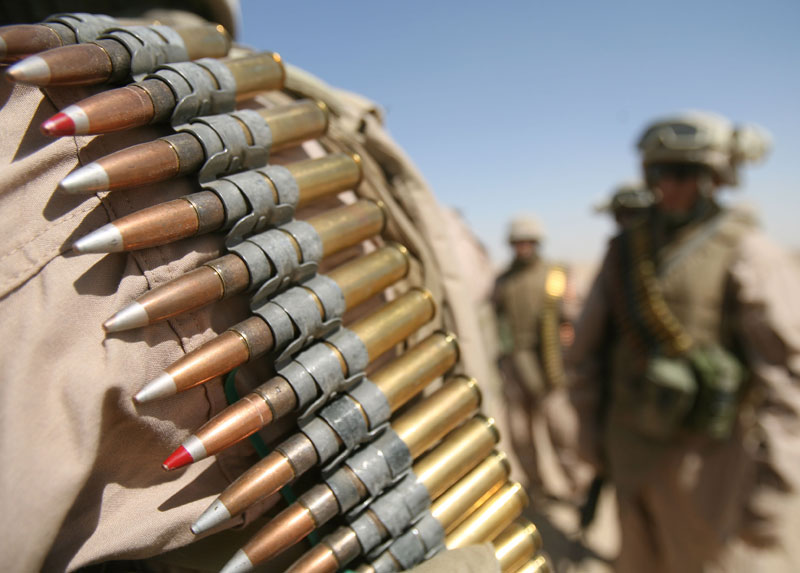
    Tracer rounds, which are usually loaded as every fifth round in machine gun belts, provide essential information to Soldiers firing at an enemy target by creating a line-of-sight that allows them to track the trajectory of their bullets and adjust their aim. However, the pyrotechnic streak they emit also gives away the shooter’s location by allowing the enemy to follow the line of pyrotechnic back to the shooter.

    The ultimate goal is to replace the tracer rounds with the OWL rounds and, potentially, put OWL on the back of every ball roun

    Current tracer projectiles have a longer jacket, in comparison to their ball projectile counterparts, in order to incorporate a cavity that is packed with pyrotechnics. As the bullet flies through the air, the pyrotechnics burn and emit a flame from the back of the round, which allows the enemy to see the shooter’s position.

    owl_tracers_inactivated725

    The One-Way Luminescence, (OWL), tracer round being developed by engineers at the Armament Research, Development and Engineering Center (ARDEC), will give only those at the shooter location the ability to see where the round is headed, without revealing their position. This will keep Soldiers safer because their location will not be observable to the enemy.

    “OWL is a technology approach that doesn’t allow an enemy target to trace back to who is firing rounds at him, even if the target is using night vision goggles,” said Christel Seitel, Quality Assurance Lead for the OWL program.

    ARDEC engineers are experimenting with a variety of potential solutions. With one of the OWL technology concepts, “we’re just putting a thin layer of material on the back of the ball round. So, instead of burning pyrotechnics, our luminescence is like a glow-in-the-dark sticker. You excite it with specific wavelengths of light. The ultimate goal is to replace the tracer rounds with the OWL rounds and, potentially, put OWL on the back of every ball round,” Seitel said.

    ARDEC scientists are currently exploring options to achieve this, looking at different coatings and materials to find a solution that satisfies the Army’s requirement to be both a day and night tracer. “Finding something that burns brighter than the sun is difficult,” Seitel said of the technology development goal. “You want to have something that’s bright enough to give you that contrast [with the background].”

    OWL is a technology approach that doesn’t allow an enemy target to trace back to who is firing rounds at him, even if the target is using night vision

    OWL is a technology approach that doesn’t allow an enemy target to trace back to who is firing rounds at him, even if the target is using night vision. Photo: US Army by Justin English
    OWL is a technology approach that doesn’t allow an enemy target to trace back to who is firing rounds at him, even if the target is using night vision. Photo: US Army by Justin English

    Because little to no material is ejected from an OWL projectile, finding a technology that meets or exceeds the light output of a current pyrotechnic tracer is extremely challenging. Current pyrotechnic trace rounds lose mass as the pyrotechnics burn, so they don’t completely mimic the trajectory of the ball rounds, which don’t lose mass. Since it is anticipated that OWL will be applied to all ball rounds, effectively making ball rounds trace without the need of a cavity, they will all have the same trajectory. And since the shooter can see the exact trajectory of where their round is heading, they can quickly make adjustments to get on target faster.

    The absence of pyrotechnic material makes the OWL manufacturing safer and less sensitive to handle in a production environment. However, there are a few OWL concepts that contain limited amounts of energetic material to try and overcome the sun’s light output. “Currently, the pyrotechnics have a separate wing in manufacturing plants due to safety concerns. But if you can just make your bullets and then paste something on the back, you won’t have the costs of special handling.” Seitel said.

    OWL is expected to become a formal acquisition program in 2015, with selection of a final OWL design anticipated in fiscal year 2017, followed with the transition to an Engineering and Manufacturing Development. Currently OWL is a joint effort by ARDEC, the Program Executive Office for Ammunition, the Joint Service Small Arms Program Office, Army Corps of Engineers, Army Research Laboratory, Naval Research Laboratory and Night Vision Laboratory. Army Project Manager Maneouver Ammunition Systems (PM-MAS) is also part of the joint effort, supporting ARDEC in obtaining science and technology funding. In addition to the in-house design effort, multiple contracts have been awarded in fiscal year 2014 using the Defense Ordnance Technology Consortium process to seek competitive prototype designs from industry.

    ammo_load800
    Tracer rounds, which are usually loaded as every fifth round in machine gun belts, provide essential information to Soldiers firing at an enemy target by creating a line-of-sight that allows them to track the trajectory of their bullets and adjust their aim. However, the pyrotechnic streak they emit also gives away the shooter’s location by allowing the enemy to follow the line of pyrotechnic back to the shooter. Photo: US Army by Mark Oliva.

    Eurosatory 2014 Full Report

    Defense-Update new interactive VideoReport


    To navigate through the different chapters clock on the thumbnails shown at the beginning of this video.
    This video is highlighting several topics including light and heavy armored vehicles, armor protection, artillery and precision fires, unmanned systems, and more…

    Defense-Update Israeli focus

    You can read this video script is published here.

    “The majority of Israel’s exportable land warfare capabilities were presented at Eurosatory this year” Itamar Graff, principal deputy director of SIBAT, Israel’s defense export directorate.

    “Sibat created the largest ever exhibit at an international defense expo this year” Itamar Graff told Defense-Update. “The national Israeli pavilion we organised at Eurosatory hosted 30 companies, additional Israeli defense companies were exhibiting nearby and on the static area. In fact, the majority of Israel’s exportable land warfare capabilities were here in paris this year.” Graff added.

    Eurosatory, the world’s premier defense exhibition held at the Paris exhibition centre in June 2014 was one of the largest ever. More than 250 combat vehicles participated in live demonstrations and on the static display, 1,500 exhibitors and strong participation of official delegations and visitors from around the world were all indicators that the global defense market could be at a turning point after a long decline.

    This video outlines some of the highlights displayed at the Israeli national pavilion organized by SIBAT. Among the companies included in this review are:

    • Aeronautics
    • Camero Tech
    • DUKE
    • Elbit Systems
    • G-NIUS
    • IAI
    • IMI
    • RADA
    • RAFAEL
    • RT

    Better helmets, headgear improve blast protection, reduce facial injury

    helmet_enhanced450
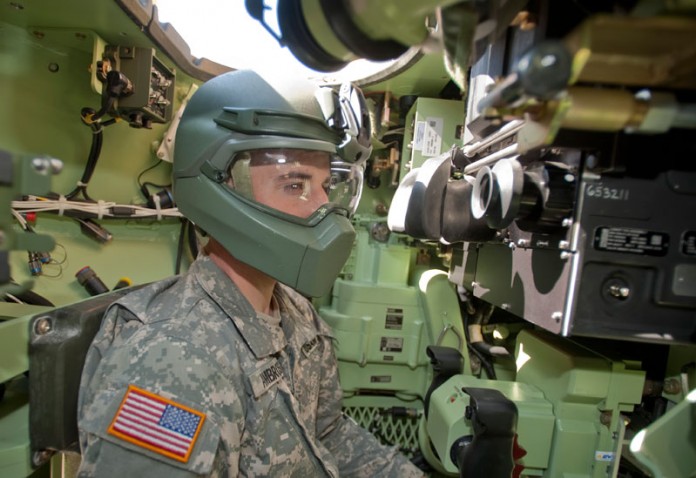
    The Helmet Electronics and Display System-Upgradeable Protection, or HEaDS-UP, helmet prototypes allow crew members to avoid breathing air fouled by dust, sand and rocks while looking out the hatches of moving vehicles. Photo: NSRDEC by David Kamm

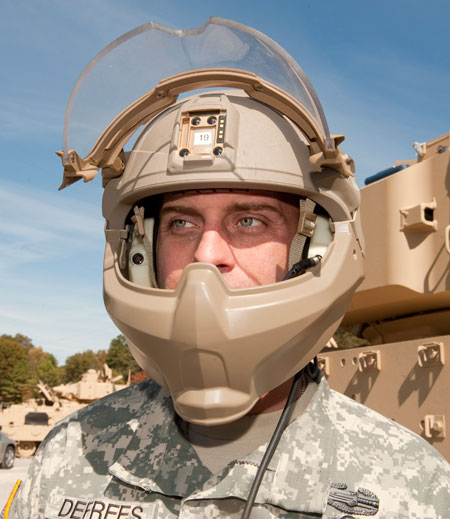
    The US Army recently concluded a study evaluating the safety and survivability applications of different headgear carried by the modern soldier. The Natick Soldier Research, Development, and Engineering Center conducted the study called ‘Helmet Electronics and Display system — Upgradeable Protection’ (HEaDS-UP) as part of a multi-year effort to develop integrated headgear technologies for the Army and Marines. The program, managed by Mr. Donald R. Lee II, recommend potential upgrades for current helmets, improving the safety and integration with headgear, communications displays. Two modular headgear concept designs emerged from the process include improved eye and face protection which include the mandible and visor. Both provide fragmentation protection for the face. According to Don Lee, project engineer in the Headgear Thrust Area at Natick, the new new headgear parts will be provided as attachments parts can be added or removed in seconds. “Being able to don that (mandible and visor) protection when needed or being able to remove it when not needed is the big ‘wow’ factor,” he added. Other aspects of the program are evaluating improved ballistic materials, non-ballistic impact liner materials and designs, see-through and projected heads-up display technologies,improved hearing protection and communications.

    The response we received that every Soldier that used these systems liked the prototype systems over their currently fielded system

    Studies of combat injuries have shown that 72 percent of all the injuries to the head are to the face, indicating the need for improved protection that will also conform with the soldier’s ‘human factors’. “We were able to integrate the concepts during their normal training scenarios, and then following their training event, get feedback from them” Lee said. “It was quite overwhelming, the response we received that every Soldier that used these systems liked the prototype systems over their currently fielded system.”

    Another aspect of HEaDS-UP project is understand and minimize the blast effect on the soldier’s head, a task Dr. David Mott—an aerospace engineer at the U.S. Naval Research Laboratory (NRL) have studied with his colleagues Ted Young and Doug Schwer . “Helmets are required to protect against a combination of threats, including ballistic and blunt impacts,” he says. The NRL research is helping to understand how blast, generated by explosions of IEDs, mines or impact of explosive anti-tank weapons, will effect the head protected by the helmet. The study explores how different shapes of helmets behave in an IED environment and its results would recommend the optimal protection for multiple threats situations.

    These studies have shown that the mandible and visor are instrumental in protecting the wearer from those blast effects.

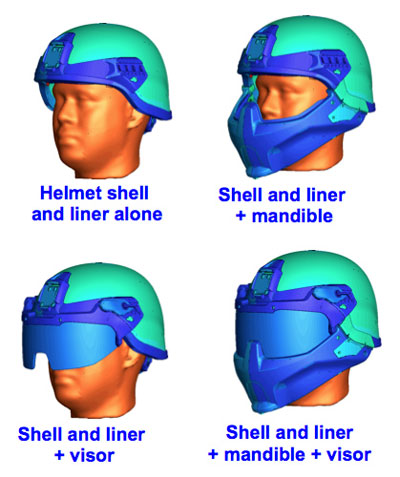
    NRL tested four configurations of an Army helmet prototype against computer simulations of blast waves from various directions
    NRL tested four configurations of an Army helmet prototype against computer simulations of blast waves from various directions

    In 2008, NRL tested military helmets for the U. S. Marine Corps, in collaboration with Allen-Vanguard. The researchers set off an explosion near a mannequin, which had pressure sensors on its head. “After the initial wave hit, they were getting some additional spikes in the pressure on the forehead” Lee explained. The simulations showed the incoming wave of pressure can, as he says, “infiltrate the gap between the head and the helmet shell.” Sometimes called underwash, the effect has since been studied with various helmet types and reproduced by other investigators. Further experiments determined that pressure waves that infiltrate under the brim can then converge under the helmet. This causes “high pressures on the side of the head away from where the blast originated.” Trapped, the high pressure can then send a wave back toward the blast source, and this effect caused the forehead sensor in the 2008 experiments to “pick up a spike as that wave was exiting from under the helmet.”

    When using just the helmet shell and suspension, the shock wave hits the face, creating a pressure spike on the eye. The wave also reflects from the suspension under the front of the helmet, causing a pressure spike on the forehead. “Now when you add the face shield, it keeps that direct hit from happening. A weaker wave still refracts around the bottom of the shield and reaches the face, but you significantly reduce the pressure on the forehead and the eyes by adding that shield.” Mott explained. If the simulation includes the mandible shield with the face shield, again, most of the initial wave is deflected, but according to Mott, there are side effects.

    helmet_simulation_725
    Pressure changes on the head after a front-facing blast, for each of four Army prototype configurations. “When you start adding these extra pieces of equipment,” says Dr. David Mott of his research at NRL, “you don’t always get what you expect. (subscribe for larger version)

    As the helmet variants got more complicated, so did the wave behavior. “When you start adding these extra pieces of equipment, you don’t always get what you expect,” says Mott. “Multiple shocks interacting with each other can amplify the pressure, as can reflections off the structures that are in the suspension pads or lining inside a helmet.”

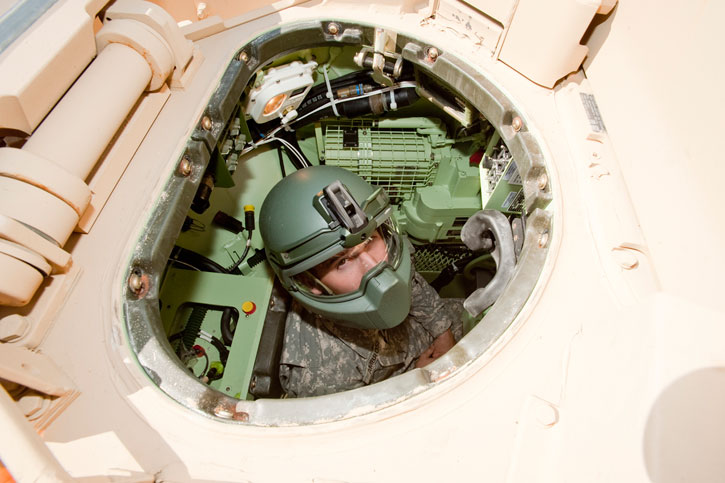
    Crew members looking out hatches discovered an unexpected benefit during evaluations. “When the Soldiers wore the prototype systems with the visor and mandible,” said Lee, “it was the first time that they weren’t eating sand and dust and rocks going down the road.” Ultimately, the program data will be transferred to Program Executive Office Soldier and the Marine Corps for decisions about what technologies should be fielded.

    Assessing the helmets for personnel operating with armored vehicles, the study evaluated a single helmet for mounted and dismounted operations. According to Lee, mounted soldiers are provided two helmets. “They have their Combat Vehicle Crewman helmet and they have their Advanced Combat Helmet. So, if they dismount from the vehicle, they’re supposed to swap helmets. We’ve proven through our program that there can be one helmet for both mounted and dismounted Soldiers, which, I think, is a big deal. I think the program’s proven that a one-helmet system for ground Soldiers, whether they’re mounted or dismounted, can exist.”

    The new integrated helmet technology would eliminate the need for crew members to switch to their Army Combat Helmets when dismounting from their vehicles. Photo: NSRDEC by David Kamm
    The new integrated helmet technology would eliminate the need for crew members to switch to their Army Combat Helmets when dismounting from their vehicles. Crew members looking out hatches discovered an unexpected benefit during evaluations. “When the Soldiers wore the prototype systems with the visor and mandible,” said Lee, “it was the first time that they weren’t eating sand and dust and rocks going down the road. Photo: NSRDEC by David Kamm


    Marine Corps tests the UHAC – a new logistics amphibian

    uhac_landing725
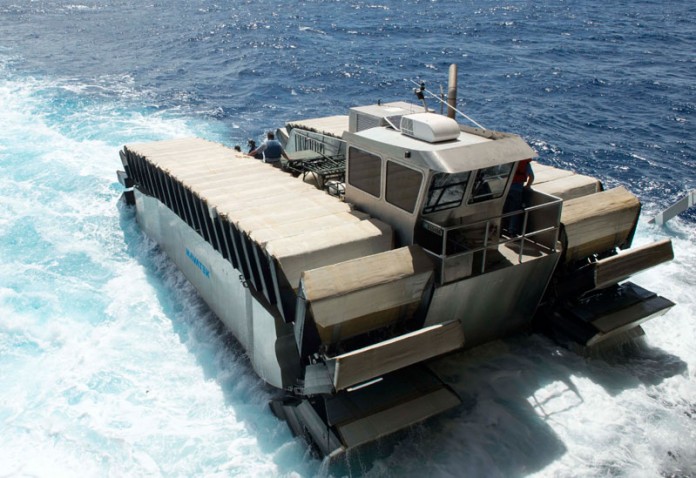
    The Ultra Heavy-Lift Amphibious Connector (UHAC) lands on the shore of Marine Corps Training Area Bellows, July 11, after disembarking the USS Rushmore with heavy equipment during a Marine Corps Advanced Warfighting Experiment. Photo: USMC, by Cpl. Matthew J. Bragg

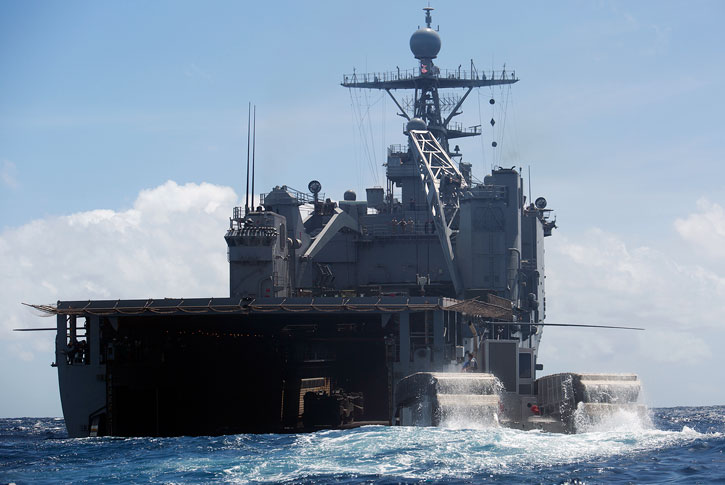
    The US Navy and Marine Corps have tested an Ultra Heavy-lift Amphibious Connector (UHAC) prototype during an Advanced Warfighting Experiment undertaken as part of the Rim of the Pacific (RIMPAC 2014) exercise in Hawaii, earlier this month. The UHAC being tested was a half-scale version of an amphibious transport system developed by the Hawaiian company Navatek under an Office of naval Research (ONR) funded program. During the exercise the UHAC departed Marine Corps Training Area the Bellows and made its way to the amphibious dock landing ship USS Rushmore (LSD 47), where it embarked the ship’s well deck. It then picked up and transported an assault vehicle back to shore.

    uhac_tracks_725
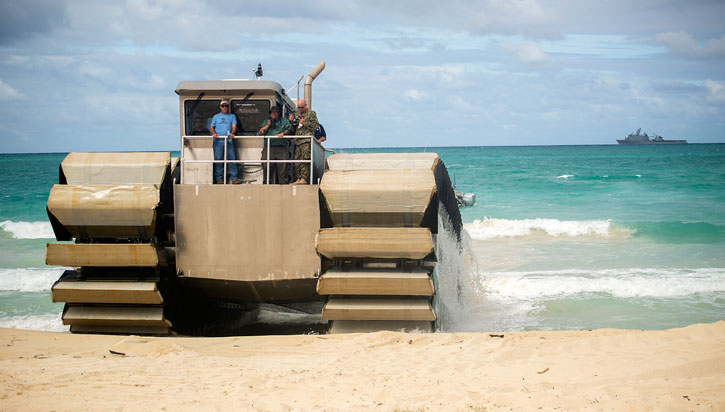
    The UHAC uses a track system with floatation-like pads that propels itself through the water and across different terrain. Photo: USMC, by Cpl. Matthew J. Bragg

    The UHAC is a track driven connector that can reach reasonable water speeds and access beach areas that Landing Craft Air Cushion’s (LCAC) and Landing Craft Utilities cannot. “It has taken a number of years of development to get to this point,” said Dr. Frank Leban, program officer at ONR. “This is actually the third demonstration vehicle in this program. There has been a one-fifth scale model, then a one-quarter scale model and this is a half scale model, so we have been progressing. Every vehicle has incorporated more features and technology to help get us to the full scale. Over the past year the Marine Corps Warfighting Lab has gotten involved and they are looking at trying to put this technology in an operational context. They have been coming up with vignettes and scenarios on how the UHAC can be used.”

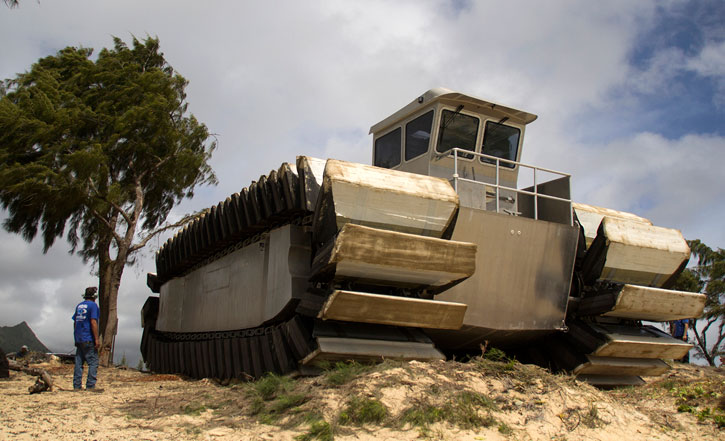
    The half scale vehicle consists of two tracks that are made out of captured-air foam blocks, which gives the vehicle the propulsion it needs for land and sea travel. The UHAC is intended to be a heavy lift vehicle; the full scale UHAC will be able to carry three times more than an LCAC and can go over more obstacles including 10-foot-high sea walls.

    “There was generally some degree of apprehension since it is a new and unfamiliar piece of equipment and how it would operate with the ship,” said Cmdr. Thomas Stephens, commanding officer of USS Rushmore. “At the same time, there was an excitement about being in a position to assist in the development of something significant like UHAC. I saw that excitement and pride on board Rushmore a great deal today. It was awesome to see them so proud of what it is they do so well day in and day out. I’m very proud of my crew’s support to the UHAC endeavor.”

    uhac_deployed_from_rushmore725
    For its first mission, the UHAC paddled two miles off the coast to the USS Rushmore where it loaded up an internally transportable vehicle (ITV) before disembarking and returning to MCTAB to offload its cargo. Photo: USMC, by Cpl. Matthew J. Bragg
    uhac_landong_725
    The UHAC prototype is a ship-to-shore connector and is half the size of the intended machine. Photo: USMC, by Cpl. Matthew J. Bragg

    Innovative robotic systems supporting Marines during warfighting experiment in Hawaii

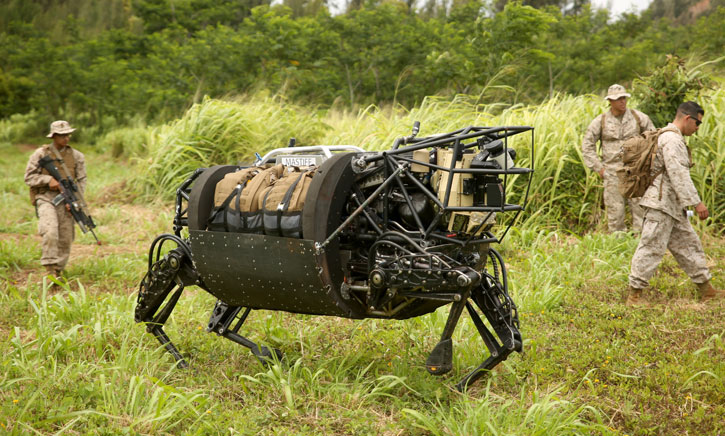
    ls3_mastiff_at_awe_hawaii
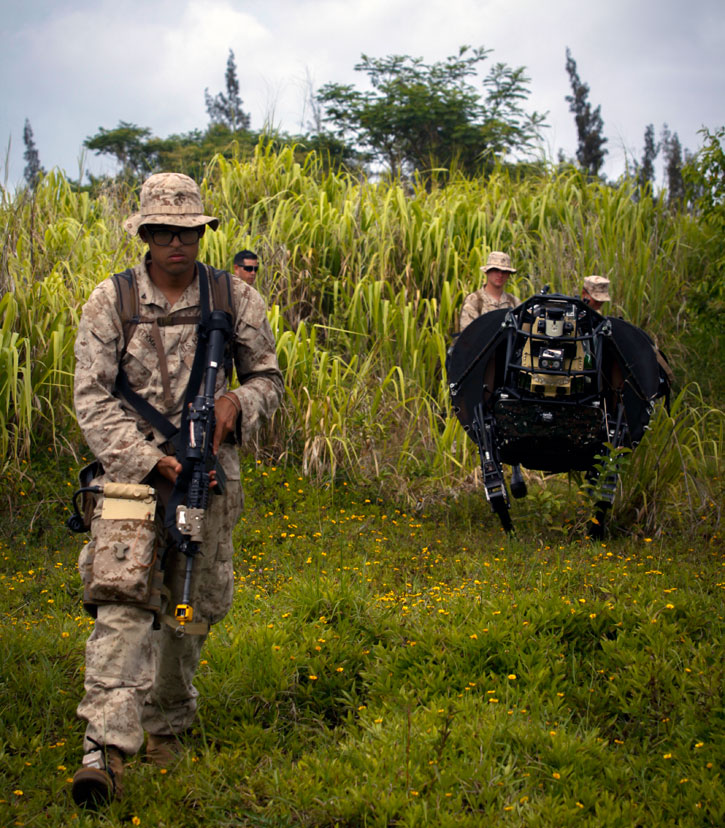
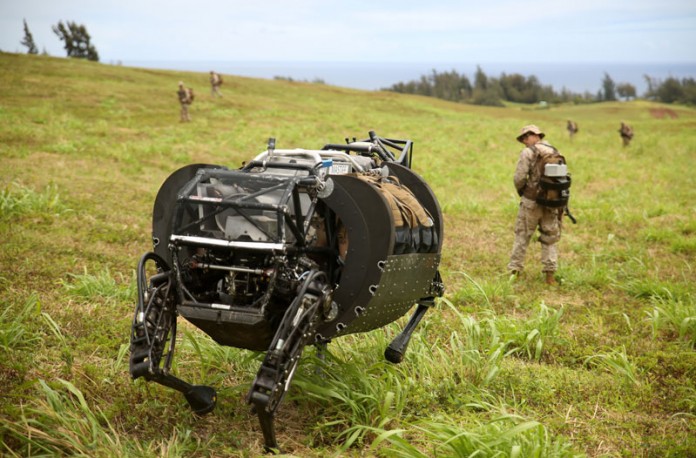
    The Legged Squad Support System (LS3) robotic ‘mule’ is experimental technology being tested by the Marine Corps Warfighting Lab during the Advanced Warfighting Experiment portion of RIMPAC. It is programmed to follow an operator through terrain, carrying heavy loads like water and food to Marines training. Photo: USMC by Sgt. Sarah Dietz.

    One of the robots included the Legged Squad Support System (LS3) which joined a Marine company on rugged terrain, offloading part of their supplies. The other was the Ground Unmanned Support System (GUSS), an autonomous Jeep size vehicle, that could deliver relatively heavy loads to the forward units, without putting drivers and security teams at risk. Both vehicles are part of MCWL’s thrust to lighten the load carried by the Marine squad; the two vehicles are designed to carry out such mission in different terrain. In addition, the GUSS can also be operated for casualty evacuation missions.

    LS3 and GUSS robotic vehicles are both part of MCWL’s thrust to lighten the load carried by the Marine squad

    The robotic mule, capable of traversing rugged terrain with Marines while carrying much of their load. It is programmed to follow an operator and detect large terrain objects to maneuver around. LS3, developed by Google’s Boston Dynamics The LS3 has recently reached a level of maturity that enabled the developmental system to operate with the troops. It has taken five years in concept developed by Boston Dynamics to create. The mule-like legged robot deployed to the Kahuku Training Area, participating with a combat unit on a realistic combat exercise for the first time, operating under the direct control of five young Marines from India Company, 3rd Battalion, 3rd Marine Regiment.

    ls3_awe_hawaii
    Lance Cpl. Brandon Dieckmann, infantryman with India Company, 3rd Battalion, 3rd Marine Regiment, leads the Legged Squad Support System (LS3) robot mule through a grassy area at Kahuku Training Area, during the Rim of the Pacific 2014 exercise. Photo: USMC by Sgt. Sarah Dietz.

    Lance Cpl. Brandon Dieckmann, a native of Las Vegas, remembers watching clips of the LS3 on Youtube before he joined the infantry. He said he never would have guessed he would be chosen to operate the machine, which has been affectionately nicknamed “Cujo” by his company. The Marines used “Cujo” to conduct resupply missions to the various platoons around the training area. The LS3 brought water to service members in terrain difficult to reach by all-terrain vehicles.

    “I was surprised how well it works,” Dieckmann said. “I thought it was going to be stumbling around and lose its footing, but it’s actually proven to be pretty reliable and pretty rugged. It has a bit of a problem negotiating obliques and contours of hills.”

    The LS3 is being used as a logistical tool during RIMPAC as opposed to a tactical tool, due to its loud noise during movement and problems traversing certain terrains. “I’d say 70 to 80 percent of the terrain we go through, it can go through,” Dieckmann said. “There are times when it is going to fall over, but most of the time it can self-right and get back up on its own. Even if it doesn’t, it can take one person to roll it back over. The way it is designed is that you can easily roll it back over.”

    However, the robotic mule is still in development. Dieckmann said creating more space within the LS3 for equipment, like heavy weapons systems, would be beneficial for quicker movement in a field or combat environment.

    Some of the Marines have grown attached to Cujo. In particular, Pfc. Huberth Duarte, an infantryman with India Co., 3/3, and an operator for the LS3, says the robotic mule has become like a dog to him. He also mentioned the controls are simple to learn and have joy sticks. He said it “feels like playing Call of Duty.”

    Putting the LS3 in the hands of young Marines is vital to the development of the program, said Ben Spies, a contractor with Boston Dynamics observing the AWE. “This is the first time we put the LS3 in a training environment like this. They push it to the max. It helps us develop it more, because right now, only the engineers have it.”

    guss_awe_hawaii
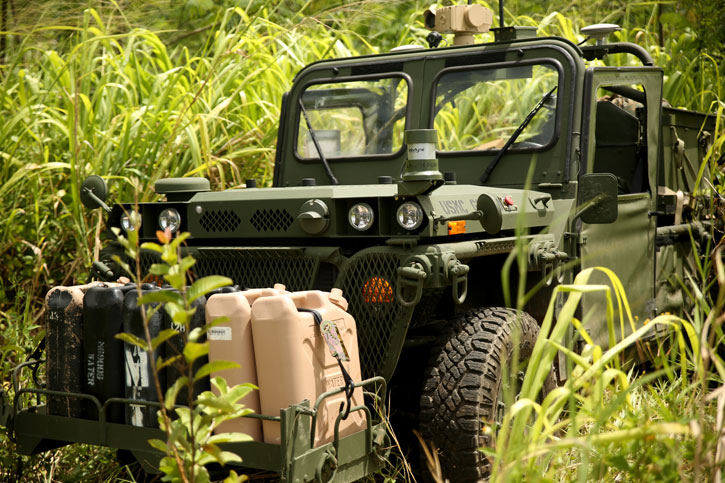
    A Ground Unmanned Support Surrogate (GUSS) being tested by the Marine Corps Warfighting Lab (MCWL). The platform is a standard Internally Transported Vehicle (ITV) fitted by the Torc company with electro-optical, laser and navigation sensors, to provide navigation and obstacle sensing for the autonomous mission. It is a multi-purpose support vehicle equipped with sensors to allow operation with or without a driver. Photo: USMC by Sgt. Sarah Dietz.
    trc_725
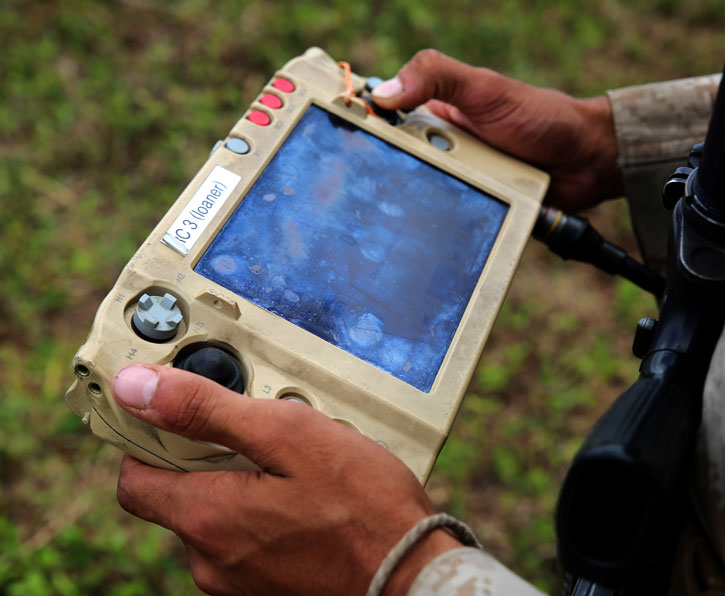
    Lance Cpl. Dieckmann is controlling the LS3 via the Tactical Remote Control (TRC), a common remote controller designed to control different robotic systems such as the LS3, GUSS and the Raven mini UAV. Photo: USMC by Sgt. Sarah Dietz.

    The LS3 can get them into terrain they can’t resupply themselves with traditional equipment. Another vehicle supporting the logistic resupply is the GUSS, access with conventional vehicles. Another robot tested by the MCWL was the Ground Unmanned Support System (GUSS), an ITV fielded with the corps, we have taken this standard ITV vehicle and outfitted it with autonomous systems, enabling it to operated either remotely via backpackable remote control system, or given waypoints, enabling the vehicle to traverse terrain on its own, avoiding obstacles, and get to the point it was sent to. The GUSS was loaded with resupply gear, water, food or ammunition, the Marines will still provide support for the vehicle, but will not have to drive it or be located close to it to conduct the resupply mission. The escort force will be able to secure the GUSS while moving on safer areas, while the vehicle moves on road.

    The GUSS was equipped with an autonomous kit developed by TORC, and controlled through the Tactical Robotic Controller (TRC), a kind of ‘universal controller’ for robotic systems. It allows the Marines to control the GUSS, LS3 as well as the Raven UAS. The use of a common gear reduces the amount of training needed to develop the necessary skills, and reduce the load carried by the troops. The TRC will also be coupled with communications and computing gear to transfer video and data through tactical networks.

    v22_guss
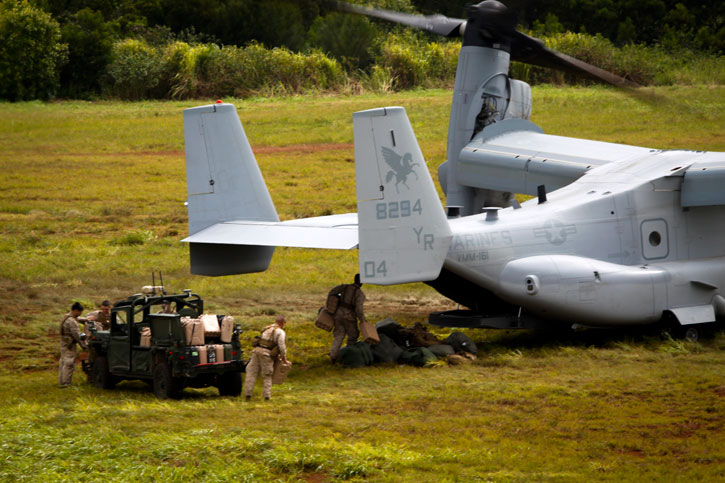
    U.S. Marines with 3rd Marines, 3rd Marine Regiment prepare to recieve a resupply of food and water by the Ground Unmanned Support Surrogate (GUSS) from a MV-22 Osprey during experiments held by the Marine Corps Warfighting Lab (MCWL) at the Kahuku Training Area, Oahu, Hawaii, July 11, 2014. Photo: USMC by Sgt. William L. Holdaway.
    guss_casevac_mission
    A simulated casualty is placed onto the back of the Ground Unmanned Support Surrogate (GUSS), experimental technology being tested by Marine Corps Warfighting Lab during Rim of the Pacific 2014 at Kahuku Training Area. Photo: USMC by Sgt. Sarah Dietz.

    Cyber Intelligence Report – August 1, 2014

    cyber_report

    Israel

    Chinese cyber espionage campaign against Israel

    A major cyber espionage campaign against the Israel defense industry, focusing on the Iron Dome, was published by the blog KrebsonSecurity. According to the publication, the attack took place between the years 2011 and 2012 against three of Israel’s major defense contractors – Elisra, Israel Aerospace industries (IAI), and Rafael. An infamous hacker group from China, nicknamed “comment crew” are believed to be behind this attack. The attack began like all other “APT1” attacks, with a well-designed phishing email. In the period of four months, the attackers established a foothold in the network system by installing backdoors, injecting Trojans, and gaining access to sensitive files. At this point, they transferred jumbo files to their own servers. The cyber security firm, cyberESI, tapped into the communication infrastructure set by the hackers to determine that the data stolen was information on the arrow 3 missile system, UAVs, the Iron Dome system, and more. Elisra and Rafael did not respond when asked about the breach, while IAI denied it completely stating the breach was not of a confidential network.

    Anonymous false claims

    On 27/07/14, @AnonymousGlobo tweeted they took down a number of Israeli websites, including the Mossad home page and a major bank within Israel. The story of Anonymous taking down the Mossad page was picked up a few days later by the cyber news website, HackRead, with the addition that the Mossad website was still down almost three days later. This claim proved to be false, even though additional cyber news websites began to report this as well as other Anonymous Twitter accounts including @YourAnonNews and @AnonymousPress. The Mossad home page website may or may not have been down for a few minutes; yet, besides the single tweet from @AnonymousGlobo, there had been no additional evidence such as screen shots or confirmations. Anonymous false claims bring up two points: firstly, even with the claim they brought down Mossad, bringing down the Mossad homepage brings little significant effects as it is not connected to the Mossad network system, and secondly, it depicts how Anonymous continues to decline in capabilities of creating long lasting or true cyber-attacks.

    North America

    Canada accuses China of cyber attacks

    At a recent meeting between Canadian Foreign Minister John Baird and Chinese Foreign Minister Wang Yi, Minister Baird accused China of cyber-attacks against Canada’s National Research Council (NRC), a research and technology organization with investments in business technology within the government. The details of the attack have not yet been released, but it hinted that personal information of employees and clients of NRC may have been comprised. Minister Baird referred to the cyber hackers as “highly sophisticated Chinese state sponsored actors.” The data comprised through this cyber-attack halted with the NRC and the 40 networks to which it is linked. The infiltration was incapable of entering into the Canadian government network. Though Canada did not reveal details of the cyber-attack, the cyber-attack demonstrated similarities to previous hacking campaigns from China; this is not the first time Canada has been hacked by China. A new and more advanced cyber security program has been ordered for the NRC, though it may take up to year. This is the first instance where Canada has publically accused a country of cyber-attacks. China has denied the allegations and opposed them.

    US House passes two bills on cyber security

    House of Representatives passed two bills regarding cyber security networks. The first bill aimed at limiting cyber-attacks against critical infrastructures through a framework constructed by the Department of Homeland Security. The bill was hailed as the National Cybersecurity and Critical Infrastructure Protection Act. The second focused on enhancing the protection of customer personal information. Currently, both bills are awaiting vote by the Senate.

    Russia

    International operation against leading Russian cyber criminals

    US authorities, in coordination with law enforcement authorities in Spain, the UK, and Canada, conducted a large-scale operation, leading to the arrest of leading Russian cyber criminals. It is assumed the gang leader is 30-year old Russian Vadim Polyakov. He and seven other hackers are suspected of theft of $ 1.6 million from bankcards in Europe.

    Russia offered $111,000 for cracking TOR anonymity

    The Russian government has offered a reward to whomever is able to crack the underground network “The Onion Router” (TOR). TOR is a downloadable system meant to virtually hide users’ activities from identification, and many use it for access into the Deep Web, aka “.onion.” The Russian Ministry of Internal Affairs explained they want researchers to “study the possibility of obtaining technical information about users and users’ equipment on the TOR anonymous network.” Only Russian companies are allowed to be included. This demand is Russia’s insurance of its country’s national security. Each participant must pay $195,000 to participate and about $5,555 application fees to enter the competition. TOR has been a real frustration for authorities. TOR eliminates a nation’s control on the incoming and outgoing Internet traffic. This announcement from Russia comes after it has been revealed for roughly five months that TOR faced a critical vulnerability to “deanonymize” users. TOR explained that anyone who downloads the most updated system will close the vulnerability; however, the effect of the attack on users had remained unclear. The attackers “modified TOR protocol headers to do traffic confirmation attacks,” TOR admitted.

    Azerbaijan becoming part of anti-phishing workshop group

    Azerbaijan Cyber Security Center became a member of the Anti-Phishing Working Group (APWG) and has been accepted to the list of official members of the research team. This entitles them for Research Partnership rights to Research Partners. The APWG was established in 2003 and currently has more than 2000 companies worldwide across industry, government, and law enforcement sectors. Azerbaijan and Georgia officials met to exchange views on the possibilities of cooperation in the field of improving cyber security in the region.

    Middle East

    Iran to hold cyber security exhibition

    Iran is about to organize one of its biggest cyber-security exhibitions. The upcoming event will take place in Teheran from the 27th to the 30th of July, 2015, and is aiming to provide a place for Iranian IT companies to display their new cyber products. This fair will also give the Iranian organizations the opportunity to find the most appropriate cyber security systems to counter cyber threats. Iran has tried to improve both its military and civil critical infrastructure against cyber-attacks. Beside the multiple cyber-attacks the country has experienced since 2010, Iran has developed a great cyber capability. Today the country is known as one of the best countries worldwide for cyber security and is the second in the Middle East after Israel.

    Qatar behind Hamas cyber advancement

    Cyber terrorism against Israel has continued since Operation Protective Edge. Though many of the cyber-attacks failed, it has been revealed that almost 70% of all cyber-attacks have come from Qatar. Qatar has emerged during the operation as one of Hamas’s biggest supporters and funders. According to Aviad Dadon of Israeli cyber-security firm AdoreGroup, Qatar has taken the initiative to train and advance Hamas’s technological capabilities. As Dadon explains: “[The people of Qatar] are taking lessons from the performance of their cyber-equipment and will improve them even further for the next war, which will be even more cyber-oriented than this one.”

    inss150About the Cyber Intelligence Report:

    This document was prepared by The Institute for National Security Studies (INSS) – Israel and The Cyber Security Forum Initiative (CSFI) – USA to create better cyber situational awareness (Cyber SA) of the nature and scope of threats and hazards to national security worldwide in the domains of cyberspace and open source intelligence. It is provided to Federal, State, Local, Tribal, Territorial and private sector officials to aid in the identification and development of appropriate actions, priorities, and follow-on measures. This product may contain U.S. person information that has been deemed necessary for the intended recipient to understand, assess, or act on the information provided. It should be handled in accordance with the recipient’s intelligence oversight and/or information handling procedures. Some content may be copyrighted. These materials, including copyrighted materials, are intended for “fair use” as permitted under Title 17, Section 107 of the United States Code (“The Copyright Law”). Use of copyrighted material for unauthorized purposes requires permission from the copyright owner. Any feedback regarding this report or requests for changes to the distribution list should be directed to the Open Source Enterprise via unclassified e-mail at: [email protected]. CSFI and the INSS would like to thank the Cyber Intelligence Analysts who worked on collecting and summarizing this report.


    The military needs better technologies for subterranean operations

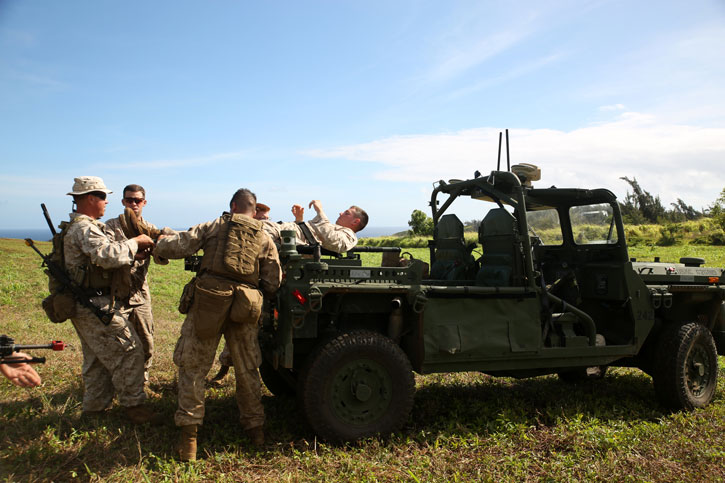
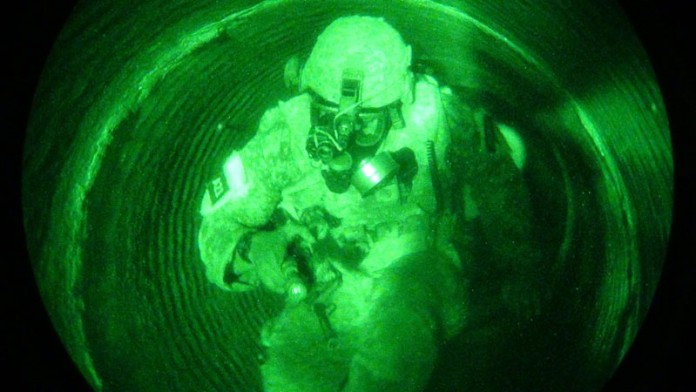
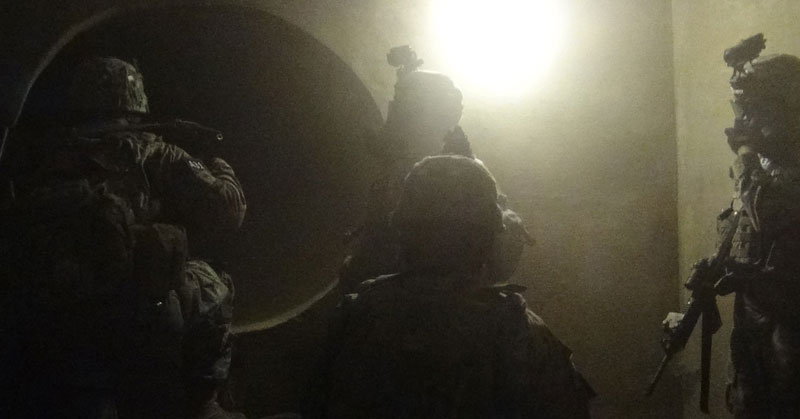
    New tools and technologies are needed to enable military forces to better train and operate in subterranean operational environment. Photo: US Army
    New tools and technologies are needed to enable military forces to better train and operate in subterranean operational environment. Photo: US Army

    Tunnels warfare is not new, in fact it has been part of military history since ancient times, through the 20th century. but has been abandoned by modern military with the introduction of mobile warfare, which rendered the static and slow subterranean warfare useless in face of rapid, dynamic enemy. During the 21st century Subterranean Warfare emerged once again, as insurgents turned to the underground domain pressed by overwhelming technologically-driven Intelligence, Surveillance and airborne reconnaissance (ISR) capabilities mastered by regular military forces, particularly western militaries.

    In an effort to extend the military capabilities to operate in the subterranean environment (Sbt OE) the US Army Rapid Equipping Force (REF) has published a call for information for industry, to provide a range of solutions for this challenge. Among the tools the Army is looking for are measures improving underground mobility, using both manned and robotic equipment. Operating robots within the confined space of the tunnel is quite a challenge, as remotely controlled robots must deliver effective orientation beyond line of sight. Wireless communication with the robot is another issue requiring deployment of repeaters to extend its range. Orientation without GPS is also a challenge, which can be solved by mapping the subterranean space, although this process may require time.

    This is the abstract. The full article is available exclusively to Defense-Update members

    Subscribe to get the latest news and analysis from Defense-Update
    Subscribe for the full analysis Defense-Update
    tunnel_snake_payload
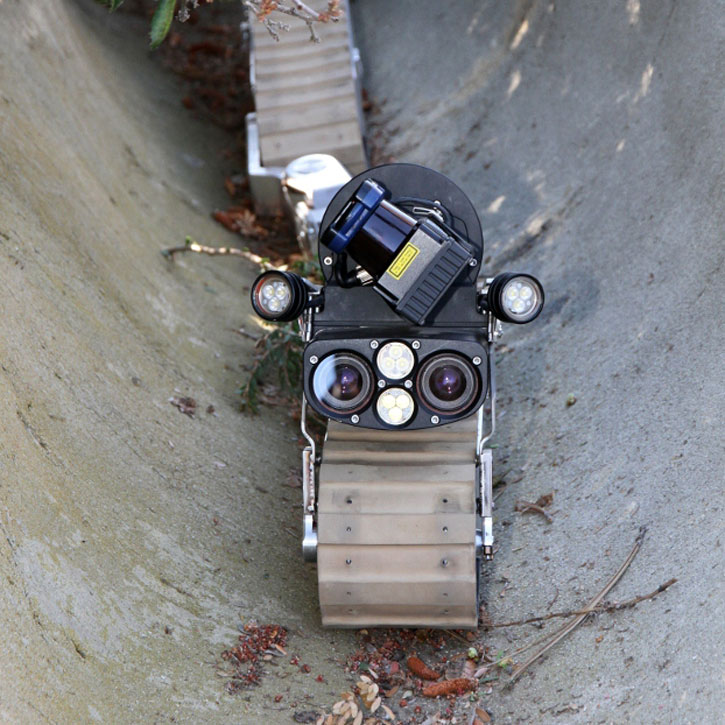
    The payload developed for the Counter Tunnel Robot System utilizes a spinning 2D lidar sensor that provides 3D coverage, stereo cameras, and inertial sensors. Visual odometry and inertial sensors and registered liar point clouds are also used to enable the robot to autonomously find its way back to the original ingress point. Photo: US Navy

    Autonomous operation of unmanned vehicles, either unmanned ground (UGV), air vehicles (UAV) or ground crawlers (insects or snake like robots) can overcome this challenge, when such robots are given the necessary sensory inputs (sonars, laser scanners etc.) to maintain situational awareness and directional control. However, adding those features to existing robots could be quiet challenging, when packed in a small footprint. Also required are new technologies improving underground communications, navigation and situational awareness.

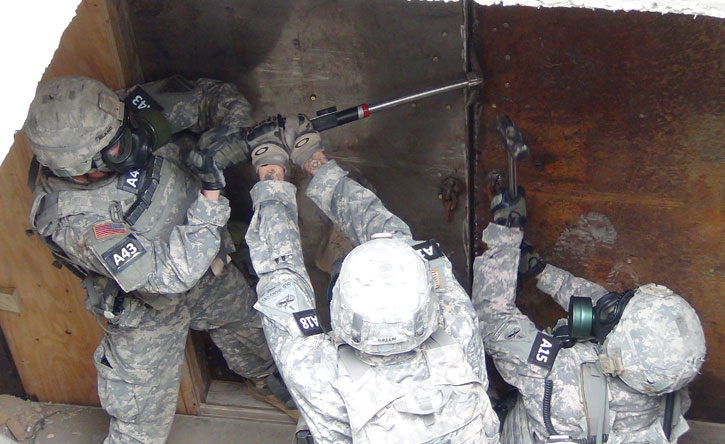
    Breeching systems are also required, particularly ‘cold’ breeching devices that would enable soldiers to overcome barriers without using explosives in the confined space of the tunnel. Compact ladders and rappelling equipment may also be required to overcome vertical obstacles.

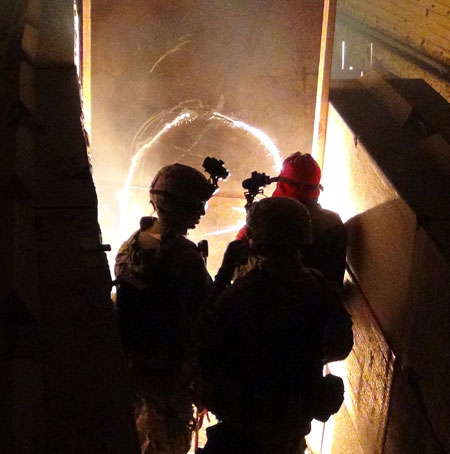
    Cold breeching tools are required to enable soldiers to rapidly overcome obstacles, locked doors and passageways. Photo: US Army
    Cold breeching tools are required to enable soldiers to rapidly overcome obstacles, locked doors and passageways. Photo: US Army

    After the an attack from Gaza in June 2006, when Palestinians infiltrated into Israel through a ‘strike tunnel’, killed two soldiers and abducted Gilad Shalit, the IDF elevated the threat of strike tunnels including this challenge among its highest priorities. Particularly the detection of tunnels as an urgent operational need. Many technologies were evaluated, and some actually put to the test, at a special test range that has been established by the Israel MOD. Among the systems considered were seismic sensors, designed to detect subterranean work in progress, trenching systems that could open deep trenches in the ground, in an effort to uncover tunnels penetrating into Israel, even flood suspected areas to disable tunnels was considered.

    A parallel effort was also conducted by the USA, as part of a joint program sponsored by the US Army and department of Homeland Security (DHS). As a single technological solution has proved marginal at best, a combination of a number of sensors could provide better results in the detection of underground activity. In 2007 Georgia Tech has studied the use of combined electromagnetic and seismic sensors to detect shallow tunnels. In 2009 the US Department of Homeland Defense has tested an unmanned aerial vehicle carrying hyper spectral payload working on a Back in the USA, similar technological efforts are directed at remote sensing.

    However, sofar none has delivered conclusive results. Other capabilities considered for the task include hyper spectral surveillance, precision mapping and surveillance, acoustic/seismic surveillance and measuring minute changes in ground surface – all as part of a relentless effort to uncover the subterranean activities deep under the surface.

    Following the repeated Palestinian attacks during Operation Protective Edge (July 2014) the I-MOD announced that yet a another technology has been tested and demonstrated promising results.

    tools_for_underground_operations

    Skunk Works and XTEND Simplify Multi-Drone Command

    0
    Lockheed Martin Skunk Works® and XTEND have achieved a major milestone in JADC2 by integrating the XOS operating system with the MDCX™ autonomy platform. This technical breakthrough enables a single operator to simultaneously command multiple drone classes, eliminating the friction of mission handoffs. From "marsupial" drone deployments to operating in GPS-denied environments, explore how this collaboration is abbreviating the data-to-decision timeline and redefining autonomous mission execution.

    From Ukraine to Taiwan: The Global Race to Dominate the New Defense Tech Frontier

    0
    As traditional defense primes face mounting competition from agile “neoprimes” such as Anduril, Palantir and Helsing, the balance of innovation is shifting toward software-defined warfare and scalable, dual-use technologies, while global industry consolidation—marked by Boeing’s integration of Spirit AeroSystems and other strategic mergers—signals an intensified race to secure control over the defense technology value chain. Our Defense-Tech weekly report highlights these trends.

    Europe’s “Drone Wall”

    0
    In early October 2025, a coordinated wave of unmanned aerial system (UAS) incursions—widely attributed to Russia—targeted critical infrastructure across at least ten European nations. The unprecedented campaign exposed the fragility of Europe’s air defenses...

    Weekly Defense Update & Global Security Assessment

    0
    Executive Summary The past week (September 18-25, 2025) represents an inflection point where strategic defense concepts have transitioned from doctrine to tangible reality. An analysis of global events reveals four primary, interconnected trends shaping an...

    U.S. Air and Space Forces Push Next-Gen Programs at the AS&C 2025 Conference and...

    0
    At the 2025 Air, Space & Cyber Conference, U.S. Air Force and Space Force leaders unveiled major updates on next-generation fighters, bombers, unmanned systems, and space initiatives, highlighting both rapid innovation and critical readiness challenges as the services race to outpace global competitors. A short version is available here, with a more detailed version for subscribers.

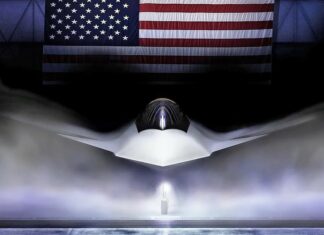
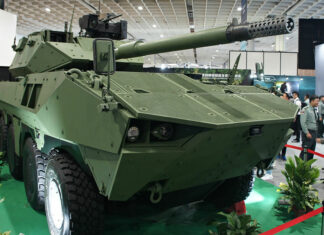
    TADTE 2025: Reflecting Taiwan’s Strategic Themes

    0
    The Taipei Aerospace & Defense Technology Exhibition (TADTE) 2025 crystallized around four dominant strategic themes that collectively illustrate Taiwan's comprehensive approach to defense modernization amid escalating regional tensions. Based on a detailed report by Pleronix (available upon request). Includes a Podcast discussion on TADTE 2025's highlighting Taiwan's four strategic themes beyond the post's coverage.
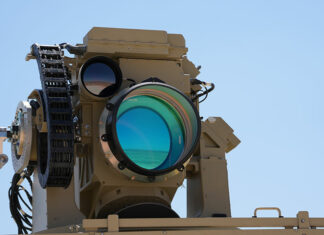
    Iron Beam 450 Completes Testing, Soon to Join With Operational Air Defense Units

    0
    Israel’s Iron Beam 450 high-power laser system has completed final testing, marking a major leap in air defense. Developed by Rafael, it offers precise, cost-effective interception of rockets, UAVs, and mortars, and is set for IDF deployment by 2025.