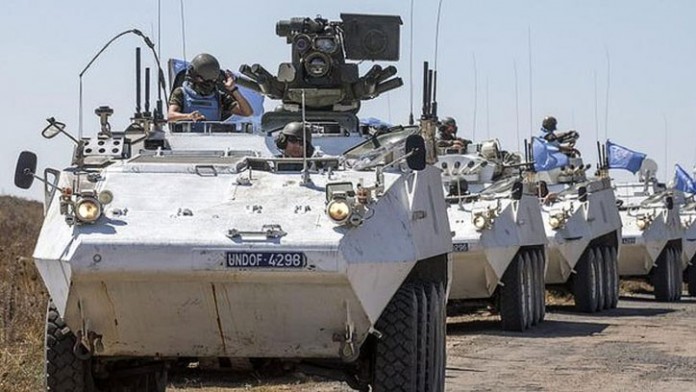
An armored column gathered to rescue Philippino peacekeepers from the Syrian Golan.
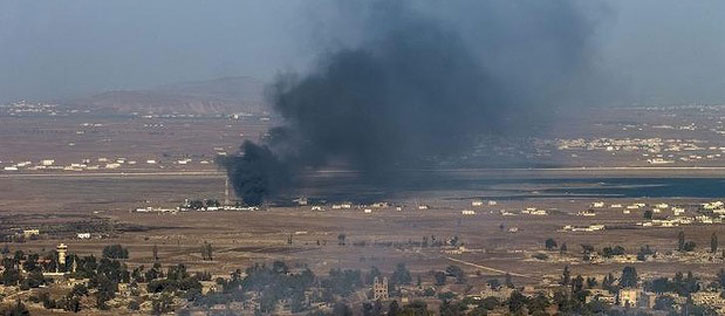
Smoke pillars from one of the UN posts in Quneitra. August 31, 2014
The collapse of the Syrian regime’s military stronghold around Quneitra, the main city in the Syrian Golan height, and border crossing with Israel has caught the United Nations Disengagement Observer Force (UNDOF) facing a mission it was not prepared to do – face extremist Syrian Jihadist rebels that have been fighting the Syrian regime for more than two years. Two UN contingent forces from Fiji and the Philippines were involved in the fighting over the weekend.
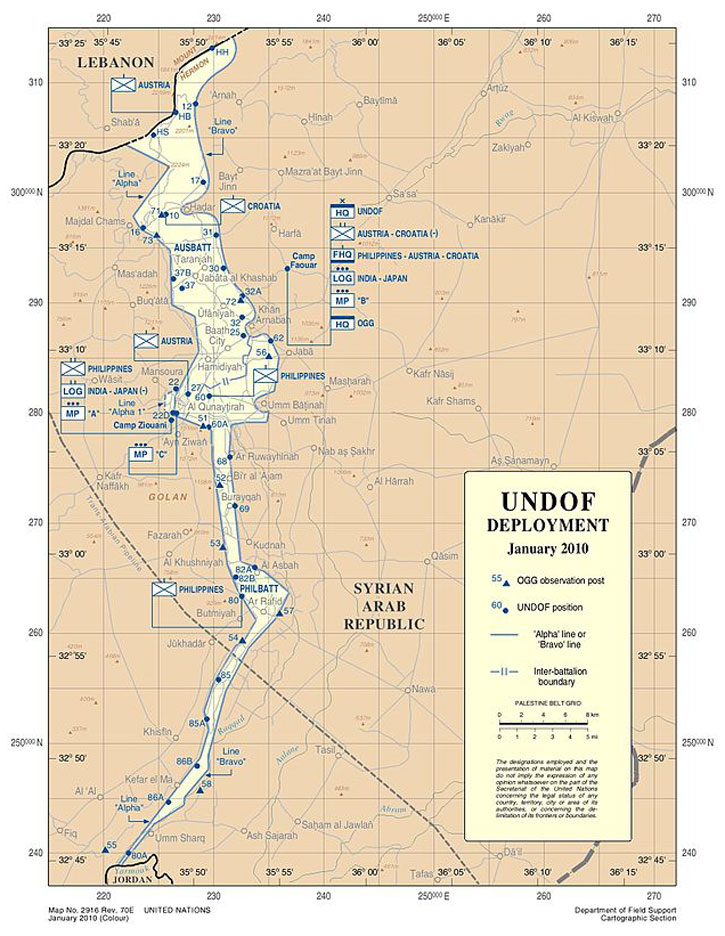
UNDOF deployment – Golan 2010 – subscribe for a larger version
The clashes came after Syrian rebel groups, including the Nusra Front, overran the Quneitra crossing on the frontier between Syrian and Israeli controlled parts of the Golan on Wednesday, the Jihadist group, affiliated with Al Qaeda seized 45 Fijian peacekeepers captured in the valley of Quneitra. As of today (Sunday), the peacekeepers remain under rebel custody. While the Jihadist captors confirmed the Fijian detainees are safe and treated well, the Nusra Front stated that the Fijians were seized in retaliation for the UN’s ignoring the suffer of Moslems by the Syrian regime.
The Islamic State, a splinter group that has separated from the Nusra Front and now rivals the Jihadist group have recently massacred hundreds of Syrian Army prisoners captured when the group captured a Syrian military airbase in east Syria.
An armored column gathered to rescue Philippino peacekeepers from the Syrian Golan.
Filipino groups that manned two positions were also under attack at two separate bases post 68 and 69 located at Ar Ruwayhinah and Burayqah. The Philippinos decided to stay put. The commands from Manila were clear – stand guard until help comes. A first group of 35 Filipino peacekeepers was rescued by an armoured escort column manned by Irish and Filipino forces on Saturday. A second group of 40 Filipinos remained at Post 68, sieged by more than 100 gunmen who fired heavy mortar fire and rammed the camp’s gates with their trucks. The rebels demanded their surrender but the Filipinos refused, and returned fire. During this fight the area was bombarded by Syrian government forces, as artillery fire was used to keep the rebels away from overwhelming the post. Shortly after midnight, the UN agreed on a cease-fire agreed with the rebels, enabling the 40 Filipino peacekeepers to leave their position and group back at Camp Ziuoani one the Israeli side of the border.
“Although they were surrounded and outnumbered, they held their ground for seven hours,” Philippine military chief General Gregorio Pio Catapang said in a news conference in the Philippine capital, Manila, adding there were no Filipino casualties. “We commend our soldiers for exhibiting resolve even while under heavy fire.”
UNDOF mission has 1,223 troops from six countries: Fiji, India, Ireland, Nepal, Netherlands and the Philippines. Austria, japan and Croatia withdrew their forces due to the escalating violence. Philippine officials also said they will withdraw the 331-strong Filipino contingent serving as part of the UNDOF mission in the Golan Heights at the end of their tour of duty in October due to the worsening security situation. However, the unit will remain in Golan until their mission ends in October.
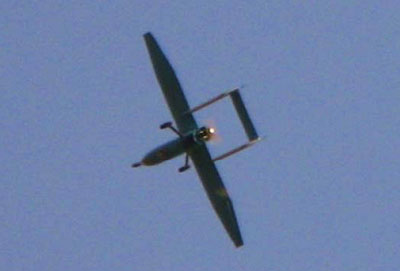
Iranian built Pahpad drones have been used by the Syrian regime in its fight against the rebels since 2012.
Israel’s air defense Patriot units have shot down a Syrian unmanned aerial vehicle that entered Israeli air space from Syria today. The Syrian drone came from the Quneitra region in Syria, adjacent to the Israeli border. The Syrian drone, likely belonged to the military of the Assad regime, has most likely strayed into Israeli airspace by accident. In recent days the Syrian army is fighting Jihadist rebels over the border crossing with Israel. The Syrians have sent strike fighters to attack rebels in the area, in violation of the cease fire treaty with Israel. Despite the clear violation, Israel has not responded to those incursions that were done inside Syrian territory. The penetration into Israeli airspace apparently ‘crossed a red line’.
Two Israeli drones have also been shot down in recent days. According to the Arab-language Al-Mayadeen television network, the Hermes Model drone was shot down near Baghdad Airport. Another drone, also a Hermes 450 was shot down in Iran, about 130 km from its northern border.
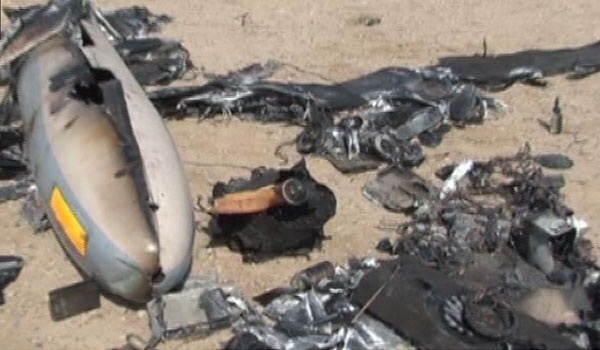
Remains of an Israeli Hermes 450 one shot down by Iranian missiles. Over Central Iran. Photo: Iranian Official photo.
Remains of an Israeli Hermes 450 one shot down by Iranian missiles. Over Central Iran. Photo: Iranian Official photo.
“Israel may be testing Iran’s air defense capacities, Iranian military expert Hossein Aryan told Azeri newspaper Trend on Aug 30, commenting on reports about alleged Israeli spy drone which was downed by the Islamic Revolution Guards Corps (IRGC) on Aug. 23.”
The IRGC claimed that it shot down an Israeli drone near the country’s uranium enrichment facility in Natanz, some 240 kilometers south of the capital, Tehran on Aug. 23. (Defense-Update)
According to Aryan, Israel could have tested the Islamic Republic’s defensive power or wanted to state its ability to fly over Iran’s most sensitive targets. Aryan believes that if the drone came from Israel’s side, and managed to reach the sensitive Natanz nuclear site, it indicates that Iran is not able to effectively prevent such actions. On the other hand, Aryan said the purpose of sending a drone into Iran may have been spying.
The Iranian expert also highlighted Iranian officials’ contradictions on the issue – “While defending Iran’s air space is under the responsibility of army, the reports say that the drone was downed by the IRGC,” Aryan said. “Maybe army has delegated its responsibility to IRGC in this specific case which is possible.”
Iran claimed the drone was launched from the territory of one of the countries, neighboring with Iran. The expert said it was interesting that Israel didn’t send the drone directly, but used another country as a launching ground. Aryan added that Israel actually does have power to dispatch its drones to Iran’s air zone from it’s own territory.
After the drone was downed by Iran, Brigadier General Farzad Esmaili, commander of the Iranian Air Defense Base said that the country’s air defense bases traced the Israel drone for about 43 minutes after it entered Iran’s territory. Considering the Hermes-type drone’s maximum speed which reaches 176 kmh, the drone only was able to travel 130 kilometers through Iran – which is far away from the Natanz plant in central Iran.
Brigadier-General Hossein Salami, deputy commander of the IRGC said that “the Israeli drone was identified upon arrival in Iranian airspace, however permitted to fly to determine its goal.” Aryan believes such statement can’t be taken seriously. “If Iran was able to down the drone without damages, it would have done that,” he underlined.
The expert explained that if Iran’s electronic warfare units were able to hack and capture the Israeli drone before shooting it down, the country would be able to read its preloaded data and understand the destination without permitting it to travel further.
Aryan argued that the statements are actually excuses for justification the gaps in the country’s defensive power in confronting with the drones.
Written by Umid Niayesh in the Azeri publication TREND.
The Iranian Cyber Offensive during Operation Protective Edge
By Gabi Siboni,Sami Kronenfeld – INSS
Although the IDF’s abilities to handle the rocket and attack tunnel threats have garnered most of the attention during the latest campaign in the Gaza Strip, it is now clear that Israel was also forced to confront cyber challenges during Operation Protective Edge. A senior officer in the C4I Corps noted that in the course of the campaign Iranian elements launched a widespread cyber offensive against Israeli targets, including attempts to damage security and financial networks. While these attempts were neutralized relatively easily and quickly by Israeli cyber defenses, it seems that Iran is investing heavily in the development of effective offensive capabilities against infrastructure systems, and might present a serious challenge to Israeli defenses within the foreseeable future. In 2013, a series of attacks on the websites of major US banks and financial institutions was attributed to Iran. An information security expert described these attacks, which included sophisticated techniques and demonstrated an ability to act in significant scope against high quality targets, as unprecedented in degree and effectiveness.
Attacks on a nation’s financial infrastructures have serious repercussions, liable to result in heavy financial damage as they disrupt routine financial activity of commercial enterprises and households alike. However, the focus of the cyber offensive during Operation Protective Edge was the civilian internet. Iranian elements participated in what the C4I officer described as an attack unprecedented in its proportions and the quality of its targets. The attack targeted IDF websites such as the Home Front Command and the IDF Spokesperson’s Unit, as well as civilian internet infrastructures. The attackers had some success when they managed to spread a false message via the IDF’s official Twitter account saying that the Dimona nuclear reactor had been hit by rocket fire and that there was a risk of a radioactive leak. Some of the attacks against Israel were attributed to the Syrian Electronic Army (SEA), a group of Assad-supporting hackers that in recent years has developed significant attack capabilities and described by Michael Hayden, former Director of the CIA and the NSA, as a veritable Iranian proxy.
Cyber attacks on Israeli targets accelerated as the military operation expanded on the ground. If, during the early part of the operation, there was marginal, unorganized attack activity by pro-Palestinian elements, the ground incursion in the Gaza Strip prompted, according to the IDF’s chief of cyber defense, a significant leap in the scope of attacks on Israel and often in their sophistication as well. The attacks peaked on July 25, 2014 – the last Friday of Ramadan, observed in Iran as “Jerusalem Day” and dedicated to resistance against Israel and Zionism – when Iranian elements, together with hackers from all over the world, launched a widespread attack against many Israeli websites in order to block access for a long period of time. Joint efforts of the IDF and the General Security Service (GSS) were prepared for the cyber onslaught in advance and successfully thwarted the attack.
An analysis of Iran’s cyber activity during Operation Protective Edge indicates growing maturity in the Islamic Republic’s operational capabilities and shows that it is capable of conducting an extensive military cyber operation against a range of targets using a wide spectrum of methods. Moreover, Iran’s focus on cyberspace during Operation Protective Edge may indicate the start of a process in which cyberwar replaces classical terrorism as the main tool in Iran’s doctrine of asymmetrical warfare. Cyberwar, which offers the attacker distance and deniability, two features the Iranians consider extremely valuable, enables serious damage to the civilian front of an enemy enjoying military and geostrategic superiority. Thus far Iran’s cyberspace capabilities remain inferior to Israel’s and to those of the leading technological powerhouses, but it is rapidly and efficiently closing the gap.
Israeli cyber defenders succeeded in foiling the Iranian attack, but there is no certainty they can repeat the feat in the future. Israel has yet to establish a comprehensive preparedness approach or name the agency that will take command of the defense against extensive cyber attacks. Israeli cyberspace has a host of institutional players: the IDF, the GSS, the Mossad, telecommunications companies and providers, the Bank of Israel and commercial banks, government ministries, the Israeli Police, civilian security companies, and others. The absence of a ranking of authority in defensive and preventive efforts is liable to create holes in the digital Iron Dome defending the country and allow enemies to cause severe damage.
The success scored in preventing the recent attack is more indicative of cooperation and coordinated work at the professional level rather than a mapping of authority among the various organizations, and Israel cannot rest on these laurels. Iran’s cyber force buildup and attacks are progressing apace, and Iran is liable to challenge Israel’s defensive capabilities to a larger extent than ever before. It is therefore imperative that Israel sees to the organizational aspect of the nation’s cyber defense as soon as possible, and determines the interrelationships among the various institutions operating in the field. Furthermore, defensive measures are not enough, and therefore Israel must launch preemptive and retaliatory strikes as well. There is no reason that Israel’s long arm should not reach the hands of those who are intent on injuring Israel in cyberspace.
About the Cyber Intelligence Report:
This document was prepared by The Institute for National Security Studies (INSS) – Israel and The Cyber Security Forum Initiative (CSFI) – USA to create better cyber situational awareness (Cyber SA) of the nature and scope of threats and hazards to national security worldwide in the domains of cyberspace and open source intelligence. It is provided to Federal, State, Local, Tribal, Territorial and private sector officials to aid in the identification and development of appropriate actions, priorities, and follow-on measures. This product may contain U.S. person information that has been deemed necessary for the intended recipient to understand, assess, or act on the information provided. It should be handled in accordance with the recipient’s intelligence oversight and/or information handling procedures. Some content may be copyrighted. These materials, including copyrighted materials, are intended for “fair use” as permitted under Title 17, Section 107 of the United States Code (“The Copyright Law”). Use of copyrighted material for unauthorized purposes requires permission from the copyright owner. Any feedback regarding this report or requests for changes to the distribution list should be directed to the Open Source Enterprise via unclassified e-mail at: [email protected]. CSFI and the INSS would like to thank the Cyber Intelligence Analysts who worked on collecting and summarizing this report.
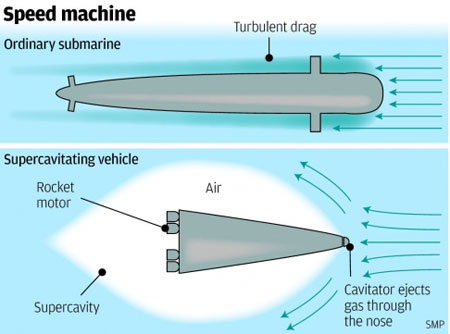
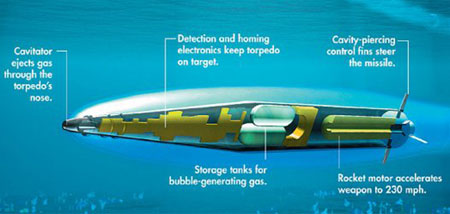
The Chinese liquid spray membrane will employ rudderless control of submarines, travelling through supercavitation phase, enabling high speed travel underwater.The propulsion method used to speed up the Ghost is the same enabling the Russian Skval torpedo to gain a speed four time higher than its western counterparts.
Chinese scientists are studying the applications of supercavitation to propel large bodies underwater at high speed. A team of scientists at the Harbin institute of Technology’s Complex Flow and Heat Transfer lab headed by Prof. Li Fengchen has come up with a new approach to create an ‘air bubble’ required for rapid underwater travel.
“We are very excited by its potential” Prof. Fengchen said, explaining that the unique attributes of the team’s new concept is the ability to control the vessel within the air bubble, without a rudder. Lack of steering and control has limited the application of this concept to unmanned bodies such as torpedoes, that were fired in a straight line because they had limited ability to turn. “Our method is different from any other approach, such as vector propulsion or thrust created by an engine” Li said.
Scaled up into a full size ‘supersonic submarine’, such vessel could make the distance from Shanghai China to San Francisco, CA in less than two hours
The supercavitation propulsion concept was explored in the Soviet Union in the 1960s, but implemented only with torpedoes (Shkval). In the US, applications are explored with hovercraft and counter-mine applications. (New Scientist Magazine, 7-2000) The Chinese team’s concept employs the application of a liquid spray around the underwater vessel’s body, creating a membrane on its surface, reducing the drag at low speed. As the speed reaches 40 knots (75 km/h) and higher the vessel would enter the supercavitation state. At this stage, the membrane that wraps the vessel would help with steerin by applying variable levels of friction in the appropriate axis. remain Wang said even he had been kept in the dark about recent supercavitation developments in China. “By combining liquid-membrane technology with supercavitation, we can significantly reduce the launch challenges and make cruising control easier,” he told the South China Morning Post.
The Russian Shkval torpedo could not easily steer underwater and would often be fired in a straight line.
Scaled up into a full size ‘supersonic submarine’, such vessel could make the distance from Shanghai China to San Francisco, CA in less than two hours. A submarine that could be traDespite these breakthough researches, supercavitating super-submarines are still decades away, Li said, including the introduction of powerful underwater rocket engines that could give the vessels longer range and higher underwater velocity, up to supersonic speed. The effective range of Russian supercavitation torpedoes (Shkval) that could travel at a speed of 200 knots (370km/h) was between 6-8 nm (11-15 km).
Remains of an Israeli Hermes 450 one shot down by Iranian missiles. Over Central Iran. Photo: Iranian Official photo.
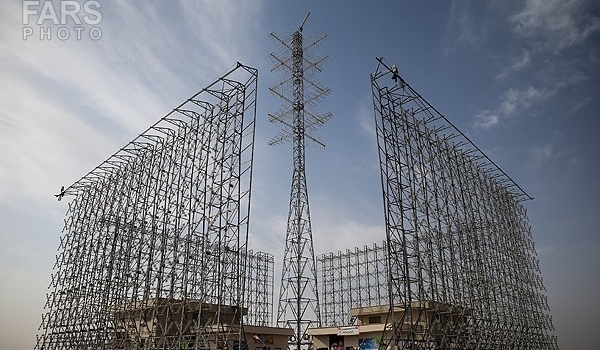
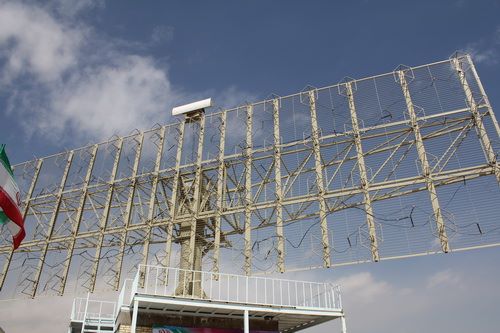
The Irainan new Sepehr radar, employing multiple transmit-receive units operating in the VHF/UHF band, could have helped detect and track stealth targets. Photo: FARS news agencyAnother type of a low-frequency radar recently deployed by Iran, which could be a derivative of a Chinese VHF 2D design, with an Iranian indigenous antenna. Operating in the upper VHF/lower UHF waveband this static radar could be effective against stealth targets.
Iran reported today its air defense forces have downed an Israeli unmanned aircraft possibly a previously unknown, stealth model. The aircraft, believed to be an IAF/Elbit Systems Hermes 450, was intercepted by a surface-to-air missile. “A pilotless Israeli spy plane was shot down after it was traced and intercepted by the IRGC Aerospace Force,” a statement by the Iranian Republican Guards Corps’ (IRGC) announced.
According to the statement, the Israeli pilotless aircraft was a radar-evading, stealth drone with the mission to spy on Iran’s enrichment activities by flying over Natanz nuclear enrichment plant. Natanz is Iran’s main uranium enrichment site, housing more than 16,000 centrifuges. Around 3,000 more are at the Fordo plant, buried inside a mountain and hard to destroy.
Subscribe to get our analysis…
The Iranians claim a drone of this class would have an operating radius of only 800 km, therefore, it could not fly all the way from Israel to Natanz, unless it was supported by forward basing in a neighbouring country
Remains of an Israeli Hermes 450 one shot down by Iranian missiles. Over Central Iran. Photo: Iranian Official photo.
“Parts of the aircraft have burnt out after it was targeted by the ground-to-air missiles of the IRGC Aerospace Force and after its fuel tank blast, yet “some parts of this drone are intact and we are now analyzing the information and intel of these parts”, the Commander of the IRGC Aerospace Force Brigadier General Amir Ali Hajizadeh said.
“There was no prior information available about the aircraft and the only one of this type had been downed in Syria, but this one is more advanced,” General Hajizadeh said.
The IRGC has been preparing to deal with UAV threats as part of its operational planning and preparation. UAV operations and countermeasures are integrated in all major exercises, and these requirements are included in air-defense systems developed or modernized by the domestic military industries. Iran has been developing an increasingly sophisticated air defense system in recent years, since the US stepped up surveillance activities using state of the art stealth drones.
In 2011 Iran managed to capture a U.S. RQ-170 Sentinel stealth drone operated by the CIA. Iranian sources have claimed they managed to sieze control of the drone via sophisticated cyber attack. Iranian defenses have also downed several US drones in the last few years, including Scan Eagle tactical drones. The drone was the first such loss by the US. Tehran is believed to have acquired remains of Israeli Hermes 450 and Heron, which have crashed over Lebanon or Syria, which enabled the Iranians to reverse engineer these platforms in recent years.
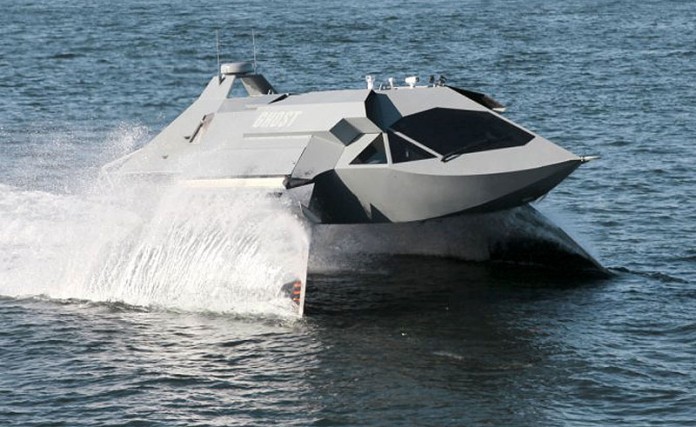
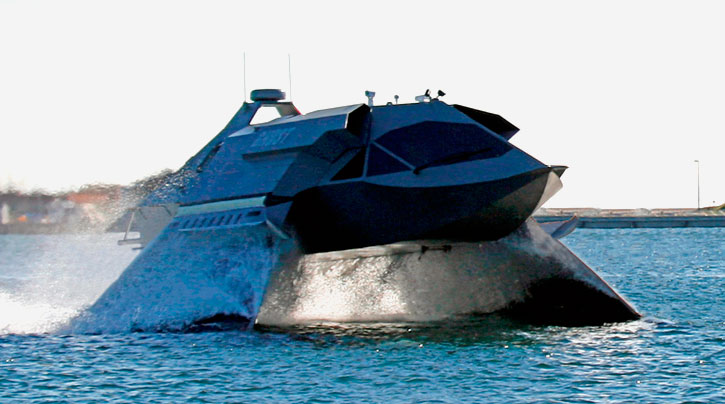
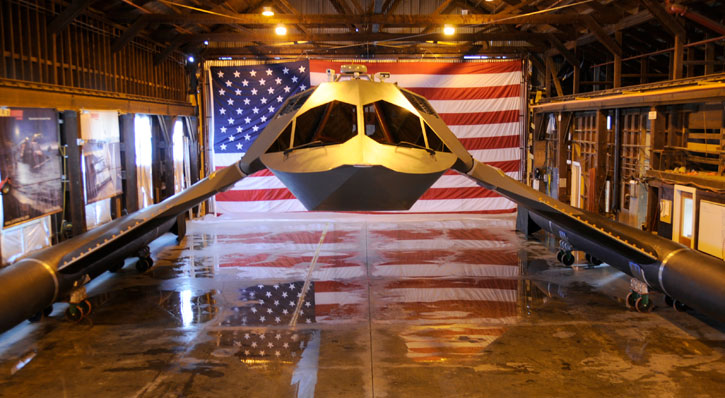
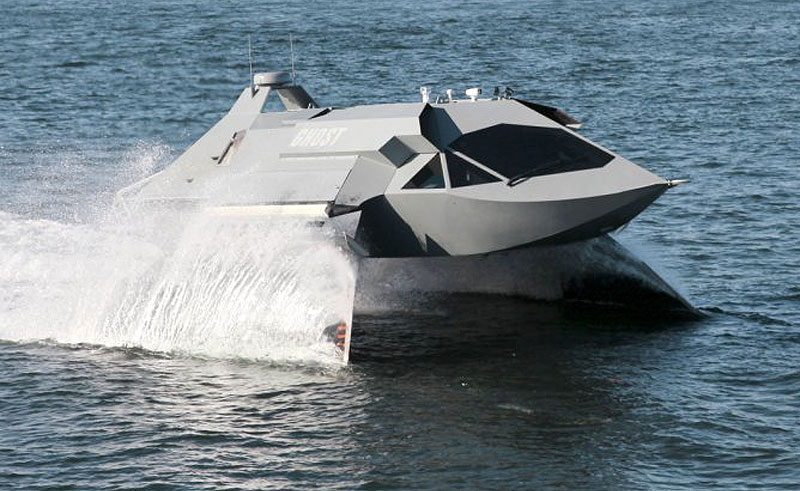
The Ghost prototype developed and built by Juliet Marine Systems piercing the Piscataqua river during one of its ‘test flights’.
Juliet Marine Systems a small company from Portsmouth, N.H., has developed a unique high-speed watercraft called Ghost that could take on missions close to shores, where larger vessels, such as the Littoral Combat Ship (LCS) would normally be too vulnerable to operate – company officials say. While initially the Ghost design was offered for fast patrol, special operations and force protection missions, Juliet Marine is now promoting a scaled-up corvette version ‘super Ghost’ for the US Navy re-evaluation of the Littoral Combat Ship force structure.
“With Ghost you can you can get into denied-access ocean areas, monitor what’s going on, launch operations and leave, and no one knows you’re there”
Plans are to build a corvette-sized 46 meter (150 ft) ‘super Ghost’ at a cost of about $50 million per vessel – six times cheaper than the $300 million per-ship cost of a current Freedom-class and Independence-class littoral combat ship. Such a vessel could operate with LCS or with other oceangoing naval vessels, providing a more affordable, agile and survivable naval strike forces.
Subscribe to get the full version of this article…
Started as a privately funded venture, the Ghost development began in 2008, leading to the completion of the prototype in early 2010, at an investment of US$15 million. Each vessel is estimated to cost about $10 million. Apart from the US Navy, other government agencies and special forces which could be interested, Juliet Marine has been in high-level discussions with a foreign nation interested in 25 Ghosts for potential sale $300 million. Bloomberg Businessweek reported.Subscribe to get a larger image.
“With Ghost, you can get into denied-access ocean areas and loiter for 30 days with the fuel on board. You can listen to cell phone conversations, you can monitor what’s going on, you can launch operations and leave, and no one knows you’re there.” Gregory Sancoff told Bloomberg, “That’s not something the government can do right now.”
The supercavitation propulsion method used to speed up the Ghost is the same enabling the Russian Shkval torpedo to gain a speed four time higher than its western counterparts.
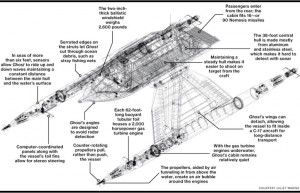
The craft is built of a main hull which is lifted above water when the Ghost is moving at speeds over eight knots. Its powerplants comprise of two T53-703 turboshaft engines seated in pontoons, powering a counter rotating propeller located at the front of each pod. The propellers are creating ‘supercavitation’ effect, enabling the pod (carrying the entire vessel) to move through the bubble trail rather than the denser sea-water, thus able to achieve 900 times less hull friction, compared to a conventional watercraft.
This effect enables the vessel to cut through waves of 10 feet at high speed, remaining extremely stable by employing computer controlled stabilization using ‘fly by wire’ controls. In testing sorties the Ghost has already achieved a speed of 30 knots and is expected to reach the 50-knot range, matching the top speed of much smaller fast attack boats. The fully computerized control enables the vessel to become a truly stealthy ghost ship, operating on extended missions without humans on board.
The supercavitation effect used by the Ghost enables the vessel to move through water inducing 900 less drag, which translates into more stable ride with less fuel consumption, resulting in faster, and longer missions.
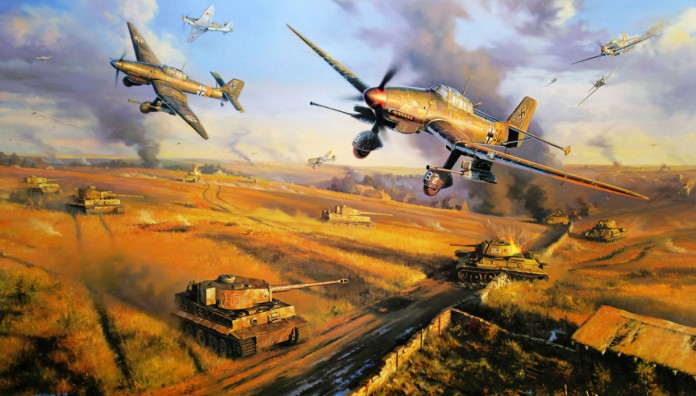
70 years ago, the great Battle near Kursk took place. It was long claimed being one of the largest tank battles in history. Following their disastrous defeat at Stalingrad during the winter of 1942-43 the German summer offensive in the Kursk enclave, code-named Operation “Zitadelle” led into the heaviest armored clashes ever fought in such a confined area. The climax of this horrendous carnage took place near the village of Prokhorovka which is about 140 km from the city of Kursk.
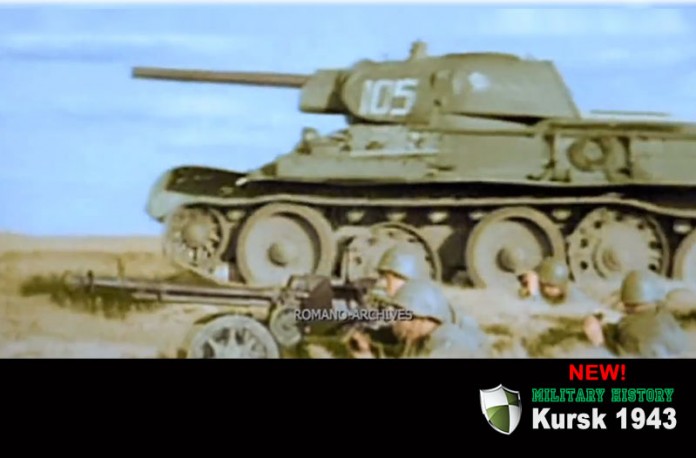
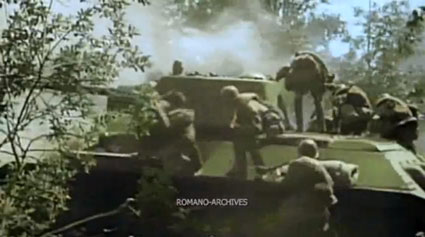
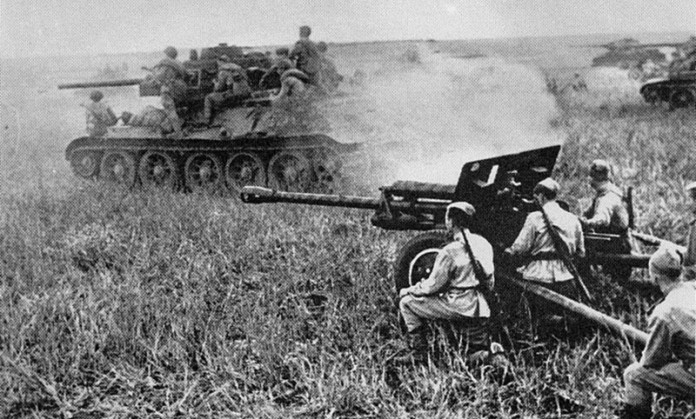
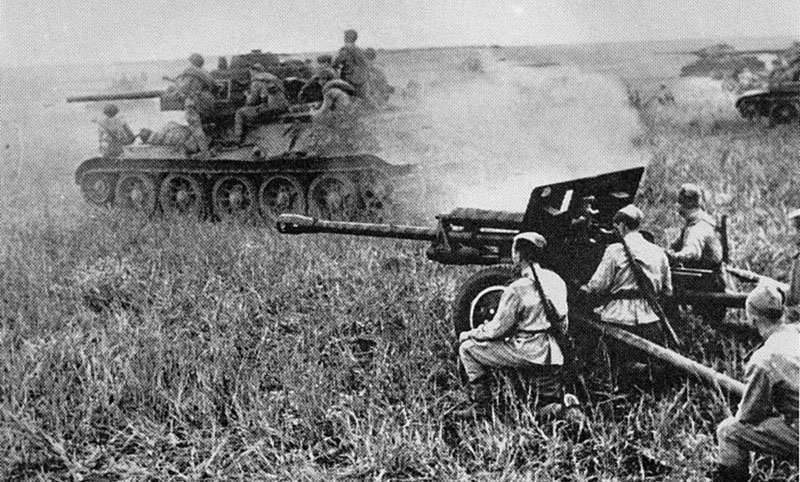
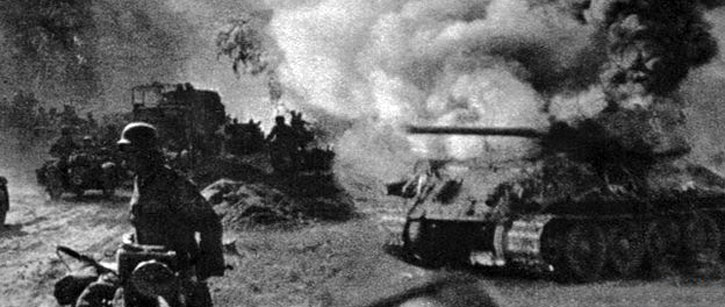
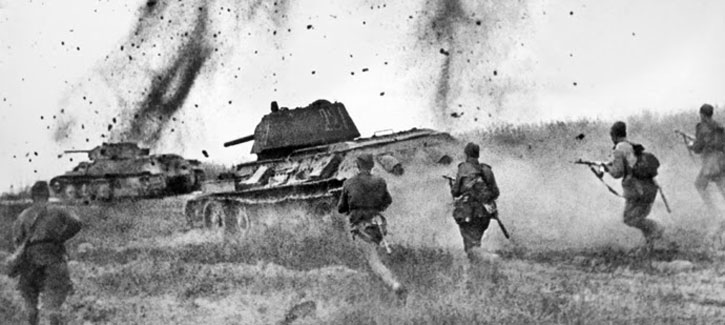
The German campaign planRussian infantry riding a T-34 tank on an assault during the Kursk campaign, 1943. Photo via Romano Archives
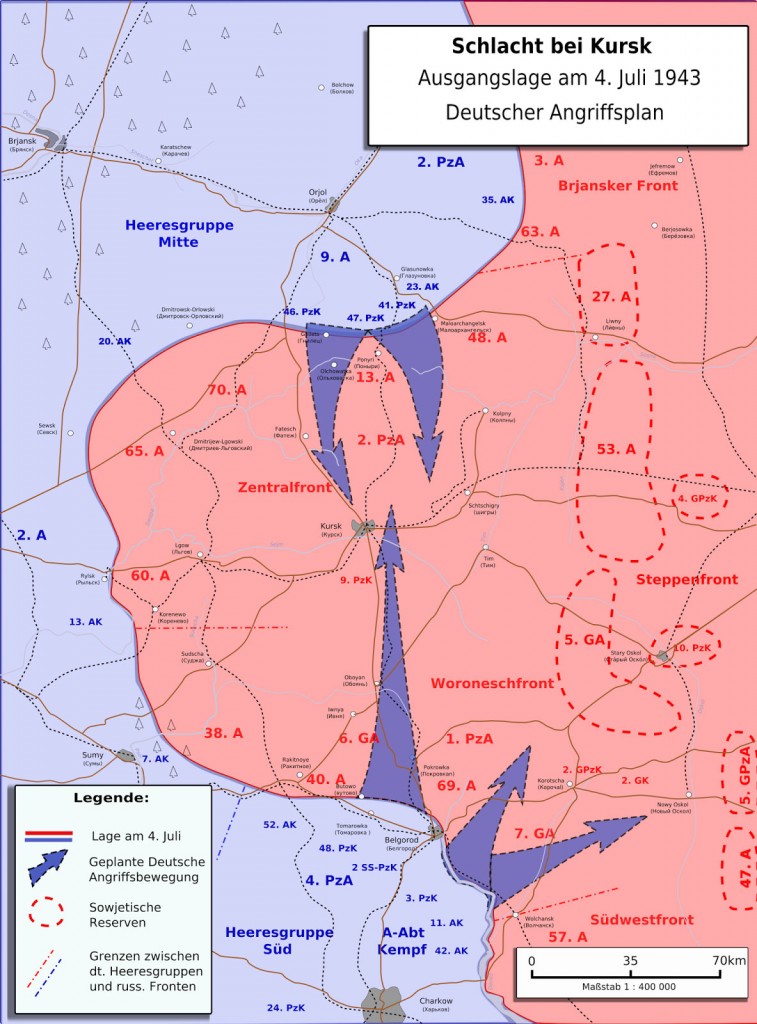
The original German plan, was to pinch off a large bulge created in the Eastern Front, extending 70 miles westward, presenting an ideal target for a twin pincer attack, which German Panzer leaders had successively mounted with devastating effect. If their plan succeeded, the Germans would encircle and destroy more than five Soviet armies, letting the “Victory Bells” ring in Berlin again, after the moral blow of the Stalingrad catastrophe shattered the peoples’ mood. Moreover, it would have forced the Soviets to delay their planned summer offensive and might have allowed the Wehrmacht its desperately needed breathing space on their battered Eastern Front.
The frontal bulge created in the front-line around Kursk made it an obvious and tempting target to the Wehrmacht. But by allowing the Germans to strike first at the target area would give the Red Army an opportunity to wear down German Panzer formations against pre-prepared positions, thereby shaping the force in its field ratio heavily against the enemy. Once the initiative had been achieved and the enemy had been worn down sufficiently, well concealed strategic reserves would be committed to finish off the remaining German force. This indeed was the plan of the Soviet high command (Stavka) in Moscow. The problem was that it hinged on a very thin threat of luck, because the Germans had placed everything on a single card, massing all their armor to be thrown into this Bulge to achieve a strategic victory, on which depended the entire campaign in Russia. Some of their generals were expressing concern over concentrating all their available power in, what they considered a dubious campaign on which they had serious doubts as to its successful outcome. But on Hitler’s direct order, no less than 2700 panzers and assault guns and 23 infantry divisions were earmarked for the Battle of Kursk.
Much of the long under-strength German Panzer units were of minor combat value, being equipped largely with virtually obsolete MkIII or MkIV still mounting the short barrel 50 and 75mm gun, although a large part of the latter were sent, almost at last minute, with the new MkIVG version, mounting the more effective and longer 75mm KwK 40 L/48 gun. Nevertheless, the Panzerwaffe poised for action in Summer 1943 was a most powerful adversary. The Stavka in Moscow was fully aware on what was in stake and prepared itself to defeat the German plan, cost what it takes. And indeed, the loss in manpower and Materiel was to be horrendous, remaining a source for painful memories and inevitably, also long disputable myth for decades.
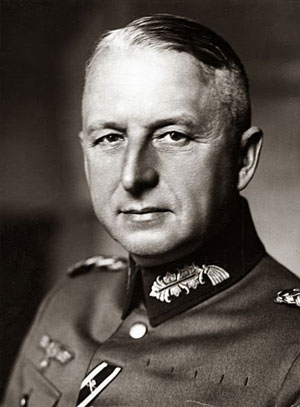
Field Marshal Erich von Manstein. Photo: Bundesarchiv
The foremost commander masterminding the Zitadelle Campaign was one of Germany’s greatest strategists, Field Marshal Erich von Manstein. Born into an aristocratic Prussian family with a long history of military service. Following a notable combat career in WW1, Manstein displayed brilliant strategic outlook, mastermining the dramatic drive through the believed “impassable” Ardennes, which brought to the fall of France in 1940. After a series of excellently conducted defensive battles against overwhelming enemy forces, he was given command of the armor heavy Army Group South, achieving the deepest penetration into the Soviet defenses, until embroiled in the notorious tank battle at Prokhorovka.
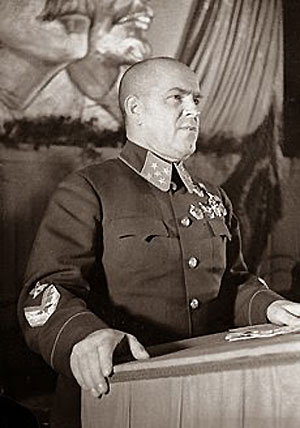
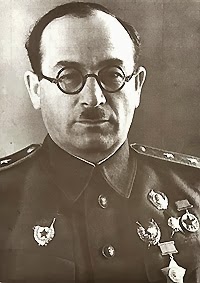
Marshall Fyodorovich Vatutin facing Manstein on the Russian side, took command of the Voronezh Front, preparing for the momentous Battle of Kursk, he rejected conventional echeloning of armies; his innovative deployment allowed him not only skillfully conducting the defense against the technically superior Germans, but also to quickly switch from defense to offense, when time was ready. The overall command designated by Stavka was to Marshall Georgy Konstantinovich Zhukov, perhaps the most famous Russian commander in WW2. Born into a poverty-stricken peasant family, he already became noticed, when commanding the First Soviet Mongolian Army Group in 1938, saw action against Japan’s Kwantung Army on the border between Mongolia and the Japanese-controlled state of Manchukuo. The campaign at Khalkhim Gol had significance beyond the immediate tactical and local outcome. Zhukov demonstrated and tested here the techniques later used against the Germans in Russia. Evaluation some of the problems inherent in the performance of the BT tanks led to the replacement of their fire-prone petrol (gasoline) engines with diesel engines and provided extremely valuable practical knowledge that was essential to the success in development of the excellent T-34 medium tank.
Subscribe to get the full version of this study and more…
Books related to the Battle of Kursk (a selection of recommended books)
This is a review of books related to the Battle, it does not contain all available books, also the latest publications are not included, but this review is worth reading to get an insight into the main topics, before choosing a reliable book to study.
The Battle of Kursk by Col, retd David GlantzISBN 0-7006-0978-4, 2009, 472 pages This is probably the best researched book on the Battle at Kursk. Written by a veteran military researcher and historian, it best used as a reference source. Although quite difficult to read from start to finish, it is packed with details, data and sources, both German and newly released Russian. Problem are the maps, which are so packed with numbers that they are quite impossible to understand- their background is grey and place names near unreadable. The mythical July 12 tank battle at Prokhorovka is critically examined and placed in a proper context. This book also does an excellent job of placing the entire Kursk battle in its larger context. There is a wealth of appendices containing all possible statistical information, making it an indispensable tool for researchers and historians.
Demolishing the Myth: The Tank Battle at Prokhorovka, Kursk, July 1943 An Operational Narrative by Valeriy ZamulinISBN-10: 1906033897, 2011, 672 pages Written by a Russian historian, a local resident living near the site of event, Zamulin’s book is trying to rip off the decades of misinformation and to reveal heretofore unavailable detail about well-known battles like Kursk. The first three chapters, which consist of about 60 pages, provides an overview of the Battle of Kursk, the defensive preparations of the Voronezh Front and an overview of the 5th Guards Tank Army (5GTA) and its commander, Pavel Rotmistrov. The author gets into the Battle of Prokhorovka proper about one-third of the way through the book and is most likely to remain the best Soviet account of the battle for some time
Kursk 1943: The Tide Turns In The East Osprey Campaign Books – By Mark HealyISBN-10: 1855322110, 2002, 96 pages Mark Healy’s Book is a short and easy to read coverage of the campaign, with lots of photos, maps and diagrams, without going into much detail. I does however give the reader an insight into the battle, the participants and the outcome. A very good buy.
Scorched Earth The Russian-German War 1943-1944 by Paul Carell ISBN 345-02213-0-165, 1966 This is a book which tells the German side of the story, although some Russian survivors’ tales have been included. It is one of the best books written on the war in Russia, describing the heat of battle in brilliant narrative and style. Personal stories of the men involved in this terrible carnage are gripping and live. A tale told to remember what war is like in real terms. Unfortunately only second hand buy available of this excellent book.
Panzer Battles A study of the employment of armor in the Second World War by Major General F.F. von MellenthinISBN-10: 1862274592, 2009, 256 pages (first edition: 1956) One of the best books written on the subject, presenting not only the story of Germany’s armor, but told by one of their foremost experts on armored warfare, which served as guidance to many officers and students how armor should be operated in battle. The author’s gripping description of his part in the Battle of Kursk is of prime interest, although it covers only the German side of the campaign, at the time no Russian version was available to the author, it is still an unbiased report. His maps are very good and clear to follow the narrative. An interesting part discusses armored tactics throughout Citadel, which is very helpful to explain the way German panzers fought in the Southern section of the campaign. A reprint is available from 2009.
The Russians massed large concentrations of anti-tank guns, T-34 tanks and heavily armed infantry grouped to defend the Kursk region in an effort to break the German move east.The Stavka also held an “ace card” carefully concealed from German intelligence – the newly created huge Steppe Front concentrating an unprecedented mass of fresh fighting units, including six Armies with massive tank forces and airpower…
German forces occupied an extensive salient in the northern portions of the uplands around the city of Orel, while the Soviet Kursk Bulge dominated the upland’s southern region. The Red Army anchored its defenses along the northern edge of the Kursk Bulge, based on ridge lines north of the Svapa River valley and along the southern bank of the Oka River north of Kursk. Along the southern flank of the bulge, Soviet defenses extended along the higher ground north of the cities of Sumy and Belgorod, but here the terrain was barren and open country enabling wide deployment and maneuver of armored forces.
But the Stavka also held an “ace card” carefully concealed from German intelligence: The newly created huge Steppe Front in the rear zone of the Bulge contained not only further fortified belts, covering the east bank of the river Don, but concentrating an unprecedented mass of “fresh” fighting units, including six Armies with massive tank forces and airpower, all in top fighting condition, ready to strike a devastating counter attack on the mauled Nazi Panzers in the “Bulge”.
The nature of the bulge allowed the Red Army to build a virtual fortress of strong fortifications in greatest depth facing all the expected German axis of advance. The depth of these defenses was indeed staggering, combining no less than eight fortified lines of resistance, stretching nearly 110 miles deep. The immense use of manpower, both military and civilian, employed to build this huge task, left no doubt as to the significance of the coming battle for life and death, facing the Nazi onslaught as anticipated by the Russian commanders.
Subscribe to get the full version of this study and more…
Having described the general situation, without going into unnecessary detail, (which can be easily studied further by consulting the variety of maps) let us therefore enter into the battle scene, without further ado and try enliven what happened, as seen through the eyes of combatants and their experience, fighting under the most trying conditions, that the horrors of war can challenge young humans to the utmost courage.
Operation Citadel – the German plan. (click for a full-size map)
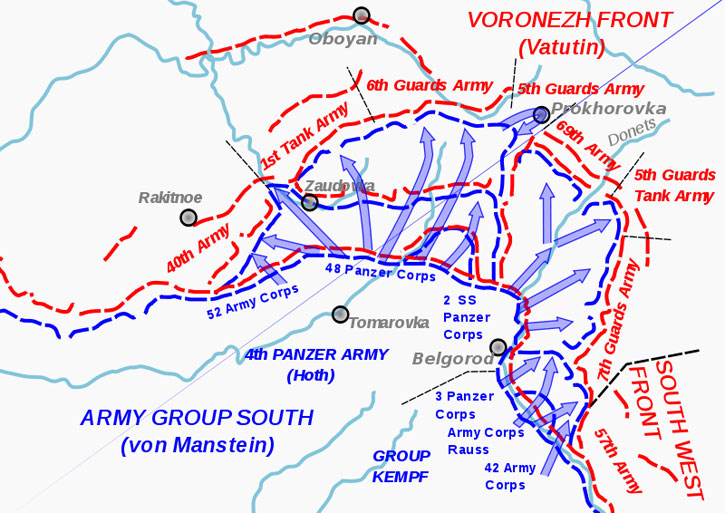
Broadly speaking, the German plan for Citadel was relatively simple indeed: The Kursk “Bulge” created the ideal conditions to “pinch” the entire Russian frontline, with two massive armored thrusts, 9th Army from the north and Fourth Panzer Army from the south, smashing the Soviet defenses to link up east of Kursk, thus encircling the entire Russian forces in the Bulge. Success depended on massive fire power, speed and courage of the panzer crews advancing relentless with heavy air cover, smashing all in their way.
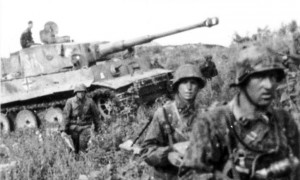
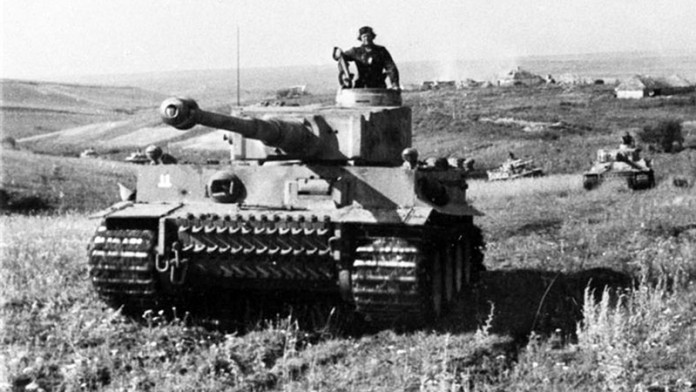
German soldiers of SS-Panzer Grenadier Division ‘Das Reich’ advance through the southern Voronezh Front during Battle of Kursk, covered by Panzer VI Tiger I tank. Photo: BundesarchivSubscribe to get the full version of this study and more…
As the Germans managed finally to break through the Russian forward lines, while suffering heavy casualties, they ran into improvised minefield which soldiers recruited from the notorious Soviet penalty battalions quickly laid out, disregarding the withering fire from the advancing panzers. Only one or two out of dozens of these unfortunate troops survived, the rest blew up by their own mines or were squashed by the panzers as they drove over them and blowing up the mines, all involved suffering a horrible death.
The attack halted under heavy fire right in front of the Russian defenses. As one German survivor told:” the panzers were supposed to attack, but looking back I saw them stuck in a minefield, some exploding, with their crews bailing out only to be killed by enemy fire. With the tanks stuck fast, it was up to us to enter the enemy trenches and a savage hand-to-hand melee started with no quarter taken or given. All round me, men fell, Russians and Germans grappeled for life and death. Tremendous confusion raged, within minutes we suffered dozens of casualties, but no rescue was possible, as the medics fell too in the carnage. Ten more nerve shaking hours were to pass until the panzers finally managed to extricate themselves from the minefield and came to our rescue. By them most of our company lay dead or severely wounded in the trenches”.
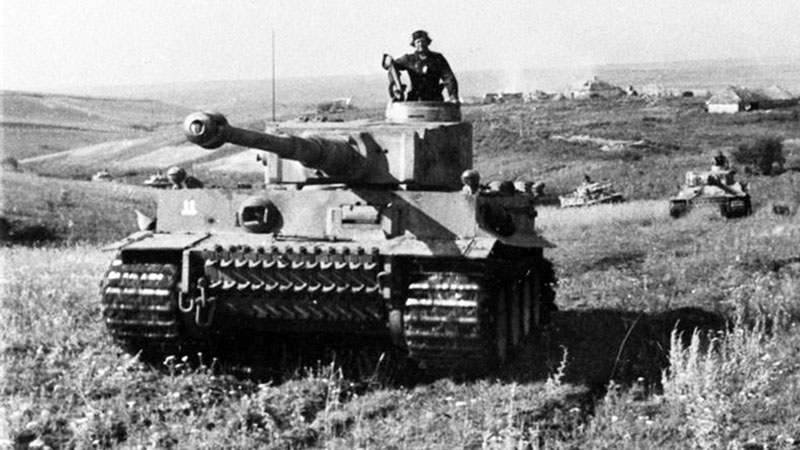
Tiger I (PzVI) heavy tanks of the German 2nd SS Panzer Division 'Das Reich', near Kursk, Russia, June 1943. Photo: Bundesarchive
Tiger I (PzVI) heavy tanks of the German 2nd SS Panzer Division ‘Das Reich’, near Kursk, Russia, June 1943. Photo: BundesarchiveWalter Model with General lieutenant (later General der Infanterie) Friedrich Schulz.
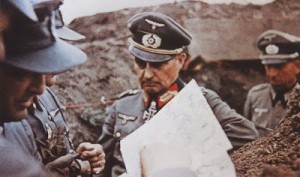
Commanding the 9thArmy was General Walter Model a hard-driving, aggressive panzer commander. Born January 24, 1891, as the son of a music teacher in Genthin, Saxony, he fought in the Great War with distinction and quickly advanced his career, becoming Hitler’s expert in defensive warfare. Although a devout Nazi, he openly criticized Hitler’s Kursk Plan, with other generals, including the panzer expert Heinz Guderian, feeling that attacking was unnecessary, and the Germans should instead wait for the Soviets to launch their own offensive before defeating it. Model was also dubious about attacking with his 9th Army, pointing out that Konstantin Rokossovsky’s Central Front was strongly dug in and outnumbered him two to one in men, tanks and artillery.
As it turned out, indeed Model’s assault was a failure, as his Army quickly became enmeshed in the elaborate Soviet fortifications.
Subscribe to get the full version of this study and more…
The fight over the capture of this important vantage point reached its climax when the Germans stormed the fortified villages on a dominant hill. The savage fighting over the possession of the Hill continued for hours, culminating, when a Soviet force led by Colonel Teliakov’s 107 Tank Brigade fell into a well concealed Tiger ambush, which in minutes destroyed nearly half of the Russian force. The scene was horrifying, as tanks exploded, surviving crew members having extricated themselves from their burning hulks, frantically searched cover, only to be killed by the German grenadiers. But as evening fell, General Model’s attack had reached its deepest point and was stalled in front of heavy enemy fire from their multi-trench defensive position. Next day at dawn Rokossovsky, at last, launched his first massive strategic counter attack upon the Orel salient. It was a crucially decisive move that decided the fate of Model’s offensive ambitions.
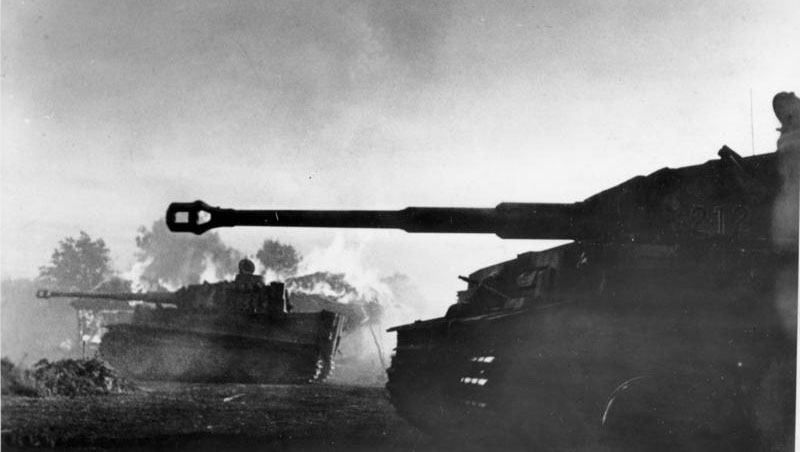
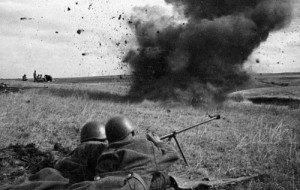
German Tiger tanks in the Eastern Front, July 1943. Photo: BundesarchivAnti-tank PTRD rifle teams in action, 1943.
During the night of 4–5 July SS combat engineers had infiltrated no-man’s land and cleared lanes through the Soviet minefields. At dawn the three divisions of II SS Panzer Corps – 1st, 2nd and 3rd SS Panzer Divisions- moved to attack General Ivan Christiakov’s 6th Guards Army defenses. Using a special “Panzer Keil” formation, at the point of the wedge were the heavy Tigers, flanked by Panthers, while the older tanks followed behind, well protected by the heavies. This panzer tactic, might have been fully effective if both Tigers and Panthers were up to their expected operational value. But they were relatively new and still full of technical problems, which caused severe setbacks.
What proved to be the best tank performing at Kursk was the Pz IV G version. Even though the T-34 had better speed and mobility, it’s armor could easily be penetrated by the L/48 gun at 1000 meters.
Pz III was less protected, and equipped with less firepower, compared to the upgunned Panthers and Tigers.
Leading the assault with the heavy Tiger tanks, protecting the more vulnerable Pz III and IV, while also bringing forth a strong armored vanguard for its most effective firepower at the first encounter- was foreseen as the very best solution to open the offensive against the Russian defenses. Shock-and Awe was the motto, but while it did, for the first phase function as planned in Iraq, several decades later, here at Kursk it backfired. The Soviets, having anticipated the strong German panzer assault, had organized their defenses, emplacing their heaviest equipment and the best troops to stop the German onslaught, right up front. General Hoth’s tactic staggered, as his two elite panzer corps, storming head-on soon closed range with the enemy defenses and exposed their best equipment to the full effect of the Russian heavy anti-tank fire coordination in their prepared defenses, thereby losing the effect of their massive long-range firepower- but close enough for the defending T-34 and anti-tank artillery to penetrate even the thick Tiger armor protection, at their weakest points known and thoroughly trained by the Soviet troops.
Subscribe to get the full version of this study and more…
What Hausser and his superiors did not realize, was the huge reserves, which the Russians had concentrated under highest secrecy and stealth, the Steppe Front, commanded by capable General Ivan Konev massing its forces, preparing for a tremendous counter attack, which would dislodge all German planning for the campaign. Only days before, the 2ndSS Panzer Corps officers were confident that through their impressive power, victory was in hand, as one officer joyously declared: ” “We will have lunch in Kursk!” But the SS would never have lunch nor dinner in Kursk, other then as prisoners!
In fact, neither campaign objectives, General Walter Model 9th Army’s, nor Hoth’s 4th Panzer Army, and in fact Field Marshal Erich von Manstein’s general campaign plan had materialized and the planned joined pincer seemed illusive as matters stood, facing the overwhelming Soviet power and huge reserves, confronting a more and more demoralized and exhausted German army.
While 9th Army encountered growing resistance from Rokossovsky’s massed armor reserves and his infantry fighting desperate battles in the endless maze of Soviet defenses, Model played his last card by throwing in his own armor divisions, which he had held in reserve for the “final” strike into the Russian rear, closing the pincer with Hoth’s 4th Army. But it was not to be. Losses grew dangerously by the day, as seemingly endless numbers of Russian tanks appeared out of nowhere and desperate fighting went on day and night with no decision achieved.
All depended now with “Papa” Hoth’s 4th Army and Hausser’s ambitions to decide the battle of Prokhorovka, which was the key objective for his campaign. The relatively open terrain made excellent tank country, bringing the German 88mm/56cal long range firepower to its maximum effect. But while the Germans were confident to achieve a decisive win at Prokhorovka on 12 July, it proved them wrong. As Hausser’s panzer divisions smashed through the last Soviet lines of defense, they came up on a painful surprise.
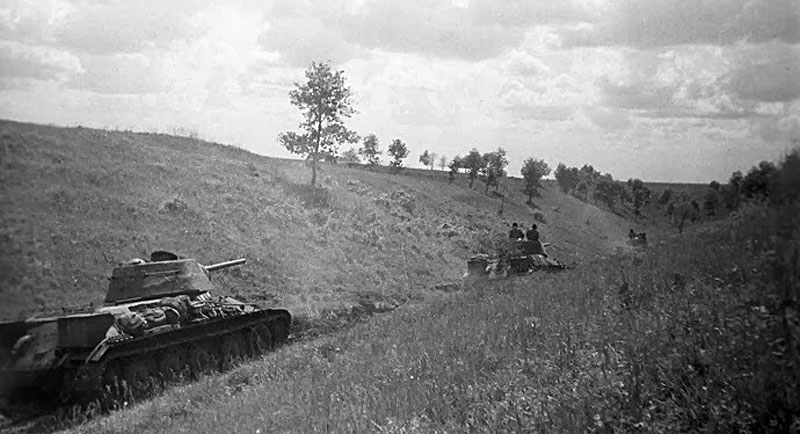
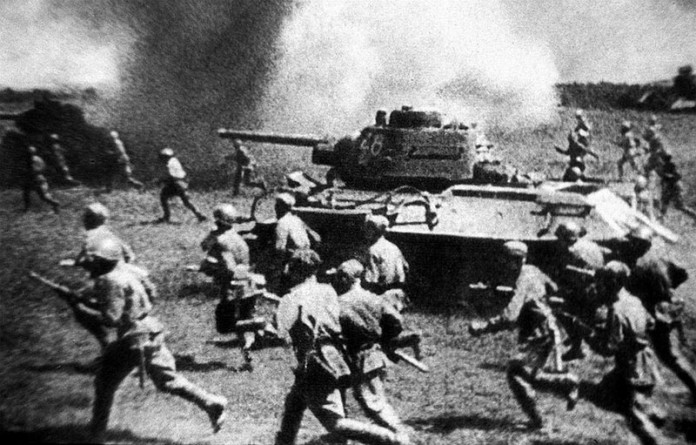
An assault by T-34 tanks and infantry near Prokhorovka, July 1943.Russian Army Lt. General Pavel Rotmistrov
While General Hausser’s SS divisions prepared for battle, there was feverish activity in the Soviet camp as well. On July 11, the elite Fifth Guards Tank Army, commanded by Lt. General Pavel Rotmistrov, who at the age of 42 became one of the youngest Soviet generals, had also moved his massive force into the Prokhorovka area, having force-marched 200 miles in four days from his deployment with Konyev’s Steppe Front to the East.
What lay a head, was to become the most savage and massive armor encounter, fought in such a relatively confined battlefield. The ruthless bloody carnage, under which this battle was fought, but the confusion also creating one of great myth make-believes of the War in Russia, to be disputed to this day. The battle was fought across a stretch of land ranging in an arc of 20 kilometers to the west and south of Prokhorovka.
Generally open country, but hilly, terrain around a vital railroad, with groups of woods providing shelter for tank destroyers, a near pergect scene for a great tank battle. Seen in detail, the countryside around Prokhorovka, while relatively open to mechanized operations, was divided into compartments by the Psel and Lipovyi Donets Rivers and adjacent ridge lines, rendering good hide-outs for hull-down positions for long range guns. With the massing of armor and confused in-fighting that followed, this was of limited gain, as proved by the morrow.
Subscribe to get the full version of this study and more…
Carnage at Prokhorovka
The battle may best be described by one of the participants.
Down off the west slopes before Prokhorovka came the massed armor of five tank brigades from the two Soviet tank corps. They had been ordered to approach at high speed. What followed became a horrifying spectacle, engulfed in dust smoke and fire, lasting throughout the day. As one Russian tank commander remembers: “The sun came to our aid as we raced into the battle. It blinded the Nazi tankers, making their periscopes useless. The German Tiger giants seemed confused, their drivers trying to change direction, but we were on to them, closing fast, making their long range 88mm guns ineffective, our own 76,2mm guns tearing great holes into their side armor. Ammunition exploded inside, from the blast the ton heavy turrets were torn off and flung away. The point-blank fighting became totally disarrayed, no control possible as it was each tank fighting for his life in a swirling melee caught in a murderous slogging-match. Soon the entire battlefield was littered with smoldering steel coffins, that had been proud vehicles of war only seconds before. Black thick oily smoke covered the valley, leaving not a blade of grass green.”
But the battle was far from over yet.
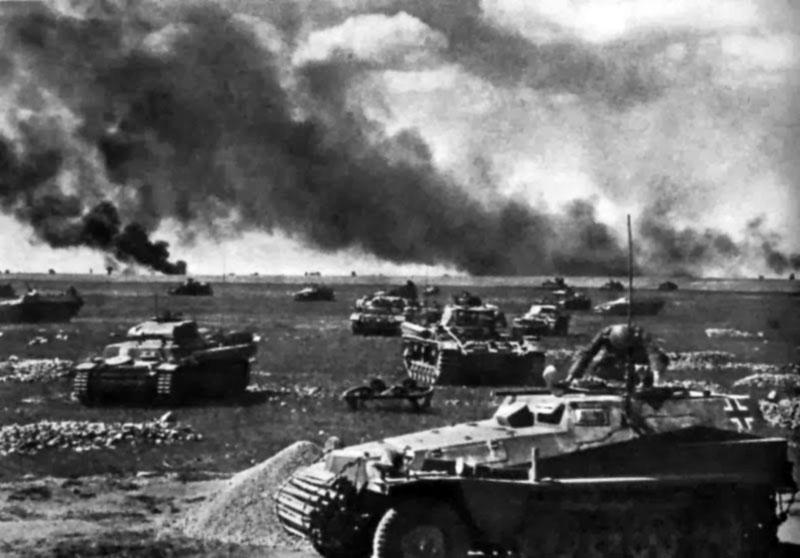
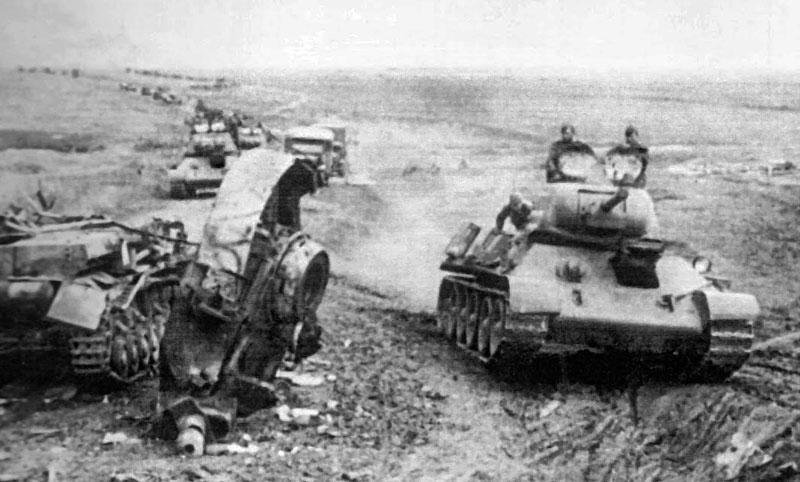
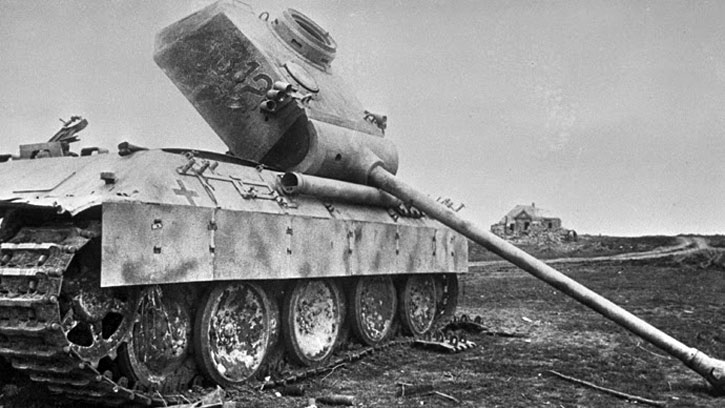
A German Pz V Panther tank destroyed near Prokhorovka, July 1943.
The Reckoning
The Prokhorovka battle ended at a draw with heavy losses on both sides. However, after the battle was over, the Soviets held the area and were able to recover their disabled tanks and wounded crews.
While it makes a dramatic story, nearly all the stories of this battle scenario are essentially myth. Steel certainly clashed head on with Steel, but the numbers, which both sides claimed destroyed was exaggerated and there was no “ramming” of Tigers by Soviet T-34 tanks either, as some of the Russian sources claim.
Certainly when tanks are fighting in such a confined battlefield, with little maneuver possible, there would have been close clashes and display of heroics by very brave soldiers giving their utmost under most difficult conditions. But under the heat of battle these things happen and are unfortunately much later are exploited for quite different purpose by ruthless and egocentric politicians, which never fail.
On 16 July, German forces withdrew to their start line. Severely depleted, the Germans then had to face a heavy Russian offensive launched to smash the German forces in the Belgorod–Kharkov area which was launched on 3 August.
Although the Battle at Kursk may not have been the “turning point” of the war, it does represent the point where the Red Army took away, for good, the initiative from Hitler’s War in Russia. From now on, hard fighting was still ahead, but the road was now clearer in the single direction of Berlin.
There is a tremendous amount of misunderstanding about how CITADEL progressed. This misunderstanding is fueled by oft-repeated, but false, descriptions of the combat that took place. The typical claim that the Battle of Prokhorovka was the biggest tank battle ever fought is also misleading, as there were tank battles fought in which no less numbers of tanks took part. To mention only one of them, at Brody in June 1941, soon after the beginning of the German Barbarossa invasion, several thousand Russian tanks, including some of the first T-34, fought over a thousand German Panzers, with huge losses on both sides.
Thirty years later in 1973, the so-called Yom Kippur War, cost nearly 3000 tanks , with the Syrian army losing 4,000 men and 1,100 tanks, the Egyptian Military lost 10,000 men and over a thousand tanks, while the IDF lost 2500 men and 800 tanks, These losses were based on real numbers and not myth, so it might well be that the Arab-Israeli war in 1973 became the greatest tank campaign in modern history.
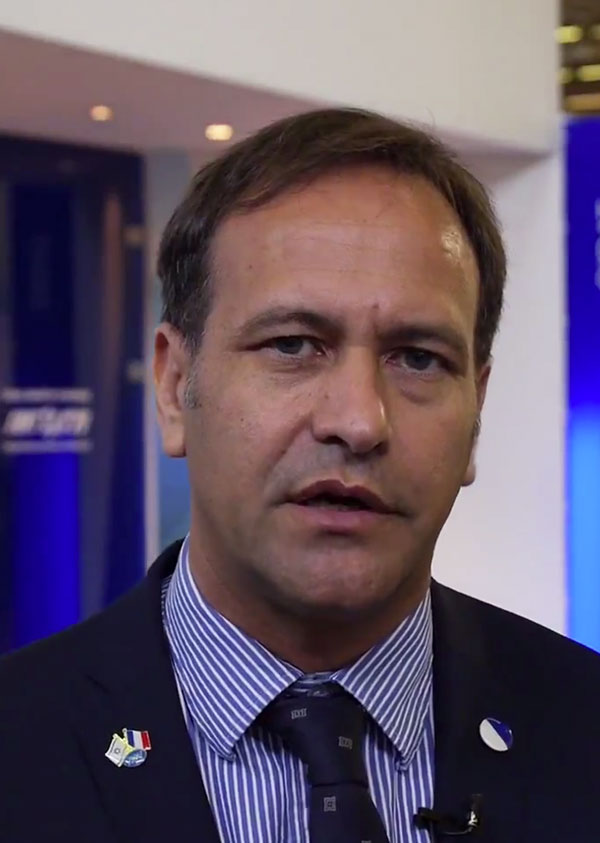
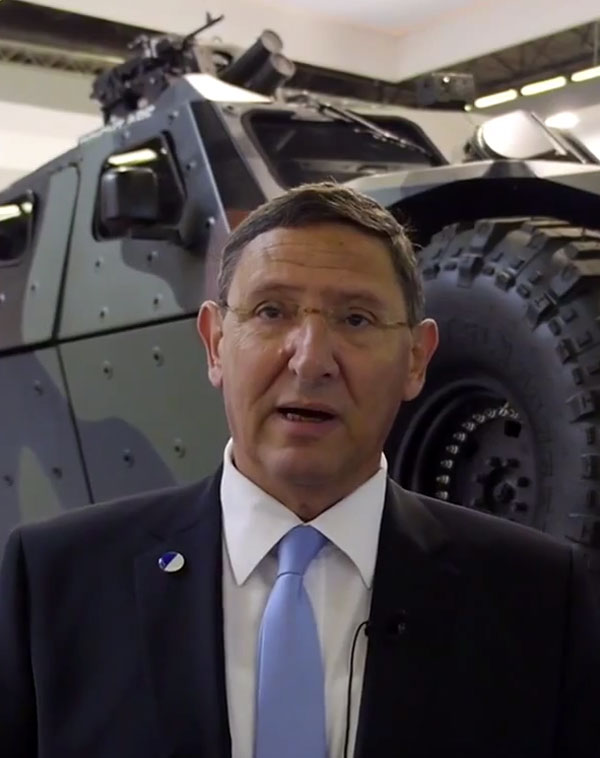
Itamar Graff, principal deputy director of SIBAT, Israel’s defense export directorate.
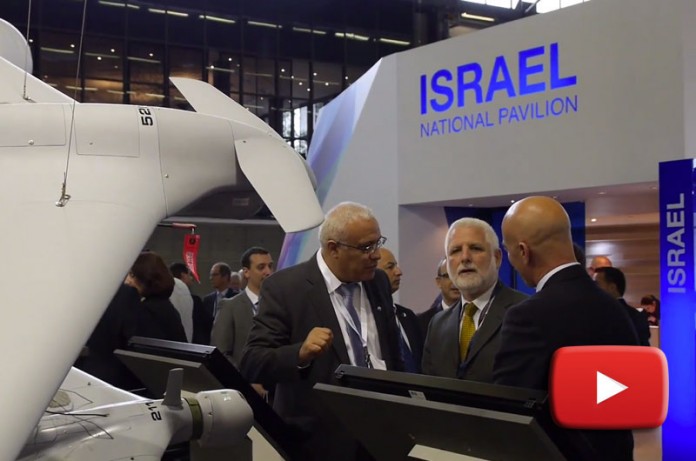
Eurosatory, the world’s premier defense exhibition held at the Paris exhibition centre in June 2014 was one of the largest ever. More than 250 combat vehicles participated in live demonstrations and on the static display, 1,500 exhibitors and strong participation of official delegations and visitors from around the world were all indicators that the global defense market could be at a turning point after a long decline.
“The majority of Israel’s exportable land warfare capabilities were here in paris this week” Itamar Graff
“Sibat created the largest ever exhibit at an international defense expo this year.” Itamar Graff, principal deputy director of SIBAT, Israel’s defense export directorate told Defense-Update. “The national Israeli pavilion we organised at Eurosatory hosted 30 companies, additional Israeli defense companies were exhibiting nearby and on the static area. In fact, the majority of Israel’s exportable land warfare capabilities were here in paris this year.” Graff added.
Eyal Ben Reuven, Land Systems Chief Coordinator at IAI
One of the largest exhibitors at the Israel’s national pavilion was Israel Aerospace Industries (IAI). According to Eyal Ben Reuven, Land Systems Chief Coordinator at IAI, the company highlighted a complete concept of autonomy provided for the tactical, combat echelon.
A complete concept of tactical autonomy that applies to the battalion level
“IAI displayed at Eurosatory a complete concept of tactical autonomy that applies to battalion level and above.” Ben Reuven told Defense-Update. “We are introducing this capability at the tactical manoeuvre space, empowering manoeuvre forces with autonomous intelligence gathering and precision fires capabilities, integrated through an innovative battle management system. Other elements address force protection, providing counter rocket, artillery and mortar (C-RAM) sensors.”
Sensors for the tactical forces
According to Igo Licht, VP marketing at Elta Systems, the systems’ manufacturer, the new C-RAM developed by Elta is shown here for the first time. The ‘Green Rock’ moves with the forces, detects hostile fire from distances up to ten kilometres and indicates the threat’s projected impact point and point of origin. “This information provides critical early warning to the forces, enabling immediate and effective action. By rapidly linking sensors to shooters, this radar also provides targeting data for immediate counter-fire. We are currently delivering the first systems to the Israel defense forces.” Licht added. A different radar displayed by Camero Tech is designed to see through walls. “We send the pulses through the wall and measure the echoes returning from objects behind them, to build the sensor display.” Camero’s marketing director Joshua Levontin explains. These system include the Xaver 800, providing three dimensional spatial view of the space behind the wall, showing details with depth, the Xaver 400 is a more compact system, delivering a two-dimensional view and Xaver 100 hand held system indicating only the human presence behind the wall. “This level of information was not available to assault forces in the past. This is a life saving capability.” Levontin adds.
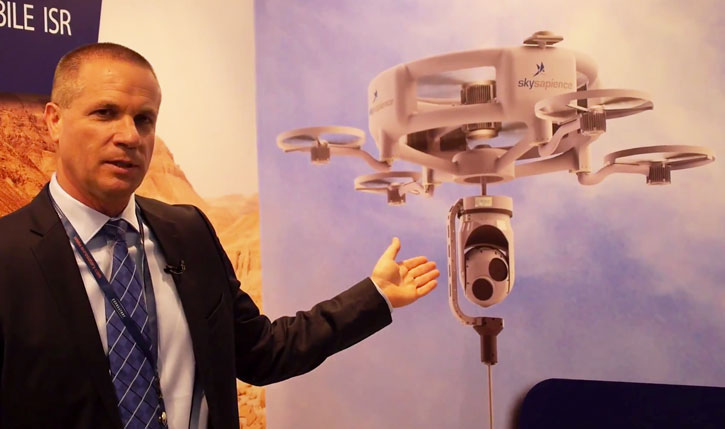
Gabriel Shachor, SkySapience CEO
Another innovative tactical sensor making its debut at the show was Hovermast 100, from Sky Sapience. “This is the first and only operational, tethered hovering platform in the world.” said CEO Gabriel Shachor. The Hovernmast 100 was launched commercially in 2013 and has since been sold to several customers, including the IDF. “The advantage of the system is its autonomy – taking off instantly, without any preparation.” Shachor explains. The system can ascend up to an altitude of 50 meters and stay on station for days, feeding on power transferred to the vehicle through the tether. Sensor data is also fed through the cable to the ground station, which is networked to other uses. One of the payloads the Hovermast 100 carries is the T-STAMP electro-optical payload pack from Controp. This gimballed payload contains three sensors, operating TV, cooler Infra-red and laser sensors for daylight, night and range finding applications, all mounted on a gyro stabilised gimbal.
The aerostat is deployed in 5-10 minutes to provide an immediate coverage of a large area, in day and night
Different approaches to elevated observation were provided here by UAV developer Aeronautics and Aerostat builder RT. “The Skystar 100 aerostat is designed for security, border protection and first response in disaster areas. Carried in backpacks by two soldiers, it can deploy in 5-10 minutes to provide an immediate coverage of the area in day and night.” Rami Shmueli, RT’s managing director noted. The UAV specialist Aeronautics displayed two new versions of the Orbiter tactical UAS family – the Orbiter 2B and 3B. At weights of 10 and 30 kilograms both these vehicles are designed for tactical missions. Both offer exceptionally long endurance for their classes, and use highly advanced datalink, navigation and day/night payloads. According to VP Marketing Dany Eshchar, the two platforms are designed for reliable operation even under difficult weather conditions and high winds. Orbiter 2B can fly four hour missions at a range up to 100 km. Orbiter 3B can fly out to 150 km with seven hour endurance.
New systems for force protection
A life saving capability from RAFAEL is the Trophy active protection system or APS. The Trophy APS was originally developed for the Merkava tank, which has already proved itself in combat. At Eurosatory RAFAEL presented the new lightweight configuration. “We are displaying a line of protection systems, including passive, hybrid, as well as active protection; we are displaying here the Trophy LV, optimised as an affordable system for light armoured wheeled vehicles.” Giora Katz, Executive VP, head of Rafael’s land and naval division said.
Dubi Sela, chief Business development officer, RADA
The radar instantly computes the firing position to inform the tactical unit of the incoming threat
Another system making its debut at Eurosatory was the Multi-mission Hemispheric Radar (MHR) radar from RADA. “We began developing this radar in 2010, and began field in 2013, RADA’s Chief Business development officer Dubi Sela told Defense-Update. “This radar is currently undergoing advanced testing and evaluation by different customers throughout the world. It detects almost any moving target, at different velocities ranging from moving people to flying missiles. “The radar instantly computes the firing position to inform the tactical unit of the incoming threat. Unlike larger systems that are operating behind the forward units, this compact radar is carried by the manoeuvring forces on their vehicles to trigger alerts in real time.” Another member of the family, the CHR, acts as part of vehicle active protection systems or APS, it is able to detect incoming threats and point at the location from where hostile fire is coming from. An application of this radar was seen across the isle, on IMI’s new CombatGuard vehicle where the CHR was integrated with IMI’s ‘Bright Arrow’ APS. Battlefield mobility was demonstrated by several companies, among them IMI displaying an exciting new off-road vehicle – the CombatGuard.
Udi Adam, IMI Chairman
“CombatGuard fills a gap between the light armoured vehicles and heavily protected armoured fighting vehicles.” Udi Adam, Chairman of the board at IMI commented. “With high off road mobility it is designed to go anywhere at high speed, reaching its objectives from unexpected directions.” Adam added. In addition, IMI is presenting an impressive arsenal, from multi-disciplinary protection, part of which is demonstrated on this vehicle, for personnel, vehicles and structures to precision weapons, reaching from hundreds of meters to 150 km.
Artillery and mortars delivering Precision fires
Another theme at Israel’s display at Eurosatory was fire support, represented by Elbit Systems’ mobile mortar and artillery systems, the Topgun and Silver Bullet – both GPS guided projectiles developed by IAI and BAE Systems/Rokar, precision guided mortar bomb from IMI and precision targeting capability from RAFAEL. Two mobile artillery and mortar systems from Elbit Systems made their international debut at Eurosatory. One of several variants of ATMOS built by Elbit Systems, all based on 155mm 52 Caliber howitzer, the model on display was mounted on a chassis manufactured by Tatra. According to Boaz Cohen, VP Marketing & Business Development at Elbit land systems, “The ATMOS delivers firepower with high precision, at ranges beyond 40 km. The gun is operated by a crew of four, seated in an armour protected cabin. As a mobile, agile system, The system can accommodate wide range of trucks. The ATMOS carries enough ammunition sustaining several fire missions. The system is linked to a C3I network delivering target data while on the move. It is equipped with semi-automatic loading to deliver rapid fire, firing the first round 20-30 after halt. Spear is an innovative new mortar system integrating a 120mm mortar on a tactical light wheeled vehicle, while maintaining the mortar’s range, firing rate and precision. “SPEAR enables such vehicles the capabilities that were previously feasible only with much heavier, tracked vehicles.” Cohen explained, adding that by dramatically reducing the mortar’s recoil force, SPEAR can be mounted on standard vehicles, requiring no changes to the chassis.
While standard mortars score hits within 50-200 meters, the guided bomb would hit in less than 10 meters
Improving the mortar’s precision fire capability, IMI introduced the precision mortar bomb designed for deployment with 120mm mortars employed by battalions and brigades. The guided bomb uses GPS guidance to achieve ultimate precision with standard mortars. According to Lior Lifshitz, infantry marketing director at IMI, the system comprises the guided bomb and fire control computer, that handles the fire mission, based on the target coordinates received from the target acquisition system. The bomb will hit with 10 meter accuracy, without the need for further observation, ranging or corrections. “This is an unprecedented new capability for the infantry battalion, since firing unguided bombs, mortar teams typically score hits 50 to 200 meters off target.” Lifshits said.
Unmanned systems and robotics
Israeli developers also unveiled here new, futuristic robotic systems that are in development today, among those innovations were unmanned vehicles that can take off and land vertically, ground robotics that can be used on pathfinding or security missions, and remotely operated weapon stations mounted on vehicles and helicopters. “One of the robotic systems developed by IAI is the MIDS – a pathfinder robotic system that detects, locates and defeats mines and IEDs, enabling safe movement through contested terrain and dense urban areas.” Ben Reuven noted. A new UGV displayed by ground robotics specialist G-NIUS was the new, electric powered combat robot. According to Danny Gur, business development and program manager at G-NIUS, the new robotic vehicle is powered by two electrical motors. The robotic control system is based on a common module developed recently by the company. “It enables autonomous mission control with optional teleoperation from a distance.” Gur added that the miniaturised system can be installed on various vehicles, from this electrical vehicle, APCs, HMMWVs, ford 150, Tomcar. “We can integrate it to any vehicle the customer would bring.” he added. In addition to the sensors necessary for the robotic operation the vehicle is fitted with mast mounted observation system comprising day and night cameras and laser rangefinder. It is also equipped with a weapon system mounting an 0.5 caliber machine gun, developed by Elbit Systems.
the electrically powered robotic vehicle is uses a newly developed common robotic control system
Sagiv Aharon, general manager – Duke
A different robotic weapon system developed by Duke is designed for assault helicopters. “It can be used as an active protection system for helicopters, returning fire to the enemy firing positions, based on hostile fire locator data.” said Sagiv Aharon, Duke’s general manager. The system is provided as a kit attached to the helicopter belly, attached to the cargo hook, The capsule is stored inside the cabin and, when needed, deployed by robotic arms to its position. Aharon added. “It was a very busy week here in Eurosatory; in the first two days over 10,000 visitors attended the pavilion. For the exhibitors it was an important opportunity to meet customers, agents and colleagues.” Itamar Graff concluded SIBAT’s role in this year’s Eurosatory. “SIBAT arranged and conducted dozens of meetings with foreign delegations from many countries representing the core of Israel’s export markets. A senior delegation from Israel attended the show, headed by director general of the Ministry of Defense who personally lead some of these meetings.” Stay tuned for more VideoReports from Defense-Update.com
tens of thousands of visitors attended the Israeli pavilion at Eurosatory this year.
IAI’s ‘Green Rock’ force protection radar
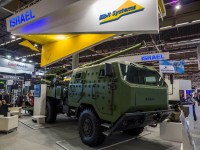
RAFAEL loaded the Tiger from MDT Shladot with the Samson remotely operated weapon station carrying machine gun and two Spike missiles, an Trophy LV active protection system and Spotter M hostile fire location system.
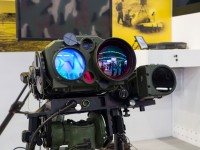
Elbit Systems unveiled the Long View CR-D (LVCR-D) long-range multi-function observation and targeting system
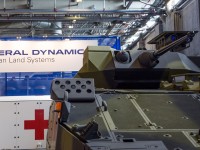
General Dynamics’ Piranha 5 was displayed here with RAFAEL’s Samson 2 with 30mm cannon remotely operated turret.
ATMOS self propelled gun was displayed on the Czech TARTA chassis
Elbit Systems’ SPEAR lightweight SP mortar
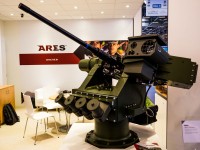
Remote Weapon System designed shown at the Brazilian ARES display
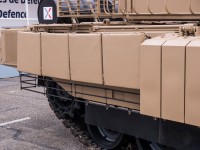
Plasan displayed two new types of add-on armor providing protection against RPG – the Hybrid Slat Fence (flexible bar armor) flexible slat fence and the FlexFence. Both were shown on the Leclerc tank at Nexter’s outdoor display.
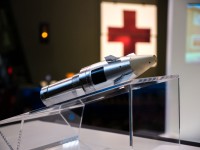
BAE Systems displayed the ‘Silver Bullet’, a precision guidance fuse-replacement that can turn a ballistic artillery projectile into a GPS guided precision weapon
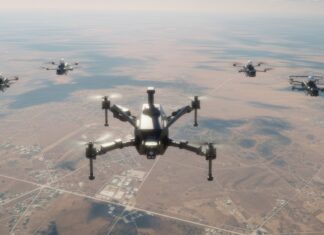
Lockheed Martin Skunk Works® and XTEND have achieved a major milestone in JADC2 by integrating the XOS operating system with the MDCX™ autonomy platform. This technical breakthrough enables a single operator to simultaneously command multiple drone classes, eliminating the friction of mission handoffs. From "marsupial" drone deployments to operating in GPS-denied environments, explore how this collaboration is abbreviating the data-to-decision timeline and redefining autonomous mission execution.
As traditional defense primes face mounting competition from agile “neoprimes” such as Anduril, Palantir and Helsing, the balance of innovation is shifting toward software-defined warfare and scalable, dual-use technologies, while global industry consolidation—marked by Boeing’s integration of Spirit AeroSystems and other strategic mergers—signals an intensified race to secure control over the defense technology value chain. Our Defense-Tech weekly report highlights these trends.
In early October 2025, a coordinated wave of unmanned aerial system (UAS) incursions—widely attributed to Russia—targeted critical infrastructure across at least ten European nations. The unprecedented campaign exposed the fragility of Europe’s air defenses...
Executive Summary
The past week (September 18-25, 2025) represents an inflection point where strategic defense concepts have transitioned from doctrine to tangible reality. An analysis of global events reveals four primary, interconnected trends shaping an...
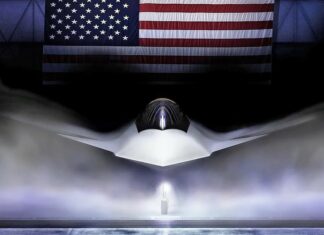
At the 2025 Air, Space & Cyber Conference, U.S. Air Force and Space Force leaders unveiled major updates on next-generation fighters, bombers, unmanned systems, and space initiatives, highlighting both rapid innovation and critical readiness challenges as the services race to outpace global competitors. A short version is available here, with a more detailed version for subscribers.
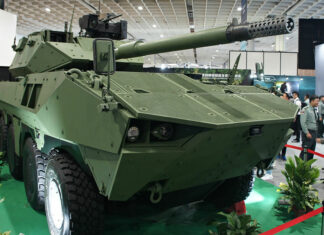
The Taipei Aerospace & Defense Technology Exhibition (TADTE) 2025 crystallized around four dominant strategic themes that collectively illustrate Taiwan's comprehensive approach to defense modernization amid escalating regional tensions. Based on a detailed report by Pleronix (available upon request). Includes a Podcast discussion on TADTE 2025's highlighting Taiwan's four strategic themes beyond the post's coverage.
Israel’s Iron Beam 450 high-power laser system has completed final testing, marking a major leap in air defense. Developed by Rafael, it offers precise, cost-effective interception of rockets, UAVs, and mortars, and is set for IDF deployment by 2025.