Thursday, December 25, 2025
More
    Home Blog Page 112

    Parachuting accident puts T-11 parachute safety in question

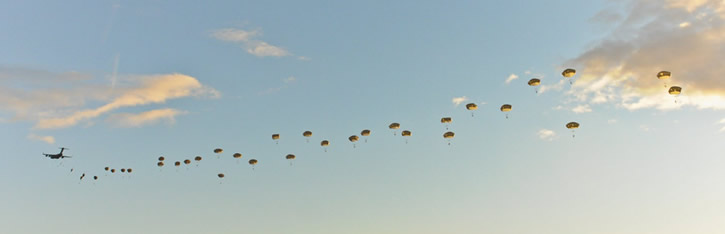
    Paratroopers of the U.S. Army's 4th Brigade Combat Team (Airborne) 25th Infantry Division parachute over the Malemute Drop Zone at Joint Base Elmendorf-Richardson, in Alaska, April 2013. Photo: US Army
    Paratroopers of the U.S. Army’s 4th Brigade Combat Team (Airborne) 25th Infantry Division parachute over the Malemute Drop Zone at Joint Base Elmendorf-Richardson, in Alaska, April 2013. Photo: US Army
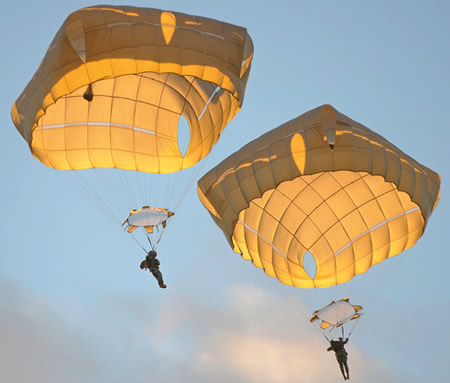
    The cruciform shape of the T-11 parachute helps to vertically stablilize the parachute soon after deployment, eliminating the oscillation experienced with T-10. Researchers considered these oscillations likely to increase injury risk by increasing the impact energy on ground contact. Photo: US Army
    The cruciform shape of the T-11 parachute helps to vertically stablilize the parachute soon after deployment, eliminating the oscillation experienced with T-10. Researchers considered these oscillations likely to increase injury risk by increasing the impact energy on ground contact. Photo: US Army

    Sgt. Shaina B. Schmigel, the paratrooper who died Friday May 30 during an airborne training exercise at Ft. Brag was using the new T-11, the Fayetteville Observer reports. Schmigel was a member the 2nd Brigade Combat Team, 82nd Airborne Division. The cause of Schmigel’s death is under investigation, and officials have not said if the parachute played a role.

    While Army records of Fort Bragg parachute operations have determined the T-11 to be a safer Parachute that is less likely to injure parachutists, this system has been associated with at least two fatal falls since its introduction on Fort Bragg in 2009. One other death took place with a third, less common type of Parachute during that time span.

    In 2011, the Army suspended the use of the T-11 after a training death on Fort Bragg. Sgt. Jamal Clay, a soldier with the 82nd Airborne’s 3rd Brigade Combat Team, fell to his death when his T-11 parachute malfunctioned in June of that year. A safety investigation board determined the T-11 failed because of debris within the parachute and improper packing. Clay did not activate his reserve parachute. The T-11 was reintroduced in March 2012, with Fort Bragg’s then-commander, Lt. Gen. Frank Helmick, being the first to use the parachute to show leaders’ confidence.

    The Army has closely followed the safety records of the new parachutes that have determined the T-11 to be safer to parachutists

    Since 2012 the Army is increasing its production of the T-11 parachutes, with 14,000 systems already in place at Fort Bragg, phasing out the T-10 parachutes.

    The Army has closely followed the safety records of the new parachutes that have determined the T-11 to be safer to parachutists. Compared with the T-10D, injuries were 43 percent less likely to occur with the T-11, according to a study by the U.S. Army Public Health Command. The latest study released in February 2014 has analyzed data from more than 130,000 jumps, most of them performed at Fort Bragg’s drop zones.

    parachuting_risk
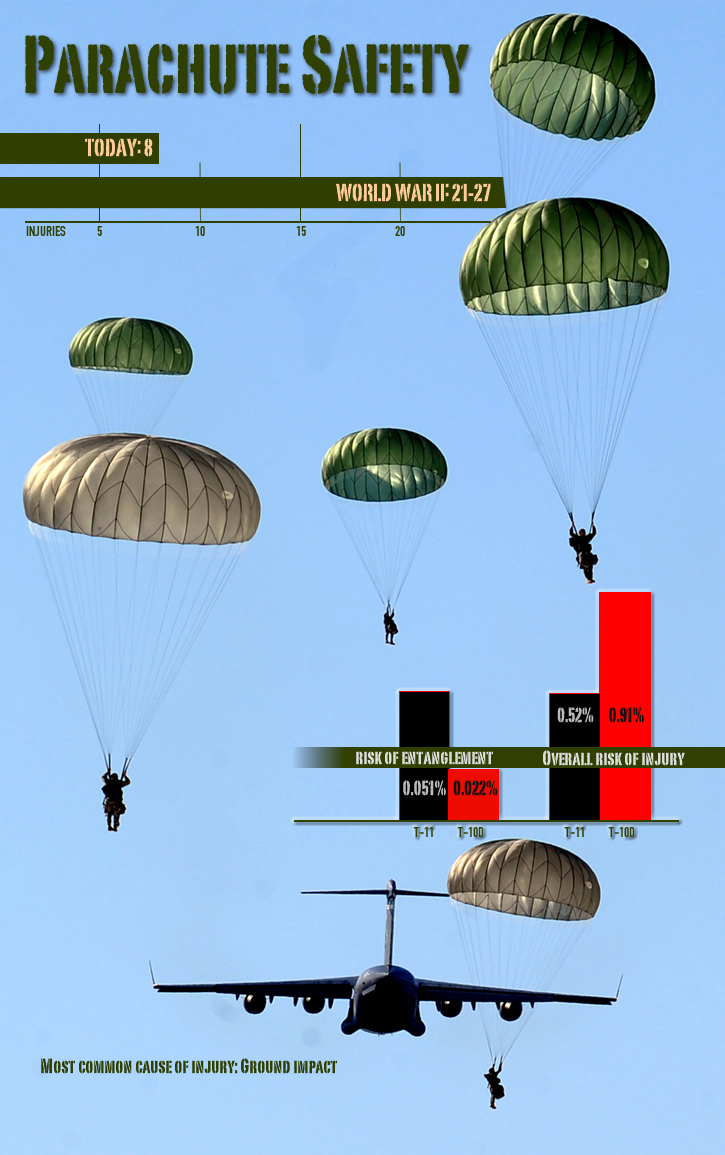
    Parachutists deploying from a C-17 Globemaster using T-10 parachutes. The US Army has found the new T-11 parachute reduces the risk of injuries in military parachuting, however, the risk of entanglement, although rare occurrence, is twice as high as with the simpler T-10D. Infographic based on a US Army study, February 2014. Full-size infographic available to subscribers. Click on the image to subscribe.

    The study looked at 1,101 injuries and found that soldiers were injured on average 8.4 times per 1,000 jumps. Most of those injuries – about 88 percent – were associated with ground impact, but were less common with the newer parachutes.

    Paratroopers using the T-10D were injured 9.1 times per 1,000 jumps, according to the study. Injuries occurred 5.2 times per 1,000 jumps in the T-11. Other factors that made jumps more dangerous include jumping at night, carrying a full combat load or jumping in higher winds or higher temperatures.

    Controlling for those factors, the Army study found the T-11 still was safer for every category except entanglements.

    The risks of entanglement and injury from entanglement were higher with the T-11, according to officials, but the incidents were rare, regardless of the parachute. Entanglements occurred in .51 per 1,000 jumps in the T-11 and .22 per 1,000 jumps in the T-10D.

    Armywide, parachuting injuries are the sixth leading cause of hospitalizations among active-duty soldiers, officials said. But injury rates have improved over the decades. During World War II, there were 21 to 27 injuries per 1,000 jumps, according to officials. The 82nd Airborne’s historical injury rate is 11 per 1,000 jumps.

    The T-11 was developed over several years in response to a need for Army parachutes to carry heavier loads

    The most common injuries on Fort Bragg over the 31/2 year study were concussions, ankle sprains and lower back sprains, with concussions making up more than a third of all injuries. Fractured or broken bones accounted for about 13 percent of all injuries.

    The major differences between the T-10 and the T-11 are that the T-11 allows more weight to be carried by the paratrooper and is able to handle a load capacity of more than 400 pounds to accommodate today’s paratrooper and their equipment load. The new parachute is cruciform in shape, as opposed to a circle, like its predecessor, with a larger surface area and diameter. The T-11’s design aids in slowing the rate of descent from 22 feet per second to 19 feet, which significantly lowers the possibility of jump-related injuries. The cruciform shape of the T-11 parachute helps to vertically stablilize the parachute soon after deployment, eliminating the oscillation experienced with T-10. Researchers considered these oscillations likely to increase injury risk by increasing the impact energy on ground contact.

    The T-11 was developed over several years in response to a need for Army parachutes to carry heavier loads. The T-10D held a maximum weight of 350 pounds (159 kg) and was developed during a time when the average load of a soldier and his equipment was 300 pounds (136 kg), according to officials.

    By 1989, when paratroopers jumped into Panama as part of Operation Just Cause, 4 percent of all paratroopers carried more than 350 pounds (159 kg). More than a decade later, during combat jumps into Iraq and Afghanistan, paratrooper loads averaged between 327 and 380 pounds (148-172 kg). The T-11, which began replacing the T-10D in 2010, can hold 400-pound (181) loads.

    CombatGuard – go-anywhere 4×4 armored vehicle

    combatguard2725
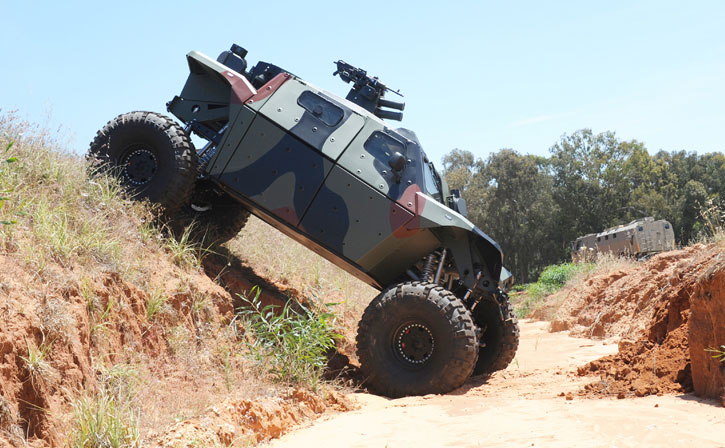
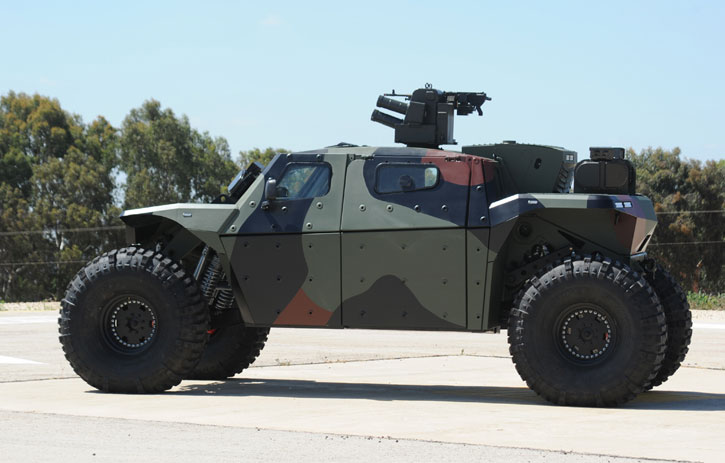
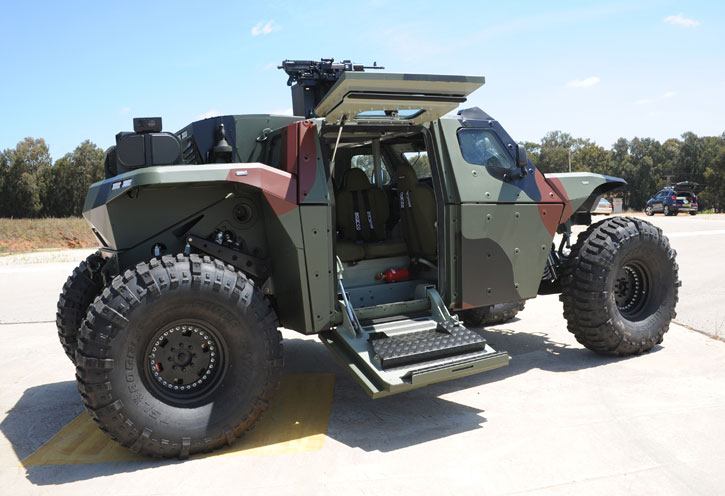
    At an eight-ton gross vehicle weight the vehicle can carry 1.5 tons of payload over rough terrain in sand, rocky and rugged terrain. With custom 54 inch tires, ground clearance of 0.7 meters and an approach and departure angle of 90 degrees CombatGuard can handle vertical obstacles up to 0.80 meter high with ease. It can also ford water obstacles up to 1.5 meter deep. Photo: IMI

    IMI is unveiling the ‘CombatGuard’, an armored combat vehicle designed to offer protected off-road mobility. The CombatGuard supports different levels of protection, and has demonstrated mobility levels matching or exceeding tracked combat vehicles in certain conditions. IMI will be introducing the new vehicle at the Eurosatory international defense and security exhibition in Paris, France on June 16-20, 2014.

    According to IMI the new vehicle is designed to address a wide range of missions and battlefield conditions, from high intensity combat through stability and peacekeeping operations.

    CombatGuard is designed as a modular vehicle, enabling specific customization into combat or combat support variants, such as scout, command, intelligence and communications support and others. The protected mobility it provides enable combat units to rapidly deliver effects where and when required, supporting different operational missions on low or high-intensity warfare. Typical missions could range from border security, supporting counter-terror operations, to deployment in dense urban areas or other challenging terrain.

    The vehicle was developed by IMI, providing the design design authority for the vehicle and protection suite, with off-road mobility design and engineering provided by Ido off road center, the developer and designer of the Zibar offroad racer. The vehivle is powered by a rear mounted 300HP GM 6.5 L Cobra diesel engine coupled to a four-speed automatic transmission powering all four custom 54″ wheels. It can travel over 600 km (373 miles) range, travelling at up to 150 km/h (93 mph) on roads or 120 km/h (75 mp/h) off-road. At an eight-ton gross vehicle weight the vehicle can carry 1.5 tons of payload over rough terrain in sand, rocky and rugged terrain, ford water obstacles 1.5 meter deep, travel a 35% side slopes and climb over 70% gradient, vertical obstacles up to 80 cm in forward drive and in reverse.

    combatguard3725
    At Eurosatory the CombatGuard is displayed with the Bright Arrow remotely controlled weapon station coupled with the ‘Iron Fist’ active protection. The systems’ three RPS-10 radar sensors can be seen at the fore and aft sections. Photo: IMI

    According to IMI, CombatGuard is based on ‘clean sheet design’, and is optimized for the military missions. Unlike armored vehicles based on modified commercial or military chases, which are worn out quickly, the CombatGuard is prepared for decades of reliable and efficient operations under harsh terrain and environmental conditions.

    The monocoque capsule protected hull accommodates six or eight fully equipped troops along with modern, advanced weapon systems. Locating the wheels on the capsule’s sides also enhances the capsule’s protection. The modular design enables the application of different level, including protection against advanced threats such as EFP, land mines and blast.

    combatguard1725
    The monocoque capsule protected hull accommodates eight fully equipped troops along with modern, advanced weapon systems. Locating the wheels on the capsule’s sides also enhances the capsule’s protection. The modular design enables the application of different level, including protection against advanced threats such as EFP, land mines and blast. Photo: IMI

    Scramble? Quiet! We are sleeping

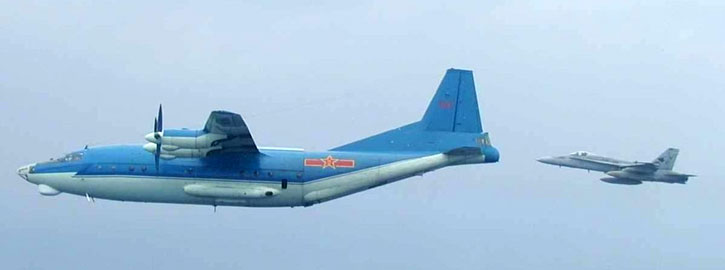
    A U.S> Navy F/A-18 escorts a Chinese Y-8A maritime surveillance aircraft as the Chinese shaddows a naval exercise at the the South China Sea.
    A U.S. Navy F/A-18 escorts a Chinese Y-8A maritime surveillance aircraft as the Chinese shadows a naval exercise at the South China Sea.

    In February, a hijacked Ethiopian Airlines plane was escorted by Italian fighter jets to land at the Swiss town of Geneva. Why Italian? because the Swiss Air Force was closed at this early hour (06:02). “Switzerland cannot intervene because its airbases are closed at night and on the weekend,” spokesman Laurent Savary told AFP. “It’s a question of budget and staffing.” As a neutral country Switzerland does not contribute forces to NATO or other U.N. contingencies overseas. Nevertheless, the country has invested significant amounts in maintaining a military force, but is currently preferring to rely on its neighbours’ military capabilities. The incident came at the right time to convince the Swiss people they were willing to take the risk – in a national vote two months later they opted to waive a Swedish offer to replace their obsolete F-5Es with the modern Gripen E fighter. If the air force isn’t ready to do its job, why invest in modernization?

    An air defense gap over Finland could become a serious concern for NATO and Europe, with the rising tension over the Ukraine, and the Baltics

    Switzerland, Austria and Finland opted not to join the NATO alliance, and, therefore they can’t share the burden of joint air defense as other European nations do. While Switzerland is surrounded by European friendly neighbours, the case of Finland is different, as the country stretches along half of the border line separating Russia and Europe.

    Suffering from repeated violations of its airspace by Russian reconnaissance aircraft, the Finnish Air Force has failed to pursue recent incursion. One incident on May 20 was of special importance as it uncovered their poor state of readiness. Sauli Niinistö, the commander-in-chief of the Finnish Defense Forces, admitted in an interview that his Air Force fighter jets were unable to respond to the violations of Finnish airspace by two Russian aircraft, as their flight path crossed the international boundary line over the Russian enclave of Kaliningrad. Apparently, the F/A-18 Hornet pilots assigned to  that shift were not on standby, since the air force staff decided to reduce the overtime to cut costs. Waiting for their regular working hours, the fighter jets were ‘scrambled’ only four hours after the alert came. At that time, they two of the targets disappeared (probably ran out of fuel and landed). Luckily a third Russian intruder appeared and chased away by two Finnish jets. “The resources of the Defense Forces are evidently scarce,” Niinistö explained.

    This air defense gap could represent a serious concern for NATO and Europe, particularly with the rising tension over the situation in Ukraine, the Baltic and Kaliningrad. At the state of alert of the Finnish Air Force, potential incursions are likely today more than ever before.

    Airspace policing and control of restricted airspace are also an important mission for countries facing threats of aerial terrorism. After the Sept. 11, 2001 terrorist attacks, the U.S. military boosted its alert facilities around the country, maintaining fighter pilots round-the-clock state of readiness, 24/7. The Air National Guards is scrambling fighter jets about once a week, on average, to intercept civilian planes that stray into restricted airspace.

    Scorpion-Mission-Aerospace-Control-Alert800
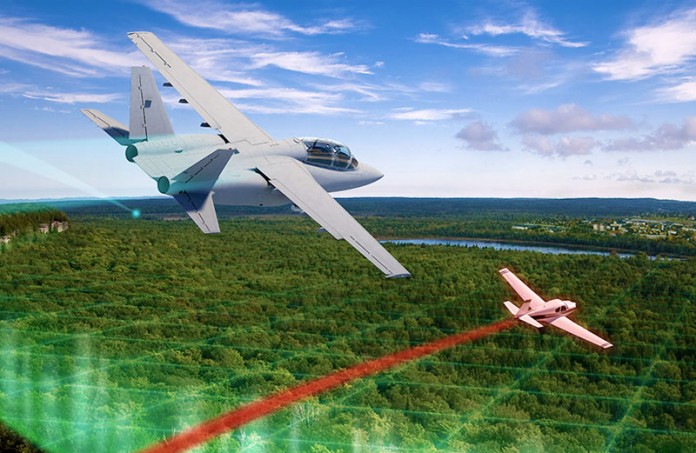
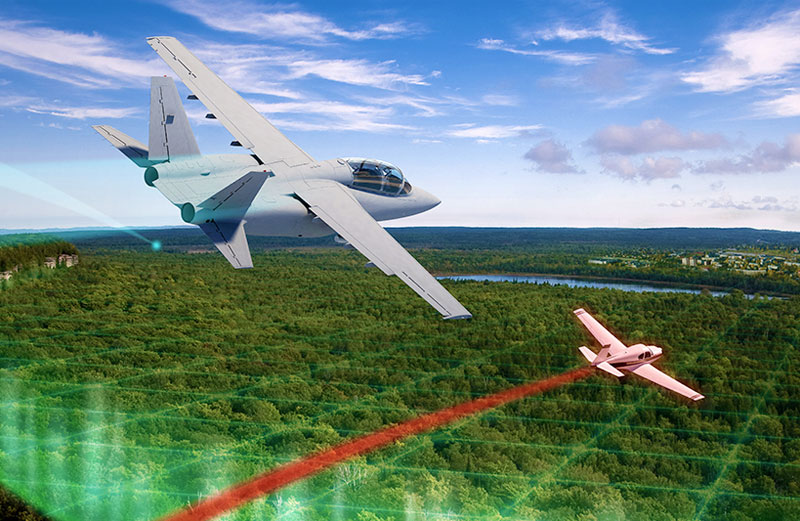
    The Scorpion was designed for the ‘aerospace control alert’ missions as one of law enforcement and irregular warfare missions. When an unidentified, low and slow aircraft is detected, the scorpion would quickly scramble, launch and reach 400+ kt for the intercept. The Scorpion is equipped with sensors to detect and identify the aircraft at a relatively long range. While reaching close to the target it can slow down to a speed of 100 knots, effectively chasing the aircraft and escorting it to a nearby airfield. Photo`; Textron AirLand

    In recent years aircraft manufacturers have come up with ‘air policing aircraft’ that could fulfil those missions, and be suitable for operations in nations like Switzerland, Finland and many other countries in Europe and the more peaceful parts of the world, that do not face high performance threats. Aircraft such as the turboprop or jet trainers (Aero L-159, Embraer Super Tucano, Beechcraft AT-6 or the new Textron AirLand Scorpion, are all available in armed configurations that would fit the need for air-intercept missions during peacetime.

    These nations do not need to maintain expensive, high performance supersonic fighter jets, and could use more efficient, though less performing armed aircraft that can fulfil airspace policing role to a reasonable degree. In fact, some of these aircraft are more capable than fast jets, in chasing small, slow aircraft and helicopters and unmanned aerial vehicles.

    As these aircraft would be used on a single mission, pilot skills could be less demanding, enabling operations by part-time pilots – all contributing to lower operating costs. Admittedly, these aircraft would not be able to chase a fast enemy jet on a penetrating recce mission, or a combat formation of Su-30s en-route to their targets at Mach 1.5, but it will be able to deal with any airliner that deviates from its course, or a light aircraft carrying drugs dashing across the border at low-level.

    Growing tension drives demand for more fighter jets

    Air defense exclusion zones are at the core of the conflict over the Yellow Sea, where China, Japan, Taiwan, South Korea, Vietnam and the Philippines are entangled over sovereignty over several archipelagos in the South China Sea. Each of the countries involved declared its own Air Defense Identification Zones (ADIZ) as a claim for airspace over the disputed territories. The fiercest conflict is waged between China and Japan over the Senkaku islands, with China repeatedly sending air patrols crossing the islands’ airspace into the areas claimed by the Japanese. The rising tension has also attracted Russian overflights, which are also tasking the japans air force. The number of intercepts in 2013 was 415 – up from 306 times in 2012. And in the period of October 13 through March 14 it has further increased to 266.

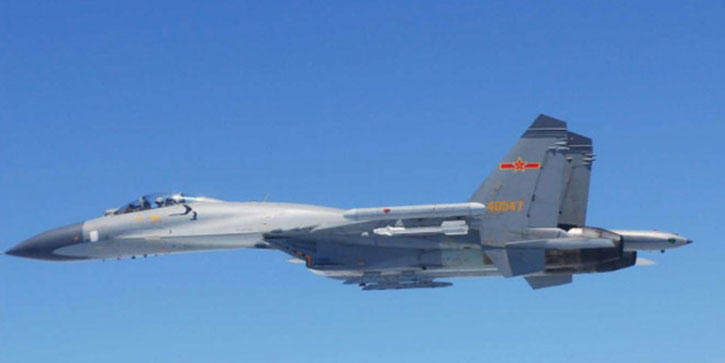
    The Chinese are not idle either. In recent weeks, they have followed Japanese flights in the ADIZ, with Chinese fighters getting alarmingly close to the Japanese aircraft. Last week two pairs of Chinese Su-27 fighter jets were scrambled and flew unprecedentedly close to a Japanese OP-3C surveillance plane and a YS-11EB electronic intelligence aircraft.

    Considered as a matter of national security, Japan has allocated significant resources to maintain and improve its fighter jet fleet made of F-15J and F-2 aircraft. The modernization of that fleet, primarily with the introduction of the F-35A and future ‘Shinshin’ (ATD-X) is a major factor in the country’s entire defense expenditure for the coming years.

    Chinese Air Force Su-27s got as close as 50 meters to a Japanese surveillance aircraft over Senkaku islands. Photo: Japan's Self defense Force
    The Chinese SU-27 fighters came as close as 50 meters to a Japanese P-3C surveillance plane near the uninhabited Senkaku Islands on Saturday, and within 30 meters of YS-11EB electronic intelligence aircraft, Japan’s defense ministry said. Photo: Japan’s Self defense Force

    Turkey’s Firm Stand on Air Defense

    Turkey, has also presented a firm stand toward incursions by its neighbours. In the past, Turkish Air Force fighter jets had several encounters with Greek aircraft, over the mediterranean and over the disputed areas in Cyprus, but the conflict with Greece has diminished, at least in terms of air warfare. In recent years, the tensions have shifted south, to Syria and more recently to the East, over the Iranian border. Hostility between Turkish and Syrian forces have occasionally flared up since the start of the civil war in Syria in 2011. When Syria shot down a Turkish jet in June 2012, Turkey changed its rules of engagement and warned that it would strike Syrian warplanes that approached the Turkish border. Turkey shot down a Syrian jet in late March after it violated Turkish airspace on the Turkish-Syrian border near Yayladağı, a district in southern Hatay.

    Last month, two jet fighters were scrambled to intercept a Syrian military helicopter approaching the border of Hatay province. The military said in a statement that a Syrian Mi-8 helicopter turned back 0.9 nautical miles from the Turkish-Syrian border as Turkish F-16 fighters approached. Under Turkey’s new rules of engagement, any Syrian military unit approaching the border is considered a threat. Last week the Turkish Air Force scrambled two F-16s against an Iranian recce aircraft, which turned back 20 seconds after crossing the border over the eastern province of Iğdır, bordering Iran.

    These stealthy bikes are made for special ops

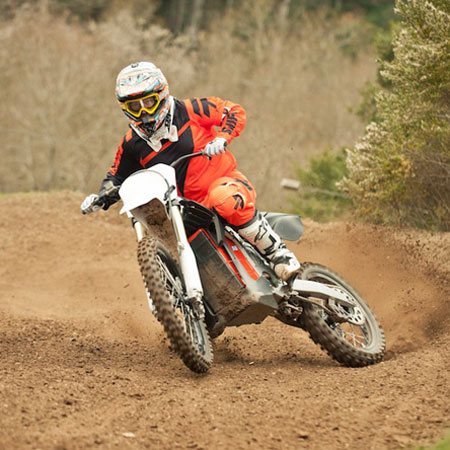
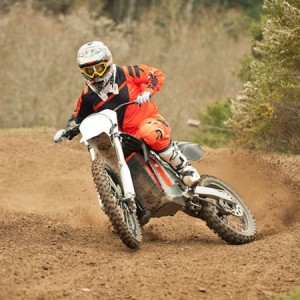
    DARPA has funded a $100,000 study to enhance the Redshift MX high performance off-road motorcycle into a military-optimized hybrid-electric powered dirt bike.
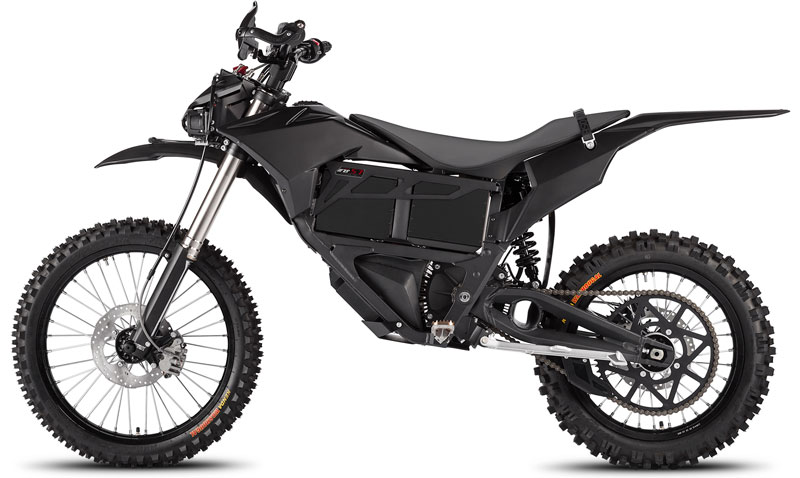
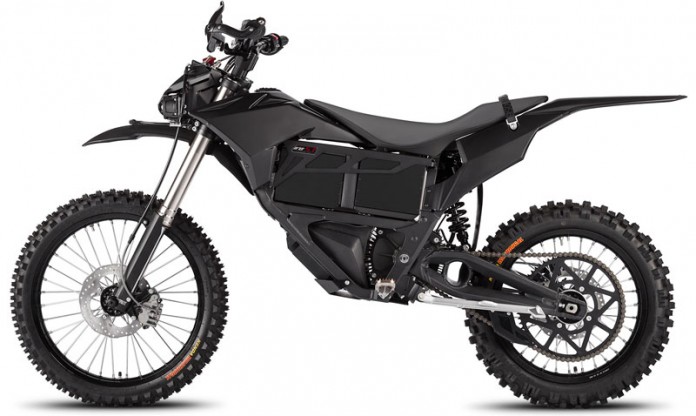
    The Zero MMX uses the  Z-Force electrically powered powertrain with direct drive gearing and an air cooled motor. With no transmission, powertrain fluids or gas, the Zero MMX is easy to transport and maintain. Endurance is provided by quick swappable power packs. Photo: Zero MMX
    The Zero MMX uses the Z-Force electrically powered powertrain with direct drive gearing and an air cooled motor. With no transmission, powertrain fluids or gas, the Zero MMX is easy to transport and maintain. Endurance is provided by quick swappable power packs. Photo: Zero MMX

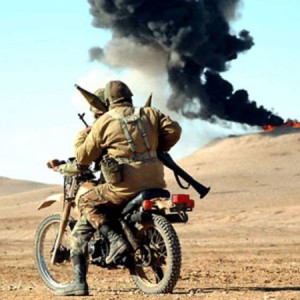
    Iranian RPG team deployed on a combat dirt bike.
    Iranian RPG team deployed on a combat dirt bike.
    Motorcycles are serving military forces for over a century, providing fast, agile and efficient transportation for scouts, warfighters, security patrols and guards, messengers and technicians. With the introduction of all terrain vehicles (ATV) with the military, the importance of bikes as off-road vehicles has diminished. With the transition of military to diesel fuel, this trend has grown, as diesel hasn’t been well received by the motorcycle industry and community.

    The introduction of 100% electrical powered and hybrid-electric bikes has the potential to bring the bikes back to the military focus, especially with special operations forces (SOF), where their speed and stealth are of utmost value.

    For their low cost, high mobility and efficiency, bikes have become a popular tool in irregular warfare. Used by insurgents, bikes enable insurgents to outpace the military ‘sensor to shooter’ cycle (also known as OODA loop).

    Gold members have access to the full article

    subscribe

    Motorcycles were widely used by all sides during the first and second world war. During the great war, during WW II hundreds of thousands of bikes were produced and used in all theatres, primarily for liaison, communications, and transportation. After WW II the popularity of military bikes diminished. These huge wartime orders have never returned. In 1981 the US Army selected a new type of motorcycle, for off-road mobility, buying 2,500 examples from Hayes, the majority being Kawasaki KLR650s that Hayes modified for military use.

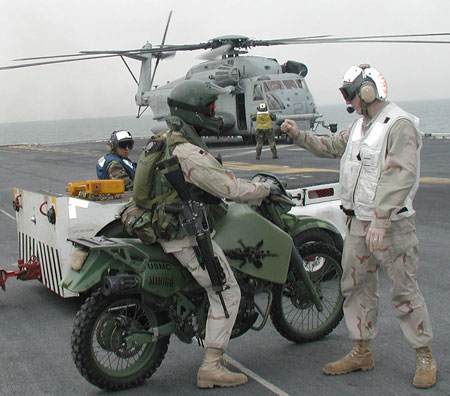
    A member of the 15th Marine Expeditionary Unit (MEU) Special Operations Capable (SOC) waits his turn to onload his motorcycle for a helicopter flight into Kuwait. Photo: US Navy
    A member of the 15th Marine Expeditionary Unit (MEU) Special Operations Capable (SOC) waits his turn to onload his motorcycle for a helicopter flight into Kuwait. Photo: US Navy

    Most motorcycles manufacturers consider petrol engines as the only option for propulsion. This poses significant challenge in the diesel-oriented military economy. To exploit the military transition to diesel Hayes also developed a diesel Known as the Hayes’ 1030 the vehicle used the same Kawasaki KLR650, converted to take Hayes’ powered variant of the KLR650, known as Hayes 1030. These bikes can run on can run on seven different fuels, including diesel, biodiesel, JP8 aviation kerosene and other military fuel variants. Over the last 10 years the Marine Corps, who paid for the development, have bought only 211.

    Bikes are often the only type of vehicle than can be carried on assault helicopters and, when flown by V-22, Chinook or CH-53, deploy safely straight off the ramp. While offroad bikes are tough, military bikes are built even tougher, some are even dropped from helicopters on deployment. For the average military user, a diesel powered motorcycle would be sufficient for mobility, fuel economy, weight and range, but when it comes to special operations, the noisy bikes become is a liability.

    Another model enhanced to meet the growing military interest in dirt bikes is the ChristiniAWD Military Edition based on the company’s AWD 450 E or DS models. These can be tailored for off-road or highway. According to Christini, these special edition bikes are used by the Navy Seals and Special Forces groups overseas, as well as other branches of the military. It features a liquid cooled 450cc four-stroke engine, and an all wheel drive system that provides additional traction, handling and stability.

    Christini is also offering customized military training as part of its partnership with Fayetteville N.C. based Tactical Mobility Training, where founder, James King, is operating a training regiment to develop and mentor operators that utilize light mobility platforms to penetrate deep within the enemy’s territory. Personnel from SOCOM, Army, Navy, Air Force, Marines, and British Special Forces have already took these courses.

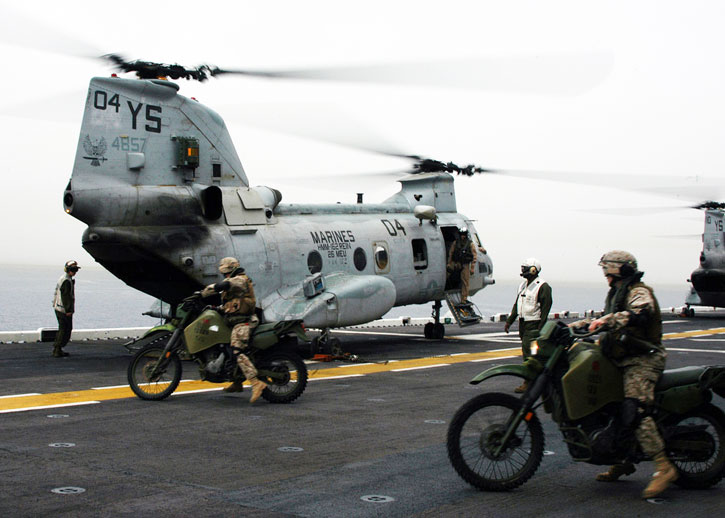
    26th MEU scouts on board an LHD at the Mediterranean load two KLR-250D8 motorcycles onto a CH-46 helicopter. Photo: USMC
    26th MEU scouts on board an LHD at the Mediterranean load two KLR-250D8 motorcycles onto a CH-46 helicopter. Photo: USMC

    Electric powered motorcycles are promising a unique and stealthy solution (listen and see video), Adapting electrical propulsion and high power density batteries developed for hybrid and commercial 100% electric propelled vehicles, electrically powered motorcycles are promising new capabilities for special ops.

    In 2013 Zero Motorcyclesintroduced a special military model of its Zero FX electric bike called ‘Zero MMX’, designed specifically for special operations. Apparently, the US Special Operations Command has already ordered some of those bikes for evaluations. Packing speed, off-road ruggedness and stealth, the MMX has what it takes to move special ops. Its main advantage is the quiet propulsion – it is powered by an electrical motor feeding on a high capacity lithium-ion rechargeable battery, supplying sufficient power for a relevant mission.

    Stealth is an important attribute of the electric bike and the Zero is indeed absolutely silent when stopped. It is barely audible while on the move, and puts out a minimal heat signature to keep operators undetected. The MMX was introduced last year and received minor modifications and updates in 2014.

    By militarizing their motorcycle Zero has sealed all sensitive systems, enabling the MMX to operate in wet or rainy conditions at water levels up to one meter deep (3.2 foot). The bike comes already wired to take infrared lights on the front and tail. The military model is fitted with safety override and reserve power enabling the rider to extract the maximum potential in extreme, life threatening situations.

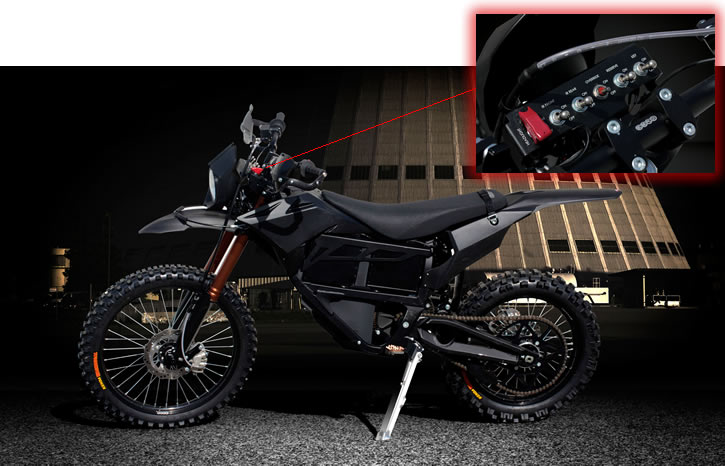
    Zero MMX is an electric powered bike designed specifically to military use. In addition to the extra rugged design, the bike is fitted with military-unique controls that would provide riders more manoeuvrability and performance over safety and stability, for use in extreme conditions, where their survival may be in stake. Photo: Zero
    Zero MMX is an electric powered bike designed specifically to military use. In addition to the extra rugged design, the bike is fitted with military-unique controls that would provide riders more manoeuvrability and performance over safety and stability, for use in extreme conditions, where their survival may be in stake. Photo: Zero

    What if your mission would last much longer than two hours? you can’t top up an electric motorcycle at the nearest gas station. That’s where the Defense Advanced Research Projects Agency (DARPA) came in. In February 2014 the agency awarded a $100,000 contract for preliminary design of a hybrid-electric stealthy motorcycle for the military. The idea is to combine the stealthiness and speed of the all-electric power train with the energy efficiency of internal combustion engine-generator, resulting in extended missions and more flexibility in field use.

    DARPA has funded a $100,000 study to enhance the Redshift MX high performance off-road motorcycle into a military-optimized hybrid-electric powered dirt bike.
    DARPA has funded a $100,000 study to enhance the Redshift MX high performance off-road motorcycle into a military-optimized hybrid-electric powered dirt bike.

    The feasibility study is managed by Logos Technologies, a Research and Development (R&D) contractor working closely with DARPA and other government agencies, and utilize the RedShift MX hybrid powered bike platform provided by BRD. “With a growing need to operate small units far from logistical support, the military may increasingly rely on adaptable, efficient technologies like this hybrid-electric motorcycle” Wade Pulliam, manager of advanced concepts at Logos Technologies noted. “Quieted, all-wheel-drive capability at extended range in a lightweight, rugged, single-track vehicle could support the successful operations of U.S. expeditionary and special forces in extreme terrain conditions and contested environments” Pulliman added.

    The hybrid power pack could be used to support the warfighter in more than mobility, speed and stealth. It also provides an integral power generation source, providing teams with electrical power to recharge batteries, or run appliances, such as satellite links and networks.

    For its base platform, the project relies on an existing racing bike, the RedShift MX, a 250-pound all-electric motorcycle that will be fitted with a small internal combustion engine generating the power to drive the main engine and recharge the battery. The study will provide the data for tradeoff analysis determining the size of the engine and associated fuel tank.

    “Ghostrider” is a robot motorcycle that drives itself, with no human intervention once it is underway. The motorcycle was the only two-wheeled entrant in the autonomous vehicle races of 2004 and 2005 sponsored by Defense Advanced Research Projects Agency (DARPA). Photo: Smithsonian Museum
    “Ghostrider” is a robot motorcycle that could stabilize and drives itself, with no human intervention once it is underway. The motorcycle was the only two-wheeled entrant in the autonomous vehicle races of 2004 and 2005 sponsored by Defense Advanced Research Projects Agency (DARPA). Photo: Smithsonian Museum

    Similar to the Zero, the RedShift MX has a two hour range. The hybrid system will extend its mission endurance much further. While the system would optimize on stealth, rather than mission endurance, but the addition of hybrid power train is expected to significantly increase the vehicle’s mission endurance.

    In the past DARPA has also explored the use of unmanned motorcycle, one of the early designs, Yamaha 90cc racing motorcycle called Ghostrider was turned into a robot motorcycle that could drive itself. The Ghostrider participated in the DARPA Challenge of 2004 and 2005 but this path hasn’t moved on, as follow-on developments focused on unmanned all-terrain mobility opted for the four-wheel ATVs and legged platforms. The Ghostrider is now presented at the Smithsonian National Museum of American History.

    Electric bikes gear for military service

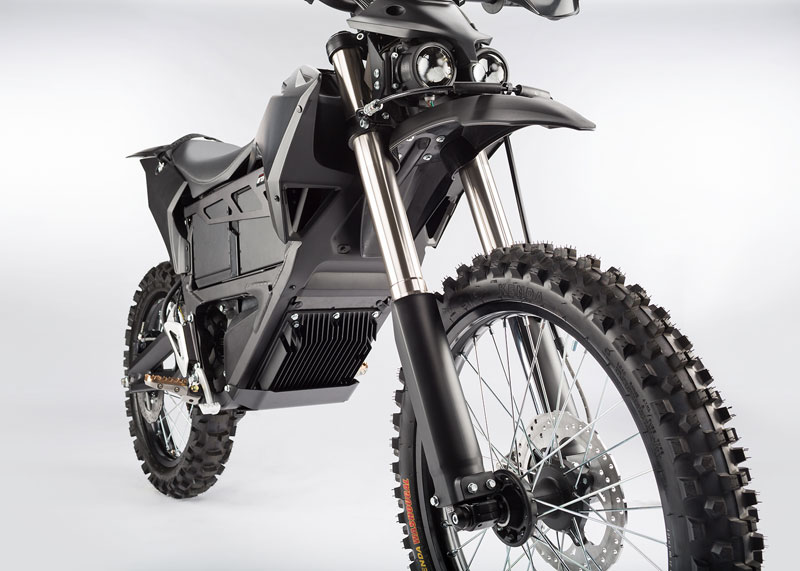
    The Zero MMX uses the Z-Force electrically powered powertrain with direct drive gearing and an air cooled motor. With no transmission, powertrain fluids or gas, the Zero MMX is easy to transport and maintain. Endurance is provided by quick swappable power packs. Photo: Zero MMX

    The military has employed motorcycles for special purposes since they were invented, for their independent operation, transportability and tactical advantages. The concern about these machines was never about their performance or manoeuvrability but about safety, as the accident rate of motorcycles was always higher than four wheeled motorcars.

    The special operations community has recognized these combat advantages, realizing that go-anywhere dirt bikes can move where no ATV can go. But these motorbikes are still too noisy for covert operations.

    In fact, the U.S. Special Operations Command (SOCOM) wanted a stealthy motorcycle, one that could jump out of helicopters or MV-22s tilt-rotor plane, move fast and quiet, enabling assault teams to gain the element of surprise. They wanted a rugged machine that could be operated reliably in harsh field conditions, start instantly even at extreme temperatures.

    “Although there are diesel motorbikes in service, they didn’t meet all the requirements and SOCOM decided to shop for a more advanced solution.” John Lloyd, Zero Motorcycles President and CEO told Defense-Update. They selected Zero Motorcycles to come up with an electrically powered motorcycle, tailored for their specifications” Lloyd added, “Electrically powered motorcycles like our Zero family offer unique advantages for the military user – with no gears and liquids, they have low wear, and are practically maintenance free, thus they are very reliable.” Lloyd explains. The simplicity is also reflected in low cost, he said.

    Lloyd: “Todays’ electrical motorbike stands out to any petrol bike, adding stealth and improved field reliability”


    Gold members have access to the full article

    subscribe

    “Todays’ electrical motorbike stands out to perform at least equally to any petrol bike, adding stealth and improved field reliability” Lloyd claims, adding that the militarized variant of the family, Zero MMX was specially designed to address the special operations missions. Zero has already delivered the first MMXs to the US military as Well as to foreign countries.

    “The special operations community has recognized these combat advantages, realizing that go-anywhere motorbikes can move where no ATV can go”

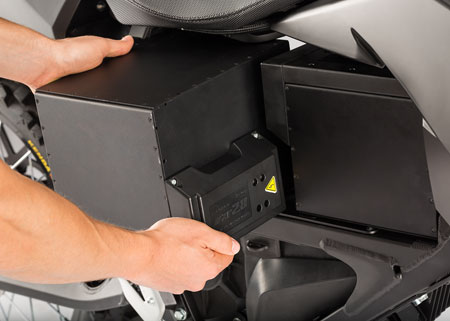
    The Z-Force powertrain used with the Zero  MMX features quick swappable power packs that can be swapped in 60 seconds and recharged in 20 minutes. Photo: Zero Motorcycles.
    The Z-Force powertrain used with the Zero
    MMX features quick swappable power packs that can be swapped in 60 seconds and recharged in 20 minutes. Photo: Zero Motorcycles.

    Lloyd argues that hybrid propulsion would complicate the system, and increase maintenance workload. The military is also pursuing this technology, combining electrical and internal combustion engine, in parallel to the all electric bike. “We decided not to participate in the DARPA hybrid motorcycle program, as we are fully committed to full-electric propulsion for the advantages it has. By adding an internal combustion engine and associated mechanisms you complicate the system. Our all-electric technology can compete with that.”

    The Zero MMX uses the  Z-Force electrically powered powertrain with direct drive gearing and an air cooled motor. With no transmission, powertrain fluids or gas, the Zero MMX is easy to transport and maintain. Endurance is provided by quick swappable power packs. Photo: Zero MMX
    The Zero MMX uses the Z-Force electrically powered powertrain with direct drive gearing and an air cooled motor. With no transmission, powertrain fluids or gas, the Zero MMX is easy to transport and maintain. Endurance is provided by quick swappable power packs. Photo: Zero MMX.

    Cyber Intelligence Report – June 1, 2014

    cyber_report

    Israel

    Physical cyber infrastructure failure

    While the Israeli government heavily invests in cyber security, the physical side of Israel cyber systems have been neglected. In Israel, a recently published state comptroller report noted the “gov.il” systems are exposed to physical threats such as natural disasters (earthquakes, fires) and also human attacks. The computers and servers systems referred to as Government Infrastructure in the Internet Era are providing services to about 50,000 government employees and was defined by Shin Bet of the Israeli Security Agency as a national critical infrastructure in 2011. In an exercise conducted by the Shin Bet, an operative was successful in penetrating into the building and hiding a bomb like device in the server room. “Gov.il” responded by claiming all the deficiencies were corrected.

    Israeli insurance industry involved in cyber security

    For the first time in Israel, the insurance and pension industry will participate in a wide range exercise, testing their organization’s computer functioning capabilities during an emergency, “pc.co.il” reported. The exercise was intended to be part of the Department of Defence drill “tuning point;” however, when the drill was cancelled due to budget difficulties, the Ministry of Finance decided to implement the exercise themselves. The exercise will include 24 participating insurance companies and 150 pension funds, as well as check the institute’s IT department’s disaster response program (DRP) and their functions in alternative locations.

    USA

    BlackShade arrests cause largest international cyber crackdown

    The FBI charged over 100 people worldwide for reportedly being involved in the enabling of over half a million computers in more than 100 different countries to be infected by a malicious malware, BlackShade. The arrests are being considered the largest international cyber crackdown in law enforcement. BlackShade Remote Access Tool, or RAT, targeted Microsoft Windows operating systems and allowed cybercriminals to control and hijack the webcam and make recordings of the user, intercept keystrokes, steal personal information and other harmful uses by tricking users into clicking links that would install the malicious malware. BlackShade has existed and has been sold on PayPal since 2010 to thousands of users, making it one of the most popular tools used in the hacking community.

    “Blackshade was a tool created and marketed principally for buyers who wouldn’t know how to hack their way out a paper bag,” Brian Krebs of Krebs on Security detailed. The ability for any random person, with little knowledge in hacking, gaining the ability to breach computers has become a concerning theme as Preet Bharara, U.S. Attorney for the Southern District of New York, stated: “We now live in a world where, for just $40, a cybercriminal halfway across the globe can – with just a click of a mouse – unleash a RAT that can spread a computer plague not only on someone’s property, but also on their privacy and most personal spaces.”

    The program has been connected to attacks on Syrian dissidents in 2010 and breaches against French organizations. However, even with the arrests made, it is very unlikely for BlackShade to disappear as the source code of BlackShade was released online in 2010, enabling different variants and tools to be sold in different forms in the cybercriminal community. Additionally, different versions of BlackShade still exist and are being sold by different vendors.

    Five Chinese military officers indicted for cyber espionage activities

    In the last few weeks, the U.S. ministry of Justice indicted five Chinese military officers for cyber spying activities beginning in 2006. The Chinese hackers were involved in the Chinese military hacking group known as the Chinese PLA 61398 cyber unit. They hacked U.S. computers for economic espionage purposes by targeting nuclear, metal, and solar industries. According to FBI sources, the Chinese hackers used military and intelligence resources to pilfer large quantities of data about U.S. industries, including strategic plans from U.S. businesses.

    The FBI managed to track hackers to a building based in Shanghai. The Chinese government denies this accusation; nevertheless, the U.S. claims to have secured proof the Chinese army did perform this specific cyber spying operation. Chinese Foreign Ministry spokesman, Qin Gang, declared: “The United States fabricated facts in an indictment of five officers for so-called cyber theft by China, a move that seriously violates basic norms of international relations and damages Sino-U.S. cooperation and mutual trust. China has lodged a protest with the United States, urged the U.S. to correct the error immediately and withdraw its so-called prosecution.”

    He also added, “China is a staunch defender of cyber security” and denied the Chinese government, military, and “associated personnel” have ever “engaged or participated in the theft of trade secrets through cyber means.” He called the U.S. accusations “purely fictitious, extremely absurd.” This affair is disturbing the diplomatic relations between the countries and will probably affect their economic exchanges.

    Latin America

    Anonymous planning major cyber-attack on World Cup corporate sponsors

    Anonymous disclosed their next cyber operation to be on corporate sponsors of the World Cup in Rio de Janeiro, Brazil, this summer, including Adidas, Emirates Airline, Coca-Cola, and Budweiser. Hacker Che Commodore (operating alias) explained Anonymous refuses to stay quiet while the Brazilian government spends an extraordinary amount of money on the Games while the rest of the country lives below the universal poverty line. Already, the cyber hacktivists breached Brazil’s Foreign Ministry computer networks, leaked confidential emails, and posted over 300 documents online. The Foreign Ministry closed down their email systems and instructed all 3,000 users to change passwords as Brazilian Federal police continue to investigate. The Foreign Ministry insisted no crucial information was leaked and that only 55 email accounts were hacked. Nevertheless, Che Commodore asserts: “We have already conducted late-night tests to see which of the sites are more vulnerable. We have a plan of attack.” It will be a testament to Brazil’s readiness and Anonymous’ capabilities to see if the group can breach major networks.

    Russia and CIS

    Russia involved in cyber spying operation in Belgium

    According to Belgian news agency, Belga, Russia carried out cyber espionage operations attacking the Belgian Ministry of Foreign Affairs networks. The cyber-attack has apparently been in response to the events in Ukraine, Belga reported. After the attack, emergency meetings were held, which included officials such as Belgian Prime Minister, Foreign Minister, Defense Minister, and Department of Justice Minister. Belgian Foreign Affairs Ministry confirmed the invasion on Saturday, stressing “the sent computer virus copied information and documents from our database, which were related to the Ukrainian crisis.”

    Russian hackers cripple Ukraine’s network ahead of presidential vote

    Ukrainian Security Service reported a ‘virus’ designed to delete the results of the presidential voting system had breached the systems of Ukraine’s Central Election Commission. Two days before the elections, the СyberBerkut hacker’s group hacked the Central Election Commission internal network and disabled its electronic information and analytical system. A day before the elections, Valentin Nalivaychenko, the head of the Security Service of Ukraine, claimed they had removed a virus. But CyberBerkut claimed responsibility, declaring on their website the whole system does not work, and the exchange of information between the center and the regions is carried out exclusively by employees on the phone and via e-mail. The day of the election, Arsen Avakov, Head of the Interior Ministry, confirmed the CEC electronic system was out of order, making the elections a mockery, as well as illegitimate.

    Since the beginning of the crisis in Ukraine, there has been a significant spike in “callbacks,” – transmission to an already hacked computer to the attacker’s first-stage command-and-control (C2) server – both from Russia and Ukriane, Kenneth Geers of FireEye reported. The increase in malicious malware activity can be attributed to a number of reasons, including “lone hackers, ‘patriotic hackers,’ cyber criminals, Russian and Ukrainian government operations, and cyber operations initiated by other nations.” However, Geers suggest the escalation in callbacks can likely be linked to the tensions rising between the two countries, and “computer network operations are being used as one way to gain competitive advantage in the conflict.”

    Middle East

    The Wall Street Journal Twitter hacked by the SEA

    The Wall Street Journal Twitter handle has been one of the lastest major news organizations to be hacked by the Syrian Electronic Army (SEA). SEA uploaded an offensive picture of security expert, Ira Wrinkler, referring to him as a cockroach, and targeting him in response to his remarks at the RSA cyber security conference, where Wrinkler mentioned the SEA is not capable of sophisticated cyber-attacks and that most of their hacking operations are aimed to create propaganda and less in causing actual harm. Nevertheless, a new report produced by IntelCrawler explained that over time, SEA has moved away from creating infamous phishing attacks and more towards global espionage.

    Apparently, certain SEA targets are “’C’ level executives in technology and media companies, allied military procurement officers, United States defense contractors, and foreign attachés and embassies.” By perfecting their methods, SEA has been able to gain additional access to networks, and many SEA breaches have been unreported or recognized making it difficult to perceive the causality of each attack.

    Iranian espionage through social media revealed

    Iranian hackers have used social media to conduct a three-year-old cyber espionage campaign referred to as Newscaster, iSight Partners revealed. The campaign focused on 2,000 people in the military and political leaders in the United States, Israel, and other countries by fabricating social media sites (Facebook, Linkedin, Twitter, etc.) and a fake news website called NewsOnAir.org. The Iranian hackers gained trust through befriending them through the fake personas, eventually sending malicious malware that would steal email information. The reasoning behind the hack is unclear; however, iSight Partners suggested it could be for the development of weapons systems or to provide insight into US military actions and negotiations with Middle Eastern countries.

    China and APAC

    South Korea developing new cyber technologies in cooperation with U.S.

    A few weeks ago, South Korea signed an agreement with the U.S. to develop new cyber defense technologies. According to the South Korean government, the goal of this joint development program is to develop an IT-based crisis management system. This agreement was signed during the eighth Korea-U.S. Science and Technology meeting in Washington. South Korea is not the only country in Asia with whom the U.S. has cyber security cooperation. Indeed, Japan is also one the biggest U.S. partners in the region.

    Europe

    UK: A bilateral agreement with Israel on Cyber Defense

    In London, the United Kingdom has signed a new bilateral agreement for joint research on cyber defense with Israel. This agreement is based on a 7 million NIS ($2 million) budget. The agreement includes the Israeli National Cyber Bureau and the Ministry of Science, Technology, and Space. According to the Israeli Economics Minister Fund they “will enable Israeli and British researchers to strengthen collaboration and conduct joint projects, which will place them at the forefront of global scientific research.” Moreover, Dr. Eviatar Matania, head of the National Cyber Bureau, stated this cooperation would benefit the two countries. Today along with the U.S., Israel and the U.K. are the most advanced countries in terms of cyber defense. Indeed, the UK dedicated a significant budget to its cyber defense. Moreover, there are about 20 UK universities, including Oxford, London, York, Cardiff, Glasgow, and Liverpool, which offer cyber security degrees and have cyber research laboratories. On their side, Israel is globally known for its cyber capabilities as the Israel Defense Force is forming top elite cyber security specialists, Israeli Universities have constructed great research programs in the field, and Israel’s development is moving forward in creating the biggest cyber capital in the Middle East.

    French Ministry of Defense establishing new data center

    The French Ministry of Defense has inaugurated its new data center based in Rennes. This new data center is part of the information and communication systems modernization project of the French Department of Defense systems. The new ultra-secure center will host multiple computer systems all dedicated to its three armies. As with the two other data centers France already has, this new center is integrated into the French Ministry plan called “Cloud Defense.” Since 2013, France started to modernize its cyber defense. After inaugurating its new defense cyber security center in Paris, France appointed a doctor in cryptography to take over the French National Information Security System Agency. This new appointment shows a real desire of change, professionalism, and modernization to face new international cyber threats.

    inss150About the Cyber Intelligence Report:

    This document was prepared by The Institute for National Security Studies (INSS) – Israel and The Cyber Security Forum Initiative (CSFI) – USA to create better cyber situational awareness (Cyber SA) of the nature and scope of threats and hazards to national security worldwide in the domains of cyberspace and open source intelligence. It is provided to Federal, State, Local, Tribal, Territorial and private sector officials to aid in the identification and development of appropriate actions, priorities, and follow-on measures. This product may contain U.S. person information that has been deemed necessary for the intended recipient to understand, assess, or act on the information provided. It should be handled in accordance with the recipient’s intelligence oversight and/or information handling procedures. Some content may be copyrighted. These materials, including copyrighted materials, are intended for “fair use” as permitted under Title 17, Section 107 of the United States Code (“The Copyright Law”). Use of copyrighted material for unauthorized purposes requires permission from the copyright owner. Any feedback regarding this report or requests for changes to the distribution list should be directed to the Open Source Enterprise via unclassified e-mail at: [email protected]. CSFI and the INSS would like to thank the Cyber Intelligence Analysts who worked on collecting and summarizing this report.


    Israel Air Force opts for drones over attack helicopters

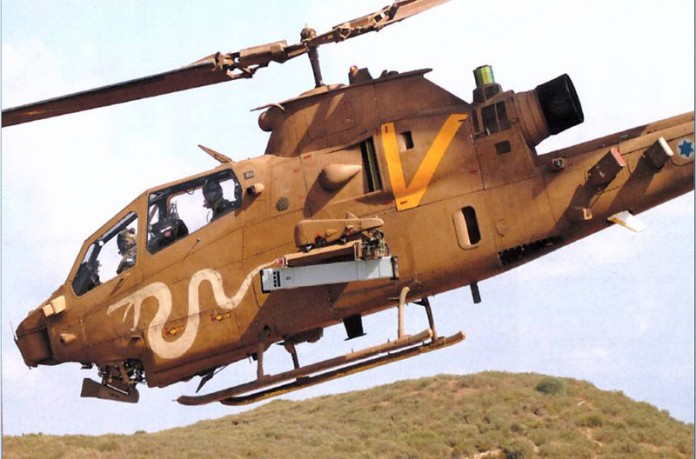
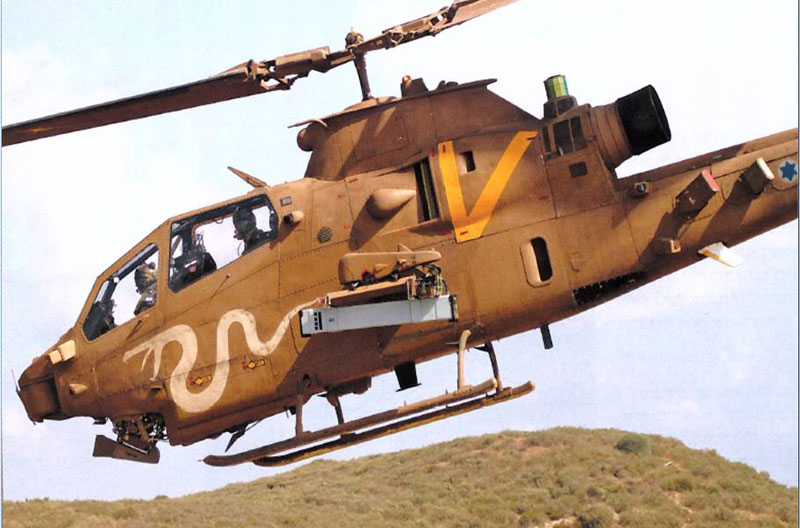
    The Israel Air & Space Force has withdrawn the last AH-1S Cobra from active service late in 2013. The mission of the helicopter gunships have been assumed by locally built drones. The Cobra seen in this photo was modified to carry the Tamuz (SPIKE NLOS) attack missile, capable of striking mobile targets at a range of 25 km with pin-point accuracy. Photo: RAFAEL
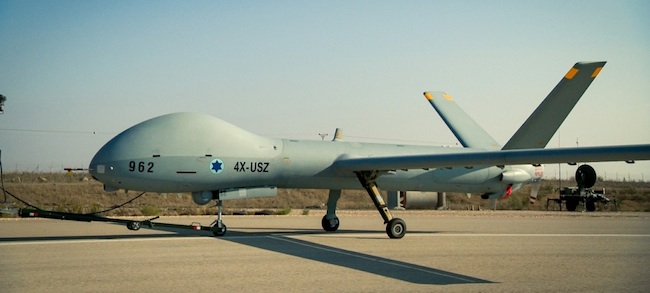
    The Israel Air Force has placed a second order with Elbit Systems' for the Hermes 900 Medium-Altitude Long Endurance Unmanned Aerial System
    Hermes 900 Medium-Altitude Long Endurance Unmanned Aerial System. Photo: Elbit Systems.

    Israel has phased out the AH-1S Cobra helicopter gunship, in favour of using more drones, the Reuters news agency reports. The increasing reliance on unmanned aerial vehicles (drones) has evolved through the years, as the unmanned aircraft assumed increasingly complex missions, and proved themselves as an indispensable asset in the continuous war against terror along and beyond Israel’s borders.

    Despite the improvements and extensive support, the Cobras have encountered significant ageing challenges, some causing fatal accidents. One squadron has been disbanded few years ago, the second was closed late in 2013. But, according to Reuters, The Cobras were axed as part of budget cuts. “They were sort of stuck in the middle in terms of the role they could fulfil, so we decided to do without them,” a senior military officer told Reuters on condition of anonymity.

    The air force aims to carry out strikes “within minutes” of receiving a request from ground troops – a timing that he said would likely be met by drones and helicopters rather than jets

    Israel has retained two squadrons of Apache helicopters, operating AH-64A and D models. Squadron 161, formerly the second Cobra squadron, was commissioned in 2012 at the Palmahim base, as a Hermes 450 (Zik) UAV squadron. Squadron 160 decommissioned in August 2013 is likely to follow.

    According to Reuters, operations have been shifted toward drones rather than manned aircraft and helicopters. According to the agency’s correspondent Dan Williams, the mission of the Cobras are now performed by unmanned aircraft, currently operating under several squadrons. Israel is known to be operating the Elbit Systems’ Hermes 450 and newer Hermes 900, as well as the IAI Heron TP dubbed Eitan. Officially these drones are operated on intelligence gathering and targeting missions only, but, according to foreign sources, they are also carrying guided weapons. subscribe

    Subscribe to read more…

    All UAVs operated by the IAF are locally made the country’s defense industries. These drones are increasingly used to patrol combat zones such as the Gaza Strip and South Lebanon.

    The Israel Air & Space Force has withdrawn the last AH-1S Cobra from active service late in 2013. The mission of the helicopter gunships have been assumed by locally built drones. The Cobra seen in this photo was modified to carry the Tamuz (SPIKE NLOS) attack missile, capable of striking mobile targets at a range of 25 km with pin-point accuracy. Photo: RAFAEL
    The Israel Air & Space Force has withdrawn the last AH-1S Cobra from active service late in 2013. The mission of the helicopter gunships have been assumed by locally built drones. The Cobra seen in this photo was modified to carry the Tamuz (SPIKE NLOS) attack missile, capable of striking mobile targets at a range of 25 km with pin-point accuracy. Photo: RAFAEL

    Israel has quadrupled its air-strike capacity over the past eight years

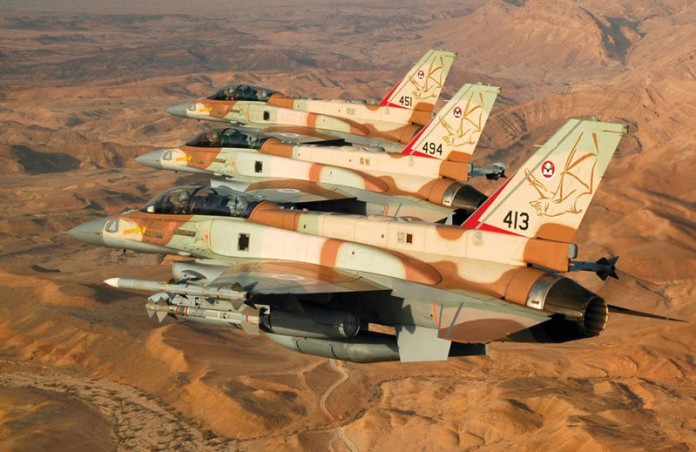
    The strike capacity of the IAF has increased while reducing the number of its strike-fighter jets.
    f-15i-idf_pair
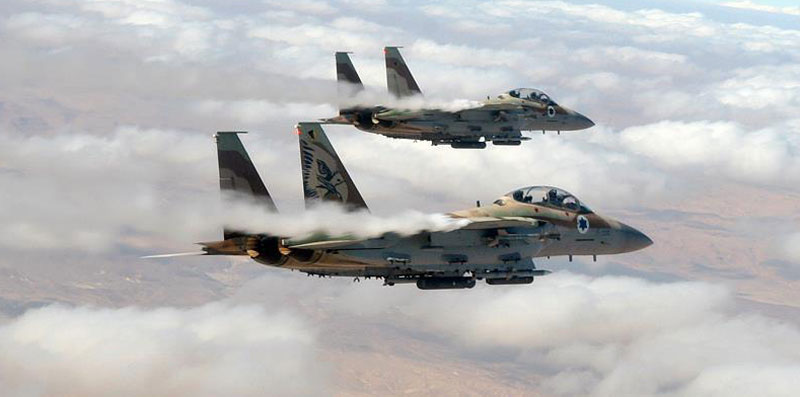
    New developments in guided weapons such as the SDB-I are enabling the F-15, to carry four guided bombs in place of each unguided bomb it used to carry. This will result in a pair of F-15s carrying over 50 individually targeted guided weapons – more than a full squadron would carry few years ago. Israel has reportedly received the SDB-I in 2008. Photo: IDF Spokesman

    At a time when Israel’s Ministry of Defense (IMOD) is striving for cash and the Israel Air & Space Force (IASF) is shutting down training due to lack of funding, it is encouraging to listen to the commander of the IASF, Maj. General Amir Eshel talks about the state of air force and how much it has evolved and strengthened in recent years. Following are excerpts from a post originally published by the IDF Blog.

    An IAF F-15C loaded with three JDAM bombs during the 2006 2nd Lebanon War. SInce 2006 the IAF has quadrupled its strike capability, IAF commander Maj. General Eshel stated. Photo: ISF Spokesman
    An IAF F-15C loaded with three JDAM bombs during the 2006 2nd Lebanon War. SInce 2006 the IAF has quadrupled its strike capability, IAF commander Maj. General Eshel stated. Photo: ISF Spokesman

    “I believe our capabilities are only second to the United States, from both an offensive and defensive standpoint” General Eshel told the audience at the Israel conference of National Security, in April 2014. IAF commander said, referring to a significant leap in capabilities over the past two years. The commander said he has based his assessment on an evaluation of IDF abilities and conversations with officials from foreign militaries.

    “We have an unprecedented offensive capability, which allows us to accurately strike thousands of targets in one day. We have doubled our abilities twice in the past two years. By the end of 2014, we will see an improvement of 400 percent to our offensive capabilities relative to the recent past, as a result of a long improvement process.”

    “By the end of this year (2014) the Air Force can do in less than 24 hours what it did in three days of fighting during the Second Lebanon War of 2006. It will be able to do in 12 hours what it did in a week of fighting during Operation Pillar of Defense in 2012.”

    Eshel: “We have doubled our abilities twice in the past 2 years”

    subscribe
    Subscribe to read more…

    Eshel did not elaborate on the means that have contributed to this dramatic increase in air power, but Maj. Gen. Eshel explained the reasons behind the investments in such powerful and extensive strike capabilities: “Israel can not afford lengthy attacks. We need to win quickly. A short time, in my opinion, is a few days. I do not believe in conducting long wars.”

    The air force chief argued that accurate and quality firepower is the main variable in achieving victory. To do so, he said, “It’s not enough to have just technical ability – we need to adopt an approach. We’re talking about an operation with full power, all of the air force, all encompassing, from the opening of the offensive effort in order to strike as powerfully as possible and shorten the war.”

    Analysts: The increased capability is likely to associate with improved intelligence acquisition, targeting capabilities, and deployment of smaller precision guided weaponry

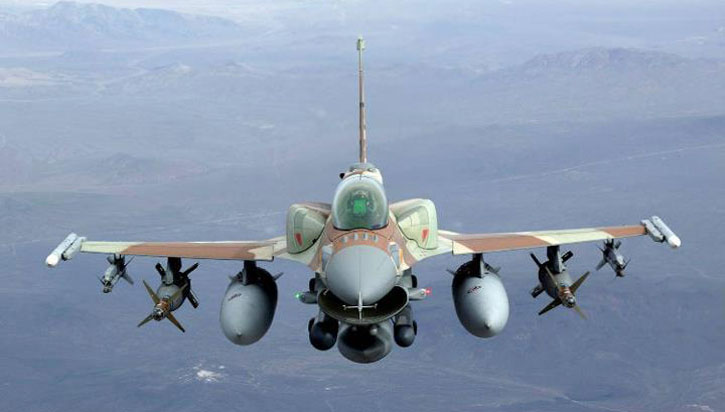
    In few years, the F-16I Sufa seen here carrying two laser guided bombs, will be able to launch 16 smaller but more lethal Spice 250 bombs, currently under development at RAFAEL advanced defense systems company.
    In few years, the F-16I Sufa seen here carrying two laser guided bombs, (in addition to four air/air missiles) will be able to carry 16 smaller but more lethal Spice 250 bombs, that could be used to attack 16 targets simultaneously. The new weapon is currently under development at RAFAEL advanced defense systems company.

    “We can destroy the military capabilities and infrastructure that support the activities of Hezbollah on a scale that would require decades to rebuild. [We could achieve] a direct hit on the terror organization and all that supports it on an unimaginable scale,” the IAF commander said.

    “Unfortunately Hezbollah took its assets and moved them into the cities,” he added. Hezbollah terrorists position themselves deep within urban areas, where they use homes and civilians as shields against Israeli counterattacks. In recent years, they have also mastered the technique of disappearing underground.

    “This is a very significant challenge because we do not want to hurt innocent bystanders. We’ve more than once that houses that are inhabited by citizens will be harmed…These are military targets that support their war effort.”

    In the face of these challenges, the IDF uses precision strikes to eliminate terror targets – a method which also prevents operations from spiraling into wars. “What characterizes [our] air power is our ability to control its impact, and this is very important during incidents of combat between wars,” Maj. Gen. Eshel explained. “Everything is flexible and subject to change. This is the advantage of the air force: the ability to take the hammer that was made for wars and use it in a more limited capacity.”

    The strike capacity of the IAF has increased while reducing the number of its strike-fighter jets.
    The strike capacity of the IAF has increased while reducing the number of its manned, strike-fighter jets.


    10 technologies to follow at Eurosatory 2014

    eurosatory2014_countdown

    Eurosatory 2014, the biennial defense and security event takes place in Paris is just around the corner. As it evolved through the years Eurosatory has become the largest defense exhibition in the world. Taking place at the parc des expositions, Paris Nord, June 16-20, The exhibition is promising to be one of the largest defense and security events this year and sets the stage for the introduction of many innovations and breakthroughs in defense technology. This year Eurosatory will be hosting about 1500 exhibitors, up 5 percent from 2012.

    Top 10 technologies to follow

    Following are 10 exciting new technological areas and applications we intend to follow, that are likely to attract your attention:

    • Fused vision systems (enabling human vision over a wider spectrum)
    • Terrain dominance (integrating advanced, persistent surveillance, big-data processing and networking technologies)
    • Advanced counter-IED Jammers (enabling comms-through-jam)
    • AESA radars as ground sensors
    • Focused lethality (new speak for small but powerful guided munitions)
    • Precision artillery and mortars
    • Special operations mobility (cool off-road vehicles)
    • Combat vehicle modernization (new ideas for resetting the vehicles that come back from Afghanistan)
    • Vehicle electronics
    • Wearable electronics and power for the new soldier systems

    Want to learn more about those trends? Subscribe to the full edition or join our email list to ensure you don’t miss the news!


    Need a last minute hotel in Paris
    for the next weeks?

    For the best rates and 24/7/365 availability
    we are recommending:


    Our editorial team has based this list on countless visits, meetings, talks, conferences and exhibitions. But we also invite our readers to comment and send other suggestions for coverage, to enable our team to focus on the topics that are of importance to you. You are invited to send your suggestions through our groups in Facebook or Linkedin.

    Four focus areas for Eurosatory

    COGES, the exhibition organizers have analysed new trends from the list of exhibitors that have booked display space at the exhibition, and highlighted the following topics among the trends in this year’s event:


    Among other exhibits and live displays expected at the event will be a wide range of weapons, ammunition, manned and remote controlled turrets, and over 250 different land and air vehicles, manned and unmanned to be displayed. Indoors, visitors can expect to witness the latest command, control, communications, networking and intelligence(C4) equipment and applications, as well as training systems and simulators.

    Traditionally, Eurosatory provided much attention to force protection, in addition to aspects of early warning, countermeasures and active protection. While the numbers of combat vehicles being procured are diminishing, those vehicles acquired in the past decade were often designed with modular armor, which can be updated and improved. Additionally, applique armor are also provided for older vehicles, improving their protection against ballistic, blast, mines and IEDs, as well as biological, chemical or radiological (CBR). With the introduction of lighter and more protective armor systems, including revolutionary composites, ceramic/metal hybrids and nano-technologies, the protection for personnel, infrastructures and vehicles will undoubtedly continue to be a hot topic at Eurosatory.

    Facing a growing irregular and terrorist threats, exhibitors at Eurosatory are also likely to highlight IED detection and countermeasures, mitigation, as well as counter-UAV capabilities, for early warning, targeting and defeat of these new threats.  

    The displays will also include a wide range of support capabilities, including fires – artillery and mortars, scout and reconnaissance and target acquisition systems (ISTAR) and combat engineering which nowadays include demining, route clearing and counter-IED missions. Combat service support also covers combat recovery and logistics which are also highlighted on the displays.

    Electro-Optical Systems

    Eurosatory has become a key venue for companies involved in the manufacturing of very high-tech optical components. The event will host the entire supply chain of the Defense-EO market, from system integrators and Equipment manufacturers (OEM), to specialists in subsystems and key components such as detectors, optical components and assemblies, electro-optical and electro-mechanical assemblies for zoom, stabilization and measurement, glass, crystals, coating, fiber optics, lasers etc.

    EO system applications on display are also varied, from high definition thermal imagers, covering long, medium and short wave infrared, CCD, Image intensifiers (I2), integrated into remotely operated payloads, providing area surveillance as part of air and land applications. Another area of activity in EO systems are panoramic and direct viewing cameras for vehicular and dismounted applications, weapon detection and locating, weapon guidance seekers. Among the viewing devices displayed are various near-eye displays, used in helmet mounted displays, visors, reticule integrated into displays integral in hand held devices, weapon sights, viewers etc. [Back]

    Heavier, more capable ground robots

    The field of ground robotics has undergone rapid changes in recent years. Military robotics was first implemented as means to replace the human operator in dangerous missions – particularly Explosive Ordnance Disposal. However, based on the vast experience of using robots in Iraq and Afghanistan in recent years, robots are increasingly used for area reconnaissance, or operations in hazardous environment, such as polluted areas. Smaller robots, equipped with advanced communications, used as repeaters are also becoming useful in operating inside buildings, or underground, in caves, tunnels, basements or sewers, where access by humans is difficult, hazardous or simply impossible.

    Another evolving trend is the use of robotic vehicles in logistical and support missions, employing autonomous vehicles in unmanned convoys or carrying supplies in support of dismounted troops. These robotic ‘mules’ are supporting troops in more than one way – in addition to carrying heavy loads, they also deploy sensors, mount remotely controlled weapons, provide electrical charging, and carry protection systems for the troops. [Back]

    Broadband mobile satellite communications

    As the military is shifting from the traditional, linear battlefield to asymmetric, rapid deployment contingencies, smaller task forces that are often required to operate far from home, must rely on extensive support thousands of miles away. Broadband, satellite communications is bridging this gap, providing deployed elements with efficient reach-back to support intelligence collection and assessment, command and control, combat service support and, in some cases, even kinetic operations. To sustain those capabilities military forces rely on dedicated military and shared commercial satellite operators, and new generations of small, compact and highly efficient terminals, enabling the use of broadband SATCOM on vehicles, on the move. In addition, manpack and pan portable SATCOM is also supporting dismounted teams and special operations, even when they are communicating from hidden, or covered locations. [Back]

    Meeting the growing demand for power

    Electrical power is a key aspect for all military operations, from the weapon systems, with rough surveillance and communication systems, to provision of automotive power. Coping with the growing demand for electronic devices, electrical power generation on vehicles and dismounted has been a major issue. Among the solutions currently discussed are the use of higher density batteries, backup solar power, wind power, harvesting power and more effectively managing power usage, as well as designing systems for overall low power consumption by the different applications employed by the soldier. [Back]

    Defense Update will continue these previews, to be followed by on-site reports beginning on June 15. You are invited to join our email list to ensure you don’t miss the news!

    SOFIC 2014 photo report: SOF Mobility

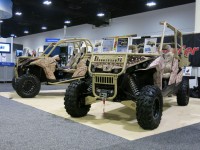
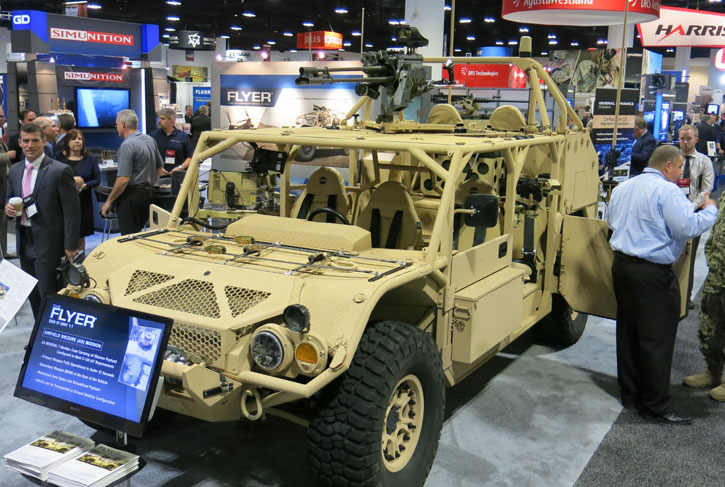
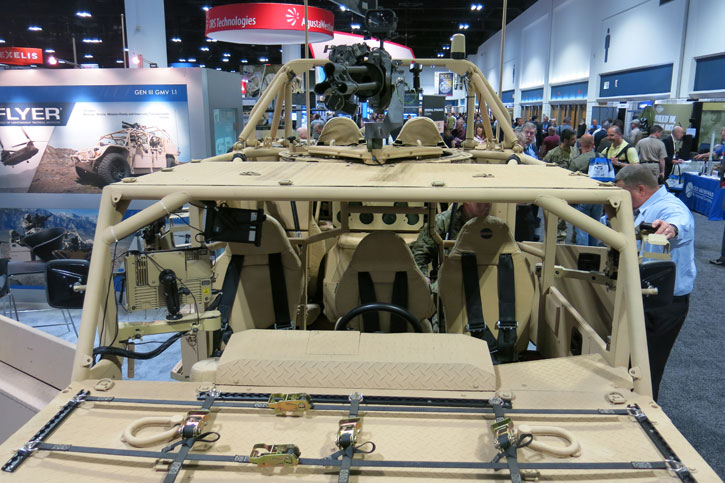
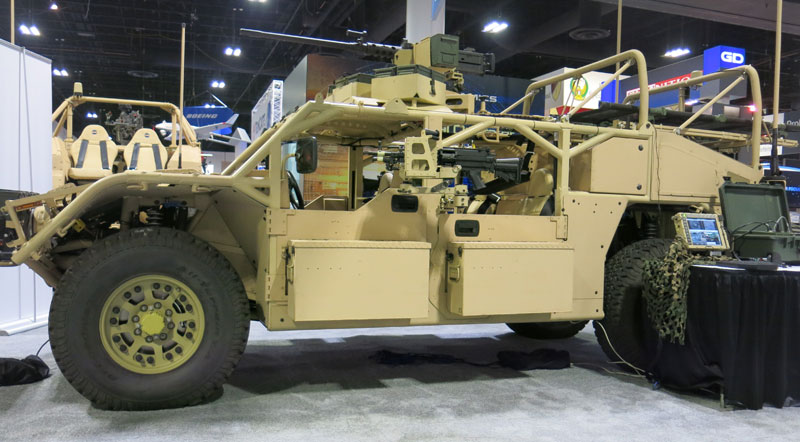
    STRIKERGMV11725
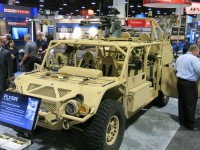
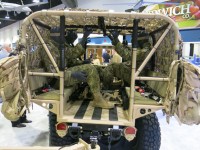
    Flyer GEN III GMV 1.1
    STRIKERGMV11725
    Flyer GEN III GMV 1.1
    flyeritv_side
    Flyer GEN II ITV
    flyer_itv
    Flyer GEN II ITV
    phantom_badger_front
    Boeing Phantom Badger
    phantom_badger_rear
    Boeing Phantom Badger
    prowler_ltatv800
    Prowler LALTV
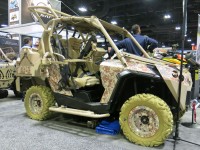
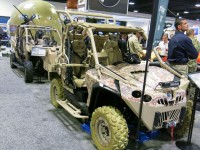
    polaris_razr
    Polaris MRZR 4
    polaris_tow
    Polaris MV850
    brp
    Strike-C Commander
    brp_duo
    Strike-C / Strike-M Commander
    BRP_PR350
    TRAPS T360 on Strike-M
    STRIKER_R725
    E-powered Strike-M4
    RC_STRIKER_R_WITH_BUSTER
    Remotely controlled Strike-R
    polaris_blacks
    ATVs with BMI Accessories
    battelle_proteus
    Proteus UDV
    dcs3_725
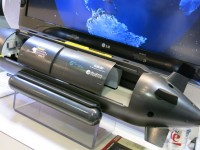
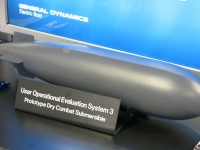
    Dry Combat Submersible prototype
    ssbn_725
    Universal Launch and Recovery Module
    jetboots_725
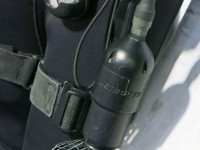
    Jetboots diver worn propulsion
    stidd_sdv725
    Diver propulsion Device XT
    prowler_725
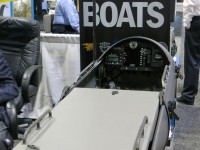
    Prowler motion augmentation system

    Click on each photo to view a larger version. Click on the larger image to return to the collection.

    Samples of the full size images are provided as a courtesy for all our readers.
    Defense-Update Gold Members have access to all images in full size.

    All photos: Copyright 2014 by Defense-Update, Photographer: Tamir Eshel

    STRIKERGMV11725
    General Dynamics is offering the Flyer GEN III GMV – Advanced Light Strike Vehicle for SOCOM Ground Mobile Vehicle 1.1 (GMV 1.1) program.

    STRIKERGMV11725
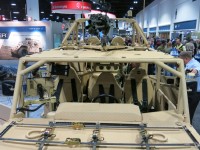
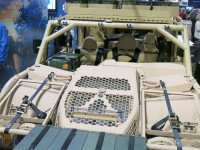
    The GEN III GMV can accommodate up to nine fully equipped troops – six in the open cab, one in the gunner position and two on the cargo deck, facing backwards.

    flyeritv_side
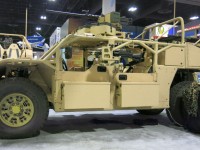
    The prototype compact Flyer GEN II Internally Transported Vehicle (ITV) was selected by SOCOM for the evaluation of its V-22 transportable vehicle. The GEN II Flyer can be transported internally in the CV-22, CH-47G, C-130 and C-17 or sling loaded under the V-22 or Chinook.

    Click on each picture to view a larger format. Click on the large picture to return to the collection.

    More images are accessible by Gold Members - Join now!
    Want to view all images? Join now!

    Israeli DIRCM laser to protect German A400M transport planes

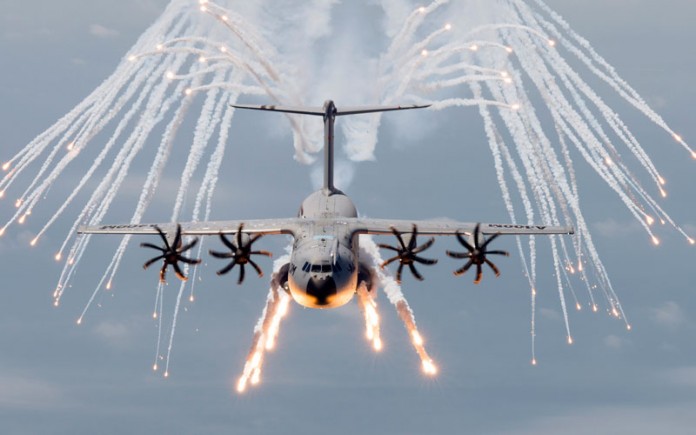
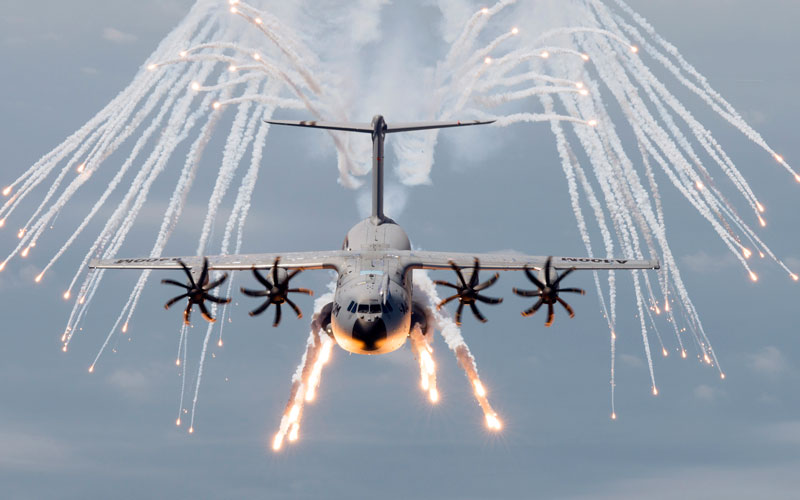
    Airbus Military A400M demonstrates the release of decoy flares. Photo: Airbus Military
    Airbus Military A400M demonstrates the release of decoy flares. Photo: Airbus Military
    Airbus Military A400M demonstrates the release of decoy flares. The A400 currently integrates a defensive aids systems comprising RF and IR warning systems and Chaff/Flare dispensers. The J-MUSIC will represent the first DIRCM to be integrated into the European transport plane, providing more effective countermeasure against advanced air defense threats. Photo: Airbus Military

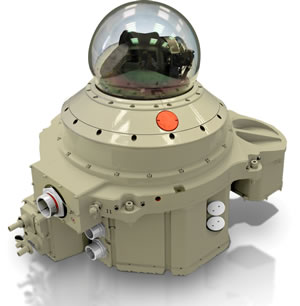
    Diehl announced it plans to combine Elbit System´s J-MUSIC (Multi-Spectral Infrared Countermeasure) system into a multi-turret Directed Infrared Counter Measure (DIRCM) system to be integrated into the german A400M Atlas military transport, ensuring complete 360° protection of the aircraft. Diehl and Elbit Systems have signed an exclusive cooperation agreement at the recent ILA Berlin airshow, to equip the Bundeswehr´s Airbus A400M transport aircraft with its self-protection system. J-MUSIC was designed to protect large military and commercial aircraft against man portable infra-red guided anti-aircraft missiles (MANPADS) employed by terrorists worldwide.

    The J-MUSIC fiber-laser DIRCM will be part of the self protection suite protecting the german A400M Atlas transport aircraft. Photo: ELbit Systems
    The J-MUSIC fiber-laser DIRCM will be part of the self protection suite protecting the german A400M Atlas transport aircraft. Each A400M will be fitted with two MUSIC laser-countermeasure units, providing  360 degrees protection for  the aircraft. Photo: Elbit Systems

    In recent months Elbit Systems completed extensive testing of the fiber-laser based J-MUSIC and its the podded version C-MUSIC systems, and has delivered systems to equip several aircraft for customers this year. Several variants of the MUSIC system and modules were already selected to protect the Italian Air Force Lockheed Martin C130J and Alenia Aermacchi C27J military transports and AgustaWestland AW101 CSAR helicopters, as well as the Brazilian Embraer C390 military transports. The cooperation with Diehl further extends Elbit Systems’ access to military and commercial aircraft fleets. In 2013 Boeing and Elbit Systems have also signed a Memorandum of Understanding offering Elbit Systems’ Directed Infrared Counter Measure (DIRCM) systems for a range of Boeing military fixed-wing and vertical-lift aircraft.

    By adapting the Israeli solution Diehl will be able to meet the Bundeswehr schedule with operationally-ready DIRCM solution for the A400M in 2015

    By adapting the Israeli solution Diehl will be able to meet the Bundeswehr schedule with operationally-ready DIRCM solution for the A400M in 2015. Germany is expected to operate 53 A400Ms positioned to become the largest operator of the Atlas; the first aircraft is currently in assembly and will be delivered to the customer in November 2014.
    Goldsidebar
    Exclusive version available for Gold Members

    The first A400M Atlas has been delivered to the French Air Force in 2013, followed by the delivery to the Turkish Air Force earlier this year. The RAF is British Royal Air Force will be next, followed by the German Air Force, both receiving their first Atlas this year.

    The current intention of the participating nations is to procure a total of 170 aircraft with delivery schedule extending to 2024. Of the 170 aircraft Germany 53, France 50, Spain 27, Turkey 10, UK 22, Belgium 7 and one for Luxembourg. Malaysia has also ordered four aircraft, with deliveries commencing in 2015. Airbus is expecting a second export order to be signed in 2014.

    Subscribe to read more…

    SM-3B performs first launch from land-based unit

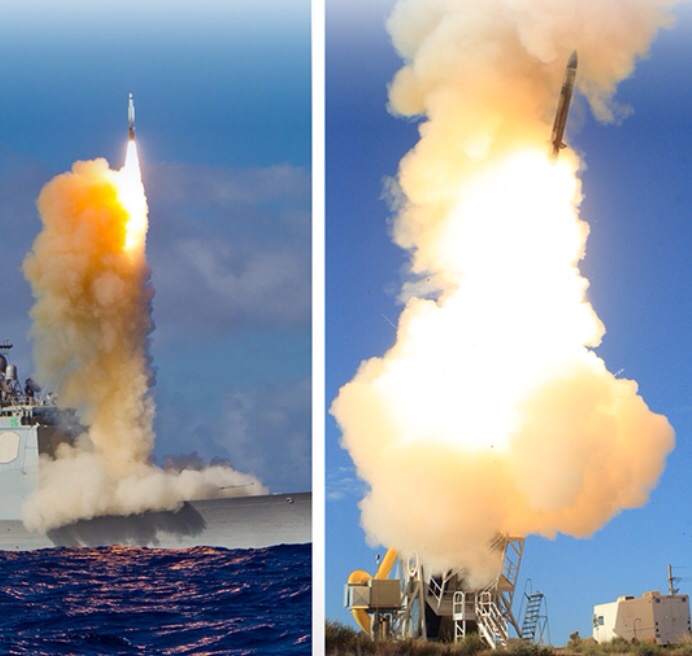
    The U.S. Missile Defense Agency conducted the first flight test of the Raytheon-made Standard Missile-3 from the Aegis Ashore weapon system. Aegis Ashore will provide the effector (missile interceptor) operated by the joint U.S.-European missile defense capability to be deployed in Romania by 2016. The system will protect U.S. deployed and NATO forces in Europe from ballistic missile attack.

    The recent flight did not include an intercept, but tested the safe launch and fly-out of an SM-3 Block IB against a simulated target; an intercept flight test is scheduled for 2015.

    The test, known as Aegis Ashore Control Test Vehicle-01 (AA CTV-01) flight test, is the first live fire event for the Aegis Ashore system at the Pacific Missile Range Facility (PMRF) in Hawaii. During the event, a Standard Missile-3 (SM-3) Block IB guided missile was launched while a simulated target was tracked by the Aegis Weapon System. This is the first Aegis BMD system test using a land-based missile launcher.

    The land-based system uses the sea-based Aegis BMD and deploys it in a land-based application using the newest generation of BMD, known as BMD 5.0 and the same SM-3 missile deployed on Aegis Ballistic Missile Defense ships. The system currently holds 24 SM-3 missiles at one time. The Aegis Ashore system also possesses the capacity for additional launchers and missiles. The system will deploy with the latest SM-3 Block IB.

    “The SM-3 Block IB deployed for the first time earlier this year at sea, and the success of this Aegis Ashore test keeps us on track to deploy the missile on land in 2015,” said Dr. Mitch Stevison, Raytheon’s Standard Missile-3 senior director.

    The first Aegis Ashore system is installed in a deckhouse at the Pacific Missile Range Facility (PMRF) in Hawaii. The second system will be delivered to Romania for operational capability in 2015. According to the European Phased Adaptive Approach plan for missile defense, the first Aegis Ashore site will be operational in Romania next year. The second Aegis Ashore site is on track for Poland in 2018. Both sites will be capable of launching SM-3 Block IAs, IBs and IIAs (2018).

    “As it deploys to Romania next year and to Poland in 2018, Aegis Ashore is a tremendous and critical asset for NATO to pursue its collective resolve to protect and defend Europe” said Riki Ellison, Chairman, Missile Defense Advocacy Alliance (MDAA). Allison added that the test tonight proved three important competencies in its deployment to Romania:

    – The validation of communication from the Aegis Ashore site with constant persistence to the second and third stage of the launched SM3 1B interceptor in its guidance for a correct path towards the target.

    – The validation of the accuracy of a “launch on remote” above ground interceptor site that is much further away from the Aegis Ashore site than it would be if the interceptors were on a Aegis BMD ship.

    – The validation of the increased safety measures for the surrounding area and Pacific Missile Range Facility for the requirements of this interceptor and system to launch from an Aegis Ashore land based site.

    SOFIC 2014 – international SOF demonstration

    sofic_demo3
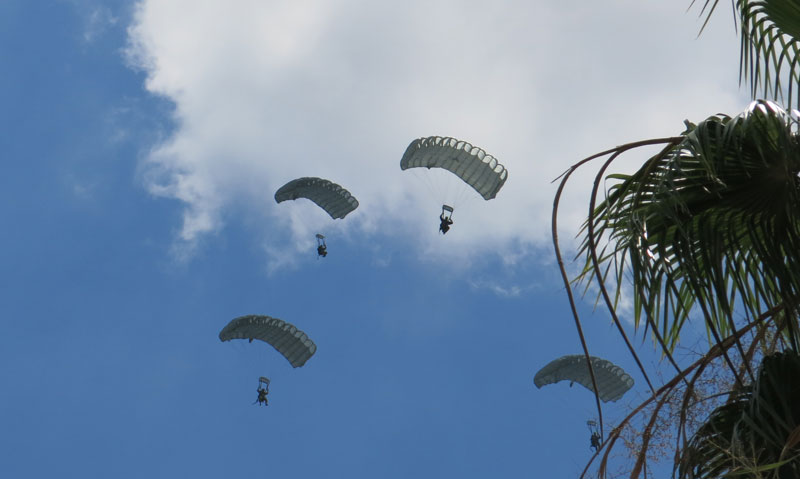
    Parachutists from several nations have joined SOCOM for the international SOF exercise, that culminated in delivery of free-fall parachute delivery from a n MC-130. The parachutists jumped from an altitude of 8000 ft and landed at the bay, in front of the convention center. Photo: Tamir Eshel, Defense-Update

    The 2014 SOFIC (Special Operations Forces Industry Conference) taking place at the Convention Center in Tampa, Florida this week highlights the latest trends in special operations equipment and technology, depicted by SOCOM and defense industries from the US and abroad.

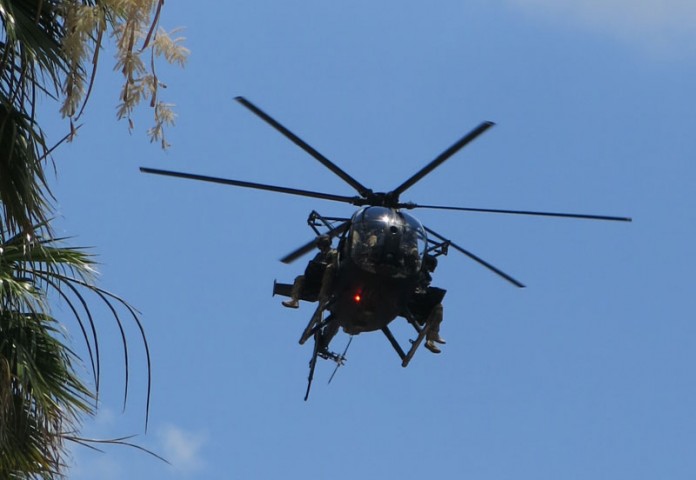
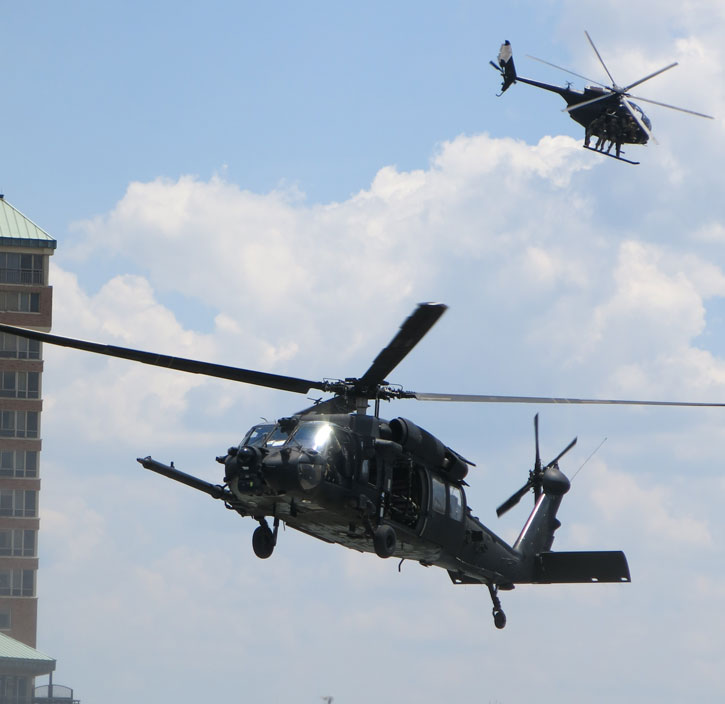
    Among the event’s main topics are intelligence gathering and surveillance, command, control and communications. Aviation systems shown at the show address a wide range of systems, from conventional, manned transport and support, through parachute delivery to unmanned aerial systems. Some of the methods used by the US Special Operations Command, as part of its aviation unit – Task Force 160 – were demonstrated over the Tampa bay by SOCOM units that have joined foreign operatives from many nations joining the international SOF exercise. The demonstration took only three days to plan, and today’s performance was the grand rehearsal for the full display planned for Wednesday 21 May. 

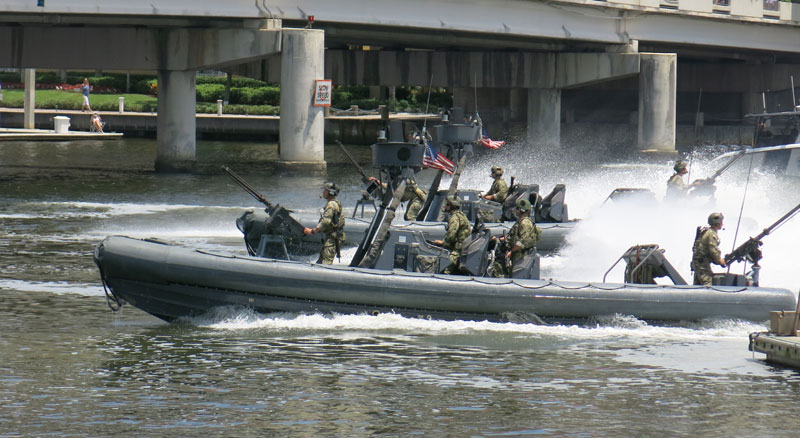
    The international Special Operations Exercise is a multinational exercise to increase interoperability among SOF partners. Through the exercise, special operators from 16 partner nations are conducting tactical, scenario-driven exercise in the vicinity of the Tampa Convention Center which overlooks the Tampa Bay. The exercise includes an MC-130 military freefall water jump, MH-60 Black Hawk helocast and fast-rope insertions, an MH-6 Little Bird sniper insertion and armed reconnaissance operations, a SEAL underwater infiltration and Ground Mobility Vehicle (GMV) and Rigid Hull Inflatable Boat (RHIB) assaults. Marine Corps Special Operations (MARSOC) is leading the US SOF support to the exercise.

    Sixteen countries have accepted the invitation to send operators to participate in the exercise, including Belgium, Canada, Czech Republic, Denmark, Estonia, Finland, France, Germany, Jordan, Ireland, Netherlands, Norway, Peru, Poland and Thailand.

    Other topics at the exhibition are individual and crew served weapons, as well as innovative precision strike systems, combining unmanned aerial systems technologies. and airborne and unmanned systems. Other topics highlight delivery systems – underwater, land based, parachuting and air delivery.

    Defense-Update will publish updates from SOFIC through several photo reports and articles covering specific topics. Among the themes to be covered are news about the TALOS system, suicide drones, new intelligence, command and control systems, EO systems, all-terrain vehicles, and more.

    tf160_sofic
    As part of the operation, TF160 Black Hawk and OH-6 Little Bird helicopters demonstrated the delivery of snipers, dinghies and commandos to their targets. Photo: Tamir Eshel, Defense-Update
    sofic_demo2
    In synch with the heliborne assault naval special warfare (SEAL) teams demonstrated an assault using Rigid-hull inflatable boats (RHIBs). Photo: Tamir Eshel, Defense-Update


    Elbit Systems introduces enhanced light mobile mortar system

    SPEAR3
    Elbit Systems introduced an enhanced version of the SPEAR, lightweight, mobile mortar system.

    The new patent-pending 120mm light vehicle-mounted Recoil Mortar System provides ground forces with improved mobility, lethality and accuracy across a wide range of operational scenarios Elbit Systems will showcase its latest autonomous Recoil Mortar System (RMS) for lightweight 4×4 combat vehicles at the 3rd International Fire Conference, held May 20-22, 2014, at ”Home of the Gunners” in Zikron Ya’akov, Israel.

    Introducing a revolutionary technology, the advanced 2nd generation RMS reduces 120mm gun barrel firing recoil loads from 30 to less than 10 tons, enabling adaptability with previously non-installable Light Combat Vehicles (LCVs), such as (Humvees), jeeps and more. This capability significantly improves the maneuverability and operational performance of infantry forces, as it delivers immediate indirect artillery support for effectively engaging a wide range of targets.

    SPEAR2

    SPEAR
    SPEAR lightweight, low recoil mortar undergoing firing tests. Photo: Elbit Systems

    SOLTAM SPEAR’s lightweight, modular design enables high-speed, all-terrain vehicle mobility, as well as helicopter and cargo aircraft transportability – allowing rapid deployment in both close range and Special Forces counterinsurgency operations. SOLTAM SPEAR is equipped with cutting-edge fire control, navigation, automatic aiming and propulsion systems, which facilitate a fully-autonomous operation and provide increased fire power and accuracy (within 30 meters of the Circular Error Probability (CEP) radius. In addition, the RMS’’ advanced target data collection and identification capabilities enhance situational awareness and increase crew survivability. SOLTAM SPEAR is offered both independently as a standalone installation or as an integral part of a larger artillery unit or formation. It is compatible with all types of 120mm smooth bore mortar systems and munitions.

    Yehuda (Udi) Vered, General Manager of Elbit Systems Land and C4I, noted: Elbit Systems is a world leader in the field of mortar systems, and the CARDOM mortar is already in use by the IDF and other leading armed forces around the world. The SPEAR provides our customers with a broader range of capabilities and further establishes our leading position in this field. SPEAR addresses the operational demand for agile, accurate and precise mobile fire power, which enables operation deep within combat zones and the deployment of Special Forces. The full integration of SPEAR into Elbit Systems’ C4I systems allows rapid closure of sensor-to-shooter loops and enhanced operational effectiveness for ground forces”.

    The SPEAR as shown at the International Fire Conference in Israel – Tuesday, May 20, 2014:

    spear-close-back
    The low recoil system developed by Elbit Systems’ subsidiary SOLTAM for the SPEAR system. Photo: Noam Eshel, Defense-Update
    spear-front
    The SPEAR system. Photo: Noam Eshel, Defense-Update


    Skunk Works and XTEND Simplify Multi-Drone Command

    0
    Lockheed Martin Skunk Works® and XTEND have achieved a major milestone in JADC2 by integrating the XOS operating system with the MDCX™ autonomy platform. This technical breakthrough enables a single operator to simultaneously command multiple drone classes, eliminating the friction of mission handoffs. From "marsupial" drone deployments to operating in GPS-denied environments, explore how this collaboration is abbreviating the data-to-decision timeline and redefining autonomous mission execution.

    From Ukraine to Taiwan: The Global Race to Dominate the New Defense Tech Frontier

    0
    As traditional defense primes face mounting competition from agile “neoprimes” such as Anduril, Palantir and Helsing, the balance of innovation is shifting toward software-defined warfare and scalable, dual-use technologies, while global industry consolidation—marked by Boeing’s integration of Spirit AeroSystems and other strategic mergers—signals an intensified race to secure control over the defense technology value chain. Our Defense-Tech weekly report highlights these trends.

    Europe’s “Drone Wall”

    0
    In early October 2025, a coordinated wave of unmanned aerial system (UAS) incursions—widely attributed to Russia—targeted critical infrastructure across at least ten European nations. The unprecedented campaign exposed the fragility of Europe’s air defenses...

    Weekly Defense Update & Global Security Assessment

    0
    Executive Summary The past week (September 18-25, 2025) represents an inflection point where strategic defense concepts have transitioned from doctrine to tangible reality. An analysis of global events reveals four primary, interconnected trends shaping an...

    U.S. Air and Space Forces Push Next-Gen Programs at the AS&C 2025 Conference and...

    0
    At the 2025 Air, Space & Cyber Conference, U.S. Air Force and Space Force leaders unveiled major updates on next-generation fighters, bombers, unmanned systems, and space initiatives, highlighting both rapid innovation and critical readiness challenges as the services race to outpace global competitors. A short version is available here, with a more detailed version for subscribers.

    TADTE 2025: Reflecting Taiwan’s Strategic Themes

    0
    The Taipei Aerospace & Defense Technology Exhibition (TADTE) 2025 crystallized around four dominant strategic themes that collectively illustrate Taiwan's comprehensive approach to defense modernization amid escalating regional tensions. Based on a detailed report by Pleronix (available upon request). Includes a Podcast discussion on TADTE 2025's highlighting Taiwan's four strategic themes beyond the post's coverage.

    Iron Beam 450 Completes Testing, Soon to Join With Operational Air Defense Units

    0
    Israel’s Iron Beam 450 high-power laser system has completed final testing, marking a major leap in air defense. Developed by Rafael, it offers precise, cost-effective interception of rockets, UAVs, and mortars, and is set for IDF deployment by 2025.