
The need to share and enhance knowledge regarding Defensive Cyberspace Operations (DCO) is growing as cyber threats continuously develop and transform globally. The INSS Cyber Warfare Program and Cyber Security Forum Initiative (CSFI) are proud to host the Annual Defensive Cyberspace Operations Conference with the purpose of fostering international cooperation on issues of security, intelligence, and defense. The conference aims to contribute to an informed public debate on cyber-net security and to promote international collaborations in the technological, legal, and policymaking domains. The conference will be held in English at INSS, April 8-9, 2014. Access the DCOI event here
IDF to Spend $100 Million Modernizing its Secure Smartphones

Israel’s Ministry of Defense and US based Motorola Solutions have signed an agreement for the procurement of 4G handsets for the Israel Defense Forces (IDF). These new smartphones will replace about 10,000 TETRA based ‘Mountain Rose’ handsets operating over the military-owned cellular system since 2004. ‘Mountain Rose’ was developed by Motorola Solutions in 1999 and was first deployed in 2004.
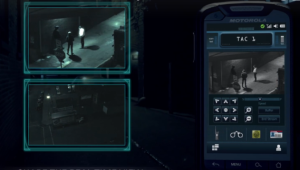
After 10 years in service ‘Mountain Rose’ is considered almost obsolete. While it offers highly resilient and robust communications, the network coverage is limited, it doesn’t provide broadband support and handsets availability is limited, given the sole manufacturer is producing these handsets only for the IDF.
The new handset will use modified Commercial Off-The Shelf (COTS) units produced by Motorola Solutions for public safety users.
The program is expected to cost about $100 million, with first devices delivered to the IDF in 2016. The IMOD is planning to cover half of the cost using US Foreign Military Sales funding. This funding will cover the adaptation design, modification and procurement of handsets. The remaining budget, about IS175 million for the integration Israeli-made encryption and allocate funding for operations and support over the next 15 years. Additionally, the IDF will have to maintain the necessary network infrastructure operated and deployed with mobile forces.
Most likely to be the IDF next generation smartphone, Motorola Solutions‘ Mission Critical Handset is implementing the latest LTE commercial 4G communications standard, offering broadband personal communications supporting up to 10 Mbps data rates, carrying video, images, data and voice, at a high level of security. In fact, the IDF opted for the new system based on its proven 128 bit security, which will be further enhanced before being inducted into operational service. The handset also maintains backward compatibility to current standards, enabling the user to deploy over existing networks.
While Israel is considered a leading technology driver in the field of communications, at present the country does not have 4G / LTE network in place. Implementing such a network was delayed repeatedly due to spectrum availability and regulation issues. In May 2013 the IDF began clearing some of the spectrum segments to be used for the implementation of a 4G cellular network. The process is expected to be completed by 2015. The new network is likely to be auctioned next year, paving the way for timely coverage as the IDF future smartphones arrive.
The new devices will operate over Cellular and IP networks, as well as functioning as a Push to Talk (PTT) radio at close range, and adapt to LTE when the network becomes available. Unlike the current Mountain Rose network that offers only partially coverage of Israel, the new network will be based in part on existing commercial operators that will have to beef up their coverage of areas where the IDF regularly operates. The IDF will also maintain mobile base stations, designed to roll with the ground forces and establish reliable communications beyond the commercial terrestrial network.
For the public safety sector Motorola Solutions offers LEX700 ‘Mission Critical handheld’ device, running dual-core 1 GHz processor and a high-capacity battery (3760mAh) supporting up to 400 talk minutes or 500 hours in standby.
The rugged Android based smartphone operates a four-inch touch screen, using daylight-visible bright display visible in direct sunlight. The device supports apps and streaming video, displaying images and maps, utilizing hardware-accelerated 3D graphics. The Motorola LEX700 handset also has a standard 8 megapixel camera and GPS, which the Israelis are expected to retain.
Armor Technology 2014

Armor Technology 2014 forum provides armor professionals an insight into the latest trends in combat survivability and force protection.


The forum is providing the platform for an online event organized by Defense-Update, scheduled for May 2014. Since our ‘quiet launch’ in October 2013 ‘Armor technology 2014’ has gathered momentum and support among the world’s leading military forces, scientists at R&D centers and technical advisors, to defense integrators and armor specialized industries throughout the world.

Military and industry experts from Israel, the USA, Netherlands, Germany, France, the U.K. and Russia have already expressed interest to speak before the forum. More details will be released as specific presentations are confirmed.  Our theme for the 2014 forum will be “Combat Vehicles Survivability”, addressing various aspects of today’s armor challenges:
♦ Evolving Challenges in Asymmetric Warfare
Modern military forces are facing new threats today, as insurgents, terror groups, even some military forces are adapting new operational techniques and technical capabilities evolved through years of combat.
♦ Advancement in anti-armor capabilities
The proliferation of advanced counter-armor weaponry and operational techniques is challenging the Army planners to rethink their operational concepts, particularly when it comes to complex and urban terrain.
♦ Advanced armor technologies
Innovation in materials and processes, Advanced composites, metals, ceramics and hybrids are improving ballistic and blast protection, offering superior, multi-functional protection at lower cost.
♦ Improving design and manufacturing processes
Affordably building and upgrading combat vehicles. Surviving mines and IEDs – Dealing and mitigating blasts effects.
♦ Beyond armor – hard kill and hit avoidance
Improving situational awareness and rapid response, employing soft and hard kill active protection systems.
♦ Maintaining a credible combat force
How different militaries view the roles, requirements and modernization of the armored component, being part of the modern land forces.
Participants at the “Armor Technology 2014” international forum include leading experts from military services, prime contractors, integrators and OEMs as well as scholars and researchers from the world’s leading R&D and academic institutions. Due to the sensitivity of this topic, all participants are required to pre-qualification with Defense-Update as approved members.
Join Now
Members of the Armor Technology 2014 forum will get access to exclusive presentations, provided by leading international experts. Forum members you will have the opportunity to address the panel of experts with questions and suggestions. Forum membership includes access to all presentations, and their related discussion threads. Other member privileges include a full year subscription to Defense-Update, access to premium content, personalized information updates via email and more. Companies interested in sponsoring and supporting the forum are invited to contact the editor for more details.

Armor Technology 2014 Application
Please fill this application to apply for Armor Technology 2014 participation
Armour Technology 2014 Sponsorship Application

To receive our sponsorship packages / non-commercial support plans please fill the following application:
US-Canadian JV Wins Philippine Huey Helicoopters Tender
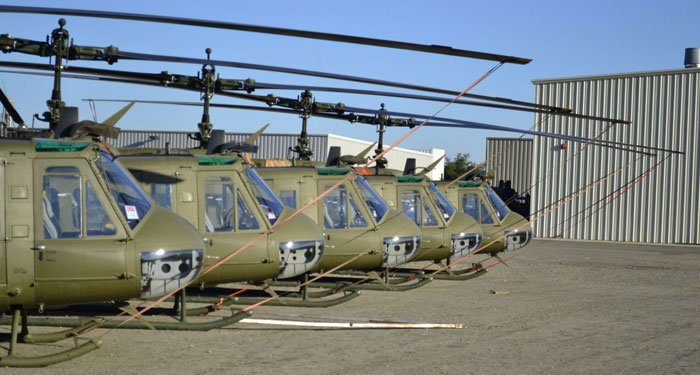
The Philippine Air Force is acquiring 21 refurbished Bell UH-1H (Huey) helicopters to bolster its combat, security and utility, transport capability, the PhilSTAR reported. The winner of the tender was a joint venture of two foreign companies – U.S. based Rice Aircraft Services Inc. and the Canadian Eagle Copters Ltd. According to the STAR, the JV will deliver the helicopters at a cost of about US$28 million, (P1.25 million, $28,000 short of the threshold the DND has set for the procurement). Rice is specializing in maintenance, repairs and overhaul (MRO) and restoration of Bell helicopters. Rice also provides support MRO as well as sales and leasing services. The company operates a number of international locations, including Chile and Australasia.
It was the fourth round of bidding on this tender. The third was cancelled in September, as all bidders, including the Rice/eagle JV were disqualified. Since then nine firms expressed interest in the tender; according to the STAR, apart from the Rice/Eagle JV, other bidders included Radom Aviation Systems, Serpenair Group Inc./Bell Helicopter, St. Aerospace Engineering, Stone of David Tactical Equipment, Overseas Aircraft Support, Aerospace Engineering Group and Philjets Aero Services/Vector Aerospace were all considering offers.
The PAF 205th Tactical Helicopter Wing has been operating some UH-1H over the years, but their conditions deteriorated and the level of airworthy helicopters has been reduced from 67 to 21. In September 2013 Maj. Gen. Raul Dimatactac said that the Air Force has asked for 45 helicopters but could budget only 21. ” 33 of those 67 helicopters are beyond repair, while 22 are recoverable” Dimatactac said, “the air force needs 96 Hueys, but has only 76 in its inventory” he added. Since 2003 Manila received used 20 UH-1H helicopters from US surplus, including five helicopters retired from service with the US President air fleet.
Besides partly restoring their fleet of Hueys, the PAF has recently ordered 16 new helicopters – eight Polish Sokol helicopters, acquired for $62 million (P2.8 billion) from the Augusta PZL Swidnik company and delivered to Manila in 2013, and eight AW109P (Power) acquired directly from the Italian parent company AgustaWestland for $77 million (P3.44 billion). These A109Power copters could be in the Philippines by 2015.
FAA Clears Six Sites in the USA for UAS Testing
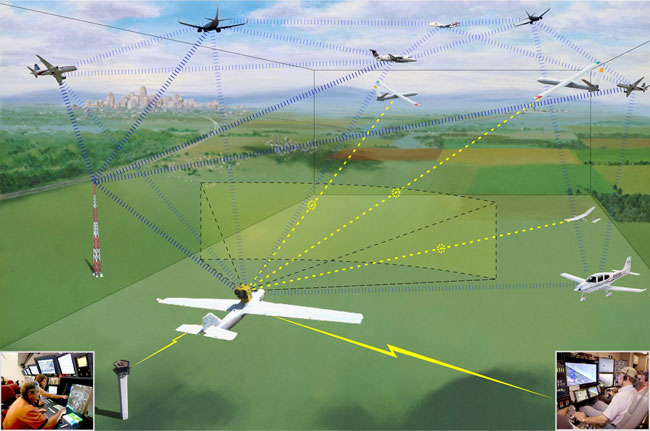
<img style=”margin-left: 5px; margin-right: 5px;” alt=”uas_infographic720″ src=”https://defense-update.com/wp-content/uploads/2013/11/uas_infographic720-300×248.jpg” width=”300″ height=”248″ />The Federal Aviation Administration (FAA) announced yesterday the selection of the six public entities that will develop unmanned aircraft systems (UAS) research and test sites around the country. The locations include the University of Alaska, the State of Nevada, New York Griffiss international airport, the Department of Commerce of North Dakota, Texas A&M University at Corpus Christi and Virginia Tech Polytechnic Institute.
These congressionally-mandated test sites will conduct critical research into the certification and operational requirements necessary to safely integrate UAS into the national airspace over the next several years.
“Across the six applicants, the FAA is confident that the agency’s research goals of System Safety & Data Gathering, Aircraft Certification, Command & Control Link Issues, Control Station Layout & Certification, Ground & Airborne Sense & Avoid, and Environmental Impacts will be met.” The agency said in a statement.
The FAA’s role in the UAS program is to help the test site operators set up a safe testing environment and to provide oversight that ensures the sites operate under strict safety standards.
“Safety continues to be our first priority as we move forward with integrating unmanned aircraft systems into U.S. airspace,” said FAA Administrator Michael Huerta. “We have successfully brought new technology into the nation’s aviation system for more than 50 years, and I have no doubt we will do the same with unmanned aircraft.”
Today, UAS perform border and port surveillance, help with scientific research and environmental monitoring, support public safety by law enforcement agencies, help state universities conduct research, and support various other missions for government entities.
Huerta said the first site is to be operational within 180 days, with the rest to be online “as quickly as possible”. The current authorization will last until 13 Feb., 2017, at which time the FAA would need to be reauthorized. Huerta noted that parralel to the current acticity the agency continues working on a proposal for the rules guiding the integration of small umanned aircraft operating in the national airspace.
In selecting the six test site operators, the FAA considered geography, climate, location of ground infrastructure, research needs, airspace use, safety, aviation experience and risk. In totality, these six test applications achieve cross-country geographic and climatic diversity and help the FAA meet its UAS research needs.
- University of Alaska
The Alaskan test plan contained a diverse set of test site range locations in seven climatic zones as well as geographic diversity with test site range locations in Hawaii and Oregon. The research plan includes the development of a set of standards for unmanned aircraft categories, state monitoring and navigation. Alaska also plans to work on safety standards for UAS operations. - State of Nevada
Nevada’s project objectives concentrate on UAS standards and operations as well as operator standards and certification requirements. The applicant’s research will also include a concentrated look at how air traffic control procedures will evolve with the introduction of UAS into the civil environment and how these aircraft will be integrated with NextGen. Nevada’s selection contributes to geographic and climatic diversity. - New York’s Griffiss International Airport
Griffiss International plans to work on developing test and evaluation as well as verification and validation processes under FAA safety oversight. The applicant also plans to focus its research on sense and avoid capabilities for UAS and its sites will aid in researching the complexities of integrating UAS into the congested, northeast airspace. - North Dakota Department of Commerce
North Dakota plans to develop UAS airworthiness essential data and validate high reliability link technology. This applicant will also conduct human factors research. According to the FAA, North Dakota’s application was the only one to offer a test range in the Temperate (continental) climate zone and included a variety of different airspace which will benefit multiple users. - Texas A&M University – Corpus Christi
Texas A&M plans to develop system safety requirements for UAS vehicles and operations with a goal of protocols and procedures for airworthiness testing. The FAA said the selection of Texas A&M contributes to geographic and climactic diversity. - Virginia Polytechnic Institute and State University (Virginia Tech)
Virginia Tech plans to conduct UAS failure mode testing and identify and evaluate operational and technical risks areas. This proposal includes test site range locations in both Virginia and New Jersey.
As required in the 2012 FAA Reauthorization, the Joint Planning and Development Office has developed a comprehensive plan to maintain privacy and safely accelerate the integration of civil UAS into the national airspace system. That plan details a multi-agency approach to safe and timely UAS integration and coordination with the NextGen shift to satellite-based technologies and new procedures.
South Korea to Field Hybrid Version of the BiHO VSHORAD Vehicle in 2015
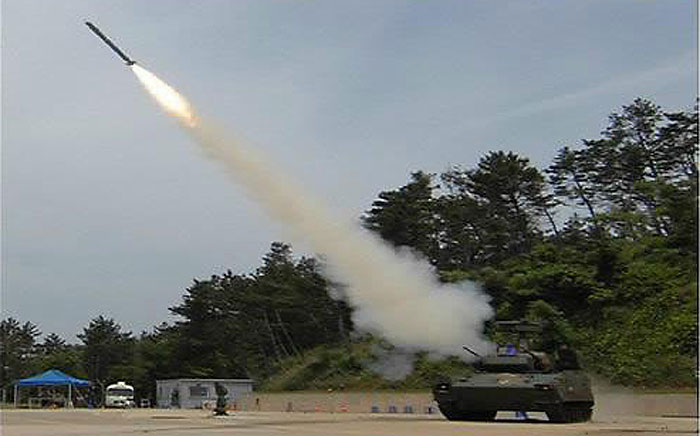
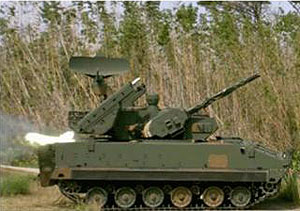
South Korea’s Defense Acquisition Program Administration (DAPA) announced Friday, December 27, 2013, that it has completed development of a hybrid variant of the self propelled air defense gun carrier K30 Bi-Ho (flying tiger in Korean) integrated with indigenously developed Shingung guided missiles. Both elements are based on indigenous technology.
The new hybrid system uses the vehicle’s target acquisition systems and Shingung surface-to-air missile to extend the system’s effective range from less than 3 km (guns only) to 7 km (missiles). As a ‘Very Short Range Air Defense System’ (VSHORAD), the hybrid Bi-HO will be able to effectively engage targets flying at very low altitude, such as helicopters and unmanned aerial vehicles (UAV). The system mounts two missile pods, each containing two missiles. Each pod can engage a different target, DAPA said. Over 300 K30 have been deployed with the Korean Army since 1999. According to the agency the hyprid variant entered development in 2010 and is expected to enter production in 2014 and be ready for fielding as new systems or an upgrade by 2015.
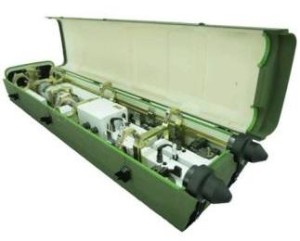
K30 Bi-HO integrates specific modules from a number of local manufacturers, including Doosan Defense Systems & Technology contributing the K200 armored personnel carrier chassis and and system integration, LIG Nex1 delivering the TPS-830K low-level target acquisition radar and Shingung missiles. Samsung Thales is providing the EO sensors comprising the FLIR system and laser rangefinder acting as a secondary target acquisition system, supplementing the radar to provide a passive target acquisition mode, where the air defense system remains passive until the missile is launched.
The modification includes mounting two Shingung missile pods on each side of the turret, to accomodate the heavier load the turret drive and power supply are uprated, and modifications to the existing fire control system are installed to handle target acquisition for the ‘fire and forget’ Shingung missile.
Indian Government Approves Procurement of 15 New Heron UAVs
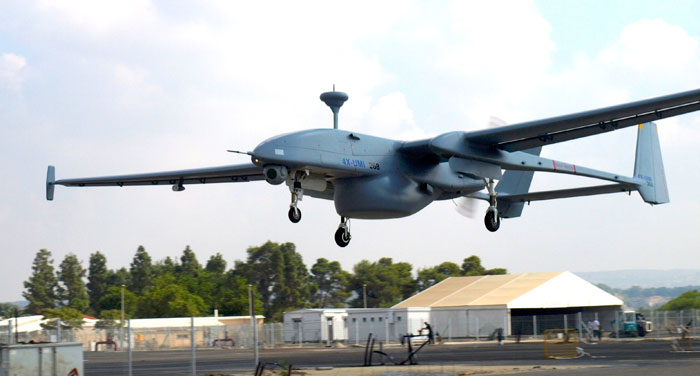
The Indian government has cleared a new procurement of up to 15 Heron I unmanned aerial systems from israel, as part of an effrot to increase the country’s surveillance over the northern borders with Pakistan and China. The cost of this acquisition is estimated at unmanned aerial vehicles (UAVs) from Israel at a cost of around US$195 million (Rs 1,200 crore.) The proposal to procure these Heron UAVs was approved by the Cabinet committee on security headed by Prime Minister Manmohan Singh at its recent meeting, the Times of India reported December 29.
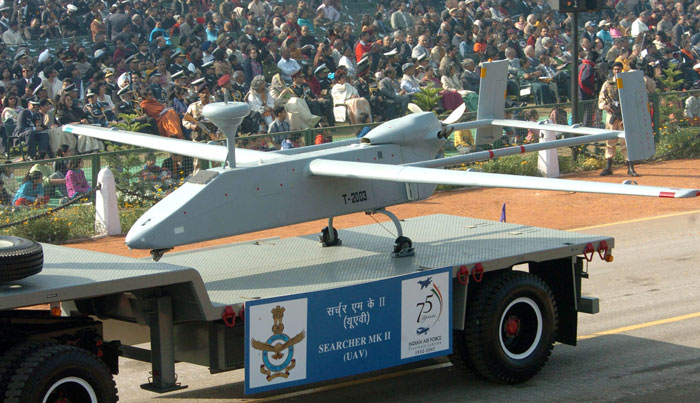
India is the largest operators of Israeli unmanned systems. The IAF flies the IAI Searcher II and Heron UAVs for reconnaissance and surveillance purposes over the Indian borders in western, northern and eastern regions. The Herons are also supporting internal security operations, performing surveillance missions as part of anti-Naxalite counter-insurgency activity in central India. (IBN)
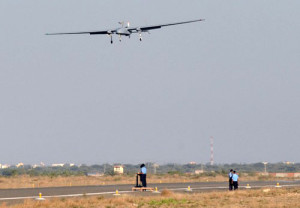
last year India has embarked on an upgrading of those vehicles, adding satellite communications to extend operating range over long distances and mountainous terrain. The army is also operating a fleet of more than 40 Searcher I, II and Heron I vehicles. The Indian Navy also operates three squadrons of UAVs, operating Seacher II and Heron I on maritime surveillance missions.
As India is increasing its operational unmanned fleet, there is a growing need for more personnel to fly and maintain those vehicles. The Indian Air Force is considering a proposal to establish a separate cadre (from recruitment to operations) for unmanned aerial vehicles (UAVs). Since their induction into service in the late 1990s UAV operators were airmen who had been excluded from the pilot training for medical reasons. Over the years, their numbers have been declining steadily, mainly because of advances in medical care. The IAF Training Command is recommending to set-up a role-specific training process for UAV operators, similar to those specific courses designed for fighter pilots, transport pilots or helicopter pilots. (Deccan Herald)
Georgia to Phase Out Mi-8, Mi-24 in Favor of Western Rotorcrafts
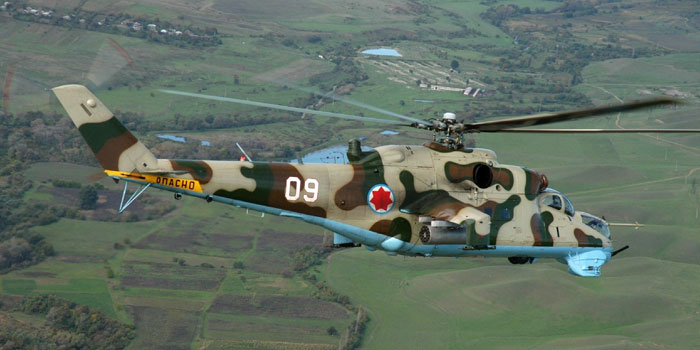
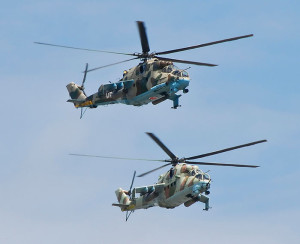
Georgia is set to replace its Russian supplied helicopter fleet, Georgian defense minister Irakli Alasania confirmed last week. He said his country intends to replace the Russian made helicopters with ‘american helicopters’. Until the early 2000s Georgia relied almost exclusively on Russian suppleid arms, having 16 Mi-8 (HIP assault helicopters), 16 Mi-14 (Haze maritime search and rescue helicopters) and 12 Mi24 (Hind attack helicopters) in service. The trend changed when Tiblisi turned west, reaching out to join NATO. As part of this move, Georgia acquired unmanned aerial systems and air defense missiles from Israel, and received at least 12 Bell UH-1H helicopters from the USA and Turkey. Following the war with Russiia in 2008 Georgia has lost some of these helicopters (attacked on the ground). Some of these losses were covered by the delivery of more Hueys from the US. Meanwhile, the airworthiness of the remaining birds dropped, lacking consistent supply of spare parts and support from Russia.
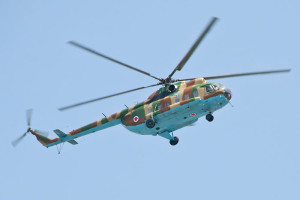
“We have abandoned the Soviet helicopters. In 2014 we are going to withdraw Soviet and Russian military transport and attack helicopters, which the Georgian armed forces have, and to begin to develop a fleet of American helicopters,” the minister told the Azeri newspaper ‘Trend‘.
In 2009 Georgia received the first two UH-1H ‘Huey Plus’ from US military support. These helicopters, delivered from U.S. military surplus have been refurbished by Oregon U.S. based Northwest Helicopters with all components and upgraded -703 1800 SHP engine to zero time and includes new main and tail rotor blades. Performance options include the BLR Strake and Fast Fin Kit along with the advanced AFS Engine Filter System. fitted with an upgraded Night Vision Goggle compatible cockpit and modern avionics.
WHile Hueys are the type of helicopters the Georgians have go used to in the past years, Georgia may opt for other models. Alasania said they are negotiating helicopter sates with other suppliers as well, “We are also in negotiations with other countries. Such an opportunity came in France after my visit to this country. The maintenance of the fleet of the Soviet helicopters is very costly for the state. The purchase of spare parts for them is problematical, and often it is almost impossible to get that kind of service without corrupt deals. On this basis, we have adopted a tough but correct and logical solution,” the minister explained.
Der Spiegel: ‘Backdoor Openers’ are Paving the Way for NSA Surveillance


After years of speculation that electronics can be accessed by intelligence agencies through a back door, an internal National Security Agency (NSA) catalog reveals by the German magazine Der-Spiegel indicates that the NSA division called ANT has burrowed its way into nearly all the security architecture made by the major players in the industry.
“Through their back door entry ANT agents who are able to keep an eye on all levels of our digital lives” Der Spiegel comments, “from computing centers to individual computers, from laptops to mobile phones. For nearly every lock, ANT seems to have a key in its toolbox. And no matter what walls companies erect, the NSA’s specialists seem already to have gotten past them.”
The magazine gained access to a secret 50-page document prepared by ANT. “The list reads like a mail-order catalog, one from which other NSA employees can order technologies from the ANT division for tapping their targets’ data. The 208 dated catalog lists the prices for these electronic break-in tools, with costs ranging from free to $250,000.” Some of the equipment available is quite inexpensive. the magazine indicates. “A rigged monitor cable that allows “TAO personnel to see what is displayed on the targeted monitor,” for example, is available for just $30. But an “active GSM base station” — a tool that makes it possible to mimic a mobile phone tower and thus monitor cell phones — costs a full $40,000. Computer bugging devices disguised as normal USB plugs, capable of sending and receiving data via radio undetected, are available in packs of 50 for over $1 million.”
Der Spiegel mentioned a particular digital lock pick called “FEEDTROUGH” tailored to match the back door the NSA managed to gain on Juniper Networks systems. “This malware burrows into Juniper firewalls and makes it possible to smuggle other NSA programs into mainframe computers. Thanks to FEEDTROUGH, these implants can, by design, even survive ‘across reboots and software upgrades.’ the magazine disclosed. The catalog states that FEEDTROUGH “has been deployed on many target platforms.”
Philippines to Bolster Surveillance with new Maritime Air Patrols, Radar Stations
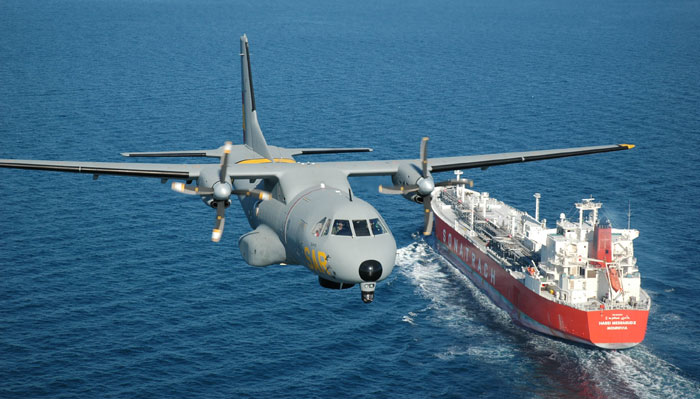
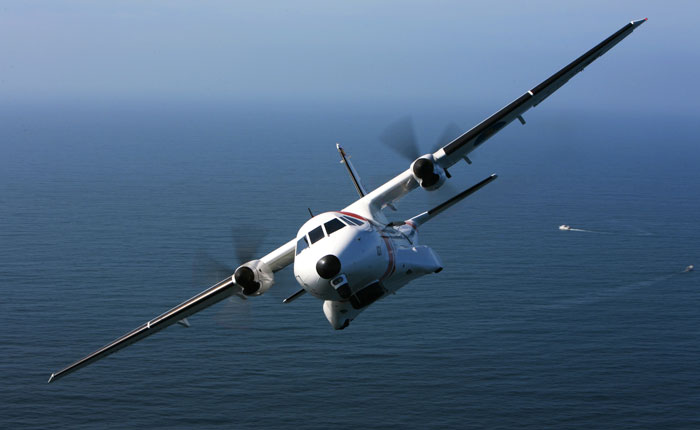
The Philippines Department of National Defense (DND) plans to acquire two long-range patrol aircraft at an investment of US$135 million, (P5.98 billion). Support facilities for these aircraft will be established at the Lipa, Palawan and Zamboanga airfields located at the western and southern perimeters of the Sulu Sea. In addition, DND is set to field three air surveillance radars to expand airspace coverage at key locations, at a cost of $60 million (P2.68 billion).
Manila expressed interest in the CASA CN-235MP assembled and supported in Indonesia by IPTN under a joint venture agreement with the Spanish OEM. On a typical mission the CN-235MP has a mission endurance of over eight hours, cruising at a speed of up to 455 km/h. The US Coast Guards and the Spanish Navy are operating the CN-235MP ‘Persuaders’ since the early 2000s. In SouthEast Asia, Indonesia has recently inducted the first locally built CN-235MP. Other operators include South Korea, Turkey, Brunai and Malaysia.
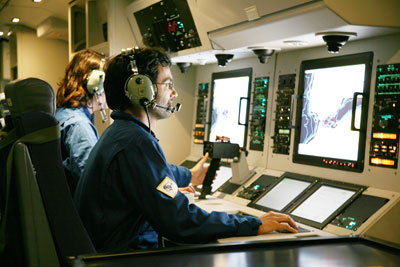
While CN-235MP seems as the right choice, Manila said it could also consider the Italian C-27J Spartan tactical transport aircraft, but that plane would have to be converted especially for the maritime patrol role, a process that is likely to be too costly for the budget the Philippines have set aside for the acquisition.
According to the ABS-CBN, these investments are part of the renewed Armed Forces Modernization Act, which took effect in 1995, giving the military a chance to modernize its assets and equipment in 15 years with a $7.5 billion (P331-billion) investment. Back in the 1990s the original program was stalled, but following an evolving conflict with China over the control of the Spratly archipelago last year, President Aquino signed a new modernization law to provide more resources to the military’s upgrade efforts.
The cost of the current modernization program could reach $2 billion (P85 billion). The acquisition program in this budget is the procurement of 12 A/T-50 jet trainers from South Korea, at an estimated cost of about $450 million (P18.9 billion), and a number of naval vessels, acquired from the USA and Italy. The program is funded by nearly $330 million (P15 billion) annual allocation set aside in the national budget until 2017. Additionally, over $100 million (P4.78 billion) will come from proceeds of the Malampaya natural gas project, in which the government has a share from taxes, royalties and charges, and remittances from the Bases Conversion and Development Authority.
Eight Teams Graduate DARPA Robotic Challenge Trials
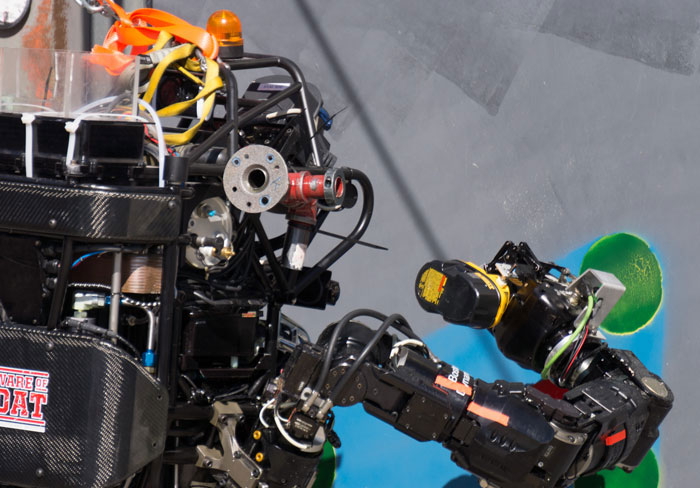
16 robotic research teams from the USA and Japan demonstrated the skills of humanoid robots developed for the DARPA Robotic Challenge (DRC) trials, which took place in Florida that On December 20-21, 2013. The teams were called to demonstrate their prototype robots’ ability to perform a number of critical real-world disaster-response skills. After two days of trials, eight of the teams qualified to receive up to $1 million in funding to continue their work.

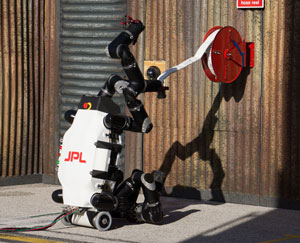
For the DARPA Robotics Challenge (DRC) Trials, DARPA constructed an eight tasks challenge course at the Homestead Speedway in Homestead, Fla., these tasks simulated what a robot might have to do to safely enter and effectively work inside a disaster zone, while its operator would remain out of harm’s way. “The key is that these standards provide a real opportunity for robots to compare themselves to each other and measure progress.” said Adam Jacoff, robotic research engineer at the National Institute of Standards and Technology (NIST) that helped set the tasks for the trials. “The idea of the standards is to help developers, get out of the laboratory, understand what is working and what isn’t”. Successfully fulfilling each tasks would earn the robot and team a set of points which would add up to 32, if all tasks are successfully met.
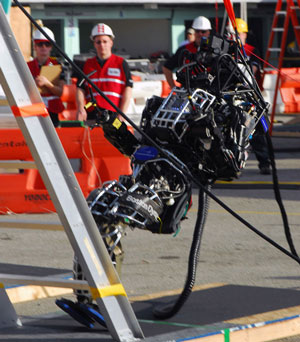
After two days of competition, DARPA selected eight teams to receive the coveted funding:
27 points: SCHAFT (SCHAFT, Inc., Tokyo, Japan)
20 points: IHMC Robotics (Florida Institute for Human & Machine Cognition, Pensacola, Fla.)
18 points: Tartan Rescue (Carnegie Mellon University, National Robotics Engineering Center, Pittsburgh, Pa.)
16 points: Team MIT (Massachusetts Institute of Technology, Computer Science and Artificial Intelligence Laboratory, Boston, Mass.)
14 points: RoboSimian (NASA Jet Propulsion Laboratory (JPL), Los Angeles, Calif.)
11 points: Team TRACLabs (TRACLabs, Inc., Webster, Tex.)
11 points: WPI Robotics Engineering C-Squad (Worcester Polytechnic Institute, Worcester, Mass.)
9 points: Team Trooper (Lockheed Martin Advanced Technology Laboratories, Cherry Hill, N.J.)
“At the start of the event, I said that I would be thrilled if even one team scored half the points available,” said Gill Pratt, the DARPA program manager for the DRC, during the event’s closing ceremony. “The event exceeded my expectations multiple, multiple times over, with the top four teams each scoring half or more.

The awards ceremony capped off a second day in which spectators—including many families with children—enjoyed an atmosphere similar to a traditional sporting event, not a scientific exercise. In addition to the Trials, DARPA hosted the DRC Exposition that demonstrated first responder exercises and their technology needs.

“The DRC Trials demonstrated the difficulty of having robots conduct seemingly simple tasks in real-world situations, and the participation of the first responder community provided an important illustration of how technology can save lives,” said Brad Tousley, Director of DARPA’s Tactical Technology Office. “This event was yet another example why challenges work to attract new ideas and help quickly advance technology to solve a focused need.”
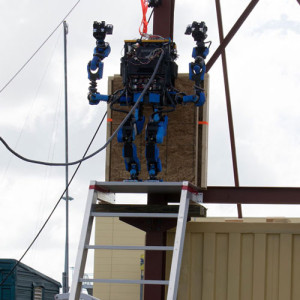
With the conclusion of the DRC Trials, DARPA and the teams are now looking ahead to the DRC Finals sometime in the next 12-18 months. The Finals will be an opportunity for the eight top teams and the other eight participating teams to continue their efforts alongside new teams to vie for the chance to win the DRC’s $2 million prize.
Pratt has already identified three initial goals for the next competition. “First, we’d like the robots to be more stable so they don’t fall, and if they do fall, be more robust so they won’t break,” he said. “Second, have the robots work without their tethers by using wireless communications and more efficient, self-contained power systems. Finally, we’d like the robots to use more task-level autonomy in unstructured environments such as those found in real disasters.”
The finals will be held again at the Homestead-Miami Speedway. The eight teams that graduated the trails will participate utilizing the DARPA funding they have won. Other teams will also be able to qualified for the finals, using independent sources of funding.

Africom Repositioning Forces in Eastern Africa
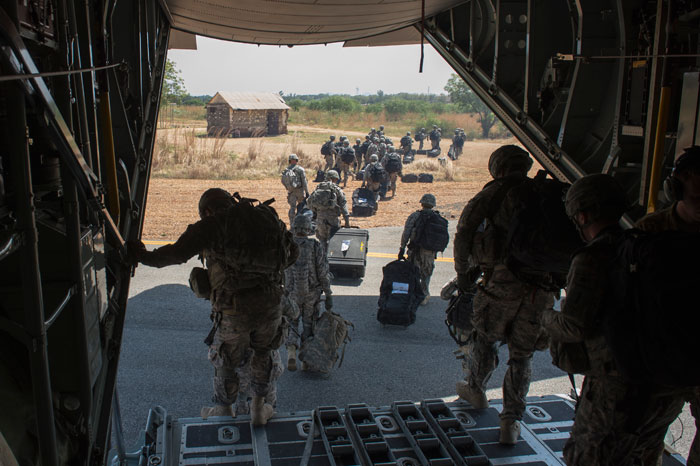
The U.S. Africa Command (Africom) is repositioning forces in East Africa in an effort to attain maximum flexibility to respond to State Department requests, Pentagon spokesman Army Col. Steve Warren said. Based on the current situation in South Sudan, Army Gen. David M. Rodriguez, the commander of Africom, moved elements from the Special-Purpose Marine Air-Ground Task Force Crisis Response from Moron, Spain, to Camp Lemonnier, Djibouti. “By positioning these forces forward, we are able to more quickly respond to crisis in the region, if required,” a defense official said. The Djiboutian government fully agrees with the movement. The repositioning was decided after four Navy SEALs were injured in South Sudan; they were hit by small-arms fire when their Osprey aircraft attempted to land in the town of Bor, to evacuate US citizens from the town. Following the attack the three aircraft aborted their mission and diverted to an airfield outside the country, the Pentagon said. Last week Defense Department and other government contracted aircraft have evacuated more than 300 personnel out of South Sudan’s capital of Juba.
The Pentagon said moves are precautionary, and there is risk associated with this or any other military operation, the colonel said.
“As everyone would expect, the combatant commander is repositioning forces in the region in an effort to g
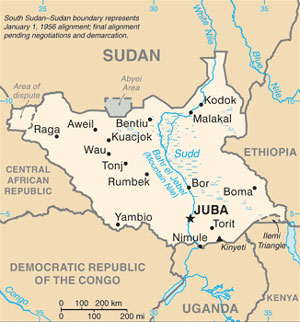
ive himself the maximum flexibility to respond to any follow-on request from the Department of State,” Warren said. Press reports said that 45 soldiers from the Africom East Africa Response Force, were sent to South Sudan last Wednesday, to help secure U.S. personnel and facilities. based on Camp Lemonnier, Djibouti. The soldiers are believed to be from 2nd Brigade Combat Team, 1st Infantry Division, which is regionally aligned with U.S. Africa Command. the Military Times reported.
Defense Secretary Chuck Hagel has been following the situation very closely, and is in nearly continuous communication with the combatant commander, the official said.
There has been no discussion about the U.S. military helping reposition United Nations forces, Warren added.
EU Summit Sets Defense Technology Focus on: UAS, Aerial Refuelling, SATCOM and Cyber


“Heads of State and Government yesterday highlighted the importance of an effective Common Security and Defence Policy (CSDP) for the security of European citizens, peace and stability in our neighbourhood as well as in the broader world.” Chief Executive of the European Defence Agency Claude-France Arnould commented after the Council’s conclusions on CSDP yesterday in Brussels.
The council also underlined that Europe needs strong military capabilities and a healthy, innovative and competitive European Defence Technological and Industrial Base. The tasking by Heads of State and Government stemming from the EU Summit for the European Defence Agency are substantive. “In terms of capability development, we will push forward four key programmes: Remotely Piloted Aircraft Systems (RPAS), Air-to-Air Refuelling, Satellite Communications and Cyber.” Arnould added.
The Council supports a more systematic and long-term approach to cooperation through increased transparency and information-sharing in defence planning. “In this context, we will continue to assess progress on the implementation of the Agency’s Code of Conduct on Pooling & Sharing and propose an appropriate policy framework by the end of 2014, as mandated by the European Council.” Arnould said. As such deliberation would be too lengthy for some of EU members, Arnould added that within the same timeframe the Agency will also propose ways in which Member States can cooperate more effectively and efficiently in pooled procurement projects.
Strengthening of Europe’s defence industry facing military reduction and financial constraints was another concern of the council. “EDA will closely work together with the European Commission to develop proposals to stimulate further dual use research, to develop defence industrial standards and a roadmap for a comprehensive EU-wide Security of Supply regime” Arnould commented.
“This year was marked by intensive preparations for this EU Summit, which gave a fresh boost to European defence matters.” Arnould concluded, “It is especially important that this new dynamic in defence and security is maintained and developed. EDA will strive to ensure that further concrete and substantive deliverables are achieved when the European Council next assesses progress in June 2015.”
Skunk Works and XTEND Simplify Multi-Drone Command
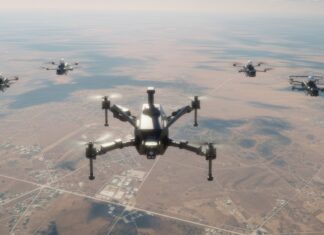
Lockheed Martin Skunk Works® and XTEND have achieved a major milestone in JADC2 by integrating the XOS operating system with the MDCX™ autonomy platform. This technical breakthrough enables a single operator to simultaneously command multiple drone classes, eliminating the friction of mission handoffs. From "marsupial" drone deployments to operating in GPS-denied environments, explore how this collaboration is abbreviating the data-to-decision timeline and redefining autonomous mission execution.

From Ukraine to Taiwan: The Global Race to Dominate the New Defense Tech Frontier
As traditional defense primes face mounting competition from agile “neoprimes” such as Anduril, Palantir and Helsing, the balance of innovation is shifting toward software-defined warfare and scalable, dual-use technologies, while global industry consolidation—marked by Boeing’s integration of Spirit AeroSystems and other strategic mergers—signals an intensified race to secure control over the defense technology value chain. Our Defense-Tech weekly report highlights these trends.

Europe’s “Drone Wall”
In early October 2025, a coordinated wave of unmanned aerial system (UAS) incursions—widely attributed to Russia—targeted critical infrastructure across at least ten European nations. The unprecedented campaign exposed the fragility of Europe’s air defenses...
Weekly Defense Update & Global Security Assessment
Executive Summary
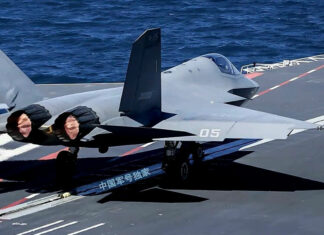
The past week (September 18-25, 2025) represents an inflection point where strategic defense concepts have transitioned from doctrine to tangible reality. An analysis of global events reveals four primary, interconnected trends shaping an...
U.S. Air and Space Forces Push Next-Gen Programs at the AS&C 2025 Conference and...
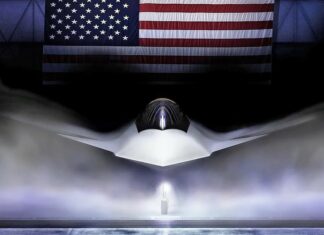
At the 2025 Air, Space & Cyber Conference, U.S. Air Force and Space Force leaders unveiled major updates on next-generation fighters, bombers, unmanned systems, and space initiatives, highlighting both rapid innovation and critical readiness challenges as the services race to outpace global competitors. A short version is available here, with a more detailed version for subscribers.
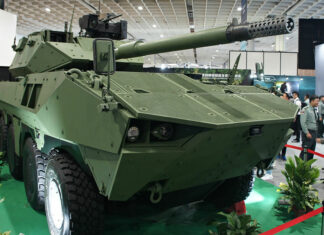
TADTE 2025: Reflecting Taiwan’s Strategic Themes
The Taipei Aerospace & Defense Technology Exhibition (TADTE) 2025 crystallized around four dominant strategic themes that collectively illustrate Taiwan's comprehensive approach to defense modernization amid escalating regional tensions. Based on a detailed report by Pleronix (available upon request). Includes a Podcast discussion on TADTE 2025's highlighting Taiwan's four strategic themes beyond the post's coverage.
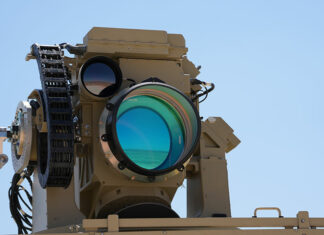
Iron Beam 450 Completes Testing, Soon to Join With Operational Air Defense Units
Israel’s Iron Beam 450 high-power laser system has completed final testing, marking a major leap in air defense. Developed by Rafael, it offers precise, cost-effective interception of rockets, UAVs, and mortars, and is set for IDF deployment by 2025.