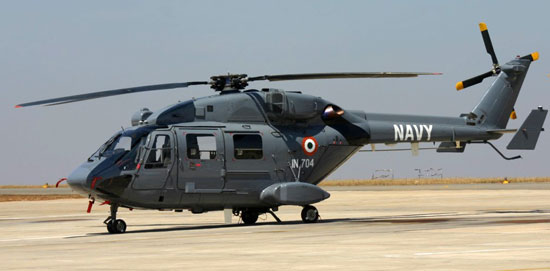
The Indian Navy commissioned today the first Dhruv Advanced Light Helicopter (ALH) Squadron – Indian Naval Air Squadron (INAS) 322. The commissioning ceremony was held at INS Garuda, the Naval Air Station and mother base of INAS 322. Dhruv is the first indigenously designed and manufactured helicopter at Hindustan Aeronautics Limited to provide multi role capabilities. Dhruv has been operating with the three services of the Armed Forces, Indian Coast Guard and Border Security Forces.
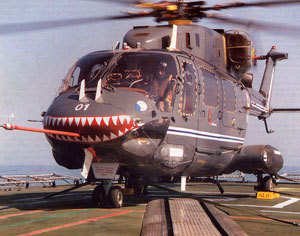
ALH tested on a carrier flight deck
The squadron will call themselves “Guardians” with the credo “Search Fearlessly, Rescue Valiantly” signifying their primary role of SAR. Vice Admiral Satish Soni, Flag Officer Commanding in Chief Southern Naval Command under whose administrative control INAS 322 would function, in his address said that the versatile aircraft would soon be cleared for night SAR role, one of the few helicopters in the world to have that capability over sea. He also expressed satisfaction that the ALH would beef up the coast security architecture.
The following analysis was published November 5, 2013 by The Institute for Science and International Security (ISIS), few days before the P5+1 and Iran have reached an understanding on implementing wider inspections over the Iranian nuclear program.
Iran and the P5+1 are set to resume talks on Iran’s nuclear program on Thursday, November 7 in Geneva. ISIS has developed a list of irreducible elements that should be goal achievements of a negotiated interim agreement. These irreducible elements would satisfy the following immediate goals:
– Stopping the advance of Iran’s centrifuge and Arak reactor programs; Extending breakout times;
– Capping the Iranian centrifuge program and ensuring that it will not expand beyond this cap (in terms of enrichment output) during the next 5-15 years; and
– Increasing the chance of finding a secret centrifuge or plutonium separation plant.
Other, vital questions not addressed here: How to establish adequate transparency in general, including Iran addressing the IAEA’s concerns about Iran’s past and possibly on-going nuclear weapons efforts? How to trade Iranian concessions for sanctions relief? In the longer term, what incentives package is appropriate and how to increase Iran’s supply of medical isotopes and nuclear electricity?
The “Freeze Plus” interim agreement should seek the following elements:
Freezing the Iranian centrifuge program and extending breakout times:
– Stopping production of near 20 percent LEU; mothballing or disabling the six cascades involved in making near 20 percent LEU at Natanz and Fordow;
– Reducing stocks of near 20 percent LEU, focusing initially on a time table to eliminate all stocks in hexafluoride form through shipping out of country, blending down, or converting into oxide form. (A longer-term agreement would need to eliminate all stocks of near 20 percent LEU, other those that are irradiated or about to be loaded into a reactor);
– Achieving the principle that Iran’s centrifuge program would be capped to below a certain size, taken initially as about 9,000 enriching IR-1 centrifuges in only three modules at the Natanz Fuel Enrichment Plant, a slight decrease from the current level of enriching centrifuges.
Other modules at Natanz and those at Fordow would be disabled, so as to increase the time needed for restart;
– Halting the installation of any more centrifuges. The issue of whether the IR-2m centrifuges, or other advanced centrifuges, would enrich uranium would be addressed later, although in a way that is consistent in terms of maintaining the cap in enrichment output in the third sub-bullet;
– Spares for broken IR-1 centrifuges could come from the large inventory of IR-1 centrifuges installed at Natanz and Fordow but not yet enriching (about 8,000 as of August 2013). As a result, Iran would have no need to manufacture more IR-1 centrifuges for years, allowing for the freezing of centrifuge manufacturing immediately; and
– Establishing remote camera monitoring of all centrifuge plants.
Alternatively, inspectors could visit the enrichment sites daily, or near daily, although this step would require substantial IAEA inspector resources, which could be better applied to other tasks in Iran. Preliminary steps aimed at helping ensure Iran is not building another centrifuge plant and increasing the chance of detecting a secret centrifuge plant:
– Implementation of early notification of construction of new facilities (code 3.1 of comprehensive safeguards agreement);
– Developing a baseline of information about Iran’s gas centrifuge program, including a detailed declaration of any centrifuge plants under construction or planned for construction; a declaration of its centrifuge research, development, assembly and manufacturing complex; and a declaration of Iran’s total inventory of centrifuges; and
– Other verification measures, such as the Additional Protocol and the monitoring of uranium mines and mills and of the centrifuge complex, would be implemented later.
Halting further construction of the Arak reactor, including the manufacture of its fuel. Ensuring that Iran agrees that future sanctions relief requires that Iran address fully and cooperatively the IAEA’s concerns about Iran’s alleged past and possibly on-going work on nuclear weapons.
In essence, these conditions amount to a freeze plus a few reductions in the scale of the centrifuge program, a few modest declarations, and a few additional transparency and disablement steps. A longer term agreement would need to include far more detailed conditions on the scope and timing of Iran’s nuclear program, far more intrusive inspection arrangements, and much more detailed declarations about Iran’s nuclear programs. Read ISIS’s full Power Point presentation on this subject here.
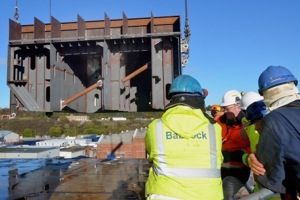
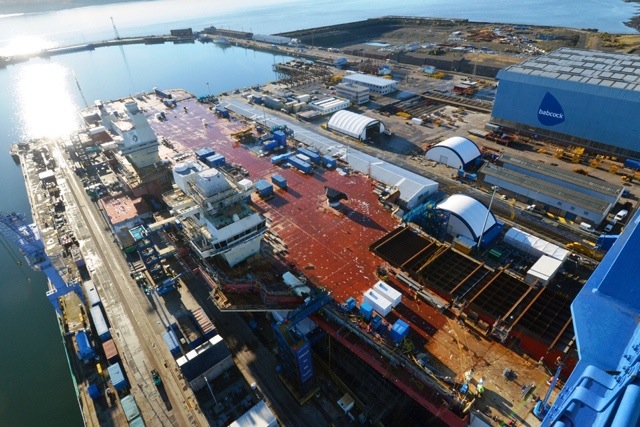
Pictures released by the Aircraft Carrier Alliance yesterday show the ramp section, which will allow jet aircraft to take off from the ship, being lowered into place at the shipyard in Rosyth, Scotland, where the Queen Elizabeth Class carriers are being constructed.
The 300-tonne section of ramp, which is 64 metres long and 13 metres wide, is the final exterior piece of the aircraft carrier to be fitted. At its highest point, the take-off ramp is 6 metres above the flight deck, which will allow aircraft to be propelled into the air.
The pictures come on the same day as MOD announces that a fourth Lightning II Joint Strike Fighter aircraft has been ordered from Lockheed Martin. The UK has already taken delivery of 3 Lightning II jets and Royal Navy and RAF pilots are training on the aircraft in the USA.
This fourth jet, which is specially designed to be a test aircraft, will help boost the ongoing training available.
Earlier this year, the first take-off at sea by a UK pilot in a Lightning II took place during a week of trials aboard the United States Marine Corps’ amphibious assault ship USS Wasp.
“We are on track to ensuring carrier strike capability by 2020. Both the completion of the take-off ramp and the announcement of the contract for the fourth jet show the tremendous progress being made to ensure that the Royal Navy will have a modern carrier force.” Philip Dunne, Minister for Defence Equipment, Support and Technology confirmed.
The forward ramp section in place on the Queen Elizabeth at the shipyard in Rosyth (Photo: Aircraft Carrier Alliance)
While the 5+1 negotiations with Iran progress, Tehran continues the ‘Smile Campaign’, reaching an understanding with the United Nations (UN) to cooperate on resolving outstanding issues regarding the country’s nuclear program. Talks Monday between the head of the International Atomic Energy Agency Yukiya Amano and Iranian nuclear chief Ali Akbar Salehi yielded a roadmap that will allow wider U.N. inspections, broadening the sites under inspection to include the disputed heavy water reactor site at Arak and the Gachin uranium mine, providing the raw material for processing the ‘yellow cake’, necessary for uranium enrichment at other facilities in the country. These concessions could, potentially, provide IAEA a trip-line indicating a potential Iranian ‘race to the bomb’, assuming that tehran has not secretly acquired enough fissile material to build such weapons.
There has been hope that the election of new moderate Iranian President Hassan Rouhani in June will lead to progress in both the talks with the IAEA and the group of six world powers. Mr. Rouhani told his parliament Sunday that Iran will not give up what it considers its nuclear rights, including uranium enrichment on Iranian soil, in any deal with international negotiators.
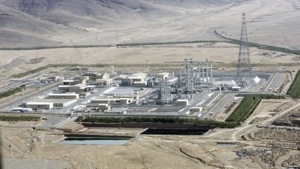
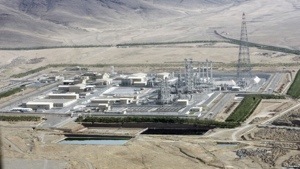
The heavy water reactor Iran is building at Arak has been a major concern for IAEA. In June the US said it was “deeply troubled” by Iran’s plans to start the reactor in 2014, a process that could yield nuclear bomb material while failing to give U.N. inspectors necessary design information about the plant. “We are deeply troubled that Iran claims that the IR-40 heavy-water reactor at Arak could be commissioned as soon as early 2014, but still refuses to provide the requisite design information,” Joseph Macmanus, the U.S. ambassador to the IAEA, told the 35-nation IAEA Board of Governors in June.
Iran said the Arak plant will make isotopes for medical and agricultural use. But analysts say this type of facility can also produce plutonium for weapons if the spent fuel is reprocessed — something Iran says it has no intention of doing.
Tasked with ensuring that nuclear material is not diverted for military purposes, the IAEA says Iran must urgently give it design data about Arak to allow it to monitor the site properly.
At present, the disagreement between the agency and Iran is mainly procedural, IAEA member state must inform the Vienna-based U.N. agency about a nuclear plant, and give design details, as soon as it has decided to build one. Iran claims it must only do so 180 days before bringing atom fuel to the plant. Iran’s agreement to yield to inspections could therefore mean the Arak reactor could become live by mid 2014.
The IAEA has been focused for two years on reaching a deal with Iran to gain greater access to nuclear program documents, personnel and sites. Meanwhile, U.S. Secretary of State John Kerry said Monday during a visit to Abu Dhabi that critics, including Israeli Prime Minister Benjamin Netanyahu, must recognize that world powers have not yet reached any agreement in their talks with Iran. He said the 5+1 (United States, Britain, France, China, Russia and Germany) were united on the plan they presented to Iranian negotiators Saturday in Geneva, but that Iran could not accept it at that time.
The powers are seeking to persuade Iran to suspend work that could allow it to build nuclear weapons in exchange for easing some sanctions against Iran. Those negotiations are due to resume next week. Kerry said Monday it would not be responsible to ignore an opportunity to come to a verifiable agreement with Iran that would prevent it from developing nuclear weapons.
Israel, which calls Iran’s nuclear drive a mortal threat, has warned against any deal that would leave some of Iran’s nuclear fuel-making capacity intact, while giving Tehran respite from sanctions
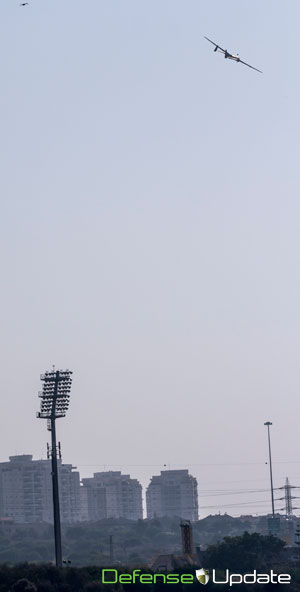
Heron performing a low pass over the demonstration range on the live rehearsal today at Rishon Lezion. Photo: Noam Eshel, Defense-Update
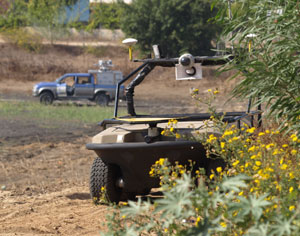
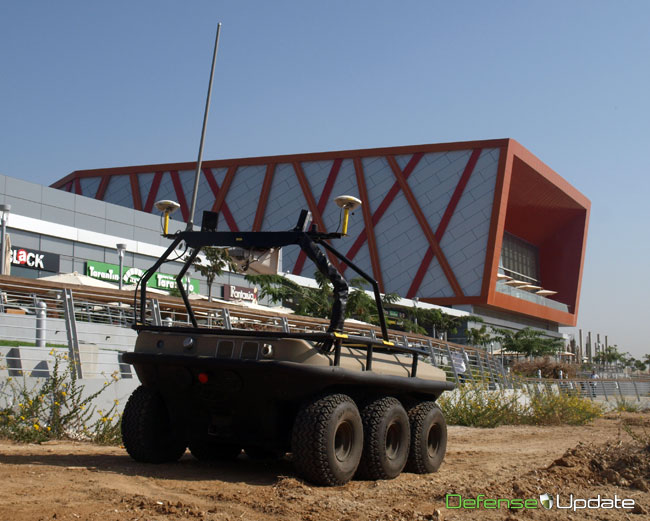
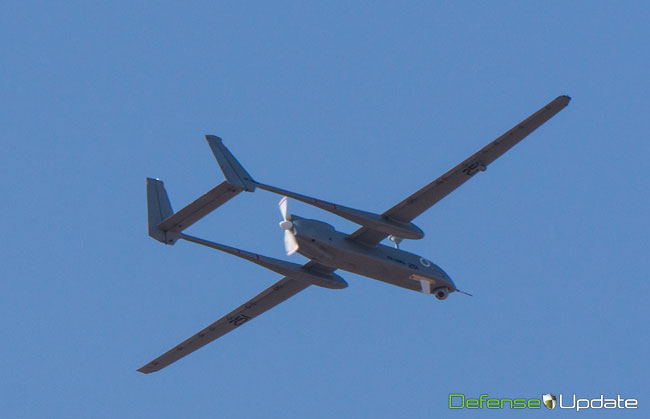
The Amstaf 6×6 autonomous ground patrol vehicle demonstrated a live security mission, self driving under remote operator supervision. Photo: Noam Eshel, Defense-UpdateIAI flew today its Heron I Remotely Piloted Aircraft (RPA) south the city of Rishon Lezion, as part of a dress rehearsal for the upcoming unmanned systems event planned for November 26. Photo: Noam Eshel, Defense-Update
Citizens of the seaside town of Rishon Lezion, south of Tel-Aviv woke up today to an unfamiliar sound, as an IAI Heron I unmanned vehicle roamed low over the edge of the city, buzzing over the ‘Yes Planet’ range. Defense-Update reports.
The heron was not alone here. Some of Israel’s leading unmanned systems manufacturers gathered here today, to test their systems in a live rehearsal, prior to the Autonomous Unmanned Systems & Robotics event, scheduled at this site on 26 November.
The test provided an opportunity to test the operational protocols, safety measures and necessary preparations required for safe and impressive display.
This unprecedented display has been coordinated between Israel’s Civil Aviation Authorities, Airport authorities, the displaying companies and representatives from the event organizer for months, adhering to the regulation procedures the CAA has been implementing in recent years, and ensuring that safety measures and environmental concerns are followed.
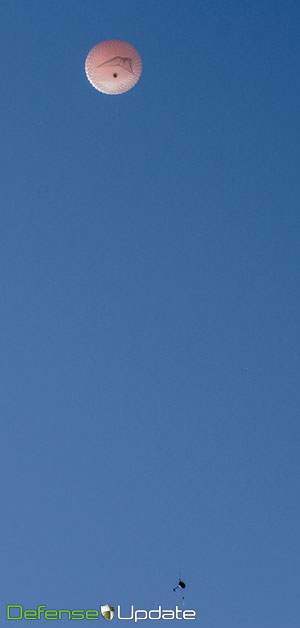
Shilat optronics tested its Light Eye aerostat borne sensor. Light Eye is designed for high altitude flight of up to 800m, with coverage of 360°. The systems’ light weight exempts it from flight restrictions, when deployed below a safe altitude. Photo: Noam Eshel, Defense-Update
The Heron I is the largest UAS taking part in the display. Apart from the Heron, IAI will debut an Autonomous Surface Vessel here, along other systems displayed at the static park.
Apart from the Heron I which made its first ever ‘official’ flight over the city edge, the Orbiter II was also flown here by a team from Aeronautics. On the ground, the Amstaf unmanned ground patrol vehicle performed, simulating a security mission, with the Light Eye aerostat-borne surveillance system from Shilat Optronics watching from above. Light Eye and the Hovermast 100 from Skysapience, are both making their public demonstration debut at the event.
Other participants will include the Guardium and TAGS robotic vehicles from G-NIUS, and the Orbiter III from Aeronautics.
Aerial vehicles, aerostats and ground vehicles will be feeding live video and sensor data to a large display, enabling the audience to experience the performance of unmanned systems first hand.
Heron flying low over Rishon Le’Zion, during the live rehearsal for the unmanned systems demonstration, scheduled at the place for 26 November. Photo: Noam Eshel, Defense-UpdateThe Orbiter II is prepared for the flight, taking off from a nearby dune. On the 26th Aeronautics plans to conduct a live display of the Orbiter III for the first time. Photo: Noam Eshel, Defense-Update.
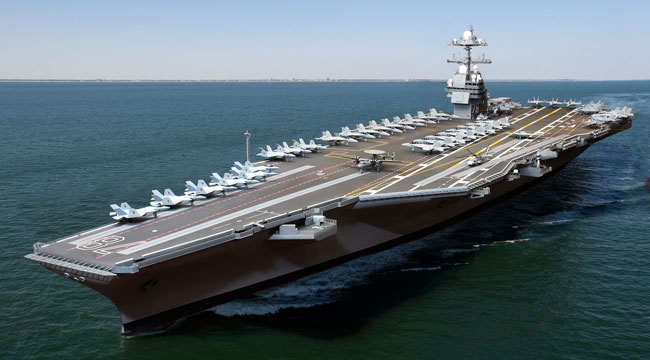
CVN-78 USS Gerald R. Ford. President Ford served aboard USS Monterey in the Pacific during World War II, and was the first president to serve aboard an aircraft carrier. He helped guide the nation through the end of the Vietnam War and the bicentennial of American independence.
USS Gerald R. Ford (CVN-78), the first of class of the US Navy next generation aircraft carrier (formerly known as CVN-21) officially received its name today. USS Gerald R. Ford represents the first new design since the USS Nimitz (CVN 68), which was launched in 1972. The new aircraft carrier will be able to sustain higher operational tempo, while costing less to operate and maintain, saving the Navy a projected $4 billion over the ship’s 50-year lifespan. Capt. John F. Meier has already been named as the ship’s first commanding officer. He will be responsible for monitoring the final months of construction and likely be onboard when the Ford goes on its first sea trials.
50 years after commissioning the first nuclear powered aircraft carrier (CVN-65 USS Enterprise), the US Navy christened today the first ship of the third generation of nuclear powered carriers. Larger and much more advanced version of the $13 billion ‘floating airport’, the new Ford class is designed to carry naval air power well into the 22nd century.
The new carrier uses the basic Nimitz-class hull form but incorporates several improvements, including features permitting the ship to generate about 25% more aircraft sorties per day, and generate more electrical power to support the propulsion and ship systems and new launch and retrieval systems enabling the operation of a wider range of aircraft. It is also designed for higher efficiency, permitting the ship to be operated by several hundred fewer sailors than a Nimitz-class ship, significantly reducing life-cycle operating and support (O&S) costs.
Rear Adm. Thomas Moore, the Navy’s program executive officer for aircraft carriers, told Seapower Magazine the ships of the Ford class will serve for 94 years from 2016, out to 2110. CVN 78, the lead ship and the first carrier built after the 10-ship Nimitz class, is expected to serve 50 years, 23 before a four-year refueling and 23 years afterward. Its two sister ships are already in the planning – USS John F. Kennedy, (CVN-88) will be laid down at Huntington shipyards in late 2013, and is expected to be commissioned in 2016, in time for the USS Nimitz (CVN 77) retirement. USS Enterprise (CVN-80) will be laid down at the same location in 2018. the Navy plans to build at least 10 Ford class carriers through the next 40 years, at least until the last Nimitz-class carrier will leave the fleet in 2057.
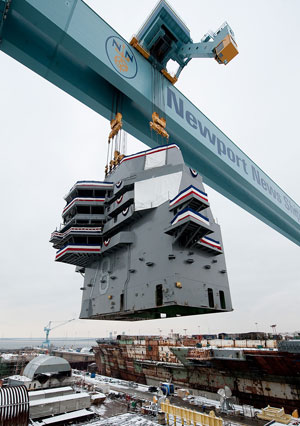
Gerald R. Ford’s island is lifted by the shipyard’s ‘Big Blue’ crane, rated to lift 1,050 metric tons. Photo by Ricky Thompson
Four Years at the Docks
Construction of the Ford began in November 2009. As the lead ship of a new class, USS Gerald R. Ford would take more time to complete than its follow-on sister ships. Moore said the labor for CVN 78 will total 50 million man-hours, compared with the 40 million used to build the Nimitz-class ships. CVN 79 is expected to require 43 million to 44 million man-hours to build.
The cost of CVN 78 is expected to reach $12.9 billion, compared with an original estimate of $10.5 billion. Moore said he expect the next carrier, CVN 79, to cost $1.2 billion less than CVN 78 because of lessons learned in processes and of the technology already developed. Newport News Shipbuilding is using a full-scale three-dimensional product model to design and plan the construction of the Ford-class of aircraft carriers. The significant investment allows visual integration in design, engineering, planning and construction.
CVN 78 has been floated in a graving dock, where the christening ceremonies took place today. This ceremony was delayed four months to enable the shipyard to complete more of the ship in the convenience of the graving dock. The ship, currently at 77,000 tons, couldn’t accept any more weight until it is launched from the graving dock. After launch, the carrier will be moved to a pier to begin a 27-month outfitting period, after which it is scheduled to be commissioned during the second quarter of fiscal 2016.
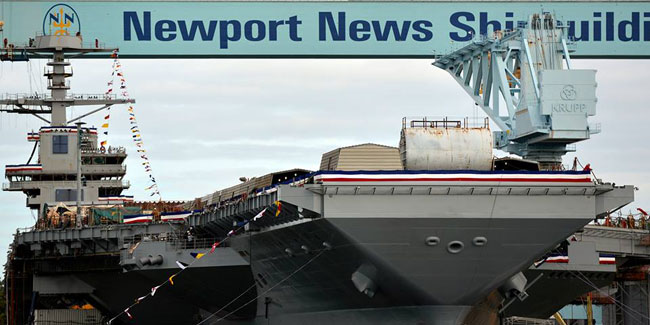
Christened November 9, 2013 the new vessel is expected to move to a pierside for 27 months of outfitting, before being commissioned to service in 2016. Photo: Huntington Shipyard
Built to Sustain High Operational Tempo
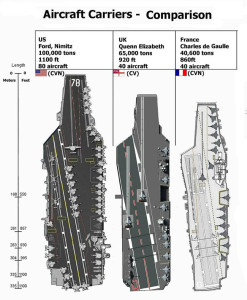
Stretching 1,092 feet (33 m’) long, the USS Gerald R. Ford will feature a redesigned command center, electromagnetic catapults and an enhanced flight deck to get more warplanes in the air faster. CVN 78 is designed to be ready for the future air wing, comprising manned and unmanned aircraft. The US Navy required the carrier to support higher sortie rate of around 160 exits a day with surges to a maximum of 220 sorties a day in times of crisis and intense air warfare activity. To support the increased rate, more flight deck was cleared by reducing the number of lifts to three, and using a shorter but taller island (it stands 20 feet [six meter] taller than previous aircraft carriers’ islands.)
Modern aircraft carrier comparison
The island is positioned 140 feet further aft and three feet further outboard than the island of the Nimitz’s class, thus clearing more deck area for aircraft operations and support.
The route of weapons to the aircraft stops on the flight deck has been replanned to accommodate higher re-arming rates, and in turn higher potential sortie rates. Moving the island creates deck space for a centralized re-arming and re-fueling location. The new path that ordnance follows does not cross any areas of aircraft movement, thereby reducing traffic problems in the hangars and on the flight deck. This reduces the number of times that an aircraft will have to be moved after landing before it can be launched again. Fewer aircraft movements require, in turn, fewer deck hands to accomplish them, reducing the size of the ship’s crew. The ship is designed to require 800 fewer sailors to operate, and for 400 fewer personnel to embark with an air wing on the ship, in total, around 4,300 hands, compared to the average 5,500 hands operating a Nimitz class carrier.
The flight deck of CVN 78 has been completely redesigned and rearranged. The end result is a 25 percent increase in the ability to launch and recover aircraft missions. In order to accomplish this, the carrier has three aircraft elevators instead of four, and the island is positioned 140 feet (42.6 m’) further aft. The flow of weapons has been significantly upgraded, with the installation of new electromagnetic hoist system replacing cables.
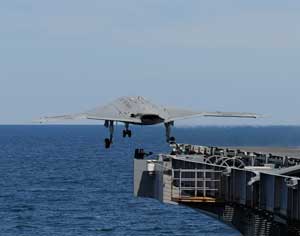
The X-47 UCAS-D currently undergoing carrier suitability flight tests is the only fixed-wing drone designed to operate from aircraft carriers. Following these tests it will also be fitted with aerial refueling capability, preparing for air refuelling evaluations in 2014.
Ready for future unmanned aircraft
The carrier will be capable of carrying up to 90 aircraft including the F-35C carrier variant of the Lockheed Martin Lightning II, Boeing F/A-18E/F Super Hornet, Northrop Grumman E-2D Advanced Hawkeye, Boeing EA-18G Growler electronic attack aircraft, Sikorsky MH-60R/S helicopters and future UCLASS unmanned carrier launched air vehicles systems or unmanned combat air vehicles.
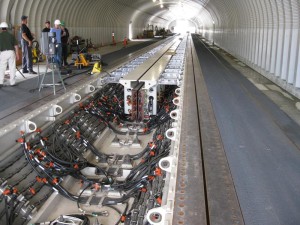
The minimum weight limit is above the weight of all UAVs. An inability to launch the latest additions to the Naval Air Forces is a restriction on operations that cannot continue into the next generation of aircraft carriers. The Electromagnetic Aircraft Launch System (EMALS) provides solutions to all these problems. An electromagnetic system is more efficient, smaller, lighter, more powerful, and easier to control.
Engineers at Naval Air Engineering Station Lakehurst, N.J., work on the EMALS trough at the System Functional Display site. U.S. Navy Photo.
Increased control means that EMALS will be able to launch both heavier and lighter aircraft than the steam catapult. Also, the use of a controlled force will reduce the stress on airframes, resulting in less maintenance and a longer lifetime for the airframe. The current system is unable to capture UAVs without damaging them due to extreme stresses on the airframe. UAVs do not have the necessary mass to drive the large hydraulic piston used to trap heavier manned planes. By using electromagnetics the energy absorption is controlled by a turbo-electric engine. This makes the trap smoother and reduces shock on airframes. Even though the system will look the same from the flight deck as its predecessor, it will be more flexible, safer, more reliable, and require less maintenance and manning.
Unlike the Nimitz, CVN-78 will have no catapult-specific restrictions on launching aircraft, but still retains four catapults, two bow and two waist. The lighter software-controlled advanced arresting gear system increases the ability to recover smaller aircraft with reduced wear. The combined contribution of those capabilities and the vessel’s higher efficiency would enable the Ford Class carrier to increase operational tempo, generating about 25 percent increase in sorties per day, compared to Nimitz-Class carriers.
More power, for Bigger Punch
The ship will be equipped with two newly-designed reactors that will provide propulsive power driving four shafts, supporting a cruising speed over 30 knots. The new A1B reactor plant built by Bechtel is a smaller, more efficient design that provides approximately three times the electrical power of the Nimitz-class A4W reactor plant. The modernization of the plant led to a higher core energy density, lower demands for pumping power, a simpler construction, and is expected to require less maintenance over its lifetime. The reactors deliver 250 percent more electrical capacity than previous carriers, supporting the ship’s EMALS. Additional power will also provide for the integration of future directed energy weapons, expected to be fielded in the future, providing more effective self protection for the carrier, particularly against ripple attacks of cruise missiles, ballistic missiles or surface bound threats.
The designers have also planned the vessel for more efficient operation, the new class will have 12 year operating interval before dry-dock maintenance are required. Reduced maintenance is also reflected in the fewer manpower needed to operate and maintain the ship. In addition, more air-conditioned space means reduced maintenance requirements for equipment and electronic systems.
Smarter Eyes and Ears for the Carrier
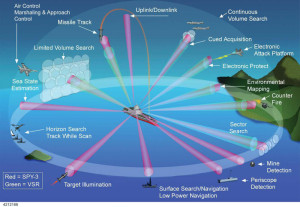
Functional scheme of the DBR radar, developed as a common sensor for DDG-1000 and CVN-21 platforms.
The Ford will use an AEGIS class radar, employing six Dual-Band Radar (DBR) panels developed by Raytheon for both the DDG-1000 Zumwalt-class guided missile destroyers and the Ford-class aircraft carriers. By replacing six to ten different radar antennas with a single six-faced multi-mission radar, attached to the outer walls, the island can be kept smaller. The DBR works by distributing multiple emitters of X-Band AN/SPY-3 multi-function radar and S-band Volume Search Radar (VSR) emitters, distributed into phased arrays. Each system has three phased array faces.
Operating as an integrated warfare system, the Ship Self-Defense System (SSDS), has been developed to be flexible in supporting the carrier’s operation while providing self defense to the platform. The carrier will be armed with the Raytheon evolved Sea Sparrow missile (ESSM), which defends against high-speed, highly manoeuvrable anti-ship missiles. The close-in weapon system is the rolling airframe missile (RAM) from Raytheon and Ramsys GmbH.
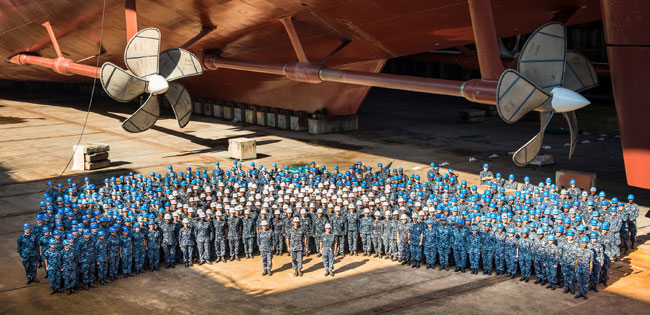
Shipbuilders take a photoop after completing the installation of the vessels’ four propellers. All U.S. aircraft carriers procured since FY1958 have been built by Newport News Shipbuilding (NNS), of Newport News, VA, a shipyard that is part of Huntington Ingalls Industries (HII). NNS is the only U.S. shipyard that can build large-deck, nuclear-powered aircraft carriers. The aircraft carrier construction industrial base also includes hundreds of subcontractors and suppliers in various states. Photo: Huntington Ingalls Shipyards
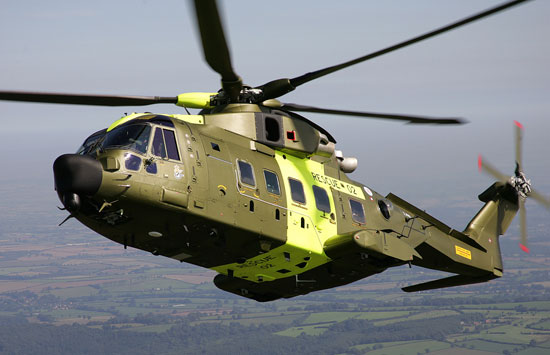
Denmark is operating eight AW101 helicopters since 2007. Photo: Agustawestland
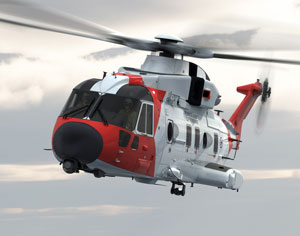
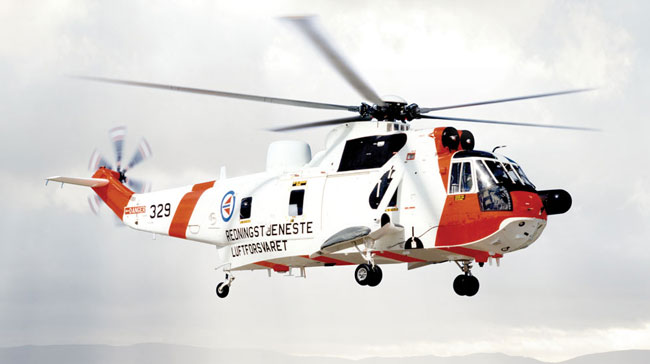
The Norwegian Government selected AgustaWestland Ltd. for the delivery of up to 22 new AW-10 search and rescue helicopters to replace the current Sea King. “AgustaWestland AW 101 is the candidate that in total, after intensive negotiations, best meets the demands for Norway’s future SAR helicopter.” the Ministry of Justice and Public Security said in its announcement. “The new helicopters will be able to relieve significantly more people in distress, be noticeably faster and with longer range than today – under virtually all weather conditions. Additionally, search capability and the possibility for medical treatment are significantly improved.” Norway and Iceland have an agreement to jointly buy SAR helicopters due to the very similar operating requirements. Iceland is currently operating three Eurocopter Super Puma AS-332L1 helicopters.
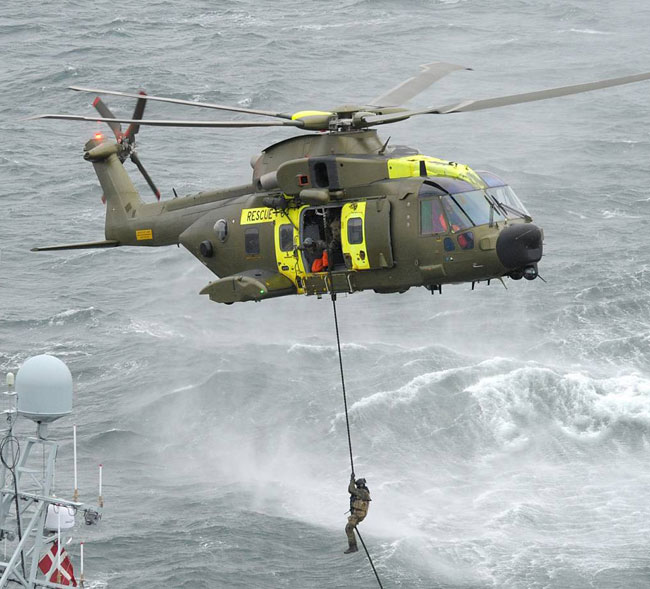
Eight AW101 SAR Model 512 are operated by the 722 squadron of the Royal Danish Air Force. Photo: AgustaWestland
AgustaWestland came as the preferred bidder with its AW101, over Eurocopter, offering the EC722. The company will deliver 16 new AW101 helicopters configured for SAR missions, to replace the current Sea King. The Norwegian government has an option for further 6 helicopters. The package also includes related equipment and maintenance. First deliveries are planned for 2017. Norway is planning to phase out the Sea King operations across the country by the end of 2020.
The aim is that the contract following final negotiations will be concluded by the end of the year. The acquisition cost is expected to be more than 2 billion Euros (17 billion Norwegian Krones, or US$2.76 billion)
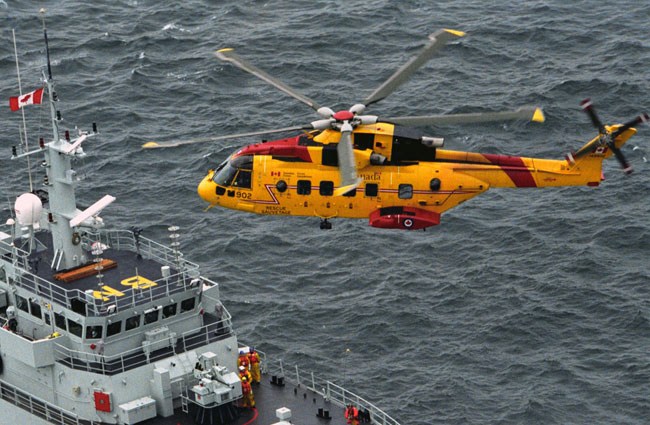
The CH149 Cormorant variant of the AW101 is operated by the 103 SAR, and 413 and 442 transport squadrons of the Royal Canadian Air Force. Photo: AgustaWestland.
As a medium/heavy multi-role platform AW101 has a large cabin that can carry 30+ survivors, SAR equipment and crew, and the cabin can be reconfigured in flight to meet mission requirements. crashworthy seats or 16 stretcher patients. The helicopter is powered by three GE CT7-8E engines, but can also cruise with one engine idling, to extend range or endurance of 750 nm (over 1300 km). High cruise speed, all weather operating capability, high reliability and safety are among its main advantages. The company also offers a special variant for Combat Search and Rescue missions, for which the AW101 can be equipped with up to 3 window and door mounted guns, Defensive Aids Suite and air-to-air refueling equipment.
The Norwegian Government selected AgustaWestland Ltd. for the delivery of up to 22 new AW-10 search and rescue helicopters to replace the current Sea King that has been in service for 36 years.
The Department of Defense has a long and unhappy history of spending tens of billions of dollars bringing weapons programs well along the path to completion only to terminate them in the 11th hour. Remember the A-12 attack aircraft, Comanche helicopter, Future Combat System, Armed Reconnaissance Helicopter, CG(X) cruiser, VXX Presidential Helicopter and Crusader howitzer.
Often the military service and contractors involved fail to salvage any of the advanced technologies or manufacturing capabilities developed as part of the program. If the political stars are properly aligned, the Pentagon may be pressured into producing a small number of extremely capable but controversial platforms at very high unit prices: Seawolf nuclear submarine, B-2 bomber, F-22 fighter and Zumwalt DDG-1000 destroyer.
In an era of austere budgets and renewed calls for acquisition reform, one might think that DoD would make a concerted effort to admit to its dysfunctional behaviors and reconsider some of its near-term acquisition decisions. Chief among these is the decision by the U.S. Army to terminate the Medium Extended Air Defense System. MEADS was intended to be the next-generation in ground-mobile air and missile defense replacing a wide range of Western systems. MEADS had many attractive features, it was a multinational program — Germany and Italy were co-developers and provided nearly half the funding, it was highly mobile, and the radar and battle management system provided 360-degree coverage against fast moving aircraft and cruise missiles.
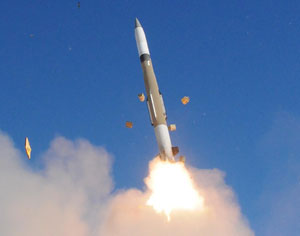
Just this week, MEADS demonstrated the unprecedented capability to track, intercept and destroy simultaneously two targets approaching from opposite directions. One target represented an air-breathing threat and the other a short-range ballistic missile. Every element of the system worked flawlessly: the 360-degree MEADS Surveillance Radar, a networked MEADS battle manager, two lightweight launchers firing PAC-3 Missile Segment Enhancement Missiles and a 360-degree MEADS Multifunction Fire Control Radar. This was the third successful test in a row for the MEADS system.
At a time when the Army is trying to become more expeditionary, agile, lighter and responsive to new threats, the decision to cancel MEADS, a system that supports all of these objectives, seems odd. The Army has promised to identify component technologies that could be harvested from MEADS to enhance existing air and missile defense systems. Unfortunately, this means the Army will still be left with a ground-based air and missile defense capability less responsive and mobile than MEADS.
Critics have complained that the multinational character of MEADS increased complexity and cost. But the same could be said about the international F-35 Joint Strike Fighter program which has eight co-development partners. Yet, DoD has stressed international participation as one of the positive features of the JSF program. Germany and Italy would like to keep the MEADS program going, adding new participants. Poland recently expressed strong interest in becoming a MEADS principal. Warsaw would have to put some money to the program for which it would expect to receive significant industrial participation. If other nations can be enticed to participate, perhaps DoD should tell the Army to give MEADS a second look.
Author: Daniel Goure, Ph.D.
Dr. Goure is a Vice President with the Lexington Institute, a nonprofit public-policy research organization headquartered in Arlington, Virginia. He is involved in a wide range of issues as part of the institute’s national security program.
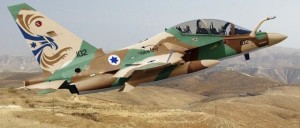
This is how the M346I could look like when it is delivered in 2014
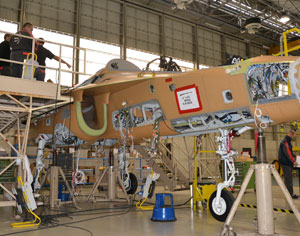
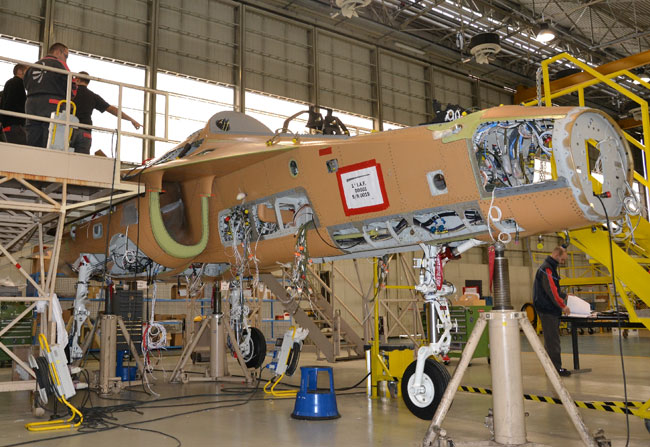
Alenia Aermacchi’s plant in Venegono has begun assembling Israel’s first M-346 advanced jet trainer. The three major components of the first aircraft are currently being joined to form the aircraft’s structure. Israel’s first M-346 – to be called Lavi – in IAF designation – will make its way down the assembly line and roll out of the factory for final checks and delivery to the IAF in the mid of 2014. Israel ordered a total of 30 M-346 as advanced trainers to replace the TA-4 Skyhawk and F-16A/B s Falcons currently in service.
Israel is expecting to receive the first two aircraft in 2014 with remaining 28 to be delivered through 2016.
Alenia Aermacchi’s plant in Venegono has begun assembling Israel’s first M-346 advanced jet trainer. Photo: Alenia
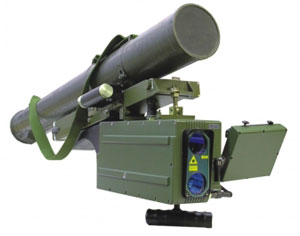
Corsar, a man portable guided missile weapon system weighing 28 kg can engage moving or stationary targets at ranges of 2,500 meters.
Corsar, a man portable guided missile weapon system weighing 28 kg can engage moving or stationary targets at ranges of 2,500 meters.The Defense Ministry of Poland is considering purchasing anti-tank missiles from the Ukraine as part of the implementation of a weapons modernization program. According to Ukraine news agency Interfax-Ukraine, a Polish executives mission headed by Deputy Defense Minister for Weapons and Arms Modernization Waldemar Skrzypczak, has met last week with representatives of Ukroboronprom State Concern and Ukrspecexport State Enterprise, to discuss bilateral military and technical cooperation. The meeting was held in Bangkok, where the missions attended the Thai defense exhibition Defense & Security 2013. This proposal of the Polish defense ministry will be discussed at a meeting of the Ukrainian-Polish sub-commission for cooperation in the defense industry, which will take place in Kyiv in November.
“We are ready to consider the acquisition of Ukrainian-produced advanced 105mm anti-tank guided missiles which were developed by the Promin State Design Bureau. We are also interested in the joint production of high-precision weapons.” Interfax quoted Skrzypczak saying.
Since 2003 Poland has fielded over 2,600 Israeli Spike LR missiles, which are likely to remain and even increase the number in service, particularly with the planned fielding of missile-equipped turrets with the new Rosomak wheeled infantry carriers in is planning to buy over the next four years. The Polish interest in these Ukraine missiles could be in in the laser-guided man-portable and tank-gun launched missiles the Ukraine offers. Laser guided missiles are often less costly, compared to EO guided weapons. They are likely to have high immunity to thermal and EO countermeasures.
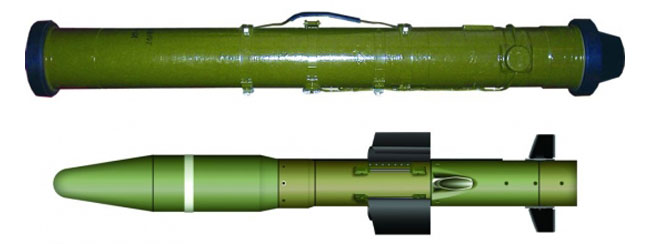
The weapon Skrzypczak has mentioned is likely to be the Corsar, built by the kiev based LUCH Design Bureau. The Corsar weapon system is designed as a semi-active laser guided man-portable weapon (18 kg total system weight), capable of engaging stationary and moving targets at a range of 2,500 m’, its tandem warhead is designed to penetrate 550mm of armor (RHA) behind reactive tiles. The Corsar homes in on laser light reflected from the target. It was designed as an affordable, lightweight anti-tank weapon offering superior range, compared to light ATGW, while maintaining relatively low cost (a system is offered at a cost of $130,000).
The Polish Army also operates laser guided missiles with 30 Mi-24 HIND and is interested in arming the W-3/W-3W Sokol light helicopters used for recce, scout and utility missions. For that mission, the Polish military is likely to consider EO and laser guided weapons, to modernize or augment existing systems.
Egypt is considering spending up to $4 billion on advanced weaponry from Russia following the partial suspension of military aid and equipment deliveries from the United States. Egypt’s foreign minister Nabil Fahmy confirmed the issue of buying arms from Moscow is considered by the Government. Tuesday November 12. Such spending would require generous Russian loans, as Egypt is currently unable to invest in new arms, given the country’s desperate economic situation. Nevertheless, Egypt is still positioned as the largest, most powerful nation in the region. Winning back Egypt could offset the loss of Libya as a Russian arms buyer. As for the military regime in Egypt, a strong Russian support would help stabilize the regime, that has been under pressure from Washington, over the disputed military coup.
For Moscow, such an investment in the renewal of military ties with Egypt could signify a return in force to the Middle East while US diplomacy is failing all over the region.
Russia will supply modern weaponry to Egypt, provided that Cairo is able to finance the purchases, a high-ranking official at Russia’s state arms exporter Rosoboronexport said Friday. Novosti quoted Donia Al-Watan that published earlier today that Moscow has offered Cairo “a historic deal giving Egypt an option to buy the most advanced weaponry without any restrictions.” the Rosoboronexport official told RIA Novosti. “We are ready to negotiate with the Egyptian side the possibility of deliveries of new weaponry as well as repairing equipment supplied in Soviet times,” He said such new deliveries would depend on Egypt’s ability to pay for them. But he noted, “Moscow is ready to discuss with Cairo a possible loan to that country.” The source spoke on condition of anonymity due to the sensitive nature of the subject.
On the backdrom of the warming relations with Moscow, a Russian missile cruiser, the Varyag, has made an unofficial port call in the Egyptian city of Alexandria on the Mediterranean Sea. Varyag that arrived here for a six day visit, is part of the Russian standing task force in the Mediterranean currently comprising the Varyag missile cruiser, the Smetlivy frigate, several large amphibious landing ships, as well as two reconnaissance ships. The flagship of the task force is the nuclear-powered missile cruiser Pyotr Veliky that arrived here from the Northern Fleet area of operation.
The report comes on the eve of a visit to Egypt by a Russian military delegation led by Defense Minister Sergei Shoigu. A source in the Russian Defense Ministry told RIA Novosti on Thursday that the delegation would visit Egypt on November 13-14. The source said the Russian delegation would include the first deputy director of the Federal Service on Military-Technical Cooperation, Andrei Boitsov, and officials from state-arms exporter Rosoboronexport.
The Obama administration announced on October 9 that it had decided to “hold the delivery of certain large-scale military systems and cash assistance to the [Egyptian] government pending credible progress toward an inclusive, democratically elected civilian government through free and fair elections.” According to US officials, the suspended aid included the delivery of four F-16 fighter jets, 10 Apache helicopters, M1A1 tank kits and Harpoon anti-ship missiles.
The Soviet Union and Egypt enjoyed close ties during the 1960s and early 1970s, when the Arab country was led by Abdel Nasser. But within years after the death of Nasser, the new president Anwar Sadat started reorienting the country toward the West and expelled about 20,000 Russian military advisers stationed in Egypt in July 1972. Bilateral relations have since never warmed up to the previous friendship level.
The U.S. Department of Transportation’s Federal Aviation Administration (FAA) today released its first annual Roadmap outlining efforts needed to safely integrate unmanned aircraft systems (UAS) into the nation’s airspace. The Roadmap addresses current and future policies, regulations, technologies and procedures that will be required as demand moves the USA from today’s limited accommodation of UAS operations to the extensive integration of UAS into the Next Generation Air Transportation System (NextGen) in the future.
“Government and industry face significant challenges as unmanned aircraft move into the aviation mainstream,” said U.S. Transportation Secretary Anthony Foxx. “This Roadmap is an important step forward that will help stakeholders understand the operational goals and safety issues we need to consider when planning for the future of our airspace.”
The Roadmap outlines the FAA’s approach to ensuring that widespread UAS use is safe, from the perspective of accommodation, integration, and evolution. The FAA’s main goal for integration is to establish requirements that UAS operators will have to meet in order to increase access to airspace over the next five to 10 years. The Roadmap discusses items such as new or revised regulations, policies, procedures, guidance material, training and understanding of systems and operations to support routine UAS operations.
“The FAA is committed to safe, efficient and timely integration of UAS into our airspace,” said FAA Administrator Michael Huerta. “We are dedicated to moving this exciting new technology along as quickly and safely as possible.”
Expanding the Utilization of UAS
“Our FAA forecast estimates that we can expect 7,500 small unmanned aircraft in our national airspace in the next five years, provided the regulations are in place to handle them.” Huerta added, “For the last two decades, the FAA has authorized the limited use of unmanned aircraft for important missions in the public interest. These include firefighting, disaster relief, search and rescue, law enforcement, border patrol, military training, and testing and evaluation. About 80 law enforcement agencies already operate unmanned aircraft now under special certificates of authorization. Universities also use unmanned aircraft for research into weather, agriculture, and industrial uses.”
The Roadmap also addresses the evolution of UAS operations once all requirements and standards are in place and are routinely updated to support UAS operations as the National Airspace System evolves over time. The document stresses that the UAS community must understand the system is not static, and that many improvements are planned for the airspace system over the next 15 years.
The FAA plans to select six UAS test sites to begin work on safely integrating UAS into the airspace. These congressionally-mandated test sites will conduct critical research into how best to safely integrate UAS systems into the national airspace over the next several years and what certification and navigation requirements will need to be established.
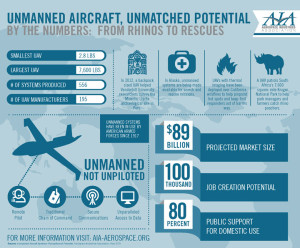
Welcoming the FAA initiative, Michael Toscano, president & CEO of the Association for Unmanned Vehicle Systems International (AUVSI) said that UAS would have great economic contribution in commercial and agricultural fields as well as in public safety, by rapidly responding to natural disasters, locating missing persons and helping to fight wildfires. “UAS can save time, save money, and, most importantly, save lives.” Toscano said, adding that, according to an AUVSI’s economic report projects he expansion of UAS technology will create more than 100,000 jobs and generate more than $82 billion in economic impact in the first decade following the integration.
Addressing Public Privacy Concern
The use of UAS, both at the designated test sites and in the national airspace generally, raises the issue of privacy and protection of civil liberties. In February, the FAA asked for public comments specifically on the draft privacy requirements for the six test sites. Today, the agency sent a final privacy policy to the Federal Register that requires test site operators to comply with federal, state, and other laws on individual privacy protection, to have a publicly available privacy plan and a written plan for data use and retention, and to conduct an annual review of privacy practices that allows for public comment.
For the next several years, the FAA will continue to use special mitigations and procedures to safely accommodate limited UAS access to the nation’s airspace on a case-by-case basis. The Roadmap notes that this case-by-case accommodation will decline significantly as integration begins and expands, but will continue to be a practical way to allow flights by some UAS operators in certain circumstances.
In addition to the FAA’s Roadmap, as required in the 2012 FAA Reauthorization, the Joint Planning and Development Office (JPDO) has developed a comprehensive plan to safely accelerate the integration of civil UAS into the national airspace system.. That plan details a multi-agency approach to safe and timely UAS integration and coordination with the NextGen shift to satellite-based technologies and new procedures.
In addition to the FAA roadmap, the Department of Transportation is releasing a Comprehensive Plan that dovetails with the FAA’s roadmap. This Comprehensive Plan details the multi-agency approach to the safe and timely integration of unmanned aircraft. The plan establishes goals to integrate both small and larger unmanned aircraft, and to foster America’s leadership in advancing this technology. .
The Russian armored vehicle manufacturer Ural Vagon Zavod (UVZ) Corporation and French company SAGEM Defense Securite (a member of SAFRAN Group) have signed a strategic partnership agreement in the presence of Prime Minister of the Russian Federation Dmitry Medvedev and Prime Minister of France Jean-Marc Ayrault. According to a joint statement, the two companies have agreed to establish a long-term strategic partnership concerning usage of optronic equipment and other high-tech products produced by SAGEM Defense Securite for UVZ armoured vehicles and artillery systems. The agreement was signed within the confines of Memorandum of Agreement dated July 27,2012.
“Russia is a strategic partner that we plan to work with in quite a few fields. The agreement we were happy to sign today will ensure mutually beneficial cooperation conditions. This is not about our company selling the goods produced in France but about setting up a joint venture that will manufacture a competitive product and will use it to break into the global markets. First of all, we’ll carry out a detailed analysis of all the most favorable and expedient collaboration opportunities. Then, we’ll decide on the projects that we’ll concentrate on,” said Philippe Petitcolin Sagem Defense Securite CEO.
Safran Group has been cooperating with the Russian industry in the field of engine-building for about two decades: the company worked with Saturn Scientific Production Association to create Engine SaM 146 for Sukhoi SuperJet 100 and set up a JV for the production of inertial navigation systems for combat air force and helicopters on the Russian soil that is the country’s first such JV in the field of military technological collaboration. The two parties are positive that Uralvagonzavod and Sagem Defense Securite’s cooperation will be mutually beneficial.
Turret and gun control systems, sights, navigation systems and thermal imaging equipment are among the systems produced by Sagem that have already been integrated or considered for use with Russian tanks and artillery systems, both for export and domestic use.
A graphic description of DDoS attack in progress. (Click on image to expand)
Much has been discussed about the damage that the Advanced Persistent Threat (APT) attacks cause to corporates and governments alike. It is estimate that at least 50% of Fortune 500 companies have been compromised by APT, and the potential financial damage to these organizations is almost impossible to quantify, but probably in the trillions of US dollars.
Compared to this a crude Denial of Service (DoS) attack or its more advance siblings, the Distributed Denial of Service (DDoS) attacks and Distributed Reflector (DRDoS) attacks, their outcome seems pretty benign- your site is being bombarded by thousands of request for information, until the server gives up and no-one can actually use the site. Once the attack stops, access is possible again and no damage to your IT infrastructure has occurred, no data or money was stolen and hopefully your angry customer will believe it was just a “site malfunction”.
But as attack methods have become more sophisticated AND more accessible (for example, now one can simply rent hundreds of BOT computer as a service, to carry the attack for him, using a simple interface, with no need to know how to actually hack), the industry had to act, and developed means to mitigate these attacks. Several methods of DDoS mitigation exist and multiple companies offer these as a service. Now a very dangerous equation begins to unfold, one where the attacker can use simple, cheap tools (a fairly typical rate for DDoS botnet rental hovers around the $200 for 10,000 bot agents per day), and the defender must invest much larger resources, both internal (maintaining a Security Operations Center or SOC) and external (service providers), creating an inherent asymmetry.
This asymmetry means that organizations wishing to mitigate this threat will keep investing (or throwing, since there is no actual gain here, only minimizing the impact) money over time, until they are in serious economic pain. And this is exactly what Islamic terrorist have been trying to do in the recent global jihad campaign- making western countries bleed money in order to try and prevent sparse attacks carried by rudimentary means. As Osama bin Laden said: “It is very important to concentrate on hitting the American economy with every available tool … the economy is the base of its military power. The United States is a great economy but at the same time it is fragile.”
The risk is that using offensive cyber means one can achieve this goal much faster (and one does not have to blow himself to pieces in the process, or hurt innocent people). Therefore, prevention and not only mitigation is necessary. Organizations must be far more proactive than they are now. Sure, investments in IT security and best practices are always a good idea, but also applying preventive intelligence to greatly reduce the impact of attacks. This, couples with harsher legislation and enforcement against both the suppliers and the perpetrators of the attacks will hopefully, in the end, balance this asymmetric equation.
Yotam Gutman, Lt. Commander (Ret.)
Ex. Israel Navy officer with abundant experience in weapons systems, C4i and simulation systems, Gutman has worked in various technical, sales and marketing roles within the Israeli defense and HLS industry. Yotam now manages global sales of tailored intelligence services for Terrogence.
Lockheed Martin Skunk Works® and XTEND have achieved a major milestone in JADC2 by integrating the XOS operating system with the MDCX™ autonomy platform. This technical breakthrough enables a single operator to simultaneously command multiple drone classes, eliminating the friction of mission handoffs. From "marsupial" drone deployments to operating in GPS-denied environments, explore how this collaboration is abbreviating the data-to-decision timeline and redefining autonomous mission execution.
As traditional defense primes face mounting competition from agile “neoprimes” such as Anduril, Palantir and Helsing, the balance of innovation is shifting toward software-defined warfare and scalable, dual-use technologies, while global industry consolidation—marked by Boeing’s integration of Spirit AeroSystems and other strategic mergers—signals an intensified race to secure control over the defense technology value chain. Our Defense-Tech weekly report highlights these trends.
In early October 2025, a coordinated wave of unmanned aerial system (UAS) incursions—widely attributed to Russia—targeted critical infrastructure across at least ten European nations. The unprecedented campaign exposed the fragility of Europe’s air defenses...
Executive Summary
The past week (September 18-25, 2025) represents an inflection point where strategic defense concepts have transitioned from doctrine to tangible reality. An analysis of global events reveals four primary, interconnected trends shaping an...
At the 2025 Air, Space & Cyber Conference, U.S. Air Force and Space Force leaders unveiled major updates on next-generation fighters, bombers, unmanned systems, and space initiatives, highlighting both rapid innovation and critical readiness challenges as the services race to outpace global competitors. A short version is available here, with a more detailed version for subscribers.
The Taipei Aerospace & Defense Technology Exhibition (TADTE) 2025 crystallized around four dominant strategic themes that collectively illustrate Taiwan's comprehensive approach to defense modernization amid escalating regional tensions. Based on a detailed report by Pleronix (available upon request). Includes a Podcast discussion on TADTE 2025's highlighting Taiwan's four strategic themes beyond the post's coverage.
Israel’s Iron Beam 450 high-power laser system has completed final testing, marking a major leap in air defense. Developed by Rafael, it offers precise, cost-effective interception of rockets, UAVs, and mortars, and is set for IDF deployment by 2025.