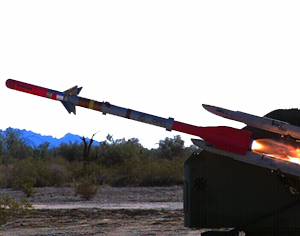
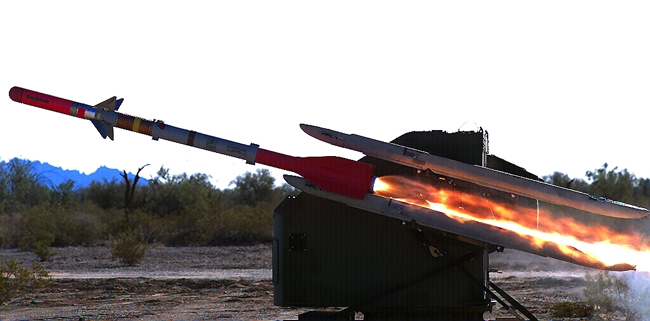
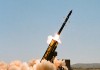
Raytheon’s AI3 interceptor consists of a modified AIM-9 Sidewinder airframe, fitted with an RF seeker, datalink and proximity fuse. The AI3 Battle Element also includes an Avenger weapon station carrying four missile launchers and Ku-Band Radar System. (Photo: Raytheon)
On a recent firing test Raytheon has successfully intercepted and destroyed a 107mm rocket target in flight. According to Raytheon, the targets were fired at low quadrant elevation (QE) and were intercepted by the Accelerated Improved Intercept Initiative (AI3) interceptor, as part of the second series of guided test vehicle (GTV) flight tests of the AI3 program. The US Army is expected to embark on live-fire engagements beginning in September 2013. On these tests the AI3 will engage 107mm and other rockets, unmanned air systems (UAS) and other threats to forward operating bases.
The interceptor is a variant of the AIM-9 missile, designed to intercept short range ballistic rockets, mortars, unmanned aerial vehicles and other air breathing platforms. The AI3 Battle element employs a modified Avenger weapon system as a launching platform, comprising common launcher rails supporting AI3, AMRAAM (AIM-120) and Sidewinder (AIM-9) missiles. The primary sensor for the system is the Ku Radio Frequency System (KRFS) fire control radar. The radar and launcher are fully integrated with the Army’s new Integrated Air and Missile Defense Integrated Battle Command System.
“This second GTV demonstrated full integration of the AI3 Battle Element with the C-RAM command and control architecture against the threat target,” said Steve Bennett, Raytheon Missile Systems AI3 Program Director. Immediately after the 107mm target rocket was fired it was picked by the KRFS radar. After the AI3 interceptor was launched, the KRFS continued to track the inbound target, guiding the interceptor via inflight radio frequency (RF) data link updates to position itself at the terminal intercept course. At that position the interceptor transitioned to terminal guidance, using its onboard seeker, assisted by the illumination from the KRFS radar, guiding the interceptor missile to within lethal range. The target was then detected using an active RF proximity fuze that determined the optimal detonation time for the warhead. With these measurements, the missile calculated the appropriate warhead burst time and defeated the incoming threat.
“Beginning only 18 months and one week ago, and with firm cost requirements, the AI3 interceptor project successfully engaged and destroyed an inflight rocket on a challenging, high-speed flight profile greatly enhancing the range of existing capabilities,” said Michael Van Rassen, the U.S. Army’s Project Director for Counter Rockets, Artillery and Mortars (C-RAM) and AI3. “The project used a system of systems approach that lowered risk and enabled an accelerated schedule by leveraging existing government components and off the shelf subsystems to expand the footprint of the protected area for our warfighters.” Van Rassen added.
Other technologies to be tested under the government sponsored evaluation are an EAPS hit-to-kill interceptor developed by Lockheed Martin, and another missile, using fragmentation warhead triggered by proximity fuse, developed by Northrop Grumman. Unlike the two missiles that were specially designed for the EAPS application, AI3 employs an existing weapon (Sidewinder, Avenger), which would be modified for the C-RAM missions. The KRFS also employs existing assets – the Ku Band Multi-function RF System (MFRFS), an electronically-scanned, solid-state phased array radar originally developed to support Active Protection Systems (APS) on future combat vehicles. The static threat warning variant was developed and deployed to provide early warning from rocket threats fired at Low Quadrant Elevation. Utilizing residual assets from the Future Combat Systems (FCS) program, MRFRS was completed in 14 months, delivering 12 systems to protect forward bases in theater.
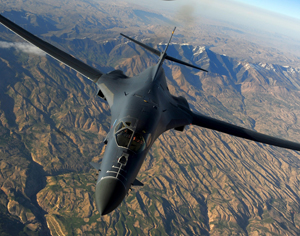
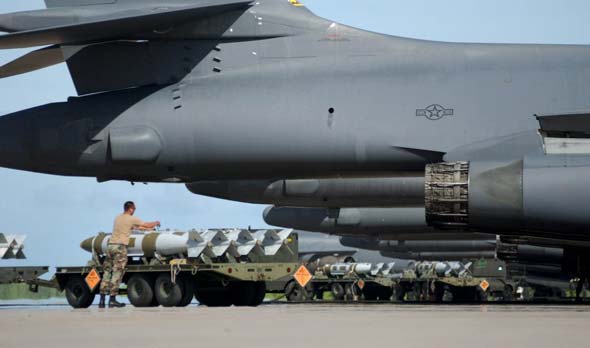
A B-1B Lancer strategic bomber has crashed Monday (August 19, 2013) in a remote area near Broadus, Montana, during a routine training flight. The bomber took off from Ellsworth Air Force Base in South Dakota. Col. Kevin Kennedy of the 28th Bomb Wing said the two pilots and two weapons system officers ejected from the aircraft before the bomber crashed. The Air Force officials will conduct a thorough investigation to determine the cause of the accident.
The Boeing B-1B Lancer is a four-engine variable-sweep wing strategic bomber, which entered service with the US Air Force in 1986. It features reduced radar signature and a top speed of Mach 1.25. All B-1B bombers operated by the USAF are currently deployed with two units the 28th Bomb Wing at Ellsworth Air Force Base in South Dakota and the 7th Bomb Wing stationed in Dyess Air Force Base in Texas. The B-1B is expected to continue to serve into the 2030s, according to USAF officials.
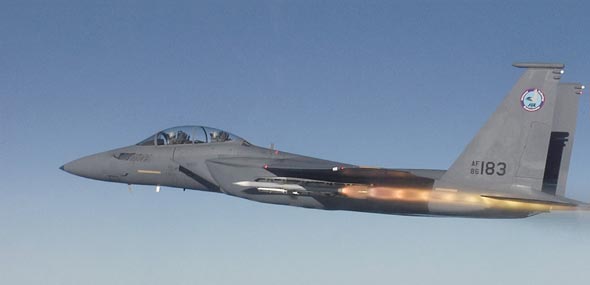
A flight demonstrator of the Boeing F-15SE Launches an AMRAAM air/air missile from the new conformal internal weapon bay. Photo: Boeing
The South Korean defense acquisition program administration (DAPA) has indicated this week that the bidding process for the 8.3 trillion won (US$7.2 billion) program buying 60 new fighter aircraft has finally got to a conclusion. A single finalist, likely to be the Boeing Company remained in the race. With a single option now on the table offered at the right price, DAPA is expected to conduct further assessment and announce its final decision in mid-September. Boeing said it was still waiting to hear the outcome of the competition. Lockheed Martin also said it has not received an official notification from the Republic of Korea regarding the results of the price bidding for the F-X Program. Company officials said the decision is not determined on cost alone, and aircraft capabilities will also be considered in the month long evaluation process that will now proceed. “The F-X source selection process has multiple phases and we will continue to work closely with the U.S. government as they offer the F-35 to Korea,” Reuters quoted Lockheed Martin sources comment. The United States has proposed the fighter planes to Seoul under a government-to-government basis, through the ‘foreign military sales’ channel, with companies providing information on price and other details.
Seoul initially planned to pick a bidder by October 2012, with the goal of receiving the first delivery in December 2016. However, due to the extended process it is likely that the first batch of fighters will be shipped in August 2017. These new fighters will replace the remaining airplanes of a fleet of some 150 F-4Es and F-5E/Fs the Republic of Korea Air Force (RoKAF) has been operating for five decades. These aircraft are nearing the end of their operational lives and will have to be withdrawn from service around 2015.
Earlier it was reported that the European Aeronautic Defense and Space Company (EADS) has been eliminated from the selection, after ‘abruptly changing its contractual terms’. EADS submitted an offer for 54 single seater and six twin-seat Eurofighter Tranche 3 fighters, while DAPA required 15 twin-seat and 45 single seat planes. South Korea’s decision to eliminate EADS and the fact that the costlier F-35A is available only in a single-seat version has left left Boeing’s F-15 Silent Eagle as the sole final candidate, government sources said Sunday.
Lockheed Martin was also one of three bidders, offering the F-35 which is available only in a single seat variant. In addition to the lack of twin-seat configuration, the F-35A was said to be costlier than the F-15SE or Typhoon Tranch 3. Throughout the bidding process Seoul insisted not to exceed its target cost, thus repeating bidding sessions 55 times.
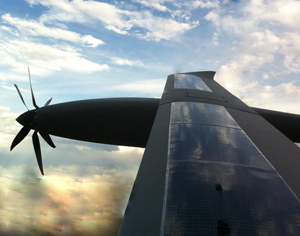
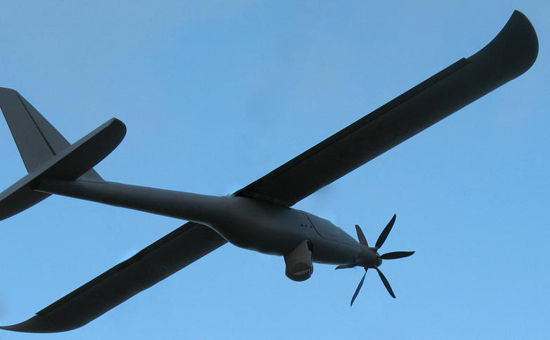
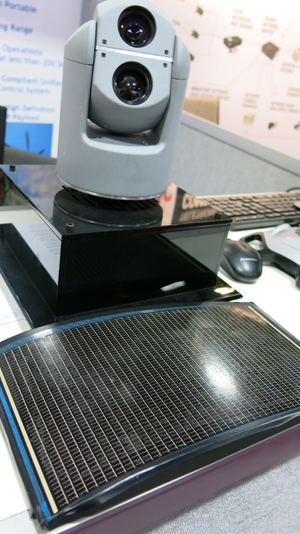
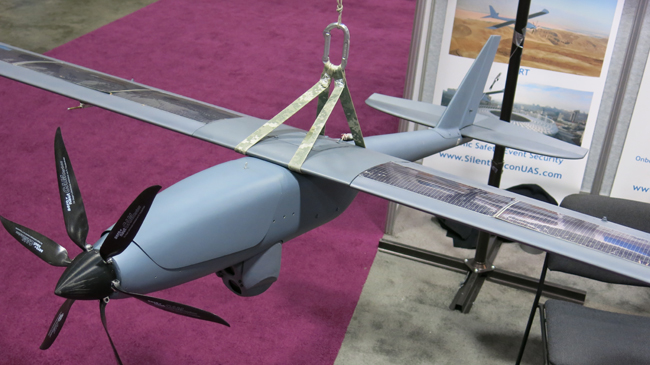
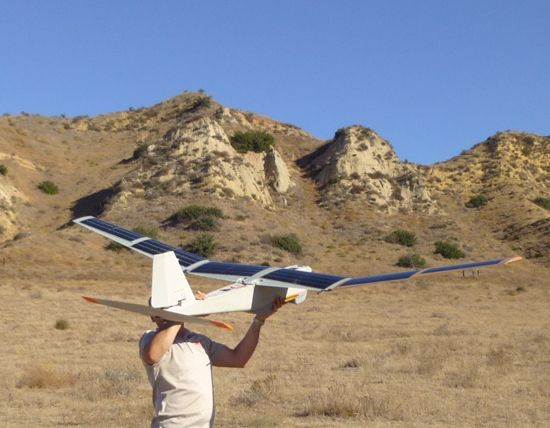
Silent Falcon is configured with different wing sets carrying solar arrays that can keep the drone aloft for up to 14 hours. Photo: Silent Faclon UASFlexible solar cells and a two-sensor gimballed payload made by Adsys are two of the unique technologies the Silent Falcon is using to provide exceptional endurance of up to 14 hours on a typical mission. Photo: Tamir Eshel, Defense-Update
Silent Falcon UAS is introducing at AUVSI 2013 a small drone, designed to perform long endurance missions of up to 14 hours using solar power. The drone called Silent Falcon, can be launched by hand or from a vehicle, and carry a dual-sensor payload weighing about 1.3 kg. According to the manufacturer the drone has completed development and is the company is currently seeking customers to operate it in developing countries, where flight restrictions are more relaxed, enabling the drone to exploit its unique mission capabilities in security of remote areas, mineral explorations etc.
The development of the Silent Falcon began few years ago under a different company, Bye Aerospace Inc., a pioneer of solar-powered long endurance unmanned aerial systems introduced their first hybrid-UAV called ‘Silent Sentinel’ in 2009. To integrate the solar arrays in a curved form, over the upper wing area, Bye teamed with flexible solar array pioneer ‘Ascent Solar’, a producer of thin film solar arrays based on plastic surface.
Three years later ‘Silent Sentinel’ evolved into the ‘Silent Guardian’, another solar powered UAV. Few months later, the company unveiled the 27 pound latest variant called ‘Silent Falcon’, at the 2012 AUVSI conference in Las Vegas. The Silent Falcon is scheduled to go into commercial production in early 2013.
“We see this emerging electric drone market expanding rapidly, with applications ranging from military to disaster relief with rapid deployment and recovery with little risk to human life.” said John W. Brown, chief executive officer of Silent Falcon UAS Technologies, the developer of the new system. “We believe that today there is a large and growing global military and public safety agency market for small or tactical unmanned aircraft systems.” According to Brown, in these markets alone, sales exceeding several hundred units per year are possible. “As their use in these markets proves their utility and functionality and as the FAA rules for domestic commercial, civilian use become more clear, we believe the market size and number of annual units sold could increase substantially.” FAA has recently approved special flight certifications to two small drones, enabling operations in remote areas of Alaska.
AUS&R 2013 – The Unmanned Systems Live Demonstration – Israel – 26 November 2013
The flexible solar panels that cover the upper wing area provide power for the sensors as well as the driving the 1.3-hp electric motor which spins the propeller. Extra power for the EO sensor payload is provided by Lithium polymer rechargeable batteries. The gimbaled payload carried under the belly consists of high-definition optical and infrared imagers, and a laser pointer. The sensor pod also handles video processing, letting the UAV track and identify targets, and stream images to ground stations. Silent Falcon can cruise at a speed of 12 to 60 knots and climb up to an altitude of 20,000 ft. The Silent Flacon will be hand-launched. Alternatively, a rocket assisted launch system could be employed. The drone lands on a skid or deploys a parachute that brings it safely to ground with its payload recessed to prevent damage from ground impact.
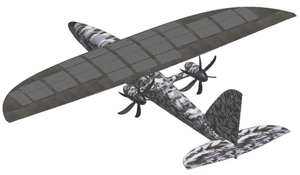
Snipe is a twin-propeller variant of Silent Falcon configured to carry a suppressed, precision automatic weapon effective at ranges 200 meters.
Users will be able to select different wingsets matching their Silent Falcon to a mission. The larger wings carry more solar panels, which give the plane more flight time. The smallest has a six foot wingspan carries a solar array that lets the plane fly for up to six hr. the nine foot wing will keep the drone airborne for ten hours while the largest 15 foot wing will suffice for a 14 hour mission. For comparison, the Falcon batteries limit missions to 6 hours at night.
The company is also considering developing two twin-engine variants, designed to carry heavier payloads. The SF Heavy Payload (SFHP) drone will have a wingspan of 5.2 meters and an empty weight of 15.9 kg. Carrying a payload of about 11 kg the SFHP will have a gross operating weight of 27.3 kg. Typical operating endurance will be 8-10 hours. A weaponized variant called ‘Snipe’ is also considered. According to Silent Falcon UAS, this drone will be configured as a ‘flying machine gun’, carrying a specialized suppressed weapon firing standard FN 5.7×28 ammunition at high precision from a distance beyond 200 meters.
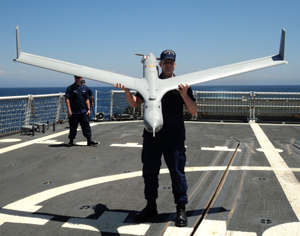
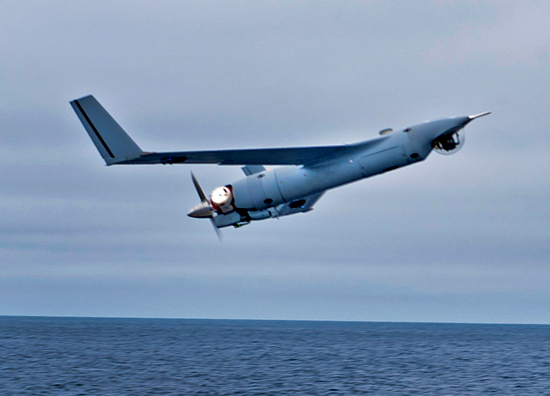
Scan Eagle UAS flying close to USCG cutter bertholf, prior to being caught by the vessel’s Skyhook, that snatches the drone in flight, retrieving it safely on board.
This spring with the aid of a small, unmanned drone more than half a ton of cocaine was confiscated — signaling the first time the U.S. Coast Guard deployed an unmanned aerial system from a cutter in a drug interdiction. i-HLS reports.
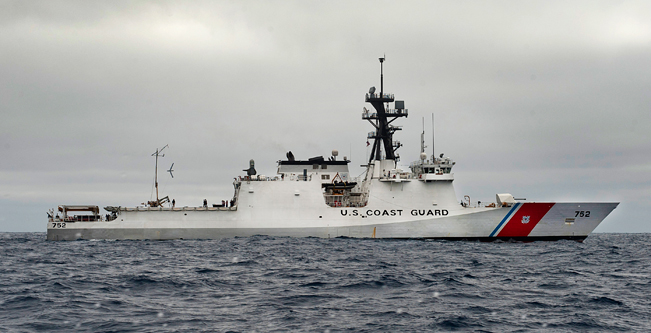
The service has put the ScanEagle through two weeks of trials at sea in May and has high hopes for the future: rolling out a small UAS across its national security cutter fleet, starting in fiscal 2017. The trial aboard the cutter Bertholf, conducted off the western coast of Central America, was used to assess how unmanned vehicles operate with Coast Guard cutters.
The UAVs, which relay video back to the ship, increase the surveillance reach of the NSCs. The overhead surveillance can help bust drug smugglers, but it can also track flight patterns or fishing operations.
A Scan Eagle UAS is retrieved by the Skyhook, installed at the aft of USCG Cutter Bertholf.
During the two-week demo, the ScanEagle completed 90 hours of flight time. The Bertholf crew seized the cocaine in late May using the UAV to spy on a go-fast boat smuggling the drugs in the eastern Pacific. During the operation, the ScanEagle “was able to maintain visual surveillance of the target until a cutter was able to get out and interdict the vessel,” said Lt. Cmdr. Jeff Vajda, the unmanned aerial system platform manager for the office of aviation forces.
This is not the first time the Coast Guard had tried to equip its NSCs with unmanned capabilities. EagleEye, a rotary wing UAV, was tested but ultimately abandoned in 2007 “due to rising costs and technical challenges,” said Cmdr. Albert Antaran, the aviation portfolio manager for the office of research, development, test and evaluation. With the cancellation of that project, the NSC’s aerial surveillance coverage area dropped from a potential 58,000 nautical miles to about 18,000 nautical miles, according to a 2009 Department of Homeland Security report.
The Coast Guard is trying again, but this time with a smaller UAV that’s easier to field and already has a proven flying record in the Navy and Marine Corps. May marked the second demo of the ScanEagle. The first was on NSC Stratton last summer and focused on the basics. The third demonstration will be in early 2014.
The service hopes to obtain hard numbers on the value that the unmanned system provides the Coast Guard, Vajda said. That would include measuring the surveillance capabilities of sensors, and how well they can detect objects at sea.
The Coast Guard’s five year investment plan calls for small UAS purchases in fiscal 2016, so that’s “the soonest we can spend any real money,” Antaran said.
And while it is evaluating the ScanEagle, the service may ultimately opt for a different airframe, Vajda said. Although it looks like the service’s first cutter-based drone will be a small UAS, it’s just an interim solution. The service is still monitoring the Navy’s Fire Scout, an unmanned helicopter, as a possibility. The Fire Scout is much larger — at more than 30 feet, it’s seven times the length of the 4.5-foot ScanEagle.
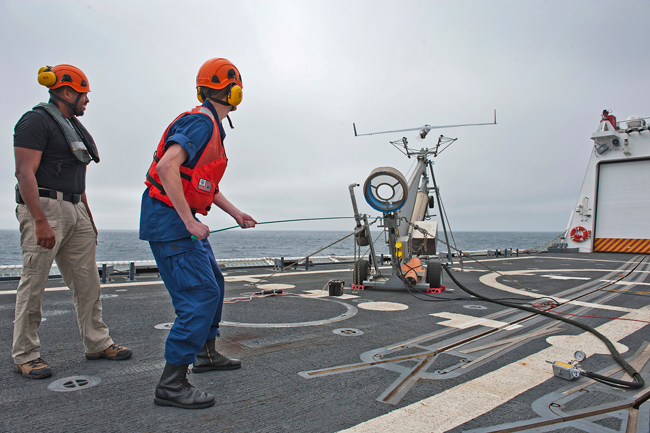
Each cutter with a small UAS will likely have a specialized six-person detachment of Coasties onboard to operate the drone, Vajda said. Pilots will be officers, as there are no immediate plans for enlisted to fly unmanned aircraft, Vajda said. The detachment will include three pilots and the rest of the crew will be enlisted who cover maintenance and launch and recovery.
The Coast Guard already has eight active operators of unmanned aircraft, but they deploy the land-based MQ-9 Guardian, owned by U.S. Customs and Border Patrol. They operate the Guardian jointly with CBP from stations in Florida and Texas.
Long-term, the Coast Guard also envisions UAVs on offshore patrol cutters, the replacement for the medium endurance cutters, Vajda said.
Officials stress the service’s UAVs are not meant as replacements for Coast Guardsmen, but are meant to contribute to manned capabilities.
Scan Eagle UAS is launched from the aft deck of the USCG Cutter Bertholf.
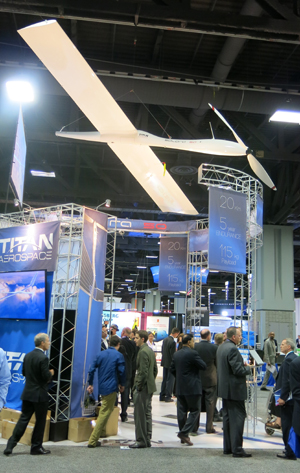
At AUVSI 2013 Titan Aerospace announced the Solara 50 drone, with an endurance of five years on a mission. The fore-section of the drone, without its tail or 50 foot wings are seen here. Photo: Tamir Eshel, Defense Update.
While DARPA refocuses its SOLAR HALE ambitions, a privately funded company is determined to launch a solar drone into an ‘atmospheric orbit’, tapping evolving opportunities in the commercial and homeland security market.
Mega-size solar power drones are taking shape at several manufacturers across the USA, where ‘atmospheric satellites’ are being developed, designed to take small payloads into ‘atmospheric orbit’ at 65,000 ft on missions that could last five years.
One of the largest solar powered drones, known as ‘SolarEagle’ is under development at Boeing Phantom Works, under DARPA’s $89 million Vulture II program. This program followed earlier experiments with solar-powered drones, among them Zephyr, developed by QinetiQ, that has flown the longest drone mission in history – between 9 July to 23 July 2010, it flew a mission lasting 336 hours and 22 minutes, breaking the world’s endurance record for an unmanned aerial platform.
This ultra high-altitude, long-endurance (HALE) platform would have been capable of flying missions lasting between three months to five years. According to DARPA’s original plan, this drone’s 400-foot span wings would carry solar panel arrays that will be able to sustain the drone aloft in the stratosphere for at least five years. Key suppliers for that program include Versa Power Systems and QinetiQ.
The solar-electric-powered aircraft was designed to cruise at altitudes above 60,000 feet at a speed of 70 to 80 knots while performing communications, intelligence, surveillance and reconnaissance missions.
During the day, the solar power generation is used to power the aircraft and excess solar power generation is converted to hydrogen by the fuel cells as they operate in electrolysis mode. At night, the fuel cells run in fuel cell mode, converting the stored hydrogen to power. Solid Oxide Fuel Cell (SOFC) based energy storage systems have the potential to provide unprecedented round trip energy efficiency as the storage application of the technology is further developed.
The aircraft was designed with solar arrays attached to its plastic skin, covering more than 50 percent of its surface. Highly efficient electrical motors and propellers and a high aspect-ratio wing, similar to those used in gliders, will all contribute for increased solar power and improved aerodynamic performance. Similar to satellites, the platform will be designed to be a “zero-maintenance, launch-and-leave” UAV, Boeing’s Pat O’Neil said.
When completed and proven, such aircraft could offer many of capabilities currently provided by orbiting satellites, at a higher degree of flexibility and a lower cost, making such ‘atmospheric satellites’ useful for intelligence gathering, communications and commercial applications. The SolarEagle was designed to carry payloads of up to 1,000 pounds of weight.
Under the original plan Boeing was planning to test a scale-down proof of concept platform sometime in 2014, to demonstrate continuous operation on a 30-90 day mission. However, following the Preliminary Design Review, the program was restructured by DARPA, and is now refocusing on advancing critical energy management technologies – solar collection (photovoltaic) and fuel cells (energy storage systems). According to DARPA, these technologies are the least mature and are vital for enabling ultra-persistent high-altitude, long-endurance (HALE) flights lasting multiple years. By narrowing the program’s focus, DARPA seeks to advance energy management technologies that would benefit a number of future HALE aircraft applications and should reduce risk for development of future very long-endurance aircraft programs.
DARPA said it still considers the Vulture long endurance attributes as essential for future ISR missions. It’s advanced energy storage system technologies ultimately could enable a re-taskable, persistent pseudo-satellite capability in an aircraft package. Unfortunately, as it stands today, the Solar Eagle will not reach the flight test phase.
In addition to the Solar Eagle, Boeing is also pursuing the hydrogen-powered ‘Phantom Eye’ HALE platform, designed to stay aloft for up to four days. Phantom Eye made its maiden flight in 2011, a second flight followed in 2013.
A newcomer to this exciting field of ‘Atmospheric Satellites’ is Titan Aerospace, developing a commercial based service that promises to ‘revolutionize near-earth applications for dozens of industries’. “The ability to park a stationary payload directly above a specific point is opening dramatic new possibilities and redefining the landscape.” Titan’s Chief Technology Officer Maximus Yaney said.
A typical launch sequence will begin just after midnight as the aircraft launched from a vehicle travelling on a runway would climb under its fully charged battery power, to an altitude where the drone can obtain the first rays of light, as the sun crests over the horizon and enters its standard day-night cycle. The drone recharges its battery banks through daylight hours. As the sun sets, the SOLARA shifts its propulsion, payload, and systems to those battery banks. As the drone uses lithium ion batteries, rather than fuel cells, precision battery management system are used to ensure voltage and thermal thresholds are maintained in the subzero atmosphere. At an altitude of 65,000 ft (about 20 km), SOLARA soars above terrestrial weather where it can remain on station for years. The drone will use silicon-based solar arrays formed into the outer wing structure, providing a multi-functional structural and power generating and structural strength.
According to Titan Aerospace, the platform maintains efficient energy harvesting even when the sun is low on the horizon, employing its high efficiency solar array positioned on horizontal wings and tail, slanted wing tips and vertical tail. To further conserve energy, the platforms use a distributed Maximum Point Power Tracking system, dynamically maintaining optimal voltage across the entire array at various solar insolation and incidence levels.
The solar array generates a tremendous amount of nonpolluting energy, enough power for propulsion and systems, charge batteries, and supply payload with kilowatts of energy in peak periods and hundreds of watts throughout the night.
The company is building three versions of this solar-powered platform. SOLARA 10 has been flying regulary, on day-long missions. SOLARA 50, currently in advanced development, will have a gross weight of 350 pounds (159 kg) carrying a payload of over 70 pounds (+32 kg). The 54 foot (15.5m) long drone will soar on wings that will span over 164 feet (50 meters), cruising at a speed of 56 Knots (104 km) at an altitude of 65,000 ft (+20 km). It will be designed to remain on station for five years, thus covering almost 2.5 million nautical miles (over 4.5 million km) on a mission. It is slated to fly early 2014. The larger SOLARA 60 will be able to carry twice the payload with nearly 200 foot (60 m’) wing. Titan plans to fly the SOLARA 60 around late 2014.
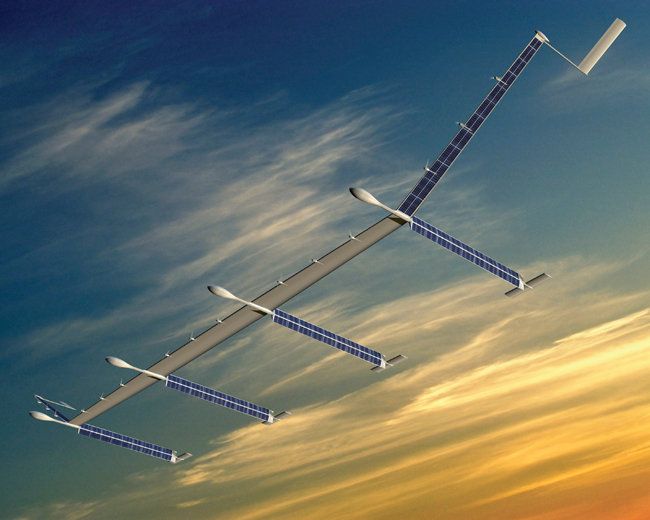
The concept design of Solar Eagle envisions photovoltaic cells positioned in multiple angles toward the sun. The program has been restructured by DARPA, to focus on the energy supply rather than the flying demonstration and is unlikely to reach flight status.
The solar powered Puma AE launched on a long-endurance mission. Its standard batteries are augmented by by the new solar cells. Photo: Aerovironment
Flexible solar array manufacturer Alta Devices has recently conducted an experiment applying its flexible PV arrays onto an AeroVironment Inc. RQ-12A Puma AE small unmanned aircraft system (SUAS), which demonstrated an extended mission endurance of 9 hours, 11 minutes using a hybrid battery and solar array power source. “This is a critical milestone with far-reaching implications for the many ways small UAS can benefit military, public safety and commercial customers,” said Roy Minson, AeroVironment senior vice president and general manager, Unmanned Aircraft Systems (UAS).” The solar Puma AE configuration currently is in the research and development phase. A production version is planned for early 2014.
Minson added that with the new power source the RQ-12A would approach the capabilities envisaged for the next class of UAS at a much lower acquisition and operating cost, and with much greater operational flexibility. Minson said AeroVironment’s new long endurance battery extends Puma AE’s non-solar endurance to more than three hours. This means small UAS could be used for longer missions over greater distances than previously possible.
Minson added that past solar solutions for powering small UAS were either too heavy or did not produce enough power for long-range flight – or both. “However,” he said, “the solar Puma AE technology can produce enough power, while adding negligible weight, so that endurance is no longer an issue for most customer missions.”
In 2011 the US Air Force Research Lab (AFRL) pioneered the integration of a solar array on another Aerovironment drone – the RQ-11B Raven small UAS. In that demonstration solar cells, 20 square centimeters in size, were applied to the Raven’s wings, adhered to the wings of the vehicle using a clear, protective plastic film and an adhesive. According to AFRL researchers, the number of solar cells integrated onto the wing – and the amount of solar power provided to the SUAS – depends on the surface area of the wings. Back in 2011 AFRL researchers predicted the total improvement in flight endurance, considering the aircraft’s energy usage would also be improved, could increase nearly 300 percent. The recent test with the Puma AE has confirmed this AFRL prediction.
AUS&R 2013 – The Unmanned Systems Live Demonstration – Israel – 26 November 2013
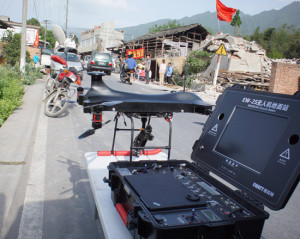
During emergency missions conducted in China in April EWATT also deployed miniature quad-copters for surveying.
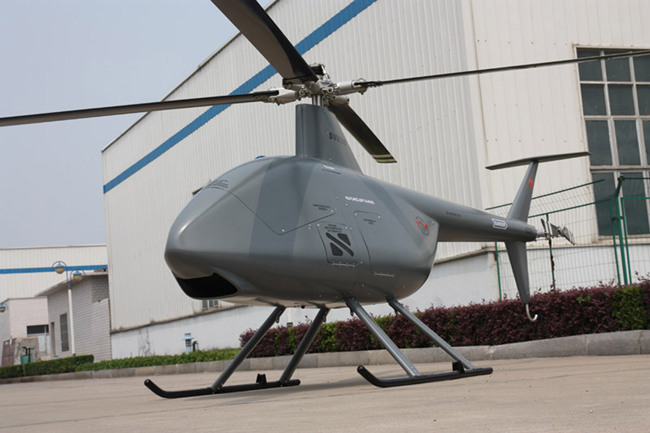
The Chinese company Ewatt Technology is introducing its new SVU-200 VTUAV to the AUVSI show in Washington. It is the first time the unmanned helicopter is displayed in the USA. While the VTUAV is claimed to be 100% Chinese, it is based on the design of Dennis Fetters, an American currently living in China.
Ewatt plans to increase its production capacity, from an annual capacity of 200 aircraft today to more than 1,000. Ewatt has teamed with Fetter’s US company – Fetters Aerospace – to invest about US$81 million (500 million Yuan) to build a large production base for unmanned aerial vehicles in the city of Wuhan, China. The deal represents the first venture between China and the US in civil drones. Fetters will provide 10 technical and management experts to support the venture.
Ewatt entered the UAV business to provide surveillance systems for power-line inspections. Technical Director of VTOL Vehicles Mr. Dennis Fetters, a pioneer of helicopters, gyroplanes and UAV vehicles. Based on the Star-Lite VTUAV Multi-Task helicopter, the fully autonomous SVU-200 Heavy-Lift multipurpose UAV platform was designed and built by Fetters for Hunan Sunward Science and Technology Co., LTD., in Changsha China.
According to Ewatt founder and Chief Executive Officer, Mr. Zhao Guocheng Ewatt plans to introduce a complete line of VTUAVs over the next three – five years, with a payload capacity of 50, 200 and even 300 kilograms.
The SVU-200 is powered by the Rotax 582 engine, using the Power Enhancement Package (PEP) exhaust system. According to Fetters, the PEP enables the increase in the engines power to 78 horsepower (up from its normal 65). The vehicle is designed to be capable of lifting up to a 200kg maximum useful load and fly at a top-speed up to 209 km/hr. Fetters claims the SVU-200 employs an optimized rotor-head and control system that requires significantly less computer-stability control inputs, compared to other unmanned helicopters.
The SUV-200 has two internal payload bays, one in the nose and one in the rear of the aircraft, and is also equipped with hard-points and capable of hauling sling-loads, or carry an external cargo/payload pod, and even extended-range tanks with extra fuel for longer mission capabilities. External loads can also include 18 rocket tubes and chin-mounted electro optical/infrared sensor payloads.
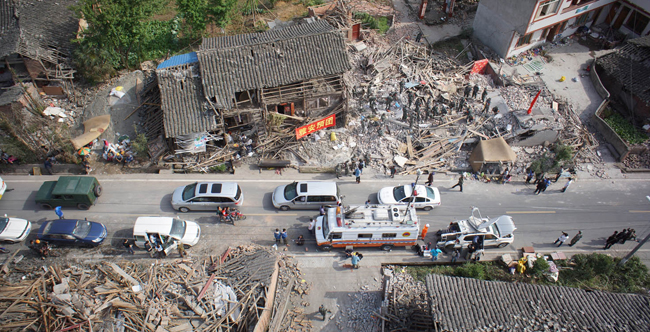
After April’s Lushan earthquake in Sichuan China, Ewatt sent two of its drones to help record earthquake damage, and help power companies in rebuilding power supplies.
Images collected from EWATT surveillance drones during emergency response in Sichuan, China, April 2013
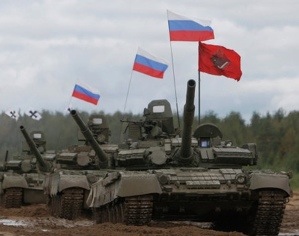
Blurring the line between sports and warfare, the Russian army premiered a new sport – tank biathlon – and invited US crews to compete. Russian news agency Novosti reports. “We’ve invited our American colleagues to participate… and our invitation was accepted by US Secretary of Defense [Chuck] Hagel,” Russian Defense Minister Sergei Shoigu said Saturday. Italy and Germany also agreed to send their teams to compete with Russian and US tank crews, Shoigu said, adding that the event will take place sometime next year.
Russia will host the world’s first ever tank biathlon championship next week. The country’s best tank crews will compete against each other at a firing range outside Moscow, the winners then taking on competitors from Armenia, Belorussia and Kazakhstan.
The new sport allows showcasing the quality of Russian tanks, comparing them against foreign analogues, Shoigu’s deputy Yury Borisov said Saturday.
Next week’s event, however, will be limited to T-72 tanks, the staple of post-Soviet militaries, Vedomosti business daily said Friday. The newspaper offered a preview of the new sport, covering a test competition held outside Moscow earlier this week. The event involved four tanks painted in bright colors – including yellow and pinkish red – which did three laps over rough terrain, shooting at targets shaped like tanks, houses and helicopters. The best time was 5:28.
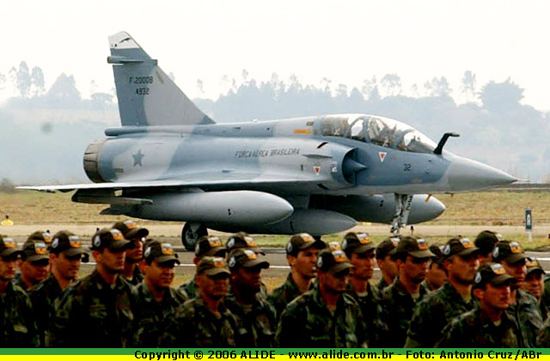
The political changes in Brasilia, with the new president and defense minister at the helm means that the jets, brought by the former regime, will not be missed. Photo: Courtesy of Elide.com.br
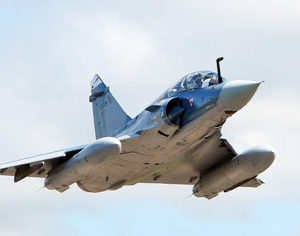
Brazil plans to withdraw from service 12 Mirage 2000C/B fighters operating with the 1st Air Defense Group, currently providing the mainstay of the country’s air-defense force. The jet fighters also known as ‘Jaguars’ are operating from Annapolis, about 140 km from the capital Brasilia. These fighters were acquired from French Air Force surplus in 2005 for $74 millions to replace older Mirage IIIBR fighter jets. France delivered three batches of the fighters in 2006, 2007 and 2008. At the time, the life expectancy of these refurbished fighters should last for 16-18 years (till 2025), however, after merely six years most of the small fleet exhausted its remaining operational life and required a temporary life extension plan to keep them flying until the next generation F-X2 was due.
The two years passed, but the decision on F-X2 is still pending and now, even the extra life of these Mirages has been depleted, with the jets reaching the absolute end of their operational life, and no further investment is in sight for further modernization. Since Brazil acquired the old variant (B/C) of Mirage 2000 it was not well equipped, and carried relatively obsolete weapons – Matra 530D and Magic II missiles. The radar did not provide Beyond Visual Range capability while navigation equipment was far from state of the art. The political changes in Brasilia, with the new president and defense minister at the helm means that the jets, bought by the former regime, will not be missed.
To fill the gap the Brazilian Air Force is planning to replace those jets with 6-12 modernized F-5Es obtained from the Royal Jordanian Air Force. Embraer is upgrading these fighters under a comprehensive modernization plan that initially included older Brazilian Air Force F-5E/Fs. Sofar 46 planes have gone through the upgrade and 11 more are planned to enter the process. While the F-5E has been upgraded with modern avionics and weaponry, its radar falls short of the radar carried by the Mirage 2000.
The Brazilian Air Force has examined several options for acquiring modernized second-hand fighters, but rejected those proposals, as it is about to decide on the $4.5–6 billion F-X2 acquisition (which has been dragged over more than a decade). For the F-X2 Brazil is considering three Generation 4.5 fighters – The US made Boeing Super-Hornet, Swedish developed Saab Gripen NG and Dassault Rafale from France. More editorial reserved for subscribers
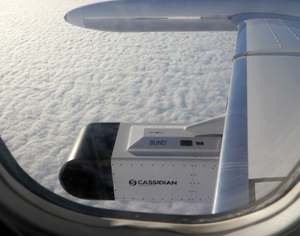
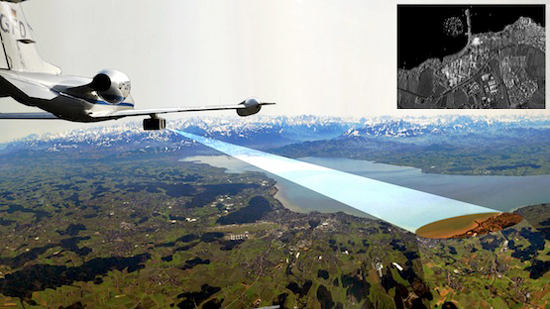
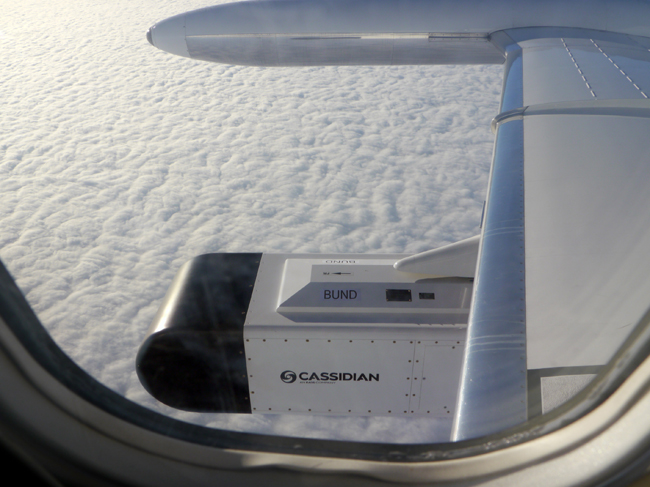
Cassidian’s podded SMART Radar was recently tested over Germany in ground and maritime surveillance applications. Photo: Cassidian
An airborne ground surveillance radar developed by Cassidian (EADS’ defense and security division) was recently demonstrated in flight testing. The new AESA-based radar is designed to detect targets over land and sea, with maximum resolution. Cassidian defines the new system as a ‘SMART radar’, for ‘Scalable Modular Aerospace Radar Technology’, featuring software-defined sensor architecture and flexible adaptation to various manned and unmanned platforms. As part of the flight test campaign carried out from the German air base in Hohn (in the Federal State of Schleswig-Holstein), ‘SmartRadar’ demonstrated airborne ground surveillance capabilities achieving record detection performance. According to Cassidian, the radar has also added new operating modes for maritime surveillance for this test. The Initial test phase included flights over Goose Bay in Canada in June 2012. Defense-Update reports
These tests confirmed the company’s innovative software-defined sensor concept, enabling the use of a common radar platform for different surveillance tasks, by implementing minor modifications to the system. Unlike conventional radars that are often optimised for a specific task, and are employed in a narrow frequency band, the ‘SmartRadar’ modular architecture permits scalability of bandwidth, frequency band and processing performance. This concept enables rapid adaptation of the sensor to new operational requirements, through the use of configurable firmware and software, supported by the systems’ variable cooling design, making the ‘SmartRadar’ suitable for a multitude of manned and unmanned platforms of different sizes.
AUS&R 2013 – The Unmanned Systems Live Demonstration – Israel – 26 November 2013
The tests were conducted on behalf of the German procurement authority BAAINBw (Federal Office of Bundeswehr Equipment, Information Technology and In-Service Support). Most recently, outstanding reconnaissance results were obtained over land during two flight test series in the past year. For these tests, a version of Cassidian’s SmartRadar was integrated into a pod, equipped with an autonomous cooling system, making it easy to adapt to various mission aircraft.
The high performance of the radar is largely due to state-of-the-art AESA technology (Active Electronically Scanned Array) which uses a large number of transmitter and receiver (T/R) modules in the antenna. These modules are developed and manufactured by Cassidian in its own facility, known as the “Microwave Factory”. Cassidian is the pioneer of this technology in Europe and delivers similar T/R modules for the TerraSAR earth observation satellite, the radar systems for the German Navy’s new F125-class frigates and the SPEXER 2000 border surveillance radar, amongst others.
Source: Defense-Update
Through the use of configurable firmware and software, supported by the systems’ variable cooling design, making the ‘SmartRadar’ suitable for a multitude of manned and unmanned platforms of different sizes. Photo: Cassidian
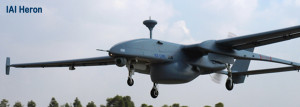
Heron I built by IAI will be one of the main attractions performing live display at AUS&R 2013
Displaying a wide range of systems, from 12 ton autonomous boats, and 16 meter wingspan Heron-I class drones shown in flight, to tethered hovercrafts and miniature man-portable systems weighing only few kilograms performing a live mission for the first time in public, AUS&R 2013 sets the stage for the leading International Event of Unmanned Systems Technology originating in Israel.
The AUS&R 2013 convention has reached a significant milestone today, with eight of the displaying companies participating in the Preliminary Display Review (PDR), confirming the demonstration of 10 different platforms in the event’s live display. (Register now to attend AUS&R 2013)
According to the PDR, the dynamic demonstration will span over several segments throughout the day. The program will offer opportunities for different systems to be demonstrated in realistic scenarios. This unprecedented display, here in Israel, provides a unique opportunity for top officials from the international defense forces, HLS and first responder community, to witness firsthand how unmanned systems can be employed in a range of practical applications, from terrain dominance and surveillance, counter-terror, security and safety, to emergency response and firefighting – all will be demonstrated here at the AUS&R live display.
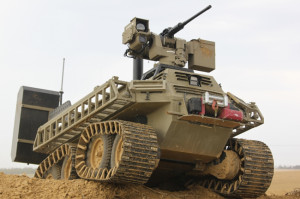
AUS&R 2013 – The Unmanned Systems Live Demonstration – Israel – 26 November 2013G-NIUS will demonstrate an experimental armed robot at AUS&R 2013
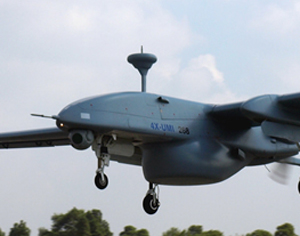
The largest Unmanned Aerial Systems (UAS) approved for participation so far, is the Heron I Medium Altitude, Long Endurance (MALE) multi-mission drone from IAI, carrying various electronic payloads such as radar and EO systems. The Heron I weighs over one ton, and its wingspan measures 16.60 meters.
The Orbiter 3 Small UAS from Aeronautics, will represent the ‘Small UAS’ range. It will be the first public flight demonstration of this type. The Orbiter 3 will demonstrate reconnaissance missions carrying a multi-sensor EO payload.
Another system to be displayed in live operation for the first time, is the Hovermast tethered platform from SkySapience, deployed from a vehicular platform. The Spider Micro-UAS developed by Innocon is also expected to make its first live public demonstration debut here.
Bluebird Aero Systems will demonstrate two systems – the Spylite and the MicroB, a manpack tactical UAS system. The German Microdrones MD4-1000 VTOL UAS will also be displayed.
G-NIUS and Amstaff On Guard have both confirmed the participation of Unmanned Ground Vehicles. G-NIUS will showcase the Guardium II unmanned patrol system and TAGS robotic combat platform demonstrator, while the Amstaff 6 and Amstaff 8 will be shown configured for security and first response applications.
More drones, UGVs and USVs of Israeli and International origin are in the approval process for the live display. Additionally, many more systems will be shown on the static display.
The First International Autonomous Unmanned Systems & Robotics (AUSR 2013) convention will take place in Rishon LeZion, south of Tel Aviv on November 26, 2013. The event will include a professional conference, exhibition and live demonstration. Hundreds of delegates have already confirmed their participation at the event. More details are available on the event page: AUSREXPO.COM
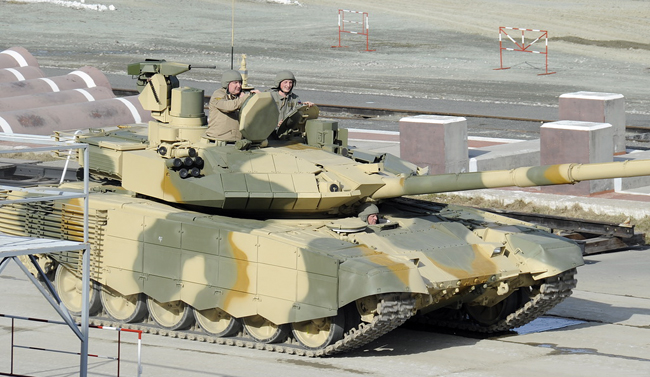
Rogozin inspects a T-90M on the Niznhy Tagil test track. The facility is being renovated and prepared for the Russian Arms Expo, prepared to become one of the largest biennial defense shows. Photo: RAE
The Russian military complex, a gigantic economic power at the Soviet times, has shrunk dramatically after the collapse of the communist regime in the 1990s. After more than 30 years, it seems that the awakening giant is finally getting back on its feet.
While the Russian military industry is still facing plenty of challenges – skill shortage, outdated equipment at production and research facilities, and the nearly-depleted legacy of technologies and know-hows inherited from the USSR. Dmitry Rogozin, Russia’s Deputy Prime Minister in charge of defense industry, thinks it is time to get down to work, as united efforts by authorities, industrialists, expert community, and the public will help rejuvenate the country’s defense industry and take it to an entirely new level.
After decades of stagnation, the Russian military industry is back on the rise now, with the state pumping serious money into arms procurement, supporting manufacturing facilities, research and development and encouraging modernization and upgrades of obsolete production lines.
The industry is also streamlining according to business wise conduct, with government customers becoming better aware and accountable to managing risks, and meeting schedules. The legal base for placement and realization of state defense order has been laid down, and relations among players in the industry are becoming more constructive and reasonable.
The transformation is not limited to the defense industry, but also affects trade fairs and exhibitions, primarily, the Russian Arms Expo (RAE), previously known mainly for the name of the town hosting the fair – Nizhniy Tagil. RAE 2013, the ninth edition of ARE is now positioned as the premier arms fair for military technology, focusing on arms, military equipment and ammunition. Preparations are in full swing now to demonstrate the latest achievements of Russia’s military industry. RAE-2013 is expected to promote Russian-made military equipment, armaments, and ammunition in the domestic and international markets and boost business ties among military equipment manufacturers and customers all over the world.
According to Oleg Sienko, Director General of Uralvagonzavod, the General Coordinator of Russia Arms EXPO, the Nizhniy Tagil test range, 52 km long and seven kilometers wide, is unequalled in the world in terms of size and capabilities. “This site will gather the top players in the industry to discuss and evaluate the latest examples of military hardware.” Sienko said. The test tracks are is being renovated to enable optimal presentation of the armored vehicles on live display, demonstrating their combat capabilities. The venue will also offer rich business facilities agenda with a colorful show program. There is even more to come, though. According to Oleg Sienko, work is already in progress to further improve the venue’s infrastructure: test tracks and obstacle courses are being rebuilt, chalets and pavilions rebuilt and modern telecom infrastructure being upgraded, to support a richer business environment. The entire exhibition complex will be massively rebuilt for better logistics and accessibility. All signs and information stands at the venue will be repeated in English.
The preparations are closely followed by the top ranks at the MOD, one of the recent board meetings was chaired by Rogozin himself.
“If we pursue serious, ambitious goals such as competing on equal terms with the world’s best exhibitions of weapons, military equipment, and ammunitions – like the one taking place in the USA, in Arab East countries, and in France – we must have the ambitions to match “, Dmitry Rogozin said in his introductory speech.
Deputy Prime Minister pointed out the need to find ways to turn the exhibition into a serious exhibition and demonstration complex that will develop according to the current situation, both in terms of military and technical cooperation and in terms of state orders for weapons and equipment for Russia’s armed forces.
The new business spirit of the event is also reflected by the branding campaign, featuring a new logo and website, modern design and the integration of online social media activities on Facebook, Twitter, Instagram, Youtube Slideshare, Blogspot and Flickr. “The rebranding campaign has touched upon everything. This year we are forming both the exhibition and business programs very differently. We have changed our approach to participants: speakers, as well as exhibitors” – says Alexei Zharich, Chief Communications Officer, Uralvagonzavod. According to the official, this approach has already attracted new international exhibitors.
Deputy Minister Alexei Rakhmanov of the Ministry of Industry and Trade of the Russian Federation, said the ministry is expecting the number of participants to reach 200, up from 130 in 2011. In June, 2,100 square meters in the pavilions are already booked along with some 7,000 sq. meters booked on the outdoor display areas. (In 2011, the outdoor display spanned over 5,000 square meters). “We expect a 1.5-time increase in all figures, even though we are now using a stricter approach to participant selection in terms of relevance to the subject of the exhibition”, Rakhmanov noted.
Deputy P.M. in charge of defense industry Dimitry Rogozin takes a ride on the T-90M at the demonstration and testing track at Niznhy Tagil. Photo: RAE
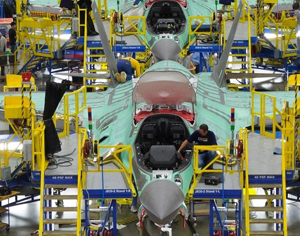
The U.S. Department of Defense and Lockheed Martin have reached an agreement in principle for the next two F-35 Lightning II aircraft production contracts, reflecting up to eight percent cost reduction compared to current prodyction prices agreed upon in December 2012.
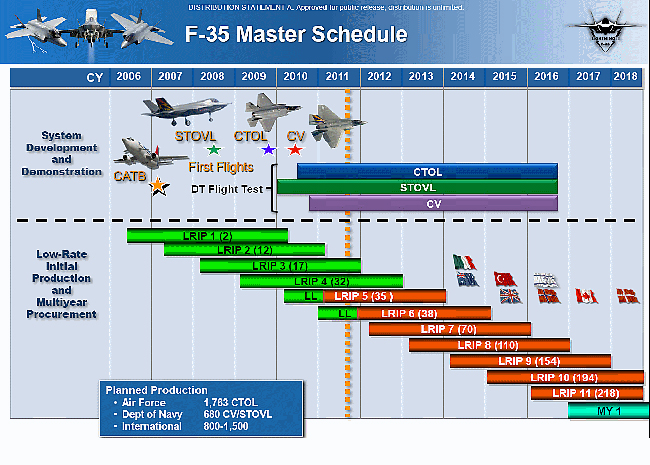
Low-Rate Initial Production (LRIP) lots 6 and 7, which covers the production of 71 aircraft. The two agreements reflect the continued reduction in the pricing of the F-35 aircraft. The contracting effort spanned six months from proposal to settlement. A decrease in F-35 LRIP 6-7 unit costs, coupled with negotiating lower prices on a number of other smaller contracts, will allow the DOD to purchase all the aircraft originally planned, including those that were in jeopardy of being cut due to sequestration budget impacts.
Cost details will be released once both contracts are finalized; however, in general, the unit prices for all three variants of the U.S. air vehicles in LRIP-6 are roughly four percent lower than the previous contract. LRIP-7 air vehicle unit prices will show an additional four percent reduction. The LRIP-7 price represents about an eight percent reduction from the LRIP-5 contract signed in December 2012.
“These two contracts represent a fair deal that is beneficial to the government and Lockheed Martin,” said Lt. Gen. Chris Bogdan, F-35 Program Executive Officer. “Improving affordability is critical to the success of this program, and by working together we were able to negotiate a lower cost F-35. There is still work to be done, but these agreements are proof the cost arrow is moving in the right direction. We will continue to work with industry to identify areas for savings in future production contracts.”
The new contracts will also include the first F-35s for Australia, Italy, Norway, and the fourth F-35 for the United Kingdom. In addition to procuring the air vehicles, these contracts also fund manufacturing-support equipment and ancillary mission equipment.
Deliveries of 36 U.S. and partner nation aircraft in LRIP-6 will begin by mid-2014 and deliveries of 35 U.S. and partner nation aircraft in LRIP-7 will begin by mid-2015.
“At the start of these negotiations, the F-35 Joint Program Office and our F-35 team jointly committed to conduct LRIP-6 and -7 negotiations in an efficient manner that leveraged all we achieved from the LRIP-5 contract,” said Lorraine Martin, Lockheed Martin F-35 Vice President and General Manager. “Today’s agreement reflects our collective JPO/LM delivery on that commitment. We know how critical aircraft production is to meeting our services’ Initial Operational Capability dates, beginning with the Marine Corps in 2015, and we’re committed to making that happen.”
The LRIP-6 and -7 aircraft will join the 95 F-35s contracted under LRIPs 1-5. To date, 67 F-35s (including test aircraft) have been delivered from Lockheed Martin’s production facility in Fort Worth, Texas. The U.S. and eight partner nations plan to acquire more than 3,100 F-35 fighters. Israel and Japan have also announced plans to purchase the jet under Foreign Military Sales agreements.
The agreement in principle reached between the Government and Lockheed Martin are for air vehicles and do not include the propulsion systems. The LRIP-6 engine contract is currently being negotiated between the Government and Pratt & Whitney.
Lockheed Martin Skunk Works® and XTEND have achieved a major milestone in JADC2 by integrating the XOS operating system with the MDCX™ autonomy platform. This technical breakthrough enables a single operator to simultaneously command multiple drone classes, eliminating the friction of mission handoffs. From "marsupial" drone deployments to operating in GPS-denied environments, explore how this collaboration is abbreviating the data-to-decision timeline and redefining autonomous mission execution.
As traditional defense primes face mounting competition from agile “neoprimes” such as Anduril, Palantir and Helsing, the balance of innovation is shifting toward software-defined warfare and scalable, dual-use technologies, while global industry consolidation—marked by Boeing’s integration of Spirit AeroSystems and other strategic mergers—signals an intensified race to secure control over the defense technology value chain. Our Defense-Tech weekly report highlights these trends.
In early October 2025, a coordinated wave of unmanned aerial system (UAS) incursions—widely attributed to Russia—targeted critical infrastructure across at least ten European nations. The unprecedented campaign exposed the fragility of Europe’s air defenses...
Executive Summary
The past week (September 18-25, 2025) represents an inflection point where strategic defense concepts have transitioned from doctrine to tangible reality. An analysis of global events reveals four primary, interconnected trends shaping an...
At the 2025 Air, Space & Cyber Conference, U.S. Air Force and Space Force leaders unveiled major updates on next-generation fighters, bombers, unmanned systems, and space initiatives, highlighting both rapid innovation and critical readiness challenges as the services race to outpace global competitors. A short version is available here, with a more detailed version for subscribers.
The Taipei Aerospace & Defense Technology Exhibition (TADTE) 2025 crystallized around four dominant strategic themes that collectively illustrate Taiwan's comprehensive approach to defense modernization amid escalating regional tensions. Based on a detailed report by Pleronix (available upon request). Includes a Podcast discussion on TADTE 2025's highlighting Taiwan's four strategic themes beyond the post's coverage.
Israel’s Iron Beam 450 high-power laser system has completed final testing, marking a major leap in air defense. Developed by Rafael, it offers precise, cost-effective interception of rockets, UAVs, and mortars, and is set for IDF deployment by 2025.