
Sunday, December 28, 2025
More
    Home Blog Page 149

    First Unmanned Aircraft Launch from Carrier – A Moment in History

    The X-47 UCAS-D currently undergoing carrier suitability flight tests is the only fixed-wing drone designed to operate from aircraft carriers. Following these tests it will also be fitted with aerial refueling capability, preparing for air refuelling evaluations in 2014.
    An X-47B Unmanned Combat Air System (UCAS) demonstrator flies over the aircraft carrier USS George H.W. Bush (CVN 77). George H.W. Bush is the first aircraft carrier to successfully catapult launch an unmanned aircraft from its flight deck. (Photo: Northrop Grumman by Alan Radecki)
    An X-47B Unmanned Combat Air System (UCAS) demonstrator flies over the aircraft carrier USS George H.W. Bush (CVN 77). George H.W. Bush is the first aircraft carrier to successfully catapult launch an unmanned aircraft from its flight deck. (Photo: Northrop Grumman by Alan Radecki)

    The X-47B Unmanned Combat Air System demonstrator (UCAS-D) completed its first ever carrier-based catapult launch from USS George H.W. Bush (CVN 77) off the coast of Virginia May 14, 2013.

    “Today we saw a small, but significant pixel in the future picture of our Navy as we begin integration of unmanned systems into arguably the most complex warfighting environment that exists today: the flight deck of a nuclear-powered aircraft carrier,” said Vice Adm. David Buss, commander, Naval Air Forces, the Navy’s “Air Boss”.

    The unmanned aircraft launched from the deck of George H.W. Bush at 11:18 a.m. It executed several planned low approaches to the carrier and safely transited across the Chesapeake Bay to land at Naval Air Station Patuxent River, Md., after a 65-minute flight.

    Buss called the launch a “watershed event” in naval aviation and said he expects that decades from now, a future “Air Boss” will have a picture of the X-47B launching from Bush behind his or her desk just as he has a picture of aviation pioneer Eugene Ely’s first-ever landing on the deck of a ship in 1911 behind his desk today.

    “This ship and her crew continuously meet the challenges placed before them,” said the ship’s commanding officer, Capt. Brian E. Luther. “The successful launch of the X-47B is yet another first on USS George H.W. Bush. We were excited to host the experimental aircraft, and are proud to know we have played a part in a significant milestone in naval aviation.”

    Completing another important first for the UCAS-D program, the team demonstrated the ability to precisely navigate the X-47B within the controlled airspace around an aircraft carrier at sea and seamlessly pass control of the air vehicle from a “mission operator” aboard the carrier to one located in the Mission Test Control Center at NAS Patuxent River for landing.

    “The flight today demonstrated that the X-47B is capable of operation from a carrier, hand-off from one mission control station to another, flight through the national airspace, and recovery at another location without degradation in safety or precision,” said Matt Funk, lead test engineer for the Navy UCAS program.

    Prior to the catapult launch on Tuesday, the UCAS test team also conducted deck-handling and ship-integration testing to demonstrate the capability to safely operate the X-47B in the dynamic, unforgiving environment of an aircraft carrier flight deck.

    “This event is a testament to the teamwork, professionalism and expertise of everyone involved with X-47B program,” said Rear Adm. Mat Winter, program executive officer for Unmanned Aviation and Strike Weapons. “Their work will positively impact future unmanned aviation development for years to come.”

    Over the next few weeks, the X-47B aircraft will fly approaches to the ship multiple times and eventually land on the pitching flight deck, said Navy UCAS Program Manager Capt. Jaime Engdahl.

    The UCAS team will conduct additional shore-based testing with the X-47B at NAS Patuxent River in the coming months before its final carrier-based arrested landing demonstration later this summer.

    3 days later – Touch and Go

    Three days after leaving the aircraft carrier USS George H. W. Bush on the first catapult launch, the Northrop Grumman X-47B Unmanned Combat Air System Demonstrator (UCAS-D) returned to the carrier for a ‘touch and go’ landing trial, successfully testing the automatic landing system which integrates reference signals from the carrier deck and the drone’s avionics, conducting fully automatic approach and precision touchdown landing. On this landing test the drone touched down within the locations that would enable the tailhook to catch the arresting cables and slow the aircraft to a complete stop within the required parameters. After the test landing the aircraft returned to its shore-base at Patuxent River Naval Air Station in Maryland. The aircraft is expected to conduct shore based arrested landings at Pax River in the coming months, before final carrier-based arrestments scheduled for later in 2013.

    Capt. Jamie Engdahl, Program Manager for UAS program office at the U.S. Navy the X-47B will continue to demonstrate consistent, reliable and repeatable touch down on a moving carrier flight deck, “this precision relative navigation technology is key to ensuring future unmanned systems can operate off our aircraft carriers”.

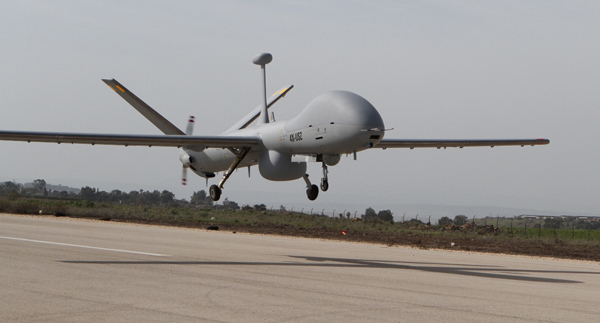
    US Navy / Northrop Grumman X-47B Unmanned  Combat Aerial Vehicle takes off from W.G Bush on its maiden launch from an aircraft carrier, May 14, 2013. Photo: Alan Radecki, Northrop Grumman

    US Navy / Northrop Grumman X-47B Unmanned Combat Aerial Vehicle takes off from the Aircraft Carrier George H.W Bush (CVN 77) on its maiden launch from an aircraft carrier, May 14, 2013. Photo: Alan Radecki, Northrop Grumman

    Heron, Reaper and Hermes 900 Compete for Canada’s Arctic mission

    Hermes 900 Maritime Equipped with Maritime Patrol Radar (MPR) and EO & IR Payloads. Photo: Elbit Systems

    The Israel Aerospace Industries (IAI) Heron unmanned air system (UAS), General Atomics (GA‑ASI) Reaper and Elbit Systems’ Hermes 900 are among three platforms eyed for a Canadian tender to supply an advanced system for  operation in the Arctic.

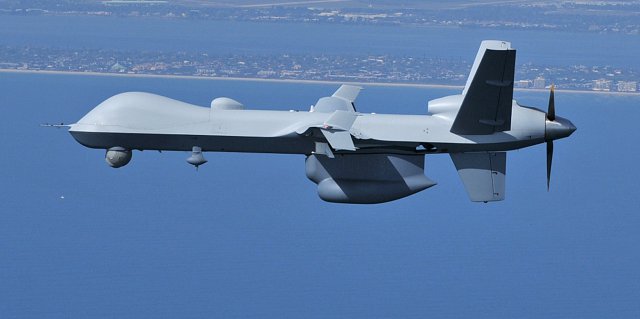
    General Atomics' Guardian is a marinized verstion of the MQ-9 Reaper, designed for maritime and border patrol missions. Photo: General Atomics
    General Atomics’ Guardian is a marinized verstion of the MQ-9 Reaper, designed for maritime and border patrol missions. Photo: General Atomics

    Canada’s military wants its next unmanned aircraft system to be cap­able of dropping search-and-rescue sup­plies in the Arctic and in other areas as it looks to expand UAS roles into activities formerly conducted by manned platforms.

    According to UAS Vision, Canada plans to spend between CAN $1 billion (US $998 million) and $1.5 billion on a new fleet of UAS.

    Hermes 900 Maritime Equipped with Maritime Patrol Radar (MPR) and EO & IR Payloads. Photo: Elbit Systems
    Hermes 900 Maritime Equipped with Maritime Patrol Radar (MPR) and EO & IR Payloads. Photo: Elbit Systems

    Lieutenant-General Yvan Blondin, head of the Royal Canadian Air Force, explained “I would like to have a UAS that can carry some equipment, whether it is weapons or other equipment, to be able, when it is patrolling the Arctic, to carry a search-and-rescue package that I can drop any time I want or need to,” Blondin said. “For UAS, we are looking at the requirement to work from home to be able to do maritime patrol, to do a bit of what the Auroras are doing and be able to patrol the coast,” he added. Aurora maritime surveillance aircraft are a variant of the US Navy’s P-3 Orion. UASs are also going to need greater range and endurance for long patrols, and “be our eyes in the sky in the Arctic”, said Blondin.

    The Air Force did not respond to questions about whether it would be willing to fund research and testing into adding equipment transport capability to UAS. But a National Defense Department source said the Air Force hopes industry will provide solutions to Canada’s project to purchase the UAS, known as the Canadian Forces Joint UAV Surveillance and Target Acquisition System (JUSTAS). Adding additional weight for every mission of an unmanned mission is unlikely as the extra weight will reduce the volume of fuel carried on board, dramatically reducing mission endurance, increasing system’s wear (due to excessive takeoff and landing) and increasing the risk of losing aircraft (caused often by takeoff or landing)

    The Air Force’s quest for leading-edge UAS technology has raised some concerns. John McKay, the defense critic for the opposition Liberal Party in the House of Commons, said he is worried that adding such a capability would further delay JUSTAS, which has already fallen years behind schedule.

    Source: I-HLS

    Heron TP, IAI
    Heron TP, IAI

    IMDEX 2013: World navies Gather in Singapore

    Warships-IMDEX-2013_960
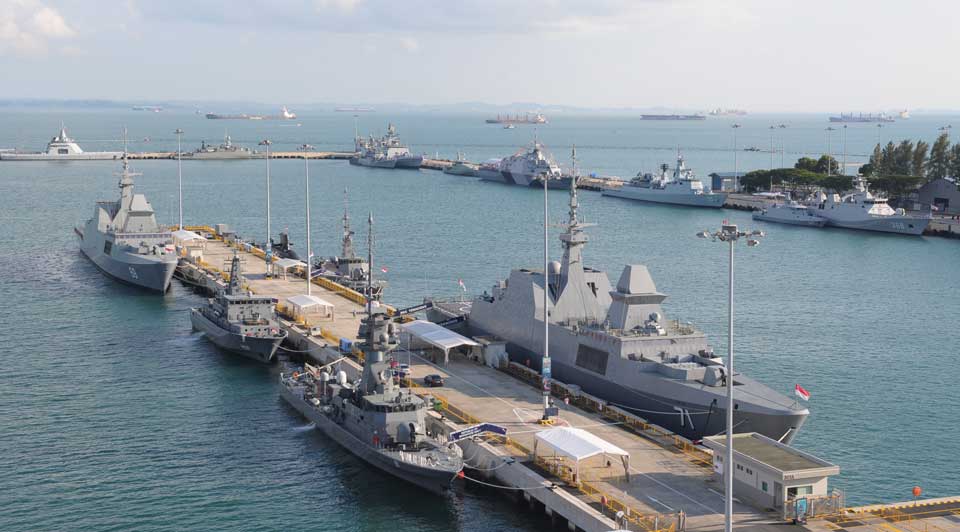
    15 vessels from nine navies have gathered in Singapore for IMDEX ASIA 2013. Photo: IMDEX Asia

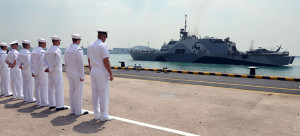
    Changi Naval Base, Singapore: 15 warships from nine countries around the world, including the latest patrol vessels, frigates, corvettes and destroyers, sailed into Singapore for the Warships Display at IMDEX Asia 2013 this week. The US Navy’s first ever littoral combat ship, USS Freedom, in its maiden overseas deployment, was among the warships at Changi Naval Base.

    Visit IAI at IMDEX 2013
    Visit IAI at IMDEX 2013

    The picture shows some of the visiting vessels cisiting IMDEX this year, including (in clockwise order): RSS Valiant (Victory Class corvette P91), RSS Bedok mine countermeasure boat (M105), RSS Formidable (F68) and RSS Tenacious (F71), both Formidable (La Fayette) Class frigates.

    In the background, left is Ladroite, the French experimental OPV, with the Royal Thai Navy HTMS Rattanakosin (F441) to its right, the Shivalik class Frigate INS Satpura (F48) and Kora class Corvette (P62) INS Kirch, both from India. The Australian Armidale class Patrol Craft HMAS Bathurst is seen by the side of the USS Freedom, the first Littoral Combat Ship of the US Navy.

    The Malaysian frigate KD Lekiu frigate (30), Indonesian KCR 40 class patrol craft KRI Kujang [642] and Diponegoro Class Corvette KRI Frans Kaisiepo [368] are closing this impressive line up at the Changi Naval Base in Singapore. Two vessels from Singapore are filling in for the two vessels that were scheduled to arrive from South Korea.

    Defense-Update IMDEX ASIA 2013 VideoReport


    Following is a collection of photos from the first day at IMDEX Asia

    The new Littoral Mission Vessel (LMV) class program for Singapore comprises eight 1,200-tonne vessels. The program is being led by ST Marine as prime contractor. These boats will replace the country’s current Fearless-class patrol vessels.
    The new Littoral Mission Vessel (LMV) class program for Singapore comprises eight 1,200-tonne vessels. The program is being led by ST Marine as prime contractor. These boats will replace the country’s current Fearless-class patrol vessels.
    lm_mms
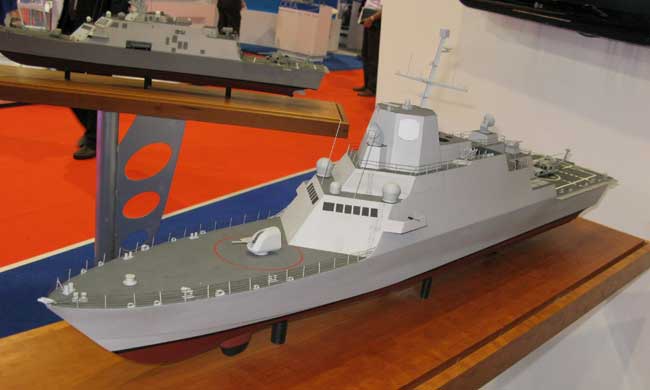
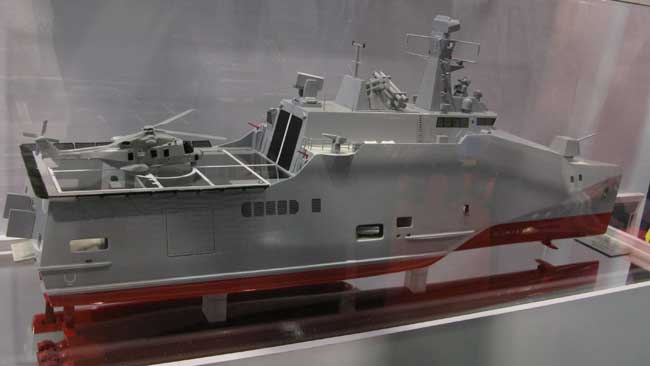
    Lockheed Martin is offering the Multi-mission Combatant (MMC), a stretched version of the current LCS.
    austal_lsv
    Austal is offering a Trimaran design similar to the Independence Class 127 meter LCS, for a more compact 80 meter Multi-Role Vessel (MRV). This ship will be constructed of aluminum and have a deadweight of 400 tonnes. It will feature a flight deck of 290 m2 and hangar, supporting H-60 class helicopter. The maximum speed will be 26 knots, but when cruising at a speed of 12 knots the ship will be able to sustain missions of 28 days at ranges of 4,500 nm.
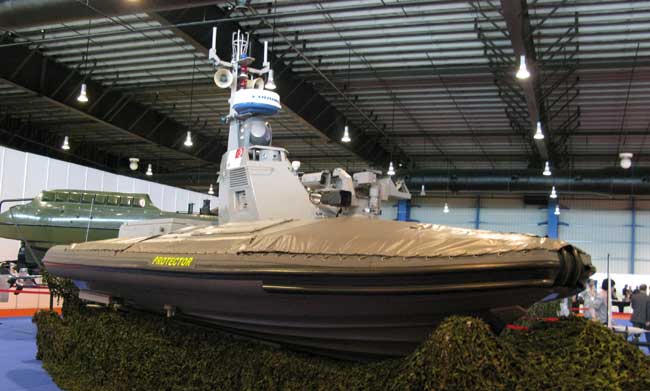
    The Protector Unmanned Surface Vessel was the first USV used by the Singapore Navy.
    The Protector Unmanned Surface Vessel was the first USV used by the Singapore Navy.
    typhoon_mls
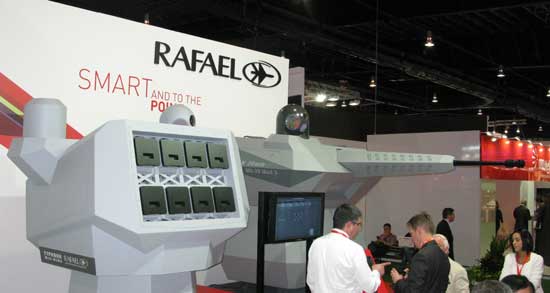
    RAFAEL displayed models of the Typhoon 30 and Typhoon MLS-NLOS.
    cj130sc
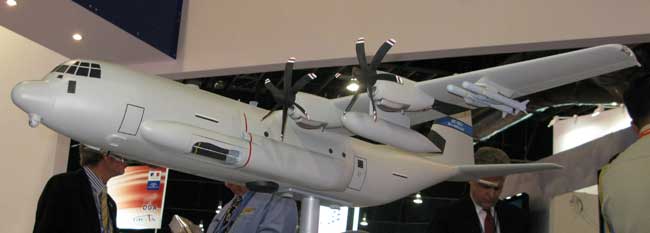
    Lockheed Martin displayed here a model of the proposed CJ-130SC designed to replace the Orion P-3C currently in service with many world navies. Note the surface attack missiles carried underwing and ASW torpedoes carried on the belly sides.

    The Ugly End to the Largest Service Contract In U.S History

    Dealings between KBR and the Army have gotten “very nasty” as the two try to close out the largest government services contract in U.S. history, according to an article in Federal Times.

    The dispute is over whether the remaining work in the $38 billion Logistics Civil Augmentation Program (LOGCAP) III should be completed on a fixed price basis, which the Army wants, or a cost-reimbursable basis, which is what KBR wants. The LOGCAP III contract provides everything from food to housing for the U.S. military in Iraq. In 2010 KBR was awarded the follow-on LOGCAP IV, supporting Corps Logistics Support Services (CLSS), Theater Transportation mission (TTM), and Postal Services Task Order in Iraq. The Period of Performance is one base year plus four option years. The award represented KBR’s first major Task Order under the LOGCAP IV contract.

    By its own estimates, KBR says the closeout work on the contract will cost more than $500 million and take up to 13 years. The final decision on the closeout, as well as years of still-unresolved audits, could cost or save the government hundreds of millions of dollars in additional costs.

    The dispute has led to a badly damaged relationship between the Army and one of its largest contractors. Army officials sent KBR an ultimatum on the fixed-price issue, and KBR has responded with a lawsuit.

    European Air Forces Seek a Common Weaponized UAS

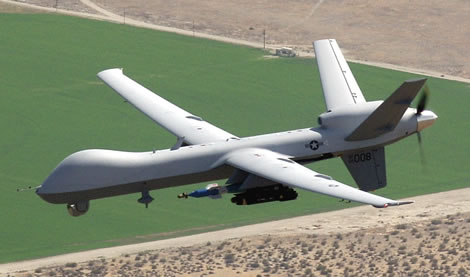
    An MQ-9 Reaper is tasked with armed recce missions, armed with laser guided bombs and Hellfire missiles. At present, France intends to use its new Reapers for ISR missions. Photo: General Atomics
    Illustration-Photo-Credit-IAI-Heron
    Illustration-Photo-Credit-IAI-Heron

    Some European countries may consider an Israeli made unmanned air system (UAS) as a platform for a “Black program” to create a European medium-altitude/long-endurance (MALE) armed UAS, I-HLS reports.

    This is the assessment of European sources familiar with the advanced Israeli made UAS.

    According to Aviation Week, frustrated by apparent U.S. ambivalence in granting authority to integrate weapons onto its Reaper aircraft, the Italian air force is looking at possible alternatives, including a yet-to-be-announced “black program” to create a European Medium Altitude/Long-Endurance (MALE) armed UAV. Several European air forces have long planned to arm their UAS but non of the NATO nations have sofar reached this goal.

    Membersd can get further analysis for this article

    While the Italian aircraft manufacturer Alenia Aermacchi is already developing a MALE drone (SKY-E), Italy decided to purchased the General Atomics MQ-1 Predator and MQ-9 because they were readily available to support operations in Afghanistan. The decision has put Italy at the whim of the U.S. government in terms of upgrades. But weaponizing these UAVs is a “high priority” for Italian forces, says Gen. Alberto Rosso, logistics branch chief for the Italian air force. “The U.S. is not the only country with the capability to provide those capabilities,” he says. “If we are unable to meet those requirements, we are already looking for alternatives.”

    Along those lines, Rome is in talks with potential European partners to move forward with a weaponized UAS that Debertolis refers to as a “Super MALE.” One of its principal requirements would be for it to deploy weapons, he says.

    This “Super MALE” is currently a “black program,” Debertolis says, providing little details. Work has not yet begun because partners haven’t yet agreed on a way ahead. But the goal would be to field something using existing technology by around 2017.

    This project, if it moves forward, could be unveiled at the Paris Air Show in Le Bourget next month, Debertolis said.

    Massive Rocket Launcher for the UAE

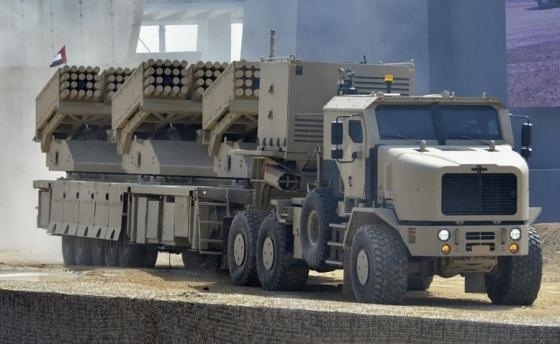
    The MCL demonstrated at the recent IDEX show.

    20130513-204633.jpg

    The UAE is getting ready to face the Iranian threat. Jobaria Defense Systems (JDS) Multiple Cradle Launcher MCL has unveiled its Multiple Cradle 122mm Rocket launcher system at the recent IDEX defense expo in the UAE. I-HLS reports.

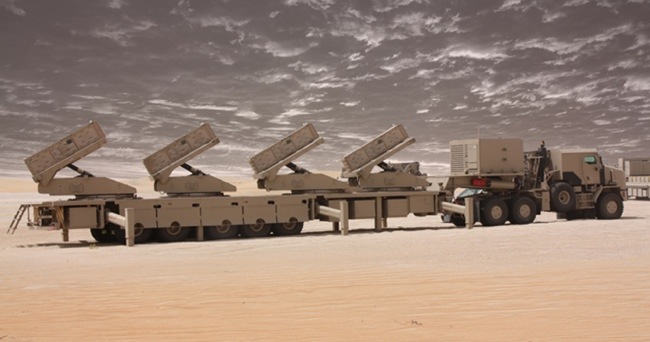
    The MCL is A 10 wheel semitrailer mounting four power-operated rocket launchers, each carrying 60 x122mm rockets in three blocks of 20 rockets each. The system can fire Roketsan 122mm TR-122 rockets fitted with a high explosive (HE) warhead activated by a point detonating fuze or Roketsan TRB-122 rockets fitted with HE steel ball warhead activated by a proximity fuze. The maximum range is being quoted as 40km, with a minimum range of 16km.

    The semi-trailer is equipped with an auxiliary power unit allowing more autonomy for the weapon system. 10 stabilizers extracted before firing are used to level the platform. A global positioning/inertial navigation system and computerized fire control system are used for position location and increased accuracy. The operator can select firing a single pod, a number of pods, or fire the full load of 240 rockets in under two minutes. Each launcher cradle is also provided with an independent inertial reference unit, enabling accurate ballistic setting even under rapid salvo firing.

    The platform is towed by an Oshkosh Defense 6×6 Heavy Equipment Transporter (HET). HET is fitted with a protected cab, an air conditioning system and a central tyre inflation system. The entire system is operated by a crew of three: commander, navigator and driver and can be operated in an autonomous mode or integrated in an overall higher-level artillery fire control system.

    Once the rockets have been launched, the system would normally redeploy to another position where new pods of rockets would be rapidly loaded using the on-board crane of the dedicated support vehicle.

    Read our analysts assessment – accessible to Members

    The MCL demonstrated at the recent IDEX show.
    The MCL demonstrated at the recent IDEX show.

    SNPE to Merge into GIAT Industries

    Two major French defense companies, GIAT Industries and SNPE will be merging into a singleventity. The two companies are both owned by the French state, which supports the move.
    The mergerv will retain the activities, strategies and customer base of each company. By unifying complimentary activities the merged company will be able to shed redundant overhead. The merger is expected to be completed this year, with SNPE to be merged into GIAT Industries.

    GIAT Industries is one of the largest defense companies in France, focusing in land systems and munitions. Its main asset is the holding of the French weapon manufacturer Nexter Systems. With turnover of 736 million Euros in 2012. SNPE, through its subsidiary Eurenco, is the European leader in propellant powders and explosives for civil and military use.

    Typhoon Expanding into Multi-Role Weapon Stations

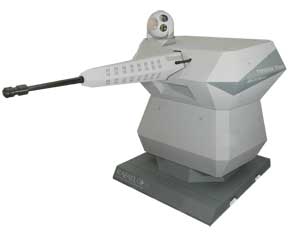
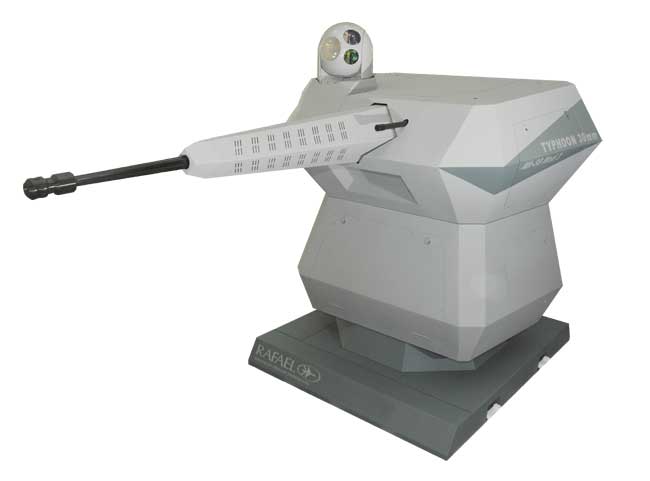
    The new configuration of Typhoon 30mm mounts an ATK Mk-44 Bushmaster II automatic cannon, with 400 rounds in ready magazines. The gun fires standard 30mm ammo including the new airburst (ABM).
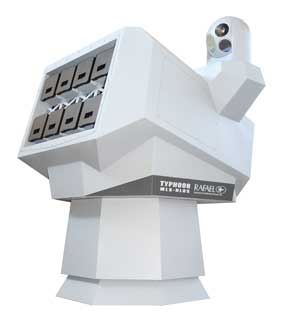
    TYPHOON MLS NLOS configuration has eight Spike NLOS missile launchers and integrated Toplite stabilized observation and target acquisition system. Photo: RAFAEL
    TYPHOON MLS NLOS configuration has eight Spike NLOS missile launchers and integrated Toplite stabilized observation and target acquisition system. Photo: RAFAEL

    Visit IAI at IMDEX 2013
    Visit IAI at IMDEX 2013
    RAFAEL is unveiling at IMDEX 2013 a new missile-carrying variants of the Typhoon marine stabilized weapon system. Defense-Update reports from IMDEX Asia 2013.

    Two systems – MLS-ER and MLS-NLOS represent two modular evolutions of the combat proven Typhoon, enhancing the operational capabilities of small and medium naval crafts, responding to evolving requirements of navies facing new asymmetric threats. The MLS utilizes the standard Typhoon pedestal, electronics and control systems providing a complete naval missile and gun system.

    RAFAEL’s latest variant of Typhoon Stabilized Naval Gun carries the ATK Mk 44 Bushmaster II automatic cannon, which is currently considered the optimal weapon for small boats. Over 350 such systems have been delivered and are operational with 15 navies worldwide. This design features well over 90% commonality with the U.S. Navy’s fielded Mk 38 incorporating the same electronics and man-machine interfaces. The Typhoon adds significant capability for shipboard defense against small, fast, and agile surface threats.

    The company has recently launched an upgrade program, enabling Typhoon operators, using the M242 Bushmaster cannon to upgrade their Typhoon mounts to the more powerful Mk44 cannon. This cannon fires all 30mm x 173mm NATO Standard ammunition and is also capable of firing the new programmable airburst munitions (ABM). The mount also features two options for a Coaxial Mounted Machine Gun – either the M2HB 0.5 caliber or a 7.62mm machine gun with remote charging capability built-in. The new mount has a magazine capacity of over 400 ready 30mm rounds, compared 200x25mm rounds in the current configuration. Retaining the M242, the new mount will more than double ammunition capacity to 500 rounds.

    Source: Defense-Update

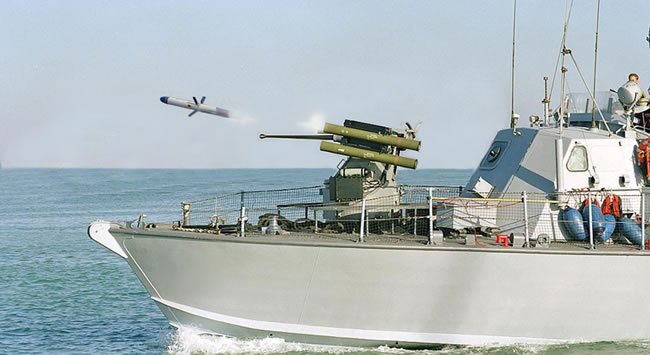
    Spike LR Missile launched from a Typhoon weapon station on an Israel Navy Super Dvora Mk 2. A similar configuration was recently tested by the US Navy, from an unmanned surface vessel (USV-PEM). Photo: RAFAEL
    Spike LR Missile launched from a Typhoon weapon station on an Israel Navy Super Dvora Mk 2. A similar configuration was recently tested by the US Navy, from an unmanned surface vessel (USV-PEM). Photo: RAFAEL

    Typhoon Expanding into Multi-Role Weapon Stations

    The new configuration of Typhoon 30mm mounts an ATK Mk-44 Bushmaster II automatic cannon, with 400 rounds in ready magazines. The gun fires standard 30mm ammo including the new airburst (ABM).
    TYPHOON MLS NLOS configuration has eight Spike NLOS missile launchers and integrated Toplite stabilized observation and target acquisition system. Photo: RAFAEL
    TYPHOON MLS NLOS configuration has eight Spike NLOS missile launchers and integrated Toplite stabilized observation and target acquisition system. Photo: RAFAEL

    RAFAEL is unveiling new missile-carrying variants of the Typhoon marine stabilized weapon system at IMDEX 2013. Two systems – MLS-ER and MLS-NLOS represent two modular evolutions of the combat proven Typhoon, enhancing the operational capabilities of small and medium naval crafts, responding to evolving requirements of navies facing new asymmetric threats.

    Visit IAI at IMDEX 2013
    Visit IAI at IMDEX 2013

    The MLS utilizes the standard Typhoon pedestal, electronics and control systems providing a complete naval missile and gun system. Defense-Update reports from IMDEX 2013.

    This is an excerpt of an article currently reserved for members only.

    30mm Typhoon to Upgrade 25mm Gun Mounts

    RAFAEL’s latest variant of Typhoon Stabilized Naval Gun carries the ATK Mk 44 Bushmaster II automatic cannon, which is currently considered the optimal weapon for small boats. Over 350 such systems have been delivered and are operational with 15 navies worldwide. This design features well over 90% commonality with the U.S. Navy’s fielded Mk 38 incorporating the same electronics and man-machine interfaces. The Typhoon adds significant capability for shipboard defense against small, fast, and agile surface threats.

    The company has recently launched an upgrade program, enabling Typhoon operators, using the M242 Bushmaster cannon to upgrade their Typhoon mounts to the more powerful Mk44 cannon. This cannon fires all 30mm x 173mm NATO Standard ammunition and is also capable of firing the new programmable airburst munitions (ABM). The mount also features two options for a Coaxial Mounted Machine Gun – either the M2HB 0.5 caliber or a 7.62mm machine gun with remote charging capability built-in. The new mount has a magazine capacity of over 400 ready 30mm rounds, compared 200x25mm rounds in the current configuration. Retaining the M242, the new mount will more than double ammunition capacity to 500 rounds.

    The new configuration of Typhoon 30mm stabilized gun system mounts the ATK Bushmaster II automatic gun with 400 rounds in the ready magazine. The gun fires standard 30mm high explosive rounds as well as the new airburst munitions (ABM).
    The new configuration of Typhoon 30mm stabilized gun system mounts the ATK Bushmaster II automatic gun with 400 rounds in the ready magazine. The gun fires standard 30mm high explosive rounds as well as the new airburst munitions (ABM).

    Small Boats – Big Gains!

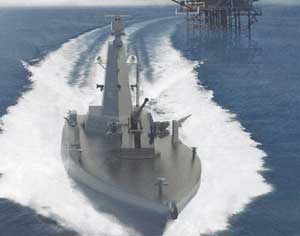
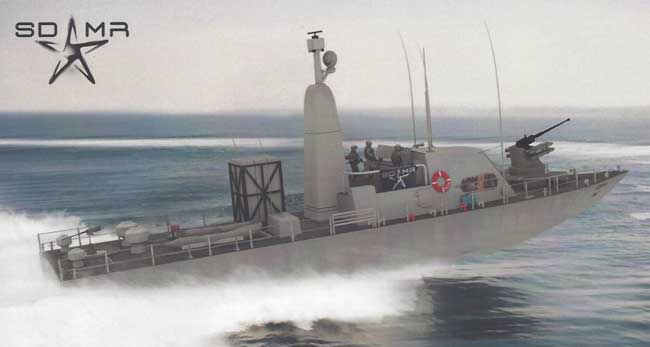
    The Super-Dvora Unmanned Surface Vessel (SD-USV) concept - proposed for maritime surveillance and EEZ patrol missions.
    Super Dvora Multi Role concept drawing
    Super Dvora Multi Role concept drawing
    Visit IAI at IMDEX 2013
    Visit IAI at IMDEX 2013

    As domestic economies change into a global market, dependent on the ocean for energy, food and transportation, the open seas becoming contested areas, and pirates, outlaws and terrorists using isolated littorals as safe haven, prowling waterways and the open sea along international merchant routes, no wonder that governments are looking for new means to deal with the new challenges. Defense-Update reports from IMDEX 2013.

    Changing interest span from securing off-shore assets throughout littoral and Economical Exclusion Zone (EEZ), protecting economical rights including fishery, mineral resources and merchant marine routes. Coastal protection, particularly addressing terror threats and infiltration from the sea, is also critical in defending urban centers, key infrastructure, port facilities, power stations and other strategic assets.

    With the rising costs of maritime security, government agencies are interested in smaller, highly versatile boats that could operate effectively in peacetime, emergency and at war. Boats that can effectively chase smugglers, and human traffickers, defeat well-armed terror attacks and become part of the nation’s maritime power in time of war.

    This is an excerpt of an article currently reserved for members only.

    An affordable ‘interceptor’ type boat, Mini-Dvora enables fast and highly responsive teams to efficiently cover large areas from forward operating bases. Requiring low maintenance and minimal shore support, these boats can efficiently operate either under naval flotillas or independently, from small port facilities under coast guard control. Forward deployment can dramatically save transit time back and forth to their patrol areas, further improving utilization and lowering operating cost. With smaller boats, lower fuel costs, and minimal crews, life cycle cost of small boats is significantly lower than larger vessels. Moreover, preventive maintenance is also shorter – requiring few weeks every two years to bring the boat back in shape.

    The SDMR variant uses a the Super-Dvora Mk III hull designed with a modular approach, enabling the customer to integrate specific mission systems, thus modifying the boat for new missions. These include coastal defense, surface attack, command and control etc.

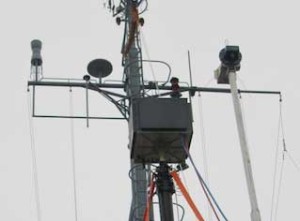
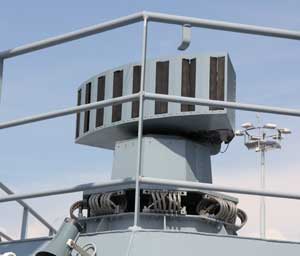
    The Navguard radar developed by IAI Elta Systems is a common system shared by all configurations. This radar detects all types of threats, including guided or unguided missiles fired at the boat. The system is configured in a four-panel scheme, fully integrated with signal processing and target acquisition necessary to drive active protection systems. The system’s modules are connected via fiber-optical links, for maximum speed and security. The system uses fiber-optical has already been tested at sea, proving excellent results. A unique capability offering the SDMR a high level of survivability, particularly against asymmetric threats,

    In addition to self-protection, the boat is also equipped with a stabilized electro-optical payload with an integrated laser designation capability, supporting precision attack weapons. Other sensors include passive EO, communications (COMINT) and other electronic signals detector ESM.

    According to Ramta, on the SMDR, a crew of 10 can effectively fulfill all tasks. The key to such efficiency is newly designed Combat Information Center (CIC) and operating consoles. Instead of dedicating specific console for each task (detection, identification, defensive systems, offensive systems, situational display, communications etc.) IAI introduced a common, compact operating station integrating all functions into a single display, similar to those used in the cockpit of fighter aircraft. Specific tasks are shown on different displays, integrated into the situational picture, which also supports routine operations. A typical CIC layout in the SDMR comprises three common and interchangeable workstations that support regular operations in peacetime and can be easily reconfigured into detection, defense and offense workstations at war. To simplify these tasks the system employs extensive automation to simplify and expedite certain processes by minimizing user interactions.

    The Super-Dvora Unmanned Surface Vessel (SD-USV) concept - proposed for maritime surveillance and EEZ patrol missions.
    The Super-Dvora Unmanned Surface Vessel (SD-USV) concept – proposed for maritime surveillance and EEZ patrol missions.

    Eventually, IAI/Ramta plans to expand the Super Dvora to unmanned surface vessels, extending capabilities developed and fielded by the company in the past 30 years. Such autonomous vessels would establish routine patrols, generate the marine situational picture required for operation and security, supporting manned and unmanned operators with maximum security at an affordable cost.

    Source: Defense-Update

    Self Protection for Small Boats

    Rheinmetall 'soft kill' system fires a blinding smoke screen against an incoming target. Photo: Rheinmetall
    navguard_test300
    The NavGuard (EL/M-2222S) Naval Self Protection System from IAI Elta mounted on the mast of a German vessel undergoing NATO testing. Photo: Elta Systems

    Fighting modern warfare doesn’t mean you face the most sophisticated weapons or strongest enemies. In fact, combat in asymmetric warfare means facing an illusive enemy that, sometime can be equipped with superior weapons, challenging even the strongest armor and most sophisticated platforms. This article addresses countermeasures to a different type of threat – guided missiles fired from the coast, which are becoming relevant in unsecured littorals. Countermeasures used against such threats employ active or passive means. Defense-Update reports from IMDEX.

    Visit IAI at IMDEX 2013
    Visit IAI at IMDEX 2013

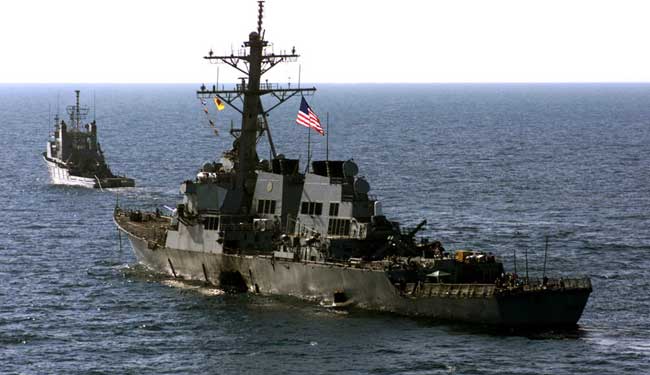
    The attack on USS Cole in Yemen in October 2000 demonstrated the vulnerability of blue-water naval vessels to asymmetric threats. Attacks by swarms of small boats are considered an imminent threat to military vessels, in the Persian Gulf, as well as in other littoral hotspots. But as many navies operating in littorals have realized, precision guided missiles are not less threatening. In fact, the risk of such attacks have caused a number navies facing such perils to avoid presence in certain littoral areas considered too risky. Instead, they prefer to maintain their patrols at safe stand-off distance from the shore, or minimize missions into riverines without the coverage of supporting air or land forces.

    While ‘pocket’ anti-ship missiles such as the C-701 are already shipping from Iran to terror groups in the Middle East, simpler anti-tank guided missiles like the TOW II (3+ km range) or KORNET (5 km range) fired from shore pose a significant risk to vessels in their effective range – particularly small patrol boats that patrol close to the coastline or larger vessels passing close to the shore. These vessels are particularly vulnerable when such missiles hit certain weak points.

    Each MASS decoy launcher stores 32 countermeasure decoys.
    Each MASS decoy launcher stores 32 countermeasure decoys.

    Active protection systems (APS) used on main battle tanks are often too violent for naval vessels. Moreover, ‘Soft Kill’ smart countermeasures are proven relatively effective against most types of guided missiles, when employed in the proper methodology and in time to defeat the threat.

    A different system currently under development at IAI ELTA is designed to protection small boats. The core of the system is the new NAVGUARD self-protection system, employing a lightweight four-panel radar based on advanced digital phased array antennae technology. The company is unveiling the system at the IMDEX Asia event in Singapore this week. The radar performs automatic detection, classification and verification of threats, in single or multiple threat scenarios. It is capable of detecting small incoming guided missiles, such as MILAN, SAGGER or FAGOTT, and thus closes a vulnerability gap when it comes to protecting vessels in littoral zones. It can operate independently of all other systems on-board, maintaining full alert to incoming threat at all time. Providing Missile Approach Warning (MAW) the radar triggers various response systems, such as smoke dispensers, chaff or flares. The whole NAVGUARD system can be mounted around the main mast, just below the vessel’s navigation radar. The lightweight system comprising four phased array antennae, main electronic box and two to four countermeasure launchers weighs about 130 kg.

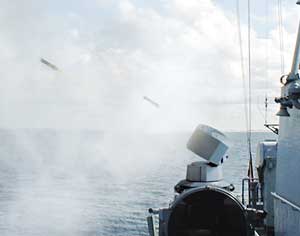
    Rheinmetall 'soft kill' system fires a blinding smoke screen against an incoming target. Photo: Rheinmetall
    Rheinmetall ‘soft kill’ system fires a blinding smoke screen against an incoming target. Photo: Rheinmetall

    ELTA has already integrated the NAVGUARD with the Rheinmetall Defence MASS system – a programmable countermeasure launcher with omnispectral coverage, designed to protect vessels of any size. Each launcher stores 32 rounds, assuring protection in all relevant wavelengths of the electromagnetic spectrum (radar, infrared, laser, electro-optic, ultraviolet). MASS can be operated either in standalone mode or as an integral part of the ship’s networked command, control and weapon engagement systems. Activation by cueing from the radar enables the system to deploy its effect at the most efficient way. In 2012 the NAVGUARD system was tested for the first time on a German vessel, effectively detecting and classifying guided missiles fired at it from different ranges. Follow-on tests will evaluate the systems’ end-to-end performance. The tests lead by the German Navy and Rheinmetall are conducted under NATO’s ‘Smart Defense’.

    Rheinmetall also offers an even smaller launcher known as “Rosy”, modified for naval applications. This 40 mm decoy system produces an instantaneous wall of radar-absorbing smoke/obscurant that makes optical and infrared detection impossible.

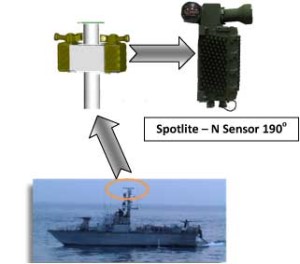
    RAFAEL's Spotlite N conceptual system layout
    RAFAEL’s Spotlite N conceptual system layout

    A different type of sensor is the Spotlite N from RAFAEL. This electro-optical sensor effectively detects and localizes firing sources within effective range, enabling the vessel’s crew to engage the threat using on-board weapons such as the Typjhoon stabilized, remortely controlled cannon.

    The Spotlite-N is a stabilized, staring EO/IR sensor, a derivative of RAFAEL’s Spotlite system, currently available in dismounted and vehicular configurations. automatically detects, classifies and tracks fire sources such as small arms, rockets, and guided missiles. The system incorporates the sensors and the electronic section including the advanced Multi algorithms/processing computer. The sensor has a field of regard covering – 360 degrees in azimuth and 90 degrees in elevation with multi-target tracking (MTT) capability. The prime mission of the system is to provide the crew with the capability to Detect, Locate, Classify & Track fire sources like: Small arms, rockets, missiles, ATGMS, shells etc. For defense purposes the Spotlite N can slave and direct weapon and other systems (guns, missiles, EO payloads, Radars etc). RAFAEL will display the Spotlite N in IMDEX Asia naval expo this weel in Singapore.

    The attack on USS Cole in the year 2000 proved the vulnerability of naval vessels to asymmetric threats. In the case of the Cole it was small rubber boats, but the danger from RPGs and guided missiles is also significant, particularly to small boats patrolling coastlines, littorals and riverine. Photo: US Navy
    The attack on USS Cole in the year 2000 proved the vulnerability of naval vessels to asymmetric threats. In the case of the Cole it was small rubber boats, but the danger from RPGs and guided missiles is also significant, particularly to small boats patrolling coastlines, littorals and riverine. Photo: US Navy

    Record Growth of IMDEX ASIA reflects Asia-Pacific Market Trend

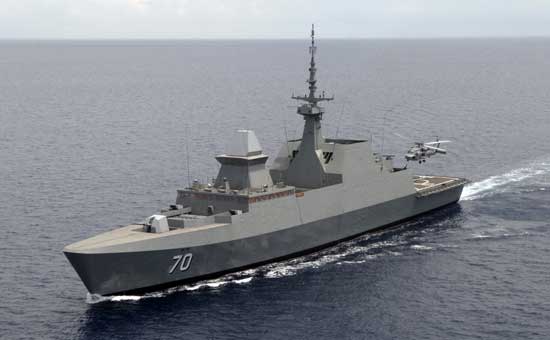
    RSS Steadfast is one of four Formidable class missile frigates in service with the Singapore Navy. Two of her sister ships -- RSS Formidable and RSS Tenacious will be open for delegates visits during the IMDEX 2013 exhibition.
    RSS Steadfast is one of four Formidable class missile frigates in service with the Singapore Navy. Two of her sister ships — RSS Formidable and RSS Tenacious will be open for delegates visits during the IMDEX 2013 exhibition.

    Exhibitors and delegates at the ninth International Maritime Defence Exhibition and Conference (IMDEX Asia) will have the opportunity to meet more key players from international navies, coast guards and maritime agencies as the biennial exhibition is set to host the highest number ever of Navy Chiefs from all over the world. This year’s show has attracted a record number of 21 Navy Chiefs from all over the world. In total, some 30 Chiefs of Navy, Coast Guard Directors-General and heads of maritime agencies from the Asia-Pacific region and beyond arewill attending at the show. The biennial show is organised by Experia Events with the support of the Republic of Singapore Navy.

    Visit IAI at IMDEX 2013
    Visit IAI at IMDEX 2013

    Defense Update is covering the event on site, reporting news and features on Asia-Pacific maritime topics through the week.

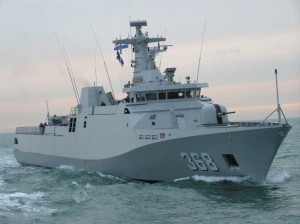
    Another vessel visiting Singapore for IMDEX is KRI Frans Kaisiepo, the new SIGMA Class missile corvette built by the Dutch Schelde shipyard for the Indonesian Navy. The vessel was delivered in 2009.
    Another vessel visiting Singapore for IMDEX is KRI Frans Kaisiepo, the new SIGMA Class missile corvette built by the Dutch Schelde shipyard for the Indonesian Navy. The vessel was delivered in 2009.

    Mr Jimmy Lau, Managing Director of Experia Events, said: “It is extremely encouraging to see that, despite uncertainty in the global economy, a record number of almost 200 companies have signed up to participate in IMDEX Asia 2013. The strong support from all our exhibitors affirms IMDEX Asia’s status as a must-attend event in the international naval and maritime defence calendar. This year’s show is set to be our biggest ever and we look forward to a successful few days ahead.”

    IMDEX Asia, returning for its ninth edition from 14 to 16 May 2013 at the Changi Exhibition Centre (CEC) in Singapore, is recognised as Asia-Pacific’s foremost maritime defence show. Some 30 Navy Chiefs, Coast Guard Directors-General and heads of maritime agencies in the Asia Pacific region and beyond will be taking part in the event. IMDEX Asia 2013 will also showcase 15 warships from 9 navies from around the world with the participation of 15 warships from nine countries including Australia, France, India, Indonesia, Korea, Malaysia, Thailand, the United States and Singapore. These vessels will include, for the first time, the new Littoral Combat Ship (LCS-1) USS Freedom, which has just arrived in Singapore.

    The Republic of Singapore Navy (RSN) is hosting the Maritime Information Sharing Exercise (MARISX) and the Western Pacific Multilateral Sea Exercise (WMSX), bringing together navies and maritime agencies to foster international co-operation.

    Debuting at this year’s IMDEX Asia are Technology Seminars, which provide a platform for exhibitors to present their latest and most innovative technologies to potential buyers from the Asia-Pacific region and beyond. The exhibition will also highlight an array of rigid-inflatable boats (RIBs) and unmanned aerial systems (UAS) in the Static Display.

    IMDEX Asia 2013 will feature 194 participating companies from 29 countries around the world. This represents a 17% increase in exhibitors from IMDEX Asia 2011. As a testament to the show’s significance and continued ability to attract top companies, 40% are new exhibitors, including Devor Technologies, Fincantieri, Liquid Robotics, Lürssen Marine Technology, Scania, Schiebel, Westport Shipyard and Viking Air. Returning exhibitors include industry heavyweights such as Austal, DCNS, Lockheed Martin, MBDA, ST Engineering and ThyssenKrupp Marine. Among the Israeli exhibitors are IAI, RAFAEL, Elbit Systems, and Israel Shipyards.

    Country/group pavilions at IMDEX Asia 2013 include Australia, France, Germany, Denmark, Italy, Singapore and the UK, as well as, for the first time ever, Israel. The Danish Pavilion, led by Naval Team Denmark, is making its return to IMDEX Asia 2013 with an even larger presence following its debut appearance in 2009.

    Jimmy Lau said: “The increasing number of Navy Chiefs and VIPs attending IMDEX Asia is a testament to the growing stature of the event globally. With the Asia-Pacific region now the world’s second largest naval market, IMDEX Asia is more than ever a must-attend show in the international naval and maritime defence calendar. With new highlights and features in place for this year, we are confident that IMDEX Asia 2013 is more than ready to deliver an even greater experience for both exhibitors and visitors.”

    Held in conjunction with IMDEX Asia will be high-level conferences such as the prestigious invitation-only International Maritime Security Conference (IMSC) and the first ever Asian edition of the International Naval Engineering Conference (INEC@IMDEX Asia). IMSC will gather Navy Chiefs, Directors-General of Coast Guard and heads of maritime agencies from around the world to discuss evolving challenges to naval security. “Conferences such as IMSC not only strengthen IMDEX Asia’s position as a mustattend event in the international maritime industry calendar, they also play an important role in cementing Singapore’s status as an important maritime hub” Lau added.

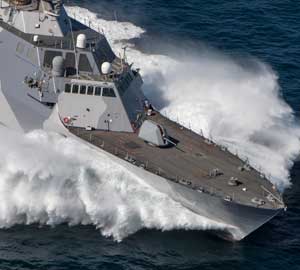
    USS Freedom (LCS 1), which deployed from San Diego in March with an MH-60 Romeo maritime helicopter, arrived in Changi, Singapore, April 18 as part of its deployment to Southeast Asia. Photo courtesy U.S. Navy.
    USS Freedom (LCS 1), which deployed from San Diego in March with an MH-60 Romeo maritime helicopter, arrived in Changi, Singapore, April 18 as part of its deployment to Southeast Asia. Photo courtesy U.S. Navy.

    Electrically Powered Ion Tiger Drone Set 48 hour Flight Record

    Researchers at the U.S. Naval Research Laboratory flew their fuel cell powered Ion Tiger UAV for 48 hours and 1 minute on April 16-18 by using liquid hydrogen fuel in a new, NRL-developed, cryogenic fuel storage tank and delivery system. This flight shatters their previous record of 26 hours and 2 minutes set in 2009 using the same vehicle, but with gaseous hydrogen stored at 5000 psi.

    Liquid hydrogen is three times denser than 5000-psi compressed hydrogen. The cryogenic liquid is stored in a lightweight tank, allowing more hydrogen to be carried onboard to increase flight endurance. Success in flight requires developing a high quality, lightweight insulated flight dewar for the cryogenic fuel, plus matching the boil off of the cryogenic hydrogen to the vehicle fuel consumption.

    “Liquid hydrogen coupled with fuel-cell technology has the potential to expand the utility of small unmanned systems by greatly increasing endurance while still affording all the benefits of electric propulsion,” said Dr. Karen Swider-Lyons, NRL principal investigator.

    Although long endurance is possible with conventional, hydrocarbon-fueled systems, these are usually loud, inefficient, and unreliable in this aircraft class. Similarly, small, electric, battery-powered systems are limited to endurances of only several hours. To address the logistics of in-theater supply of liquid or gaseous hydrogen, NRL proposes in-situ manufacture of LH2 for use as fuel. An electrolyzer-based system would require only water for feedstock, and electricity, possibly from solar or wind, to electrolyze, compress, and refrigerate the fuel. The NRL LH2 flight capability is being developed by NRL’s Tactical Electronic Warfare and Chemistry Divisions, and is sponsored by the Office of Naval Research.

    20130512-210523.jpg

    Second M346 Down

    An Italian built M-346 jet trainer crashed yesterday on a flight over Italy. The aircraft manufacturer Alenia Aermacchi said the single pilot that flew the twin-engine jet is in a good condition after ejecting from the plane designated CMX617 yesterday, after taking off from taking off from Turin-Caselle airport. The aircaft was one of four prototypes built by Alenia as part of the advanced trainer development program.

    The mishape developed 20 minutes into the flight, as the pilot reported a technical problem. The aircraft crashed in Val Bormida, between the provinces of Cuneo and Savona, without damage to people or properties. Alenia Aermacchi has launched an internal technical investigation to examine the cause for the accident. This is the second loss of M-346 prototype, following a pervious accident, when another M-346 prototype was lost over the Persian Gulf after the adubai Airshow of 2011. Both crew members escaped and survived.

    The loss comes at a sensitive time for Alenia Aermacchi, that has already delived only two aircraft to Italian Air Force, while deliveries to 12 planes Singapore, and 30 to Israel are pending, following a successful export campaign by the Italian manufacturer. The model is also seeking prospects in poland and the USA.

    Skunk Works and XTEND Simplify Multi-Drone Command

    0
    Lockheed Martin Skunk Works® and XTEND have achieved a major milestone in JADC2 by integrating the XOS operating system with the MDCX™ autonomy platform. This technical breakthrough enables a single operator to simultaneously command multiple drone classes, eliminating the friction of mission handoffs. From "marsupial" drone deployments to operating in GPS-denied environments, explore how this collaboration is abbreviating the data-to-decision timeline and redefining autonomous mission execution.

    From Ukraine to Taiwan: The Global Race to Dominate the New Defense Tech Frontier

    0
    As traditional defense primes face mounting competition from agile “neoprimes” such as Anduril, Palantir and Helsing, the balance of innovation is shifting toward software-defined warfare and scalable, dual-use technologies, while global industry consolidation—marked by Boeing’s integration of Spirit AeroSystems and other strategic mergers—signals an intensified race to secure control over the defense technology value chain. Our Defense-Tech weekly report highlights these trends.

    Europe’s “Drone Wall”

    0
    In early October 2025, a coordinated wave of unmanned aerial system (UAS) incursions—widely attributed to Russia—targeted critical infrastructure across at least ten European nations. The unprecedented campaign exposed the fragility of Europe’s air defenses...

    Weekly Defense Update & Global Security Assessment

    0
    Executive Summary The past week (September 18-25, 2025) represents an inflection point where strategic defense concepts have transitioned from doctrine to tangible reality. An analysis of global events reveals four primary, interconnected trends shaping an...

    U.S. Air and Space Forces Push Next-Gen Programs at the AS&C 2025 Conference and...

    0
    At the 2025 Air, Space & Cyber Conference, U.S. Air Force and Space Force leaders unveiled major updates on next-generation fighters, bombers, unmanned systems, and space initiatives, highlighting both rapid innovation and critical readiness challenges as the services race to outpace global competitors. A short version is available here, with a more detailed version for subscribers.

    TADTE 2025: Reflecting Taiwan’s Strategic Themes

    0
    The Taipei Aerospace & Defense Technology Exhibition (TADTE) 2025 crystallized around four dominant strategic themes that collectively illustrate Taiwan's comprehensive approach to defense modernization amid escalating regional tensions. Based on a detailed report by Pleronix (available upon request). Includes a Podcast discussion on TADTE 2025's highlighting Taiwan's four strategic themes beyond the post's coverage.

    Iron Beam 450 Completes Testing, Soon to Join With Operational Air Defense Units

    0
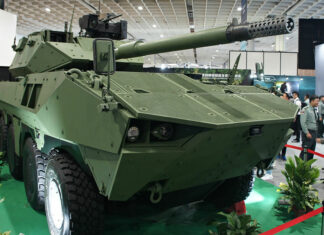
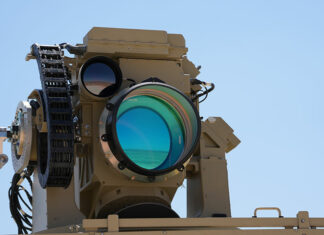
    Israel’s Iron Beam 450 high-power laser system has completed final testing, marking a major leap in air defense. Developed by Rafael, it offers precise, cost-effective interception of rockets, UAVs, and mortars, and is set for IDF deployment by 2025.