

Sunday, December 28, 2025
More
    Home Blog Page 150

    After the Damascus Attack: Ten Points to Consider

    inss150One week has passed since the attacks near Damascus, which according to American sources destroyed advanced Fateh-110 surface-to-surface missiles making their way from Iran to Hizbollah in Lebanon. Now that the dust has settled and it seems as if the strike was contained – there was no immediate response either from Syria or Hizbollah – one can point to some initial conclusions. Maj. General (Ret) Amos Yadlin, INSSAt the same time, it is entirely possible that we are in the midst of a greater crisis, both in terms of a belated reprisal and especially in terms of the probability that more red lines will be crossed and that further attacks could lead to an escalation on the northern border. This essay assumes, as reported in foreign sources, that the Damascus attack was carried out by Israel.

    1. For the first time in a decade Israel took action against the weapons supply route operated by Iran and Syria to Hizbollah. Until 2000, President Hafez al-Assad limited the supply of arms to Hizbollah; the most potent weapons he supplied – or allowed the Iranians to supply – were short range Katyushas. His son Bashar Assad, on the other hand, has provided Hizbollah with every form of advanced modern arms. The financing, knowledge, and training almost all hail from Tehran; some of the weapon systems are Iranian-made, others are manufactured in Syria (such as various rockets and the M-600 missiles, the Syrian version of the Fateh-110), and still others come from Russia. The weapons transported from Iran arrive by air to the Damascus international airport, and from there are shipped to Lebanon. Despite the legitimacy for Israeli action bestowed by Security Council Resolution 1701 in 2006, prohibiting the supply of weapons to Lebanon to any body other than the Lebanese government, Israel has never taken action against such shipments, apparently because of cost-benefit considerations and the understanding that the chances for escalation vis-à-vis Syria (with which Israel has shared a calm border for decades) and Hizbollah are high and do not justify the possible benefit. Still, when late in the last decade it became clear that Bashar Assad had broken every arms supply rule in the book, Israel identified four weapon systems that it sought to prevent reaching Hizbollah, even at the risk of escalation: advanced aerial defense systems, long range surface-to-surface missiles, the Yakhont shore-to-sea missile, and chemical weapons.
    2. The Israeli operation demanded impressive intelligence and operational capabilities: intelligence penetration of Iran and Hizbollah secrets and an attack on a sector protected by some of the densest and most advanced aerial defense systems in the world. At the moment it seems that Israel’s intelligence and strategic assessments about the enemy’s response were correct. The calculated risk Israel took has proved itself. It seems that Israel’s assumption that its deterrence is very strong vis-à-vis all the players, given a situation in which the Syrians, Hizbollah, and Iran have different priorities and therefore will not risk an immediate military confrontation, proved correct. Israel has also adopted the method that proved itself in 2007-8 and did not claim responsibility for the attack, leaving the Syrians plausible deniability. In addition, the targets were not Syrian assets, making it easier for the Syrians to contain the damage, and the attack did not occur on either Iranian or Lebanese territory, allowing these two actors – the weapon systems supplier and the customer – free of obligation for an immediate response.
    3. Each of these three enemies of Israel is preoccupied with more important challenges than responding to an Israeli attack. The Syrian regime is fighting for its life against the internal opposition, already in control of 50 percent of Syrian territory. In the past month, the regime has made some strides against the rebels and is managing to keep the conflict internal, in which the army has a built-in advantage over the insurgents; the regime is eager to maintain this success. External intervention and a confrontation with Israel are a danger to the regime, bearing the potential for toppling it. Hizbollah too prefers survival of the Syrian regime, which serves as a bridge to Iran and as a strategic rear. Its soldiers are fighting in Syria; opening another front with Israel is not desirable and would damage its legitimacy in Lebanon, which has suffered due to its involvement in the Hariri murder and because it dragged Lebanon into the war with Israel in 2006 and is now actively supporting Assad’s regime. Iran too will find it hard to respond, as it has never admitted supplying advanced weapons to Hizbollah. Furthermore, the survival of Assad’s regime is very important. Above all, Iran’s supreme interest is to protect its military nuclear program and maintain Hizbollah as its forward arm to respond to an attack on the nuclear facilities.
    4. Yet even if there is no immediate massive response, Hizbollah, Iran, and at times even Syria sometimes display patience, keep their account ledgers open, and choose a delayed response, preferably far from the local arena where they risk escalation and Israel has good defensive capabilities. Another type of response is deploying small terrorist organizations or executing a limited operation in the Israeli-Lebanese-Syrian sector without assuming responsibility. Israel can contain such operations and avoid a response because the Israeli action that started the cycle of retaliation was highly successful – provided the response doesn’t take a toll requiring further escalation.
    5. The Israeli attack enjoys a relatively high degree of legitimacy, from Western recognition of the move as one of self-defense (President Obama) to the Sunni world’s pleasure at the distress of the Syrian and Iranian regimes and Hizbollah. The satisfaction with the attack in the Gulf and Saudi Arabia was hard to hide, and even Egypt and Jordan sufficed themselves with pro forma denunciations and diplomatic lip service. An attack on the radical axis, no matter which component – an axis currently butchering tens of thousands of Syrian citizens – is now more legitimate than ever. Nonetheless, it is important to note that Israel has not intervened in the civil war and even indicated to Syria that it has no intention of aligning itself with the opposition to the regime. Israel did not directly damage Syrian assets, only Hizbollah and Iranian assets that pose a risk to Israel’s security.
    6. The American angle: Israel did not ask for a green light from the United States before the attack. Still, the level of coordination and the strategic understandings between the two nations are profound, and there is no doubt that that each side has defined its critical interests to the other and described the causes that will require action, the limits of the action, and its own limitations. While some claim that the action was Israel’s attempt to maneuver the United States into intervening in Syria, this is without foundation. Israel acted against Iranian and Hizbollah elements in Syria posing a direct danger to Israel’s security. There is also no verification of reports that dozens of the regime’s commandos were killed or injured. Still, critics of President Obama can point to the Israeli operation as an example of an appropriate response to a red line being crossed and the weakness of the claim made by NATO and the Pentagon that the Syrian aerial defenses are significantly stronger than those of Libya or Iraq
    7. The Russian angle: The Russians, not the Iranians, are the suppliers of two of the four systems defined as red lines: advanced aerial defense systems such as the SA-17 and the advanced Yakhont shore-to-sea missile. If these Russian systems, supplied to Syria on condition they would not be transferred to another end user, were to have been attacked on the Lebanese side, the Russians would have been placed in a very embarrassing position. Among the risks of attacking in Syria is the possibility that the Russians, who took an unfavorable view of the operation, will release long range aerial defenses such as the S-300 for export to Syria.
    8. One objection to the recent attack is that some of the weapon systems constituting a red line are apparently already in Hizbollah hands. However, quantities matter. Hizbollah certainly does not have tens of thousands, or even thousands, of long range missiles. If at issue are several dozen or even a few hundred missiles, there is importance in reducing the number of enemy missiles to a minimum. As in Operation Pillar of Defense in Gaza, many enemy missiles are destroyed before they are launched and others are shot down by anti-missile defense systems. A large number of missiles in enemy hands allows saturation of anti-missile defense systems in Israel and provides Hizbollah more breathing room. What was destroyed in Syria will make a more extensive future confrontation with Hizbollah easier to manage. Also, the future costs of reviving the smuggling route will represent a logistical, operational, and intelligence burden for Iran and Hizbollah, thereby slowing the pace of Hizbollah force construction.
    9. What is the impact on the conflict with Iran? There are two strategic schools of thought: One says “Iran first” and that all priorities and resources should be directed at this effort, including the willingness to pay strategic costs in other arenas, whereas another says “Syria and Hizbollah first,” based on the recognition that it is possible to deter Iran and demonstrate Israel’s resolve and capabilities when it comes to crossing red lines and weaken Iran’s ability to respond by attacking its allies and first line of fire. It is unclear if these broader strategic considerations were examined before the attack, but in practice, results suggest that the second school of thought has proven itself. It remains to be seen whether Iran has internalized the message of Israel’s resolve on the one hand and the weakness of its allies on the other.
    10. Finally, the episode is likely not yet over, neither tactically nor strategically. In the short term, a high level of vigilance is required to watch for a closing of accounts by a limited and/or delayed response, both locally in the northern sector and abroad. Strategically, Israel’s decision makers will have to decide whether to continue taking action against Hizbollah’s acquisition of advanced critical weapon systems. When Israel considers its next operation, it will have to ask whether the strategic circumstances still allow freedom of action with little risk to Israel, or the cumulative incidents will necessarily lead to unwanted escalation. The assumption of relative freedom of action is an illusion, because freedom of action is a consumable asset. An inductive assumption – if there was no response to two incidents there will likewise be no response to future incidents – is liable to prove erroneous. There is cumulative pressure on the leaders of the other side to react. This pressure might generate a breaking point and an extended response, followed by dangerous escalation.

    Lightweight Personnel Armor

    The RynoHide lightweight body armor produced by Amendment II is the first to employ Carbon Nano-Tubes . It was a result of a partnership deal signed in 2011 by Amendment II and the Nano Institute of the University of Utah to develop carbon nanotubes for body armor applications. Photo: Amendment II
    The RynoHide lightweight body armor produced by Amendment II is the first to employ Carbon Nano-Tubes . It was a result of a partnership deal signed in 2011 by Amendment II and the Nano Institute of the University of Utah to develop carbon nanotubes for body armor applications. Photo: Amendment II
    The RynoHide lightweight body armor produced by Amendment II is the first to employ Carbon Nano-Tubes . It was a result of a partnership deal signed in 2011 by Amendment II and the Nano Institute of the University of Utah to develop carbon nanotubes for body armor applications. Photo: Amendment II

    New materials promise improvements in the weight of body armor, but are unproven—and an alternative approach to the problem involves looking at whether some current systems are stronger and heavier than necessary. I-HLS reports.

    Technological progress tends to be incremental, but the U.S. Office of Naval Research (ONR) hopes to make significant advances with its “Lighten the Load” initiative to reduce the burden on U.S. Marines. Body armor is a critical target, as it is the single largest element of the load. “We are taking multiple approaches to reduce the weight of PPE (personal protective equipment),” says James Mackiewicz, program manager in ONR’s department of expeditionary warfare and combating terrorism.

    One approach is to find improved materials for all applications. For example, the ONR is looking into “better ballistic fabrics, fabric system configurations, improved armor synergy and improved ceramics for small-arms defeat,” Mackiewicz says.

    According to Aviation Week another approach is determining whether the armor is suitable to the mission, or whether lighter-weight armor could do as well. “We are reevaluating the threats to Marines to ensure we provide the appropriate armor for the threat scenario,” says Mackiewicz. Body armor usually consists of “soft-armor” garments with “hard-armor” insert plates. The soft armor, which defeats low-velocity rounds and shrapnel, is typically woven DuPont Kevlar aramid fiber, ultra-high-molecular-weight polyethylene or other synthetics. The inserts have a front face made of ceramic, usually boron or silicon carbide—among the hardest materials known—with a tough synthetic backing. Incoming rounds, even armor-piercing bullets, are deformed or shattered by the hard armor, and remnants are stopped by the backing material or soft armor.

    Armor research tends to follow developments in materials science, and much of the current effort focuses on carbon nanotubes (CNT), a single sheet of carbon atoms rolled into a tube. In theory, CNTs could be made hundreds of times stronger than steel, but this would rely on manufacturing flawless tubes in bulk, which is not yet possible. However, smaller tubes can be produced in bulk, and these are used to reinforce soft and hard armor.

    Armor is not provided only to human warfighters. In 2010 the Navy spent $86,000 on four tactical vests to outfit Navy Seal dogs. The system was designed by  Winnipeg, Canada-based contractor K9 Storm. The canine armor suits is based on K9’s Intruder. The tactical body armor is wired with a collapsible video arm, two-way audio, and other attachable gadgets.

    i-HLS ISRAEL Homeland Security

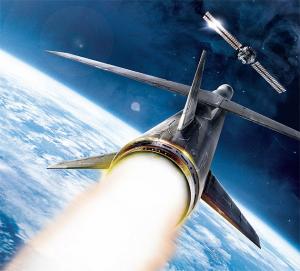
    Protecting Satellites in Orbit

    China is developing a number of Anti-Satellite technologies, including missiles and laser-based weapons.

    Carter said the US has established an integrated effort to in understanding the anti-satellite threat, and preparing a work plan on how the US can operate without spacecraft,” Carter told reporters at the National Press Club. I-HLS reports.

    Carter said the initiative was looking at how to make U.S. military and intelligence satellite systems more resilient if they were threatened, or how to operate without them if need be. He said the fiscal 2014 budget included funding for the initiative, as well as “investments in our own capability to deny the use of space against our forces in a conflict.” He did not provide additional details.

    The U.S. government is relying on satellites for a number of defense-critical services including strategic and tactical reconnaissance and intelligence gathering, early warning on missile launches, communications and weather monitoring.

    The Pentagon on Monday released an 83-page report on Chinese military developments, saying China uses computer espionage to acquire technology to fuel its military modernization, but China dismissed the report as groundless. The annual report also highlighted China’s increasing space capabilities, citing Beijing’s “multi-dimensional program to improve its capabilities to limit or prevent the use of space-based assets by adversaries during times of crisis or conflict.”

    It said China was pursuing a variety of air, sea, undersea, space and counter-space capabilities, and military strategists there viewed the ability to utilize space and deny adversaries access to space as key priorities. The report cited a Chinese military analysis which highlighted the importance of “destroying or capturing satellites and other sensors” during a military conflict.

    i-HLS ISRAEL Homeland Security 

    Teherans’ Drone Fever

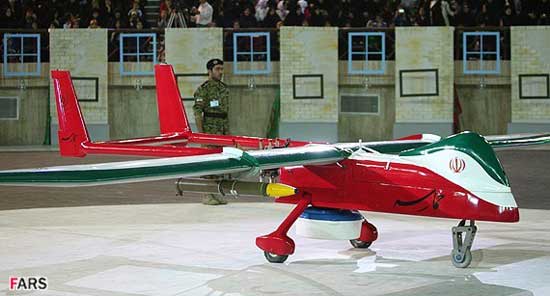
    The Hamaseh drone unveiled last week is one of Iran's new generation of drones, based on designs that follow proven western UAVs. Hamaseh clearly resembles the Israeli Heron.
    The Hamaseh drone unveiled last week is one of Iran’s new generation of drones, based on designs that follow proven western UAVs. Hamaseh clearly resembles the Israeli Heron. Photo: FARS

    Last week Iran unveiled its latest drone dubbed “Hamaseh”. This unmanned aerial vehicle follows a classic twin-boom tail design, pioneered by IAI’s Scout and Tadiran Mastiff in the 1980s. On the My 9, 2013 unveiling ceremony the drone was shown carrying two 107mm rockets and what seems to be an electronic payload – probably a radar. The Iranians say it can ‘avoid detection by the enemy thanks to its stealth features’, but based on visual impression of the aircraft shown in flight, the overall shape and non-stealth features such as the non retractable landing gear, wing strakes (beefing up the hard-points) would negate signature reduction to a level considered ‘stealthy’ by western standards. According to the Iranians, Hamaseh is designed for reconnaissance and combat missions.

    Regardless of the maturity of the current Hamaseh, the design represents a new level of maturity for Iran’s drone program, which currently includes about 40 different types of drones. Of these, about 30 are in different phases of production.

    In recent months the Iranians have released a number of drones.

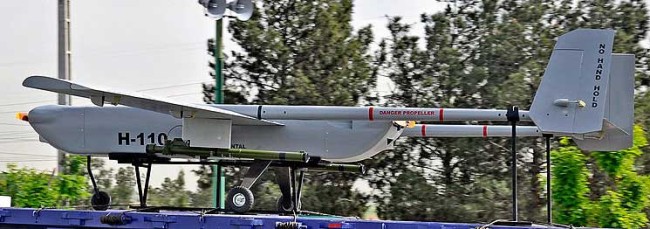
    Another drone unveiled in 2012 was Shahed 129 followed another Israeli design – the Hermes 450. In April 2013 Tehran unveiled four new drone programs – Azem-2, Mohajer B, Hazem 3 and Sarir H110, dubbed as a ‘long-endurance drone’. Sharir 110 was first shown on a march in Tehran, on April 10, 2013. As other recently unveiled Iranian designs, this drone follows the design of the Israeli Hunter (Developed by IAI), which has seen operational use with the US Army in Iraq and Afghanistan over the past decade. Sharir 110 is also configured with a twin-boom tail, and is powered by two propellers used in tractor-pusher configuration. This drone was also displayed carrying external weapons on wing pylons (it was displayed with two SA-7 class air/air missiles). Iran also claims this drone is stealthy, but its design does not indicate any such attributes.
    long endurance missions. It was displayed on the April 2012 Army Day military parade in Tehran. The drone follows the lines of the Israeli Hunter UAV.

    H-110 Sarir is a twin-engine UAV designed for long endurance missions. It was displayed on the April 2012 Army Day military parade in Tehran. The drone follows the lines of the Israeli Hunter UAV.
    H-110 Sarir is a twin-engine UAV designed for long endurance missions. It was displayed on the April 2012 Army Day military parade in Tehran. The drone follows the lines of the Israeli Hunter UAV.

    Tehran is developing the operational techniques, tactics and procedures (TTP) for these unmanned systems in parallel to the continuous development of systems. Unmanned systems are integrated in all exercises, on both sides. Iran regularly trains its forces and air defenses in counter-surveillance measures, and specific counter-UAV techniques. These have culminated in the ‘abduction’ of an RQ-170 Sentinel, the top-secret CIA drone operated from Afghanistan in 2011. The Sentinel was said to be on surveillance missions over east-central Iran when Tehran’s electronic warfare units claimed to have managed to deceive its navigation and command links, landing the drone undamaged in Iran. It is assumed that by reverse engineering some of the RQ-170 design features the Iranians could implement signature reduction capabilities, particularly in electromagnetic shielding, use of materials and the topology of elements, achieving a level of low observability in their newer drones. Nevertheless, the adaptation of overall stealth design, that requires complex manufacturing techniques, exotic materials and use of advanced aerodynamic control are probably beyond the scope of Iran’s current achievements, hence the lack of visible ‘stealth shaped’ drones.

    Since 2006 Iran also launched several surveillance missions over Israel, through its Hezbollah Lebanese proxy organization. In 2006 and 2011 Hezbollah used Ababil drones on strike missions directed at Israel. In all occasions the drones were intercepted by Israel Air Force jet fighters.
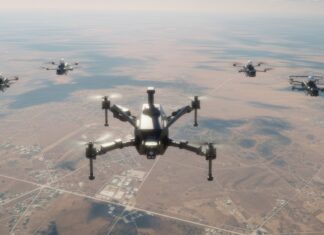
    Aware of the Ababil’s limited stealth capability, Iran is trying to reduce the detectability and signatures of its newer drones. On the more recent missions Iranian drones achieved more impressive results; on one occasion, in October 2012 the new Shahed 129 managed to fly from Lebanon and conduct a reconnaissance mission over Southern Israel, for about 30 minutes before being intercepted. Iranian sources said it was not the first time they flew such missions over Israel, but did not present any proof for these claims. The Israelis have learned their lessons, on another mission launched in April 2013 an Iranian drone was intercepted long before approaching the Israeli coastline.

    SATCOM Assists ESA-EDA Demonstration of UAV Airspace Integration

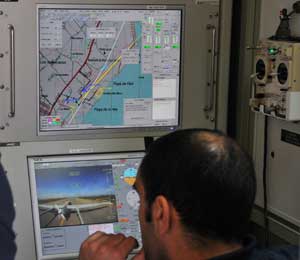
    Integration of the flight control and mission data (images, radar etc) was performed at the Heron I  ground station positioned at the Spanish Air Force Air Operation Center at Torrejon Air Base. As part of the evaluation, the drone was flown through unsegregated airspace with remote operators and air traffic controllers exchanging instructions and reporting positions as any manned aircraft do. Photos: Spanis MOD
    Integration of the flight control and mission data (images, radar etc) was performed at the Heron I ground station positioned at the Spanish Air Force Air Operation Center at Torrejon Air Base. As part of the evaluation, the drone was flown through unsegregated airspace with remote operators and air traffic controllers exchanging instructions and reporting positions as any manned aircraft do. Photos: Spanis MOD

    A European project designed to prove the feasibility of operating unmanned aerial systems in non-segregated airspace completed six missions flown form the Spanish Air Force base San Javier air base on 24 April. Defense-Update reports.

    The test was conducted by an international consortium led by Spain’s Indra, in cooperation with AT-One, CIRA, SES ASTRA and Thales Alenia Space. The project demonstrated the safe operation of RPAS in non-segregated airspace using satellite communications.

    The test involved a satellite communications link using Ku-band capacity, provided SES Techcom. The link established immediately after take-off, while the aircraft was still in segregated airspace, before it entered class-C airspace at 20,000ft under the supervision of Spanish air navigation service provider Aena. The sat-link provided reliable command and control, Air Traffic Control and Mission data transfer.

    During the trial, a manned aircraft from the Spanish air force academy approached the UAS, simulating frontal and 90˚ collision trajectories. “The pilots of the two aircraft followed the separation instructions issued by the air traffic controllers, demonstrating the safe operation of remotely-piloted aircraft, even in an emergency situation,” the EDA, ESA and Indra said in a joint statement.

    The missions flown under the European Space Agency – European Defense Agency (ESA-EDA) sponsored ‘Demonstrating Satellites enabling the Insertion of RPAS in Europe’ (DeSIRE) initiative. Other members collaborating in the program included ThalesAleniaSpace and AT-one (an European Economic Interest Group consisting of Dutch Aerospace Laboratory NLR and German Aerospace Centre DLR). Other partners, included GUCI (Spanish “Guardia Civil”) and AENA (Aeropuertos Españoles y Navegación Aérea).

    The initiative followed another ESA study (ESA SINUE) during which SES was already partnering with INDRA, the Spanish information technology and defense systems company.

    SES operates a fleet of 52 geostationary satellites. The company provides satellite communications services to broadcasters, content and internet service providers, mobile and fixed network operators and business and governmental organisations worldwide.

    Check the test summary on the ESA Page.

    Source: Defense-Update

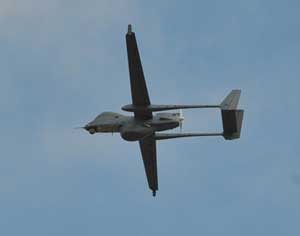
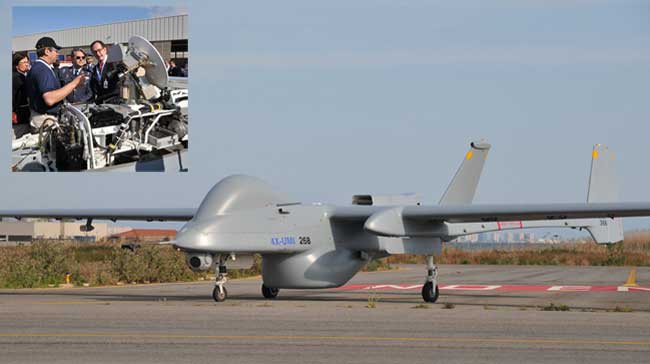
    The IAI Heron 1 UAV was employed on a maritime surveillance test test recently, where the drone was flown in non segregated airspace using satellite communications control. Photos: Spanis MOD
    An Israeli IAI Heron 1 (Designation 4X-UMI 268) drone deployed on the maritime surveillance test in Spain in April 2013, was flown in non segregated airspace using satellite communications control (The SATCOM dish is seen in the insert). Photos: Spanis MOD

    Introducing: Defense-Update VideoReport

    Defense-Update is proud to present ‘VideoReport’. Part of Defense-Update digital media, VideoReport covers aerospace, military and Homeland Security topics.

    The first edition will cover the upcoming IMDEX 2013 maritime expo in Singapore.

    Presenting broad coverage by matter experts, Defense Update VideoReport highlights the latest trends, innovative products and leading companies in the military, aviation and security domains.

    Get your company covered. Look us up at major exhibitions, conferences and tradeshows. The video introduction above outlines the quality and content options of our offerings, presented to advertising prospects. If you are responsible for your company’s event production, marketing or marketing communications, please contact us to hear more about our attractive and affordable offerings. If you are taking part at IMDEX 2013, ISDEF 2013 or Paris Air Show 2013, please contact us to book your company’s coverage.

    We are excited to embark on this project and look forward to cooperate with organisers, exhibitors and other stakeholders in the defense business, assisting us in creating the best, most compelling content for our viewers worldwide.

    Defense-Update VideoReport Coverage Plan:

    imdex

    IMDEX 2013 – Singapore

    14-16 May 2013

    Our team is available at the Singapore Changi Exhibition Centre from 14 to 16 May 2013
    Click to SMS your name, company & Booth # to Book an Interview
    isdef

    ISDEF 2013 – Tel Aviv, Israel

    4-6 June 2013

    Our team is available in Tel Aviv Exhibition Center from 3 to 6 June 2013
    Contact us to schedule coverage
    paris_airshow

    Paris Air Show – Paris, France

    17-21 June 2013

    Our team is available in Paris Le Bourget from 17 to 21 June 2013
    Contact us to schedule coverage
    auvsi

    AUVSI 2013 – Washington DC, USA

    12-15 August 2013

    dsei

    DSEI 2013 – London, UK

    10-13 September 2013

    rae

    RAE 2013 – Niznhy Tagil, Russia

    25-28 September 2013

    ausa

    AUSA Annual Meeting

    Washington DC, USA

    21-23 October 2013

    seoul

    ADEX 2013 – Seoul, Republic of Korea

    29 October/3 November 2013

    milipol

    MILIPOL, Paris, France

    19-22 November 2013

    Secure your coverage!

    call our team at +972544508028 or drop us an email at: [email protected]

    On site, you can call our team or request an interview

    by scanning the QR code or clicking the links below.

    presentation_download 4634467Scan or click to send us an SMS

    Download Defense-Update VideoReport Presentation


    VideoReport Information Request:

    VideoReport Contact Form:

    US Army About to Cancel Carbine Replacement

    M4_army
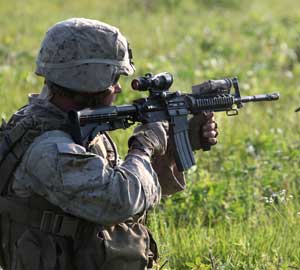
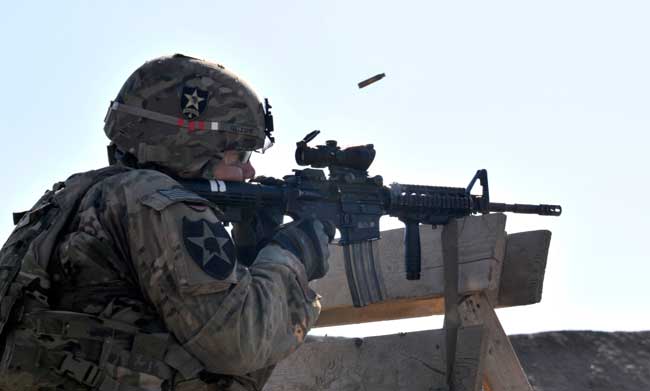
    The M4 Carbine is designed for lightness, speed, mobility and firepower. The M4 series of carbines can also be mounted with the M203A2 Grenade Launcher, M320 Grenade Launcher, or M26 Modular Accessory Shotgun System. Photo: US Army

    The US Army is likely to cancel a plan to replace its M4 assault rifles with a new carbine. The Army prepared for a selection of three finalists of a major evaluation, before committing over $300 million for new Carbines over the next five years. It is now likely the Army will opt for the modestly improved M4A1. Military.com reports.

    For the past five years, Army weapons officials have been trying to improve the existing M4, and at the same time, search for a possible replacement for it. In 2008, after a number of commercial carbines outperformed the Army’s main sidearm in an Army led reliability test. As a result the Army launched a replacement plan for its main sidearm, budgeting over $300 million for the procurement of millions of weapons over five years. Program officials launched the formal competition in 2011 and just recently wrapped up Phase II of a three-phase competition. The first procurement segment was planned for next year, with an investment of about $50 million buying 30,000 weapons. Now the Army is seemed to back off from the plan, hoping to save money for other investments.

    Testers have so far fired hundreds of thousands of rounds through carbines submitted by gun makers such as Heckler & Koch, FNH-USA, Remington Defense, Adcor Defense Inc. and Colt Defense LLC, the original maker of the M4 carbine. However, after five years, they have not come to any conclusion about the weapon of choice. “DoD may not have an established need for this weapon nor developed performance requirements” the Pentagon’s Inspector said In on a testimony in front of the House Committee on Oversight and Government Reform. The current requirements lack accuracy, reliability, and lethality” the inspector testified.

    In fact, at a time of budget pressure, replacing millions of rifles may seem luxury. U.S. Army Chief of Staff Gen. Raymond Odierno said he “feels very good” about the upgraded version of the M4 carbine, but did not confirm if the service has decided to cancel the Improved Carbine competition. “We haven’t made that final decision,” he told Military.com. “We’re getting close.” A final decision could be announced later this month.
    Cancelling the replacement carbine doesn’t mean the Army will avoid buying new rifles. Most likely they will opt for the Improved M4, also known as M4A1. THis rifle was designed as a ‘special-operations version’ of the M4 that has been in service for just over a decade. It features a heavier barrel and offers fully automatic trigger. (the standard M4 has a single shot or three round burst modes, but not full automatic).

    The Army had originally planned to award three contracts to three gun makers for the final phase of the competition, which would involve soldiers firing nearly 800,000 rounds in three separate user evaluations before choosing a winning carbine. The Army then planned to conduct an analysis of alternatives to see if the winner is a significant improvement over the M4A1 to justify the investment.

    The M4A1 carbine is a fully automatic variant of the basic M4 carbine intended for special operations use. The automatic function creates more recoil than the three-round burst, and would require additional training for Army soldiers. The whole key to the burst function was to allow you time to reacquire the target. The M4A1 is used by almost all U.S special operation units including, but not limited to, the Army Rangers, Army Special Forces, Navy SEALs and Air Force Combat Control Teams and the US Marine Corps.

    In the last few years, M4A1 carbines have been refit or received straight from factory with barrels with a thicker profile under the handguard. This is for a variety of reasons such as heat dissipation, which is useful due to the complaints of high-heat production from test soldiers, which occurs during full-auto and accuracy as a byproduct of barrel weight.

    Source: Defense-Update

    WikiGun – 3D Printers Bring the Age of DIY Weapons

    Liberator, the printed gun fires is currently designed to fire a single .308 cartridge. It is produced by printing it into a net shape from ABS thermoplastic material. The files for the printing of this product will be available free on the internet. Photo: Defense Distributed
    Printed AK47 magazine designed and printed on a 3D printer by Defense Distributed. Photo: Defense Distributed
    Printed AK47 magazine designed and printed on a 3D printer by Defense Distributed. Photo: Defense Distributed.

    Few months ago Texas based Defense Distributed had an idea – to produce weapon accessories using new 3D printing technology. It started with ‘printed magazines’ for AK47 made of from ABS, a thermoplastic material processed into net-shape form by 3D printers. Each magazine sells for $47. A more complex system – the lower receiver for AR15 sells for $150. But the accessories business wasn’t exciting enough. Taking technology beyond the limits was more fun. It also created a lot of buzz – over five months, 750,000 people viewed on youtube how the lower receiver fails in a firing test. So Defense Distributed decided to take the next step – produce a complete printable weapon and distribute the code free on the web, facilitating a Wikipedia like printable firearm – hence ‘WikiWep’. Defense Update reports.


    Few months later, the project has got a whole new dimension, with news networks, weapon activists, even legislators airing their opinions about the risks and opportunity of 3D printed weapons, that can be produced by anyone having a commercially available 3D printer and internet access.

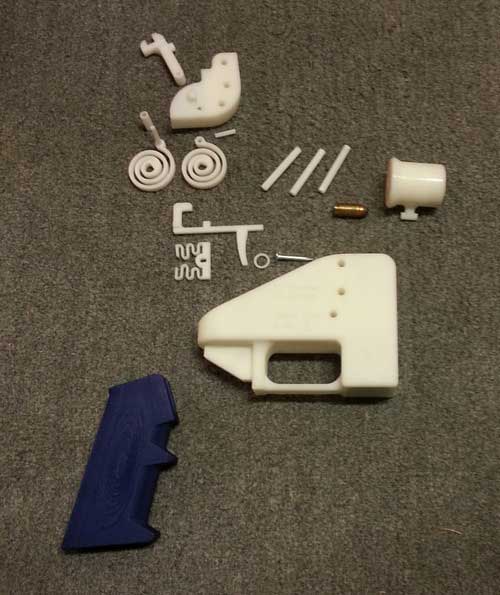
    Liberator, the printed gun fires is currently designed to fire a single .308 cartridge. It is produced by printing it into a net shape from ABS thermoplastic material. The files for the printing of this product will be available free on the internet. Photo: Defense Distributed
    Liberator, the printed gun fires is currently designed to fire a single .308 cartridge. It is produced by printing it into a net shape from ABS thermoplastic material. The files for the printing of this product will be available free on the internet. Photo: Defense Distributed

    Defense Distributed founder Cody Wilson says he wants to “produce and publish a file for a completely printable gun – or as near to completely printable as actually possible with current technologies.” Many are sharing their excitement – one day after releasing their dramatic test video “The Liberator” was aired it logged over 800,000 views on Youtube. During the hour it took us to write this post the number passed one million.

    The weapon demonstrated in this video is simple. The largest pieces are the pistol grip and receiver device, seen surrounded by a number of smaller internal components, including the hammer’s springs. The test firing included a single .380 caliber bullet. Cody Wilson told Wired Danger Room he plans to release barrels capable of firing nine-millimeter and .22 caliber bullets. “I think a barrel like this can do five to six rounds,” Wilson said. “It’s very important you get a central strike on the primer cap, or you’ll get a misfire. We had a number of misfires in .380.” Though Wilson is critical of his gun — he calls it overbuilt, and too big, but says it’s easy to fire. There’s no safety. At one point during testing in recent weeks, one of the barrels exploded. But the design does work, he said.

    There are questions about the legality of such guns, printed or not. On Sunday Senator Charles Schumer of New York call for the banning of 3-D printed handguns, because they are made of plastics which are not detectable by metal detectors. The only metal part in Wilson’s gun is the firing pin, too small to be detected by metal detectors.

    The senator also proposed updating the Undetectable Firearms Act of 1988 — which bans guns that can defeat airport security metal detectors — to include printable gun magazines. Defense Distributed has a federal firearms manufacturers license, which Wilson sought after being questioned by the Bureau of Alcohol, Tobacco and Firearms in 2012. That was shortly after a 3-D printer Wilson had rented was seized by its manufacturer over worries he’d violate the Undetectable Firearms Act. The law, which is set to expire this year, exempts licensed manufacturers to produce plastic guns for use as a models and prototypes.

    In few months the 3D printed weapon has become a battleground between weapons supporters and opponents in the US. Provided candidate files and prototypes can make it through testing, the next phase of this goal requires adaptation of the design down to some of the most commonly available of 3D printers. Defense Distributed has chosen the RepRap printer to be this platform, but the manufacturer is not keen about their product becoming a platform for anarchist weapon buffs.

    “We hope the result will be an easily accessible and replicable design shared with the world. From such a point, any person has near-instant access to a firearm through the internet.” Wilson wrote. He doesn’t claim his new weapon is ready for use. In fact, each video shows various failures in firing. But Wilson is concerned that the safety issue will be used against his WikiWep initiative. “We want to minimize negative media about the safety concerns of untested firearms and the inevitable suggestion that government agencies are necessary protect us from ourselves.

    “This project might change the way we think about gun control and consumption.” Wilson posted on his blog, “How do governments behave if they must one day operate on the assumption that any and every citizen has near instant access to a firearm through the Internet? Let’s find out.”

    Source: Defense-Update

    A Living Sensor Inspects Explosives, Narcotics

    The mice in each cartridge 'work' on a 4 hours shift, followed by 8 hours 'off duty'. Cartridges are recycled after 14 days. Photo: Tamir eshel, Defense-Update
    The mice in each cartridge ‘work’ on a 4 hours shift, followed by 8 hours ‘off duty’. Cartridges are recycled after 14 days. Photo: Tamir eshel, Defense-Update

    Next time, whoever tries to conceal on his body explosives or other contraband material, it will be detected by a sensor, but this time it may not be an artificial one, but rather, a living sensor – no other than a well trained lab mouse. I-HLS reports.

    Bio Explorers, a member of TAMAR Group has developed an innovative method of detecting explosives and other contraband materials. This method is based on the training of lab mice, exploiting their ultra-sensitive sense of smell. These mice sense explosive traces odor as they are exposed to vapor emitted from the scanned material. The mice are trained to run away when they sense explosives. By tracking the movement of mice in the test chamber the system indicates the presence of specific materials.

    At the first stage, Bio Explorers, successfully demonstrated a biologic detection system for locating explosives, working in cooperation with local security agencies. Further applications for the new system could include explosive detection, detection of narcotics or illegal currencies by customs authorities, detection of poisonous materials and bacterias by agriculture inspection agencies. Possible applications also include medical diagnostics and early detection of diseases.

    According to the Bio Explorers, the mice can be trained to detect virtually any substance based on its odor within few days, using an automated, methodical process patented by the company. They achieve a detection rate of 90% after only 10 sessions. By adjusting the number of biosensors and  sensitivity, the combined detection rate can reach 99% with false alarm rate dropping under 0.2%. The mice live in a cartridge for 14 days. The cartridge includes all food, water and sleeping accommodation. The mice in each cartridge ‘work’ on a 4 hours shift, followed by 8 hours ‘off duty’. According to the company, tests have shown that the biological sensor is far more sensitive than existing systems, including dogs and various sniffers. While existing methods rely on the detection of particles (solid or liquid) of the target materials, the biologic method rely on the natural senses to detect much lower concentrations of the target substance.

    The first application is a ‘walk through explosive detector’, inspecting personnel passing the portal without requiring them to take off clothes, empty their pockets or take off their shoes. Such sensor emits no radiation offers higher privacy and faster throughput compared to the existing methods. A follow-on system currently in development is designed to inspect commercial cargos and vehicles.

    Written by: Dan Arkin

    i-HLS ISRAEL Homeland Security

    Chemical Weapons Were Used in Syria – But Who’s to Blame?

    Testimony from victims of the conflict in Syria suggests rebels have used the nerve agent, sarin, a leading member of a UN commission of inquiry has said. Carla Del Ponte told Swiss TV that there were “strong, concrete suspicions but not yet incontrovertible proof”. The BBC reports.

    Ms Del Ponte did not rule out the possibility that government forces might also have used chemical weapons. Later, the commission stressed that it had “not reached conclusive findings” as to their use by any parties. “As a result, the commission is not in a position to further comment on the allegations at this time,” a statement added. According to the BBC the statement was terse and shows that the UN was taken by surprise at Ms Del Ponte’s remarks.

    “This is not the first time rebel forces in Syria have come under suspicion for using chemical weapons.” BBC Diplomatic correspondent, Bridget Kendall commented, “The Syrian government has accused them, and some independent commentators have speculated some groups could conceivably have got hold of stocks when storming government facilities.” Kendall added that the recent allegations coming from a senior UN official is a different matter. “Carla del Ponte is a former war crimes prosecutor and serves on a UN commission looking into human rights abuses in Syria. So any comments from her carry weight.”

    The responsibility on chemical attacks attributed to the Syrian regime was one of the main causes for the shift in the west toward backing the Syrian rebels, with growing openness to actively supporting the rebels with arms and training. The news about the use of the use of such weapons will likely cool off such initiatives.

    New Ultra-Strength Steel Introduce a More Affordable Material for Aviation

    Prof. Warren M. Garrison Jr., Carnegie Mellon University (CMU)

    Carnegie Mellon University (CMU) has developed an ultra-strength steel of high fracture toughness that is significantly less expensive to manufacture than existing products. The new material also has high fracture toughness, particularly during stress corrosion cracking in salt water, making it applicative for the manufacturing of critical parts auch as landing gear for naval aircraft. Defense-Update reports.

    When the process is commercialised, the new steel would be more affordable, compared to specialty steels currently used in applicable aerospace industries. This steel contains no cobalt and only a relatively small amount of nickel and therefore is much less expensive than other ultra-high strength steels of high fracture toughness — all of which contain large amounts of cobalt and nickel. While the alloy was developed with Navy aircraft applications in mind, given its low cost and high toughness, it could be used for other applications. The next step in the development would be to assess its properties in commercial scale heats.

    One of the objectives of the STTR program was the development of an inexpensive, ultra-strength steel with high fracture toughness that could be used in Navy aviation applications. The new steel also has excellent resistance to crack growth during stress corrosion cracking in salt water. “The rate of crack growth during stress corrosion cracking of the new steel is comparable to that of other ultra-high strength steels of high fracture toughness and is much better than that of low alloy steel 300M, which is the steel used in the landing gear of most commercial aircraft,” said Garrison, who has a patent pending for the new steel.

    The new material was developed by Warren M. Garrison Jr., a professor of materials science and engineering at CMU. The company in charge of the STTR program was Navmar Applied Sciences Corporation of Warminster, Pa., which specializes in engineering and technical support for the Department of Defense, the U.S. government and private industry. Garrison worked with Jeffrey Waldman, the scientist in charge of the program at Navmar, and William Frazier, chief scientist at the Air Vehicle Engineering Department of the Naval Air Systems Command. The new material resulted from a U.S. Navy funded Small Business Technology Transfer (STTR) Program.

    Source: Defense-Update

    Arrested Landing Completes X-47B Unmanned UCAS-D Preparations For Carrier Tests

    “Shore-based testing allows our combined Navy/Northrop Grumman team to control test conditions before taking the aircraft to the ship,” said Matt Funk, Navy UCAS test team lead. “We are gradually building up to the maximum load conditions we expect to see during an arrested landing aboard an aircraft carrier.” Photo: US Navy
    “Landing an unmanned aircraft on an aircraft carrier will be the greatest singular accomplishment for the UCAS demonstration and will serve as the culmination of over a decade of Navy unmanned carrier integration work”, said Capt. Jaime Engdahl, Navy UCAS program manager. Photo: US Navy
    “Landing an unmanned aircraft on an aircraft carrier will be the greatest singular accomplishment for the UCAS demonstration and will serve as the culmination of over a decade of Navy unmanned carrier integration work”, said Capt. Jaime Engdahl, Navy UCAS program manager. Photo: US Navy

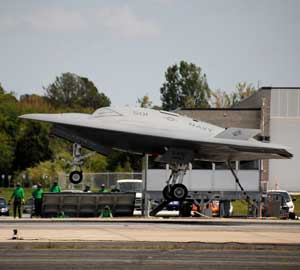
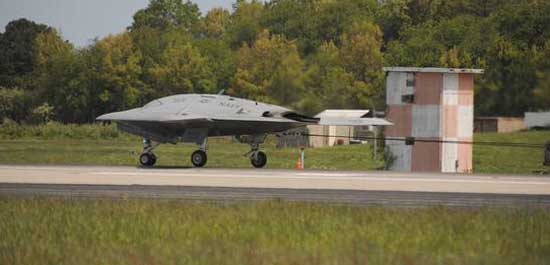
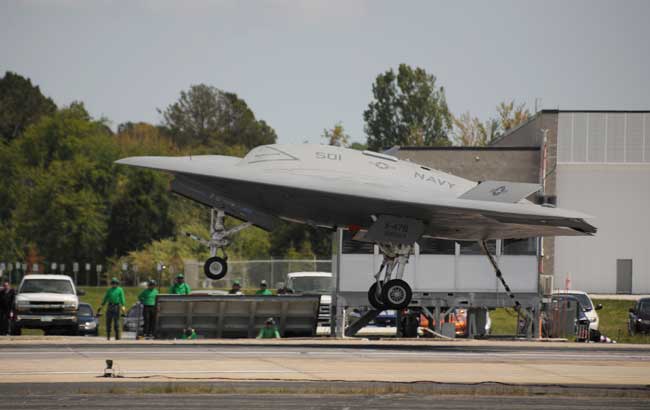
    The U.S. Navy’s X-47B Unmanned Combat Air System (UCAS) demonstrator performed its first arrested landing at Patuxent River, Naval Air Station in Maryland, on May 4. The landing using arresting gear was a key step in maturing the system for its upcoming carrier-based tests later this month. The X-47B is scheduled to begin sea-based carrier flight testing on the USS George H.W. Bush (CVN 77). These tests will include launching from the carrier deck via catapult and, potentially completing landings aboard. Defense-Update reports.

    “Landing an unmanned aircraft on an aircraft carrier will be the greatest singular accomplishment for the UCAS demonstration and will serve as the culmination of over a decade of Navy unmanned carrier integration work”, said Capt. Jaime Engdahl, Navy UCAS program manager. “Shore based arrested landing testing here at NAS Patuxent River is our final check that the X-47B can meet that objective.”

    During Saturday’s test, the X-47B used a tailhook on the aircraft to catch a carrier representative cable, known as the MK-7 arresting gear, to quickly stop the aircraft. This is known as an arrested landing, the type of recovery required aboard aircraft carriers. The MK-7 arresting gear is an underground installation of actual carrier equipment that accommodates structural tests and aircraft/arresting gear compatibility studies with all models of U.S. Navy carrier aircraft.

    “Shore-based testing allows our combined Navy/Northrop Grumman team to control test conditions before taking the aircraft to the ship,” said Matt Funk, Navy UCAS test team lead. “We are gradually building up to the maximum load conditions we expect to see during an arrested landing aboard an aircraft carrier.”

    “The entire system has performed very well across a large set of shore-based testing events including aircraft performance, flying qualities, navigation performance, catapult launches, and precision landings designed to stress system operation,” Engdahl said. “Our final carrier-landing software simulation shows excellent performance, flight test results are very good, and we are confident the X-47B will perform well on the ship.”

    The X-47B is a tailless, autonomous aircraft designed with unique features for an unmanned aircraft, such as carrier suitable landing gear and structure.While the X-47B itself will not be used for operational use, the UCAS-D program is developing a concept of operations and demonstrating technologies for use in follow-on unmanned carrier based aircraft programs.

    “This actual demonstration of the X-47B unmanned carrier operations is a first, essential step toward developing a carrier-based unmanned system for the U.S. Navy,” said Rear Adm. Mat Winter, who leads the Program Executive Office for Unmanned Aviation and Strike Weapons. “A carrier-based unmanned aircraft will increase carrier strike group relevance, provide opportunities for training and readiness cost avoidance and enable our future forward deployed carrier air wings to provide continuous intelligence, surveillance and reconnaissance capability.”

    Source: Defense-Update

    UCAS_Arrested
    “Shore-based testing allows our combined Navy/Northrop Grumman team to control test conditions before taking the aircraft to the ship,” said Matt Funk, Navy UCAS test team lead. “We are gradually building up to the maximum load conditions we expect to see during an arrested landing aboard an aircraft carrier.” Photo: US Navy

    Fighting Piracy in Africa – too little too late

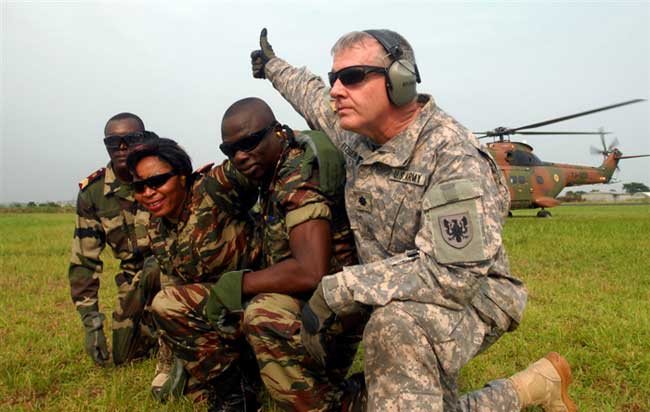
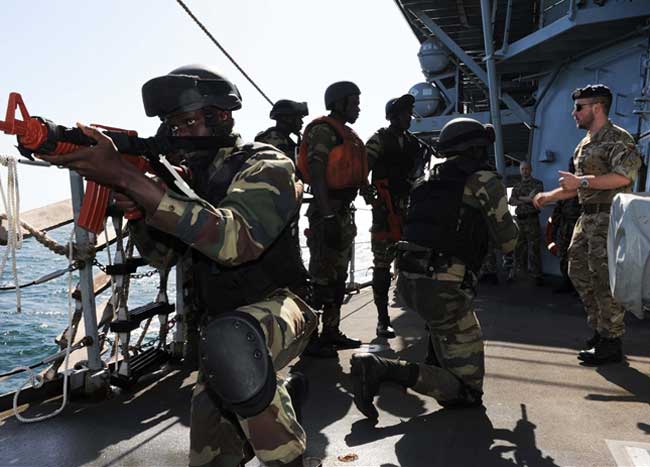
    dozen organizations and agencies gathered at the Admiral Faye Gassama Naval Base in Dakar to explore maritime security issues as part of Exercise Saharan Express 2013. Photo: AFRICOM
    dozen organizations and agencies gathered at the Admiral Faye Gassama Naval Base in Dakar to explore maritime security issues as part of Exercise Saharan Express 2013. Photo: AFRICOM

    The US must increase its intelligence- gathering capacity in Africa 15-fold in the short term to counter the threat posed by regional Islamic extremist groups and maritime piracy, particularly in the Gulf of Guinea, according to a top US general. I-HLS Reports

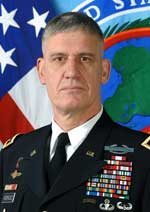
    US Army Gen. David Rodriguez paid his first visit to the continent as head of US Africa Command (AFRICOM) this month, visiting the US Army base at Camp Lemonnier in Djibouti. The visit came as the US, Britain and some European partners consider plans to increase anti-piracy operations in the Gulf of Guinea while ramping up the training and equipping of West African partner armies to crack down more effectively on the maritime piracy crisis.

    General David M Rodriguez,  Commander, U.S. Africa Command
    General David M Rodriguez, Commander, U.S. Africa Command. Photo: AFRICOM

    According to Defense News security analysts say there is a possible link between piracy in the Gulf of Guinea and the financing of regional Islamist terrorist groups such as al-Qaida in the Islamic Maghreb (AQIM), Ansar Al Dine, Movement for Oneness and Jihad in West Africa (MUJAO), Boko Haram and the National Movement for the Liberation of Azawad, all of which operate in the wider Sahel desert region covering Nigeria, Mali, Niger, Algeria, Morocco and Mauritania.

    The Gulf of Guinea is a key international shipping lane off the Atlantic coast of West Africa and is considered one of the world’s most dangerous security zones due to a surge in maritime crimes such as piracy, robbery, hijackings, arms and narcotics smuggling, kidnappings and oil theft in the past three years. The “pirate zone,” which had been limited to territorial waters off the coasts of Nigeria and Benin, now covers the West African region from the Atlantic coast of the Democratic Republic of Congo in Central Africa up to Ivory Coast, according to the latest report from the International Maritime Bureau.

    Rodriguez said expanding the command’s ISR capabilities includes an urgent need for unmanned aircraft and more spy satellites for image collection over the continent.

    The US, Britain, Spain, France and Belgium have taken part in several regional maritime security and naval exercises and provided training for some African forces while leaving territorial water patrols to local forces. Concerned that money generated from piracy operations in the Gulf of Guinea could be used to finance terrorist groups, US defense officials are examining more practical ways of clamping down on piracy in West Africa.

    This year, naval and marine forces drawn from several African nations participated in the US-led Exercise Obangame Express 2013 in which naval specialists from Britain, France, Belgium, the Netherlands and Canada led training.

    Concerned by the spread of terrorism in the Sahel and piracy in the Gulf of Guinea, the US Army this year opened its first West African drone base in the capital of Niger, Niamey.

    From that base, Predators operate on intelligence-gathering and surveillance missions. Since 2011, when Sahelian terrorism became a serious threat, AFRICOM has evolved into a more offensive force, creating a special purpose Marine air ground task force to provide limited crisis-response capability and conduct counter­terrorism training on the continent.

    In line with its shift to more combat-oriented duties, AFRICOM has dedicated special operations units, including a rapid reaction force set up after last year’s Benghazi attacks.

    Source: i-HLS ISRAEL Homeland Security 

    Samsung is now cleared for use in the U.S. government

    The handset maker announced that its Knox-enabled mobile devices have been approved by the Pentagon for government use. Samsung’s Knox software offers high-level encryption, a VPN feature, and a way to separate personal data from work data. The software also enables IT administrators to manage a mobile device through specific policies.

    A little earlier , the Pentagon gave the same approval to BlackBerry devices with the BlackBerry 10 operating system, which translates into its Q10 and Z10 smartphones and Playbook tablets.

    In the past, BlackBerry was the only hand held with high-level security on its devices. But Apple and Android have begun carving out of a chunk of this lucrative market. Samsung in particular is aiming to muscle in on BlackBerry’s territory with help from its Knox software.

    The Pentagon approval means that the S4 and future Knox devices can be used by U.S. government and military departments that tap into the Department of Defense networks. Access to these networks requires high security standards, and the S4 is the first Android phone to meet the requirements, according to Samsung. For now, the Galaxy S4 is the only Samsung device equipped with Knox. But the company promises that other smartphones as well as tablets will receive the security software.

    The new security clearance also opens up certain types of businesses as potential new customers for Samsung.

    Samsung KNOX addresses platform security with a comprehensive three-pronged strategy to secure the system: Customizable Secure Boot, ARM TrustZone-based Integrity Measurement Architecture (TIMA), and a kernel with built-in Security Enhancements for Android (SE for Android) access controls.

    i-HLS ISRAEL Homeland Security 

    Skunk Works and XTEND Simplify Multi-Drone Command

    0
    Lockheed Martin Skunk Works® and XTEND have achieved a major milestone in JADC2 by integrating the XOS operating system with the MDCX™ autonomy platform. This technical breakthrough enables a single operator to simultaneously command multiple drone classes, eliminating the friction of mission handoffs. From "marsupial" drone deployments to operating in GPS-denied environments, explore how this collaboration is abbreviating the data-to-decision timeline and redefining autonomous mission execution.

    From Ukraine to Taiwan: The Global Race to Dominate the New Defense Tech Frontier

    0
    As traditional defense primes face mounting competition from agile “neoprimes” such as Anduril, Palantir and Helsing, the balance of innovation is shifting toward software-defined warfare and scalable, dual-use technologies, while global industry consolidation—marked by Boeing’s integration of Spirit AeroSystems and other strategic mergers—signals an intensified race to secure control over the defense technology value chain. Our Defense-Tech weekly report highlights these trends.

    Europe’s “Drone Wall”

    0
    In early October 2025, a coordinated wave of unmanned aerial system (UAS) incursions—widely attributed to Russia—targeted critical infrastructure across at least ten European nations. The unprecedented campaign exposed the fragility of Europe’s air defenses...

    Weekly Defense Update & Global Security Assessment

    0
    Executive Summary The past week (September 18-25, 2025) represents an inflection point where strategic defense concepts have transitioned from doctrine to tangible reality. An analysis of global events reveals four primary, interconnected trends shaping an...

    U.S. Air and Space Forces Push Next-Gen Programs at the AS&C 2025 Conference and...

    0
    At the 2025 Air, Space & Cyber Conference, U.S. Air Force and Space Force leaders unveiled major updates on next-generation fighters, bombers, unmanned systems, and space initiatives, highlighting both rapid innovation and critical readiness challenges as the services race to outpace global competitors. A short version is available here, with a more detailed version for subscribers.

    TADTE 2025: Reflecting Taiwan’s Strategic Themes

    0
    The Taipei Aerospace & Defense Technology Exhibition (TADTE) 2025 crystallized around four dominant strategic themes that collectively illustrate Taiwan's comprehensive approach to defense modernization amid escalating regional tensions. Based on a detailed report by Pleronix (available upon request). Includes a Podcast discussion on TADTE 2025's highlighting Taiwan's four strategic themes beyond the post's coverage.

    Iron Beam 450 Completes Testing, Soon to Join With Operational Air Defense Units

    0
    Israel’s Iron Beam 450 high-power laser system has completed final testing, marking a major leap in air defense. Developed by Rafael, it offers precise, cost-effective interception of rockets, UAVs, and mortars, and is set for IDF deployment by 2025.