
Tuesday, December 30, 2025
More
    Home Blog Page 181

    Lockheed Martin Increase Revenues, Profits in 2nd Quarter 2012

    Lockheed Martin Corporation today reported second quarter 2012 net sales of $11.9 billion compared to $11.5 billion in 2011. Net earnings from continuing operations for the second quarter of 2012 were $781 million, or $2.38 per diluted share showing a small increase over the second quarter of 2011. “Our solid performance in the second quarter is a result of our responsive strategy and dedicated team that focus on delivering value to our customers and shareholders,” said Bob Stevens, Lockheed Martin chairman and chief executive officer. “While the threat of sequestration has created uncertainty for our industry, we are maintaining an unwavering commitment to program execution and cost reduction throughout the organization.” Stevens added.


    The Aeronautics business segment increased $18 million in the quarter (1% over Q2/2011), primarily due to higher volumes in the fighter aircraft business. The company attributed this increase to higher net sales of approximately $200 million from increased production volume on F-35 Low Rate Initial Production (LRIP) contracts. This amount was partially offset by Partially offsetting lower net sales of approximately $140 million from the F-35 development contract, principally due to the inception-to-date effect of reducing the profit booking rate and lower volume. The workers strike has also erodded the profit in the F-35 operations. About $130 million was attributed to F-16 programs, primarily as a result of increased aircraft deliveries (10 F-16 aircraft delivered in the second quarter of 2012 compared to seven in the same 2011 period); approximately $40 million from the F-22 program due principally to decreased production as final aircraft deliveries were completed in the second quarter of 2012.

    The transport aircraft remained stable in the C-130 programs, but since no C-5M aircraft were delivered in the second quarter C-5M was lower compared to the second quarter last year.

    Net sales of the Electronic Systems business segment increased $86 million, or 2 percent, during the second quarter of 2012 as compared to the corresponding period in 2011. The increase was attributable to higher volume and risk retirements of approximately $245 million from ship and aviation programs including Persistent Threat Detection System (PTDS), Littoral Combat Ship (LCS) and MH-60 and about $65 million from tactical missile programs (Multiple Launch Rocket System (MLRS) and Javelin. On the down side, reduced volumes incurred in air defense programs like Patriot Advanced Capability-3 (PAC-3) and Terminal High Altitude Area Defense (THAAD), fire control systems programs such as Sniper, Target Acquisition Designation Sight/Pilot Night Vision Sensor (TADS/PNVS), Aegis and DDG-1000.

    Defense Sales Improve Rockwell Collins Q3 2012 Performance

    Rockwell Collins, Inc. today reported third quarter fiscal year 2012 income from continuing operations of $166 million, an increase of 6%, compared to $157 million in the same period last year. The company reported total sales of $1.21 billion for the third quarter of 2012, an increase of 1%, while sales reported for the same period last year were $1.19 billion.

    Sales of the the company’s Government Systems’  (defense electronics operations) totalled $679 million in the third quarter of 2012, an increase of $11 million, or 2%, compared to the $668 million reported for the same period last year. Avionics sales increased $40 million, or 11%, from the third quarter of 2011 due to higher sales for Saudi F-15 fighters and the KC-46, KC-10 and KC-390 tanker programs. Communication product sales improved $14 million, or 9%, due to higher sales of networked communication and data link products.


    However, surface solutions sales decreased $32 million, or 39%, resulting from the impact of two programs terminated for convenience in 2011, lower sales on the Joint Precision Approach and Landing System program as it transitions from development to production and reductions in deliveries of optical products for surface based programs. Sales of Navigation products also declined by $11 million, or 16%, driven primarily by fewer deliveries of Defense Advanced GPS Receiver products. Government Systems third quarter operating earnings of $148 million resulted in an operating margin of 21.8%.

    “In the current challenging market conditions, our balanced business model and capital deployment strategies are providing the stability and shareowner focus that you would expect from Rockwell Collins,” Chairman, President and Chief Executive Officer, Clay Jones said. “For the first time in five quarters, Government Systems sales increased to complement moderating revenue in Commercial Systems due to difficult comparables and the impacts from a recent bankruptcy filing by one of our customers.” Jones went on to state, “The slowdown in the global economic recovery and bankruptcy of Hawker Beechcraft continues to impact our initial projections of the business aviation growth.”

    US Army Prepares a New Version for Artillery C2 System (AFATDS)

    The US Army has entered development of a new version of the AFADTS, the command and control system for artillery, mortars and fire support. Photo: US Army

    The US Army is upgrading the AFADTS fire support C4 system. Photo: US Army
    In two years the U.S. Army is planning to introduce a a new version of the Advanced Field Artillery Tactical Data System (AFATDS). Version 6.8X of the system will focus on improving and simplifying the user interface while enhancing speed and capabilities.

    The new build (dubbed ‘ Eisenhower Build’) will provide general and fires command and control capabilities to ground forces, from mission planning to execution. AFATDS is designed to integrate and use information from a variety of sources to create a common operational picture for fire support. The system utilizes the information and common operational picture to plan, coordinate and control battlefield elements, including mortars, close air support, naval gunfire, attack helicopters, offensive electronic warfare, field artillery cannons, rockets and guided missiles.


    AFATDS is an Army program with significant joint interest that provides the automated command and control (C2) system for the Fires Warfighting Function used by the U.S. Army, Navy and Marine Corps. To date, more than 5,100 systems are fielded worldwide. In addition to the US military, international AFADTS users include Turkey, Taiwan, Portugal, Bahrain, Egypt and Jordan.

    Raytheon supports the program’s full life-cycle, beginning in the development phase, supporting stringent government testing, and supporting the product in the field. For the current 24-month version upgrade Raytheon has received an $81 million contract, with an $18 million reserved for an additional 12-month option.

    Russian Arms Ship Loads up with New Secret Cargo

    The Russian arms ship at the center of a diplomatic row between Russia and the West is loading up with a new unknown cargo at the St. Petersburg port. Photo: Novosti
    The Russian arms ship at the center of a diplomatic row between Russia and the West is loading up with a new unknown cargo at the St. Petersburg port. Photo: Novosti

    The Russian arms ship at the center of a diplomatic row between Russia and the West is loading up with a new unknown cargo at the St. Petersburg port, according to a bulletin posted on the port’s website on Tuesday. Novosti news agency reports.

    The Alaed docked at St. Petersburg on Friday after offloading Mi-25 helicopters in the Russian port of Baltiysk in the Kaliningrad region. There has been no word from the ship’s owner, Femco, about the nature of the new cargo. Femco previously said the documentation accompanying the cargo did not contain any data linking it to Syria.

    The Alaed originally set sail from Baltiysk in June, reportedly carrying three Mi-25s and some air defense systems. The ship turned back to Russia later that month, after its insurance cover was suspended by its British insurer, Standard Club. It later turned back and entered the port of Murmansk, and was later re-flagged as a Russian registered vessel.

    The U.S. Congress voted to break off all contacts with Russia’s state arms corporation Rosoboronexport on Thursday over concerns about Russia continuing to supply arms to Syria. Russia has maintained it is only fulfilling contracts signed before the current wave of unrest in Syria, and said last week it will not supply a batch of Yak-130 advanced jet trainers to Damascus.

    Forecast: Tracked Armored Vehicles Market Remains “Competitive and Dynamic”

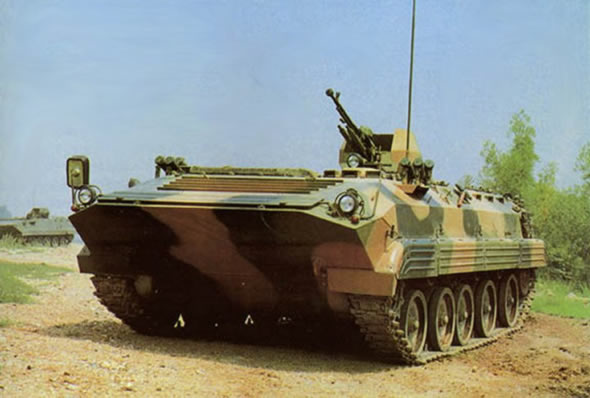
    PLA Type-90 APC produced by Norinco

    In its annual analysis “The Market for Light Tracked Vehicles,” the Forecast International Weapons Group reports that it expects the market to produce nearly 9,300 units, worth more than $19.7 billion, through 2021. According to the study, the international market for light tracked vehicles remains a highly competitive and dynamic environment.

    Dean Lockwood, weapons systems analyst at Forecast International, notes that in terms of sheer numbers, China’s Type 90 armored personnel carrier (APC) and Type 90 mechanized infantry combat vehicle (MICV) represent the most significant light tracked vehicle production run of the forecast period. As the People’s Liberation Army standardizes its mechanized forces around the Type 90 APCand MICV, Forecast International expects that combined production of these two vehicles will account for about 41 percent of all new light tracked vehicle production worldwide, worth some 9 percent of the market, through 2021.

    Meanwhile, new production of the top high-end vehicle – the Igel/Puma – will account for only 10.9 percent of all production through the forecast period. Yet, Lockwood states, “We estimate this program will own 59.5 percent of the total value of the light tracked vehicle market through 2021.” Lockwood adds, “For most nations, the expense associated with the modernization and retrofit of high-end light tracked vehicles pales in comparison with the prospect of new procurement.”

    The ongoing U.S. Army investment in the maintenance and upgrade of the existing Bradley fleet through FY17 is now equivalent to only 5 percent of the value of all new-production light tracked vehicles scheduled to roll out worldwide through 2021. “While transparent to this market analysis, maintenance of the existing Bradley Fighting Vehicle fleet in U.S. Army service is still effectively the sixth most valuable light tracked vehicle program on the international market,” Lockwood said.

    Although the light tracked vehicles in service today are all products of the Cold War, Lockwood says that they are far from relics destined for the scrap heap. “Since the U.S. 3rd Infantry Division (Mechanized) executed its ‘Thunder Run’ toBaghdadin 2003, the light tracked vehicle has soldiered on as a significant force multiplier on the modern asymmetric battlefield,” he said.

    New AC-130J Gunship In Production

    MC-130J Super Spectre gunship. Photo: Lockheed Martin
    MC-130J Super Spectre gunship. Photo: Lockheed Martin

    The first MC-130J Commando II that will be converted to become an AC-130J Gunship is being built at the Lockheed Martin C-130 production facility here. The AC-130J will be equipped with a Precision Strike Package creating the U.S. Air Force Special Operations Command’s newest gunship. Sixteen AC-130Js are planned with an Initial Operating Capability scheduled for 2015.

    China Announces Intention to Garrison Disputed South China Sea

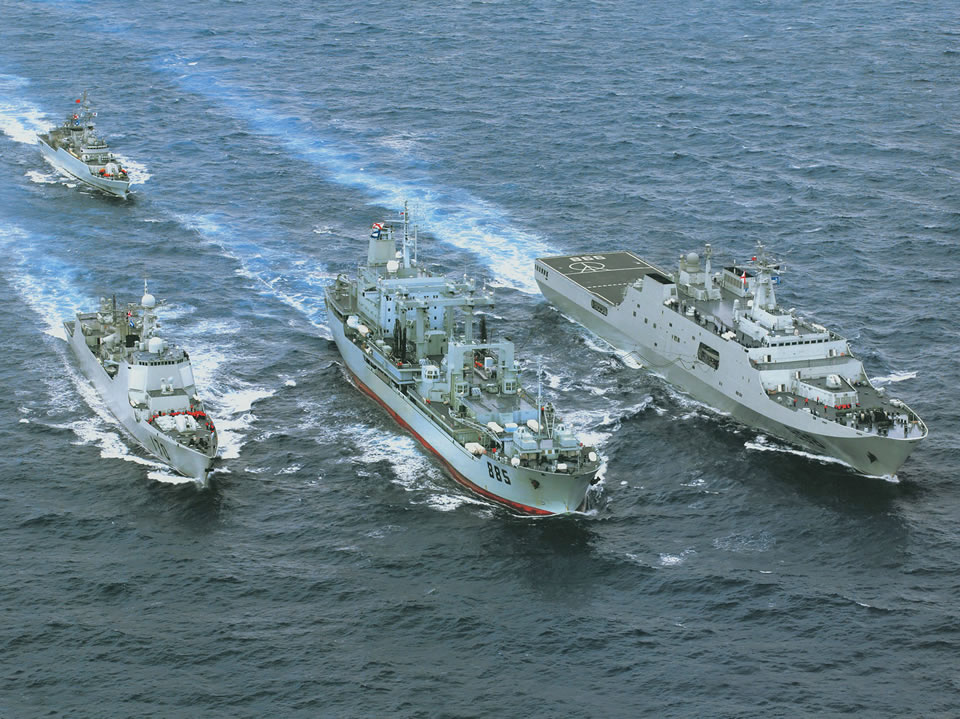
    This People's Liberation Army Navy (PLAN) flotilla is lead by the latest LPD 998 Kunlunshan amphibious landing dock vessel, escorted by the guided missile destroyer DDG 170 Lanzhou and Type 054 guided missile frigate FFG 568 Chaohu. The support ship is AO 885 Qinghaihu, an ex-Russian Komandarm class oiler. Photo: PLAN
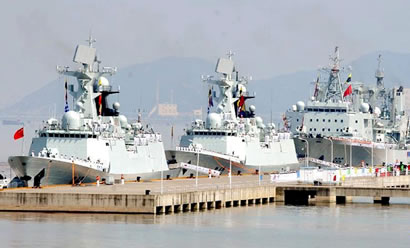
    The 12th Chinese naval escort flotilla prepare to set sail at a port in Zhoushan, east China’s Zhejiang Province, July 3, 2012. The 12th Chinese naval escort flotilla, consisting of frigate “Yiyang”, frigate “Changzhou” and comprehensive supply ship “Qiandaohu”, departed from Zhoushan on Tuesday for the escort mission in the Gulf of Aden and Somali waters to protect commercial ships from pirate attacks. (Xinhua/Hu Sheyou)

    On 22 July China’s official state-run Xinhua News Agency announced that the People’s Liberation Army’s (PLA) Central Military Commission approved plans to establish a permanent military garrison in the disputed South China Sea. China is known to have positioned military vessels in the region on a routine and recurring basis in the recent past and this announcement appears to be a continuation of China’s determination to strengthen its claims of sovereignty over the area.


    On 21 June, the Vietnamese National Assembly passed the “Vietnamese Law of the Sea” that formally categorized the Spratly and Paracel Islands as lying within the boundaries of Vietnam’s sovereignty and jurisdictional control. China was quick to condemn this action and responded with an announcement of its own to lay claim to the region.

    Later on 21 June, in response to Hanoi’s legislative move, the Chinese State Council (governing cabinet) administratively raised the status of the small town of Sansha, located on Woody Island in the Paracel chain, to that of a prefectural-level city with administrative authority over the Spratly Islands, the Paracel Islands, and the Zhongsha Islands.

    Sansha City, occupying little more than 5 kilometers of land area, is tasked with exercising administrative control over a vast expanse of the South China Sea, portions of which are also claimed by the Philippines, Taiwan, Malaysia, Vietnam, and Brunei.

    the island of Sansha City, The State Council has approved the set China plans to establish a prefecture-level city called Sansha at the Island of Yongxing (also known as Woody Island), to manage the Xisha, Zhongsha and Nansha islands and their surrounding areas in the South China Sea.

    The city of Sansha, boasting a population of only 1,100 inhabitants, announced on 22 July that a municipal people’s congress of 45 members had been elected and installed, igniting protests from nearly all of China’s Pacific neighbors. Both Vietnam and Taiwan lay claim to the Paracel Islands, home to the new city. China has exercised de facto control of the Paracels since forcing Vietnam to withdraw following a naval showdown in 1974.

    China claims that they were the first to discover and name the Spratly, Paracel, and Zhongsha island groups in the South China Sea – the Chinese names for the island chains are Xisha, Zhongsha, and Nansha. The Chinese also claim they established an administrative apparatus to manage the islands back in 1959 and therefore, have absolute sovereignty throughout the area.

    Earlier in July, mass demonstrations were organized in Hanoi to protest China’s establishment of Sansha City and an invitation sent by the Chinese to oil companies announcing the solicitation of bids for drilling rights in offshore locations Vietnam claims to have sovereignty over. The drilling rights being offered up for bidding encompass areas well within Vietnam’s internationally-recognized 200-mile exclusive economic zone. Both Vietnam and the Philippines have filed diplomatic protests over the establishment of Sansha City.

    China began sending combat-ready naval patrols throughout the disputed area following Vietnam’s 21 June passage of legislation claiming sovereignty over the disputed islands and the surrounding waters.

    The Xinhua News Agency’s announcement went on to say that the new Sansha military garrison would have responsibility over “national defense mobilization” while also “guarding the city and supporting local emergency rescue and disaster relief.” The garrison would also, it was announced, conduct “military missions” although the extent and purpose of such missions was not addressed.

    The news announcement also reported that the Sansha “garrison command will be a division-level command under the PLA’s Hainan provincial sub-command, responsible for managing the city’s national defense mobilization, military reserves, and carrying out military operations.”

    An independent report filed by Reuters stated that Beijing also plans to begin construction of communication facilities, buoy tenders, supply installations, and light stations in Sansha City in the near future.

    Sansha City, located on Woody Island (Yongxing in Chinese), is currently serviced by an airfield completed in 1990 that boasts a 2,700-meter long runway capable of supporting all the third-generation fighter aircraft in China’s existing air fleet. The island also has a small coast guard facility and a police station to support the city.

    The South China Sea is a waterway of critical importance to the global economy with more than one-third of the world’s trade passing through the expanse. It is also a rich fishing ground and is believed to be, based on preliminary exploration, home to immensely valuable deposits of natural gas, petroleum, and rare-earth materials.

    This People’s Liberation Army Navy (PLAN) flotilla is lead by the latest LPD 998 Kunlunshan amphibious landing dock vessel, escorted by the guided missile destroyer DDG 170 Lanzhou and Type 054 guided missile frigate FFG 568 Chaohu. The support ship is AO 885 Qinghaihu, an ex-Russian Komandarm class oiler. Photo: PLAN

    F-15E, B-1B Modernization and Upgrades

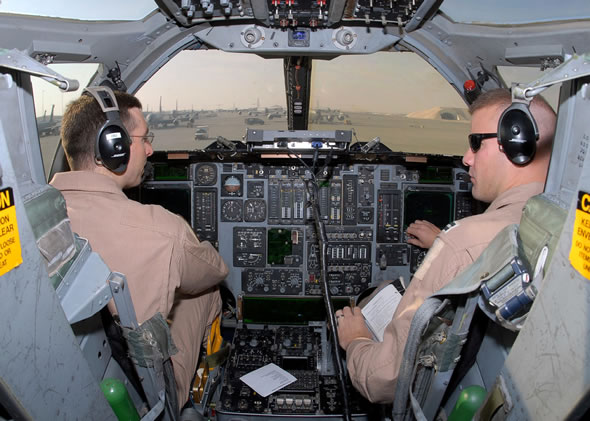
    Maj. Anthony Mincer and Capt. Brian Buschur, 9th Expeditionary Bomb Squadron, sit in the cockpit of a B-1B Lancer bomber as they run through the preflight checks to prepare the aircraft for a mission at a Southwest Asia air base Dec. 29, 2007. (Photo: U.S. Air Force by Staff Sgt. Douglas Olsen)

    Last week Boeing was awarded two aircraft upgrading and modernization contracts, upgrading the operational capabilities of U.S. Air Force combat command F-15E Strike Eagles and B-1B Lancers.

    The Air Force has granted the company to begin Low Rate Initial Production 2 (LRIP 2) of the F-15E Radar Modernization Program (RMP), replacing APG-70 radars with Raytheon APG-82(V)1 Active Electronically Scanned Array (AESA) radar systems in ten aircraft. Boeing received Milestone C authorization for six systems under LRIP 1 in September 2011. Installation of AESA radar systems is scheduled to begin in the third quarter of 2013.


    The RMP is undergoing an aggressive flight test program at Eglin Air Force Base, Fla., and Nellis Air Force Base, Nev. Boeing and Raytheon are analyzing data throughout the test phase to verify that the system’s performance meets the customer’s rigorous specifications. The RMP is the latest active F-15E fleet modification that the Air Force has identified in its Modernization Sustainment Plan. Other RMP elements include a wideband radome, modified environment control system, and modified radio frequency tunable filters, which allow the radar and electronic warfare system to operate simultaneously.

    Click on the picture to launch AESA Infographic

    The RMP APG-82(V)1 AESA radar will replace the F-15E strike fighter’s current APG-70 Mechanically Scanned Array radar, also produced by Raytheon. The AESA provides improved radar reliability, maintainability and performance, as well as reduced support costs. When integrated into the F-15E weapons system, the AESA radar will significantly improve detection and tracking of enemy targets.

    Boeing has also won a separate contract worth $65.8 million Boeing to upgrade the B-1B bomber under a Lot 2 follow-on contract from the U.S. Air Force. This lot includes the delivery of Integrated Battle Station (IBS) modification kits to be installed in nine B-1 Lancer bomber. The IBS upgrade is designed to enhance situational awareness and communications for the crew. IBS integrates three major aircraft modifications, The upgrade includes a new Vertical Situation Display Unit for the forward cockpit replacing the obsolete monochrome pilot and co-pilot displays with four multi-functional color displays, giving the crew better situational awareness data in a user-friendly format. The new diagnostics system will add improved usability. The integration of the Link 16 data link will adds line-of-sight communications to the bomber’s existing beyond line-of-sight Joint Range Extension Applications Protocol (JREAP) data link. The two links will also employ new full-color displays with intuitive symbols and moving maps. “Combining the three major B-1 modifications into one installation will not only save taxpayer dollars, but also will allow us to get the bombers back to the field much faster and with more capability,” said Rick Greenwell, Boeing B-1 program director.

    The initial Lot 1 contract was awarded in June 2011. Installation of those four kits will begin this fall at the company’s Maintenance, Repair, Overhaul and Technology Center in Oklahoma City. Civilian employees from Tinker Air Force Base will install the upgrades while Boeing employees provide engineering support. Lot 2 kit orders will begin immediately and the entire fleet will be upgraded by the end of 2019.

    Northrop Grumman Deliver First RMIP Radar Upgrade for B-1B

    Under a separate contract, Northrop Grumman recently delivered the first upgraded radar for the B-1B, the company produces these upgrade kits under a series of U.S. Air Force contracts worth a combined total of $161 million, for the B-1’s Radar Reliability and Maintainability Program (RMIP). Sofar one radar kit has since been installed on a B-1 aircraft based at Ellsworth Air Force Base, S.D. Two additional kits have been delivered to Dyess Air Force Base, Texas, and were installed in June.

    “this upgrade is projected to significantly enhance B-1 mission readiness” sais Maj. Daniel P. Walters, Air Force program manager, B-1 radar. Replacing two line-replaceable units in the B-1’s AN/APQ-164 radar to RMIP will improve the radar’s reliability and maintainability. The modification kit includes a new radar receiver and transmitter, a radar processing computer and a reconfigured software package. The new hardware will provide flexibility to expand the bomber’s mission capabilities as new technologies become available. The B-1 fleet was manufactured primarily during the 1980s. “With this upgrade, the B-1 fleet will remain combat-ready for our warfighters.” said Tim Winter, vice president of Global Sensor Solutions at Northrop Grumman.

    The Air Force awarded Northrop Grumman a $65 million RMIP base contract in September 2010 for 22 modification kits, with options worth an additional $95 million have since been awarded for another 38 kits. Northrop Grumman developed the RMIP upgrade prior to receiving the 2010 production contract.

    B-1B Lancer Cockpit as it looks today. Maj. Anthony Mincer and Capt. Brian Buschur, 9th Expeditionary Bomb Squadron, sit in the cockpit of a B-1B Lancer bomber as they run through the preflight checks to prepare the aircraft for a mission at a Southwest Asia air base Dec. 29, 2007. (Photo: U.S. Air Force by Staff Sgt. Douglas Olsen)

    Qatar Emiri Air Force Picks PC-21 for Pilot Training

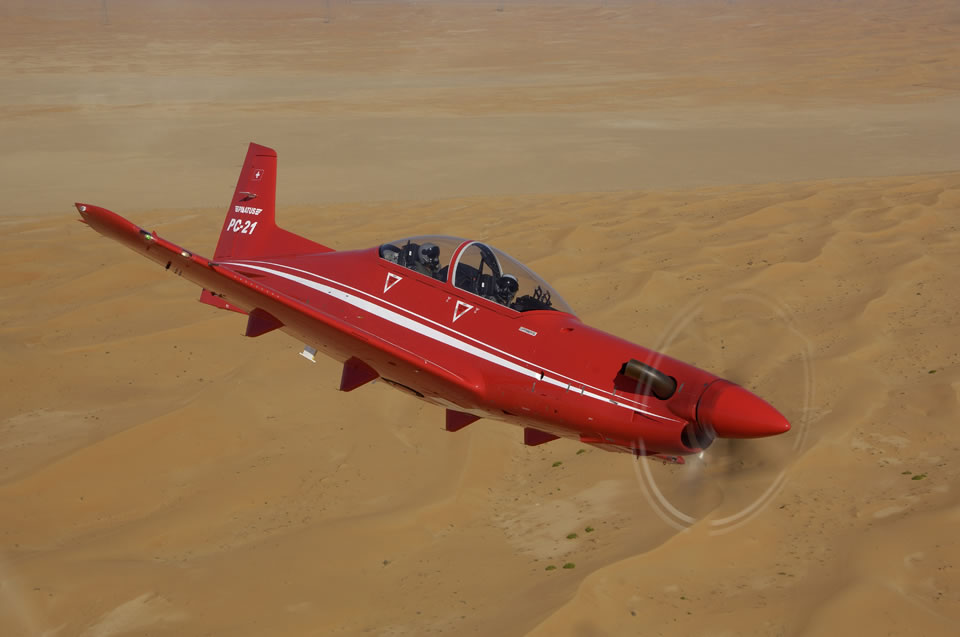
    Qatar selected Pilatus to deliver a comprehensive pilot training system consisting of 24 PC-21 aircraft and ground based simulators. Photo: Pilatus
    Qatar selected Pilatus to deliver a comprehensive pilot training system consisting of 24 PC-21 aircraft and ground based training systems. Photo: Pilatus

    Pilatus Aircraft announced today the Qatar Emiri Air Force (QEAF) has awarded a contract to Pilatus for the procurement of a complete PC-21 Training System, consisting of a fleet of 24 PC-21 trainer aircraft, a suite of Ground Based Training System assets and an extensive logistics support and maintenance package. The QEAF Air Academy will receive their first aircraft in the middle of 2014 and training will start mid-2015.


    The QEAF selected the PC-21 as their fixed wing basic and advanced training aircraft, after a thorough evaluation both in Switzerland and in Qatar. The PC-21 will support pilot training in the newly established Air Force Academy in Qatar. Operations will be directly supported by Pilatus under a long-term performance based support contract.

    The selection of PC-21 by Qatar follows other marketing successes in the region; In May 2009 Pilatus was awarded nearly half a billion US$ by the UAE, to deliver 25 PC-21 trainers to the Emirate air force; deliveries of these aircraft are currently underway. In May 2012, the PC-21 was included as subcontractor for the supply of 55 PC-21s, as part of a 102 aircraft mega-deal signed by BAE Systems, modernizing the training systems of the Royal Saudi Air Force. Earlier, in 2006 Pilatus scored the first sale of this type, as it was selected to provide 19 PC-21 to equip the 130 (Eagle) squadron of the Republic of Singapore Air Force (RSAF) based in Australia. The Switzerland was second, ordering six (later two additional) PC-21s in 2007.

    Qatar selected Pilatus to deliver a comprehensive pilot training system consisting of 24 PC-21 aircraft and ground based training systems. Photo: Pilatus

    Harris Atlas Systems to Establish Geospatial Data Sharing System for a Mid-Eastern Government

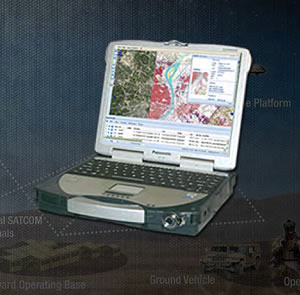
    Harris Atlas Active Catalog application. Photo: Harris Atlas
    Harris Atlas Active Catalog application. Photo: Harris Atlas

    Harris Atlas Systems LLC has been awarded an $8 million dollar contract to provide a Middle Eastern government agency with a system that will ensure that critical military and public safety information can be shared quickly, easily and securely even under the most demanding circumstances.

    The advanced geospatial intelligence solution consists of enterprise and mobile versions of Harris Corporation’s Active Catalog™ system, which enables users to manage, share, and retrieve large volumes of geospatial data — information that identifies the geographic location and characteristics of natural or constructed objects — that reside throughout an enterprise. It also provides access to live data feeds, and can generate and publish documents and map products of urban environments.


    Active Catalog integrates with a variety of Open Geospatial Consortium-compliant and standard geographic information systems software, such as ESRI and Bentley, which many customers are already using for military, intelligence and public safety operations. With sophisticated techniques to extract metadata, it supports a wide range of data formats, including overhead and aerial imagery, maps, intelligence reports, sensor data and other derived products. Data and metadata are securely shared between enterprise and remote versions of the system, enabling remote users to access enterprise-based geospatial intelligence data and also send field-collected information back to the enterprise.

    Leveraging 130 patents and more than 30 years of experience developing systems for the largest geospatial customers, Active Catalog goes beyond traditional catalog capabilities to one that incorporates a variety of data sources, and effectively support remote users in the most limiting environments — such as in a disaster or emergency — and delivers the highest level of security possible, Leon Shivamber, managing director, Harris Atlas Systems explains.

    Barracuda UAS Demonstrates Networked Multi-UAS Missions in Canada

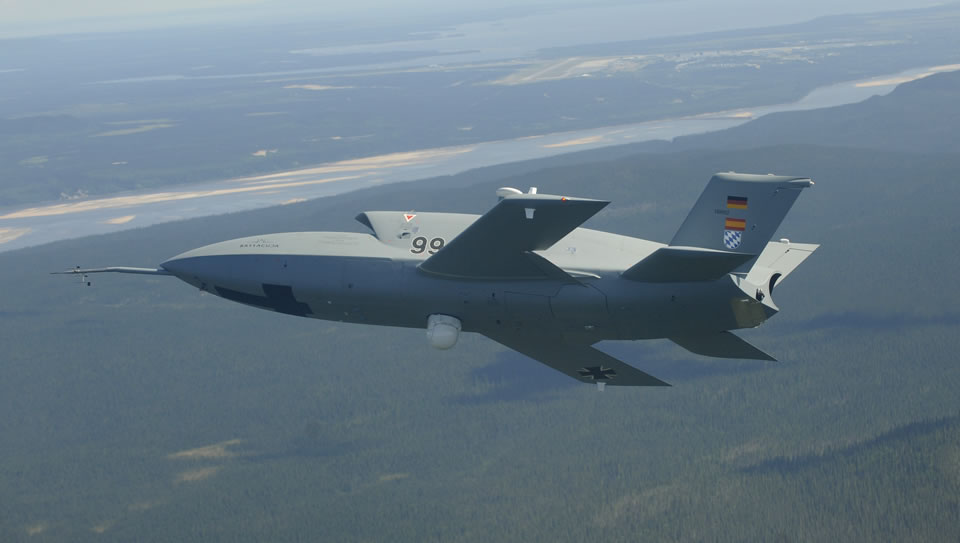
    The Barracuda demonstrator is designed as a technology test bed with a modular structure and a flexible configuration, enabling a wide variety of systems and flight profiles to be tested and a wide range of mission requirements to be demonstrated. Photo: Cassidian
    Barracuda performed pre-programmed missions throughout the recent test series. Photo: Cassidian

    Cassidian has successfully carried out a series of test flights with its Barracuda UAS (Unmanned Aerial System) technology demonstrator at Goose Bay military test range in Canada. In the past month Barracuda testbed completed five test flights under the ‘Agile UAV in a Network Centric Environment’ (Agile UAV-NCE) program. These test series involved the Barracuda technology demonstrator flying in combination with another unmanned aerial vehicle, which was simulated by a converted Learjet. The two aircraft flew missions where they each had different role profiles that were autonomously coordinated and synchronised with one another.

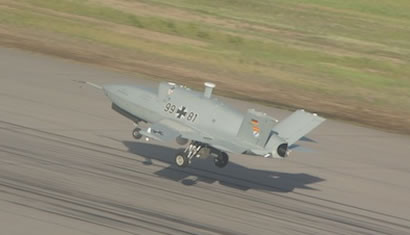
    The test flights provided an insight into several networked UAS oprations and the autonomous distribution of roles between unmanned aerial vehicles in complex mission scenarios. Although the role distribution was predefined in each test, coordination between the two UAS was largely automated. However, the missions could be adapted by uploading new mission files via datalink. Such mission files included new waypoints, and associated mission segments. The Barracuda again flew completely autonomously along pre-programmed flight profiles including auto-taxiing processes. The Barracuda and the Learjet simulating the second UAS were monitored from the ground station with respect to flight safety only.

    Designed as a technology test bed, Barracuda has a modular structure and a flexible configuration, enabling a wide variety of systems and flight profiles to be tested and a wide range of mission requirements to be demonstrated. The avionics system was developed as an open and modular structure that allows a large number of sensors and data link solutions to be integrated with the demonstrator. Electro-optical and infrared sensors, laser target designators, an Emitter Locator System (ELS) consisting of Signals Intelligence (SIGINT) detectors and Synthetic Aperture Radar (SAR) systems  can all be accommodated in the Barracuda’s payload bay.

    The Barracuda demonstrator is designed as a technology test bed with a modular structure and a flexible configuration, enabling a wide variety of systems and flight profiles to be tested and a wide range of mission requirements to be demonstrated. Photo: Cassidian

    US Air Force F-16 Crashes in Ocean Northeast of Japan

    A US Air Force Lockheed Martin F-16 Fighting Falcon crashed in the sea approximately 470 kilometers northeast of the northernmost Japanese island of Hokkaido at 11:30 a.m. on 22 July.

    A spokesperson from Misawa Air Force Base in Aomori is quoted as saying the aircraft was enroute to North America at the time of the incident and the cause of the accident is, at this time, unknown.

    The pilot, the sole member aboard the aircraft, ejected and at the time of this writing had been located and was rescued several hours later.  Japanese Coast Guard ships and rescue aircraft are enroute to the site of the accident to retrieve the pilot.  No information has been provided as to the condition or identity of the pilot.

    Aircraft accidents are always a matter of serious concern, but the timing of this crash is especially inopportune given widespread Japanese misgivings regarding the operational safety of US military aircraft deployed to Japan.

    Twelve Marine Corps Mv-22B Ospreys are scheduled to be offloaded at Marine Corps Air Station (MCAS) Iwakuni in Yamaguchi Prefecture on 23 July against a backdrop of intense Japanese opposition.  This unfortunate incident is likely to reignite public protests from anti-American activist groups and elected officials in Okinawa.

    Jets Make First Landing on Indian Carrier

    A MiG-29KUB two-seat naval fighter jet made the first touch-and-go landings last week on the Indian Navy aircraft carrier Vikramadatiya, Sevmash shipyard said on Monday. The ship is currently undergoing sea trials in the Barents Sea off the north coast of Russia. The jet, piloted by navy test-pilots Col. Nikolai Diorditsa and Mikhail Belyaev, completed several approaches to the carrier and finally made a touch-and-go landing. The Vikramadatiya, formerly the Russian Navy’s Admiral Gorshkov, is to be handed over to India after the trials after a much-delayed refit.

    Taiwan Signs LOA for F-16 Upgrades

    Taiwan's F-16A/B fighter plane

    On 13 July, Taiwan signed a Letter of Offer and Acceptance (LOA) valued at $3.7 billion for an upgrade of its fleet of 146 F-16A/B Block 20 Fighting Falcons. The signed LOA now opens up competition for final selection of upgrade providers and will be handled through the US Foreign Military Sales (FMS) program under the administration of the Defense Security Cooperation Agency (DSCA).

    While Lockheed Martin and BAE Systems have been in intense competition with each other for the past year over which company would secure the contract to provide the upgrade, it appears that BAE Systems has now lost that battle. Defense sources have reported that Lockheed Martin and Taiwan’s state-run Aerospace Industrial Development Corporation (AIDC) finalized a Memorandum of Understanding (MOU) on 11 July calling for the formation of a strategic partnership to carry out the upgrade. The reports say that Lockheed’s Vice President of International Business Development, Ana Wugofski, and AIDC President, Butch Hsu, signed the MoU at the Farnborough International Airshow.


    Lockheed spokesperson Laura Siebert is quoted as saying that AIDC and Lockheed have a long history of working together in the development of F-16 upgrades and that Lockheed is “impressed with AIDC’s capability” and the company is “looking forward to the opportunity to expand this relationship as we begin to implement the Taiwan F-16 upgrade program.” With the Lockheed/AIDC MoU signed, it appears fairly certain that BAE Systems is no longer in the running to perform the upgrade.

    An intense battle remains to be fought over selection of the firm that will deliver the Active Electronically Scanned Array (AESA) portion of the upgrade. Both Raytheon and Northrop Grumman have been pursuing an aggressive strategy to lock-up the contract. Raytheon is promoting its Advanced Combat Radar (RACR) in competition against Northrop’s Scalable Agile Beam Radar (SABR).

    Both Raytheon and Northrop are also expected to be offering the same radar systems in competition for a contract to upgrade South Korea’s fleet of KF-16C/D Block 52 fighters and an anticipated Singapore F-16 AESA upgrade sometime in the future. The US Air Force is also planning to upgrade several hundred F-16C/D fighters for the Air National Guard, under a similar modernization plan.

    Skunk Works and XTEND Simplify Multi-Drone Command

    0
    Lockheed Martin Skunk Works® and XTEND have achieved a major milestone in JADC2 by integrating the XOS operating system with the MDCX™ autonomy platform. This technical breakthrough enables a single operator to simultaneously command multiple drone classes, eliminating the friction of mission handoffs. From "marsupial" drone deployments to operating in GPS-denied environments, explore how this collaboration is abbreviating the data-to-decision timeline and redefining autonomous mission execution.

    From Ukraine to Taiwan: The Global Race to Dominate the New Defense Tech Frontier

    0
    As traditional defense primes face mounting competition from agile “neoprimes” such as Anduril, Palantir and Helsing, the balance of innovation is shifting toward software-defined warfare and scalable, dual-use technologies, while global industry consolidation—marked by Boeing’s integration of Spirit AeroSystems and other strategic mergers—signals an intensified race to secure control over the defense technology value chain. Our Defense-Tech weekly report highlights these trends.

    Europe’s “Drone Wall”

    0
    In early October 2025, a coordinated wave of unmanned aerial system (UAS) incursions—widely attributed to Russia—targeted critical infrastructure across at least ten European nations. The unprecedented campaign exposed the fragility of Europe’s air defenses...

    Weekly Defense Update & Global Security Assessment

    0
    Executive Summary The past week (September 18-25, 2025) represents an inflection point where strategic defense concepts have transitioned from doctrine to tangible reality. An analysis of global events reveals four primary, interconnected trends shaping an...

    U.S. Air and Space Forces Push Next-Gen Programs at the AS&C 2025 Conference and...

    0
    At the 2025 Air, Space & Cyber Conference, U.S. Air Force and Space Force leaders unveiled major updates on next-generation fighters, bombers, unmanned systems, and space initiatives, highlighting both rapid innovation and critical readiness challenges as the services race to outpace global competitors. A short version is available here, with a more detailed version for subscribers.

    TADTE 2025: Reflecting Taiwan’s Strategic Themes

    0
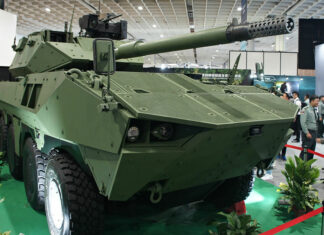
    The Taipei Aerospace & Defense Technology Exhibition (TADTE) 2025 crystallized around four dominant strategic themes that collectively illustrate Taiwan's comprehensive approach to defense modernization amid escalating regional tensions. Based on a detailed report by Pleronix (available upon request). Includes a Podcast discussion on TADTE 2025's highlighting Taiwan's four strategic themes beyond the post's coverage.

    Iron Beam 450 Completes Testing, Soon to Join With Operational Air Defense Units

    0
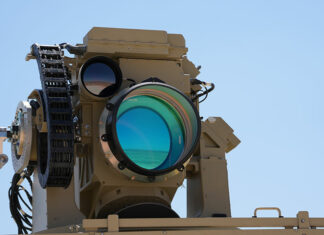
    Israel’s Iron Beam 450 high-power laser system has completed final testing, marking a major leap in air defense. Developed by Rafael, it offers precise, cost-effective interception of rockets, UAVs, and mortars, and is set for IDF deployment by 2025.