
Monday, December 29, 2025
More
    Home Blog Page 233

    The High Cost of Precision Attack

    Dassault Mirage 2000D operated by the French Air Force typically carry two GBU-12 laser guided bombs or GBU-49 GPS enhanced LGB and Damocles target designation pod, on combat missions over Libya. Photo: French Air Force

    This is a page  1 of a three page article: 1 – 2 – 3

    Depleting stocks of Precision Guided Munitions (PGM) used by European Air Forces could soon trigger a renewed demand for these weapons, and heat up the debate of cost versus efficiency. Recent news reports from the U.S. that claimed precision munitions stocks of certain NATO members were depleting quickly were rebuffed by official responses from Britain and France, claiming their air forces could continue unaffected at current operational tempo. However, Pentagon sources insisted Washington was in talks with NATO allies to ensure a sufficient supply of munitions for the Libya bombing campaign.
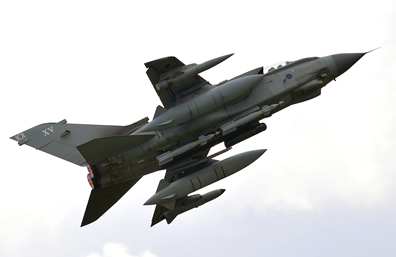
    RAF Panavia Tornado GR4 carrying two enhanced laser guided bombs, takes off on a mission in Libya. While demonstrating impressive range and lethality, Tornados were able to carry a limited number of precision weapons, as many of the hardpoints originally designed for stores carriage were used to carry extra fuel, electronic warfare support and countermeasures. Photo: MOD

    NATO members maintaining smaller munitions stockpiles could be the most adversely affected. In a recent article published by Defense News, an unnamed British claimed Denmark did suffer precision weapons shortage, which was fulfilled by U.S. supplies. Britain and France are carrying out about half of the bombing raids in Libya with four other countries – Belgium, Canada, Denmark and Norway – conducting the rest.
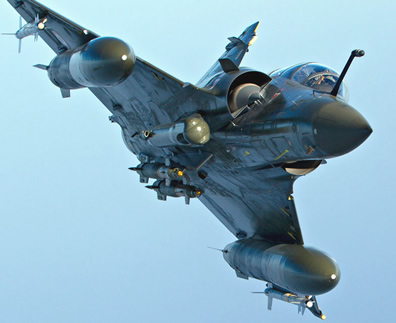
    Dassault Mirage 2000D operated by the French Air Force typically carry two Raytheon GBU-12 laser guided bombs or GBU-49 GPS enhanced LGB and Thales Damocles target designation pod, on combat missions over Libya. Photo: French Air Force

    While European Air Forces are relying heavily on U.S. produced laser guided bombs mostly produced by Raytheon, these models are uniquely designed for specific European built platforms and are not readily available to replenish British or French stocks from U.S. munitions reserves.

    Although the United States has significant stockpiles, its munitions do not fit on the British- and French-made planes that have flown the bulk of the missions. The French Air Force uses the GBU-12, (Paveway II) GBU-22 (Paveway III) and GBU-49 Enhanced Laser Guided Bomb, (adding a GPS/INS to the basic GBU-12 kit. The French Rafale fighters used by the Air Force and Navy also carry the AASM stand-off guided munition.

    The British Royal Air Force uses Paveway II and Paveway III kits with 1,000 pound warheads, carried by Tornado GR4 strike fighters. The Paveway IV loaded with 500 pound (225 kg) warheads is also carried by the Tornado and was recently cleared for the Typhoon, a step soon followed by similar clearance of the European equivalent – EGBU-16 for the German, Italian and Spanish versions of Typhoon. The European choice of enhanced LGB derive from its inherent all-weather capability, considered better adaptable to the European climate. EGBU-16 employs the 1,000 pound bomb shell converted into a guided weapon.

    The Typhoon maintains an autonomously air-to-ground capability since 2008, employing the Litening III target acquisition and laser designation pod with laser guided munitions. Both types of weapons are combining GPS/INS and laser guidance enabling high precision attack under adverse weather conditions that would hinder the use of standard LGBs.
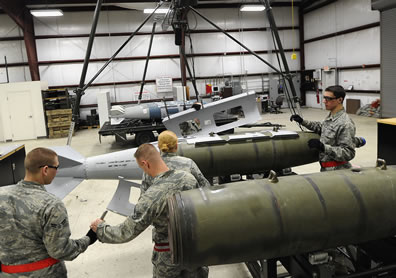
    U.S. Air Force technicians install a JDAM kit, converting a Mk82 bomb into a GBU-31 JDAM GPS guided weapon. Photo: U.S. Air Force

    Precision has its Cost

    How much European Air Forces will be asked to pay for replenishing their stock is yet unknown. Guided weapons are sold for $15,000 for the cheapest laser-guided types, to quarter of a million apiece, for the most versatile, and sophisticated models, providing stand-off, autonomous, off-boresight attack modes. The scale of the orders should also determine the cost to each customer. Maturity of the weapon have a factor on the cost per unit.

    For example, a the cost of a basic JDAM kit as paid by the Pentagon was about $40,000 ten years ago. After producing almost quarter of a million weapon, Boeing could drop the cost to around $25,000, as reflected in recent orders. As weapons become more sophisticated, their cost increase – Paveway II laser guidance kits were sold for $12,000 ten years ago, but increased four to seven times higher, when served with improved seekers, electronics and optional GPS, associated with the Paveway III version. Depending on the size of the weapon – ($40,000 for a 1,000 pound and $70,000 for the 2,000 pound warhead.

    like many other aerospace systems, the cost of such weapons is often increases with the weight. Additional costs are involved with the integration of GPS navigation kits. Those comprise special anti-jam receivers (SASSM) that further increase the cost of otherwise off-the-shelf capability. Overall, the cost of an EGBU-12, is around $40,000, compared to the past generation, $12,000 laser only baseline kit. In the past decade Raytheon has sold over two billion worth of laser guided bombs, by far its most active production line of laser guided bombs.

    Boeing originally expected JDAM sales will add up to about two billion, but the conflicts in the Middle East and Central Asia have increased demand, actually doubling that figure. A much smaller, yet equally precise, stand-off capable weapon is the GBU-39 Small Diameter Bomb (SDB), sold for around $40,000 each (this price also reflects the cost of the associated SDB carriage system). Future acquisitions will not require these elements and further reduce the cost of SDB munition replenishment acquisitions.
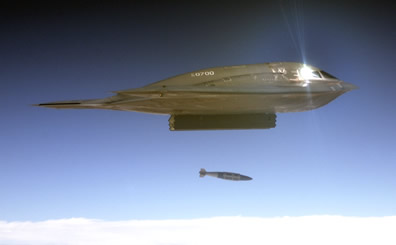
    A US Air Force B-2A Stealth Bomber from the 325th Bomb Squadron, Whiteman Air Force Base (AFB), Missouri (MO), drops a GBU-31 Joint Direct Attack Munitions (JDAM) over the Utah Test and Training Range during exercise Combat Hammer, a Weapon System Evaluation Program (WSEP) conducted at Hill AFB, Utah (UT). Photo: US Air Force

    More Bang – More Bucks

    There are also the more expensive options – priced in the six-digit range and up – that offer advantages over the baseline precision weapons. More flexiblility, wider launch envelope, better stand-off range, ‘man in the loop’ capability, introducing manual corrections and piloting to achieve near 100% mission success.

    Typically, the more expensive weapons offer an important ‘stand off’ capability – launched from 50-60 km – keeping the launching aircraft outside the range of enemy air defense missiles. Other benefits are less restrictive launch envelope and flexible mission planning. While these weapons are twice, or four times more expensive than laser guided bombs or J-class weapons, these weapons offer a ‘low cost alternative’ to much more expensive cruise missiles.

    When all these factors are measured, against potential attrition of aircraft, launching of additional missions to strike targets that were not eliminated in the first run, the cost of enhanced weapons, particularly those designed for killing Surface/Air Missile sites, attacking high value targets in the first stages of the conflict, or when operating in conditions where air supermacy cannot be achieved, the higher cost of such weapons pays off in great saving in human lives, aircraft, weapons and operational expense.

    Two representatives of this class are the Israeli SPICE and French AASM and, to some extent, the American Joint Stand Off Weapon JSOW-C1.
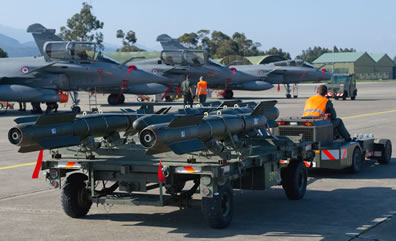
    A six AASM load being transported to the flight line, for loading on a Rafale fighter at th eFrench Air Force base in Solenzara, Sardinia. Photo: French Air Force.

    Operational with the French Air Force, and French Naval Aviation, AASM was first deployed in Afghanistan with the French Rafale in 2008. The baseline AASM kit comprises of the INS/GPS guidance system, designed for standard 250 kg (500 pounds) bombs. The AASM family will eventually include 125, 500 and 1,000 kg (250, 1000, and 2000 pounds) versions. Since the French forces have received only the initial deliveries of 3,500 weapons ordered, chances are that the used inventory could be replenished by extending current production runs. It is assumed that new weapons could be delivered at considerably lower costs than the original ones, as the manufacturer has stepped up the learning curve. Nevertheless, the cost of a basic AASM is still expected to ship at around $300,000 apiece (€200,000).

    European air forces considering their future PGM roadmaps could also consider the Israeli Spice, for their stand-off, autonomous attack capability. Earlier in 2011 Greece has awarded the Israeli company Rafael Advanced Defense Systems a contract worth about €100 million to deliver 300 SPICE 1000 weapons for the Hellenic Air Force (while this deal reflects almost $480,000 unit cost, it is asusmed the cost involves spending for setup, training supporting the new weapons). SPICE is available in 2,000 and 1,000 pound versions, and will soon be offered in a 500 level. The weapon uses GPS/INS navigation with electro-optical guidance and homing techniques to achieve accurate and effective destruction of high-value targets with pinpoint accuracy and at high attack volumes. An major advantage of the Israeli weapon is its adaptability to the Tornado and F-16 platforms, employed by a number of European Air Forces and the integration with Rafael’s Reccelite tactical recce pod, enhancing the weapon’s ability to rapidly respond in engaging time critical targets from stand-off range. Reccelite is already employed by a number of NATO air forces, including the Italian, Dutch and Royal Air Force.
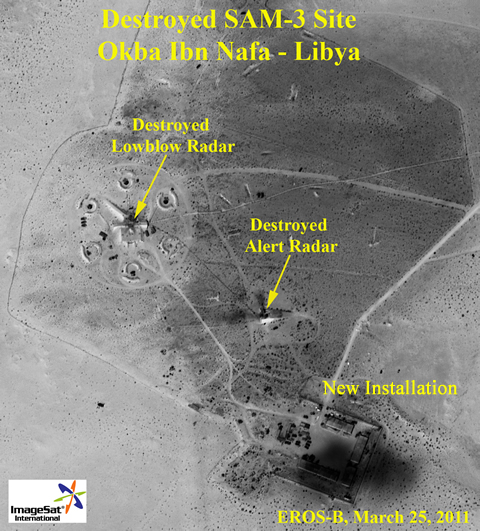
    A typical precision strike took out the LOW BLOW engagement radar, the heart of this SA-3 site protecting the place at at the desert airbase Okba Ibn Nafa, near the Tunisian border. Photo by Imagesat International

    NATO strikes targeting air defense sites in Libya

    NATO attacks at Misrata Airbase

    Currently entering flight testing, prior to induction into service with the U.S. Navy, JSOW C-1 is an all-weather, day or night, launch-and-leave, network-enabled weapon that employs a Global Positioning System/inertial navigation system. The weapon uses an infrared seeker for terminal guidance. The test paved the way for more extensive testing, with the first free flight of the weapon expected later this year. The C-1 is a variant of the combat-proven JSOW, offering upgraded capability to strike moving maritime targets. The weapon’s Link-16 data link allows the F/A-18E/F Super Hornet aircraft to relay targeting information to the weapon. Following this initial test, the Navy is expected to follow with more extensive testing to ensure warfighter requirements are met. With the new datalink the weapon will be able to enter Navy’s secure military tactical data exchange, transferring mission data, target allocation, moving target indications and other commands. The cost of JSOW-C1 is yet unknown, but is considered to be significantly above the original JSOW, sold for around $700,000 apiece.
    This is a page 1 of a three page article: 1 – 2 – 3

    Sagem Reports Progress with Laser AASM

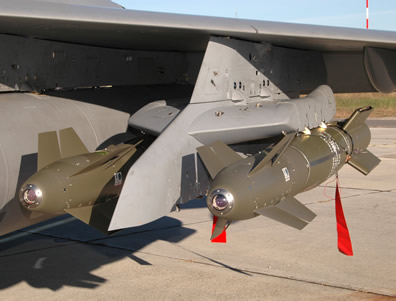
    The basic AASM uses INS/GPS guidance. It can be enhanced with add-on terminal homing modules, using semi-active laser or Infrared (IR) guidance. Photo: Sagem

    The French defense procurement agency (DGA) has performed a successful test firing of the AASM modular air-to-ground weapon, fitted with terminal laser homing capability, enabling the guided weapon to engage fast-moving surface targets. This firing test demonstrates the AASM Laser’s ability to offer 1-meter accuracy against high-speed, agile land or maritime targets.

    The test was carried out at the DGA’s missile test range in Biscarosse by a production Rafale fighter deployed by the DGA’s flight-test center in Cazaux. The moving target was represented by a laser spot generated by a ground illuminator, simulating a vehicle moving at a speed of 80 km/h. The AASM was fired from an extreme off-axis angle (90°) at a range exceeding 15 kilometers. Using its algorithms for detection and slaving of the trajectory to the laser spot, the weapon maneuvered itself to hit the designated target, impact was at a very low angle, within less than one meter of the designated spot.

    The basic AASM uses INS/GPS guidance. It can be enhanced with add-on terminal homing modules, using semi-active laser or Infrared (IR) guidance. Photo: Sagem

    The first test of a laser equipped AASM was conducted in July 2010, dropping a 250kg weapon at a stationary target from a range of 25km. The laser terminal guidance version of the AASM is expected to enter volume production for the French air force and navy starting at the end of 2012.

    Sagem is on contract to develop and qualify the add-on laser guidance for AASM, under a delivery contract for 680 guidance kits, part of a framework contract awarded by DGA in 2009, covering 3,400 AASM units for the French Air Force and Navy.

    Israel to Receive a Third Enhanced Dolphin Submarine

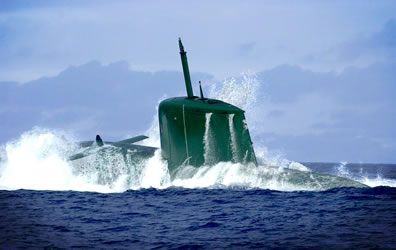
    Israel Navy Dolphin class submarine performs emergency surfacing drill. Photo: IDF

    The Israeli government has decided to finalize the acquisition of a sixth Improved Dolphin class submarine from Germany, with payment to be spread over several years. The Dolphins are manufactured by Howaldtswerke-Deutsche Werft (HDW), which is owned by ThyssenKrupp Marine Systems. Israel currently operates three Dolphin Class subs, two were financed by Germany and the cost of a third sub was shared by Israel These three submarines were delivered in 1998 – 2000. Two additional submarines are currently under construction and expected for delivery in 2013-2014. Berlin was ready to bear two thirds of the cost of these two constructions but was reluctant to extend such terms to the sixth sub.

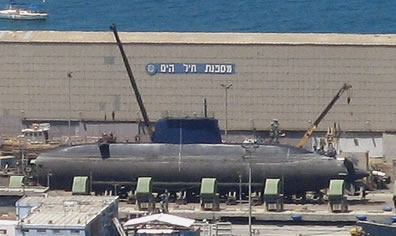
    An Israel Navy Dolphin class submarine inspected on a Israel Navy Shipyard’s dry dock. Haifa, 2007.

    The Dolphin is a 1,900 ton submarine designed specifically for Israel, based to some extent on the German Type 209 design. It is powered by standard diesel electric propulsion, and is equipped with four 533mm (21″) torpedo launch tubes, launching torpedoes and surface attack missiles. Four additional 650mm (25.5″) tubes are believed to support launching of oversized weapons, such as a type of submarine launched cruise missile enabling the Israeli Navy an unconventional ‘second strike’ capability – according to unconfirmed reports.

    The enhanced version of the Dolphin submarine is extended by ten meters over the original standard Dolphin, utilizing an Air Independent Propulsion, enabling the submarine to remain submerged for weeks, rather than days.

    The Dolphin has ten launch tubes fitted to launch torpedoes, missiles, mines or other vehicles. Two pairs on each side are 25.5″ (650mm), fitted to accommodate outsized vehicles while the three pairs in between are standard 21″ tubes, launching torpedoes and surface attack missiles. Photo courtesy of the Naval Museum Haifa, via submarines.dotan.net
    Israel Navy Dolphin class submarine performs emergency surfacing drill. Photo: IDF


    Phantom Ray – Boeing’s Unmanned Fighter is Finally Flying

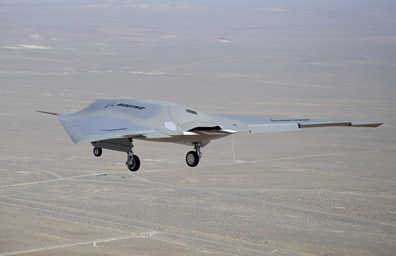
    The Phantom Ray on its first flight from Edwards AFB. Photo: Boeing

    Boeing made Phantom Ray unmanned airborne system (UAS) successfully completed its first flight April 27 at NASA’s Dryden Flight Research Center at Edwards Air Force Base, Calif. Since being delivered to the base in December 2010, the flight demonstrator, based on the company’s Phantom Works’ X-45C, originally developed for the DARPA/USAF Unmanned Combat Aircraft System (UCAS) program. Months before the first flight the unmanned plane went through extensive pre-flight testing, culminating in a series of high-speed taxi tests performed in March. These tests validated ground guidance, navigation and control and verified mission planning, pilot interface and operational procedures. On its first flight Phantom Ray was airborne for 17-minute mission, flying to 7,500 feet and reaching a speed of 178 knots.

    The Phantom Ray on its first flight from Edwards AFB. Photo: Boeing

    The flight demonstrated Phantom Ray’s basic airworthiness, setting the stage for additional flights in the next few weeks. “The first flight moves us farther into the next phase of unmanned aircraft,” said Craig Brown, Phantom Ray program manager for Boeing. “Autonomous, fighter-sized unmanned aircraft are real, and the UAS bar has been raised. Now I’m eager to see how high that bar will go.”

    Phantom Ray takes off on its maiden flight. April 27, 2011. Photo: Boeing

    Boeing considers the current company-funded flights will prepare Phantom Ray to support potential missions that may include intelligence, surveillance and reconnaissance; suppression of enemy air defenses; electronic attack; strike; and autonomous air refueling. Boeing is one of four candidates offering unmanned platforms for the U.S. Navy stealthy Unmanned Carrier-Launched Airborne Surveillance and Strike project (UCLASS) program projected to become operational by the turn of the decade. Besides Boeing developing the Phantom Ray, other likely competitors are Lockheed Martin (has developed the RQ-170 Sentinel, which already entered operational use), Northrop Grumman (its X-47B technology demonstrator will begin carrier suitability tests next year), and General Atomics (proposing a naval version of Predator C – Avenger).

    Phantom Ray unmanned aircraft prepared for takeoff on its first flight - April 27, 2011. Photo: Boeing


    U.S. Operatives Kill al Qaeda leader Osama bin Laden

    Osama bin Laden is dead.

    The ten years long chase after al Qaeda leader is over. Osama bin Laden is dead, killed by U.S. operatives. The number one international terrorist was located in a new (five year old) compound located at the town of Abottabad in Pakistan, about 50 km north of the capital Islamabad.

    Top U.S. officials listening as President Barack Obama makes a statement on Osama Bin Laden's death. Seated from left, James Clapper, Director of National Intelligence, National Security Advisor Tom Donilon, CIA Director Leon Panetta, Admiral Mike Mullen, Chairman of the Joint Chiefs of Staff, Secretary of State Hillary Rodham Clinton, and Vice President Joe Biden (Official White House Photo by Pete Souza)

    The raid, conducted by U.S. operatives took under 40 minutes. The forces arrived at the scene by helicopters, one was lost in the fight. Bin Laden and his guards resisted the assault force; Bin Laden, his adult sons and two couriers were killed in the firefight. The body was recovered by the US military and was ‘burried at sea’ after positive identification done by U.S. forces in Afghanistan. Bin Laden’s  identity was confirmed, by DNA samples taken from the body, compared with DNA samples on record from his dead sister.

    The operation was the result of eight months of intelligence work, with Obama giving the order to carry out the operation last week. It is assumed that the operation was CIA and the Joint Special Operations Command.

    After failing to capture Bin Laden in Tora Bora, in South-Eastern Afghanistan, the U.S. launched a massive campaign lead by unmanned aerial vehicles (UAVs) launching attacks against suspected al-Qaeda and the Taliban in Pakistan. To support the campaign the CIA has established its own intelligence network inside Pakistan’s tribal areas, ‘assisted’ by unenthusiastic support from the Pakistani intelligence service.

    Obama said that the operation couldn’t have happened without Pakistani cooperation. But the senior administration official says that the Pakistanis didn’t know about the raid until after it occurred, citing the need for the “utmost operational security.”

    More on this topic:


    Pakistan Tests Ra’ad (HATF VIII) Air-Launched Cruise Missile

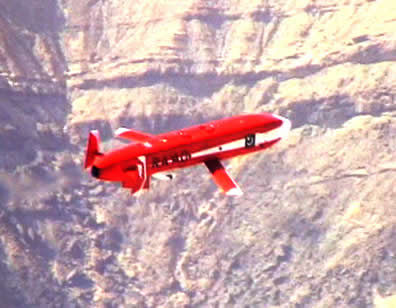
    Pakistan's Ra’ad Air Launched Cruise Missile is powered by a turbojet engine, sustaining a cruising speed around Mach 0.8. The weapon uses twin horizontal fins. The weapon employs autonomous electro-optical guidance for terrain matching and terminal guidance. Photo: ISPR

    Pakistan conducted a successful flight test of the indigenously developed Ra’ad Air Launched Cruise Missile (ALCM) also designated Hatf-VIII. According to the announcement made by Pakistan’s defense department, the missile test was conducted yesterday (April 29, 2011) as part of the continuous process of improving the technical parameters of the weapon system. Raad has a range of over 350 km; it is designed to deliver nuclear and has sufficient attack precision (reportedly 3 m’ CEP) to effective deliver conventional warheads, when employed against hardened aircraft shelters at air bases, enemy command-and-control centers or naval targets. The missile provides the country with greater strategic stand-off attack capability on land and at sea.

    Developed exclusively for launch from Aerial Platforms, the Ra’ad Missile can be carried by Pakistan’s strike fighters such as the upgraded Mirage IIIEA, which provided the launch platform for the recent test, and, possibly the JF-17 Thunder.

    As a ‘Cruise missile’ Ra’ad is designed to fly low altitude, automatically maneuvering through terrain following flight profile to avoid detection by ground based air defenses. The missile also uses stealth technology to further reduce probability of detection. The missile uses GPS and infra-red imaging (IIR) seeker to navigate employing ‘digital scene-matching’ techniques.

    Pakistan was able to recover at least two RGM/UGM-109 Tomahawk cruise missiles launched by U.S. forces against targets in Afghanistan in 1998. The missiles landed unexploded in Southern Pakistan, enabling Pakistani scientists to study the weapons and improve previous designs dated from the mid- 1990s. The development of the Raad ALCM began in 2003 and the first firing took place in 2007. Another cruise missile, the Babur (HATF VII) was also launched in 2005, demonstrating an attack range of 500 km. It later demonstrated flight ranges up to 750 km.

    Australian Multi Role Helicopter Gets More Time to Sort out Availability problems

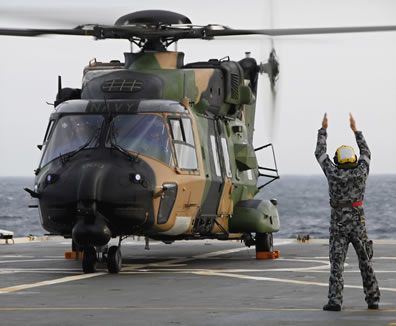
    MRH 90 'Cobra 08' prepares to take off during the First of Class Flight Trials onboard HMAS Manoora in November 2009. The month long testing regime gauged the MRH-90’s capabilities at sea through takeoffs, landings, munitions transfers and weight load carries. The Royal Australian Navy was scheduled to field Forty six MRH90 by mid 2010. However, by April 2011

    The Australian Defence Department completed a two-month diagnostic review of the MRH-90 Multi Role Helicopter Program, addressing delays to the project. The review has recommended that at present the project should not be listed under the ‘Project of Concern’ list, but recommended the ministry to work with the contractor, Australian Aerospace, to improve the availability of the helicopters by addressing engineering and reliability issues. Progress on the project will be evaluated by a follow-on diagnostic review. The Australian MRH-90 project experienced a series of reliability issues, including engine failure, transmission oil cooler fan failures and the poor availability of spares.

    An MRH 90 lands on the aft flight deck of HMAS MANOORA in lead up to the MRH 90 acceptance trials. Photo: Australian Navy

    To date, 13 MRH-90 helicopters have been accepted by Defence and are currently being used for testing and initial crew training. The project has suffered delays of 12 months for the Navy’s helicopters and 18 months for the Army’s helicopters.

    MRH 90 'Cobra 08' prepares to take off during the First of Class Flight Trials onboard HMAS Manoora in November 2009. The month long testing regime gauged the MRH-90’s capabilities at sea through takeoffs, landings, munitions transfers and weight load carries. The Royal Australian Navy was scheduled to field Forty six MRH90 by mid 2010. However, by April 2011 the initial 13 aircraft delivered are still undergoing testing. Photo: LAC Christopher Dickson, Royal Australian Navy.

    HJT-36 ‘Sitara’ Lost in an Accident

    HJT-36 shown in taxi before takeoff at Farnborough, 2006.

    An Intermediate Jet Trainer (HJT-36 Sitara) made by Hindustan Aeronautics Limited (HAL) crashed yesterday in the Tamil Nadu region, Southern India. Group Captain Mathur of HAL and co- pilot, Wing Commander Patra of Aircraft and Systems Testing Establishment (ASTE) ejected to safety. The aircraft, a developmental model of India’s indigenous intermediate trainer was destroyed in the accident. HAL began designing of the IJT in 1997; the aircraft is scheduled to enter Indian Air Force service in two years. In recent years the program suffered several mishaps, both occurring during takeoff and landing.

    HJT-36 shown in taxi before takeoff at Farnborough, 2006.

    While the Indian incident ended in material loss only, other accidents involving training missions that took place in the U.S.A and Philippines proved fatal. A Dutch instructor pilot was killed yesterday flying on a training mission with another Dutch AH-64 cadet from Ft. Rucker, Alabama. A statement from the Dutch Ministry of Defense identified the pilot as Captain Van de Perre. The other crew member, a Dutch cadet was wounded in the accident.

    Two days ago, in the Philippines, an S-211 of the Philippine Air Force crashed near a village in Northern Philippines, killing the pilot Maj. Ephraim Gatus Suyom. Maj. Gatus flew a routine proficiency flight from Clark Air Force Base when the accident occurred. Following the mishape the Philippine Air Force has grounded all its S211 aircraft until further investigation of the cause of the crash.

    Northrop Grumman Joins BAE Systems’ JLTV Industry Team

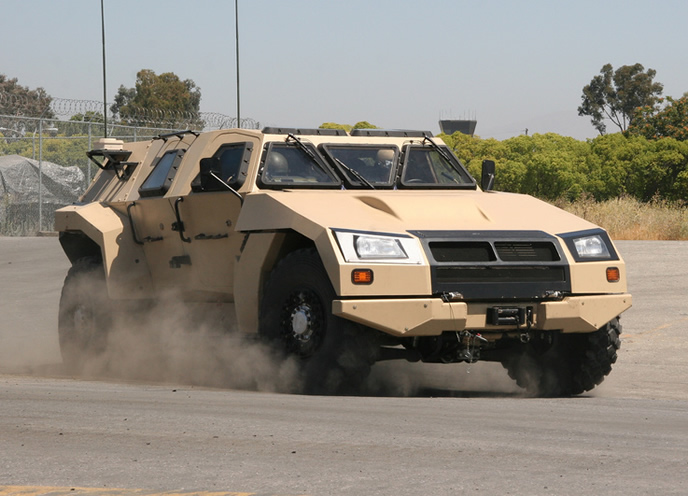
    The Valanx, proposed by the BAE-Systems lead team for the U.S. Army/Marine Corps joint Light Tactical Vehicle (JLTV) program. Photo: BAE Systems

    Northrop Grumman has joined the BAE Systems lead Joint Light Tactical Vehicle (JLTV) team. The BAE team currently consists of BAE Systems, Navistar Defense and Meritor Defense (formerly ArvinMeritor). As the new member of the team, Northrop Grumman will serve as the lead for electronics mission systems (C4ISR – command, control, communications, computers, intelligence, surveillance and reconnaissance) lead, responsible for the integration of command and control hardware and software, computers and communications equipment, sensors and sensor suites for intelligence gathering and force protection.

    “Our decision to team with one of the world’s leaders in C4ISR recognizes the growing importance of situational awareness, information sharing, and command and control on the battlefield, both for vehicles and dismounted soldiers,” said Ann Hoholick, vice president and general manager of amphibious and new programs at BAE Systems explained the new move. Joe G. Taylor, Jr., Northrop Grumman Information Systems’ vice president for Ground Combat Systems added that the goal of the combined team effort is to deliver proven, low-risk solutions with the best vehicles, best payload, protection and performance that industry can offer. “Northrop Grumman will help us ensure that we provide the kind of scalable solutions the military needs, at an affordable price” Hoholick added. “By applying Northrop Grumman and BAE Systems’ substantial domain expertise, the team will develop a net-ready, open architecture system, allowing the warfighter to configure the JLTV platform rapidly and inexpensively for current and future mission needs.” The BAE Systems’ announcement said.

    As one of three teams participating in the current Technology Development phase of the JLTV program the BAE team plans to compete for the next phase of the program, Engineering and Manufacturing Development (EMD). The BAE Lead team submitted the Valanx vehicle for the testing. The Army has announced plans to award up to two contracts for the EMD phase, which is currently scheduled for the beginning of 2012.

    The Valanx, proposed by the BAE-Systems lead team for the U.S. Army/Marine Corps joint Light Tactical Vehicle (JLTV) program. Photo: BAE Systems

    Israel Acquires Two Additional C-130J ‘Samson’ Multi-Mission Transport Aircraft

    Lockheed Martin has received an Undefinitized Contract Action from the U.S. Government for the Foreign Military Sale of an additional C 130J ‘Samson’ to Israel, with funding for advanced procurement items for a third aircraft.

    Israel ordered its first C-130J in April 2010 and will receive that aircraft in spring 2013. The next two aircraft will be delivered in late 2013 and late 2014 respectively. The contract also covers a number of items to meet Israel’s unique operational requirements.

    The Israeli Air Force’s new Super Hercules are the longer fuselage or “stretched” variant of the C-130J.

    Israel’s aircraft are being modified during production with non-developmental items, which include an Enhanced Service Life center wing, two embedded Global Positioning Systems and a Universal Aerial Refueling Receptacle Slipway Installation aerial refueling system.

    SAAB Wins a New Order for AT-4

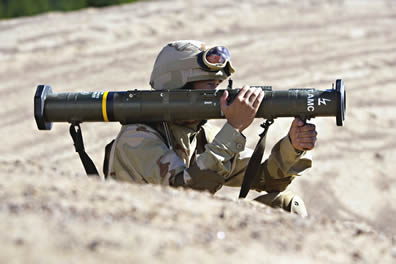
    AT-4 CS is the newest version of the weapon, configured for action from confined spaces such as firing from windows or vehicles. Photo: Saab
    The AT4 CS RS undergoing testing by the U.S. Army. The weapon's warhead uses insensitive explosives charge and is equipped with double safety fuse for maximum safety. Photo U.S. Army AETC.

    Defence and security company Saab have signed a contract on further deliveries of AT4 CS RS man-portable weapon system. This version is designed for operations from confined spaces (CS).  The weapon’s warhead uses insensitive explosives charge and is equipped with double safety fuse for maximum safety, hence its designation ‘Reduced Sensitivity’ (RS) to battlefield damage.

    This recent order will be delivered during 2012 and has a total value of more than US$17 million (MSEK 104). The identity of the customer was not provided by the company.

    “This is very positive and it further proves the capability of the AT4 system which until now has been exported to more than 15 customers around the world.” says Tomas Samuelsson, Head of Business Area Dynamics.

    AT-4 CS is the newest version of the weapon, configured for action from confined spaces such as firing from windows or vehicles. Photo: Saab

    Typhoon, Rafale Shortlisted for India’s MMRCA

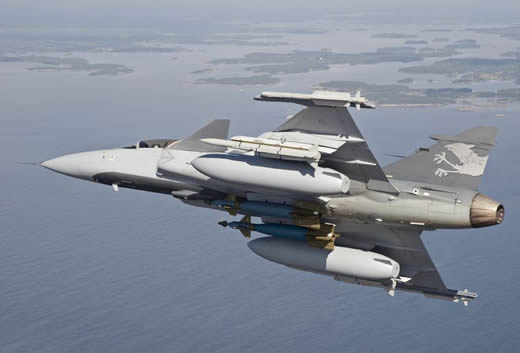
    Gripen showing a multi-mission weapon configuration

    The Indian Defence Ministry apparently shortlisted the Eurofighter Typhoon and French Dassault Aviation Rafale for the Medium Multi-Role Combat Aircraft (MMRCA) and has asked the two companies to extend validity of their commercial bids for the multi-billion dollar contract for 126 combat aircraft. The Swedish company Saab has confirmed tonight the Gripen is apparently out of the race. The three European companies submitted their commercial offers for the MMRCA along with the American F-16 and F/A-18, Russian MiG 35 and Swedish Saab Gripen. All bids will expire tomorrow, except the two proposals being extended by the Indian request.

    Saab AB confirmed today that its Gripen fighter aircraft was not selected for India's MMRCA shortlist. Photo: Saab

    SAAB confirmed this evening that the Gripen has not been shortlisted for the Indian Medium Multi-Role Combat Aircraft (MMRCA) programme. ”We are offering India a world class next generation fighter aircraft to a very competitive price and an extensive technology transfer programme. We have received this decision and will closely monitor the future process and provide additional information if requested by the Indian Ministry of Defence. We are confident that the Gripen system is the perfect match for the Indian Air Force as well as meeting the highest requirements for the international markets,” says Håkan Buskhe, President and CEO at Saab.

    Saab considers India as one of its strategic markets and has recently announced an investment in a research and development centre in India. “We are committed to the Indian market and continue our plans for growth and see huge business opportunities in the aerospace, defence and security sectors,” says Håkan Buskhe.

    Gripen is in service with the Swedish, Czech Republic, Hungarian, South African and Royal Thai Air Forces. The UK Empire Test Pilots’ School (ETPS) is operating Gripen as its advanced fast jet platform for test pilots worldwide. SAAB is also competing for Brazil’s FX-2 future fighter program.

    First Quarter Financial Reports Testify on Defense Market Fluidity

    Three of the world’s leading aerospace companies released today their first quarterly reports for 2011. All three reported healthy margins despite the challenging business environment and uncertainty reflected in the global defense sector. While all reports present stable forecast and reiterate previous financial outlooks, they also highlight the intensive activities companies are undertaking to ensure financial stability to support them through difficult times ahead.

    Boeing reported today revenue of $14.9 billion, adding $23 billion in new orders, bringing its total backlog to $329 billion. About half of the total revenues were reported by Boeing Defense Systems (BDS) – $7.617 billion, slightly higher than Q1 2010. Boeing’s Military aircraft business grew five percent during the quarter, reflecting a better mix of global strike programs and lower spending on research and development. Backlog at BDS increased slightly to $66 billion, approximately two times the unit’s expected 2011 revenue. The company’s Networks and space business maintained one percent growth, while Global Service & Support (GS&S) operations declined eight percent.

    Maintaining this growth at times of financial uncertainty had its cost. While Boeing’s military aircraft division presented a sharp improvement of 37 percent, over the first quarter of 2010, reported earnings from operations for both Networks and Space and Global Services & Support declined in the recent quarter by 18% and 28% respectively. These operations were affected by lower earnings in the satellite business and the conclusion of the U.S. Air Force KC-10 support program. However, during the quarter, GS&S won Performance Based Logistics (PBL) contract for the C-17 Globemaster III Sustainment Partnership, paving the way for sustainable performance in the future. Boeing also won a follow-on order extending F-22 sustainment contracts.

    Lockheed Martin reported yesterday net sales of $10.6 billion for the period, with earnings from continuing operations of $548 million. Sales of the aeronautics segment increased to $3.182 billion, up from$ 2.940 in the first quarter last year. Electronics Systems also increased to $3.459 billion (six percent up from $3.250 billion) while information systems and space systems both decreased to $2.149 and $1.843 billion respectively. However, all divisions except Information Systems (IS) presented higher profitability.

    The Aeronautics division presented a healthy eight percent increase, adding $235 million in C-130J business, due to an increase in deliveries (Six C-130J were delivered in the first quarter of 2011, compared only to three in Q1 last year). Growing support activities also contributed to the growth, while increasing production volumes of the F-35, currently produced at ‘low-rate initial production’ (LRIP) contributed additional $220 million. On the down side, the company is winding down its F-22 operations with final deliveries expected next year. Despite the growth in activity, Aerospace business profitability remained almost unchanged – as new production (LRIP) contracts associated with the F-35 are typically yielding lower profits than mature production programs. Lockheed Martin’s Electronics Systems also represented a healthy growth this quarter, reflecting gains of about $130 million from radar programs associated with air-defense systems such as Patriot Advanced Capability-3 (PAC-3).

    Northrop Grumman’s Q1/2011 report reflected the challenging transformation the company has gone through in recent months, divesting its shipbuilding business and reducing its participation in the Nevada National Security Site (NSTec) a Joint Venture with the U.S. Government tasked with storage management and experimentation with nuclear materials.

    Northrop Grumman reported first quarter 2011 sales totaling $6.7 billion, about $200 million off the $6.9 billion reported in the first quarter of 2010, excluding the revenues derived by the shipbuilding division. Despite the reduction in sales, operating income increased 19 percent to $811 million (up from $679 million last year).

    The company’s Aerospace division was the only unit reporting growth in this quarter, with sales of $ 2.736 billion, representing a 1.5 percent growth, due to higher volume for manned and unmanned aircraft and restricted programs. The Electronics Systems division dropped four percent to $ 1.808 billion, by slower activity in land and self-protection systems, although targeting systems maintained a healthy level at the reported period. Intelligence Programs division has also declined two percent, with one of its classified programs transitioning from development to maintenance. Nevertheless, all divisions reported improved operating margins, contributing to better profitability.

    “This was a very productive quarter. We completed the shipbuilding spin-off and our newly aligned portfolio generated solid financial results. We now expect 2011 earnings of $6.50 to $6.70 per share. We also increased the dividend and raised our outstanding share repurchase authorization to $4 billion, which includes committing the $1.4 billion contribution we received in the shipbuilding spin-off to share repurchases,” said Wes Bush, chief executive officer and president. “In today’s challenging environment, our actions demonstrate our continued commitment to value creation through performance improvement, portfolio management and effective cash deployment,” Bush added.

    U.S. Army Apaches to Test a new Gunfire Detection System

    Crews often return from missions in Afghanistan with small-arms damage to the aircraft, from gun fire they were not aware of at all. GFAS will provide an offensive targeting system that helps closing the 'sensor to shooter' loop, instantly and effectively responding to enemy fire. Photo: Boeing
    The WeapoWatch systems was designed with a modular concept supporting many weapon detection applications. Photo: Radiance technologies

    U.S. Army AH-64D Apache Longbow attack helicopters will soon be equipped with a Ground Fire Acquisition System (GFAS) to automatically detect, and identify the sources of ground fire shot at the helicopters. GFAS consists of a combination of infrared cameras and processing system known as ‘Weapon Watch” that detect, locate and point other systems (or weapons) to source of ground fire that could put the helicopter in danger. The system also detects enemy fire on the ground, assisting supported forces on the ground. The infrared camera are packed into external pods attached to the helicopters’ stub wings. These sensors are designed to detect the muzzle flashes from the ground, allowing Apache pilots to get their sensors on potential targets and immediately know the location, and distance of ground fire. The system was developed by Radiance Technologies, Inc. and is being integrated with the Apache Longbow under a recently awarded $7 million U.S. Army Aviation Applied Technologies Directorate (AATD) contract.

    WeaponWatch uses a common weapon detection and response technology developed under the Overwatch Advanced Concept and Technical Demonstration (ACTD), to provide a complete solution that detects, locates, classifies and responds to fired weapons from fixed and rotary wing aircraft, UAVs, ground vehicles, towers or dismounted mounts. The system employs a Long Wave Infra-Red (LWIR) Imaging Sensor to spot the threat. the system’s ultra-fast processor recognizes and analyzes the threats in real-time, analyzing the heat signatures generated by fired weapons, identifying the type of weapon by referencing a comprehensive database of weapon fire signature algorithms. The rapid processing enables the WeaponWatch system to respond to enemy weapon fire by alerting the crew, communicating the type and location of the weapon, or cueing remotely operated weapons even before the sound of the enemy weapon reaches the sensor. The system is already deployed on observation towers (RAID) integrated with existing base-protection systems.

    According to Radiance Technologies, the electro-optical sensor offers several advantages over similar, acoustic weapon detection systems, particularly in detecting weapons fired in any direction, in urban environments, while the sensor is “on-the-move,” and at long range.

    In spring 2011 the first GFAS systems will be allocated to 1-101 Aviation Brigade at Ft. Campbell Ky Early User Evaluation. Before this phase the system has undergone a range of key tests at places such as Mesa Ariz., and Yuma Proving Ground, Ariz. According to Lt. Col. Jeff Johnson, product manager, Longbow Apache. Pending successful outcome of the User Evaluation, the Apache Program Manager will look at expanding GFAS’ capabilities, including integrating the technology with Blue Force Tracker display screens.

    GFAS automatically process the detected signals and localizes the sources of fire, feeding the information through the helicopter’s defensive avionics gateway system to display on the pilot’s standard threat warning display. “The beauty of this system is that we are not changing the aircraft software. We are not adding displays. It’s integrated through an Aircraft Gateway Processor” Johnson said. Upon receiving the information about the ground fire on their display screens, the aircraft crew can move their Modernized Target Acquisition Designation Sight/Pilot Night Vision Sensors, or MTADS/PNVS, onto the target at the touch of a button. “The crew sees the point of origin where the muzzle flash was detected,” he said. “It is not just about the aircraft, but about getting information to guys on the ground who are in the fight. Apache has led the way for other platforms with net-centric operations and situational awareness.”

    “Crews often return from missions in Afghanistan with small-arms damage to the aircraft,” Johnson explained. “GFAS is an offensive targeting system. It is not a piece of aircraft survivability equipment. It helps us fulfill our mission of closing with and destroying the enemy.”

    Crews often return from missions in Afghanistan with small-arms damage to the aircraft, from gun fire they were not aware of at all. GFAS will provide an offensive targeting system that helps closing the 'sensor to shooter' loop, instantly and effectively responding to enemy fire. Photo: Boeing

    Skunk Works and XTEND Simplify Multi-Drone Command

    0
    Lockheed Martin Skunk Works® and XTEND have achieved a major milestone in JADC2 by integrating the XOS operating system with the MDCX™ autonomy platform. This technical breakthrough enables a single operator to simultaneously command multiple drone classes, eliminating the friction of mission handoffs. From "marsupial" drone deployments to operating in GPS-denied environments, explore how this collaboration is abbreviating the data-to-decision timeline and redefining autonomous mission execution.

    From Ukraine to Taiwan: The Global Race to Dominate the New Defense Tech Frontier

    0
    As traditional defense primes face mounting competition from agile “neoprimes” such as Anduril, Palantir and Helsing, the balance of innovation is shifting toward software-defined warfare and scalable, dual-use technologies, while global industry consolidation—marked by Boeing’s integration of Spirit AeroSystems and other strategic mergers—signals an intensified race to secure control over the defense technology value chain. Our Defense-Tech weekly report highlights these trends.

    Europe’s “Drone Wall”

    0
    In early October 2025, a coordinated wave of unmanned aerial system (UAS) incursions—widely attributed to Russia—targeted critical infrastructure across at least ten European nations. The unprecedented campaign exposed the fragility of Europe’s air defenses...

    Weekly Defense Update & Global Security Assessment

    0
    Executive Summary The past week (September 18-25, 2025) represents an inflection point where strategic defense concepts have transitioned from doctrine to tangible reality. An analysis of global events reveals four primary, interconnected trends shaping an...

    U.S. Air and Space Forces Push Next-Gen Programs at the AS&C 2025 Conference and...

    0
    At the 2025 Air, Space & Cyber Conference, U.S. Air Force and Space Force leaders unveiled major updates on next-generation fighters, bombers, unmanned systems, and space initiatives, highlighting both rapid innovation and critical readiness challenges as the services race to outpace global competitors. A short version is available here, with a more detailed version for subscribers.

    TADTE 2025: Reflecting Taiwan’s Strategic Themes

    0
    The Taipei Aerospace & Defense Technology Exhibition (TADTE) 2025 crystallized around four dominant strategic themes that collectively illustrate Taiwan's comprehensive approach to defense modernization amid escalating regional tensions. Based on a detailed report by Pleronix (available upon request). Includes a Podcast discussion on TADTE 2025's highlighting Taiwan's four strategic themes beyond the post's coverage.

    Iron Beam 450 Completes Testing, Soon to Join With Operational Air Defense Units

    0
    Israel’s Iron Beam 450 high-power laser system has completed final testing, marking a major leap in air defense. Developed by Rafael, it offers precise, cost-effective interception of rockets, UAVs, and mortars, and is set for IDF deployment by 2025.