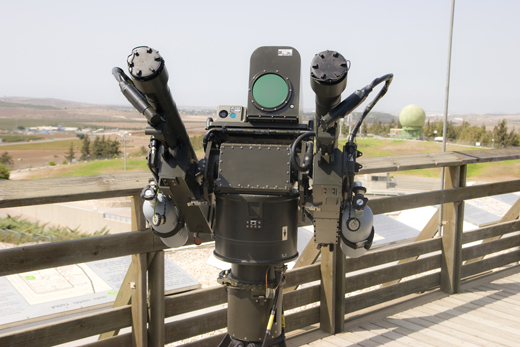
IMI's "Red Sky 2" - Man Portable Air Defense System. Photo: Defense-Update
Man Portable Air Defense Systems (MANPADS) are commonly used to protect mobile, deployed forces, or defend point targets and strategic sites. Although technically capable to intercept combat aircraft and helicopters, human factors critical limit the use of MANPADS to very short range. At Aero-India 2011 Israel Military Industries (IMI) is introducing the new and improved Red-Sky 2, which converts existing or new MANPADS into an integrated air defense system, centrally controlled and enhanced with passive (FLIR) and active (radar) sensors, and semi-automatic engagement features maximizing the probability of intercept with available assets. Red Sky 2 can be adapted to operate with all types of IR guided missiles – Igla type systems, Mistral or Stinger.
IMI’s “Red Sky 2” – Man Portable Air Defense System. Photo: Defense-Update
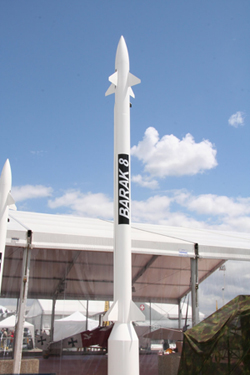
Barak 8 air-defense missile was developed by Rafael, using a booster developed in India. The system was developed by IAI and the radar by Elta Systems. Photo: Noam Eshel
Test firing of the Barak 8 missile is expected this year. “Testing will be conducted in India and is part of the responsibilities of our strategic partner in this program, India’s Defense Research & Development Organization (DRDO)” IAI officials told Defense-Update. The missile is on schedule to complete development and be integrated on board the first combat vessels by 2012.
After being inducted into service, the system will continue development and phased improvement, toward its full operational capability phase. Barak 8 is designed to be fielded on both Israel and Indian Navy vessels.
In 2006 Israel and India embarked on a strategic cooperation in developing a new naval air defense system that will address the specific, common requirements of both Israel and Indian navies. The system, known as Barak-8 introduces a revolutionary concept of ‘network-centric air defense’, incorporating the best technologies India and Israel could offer.
Our sponsor: IAI
Such technologies include superior missile interceptors, the latest technology phased array radars, state-of-the-art command, control and communications, integrated with missionized land-based and airborne command and control, coupled with unmanned aerial sensors.
Three years ago the program expanded this concept, adding another dimension to the Indo-Israeli cooperation, embarking on the Medium-Range Surface-to-Air missile (MRSAM) system, protecting strategic targets on land. Both programs are progressing well as IAI’s partners in India are actively involved and taking part in every phase of the development.
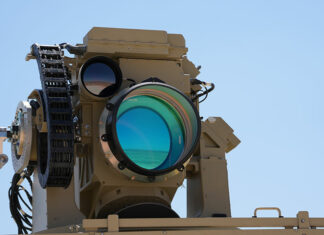
MEOS from Controp combines the capabilities of other Controp the wide area surveillance system CEDAR, with more powerful FLIR and
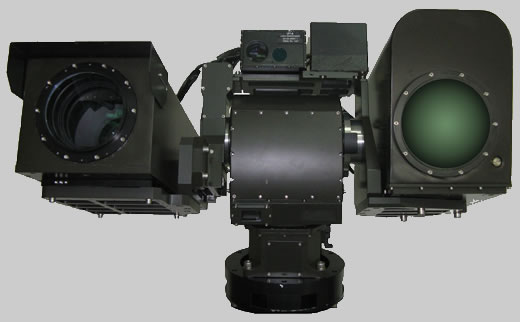
At Aero-India 2011 Controp is introducing two new stabilized EO systems, optimized for vehicular platforms. The new, remotely controlled, gyro-stabilized Modular Electro-Optical System (MEOS). The system employs an open architecture similar to Controp’s CEDAR product line, yet MEOS also features a two-axis gyro-stabilized platform, enabling installation on vehicular platforms, as well as elevated mast mounting. The system employs day and night imaging devices integrating CCD daylight sensor, Infrared night imager and a laser rangefinder.
MEOS from Controp combines the capabilities of stationary, wide area surveillance system like CEDAR, with a stabilized platform enabling mounting of the system on a moving vehicle. Photo: Controp
Our Sponsor: Rada
On panoramic or sector scanning the system automatically follows a scanning pattern, effectively detecting intruders into the protected sector by establishing a ‘virtual fence’. The system is controlled by a scanning. The system operates passively and is able to handle multiple targets simultaneously, performing intruder detection and recognition while scanning, followed by intruder identification, in observation mode.
SPEED V is a stabilized multi-sensor payload optimized for mobile-mast mounted platforms. Photo: Controp
Another new vehicle-oriented surveillance product launched here is the Speed V stabilized EO/IR observation and panoramic scanner, developed specifically for vehicular applications. This lightweight (24kg) EO/IR gyro-stabilized system provides long range observation, deployed on vehicular mounted telescopic masts. It is designed for intelligence gathering missions, as well security and early warning, conducting panoramic scanning for intruder detection and troop protection.
The Speed-V combines capabilities, technologies and expertise gained from Controp’s Spider systems and the lightweight Speed-A Aerostat Camera System, making Speed-V the optimal lightweight, high performance stabilized EO/IR camera system for mounting on vehicle masts for long range mobile applications. Applications for the SPEED-V include mobile security missions, mobile coastal and border surveillance, ground troops security, force protection and more.
Controp Precision Technologies, an Electro-Optics specialist from Israel is launching at Aero-India 2011 miniature, gyro-stabilized, high-definition EO payload designed for small and mini-UAVs. Designated HDSTAMP, this miniature gimbaled payload is fitted with daylight High Definition CCD sensor extending standard SUAV missions to new applications including surveying power lines, and other requirements where high definition images are required.
The company also expanded the family of STAMP stabilized mini-payloads, which already includes the D-STAMP daylight payload, U-Stamp (using an uncooled thermal sensor) and U-STAMP Z, utilizing a FLIR zoom mechanism, packed into a miniature 1.3kg payload. These configurations were recently selected for Israel’s new ‘Skyrider’ mini-UAV program. Two new sensors are also available with the STAMP family – the U-Stamp Z, fitted with thermal imager coupled with continuous zoom and the lighter U-STAMP DF, featuring a similar thermal imager with dual field of view configuration (11º – 32º). Almost all STAMP configurations (except U-STAMP-Z) are available at weights below 1,000 gram.
At Aero-India 2011 Israel’s Rafael Advances Defense Systems is presenting the latest Network Centric Warfare solutions for aerospace applications, highlighting the ‘Global Link’ – a mature, operational solution providing integrated, airborne voice and data communication and applications suite designed for modern air forces Net work Centric Operations (NCO). Global Link provides air forces network-based operation an essential, robust and reliable platform to realize advanced NCO solutions.
The Global Link consists of matured multi band multi services communication system comprising the NETwork Centric Operation Radio (NETCOR) an NCO applications suite. The system provides full connectivity between sensors, platforms, command centers and weapon systems. At its booth RAFAEL is demonstrating three of the Global-Link system radios including the GVDL, DGL and NETCOR. The Global Link Voic-Data Link (GVDL) – enhanced airborne network-based voice and data radio operating at the V/UHF bands. GVDL is designed to operate as an advanced multi channel radio maintaining constant, low delay transfer suitable for voice communications in addition to high data-rate communications, maintaining balanced, uninterrupted performance for voice quality and instantaneous data transfer capacity.
Our Sponsor: RAFAEL
The GVDL operates simultaneous multi-voice channels supporting advance services such as conference call between the net members, two way voice conversations (duplex) without any performance degradation. Voice communications also supports ad-hoc networking, enabling the formation of None Line Of sight (NLOS) communication, or extending voice communications coverage over extremely long range.
The Global-Link Data-Link (GDL) advanced, high-capacity data network radio operating at the L band. Both the GVDL and the GDL have advanced self forming and self healing multi-hop data networking.
Advanced Quality of Service (QoS), optimizing communication services for specific application needs or user level, are also supported. Such services include maintaining low delay for high priority messages or guaranteed delivery for very long messages or file transfer.
The Global-Link radios are designed as Software Defined Radios (SDR) implementing multi Wave Forms simultaneously. This capability allows future growth of the system capabilities without any hardware or installation changes.
The hardware is provided in relatively small size (1/2 ATR) conforming to standard interfaces, enabling simple integration on every platform, by replacing existing analog radios.
RAFAEL provides similar networking technologies for ground to air, naval, and ground applications, The C4I Connect, comprising Radio over IP technology facilitates an integrated communications between command and control centers, air defense assets and airborne elements, transferring voice over high bandwidth fiber-optic network. C4I Connect enables air controllers to synchronize and integrate communications into the air situation picture.
“India, as one of the world’s fastest growing nations, opens many opportunities for us, in which we can offer our advanced, proven technologies.” Joseph Ackerman President and CEO of Elbit Systems told Defense-Update. Elbit Systems, Israel’s largest defense company is a private holding company publicly traded in New York (NASDAQ) and Tel Aviv stock exchanges has entered the main weapons platforms market as a prime contractor. Its current backlog has grown to more than $5.3 billion in 2010.
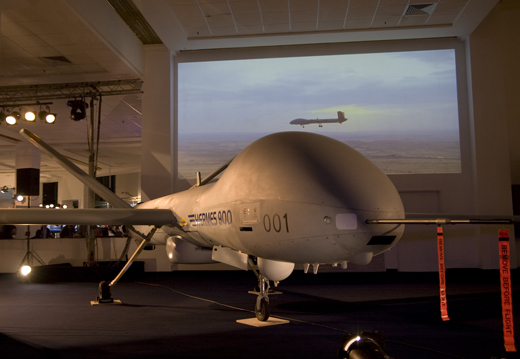
The Hermes 900 UAS. Photo: Defense-UpdateJoseph Ackerman President and CEO of Elbit Systems
India, considered as a major growing market for Elbit Systems, and according to Ackerman, the company intends to broaden its operations here by expanding existing partnerships and, where applicable, establish new partnerships and joint ventures, addressing specific opportunities.
Our Sponsor: Elbit Systems
“Elbit Systems has established the ‘multi-domestic’ operational conduct, enabling the company to perform as an international conglomerate, while focusing its operations on strategic local markets, through dedicated local business entities formed to meet the specific regulations of each of our strategic markets.” Ackerman explains. These business formations are responsible in developing the long term growth-strategy in their market. In parallel, they operate through partnerships with local companies, domestic contractors and subcontractors. “This is our common operational policy, in all our strategic markets, and India being no exception” Ackerman said, indicating that “the local partnership HALBIT we established with Hindustan Aeronautics Ltd (HAL) is already operating successfully for several years.” Ackerman said, “as our activities in India expand we intend to add more co-operations here” he added.
One of the areas for future cooperation with local enterprises is Unmanned Aerial Systems (UAS). We are offering our comprehensive line of unmanned aerial systems, ranging from the new Hermes 900 Medium-Altitude Long Endurance (MALE) system and to the combat proven, compact, man-portable Skylark 1LE, which can be operated on military, paramilitary and civilian applications.
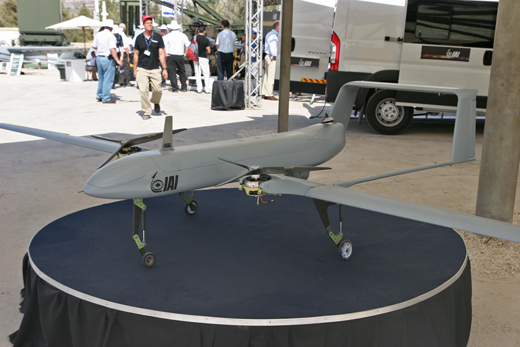
The Panther UAV Debut at the Latrun 2010 Conference in Israel. Photo: Defense-Update
Israel Aerospace Industries (IAI) is introducing at Aero-India a new class of aerial vehicles employing a revolutionary three tilting propellers design. This new propulsion concept enables the vehicle to take-off and land vertically, fly at high speed, or hover efficiently for extended period.
The Panther UAV Debut at the Latrun 2010 Conference. Photo: Defense-UpdateOur sponsor: IAI
By employing two tilt-rotor propellers, and a vertical lift augmenter propeller, providing additional lift and stability for hovering, takeoff and landing. The unique design is optimized for extended missions of several flight hours. The new design is representing a breakthrough in Vertical Take off and Landing (VTOL) unmanned aerial vehicle (UAV) architecture. This configuration enables the aircraft to be runway-independent, taking off and landing from unprepared areas, providing land forces and special operations units at tactical level capabilities commonly associated with much larger platforms.
IAI’s tilt-rotor concept has already been implemented in two tactical unmanned aerial vehicles on display at Aero-India – the Panther and Mini-Panther have already performed test flights. Weighing about 65 kg, the Panther is powered by three electrical motors and packs sufficient power to loiter on missions of up to six hours, at an altitude of 10,000 ft. At this altitude operational radius can exceed 60 km. The Panther carries IAI’s MiniPOP multi-sensor electro-optical day-night payload comprising stabilized day and night cameras, laser rangefinder, laser pointer or laser designator. The smaller Mini-Panther is a 12 kg tilt-rotor mini-UAV designed for mission-endurance of two hours. This version operates at lower altitudes and carries the miniature ‘Micro-POP’ EO stabilized payload. Both versions are powered by ultra-quiet electrical motors contributing to the Panther’s stealth capability.
The Panther’s flight control system employs automatic transition flight modes, enabling the Panther to take off, land and transition automatically from forward to vertical flight by a simple click of the operator console, thus eliminating the need for an external pilot.
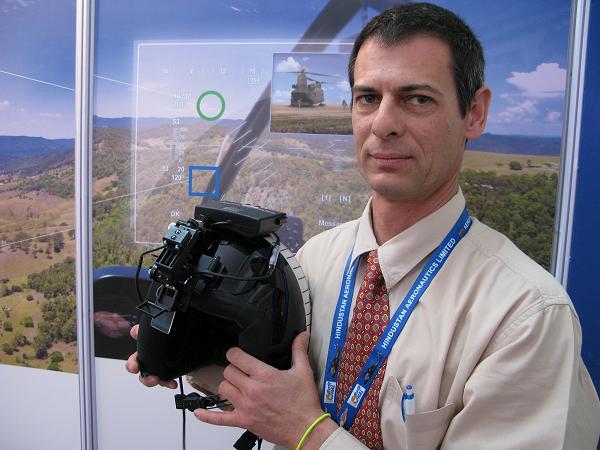
HeliEye, from SDS offers a revolutionary smart, color, day and night helmet display and tracking system at a fraction of the weight of current technology. Photo: Tamir Eshel, Defense Update
Israel’s defense electronics company Star Defense Systems (SDS) is presenting at Aero-India 2011 the HeliEye – a smart helmet mounted display and tracking system, promising to revolutionize pilot performance. “HeliEye introduces several breakthroughs in pilot display” Tomer Ganelevin Chief Executive Officer (CEO) at SDS explains. Unlike current systems that are limited to monochromatic, stroke displays, HeliEye provides full resolution 600×800 color display.
HeliEye, from SDS offers a revolutionary smart, color, day and night helmet display and tracking system at a fraction of the weight of current technology. Photo: Tamir Eshel, Defense Update
One HeliEye module is used for day and night operation, offering pilots to see clear, crisp symbology under all visibility conditions and, in addition, view video, maps or images. Ganelevin highlights another unique capability provided by HeliEye is the rapid set-up and line-of-sight tracking calibration, “Our system uses self calibration, performed instantly, enabling pilots to prepare for flight immediately as they enter the cockpit”. He explained.
HeliEye is connected to the pilot helmet via standard ANVIS bracket to allow helicopter pilots to fly ‘head out of the cockpit’. The systems’ display is a single, thin transparent eye-piece designed for night and day operation. It enables dual, high resolution, true color flight data symbology together with real-time video display, showing FLIR, TV or maps.
The passive tracking system developed by SDS uses image processing to measure the pilot line of sight, relative to the aircraft. The information can be used to manage the display in reference to the pilot’s area of interest, directing gimbaled payloads or weapon systems to point to a specific target or efficiently handle two pilot activity or multi-ship formation, air/ground joint operations.
HeliEye incorporates a flight qualified single board computer conformed to 1553/ARC429 advanced buses as well as analog and digital IOs. The helmet unit itself weighs 290 gram, while the whole system weighs only eight kilograms, including the ultra-light helmet mounted segment, cable harnesses, tracking units and cockpit mounted processing unit.
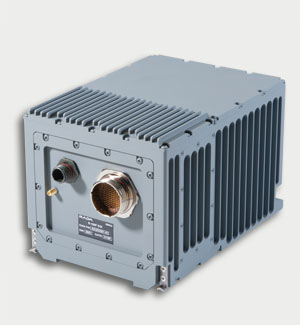
Israel’s avionics company Rada Electronic Industries has expanded into new areas in recent years, including mission systems integration, inertial navigation systems (INS), aircraft and UAV avionics and advanced radars. The growing portfolio has already generated significant increase in sales, with turnover in the first nine months of 2010 increased 58% over 2009, attributed to the large scale integration projects the company won in Latin America. Zvi Alon, RADA’s CEO expects the momentum to continue “We hope the Inertial Navigation and radar product lines will become major growth drivers for our company in the future” Alon said.
Our Sponsor: Rada
“We introduced our INS product line at Aero-India 2009” Dov Sella, V.P. Business Development at RADA told Defense-Update, “Our position as a provider of high quality navigation solutions has been endorsed by our customers, as we deepen our sales, win new opportunities and are invited to respond to Requests For Proposals for sophisticated MEMS and Fiber Optical Gyro (FOG) airborne INS for aircraft, helicopters and unmanned systems.”
RADA Introduces a New Line of Radars at Aero-India
At Aero-India 2011 the company is launching its latest line of products, known as Perimeter Surveillance Radar (PSR). This compact, lightweight radar, designated RHS-20, is a new sensor providing perimeter surveillance and border security, as part of military and homeland security systems. This highly sophisticated, yet affordable radar is integrated into peripheral systems over standard Ethernet links. It weighs less than 15 kg and can be mounted on masts, vehicles or deployed as a man portable system. It is able to detect human targets at distances of 6 km and vehicles at 10 km.
In the recent tender the Indian Air Force is seeking proposals for the delivery of five new aerial tankers at an estimated cost of $2 billion. After Boeing dropped out of the race, only Airbus A330 and the Russian IL-78MKI remained. Both are addressing the IAF requirement for the delivery of new platforms. But the Boeing 767 could return to the scene from an unexpected direction – Bedek group is promoting its conversion of used Boeing 767/300 Multi-Mission Tanker-Transport (MMTT) which could be available with an entire Air-to-Air Refueling (AAR) kit, at half the price of new platforms.
The systems are similar to those already flying with India’s current IL-78MKI tankers. The Boeing 767 platform offers significant cost savings in operation as well as the benefit of flying simultaneously with fuel and cargo, the same aircraft could be easily configuration into flying hospitals for humanitarian assistance missions or perform as VIP transport, by introducing mission specific kits. Bedek has already delivered the first MMTT to Columbia.
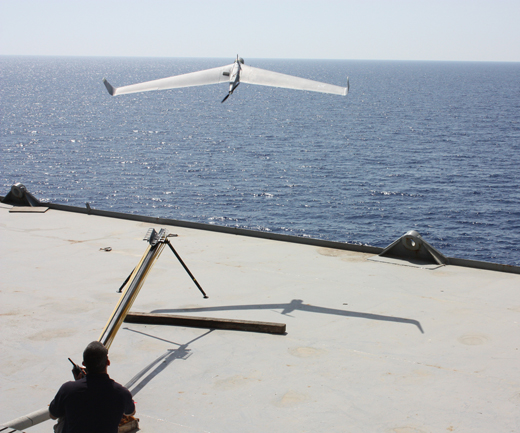
Jubilant Bhartia Group and Israel’s Aeronautics Defense Systems have recently formed a joint venture company addressing the growing need for unmanned aerial systems and aerostat systems in India. Aeronautics will hold 26% stake in the Bangalore based JV called ‘Jubilant Aeronautics’. The JV targets both the civil and defense sectors in India. The team has already responded to a number of Requests for Information (RFI) submitted by different Indian authorities. Aeronautics will be offering various versions of its Orbiter mini-UAV – the newest and largest Orbiter UAV – Orbiter II is on display here at the Israeli pavilion at Aero-India.
Orbiter Mini UAV System. Photo: Aeronautics
Enter your Email to subscribe free to Airshow-Live!
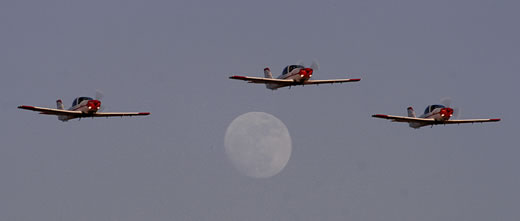
Operating the Grob G120A on a Private Financing Initiative (PFI) service contract awarded to Elbit Systems, the G120A offers 97% dispatch readiness level serving the Israel Air Force. In the U.S. and Canada the level is even higher, averaging 98.5% Photo: Nehemia Gershuni.
Offering its G120TP as an ‘intelligent training solution for the 21st Century’ for the Indian Air Force, Grob Aircraft has extended its innovative concept of more efficient pilot training, utilizing a single platform to cover several phases of the pilot training process. This solution is now being implemented at different phases by several air forces, offers great saving in pilot training while improving training quality and pilot skills. According to Andre Hiebeler, Co-Chief Executive Officer at Grob Aircraft, the Grob offering addresses much more than fighter pilot training, “our concept streamlines the whole pilot training process, from the elementary to the basic and advanced phases. G120TP is quite an expensive option for the screening process admits Hiebeler, but this phase is too short (about five hours per cadet) to justify the acquisition and operation of a dedicated type. According to Hiebeler, G120TP is positioned as the best solution for the basic and advanced training phases, accounting for about 80 flight hours per cadet. The Indian Air Force plans to use its new basic trainers only for the elementary-basic phase currently performed on HPT-32 Deepak. While the results of the recent tests held in October were not published yet, Defense-Updtae has learned that last week the Indian Air Force has decided to proceed with three trainers: the American Hawker Beechcraft T-6C Texan, Korean Aerospace Industries KT-1 and the Swiss Pilatus PC-7 MkII to proceed to commercial and legal negotiations. Two other competitors failed this stage – the Grob G120TP and Polish PZl 0-130 Orlik proposed by EADS.
Operating the Grob G120A on a Private Financing Initiative (PFI) service contract awarded to Elbit Systems, the G120A offers 97% dispatch readiness level serving the Israel Air Force. In the U.S. and Canada the level is even higher, averaging 98.5% Photo: Nehemia Gershuni.
Regardless of the IAF decision about the specific HPT32 basic trainer replacement, the innovative approach to pilot training presented by Grob remains valid and unique. “This will not affect our decision to be in this market for the long term” Hiebeler commented. Using its integrated ‘virtual avionics’ the G120TP can save 5-10 flight hours on advanced jet trainer such as Hawk 128, at an equivalent cost of $200,000 per cadet. Hiebeler said the G120TP have demonstrated extremely high rate of dispatch, meeting an average 98.5% in the U.S.A and Canada and 97% in France and Israel with the G120A. The differences in readiness levels are effected by the number of aircraft available with local fleets. India is planning to buy 75 training aircraft to replace the HPT32 trainer, using them as basic trainers. After completing about 50 hours on the basic phase cadets advance to the advanced phase, currently flying on HAL Kiran Mk1 trainers, which will be replaced by the Sitara Intermediate Jet Trainer,(IJT) also bilt by HAL, where cadets are flying abot 30 hours of advanced training. Then, prepared for their missions as jet pilots, trainees move on to the Hawk 128 advanced jet trainers.
With the new concept proposed by Grob, the G120TP is equipped with configurable cockpit instrumentation developed by Israel’s Elbit Systems. The instrumentation can be configured according to the stage and goal of the training, i.e. simple displays for basic phase, jet-type MFDs for pilots destined for fighter course or dial-like instruments designed for those destined for helicopters or transport pilots. Virtual avionics are also employed to represent more complex systems without having the actual avioinc units on board, like weather radar, fighter radar, radar warning system or situational display. Furthermore, using the Targo helmet mounted display pilots can train with ‘simulated HUD’ and helmet displays as early as possible, without having to fly on expensive and complex advanced trainers, therefore reserving actual HUD training for the pilots who actually need this skill. The cockpit avionics, along with the Targo helmet and virtual avionics, are provided by Grob’s team member Elbit Systems, which also operates the G120TP (called Snunit) for the Israel Air Force via Private Finance Initiative (PFI).
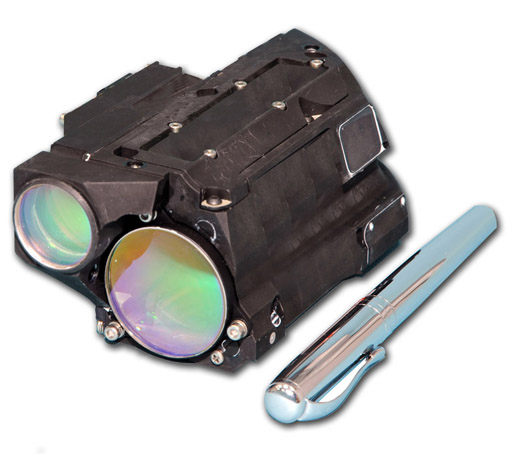
IAI's New Laser Rangefinder/Designator - DART 45. Photo: IAI
Israel Aerospace Industries (IAI) has developed a new, lightweight and compact laser rangefinder/designator designed for small electro-optical systems and payloads used for Ground, Airborne and Naval applications. The system called DART 45 is displayed at Aero-India for the first time. According to IAI, several units of the new system, have already been integrated into MiniPOP-D (Designator) Electro-Optical naval payloads for an export customer, as well as into IAI/TAMAM’s new Ground Targeting and Designating System (GTADS).
According to Shaul Shahar, General Manager of IAI’s TAMAM Division, DART45 offers a 45mJ (milliJoule), very low divergence Laser Designator as well as an eye-safe Rangefinder which enables high performance in a very lightweight and compact package. Its design is based on diode-pumped advanced Nd:YAG laser, compatible for all US and NATO laser-guided munitions. According to Shahar, the unique characteristics, such as compact dimensions and low power requirements make it an excellent and attractive solution for the rising market of 6″ to 8″ EO targeting payloads for UAVs, static and ground vehicle sights and for targeting and designating handheld systems.
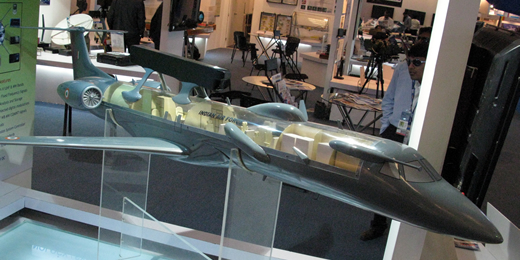
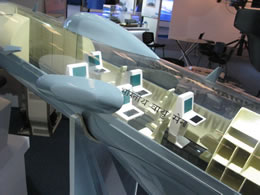
The first ERJ-145 configured for the DRDO light AEW&C mission will roll out in 10 days in Brazil. This model displayed at Aero-India by the CABS shows some of the unique design features of this aircraft.
Our Sponsor: Elbit Systems
DRDO CABS and Embraer have unveiled today the new transparent configuration of the ERJ-145 configured by Embraer for India’s Defense Research & Development Organization (DRDO) Center of Airborne Systems (CABS) indigenous Airborne Early Warning and Control (AWE& C) aircraft. While the original concept was to use the standard configuration of ERJ-145 developed for the Brazilian Air Force, which is already in operation with Greece and Mexico, the Indian application required more adaptations, as depicted in the model displayed at Aero-India at CABS.
The first ERJ-145 configured for the DRDO light AEW&C mission will roll out in 10 days in Brazil. This model displayed at Aero-India by the CABS shows some of the unique design features of this aircraft.
A tail view of the new EMB-145 platform showing a different tail configuration, as some of the antennae were moved to the side fairings.According to Sergio Bellato, Director of marketing and sales Embraer, the first aircraft is expected to be unveiled at the rollout ceremony in Brazil on February 21, 2011.
This aircraft will fly during the first half of 2011 and is scheduled for delivery to the DRDO for mission systems integration during the second half. The remaining two aircraft will be delivered in 2012. Final integration will be done by the DRDO in Bangalore, India.
The aircraft is configured to carry the Active Array Antenna Unit (AAAU), developed by CABS. An ESM system, fully integrated with the AEW&C system is also on board (presumably housed in the bulges seen on the two sides).
The aircraft has five workstations operating the radar, ESM and other sensors on board.The aircraft is equipped with five operating consoles and seven crew seats for resting, provision for aerial refueling probe provides the aircraft with extended mission duration.
The current contract provides for the development and procurement of the first three aircraft. While India has a need for more AEW&C, the air force has not decided yet what mix of aircraft to buy.
Enter your Email to subscribe free to Airshow-Live!
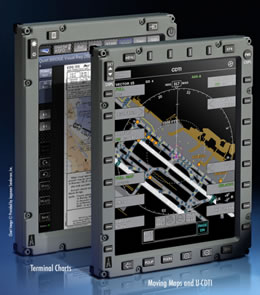
The Electronic Flight Bag - from Astronautics C.A.
Our Sponsor: Rada
Astronautics CA Ltd. of Israel is presenting at Aero-India an innovative application of its Electronic Flight Bag (EFB), utilized as mission computer used in military transport aircraft. According to Menahem Donner, Manager, Airborne Systems Business development at Astronautics, implementing changes in avionic equipment requires a lengthy process. The EFB designed to operate as a stand-alone system can receive information from the aircraft but does not transmit any data and therefore does not have any effect on the flight safety or other critical systems. EFB is becoming a popular device in the cockpits of commercial aircraft, and is now entering military planes, providing a flexible tool running specific mission applications that can be developed by the user, on standard Microsoft Windows operating system and run on Windows as well.
The Electronic Flight Bag - from Astronautics C.A.
Typical commercial EFB applications include listing of emergency procedures, flight operations manuals (FOM), performance calculators, weight and balance, charts, checklists, airport moving maps, weather and aeronautical data, merging and spacing, and maintenance. EFB can also run specific applications, including cabin video surveillance. The system comprises an EFB electronic unit (i.e. computer) and a detachable or mounted display. Linked via satellite communications to provide a fully networked information device supporting synthetic vision and displaying safe route, utilizing combined real-time information processing with the EFB package.
Enter your Email to subscribe free to Airshow-Live!
Donner expects military applications to lead in these advanced applications, as commercial aviation certification of such devices would be more complex. An example of the uses could be 3D displays of 2D digital maps, or video monitoring system. Such application is already in use in the A330 Multi-Role Tanker Transport (MMRT), providing monitoring of the refueling boom, loadmaster position, drogue parachute and cargo bay, right from from the cockpit.
Lockheed Martin Skunk Works® and XTEND have achieved a major milestone in JADC2 by integrating the XOS operating system with the MDCX™ autonomy platform. This technical breakthrough enables a single operator to simultaneously command multiple drone classes, eliminating the friction of mission handoffs. From "marsupial" drone deployments to operating in GPS-denied environments, explore how this collaboration is abbreviating the data-to-decision timeline and redefining autonomous mission execution.
As traditional defense primes face mounting competition from agile “neoprimes” such as Anduril, Palantir and Helsing, the balance of innovation is shifting toward software-defined warfare and scalable, dual-use technologies, while global industry consolidation—marked by Boeing’s integration of Spirit AeroSystems and other strategic mergers—signals an intensified race to secure control over the defense technology value chain. Our Defense-Tech weekly report highlights these trends.
In early October 2025, a coordinated wave of unmanned aerial system (UAS) incursions—widely attributed to Russia—targeted critical infrastructure across at least ten European nations. The unprecedented campaign exposed the fragility of Europe’s air defenses...
Executive Summary
The past week (September 18-25, 2025) represents an inflection point where strategic defense concepts have transitioned from doctrine to tangible reality. An analysis of global events reveals four primary, interconnected trends shaping an...
At the 2025 Air, Space & Cyber Conference, U.S. Air Force and Space Force leaders unveiled major updates on next-generation fighters, bombers, unmanned systems, and space initiatives, highlighting both rapid innovation and critical readiness challenges as the services race to outpace global competitors. A short version is available here, with a more detailed version for subscribers.
The Taipei Aerospace & Defense Technology Exhibition (TADTE) 2025 crystallized around four dominant strategic themes that collectively illustrate Taiwan's comprehensive approach to defense modernization amid escalating regional tensions. Based on a detailed report by Pleronix (available upon request). Includes a Podcast discussion on TADTE 2025's highlighting Taiwan's four strategic themes beyond the post's coverage.
Israel’s Iron Beam 450 high-power laser system has completed final testing, marking a major leap in air defense. Developed by Rafael, it offers precise, cost-effective interception of rockets, UAVs, and mortars, and is set for IDF deployment by 2025.