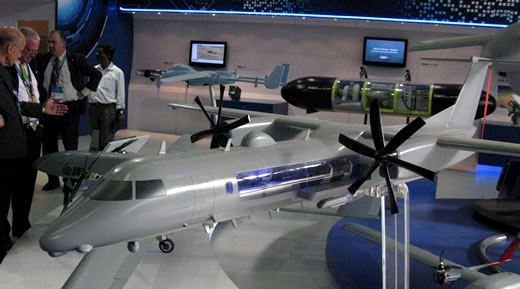
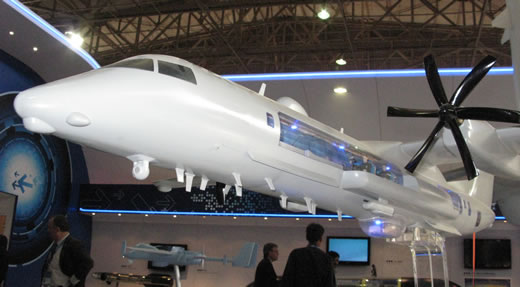
A model of the Maritime Patrol Aircraft IAI based on Bombardier Q400 turbo-prop powered aircraft. Elta and Bombardier are positioning this platform to meet Medium Range Maritime Patrol and Coastal Surveillance requirements currently developing in India.
With the third Indian Airborne Early Warning (AEW) undergoing final integration, the Israeli company is looking for new opportunities to fulfill India’s thirst for AEW. With the growing interest in smaller platforms Elta is reportedly considering expanding its platform options beyond the Conformal AEW (CAEW) based on the specially modified Gulfstream 550 jet, integrating its AEW system on Bombardier Challenger and Global series aircraft.
A model of the Maritime Patrol Aircraft IAI based on Bombardier Q400 turbo-prop powered aircraft. Elta and Bombardier are positioning this platform to meet Medium Range Maritime Patrol and Coastal Surveillance requirements currently developing in India.
Enter your Email to subscribe free to Airshow-Live!
Interpretation of the model shows a combination of sensors, comprising Elta’s EL/M-2022A maritime search radar, Electronic Support Measures and MOSP type electro-optical sensor, and, additional communications intelligence COMINT array. The aircraft also mounts a side-mounted gun pod, aft-mounted countermeasures dispensers and side-mounted containers which could carry various stores, for search and rescue missions or other tasks. To minimize drag and generated by these containers, forward strakes were added.Our sponsor: IAI
The two companies are also planning to integrate ELTA mission systems and radars on turbo-prop powered Dash-8 Q300 and Q400 aircraft optimized for military and civilian maritime patrol missions. A model of the aircraft carrying a multi-mission package designated EL/I-3360 is on display at IAI’s display at the Israeli Pavilion at Aero-India 2011.
The system on display comprises a Other special mission platforms considered for these platforms are Signals Intelligence (SIGINT), Communications Intelligence and Multi-Sensor Platform (MARS) carrying Synthetic Aperture Radar and Electro-Optical payloads.
On March 1 the company announced receiving a contract worth over 20 million Swiss francs from the Swiss defence procurement authority Armasuisse, for the advanced production engineering of the Integrated and Modular Engagement System for the Swiss Soldier (IMESS) program. While the selection of Cassidian’s Warrior21 by Switzerland was publicized before, the new contract puts the program in motion for the preliminary production phase.
IMESS prototypes based on Warrior 21 have been proving their worth since 2007 through field tests and demonstrations. Under the current phase these combat suites will be designed for production standard, employing more efficient, powerful and durable components, utilizing optimized communication media, significantly improved weight and energy balance enabled by the deployment of new and optimized components. The system is expected to integrate into the Swiss Army joint reconnaissance, command and action forces. To ensure command-and-control capability on high-mobility operations, the contract also provides for the equipping of combat vehicles – including the tactical military vehicle DURO and the armored assault vehicle PIRANHA – and their integration into the IMESS network.
IMESS systems address tactical command-and-control functions from company level to the individual soldier level. The system supports soldiers operating on dismounted or vehicular operations. Enhanced situational awareness and navigation is maintained through the use of head/helmet mounted displays, and better night fighting and reconnaissance capabilities through such means as navigation aids and video streaming of night weapon sights (optronics).
The system uses more powerful, energy-efficient ‘electronic backbone’ offering reduced unit count and more reliable harnesses, cabling and connectors being integrated to handle the heavy loads encountered in infantry operation scenarios. The systems’ PowerController enables the soldier to tap into a wide range of energy sources gaining constant power upon availability. The system’s modular architecture supports a wide range of standard interfaces to sensors, as well as modules for link-up with external systems.
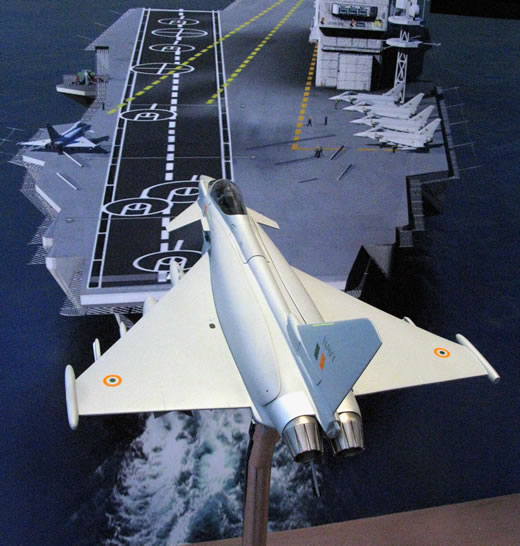
A model of the navalized typhoon on display on a landing approach to a Gorshkov class carrier, displayed at the BAE Systems pavilion at Aero-India 2011.
While the competition between six international aircraft manufacturers moves on, some of the competitors are already looking a step further, positioning their respective platforms addressing possible interest from the Indian Navy. The Super Hornet F/A-18E/F from Boeing and French Rafale from Dassault are already operational on board U.S. and French carriers, while the MiG-35 could be matched with the MiG-29K model the Indian Navy already operates. That leaves the Lockheed Martin F-16IN, Saab Gripen and Eurofighter Typhoon in a disadvantage.
A model of the navalized typhoon on display on a landing approach to a Gorshkov class carrier, displayed at the BAE Systems pavilion at Aero-India 2011.
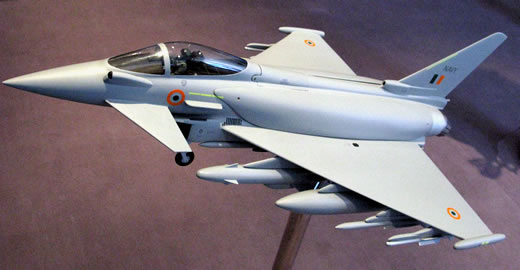
Well… Things may change quite soon, according to BAE Systems. The company has anticipated this, highlighting at its display a navalized version of the Typhoon, utilizing few of the Tranche 3 features, such as thrust vector nozzles, conformal fuel tanks, and spoilers at the leading edge wing roots, designed to minimize landing speed. Unlike the Super Hornet and Rafale using catapult launch which requires significant strengthening of the landing gear and airframe, Typhoon is considered for ‘ski-jump’ equipped carriers only (like QE2 and India’s future indigenous carriers).
According to Paul Hopkins, Vice President Business Development (Air) at BAE Systems, simulation tests of a ‘navalized Typhoon’ show the aircraft can takeoff and land with full mission payload, including two ‘Storm Shadow’ cruise missiles, four BVR missiles, two short range missiles, a centerline fuel tank and two conformal fuel tanks – something no other navalized aircraft can perform. A navalized Typhoon will be new built aircraft, fitted with strengthened airframe and landing gear. The British decision to switch from STOVL F-35B to F-35C conventional take off Lightning could pave the road for reconsideration of use Navalized Typhoons by the Royal Navy, on QE-2 aircraft carriers.
The Gripen can also potentially be modified for service on aircraft carriers equipped with Ski Jumps. According to Eddy de la Motte, Director of Gripen operations in India, Saab performed a feasibility study of operating Gripen on aircraft carriers about ten years ago. The study determined this possibility is possible, feasible and affordable. :We don’t have carrier experience and will rely on our partners like Embraer and HAL having more experience in this field to meet such requirement when it comes’ LaMotte said.
Navalized Typhon – note the conformal tanks, part of the Tranche 3 program. However, no air force has used this option yet.
Enter your Email to subscribe free to Airshow-Live!
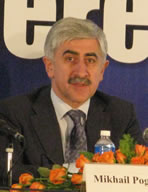
Russia’s largest aircraft manufacturer United Aircraft Corporation (UAC) is entering a new era of cooperation with India, with the launching of the development of Prospective Multi-Role Fighter (PMF). Embarked December 2010 by UAC, Irkut and HAL, it was inaugurated in a press conference held at Aero-India 2011. Mikhail Pogosyan, recently nominated the new general director of UAC presented his view of the evolving cooperation between the two countries.
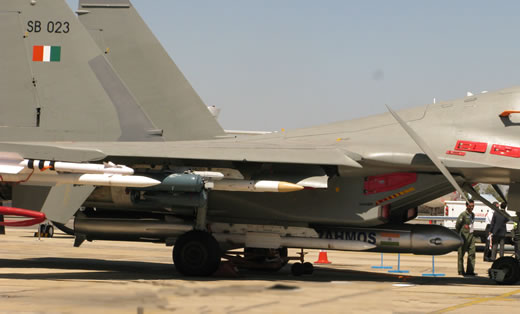
Another upgrade program currently in the planning addresses the Su-30MKI, which will receive a new radar, and, most importantly, integration of BrahMos missile carrying capability. Photo: wikipedia (g4sp)Mikhail Pogosyan - General Director UAC
“The 5th Generation fighter is a most important step for the future relationship of the two countries’ said Pogosyan. The Russian T50 providing the basis for FGFA has already performed 40 flights and is undergoing ground testing, using three test articles, undergoing various static ground tests. Two additional T50 prototypes will join the test unit this year, accelerating the development progress. Pogosyan expects the program to complete the first phase next year. He assured that the Indian concern for sharing technology in the program was well covered in the contract, to the mutual satisfaction of both sides.”We are moving into a new level of cooperation, based on good and sound basis proven with MiG-27 3rd generation and Su-30 fourth generation aircraft.” Pogosyan added.
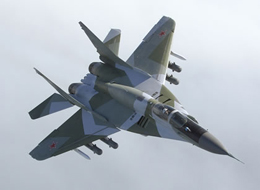
The Upgraded Mig-29
He addressed the long cooperation between Russian and Indian aerospace companies, specifically in local production and upgrading of aircraft, with past programs including MiG-27, and upgrades currently underway, of the MiG-29, the modernized plan, to be equipped with new cockpit, avionics and radar, made its first flight earlier in February.
“This aircraft will be capable of operating the latest air/air and air/ground the Indian Air Force is requiring” Pogosyan said. He told reporters the program will span over several years and include at least 60 aircraft.
A contender in the Indian Air Force Medium Multi-Role Combat Aircraft (MMRCA) program, MiG-35 has not made it to Aero-India but has advanced through flight demonstration, in India and in Russia. It was modified to address specific Indian requirements, and Pogosyan said he is confident it is well positioned in effort to win the MMRCA race. “The important demonstrations are not at the airshow but are done with the customer, where we can demonstrate the real capabilities of our aircraft” he rebuffed critics questioning the MiG’s absence from the show. “We demonstrated our capabilities and are awaiting the tender committee’s response” he concluded.
Another upgrade program currently in the planning addresses the Su-30MKI, which will receive a new radar, and, most importantly, integration of Indian BrahMos missile carrying- capability. A Su-30MKI carrying a BrahMos missile at the centerline is on display here at Yalahanka.
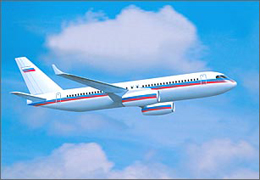
MC-21 has confirmed 50 orders while still on the drawing board, with customers commited to buying 190 aircraft, testifying to the high credibility UAC and Irkut gained through the current Superjet program.
On the civil side, Pogosyan is optimistic about the progress of Superjet 100, which recently passed certification, and the MC-21 which is also showing great progress. “It is turning from virtual design to reality” Pogosyan said. In November 2010 the aircraft passed preliminary design review of the airframe, the first gas generator is being tested at Perm, and primary composite parts supplied. Designed to reduce operating cost of regional aircraft by 12-15 percent, MC-21 has confirmed 50 orders while still on the drawing board, with customers commited to buying 190 aircraft, testifying to the high credibility UAC and Irkut, gained through the current Superjet program. MC-21 is expected to be ready for first flight in 2014 and complete certification two years later. By April the team will freeze the design and decide on the final selection of suppliers, and Pogosyan encouraged Indian aerospace manufacturers and subcontractors to extend Indo-Russian cooperation into commercial aviation programs, “This is the right time to step in” Pogosyan concluded.
Enter your Email to subscribe free to Airshow-Live!
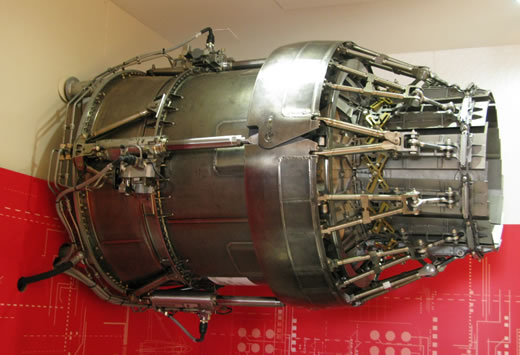
Eurojet is offering to modify existing Typhoon EJ200 engines by installing thrust vectoring nozzles (TVN), improving maneuverability, supercruise and asymmetric load carrying capability while reducing five percent in fuel consumption. EJ200 TVN is part of the Eurofighter display at Aero-India 2011. Photo: Tamir Eshel, Defense-Update.
Eurofighter and engine supplier Eurojet are promoting a thrust-vector option for the Eurojet EJ200 engines powering the Typhoon, proposed for the Indian MMRCA program. Eurofighter has raised the possibility of a thrust-vectoring upgrade to become part of a future Typhoon mid-life upgrade, a move that could deliver substantial operational cost savings that would offset the cost involved with the engine modification. Early at the Eurofighter program addind TVN was originally considered part of the Tranch 3 upgrades but this plan did not materialize.
Eurojet is offering to modify existing Typhoon EJ200 engines by installing thrust vectoring nozzles (TVN), improving maneuverability, supercruise and asymmetric load carrying capability while reducing five percent in fuel consumption. EJ200 TVN is part of the Eurofighter display at Aero-India 2011. Photo: Tamir Eshel, Defense-Update.Our Sponsor: RAFAEL
According to Eurojet, a Typhoon equipped with thrust vectoring nozzles (TVN) could reduce fuel burn on a typical mission by up to 5%, while increasing available thrust in supersonic cruise by up to 7%. Typhoon is already capable of performing ‘super-cruise’ (flying supersonically without afterburner) and the proposed modification will further increase this capability. Other cost saving aspects of thrust vectoring include the potential to extend engine life by reducing operating temperatures at a given power setting. It could also be used to reduce take-off and landing distances and approach speed. Beside the operational cost savings, TVN enhances the aircraft maneuvering as it becomes a ‘virtual control surface’ when coupled with the aircraft flight-control system. Another aspect is improving the aircraft ability to carry an asymmetric weapons load.
Eurofighter is considering to fund a flight demonstration of TVN equipped Typhoon to test these capabilities. According to Eurojet, TVN could be retofitted to the existing EJ200 without the need for structural changes to the engine or airframe.
TVN was part of a research program slated for inclusion in the Tranche 3 upgrade. Eurofighter is now considering to fund a flight demonstrator to test and verify the potential performance and operational cost gains such systems can derive. Photo: Eurojet
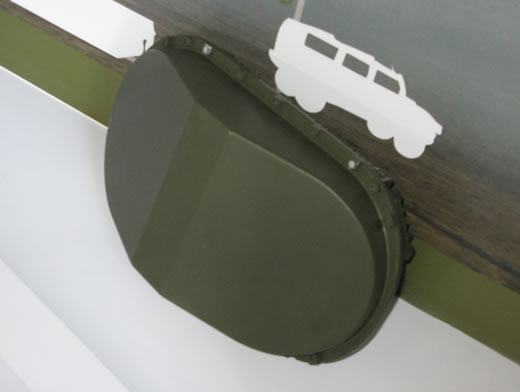
The new Persistent Surveillance radar from RADA is designed to provide real-time threat warning for active protection systems installed on main battle tanks and other armored vehicles. Photo: Tamir Eshel, defense-Update
Rada has unveiled today a new version of its threat warning radar, optimized for active protection systems for armored vehicles. The radar was designed with a flat configuration, which was found to better conform with side mounted installations on main battle tanks and infantry fighting vehicles.
The new Persistent Surveillance radar from RADA is designed to provide real-time threat warning for active protection systems installed on main battle tanks and other armored vehicles. Photo: Tamir Eshel, defense-UpdateOur Sponsor: Elbit Systems
The radar has 120°, enabling three unit installations in certain configurations or four unit installation providing significant overlap for each sector. The radar uses standard networking interface to integrate with APS, and is provided as self contained unit, along with flat antennae, signal processors and power supply. The new radar was recently tested during successful system demonstrations of IMI’s Iron-Fist system, conducted in Israel and in Germany.
Our Sponsor: Elbit Systems
Rada is also developing a derivative of this radar, known as Peripheral Surveillance Radar (PSR) to be used for ground surveillance and homeland security applications. This compact, lightweight sensor provides perimeter surveillance and border security as part of military and homeland security systems.
Rada positions its new radars product line as highly sophisticated, yet affordable radar, easily integrated into peripheral systems over standard Ethernet links. The radar can detect human targets at distances of 6 km and vehicles at 10 km. It weighs less than 15 kg and can be mounted on masts, vehicles or deployed as a man portable system.
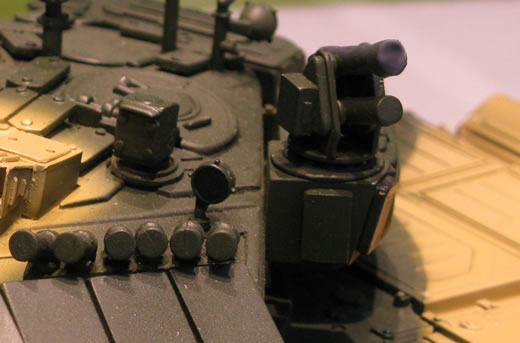
The new Iron-Fist installation proposed for the Indian T-90 comprises the new radar mounted under the Iron Fist launcher pedestal. This configuration was tailored to meet specific Indian requirements. However, the tender was recently cancelled just before trial demonstration were scheduled to begin. The Indians were evaluating systems from Israel, Russia, Sweden/South Africa and Ukraine. Photo: Tamir Eshel, defense-Update.
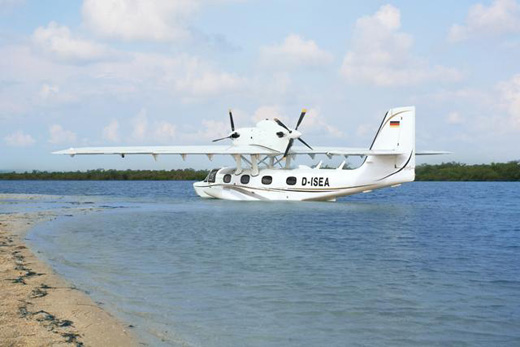
The Seastar from Doriner Seaplane Company, one of the candidates to fill the Indian Navy request for amphibious aircraft
Our sponsor: IAI
The Indian Navy is mulling acquisition of nine amphibious aircraft to keep an aerial tab on the Andaman, Nicobar and Lakshadweep islands off the Bay of Bengal, a senior official said. The Navy has issued a Request for Information (RFI) for such aircraft, to be used for maritime surveillance on the islands. The Indian Navy has been acquiring sophisticated surveillance equipment, particularly following the Mumbai terror attacks in November 2008, which officials said had exposed loopholes in the country’s maritime surveillance.
The Seastar from Doriner Seaplane Company, one of the candidates to fill the Indian Navy request for amphibious aircraft
At Aero-India 2011 the Indian Air Force Su-30MKI is shown with Brahmos missile model attached at the centerline, representing a new configuration currently in development, which will be part of the next upgrade of the aircraft, being developed by HAL and Irkut. Photo: Tamir Eshel, Defense-Update.
Our Sponsor: RAFAEL
BrahMos, the supersonic cruise missile for the Indian Air Force, would be ready by next year, officials said. Destined to fly on the Su-30MKI air dominance fighter, the Brahmos is nine times faster than other anti-ship missiles, BrahMos Aerospace Chief Executive and Managing Director A Sivathanu Pillai told reporters. Carrying the large missile requires major modification of the Su-30MKI, which is currently underway as part of the aircraft upgrading program, which will also include an introduction of a new radar and avionics.
At Aero-India 2011 the Indian Air Force Su-30MKI is shown with Brahmos missile model attached at the centerline, representing a new configuration currently in development, which will be part of the next upgrade of the aircraft, being developed by HAL and Irkut. Photo: Tamir Eshel, Defense-Update.
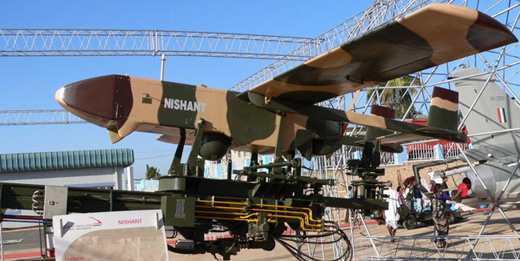
Indian Army Get 4 Indigenous Nishant Unmanned Aerial Vehicles UAV’s After completing successful flight trials in Rajastan, the Indian Army recently took delivery of four indigenously designed and developed ‘Nishant’ Unmanned Aerial Vehicles (UAV).
“Nishant has successfully completed the series of confirmatory trials conducted recently, by the Indian Army at Chandan Range in Pokharan, before taking delivery of a set of four UAVs together with ground systems,” DRDO officials said. Read more on Asian Defense & Diplomacy partner magazine.
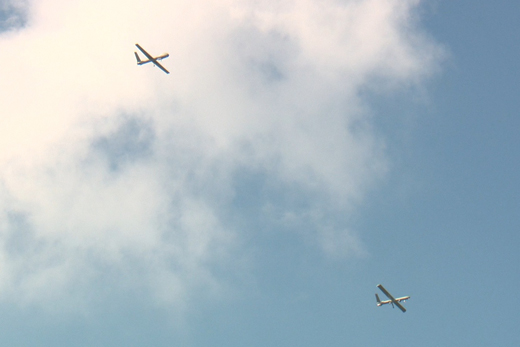
The two UAS simultaneously performed two different missions, transmitting the gathered imagery, ELINT and COMINT to the same ground control station, using different communications systems. Photo: Elbit Systems
Elbit Systems announced that it successfully performed a series of joint flight missions of its Hermes 450 and Hermes900 Unmanned Aircraft Systems (UAS). The two different UAS were controlled and operated from the same universal ground control station (UGCS), transmitting the gathered imagery, ELINT and COMINT to their station operators, while using different communications systems.
The two UAS simultaneously performed two different missions, transmitting the gathered imagery, ELINT and COMINT to the same ground control station, using different communications systems. Photo: Elbit SystemsElbit Systems Universal Ground Control Station (UGCS). Photo: Elbit Systems
Joint flight control and management of two different UAS provides users with enhanced operational flexibility, adapting each specific UAS to a specific mission and furthermore enabling management of highly complex missions in diverse arenas. Conducting joint flight operation from a common UGCS is also highly cost effective as the two distinct UAS rely on shared software architecture and training programs, thus reducing additional costs. Capable of simultaneously controlling two parallel UAS missions, each mission managed by a single operator, the UGCS enables advanced mission performance, automatic taxiing, autonomous flight and automatic takeoff and landing systems common to all the UAS in the Hermes family.
Building on the vast operational experience of the Hermes 450, the backbone of the Israel Defense Air Forces with over 200,000 operational fight hours in its track record, the Hermes 900 offers additional capabilities such as higher flight altitude (over 30,000 ft), longer endurance and larger payload capacity (up to 350kg), thus allowing the execution of more diverse and complex missions using the two distinct UAS.
A three-ship formation of Indian Air Force Sukhoi Su-30MKI air dominance fighters breaking formation before the audience at the opening of Aero-India 2011 today at Yalahanka, Bangalore.
Aero India 2011, Asia’s biggest air show beginning at the Yelahanka Indian Air Force base near Bangalore today is the largest ever, with 29 participating countries bringing 93 fighter jets, trainers, private jets, helicopters and commercial jets to the fair – up from 67 in the last show.
A three-ship formation of Indian Air Force Sukhoi Su-30MKI air dominance fighters breaking formation before the audience at the opening of Aero-India 2011 today at Yalahanka, Bangalore.
Defense-Update will be reporting live from the show, through our ‘Airshow-Live’ program, optimized for mobile devices, smart mobile phones, blackberry and iPad. You are welcome to subscribe free to our news via email service submitting your email below:
Our sponsor: IAI
Two daily aerial displays will be the centerpiece of the show, taking place daily between 10:00-12:30 and 14:30-17:00. At the focus of the show is the flying displays, where fighter jets from the U.S., Europe, France and Sweden are demonstrating their fighters, aiming to win the hearts and minds of Indian Air Force officers and the public toward an upcoming decision on the Medium Multi-Role Combat Aircraft (MMRCA) tender. Among the fighters flying on the daily display are the Eurofighter Typhoons, Swedish Saab Gripen, the French Dassault Rafael, F-16 Super Viper from Lockheed Martin’s and F/AF-18E/F Super Hornet from Boeing. Another highlight on the flight display is an aerobatic show displayed by India’s Tejas fighters. Another highlight at Yalahanka is the debut by Flying Bulls Aerobatics Team.
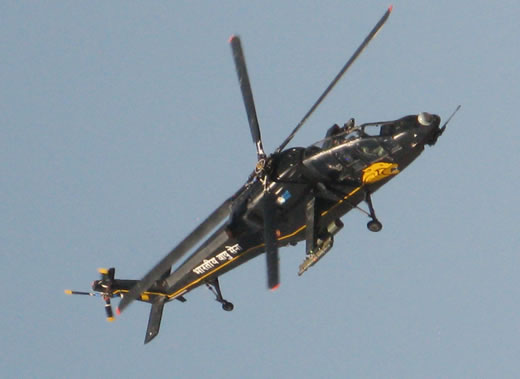
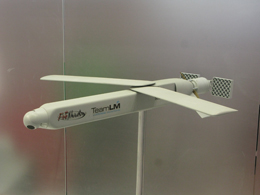
Aero-India 2011 provided the stage for the public debut of Hindustan Aeronautics Ltd. (HAL) Light Combat Helicopter (LCH). The Indian Army considers fielding 179 such helicopters in coming years, equipping the Indian Air Force (65) and Army (114). Photo: Defense-UpdateMBDA is also eying India’s interest in loitering weapons, displaying the latest configuration of the Fire Shadow, developed in response to similar British Army requirements. Photo: Defense-update
While military aviation is attracting much attention, it is the civil aviation that generate most of the business, comprising 55 percent of the exhibition area.
As in many leading airshows, national pavilions are grouping exhibitors by countries – the top eight countries included are Belgium, France, Germany, Israel, Italy, Russia, the UK and the USA. The USA is leading the list with 250 companies participating at the show, Germany with 35, Italy with 10 and 9 from Israel. The expected number of business visitors is 70,000, double from the last edition. In addition, organizers are preparing to accommodate 175,000 general visitors, 29% more than the last Aero India in 2009.
Here are some fresh Photos from the First day of the Air-Show, Keep following for new photos coming to you by Defense-Update “Airshow-Live” Program.
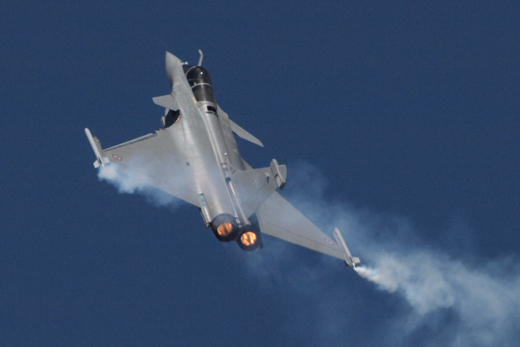
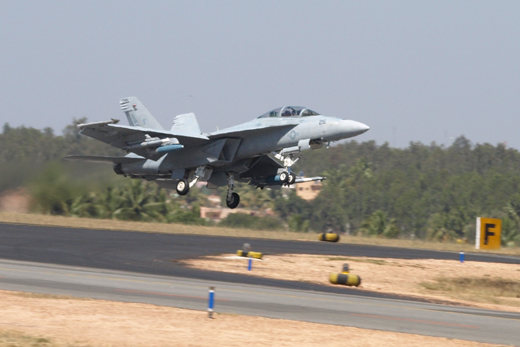
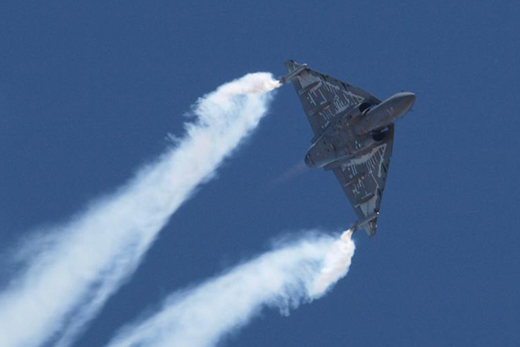
Dassault Rafale is one of six contenders for the Indian Medium Multi-Role Combat Aircraft (MMRCA) program. The French fighter is seen here during a low pass, on its impressive aerial display performed earlier this morning. Photo: Defense-UpdateAnother MMRCA contender performing at Yalahanka today was the Boeing F/A-18E/F Super Hornet. Unlike all other fighters on the aerial display, the Super Hornet performed admirably with full weapons load, demonstrating its excellent power/weight ratio, aerodynamic and maneuverability. Photo: Defense-UpdateThe Hindustan Aeronautics Ltd. (HAL) Light Combat Aircraft – Tejas, performing an impressive flight display over the show. The aircraft being part of the LCA test force is clearly noticeable in this low fly past. Photo: Defense-Update
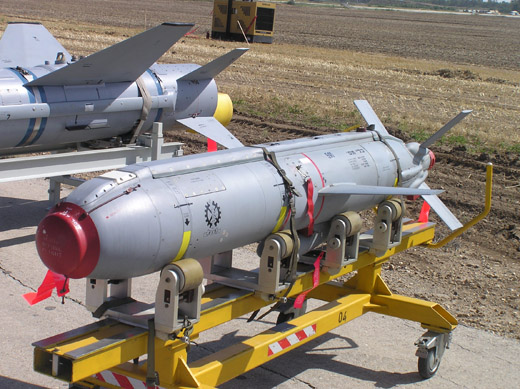
Delilah -a loitering guided missile, designed for use by fix wing aircraft or helicopters. Photo: IMI
An increasing demand for precision guided weapons, driven by the network-enabled revolution, and essential needs for defensive systems are creating significant demand for the broad range of weapons developed at IMI, and operationally proven in combat by its customers.
Delilah -a loitering guided missile, designed for use by fix wing aircraft or helicopters. Photo: IMIOur Sponsor: Rada
At Aero-India 2011 IMI highlights the air-launched version of ‘Delilah’ -a loitering guided missile, designed for use by fix wing aircraft or helicopters. This stand -off, long range, multi-purpose missile system delivers precision deep strike against moving, re- locatable and fixed high value targets.
As a loitering weapon, Delilah offers ‘man in the loop’ control ensuring effective targeting, based on real time intelligence, integrated battle damage assessment capability ensuring effective attack deep inside enemy area. Operational onboard Israel’s Air-Force F-16, the combat proven Delilah is in production.
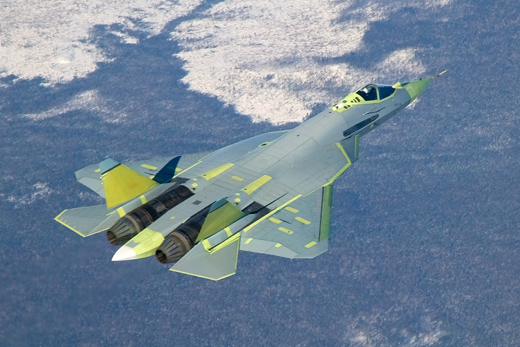
During the recent visit of Russian president Dmitry Medvedev in December, a number of important agreements were signed, including a memorandum of understanding for preliminary design of the Indo-Russian Fifth Generation Fighter Aircraft (FGFA), signed between Hindustan Aeronautics Ltd (HAL), and Russian companies Rosoboronexport and Sukhoi. The aircraft, to be jointly developed by HAL and Sukhoi is currently referred to as Perspective Multi-Role Fighter (PMF), and will be based on the Russian PAKFA (Sukhoi T50) design which has flown for the first time in February 2010.
1st flight of the PAK-FA. Photo: Sukhoi
Our Sponsor: Elbit Systems
Russia and India have maintained special relations since Russia became India’s leading source for combat aviation in the 1964s with the sale, and local production of MiG-21 fighters. “We are moving up to deep-rooted cooperation and joint development of advanced systems.” Viktor Komardin, deputy director general of Rosoboronexport and head of delegation in India said, “it does require a renewed level of trust. It is one thing to sell finished items or assemble them by license, and it is quite different to implement programs such as the fifth generation fighter aircraft”. The FGFA program is expected to be at the highlight of the Russian display at Aero-India 2011.
Photo: Sukhoi
FGFA will introduce stealth capabilities, retain the high level of maneuverability beyond current generation fighters, it will be able to supercruise (fly supersonic speed for long duration, without using fuel guzzling afterburners). As a true fifth generation fighter FGFA will have a highly integrated avionics suits and stealthy network-enabled connectivity, enhanced situational awareness (utilizing passive sensors providing 360 degree spherical. Weapons will be carried internally to maintain low signature, with optional external carriage when required.
The development agreement covers the design, development, and necessary production engineering preparing for manufacturing of the aircraft in both countries. India stated its intention to field 250-300 of advanced FGFA type aircraft in the next decade, along with a future unmanned combat aircraft yet to be developed. Apart from the basic single-seat model, India is also planning to develop a two-seater version, to be used for training and special missions. A new engine, to be based on the Indian Kaveri core, providing higher thrust over the current Saturn AL-41F engine is also being considered by India for a later phase of the program.
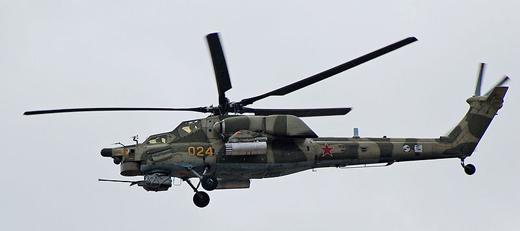
A Mil Mi-28N flying at the international air show MAKS in 2007
Pursuing multiple Indian Ministry of Defense helicopters tenders Russian helicopter manufacturers are promoting a line of military helicopters at Aero India 2011, through the Russian state-owned arms marketer Rosoboronexport. In recent years exports of Russian rotary-wing aircraft have been steadily growing with initial deliveries of Mi-17 military transport helicopters to the Indian Air Force.
A Mil Mi-28N flying at the international air show MAKS in 2007Our sponsor: IAI
At Aero-India 2011 Russia is promoting the new Mi-28NE the new export version of the ‘Night Hunter’ combat helicopter, inducted into service with the Russian Army in 2009. In India the Mi-28NE is competing against the American AH-64D Apache, on the Indian tender for the supply of 22 attack helicopters. Two competitors already dropped out of the competition – the Eurocopter Tiger and Inalian A-129 Mongoose. This is the first time the Russian gunship is competing in the international market and Moscow is hopeful that the Indian tender will bring establish the credibility the Night Hunter deserves, among the world’s leading helicopter gunships. Like its U.S. competitor, the Mi-28NE helicopter employs a wide range of weapons, boasts unique survivability features and can operate in day, night and under most adverse weather conditions. These helicopters started entering service with the Russian Armed Forces in 2009. Similar to the American Apache, Mi-28 was designed in the 1980s and received NATO reporting name ‘Havoc’. Unlike the Apache, operational fielding was delayed by more than two decades, as cashed stripped Russia could not afford full scale production.
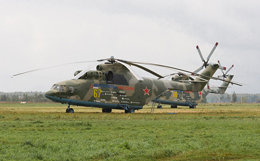
Russian Air Force Mi-26
Russia is also positioning the Ka-226T light multi-role helicopter to compete for the Indian Army multi-role helicopter tender. A significant advantage offered by this type is its service ceiling and optional mission specific reconfiguration, utilizing mission modules installation. Russia is also after India’s tender for heavy lifters, offering the Mi-26T2. The unique model offered to India has the world’s heaviest load-carrying capacity (up to 20 tons).
Lockheed Martin Skunk Works® and XTEND have achieved a major milestone in JADC2 by integrating the XOS operating system with the MDCX™ autonomy platform. This technical breakthrough enables a single operator to simultaneously command multiple drone classes, eliminating the friction of mission handoffs. From "marsupial" drone deployments to operating in GPS-denied environments, explore how this collaboration is abbreviating the data-to-decision timeline and redefining autonomous mission execution.
As traditional defense primes face mounting competition from agile “neoprimes” such as Anduril, Palantir and Helsing, the balance of innovation is shifting toward software-defined warfare and scalable, dual-use technologies, while global industry consolidation—marked by Boeing’s integration of Spirit AeroSystems and other strategic mergers—signals an intensified race to secure control over the defense technology value chain. Our Defense-Tech weekly report highlights these trends.
In early October 2025, a coordinated wave of unmanned aerial system (UAS) incursions—widely attributed to Russia—targeted critical infrastructure across at least ten European nations. The unprecedented campaign exposed the fragility of Europe’s air defenses...
Executive Summary
The past week (September 18-25, 2025) represents an inflection point where strategic defense concepts have transitioned from doctrine to tangible reality. An analysis of global events reveals four primary, interconnected trends shaping an...
At the 2025 Air, Space & Cyber Conference, U.S. Air Force and Space Force leaders unveiled major updates on next-generation fighters, bombers, unmanned systems, and space initiatives, highlighting both rapid innovation and critical readiness challenges as the services race to outpace global competitors. A short version is available here, with a more detailed version for subscribers.
The Taipei Aerospace & Defense Technology Exhibition (TADTE) 2025 crystallized around four dominant strategic themes that collectively illustrate Taiwan's comprehensive approach to defense modernization amid escalating regional tensions. Based on a detailed report by Pleronix (available upon request). Includes a Podcast discussion on TADTE 2025's highlighting Taiwan's four strategic themes beyond the post's coverage.
Israel’s Iron Beam 450 high-power laser system has completed final testing, marking a major leap in air defense. Developed by Rafael, it offers precise, cost-effective interception of rockets, UAVs, and mortars, and is set for IDF deployment by 2025.