Monday, December 22, 2025
More
    Home Blog Page 74

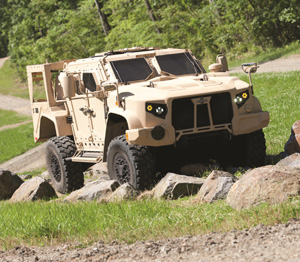
    Court Clears Oshkosh to Continue JLTV work

    Updated: February 18, 2016: A federal judge on Thursday denied Lockheed Martin’s motion that could have forced Oshkosh Corp. to stop working on a $6.7 billion Joint Light Tactical Vehicle (JLTV) contract while a lawsuit over that contract award continued. A week after the court decision, following “careful deliberation”, Lockheed Martin has withdrawn its protest of the JLTV contract award decision in the Court of Federal Claims.

    This decision lifted the last legal obstacle from the program and Oshkosh Corp. can now keep working on its JLTV contract, focusing on production and delivery. The procurement of JLTV could net the company more than $30 billion over the next 25 years.

    Lockheed in its motion to halt work argued that the military applied different standards to the two companies when evaluating the contract and held ‘misleading’ meetings with the company about the bid.

    Lockheed Martin To Offer Korean ‘Golden Eagle’ for USAF Advanced Future Trainer (T-X)

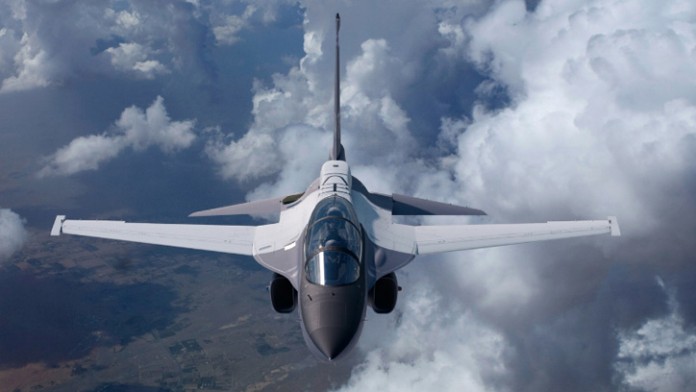
    T-50A trainer delivers the fighter-like performance and capabilities needed to eliminate 5th Generation training gaps and inefficiencies. Photo: KAI/ Lockheed Martin

    Lockheed Martin announced today that it will offer the T-50A in the U.S. Air Force’s Advanced Pilot Training (APT) competition (also known as T-X). The T-50A was developed jointly by Lockheed Martin and Korea Aerospace Industries (KAI) to replace the T-38 and train the next generation of pilots to fly 5th Generation aircraft. If the Korean trainer will win the tender the T-50As will be assembled in Greenville, South Carolina, following the selection of Greenville Operations facility by Lockheed Martin as the preferred Final Assembly and Checkout (FACO) site for the T-50A. The US Air Force plans to acquire 350 advanced trainers, to replace the +50 year old T-38 Talon in service.

    “The T-50A is production ready now. It is the only offering that meets all of the APT requirements and can deliver those capabilities on schedule,” said Rob Weiss, executive vice president and general manager, Lockheed Martin Advanced Development Programs (Skunk Works). “We carefully studied a clean-sheet option for the [Advanced Pilot Training] competition and determined that it posed excessive risk to the APT cost and schedule requirements.” Last month KAI unveiled the first of two T-50s built in an advanced configuration designed to compete for the US tender. The two production-standard T-50As will be flown to Greenville by the end of the 2016 to be used for flight evaluation by the Air Force, schedulded to commence in 2017.

    The T-50A is the US designation reserved for the Korean T-50 Golden Eagle. The aircraft is equipped for inflight refueling, and the cockpit instrumentation included large-area display, similar to the F-35. Its avionics utilize open systems architecture, enabling the user sn organic sustainment and upgrading of the aircraft without independent of the Original manufscturer(OEM).  

    These capabilities jwill enable the T-X to deliver the fighter-like performance and capabilities needed to eliminate 5th Generation training gaps and inefficiencies.

    As part of the training package that will come with the T-50A Lockheed Martin will provide Ground-Based Training System (GBTS) that Lockheed Martin describes as ‘an immersive, synchronized ground-based training platform’. “The agile T-50A GBTS applies lessons-learned from decades of training with leading-edge technologies to deliver a cost-effective advanced pilot training solution.” the company said in a statement.

    Four companies are competing on this opportunity – In addition to Lockheed Martin with KAI offering the T-50A, Northrop Grumman plans to submit a new aircraft based on a new-built and redesigned T-38; Boeing, teamed with SAAB will also offer a newly designed aircraft and Alenia Aermacchi plans to offer its M-346 as T-100 for the USAF. Alenia and Raytheon are expected to formally announce their teaming for the T-100 by February 22.

    The 227-acre Greenville site selected by Lockheed Martin for the APT has 13 hangars, 1,200,000 square feet of covered space optimized for APT and 8,000 feet of runway. Greenville is also home to a highly-skilled, flexible workforce of Lockheed Martin aviation technicians, engineers, program managers and other experienced personnel.

    Rocket Systems for Coastal Defense

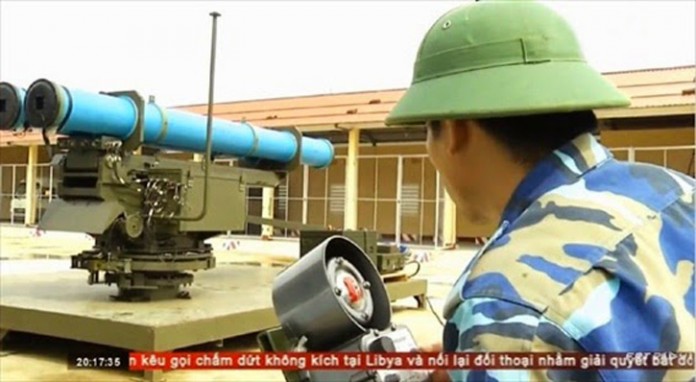
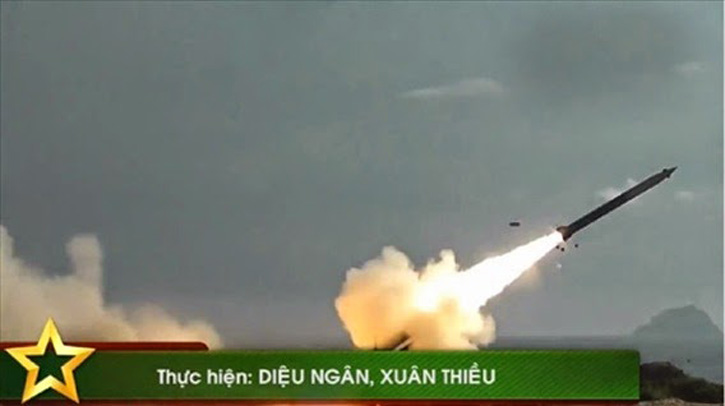
    A 'Killer' weapon site in Vietnam, where the rocket coastal and island defense system is used to deter landing from the sea. Photo: Vietnamese navy

    Updated | Designated Coastal & Island Defense System (CIDS), the new system provides authorities with the tools to enforce national sovereignty over coastal areas, islands and archipelagos, protecting interests throughout a national Economic Exclusion Zone that can extend up to 200 miles from the seashore. A version of the system has already been activated in Vietnam, where it is deployed as part of the country’s ‘Killer’ anti-landing system. The Vietnamese application integrated by IMI uses coastal defense systems provided by IAI’s Elta Systems, Orbiter 2 mini-UAVs supplied by Aeronautics, and extra rockets provided by IMI.

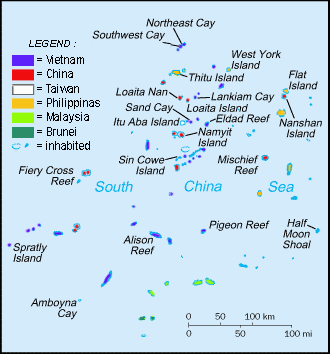
    Spratly_Is_since_NalGeoMapsWhile cruise missiles and artillery have been used for coastal defense for many years, until now, ballistic missiles and rockets have lacked the range and precision necessary to deter naval vessels. With its high precision, CIDS can hit targets at sea at long range, while they are still hours of sailing distance from shore. The system’s radars and optional UAVs provide the early

    Vietnamese Extra rocket fired from a coastal defense site. Photo: Vietnamese navy.
    Vietnamese Extra rocket fired from a coastal defense site. Photo: Vietnamese navy.

    warning, location, speed and heading data necessary to identify and lock onto targets in order to exploit its extended range and precision. The introduction of GPS guidance transforms the system’s rockets into precision, guided weapons, with accuracy of better than 10 meters. Moreover, with their ballistic attack trajectory, these weapons are difficult to defeat by conventional naval defenses.

    Two weapons of this class include the Chinese DF-21D and the Iranian Khalij Fars, derived from the Fateh 110 short-range ballistic missile. Both use vehicular-launched ballistic missiles. The system introduced by IMI Systems offers a similar application in an operationally flexible, distributed and affordable configuration.

    A rocket-based island defense system such as the Vietnamese ‘Killer’ system is particularly suited to protect the country’s territorial claims in the disputed Spratly Islands of the South China Sea. Its coverage, which extends over 80 nautical miles, is sufficient to enable a small garrison to protect approaches to key islands and many of the atolls and small islands in the area.

    Updated: August 11, 2016: In the summer of 2016 Vietnam has discreetly fortified five of the islands in the disputed South China Sea with these mobile rocket launchers. Some of the sites are within striking range of China’s runways and military installations across the Spratlys, Reuters reported. According to these reports, only launchers have been deployed that could be made operational with rocket artillery rounds within two or three days. Deputy Defence Minister, Senior Lieutenant-General Nguyen Chi Vinh denied that Hanoi deployed such rockets to the islands but said Vietnam reserves the right to take such measures. Military analysts say it is the most significant defensive move Vietnam has made on its holdings in the South China Sea in decades.

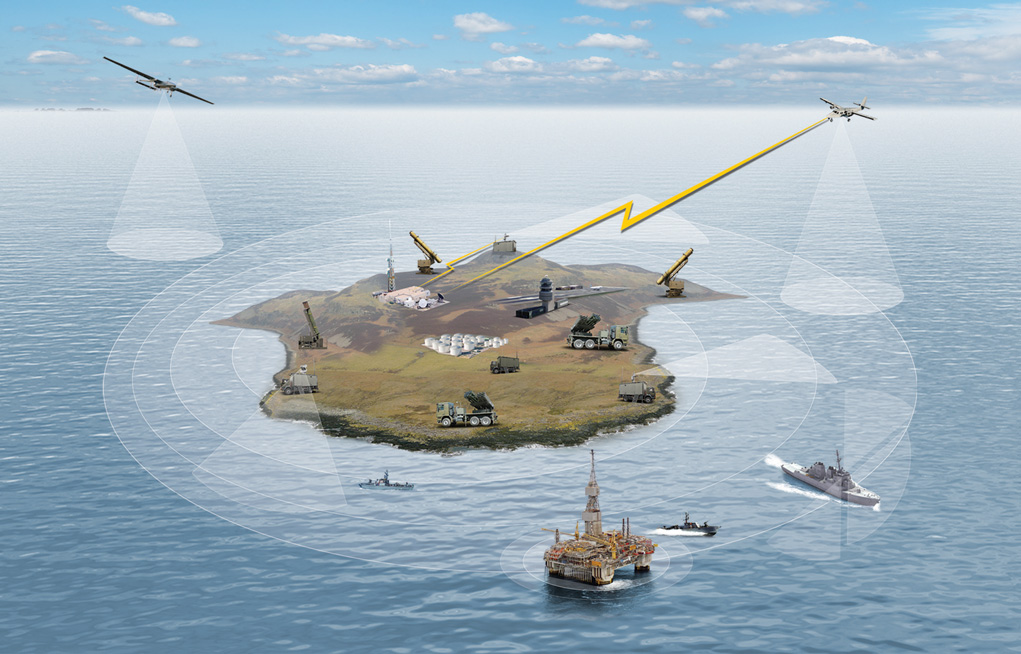
    IMI Systems offers the CIDS as an integrated coastal defense solution, integrating sensors and command, control and communications elements to create, update and process a situational picture over a wide area in real time. Configured for mobile, stationary or hybrid formations, CIDS supports flexible deployment in remote theaters. The system employs precision, guided ballistic rockets such as those of the ACCULAR family, that can hit pinpointed targets at sea and on land, at distances of up to 80 nautical miles.

    cids_concept_1021
    IMI Systems offers the CIDS as an integrated coastal defense solution, combining sensors on land and on manned and unmanned platforms, command, control and communications elements to create, update and process a situational-picture over a wide-area in real time. Image: IMI Systems

    The rockets used by the system enable coastal defenders to respond rapidly and decisively, engaging multiple moving targets simultaneously. CIDS offers a cost-effective alternative to coastal artillery and missile systems, offering superior performance in range and precision over coastal artillery. It also provides a higher degree of operational flexibility, through remote control and the ability to engage targets both at sea and on land.

    CIDS elements can be distributed in multiple locations for optimal coverage and response. These elements can be controlled remotely from the system’s central command post. Redundant communications links ensure secure control over all distributed assets.

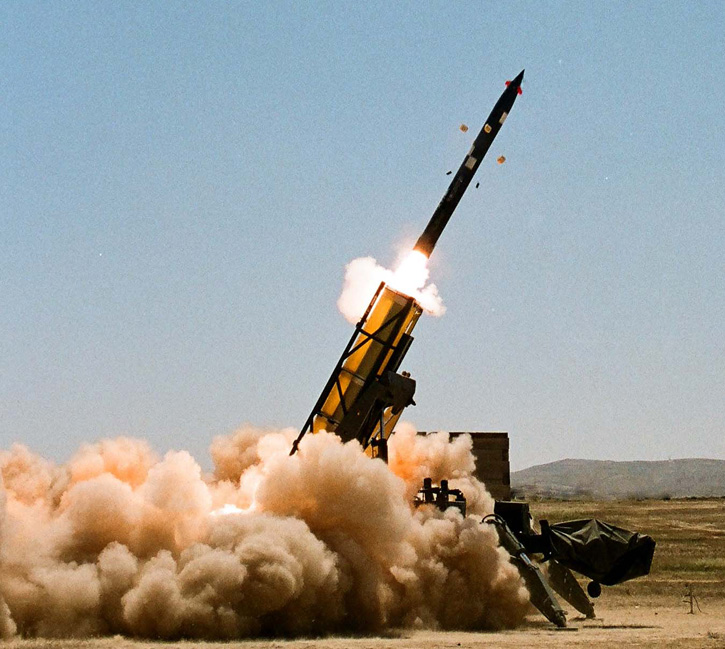
    Fired from a range of 150 km, IMI Systems' 306mm Extra rocket can hit within less than 10 meters of a target. Photo: IMI Systems.
    Fired from a range of 150 km, IMI Systems’ 306mm Extra rocket can hit within less than 10 meters of a target. Photo: IMI Systems.

    New Drone Extends Combat Brigade’s View Beyond 100 km

    Skylark 3 incorporates an electric motor which reduces sound signature and enables operating over long distances and at high altitudes, has a 4.8 m wingspan and a maximum takeoff weight of 45 kg. It has a service ceiling of 15,000 ft. Photo: Elbit Systems

    Elbit Systems will be unveiling its latest small, unmanned aerial system (UAS) – the Skylark 3 – at the Singapore Airshow 2016. Skylark 3 extends the company’s family of small UAS, introducing a larger platform designed to support the brigade level. Previous versions of the family include the Skylark 1-LEX and Skylark 2. Both, as the new one, are electrically-powered platforms.

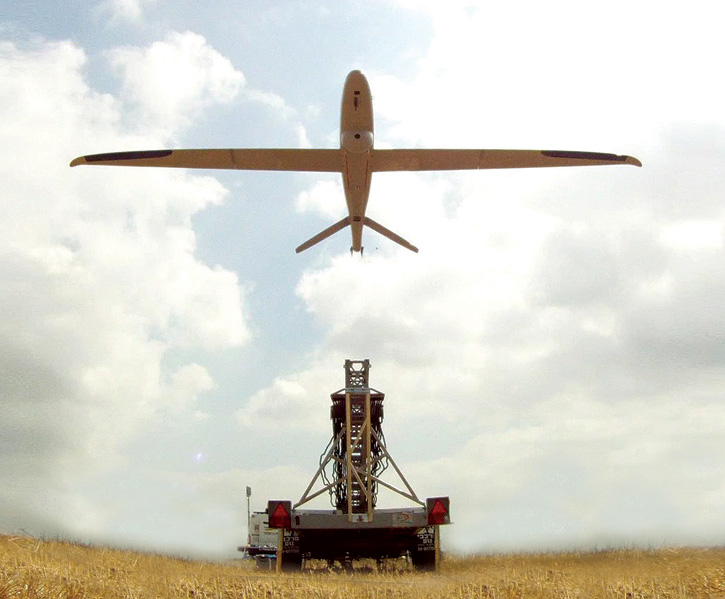
    skylark3_takeoff_725
    Launched via a pneumatic launcher, mounted either on the ground or on a vehicle, Skylark 3 offers upgrades such as improved payloads with better target detection, classification and surveillance capabilities. Photo: Elbit Systems

    As a growth version of the Skylark I, the performance improvements provided by the Skylark 2 did not place this mini-drone in a competitive position for the missions for which it was designed. That’s what the new model improves.

    The new variant – Skylark 3 – is a smaller platform, providing improved performance over the previous model. Discarding the former’s podded payload, for a smooth, low-drag design, Skylark 3 has a lighter maximum takeoff weight (48 kg. for Skylark 3, vs. 65 kg. for Skylark 2) and requires a smaller wingspan of 4.8 meters (vs. 6.5 m. for Skylark 2) providing the new platform  better mission endurance (6 hours, compared to 4 for Skylark 2), and a heavier payload carrying capacity (10 vs. 9 kg.). Operational radius has also increased – from 60 km. for the second version, to more than 100 km. for Skylark 3. Skylark 3 can also operate at higher altitudes, cruise at a ceiling of up to 21,000 ft -6,000 above its predecessors.

    Launched by a pneumatic launcher, mounted either on the ground or on a vehicle, Skylark 3 offers upgrades such as improved payloads with better target detection, classification and surveillance capabilities. These deliver superior Electro-Optical/Infra-Red (EO/IR) video and photographic imaging in both day and night operations and in adverse field conditions.

    To support interoperability, Skylark 3 uses the same advanced technologies and know-how found in other Elbit Systems’ UAS. This feature enables the Skylark 3 to be inducted into service with users that currently operate Skylark 1, – such as the Israel Defense Forces – and plan to extend its use to support combat forces at higher echelons.

    In addition to conventional deployment, multiple drones can now be supported through a shared GCS. As such, two Skylark 3 vehicles can be assigned to the same mission simultaneously, so that constant target acquisition can be maintained from two perspectives. This also offers ground forces the ability to extend the flight endurance of their mission significantly by UAS hot-swap.

    New Seagull USV Sets for Anti-Submarine, Counter-Mine Warfare

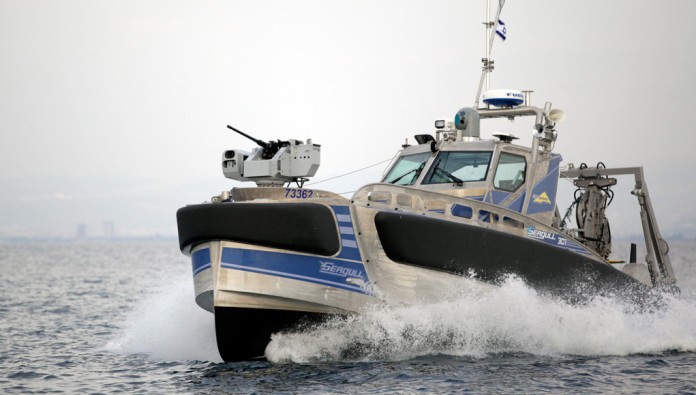
    Elbit Systems today unveiled its latest unmanned system – the Seagull autonomous, modular, multi-mission Unmanned Surface Vessel (USV). The company will publicly display its new USV at the upcoming Singapore Airshow.

    The USV utilizes a specially designed 12-meter platform made of aluminum or composites. The boat can be disassembled and carried in three containers on board larger vessels, and assembled at sea for specific missions. Anti-submarine warfare (ASW) and Mine-Countermeasures (MCM) operations are two of the missions envisioned for the new unmanned boat. Seagull vessels are designed to operate in pairs, controlled via a single Mission Control System (MCS), mounted on a mothership or on shore. The same MCS can also control unmanned aerial systems that can also participate in the mission, with the robots operating both on the surface and underwater.

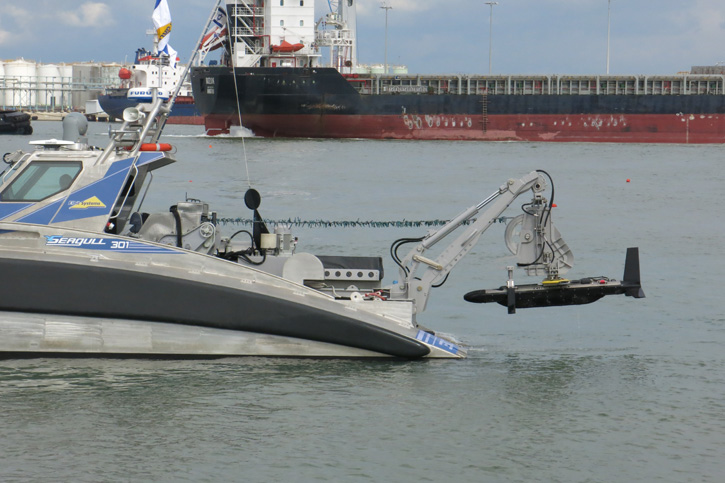
    Seagull can automatically deploy its towed or dipping sonar to conduct underwater scanning of the sea surface, in search of objects suspected as mines or submarines. Photo: Tamir Eshel, defense-Update
    Seagull can automatically deploy its towed or dipping sonar to conduct underwater scanning of the sea surface, in search of objects suspected as mines or submarines. Photo: Tamir Eshel, defense-Update

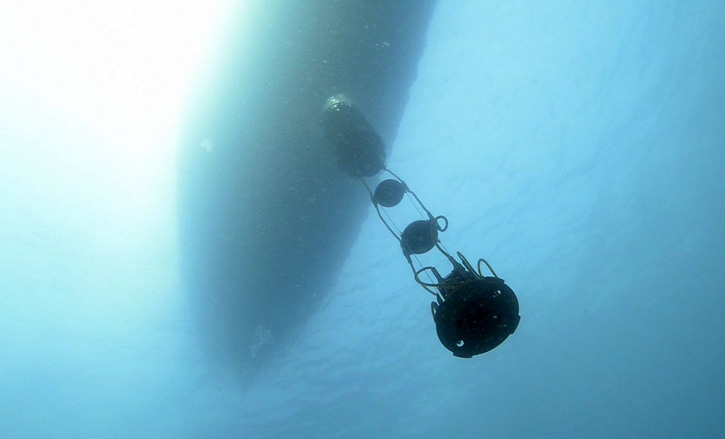
    Seagull provides unmanned end-to-end mine-hunting operation, taking the man out of the minefield. The system supports on-line operation in both known and unknown areas, conducting area surveys, search, detection, classification, identification, neutralization and verification. It also provides mission planning. It is equipped to search the entire water volume and to operate underwater vehicles to identify and neutralize mines. The small vessel can operate a number of sonars, including forward looking sonars, multi-beam echo sounders, side-scan and synthetic-aperture or dipping sonars, diver-detection sonars, Remotely-Operated Vehicles (ROV), and expendable mine-disposal vehicles.

    In a two-vessel configuration, one Seagull could scan for mines, using its sonars, while the second could identify and defeat the detected mines using the ROV and remotely-controlled mine-neutralization weapons. Each boat also carries a communications and datalink system, a radar transceiver, a stabilized EO/IR sensor pod, and a remotely-controlled weapon station mounting a 12.7 mm machine gun, other, diverse neutralization weapons, and an optional launch tube for an anti-submarine torpedo.

    “The Seagull multi-mission USV system offers navies a true force-multiplier by reducing risk, cost and manpower requirements, and performing missions which have only been performed to date by costly manned assets,” said Ofer Ben Dov, VP for Unmanned Naval Systems at Elbit Systems Intelligence and ISR Division. “The Anti-Submarine Warfare (ASW) capability provides the navy with a significant tactical advantage by effectively deterring and threatening enemy submarines, using an available asset with significantly lower risk.

    The dipping sonar is used for underwater search of mines. Photo: Elbit Systems
    The dipping sonar is used for underwater search of mines. Photo: Elbit Systems

    “Seagull changes the dynamics of anti-submarine operations by creating a threat to submarines using a cost-effective and available asset, replacing and augmenting manned assets with minimal threat from submarines,” Ben-Dov added. “It empowers a surface vessel or naval base commander with off-board, available and rapidly-deployable Anti-Submarine Warfare (ASW) capabilities to protect critical sea areas and high-value assets from both submarine and sea-mine threats.”

    Seagull features robust, modular, mission-payload suites, selected to enable a variety of required missions including EW, surface-force protection and hydrographical missions, in addition to the core MCM and ASW missions. Inherent C4I networking capability also supports enhanced situation awareness.

    Seagull is powered by two diesel engines driving two propellers; it can remain at sea for over four days, surviving sea state up to 7 with autonomous operation. The highly-autonomous and safe-sailing suite includes a patented Autonomous Navigation System (ANS), with obstacle avoidance, which conforms with international regulations for preventing collisions at sea. The boat can zero-turn using two lateral thrusters that also function in precision station keeping necessary for the ROV operation. Operator control is performed either via satellite communications (SATCOM) or by conventional, line-of-sight apparatus.

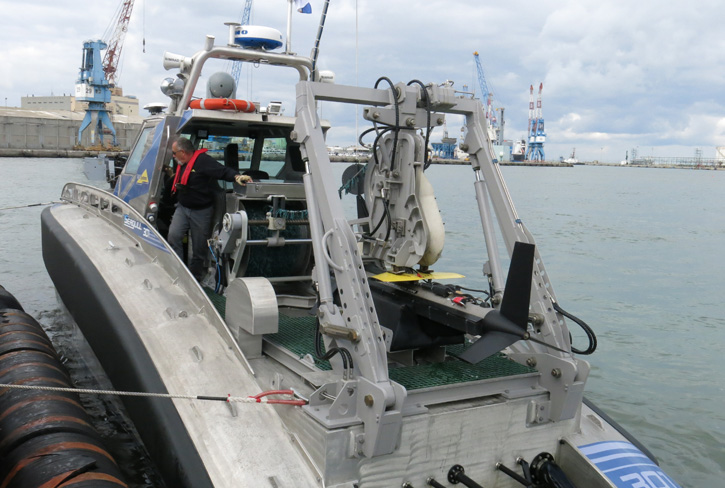
    Seagull uses a specially designed mount optimized for remotely controlled operation. Photo: Tamir Eshel, Defense-Update
    Seagull uses a specially designed mount optimized for remotely controlled operation. Photo: Tamir Eshel, Defense-Update

    IDF Expands Use of Active Protection Systems (APS)

    Based on positive lessons learned in recent combat RAFAEL is enhancing the Trophy Active Protection System (APS). “The system is designed to meet and adapt to face unexpected threats” IDF Maj. R, APS Program Manager told professional audience at the International Armored Vehicles conference in London last week. “We are currently improving the system and plan to field more enhancements in the future. We’ll proceed with 2nd and 3rd Generation systems as we intend to equip all active and reserve forces with APS”.

    According to IDF sources, the system, currently integrated on Israel’s Merkava Mk 4 main battle tanks and Namer heavy Armored Personnel Carriers (APC) is evolving and will be deployed on Merkava Mk3 and other combat vehicles in the future. The IDF future combat vehicles – the 8×8 wheeled APC Eitan and tracked Future Combat Vehicle (FCV) Carmel will both include the next generation APS. Part of the ‘Next Generation’ features of these future APS s will be the ability to ‘cover’ other elements, including unprotected vehicles, using ‘cooperative engagement’, utilizing advanced sensors and countermeasures. The first example of the Carmel FCV will be a technology demonstrator and is expected to have many advanced features, including the next generation co-operative active defense system (ADS).

    The need for an APS was realized with the introduction of threats that overmatched conventional ballistic armor, for example, to defeat an AT-15 Kornet anti-tank guided missile that can penetrate 1,200mm of homogenous steel armor (HMA), an armored vehicle have to add armor weighing close 100 tons, just to stay alive. While the frontal armor of main battle tanks could be sufficient to stop most ATGWs, the Kornet can be fired from any direction, at a range up to 5,500 meters, with hit probability of 80 percent – practically invisible to the tank crew and hardly reachable by the tank gun. Equally threatening is the Tandem-head of the RPG-29, fired from close range.

    APS is tipping the scale back to the tank’s side. With sensors detecting threats over 360 degrees, and countermeasures designed to defeat high-explosive anti-tank (HEAT) warheads (such as those carried by the RPG and ATGM) APS enables the tank and its crew to defeat such attacks and precisely engage the firing squad operating the ATGM even before the missile reaches its target.

    trophy_aps_display725trophy_aps_display725The development of the Trophy APS continued for almost two decades, but was accelerated following the 2006 Second Lebanon War, where the IDF faced the new generation anti-tank threats for the first time. RAFAEL completed the system’s development and integration in 2009, leading to initial operational capability approval of the first battalion of 401th Armor Brigade in 2010. The first combat engagement of the system was in 2011 and in 2014 the entire 401th brigade was equipped with APS protected tanks. The 7th Armored Brigade received the Trophy in 2015. Next to deploy the APS is the Namer Heavy APC, operated by the Golani Infantry Brigade. “It was the first time that a large formation operated with APS in a small area” Said Major R. APS-PM.

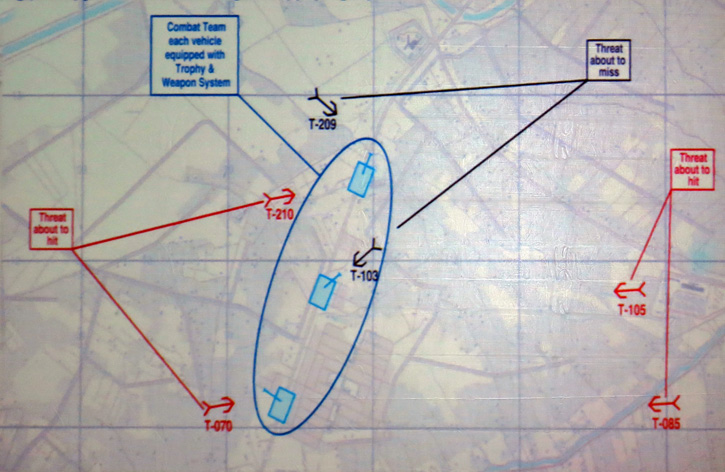
    During recent combat engagements the system proved highly reliable, repeatedly facing a large number of threats, including multiple shots that targeted single tanks. Tank crews that went into battle with the systems felt more protected, and could maneuver with confidence in any terrain, trusting their APS sensors to provide full situational awareness of threats at all time and countermeasures protecting their tanks when they were fired upon. Trophy also demonstrated effective operation in platoon, company and battalion level, where multiple tanks equipped with the system were operated together. In certain engagements APSs on several tanks detected incoming threats, but only the tank that was most vulnerable activated the countermeasures. Overall, the APS directly improved fighting continuity, reduced combat damage, improved crew situational awareness, confidence and resilience.

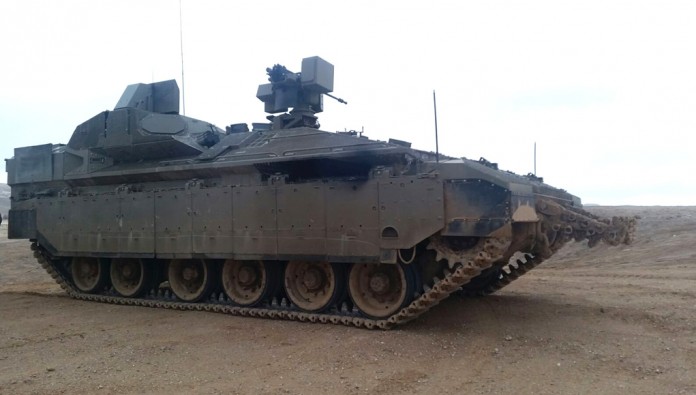
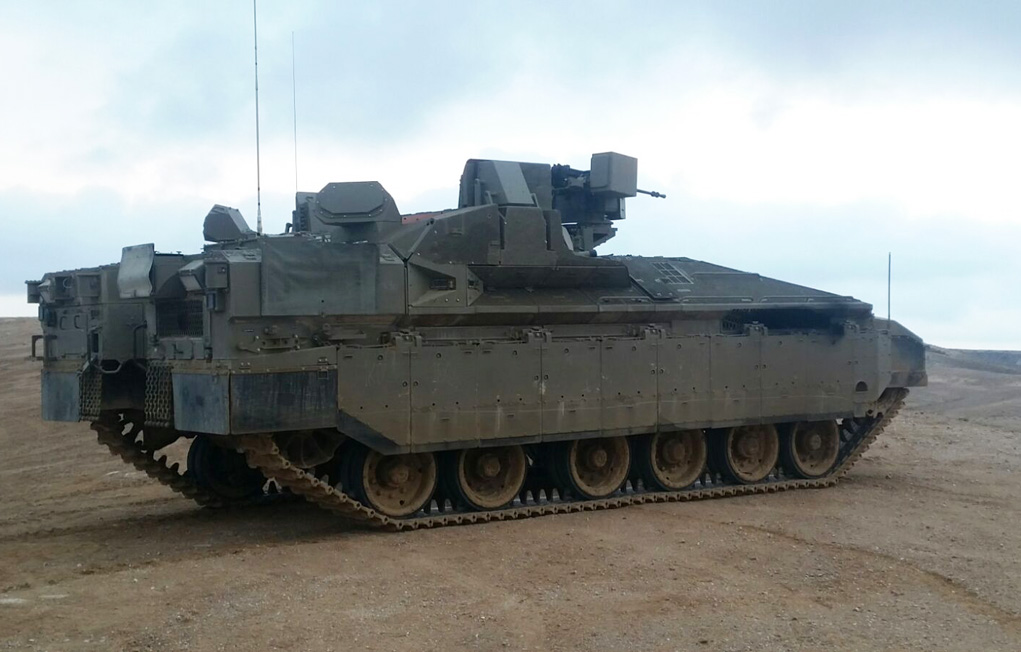
    Operational trials of the Namer equipped with the Trophy APS began recently at the Infantry School in the Negev Desert in Southern Israel.

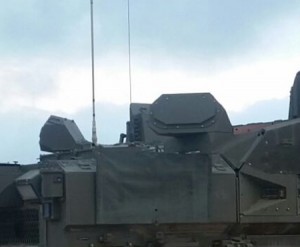
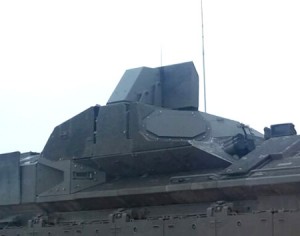
    These two Windguard AESA radars are part of the 360 degrees sensor of the Trophy system. They provide the situational picture, threat detection and fire control cueing for the Trophy APS system. Photo: IMOD
    These two Windguard AESA radars are part of the 360 degrees sensor of the Trophy system. They provide the situational picture, threat detection and fire control cueing for the Trophy APS system. Photo: IMOD
    The active protection countermeasures launcher and reloader are mounted on each side of the Namer. Photo: IMOD.
    The active protection countermeasures launcher and reloader are mounted on each side of the Namer. Photo: IMOD.

    Head of the Ministry of Defense Tank Production Office, Brigadier General Baruch Matzliah: “Over the past few weeks we have completed the integration and adaptation of the Trophy system for installation on NAMERS. At the end of a series of tests that have been taking place, we will begin serial installation of the system on additional vehicles. As such, we will implement Ministry of Defense policy of equipping every NAMER that leaves the production line with the only operational active defense system in the world. NAMER with Trophy will provide the highest level of protection to Israeli troops and will grant them security and a significant edge on the field of battle.”

    Considered the most protected armored personnel carrier in service today, Namer has proved its combat abilities during Operation Protective Edge in Gaza, 2014. Following the successful performance of the Trophy APS during the recent combat engagements, protecting the Merkava tanks, Israel’s Ministry of Defense announced that all new NAMER APCs will be equipped with the Trophy system – just like the latest Merkava Mk4 tanks.

    The baseline design of the Namer is fitted with modular protection suite that can accommodate an APS. Therefore – given adequate budget is provided – all IDF Namer based combat vehicles could be equipped with this lifesaving equipment.

    namer_trophy_rear_1021

    Nano-Coating Makes Coaxial Cables Lighter

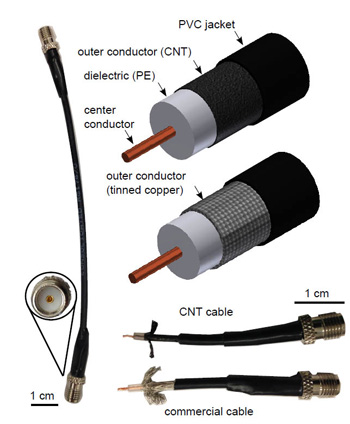
    Rice University research scientist Francesca Mirri holds a standard coaxial data cable (bottom) and a new cable with an outer conductor of carbon nanotubes. Replacing the braided metal outer conductor with a conductive nanotube coating makes the cable 50 percent lighter, Mirri said. (Photo: Jeff Fitlow/Rice University)

    Common coaxial cables could be made 50 percent lighter with a new nanotube-based outer conductor developed by Rice University scientists.

    The Rice lab of Professor Matteo Pasquali has developed a coating that could replace the tin-coated copper braid that transmits the signal and shields the cable from electromagnetic interference. The metal braid is the heaviest component in modern coaxial data cables. Replacing the outer conductor with high-performance coating would benefit airplanes and spacecraft, in which the weight and strength of data-carrying cables are significant factors in performance.

    Rice research scientist Francesca Mirri, lead author of the paper, made three versions of the new cable by varying the carbon-nanotube thickness of the coating. She found that the thickest, about 90 microns – approximately the width of the average human hair – met military-grade standards for shielding and was also the most robust; it handled 10,000 bending cycles with no detrimental effect on the cable performance.

    “Current coaxial cables have to use a thick metal braid to meet the mechanical requirements and appropriate conductance,” Mirri said. “Our cable meets military standards, but we’re able to supply the strength and flexibility without the bulk.”

    Replacing the braided outer conductor in coaxial data cables with a coat of conductive carbon nanotubes saves significant weight, according to Rice University researchers. (Credit: Pasquali Lab/Rice University)
    Replacing the braided outer conductor in coaxial data cables with a coat of conductive carbon nanotubes saves significant weight, according to Rice University researchers. (Credit: Pasquali Lab/Rice University)
    Coaxial cables consist of four elements: a conductive copper core, an electrically insulating polymer sheath, an outer conductor and a polymer jacket. The Rice lab replaced only the outer conductor by coating sheathed cores with a solution of carbon nanotubes in chlorosulfonic acid. Compared with earlier attempts to use carbon nanotubes in cables, this method yields a more uniform conductor and has higher throughput, Pasquali said. “This is one of the few cases where you can have your cake and eat it, too,” he said. “We obtained better processing and improved performance.”

    “Current coaxial cables have to use a thick metal braid to meet the mechanical requirements and appropriate conductance,” Mirri said. “Our cable meets military standards, but we’re able to supply the strength and flexibility without the bulk.”

    Coaxial cables consist of four elements: a conductive copper core, an electrically insulating polymer sheath, an outer conductor and a polymer jacket. The Rice lab replaced only the outer conductor by coating sheathed cores with a solution of carbon nanotubes in chlorosulfonic acid. Compared with earlier attempts to use carbon nanotubes in cables, this method yields a more uniform conductor and has higher throughput, Pasquali said. “This is one of the few cases where you can have your cake and eat it, too,” he said. “We obtained better processing and improved performance.”

    “It’s a very similar process,” Mirri said. “We just need to substitute the exit of the fiber extrusion setup with a wire-coating die. These are high-throughput processes currently used in the polymer industry to make a lot of commercial products. The Air Force seems very interested in this technology, and we are currently working on a Small Business Innovation Research project with the Air Force Research Laboratory to see how far we can take it.”

    Flight Test Evaluates New Thrusters for the Ground-Based Interceptor

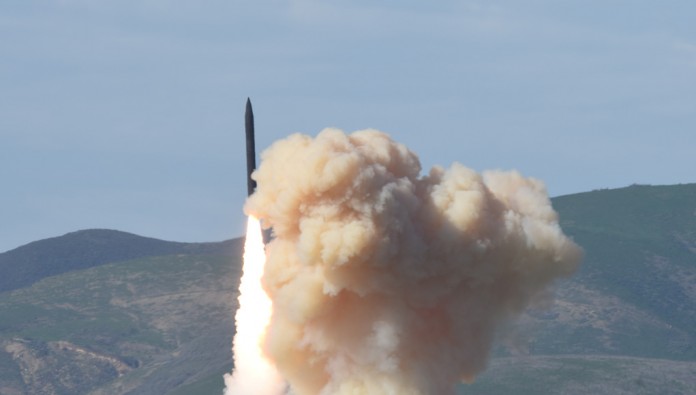
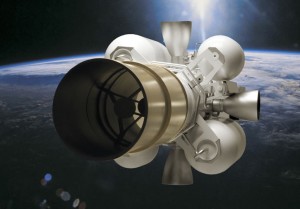
    A long-range ground-based interceptor is launched from Vandenberg Air Force Base, California, successfully evaluating performance of alternate divert thrusters for the system’s Exoatmospheric Kill Vehicle. This test, designated as Ground-based Midcourse Defense Controlled Test Vehicle-02+, was a planned non-intercept flight test. Data from this test will be used to improve the Ground-based Midcourse Defense element of the nation’s Ballistic Missile Defense System. Photo: MDA

    New thrusters system designed for the Exoatmospheric Kill Vehicle (EKV) of the Ground Based Interceptor (GBI) missile have passed an important validation test yesterday. The planned test that was originally scheduled for late 2015 did not include a target intercept. The test evaluated the CE-II EKV that demonstrated the performance of alternate divert thrusters in a flight environment. It also performed end-to-end discrimination of a complex target scene through the GMD fire control loop. The next flight test will conduct full intercept of a target simulating an Inter-Continental Ballistic Missile (ICMB).

    The interceptor and its kill vehicle are part of the Ground-based Midcourse Defense (GMD), the land-based element of the US Ballistic Missile Defense System (BMDS) supposed to protect the continental USA from a limited number of intermediate- and long ballistic missile attacks, including ballistic missiles, such as the missiles North Korea is believed to be developing. Most of these long-range ground-based interceptors are based in Alaska, a small number of interceptors are also based at Vandenberg Air Force Base, Calif., where the This ‘Ground-based Midcourse – Defense Controlled Test Vehicle-02+’ (GM CTV-02+) The mission also involved two forward based radars located in and near Hawaii.

    The test successfully evaluated the performance of alternate divert thrusters. During the test, a target representing an intermediate-range ballistic missile was air-launched from a U.S. Air Force C-17 aircraft over the broad ocean area west of Hawaii. An Army Navy/Transportable Radar Surveillance and Control Model 2 (AN/TPY-2) radar in Forward Based Mode, located at the Pacific Missile Range Facility, Kauai, Hawaii, detected the target and relayed target track information to the Command, Control, Battle Management, and Communication system. The Sea-Based X-band radar, positioned in the broad ocean area northeast of Hawaii, also acquired and tracked the target. The GMD system received track data and developed a fire control solution to engage the target. The test also included a demonstration of technology to discriminate countermeasures carried by the target missile.

    Raytheon's Exoatomospheric Kill Vehicle (EKV) is the intercept component of the Ground Based Interceptor (GBI). Illustration: Raytheon
    Raytheon’s Exoatomospheric Kill Vehicle (EKV) is the intercept component of the Ground Based Interceptor (GBI). Illustration: Raytheon
    A three-stage Ground-Based Interceptor was launched from Vandenberg AFB, performed fly-out, and released a Capability Enhancement-II Exoatmospheric Kill Vehicle. The kill vehicle performed scripted maneuvers to demonstrate performance of alternate divert thrusters. Upon entering terminal phase, the kill vehicle initiated a planned burn sequence to evaluate the alternate divert thrusters until fuel was exhausted, intentionally precluding an intercept.

    MDA said that program officials will evaluate system performance based upon telemetry and other data obtained during the test. Engineering data from this test will be used to increase confidence for future GMD intercept missions. MDA is planning another test for the end of this year (FTG-15), which will be the first intercept flight test for the CE-II Block 1 GBI and the first intercept of a target simulating an ICMB. A successful conduct of this test will release the final delivery of 10 CE-II Block 1 GBIs missiles over the next year, to achieve a full complement of 44 GBIs in Alaska and California by the end of 2017.

    The test flight was conducted by The U.S. Missile Defense Agency (MDA), in cooperation with the U.S. Air Force 30th Space Wing, the Joint Functional Component Command for Integrated Missile Defense, and U.S. Northern Command.

    Textron Systems to Supply SCTV Armored Vehicles to Ukraine

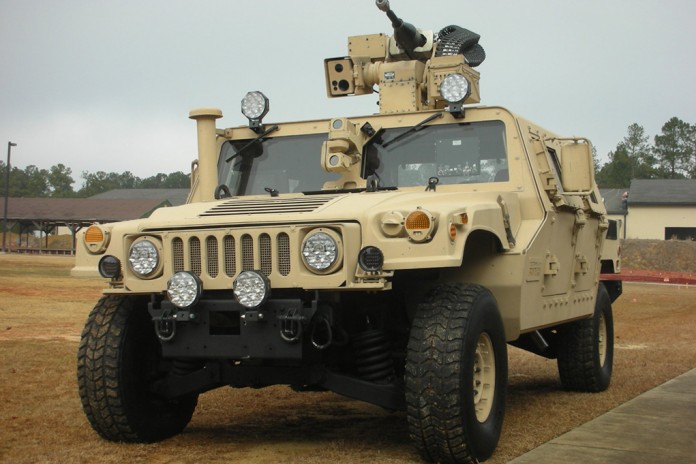
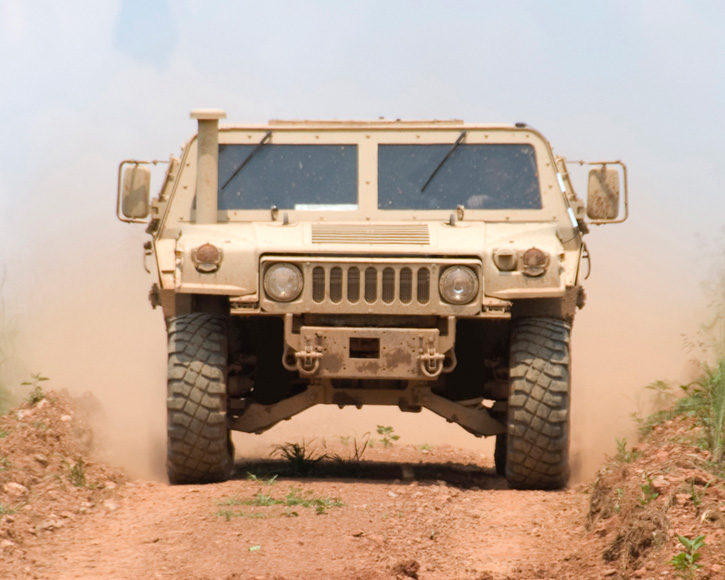
    With the SCTV modification the vehicle is heavier but also more protected and more maneuverable than an up-armored HMMWV. Photo: Textron Systems

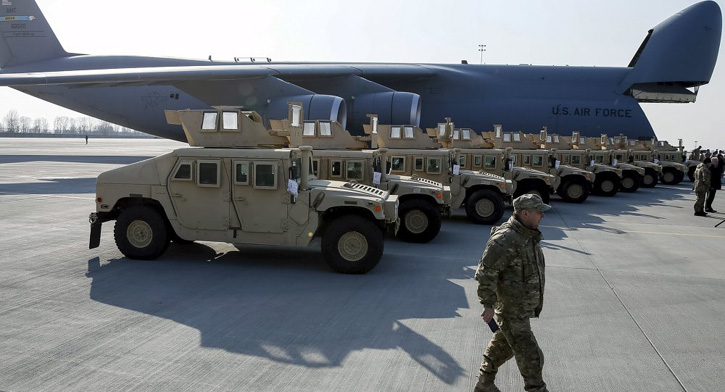
    Textron Systems announced today the first export sale of its SCTV (Survivable Combat Tactical Vehicle) to the Ukraine. In 2015 the US Government has agreed to deliver Ukraine 200 HMMWVs from US military surplus; Some of these vehicles will be converted by Ukroboronprom into SCTV, using Textron delivered kits. Serial production of the vehicles will be done in Ukraine and Ukroboronprom will be able to export SCTV vehicles in the future, to other countries, pending a US permission. Ukraine officials foresee a viable market for such vehicles, particularly in the Middle East where they already sold locally made vehicles.

    hmmwv_to_ukraine
    In 2015 Ukraine received few dozens of HMMWVs from US surplus from a total shipment of about 2000 slated for delivery to allied countries. Although the vehicles are usable they require significant refurbishments before fielding. The SCTV will use some of these vehicles to provide the basis for a major upgrade improving the vehicle’s performance, protection and reliability.

    Textron has already delivered few converted HMMWVs to Colombia, which has evaluated three partly converted SCTVs, but has yet to decide on the scale and terms of the acquisition of more vehicles.

    The SCTV is using an extended HMMWV chassis, new diesel motor, brakes and heavy duty suspension to carry the added weight. It is fitted with a new steel armored monocoque capsule, offering improved ballistic and blast protection, using V-shaped hull, and oblique side armor adding to the vehicle’s ballistic and roadside IED protection. Blast protected seats are also used to keep occupants protected in case of mine or IED blast under the vehicle. Removing the fuel tank and  battery compartment from the crew capsule also improves survivability.

    Ukrainian state-run defense company Ukroboronprom will convert the vehicles under a joint venture with the US Textron Systems. The vehicles will be delivered to the Ukrainian Army and could also be offered for export.

    Textron System announced today at the International Armored Vehicles convention in London. Textron Systems is a subsidiary of Textron Inc. (NYSE: TXT)

    The SCTV uses the basic HMMWV chassis with significant modifications, a new steel capsule, more powerful engine and improved protection. With the SCTV modification the vehicle is heavier but also more protected and more maneuverable than an up-armored HMMWV. Photo: Textron Systems
    The SCTV uses the basic HMMWV chassis with significant modifications, a new steel capsule, more powerful engine and improved protection. With the SCTV modification the vehicle is heavier but also more protected and more maneuverable than an up-armored HMMWV. Photo: Textron Systems

    RAF Testing Threat Awareness and Pilot Safety Enhancements for the Typhoon

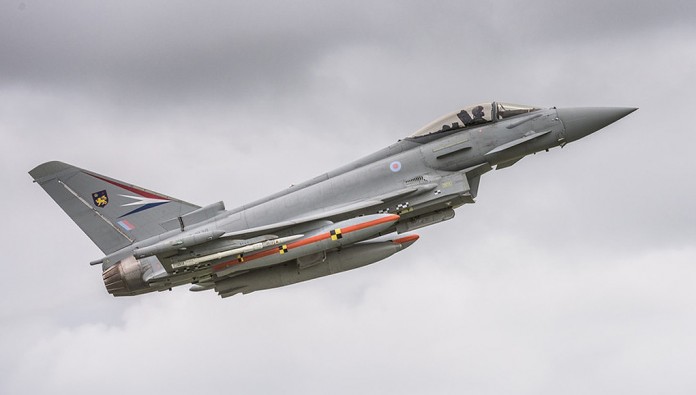
    P2E flight trials are conducted at BAE Systems’ Military Air & Information business in Warton, Lancashire. Testing is scheduled to continue through 2016. Photo: Eurofighter

    The latest enhancements for the Eurofighter Typhoon combat jet have been successfully tested by UK Royal Air Force (RAF) pilots in flight trials conducted at BAE Systems’ Military Air & Information business in Warton, Lancashire. The test is part of the test and evaluation phase of the Typhoon’s Phase 2 Enhancement (P2Ea). Testing will continue throughout 2016 with weapons integration tests also scheduled for this year.

    The P2Ea package incorporates software and avionics improvements such as upgrades to the radar, defensive aids systems and targeting pods. These enhancements will improve Typhoon’s targeting capabilities, increase threat awareness and pilot safety. P2Ea forms part of the full Phase 2 Enhancement (P2E) package for the Typhoon. P2Ea is a stepping stone along the path of the RAF’s Project CENTURION designed to ensure a seamless transition between Typhoon and Tornado capabilities when Tornado goes out of service in 2019.

    The full P2E upgrade for the RAF will include the integration of the MBDA Meteor Beyond Visual Range Air-to-Air Missile. The next phase of enhancements, P3E, will bring the MBDA Storm Shadow cruise missile and MBDA Brimstone 2 close air support weapon into service on Typhoon for the UK. Both P2E and P3E will be delivered through Project CENTURION.

    Four of 2016’s Ten Risk Hot Spots in Middle East, IHS Says

    Four Middle Eastern conflicts are staring among the top 10 ‘hot spots’ – the ‘Top Risk Environments Report determines. The report, produced by IHS Country Risk, explores 10 of the major risk environments of 2016, with their likely impact and key indicators for change.

    “Four of the 10 risk hot spots for 2016 are in the Middle East,” said Keerti Rajan, head of political risk analysis at IHS Country Risk. “The new cold war between Saudi Arabia and Iran, the rising threat from the Islamic State, the potential for more protests in Egypt and contract risks in Iran are all risks for businesses operating in the region.”

    Short summaries of the major risk environments of 2016 follow.

    Iran:

    In addition to a sustained risk of the US unilaterally imposing non-nuclear-related sanctions (for instance, terrorism-related), divergence among Iran’s political factions on the scope and pace of FDI presents high risk of contracts becoming politicised and consequently subject to review and renegotiation.

    The Arabian Gulf:

    The emergence of Islamic State in Saudi Arabia and a revived terrorist campaign there poses risks of the country being used as a launching pad to expand the group’s activities and recruitment elsewhere in the region, especially in Kuwait and Bahrain.

    Syria, Iraq and Yemen:

    The proxy conflicts in Iraq, Yemen and Syria are drawing Russia, Iran, Turkey and Saudi Arabia into more direct and overt involvement, raising the risk of limited direct confrontations between these sponsors. With the Saudi air force bombing the Iranian-backed Houthi movement in Yemen, Iran sending IRGC combat units into Iraq and Syria to fight against Turkish and Saudi militia proxies, and Russia bombing Saudi and Turkish Sunni insurgent proxies in Syria, the proxy war in the Middle East is significantly expanding.

    Egypt:

    Egypt’s military-backed government is consolidating its own power and suppressing political opposition, but ongoing failures to meet security and economic challenges would heighten the risk of protests re-emerging. At the same time, Egypt’s jihadist insurgency poses risks to economic recovery.

    Somalia:

    The onshore and maritime security environment that has contributed to a reduction in Somali-based piracy since 2012 is changing, with indicators of an increasing risk of piracy in 2016. The pirates that thrived in Somalia between 2005 and 2012 were reliant on the support of regional political leaders who were willing to provide safe havens for hijacked ships to be stored during lengthy ransom negotiations. The two conditions that led regional politicians to provide that support, namely a lack of alternative economic opportunities and a threat to their control of their territory, are currently being recreated in the Galmudug region of central Somalia.

    About 60 percent of commercial shipping travelling through this historic piracy zone no longer carry privately contracted armed security personnel (PCASP) on-board due to the costs involved and perception that piracy is not a significant risk. This means that Somali pirates, who still have the technical capabilities, manpower, weaponry and financing networks to organise deep-water hijacks, may soon regain the secure ship-storage locations required to resume operations.

    Argentina:

    Newly elected president Mauricio Macri faces significant challenges through the first half of 2016, despite expectations of a swift improvement in the business operating environment.

    Europe:

    The record-high influx of refugees continues to place the EU under significant strain, with protests, inter-EU political disputes and a revision of Schengen likely in 2016. A heightened risk of terrorist attacks will add to Europe’s challenging outlook. Disruption to ground, rail, and marine cargo in the EU and its neighbouring countries as a direct result of the refugee crisis is likely to continue in 2016, causing delays to cargo and disruption to supply chains.

    Nigeria:

    Nigerian president Muhammadu Buhari faces a daunting series of security and economic challenges in 2016 to match some of the high expectations of him since assuming office in May 2015. Despite President Buhari giving his new security chiefs until December 2015 to finish off Boko Haram, the Islamist militant group has continued to stage regular suicide bombing attacks aimed at causing mass casualties, and the faction, led by Abubakar Shekau, is likely to receive increased support from the Islamic State. The collapse in the oil price means Buhari has greatly reduced resources at his disposal as he attempts to boost fading GDP growth

    Myanmar:

    The landslide victory by opposition pro-democracy leader Aung San Suu Kyi’s National League for Democracy (NLD) in the November 2015 election has placed Myanmar on an unchartered path towards democratic rule, but political stability depends on Suu Kyi’s ability to negotiate her party’s co-existence with the military and the outgoing Union Solidarity and Development Party (USDP).

    Russia:

    As public grievances about the government’s inability to maintain public services mount, Russia’s elites will strive to scapegoat prominent policymakers, leading to changes in key influencers and contract reviews and corruption investigations in construction, real estate, and transport among the provinces.


     

    KC-46A Pegasus Conducts First In-Flight Refueling

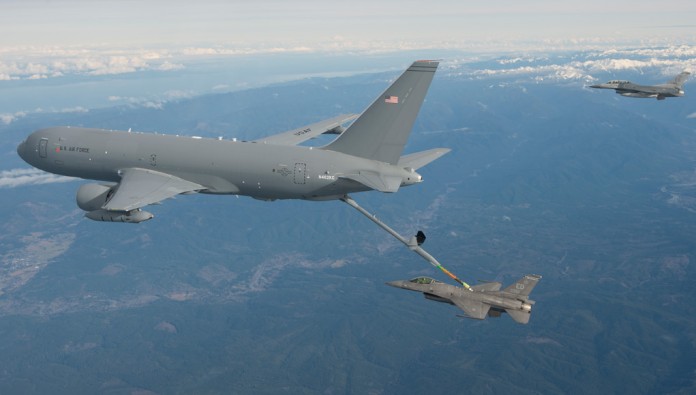
    The KC-46A Pegasus performs its first-ever aerial refueling passing 1,600 pounds of fuel to an F-16 fighter Jan. 24. Photo: USAF by Paul Weatherman

    The US Air Force’s new aerial refueler, KC-46A Pegasus successfully transferred fuel through its boom to an F-16C Fighting Falcon fighter today to demonstrate aerial refueling operations in advance of its first production decision later this spring. This was a major milestone for the air force, as the new aircraft is expected to a key enabler supporting the air force’s global operations over the coming decades.

    “These are exciting times for the KC-46A Program. We have had plans on paper and data from simulation labs, but this in-flight demonstration shows we are truly making progress on bringing this capability of the next generation of tankers to the warfighter supporting our global missions for years to come.” said Col. Chris Coombs, KC-46 System Program Manager, Air Force Life Cycle Management Center.

    The Air Force contracted with Boeing in February 2011 to acquire 179 KC-46A tankers to begin recapitalizing the aging tanker fleet. The program is currently working to meet the Required Assets Available date, a milestone requiring 18 KC-46A aircraft and all necessary support equipment to be on the ramp, ready to support warfighter needs, by August 2017.

    The tanker has a robust in-flight refueling demonstration schedule over the coming weeks. The test with the F-16C fulfilled the requirement to connect to a light/fast receiver. The remaining tests with the boom will use an A-10 Thunderbolt II as the light/slow receiver and a C-17 Globemaster as the heavy receiver. Flight tests employing the centerline drogue system and wing aerial refueling pods will use an F-18 Hornet as the light/fast receiver and an AV-8B Harrier a light/slow receiver. The KC-46A will also have to demonstrate its receiver capability by taking fuel from a KC-10 Extender.

    These refueling demonstrations represent the significant remaining test hurdles before proceeding to a Milestone C Low Rate Initial Production Decision. Program officials anticipate awarding the first production contract shortly thereafter.

    France to Upgrade SAMP/T Extended Range Air Defense System

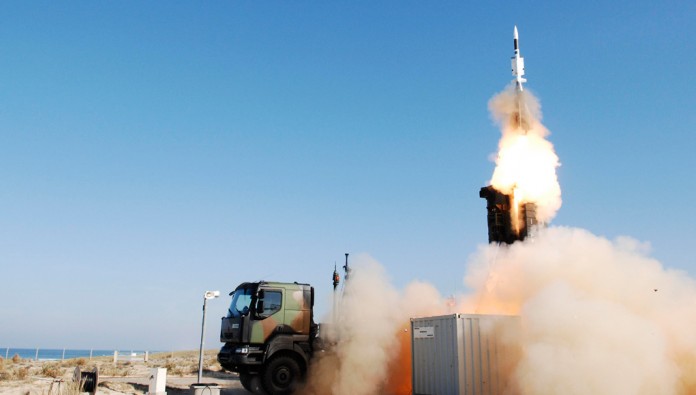
    Aster 30 extended range air defense missile system (SAMP/T). Photo: DGA

    The French Ministry of Defence has launched a modernization program for the country’s SAMP/T ground based air defense system. The Aster Block 1 NT (New Technology) programme will cover the modernization of the Aster 30 interceptor and associated SAMP/T extended range air defense system that will evolve to provide missile defense capabilities. Aster 30 is currently in service with French and Italian forces.

    The contract was notified by the French DGA (Direction Générale de l’Armement) to the EUROSAM consortium involving MBDA and Thales on 23rd December 2015. The contract provides for the development of a new version of the Aster 30 Block 1 missile, referred to as Aster B1 NT with first deliveries to the French Air Force being expected in 2023.

    France’s Aster programme is led by the DGA with the support of OCCAR (Organisation Conjointe de Coopération en matière d’ARmement), the European intergovernmental organisation for joint armament cooperation. The modernization of the current SAMP/T system will enhance the capabilities of the system, particularly against ballistic missiles. These evolutions will enable SAMP/T to further enhance its contribution towards NATO’s anti-ballistic missile defence programme.
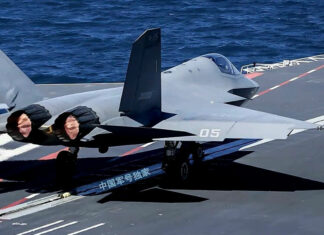
    In the next few months  Italy is expected to join, as Italy’s ground based air defence units are similarly equipped with the SAMP/T system. For quite some time, the UK, Italy and France have shared a successful cooperation covering ground and naval air defence systems based on the Aster missile. This cooperation was reaffirmed by the signing of an MoU (Memorandum of Understanding) by the three nations on 11th December 2015.

    Germany Defers MALE UAS Acquisition, Leasing Heron TP from Israel

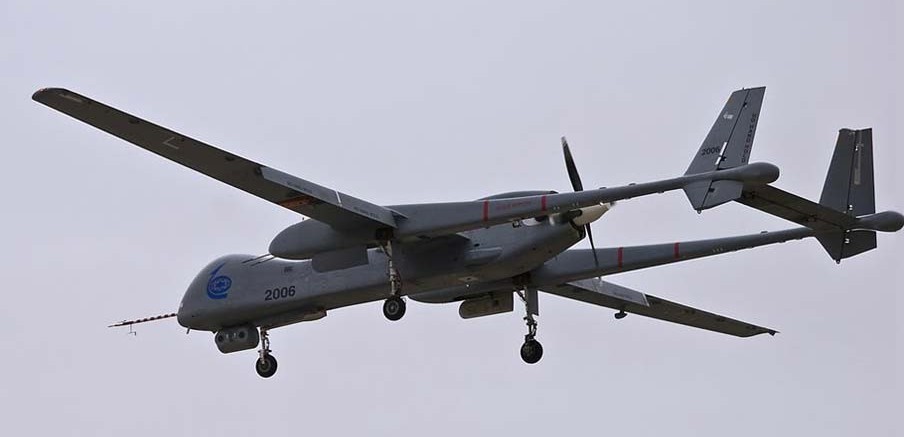
    The German armed forces have shelved a plan to buy a new Medium Altitude Long Endurance (MALE) Unmanned Aerial System (UAS) in favor of leasing such vehicles and operating them from Israel beginning in 2018. German Defence Minister Ursula von der Leyen said Tuesday. The lease of three to five Heron TPs will cost about €600 million (US $650 million). The lease contract with IAI will provide an interim solution until 2025, when a new European combat UAV is expected to enter service. The future combat MALE is being pursued by a joint effort of Germany, France, Italy and Spain. In recent years Germany considered the acquisition of IAI Heron TP or General Atomics MQ-9 Reaper, to establish its own drone force, similar to the UK, Italy, Netherlands, France and Spain.

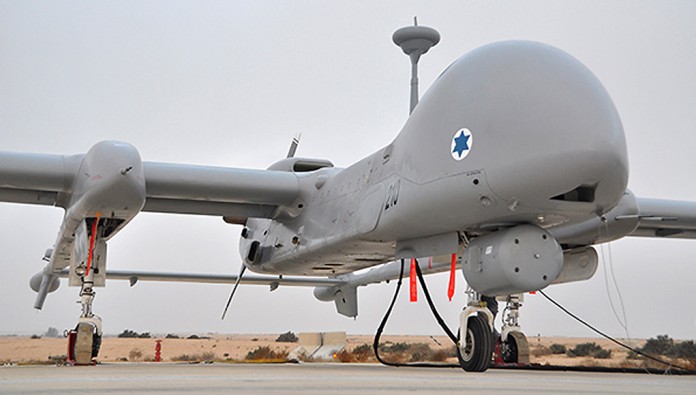
    The Heron TP is manufactured by Israel Aerospace Industries (IAI), it will be used to support German forces operating with international contingencies overseas, in a similar manner the Heron I has already operates in Afghanistan. The drones will be assigned to the Luftwaffe Taktische Luftwaffengeschwader (Tactical Air Force Squadron) 51 in Jagel based in northern Germany. This unit is currently providing Tornado Recce aircraft to support coalition air operations against Daesh in Syria and could be required to support another contingency in Mali. The leased drones will initially be stationed in Israel for training and, potentially, in support of operational deployment. Operational control and simulator based training will be maintained in Jagel, Germany.

    Heron-tp_flight
    Heron TP drones are currently operated exclusively by the Israel Air Force. Photo: Noam Eshel, Defense-Update

    Both Heron I and Heron TP can carry external stores; with a full payload capacity of one ton, Heron TP can carry out heavier payloads, enabling users to conduct intelligence, surveillance and reconnaissance from longer range. The Germans also pursue options for arming the drone. Officially Israel is not commenting on its drone’s arms carrying capabilities, but foreign sources have claimed almost all Israeli UAVs possess these capabilities. Previous platforms were restricted to light weapons, due to the platform’s limited capacity for external payloads, however, the current MALE drones are less limited in this respect. The Germans are considering the integration of MBDA Brimstone missiles, against other armaments that could already be available with the platform. The Bundestag, the German parliament, will decide on a case-by-case basis when UAVs can be armed.
    As of November, the Heron 1 UAVs had logged more than 70,000 operational flight hours in Afghanistan, 25,000 hours were logged by the German Herons. IAI have teamed with Airbus defense and Space to operate and support the Heron 1 for the German forces, and is likely to expand this arrangement to include the Heron TP as well.

    Skunk Works and XTEND Simplify Multi-Drone Command

    0
    Lockheed Martin Skunk Works® and XTEND have achieved a major milestone in JADC2 by integrating the XOS operating system with the MDCX™ autonomy platform. This technical breakthrough enables a single operator to simultaneously command multiple drone classes, eliminating the friction of mission handoffs. From "marsupial" drone deployments to operating in GPS-denied environments, explore how this collaboration is abbreviating the data-to-decision timeline and redefining autonomous mission execution.

    From Ukraine to Taiwan: The Global Race to Dominate the New Defense Tech Frontier

    0
    As traditional defense primes face mounting competition from agile “neoprimes” such as Anduril, Palantir and Helsing, the balance of innovation is shifting toward software-defined warfare and scalable, dual-use technologies, while global industry consolidation—marked by Boeing’s integration of Spirit AeroSystems and other strategic mergers—signals an intensified race to secure control over the defense technology value chain. Our Defense-Tech weekly report highlights these trends.

    Europe’s “Drone Wall”

    0
    In early October 2025, a coordinated wave of unmanned aerial system (UAS) incursions—widely attributed to Russia—targeted critical infrastructure across at least ten European nations. The unprecedented campaign exposed the fragility of Europe’s air defenses...

    Weekly Defense Update & Global Security Assessment

    0
    Executive Summary The past week (September 18-25, 2025) represents an inflection point where strategic defense concepts have transitioned from doctrine to tangible reality. An analysis of global events reveals four primary, interconnected trends shaping an...

    U.S. Air and Space Forces Push Next-Gen Programs at the AS&C 2025 Conference and...

    0
    At the 2025 Air, Space & Cyber Conference, U.S. Air Force and Space Force leaders unveiled major updates on next-generation fighters, bombers, unmanned systems, and space initiatives, highlighting both rapid innovation and critical readiness challenges as the services race to outpace global competitors. A short version is available here, with a more detailed version for subscribers.

    TADTE 2025: Reflecting Taiwan’s Strategic Themes

    0
    The Taipei Aerospace & Defense Technology Exhibition (TADTE) 2025 crystallized around four dominant strategic themes that collectively illustrate Taiwan's comprehensive approach to defense modernization amid escalating regional tensions. Based on a detailed report by Pleronix (available upon request). Includes a Podcast discussion on TADTE 2025's highlighting Taiwan's four strategic themes beyond the post's coverage.

    Iron Beam 450 Completes Testing, Soon to Join With Operational Air Defense Units

    0
    Israel’s Iron Beam 450 high-power laser system has completed final testing, marking a major leap in air defense. Developed by Rafael, it offers precise, cost-effective interception of rockets, UAVs, and mortars, and is set for IDF deployment by 2025.