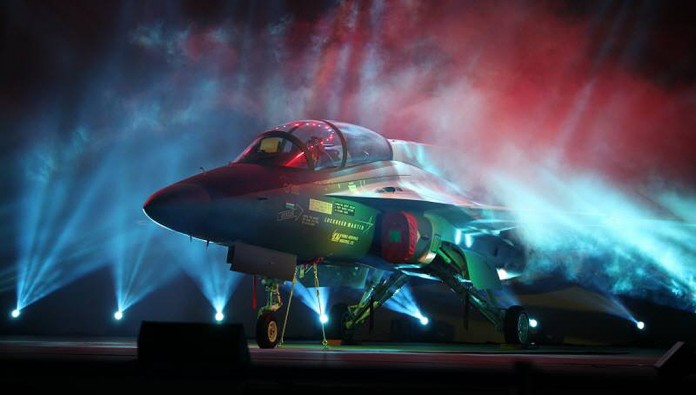
Sacheon, South Korea: Korean Aerospace Industries (KAI) unveiled yesterday the improved version of its T-50 Golden Eagle supersonic trainer, the model that KAI and Lockheed Martin are proposing as the successor of the US Air Force’ T-38 trainer, also known as T-X program. The T-X program, due for selection by late 2017 is expected to be one of the largest trainer acquisition worldwide. The US Air Force plans to acquire 350 advanced trainers, to replace the +50 year old T-38 Talon in service.
Designed for the training of pilots for 5th Generation fighter aircraft, KAI’s T-X is equipped with modern cockpit comprising large area display (LAD), embedded avionics and training systems, as well as aerial refueling capability. The aircraft is configured with large dorsal ‘hump’ providing ample cooled space for additional avionic systems and antennae.
The new variant is currently designated as a flight demonstrator, due to begin flight-testing in Korea next year, to be followed by flight demonstrations in the USA by 2017. The original T-50, along with its variants, was developed via technology transfer from Lockheed Martin with offsets related to South Korea’s large F-16 fleet.
K-50 T-X was developed by Korean Aerospace Industries (KAI) with assistance from Lockheed Martin.
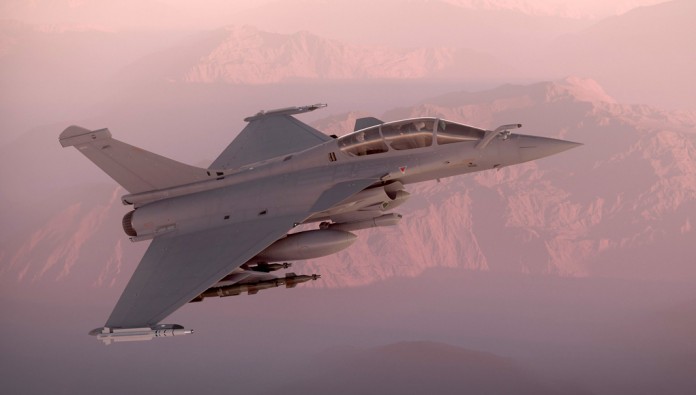
The contract for the purchase of 24 Rafale aircraft by Qatar came into force today. Qatar joins France, Egypt and India that have ordered the Rafale. The Qatari order increases the foreign orders worth €15 billion for Rafale to 84. Photo: Dassault Aviation
The contract for the purchase of 24 Rafale aircraft by Qatar came into force today. The contract was signed in Doha, on 4 May 2015, in the company of His Highness Sheikh Tamim bin Hamad Al Thani, Emir of the State of Qatar, and Mr. François Hollande, President of the French Republic. The acquisition of Rafale continues Qatari reliance on French fighter jets, that included the Mirage F1, Alpha Jet and Mirage 2000. The deal includes the aircraft, weapons and training for 36 pilots and ground crews is worth €6.3 billion ($7.1 billion). First delivery is due in 2017. Qatar joins France, Egypt and India that have ordered the Rafale. The Qatari order increases the foreign orders worth €15 billion for Rafale to 84. Egypt and India placed orders for 60 aircraft earlier this year.
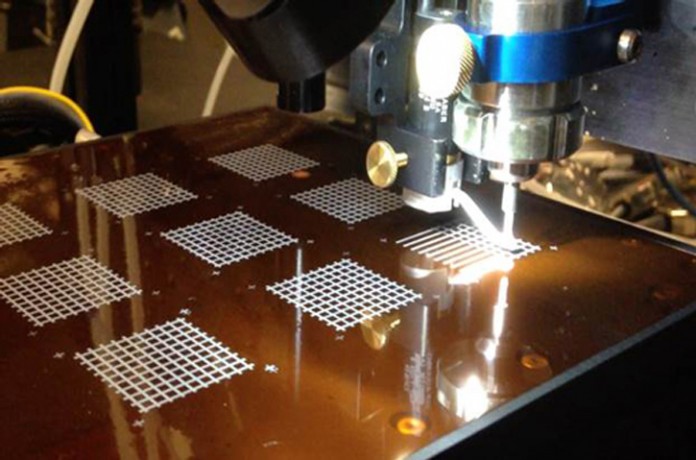
An advanced 3-D printer dispenses conductive ink to build an electronic device that can filter electromagnetic radiation. The horizontal tube uses a vacuum to remove unwanted ink. Photo: Raytheon UMass-Lowell Research Institute
Researchers at a Raytheon-sponsored lab at the University of Massachusetts, Lowell, have developed a new type of “ink” that can be used to “print” tunable microwave components that form the key elements of radar systems. Elements printed with the new “functional ink” form a specific type of capacitor called a voltage-variable capacitor, or ‘varactor’ – an essential electrical component of modern radar systems.
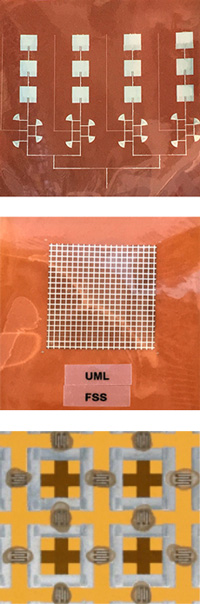
From top to bottom: A printed phase shifter, a printed frequency-selective surface (FSS), and a close-up of the FSS. In the close-up, the varactors are the oblong objects in between squares of silver conductive ink. They contain both the silver ink (squiggly lines) and the newly developed ink (brownish ovals). Photo: Images courtesy of Raytheon UMass-Lowell Research InstituteVaractor based devices are building blocks of phase shifters, the elements that electronically steer the beam of a modern Active Electronically Steerable Array (AESA) radars. Another device now printable thanks to the new ink is a frequency-selective surface—essentially a filter that can block specific frequencies of electromagnetic radiation or allow them to pass through. Such filters prevent unwanted radiation from disrupting a radar system.
“Printable devices such as those phase shifters and filters will lead to much cheaper and faster manufacturing processes”, says Christopher McCarroll, who co-directs the Raytheon UMass-Lowell Research Institute. The bottleneck has been that high-performing electronic devices generally rely on materials requiring high-temperature manufacturing, which is not compatible with plastic.
Researchers have already developed conductive inks, often containing metal nanoparticles, that can be processed at relatively low temperatures. Inks that would yield tunable devices for radar must contain materials with certain electrical properties that can be adjusted by applying voltage. The new ‘Functional Ink’ suspends those particles in a thermoplastic polymer, enabling simple deposition and curing at temperatures low enough to be compatible with certain plastics. To make the two devices, the group currently uses an aerosol-jet printer, which employs streams of gas to precisely deposit conductive ink made of silver, and another printer that relies on tiny vibrations to dispense the new ink.
Researchers hope the new printed devices could combined with the high-powered computer chips in the future, forming complete radar systems.
Lockheed Martin has received an additional production orders worth $302.2 million for 146 baseline Joint Air to Surface Standoff Missile (JASSM), for U.S. and international partners and 140 JASSM-Extended Range (ER) (AGM-58B) missiles for the U.S. The new order was negotiated with the Lot 13 order awarded in October. The new contract represents the sixth production order for JASSM-ER, which received full-rate production approval in 2014. The Lot 13 contract also included 140 baseline JASSMs for U.S. and international partners and 140 JASSM-ER missiles, data, tooling and test equipment. This recent award brings the total number of missiles under contract to more than 2,600. The JASSM production line is expected to run at least until the mid 2020s.
“Lots 13 and 14 were negotiated together, resulting in cost savings that led to more affordable missiles for our customers.” said Jason Denney, program director of long-range strike systems at Lockheed Martin Missiles and Fire Control. Recent program milestones include the $305.4 million Lot 13 contract award in October 2015 and a Foreign Military Sales contract to integrate JASSM onto Poland’s F-16C/D aircraft. The Lot 13 contract included 140 baseline JASSMs for U.S. and international partners, and 140 JASSM-ER missiles for the US forces.
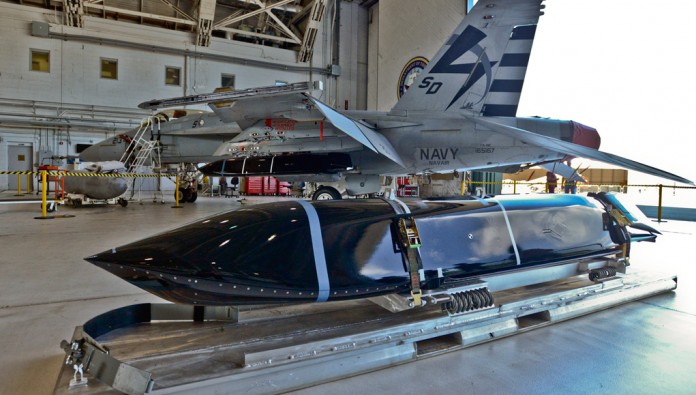
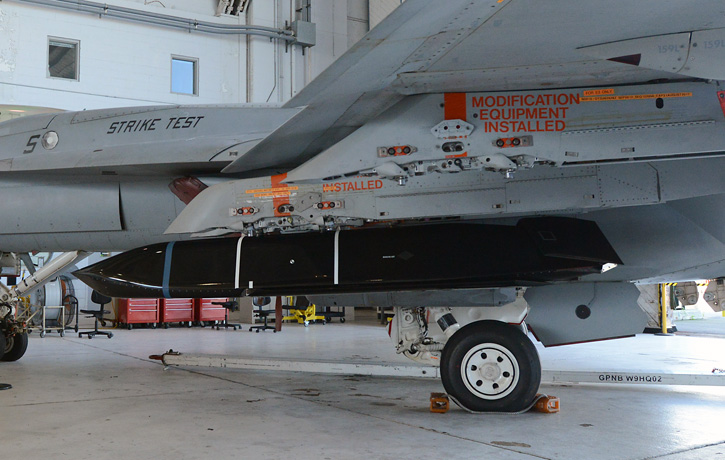
A Long Range Anti-Ship Missile (LRASM) integrated on F/A-18E/F Super Hornet Aug. 12 at NAS Patuxent River, Md. The program’s flight test team is conducting initial testing to ensure proper loading, unloading and handling of the LRASM on the F/A-18 E/F. (U.S. Navy photo)
Another recent milestone was achieved with the Long Range Anti-Ship Missile (LRASM) JASSM-ER derivative as the US Navy tested a dummy prototype of the missile in captive-carry flight tests on the F/A-18E/F Super Hornet. The flights were conducted at Patuxent River Naval Air Station, Maryland.
Integration efforts and flight testing began in August 2015 and will continue over the next few years at both NAS Patuxent River and Naval Air Weapons Station China Lake, to clear LRASM for flight operations on the aircraft. These initial airworthiness flight tests used a LRASM mass-simulator vehicle attached to the Super Hornet to evaluate flight and handling characteristics, as well as to measure structural loads and strains on the aircraft. A future series of tests would gather noise and vibration data between the aircraft and the missile. Airworthiness tests ensure safety of flight for the aircraft and the crews who employ them. Completion of integration and airworthiness tests are required for all munitions prior to a DoD initial operational capability decision. LRASM is set to be fielded on the B-1B Bomber in 2018 and the F/A-18 E/F in 2019.
LRASM is an anti-ship standoff missile based on the Joint Air-to-Surface Standoff Missile Extended Range (JASSM-ER). THis new weapon will enhance the capabilities of US Air Force and Navy in anti-access/area-denial (A2AD) threat environments. JASSM-ER shares a significant number of parts and assembly processes with LRASM, which would result in cost savings for the U.S. Navy and Air Force offensive anti-surface warfare programs.
LRASM is designed to detect and destroy specific targets within groups of ships by employing advanced technologies that reduce dependence on intelligence, surveillance and reconnaissance platforms, network links and GPS navigation in electronic warfare environments. Once operational, LRASM will play a significant role in ensuring military access to operate in open ocean/blue waters and the littorals due to its enhanced ability to discriminate and conduct tactical engagements from extended ranges.
Armed with a penetrating blast-fragmentation warhead, both missiles can be used in all weather conditions. They share the same powerful capabilities and stealth characteristics, though JASSM-ER has more than two-and-a-half times the range of JASSM for greater standoff capability. The 2,000-pound cruise missiles employ an infrared seeker and enhanced digital anti-jam GPS receiver to dial into specific points on targets. The range of the baseline JASSM (AGM-158) exceeds 200 nautical miles (370 km).
Effective against high-value, well-fortified, fixed and relocatable targets, JASSM is integrated on the U.S. Air Force’s B-1B, B-2, B-52, F-16 and F-15E. The B-1B also carries JASSM-ER. Internationally, JASSM is carried on the F/A-18A/B and the F-18C/D aircraft.
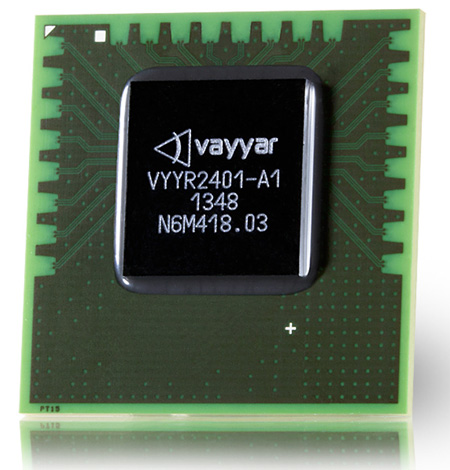
The Vayyar sensors look into objects using MIMO radar technology that provides a new perspective of objects, indicating shape, movement and composition of objects or materials even when these objects are invisible to the human eye. Photo: Vayyar
The Vayyar sensors implements a Muliple-Input-multiple-output (MIMO) radar on a chip. Photo: Vayyar
Tel Aviv, December 15, 2015: An Israeli company is developing a new 3D-imaging sensor that can see through objects and monitor the location, function and composition of multiple objects in a monitored space. The company announced yesterday the completion of a US$22 million funding round, in time for the planned introduction of its new sensor.
Vayyar’s new sensor technology could revolutionize machine sensing in number of applications, for example, in the field of robotic sensing, cancer detection and smart buildings.
Based around a Multiple-Input Multiple-Output (MIMO) radar technology, the new sensor is a radar system on a chip operating in the ultra wide band spanning over the 3-10 GHz frequency spectrum. The sensor uses multiple antennas operating in different polarization, over multiple wavelength and measuring multipath returns, along with doppler measurements, analysing target location, speed and movement. The system also provides RF imaging and relative permittivity measurements, to analyse the composition of transparent or opaque liquids.
Among the applications foreseen for the new sensors are ‘clip on’ assemblies that could turn smart phones into imaging devices that can see through walls or help medics to locate shrapnels or bullets inside the body of wounded soldiers. Other applications will enable to see through skin and tissue to detect cancer masses or track a person’s location and vital signs as they move through a ‘smart building’.
Vayyar Imaging plans to unveil its latest technology at the upcoming 2016 Consumer Electronics Show (CES) January 6-9, 2015 in Las Vegas.
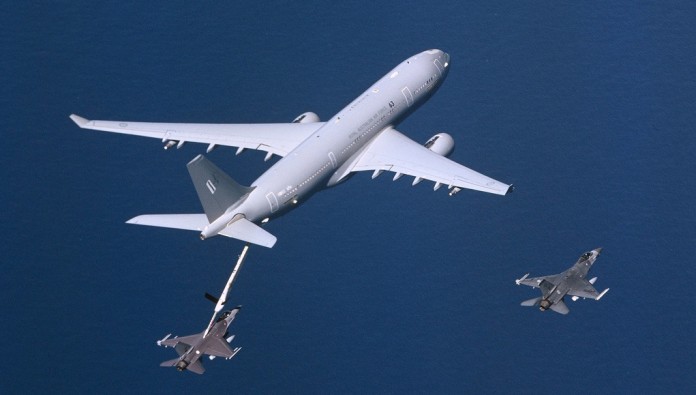
Airbus Defence and Space has received a firm order from the French Defence Procurement Agency (DGA) for a further eight A330 MRTT Multi-Role Tanker Transport aircraft. The aircraft constitute the second tranche of the multi-year contract for 12 A330 MRTTs signed by the French Ministry of Defence in November 2014 and bring the total firm order to nine. The remaining three are scheduled to be confirmed in 2018, permitting deliveries of the 12 aircraft before 2025.
The first A330 MRTT will be delivered to France in 2018, followed by the second in 2019, and the remainder at a rate of one or two per year.
In French service the A330 MRTT will be powered by Rolls-Royce Trent 700 engines and equipped with a combination of the Airbus Refuelling Boom System and underwing hose-and-drogue refuelling pods. It will also be possible to configure them in a variety of layouts carrying up to 271 passengers as well as medevac arrangements including the French MORPHEE intensive care module carrying up to ten patients as well as 88 passengers.
The combat-proven A330 MRTT has been ordered by seven nations which have now placed firm orders for 49 aircraft, of which 26 have been delivered. The A330 MRTT is configured with boom and hose drogue refueling systems, supporting all refueling methods. Photo: Airbus
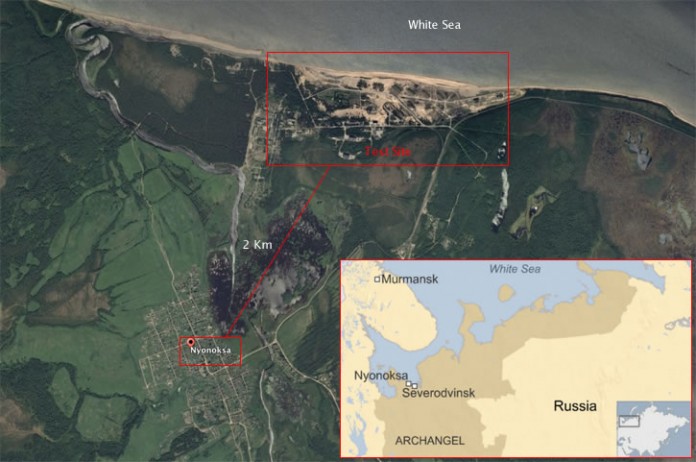
The missile test site near is located about two kilometers northeast of the the village of Nyonoksa, located along the coast of the the white sea. Photo: Google Earth
MOSCOW, December 15: A cruise missile tested yesterday by its manufacturer NPO Mashinostroyeniya failed on a test flight and crashed into a three storey building at the town of Nenoksa in the Arkhangelsk region in northern Russia.
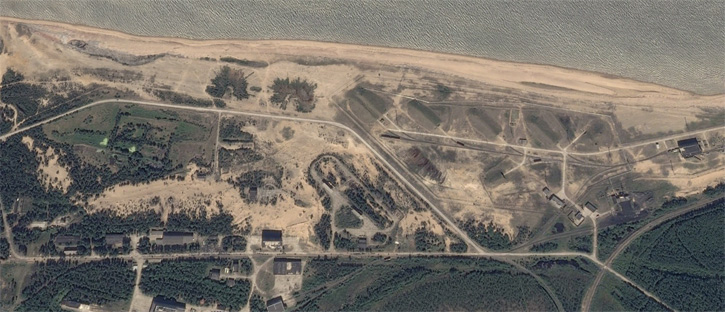
According to a company statement, the missile experienced an ‘abnormal situation’ after launch from a Russian Defense ministry test range. The missile diverged from its pre-planned trajectory and escaped the range’s safe zone. After a short flight the missile fell near the town of Nenoksa located only two kilometers from the launch site. According to the company statement, as the missile did not penetrate the building, only minor damage was caused to the building. “According to local media, the roof and four apartments in a three-story house were damaged.” Russian news agency Tass reported. A commission of industry representatives is working at the place where the missile fell,” the defense ministry’s statement said. “No facilities were destroyed and no one was injured as a result of the incident.” it said.
The missile test site near the village of Nyonoksa, located along the coast of the the white sea. Photo: Google EarthNPO Mashinostroyeniya rocket design bureau is part of the Military Industrial Corporation (MIC). The company that operates from the Reutov, Moscow region designs and manufactures the P800 Onyx supersonic cruise missile and its export and foreign derivatives – Yakhont and Brahmos.
Among the current test programs is the air launched BrahMos. The Indo-Russian JV is scheduled to conduct four test flight over six months, until mid 2016. The tests are performed on a specially modified Su-30MKI. Three flights will use a dummy missile and a final test involving the complete missile, is scheduled for April 2016.
Oshkosh is submitting the Light Armored Tactical Vehicle (LATV) design for its proposed version of the JLTV. The LATV is seen here racing through the SART course at Quantico, June 2013. Photo: Oshkosh.
The U.S. Army instructed the Oshkosh Corporation to resume work on the Joint Light Tactical Vehicle (JLTV) following the U.S. Government Accountability Office (GAO) decision to dismiss Lockheed Martin’s protest yesterday. The protest against the Army’s selection of Oshkosh for the $6.7 billion contract was filed September 8, 2015 forced the army to stop work on the program until the GAO’s decision.
The GAO announced its decision after Lockheed Martin’s notice that it intends to file another protest in the U.S. Court of Federal Claims by December 17th. Therefore, Oshkosh is expected to begin production under the Army’s orders and wait for the Court decision.
Two days later Lockheed Martin has filed a preliminary injunction with the US Court of Federal Claims that, if granted would mean the Army and Oshkosh would have to stop production of the JLTV. The new claim is based on new information obtained by the company.
According to the JLTV production contract, Oshkosh will begin delivering vehicles within the next 10 months, reaching an expected total volume of nearly 17,000 vehicles, as well as kits and sustainment services over an eight-year period. The release, even if temporary, means that Oshkosh can now proceed with orders to subcontractor, previously prevented by the Army’s the stop work order.
“We are pleased that the JLTV production contract, awarded to Oshkosh in August, is now moving forward to deliver the world’s most capable light tactical vehicle,” said U.S. Army Major General (Retired) John M. Urias, executive vice president of Oshkosh Corporation and president of Oshkosh Defense. The JLTV program fills a critical capability gap for the U.S. Army and Marine Corps by replacing a large portion of the legacy HMMWV fleet with a light vehicle that provides unprecedented protection, off-road mobility and transportability.
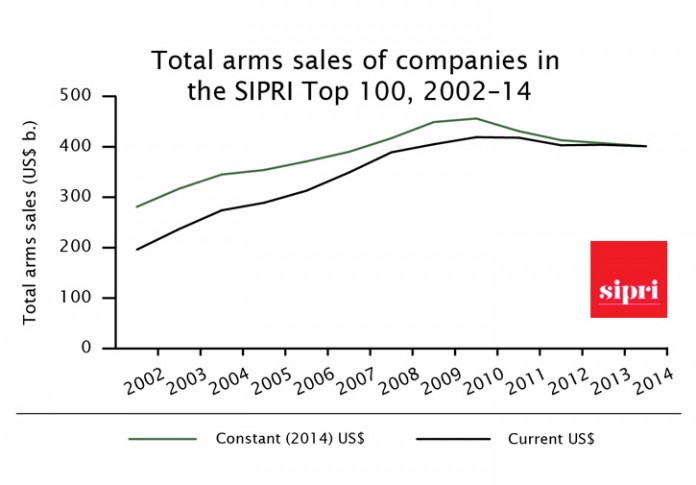
The arms sales of the SIPRI
Top 100 arms-producing and military services companies (excluding China) totalled $401 billion in 2014. This is the fourth consecutive year of decline in Top 100 arms sales.
Stockholm, 14 December 2015: Sales of arms and military services by the largest arms-producing companies totalled $401 billion in 2014, according to new international arms industry data launched today by the Stockholm International Peace Research Institute (SIPRI). This represents a decrease of 1.5 per cent compared to Top 100 revenues in 2013.
Sales of arms and military services have decreased for the fourth consecutive year, according to SIPRI’s Top 100 Arms-Producing Companies report claim. However, with a reduction of 1.5 per cent in real terms between 2013 and 2014, the global decline indicated by the report remains moderate. Falls in 2014 are due to lower arms sales for companies based in North America and Western Europe, while Top 100 companies located in other regions of the world have collectively increased performance.
US and Western European arms sales declining
All companies ranked in the Top 10 are based in the USA and Western Europe. Their combined turnover is 49.6 per cent of the total sales of the Top 100 in 2014, a slight fall from the 50.0 per cent share in 2013.
Companies based in the United States continue to dominate the Top 100, with a 54.4 per cent share of the total. US companies’ arms sales decreased by 4.1 per cent between 2013 and 2014, which is similar to the rate of decline seen in 2012–13.
One company bucking the downward trend is Lockheed Martin, which has occupied the first position in the Top 100 since 2009. Its arms sales grew by 3.9 per cent in 2014 to $37.5 billion. Lockheed Martin’s lead over the second ranked company Boeing, which had total arms sales of $28.3 billion, increased by $4.4 billion in 2014.
“With the acquisition of helicopter manufacturer Sikorsky Aircraft Corp. in 2015, the gap between Lockheed Martin and other companies ranked in the Top 10 will widen even further next year,” says Aude Fleurant, Director of SIPRI’s Arms and Military Expenditure Programme.
Western European companies’ arms sales decreased by 7.4 per cent in 2014. Only German (+9.4 per cent) and Swiss (+11.2 per cent) companies show overall growth in their arms sales in real terms. The rise in German arms sales was due to a significant growth in turnover for German shipbuilder ThyssenKrupp (+29.5 per cent), while Switzerland’s Pilatus Aircraft benefited from growing demand for its trainer aircraft, boosting Swiss sales. The companies representing the seven remaining Western European countries in the Top 100 all show an overall decline in their sales.
Frank Haun, CEO KMW, Jean Yves le Drian, French defense minister, Markus Grubel, German parliamentary state secretary for defense and Philippe Burtin, Nexter CEO after the merger signature, 29 July, 2015
Nexter Systems and Krauss-Maffei Wegmann have completed their merger today. Going forward, the merged Franco-German conglomerate is positioned to be one of the largest European defense manufacturer of military land systems.
From now on, the two companies are operated jointly under the umbrella of a holding company under Dutch law with headquarters in Amsterdam. The sole shareholders of each of the two companies have transferred all their shares into the holding company who will operate in the legal form of an N.V.; in return they have each received 50 per cent of the shares in the umbrella company.
The supervisory board of the joint holding company has already met in Amsterdam for its first constitutive meeting. the board comprises seven members and is chaired by the Belgium national, Christian Jourquin. The French owner appointed Jean-Severin Deckers (APE-State Holding Agency) and Bertrand Le Meur (DGA-French defense procurement agency) to the supervisory board; the owners of KMW appointed Dr. Manfred Bode and Axel J. Arendt. Alongside the independent chairman of the supervisory board, both shareholders appointed Antoine Bouvier (CEO of MBDA) and Prof. Dr. Dr. Utz Hellmuth Felcht onto the board as additional independent members. The supervisory board appointed the new CEO of Nexter Systems, Stéphane Mayer, and the chairman of the executive board of KMW, Frank Haun, as CEOs of the holding company.
KMW, Nexter and their owners view this step as decisive for the consolidation of the defence technology industry in Europe. The alliance of the two groups under the umbrella of a joint holding company creates a Franco-German defence technology group with a current annual turnover nearing 2 billion euro, an order book of around 9 billion euro and more than 6,000 employees.
The product portfolios of the two companies and their regional presences on the world market complement each other. The alliance of KMW and Nexter creates a group with the momentum and innovative force required to succeed and prosper in international competition. In addition, it offers to its European and NATO customers the opportunity of increased standardisation and interoperability for their defence equipment, with a dependable industrial base.
According to company sources this new strategic alignment makes it possible to retain jobs and skills in the heart of the European Union. On the signing ceremony in July 29 this year the two CEOs assured that the creation of new group will have no social consequence or impact neither on employment nor on the collective agreements in place. In the future whenever the new group would develop any consolidation project, this would be based on the preservation of the balance between the two operational companies as well as the protection of their related key technologies, know-how and competences, in full compliance with the export regulations.
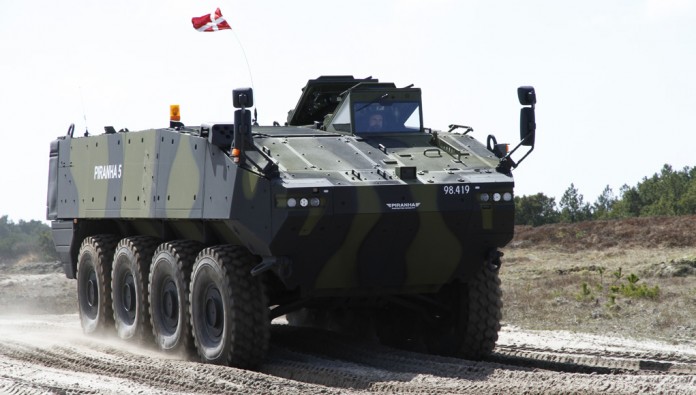
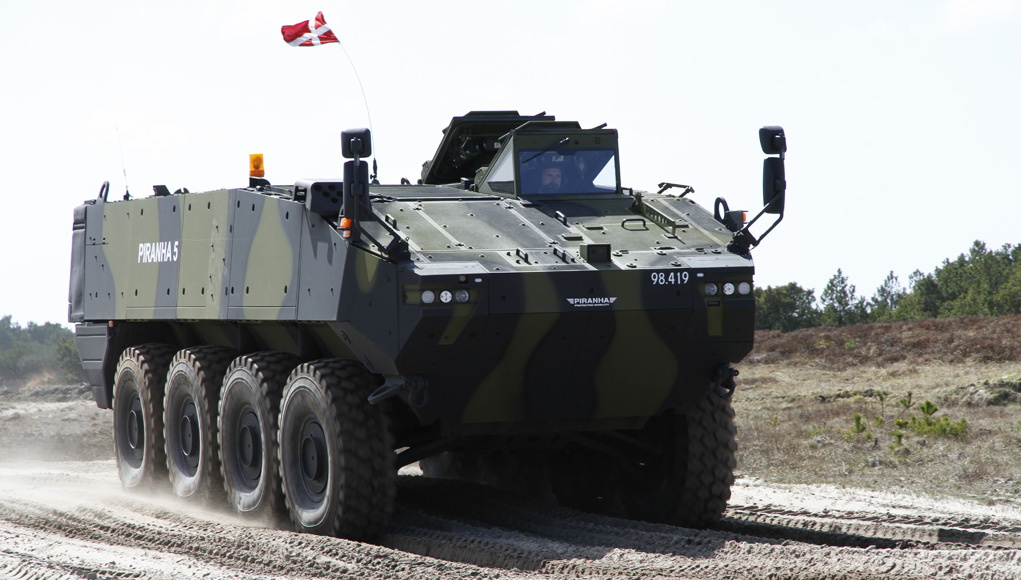
Piranha 5 undergoing evaluation in Denmark, 2013 - Photo: Lars Bøgh Vinther
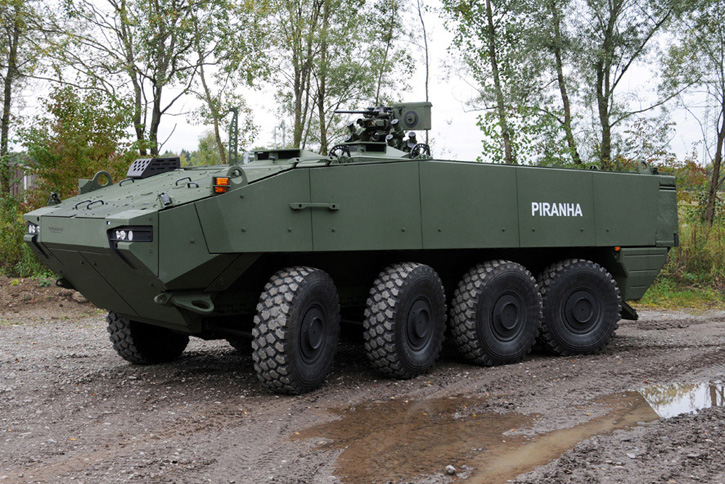
Copenhagen, Denmark: Denmark has placed an order for 309 Piranha 5 armored personnel carriers (APCs) from General Dynamics Land Systems Europe, in a deal worth $662 million (DKK4.5 billion). The first vehicles to be delivered in 2018 will be used for training; initial operational capability (IOC) is expected in 2019, with deliveries continued at least through 2023. The current order includes options to cover the additional 150 vehicles that could be acquired in a follow-on phase.
The new Piranhas will replace the 450 M-113s currently in service. The Danish military is expecting to upgrade some of its existing M-113G3 vehicles into a much heavier G4 variant. This upgrade began in 2009 but realized to be unsuitable for fielding. Additional modifications were required for the vehicle’s acceptance.
Piranha 5 APC
1 of 6
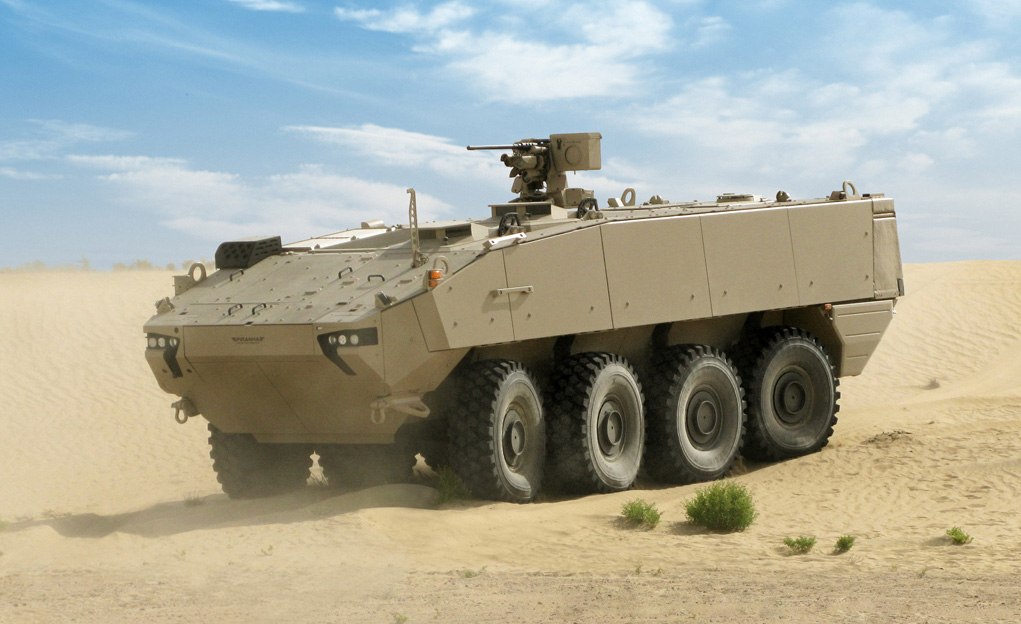
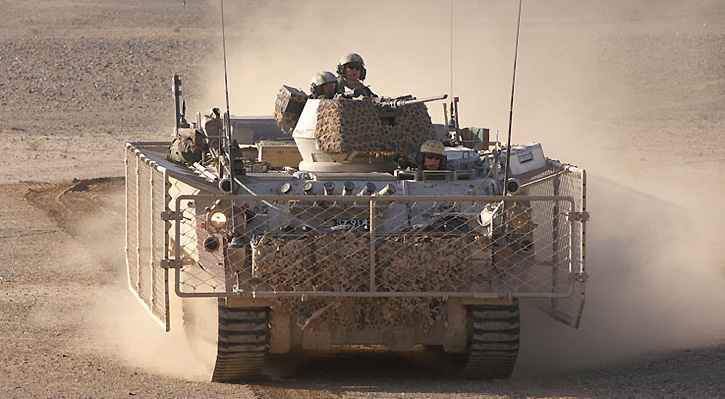
Designed for gross vehicle weight of 30 tons, Piranha 5 can carry a payload of 13 tons, including add on armor, turrets, troops and gear. The vehicle is designed with a modular integrated protection approach. Photo: GDELS.
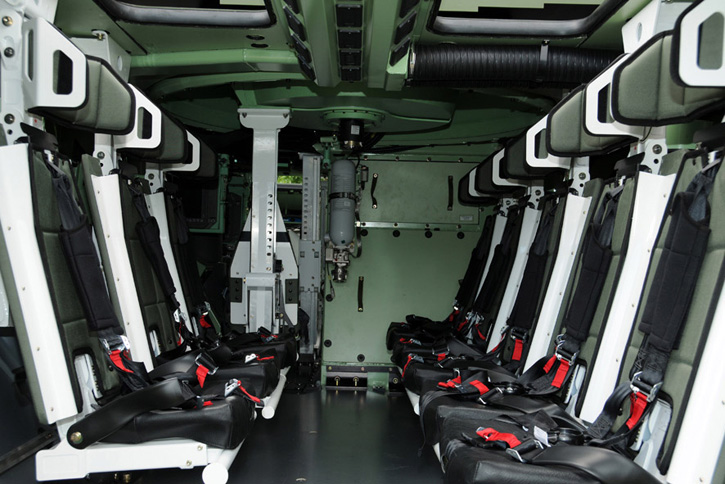
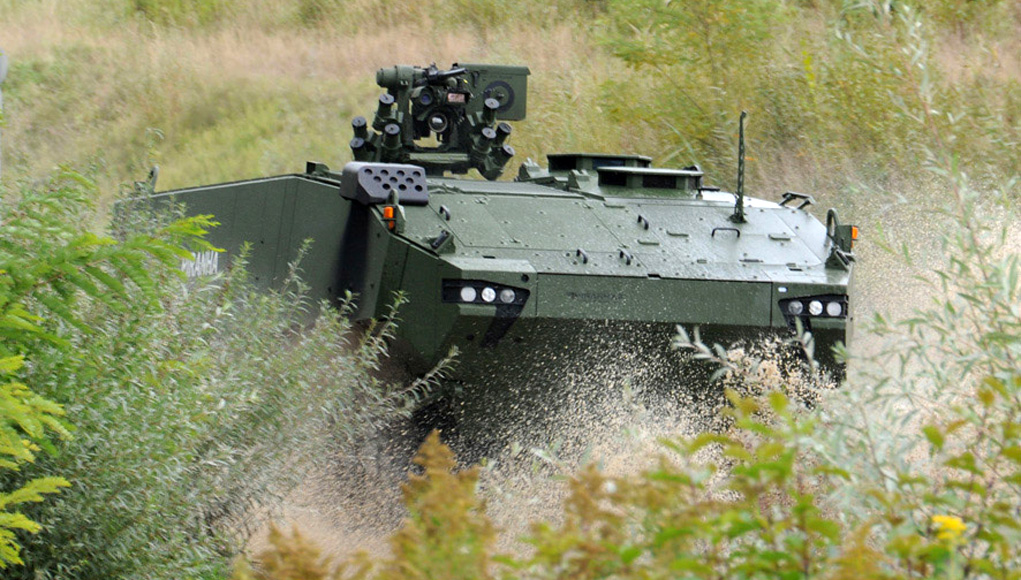
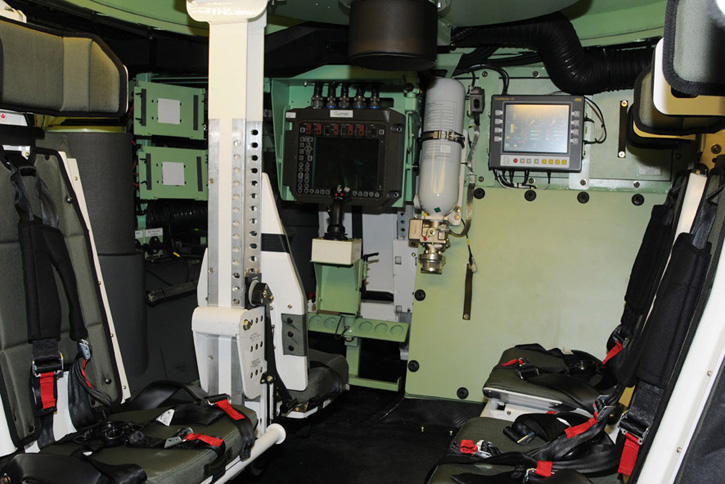
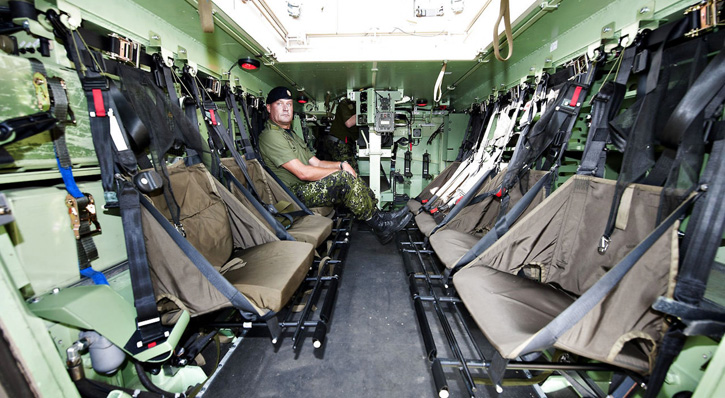
Use of remotely controlled weapon stations or turrets clears the spacious inside area to accommodates up to 13 soldiers - eight to ten troops and up to three crew members. Photo: GDELS.
The baseline vehicle (weighing 17 tons) is designed for high level of ballistic and blast protection against mines, IED and EFP threats. Add on armor for different protection levels offers coverage of more than 95% of the vehicle. Plasan developed a new range of armor recipes to defeat STANAG 4569
Vol.1 Levels 4, 5 and 6 threats. Photo: GDELS.
Piranha 5 undergoing evaluation in Denmark, 2013 - Photo: Lars Bøgh Vinther
GDELS Piranha 5. Photo: GDELS
An internal view of the Piranha 5 showing two blast protecting passenger seats, the gunner station with controls of the Protector remotely operated overhead weapon station, and part of the driver station in the far-left side. Photo: GDELS
According to current plans, some of M113s will undergo modifications into the ‘improved G4’ configuration, to provide the Army to meet urgent requirements in the 2016-2020 interim phase, until the Piranhas become operational. These conversions will include hull extension (use of six road wheels) and improved suspension, improved blast protection with additional belly plate and suspended seats. The vehicle’s height was also increased to improve crew survivability after mine explosion. All those additions have increased the vehicle’s weight from nine to 20 tons.
The Danish M113G4 modernized by FFG has six road wheels, new suspension to carry more troops and heavier weight. Photo: Danish ArmyDesigned to improve the inherent vulnerability of the flat-belly M113, the G4 adds a belly plate, suspended seats, foot rests and elevated ceiling to improve the protection of troops in case of buried IED or mine blast.
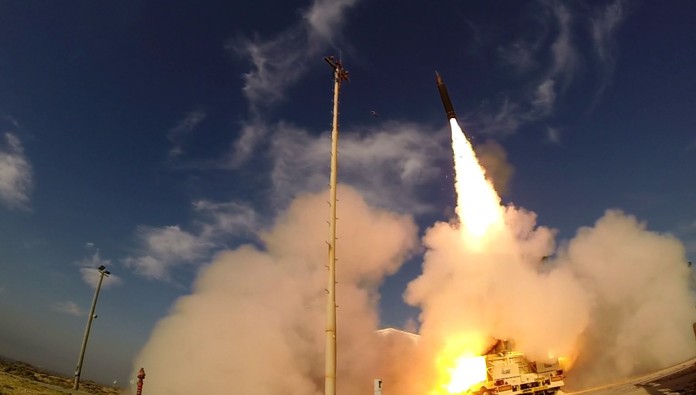
Arrow 3 interceptor missile launched from Palmachim missile test site on Israel's Mediterranean shore, December 10, 2015. Photo: IMOD
The US Missile Defense Agency (MDA) has completed three major missile defense tests this week, a closing accord for an ambitious test plan this year that encountered obstacles and delays in several key programs. Two tests performed earlier today included a successful exo-atmospheric intercept test of the US-Israeli Arrow 3 interceptor, and a first intercept mission of the Land-Based Standard Missile SM-3 Block IB launched from a land-based site Both tests were scheduled to fly months ago, but delayed by technical problems. A third test conducted earlier this week tested the latest, most advanced variant of Standard Missile 3 series, the US-Japanese SM-3 Block IIA. On the other end, developments of new, more challenging missiles threats continued in Iran, North Korea, China and Russia, stressing the need to field more capable defensive solutions as soon as possible.
Aegis Ashore Missile Defense – First Intercept Test
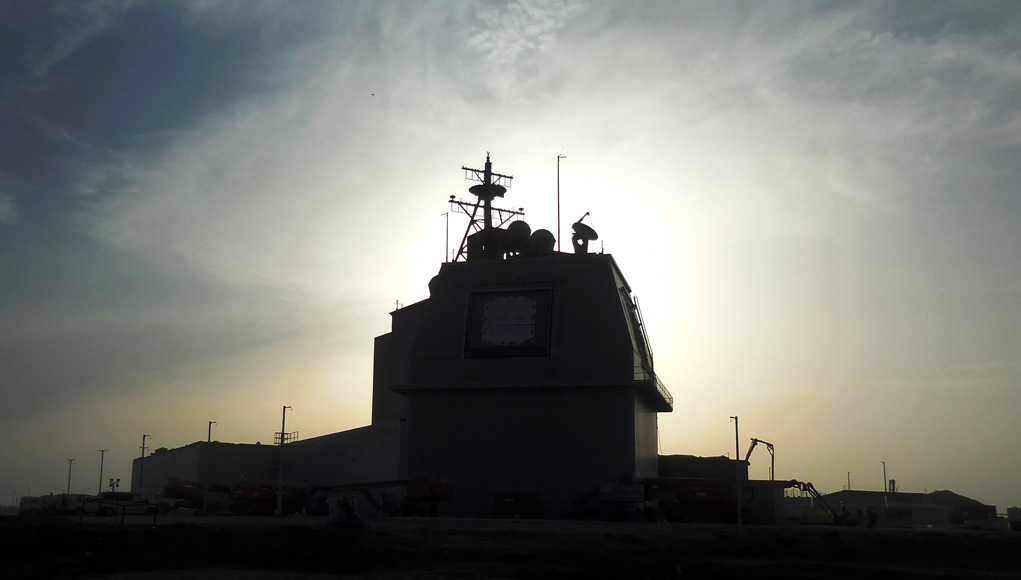
The first land-basded AEGIS missile site will become operational in Romania in 2016. Photo: MDA
The Land-based AEGIS test that took place yesterday (Hawaii Standard Time) was the first full-test form the ‘Aegis Ashore Missile Defense (AAMD) Test Complex at the Pacific Missile Range Facility (PMRF). A previous test scheduled for March 2015 was aborted due to failure in the target missile. Aegis Ashore uses a nearly identical configuration of the Vertical Launch System, fire control system, and SPY-1 radar currently in use aboard Aegis BMD cruisers and destroyers deployed at sea around the world.
Vice Admiral James D. Syring, MDA Director, said, “Today’s test demonstrated that the same Aegis Ballistic Missile Defense capability that has been fielded at sea and operational for years, will soon be operational ashore as part of the European Phased Adaptive Approach (EPAA) Phase 2 capability in Romania. I am very proud of the tremendous effort by the entire government/industry team in executing this vitally important mission for our Nation and our allies.” This flight test demonstrates Aegis Ashore capability as an important component of Phase 2 of the EPAA, of which MDA plans to announce a technical capability declaration by the end of this month.
During the test, a target representing a medium-range ballistic missile was air-launched from a U.S. Air Force C-17 aircraft over the broad ocean area southwest of Hawaii. The two-stage target missile used in this test replicated the Iranian Ghadr-110 medium-range ballistic missile with a range of 1,200 miles, that was tested November 21, in violation of United Nations Security Council resolutions. “We’re evolving our missile capability to keep pace with the rapidly advancing ballistic missile threat,” said Dr. Mitch Stevison, vice president of Air and Missile Defense Systems. “This is the first-ever test of a SM-3 Block IB enhanced with threat upgrade software,” Stevison said, adding that “The ability to upgrade a missile through software enhancements is clearly the way of the future. We’ll be able to outpace the threat much more aggressively than ever before.”
An AN/TPY-2 radar in Forward Based Mode, located at PMRF, detected the target and relayed target track information to the Command, Control, Battle Management, and Communication (C2BMC) system.
This method of operation demonstrated the system’s “Launch on Remote” capability, where Aegis Ashore uses information from another radar system to launch an intercept missile before switching to AAMD’s own SPY-1 radar to guide that missile to the target.
The Aegis Weapon System at the Aegis Ashore site received track data from C2BMC and used its component AN/SPY-1 radar to acquire, track, and develop a fire control solution to engage the target. The Aegis Weapon System then launched the SM-3 Block IB Threat Upgrade guided missile from its Vertical Launch System. The SM-3’s kinetic warhead acquired the target reentry vehicle, diverted into its path, and destroyed the target using the kinetic force of a direct impact.
“The SM-3 and the AN/TPY-2 radar are a perfect pair,” said Tom Laliberty, vice president of missile defense programs at Raytheon Integrated Defense Systems. “When this radar and missile get together, they significantly increase the defended area.” AN/TPY-2 is a high resolution, transportable, rapidly deployable X-band radar capable of providing long range acquisition, precision track, and discrimination of all classes of ballistic missiles. AN/TPY-2s are deployed globally in both terminal and forward-based mode.
The primary purpose of the test, designated Flight Test Operational-02 Event 1a, was to assess the operational effectiveness of the Aegis Ashore capability as part of a larger BMDS architecture.
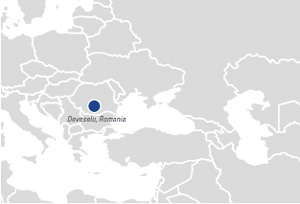
The construction of the first AAMD site at Deveselu, Romania will be completed by the end of 2015.
The AAMD is expected to become operational at the Naval Support Facility (NSF) Deveselu, Romania. The site will operate the Aegis Weapon System, integrating a land-based Vertical Launch System (VLS) and SPY-1 radar, but will only fire the Standard Missile-3 (SM3). The Romanian based system will be equipped with Aegis BMD 5.0 Command unit and SM-3 Block IB interceptors as part of the second phase of the US Phased Adaptive Approach (PAA) to the European missile defense. In 2018, a second Aegis Ashore unit will be installed in Poland, as part of the PAA Phase III. This deployed capability will use Aegis BMD 5.1 and SM-3 Block IB and IIA to support defense of Northern Europe.
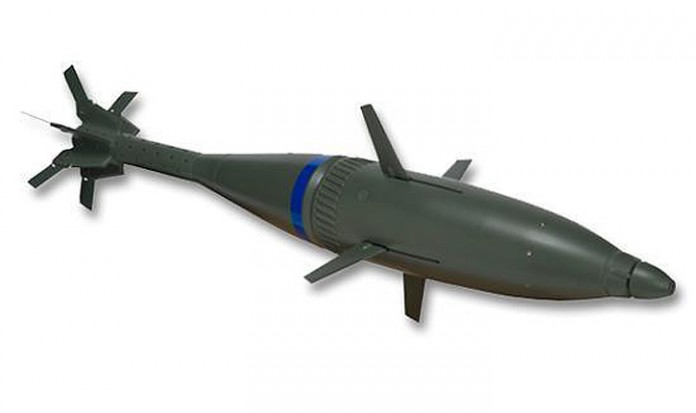
A sub-scale model of the Raytheon-IMI Precision Extended Range Mortar bomb. Photo: Raytheon
Raytheon Missile systems will provide precision guided mortar bombs to the US Marine Corps, under a contract worth $98 million awarded this week by the Pentagon. The contract with the U.S. Marine Corps has a maximum 60-month effective period, with five 12-month ordering periods. Raytheon’s PERM team has partnered with Israeli Military Industries to provide the weapon systems. As such, 39% of the work will be performed in Israel by IMI and its subcontractors. The Marine Corps plans to field 3,113 rounds beginning in 2018.
PERM gives a combat commander the ability to destroy enemy targets at longer ranges using fewer rounds. A typical mortar round travels about seven to eight kilometers. The PERM rounds can reach distances up to 16 kilometers. The basic version selected by the corps is GPS guided with accuracy of 10 meters(industry officials place it within 2 meters). PERM also increases the lethality of the 120mm mortar by as much as 250 percent. In the future Raytheon plans to add semi-active laser guidance to its PERM rounds, enabling mortar teams to hit moving targets designated by forward or airborne target acquisition teams.
The new GPS guided munitions will enable the corps’ M327 rifled 120mm mortar units called ‘Expeditionary Fire Support Systems’ (EFSS) to double the range they can engage targets, and enable those units to hit their intended targets with maximum accuracy and efficiency. EFSS consists of two Internally Transportable-Light Strike Vehicles carrying a mortar tube and ammunition supply that can be moved as a single package in the belly of an MV-22B Osprey or slung under a CH-53E Super Stallion.
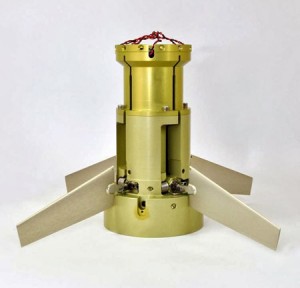
The PERM guided mortar bomb employs a specially designed mid-section containing the ‘Pure Heart’ guidance section developed in Israel. This module provided the guided weapon its extended range and high accuracy. Photo: MTC Industries
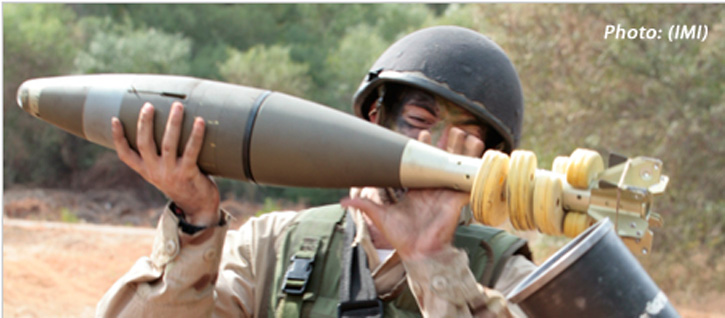
In a recent test series PERM munitions were employed in field tests in mountainous firing range, validating the munitions’ maximum and minimum range performance, with demonstrated accuracy levels exceeding the services’ requirements. A unique capability, provided by the efficient aerodynamic design combining tail fins and flaps in the mid-body, enables complex trajectory shaping techniques enabling the round to hit target in steep reverse slopes in mountainous terrain – a task that is often impossible to accomplish by other projectiles, using ballistic trajectory.
These smart munitions comprise IMI’s ‘Pure Heart’ as their ‘brain’ that matches a powerful digital processor and guidance systems, with Raytheon’s GPS based navigation solution, all packed in a compact, lightweight case designed to endure extremely high loads.
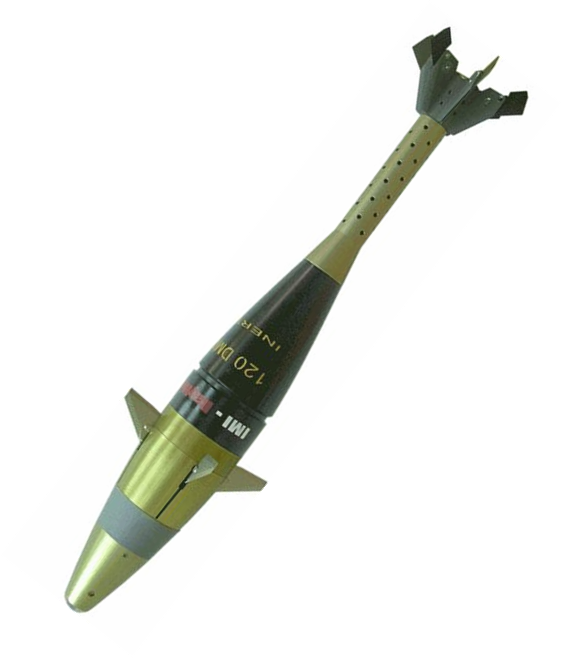
The Guided Mortar Munition (GMM) is developed by IMI for the Israel Defense Forces. Photo: IMI
According to Marine Corps sources the program came in two months ahead of schedule and 33 percent under budget, at a projected cost of $18,000 per round. The first rounds will be delivered in mid-2018, with a total purchase of 3,113 rounds over five years.
Kratos' Unmanned Combat Aerial Systems (UCAS) business is an integral part of the Unmanned Aerial Systems Group. UCAS is proudly leading the way into the emerging market of unmanned combat systems that can effectively operate in contested and/or denied airspace environments. Development activities include advanced sense-and-avoid countermeasures; as well as platform and weapons guidance systems. Image: Kratos
Kratos Defense & Security Solutions, Inc. announced this week the completion of a second test flight of a jet-powered unmanned aerial combat vehicle (UCAV) on November 23, 2015. the flight that took place on the US Navy test range at China Lake, CA involved a newly developed jet-powered drone developed by Kratos, and a US Navy/Marine Corps AV-8B Harrier manned jet fighter. A month later, on December 11, 2015, the third demonstration flight featured two UTAP-22 aircraft flying in continuous collaborative airborne operations through the tactical datalink, while flying formation with one another, flying formation with a third UTAP (simulated) as the lead aircraft.
The flight consisted of collaborative airborne operations with a US Marine Corps AV-8B Harrier. The flight evaluated command and control through the tactical data link; execution of semi-autonomous tasks; execution of autonomous flight in formation with the AV-8B; transfer of UTAP-22 control between non-line-of-sight (over the horizon) operators in the tactical network; and transfer of control (handoff) from the tactical network to an independent dedicated control link. The two-unmanned formation test successfully coordinated semi-autonomous payload deployment, breaking formation to perform independently with a subsequent rejoin, and loyal/trusted wingman flight with one UTAP being flown as if it were a manned aircraft and the second UTAP-22 joining and sustaining autonomous formation. Throughout the mission multiple UTAP-22 were controlled by a single operator.
The UTAP-22 is based on the company’s BQM-167A, a subsonic aerial target designed to perform threat simulation of a high-performance threat aircraft and/or threat missiles. The BQM-167 has a speed in excess of 0.91 Mach and can operate at altitudes from 40 feet to more than 50,000 feet. The turbojet-powered UTAP-22 is 20 feet long with a wingspan of 10.5 feet. It is launched from a ground site using a rocket-assisted takeoff booster and is recovered after parachuting in the water or on land. Changes from the BQM-167A include some airframe modifications, a mission computer, a data link and a command-and-control system.
UTAP-22, (unmanned tactical aerial platform) was developed by Kratos as a privately funded initiative. The recent flight was the second in the currently planned three-flight series of the unmanned aircraft. According to Kratos executives who attended the demonstration, the demonstration validates the ability of low-cost, unmanned aircraft with fighter-like-performance, to operate collaboratively with tactical manned aircraft through semi-autonomous tasking and autonomous formation/wingman modes.
The UTAP-22 “is ready for weapons integration and demonstration to the fleet,” said retired Rear Adm. Dennis FitzPatrick, vice president for Tactical Platforms Operations in the Unmanned Systems Division of CEi.
“I firmly believe our UTAP-22 concept of a tactical manned aircraft teamed with unmanned aircraft capable of operating at tactical speeds, in a hostile environment, will be an affordable, effective and valuable tool for the warfighter, addressing a critical need.” Jerry Beaman, President, Kratos’ Unmanned Systems Division commented.
According to Beaman, the new concept provides the warfighter with new capabilities as a front line force multiplier. “This successful mission, our first test of manned/unmanned operations was a major step forward in our unmanned tactical aerial system strategy and roadmap.” Beaman maintained saying “Kratos UTAP-22 is the most important unmanned aerial system initiative that our Company is pursuing as related to the unmanned tactical aerial vehicle market.” He added that additional flights, demonstrating simultaneous UTAP-22 operations are planned for the near future. This is an abstract of the 792 word article available to Defense-Update Members. Join now to subscribe
Lockheed Martin Skunk Works® and XTEND have achieved a major milestone in JADC2 by integrating the XOS operating system with the MDCX™ autonomy platform. This technical breakthrough enables a single operator to simultaneously command multiple drone classes, eliminating the friction of mission handoffs. From "marsupial" drone deployments to operating in GPS-denied environments, explore how this collaboration is abbreviating the data-to-decision timeline and redefining autonomous mission execution.
As traditional defense primes face mounting competition from agile “neoprimes” such as Anduril, Palantir and Helsing, the balance of innovation is shifting toward software-defined warfare and scalable, dual-use technologies, while global industry consolidation—marked by Boeing’s integration of Spirit AeroSystems and other strategic mergers—signals an intensified race to secure control over the defense technology value chain. Our Defense-Tech weekly report highlights these trends.
In early October 2025, a coordinated wave of unmanned aerial system (UAS) incursions—widely attributed to Russia—targeted critical infrastructure across at least ten European nations. The unprecedented campaign exposed the fragility of Europe’s air defenses...
Executive Summary
The past week (September 18-25, 2025) represents an inflection point where strategic defense concepts have transitioned from doctrine to tangible reality. An analysis of global events reveals four primary, interconnected trends shaping an...
At the 2025 Air, Space & Cyber Conference, U.S. Air Force and Space Force leaders unveiled major updates on next-generation fighters, bombers, unmanned systems, and space initiatives, highlighting both rapid innovation and critical readiness challenges as the services race to outpace global competitors. A short version is available here, with a more detailed version for subscribers.
The Taipei Aerospace & Defense Technology Exhibition (TADTE) 2025 crystallized around four dominant strategic themes that collectively illustrate Taiwan's comprehensive approach to defense modernization amid escalating regional tensions. Based on a detailed report by Pleronix (available upon request). Includes a Podcast discussion on TADTE 2025's highlighting Taiwan's four strategic themes beyond the post's coverage.
Israel’s Iron Beam 450 high-power laser system has completed final testing, marking a major leap in air defense. Developed by Rafael, it offers precise, cost-effective interception of rockets, UAVs, and mortars, and is set for IDF deployment by 2025.








 PERM gives a combat commander the ability to destroy enemy targets at longer ranges using fewer rounds. A typical mortar round travels about seven to eight kilometers. The PERM rounds can reach distances up to 16 kilometers. The basic version selected by the corps is GPS guided with accuracy of 10 meters(industry officials place it within 2 meters). PERM also increases the lethality of the 120mm mortar by as much as 250 percent. In the future Raytheon plans to add semi-active laser guidance to its PERM rounds, enabling mortar teams to hit moving targets designated by forward or airborne target acquisition teams.