

Tuesday, December 23, 2025
More
    Home Blog Page 84

    Wahabism and ISIS – Did the Saudis Create a Monster They Can’t Control?

    saudi-iraq1Is the House of Saud a ‘more established and diplomatic version of ISIS’?. After all, the extremist Sunni terror organization shares the Saudi extremist Wahhabi theo-fascism, lack of human rights and intolerance. In fact, ISIS external sources of funding are believed to be Iraq’s neighbors – Qatar, Saudi Arabia and Kuwait.

    Officially Riyadh views the Islamic extremism as a terrorist organization that poses a direct threat to the kingdom’s security. The Interior Ministry formally designated ISIS as a terrorist entity in March, along with Jabhat al-Nusra, the Muslim Brotherhood, Yemen’s Houthi rebels, and Saudi Hezbollah.

    However, informally, the Saudi regime is paying the Islamic extremist factions huge sums of money to save its own involvement in the conflict, a traditional attitude, the House of Saud has maintained, whenever a dangerous situation has developed. Keeping a vast arsenal of ultra-modern weapons on storage the Saudi military has sofar refrained from using it, except in small conflicts like Yemen.

    For ISIS this is a win-win situation. Not only does it gain publicity while carrying out its terror strikes, but with the money that it earns, it also laughs its way into the bank. Moreover, Saudi involvement has already become much deeper and more long-term than just increased funding, with more Saudi fighters coming to Syria than from any other country. To such movements, the Riyadh rulers are shutting their eyes or just ignore it.

    The beliefs of Wahhabism, the puritanical literalist Saudi version of Islam recognized exclusively by the Saudi educational system, are not much different from those preached by al-Qaeda and ISIS. Wahabism wholly rejects all other types of Islam beliefs and regards Shi’ism as a heresy in much the same way Catholics in Reformation Europe detested and sought to eliminate Lutheran Protestantism. All this is not new, but is getting more dangerous as the Islamic Sunni-Shia conflict spreads.

    How far is Saudi Arabia complicity in the ISIS takeover of much of northern Iraq, and is it already stoking an escalating Sunni-Shia conflict across the Islamic world? Some time before 9/11, Prince Bandar bin Sultan, once the powerful Saudi ambassador in Washington and head of Saudi intelligence until a few months ago, had a revealing and ominous conversation with the head of the British Secret Intelligence Service, MI6, Sir Richard Dearlove. Prince Bandar told him: “The time is not far off in the Middle East, Richard, when it will be literally ‘God help the Shia’. More than a billion Sunnis have simply had enough of them.”

    The fatal moment predicted by Prince Bandar may now have come for many Shia, with Saudi Arabia playing an important role in bringing it about by supporting the anti-Shia jihad in Iraq and Syria. The chilling forecast by Prince Bandar, who was at the heart of Saudi security policy for more than three decades, that the 100 million Shia in the Middle East face disaster at the hands of the Sunni majority, will convince many Shia that they are the victims of a Saudi-led campaign to crush them.

    The origins of Saudi Arabia’s anti-Shia stance can be traced back to the alliance between the Wahhabism and the House of Saud dating from the eighteenth century. If ISIS were ever to become an established state, after a few decades, one can imagine it might resemble Wahabist Saudi Arabia.

    How does Saudi Arabia go about spreading such extremism and still remain a US ally? The extremist agenda is not always clearly government-sanctioned, but in monarchies where the government money is spread around to various princes, there is little accountability for what the royal family does with their government funds. Much of the ISIS funding is via charitable organizations and is not directly military-related.

    Actually, the royal House of Saud works against the best interests of the West and even the Muslim world. Muslim communities worldwide certainly need to eradicate fanatical Wahhabism from their midst, but this will become difficult, if not impossible, to accomplish if the West continues its support of the House of Saud. The monarchy must be modernized and modified or simply uprooted and replaced. The House of Saud needs a thorough house cleaning.

    Based on its own intelligence, it seems quite ridiculous that the West is constantly strengthening ties with the very people who have spent an estimated $100 billion spreading the foundational Islamist creed of ISIS, which is considered its fiercest enemy since WW2!

    As the present US attitude may seem already strange in this complicated situation, a new, old factor is entering the scene: Saudi Arabia on recently signed six military and economic agreements with Russia, Al Arabiya News Channel reported. The news comes after Saudi Deputy Crown Prince Mohammed bin Salman bin Abdulaziz met with Russian President Vladimir Putin at the Konstantin Palace in St. Petersburg after arriving in Moscow on an official visit, the state-run Saudi Press Agency (SPA) reported.

    For Russia, the Middle East has historically been a region of strategic and economic importance. Russia is seen as an alternative to the Western ideological framework, granting it a special status in the area. Apart from being a consistent alternate power, Russia’s objectives and policies in the Middle East have always changed depending on its relationship with the Western powers.

    While in Riyadh, those on the upper echelons of power seem to remain loyal to the U.S.-Saudi alliance, the recent secretive deals between high-ranking Russian and Saudi officials seem out of place. However President Obama’s “Hands-Off” policy in the new Middle East created a perfect situation for a tête-à-tête parley between Vladimir Putin and the Deputy Crown Prince, a less pro-Washington figure in the Saudi leadership, who met in St. Petersburg in June 2015, indicating King Salman’s change of policy with Russia.

    There are unconfirmed talks of Russian investing in the construction of nuclear power plants, increasing arms sales and negotiating oil prices. This is understandable, considering the fact that the current Saudi leadership is disillusioned with Obama’s policy in the Middle East, especially regarding Iran, and thus aims at cementing bilateral ties with the Russian leadership. Russia, on its side is investing in both sides, establishing closer relations with political and military leadership in Tehran.

    The Saudi objective is to dissuade Putin from his unwavering support of Assad, whereas Putin’s is to reduce Saudi’s overwhelming influential oil production, in order to spike global oil prices. This is understandable, considering the fact that the current Saudi leadership is disillusioned with Obama’s policy in the Middle East, especially regarding Iran, and thus aims at cementing bilateral ties with the Russian leadership.

    Whatever happens in Iraq and Yemen, the political temperature of the region is getting hotter by the day. Looked at from a Saudi and Gulf monarchy point of view, Iran and the Shia are on the advance, becoming either the dominant or the most powerful influence in four Arab capitals: Baghdad, Damascus, Beirut and Sanaa. The Sunni Arabs in Iraq and Syria have linked their futures inextricably and fatally to ISIS and other al-Qaeda type organisations. Should it maintain its present attitude the dramatic developments in the turbulent Middle East conflict, the West may have to pay a heavy price for its traditional alliance with Saudi Arabia and the Gulf monarchies, which have always found Sunni jihadism more attractive than democracy.
    Paris Air Show – Photo Report #3

    an178_1021
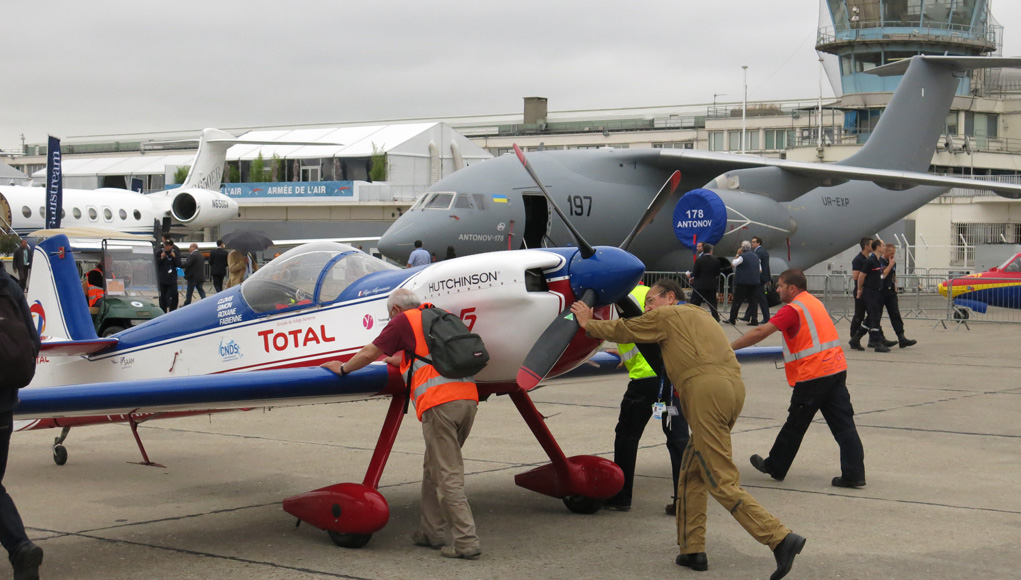
    AVA 432 MXS aerobatic plane pushed back to the flight line in front of the new Ukraine AN-178 transport plane.
    an178_725
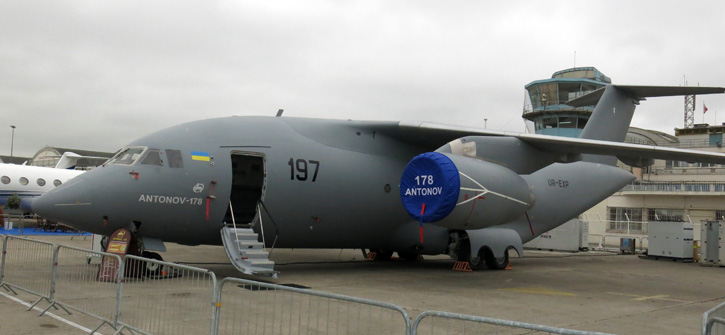
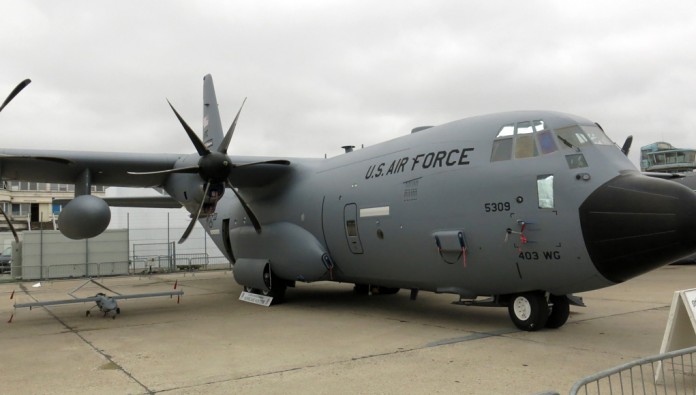
    Antonov An-178 from the Ukraine made its international debut here, five weeks after making its first flight on May 7, 2015. The aircraft will have avionics suite similar to the An-148, and will use Progress D-436-148FM engines. The An-178 is proposed to replace outdated aircraft like the Antonov An-12, Antonov An-26 and Antonov An-32.
    c130j_rq7_1021
    The Textron Systems (AAI) US Army RQ-7B dwarfs near its big brother, the USAF C-130J.
    armed_shadow_725
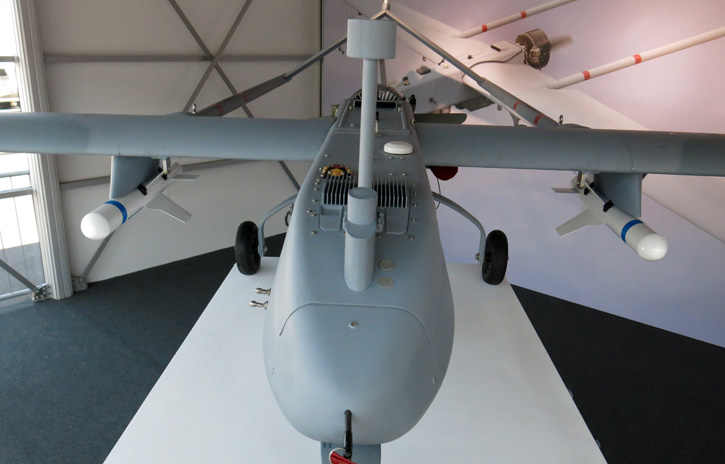
    As little as it is, the MQ-7B Shadow can be lethal, carrying two FFLLM weapons in this armed configuration.


    eagle_harfang_dual_sensor725
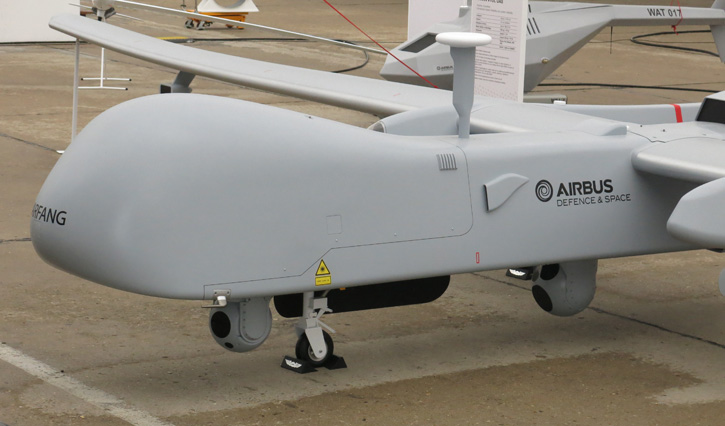
    This combat proven IAI/Airbus Eagle I Harfang is in service with the French Air Force. It is displayed here with two EO payloads.
    tanan_mmp_725
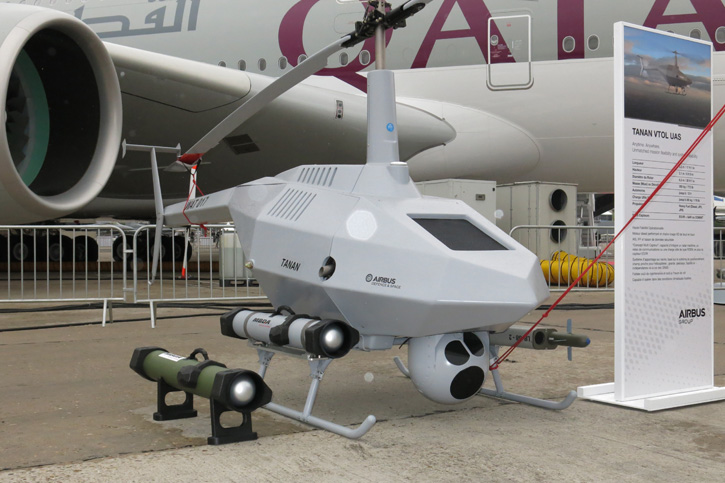
    The Airbus Defense and Space Tanan rotary wing UAV can be configured to carry guided missiles such as this light Multi-Role Missile (MMP) from MBDA, or laser guided rockets.
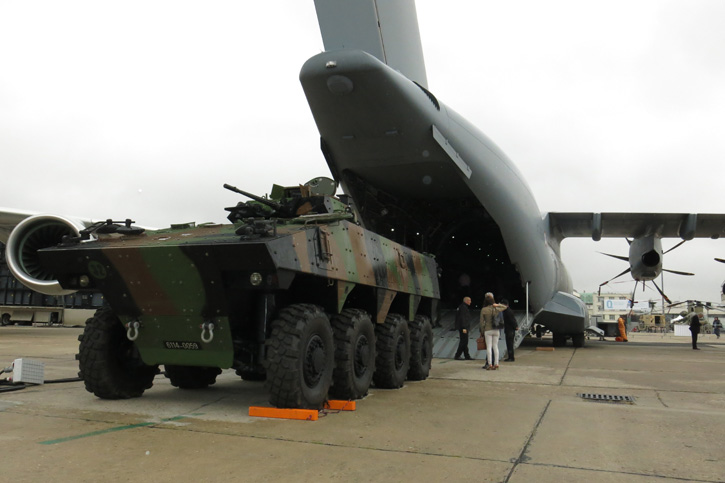
    vbci_offloaded_a400m725
    Airbus A400M military transport aircraft is designed to carry payloads that cannot roll-in to the C-130J, such as this VBCI armored infantry fighting vehicle.
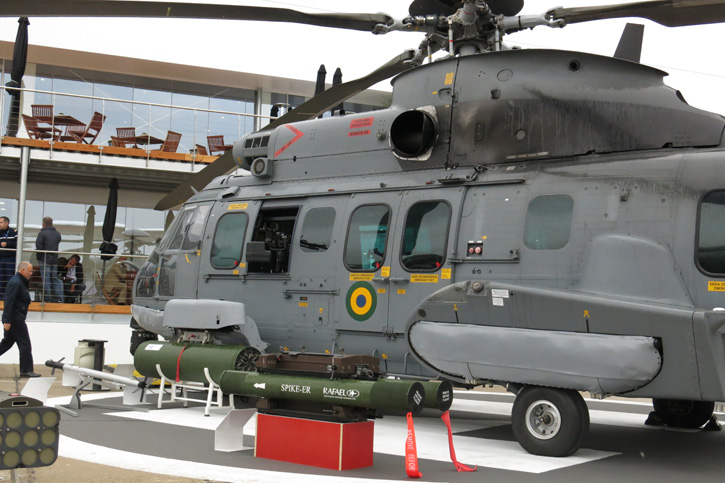
    brazilian_caracal725
    The Brazilian EC725 Caracal on display at Airbus Helicopters static area. Airbus has recently won several orders for this helicopters, beating rivals from the USA, Italy and the UK.
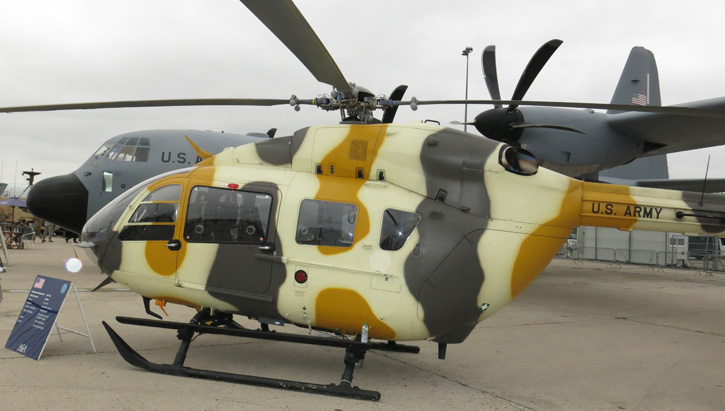
    lakota_725
    More than 130 Airbus Helicopters UH-72A Lakota light utility helicopters are in US military service. This is one of four helicopters playing for the ‘red force’ at the US Army training base at Hohenfels, Germany
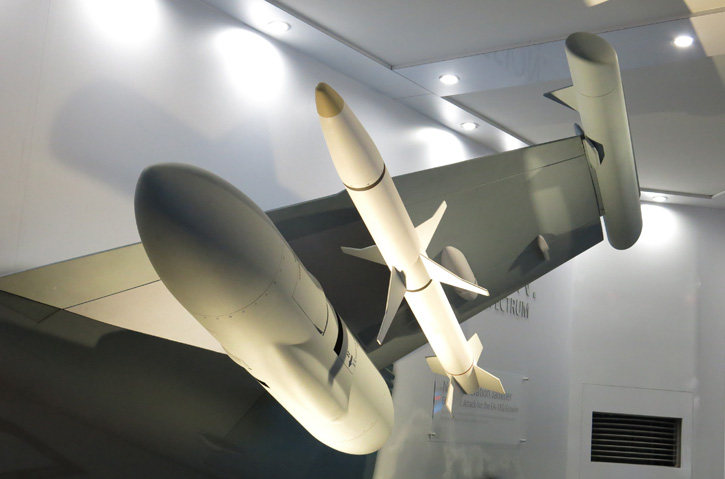
    ngj_725
    Raytheon displayed the Next Generation Jammer pod on an E/F-18G ‘Growler’ wing, along with an AGM-88E AARGM anti-radiation missile.
    tomhawk_raytheon_weapons725
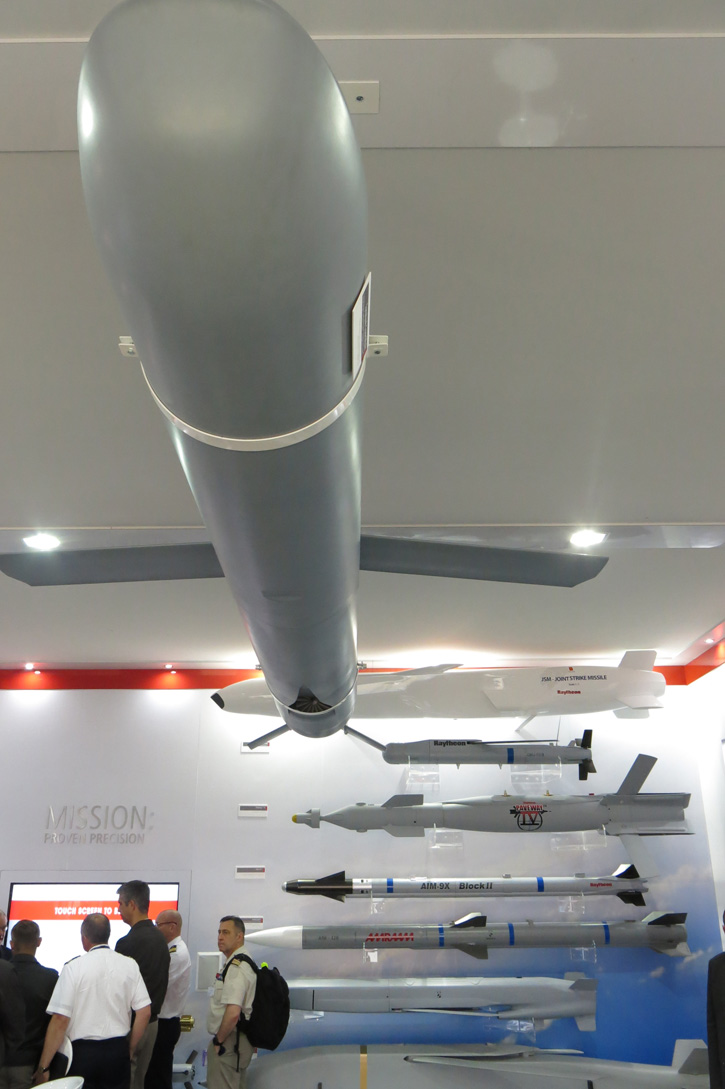
    Another impressive display at Raytheon was the BGM-109G Tomahawk cruise missile, on the backdrop of other air/ground and air/air weapons from the company.


    raytheons_weapons_wall_725
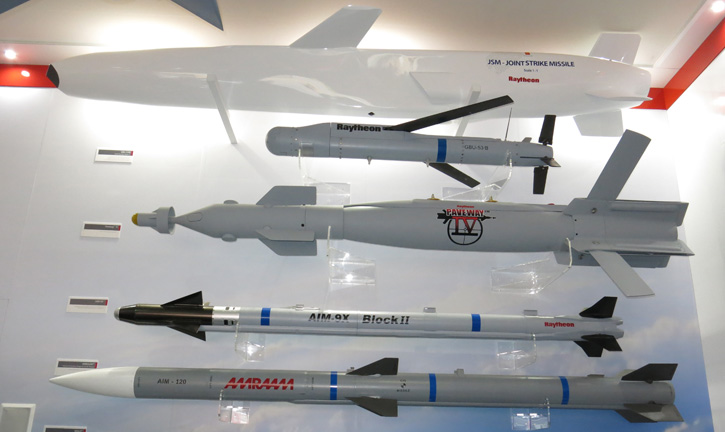
    A closer look at some of the weapons on that wall show (from top to bottom) the Joint Strike Missile, developed with Kongsberg of Norway, the GBU-53B (SDB II), Paveway 4, AIM-9X Block II and AIM-120C7 AMRAAM.
    anse_airship_725
    This TC-350 tethered balloon from A-NSE provides persistent surveillance over a specific area. Airships built of similar design can also carry loads and cruise for extended missions.
    airbus_eplane_725
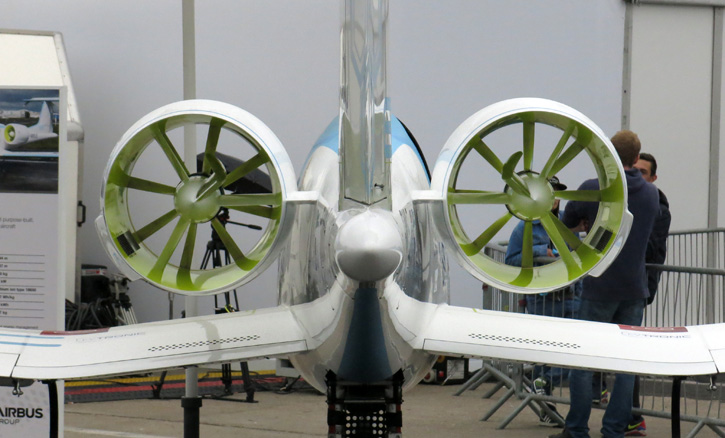
    The Airbus E-Fan is a prototype two-seater electric aircraft being developed by Airbus Group, primarily for pilot training. This prototype was unveiled at the Farnborough Airshow 2014.
    eplane_on_airbus380_725
    At the Paris Air Show 2015 Airbus unveiled a full scale mock up of the E-Fan 2.0 electric pilot training aircraft, designed for training and recreational flying.
    flaris_725
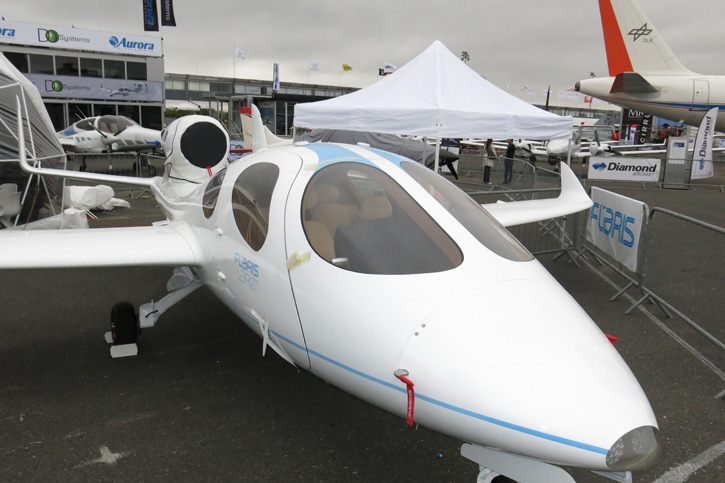
    Another recreational aircraft from Poland is the Flaris LAR-1, a five seat single engine powered aircraft equipped with a Williams FJ 33-5A. This ultralight jet airplane is designed to operate from grass airstrips. The semi-elliptical wings profile is optimized for high speed, and lift-to-drag ratio and is benign to stall. The manufacturer plans to complete certification by 2016.


    Clear and Present Danger: A Nuclear Arms Race in the Middle East

    If the framework for a Joint Comprehensive Plan of Action (JCPOA) announced in Switzerland on April 2 regarding Islamic Republic of Iran’s nuclear program and detailed in a US State Department Fact Sheet is successfully carried forward to an agreed Plan of Action (due to be concluded by June 30), it will be a major achievement, in spite of Israel’s concerns. Being extremely vulnerable in a highly explosive region, its comprehensive attitude should be well understood.

    But the Lausanne framework should not be seen as the end of the process. It is a definitive step, but it will need to be followed by a number of concrete actions before we can consider that the Iranian nuclear problem has been resolved.

    If the deal is agreed in June, and if it is faithfully implemented, which is highly doubtful, it could perhaps give all parties – Iran, its neighbors, and the wider international community – 15 years of breathing space. What ever the case,  it remains essential to use this time effectively to ensure the deal doesn’t just ‘kick the can’ down the road. During this period decisions need to be made by Iran and the other partners of the deal, to ensure that the Middle East does not end up in a South Asia-style nuclear arms race. It is essential to ensure that the consequences for crossing the threshold remain high enough to deter Iran from doing so. This will require the US to keep a high level of engagement in Middle East affairs and constant alert by intelligence monitoring, for the foreseeable future. Unfortunately, judging by its performance  since the outbreak of the ISIS war, this was so far hardly commendable.

    It is by no means a forgone conclusion that Iran really wants nuclear weapons, though the Tehran Mullahs no doubt believe that having the capability to produce nuclear weapons within a relatively short time – what is termed nuclear hedging – has major strategic value for the Shi’ite State. Its main objective is to dominate the Sunni majority in the region and especially in the Persian Gulf and thus mainly curbing Saudi Arabian influence.

    The U.S. must take a more active role in the region for what will be a race for “nuclearization” preferring energy development over weaponization. The Kingdom of Saudi Arabia, the nations of Egypt, Kuwait, the UAE, Jordan, Qatar, and Turkey will all attempt their own missile and nuclear programs with varying degrees of success and competence Saudi Arabia has been openly planning on acquiring South Korean, French, and Japanese reactors ostensibly to power desalinization plants That leaves Arabs and Persians, Sunni and Shi’a in what can only be described as a struggle of religious and deadly proportions across the spectrum of conflict and in possession of weapons, which cannot be contained, all this atop half the world’s oil and gas, and astride much of the world’s most vital shipping lanes.

    With the problem of nuclear hedging in mind, an objective discussed earlier in the ongoing negotiations, was to establish the principle that Iran’s uranium enrichment capability should be directly linked to its demonstrated nuclear fuel needs. In current circumstances these needs are zero, because Russia is willing to supply fuel for the lifetime of Iran’s only power reactor, at Bushehr. For the future, Iran says it plans a number of reactors, both imported.

    Russia has agreed to build eight, and would supply the fuel. But there is a dilemma in pushing the capability-not-exceeding-needs argument: the scale of any power generation need is much greater than Iran’s existing capability. Enrichment capability is measured in separative work units (SWU). Currently Iran has installed enrichment centrifuges totaling around 20,000 SWU, and is operating centrifuges totaling around 8000 SWU. Iran’s main enrichment facility, at Natanz, has room for 50,000 centrifuges – between 40,000 SWU (based on Iran’s first generation centrifuges) and perhaps 250,000 SWU if using more advanced models.

    This compares with the capacity required to produce the annual fuel requirements for just one Bushehr-size reactor, around 120,000 SWU (and three times this to produce the initial fuel load). Only 5000 SWU are required to produce sufficient HEU (highly enriched uranium) for one nuclear weapon. So, the scale of a “legitimate” enrichment program easily dwarfs Iran’s current program. This could be why the capacity/needs principle was cleverly dropped from the negotiations by the Iranians. But it is an important principle, and it should never be accepted that nuclear hedging is a legitimate purpose under the Nuclear Non-Proliferation Treaty for a “peaceful” nuclear program.

    Therefore it is essential for the international community to use the 15-year breathing space to address this problem of nuclear hedging. If others in the region become nuclear armed or even just nuclear capable, the strategic advantage Israel now enjoys will disappear. It would become extremely risky to rely on a nuclear deterrence under these circumstances. However for Israel to accept the longtime suggested “nuclear-free” Middle East zone would be even more unacceptable. The Jewish State surrounded by mortal enemies, with a radical Islamic State building rapidly, cannot be expected to disarm as a pre-condition for a WMD-free zone. It would certainly place such a small country under constant mortal threat to its very survival.

    And the danger of nuclear Middle East is constantly rising, as Iran continues to develop its strategic offensive posture. Tehran already chooses ballistic missiles as its preferred method of delivering future nuclear weapons, once it decides to build them. Iran’s ballistic missiles are inherently capable of delivering WMD, and Tehran already has the largest inventory of ballistic missiles in the Middle East. Iran’s progress on space launch vehicles—along with its desire to deter the United States and its allies—provides Tehran with the means and motivation to develop longer-range missiles, including intercontinental ballistic missiles (ICBMs). Iran already possesses a substantial inventory of theater ballistic missiles capable of reaching as far as parts of southeastern Europe. Tehran is developing increasingly sophisticated missiles and improving the range and accuracy of its other missile systems.

    The turbulent Middle East region will continue to decline, and instability, without strong and direct US leadership and involvement respectively, will only lead to greater conflict. Iran already represents a clear and present danger to the region, and eventually could threaten the entire world. The perceived acceptance of Iran’s nuclear program is likely to touch off a dangerous domino effect in the region, as other countries, such as the Kingdom of Saudi Arabia, look for strategic counterweights to the emerging Iranian bomb. A situation of strategic competition in nuclear capability will be horrendous for the already highly dangerous Middle East.

    Paris Air Show 2015 – Photo Report #2

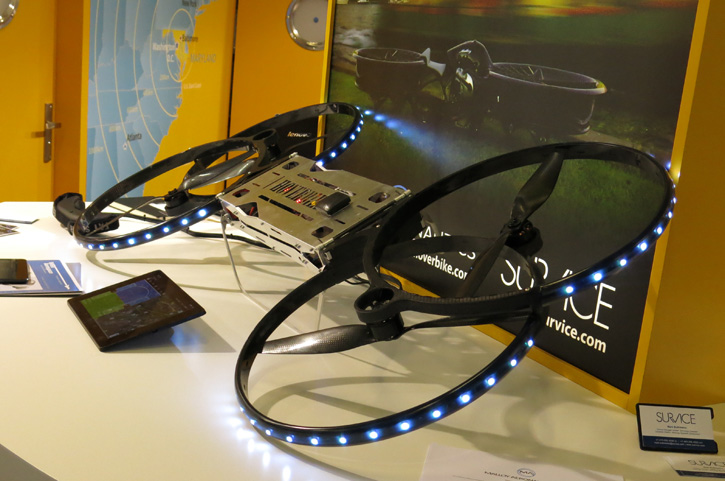
    flying_bike725
    The ‘Hoverbike’ from Malone Aeronautics is developed as a man-portable drone, a ‘hoverbike’, carrying an average person, or a cargo lifting drone carrying loads from small parcels to 800 pounds pallets.
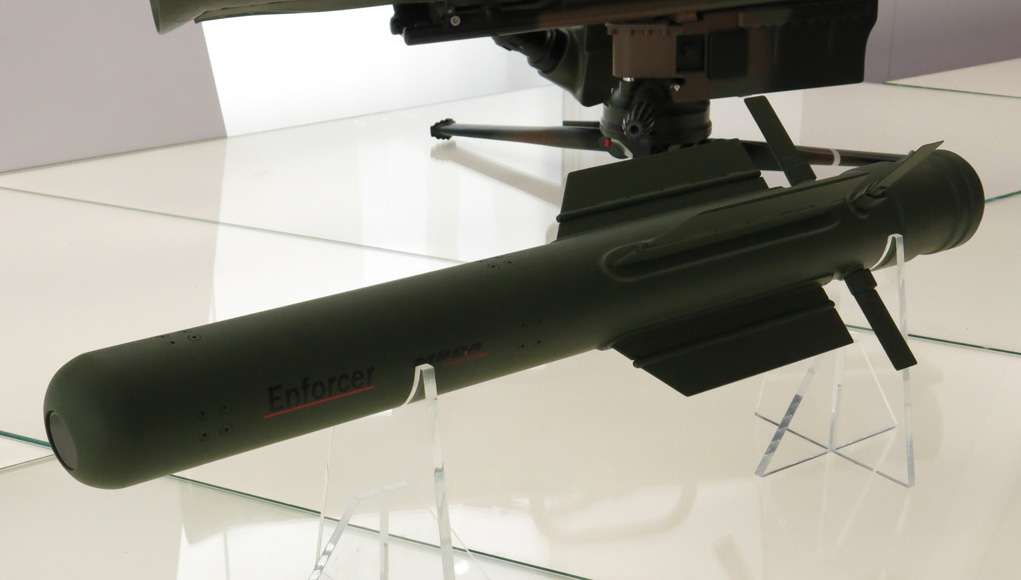
    enforcer_1021
    MBDA unveiled the Enforcer, that has transformed in few years from ‘Concept Vision’ into a pre-prototype weapon, in anticipation of the German military development funding for a man portable short range multi-purpose missile.
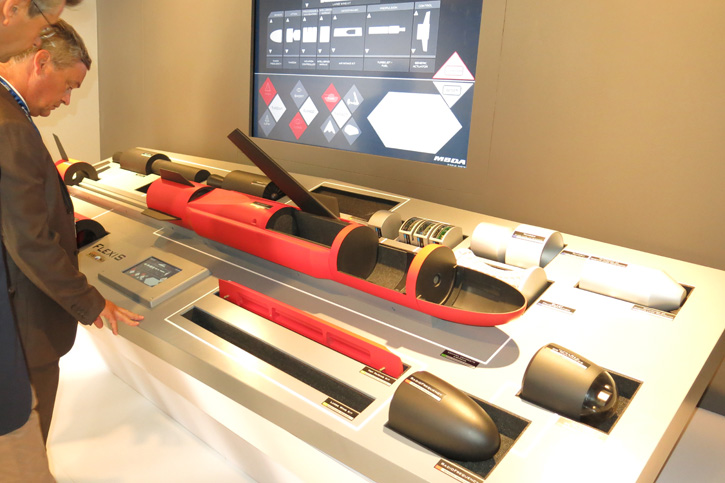
    conceptvision_flexit725
    Another Concept Vision is the modular ‘just in time’ assembled FlexIS missile unveiled at the Paris Air Show 2015
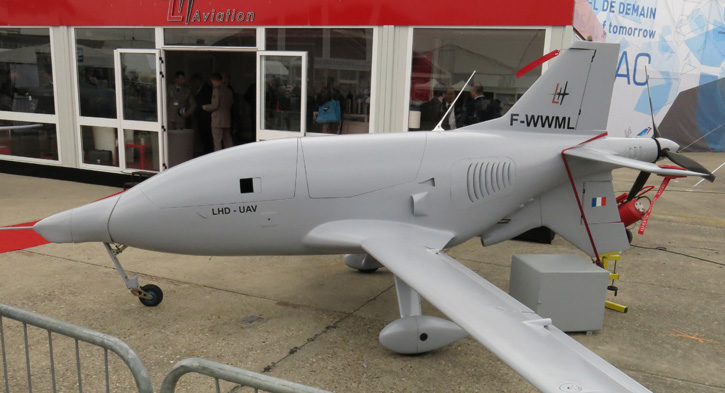
    lhd_uav_725
    New configuration for the LHD Unmanned Aerial Vehicle
    air-defense-40mm-thales725
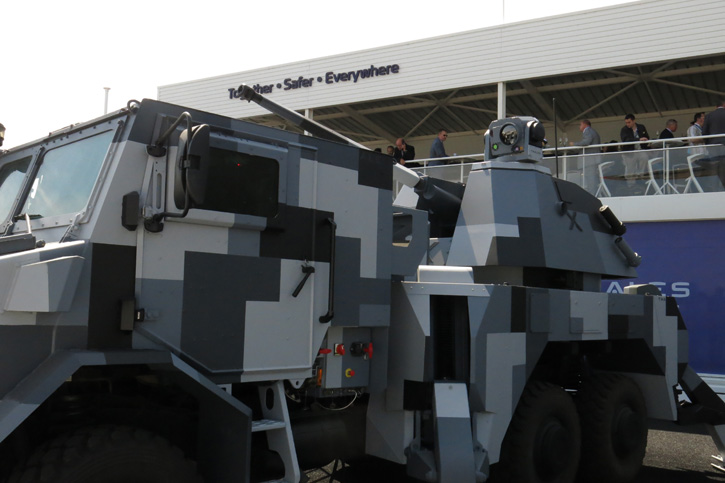
    Thales RapidFire self propelled air defense gun recently participated in a test demonstrating Thales’ systems capabilities to encounter small UAS.
    stabilized_rifle_mount_725
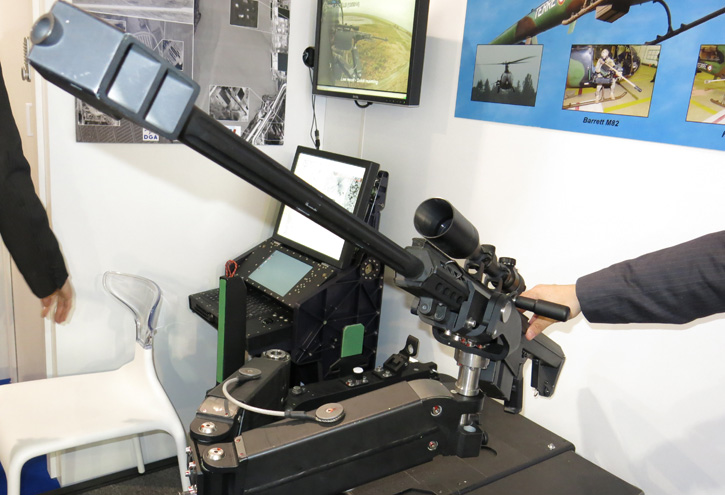
    Airborne snipers operating this 32.5 kg Strike marksman rifle stabilizer from helicopters benefit from three-axis weapon stabilization demonstrated to assist airborne snipers hitting man-size targets from 1,200 meters.
    jf17_chinese_weapons725
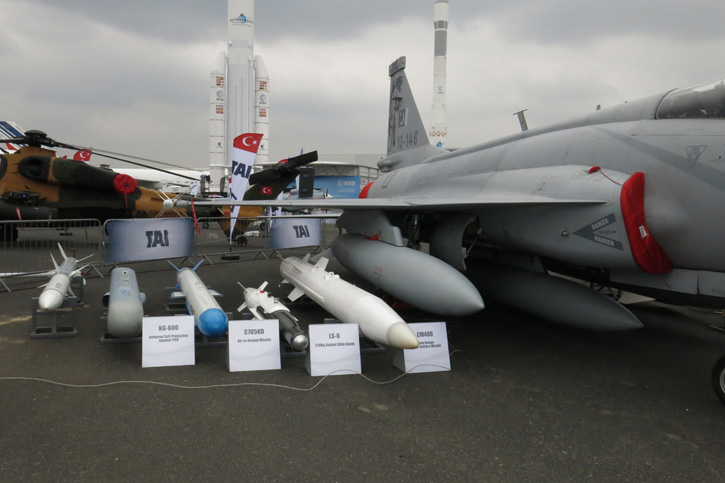
    Chinese weapons shown with the Chinese-Pakistani JF-17 Thunder
    chinese_fighter_models725
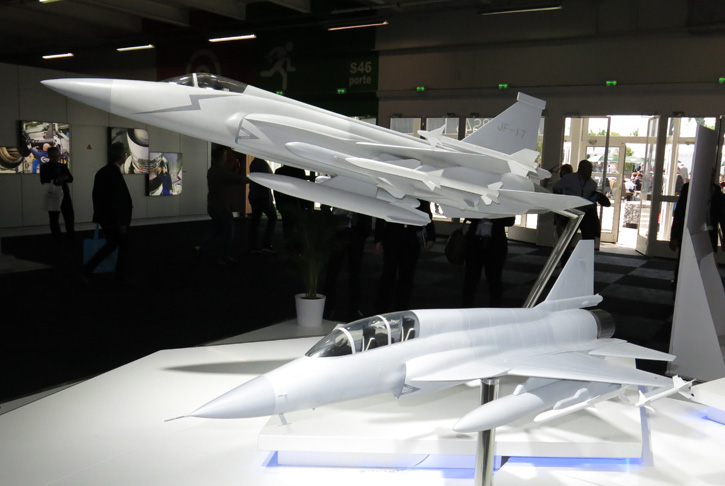
    CATIC has also displayed models of the JF-17 (also displayed the real aircraft in flight), as well as its own version FC-1 (below)
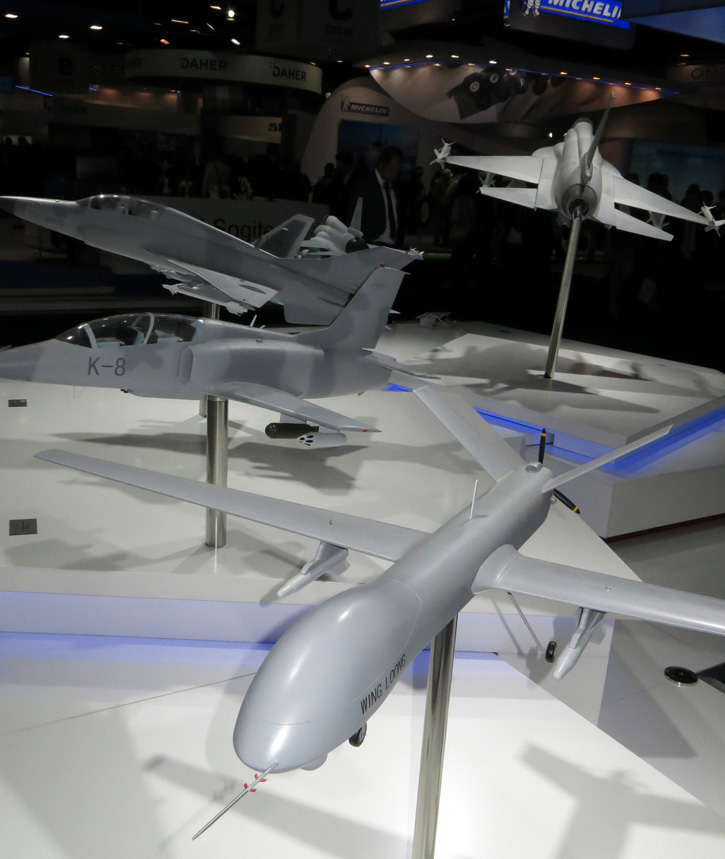
    chinese_models_725
    China’s CATIC displayed several models of aircraft – manned and unmanned, including this Wing Loong, offered to several international customers.
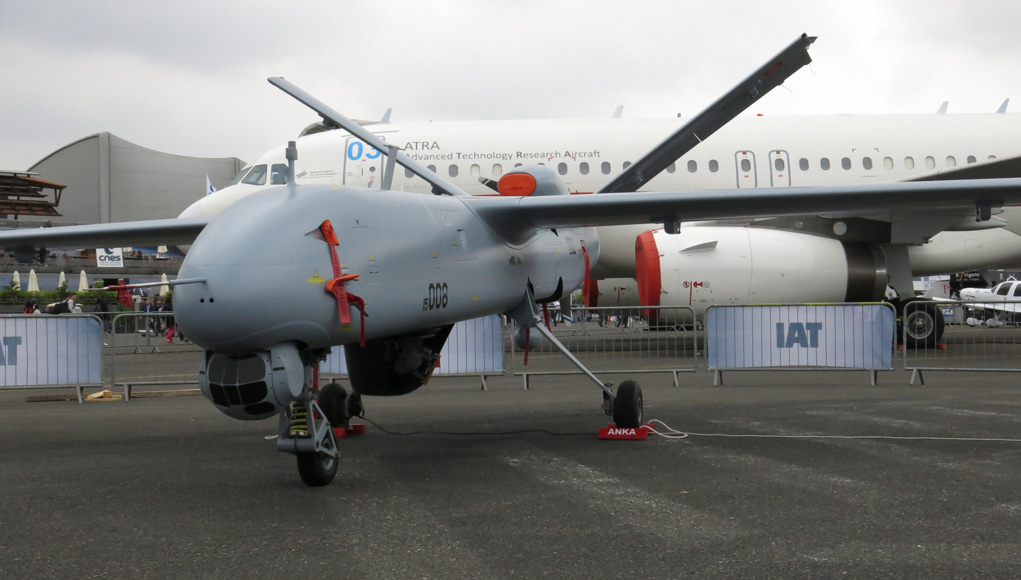
    anka_uav_1021
    The Turkish new Anka MALE UAV from TAI
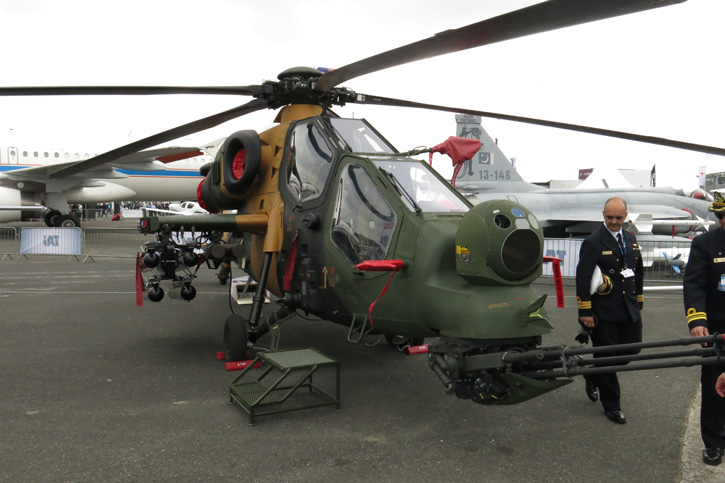
    t129_helo_725
    AgustaWestland-TAI T129 attack helicopter.
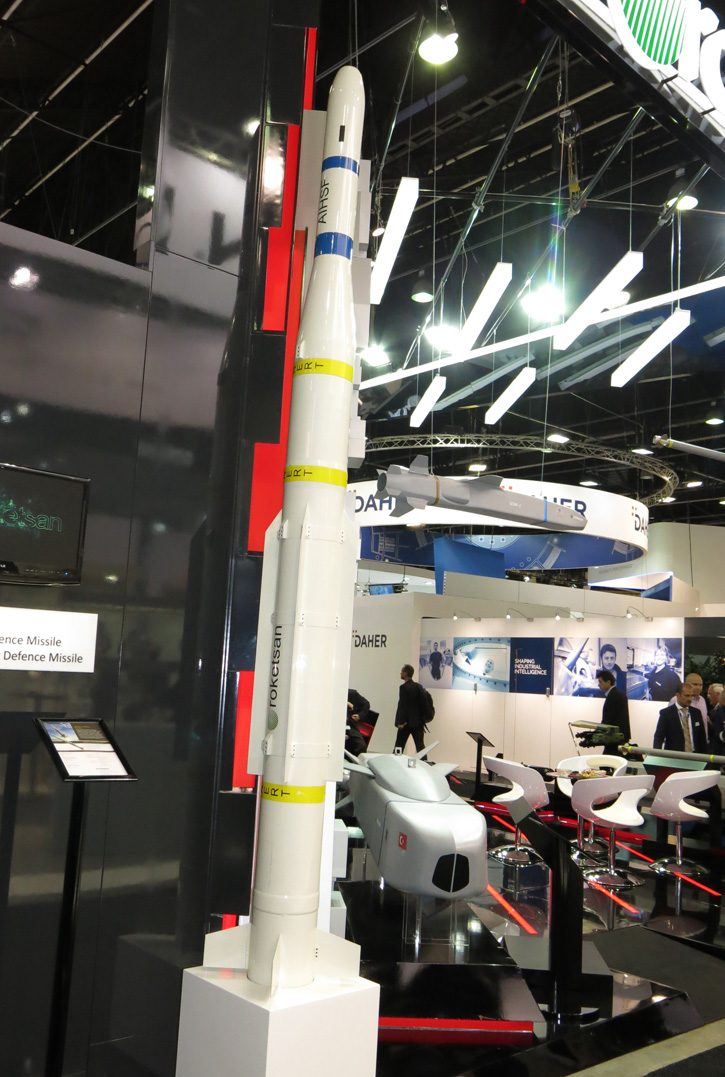
    rocketsan_missiles_725
    The Turkish weapon manufacturer Rocketsan displayed a variety of weapons, including the Hisar air defense missile and SOM cruise missile, considered for integration into the F-35 in the future blocks.
    sm3_family_725
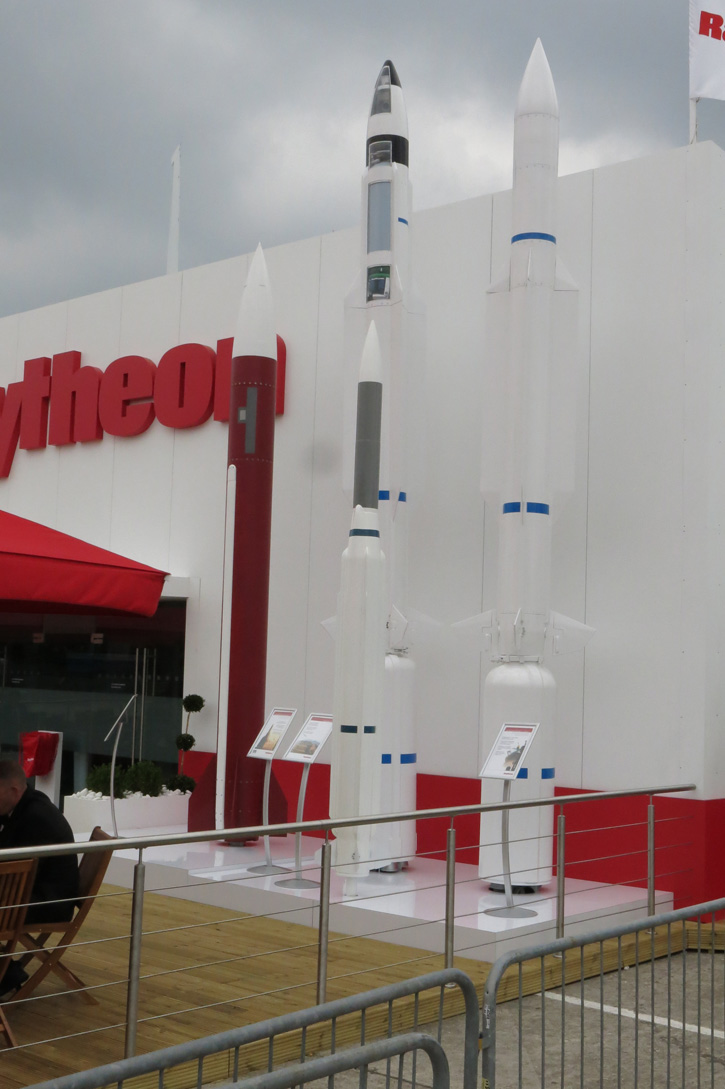
    Two of the new SM-3 variants, fitted with boosters for ground based launch application, posed near the Patriot at Raytheon’s display
    mbda_tactical_laser725
    MBDA is testing various types of lasers for counter UAV applications. The evolution of the experimental system into a weapon system could become part of Ground Based Air Defense (GBAD) systems.
    micavl_grouns725
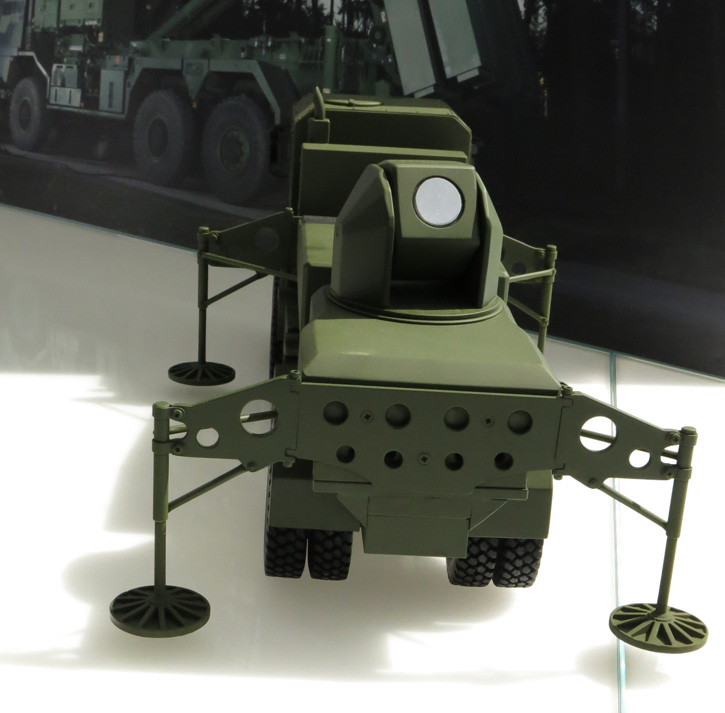
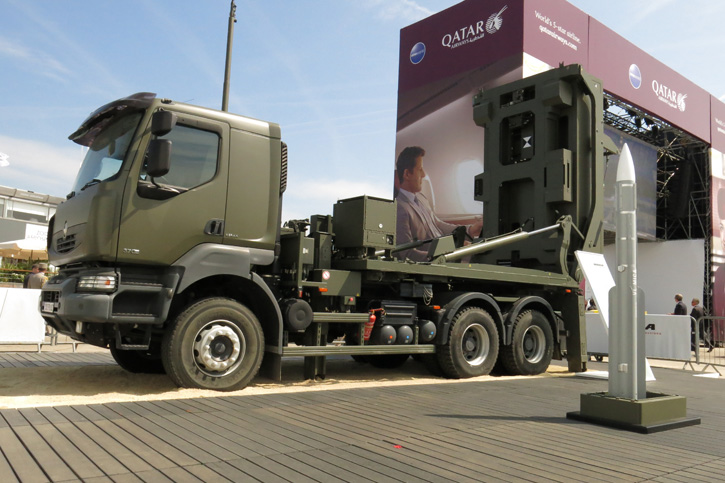
    Until lasers become the ultimate air defense weapon, Mica VL is one of MBDA’s solutions for Short Range AD (SHORAD) systems.
    korean_ground_missiles_725
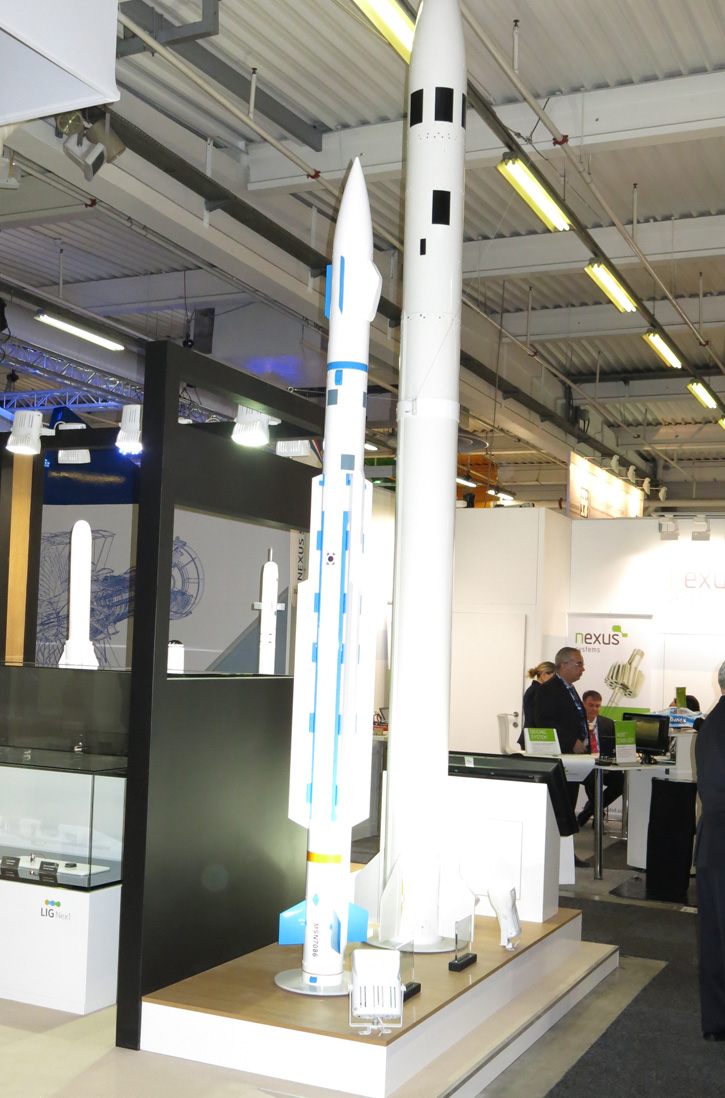
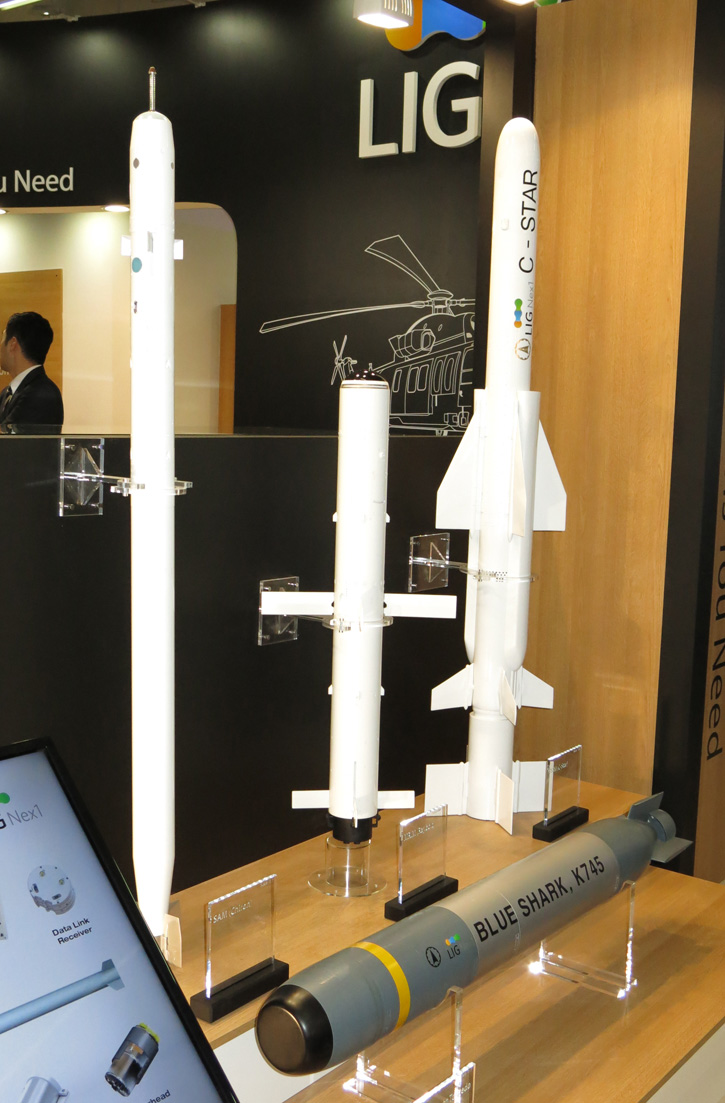
    The Korean LIG 1 group displayed several missile systems, these include ship launched and ground launched weapons.
    korean_missiles_lig1725
    Larger LIG-1 missiles on display include larger air-defense missiles.
    korean_aesa_targetingpod-725
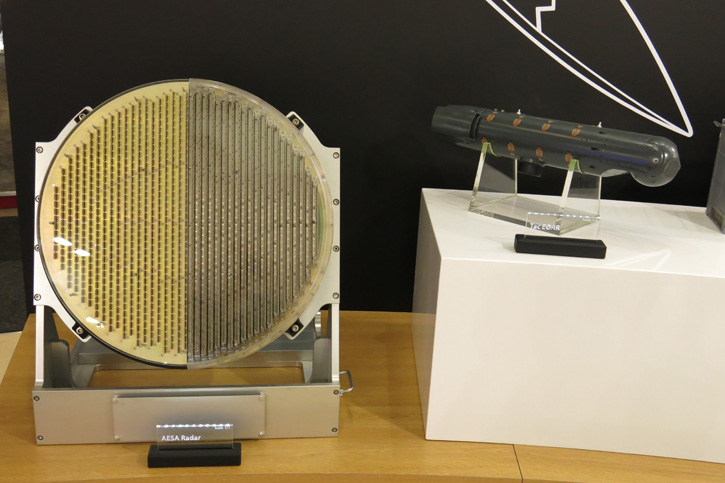
    LIG 1 also unveiled several types of avionics, including an advanced AESA radar and targeting pod for the current and future fighter aircraft.
    korean_ucav_side725
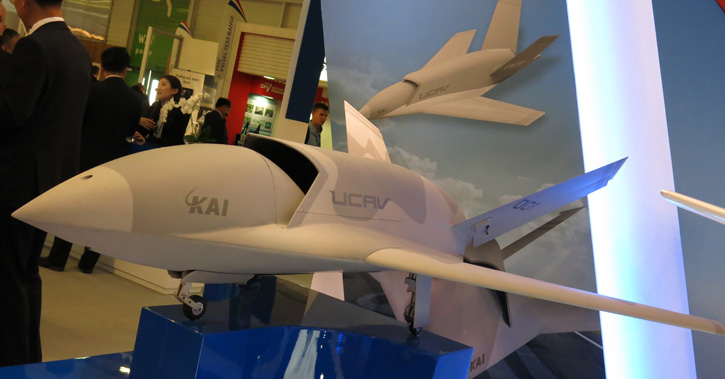
    Korean Aerospace Industries (KAI) is also working on a future unmanned combat and reconnaissance aircraft, as seen from this model

    The Year of the Scorpion (Jet)

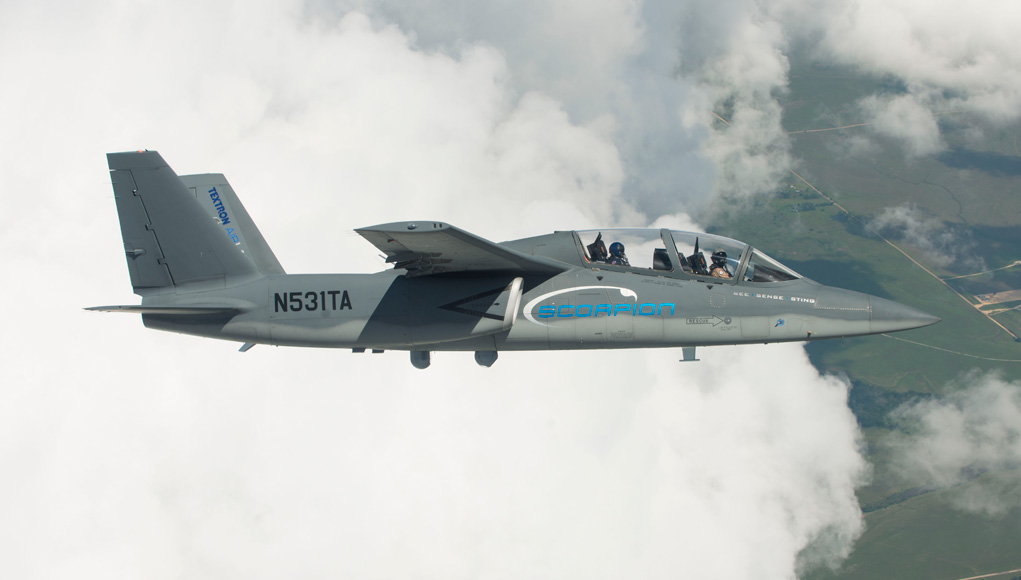
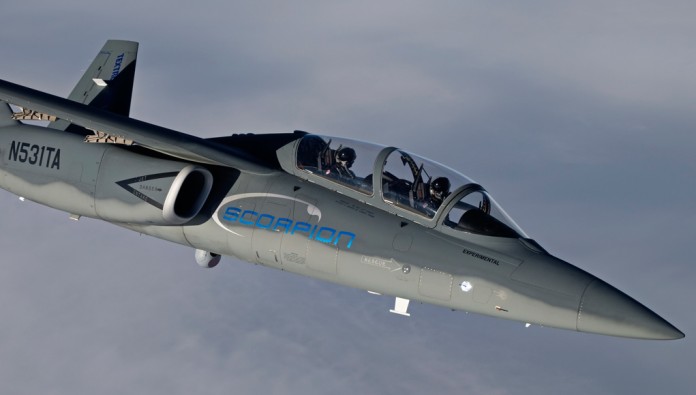
    The Scorpion reconnaissance and attack aircraft displayed at the Paris Air Show this week is currently on its second European tour, visiting mainland Europe and the UK. Following this week the aircraft will perform demonstration flights as the guest of several European air forces, before arriving at the Royal International Air Tattoo in Fairford, UK, from July 17 to 19. Textron AirLand’s Scorpion was introduced in 2013 and has completed more than 400 hours of flight-testing with an exceptionally high mission availability score.

    Textron is aiming its new jet at countries that require extensive intelligence, surveillance and reconnaissance (ISR) operations, but these missions are often carried out by non-military operators (such as certain Middle-Eastern countries that have strong national guards or internal security agencies). These operators are currently employing various ISR assets based on business aircraft and are interested in expanding their capabilities with some ‘kinetic’ effects. “We offer an operational ISR capability at the acquisition and life-cycle costs of a business aircraft,” said Ron Parker, flight test engineer in the program. According to Parker, Textron is currently producing the second Scorpion, which will be the aircraft that will undergo flight certification. It will be different from the current prototype, built as an experimental plane.

    Although its price tag is relatively low, the Scorpion features advanced capabilities, including twin-engine power, two-seat operation, large internal payload capacity, high-definition ISR cameras, wing-mounted weapons stations, and modern avionics within an all-composite structure. According to Parker, with the ability to get to an escalating situation quickly – yet maneuvering at much lower speeds, Scorpion brings the ability to see and exploit perishable intelligence and strike fleeting targets, bringing tactical advantage to demanding situations.

    Textron offers the Scorpion at a cost below $20 million per aircraft, and at a flight-hour cost of $3,000 – about 10 – 20 percent of the acquisition and operating costs of modern combat aircraft or advanced trainers. The aircraft has demonstrated high reliability and rapid ground turnaround between missions, down to 15-20 minutes at times.

    Thales I-MASTER radar was recently integrated on the  Scorpion, demonstrating multi-sensor operability on missions requiring wide area coverage. Photo: Thales.
    Thales I-MASTER radar was recently integrated on the Scorpion, demonstrating multi-sensor operability on missions requiring wide area coverage. Photo: Thales.

    Israeli UAS at the Paris Air Show 2015

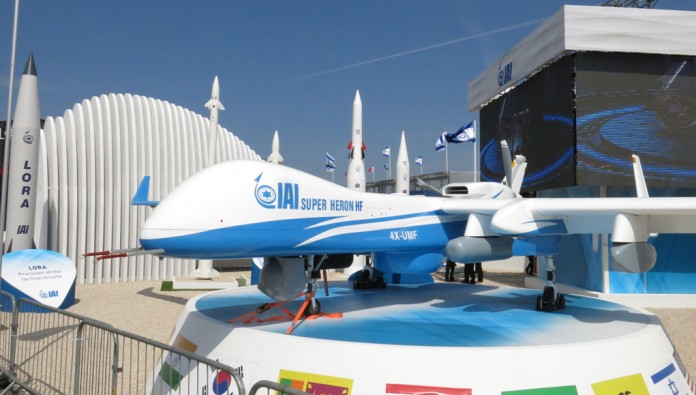
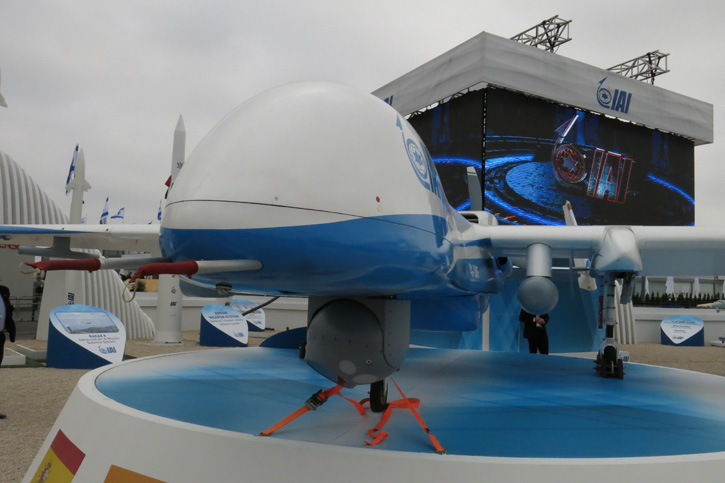
    Super Heron MALE UAV at the Paris Air Show 2015

    As a pioneer in unmanned aerial systems, Israel has been a leading supplier of such systems for military and government users since the mid-1980s. Heading the field of suppliers have been two of the country’s leading arms concerns – Israel Aerospace Industries (IAI) and the Elbit Systems Group. Thirty years later, these UAV primes continue to dominate the global market with Medium Altitude Long Endurance (MALE) UAVs. But other players have also entered this burgeoning market, which now includes dozens of small- and medium-size companies offering complete supply chains – from small- and micro-UAS, to avionics, components, actuators and controllers, propulsion and power sources, mission payloads, and training.

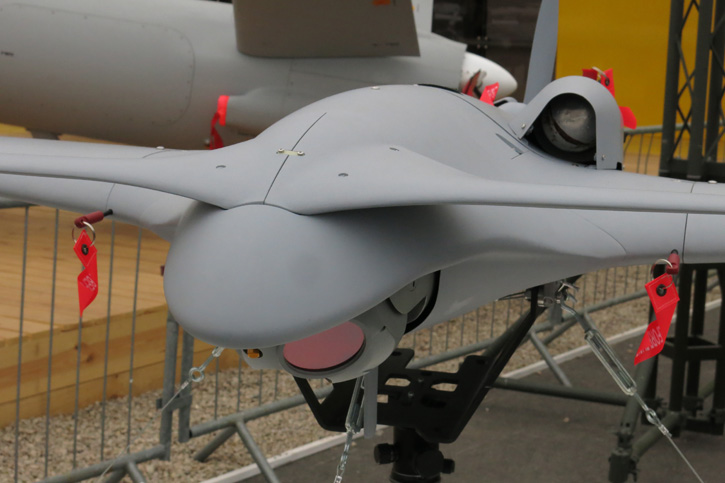
    Some of these capabilities on display at the Paris Air Show include the three leading Israeli MALEs – the Super Heron from IAI, the Hermes 900 from Elbit Systems and the twin-engine Dominator XP from Aeronautics. Super Heron is making here its European debut. The new drone offers improved payload capacity and optional Heavy Fuel Engine configuration.

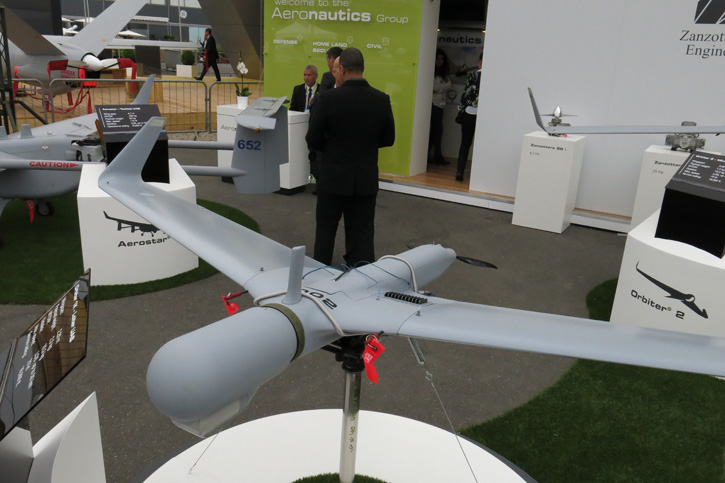
    Other systems on display include tactical UAS, such as Aerostar BP, the latest version of the Aerostar from Aeronautics. The new version is designed with open avionic architecture, supporting multiple payloads configurations weighing up to 50 kg. Such systems include laser designating EO, radar, COMINT and SIGINT payloads. The new version also supports automatic takeoff and landing (ATOL).

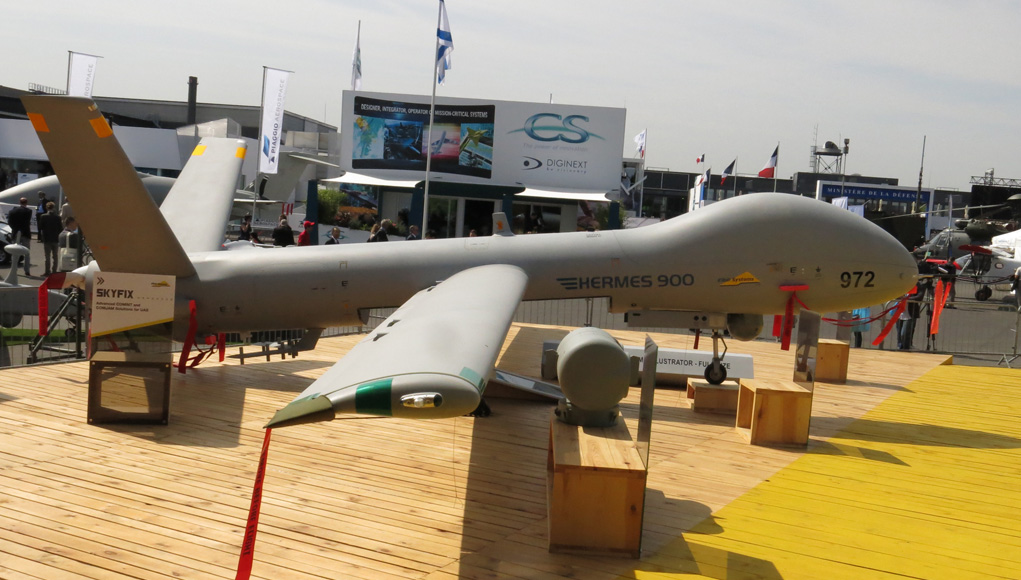
    Hermes 900 on display at the Elbit Systems pavilion at the Paris Airshow 2015. Photo: Tamir Eshel, Defense-Update
    Hermes 900 on display at the Elbit Systems pavilion at the Paris Airshow 2015. Photo: Tamir Eshel, Defense-Update

    Elbit Systems is also highlighting the Universal Ground Control Station, (UGCS) a common control station for its Hermes 900 and -450 UAS. The system is capable of concurrently control two UAS missions simultaneously using two separate communications links. With high level of autonomy that enables the operator to focus on mission execution, rather than actually flying the air vehicle the basic mission is controlled by a single operator. The system supports different applications, for example, maritime patrol for which, in addition to radar patrol and AIS operation, it provides embedded situation awareness and command and control capabilities.

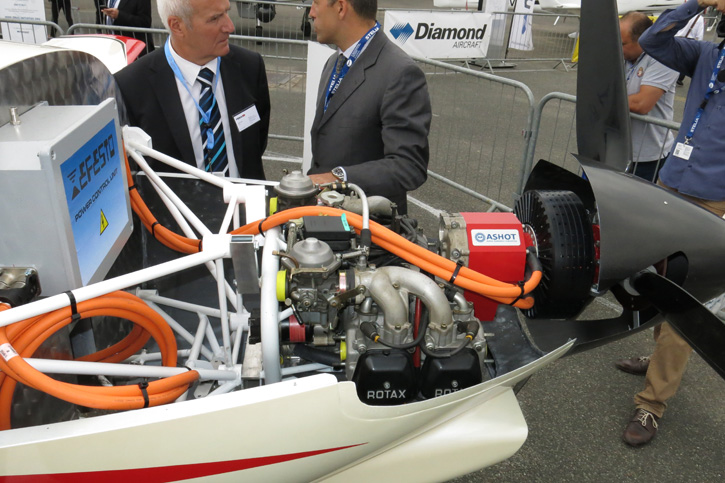
    Ashot Ashkelon unveiled a hybrid propulsion system it has developed for the Rotax 912 and 914 engines at the Paris Air Show 2015. Photo: Tamir Eshel, Defense-Update
    Ashot Ashkelon unveiled a hybrid propulsion system it has developed for the Rotax 912 and 914 engines at the Paris Air Show 2015. It has applications both for general aviation and UAS. Photo: Tamir Eshel, Defense-Update

    An innovative hybrid propulsion system (HPS) developed by Ashot Ashkelon for use by general aviation aircraft also has application for UAVs. Designed as a retrofit kit for Rotax 912 or 914 engines, the system incorporates a new transmission developed by Ashot, replacing the original gearbox, motor-alternator and high capacity lithium-polymer battery for power storage. The HPS increases available power on takeoff and dashing, enable ‘silent cruise’ mode, by shutting off the engine and cruising on electrical power, or be used as emergency propulsion, in case of engine cutoff. The new transmission can also employ thrust reversal, reducing landing run on short landing strips.

    Orbiter 3 equipped with internal combustion engine has a mission endurance exceeding 20 hours. Photo: Tamir Eshel, Defense-Update
    Orbiter 3LE is equipped with internal combustion engine has a mission endurance exceeding 20 hours. Photo: Tamir Eshel, Defense-Update

    Aeronautics is introducing its latest Tactical Small UAS model – Orbiter 3LE. Unlike the standard Orbiter 3 that has been operating with more than 10 customers worldwide, an internal combustion engine powers the new LE, extending the vehicle’s mission endurance from seven to 15-20 hours. The drone can carry different payloads at a weight of 3 kg. One of the payloads carried by Orbiter 3 is the T-STAMP from Controp, carrying day/night sensors including an HD day camera and cooled IR imager. Aeronautics is also offering an electrically-powered version of the Orbiter 3B, an enhanced version that supports longer mission endurance and datalink with high data rate, supporting the high resolution imagery obtained by the new EO payload.

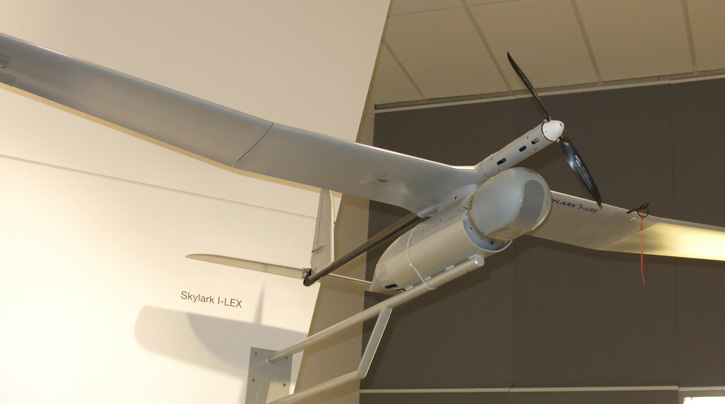
    Among the small and miniature UAS, Elbit Systems is introducing the Skylark I-LEX. This latest version of the Skylark is based on more than 10 years of operational experience with 30 customers worldwide.

    Skylark 1LEX from ELbit Systems. Photo: Tamir Eshel, Defense-Update
    Skylark 1LEX from ELbit Systems. Photo: Tamir Eshel, Defense-Update

    Skylark is a man-portable electric propelled UAS, best fitted for organic “beyond the next hill” reconnaissance, counter insurgency and force protection. The latest version, designated Skylark I-LEX is already operational as the standard battalion level UAS of the Israeli Land Forces, where it has accumulated thousands of operational sorties.

    The LEX version is enhanced with safety features designed for improved airworthiness, an advanced, stabilized day/night EO payload. Mission performance is enhanced through the use of automatic tracking, automatic motion detection and geo registration through video image processing, enhancing target accuracy. Equipped with algorithms derived from Elbit Systems’ Hermes family of larger UAS, Skylark I-LEX can be controlled by the fly-by-camera mode and other autonomous modes, allowing automatic tracking of fixed and moving targets. Communications now employs secured, encrypted datalink. The ground control system (GCS) can operate two aerial vehicles at a distance of 40 km. The GCS has been redesigned with modern user interface with multi-lingual support. Remote users are also supported through Remote Video Terminal allowing payload control by forward deployed operators.
    Schiebel’s Camcopter Sharpens its Eyes and Ears

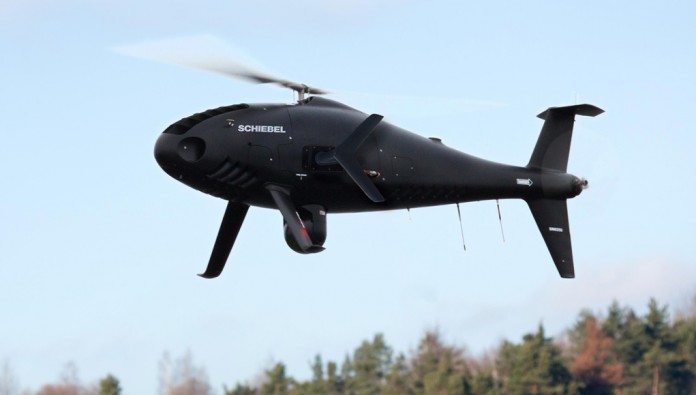
    The proposed configuration mounting the ELK-7065 COMINT-DF sensor from Elta Systems on Shiebel's Camcopter S-100.

    Schiebel continues to diversify the sensor suits carried on the Camcopter S-100 unmanned small rotorcraft. In a recent demonstration the company has flown multiple sensors on a single platform, addressing a requirement from the Australian Navy.

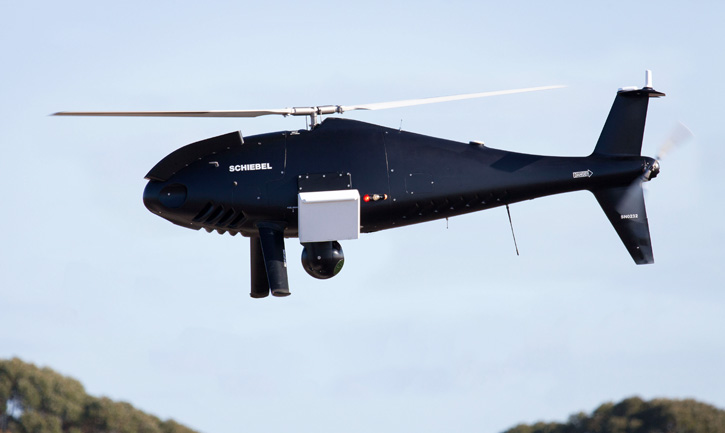
    The sensors carried on board on that mission included the SAGE Electronic Support Measures (ESM) and PicoSAR radar made by Finmeccanica – Selex ES and the Wescam MX-10 from L-3. The Camcopter S-100 can operate in day and night, under adverse weather conditions, with a beyond line-of-sight capability out to 200 km, both on land and at sea.

    The trials that took place near Nowra, on the South East Coast of Australia, provided the Australians a demonstration how an advanced rotary wing UAS could be effectively used to support maritime and littoral Intelligence Surveillance Reconnaissance (ISR) tasks.

    On the trials were operated in realistic maritime security scenarios in the littoral and open ocean the ESM and PicoSAR radar demonstrated how the use of such platform extends surveillance horizon of naval vessels and enhance situational awareness. The data provided by the ESM and radar sensors is crucial to understanding the maritime environment, which was proven in demanding conditions throughout the demonstration.

    The sensors carried on the Camcopter S-100 included the SAGE Electronic Support Measures (ESM) and PicoSAR radar, both made by Finmeccanica - Selex ES and the Wescam MX-10 from L-3, all were operated simultaneously  on the Australian test. Photo: Schiebel.
    The sensors carried on the Camcopter S-100 included the SAGE Electronic Support Measures (ESM) and PicoSAR radar, both made by Finmeccanica – Selex ES and the Wescam MX-10 from L-3, all were operated simultaneously on the Australian test. Photo: Schiebel.

    The CAMCOPTER S-100 is the only UAS in its class that is able to carry multiple sensors combined, enabling customers to gather images with an EO/IR camera, to detect and to identify electronic signatures with a ESM antenna and to use a Synthetic Aperture Radar (SAR) in real-time with only one system.

    While ESM provides an effective solution for naval surveillance, it covers mainly radar and ultra-high frequency emitters, leaving the High Frequency band (3-30 MHz) immune from detection. Military and particularly paramilitary users and smugglers, are exploiting the HF communications band taking advantage of its inherent Beyond Line-Of-Sight (BLOS) communications and perceived immunity from communications interception.

    A forthcoming demonstration will extend the frequency range coverage of the CAMCOPTER S-100, using Elta Systems’ ELK-7065 3D HF Band COMINT interception and geo-location system. The test with this payload is expected for during Q3 2015.

    The ELK-7065 3D HF COMINT provides quick labelling and identification of HF signals, creating a reliable Electronic Order of Battle (EOB) picture and accurate geolocation. The revolutionary HF airborne antenna configuration, measuring merely 30 by 50 centimetres, is optimally suited for the CAMCOPTER. The patented compact HF system is currently going through installation phases.

    Installed on the S-100 UAS, with automatic shipborne vertical take-off and landing (VTOL) capability, the ELK-7065 3D HF COMINT SENSOR can operate autonomously or as part of Intelligence, Surveillance and Reconnaissance (ISR) networks in joint operations.

    Business Jets as Alternative for the E-8C JSTARS

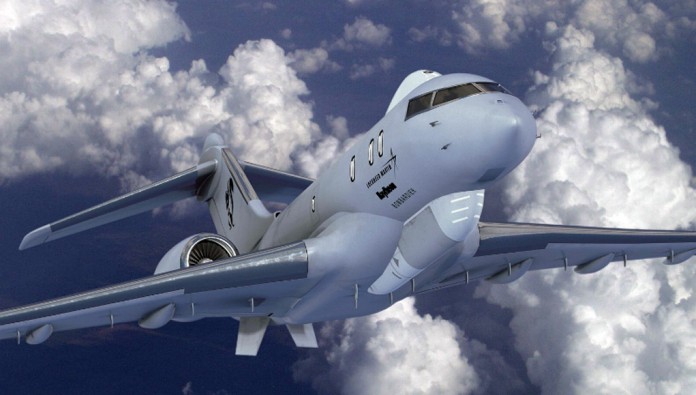
    An artist's concept of the JSTARS Recap business jet platform proposed by the Lockheed Martin-led team with Raytheon and Bombardier. (Photo: Lockheed Martin)

    Lockheed Martin is leading an industry team that includes Raytheon and Bombardier, addressing the U.S. Air Force requirement to recapitalize and modernize the Joint Surveillance Target Attack Radar System (JSTARS), currently operating on obsolete Boeing 707-300 based platforms introduced in 1991. Lockheed Martin will serve as the lead systems integrator for the program and Raytheon will bring to the team their experience with ground surveillance, intelligence, surveillance and reconnaissance systems, mission systems integration, and JSTARS communications. The team promises to deliver a low-risk, affordable solution bass on business aircraft produced by Bombardier. Raytheon and Bombardier have already joined forces on the ASTOR Sentinel R1 program for the UK, using Bombardier’s Challenger 604.

    Bombardier’s ultra-long-range Global business jet platform suggested for the recap is less expensive to operate than modern airliners, the company stated. It is uniquely suited to the JSTARS mission by allowing the on-board radar to see further and deeper into valleys and survey the battlespace for extended periods of time without refueling.

    The U.S. Air Force is already operating the Global 6000 platform as an airborne relay, under the Northrop Grumman lead Battlefield Airborne Communications Node (BACN) program, an application making the Bombardier Global platform “very well-positioned in this market segment,” added Stéphane Villeneuve, vice president, Specialized Aircraft, Bombardier Commercial Aircraft.

    “Embracing the United States government’s desire for strong industry partnerships, the Lockheed Martin-led team will provide the Air Force capabilities superior to the current JSTARS.” The team announced in a statement. “The team will also deliver a true open system architecture to allow the government to own the technical baseline for future upgrades and reduce life cycle cost.”

    “Our track record of performance in systems integration and leadership in Open Mission Systems, combined with our teammates’ relevant products and in-depth experience, give us confidence that we can provide the Air Force the best possible solution,” said Rob Weiss, executive vice president and general manager, Lockheed Martin Aeronautics, Advanced Development Programs (the Skunk Works). The sensor package remains shrouded in secrecy. According to Aviation Week, the new configuration will use scaled version of an existing radar developed by Raytheon in the classified world, says Eric Hofstatter, Lockheed Martin Skunk Works JStars recap program manager.
    Northrop Grumman, the prime contractor of the original E-8 has formally partnered with Gulfstream and L-3 on its offering to the US Air Force Joint STARS recapitalization effort. Northrop Grumman has used the G550 as a test bed for JSTARS technology. L-3 will provide the necessary modifications adapting the ‘green’ G550 for the JSTARS mission. According to Tom Vice, corporate vice president and president, Northrop Grumman Aerospace Systems, the company can “meet, or exceed, the Air Force’s acquisition requirements by integrating our team’s independently developed, mature and proven systems at the lowest cost, with the lowest risk to provide an innovative acquisition solution.”
    The Air Force currently operates 18 E-8 JSTARS platforms. Each carries a synthetic aperture ground surveillance radar providing long-range surveillance and detection of moving targets on the ground, covering a large area, up to 124 miles deep. These sensors locate, track and classify ground vehicles. The U.S. Air Force plans to recapitalize its 16 E-8C Joint Surveillance Target Attack Radar System aircraft with 17 new jets.

    Boeing is also proposing a solution for the recap, based on a modified 737-700 commercial airliner as its offering. While bigger and more expensive to operate, this platform could offer future growth capacity, Boeing argues.

    Striking in Seconds!

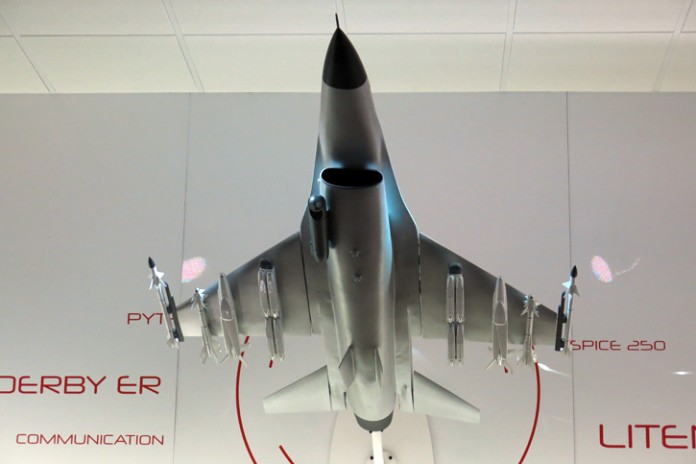
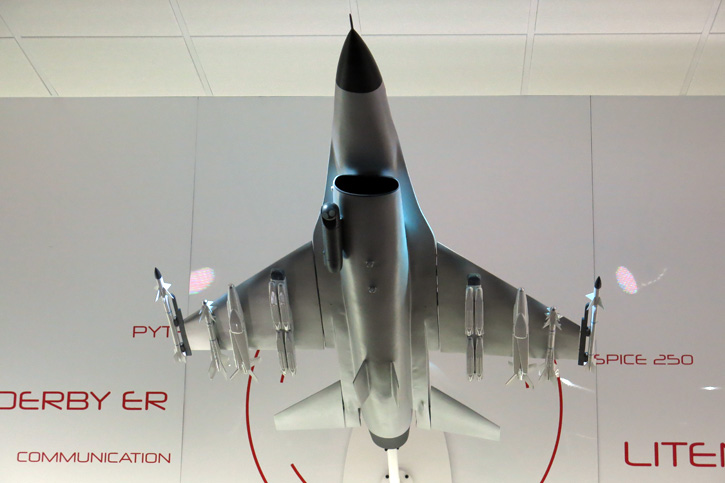
    An F-16 model at Rafael's display at the Paris Air Show 2015 showing a full loadout supporting stand-off attack at ranges of 100+ km. This loadout comprises a Litening 5 long-range targeting pod and eight Spice 250, each capable of hitting pinpoint target at long ranges. The configuration also includes two Spice 1000 EO precision guided weapons, two I-Derby ER missiles with range of +100 km and two Python 5 air/air missiles. The aircraft is also networked with other airborne or surface based elements through the broadband, multi-channel BNET communications system. Photo: Tamir Eshel, Defense-Update.
    An F-16 model at Rafael's display at the Paris Air Show 2015 showing a full loadout supporting stand-off attack at ranges of 100+ km. This loadout comprises a Litening 5 long-range targeting pod and eight Spice 250, each capable of hitting pinpoint target at long ranges. The configuration also includes two Spice 1000 EO precision guided weapons, two I-Derby ER missiles with range of +100 km and two Python 5 air/air missiles. The aircraft is also networked with other airborne or surface based elements through the broadband, multi-channel BNET communications system. Photo: Tamir Eshel, Defense-Update.
    An F-16 model at Rafael’s display at the Paris Air Show 2015 showing a full loadout supporting stand-off attack at ranges of 100+ km. This loadout comprises a Litening 5 long-range targeting pod and eight Spice 250, each capable of hitting pinpoint target at long ranges. The configuration also includes two Spice 1000 EO precision guided weapons, two I-Derby ER missiles on the wing-tips provide an air/air range of +100 km and two Python 5 air/air missiles carried on outer under-wing stations 2 and 9. The aircraft is also networked with other airborne or surface based elements through the broadband, multi-channel BNET communications system. Photo: Tamir Eshel, Defense-Update.

    Coupling RAFAEL’s latest reconnaissance and targeting pods with scene matching EO guided weapons enables air forces to tighten targeting cycles from days and hours to few seconds.

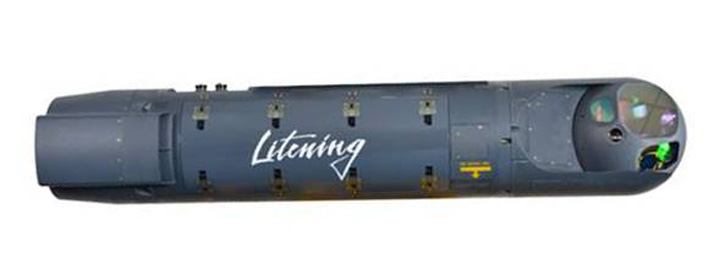
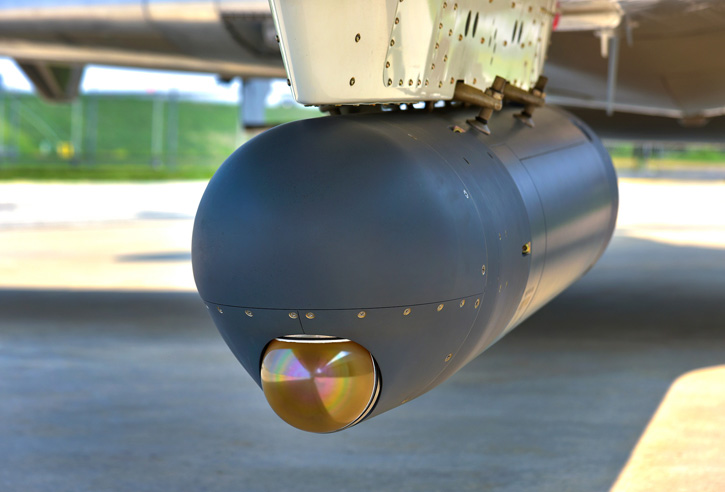
    RAFAEL is unveiling the Litening 5 at the Paris Air Show; the fifth generation of the targeting pod that defined this product category two decades ago is now capable of targeting from long range, enabling strike aircraft to employ guided weapons from standoff range without relying on external support.

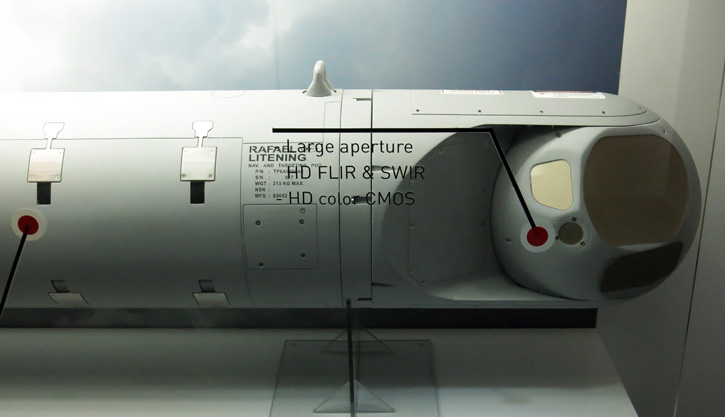
    The Litening 5 targeting pod from Rafael comprises multiple apertures and more sensors supporting target acquisition and designation at extended range. Supporting image-based targeting (using RAFAEL's Matchguide system) the pod can support scene matching EO-guided weapons such as the Spices, to their full extended range enabling all fighter aircraft types equipped with these combination of sensor and weapons an independent, stand-off attack capability. Photo: Tamir Eshel, Defense-Update
    The Litening 5 targeting pod from Rafael comprises multiple apertures and more sensors supporting target acquisition and designation at extended range. Supporting image-based targeting (using RAFAEL’s Matchguide system) the pod can support scene matching EO-guided weapons such as the Spices, to their full extended range enabling all fighter aircraft types equipped with these combination of sensor and weapons an independent, stand-off attack capability. Photo: Tamir Eshel, Defense-Update

    Litening 5 employs a new sensor pack, utilizing an optical assembly and larger aperture tailored specifically for the new sensors, enabling the increased identification and recognition distance. The pod uses two FLIRS – a Mid-Wave Infra-Red (IR) and Short Wave IR (SWIR). The later extends observation range using active laser illumination. Complementing the sensor pack is a color CCD HD-TV, improving target recognition and separation of man-made objects that are often harder to spot in the thermal, monochromatic image. Color improves the ability to share a common understanding with ground forces and recognize specific vehicles based on their color. Images can be fused or displayed separately, based on the level of avionics used in the aircraft.

    Rafael’s ‘image based common targeting language’ also known as Matchguide is integrated in the new pod, enabling rapid target handoff between the targeting pod, or ground-based forward air controller and guided weapons carried on board. Matchguide is fully integrated in the Litening 5, enabling the pilot or ground controller to designate a target simply by touching its image on a display, to deliver three-dimensional guidance cues as scene and image-based targeting for EO-guided weapons (Spice, for example) or as coordinates,  to the attacking weapon – a method dramatically shortening the ‘sensor to shooter cycle’.

    Rafael's new Litening 5 targeting pod. Photo: RAFAEL
    Rafael’s new Litening 5 targeting pod. Photo: RAFAEL

    At the Paris Airshow RAFAEL is also introducing a new version of its tactical reconnaissance pod – RecceLite XR. This multi-spectral, multi-role, real time stand-off reconnaissance system consisting of an airborne pod, a wide digital datalink, and a ground exploitation station.

    Similar to the Litening 5, Reccelite XR received an enhanced sensor package comprising megapixel-size arrays of Near-Infra-Red (NIR), MWIR, panchromatic (color) sensors and SWIR. As with the Litening 5, SWIR adds a significant long-range performance, since its spectral band is the least affected by atmospheric absorption. The gimbaled payload enables stabilized photography, irrespective of aircraft maneuvers or deviation from flight route.

    Litening 5 and Reccelite XR share many common assemblies and modules and are carried by similar aircraft, thus contributing to efficient operation and lower life cycle support cost. Over 1,500 Litening targeting and navigation pods are currently flying on dozens of platform types with +25 air forces worldwide. RecceLite is in operational service with 10 air forces.

    Meanwhile, Rafael’s US partner, Northrop Grumman has delivered the 500th AN/AAQ-28(V) LITENING G4 targeting pod to the United States military, marking an important milestone as forces worldwide continue to transition their LITENING pods to G4 configuration.

    LITENING G4 offers advanced 1K sensors, laser imaging and advanced image processing. Recent tests in the USA also included an integration of color imaging camera, as used in the Litening 5. Northrop Grumman has also designed a derivative of the Litening, fitted with an Infra-Red Search & Track (IRST) from Selex. This derivative is addressing the US Air Forces’ capability requirement set by the US Air Force for F-15C/D upgrades.

    OpenPod, based on the Litening platform, is showing here an IRST sensor from Selex.
    OpenPod, based on the Litening platform, is showing here an IRST sensor from Selex.

    Israel to Establish a New Cyber Command

    The Israel Defense Forces (IDF) will establish a new ‘Cyber Command’ to deal and oversee all operational activity in the cyber dimension. This command will be established in two years and in the mean time will work in conjunction with the intelligence branch and the C4I branch. A multi-branch team will be responsible for presenting Lieutenant General Gadi Eisenkot, ID Chief of the General Staff  with a development plan.

    “The IDF is required to excel in every aspect of war, including the cyber dimension, which is becoming more significant every day. This new command will empower the IDF to perform better in these fronts and will utilize the technological and human advantage that already exists in Israel.” General Eisenkot said.

    This decision will be submitted to the authorization of the Minister of Defence, Mr. Moshe Bogie Ya’alon.

    Israel currently operates three territorial commands, the deep-battle command (foreseeing special operations far from Israel ’s borders  and the home-front command. The Cyber Command will become the 6th command within th e IDF STRUCTURE

    A Bio Sensing Helmet Would Take Control When the Pilot Can’t

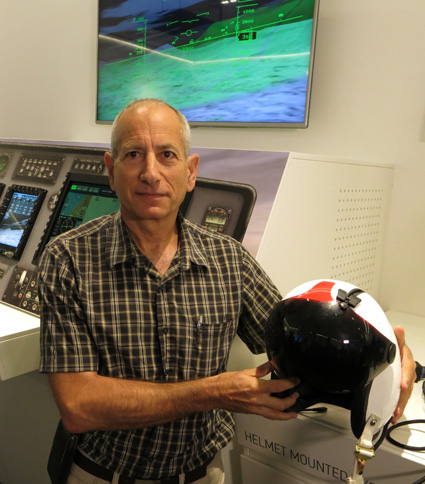
    The Canary helmet sensor can monitor heartbeat, oxygen level in the blood and flood flow, to identify developing physiological conditions that could lead to hypoxia or G-induced loss of consciousness (GLOC). Photo: Elbit Systems
    The Canary helmet sensor can identify developing physiological conditions that could lead to hypoxia or G-induced loss of consciousness (GLOC). “These two conditions are life threatening, since they often cannot be sensed by the pilot,”  said Yaron Kranz, Business Development and R&D Director at Elbit Systems. Photo: Noam Eshel, Defense-Update
    The Canary helmet sensor can identify developing physiological conditions that could lead to hypoxia or G-induced loss of consciousness (GLOC).
    “These two conditions are life threatening, since they often cannot be sensed by the pilot,” sais Yaron Kranz, Business Development and R&D Director at Elbit Systems. Photo: Noam Eshel, Defense-Update

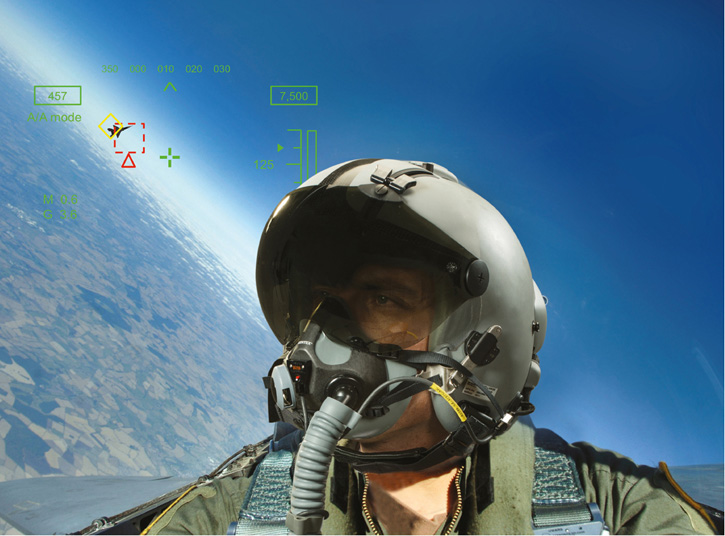
    Elbit Systems is developing new applications for smart helmets for pilots that will be able to sense life-threatening developments during flight. The helmet is fitted with unique bio-sensors that measure physiological life signs. Monitoring the pilot’s heartbeat, blood flow and oxygen level in the blood stream. The system can identify developing conditions that could lead to hypoxia or G-induced loss of consciousness (GLOC).

    “These two conditions are life threatening, since they often cannot be sensed by the pilot,” Yaron Kranz, Business Development and R&D Director at Elbit Systems told Defense-Update. Hypoxia can develop at different pace, with oxygen concentration in the blood falling and no clear signs that would signal the pilot to take preventive measures. Measuring consciousness is even harder, as GLOC may happen suddenly and comes without warning.

    “The best way to monitor oxygen level is to measure oxygen saturation in the blood, similar to the measurement done on patients. But, to do that, you need a different sensor,” Kranz explained. For this application Elbit Systems adapted a commercial sensor developed by LifeBeam, an Israeli start-up company that developed such a sensor to monitor peak performance for extreme sports’ athletes such as marathon runners, bicyclists and mountain climbers. The sensor measures oxygen concentration in the blood, heartbeat and blood perfusion (the volume of blood that flows through to the tissues).

    “We are working with AFRL to study such applications. We will soon start the second phase and expect to complete development in less than a year,” Kranz added. “We embedded the sensor in our new-generation helmets that have integral processing capability on the helmet.” Helmets with integrated sensors were tested in a centrifuge under high G loads with pilots wearing G-suits. On other tests pilots flew with them under loads of up to 6G. “The test results we have collected so far have shown that the sensors performed predictably and reliably, monitoring the pilot’s condition, collecting data in flight, and providing sound physiological data that will be able to support further decisions and advanced applications in the future,” Kranz noted.

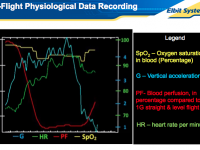
    In flight recording of physiological data collected by the Canary sensors during flight. Photo: Elbit Systems
    In flight recording of physiological data collected by the Canary sensors during flight. Photo: Elbit Systems. Subscribe to enlarge

    We discovered that hypoxia can develop in different conditions. In non-pressurized cockpits, for example, when flying helicopters over high mountain ranges, hypoxia can develop slowly over the course of an hour. When caused by oxygen supply failures or human condition, blood oxygen levels can drop, from 90 to 60-70 percent. GLOC also occurs abruptly when pilots are subjected to excessive loads without the recommended preparation.

    Usually a pilot would recover from GLOC in 20 seconds, but, during the condition, the aircraft is uncontrolled and could hit the ground. A warning issued just prior to the onset of GLOC could alert the pilot to take precautions, breath properly, apply pressure to reduce the load or ease the sharpness of the turn to reduce G. The sensor can profile each individual pilot and assess his or her performance and tolerance on the specific flight.

    Once the system ‘decides’ that the pilot is in danger, it triggers an audio-visual warning alerting the pilot to take action. In case the system ‘senses’ that the pilot is unconscious, the autopilot can be activated to take control.

    Certifiable Predator B (CPB) – Redesigned for the European Taste

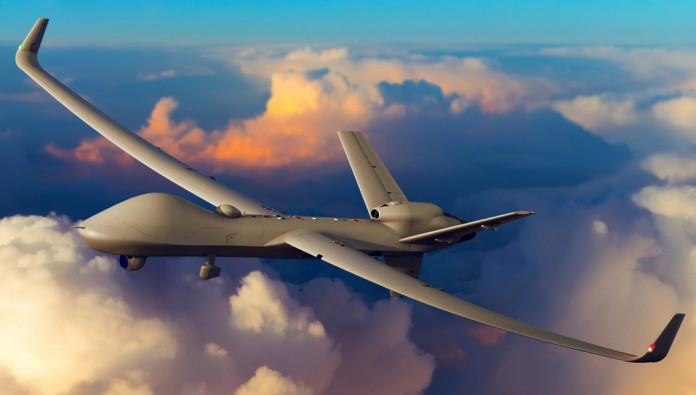
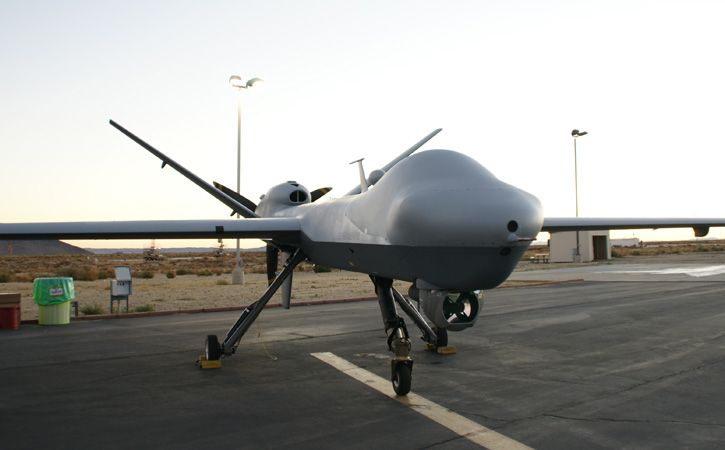
    General Atomics Aeronautical Systems Inc. (GA-ASI) is developing a variant of the Predator B Remotely Piloted Aircraft (RPA) to be certified for flight according to the NATO Airworthiness Standard for unmanned aircraft. The new variant will fly in 2017, GA-ASI said. Illustration Photo: GA-ASI

    Addressing the concern of restrictions of operating MQ-9 Reaper drones over Europe, due to the fact that this drone has not been certified to fly over civilian airspace, General Atomics Aeronautical Systems, Inc. (GA ASI), the drone’s manufacturer is developing a variant of the Predator B Remotely Piloted Aircraft (RPA) to be certified for flight according to the NATO Airworthiness Standard for unmanned aircraft.

    Four European air forces have already selected the Predator B RPA. The UK and France are operating these drones overseas (in the Middle East and Africa), while the Netherlands ordered the drones but cannot operate them in country. Italy is the only European country operating the drones in its airspace. Germany, Spain and Poland also consider buying such RPAs but have reservations about their ability to fly them in Europe.

    This new model, known as ‘Certifiable Predator B’ (CPB) should address these concerns. It has recently completed a successful internal Phase 1 Critical Design Review (CDR), along with reviews by two prospective European customers. The aircraft will receive certification-compliant wings and redesigned tails, both are expected to complete flight-testing late in 2015. The wings span 79 feet and enable over 40 hours of flight time for the aircraft. The company also has also applied for FAA Type Certification and is working with the FAA to develop Unmanned Aircraft Systems (UAS) airworthiness standards.

    According to sources at GA-ASI, the design of CPB addresses requirements that were not part of the standard Predator B’s specification. In addition, new standards and requirements continue to be developed for RPA systems and their operational use that were not envisioned during Predator B’s initial development. The development of the system follows international airworthiness standards that include STANAG 4671, UK DEFSTAN 00970, SAE ARP4754A, MIL HDBK-516C, DO-178, and DO-254, as well as others.

    What’s new in CPB?

    Most significantly, the CPB airframe will be built with certifiable composite materials with the same process that is in use on many of the newest commercial airliners. In addition, CPB has undergone a comprehensive safety analysis of all of its subsystems, and their designs are being updated as necessary to address airworthiness standards including DO-178C and DO-254. Finally, among CPB’s many design enhancements are features that provide fire protection and all-weather operations, providing lightning protection, erosion resistance, bird-strike protection, and de-ice capabilities.

    The company is on schedule to conduct flight tests of a test aircraft in 2016, leading to the first flight of a certifiable production aircraft in 2017. According to GA-ASI, certification of delivered systems will be granted by the responsible agencies within each country.

    The company has dealt with the MQ9 certification issues for several years, reviewing the requirements and design compliance with the certification agencies. According to Linden Blue, CEO, GA-ASI, the company has made a significant investment to solve issues associated with flying RPA within civilian airspace. “Certifiable Predator B will represent the first RPA system in its class to achieve this breakthrough.” Blue said.

    GA-ASI is integrating a prototype Due Regard Radar in the Predator B to evaluate the system's performance for 'sense and avoid' application. Photo: GA-ASI
    GA-ASI is integrating a prototype Due Regard Radar in the Predator B to evaluate the system’s performance for ‘detect and avoid’ application. Photo: GA-ASI

    The company is also developing and testing a new radar to function ‘Detect and Avoid’ (DAA) capabilities for RPA, combining Traffic and Collision Avoidance System (TCAS) II with the company’s Due Regard Radar (DRR) to enable both automatic collision avoidance and the ability to remain well clear of other airspace users.

    The integrated DAA system will continue to fly aboard NASA’s Ikhana (Predator B) in 2015 in support of a series of NASA flight tests. These tests will measure the performance of the entire system in a variety of situations to support the ongoing standards development within the RTCA Special Committee 228.

    Additionally, the CPB aircraft integration testing has confirmed the capability to handle multiple configurations of certified electronics, such as Technical Standard Orders (TSO)-certified Identification Friend or Foe (IFF) transponders and communications radios from other industry partners.

    Israel at the Paris Air Show: Photo Report #1

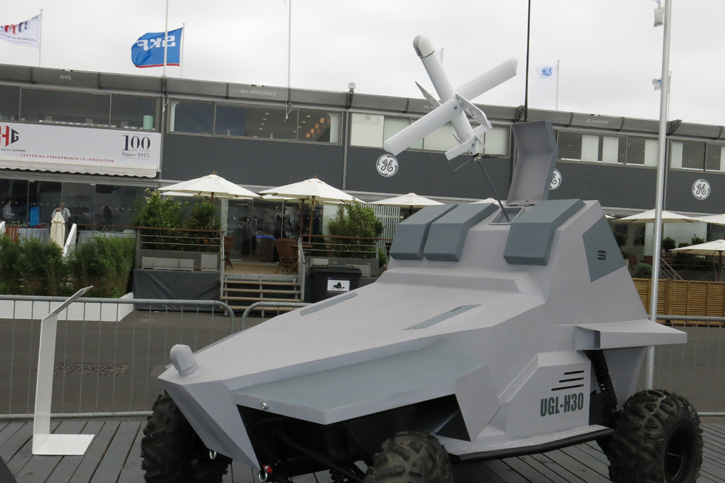
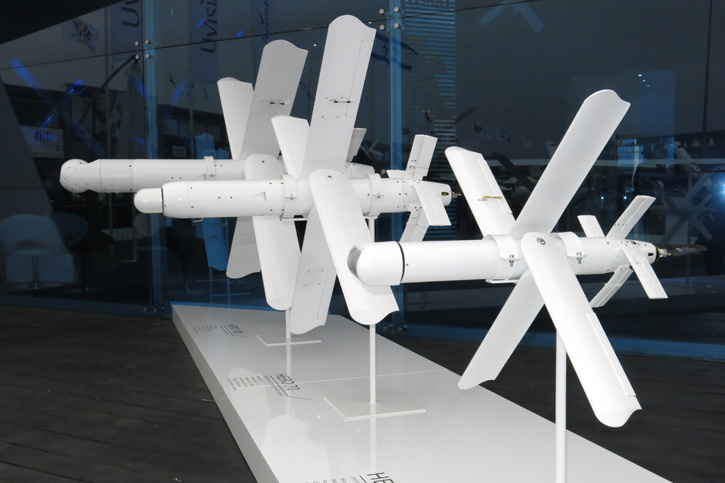
    UVision also unveiled a vehicular application of the HERO, mounted on a small off-road unmanned ground vehicle. Photo: Tamir Eshel, defense-Update
    UVision also unveiled a vehicular application of the HERO, mounted on a small off-road unmanned ground vehicle. Photo: Tamir Eshel, defense-Update
    small_heros_725
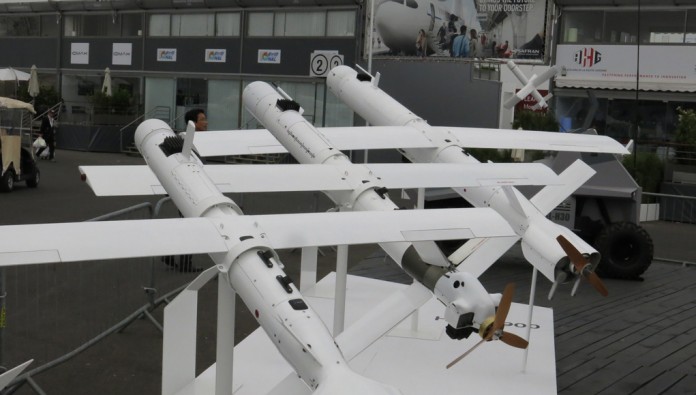
    New: UVision unveiled its new range of Hero range of loitering weapons. Photo: Tamir Eshel, Defense-Update
    hermes900_725
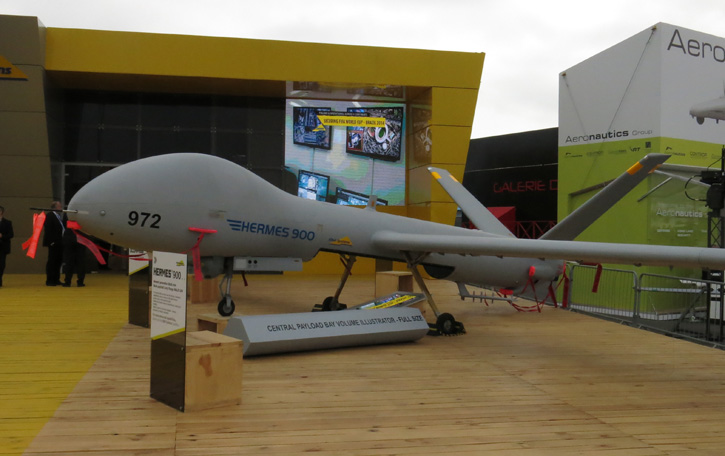
    Elbit Systems displayed the Hermes 900 emphasizing its large internal payload bay. Photo: Tamir Eshel, Defense-Update
    iai_missiles725
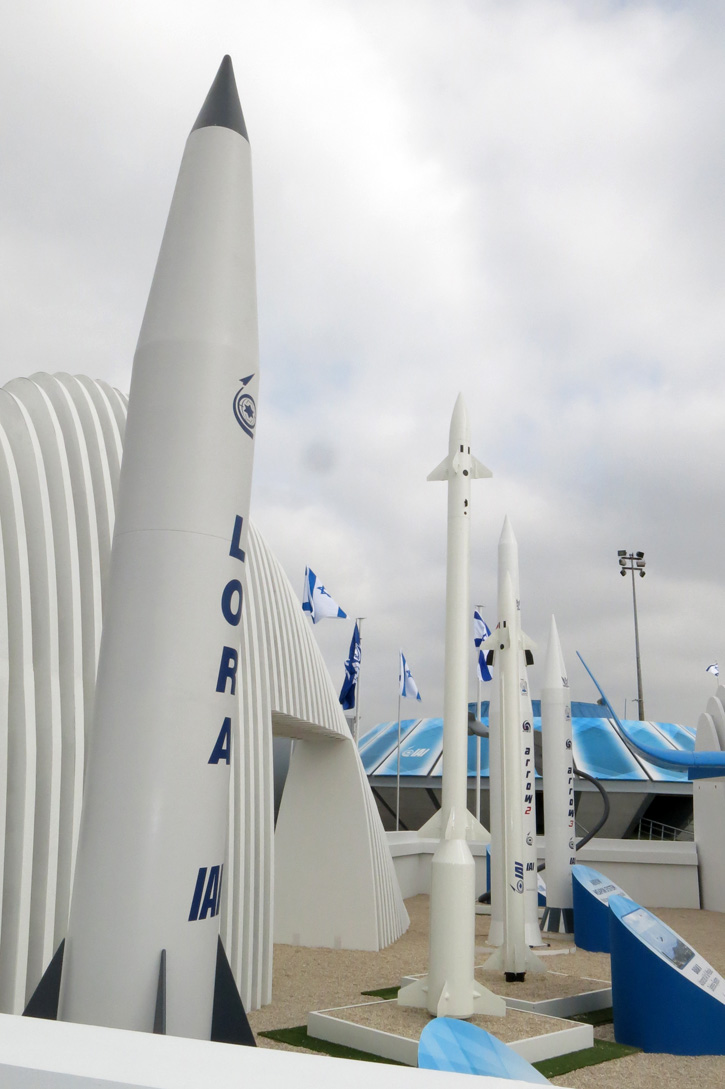
    IAI Lined up its missiles – from the Lora tactical ballistic missile, Barak 8 area air defense, and Arrow 2 and 3 ballistic missile interceptors. Photo: Tamir Eshel, Defense-Update
    iderbyer_python725
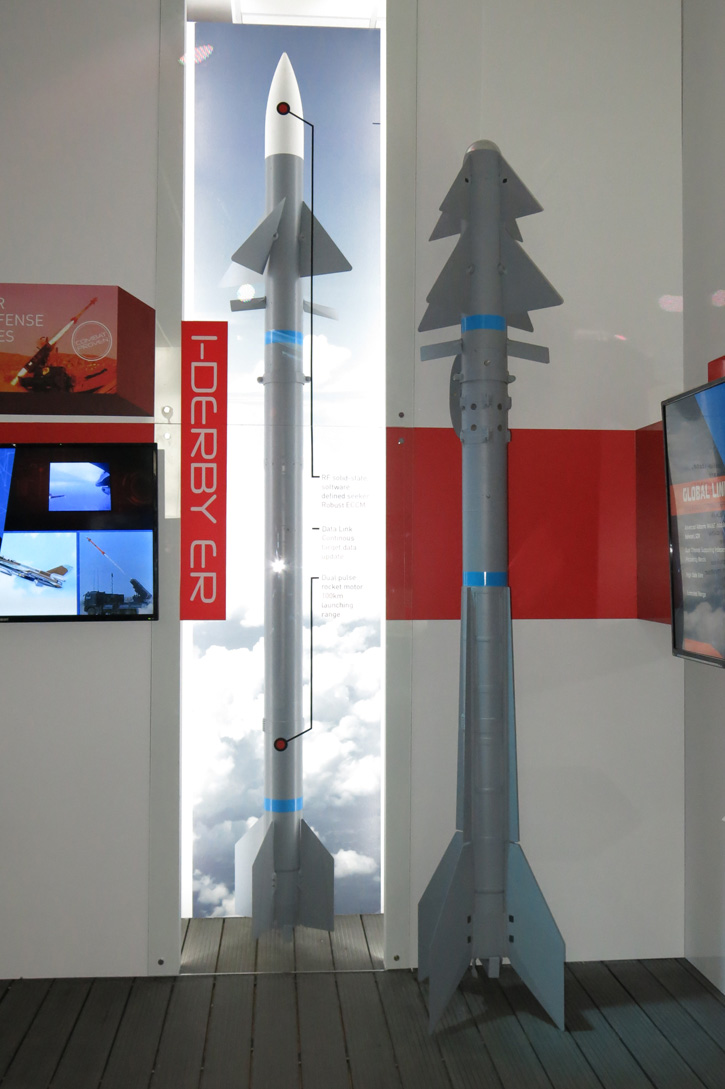
    I-Derby ER (left) and Python 5 (right) are two of RAFAEL’s air/air missiles that are also used for surface-to-air applications (Spyder). The I-Derby ER has a new active seeker and can operate at extended range over 100 km. Photo: Tamir Eshel, Defense-Update
    litening5_725
    Another new product from Rafael is Litening 5, equipped with new EO sensors enabling tactical fighter aircraft to acquire targets by EO sensors at stand-off range. The pod is associated with Rafael’s Spice EO guided weapons enabling rapid ‘sensor to shooter’ engagement. Photo: Tamir Eshel, Defense-Update
    orbiter1k_725
    Aeronautice unveiled the Orbiter 1K ‘loitering weapon’ based on the Orbiter 2 UAV. Photo: Tamir Eshel, Defense-Update
    orbiter3er725
    A new version of Orbiter 3 is equipped with a small piston engine extending this Tactical Small UAV endurance to 20 hours. Photo: Tamir Eshel, Defense-Update
    superheron725
    This model of IAI’s Super Heron on display is configured with the company’s M-19HD large aperture, long range, multi-sensor EO payload. Photo: Tamir Eshel, Defense-Update
    skylark_lex725
    Elbit Systems introduced the latest version of the Skylark mini-UAV, designated Skylark LEX. Photo: Tamir Eshel, Defense-Update

    Paris Air Show 2015: Military and Defense Technology Trends to Follow

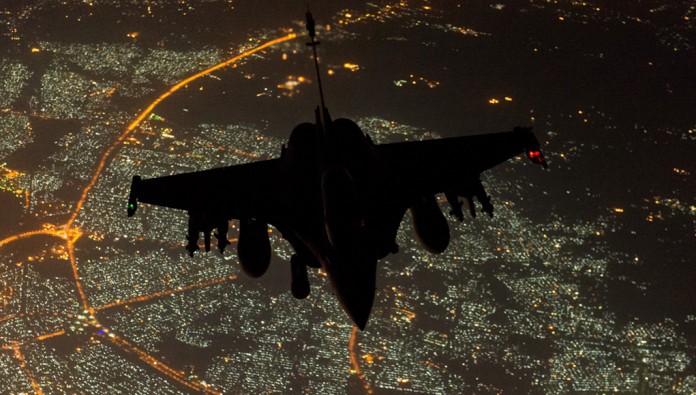
    Rafale over Baghdad, operation Chammal 2014. Photo: French Air Force

    DJHMCS_color

    A superficial look at the 51st Salon la Bourget may give the impression that this year’s Air Show is all about civil and commercial aviation. Take a closer look at the aisles and the static park, look under the wings or below some innocent looking planes, and you will realize that military aerospace is still ‘in.’

    Obviously, a military aviation enthusiast would like to see the F-35 and the Russian T-50 for a start, as well as other such top performers as the U.S. F-22 and V-22, and the Russian Su-35. But none of these are here. Instead, the French Rafale gloriously celebrates its victory in foreign markets, after grabbing three orders (Egypt, Qatar and soon – India) in just a few months. Its main rivals – the Eurofighter Typhoon and Gripen from Saab are absent.

    ENHANCING 4.5-GENERATION FIGHTER AIRCRAFT

    The absence of 5th generation combat jets does not mean there is no 5GEN technology in the Air Show. On the contrary. Advanced propulsion, futuristic avionics and cockpit designs integrating large displays and helmet-mounted sights, far-sighted Infra-Red Search & Track (IRST) (Air/Air) sensors, datalink software and advanced targeting pods are all here, ready to upgrade current 4.5-generation fighters to the next level.

    Air forces now employing upgraded 4th and 4.5-generation fighters also benefit from cutting-edge, Active Electronically Scanned Array (AESA) radars and integration with long-range command and control assets. One of the strategies considered by these air forces is the use of extended-range air/air missiles, enabling the air force with the longer arms and sharper eyes to win the battle before ‘merging’ in a close-range dogfight. Such extended-range air/air missiles are among the new weapons introduced by several missile manufacturers at the 51st Paris Air Show.

    MBDA Meteor long range air/air missile launched on a test flight from Rafale. Photo: Dassault Aviation.
    MBDA Meteor long range air/air missile launched on a test flight from Rafale. Photo: Dassault Aviation.

    One such missile is the Meteor, developed by MBDA and compatible with all 4.5-generation fighters – Typhoon, Rafale and Gripen NG. Raytheon is also developing an extended-range AAM, the AIM-120D variant of the AMRAAM, while Israel’s Rafael is unveiling the latest version of its Derby missile. Originally designed for Beyond-Visual-Range engagement, the I-Derby ER is equipped with a new software-defined active seeker and an enhanced two-pulse propulsion system, dramatically enhancing the missile’s kinematics, particularly at the final phase (endgame) even beyond 100 km.

    Skunk Works and XTEND Simplify Multi-Drone Command

    0
    Lockheed Martin Skunk Works® and XTEND have achieved a major milestone in JADC2 by integrating the XOS operating system with the MDCX™ autonomy platform. This technical breakthrough enables a single operator to simultaneously command multiple drone classes, eliminating the friction of mission handoffs. From "marsupial" drone deployments to operating in GPS-denied environments, explore how this collaboration is abbreviating the data-to-decision timeline and redefining autonomous mission execution.

    From Ukraine to Taiwan: The Global Race to Dominate the New Defense Tech Frontier

    0
    As traditional defense primes face mounting competition from agile “neoprimes” such as Anduril, Palantir and Helsing, the balance of innovation is shifting toward software-defined warfare and scalable, dual-use technologies, while global industry consolidation—marked by Boeing’s integration of Spirit AeroSystems and other strategic mergers—signals an intensified race to secure control over the defense technology value chain. Our Defense-Tech weekly report highlights these trends.

    Europe’s “Drone Wall”

    0
    In early October 2025, a coordinated wave of unmanned aerial system (UAS) incursions—widely attributed to Russia—targeted critical infrastructure across at least ten European nations. The unprecedented campaign exposed the fragility of Europe’s air defenses...

    Weekly Defense Update & Global Security Assessment

    0
    Executive Summary The past week (September 18-25, 2025) represents an inflection point where strategic defense concepts have transitioned from doctrine to tangible reality. An analysis of global events reveals four primary, interconnected trends shaping an...

    U.S. Air and Space Forces Push Next-Gen Programs at the AS&C 2025 Conference and...

    0
    At the 2025 Air, Space & Cyber Conference, U.S. Air Force and Space Force leaders unveiled major updates on next-generation fighters, bombers, unmanned systems, and space initiatives, highlighting both rapid innovation and critical readiness challenges as the services race to outpace global competitors. A short version is available here, with a more detailed version for subscribers.

    TADTE 2025: Reflecting Taiwan’s Strategic Themes

    0
    The Taipei Aerospace & Defense Technology Exhibition (TADTE) 2025 crystallized around four dominant strategic themes that collectively illustrate Taiwan's comprehensive approach to defense modernization amid escalating regional tensions. Based on a detailed report by Pleronix (available upon request). Includes a Podcast discussion on TADTE 2025's highlighting Taiwan's four strategic themes beyond the post's coverage.

    Iron Beam 450 Completes Testing, Soon to Join With Operational Air Defense Units

    0
    Israel’s Iron Beam 450 high-power laser system has completed final testing, marking a major leap in air defense. Developed by Rafael, it offers precise, cost-effective interception of rockets, UAVs, and mortars, and is set for IDF deployment by 2025.