Tuesday, December 23, 2025
More
    Home Blog Page 83

    Army Hoverbikes To Enhance Tactical Mobility in 3D

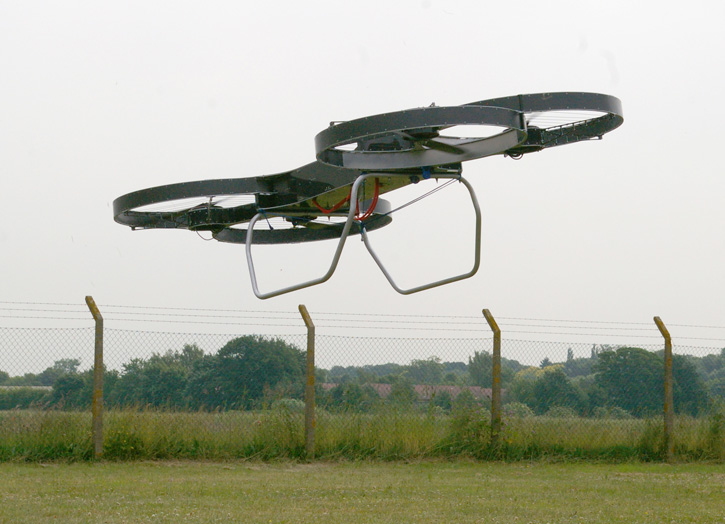
    The second prototype of Malloy Aeronautics' Hoverbike UAV shown on a test flight. Photo: Malloy Aeronautics
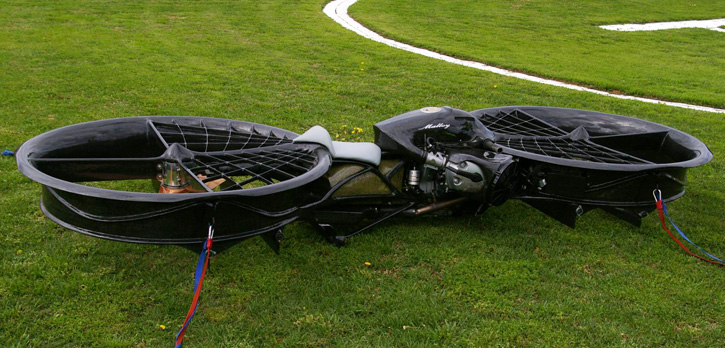
    The ‘second generation’ prototype of Malloy Aeronautics’ Hoverbike UAV shown on a test flight. Photo: Malloy Aeronautics

    The U.S. Army Research Laboratory (ARL) has been exploring the tactical reconnaissance vehicle (TRV) concept for nearly nine months and is evaluating the hoverbike technology as a way to get Soldiers away from ground threats by giving them a 3-D mobility capability. The Army considers this disruptive technology for its potential to increase Soldier protection at the squad level and below.

    The feasibility study of the technology recently concluded, and indicates successful performance. During the next three to five years, ARL, a part of the U.S. Army Research, Development and Engineering Command (RDECOM) will partner with Malloy Aeronautics, a United Kingdom-based aeronautical engineering company, and SURVICE Engineering Company, a Maryland-based defense firm, to deliver full-sized prototypes and analysis for evaluations and assessments in military applications.

    The TRV concept could unburden Soldiers while increasing their capabilities regardless of the environmental conditions, in manned and/or unmanned operations. Besides mitigating the dangers of ground threats, capabilities for the TRV concept could include aiding in communication, reconnaissance, and protection; sensing danger or even lightening the Soldiers’ load.

    flying_bike725
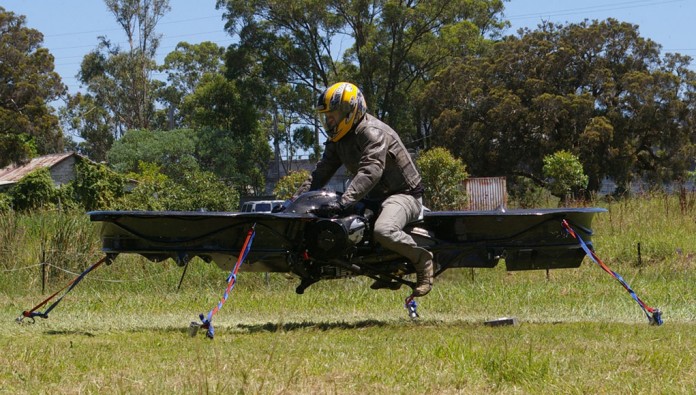
    The ‘Hoverbike’ from Malone Aeronautics is developed as a man-portable drone, a ‘hoverbike’, carrying an average person, or a cargo lifting drone carrying loads from small parcels to 800 pounds pallets. Photo: Tamir Eshel, Defense-Update

    Chris Malloy and his Hoverbike. Photo: Malloy Aeronautics
    Chris Malloy and his Hoverbike. Photo: Malloy Aeronautics
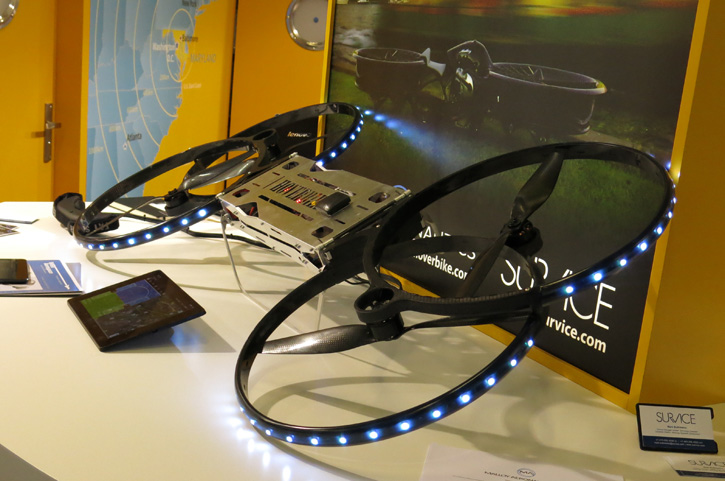
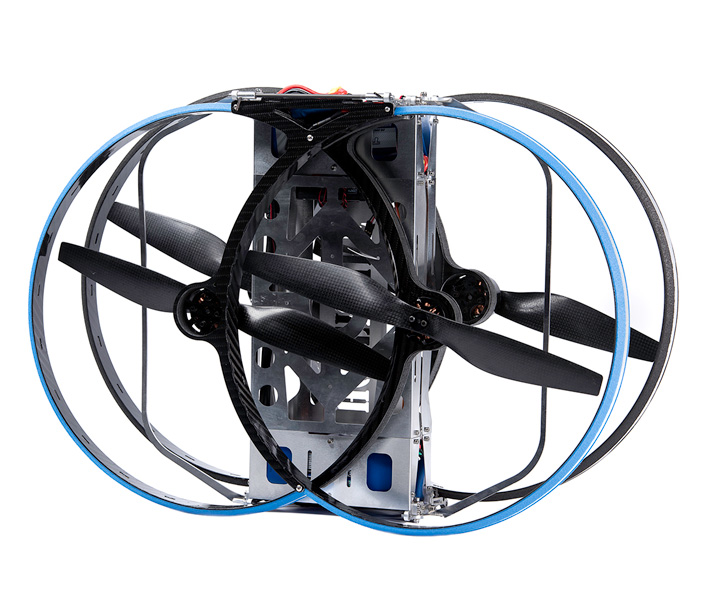
    The Drone-3 foldable quadrotor designed by Malloy Aeronautics employs the principle design of the Hoverbike, in a smaller scale. Photo: Malloy Aeronautics
    The Drone-3 foldable quadrotor designed by Malloy Aeronautics employs the principle design of the Hoverbike, in a smaller scale. Photo: Malloy Aeronautics
    The company founder Chris Malloy launched the Hoverbike in New Zealand, and later moved to Australia, before establishing Malloy Aeronautics in the UK last year. Stepping up development, Malloy turned to crowd funding in February 2014 to help raise additional money to complete the development of this innovative concept.

    The company is developing two product lines – the Drone 3 quadcopter, a quadrotor mini-drone that can be folded for carriage, and the larger HoverBike, configured in unmanned or manned variants. The company has recently flown the second-generation Hoverbike prototype, a larger aerial vehicle that is capable of lifting a person of at least 100kg. However, for safety and legal reasons the platform is currently being tested only as a drone.

    A two-rotor prototype has also made tethered flights and Malloy plans to scale up the design to support a platform that can haul up to 800 pounds.


    Most of the frame of the original Hoverbike was hand crafted from carbon fibre, kevlar and aluminum with a foam core. Photo: Malloy Aeronautics
    Most of the frame of the original Hoverbike was hand crafted from carbon fibre, kevlar and aluminum with a foam core. Photo: Malloy Aeronautics

    Enhanced Weapon Configuration for Saudi F-15SA

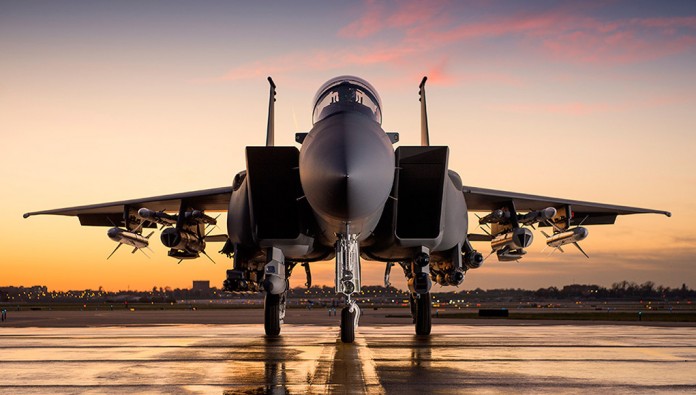
    Enhanced F-15E ground attack weapons carriage showing a mix of 22 air/ground, 4 air/air missiles and additional podded sensors. Photo: Boeing

    Boeing has recently released images depicting weapon configurations developed for the ‘Advanced F-15’, that are likely to support the F-15SA, the most advanced variant of the F-15E fighter aircraft destined for the Royal Saudi Air Force (RSAF).

    Enhanced F-15E ground attack weapons carriage showing a mix of 22 air/ground, 4 air/air missiles and additional podded sensors. Photo: Boeing
    Advanced F-15 ground attack weapons carriage showing a mix of 22 air/ground, 4 air/air missiles and additional podded sensors. Photo: Boeing

    The Advanced F-15 brings improved performance, enhanced situational awareness and increased survivability at a lower total life-cycle cost. Avionics advancements include a Digital Electronic Warfare Suite, Fly-By-Wire flight control system, an Infrared Search and Track (IRST) system and Active Electronically Scanned Array radar. Forward and aft cockpits feature advanced displays and Joint Helmet Mounted Cueing Systems.

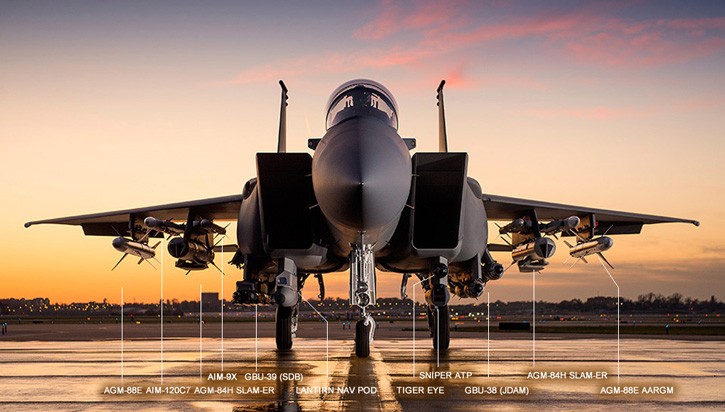
    Two additional weapon stations (outboard stations 1 – 9) were activated, providing increased payload capacity. The two weapon carriage configurations shown in these pictures display an AGM-88E AARGM in the air/ground configuration and two AIM-9X Sidewinder air/air missiles in the air superiority configuration. The later also carries a new pylon configured for four missiles – two AIM-120C7 and two AIM-9X carried on stations 2 and 8. The air superiority mission also benefits from an Infra-Red Search and Track (IRST) unit mounted in front of the cockpit.

    The F-15SA’s made its maiden flight on Feb. 20, 2013at the Boeing facilities in St. Louis, Mo. Three instrumented test aircraft are flying to validate the F-15SA. New aircraft deliveries to the Kingdom of Saudi Arabia are scheduled to begin in 2015 and conclude by 2019.

    The new aircraft is the centerpiece of the Royal Saudi Air Force F-15 Fleet Modernization Program, a wide-ranging $29.4 billion effort that stands as the largest foreign military sale in U.S. history.

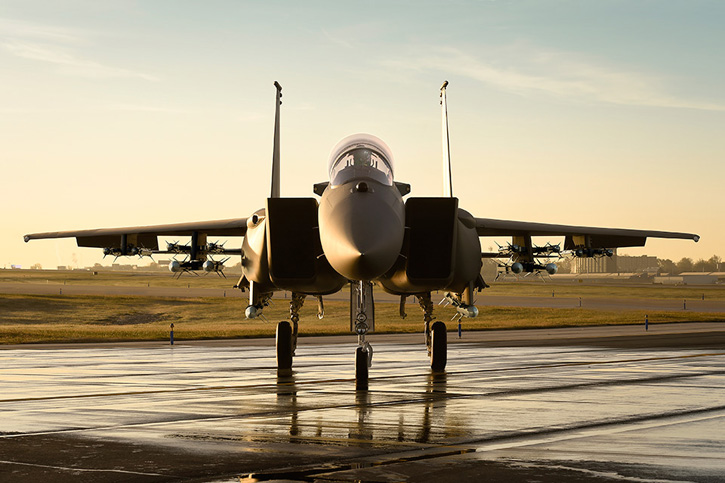
    The new F-15SA developed by Boeing  for the Royal Saudi Air Force (RSAF) is shown here an enhanced air/air configuration, carrying eight AIM-120C7 and eight AIM-9X air/air missiles. Additional loads depicted in this image show two pylons attached to stations 1 and 9, carrying two AIM-9X each, and a new pylon with four launch rails, attached to station 2 and 8. The aircraft also shows the distinctive IRST mounted on the upper nose section and two trapezoidal structures mounting additional forward looking sensors, visible below the rear cockpit. Photo: Boeing
    The Advanced F-15 developed by Boeing is shown here an enhanced air/air configuration, carrying eight AIM-120C7 and eight AIM-9X air/air missiles. Additional loads depicted in this image show two pylons attached to stations 1 and 9, carrying two AIM-9X each, and a new pylon with four launch rails, attached to station 2 and 8. The aircraft also shows the distinctive IRST mounted on the upper nose section and two trapezoidal structures mounting additional forward looking sensors, visible below the rear cockpit. Photo: Boeing

    Chinese Weapons Shipped to Lebanon to Aid Hezbollah

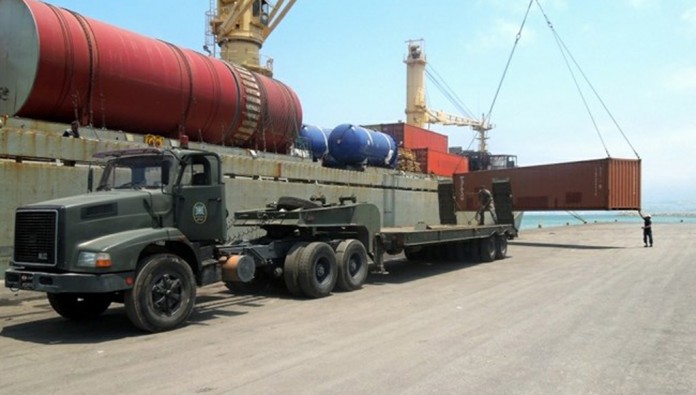
    The Lebanese Army received a shipment of Chinese weapons Friday, the latest in a recent series of international arms deliveries to help Lebanon contain the militants on its eastern border with Syria, Lebanon’s Daily Star reports. The Army statement did not specify what types of weapons and ammunition, or the quantity of the arms, were included in the shipment, which arrived in Beirut’s port before noon. Financed by Saudi grants worth about US$4 Billion, Lebanon has recently purchased weapons from France, USA, Italy and Brazil.

    Across the border with Syria, Hezbollah and the Syrian army Friday struck at militant positions inside Zabadani at the southern end of Qalamoun, on the third day of an offensive aimed at capturing the strategic Syrian town. The forces blocked the main road north of Zabadani to isolate the area from the Qalamoun towns of Serghaya and Ain Hor. Zabadani bears strategic significance for Hezbollah since it once served as a logistical hub for supplying Hezbollah with Iranian weapons. It also served as a base for party fighters and the Iranian Revolutionary Guard.

    Syria: A Threatened Druze Minority faces grave Threat

    druze_syria425Tensions have been high in Israel’s north since many of the Druze have family who are at high risk from Islamic extremists fighting in Syria. On Monday (June 20) morning, a military ambulance carrying wounded Syrians to treatment in an Israeli hospital, was pelted with stones while leaving the Druze town of Hurfeish – a town that is relatively deep inside Israeli territory in the upper Galilee and whose residents, unlike those of Majdal Shams, serve in the IDF.

    Israel regularly allows wounded Syrian civilians and even some fighters for treatment in its hospitals. The IDF has denied claims that it assists Nusra Front, or any of the rebel forces fighting in Syria. But the Druze nevertheless condemn Israel’s humanitarian efforts as helping what they regard, the enemy. If the Druze pressure rises further, Israel may have little choice but to intervene, some way in Syria to help the distressed Druze community if this finds itself facing a real emergency. This should place its leadership, first and foremost the IDF in a serious dilemma.

    Throughout Syria’s civil war, Israel has, so far contended with stray mortar fire across its border but now it faces a new spillover, with internal sectarian violence and regional loyalties threatening to drag it into the conflict. After four years of keeping to the sidelines, Israel’s position is becoming more precarious, particularly as it relates to the Druze community, a threatened people inside Syria and a vocal one across Israel’s northern border on the Golan Heights.

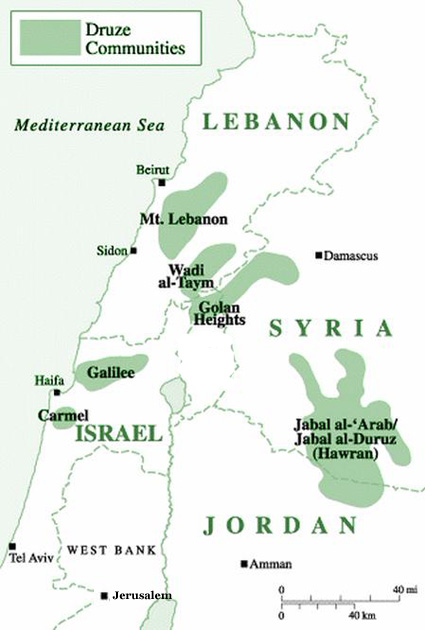
    Druze communities in the Middle East
    Druze communities in the Middle East

    The Druze are a religious group who live as minorities across much of the region, with the biggest communities living in Syria and Lebanon. In this patchwork, Israel effectively houses two Druze populations. It has around 110,000 Druze citizens who identify completely as Israelis, serve in the IDF and have also risen to prominent ranks in the security and government positions. A further 20,000 Druze live on the Israeli annexed Golan Heights, land captured from Syria in the 1967 war.

    The Druze religion arose from Ismailism, a branch of Shia Islam, in the 11th Century. It takes its name from Mohammed bin Ismail al-Darazi, a mystic from Central Asia who regarded the third Fatamid caliph of Egypt, al-Hakim, as an incarnation of God. In 1021, al-Hakim disappeared under mysterious circumstances. Druze believe that he will reappear at the end of time to establish universal justice. To avoid persecution, Druze have been secretive about their religion. Al-Hakim’s successor, al-Zahir, rejected his claim of divinity and persecuted the Druze, forcing them to take refuge in remote mountainous areas, chiefly in Lebanon and Syria. Only a small number who demonstrate extreme piety and devotion are allowed to participate fully in rituals and have access to scriptures.

    Today, Druze make up about 3% of Syria’s population of 22.5 million. Most live in the rugged Jabal al-Druze region of Suweida province, south of the capital Damascus. There are also several Druze villages elsewhere in Syria, including the Jabal al-Summaq region of Idlib – the location of last week’s shooting. And although Druze have played prominent roles in shaping the region’s history, they have traditionally been considered political quietists.

    The Islamic State of Iraq and al-Sham (ISIS) is not the only Salafi-Jihadist threatening the Syrian Druze population. Its prominence in U.S. policy has overshadowed a threat of similar magnitude from Jabhat al-Nusra (JN), the official al-Qaeda (AQ) affiliate in Syria. The two groups share common goals, including a revived Islamic Caliphate. JN, however, is pursuing its aims through a distinct, somewhat more patient methodology that is highly dangerous, despite its low signature.

    The Syrian war has proven that neutrality has no place in a region inflamed by various forms of extremism. The flames of the war have reached the countryside of a major township of Suwayda, close to the Jordanian border, where Bedouin supporters of Jabhat al-Nusra are attacking the Druze regions of the town of Dama and the village of Shaniya.

    According to media reports and local sources, the clashes have led to the deaths of 12-16 people. The Druze — who constitute the bulk of Suwayda’s population — have attempted to remain neutral in the region’s conflicts. Since the Druze sect is one of the region’s minority groups, Lebanese Druze feel a special empathy with their coreligionists in Syria and fear for their fate. The Druze are well known for their solidarity in times of adversity. Therefore, what happens in Jabal al-Arab is seen as an existential threat to the Druze sect as a whole, though some consider it a strictly Syrian concern.

    Many wonder if the Lebanese Druze will follow in the footsteps of other Lebanese groups, like Hezbollah and intervene in Syria in defense of their coreligionists. As a minority, Druze have had to negotiate centuries of conflict in the region. Once more, these days, they are being forced to pick a side and potentially decide their fate.

    Handheld Torch Accelerates Hot Breaching

    torchtech_425
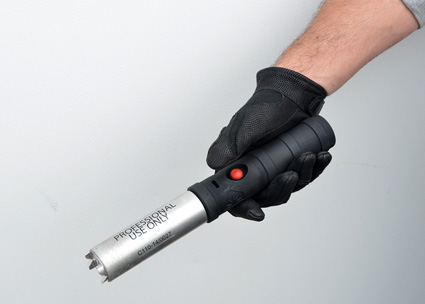
    The rod cutter is designed to be fast, cutting a solid steel rod up to 0.75 inch (19 mm.) of hardened, plain carbon, or stainless, in two seconds. Photo: EMPI

    Special operations forces (SOF) operating in war-zone environments are not regularly welcomed with open arms by their adversaries. In fact, their adversaries provide a variety of obstacles designed to keep them at arm’s length. As a result, SOF personnel requested a compact, lightweight, hand-held tool that would allow them to cut through locks, bars and other barriers.

    The energetic materials specialist EMPI answered the call, with the introduction of TEC Torch – a small, hand-held thermal erosive cutting (TEC) torch that can cut through steel bars in two seconds. Current systems require large oxygen tanks, hoses and separate ignition systems. The TEC torch uses a reusable handle and a disposable cartridge. The combined unit weighs one pound (0.45 kg.) and measures 13 inches (33 cm.) in length, and 1.5 inches (38.1 mm.) in diameter. The device can be used for breaching, forced entry and in rescue operations, as well as for the neutralization of explosive devices (EOD-UXO) and thermal destruction of objects and systems on land and underwater.

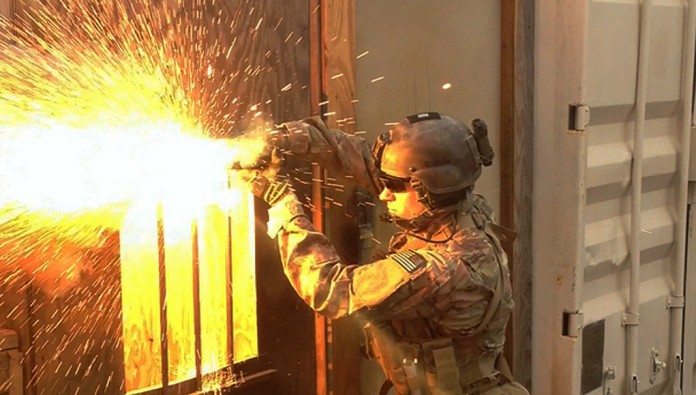
    The torch operates by feeding combustion products jet through an engineered nozzle for approximately 2 seconds. The escaping jet is a combination of vaporized metal and particulate which quickly heats the target above its melting point and erodes the target material away. Cartridges contain a unique thermite formulation to achieve maximum temperature and velocity for optimized cutting performance. The cutting jet burns hotter than 4000°F. Cartridges are designed to contain this intense pressure and thermal energy safely within inches of the operator’s hand.

    The rod cutter is designed to be fast, cutting a solid steel rod up to 0.75 inch (19 mm.) of hardened, plain carbon, or stainless, in two seconds. The Plate Penetrator cartridge can create a 0.35 inch- (8.9 mm.)-diameter hole through a 0.50 inch (12.7 mm.) steel plate. These two cartridge designs can be used in combination and rapid succession to defeat numerous obstacles.

    The device is a thermite-based, high-temperature and high-velocity metal-vapor jet developed by EMPI during the years 2011 to 2013, under a US Air Force Micro-scale Ordnance Technology SBIR. The technology demonstrated the ability to focus an extremely high thermal energy flux into a prescribed pattern using a graphite nozzle with different geometries. This allowed the hot stream to exit in a variety of configurations, including a flat blade for cutting through rods or a round jet for penetrating plates. The objective of the current (third) Phase is to ensure manufacturability and quality control of the TEC torch technology, increasing its production rate from dozens to a thousand units per day.

    According to Dr. Stephanie Johnson, an AFRL researcher involved in the project, the technology has attracted interest from a diverse set of users for several applications. “Other applications for the device include a version for miniature robots and for remote cutting operations for the oil exploration or production industry,” Johnson added.

    Introduced in 2013, TEC Torch was further developed under the US Air Force Small Business Innovation Research/Small Business Technology Transfer (SBIR/STTR) program office, optimizing the apparatus for use by SOF personnel, law enforcement and first responders. “EMPI has already provided over 600 hand-held units to SOF and to local and federal law enforcement agencies for determining reliability, performance and safety, and several of these units have been used in demonstration for SOF and law enforcement customers,” said Dennis Wilson, EMPI’s SBIR principal investigator. “Their feedback has been incorporated into making design changes, such as handle length and safety modifications.”

    The company is also developing scaled-up cartridges designed for heavy rod cutting up to 2 inch (50.8 mm) diameter and plates to 1.25 inch (31.7 mm) thickness.

    Since fuel and oxidizer components are fully contained inside a sealed cartridge body, the torch effectively operates underwater. Testing are currently underway to characterize the performance and safety of the devices at depths up to 40 meter.

    Egyptian Army Slams Militants in Northern Sinai After Deadly IS Attack

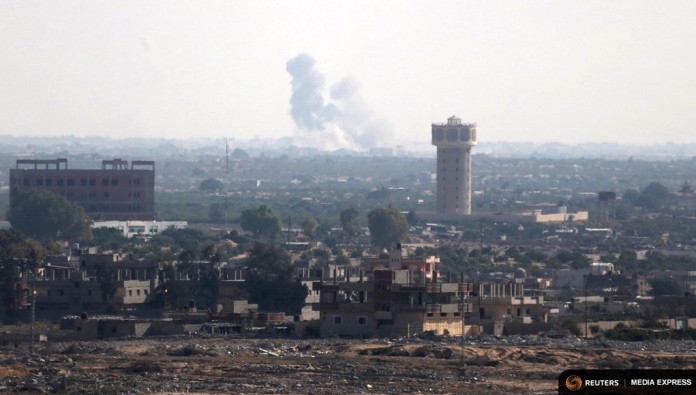
    ISMAILIA, Egypt (Reuters) – Egypt’s military killed 35 Islamist militants in North Sinai on Thursday, following a wide scale attack by militant groups affiliated with the Islamic State (ISIS). Army forces, backed by aerial support, stormed militant bases south of the North Sinai town of Sheikh Zuweid, the security sources said, and were able to destroy vehicles and weapon storage facilities. The army also defused 15 bombs planted by the militants as booby traps on the roads and cleared the perimeter of Sheikh Zuweid police station which the militants surrounded by explosives on Wednesday.

    Those killed had taken part in Wednesday’s fighting in which the army said 100 militants and 17 soldiers were killed. The sources said Thursday’s casualties included militant field commanders.

    The militants’ assault, a significant increase in violence in the peninsula between Israel, the Gaza Strip and the Suez Canal, was the second major attack in Egypt this week. On Monday, a car bomb killed the prosecutor-general in Cairo, the highest-profile official to die since the insurgency began.

    Egyptian President Abdel Fattah al-Sisi inspected soldiers and police in El-Arish, the provincial capital; few hours after Sisi’s speech in El-Arish, IS’ Sinai Province announced it had attacked two army vehicles with two bombs in the area of Sheikh Zuweid.

    On Friday night militants in Sinai fired rockets into southern Israel, in an incident that caused no casualties but appeared to be linked to fighting between Islamist insurgents and Egyptian security forces. Militants, including those from Sinai Province – formerly known as Ansar Bayt al-Maqdis – have fired rockets into Israel from Sinai on several occasions in the past. Israel has accused Hamas, the Islamist group which controls Gaza, of helping Islamic State in Sinai, an allegation Hamas denies. An Egyptian security source said some Hamas members were involved in the Sinai battles, but that there were no wider organisational ties between the groups.

    (By Yusri Mohamed, Maayan Lubell and Mostafa Hashem. Additional reporting by Ahmed Mohamed Hassan, Ahmed Tolba and Ali Abdelaty in Cairo, Allyn Fisher in Jerusalem; Writing by Ahmed Aboulenein; Editing by Grant McCool)

    Syrian Regime Airstrikes Aleppo Following Rebel Assault

    Aleppo in ruins, June 27, 2015. Photo: REUTERS/ Abdalrahman Ismail

    BEIRUT (Reuters) – Syrian government forces carried out heavy airstrikes on rebel positions in and around the northern city of Aleppo on Friday, aiming to repel a major Islamist-led offensive on areas controlled by President Bashar al-Assad.

    Thursday’s attack, the most intense insurgent offensive in Aleppo in three years, aimed to build on recent advances against Assad by an array of groups fighting on separate fronts, including Islamic State and rebels backed by his regional foes.

    Aleppo, 50 km (30 miles) south of the Turkish border, was Syria’s most populous city before the country’s descent into civil war. It has been partitioned into zones of government and insurgent control since 2012.

    Aleppo is of vital importance to Assad, and losing it would further entrench a de facto partition of Syria between western areas still governed from Damascus and the rest of the country run by a patchwork of militias.

    Elsewhere in Syria, The United States and its allies have conducted 24 air strikes against Islamic State in Iraq and Syria on Thursday, the coalition leading the operations said in a statement on Friday.

    Elsewhere in Syria, US coalition forces targeted Islamic State positions with nine strikes near the cities of Hasakah, Ar Raqqah and Tal Abyad, destroying tactical units, fighting positions, vehicles and structures.

    (Writing by Sandra Maler; Tom Perry; Suleiman Al-Khalidi, Editing by Andrea Ricci; Mark Heinrich)

    Saudi Airstrike Retaliate Yemeni Strike on Strategic Missile Base

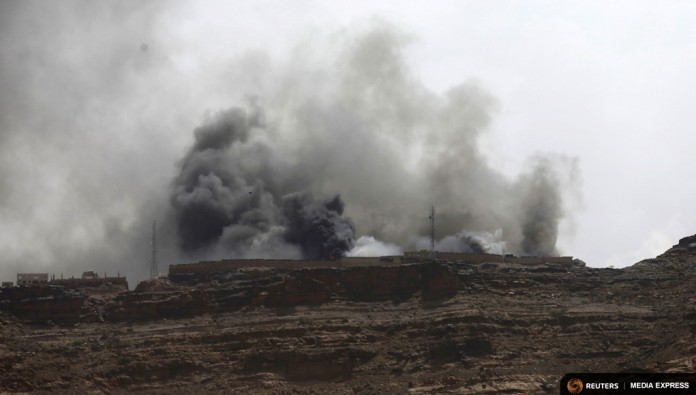
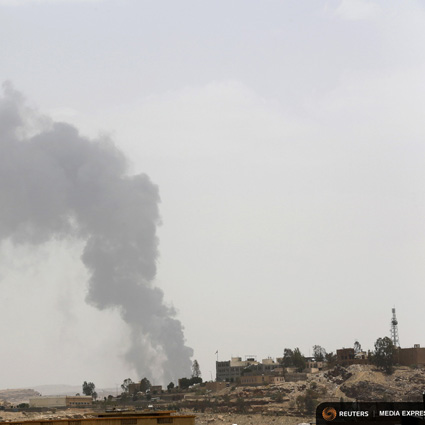
    Smoke billows from the site of a Saudi-led air strike in Yemen's capital Sanaa July 2, 2015. Photo: Reuters/Khaled Abdullah

    SANAA (Reuters) – Saudi-led airstrikes killed at least 16 people in Yemen on Friday, the country’s dominant Houthi militia said, and the European Union and United States appealed for a pause in the war to enable aid deliveries to stricken civilians.

    The Saudi retaliated after Yemeni Scud missile targeted the Saudi strategic missile base in Wadi ad-Dawasir (Al Sulayyil) in Riyadh province on June 30. The base is located about 400 km from the Yemeni border, within range of Yemen’s Scud ballistic missiles. Operational since 1988, Al Sulayyil missile base was the first operational base of the Royal Saudi Strategic Missile Force. It operates an unspecified number of Chinese made DF-3 ballistic missiles.

    An Arab coalition has been bombarding Iran-allied Houthi forces and allied army units since March in a campaign to restore exiled President Abd-Rabbu Mansour Hadi to power.

    Houthi sources said six people including a woman and a child were killed and six wounded in a dawn air strike on the al Jaraf neighbourhood of the capital Sanaa.

    The Houthi-controlled Saba news agency reported 10 people were killed by Saudi-led aerial attacks on a building in Bayt al-Faqih city in the southwestern province of al Hodeida.

    Eight Houthis were also killed in an explosion at the public library in the Red Sea port city of Hodeida used by members of the group, local officials said. But the exact cause of the blast was disputed, with one report saying it was caused by an air strike while another said it was a car bomb.

    yemen_attacks2
    Smoke billows from the site of a Saudi-led air strike in Yemen’s capital Sanaa July 2, 2015. Photo: Reuters/Khaled Abdullah

    Air strikes were also staged against Faj Attan mountain overlooking Sanaa, home to a military base and a weapons depot that had been a frequent target in the course of the three-month-old war in the Arabian Peninsula country.

    In the dawn attack, warplanes also hit the ministry of communications building, Saba reported, setting it on fire and destroying nearby buildings.

    Warplanes returned for another raid on Sanaa around noon, but there was no immediate word on casualties or damage.

    The Houthis captured Sanaa last September, pushing Hadi’s government aside and then began expanding south and westwards. The president eventually fled the port of Aden in March after the Houthis advanced on his southern stronghold.

    (Reporting by Mohammed Ghobari in Sanaa, Adrian Croft in London; Writing by Hadeel Al Sayegh; Editing by Sami Aboudi and Mark Heinrich)

    RADA to Deliver Tactical Air Surveillance Radar to a European Customer

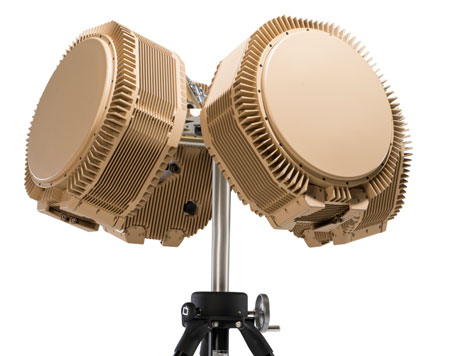
    The RPS-42 selected by the US Navy is based on RADA's MHR radar AESA platform. Photo: RADA

    Israel’s defense electronics company RADA Electronic Industries announced it has recently received an order to supply an RPS-42 tactical air surveillance radar to a leading European defense contractor. The new radar, a member of RADA’s S-band multi-mission hemispheric radar (MHR) family of systems, will be delivered later this year. According to company sources, several customers have selected the RPS-42 for aerial surveillance missions.

    MHR is a software-defined, Pulse-Doppler, active, electronically scanned array (AESA) radar. It has sophisticated beam-forming capabilities and advanced signal processing. Derivatives of the MHR radar can be configured to perform multiple missions thus offering an affordable alternative to much larger systems.

    As an aerial surveillance radar the RPS-42 variant is designed to detect and track multiple aerial targets, ranging from transport aircraft and high performing fighter aircraft — down to the smallest multi-copter nano UAVs (unmanned aerial vehicles).

    “We are very pleased with this order. While the order is not large, it comes from a new customer and we believe it confirms our global presence in this growing market. The European market is demonstrating increased interest in our radars and inertial navigation systems and is gradually becoming one of our major markets,” said Zvi Alon, RADA’s CEO.

    Benelux Invest $150 million in Infantry Smart Vests

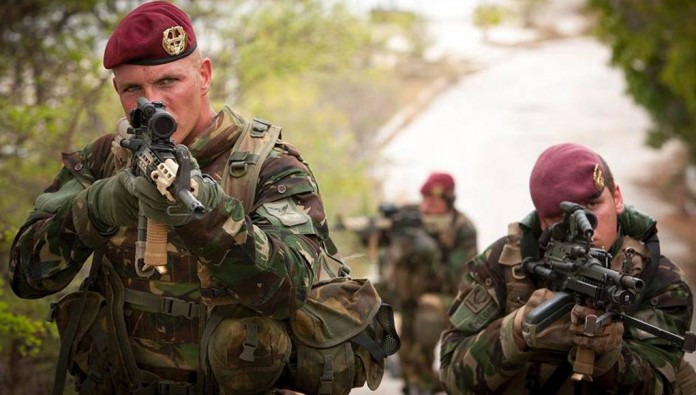
    Royal Netherlands infantry soldiers will add advanced 'Smart Vests' as part of their combat gear, beginning 2017. The new vests will include new radios, touch-screen hand-held computers and integrated load carrying and personal armor, enhancing the protection, mobility and combat efficiency of the warfighter. Photo: Royal Netherlands Army

    Elbit Systems announced today that its subsidiary, Elbit Systems Land and C4I Ltd. was awarded a contract from the Dutch Ministry of Defense, to supply ‘Smart Vests’ to equip the infantry soldiers in the Benelux countries – Netherlands, Belgium and Luxemburg. The contract, valued at approximately US$150 million, will be performed over a five-year period. The initial contract calls for the delivery of 135 pre-production systems – 80 for the Netherlands will be delivered next year, along with 40 for Belgium and 15 for Luxembourg.

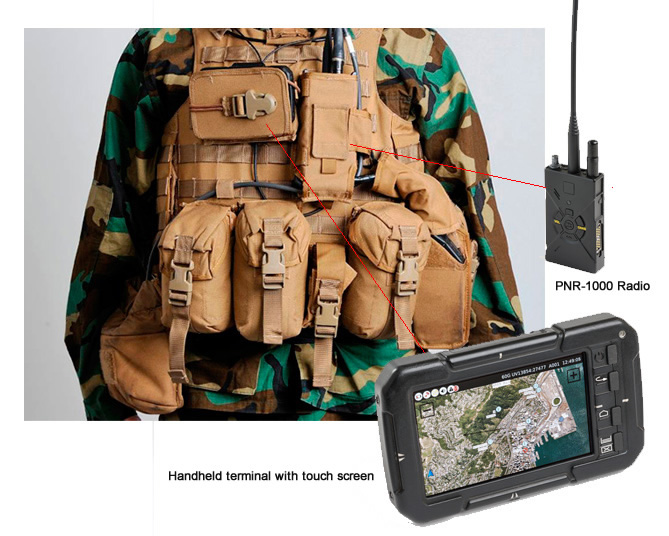
    Each ‘Smart Vest’ program includes wearable and protective systems for the soldier, command and control systems, including advanced audio and data radio systems, specialized displays and C4I capabilities as well as support systems integrated in combat vehicles. The mobile communication gear consists of the PNR-1000 Software Defined MANET soldier radio from Elbit Systems’ Tadiran division, and a hand held terminal. Operated with touchscreen and integral GPS, soldiers can see each other’s location on a map, access and send information and communicate with other units or headquarters.

    “The Smart Vest is a big step forward in safety and performance of the Benelux soldiers at operational deployment,” said Vice Admiral Matthieu Borsboom, Director Defence Materiel Organisation. he said the new gear improves performance in all areas – survivability, mobility and situational awareness, improving overall command and control and operational effectiveness.

    a big step forward in safety and performance of the Benelux soldiers

    The ‘Smart Vest’ is a co-operation between the soldier modernization programs of the Benelux countries: Netherlands’ VOSS, Belgium’s BEST and Luxemburg’s COMPASS. It is the first strategic joint program of the Benelux countries, and will enhance the warfighter’s survivability and safety while increasing their combat effectiveness empowering their digital capabilities in combat. Based on Elbit Systems’ DOMINATOR system, designed to be light-weight, modular and scalable and will interface with existing systems.

    Elbit Systems will serve as the program prime contractor, with Thales Netherlands B.V its main sub-contractor which is responsible for vehicle systems integration, battery and GPS equipment. “We welcome domestic Benelux companies to join us in the project in order to strengthen the support for the local customers”. Bezhalel (Butzi) Machlis, President and CEO of Elbit Systems commented, adding that the fact “that such advanced armies have selected our solutions attests to our technological leadership and to the maturity of our solutions”.

    The Benelux requirement is for more than 10,000 vests to be delivered through 2020. This includes 5,500 vests for lead customer the Netherlands, to begin deliveries in 2017 as part of its current Improved Operational Soldier System (VOSS) programme. Belgium has a need for approximately 4,500 systems under its Belgian Soldier Transformation (BEST) programme. Luxemburg is likely to receive few hundred systems for its Cooperative Modernisation Program of the Army for a Soldier System (COMPASS).

    The Dutch program will also benefit from the E-Lighter – a new power source developed by Fokker in parallel to VOSS. The E-lighter is a portable diesel generator, that provides 48 hours of power for the ‘Smart Vest’.

    The Smart Vest includes the PNR-1000 MANET SDR radio and hand-held tactical terminal, integrated into the load carrying and protection suite. Photo: ELbit Systems & Royal Netherlands Army.
    The Smart Vest includes the PNR-1000 MANET SDR radio and hand-held tactical terminal, integrated into the load carrying and protection suite. Photo: ELbit Systems & Royal Netherlands Army.

    Cyber Intelligence Report – July 1, 2015

    cyber_report

    ISRAEL

    IDF to establish new cyber command

    IDF Chief of Staff Gadi Eisenkot concluded on Monday that, in light of the challenges the IDF faces in the cyber sphere, a cyber command should be established in order for it to oversee all operational activity in the cyber dimension. According to the IDF Spokesperson’s Unit, the new command will be established over a time period of two years. A multi-branch team will be responsible for presenting the Chief of Staff with a development plan. The new command is of utmost importance in the mission to adapt the IDF to the dynamic changes and challenges of modern warfare. “The IDF is required to excel in every aspect of war, including the cyber dimension, which is becoming more significant every day. This new command will empower the IDF to perform better in these fronts and will utilize the technological and human advantage that already exists in Israel,” said Eisenkot. The decision will be submitted to the authorization of Defense Minister Moshe Ya’alon, the IDF said.

    Israeli regulator directs banks to focus on cyber security management

    The purpose of the directive (Directive 361, issued in March, 2015) is to support banks in efforts to manage cyber-related risks and help banking corporations manage such risks, said the supervisor of banks at the Bank of Israel.

    Europe’s largest cyber-tech firm to set up innovation center in Israel

    The German Fraunhofer SIT industrial technology institute announced that it would be setting up an international cyber research center in Israel in cooperation with the Technion Israel Institute of Technology. The center, which will focus on the development of software, systems, products, and services for use in the civilian sector, is expected to be set up by the end of the year. The research will be carried out both in Israel and Germany and will involve the exchange of staff between the two countries. The center will also cooperate with high-tech companies in Israel, including SAP Labs. “The Institute will join forces with Israel, which is widely regarded as the nation with the biggest experience and a very well trained workforce in this area, as well as one of the highest innovation capacities worldwide,” the company said.


    USA & Canada

    US admonish China for online attack

    In a bilateral meeting on June 23, senior officials of the Obama administration admonished China for sponsoring online attacks against businesses, but they remained silent, at least publicly,  on the suspected role of Chinese hackers in the recently discovered theft from government computers of personal data on millions of federal employees and contractors. Vice President Joseph R. Biden Jr. has declared that the country was not a “responsible competitor” in cyberspace. Treasury Secretary Jacob J. Lew has shown his concern about government-sponsored cyber theft from companies and commercial sectors. Secretary of State John Kerry suggested the two sides should have “a very frank discussion of cyber security and other ongoing concerns” once they went behind closed doors. US also stressed the importance of keeping the sea lanes of Asia open despite rising tensions. China expressed the hope that the two countries will manage their differences and manage to avoid any confrontation. State Councilor Yang Jiechi has declared that China is prepared to work closer with the US on the issue of cyber-crime and said Beijing supports an “international code of conduct for cyber information sharing.”

    Anti-LGBT site hacked and painted with gay flag’s colors

    Shortly after the US congress announced the ruling in favor for same sex marriage all over the 50 sates of the US, a group of hackers managed to gain access to the online Gospel news portal site (verdadegospel.com) and left the gay flag pinned for all to see. The online Gospel news portal is a protestant group with anti-gay prospective and acts. The hackers are a part of a group called “ASOR Hack Team.” The Verdade Gospel group has 264k fans on Facebook and 140k followers on Twitter, most of them being exposed to the colorful hacking job.

    Cyber-attack on Canadian government websites

    Several Canadian government websites and servers were taken down in a cyber-attack on June 17, 2015. The hacker group Anonymous posted a YouTube video and statement the same day claiming responsibility for the attack. The video said the attack is in response to the government’s anti-terrorism Bill C-51, which was recently passed in Parliament. This law would broaden the mandate of the Canadian Security Intelligence Service (CSIS), giving the agency new powers to disrupt perceived security threats. The legislation, once enacted by the government, would also make it easier for federal agencies to increase surveillance and share information about individuals. Tony Clement, the cabinet minister responsible for the Treasury Board, confirmed on his Twitter account the cyber-attack on the general website for government services (canada.ca), as well as the site of Canada’s spy agency and the Canadian Security Intelligence Service (CSIS). The government said the attack also affected email, Internet access, and information technology assets. Public Safety Minister Steven Blaney denounced the cyber-attack, telling reporters that there were many other democratic ways for Canadians to express their views. He also said the government was implementing efforts to improve its cyber security.


    RUSSIA

    Russia fosters domestic software for national computer

    The Russian state Duma adopted, in the third reading, a bill on preferences for domestic-made software for national computer and IT systems. Beginning January 1, 2016, there will be a requirement to justify their choice in favor of foreign software; if there will be a specially crafted Russian domestic-made software counterparts. However, this limitation will only affect state bodies, said the “Vedomosti” news publication.


    MIDDLE-EAST

    Iran and Saudi Arabia heading toward cyber war?

    Iran and Saudi Arabia, regional rivals in the Middle East, may be engaged in cyber warfare, according to a new report by threat intelligence firm Recorded Future. As the two powers vie for influence over the civil wars in Yemen and Syria and regional dominance, Tehran and Riyadh have begun using cyber-attacks to release critical intelligence.

    WikiLeaks released on June 19 over half a million cables from the Saudi Foreign Ministry, including several “Top Secret” reports from the country’s General Intelligence Services after a hack by a group calling itself the Yemeni Cyber Army. The Washington Post reported the theft of the Saudi Cables bore indications of Iranian hackers.


    CHINA and APAC

    New China law to boost cyber security

    China has passed sweeping new legislation reinforcing government controls over cyberspace in the wake of what it called growing threats to Chinese networks. The vaguely worded National Security Law adopted calls for strengthened management over the web and tougher measures against online attacks, theft of secrets, and the spread of illegal or harmful information. It said core information technology, critical infrastructure and important systems and data must be “secure and controllable” in order protect China’s sovereignty over its cyberspace.

    China says it is a major target of hacking and other cyber-attacks, while the ruling Communist Party has expended vast efforts in blocking content available in China that is deemed subversive or illegal.

    Singapore Defence Minister: Non-combat troops can help in cyber defence

    Soldiers who may not be fit enough to take on combat roles can instead help the Singapore Armed Forces in its fight against online threats. Calling this group of soldiers a “resource pool that we can draw from,” Defence Minister Ng Eng Hen said they can work alongside their combat-fit counterparts to monitor cyber threats and beef up the Singapore Armed Forces’ networks against virtual attacks.


    EUROPE

    UK Ministry of Defense counter thousands of daily cyber-attacks

    The UK’s Ministry of Defense hase recently declared that UK is being targeted by thousands of advanced daily cyber-attacks and declared military officers responsible for defending the army’s computer networks. According to the Brigadier Alan Hill, head of Operate and Defend at the MoD, the British Army is a large target for state and non-state actors spying operations. Accediting to the British authorities, the United Kingdom’s military computer network, which is the largest in Europe, is targeted by more than 1 million cyber incidents on a daily base. As declared in 2011 while UK invested about 800 million pounds in its cyber defense, cyber threats has become one of the UK’s top defense priorities. In an interview given to the Financial Times, Brig Hill declared, “The MoD’s ‘cutting edge’ lies in using big data analytics to sift through the millions of incidents on its network that sensors pick up. We have to have automated. . . and really slick processes to find the needle in the haystack,” Even if the UK is one of the largest targets in Europe and facing thousands of daily cyber-attacks, it is probably the country which has the best cyber defense system to counter these threats. Most of these cyber-attacks are coming from Russia and China, which seems to be engaged in a cyber cold war against the West and UK. Indeed China and Russia have been engaged in cyber espionage operations against the UK for the past 15 years. One of the first operations involved a data breach of the British government systems in 2003. A fraudulent email from a Tibetan group containing a virus that allowed the hackers the opportunity to gain access to the network was opened in the UK Foreign Office. In the next few years, evidence that Britain was targeted by a cyber-espionage campaign became clearer. This evidence also showed that these cyber campaigns did not just target the government, but also businesses for their economic or industrial secrets.

    Europol Cyber Crime Center EC3 is countering the Islamic State propaganda

    The Cyber Crime Center of the European law enforcement agency Europol has recently announced the creation of a new unit specialized in propaganda countering. Indeed this new unit will attempt to remove the social network accounts which promote jihadism, extremism, and religious fundamentalism. This new unit will be operational beginning July 1, 2015. According to the head of Europol, Mr. Wainwright, the team will initially be composed of 15 to 20 members, who “will combine what we see on social networks with more traditional intelligence sources.” Europol will recruit these new specialists from EU country members and will probably have a strong background in intelligence and cyber fields. Europol is following the move and taking example on the UK Internet-Savvy Army Unit, which has been created in order to counter these threats at the beginning of 2015. In a period where the Islamic State continues to strengthen its presence and increase its power, this new unit will be a helpful solution in countering online propaganda and thus reducing the number of people being recruited to fight alongside the Islamic State in Syria.

    Hackers targeted Polish airline LOT, grounded 1,400 passengers

    A cyber-attack against the ground computer systems of the Polish flagship carrier LOT grounded more than 1,400 passengers at Warsaw’s Okecie airport. The Polish national airline, LOT, announced on June 20 that it had cancelled 10 flights due to a cyber-attack against the airline’s ground computer systems at Warsaw’s Okecie airport. The attack occurred at around 4:00 pm local time and was resolved by 9:00 pm.


    inss150About the Cyber Intelligence Report:

    This document was prepared by The Institute for National Security Studies (INSS) – Israel and The Cyber Security Forum Initiative (CSFI) – USA to create better cyber situational awareness (Cyber SA) of the nature and scope of threats and hazards to national security worldwide in the domains of cyberspace and open source intelligence. It is provided to Federal, State, Local, Tribal, Territorial and private sector officials to aid in the identification and development of appropriate actions, priorities, and follow-on measures. This product may contain U.S. person information that has been deemed necessary for the intended recipient to understand, assess, or act on the information provided. It should be handled in accordance with the recipient’s intelligence oversight and/or information handling procedures. Some content may be copyrighted. These materials, including copyrighted materials, are intended for “fair use” as permitted under Title 17, Section 107 of the United States Code (“The Copyright Law”). Use of copyrighted material for unauthorized purposes requires permission from the copyright owner. Any feedback regarding this report or requests for changes to the distribution list should be directed to the Open Source Enterprise via unclassified e-mail at: [email protected]. CSFI and the INSS would like to thank the Cyber Intelligence Analysts who worked on collecting and summarizing this report.


    Korea Selects A330 MRTT for its Future Aerial Tanker

    Airbus Defense and Space has won a US$1.3 billion (1.488 trillion won) tender for the supply of four aerial refueling tankers for South Korean, beating competing offers from its U.S. rival, Boeing, and Israel Aerospace Industries (IAI).

    Under the deal, Airbus will supply four A330-200 in-flight refueling aircraft to the South Korean military by 2019.

    South Korea evaluated three options for its aerial refuelers: Israel Aerospace Industries offering commercial Boeing 767, converted to multi-mission military refueling and transport missions; Boeing offered the KC-46, a new-built B767 refueling platform, developed for the US Air Force. Airbus proposed the military derivative of the commercial A330-200 based Multi-Role Tanker Transport, (MRTT).

    The Airbus model is currently competing for a similar Indian Air Force tender and has already been selected by Australia, Britain, the UAE, Saudi Arabia and Singapore.

    MTGR Robot Joins the Polish Army

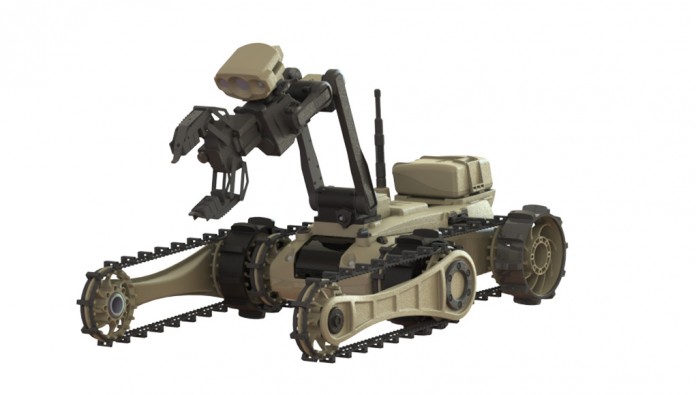
    Poland has selected the MTGR to equip its ground forces with a reconnaissance robot as part of ‘Project Tarantula.’ The man-portable Mini-UGV was developed and produced by RoboTeam, an Israeli specialist in ground robotics.

    Originally, Poland planned to field 50 robotic scouts by 2018, but the need for such systems has increased due to the growing tension in neighboring Ukraine, leading the Poles to accelerate the program. The Reago Group, Roboteam’s Warsaw-based partner, will deliver the 50 robots by the end of next year, acting as the prime contractor for the Polish contract. The new robots will support the Polish Army reconnaissance platoons both from the modernized BRDM armored recce vehicles, and on dismounted operations.

    At a curb weight of 16-19 lbs (7.3 – 8.6 kg), MTGR can carry a payload of 22 lbs (10 kg), and operate for 2-4 hours at a range of 500 meters, moving in indoor or outdoor, open or densely vegetated, urban, and subterranean environments.

    As the robot selected for the Tarantula project, MTGR will provide enhanced visibility in areas inaccessible by human soldiers.personnel.
    As the robot selected for the Tarantula project, MTGR will provide enhanced visibility in areas inaccessible by human soldiers.personnel.
    Configured for reconnaissance, MTGR is equipped with an integral, omni-directional viewing system, which provides constant, 360° video coverage with a x10 zoom, day/night camera and microphones. On Explosive Ordnance Disposal (EOD) and public safety missions, the camera system is replaced by a manipulator arm with four degrees of freedom, operated via a highly-intuitive interface.

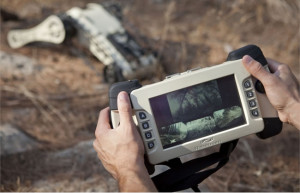
    MTGR is controlled via the RCOU7 console over a wireless mesh networking datalink. Photo: Roboteam
    MTGR is controlled via the RCOU7 console over a wireless mesh networking datalink. Photo: Roboteam

    MTGR has scored several marketing successes since its introduction in 2012. It is now operational and combat proven with US Special Forces EOD units and Israel’s Defense Forces. Special forces units in the UK have also ordered the MTGR.

    Unmanned Centaur Flies over NY State

    Aurora's Centaur OPA is based on the Austrian Diamond DA42 aircraft configured for manned and unmanned flight. In June 2015 the aircraft has flown multiple unmanned flights over the state of New York. Photo: Aurora Flight Sciences

    The Centaur optionally piloted aircraft (OPA) has flown multiple unmanned flights over the State of New York, operating from Griffiss International Airport in Rome, New York during the past month. The flights marked the first time any large-scale, fixed-wing aircraft has flown at either of six FAA-designated unmanned aircraft test sites in the U.S.

    The successful test flights were conducted in full cooperation and compliance with Oneida County’s Griffiss UAS Test Site, which is managed by Northeast UAS Airspace Integration Research Alliance (NUAIR). Flying unmanned aircraft in the US has been limited by FAA regulations on the integration of UAS in civilian airspace, as flights of military and commercial drones are limited to military-controlled areas and certain areas that were approved for research, testing and specific commercial applications last year.

    “Having Centaur lead the way in the U.S. as the first large aircraft to fly in one of the FAA-approved test sites is an important milestone for our company, Griffiss, and the FAA,” said Dr. John S. Langford, Chairman and CEO of Aurora. “This aircraft is coming into high demand from a range of customers, both military and commercial interests, in the U.S. and abroad. The flights conducted at the Griffiss site enable our company to offer these customers an aircraft that has been at the leading edge of efforts to integrate unmanned aircraft into the U.S. national airspace.”

    Aurora’s Centaur OPA is based on the Austrian Diamond DA42 aircraft, configured for manned and unmanned flight. The manned flight option enables access to airports worldwide, without the need for large transport aircraft. Conversion to the unmanned flight mode can be done in a few hours, preparing the aircraft for extended airborne missions supporting clandestine operations and low-profile Intelligence, Surveillance and Reconnaissance (ISR) missions. A wide range of payloads is available to support numerous commercial and military applications. The Centaur has been operating in Switzerland since 2012, testing sensors destined for the future Hermes 900 UAV systems.

    Designed as a general aviation aircraft, the four-seat DA42 Twin Star is also used as a manned platform by a number of users worldwide, equipped with dedicated sensor packs for ISR, COMINT and geographical surveying.

    In addition, a fully-unmanned version of the DA42, called ‘Dominator XP,’ was developed under a joint program between Aeronautics and Diamond Aircraft. In 2012 the Dominator XP began flying in Canada from Alma, Quebec, under Project Miskam, undertaken by CAE and Aeronautics to demonstrate commercial applications of UAS, in support of missions such as remote inspection of pipelines and hydroelectric installations, surveillance of forest fires, observation of critical natural resources, assessment of natural disasters etc.

    According to Langford, Global interest in the Centaur has increased dramatically in recent months, and “a number of customers have expressed interest in the one-two punch of combining Centaur’s medium altitude, long-endurance capability with unique expertise acquired on other Aurora unmanned aircraft programs,” he said. Built for very long endurance missions, Aurora’s Orion UAS set the world record for unmanned aircraft endurance, with an 80-hour flight performed in December 2014.

    centaur_opv_725

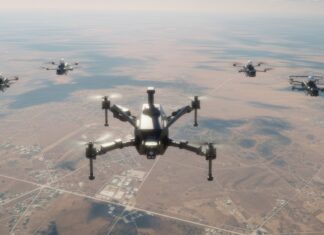
    Skunk Works and XTEND Simplify Multi-Drone Command

    0
    Lockheed Martin Skunk Works® and XTEND have achieved a major milestone in JADC2 by integrating the XOS operating system with the MDCX™ autonomy platform. This technical breakthrough enables a single operator to simultaneously command multiple drone classes, eliminating the friction of mission handoffs. From "marsupial" drone deployments to operating in GPS-denied environments, explore how this collaboration is abbreviating the data-to-decision timeline and redefining autonomous mission execution.

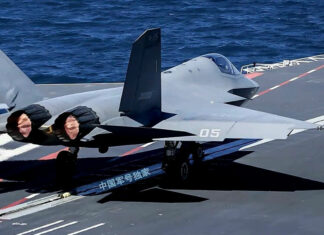
    From Ukraine to Taiwan: The Global Race to Dominate the New Defense Tech Frontier

    0
    As traditional defense primes face mounting competition from agile “neoprimes” such as Anduril, Palantir and Helsing, the balance of innovation is shifting toward software-defined warfare and scalable, dual-use technologies, while global industry consolidation—marked by Boeing’s integration of Spirit AeroSystems and other strategic mergers—signals an intensified race to secure control over the defense technology value chain. Our Defense-Tech weekly report highlights these trends.

    Europe’s “Drone Wall”

    0
    In early October 2025, a coordinated wave of unmanned aerial system (UAS) incursions—widely attributed to Russia—targeted critical infrastructure across at least ten European nations. The unprecedented campaign exposed the fragility of Europe’s air defenses...

    Weekly Defense Update & Global Security Assessment

    0
    Executive Summary The past week (September 18-25, 2025) represents an inflection point where strategic defense concepts have transitioned from doctrine to tangible reality. An analysis of global events reveals four primary, interconnected trends shaping an...

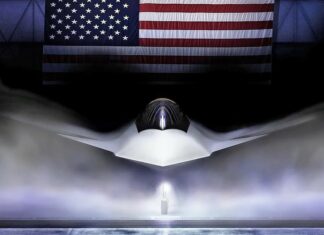
    U.S. Air and Space Forces Push Next-Gen Programs at the AS&C 2025 Conference and...

    0
    At the 2025 Air, Space & Cyber Conference, U.S. Air Force and Space Force leaders unveiled major updates on next-generation fighters, bombers, unmanned systems, and space initiatives, highlighting both rapid innovation and critical readiness challenges as the services race to outpace global competitors. A short version is available here, with a more detailed version for subscribers.

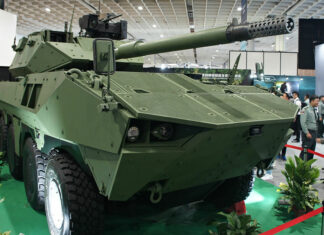
    TADTE 2025: Reflecting Taiwan’s Strategic Themes

    0
    The Taipei Aerospace & Defense Technology Exhibition (TADTE) 2025 crystallized around four dominant strategic themes that collectively illustrate Taiwan's comprehensive approach to defense modernization amid escalating regional tensions. Based on a detailed report by Pleronix (available upon request). Includes a Podcast discussion on TADTE 2025's highlighting Taiwan's four strategic themes beyond the post's coverage.

    Iron Beam 450 Completes Testing, Soon to Join With Operational Air Defense Units

    0
    Israel’s Iron Beam 450 high-power laser system has completed final testing, marking a major leap in air defense. Developed by Rafael, it offers precise, cost-effective interception of rockets, UAVs, and mortars, and is set for IDF deployment by 2025.