Thursday, December 25, 2025
More
    Home Blog Page 115

    Washington to supply 14,000 TOW missiles to the Saudi National Guard

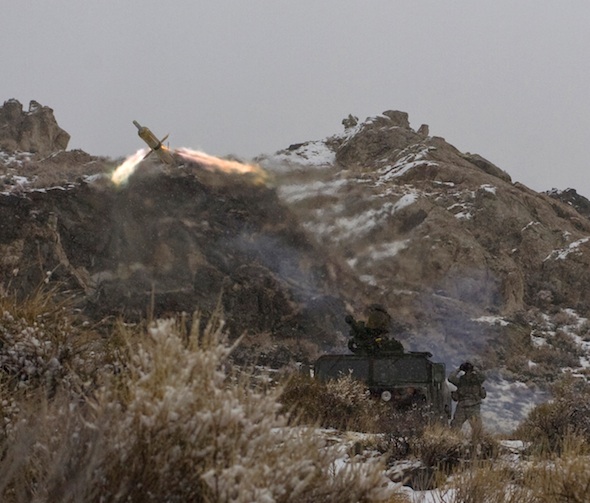
    TOW Missile launched from a HMMWV. Photo: Raytheon
    TOW Missile launched from a HMMWV. Photo: Raytheon
    TOW Missile launched from a HMMWV. Photo: Raytheon

    Following a conclusion of a large foreign military sales contract signed by the US Government, the Raytheon company is expecting an order for 14,000 tube-launched, optically tracked, wireless-guided (TOW) missiles worth about $750 million. The international customer was not named but believed to be the Kingdom of Saudi Arabia. The missiles are destined to the Saudi Arabia National Guard’s (SANG), bolstering their defense and counter-terrorism mission capability. The missiles will be delivered over a period of three years, beginning in 2015. An order is expected within weeks, Raytheon said.

    Saudi Arabia has recently concluded a contract with general Dynamics land Systems Canada, for the delivery of a new fleet of armored vehicles, some of which will be equipped with missile launchers. First deliveries of these vehicles are expected in 2016. Saudi Arabia currently operates over a fleet of 500 V-150 Commando, delivered by Textron Systems’ subsidiary Cadillac Cage in the 1970s. Some of these vehicles are also carrying TOW missile launchers.

    As a semi-automatic guided missile, the TOW has no seeker on board, thus it is highly suitable for asymmetric warfare, engaging unarmored ‘soft targets’ from ground launchers, vehicles. With the wireless version, TOW 2B AERO is also useful over water, against boats and amphibious targets.

    The Saudi order, outlined in December 2013 includes two types of missiles currently under production – 9,650 TOW 2A wire-guided variant and 4,145 TOW 2B AERO RF (wireless) missiles. Raytheon is also offering a Bunker Buster variant. TOW is in service in more than 40 international armed forces and integrated on more than 15,000 ground, vehicle and helicopter platforms worldwide. Raytheon has delivered more than 675,000 TOW missiles to U.S. and allied warfighters; the TOW weapon system is expected to be in service with the U.S. military beyond 2025 and worldwide, until 2050.

    The new order will enable Raytheon to sustain and even expand the production capability of its TOW product line, the company announced.

    NATO’s quick reaction alert scrambled to follow Russian bombers over the North Sea

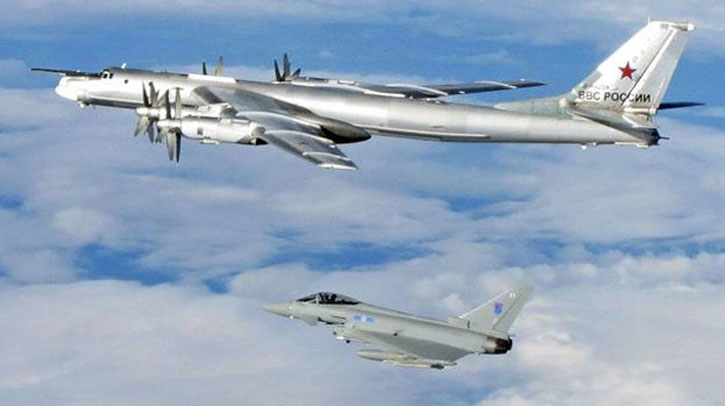
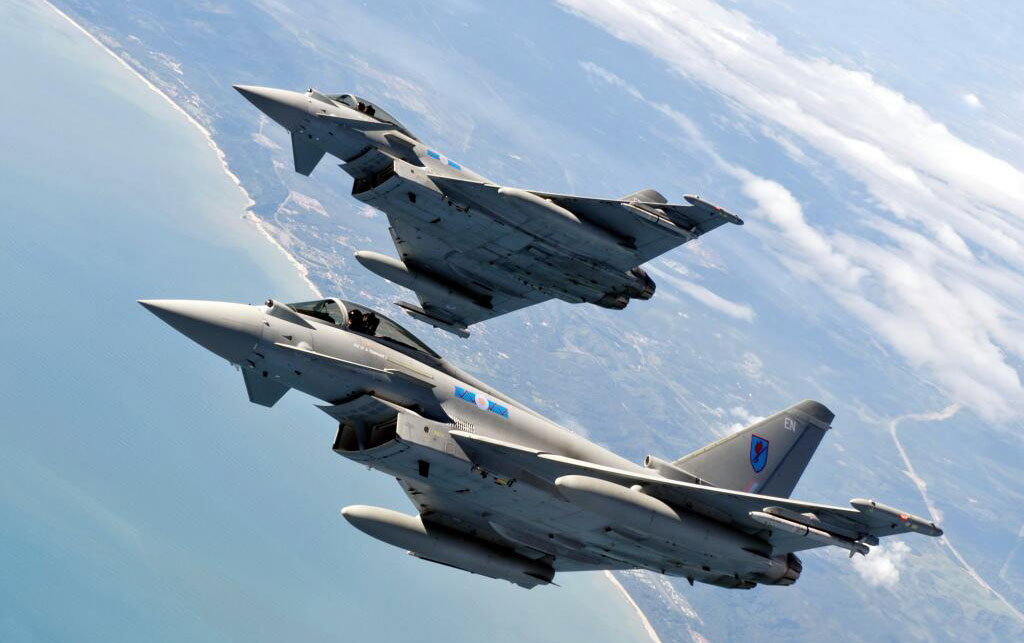
    6 Squadron Typhoon from Leuchars escorts a Russian Tu-95 Bear away from British airspace. Photo: UK MOD.
    6 Squadron Typhoon from Leuchars escorts a Russian Tu-95 Bear away from British airspace. Photo: UK MOD.

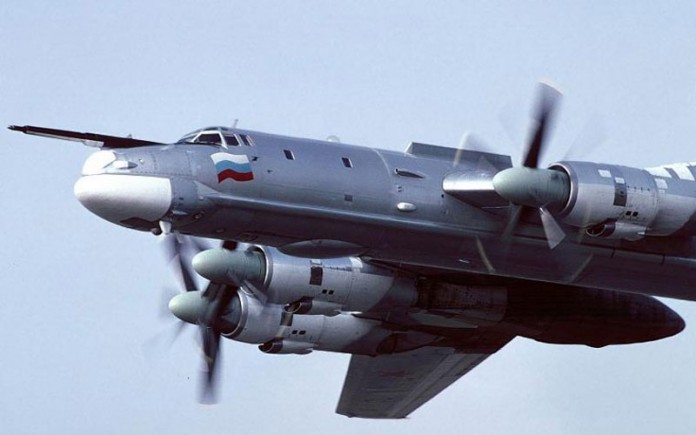
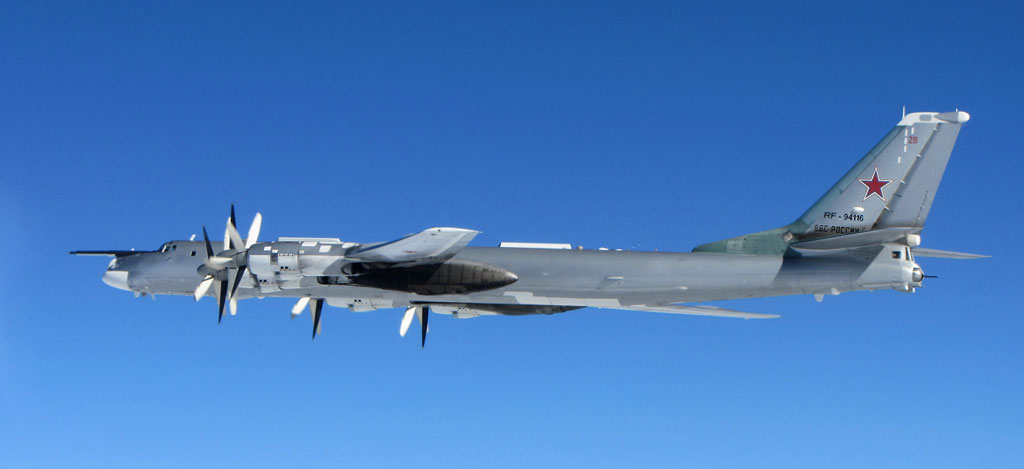
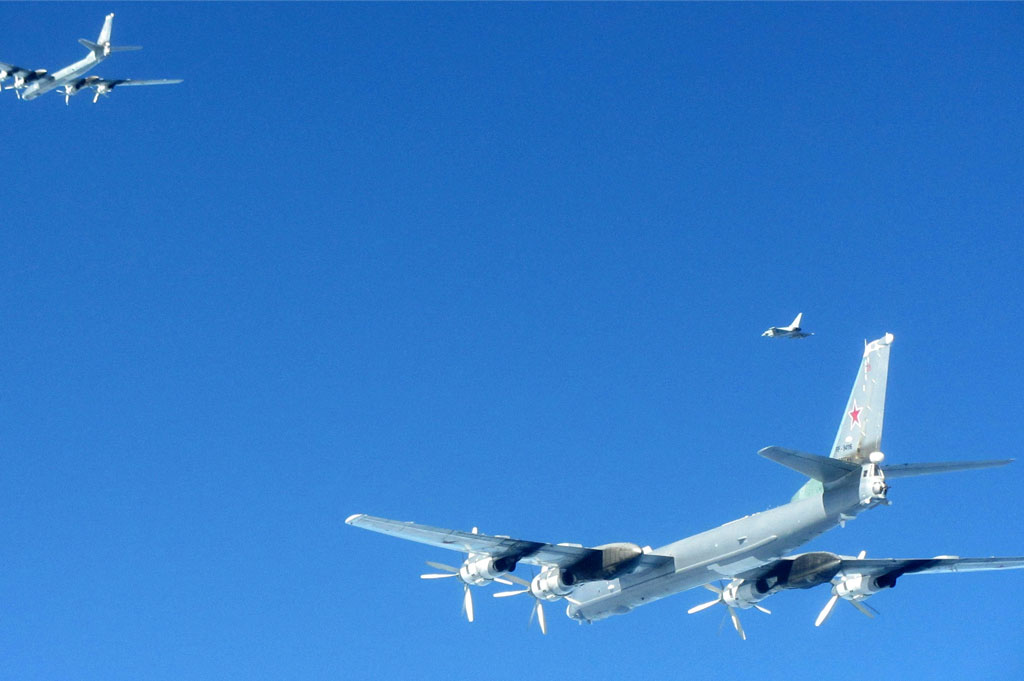
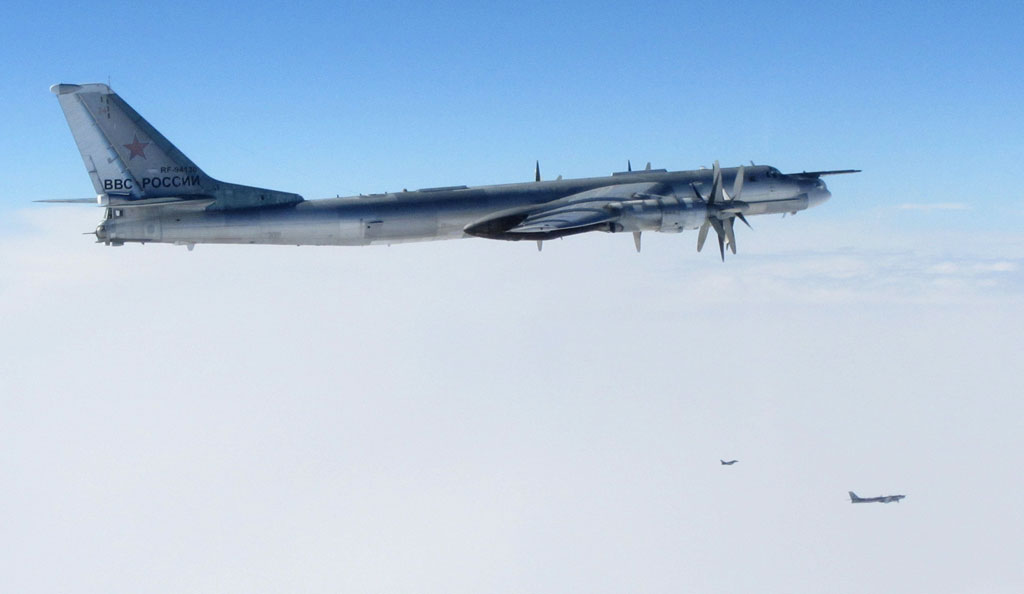
    Russian bombers Flying on a 16 hour training mission over the North Sea, two Russian Tu-95 bombers (NATO reporting name: ’Bear’) were intercepted yesterday by British, Dutch and Danish fighter jets. It is not the first time such an event happens, but this one has attracted the media attention due to the heightened tension over Russian military activity in Ukraine. The two bombers, built to carry nuclear weapons, were flying a direct route on Wednesday north from Russia’s Kola Peninsula towards the Bear Island in the northern part of the Barents Sea. North of the Bear Island, they turned around southwest towards the Norwegian Sea and continued south towards the North Sea.

    The Russians confirmed that Tu-95MS strategic bombers were on a mission over international waters of the North Sea. On these flights air crews are trained to navigate over featureless terrain and perform aerial refuelling. On part of their mission the bombers were escorted by MiG-31 supersonic interceptors. An A-50 airborne early warning aircraft also supported the mission. The Russian Defense Ministry insisted that these flights are carried out “in strict accordance with international regulations” and do not violate the borders of other countries.

    “The flight route was over the neutral waters of the North Sea, along the Kola Peninsula. The aircraft have flown some 12,000 kilometers. The flight duration exceeded 16 hours”

    As the bombers approached Scotland, RAF Typhoons scrambled to investigate two targets, initially detected by radar. At that time the “Bears” were nearing UK airspace off the north-east coast. After contact with the fighters, from RAF Leuchars in Fife, the Russians turned and flew in the direction of Scandinavia. RAF Leuchars is primarily responsible for maintaining Quick Reaction Alert (Interceptor) North, providing crews and aircraft at high states of readiness, to police UK airspace and to intercept unidentified aircraft. The base operates Typhoon jet fighters in two units -No 6 and No 1(Fighter) Squadrons.

    Russian sources indicated that the strategic bomber force regularly performs routine flights over neutral waters of the Arctic, the Atlantic, the Black Sea and the Pacific Ocean. These flights sometimes prompt a reaction by neighbouring countries. Japan has scrambled aircraft to escort such flights several times since the beginning of the month. Scrambling the Typhoons by the RAF does indicate a level of concern, Ministry of Defence officials dismissed the incident as routine, claiming indicate there were eight similar contacts last year.

    bear1024_1 bear-1024-3 bear_1024_2


    The following images released by the UK MOD today, are showing the two Russian bombers and Typhoons, shadowing them from above. Photos: MOD, Crown Copyright

    “The aircraft did not enter UK airspace. The Russian aircraft remained in international airspace at all times as they are perfectly entitled to do. Russian military flights have never entered UK sovereign airspace without authorisation” an MoD spokesman said: Other NATO members did not welcome the Russian Bears either. The Royal Netherlands Air Force scrambled two F-16s from Volkel air force base to intercept them. Denmark also escorted the Bears away from their controlled airspace; the Danish F-16s escorted the Russians until they approached UK airspace and RAF Typhoons took over. The Norwegians decided not to scramble their F-16s, as the Russians were flying too far from Norwegian airspace.

    “Intercepting Russian Bear aircraft is a routine occurrence for us, it’s what we do to maintain UK Sovereign airspace.” 6 Squadron Typhoon Pilot Flt Lt Gary Montgomery said, “We scrambled on 23 April to intercept two unknown aircraft approaching the NATO Air Policing Area from the north.  We intercepted and flew within visual range and identified them as Russian Tu-95 ‘Bear H’ aircraft.  We monitored their progress, including handing them over to Danish F-16 QRA aircraft as the Bears flew towards Denmark, then continued to monitor them as they returned and then departed towards Norwegian airspace.  During the sortie we air refuelled from a RAF Voyager aircraft, from RAF Brize Norton, to increase our airborne endurance.” Montgomery added.

    No 6 squadron is one of two units stationed at RAF Leuchars as part of the UK quick alert force. Photo: RAF
    No 6 squadron is one of two units stationed at RAF Leuchars as part of the UK quick reaction alert over the North Sea. Photo: RAF

    Egypt interested in buying 24 MiG-35s from Russia

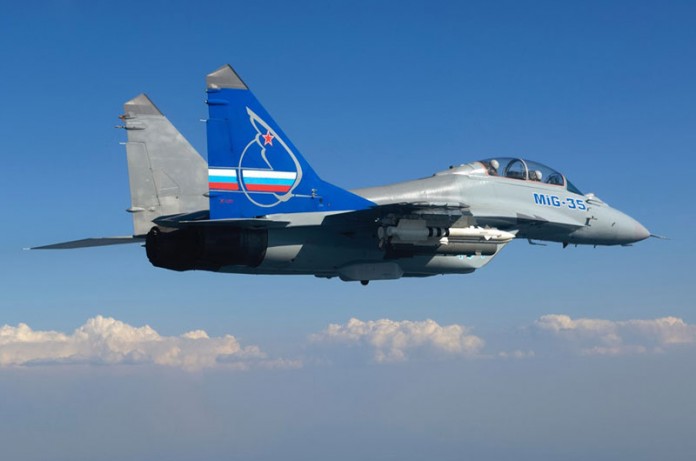
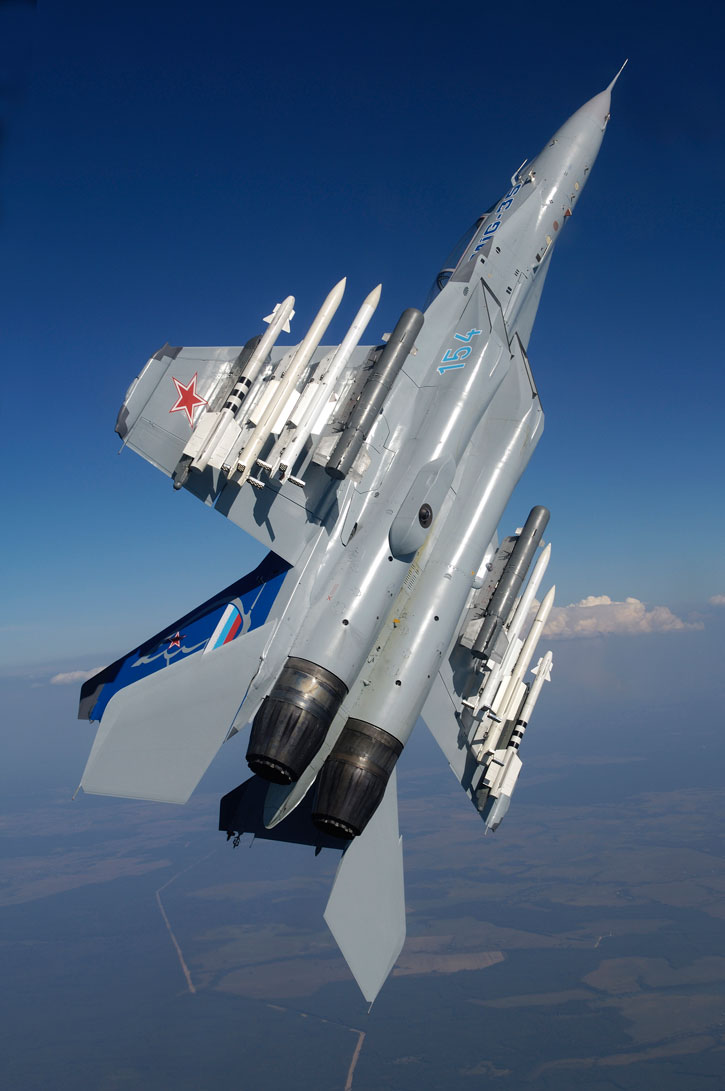
    The Russian United Aircraft Corporation has been offering the MiG-35 to a number of international customers, but sofar this 'super Fulcrum' failed to gain international orders. The Russian Air Force is expected to place the first order by 2016, if it fails to secure funding for more sophisticated and stealthy 'light advanced fighter'. Photo: RAC
    The Russian United Aircraft Corporation has been offering the MiG-35 to a number of international customers, but sofar this ‘super Fulcrum’ failed to gain international orders. The Russian Air Force is expected to place the first order by 2016, if it fails to secure funding for more sophisticated and stealthy ‘light advanced fighter’. Photo: RAC

    Russia has acknowledged an Egyptian request to procure a squadron of MiG-35 advanced fighter aircraft, to include up to 24 fighter jets at a cost of US$3 billion. The fulfilment of this package could be delayed though, as this specific type of aircraft hasn’t reached a production stage. The manufacturer, Russian Aircraft Corporation (UAC) through its subsidiary Russian Aircraft Corp (RAC) has failed to gain international orders for the aircraft and is currently awaiting an initial order from the Russian Air Force to kickstart production by 2016. However, Moscow could try to secure an Egyptian order with an earlier model that could utilize the current production line, namely the new-built MiG-29M/M2, which share commonality with the MiG-29K model recently supplied to Indian Navy.

    By approaching Moscow, Egypt is regaining international support, after getting a cold shoulder from Washington, following the military coup d’état that toppled the controversial, yet democratically Mohamed Morsi, and his moslem Brotherhood party. . 

    The $3 billion arms package could include up to 24 MiG-29/35 fighter jets, Mi-35 helicopter gunships, air and coastal defense systems, firearms and ammunition

    The arms package has been negotiated since November 2013 but no contract has been signed yet. The framework of that deal was originally proposed during a visit by Russian Foreign Minister Sergei Lavrov and Defense Minister Sergei Shoigu to Cairo in November 2013. In February the arms package was agreed in principle between Field Marshal Abdel Fattah al-Sisi, then defense minister and the Russian president Vladimir Putin during Sisi’s visit to Moscow in February 2014. It was Sisi’s first trip abroad, following his seizure of power in a coup in August 2013.

    Moreover, financial sources for the deal are unclear, particularly with the Saudi reluctance about Cairo’s moving closer with Moscow. As Egypt’s economy is in standstill for several years, with empty national treasury empty, and US financial support diminishing, how can Egypt afford such spending? The deal is reportedly to be funded mainly by Saudi Arabia and the United Arab Emirates (UAE) but following deteriorating relations between Riyadh and Moscow, particularly over the Russian support to the Syrian regime, wholehearted fulfilment of such obligation is questionable.

    The commercial side of the deal is casting more optimism; UAC CEO Sergei Korotkov confirmed that negotiations are ongoing but said the number of aircraft Egypt will eventually get has been changing constantly. According to Russian industry sources the arms package would include the MiG fighter jets, Mi-35 helicopters, air defense missile systems, coastal defense (shore-based anti-ship) missiles, as well as firearms and ammunition.

    Norwegian Battle-Lab Drive M-113 Via Oculus Rift Augmented Reality Goggles

    oculus_m113
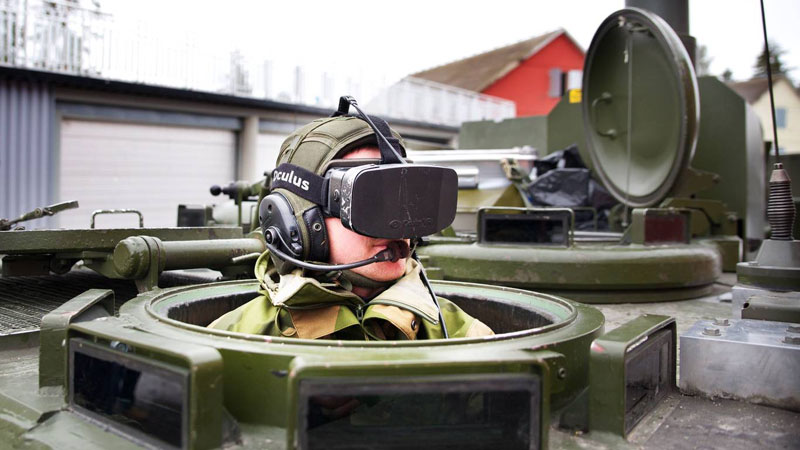
    A Norwegian Army driver controls an M-113 through Oculus Rift Augmented Reality goggles. Photo Eirik Helland Urke, Teknisk Ukeblad

    The Norwegian Army is evaluating the use of commercial off the shelf (COTS) Virtual Reality (VR) goggles in an ‘Augmented Reality’ (AR) application, enabling troops to look through the armor walls protecting their vehicles. In a recent test troops were able to drive an M-113 armoured personnel carrier using the Oculus Rift gaming-goggles, Tech Week (TU) military reporter Eirik Helland Urke reported from the Rena proving grounds, Norway.

    The tested apparatus included a prototype of the Oculus Rift goggles coupled with specially developed cameras and image processing software delivered by the Hamar company. The panoramic images captured by the cameras covered the entire vehicle’s surrounding providing real-time situational awareness. Augmented Reality information overlay developed by another company – Augmenti, was also tested by the Army.

    The Battle Lab believes the system can be operational in as little as five years.” Odden said that within two or three years such an application could ruggedize and mature for military qualification and get ready for within real traffic.

    Together with the Oculus Rift goggles, the system allows the vehicle operator to navigate independently, without verbal commands from the vehicle commanders, enabling the driver to independently control the vehicle responding to the commander’s intent, rather than having to get constant ‘left’, ‘right’, stop’, fast forward’ driving instructions. Moreover, the driver could cover blind areas with the augmented reality display. This allowed the vehicle commander to focus more on the combat situation at hand. With the system, operators could monitor the vehicle surrounding, over 360 degree filed of view, while ‘buttoned up’ – maintaining armour protection with hatched closed.

    Odden said that within two or three years such an application could be technically mature for military qualification and ruggedization, and make it ready for use in traffic. Photo: Eirik Helland Urke, TU.NO
    Odden said that within two or three years such an application could be technically mature for military qualification and ruggedization, and make it ready for use in traffic. Photo: Eirik Helland Urke, TU.NO

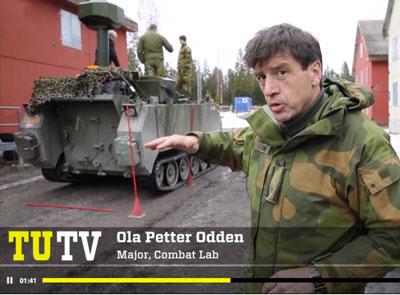
    “This concept shows great promise. [although] We found the goggles to lack the screen resolution to see well at a distance, [the goggles] can also cause a certain degree of dizziness for the vehicle operator, but overall we believe these issues can be improved fairly quickly” Major Ola Petter Odden, of the Army’s Combat Lab told TU. “The Battle Lab believes the system can be operational in as little as five years.” Odden said that within two or three years such an application could ruggedize and mature for military qualification and get ready for within real traffic.

    Indeed, a more advanced version is already in the making. Oculus VR, the developer of the revolutionary goggles are currently preparing the launch of the development version of the second generation product – subbed DK2. Cash infusion by Facebook will also help the company bring its product to market faster and more affordably, Oculus VR founder Palmer Luckey said. This new version will feature free movement, more accurate position tracking and lower latency and low persistence display, improving longer use.

    With augmented reality goggles that could resemble current night vision devices, the warfighter will be able to develop full situational understanding. In fact, night vision from fused thermal aid image intensifier sensors would also be a bonus!

    Providing built-in line-of-sight integration with AR display, the Oculus Rift goggles enable the display to seamlessly follow the wearer’s head’s movements. For example, the driver wearing the goggles could look forward or sideways, ‘into turns’ – a task that regularly requires directions by the vehicle commander or from an external controller. Using the Oculus Rift goggles, the driver could view left or right, looking ‘through the vehicle’ while watching real-time views picked by the side mounted cameras. With the new goggle the driver has also demonstrated precision driving, parking at a narrow parking spot within centimetres of the guidelines, without guidance by the commander or ground directions.

    Oculus Rift goggles are becoming a hot product primarily with gamers but since the acquisition of Oculus by Facebook, new applications are suggested for the technology, from simulation, to physical training, and virtual tourism. Military applications for VR and augmented reality are numerous, ranging from gaming-style dismounted battlefield training, to driving, as demonstrated by the Norwegian Army, to intelligence surveillance and reconnaissance analysis and remote control of drones, robots, diving vehicles and other sensors, where operators can precisely direct complex manipulators and other equipment from afar. The ability of augmented reality displays to show layers of information superimposed over real or synthetic view could also help warfighters and leaders in assessing complex combat situation, which nowadays addresses threats that are not limited to the visual sense.

    Such threats could be enemy activity reported in real-time by unmanned aerial vehicles, locations of buried or hidden IEDs, sensed by chemical sniffers, invisible, odorless yet hazardous dispersant materials that could harm the forces, or lurking cyber threats, affecting their communications links, compromising classified information or simply drain the power from their backpack equipment. With augmented reality goggles that could resemble current night vision devices, warfighter will be able to receive indications about such threats in real time, superimposed over the real world picture they see. In fact, night vision from fused thermal aid image intensifier sensors could also be a bonus.


    Israel opens military service to the Christian minority

    In a new program to make information and voluntary military drafting options available to the Christian population of Israel, the Israel Defense Forces (IDF) announced it will provide all potential Christian recruits voluntary enlistment forms. The forms will proactively be sent to all youth eligible for recruiting with the intention of making the IDF more accessible for this population, giving clear and coherent information regarding the voluntary enlistment process, and the different service options they may chose including combat service. The recent change in protocol was implemented following IDF contacts with Israeli Christian community leaders, and with the authorization of the Minister of Defense, Mr. Moshe (Bogie) Ya’alon, and the IDF Chief of the General Staff, Lt. Gen. Benjamin (Benny) Gantz.

    Since the service of the Christian population in Israel is not obligatory by law, potential recruiters are not required to respond to the invitation. Currently approximately 100 Christians serve in various positions and units in the IDF. Other minorities regularly serving in the IDF include Druze, Cherkess and Bedouins.

    “We are actively working towards integrating all populations and see this as a very important step in that direction.” Head of the Human Resource Planning and Management Division, Brigadier General Gadi Agmon said, “This change will constitute another step in the integration and connection of the Christian population with the IDF. In recent months the IDF has begun implementing a tougher enlistment campaign among orthodox Jews, which were sofar exempt of military service. As part of this campaign, Knesset (Israel parliament) members demanded that non Jewish population, particularly Arabs (Moslems and Christians alike), will also be required to serve military or national service.

    Tension is mounting along Israel-Gaza border

    Tension along the Israel-Gaza border has mounted in recent days, after a series of attacks from the Gaza Strip, On Sunday April 20th an IED was activated against Israel Defense Forces (IDF) soldiers patrolling the security fence along the southern Gaza Strip. 12 hours later; on 07:15 Monday, Palestinian militants fired a Rocket Propelled Grenade (RPG) at an IDF patrol along the security fence in the same area. No damage or injuries were caused.

    Palestinians from Gaza launched nine rockets from Gaza, One of the rockets caused damage to civilian infrastructure in the town of Sderot. Since the beginning of 2014, one hundred rockets were fired from Gaza into southern Israel.

    Israel retaliated with air strikes targeting two terror activity sites in the southern Gaza Strip and a third site in the central Gaza Strip. IDF Spokesman reported that direct hits were verified.

    The escalation comes after a month of tension since the last round of violence, which followed the apparent collapse of US mediated ‘peace talks’ between Israel and the Palestinian Authority and capturing of Gaza bound weapons shipments sent from Iran. By mid-March the Palestinians in Gaza have launched rocket salvos at Israeli cities Ashkelon and Ashdod, on which Israel responded with air strikes that managed to contain the situation.

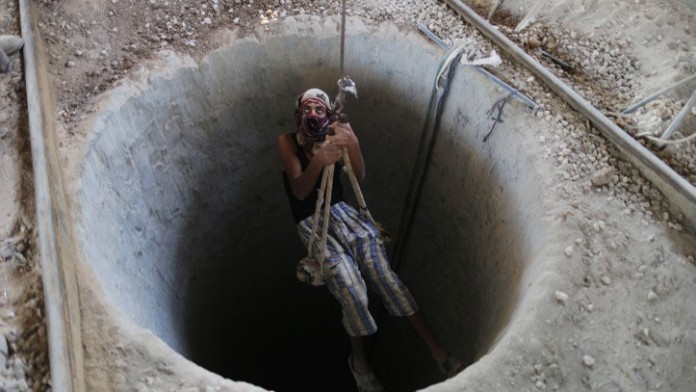
    Earlier this month the IDF uncovered a large ‘assault tunnel’ dug by the Palestinians. The main tunnel was built with splitting sub-tunnels to enable flexible planning of attacks, particularly for the abduction of Israelis (as was the case of the abduction of Gilad Shalit in 2006). These formations also offer more escape opportunities, when and if such facilities are compromised.

    In recent weeks individual terror activities by Palestinians in the West Bank have also increased in numbers and severity, taking the lives of several Israelis and Palestinians. On the West Bank front the Israeli response was milder, pressured not to aggravate the sensitive situation resulting from the peace negotiations deadlock.


    The Geographic Spread of Al Qaeda

    Dr Dave SloggettTime was when Al Qaeda’s footprint on the ground consisted of a recruiting office in Peshawar in Pakistan and a number of people fighting alongside the Taliban in Afghanistan. The parallels with the international bridge fighting alongside the communists in Spain in the late 1930s are obvious.

    People travelled from all over the world to be part of the fight against fascism and the Republicans. In Afghanistan of course the chance of joining Jihad against the non-believers from the communist Soviet Union was the draw from a new form of international brigade drawn from the wider Ummah, or peoples of Islam around the world. With an estimated 1.6 billion adherents to the faith (around 25% of the world’s population) they had a large community on which to potentially draw.

    When the Soviets withdrew from Afghanistan the newly emergent Al Qaeda was able to claim that it had made some contribution to the outcome. Of course what they actually contributed is difficult to discern. But the one thing Al Qaeda has never lacked is an understanding of how to pull the strings of the media and gain their attention, especially news outlets in the Middle East.

    The emergence of Al Qaeda with some credit for the defeat of the Soviets came at a convenient time. In several other locations around the world, such as in South East Asia, a number of on-going campaigns to rid areas of government’s deemed unfriendly to the kind of extremist form of Islam advocated by some who followed the Wahhabi school of Islamic thinking. Al Qaeda’s apparent victory against the Soviets emboldened many other insurgencies aiming to create areas in recognised states that would be run under their particular interpretation of Sharia Law.

    The events of September 11 of course catapulted Al Qaeda, and its leader Osama Bin Laden, to international fame. Even though the organisation was initially reluctant to claim their involvement in the atrocities that occurred on that dreadful day eventually through a policy of what might be described as a ‘nudge and a wink’ it became clear that Al Qaeda was indeed behind the attacks.

    History shows that the Americans and their allies were quick to respond and the relatively swift military defeat of the Taliban occurred. Al Qaeda’s leadership escaped from the mountainous Tora Bora region in Afghanistan slipping quietly away over the border into Pakistan. It was here, exploiting the fundamental security weaknesses and lack of governance in the North West of Pakistan, where the leadership of Al Qaeda sought sanctuary in order to continue its global campaign.

    9/11 Catalyst to Unite

    The success of the attacks in America became a catalyst to unite what had previously been disparate groups of uncoordinated activities and uprisings against states into a social movement. Creating such an entity requires three things. These are a narrative, resources and a window of opportunity in which to make progress with an agenda. For Al Qaeda all of these things came together in the immediate aftermath of September 11.

    Overnight Al Qaeda became a name on the lips of people in the security apparatus of the west. The question was how to deal with a social movement whose initial tentacles had spread into the heart of a number of friendly nations.

    Al Qaeda’s rise in Saudi Arabia was also spurred on by the invasion of Iraq. That became a country, like Syria today, that was a magnet for people from the Ummah. While it took time for the Saudi authorities to come to terms with the scale of the security problem they faced in time their response ensured that the remnants of the organisation had to flee into Yemen. This remains a country that also has a huge problem with a lack of governance in areas such as the desolate areas of the Hadramaut in eastern Yemen.

    These and other parts of the Yemen provided a fertile base from which to develop a new arm of Al Qaeda. In 2004-2005 Al Qaeda had started to expand its geographic presence. The base, as the organisation likes to be known, now had a foothold in several countries where local governance was weak. After a faltering start in Somalia, when Al Qaeda upset local Sufi followers of Islam by destroying the graves of their forefathers, the rise of Al Shabab provided a perfect backdrop to create a new franchise for Al Qaeda.

    The concept of Al Qaeda creating franchises in order to spread their influence appealed to western analysts. They were looking to offer an easy way to understand how the organisation was developing. The notion of franchises would also have appealed to Osama Bin Laden. Before he had become involved in Al Qaeda he had graduated in business studies from Riyadh University. Any objective analysis of the rise of Al Qaeda can see the fingerprints of business acumen all over its activities. Al Qaeda even has disaster recovery plans.

    It was at this point that Al Qaeda’s development hit a hiatus. Strikes by unmanned aircraft against specific members of the leadership in Pakistan began to have an impact, disrupting the organisations activities. Once the success of these attacks became apparent it was obvious they would spread to the Yemen. Al Qaeda’s presence in both of these countries now came under sustained pressure.

    Changing Strategy to a Hybrid Model

    As with any good business organisation Al Qaeda was bound to respond to the increased activity by American unmanned aircraft. Using its on-line magazine Inspire a series of articles appeared that suggested that instead of acolytes travelling to Pakistan, Yemen or indeed Somalia for terrorism training that these individuals should stay at home and become individual jihadists or forge links with others to create small groups capable of carrying out attacks. This was the point at which Al Qaeda morphed from a centralised hierarchy into a flatter organisation giving responsibility to those at the edge of the growing number of tentacles. This mirrored business practises being developed at the time.

    Al Qaeda’s approach was now based on a hybrid model. Individual jihad was to be conducted by anyone who felt the urge to martyr themselves for the cause. These, as events in Woolwich and Boston showed, provide a great deal of high profile media coverage – essential for a social movement that depends for its very survival on getting its narrative heard by potential recruits.

    While this tactic did have some notable high profile successes, such as the Fort Hood massacre and the attempt on the life of the Member of Parliament Stephen Timms in London there was no Tsunami of events which is presumably what Al Qaeda’s leadership had encouraged. Some attempts were a complete failure, such as attacks conducted by lone wolfs in New York and Stockholm.

    Indeed it can be argued that the idea of individual jihad carried out by lone wolfs operating below the radar horizon of the security services did not really catch on. Meanwhile the security services across Western Europe and North America continued to focus on disrupting the activities of small groups or cells of adherents planning their own attacks. The arrests of four individuals in London in October follow this pattern.

    This change of tack showed that Al Qaeda is a protean organism, capable of changing shape very quickly. Despite many leading political figures writing the obituary of the organisation it remains viable, as the reaction of the Americans to what was seen to be a credible threat to attack one of their facilities in the Middle East showed.

    The AQ Threat Remains

    Events in Benghazi, which saw the American Ambassador to Libya killed as a group of people thought to be allied to Al Qaeda stormed the diplomatic compound in the city, provided enough evidence that such threats should not be taken lightly. The fallout from that incident with recriminations flying around Washington and nearly landing on the lawn of the White House suddenly made a lot of people who had wistfully believed Al Qaeda to be finished to stand back and pay attention. This incident was compounded by the attacks in Boston and in Woolwich in London. They have shown that some are prepared to listen to the messages put out by Al Qaeda.

    It remains wishful thinking to suggest the organisation is finished. Indeed it is fair to say at this moment that with new franchises springing up all over the Middle East and North Africa that Al Qaeda has never had such a geographic spread. From South East Asia to the shores of the Atlantic Ocean on the African continent Al Qaeda’s spread of influence has moved to a new level. Despite the obvious initial success of the French forces in January and February countering the activities of one of the franchises that had established itself in northern Mali recent activity in neighbouring states suggest the French intervention has merely displaced the remnants into equally vulnerable states such as Niger, Libya, Algeria and Mauritania. In Tunisia Al Qaeda is also gaining a greater footprint.

    Is Syria the New Iraq for AQ?

    If these developments were not alarming enough the magnet that Syria has become to new acolytes threatens to exceed even the most difficult days in Iraq in 2005 to 2007. During that period the Syrian border with Iraq became a channel through which people were funnelled through the Tigress and Euphrates river valleys into Baghdad and northern Iraqi cities.

    These so-called ‘rat runs’ provided a steady flow of volunteers into Iraq from across the world. The international brigade of jihadists saw what was happening in Iraq and decided that was where they needed to fight. Today the Al Qaeda franchises in Iraq and Syria are the most deadly. If anything the ‘rat runs’ are now operating in both directions. The daily reporting of sectarian attacks in both countries shows the degree to which Al Qaeda has re-established its footprint in the area.

    Fears that Egypt may go the same way are perhaps premature. The Egyptian Army has recently mounted large-scale operations in the Sinai Desert to root out nascent Al Qaeda training camps in the area. While the Sinai like areas in Yemen and Somalia offers many hiding places the Egyptian military, unlike their counterparts in other countries where Al Qaeda has established a presence on the ground, can bring significant combat power to bear against any training camps and facilities. However somewhat ironically Egypt might be the one bright spot in what otherwise is a very gloomy picture at present.

    Further Strife Ahead

    Standing back at looking at the deteriorating situation across the Middle East and North Africa it is difficult not to conclude that with so many places now available for Al Qaeda to offer training to its adherents that soon its operating model may change yet again. While the concept of individual Jihad may not prove to be quite so attractive to vulnerable people in the west that the Al Qaeda leadership had hoped soon they will be able to offer a whole new range of destinations for would-be terrorists to visit and get training. For the security apparatus in the west, already struggling to cope with the previous incarnation of Al Qaeda, the next few years are unlikely to get any easier.


    About the author:

    Dr Dave Sloggett is a provider of training to the Emergency Services fraternity and the MoD on the nature and direction of international terrorism. Dr Sloggett has over 40 years of experience in the international security sector. He is a speaker, author and researcher working in the field of counter terrorism. Historically Dr Sloggett led the teams implementing the ANPR systems and pioneering work in the e-Borders field. He delivers a range of lectures for all branches of the Emergency Services providing insights into the current trends and future direction of domestic and international terrorism. He is also a specialist in the CBRN field having written numerous papers on the threat from WMD for a range of publications to which he contributes. He also provides advice to the MoD and is a frequent visitor to theatres of conflict.


    US, Yemen Launch Large Scale Attack against AQAP Terrorist sites in Yemen

    A large number of al Qaeda in the Arab Peninsula (AQAP) militants were killed when a series of air strikes has hit their training camp in a remote mountainous region of southern Yemen on Saturday and Sunday, April 19-20, 2014 – the Yemeni defense ministry said. AQAP has been regarded by Washington as the jihadist network’s most dangerous affiliate. The attacks are likely targeting Al Qaeda number two Nasir al-Wuhayshi, deliberately exposed in a recent video taken at a large gathering of terrorists in Southern Yemen. Yemeni sources claimed that the follow-on strike on the 20th was not carried out by foreign drones, but by Yemeni Air Force MiG-29 fighter jets. Casualties count from recent strikes has increased to 65.  

    The operation targeting al Qaeda in the Arabian Peninsula is under way in Abyan and Shabwa, Yemen, a high-level Yemeni government official who is being briefed on the strikes told CNN on Monday (see video below). The Yemeni official described the attacks as “massive and unprecedented”, confirming at least 30 militants have been killed. The operation involved Yemeni commandos who are now “going after high-level AQAP targets,” the official said.

    According to unofficial reports the April 20 attack comprised at least three separate strikes that were directed at a terrorist training camp in al-Mahfad, killing up to 25. On the 19 April attack ten AQAP personnel and three civilians were also killed on another drone attack; intelligence report said they were planning attacks on civil and military targets in al-Bayda province, in southern Yemen.

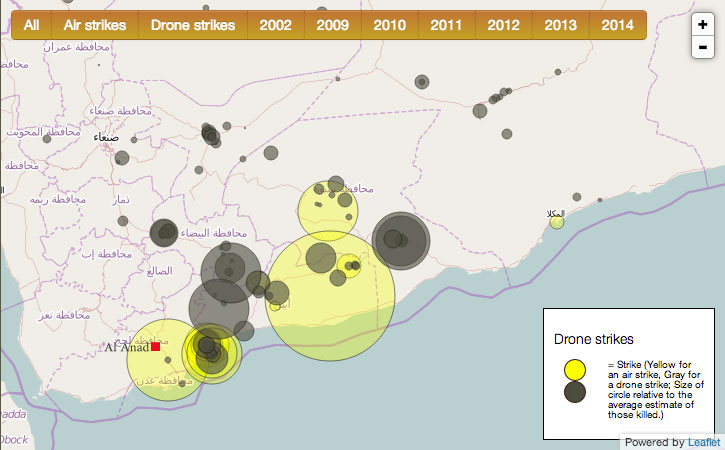
    The locations of air strikes (yellow) and drone strikes (grey) in Yemen. Radius indicates the number of killed. The red mark is the position of the Yemeni Air Force Base at Al Anad, allegedly providing the forward operation base for those operations. It is also believed that since the introduction of MQ-9 Reaper drones, at least part of the activity has moved to the more desolate Um El-Melh border guard new airbase base built near the Saudi-Arabian-Yemeni border, about 900 km north-east of Al Anad..
    The locations of air strikes (yellow) and drone strikes (grey) in Yemen. Radius indicates the number of killed. The red mark is the position of the Yemeni Air Force Base at Al Anad, allegedly providing the forward operation base for those operations. It is also believed that since the introduction of MQ-9 Reaper drones, at least part of the activity has moved to the more desolate Um El-Melh border guard new airbase base built near the Saudi-Arabian-Yemeni border, about 900 km north-east of Al Anad. Source: New America Foundation.

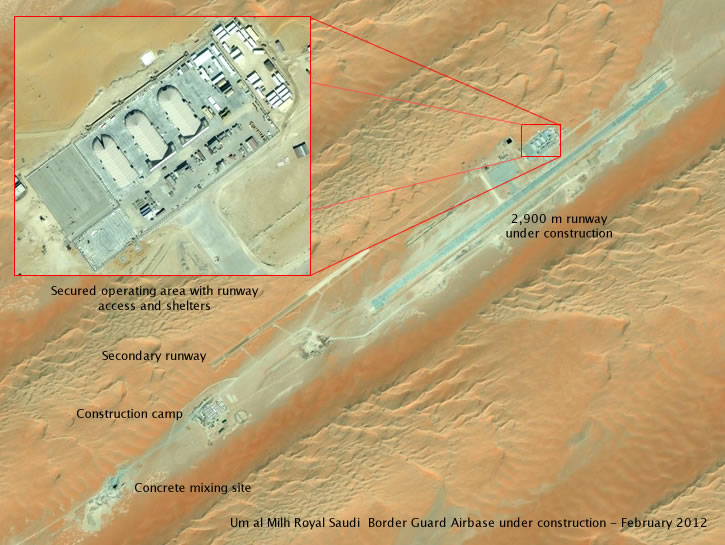
    Drone attacks in Yemen have killed about 40 people in Yemen since January 2014. While US drone activity in Yemen can be dated back to 2002, the attacks have been intensified since 2012, as the CIA increased its pressure on the Yemen-based AQAP. Yemen is among a handful of countries where the United States acknowledges using drones, but it does not comment on the practice. The CIA is believed to be operating drones from two main bases in the area, the Yemeni military air base at Al Anad, in Southern Yemen and the Saudi border guard airbase at Um El Melh guarding the southern border of the desert kingdom’s ’empty quarter’ – Rub al Khali. This base is belived to have been operational since 2013. While aerial images of Al Anad do not indicate special facilities for drones, images from Um El-Melh show massive buildup of ground facilities for a base that can operate numerous drones of various sizes.

    Umm Al Melh Border Guards Airport
    Umm Al Melh Border Guards Airport (click for a larger size)

    The drone campaign in Yemen is managed by the US Central Intelligence Agency (CIA) since 2002. The momentum of this campaign increased since 2011, particularly as the Obama administration began using drones to support the Yemeni government’s battles against al-Qaeda-linked militants in 2012. Without ‘boots on the ground’, this campaign suffered relatively high rate of ‘collateral damage’ (unintended civilian casualties) but this ration has dropped significantly in recent years (except in 2012 when 11 civilians were killed on their way to a wedding).

    AQAP has also directed its attacks on civilian and military targets of the Yemeni regime as well as targets thought to be related to US operatives. In a recent attack in December 2013 a car bomb exploded inside a hospital in the capital city Sana, killing 52 people. The Mujahedeen  claimed the attack was directed against an operations center controlling the drones attack in the country however, the US denied there were any American victims at the site.

    AQAP has been growing in Yemen despite the U.S. CIA and government efforts to rout the terrorist groups from the country. In February 2014 AQAP conducted a suicide attack on the central prison in the Yemeni capital of Sana’a. The attack involved suicide bombers and an assault team that penetrated the facility and freed 29 prisoners, among them 19 AQAP operatives, the Long War Journal reported.

    The terrorists freed during the February raid were greeted by al-Qaeda’s number two in command, Nasir al-Wuhayshi, appearing in a video aired recently on Youtube. The 15-minute video, posted on YouTube by the Terrorism Research and Analysis Consortium (TRAC).

    US Navy Requests Industry Proposals for Carrier-Operable Drones

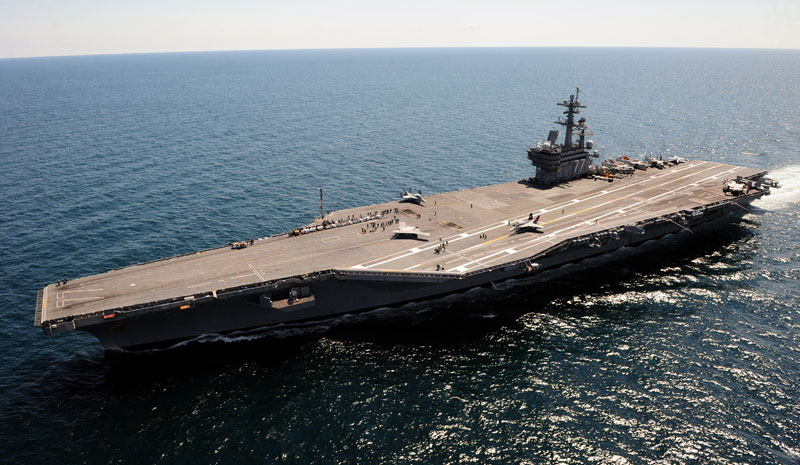
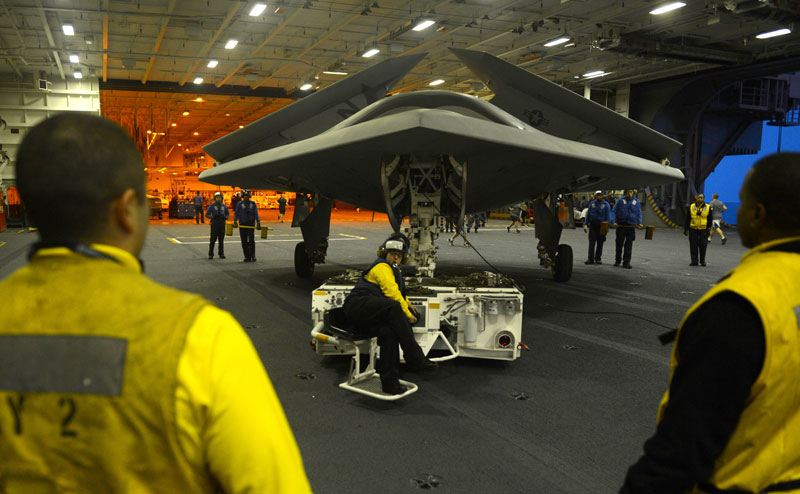
    An X-47B Unmanned Combat Air System (UCAS) demonstrator is towed into the hangar bay of the aircraft carrier USS George H.W. Bush (CVN 77). (U.S. Navy photo by Timothy Walter)
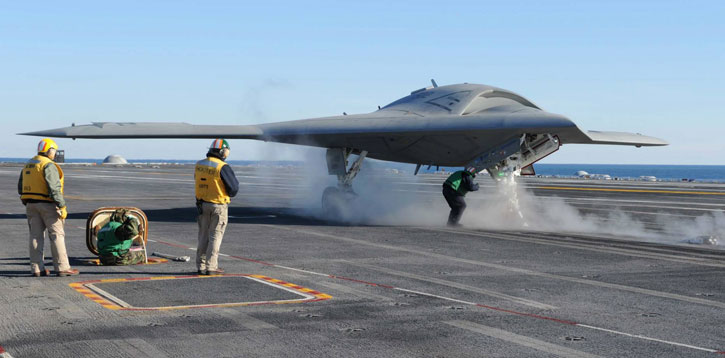
    The X-47B Unmanned Combat Air System (UCAS-D) completes preparations for launching aboard the aircraft carrier USS Theodore Roosevelt (CVN 71). Theodore Roosevelt is the third carrier to test the tailless, unmanned autonomous aircraft's ability to integrate with the carrier environment. The future UCLASS will be optimized to operate with the new Ford Class carrier (CVN-78) fitted with electrically rather the conventional steam powered catapult, enabling safe handling of lighter aircraft. (U.S. Navy photo by Heath Zeigler)
    The X-47B Unmanned Combat Air System (UCAS-D) completes preparations for launching aboard the aircraft carrier USS Theodore Roosevelt (CVN 71). Theodore Roosevelt is the third carrier to test the tailless, unmanned autonomous aircraft’s ability to integrate with the carrier environment. The future UCLASS will be optimized to operate with the new Ford Class carrier (CVN-78) fitted with electrically rather the conventional steam powered catapult, enabling safe handling of lighter aircraft. (U.S. Navy photo by Heath Zeigler)
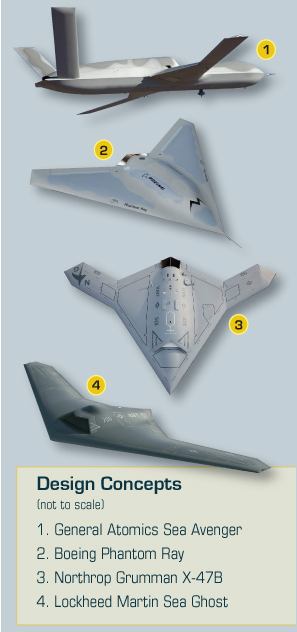
    The four candidate designs considered for UCLASS depicted in this image published by the US Naval Institute (USNI)
    The four candidate designs considered for UCLASS depicted in this image published by the US Naval Institute (USNI)

    Future drone attacks could be more pervasive and less constrained by access permissions and host country support, once the US Navy goal to integrate unmanned systems capabilities on board its aircraft carriers is fulfilled. Current operations, conducted by the CIA and Air Force from land-based sites are constrained to the availability, permission and security provided by host nations, bases that should be located relatively close to the target and, hence, may compromise operational security and operator safety. New generations of drones to be operated by the US Navy from aircraft carriers could introduce a new capability, unbound by those restrictions.

    Following a year-long delay the U.S. Navy released a draft request for proposal (RFP) for the Unmanned Carrier Launched Airborne Surveillance and Strike (UCLASS) aircraft on April 17, 2014. The draft release was delayed due to disagreements within the Navy, about the technical specifications for the future unmanned aircraft. The final RFP is expected later this year. The new carrier-operated drone is scheduled to enter service in the early 2021.

    Four prime contractors are participating in the competition – General Atomics Aeronautical Systems Inc, Boeing, Lockheed Martin and Northrop Grumman. All four have already been contracted to carry out preliminary studies of a UCLASS type drone and are likely to submit their proposals for the final design. The current draft RFP calls bidders to submit proposals for design, development, assembly, delivery, testing and integration of the air vehicles segment of the UCLASS system. Other elements are likely to include sensors, datalinks, command and control systems.

    The US Navy made history last year when the X-47B became the first unmanned air vehicle to launch off the CVN-77 George W. Bush aircraft carrier’s catapult and perform an arresting gear landing. In those cases the X-47B was alone on the carrier. Moving forward, the Navy plans to continue testing the unmanned drone operating as part of a carrier air group. These flights are scheduled to take place in the Atlantic Ocean this summer, aboard the USS Theodore Roosevelt (CVN-71).

    UCLASS will be a key Intelligence, Surveillance and Reconnaissance (ISR) asset for future carrier air groups, enabling each carrier of the CVN-78 Ford class to support two continuous ISR orbits at “tactically significant ranges” over uncontested airspace.

    In preparation for these flights an X-47B carried out its first night flight at Naval Air Station Patuxent River, Md. The flights planned for this summer will be carefully scripted to measure and account for any variables. The Navy will initially focus on low-tempo operations but could sometime in 2015 intensify the tempo if there is funding and an available aircraft carrier. Aircraft carrier are normally operating on operational cycles of 12 hours each, and all future unmanned assets would be required to align to these operational tempo.

    The UCLASS will benefit from lessons learned through these evaluations. According to Rear Adm. Mat Winter, NAVAIR’s program executive officer for unmanned aviation and strike weapons, UCLASS will be a key Intelligence, Surveillance and Reconnaissance (ISR) asset for future carrier air groups, enabling each carrier of the CVN-78 Ford class to support two continuous ISR orbits at “tactically significant ranges” over uncontested airspace. The aircraft would have some stealth capabilities to enable it to operate in ‘lightly contested’ areas.

    The Navy has budgeted the UCLASS capability at a $150 million per orbit. Assuming that two air vehicles can cover one orbit (if that aircraft is capable of flying for 14 hours), that means the maximum price point for a UCLASS air vehicle is about $75 million, USNI said, quoting industry sources. According to preliminary specifications released in June 2013 the goal for UCLASS was to conduct two unrefueled orbits at 600 nautical miles (1,111 km) or one unrefueled orbit at 1,200 nautical miles (2,222 km).

    UCLASS drones will also have moderate stealth characteristics and internal payload carrying capacity to conduct light strike missions to eliminate targets of opportunity. Additional roles for the UCLASS could also be aerial refueling, albeit, given their limited payload capacity, such missions could be relevant primarily for other UAS.

    The original spec called for a minimum payload capacity of 3,000-pound (1,360 kg), to include electro-optic/infrared (EO/IR) surveillance and signals intelligence capability similar to the current MQ-1 Predator and MQ-9B Reaper. The Navy would also like to have a modular radar payload to include synthetic aperture radar and moving target indicator (SAR/GMTI) as well as maritime area search radar capability. In addition, the aircraft will be able to carry 1,000 lbs (454 kg) of external load, primarily weapons.

    An X-47B Unmanned Combat Air System (UCAS) demonstrator prepares to launch from the flight deck of the aircraft carrier USS George H.W. Bush (CVN 77). George H.W. Bush was the first aircraft carrier to successfully catapult launch an unmanned aircraft from its flight deck. (U.S. Navy photo by Brian Read Castillo)
    An X-47B Unmanned Combat Air System (UCAS) demonstrator prepares to launch from the flight deck of the aircraft carrier USS George H.W. Bush (CVN 77). George H.W. Bush was the first aircraft carrier to successfully catapult launch an unmanned aircraft from its flight deck. (U.S. Navy photo by Brian Read Castillo)
    An X-47B Unmanned Combat Air System (UCAS) demonstrator is towed into the hangar bay of the aircraft carrier USS George H.W. Bush (CVN 77). (U.S. Navy photo by Timothy Walter)
    Part of the Demonstrator Unmanned Combat Air System – Demonstrator (UCAS-D) testing was to demonstrate how an unmanned aircraft can operate within the crowded and complex carrier environment. In this photo the Northrop Grumman X-47B is seen towed into the hangar bay on board the aircraft carrier USS George H.W. Bush (CVN 77) which was one of three carriers that participated in the evaluation. Key design parameters of the UCLASS program will be based on the lessons learned through the UCAS-D evaluations. (U.S. Navy photo by Timothy Walter)

    Japan’s stealth fighter demonstrator on schedule for first flight this Year

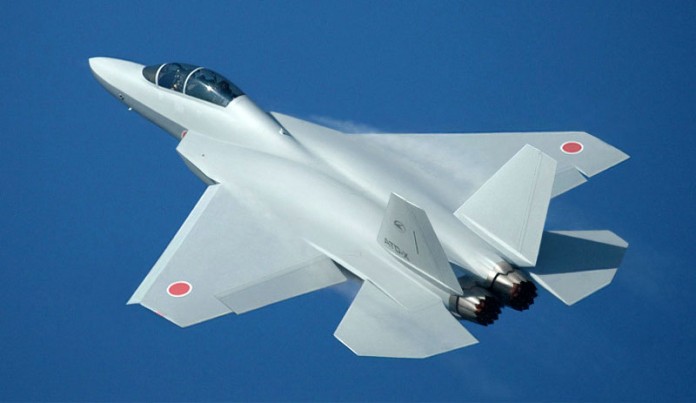
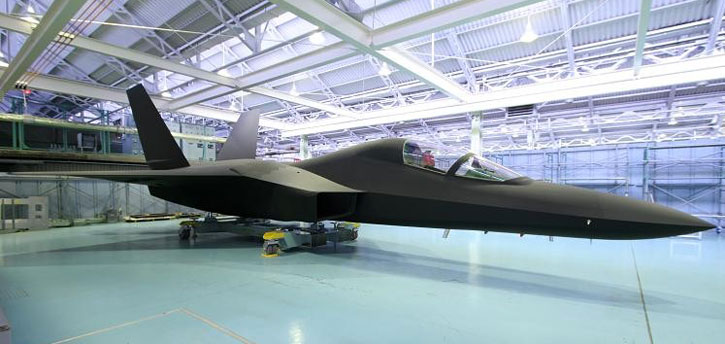
    A mockup of the ATD-X (Shinshin) was unveiled publicly in 2007.
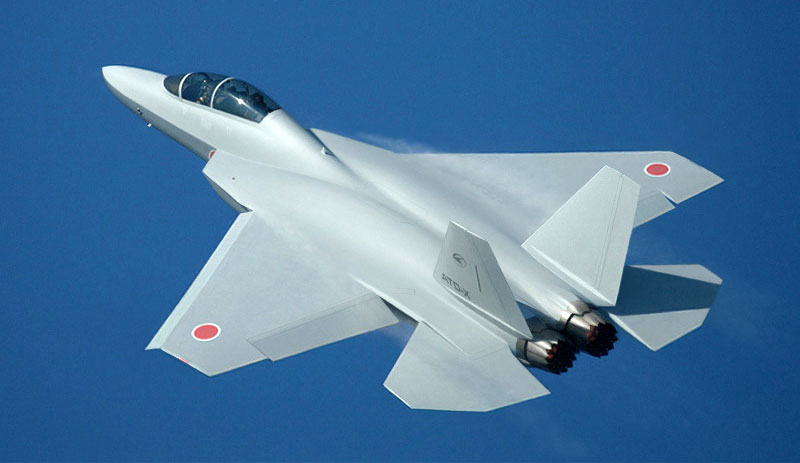
    Japan's ATD-X next generation fighter demonstrator is due to fly for the first time in 2015.
    Japan’s ATD-X next generation fighter demonstrator is due to fly for the first time in 2015.

    Japan’s defense ministry’s Technical Research and Development Institute (TRDI) is planning to unveil the country’s advanced technology demonstrator-experimental (ATD-X) plane within months; the lightweight stealth aircraft is scheduled to make its maiden flight later this year, Japan’s defense minister Itsunori Onodera has confirmed. ATD-X is positioned to become Japan’s next generation stealth fighter, replacing 94 locally produced F-2 that entered service in the year 2000. Speaking to the foreign affairs and defense committee of Japan’s upper house, Onodera said the indigenous fighter demonstrator is few months behind schedule.

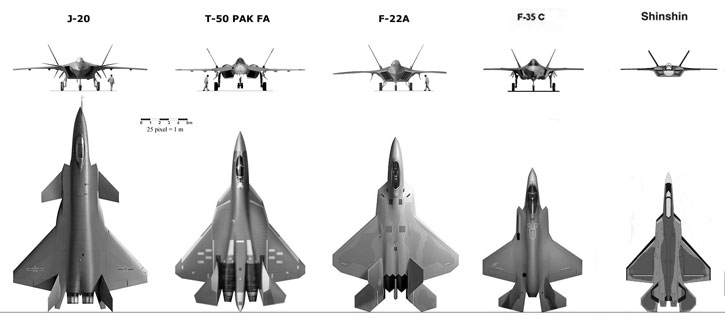
    Powered by two afterburning turbofans each developing 11,023 pounds each (5,000kg), the aircraft is designed for maximum takeoff weight of 28,659 pounds (about 13 tonnes). With a wingspan of 9 meters (29.85 feet), and overall length of 14.174 meters (46.5 ft) the ATD-X (dubbed ‘Shinshin’) will be smaller than the F-35 and mush smaller, compared to Chinese or Russian stealth fighters.

    5th-generation-fighters_atdx725

    Mitsubishi is the main contractor for the ATD-X with Ishikawajima-Harima Heavy Industries (IHI) providing the XF5-1 afterburning turbofan for the plane. The same team has also produced a licensed version of the Boeing F-15J and its P&W F100 power plant. The two companies are also producing the F-2, the Japanese F-16 variant powered by a GE F110 engine. The companies will also share significant work sharing in the production of Japan’s 42 F-35As.

    Through the 2000s the project evolved under research studies with the formal demonstration flight program launched in 2009. The program is on schedule to begin flight tests in 2014. Mitsubishi said that based on the tests results it will be ready for full scale development of a future stealth fighter by 2016.

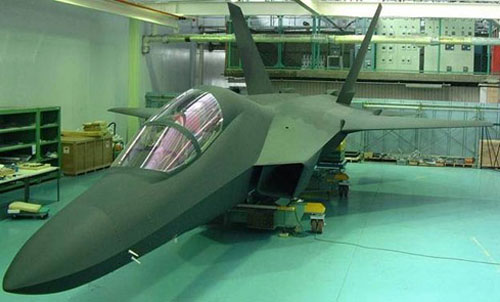
    The Shinshin (spirit of the heart in Japanese) will help mature advanced airframe, propulsion designs and manufacturing technologies necessary for the production of future fighters. The general design dates back to the early 2000s, when the ATD-X mockup was sent to France for radar cross-section tests. Following to those tests, Japanese engineers have tested a 1:5 scale model of the plane evaluating high angle of attack controllability. A full size mockup of the plane was unveiled publicly in 2007.

    atdx-shinshin725

    In 2006 the mockup was used to test radar cross section of the new design.
    In 2006 this mockup was used to test radar cross section of the new design.

    Among the technologies considered for the ATD-X are advanced fly by light fibre-optical flight control system, that will integrate ‘self healing’ capability, reconfiguring flight controls in case of malfunction or damage. The XF-5-1 afterburning engines will be equipped with three-dimensional thrust vectoring, providing additional lift and directional control augmenting the fighters’ flight control surfaces. Another system likely to be tested is an intelligent capability called “I3” (informed, intelligent, instantaneous) providing pilot assist.

    The aircraft was scheduled to make its maiden flight in early 2015 but this milestone was delayed at least to the end of the year due to issues with the software that controls automatic engine restarts, according to officials at the country’s Ministry of Defence (MoD).

    Japan intends to retire its F-2 beginning in 2020. A decision whether to co-produce a foreign designed aircraft or develop an indigenous one will be made in 2018. Although Japanese companies have produced several generations, they were mostly licensed production of foreign aircraft or derivatives of foreign designs. Indigenous programs focused mainly at specialized, non-combat designs, like the Mitsubishi PX-1 maritime surveillance/transport, Kawasaki HC-2 short takeoff and landing transport plane and T-4 trainer and ShinMaywa US-2 amphibian.

    Harnessing this experience with state of the art technologies, the ATD-X program will essentially pave the way for Japan’s aerospace industry, proving it muster the necessary technologies to support, mature and afford locally designed 6th Generation fighters. These technologies will also be essential to position Japan in the future unmanned combat aircraft market.

    A mockup of the ATD-X (Shinshin) was unveiled publicly in 2007.
    A mockup of the ATD-X (Shinshin) was unveiled publicly in 2007.

    After NATO withdrawal Afghanistan could slide into a regional proxy conflict

    With the political situation in Afghanistan in flux and international forces due to leave the country by the end of the year, the debate in neighboring Pakistan is focusing on prospects for increased cooperation with Afghanistan and Iran. Sharon Behn of the Voice of America reports.

    In just eight months the last of the international forces are due to leave Afghanistan, ending a 13 year battle against the Taliban and other militants.

    Analysts warn if Kabul’s neighbors do not start to cooperate, competing desires for influence could deteriorate into a bloody proxy war in the country.

    Pakistani Senator and Chairman of the Defense Committee Mushahid Hussain Sayed recalls the last proxy war played out in Afghanistan between Pakistan and Iran, which destabilized the region in the 1990s.

    “Pakistan and Iran must avoid making the mistakes of the past. We tried to overreach, we had outsized ambitions, the times have changed, there are new realities, in Afghanistan the elections have shown that there is a supremacy of the ballot over the bullet,” he said.

    But because of the competing and overlapping interests of the four main regional players — Pakistan, Iran, India and China — as well as the United States, it is unclear if a strong, coherent regional consensus will emerge any time soon.

    Rifaat Hussain, a professor of public policy at the National University of Sciences and Technology, is not optimistic.

    “That you are a contiguous state, you want to implement non-interference, non-intervention doctrines, but the developments inside Afghanistan, particularly the growing influence of your rival powers, does not allow you to exercise that option. So non-interference is not a viable option in my judgment,” said Hussain.

    But regional dynamics are changing. A lot will depend on the strategic decisions taken by the new political leadership in Iran, Pakistan, China and after the ongoing elections in India and Afghanistan.

    There are questions as to what extent traditional rivals Pakistan and India, and Iran and the United States, will be able to overcome past animosities and mistrust.

    Islamabad is also seen by Kabul as siding with the Afghan Taliban in order to keep a hand in Afghanistan’s political direction.

    But Sherry Rehman, Pakistan’s former ambassador to Washington, says there is a strategic shift underway in Pakistan’s policy towards Kabul, away from dominance and towards cooperation.

    “If we want to look at policy through a new lens, as opposed to the old ball-and-chain of strategic depth, then we will look at no favorites,” said Rehman.

    But in an example of persisting friction between Islamabad and Kabul, Afghanistan’s cultural attaché to Islamabad, Zardasht Shams questioned Rehman’s position.

    “We have the legitimate elected Afghan government and then we have insurgents. So there should be favorites. The Afghan government should be the favorite, not the … there should be no doubt who are the favorites,” said Shams.

    Future peace will also depend heavily on the political acumen and political deal-making ability of Afghanistan’s next president. Partial results from the April 5 elections point to a runoff between the two leading candidates: former World Bank official Ashraf Ghani, and former foreign minister Abdullah Abdullah.

    North Korean mini-Drones are Made in China

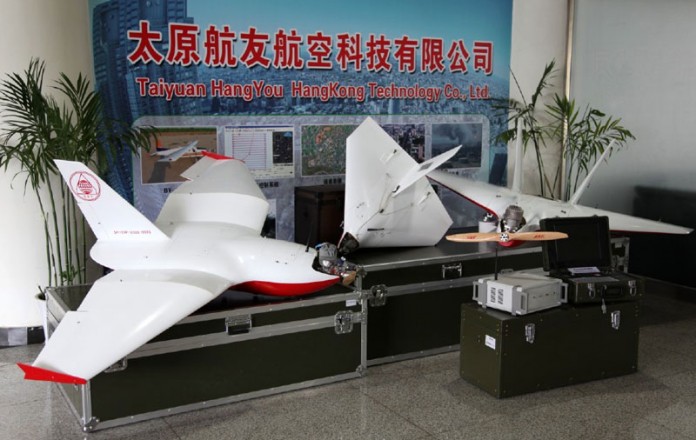
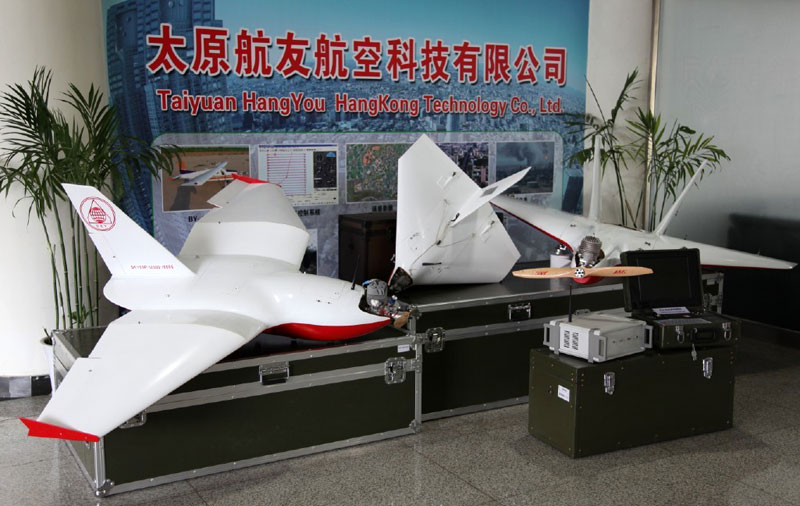
    The mini drones operated by North Korea over South Korea are the SKY 09 made in China by the Taiyuan Navigation Technology company. The models operated by North Korea was equipped with a muffler, to reduce the drone's acoustic signature. Photo: Taiyuan
    The mini drones operated by North Korea over South Korea are the SKY 09 made in China by the Taiyuan Navigation Technology company. The models operated by North Korea was equipped with a muffler, to reduce the drone's acoustic signature. Photo: Taiyuan
    The mini drones operated by North Korea over South Korea are the SKY 09 made in China by the Taiyuan Navigation Technology company. The models operated by North Korea was equipped with a muffler, to reduce the drone’s acoustic signature. Photo: Taiyuan

    According to ‘Alert 5‘ news blog, these drones are commercial off-the-shelf SKY-09P models made in China, by Taiyuan Navigation Technology. Based on the manufacturer’s data this mini-drone is launched by a catapult and retrieved by parachute. It can carry a payload of 3 kg on a 90 minute mission, controlled in flight over a distance of 30-40 km.  The company also offers a larger variant, SKY-19 that can fly for two hours and carry 5kg of payload.

    The mini drones operated by North Korea over South Korea are the SKY 09 made in China by the Taiyuan Navigation Technology company. The models operated by North Korea was equipped with a muffler, to reduce the drone’s acoustic signature.

    Read more on the drone incursions over South Korea

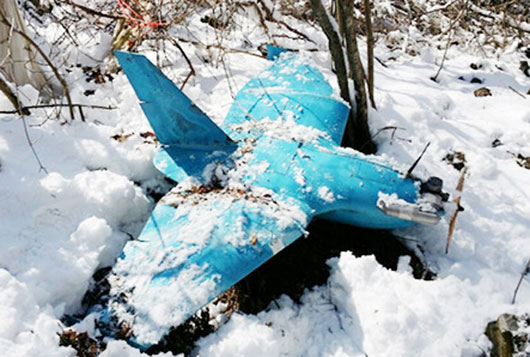
    This mini-UAV was found in October 2013 on the east coast area of South Korea, near the town of Samcheok.
    This mini-UAV was found in October 2013 on the east coast area of South Korea, near the town of Samcheok.

    GAO tells Air Force: Improve Service Conditions for Drone Pilots

    drone-office800

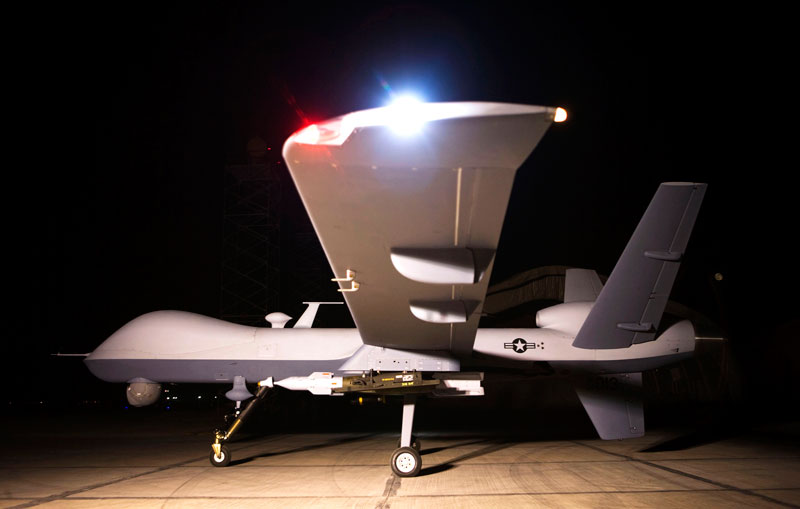
    Since 2008 the US Air Force has more than tripled the number of its active-duty pilots flying Remotely Piloted Aircraft (RPA) – including General Atomics MQ-1 Predator, MQ-9 Reaper and Northrop Grumman RQ-4 Global Hawk, as well as a number of operational types that are still secretive ‘black’ programs. Due to the increase in demand, and introduction of more capable platforms carrying multiple payloads, RPA pilots have had a significant increase in workload, and insufficient training, a report by the US Government Accountability Office (GAO) determined.

    The expanded use of RPA took these platforms beyond the traditional intelligence, surveillance, and reconnaissance (ISR) role they were originally designed for. For the past decade the MQ-1 and the MQ-9 are sharing the burden in combat missions worldwide, outfitted with missiles to strike targets, target designators to mark targets for manned aircraft and sensors able to locate the positions of improvised explosive devices and insurgents activity.

    Since 2010 the Air Force is building an RPA force able to sustain 65 Combat Air Patrols (CAP) anywhere in the world; to operate this formidable airpower the air force will require more than 1300 pilots. Today, about 40 percent of these pilots are are qualified to fly manned aircraft. By the year 2022 the Air Force intends to raise a cadre manned almost entirely by dedicated RPA pilots.

    Unit commanders and some RPA pilots stated that the high pace of operations and demand for RPA capabilities limited their units’ time to train for the various mission sets that RPA units are required to perform

    The Air Force spends considerably less to train RPA pilots than it does to train manned-aircraft pilots. While training a pilot for through Undergraduate Pilot Training course may cost $557,000 in average, training an RPA pilot costs about $65,000 to reach a parallel proficiency level flying drones.

    However, in the first three years of this program, recruitment goals for RPA pilots were missed, as new recruits don’t want to fly RPAs. Excessive workload, and the negative public perception are part of the reasons, but negative perception within the Air Force is also a major concern.

    “Headquarters Air Force officials, RPA pilots in some of our focus groups, and one unit commander stated that some in the Air Force view flying RPAs negatively, resulting in a stigma” the GAO report indicated. Overcoming this stigma may be difficult because most of the RPA activities and their role in securing warfighters and national security are classified.

    Another aspect affecting the quality of life of RPA pilots is the ‘Remote-Split’ method of RPA operation. “The Air Force has not fully analysed the challenge pilots face to balance their war fighting roles with their personal lives” GAO said, while the RPAs themselves and their support personnel are forward based at or near conflict zones, their pilots and mission system operators are based in the USA and live at home. This uncommon service, called ‘deployed on station’, exposes RPA crew members to the experience combat alongside their personal lives, which negatively affects their morale. Lower than average promotion rate among RPA pilots doesn’t add to their satisfaction either, the report stated.

    Air Force RPA pilots operate from eight active-duty bases in the continental United States. These bases include Creech, Cannon, and Beale Air Force Bases and Air National Guard bases located in six states including North Dakota, New York, and Ohio. Air Force Reserve unit will soon be added at Hurlburt Field and at Air National Guard bases in Arkansas, Iowa, Michigan, New York, and Pennsylvania.

    Excessive workload is another causes of dissatisfaction among RPA pilots. In 2008, the Air Force determined the optimum number of RPA pilots for some of the units but hasn’t updated this ratio to reflect the growing mission diversity and workload. Back in the mid 2000s the crew ratio for the MQ-1 Predator was determined to be 10:1 – ten crews supporting a Predator RPA on a 24 hour mission. Since then, the Air Force has introduced the MQ-9 Reaper, which carries more weapons and sensors and can fly longer missions, but the crew ratio for the Reaper is still 10:1. The GAO found that in most units, the ratio is significantly lower than this goal.

    ”Low crew ratios diminish combat capability and cause flight safety” the report stated, adding that the Air Force not only operates below the optimal ratio, it hasn’t met even the minimum crew ratio. “High work demands on RPA pilots limit the time they have available for training and development and negatively affects their work-life balance” the DOD stated.

    One RPA unit had to spend about 95 percent of its work hours in fiscal year 2013 flying combat-operations missions and the remaining 5 percent flying training missions, logging around 19,600 hours flying combat missions, compared to about 940 hours of training missions

    These conditions also challenge recruiting and contribute to low retention rate among pilots. “High performing organisations tailor their recruiting and retention strategies to meet their specific mission needs” the report said, “but the Air Force has not tailored its approach to recruiting and retaining RPA pilots nor considered the viability of using alternative personnel such as enlisted personnel and civilians.

    The Air Force commented it is updating recruitment and retainment of RPA crews and is working to update its crew ratios but has rejected the use of enlisted personnel to fly and operate drones.

    Each of the US Military services is operating RPA differently. The U.S. Air Force assigns officers to fly RPAs and enlisted personnel to operate the RPAs’ sensors, which provide intelligence, surveillance, and reconnaissance capabilities. In addition, the Air Force relied solely on manned-aircraft pilots to fly RPAs until 2010, when it established an RPA pilot career field for officers who specialize in flying RPAs and are not qualified to fly manned aircraft. The Navy also assigns officers to pilot RPAs, and enlisted personnel to operate RPA sensors. However, the Navy has not established a separate career field for pilots who specialize in flying RPAs and instead assigns pilots of manned aircraft to operate them. By contrast, the Army and Marine Corps have opted to assign enlisted personnel to fly RPAs and operate their sensors. Further, in both the Army and Marine Corps, there is no distinction between the pilot and sensor operator.

    MQ-9usaf800
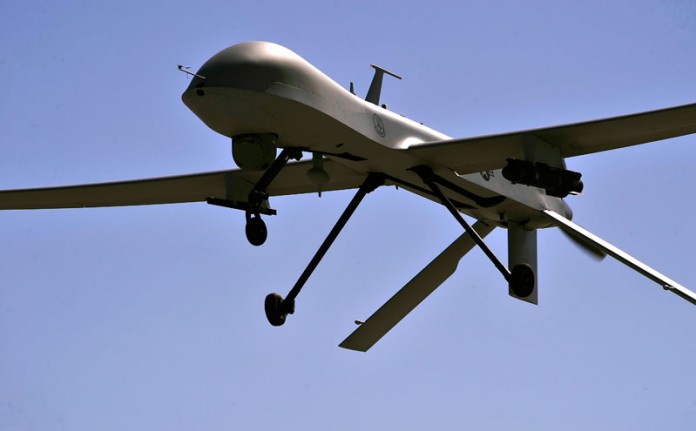
    A fully operational RPA system consists of several sensor/weapon-equipped aircraft such as this MQ-9 Reaper, a ground control station, Predator Primary Satellite Link, and spare equipment along with operations and maintenance crews for deployed 24-hour missions. Photo: USAF
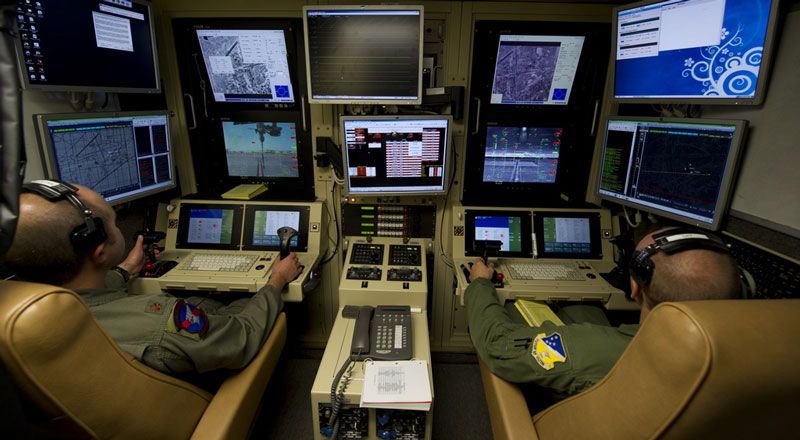
    The SATCOM terminals are used exclusively by Remotely Piloted Aircraft to fly up to eight different missions at a time, with either the MQ-1Predator or MQ-9 Reaper via satellite. USAF Photo by Colin Cates.
    The SATCOM terminals are used exclusively by Remotely Piloted Aircraft to fly up to eight different missions at a time, with either the MQ-1Predator or MQ-9 Reaper via satellite. USAF Photo by Colin Cates.

    Jordanian Fighter Jets Attack Repel Terror Raid from Syria, Iraq?

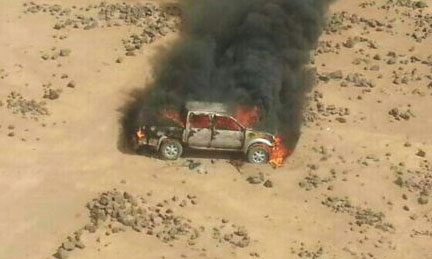
    A burning pickup truck struck by Jordanian fighter jets north of Mafraq, April 16, 2014. Jordanian MOD Photo
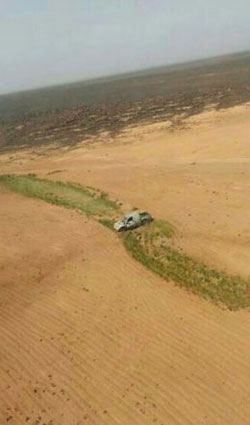
    An abandoned pickup truck hit by Jordanian fighter jets after an infiltration attempt into Jordan. Jordanian MOD photo via AP
    An abandoned pickup truck hit by Jordanian fighter jets after an infiltration attempt into Jordan. Jordanian MOD photo via AP

    Jordanian military warplanes struck a convoy of vehicles as they were trying to enter Jordan from Syria, the Jordanian army said in a statement Wednesday. A Syrian military official acknowledged the vehicles did not belong to the Syrian army. According to the Associated Press, the statement did not say how many vehicles were in the convoy, nor did it offer casualty figures. On a separate incident, a Royal Jordanian Air Force F-5E jet fighter crashed while on a training mission near the town of Safawi, killing the pilot. The crash site was about 100 kilometers west of the site where the vehicles were hit a day before. Unnamed sources added that three vehicles were engaged when travelling off-road near Ruwaished (75 west of the Iraqi border), in northern Jordan. It also did not specify whether the vehicles were targeted on Syrian or Jordanian soil.

    The attack was carried out yesterday morning at 10:30 a.m.local time (0730 GMT). The statement claimed the vehicles were “camouflaged” and were driving in a rugged area near the border and ignored demands to stop from security forces. The statement said Jordanian aircraft fired warning shots at the vehicles, but they did not stop. The warplanes then destroyed the vehicles. The photos released by the military show several burning vehicles without camouflage or distinctive weapons on them.

    While the long and open desert border separating the Hashemite Kingdom of Jordan and Syria is open is often crossed by smugglers, often arrested by Jordanian border guards. Jordan is also providing an access point for supplying weapons to the Syrian rebel forces. It is the first time since the Syrian uprising began in March 2011 that Jordan has openly used military aircraft to hit vehicles along the border.

    A burning pickup truck struck by Jordanian fighter jets north of Mafraq, April 16, 2014. Jordanian MOD Photo
    A burning pickup truck struck by Jordanian fighter jets north of Mafraq, April 16, 2014. Jordanian MOD Photo

    The Israeli website Debka Files claims the convoy attacked by the Jordanians was in fact an Al-Qaeda affiliated Iraqi strike force manned by the Islamic State of Iraq and the Levant (ISIS) fighters, coming from the western Iraqi province of Anbar. They chose the Syrian route to avoid running into Jordanian military forces securing the border from infiltration by Syrian rebels and refugees. Debka claimed their their target was a secret US-Jordanian training camp situated west of Ruwaished, where US Non Governmental contractors are said to be training Iraqi army and police forces in advanced counter terror combat tactics. The insurgents opted to take a detour through chaotic, lawless sector of southern Syria to avoid detection by Jordanian security forces.

    If this information is true, this is the first time that ISIS is turning against US targets outside Iraq, since the American withdrawal from that country.

    Skunk Works and XTEND Simplify Multi-Drone Command

    0
    Lockheed Martin Skunk Works® and XTEND have achieved a major milestone in JADC2 by integrating the XOS operating system with the MDCX™ autonomy platform. This technical breakthrough enables a single operator to simultaneously command multiple drone classes, eliminating the friction of mission handoffs. From "marsupial" drone deployments to operating in GPS-denied environments, explore how this collaboration is abbreviating the data-to-decision timeline and redefining autonomous mission execution.

    From Ukraine to Taiwan: The Global Race to Dominate the New Defense Tech Frontier

    0
    As traditional defense primes face mounting competition from agile “neoprimes” such as Anduril, Palantir and Helsing, the balance of innovation is shifting toward software-defined warfare and scalable, dual-use technologies, while global industry consolidation—marked by Boeing’s integration of Spirit AeroSystems and other strategic mergers—signals an intensified race to secure control over the defense technology value chain. Our Defense-Tech weekly report highlights these trends.

    Europe’s “Drone Wall”

    0
    In early October 2025, a coordinated wave of unmanned aerial system (UAS) incursions—widely attributed to Russia—targeted critical infrastructure across at least ten European nations. The unprecedented campaign exposed the fragility of Europe’s air defenses...

    Weekly Defense Update & Global Security Assessment

    0
    Executive Summary The past week (September 18-25, 2025) represents an inflection point where strategic defense concepts have transitioned from doctrine to tangible reality. An analysis of global events reveals four primary, interconnected trends shaping an...

    U.S. Air and Space Forces Push Next-Gen Programs at the AS&C 2025 Conference and...

    0
    At the 2025 Air, Space & Cyber Conference, U.S. Air Force and Space Force leaders unveiled major updates on next-generation fighters, bombers, unmanned systems, and space initiatives, highlighting both rapid innovation and critical readiness challenges as the services race to outpace global competitors. A short version is available here, with a more detailed version for subscribers.

    TADTE 2025: Reflecting Taiwan’s Strategic Themes

    0
    The Taipei Aerospace & Defense Technology Exhibition (TADTE) 2025 crystallized around four dominant strategic themes that collectively illustrate Taiwan's comprehensive approach to defense modernization amid escalating regional tensions. Based on a detailed report by Pleronix (available upon request). Includes a Podcast discussion on TADTE 2025's highlighting Taiwan's four strategic themes beyond the post's coverage.

    Iron Beam 450 Completes Testing, Soon to Join With Operational Air Defense Units

    0
    Israel’s Iron Beam 450 high-power laser system has completed final testing, marking a major leap in air defense. Developed by Rafael, it offers precise, cost-effective interception of rockets, UAVs, and mortars, and is set for IDF deployment by 2025.