Wednesday, December 31, 2025
More
    Home Blog Page 183

    Test Validates GBU-53B Small Diameter Bomb II Moving Target Attack Capability

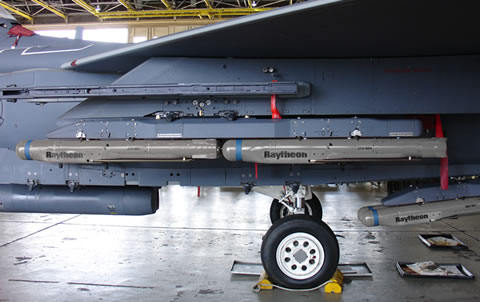
    One of the key featutures of the GBU-53/B is that it is designed to maximize the loadout on fourth and fifth generation fighter aircraft. BLU-61/A suspension equipment enables the F-15E fighter aircraft to carry seven groups of four GBU-53/Bs for a total of 28 weapons.

    GBU-53/B Small Diameter Bomb II (SDB II) program achieved an important milestone last week when the weapon successfully engaged and hit a moving target using its tri-modal seeker.  SDB II is designed to engage moving targets in adverse weather and through battlefield obscurants. “SDB II is the first in the next generation of smart weapons that uses multi-mode seekers and fully networked enabled data links to engage moving targets in bad weather or battlefield obscurants in high threat environments,” said Harry Schulte, vice president of Air Warfare Systems for Raytheon Missile Systems.

    On July 17 test, a crew of a U.S. Air Force F-15E fighter staging out of Holloman Air Force Base, N.M., released the GBU-53/B, which then acquired, tracked and guided to a moving target scoring a direct hit. during a flight test at the White Sands Missile Range, N.M. Currently in engineering and manufacturing development,

    As a mission-flexible weapon SDB II is capable of defeating threats such as swarming boats, mobile air defense systems or armored targets. It’s capabilities include the ability for the weapon to be employed in three primary attack modes, each with a subset mode, for a total of six engagement modes. A dual band, two-way weapon data link for in-flight target updates and status reporting allows post-launch control of the weapon by the launching aircraft, a Joint Terminal Attack Controller (JTAC), or a third party. In addition to its adverse weather, moving-target capability, SDB II can hit targets from stand-off ranges. It has a powerful warhead capable of destroying armored targets, yet keeps collateral damage to a minimum through a small explosive footprint.

    US Army Tests Validate Radar-Based Ground Based Sense & Avoid for UAS

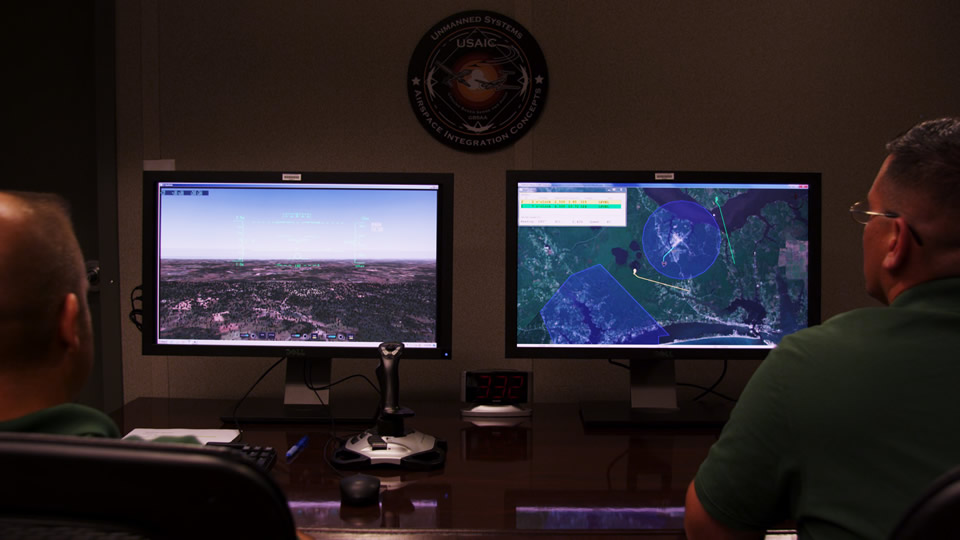
    Evaluators conduct one of the vignettes that showcased the next upgrade to the Two unmanned aircraft system operators fly a UAS during one of the synthetic flight vignettes using replicated airspace and environment from Cherry Point, N.C. On the left is an Aircraft Operator and on the right is the Ground Based Sense and Avoid System Operator. Photo: US Army

    The US Army said it is ready to begin the certification process in order to field the Ground Based Sense and Avoid system (GBSAA) to support Unmanned Aerial System (UAS) operations along with commercial aviation inside civilian controlled National Airspace. First deploymnwt is planned at Ft. Hood, TX in March 2014.

    Viva Austin, product director for the Army’s Unmanned Systems Airspace Integration confirmed. The five locations for Gray Eagle basing and training include Fort Hood, Texas; Fort Riley, Kan.; Fort Stewart, Ga.; Fort Campbell, Ky.; and Fort Bragg, N.C.It’s expected the first system will field in March 2014 at Fort Hood. About three months later, the system should field to Fort Riley.  All five sites should be equipped with the GBSAA system by 2015.

    As unmanned aerial systems and the soldiers who fly them return home from theater, the Army needs a way to keep those UAS operators trained for the next conflict, and they need to do that training inside the United States and inside the National Air Space (NAS). However, due to the Federal Aviation Administration (FAA) ‘See ad Avoid’ safety requirement, such operations are restricted to certain areas and daytime only flights. At present, the Army can’t fly the UAS in NAS at night.

    Flexing the Rules

    The FAA requires a pilot be able to “see and avoid” other aircraft flying in the same airspace. But a UAS has no pilot onboard. The Army can get around that by meeting other requirements, however. The Army can fly a UAS in the NAS with a chase aircraft following the UAS, for instance. It is also possible to fly in the NAS if a trained observer is watching the UAS. But the observer must be within one mile and 3,000 feet of the vehicle.


    The GBSAA was developed as an “alternate means of compliance” for the FAA’s “see and avoid” requirement. The system senses other traffic in the area, using a 3D radar system, and uses algorithms to determine if there is danger of collision and how to avoid that danger. That information is provided to the UAS operator.

    The GBSAA is a radar and warning system designed to allow soldiers to fly unmanned aerial systems, like the Gray Eagle, inside the National Air Space, while still meeting Federal Aviation Administration regulations. The system monitors the location and altitude of UAS and other aircraft, detects potential collisions courses, and makes recommendations to UAS operators on how to avoid those collisions.

    When the FAA approves the system for use, the Army will be able to train UAS pilots any time of day, relieving the Army from deploying chase aircraft, observers and allowing operations through the night hours.

    The US Army recently concluded a two-week demonstration of the Ground Based Sense and Avoid system, or GBSAA, at Dugway Proving Ground, Utah. During the demonstration, the Army put the system through multiple training “vignettes” that validated both the design and functionality of the system.

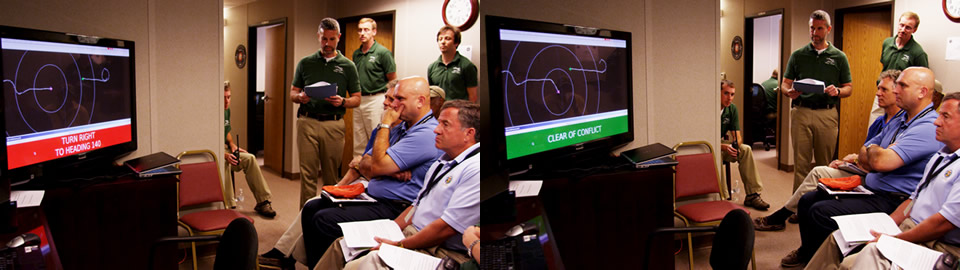
    Evaluators conduct one of the vignettes that showcased the next upgrade to the Army’s maneuver algorithms. Two live Shadows are being flown toward each other; one with the Ground Based Sense and Avoid System system and one without. The system spots the potential collission (left) and recommend diversion of one of the planes (right). Photo: US Army

    GBSAA Test Program

    The recent demonstration of the GBSAA involved seven vignettes at Dugway Proving Ground, involving both live and synthetic UAVs, as well as synthetic “intruders.” The first three vignettes used real UAS. In vignettes 1 and 2, a real Hunter UAS flew at Dougway against synthetic “intruders” in their airspace. The difference between the two vignettes was the version of the GBSAA used. In both scenarios, the system performed without endangering the mission, but on the second run, the Army Phase 2 Block 0 system’s improved algorithms indicated an earlier, safer departure time between the two intruders.

    Vignette 3 pitted two live Shadow UAS against each other. One of the Shadows served as the intruder aircraft, the other was guided by the GBSAA. The operator of that aircraft was warned at an appropriate time and was able to follow the recommended maneuver to avoid the other aircraft.

    The next three vignettes showed the adaptability of the Phase 2 Block 0 algorithms. They were flown using synthetic UAS, through the X-Plane system. Each of the three vignettes used replicated airspace over different military installations, including Marine Corps Air Station, Cherry Point, N.C.; Fort Stewart, Ga.; and Fort Drum, N.Y.

    Finally, in vignette 7, the GBSAA system was demonstrated again using a synthetic UAS, but was flown against live aviation traffic data around nearby Salt Lake City, and also against recorded air traffic data from Boston’s Logan Airport.

    Evaluators conduct one of the vignettes that showcased the next upgrade to the Two unmanned aircraft system operators fly a UAS during one of the synthetic flight vignettes using replicated airspace and environment from Cherry Point, N.C. On the left is an Aircraft Operator and on the right is the Ground Based Sense and Avoid System Operator. Photo: US Army

    Pacific Isle Disputes Continue Unabated

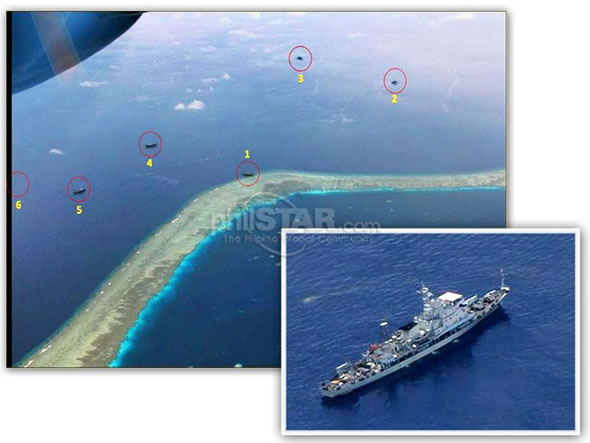
    On 13 July, the Chinese Defense Ministry announced on its website that a People’s Liberation Army Navy (PLAN) frigate ran aground in the Spratly Islands while conducting a routine patrol in the South China Sea. The frigate went aground on Half Moon Shoal located approximately 65 nautical miles west of the Philippine island of Palawan. The grounded frigate is believed to be No. 560, a Jianghu-class frigate, which has been linked to previous attempts to use intimidation to prevent Filipino fishing boats from entering the fishing grounds in the area.

    The Chinese Defense Ministry said there were no injuries resulting from the grounding. Chinese claims that the frigate was conducting routine patrols was challenged on 13 July by a story carried in Australia’s Sydney Morning Herald. This story, quoting Western diplomatic sources, stated that the Chinese frigate was engaged in activities planned to discourage Filipino fishing vessels from entering the Spratlys.


    Chinese officials announced on 15 July that the PLAN frigate that ran aground on Half Moon Shoal had been refloated and was headed for its homeport to complete a damage assessment. China’s Defense Ministry said in a statement that “the frigate which had run aground in waters near Half Moon Shoal successfully extricated itself with the help of a rescue team.” The statement went on to say that the bow of the vessel had sustained light damage and that all aboard were safe. Beijing further offered that return of the frigate to its homeport was being organized and claimed that the “incident caused no maritime pollution.”

    The Chinese Frigate No. 590 (marked 1) grounded at the Half Moon Shoal at the Spratkys islands range. Photo: Philstar.com

    Philippine defense sources confirmed that the frigate, accompanied by six additional Chinese vessels, had departed the area of the incident. Manila reaffirmed its contention that Half Moon Shoal lies well within its 200-nautical-mile exclusive economic zone, a zone recognized and guaranteed by international law. Departure of the Chinese vessels likely averted another face-to-face standoff with the Philippines, but tensions remain high and distrust of China remains strong.

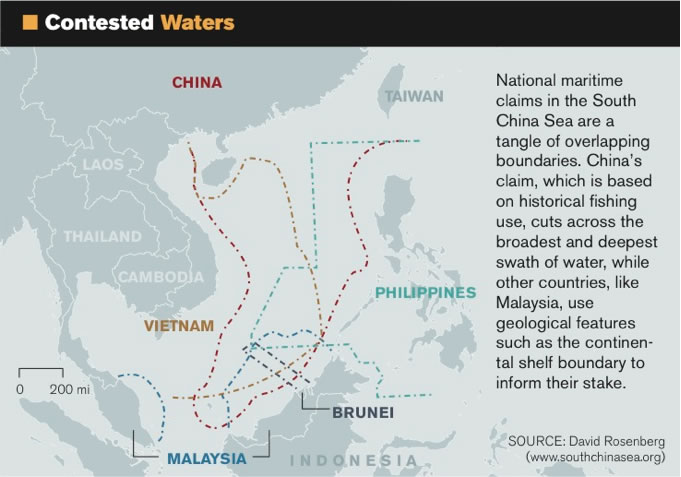
    The Spratlys form one of the largest island chains in the South China Sea. Beijing has long claimed sovereignty over virtually all the South China Sea region, a volatile claim that is disputed by no less than five other Pacific nations. The Philippines, Taiwan, Malaysia, Vietnam, and Brunei also lay claim to specific areas of the region. Of particular concern to China’s Pacific neighbors is the fact that Beijing’s claims infringe on their territorial waters, in some cases encompassing waters that are included in their internationally recognized exclusive economic zones.

    With all of the competing property claims, the South China Sea has become a potential hotspot that some fear could rise to the level of armed hostility. In recent years the South China Sea has become a lucrative prize fueled by speculation that the region is endowed with extensive oil and gas reserves. The area is also a bountiful fishing ground. All six claimants to the region are determined to protect their territorial claims to guarantee their access to these energy sources and as protection of maritime transit and trade.

    Four countries are claiming territories in the Spratlys Island range at the South China Sea.

    Beijing’s Pacific neighbors have become increasingly vociferous in their condemnation of what they call “China’s aggressive behavior and diplomatic bullying.” They have accused China of stationing warships in the area to frighten away fishing boats and generally interfere with peaceful maritime transit of the region.

    The dispute has escalated in recent years and engaged the reluctant attention of nations far distant from the Asia-Pacific region. At the conclusion of a regional Association of Southeast Asian Nations (ASEAN) summit last week the attendees failed, for the first time in 45 years, to agree on a concluding statement to highlight diplomatic progress achieved during the summit. Association efforts to draft a joint code-of-conduct framework for future action, largely precipitated by the ongoing disputes over Pacific Isles, failed primarily due to Chinese dissension.

    China, with support from Cambodia, prevented the 10-nation association from issuing a concluding statement that is customarily issued at the end of each summit to address member nation’s accomplishments and identify concerns to be addressed in future sessions. Cambodian Foreign Minister Hor Namhong defended his nation’s stance during the ASEAN summit in telling reporters that Cambodia’s position was based on principle and declared that during “the meeting of the ASEAN foreign ministers, we are not a tribunal to adjudicate who is right, who is wrong.”

    China and the Philippines have engaged in several face-to-face encounters in the South China Sea, most recently in the Scarborough Shoals some 500 nautical miles north of Half Moon Shoal. Last year, the Philippines scrambled combat aircraft and warships to counter a Chinese threat to ram and sink a Filipino survey ship in the Reed Bank area of the region.

    In June, Beijing announced the deployment of “combat-ready” vessels to areas of the South China Sea that China lays claim to. Beijing publicly announced that the Chinese government “vehemently opposed” and denied the legality of a Vietnamese law claiming sovereignty over the Paracel and Spratly Islands.

    Beijing and Manila are still pursuing negotiations to end their dispute surrounding territorial claims to the Scarborough Shoal, a dispute that has dragged on for months and resulted in naval vessels from both nations meeting in a lengthy and tense face-to-face confrontation in the disputed area.

    Manila announced on 15 July that the government was considering opening up bidding for oil and natural gas exploration rights in areas near the South China Sea to foreign investors. This announcement has also drawn a strong protest from the Chinese despite the fact that part of the area under consideration is only 34 miles off the coast of the Philippine’s Palawan Island.

    With the Obama administration’s widely publicized “shift” to the Pacific, the island disputes have now taken on more of an international tone. Although the United States has publicly adopted a stance of neutrality in the South China Sea disputes, the US has agreed to bolster the Philippines with military hardware and increased the size of its military presence in the Philippines. The guiding principle, from an American standpoint, is to protect and defend freedom of navigation in all areas of the Pacific.

    Ozone Driven Apps Transform C2 Systems Into Flexible Information Services

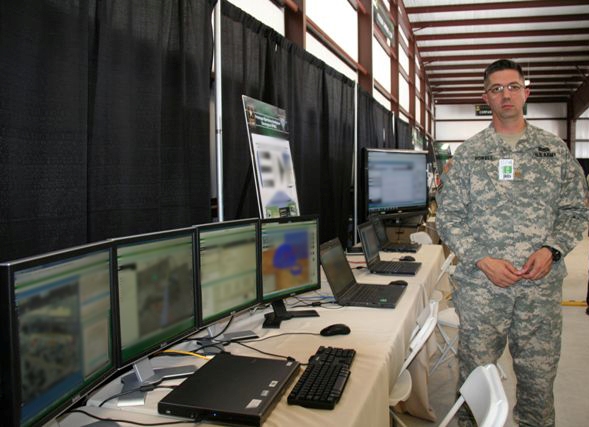
    Maj. Ryan Howell demonstrates OPS/Intel at Network Integration Evaluation 12.2 Photo: US Army

    The US Army has demonstrated a new software framework called Ozone, that supports rapid prototyping and rapid integration of real-time intelligence and operational data, providing commanders with enhanced situational understanding. Customers will use ‘Apps’ to pull these advanced information products over the pentagon’s secure web, to integrate the data into existing applications or new ones. This capability is part of a prototype of an Operations/Intelligence Convergence Army initiative to fuse real-time intelligence with combat operational data.

    The key software product for OPS/Intel is the Ozone widget framework, developed for the Defense Information Systems Agency (DISA). This government-owned product enables rapid third-party application or “apps” development to produce web-based capabilities for Soldiers and commanders. “This common framework is crucial to OPS/Intel convergence,” said Maj. Ryan Howell, Assistant Program Manager, for the Project Manager Mission Command (PM MC). “It provides the commanders with a complete Common Operating Picture (COP), viewable through apps that provide three-dimensional views for operational and intelligence awareness for ground and air reporting, field artillery commands, logistics, alerts and incident reporting.” To view these apps, users employ Command Web, the web-enabled environment that provides COP data and collaborative tools for those who do not possess thick client (full-featured computer) hardware capabilities. Developers can create the apps on the common framework, similar to how apps are developed on smartphones.


    The first phase of OPS/Intel convergence was demonstrated by establishing a collaborative computing environment combining the Distributed Common Ground System-Army (DCGS-A), the Army’s primary system for processing and disseminating collection elements of reconnaissance, surveillance and intelligence operations with mission command systems, delivering real-time shared situational understanding.

    This OPS/Intel was demonstrated by Soldiers at the recent Network Integration Evaluation, (NIE, 12.2) held at White Sands Missile Range, N.M. The NIEs are semi-annual field exercises designed to rapidly integrate and mature the Army’s tactical communications network. Howell’s team also provided a successful demonstration of OPS/Intel to U.S. Army staff at the Pentagon, which in addition to showing how the common framework could run apps, illustrated potential cost savings for the Army.

    Maj. Ryan Howell demonstrates OPS/Intel at Network Integration Evaluation 12.2 Photo: US Army
    The test demonstrated that Mission Command applications can run on both Mission Command and DSGS-A hardware, as well as on third-party PEO-provided hardware, using Mission Command and DSGS-A virtual machines. “This means that when a unit receives the new Command Post COE software, the operators can reuse equipment already provided regardless of which organization originally purchased that equipment” Howell explained. “We are nearly ready to run a complete scenario that incorporates mission receipt, hasty mission analysis, orders distribution, mission execution and reaction to activities incorporating new Intel during mission execution to the extent the current available widgets allow,” Howell added.

    The future evolution of command post systems will mature into primary service being delivered by Ozone applications, across operations, intelligence, airspace management, fires, sustainment and others, with minimal robust stand-alone systems to support disconnected, intermittent and latent requirements. “This feature will provide users with enhanced situational awareness because they will be able to seamlessly operate the apps should a network outage occur,” said Howell.

    The projects are part of the Army’s Command Post Computing Environment (CP CE) managed by the Program Executive Office Command Control Communications-Tactical (PEO-C3T).

    Japan and China at Odds Over Disputed Islands Again

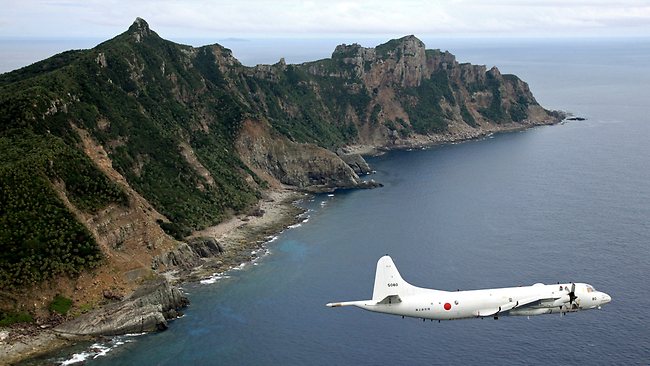
    Japanese P-3 maritime Surveillance aircrft overflying the islands.
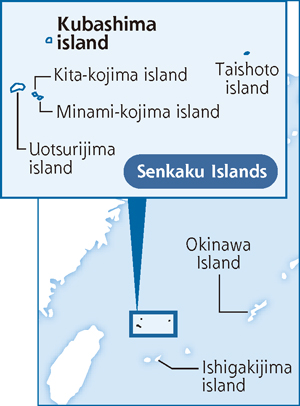
    Senkaku Islands

    The Japanese government recalled its ambassador to China on 15 July for consultations related to a long-term territorial dispute over the Senkaku Islands in the East China Sea. Japanese Ambassador Uichiro Niwa was summoned home by Foreign Minister Koichiro Gemba for discussions concerning the island dispute. Ambassador Niwa’s recall was short lived and he returned to Beijing on 16 July. Details of the high-level government discussions were not, as is customary, made public.

    Last week, three Chinese naval vessels were sighted patrolling the waters around the islands on two separate occasions, provocative events that drew two strongly-worded complaints from Tokyo. The three Chinese patrol ships were met by a Japanese Coast Guard vessel mirroring a Chinese/Philippine standoff that has occupied the better part of the past three months in a dispute over the Scarborough Shoals in the South China Sea. The Chinese ambassador to Japan was also summoned by Minister Gemba after the first sighting. The islands are known as the Diaoyu or Diaoyutai Islands by the Chinese.


    The Senkaku Islands are uninhabited and legally owned by the Kurihara family, Japanese citizens who bought the islands from the previous Japanese owners decades ago. The Japanese government has leased three of the islands since 2002 at a cost of $304,000 per year and claims that a fifth island is state property. US military forces stationed in Japan have used the fourth island in the chain, also leased for an undisclosed amount, as a live-fire range since the end of World War Two.

    The waters surrounding the island chain have long been bountiful fishing grounds and are believed to offer access to significant oil, natural gas, and rare earth reserves. As a prospective source of considerable natural wealth, the archipelago has attracted territorial claims of ownership from China, Japan, and Taiwan. Chinese and Japanese claims of sovereignty both have merit and historical precedent to support them; Taiwan’s claims are a bit more tenuous.

    Tokyo Governor Shintaro Ishihara, a vocal nationalist, announced his plan to buy three of the islands owned by the Kurihara family in April, an idea that ignited immediate complaints from Beijing. Governor Ishihara promised to buy three of the archipelago’s most prominent islands to protect them from Chinese incursions on 16 April. Following quickly on the heels of Ishihara’s pledge, the Tokyo metropolitan government formally created a special bank account to accept private donations to buy the islands. As of this writing, the Tokyo government has collected a reported $16.3 million in donations to be applied toward the purchase of the islands.

    Japanese P-3 maritime Surveillance aircrft overflying the islands.

    In June, Governor Ishihara announced he was negotiating the purchase of the fourth island in the chain as well. A fifth smaller island and three barely visible barren rocks rounding out the chain’s landmass were not included in Ishihara’s plan.

    The Japanese central government has, in years past, refrained from developing the islands to avoid any unnecessary disagreements with Beijing. In response to Ishihara’s plan, Japanese Prime Minister Yoshihiko Noda made public a government proposal to buy the entire archipelago from the Japanese owners on 7 July. When speaking to reporters, Minister Noda said that “the Senkakus are an integral part of our country’s territory in terms of history and international law.” He went on to say there existed no “ownership issue as Japan is in effective control of the islands.” Mr. Noda told reporters that formally nationalizing the island chain would strengthen the nation’s sovereignty claims.

    Chinese government officials were quick to challenge Japan’s nationalization plan with Liu Weimin, speaking for the Chinese Foreign Ministry, saying that his government “will continue to take necessary measures to resolutely safeguard the sovereign rights of the Diaoyu Islands and adjacent islets.” He added that the islands “have been inherent parts of Chinese territory since ancient times and China has indisputable historical and jurisprudential evidence for this.”

    A breakthrough in the disagreement appeared on the horizon in 2008 when Japan and China came to an understanding, an agreement never formalized, that the two nations would work together to jointly develop the oil and natural gas fields around the islands. This tentative agreement quickly fell apart when Tokyo accused the Chinese of attempting to establish a unilateral drilling operation in the area. In 2010, relations between the two Pacific neighbors took a nosedive when Japanese Coast Guard vessels were rammed by a Chinese fishing boat in the area and the Chinese captain of the vessel was arrested and returned to Japan for trial. Since that time, relations have followed a generally upward trend.

    All of the disputes now plaguing Japan in the Pacific further highlight Japan’s reliance on US political and military support. Japan cannot honestly claim it has any rock-solid allies anywhere in the Pacific except for the United States. Japan’s rapidly growing economic problems have greatly diminished the nation’s ability to exercise any meaningful influence in international matters and the traumatic memories of the Empire’s brutal World War Two conquests harbored by many Asia-Pacific nations continue to hobble Japan’s efforts to develop mutually-beneficial relationships with neighboring governments.

    The United States has followed a policy of watchful neutrality in the various Asia-Pacific territorial disputes including the Senkaku Island issue. While acknowledging that the Senkaku Islands are an integral part of the US mutual-defense treaty with Japan, Washington has refused to become embroiled in the ongoing dispute. Japan’s disagreements with Russia over the Kurile Islands have met with the same hands-off stance adopted by the US.

    Japanese officials are concerned that America’s highly-publicized “pivot” to the Pacific may have a detrimental effect on Washington’s ability and willingness to maximize its efforts to provide for the defense of the island nation. While the US has invested heavily in the military installations located on Japanese soil, impending budget cuts and the Obama administration’s intense diplomatic efforts to build new relationships with other Pacific nations may lead to large-scale relocations of US forces that might leave Japan more vulnerable than is the case now.

    For the foreseeable future, it appears Japan will have to muddle through these territorial disputes pretty much alone. Japan cannot surrender its claims without inviting more territorial challenges from other foreign interests, a completely unacceptable option for the Japanese.

    US Air Force Grounds C-27J Fleet Due to Flight Control Failure

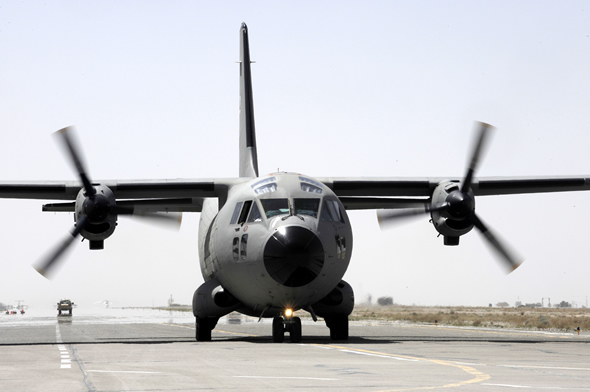
    The US Air national Guard is the main operator of the C-27J; the Afghan Air Force currently operates 14 C-27A aircraft.
    The US Air national Guard is the main operator of the C-27J; the Afghan Air Force currently operates 14 C-27A aircraft.

    The entire fleet of US Air Force C-27J cargo aircraft has been ordered grounded following a mechanical failure of one aircraft’s flight control system. The failure occurred during a training mission on 3 July and was described as a “flight control problem” in a written statement released by Air Force officials.

    The Air Force characterizes the grounding as a “precautionary measure” that is under investigation. The Air Force statement states that the service is working closely with the prime contractor, L-3 Communications, and the C-27J manufacturer, Alenia Aermacchi, to “resolve the matter as quickly as possible and return the C-27J fleet to normal flight operations.”


    No indication was provided to specify how long the fleet would remain grounded. Historically, malfunctions of this nature with similar aircraft have been resolved in a matter of weeks. Determining the cause of the malfunction will involve an examination and testing of all components related to flight control operations to include wing and flight-control surfaces with particular attention being focused on those components that control the aircraft’s altitude.

    The only operator of the C-27J in the United States is the Air National Guard, but international operators include Bulgaria (3), Greece (8), Italy (12), Lithuania (3), Morocco (4), and Romania (5). Australia has recently secured an order for 10 C-27Js for delivery in 2015. A formal bulletin has been issued to all services and nations operating the aircraft, and its predecessor the G.222 (C-27A), recommending immediate inspection of their aircraft. Other operators of the C-27J include

    Only three weeks ago, the Air Force removed the C-27J from flight operations in Afghanistan. This move appears unrelated to the recent malfunction and was undertaken as part of the Air Force’s plan to cancel the C-27J project and retire the fleet of 21 aircraft currently in service because of budget restraints.

    Cancelling the C-27J program and retiring the operating fleet has met with fierce opposition from the Air National Guard, legislators, and state governments. A proposal is now before both houses of the US Congress that, if enacted, would force the Air Force to discontinue all plans to retire the aircraft. The C-27J has been used as a cargo aircraft and troop transport in combat and for humanitarian missions in the United States.

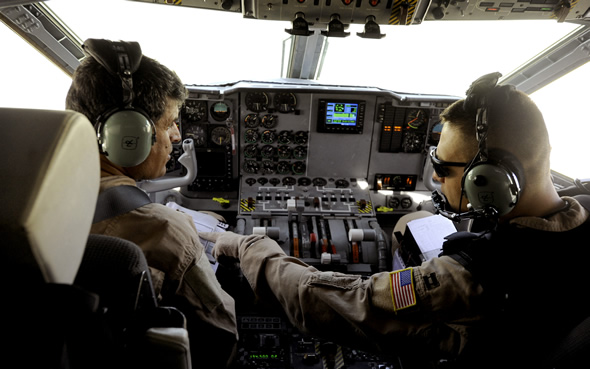
    Capt. Larry Needham (right) goes over preflight checklist items with Capt. Mohammad-Shah Ahmadzai prior to takeoff for an operational mission May 15, 2010, at Kabul International Airport, Afghanistan. Since November 2009, Combined Air Power Transition Force Airmen have been training Afghan C-27A Spartan (G-222) pilots and loadmasters to conduct strategic and tactical airlift, airdrops and presidential support. Captain Needham is a C-27 pilot assigned to the 538th Air Expeditionary Advisory Squadron. Captain Ahmadzai is an Afghan National Army Air Corps C-27 pilot. The Afghan Air Force currently operates 14 C-27A aircraft, of 18 destined under the US military support program. (U.S. Air Force photo by Staff Sgt. Manuel J. Martinez)

    Osprey Emergency Landing Reignites Japanese Safety Concerns

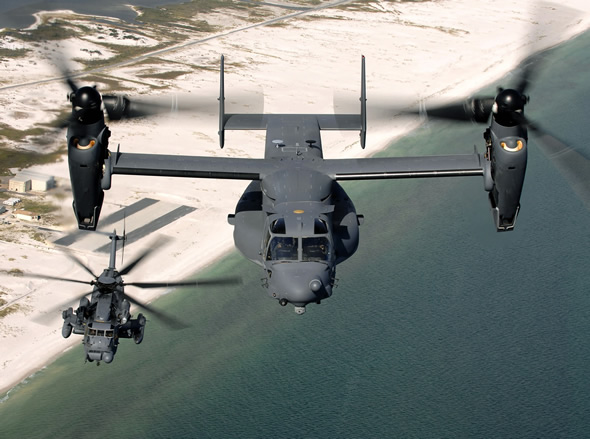
    The CV-22 Osprey will take over Air Force Special Operations Command helicopter missions when the MH-53 'Pave Low' (seen below) retires in October 2011. U.S. Air Force photo/Senior Airman Julianne Showalter

    The CV-22 Osprey will take over Air Force Special Operations Command helicopter missions when the MH-53 ‘Pave Low’ (seen below) retires in October 2011. U.S. Air Force photo/Senior Airman Julianne Showalter
    A Marine Corps MV-22B Osprey forced to make an emergency landing on 9 July is fueling a resurgence of Japanese concern regarding the safety of the world’s first production tiltrotor combat aircraft. Marine Corps officials announced that an MV-22B assigned to Marine Corps Air Station (MCAS) New River, North Carolina made a controlled emergency landing at North Carolina’s Wilmington International Airport for reasons not yet addressed.

    Marine Corps representatives declared that the pilot and crew had total control of the aircraft throughout the landing and there were no injuries. Several local media sources indicated that the emergency was caused by a driveshaft problem, but the Marine Corps has so far declined to speculate as to the cause of the emergency. Japanese news sources also announced that the emergency landing was related to a driveshaft problem.

    Pentagon Press Secretary George Little announced on 11 July that the North Carolina incident would not change the scheduled deployment of the Ospreys to MCAS Futenma. Secretary Little told reporters that the landing was only a “precautionary step during a routine training flight.” Mr. Little also told reporters that the cause of the landing was being investigated and that the United States would continue to “work closely with our Japanese allies to provide information on the MV-22,” an aircraft he further described as having “a very strong safety record overall.”


    This incident, while relatively minor, has reignited Japanese fears that the Osprey is too dangerous for operations in the heavily-populated communities that surround American military facilities in Japan. While making every effort to sooth Japanese fears of the Osprey, the Pentagon proceeded with deployment of the Marine MV-22B squadron. Twenty-four aircraft were loaded aboard a transport in San Diego earlier this month and are presently enroute to MCAS Iwakuni in Yamaguchi Prefecture, the Marine Corps’ largest air facility in mainland Japan. The aircraft will be assembled and undergo testing in Iwakuni prior to delivery to MCAS Futenma in Okinawa.

    As part of an agreement with Japanese officials, the Ospreys will remain grounded at Iwakuni until the Pentagon completes accident investigations involving two previous Osprey crashes. A Marine MV-22B crashed in Morocco in April of this year resulting in the deaths of two Marines. A second crash in Florida, this one involving an Air Force CV-22, occurred in June causing injuries to all the aircraft’s crewmembers.
    The Osprey grounding is limited to Japanese territory only; the aircraft has remained in active flight operations in all other worldwide locations without restriction.
    News of the emergency landing in North Carolina prompted Okinawa Governor Hirokazu Nakaima to request an audience with Japanese Defense Minister Satoshi Morimoto to discuss the MV-22 issue once again. Governor Nakaima was accompanied to Tokyo on 12 July by a select delegation of city officials including the mayors of Ginowan and Nago, the two Okinawan cities most affected by deployment of the Ospreys. All of these Okinawa representatives have been tenacious in their vocal and official opposition to the Osprey deployment.

    The Marine Corps has been replacing its fleet of well-worn CH-46 Sea Knight helicopters one operational squadron at a time since 2007 with a scheduled completion date of 2019. The MV-22B is the aircraft of choice as a replacement and is the only aircraft the Marine Corps has available to replace the CH-46E helicopters. This simple fact is not likely to change regardless of Japanese opposition. The CH-46E Sea Knights have, for the most part, outlived their operational usefulness and must be replaced.

    How safe the MV-22B Osprey is in an operational role is a matter of opinion and sometimes passionate disagreement. The United States claims the aircraft is one of the safest aircraft in the current inventory. Japanese officials representing Okinawa dispute this claim to the point of threatening to close all American bases on the island of Okinawa if the Osprey is delivered to Marine Corps Air Station (MCAS) Futenma. MCAS Futenma is the home base for most of the Marine Corps’ helicopters and transport aircraft stationed in Japan.

    One might consider a statistical analysis to be the answer to this safety question, but such an analysis alone may not please all parties and would be difficult to validate to everyone’s complete satisfaction.
    When comparing the safety record of the MV-22B to that of the CH-46E Sea Knights it will replace, the first question to be answered is what statistics are the most appropriate to be used in a safety comparison? The CH-46 Sea Knights have a long and storied history of exceptional service in peacetime and combat conditions, flying in almost every environment imaginable. The MV-22B, in contrast, hasn’t been in operation that long and has been subjected to intense media scrutiny since its inception, a spotlight of public interest the CH-46 never had to contend with.

    A Marine Corps environmental impact report, released by the Japanese government on 14 June, gave the MV-22B a slight statistical safety edge over the CH-46. This report became public one day before the Air Force CV-22 crash in Florida. The April crash of an MV-22B in Morocco was not included in the impact report as the Marine Corps review was completed before the date of that crash. Of course, the big question is, how are recent accidents evaluated and what weight do they carry in the overall safety analysis?

    Should we include Morocco incident in the Marine report, the MV-22B would appear statistically less safe than the CH-46. The pertinent data related to this accident was published in a Marine Corps addendum to the initial report delivered to the Japanese government following a preliminary investigation into the crash. This addendum would seem to confirm that the CH-46 is the safer aircraft.
    Marine Corps officials claim the numbers don’t tell the whole story and insist the Osprey is a safe aircraft.

    Aircraft safety reviews are based on the number of Class A mishaps an aircraft experiences over a period of 100,000 flight hours. A mishap is rated a Class A incident if the aircraft or government property sustains damage requiring repairs valued at $2 million or more or if the incident results in the death or permanent disability of a servicemember.

    The initial Marine Corps report, not including the numbers for the Morocco accident, listed the MV-22B as suffering 1.12 Class A mishaps per 100,000 flight hours while the CH-46 was recorded as having experienced 1.14 Class A mishaps per 100,000 flight hours. This gives the Osprey a slight safety advantage over the Ch-46. Following the Morocco accident, the Marine Corps addendum adjusted the numbers upward to reflect 1.93 Class A mishaps for the Osprey per 100,000 flight hours. With only one incident, the accident rate for the Osprey almost doubled.

    Marine Corps spokesman Captain Richard Ulsh said that the Osprey is a safe aircraft with five years of combat missions to its credit and the Morocco crash creates an unfavorable safety image of the Osprey that is neither earned nor justified. Captain Ulsh extolled the Osprey’s performance during five years of continuous combat operations in Iraq and Afghanistan. He said, that during this period of combat “the MV-22 has only had two Class A mishaps; the most recent one in Morocco in April of this year.” He went on to say that this record of survivability in a hostile combat environment is a solid testament to the aircraft’s performance and operational safety.

    The Sea Knight airframe, with necessary upgrades over time, has been in continuous operation since 1964. The US Navy retired the aircraft in 2004 replacing it with the MH-60S Knighthawk while the Marine Corps kept the airframe in operation awaiting operational deployment of the Osprey.

    Captain Ulsh pointed out that the CH-46 fleet has recorded more than 450,000 flight hours in the past ten years alone while the Osprey has accumulated only 115,000 hours since it became operational in 2007. One or two Class A mishaps would have little impact on the overall safety record of the CH-46 Sea Knight while one or two such incidents would have an adverse impact of inflated significance on the MV-22’s safety record.
    Captain Ulsh emphasized that the CH-46E Sea Knights are old, worn-out, and must be replaced. Ulsh indicated that one way or the other; the Japanese people would have to live with the Osprey because the Marine Corps has no alternative available. He also pointed out that the aircraft’s range, versatility, and load capacity would allow US forces in Japan to make more operational flights over mainland Japan in support of training missions and humanitarian activities.

    The residents of Okinawa, routinely incited to protest the American presence on their island by various political groups and spurred to action by memories of a 2004 CH-46 crash, have adopted a stance of firm opposition to the stationing of the MV-22B squadron on the island. In 2004, a Marine Sea Knight from MCAS Futenma crashed and burned on the campus of a nearby university causing some damage to university property, but resulting in no civilian injuries and only minor injuries to the crew. The burned-out walls of the campus building damaged in the accident remain standing in the university’s courtyard as a reminder of the crash.

    The 2004 crash was eventually determined to have resulted from poor maintenance. Since the time of that incident, protestors have regularly gathered to call for the closing of the Futenma facility. Although the MV-22B still faces considerable opposition in Okinawa and in Iwakuni, the aircraft will arrive at MCAS Iwakuni late this month. What protests materialize following their arrival in Iwakuni, and later in Okinawa, remain to be seen. It is reasonable to believe that the protests will not end anytime in the near future and should a single mishap occur once the Osprey becomes operational, one should expect even greater and more heated protests.


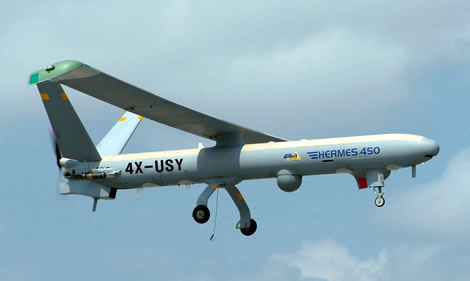
    Boeing, Elbit Systems to offer Hermes 450 and 900 UAVs in the US Market

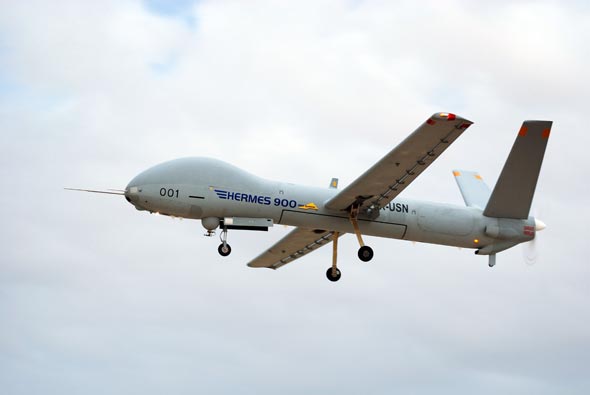
    Photo: Elbit Systems

    The Boeing Company is teaming with Israel’s Unmanned Aerial Systems developer Elbit Systems to market Elbit Systems Hermes class UAS in the US and select international markets. The companies have signed a Memorandum of Understanding (MOU) formalizing this cooperation at the Farnborough Airshow today. The agreement covers marketing and sales of Elbit’s Hermes450 and 900 UAS product lines. The team expects the combat proven Hermes family systems to be well positioned to meet the growing roles UAS are expected to play in supporting US forces towards the next decade.


    “This partnership further expands and enhances Boeing’s longstanding relationship with Elbit Systems to include unmanned products,” According to Debbie Rub, Boeing Missiles and Unmanned Airborne Systems vice president and general manager. She said the Hermesproduct line will complement Boeing’s provides unmanned portfolio with medium-altitude, long-endurance capability, addressing an important need for U.S. warfighters and allies on today’s ever-changing battlefields. The recent announcement follows other recently announced strategic agreements between the two companies, related to the development of advanced fighter avionics, and the successful long-term cooperation providing helmet mounted display sights (JHMCS) for all Boeing’s fighter aircraft.

    Photos: Elbit Systems

    In recent years Boeing has been developing its portfolio of unmanned systems. Through the acquisition of InSitu (the Scan Eagle manufacturer), Boeing established a foothold in the small/tactical UAS market, eventually winning the Marine Corps’ prestigious Small Tactical UAS (STUAS) contract with the new RQ-21 Integrator system. With the Scan Eagle, Boeing also scored multiple Intelligence, Surveillance and Reconnaissance (ISR) service contracts in the US, Australia and, most recently, Singapore. However, in the field of tactical/Medium Altitude Long Endurance (MALE) Boeing did not have an off the shelf solution, in the absence of an adequate platform. Although announcing a similar cooperation with another Israeli UAS company Aeronautics a year ago, Boeing remained out of several international and domestic programs in North American market. Elbit System hasn’t been successful promoting its systems in the US either. Few years ago the company established a joint venture with General Dynamics to bid on the STUAS but this venture has dissolved after Boeing won the program. Elbit has recently bought GD’s share in the JV, to continue promoting its smaller UAS on its own.

    Hermes 450 is a multi-role, high-performance tactical UAS, providing the primary platform of the Israeli Defense Forces in counter-terror operations. A combat proven and mature UAS with more than 400,000 operational flight hours, Hermes 450 has been successfully operated by a number of international air forces, including the UK, Singapore, Georgia and Brazil. The larger Hermes 900 was introduced later, augmenting the capability of the Hermes 450 with a platform that can carry twice the payloads for extended missions, on a platform designed from baseline for over-the-horizon, persistent multi-mission, multi-payload missions. Hermes 900 is well suited to perform ground support and maritime patrol missions. The two platforms are sharing identical building blocks sharing interoperable systems and support. In the past year Hermes 900 has been ordered by three customers, Israel, Chile and Mexico.

    MBDA Introduces Futuristic UAV Weapon Approach

    MBDA unveiled today a new member of its ‘Concept Vision’ system ideas, a futuristic weapon systems for Unmanned Aerial Vehicles (UAV) the company’s scientists consider could mature in the next 20 year timeframe. The innovative concept MBDA presented today is a concept weapon system designed specifically for Medium Altitude Long Endurance (MALE) UAV. This weapon suite enables MALE UAVs to deliver close air support directly assisting ground forces over long periods of time, without lengthy and complex command and control cycles limiting such activities today.


    The system as a whole is designed for ‘persistent engagement’ in mind, deploying dedicated sensors low above the enemy area for hours, allowing the unmanned platform to maintain stand-off distance from the target, thus remaining relatively safely for longer missions.

    The company’s successful introduction of ‘Concept Vision’ plans in 2010 and 2011, have helped harnessing the imagination and innovation of its European workforce through the creation of inspirational and ambitious concepts for future weapon systems. “As in previous years, MBDA will use the concepts generated to stimulate our customers, suppliers, shape our markets and challenge our own assumptions about the possibilities for the future.” Wadey said.

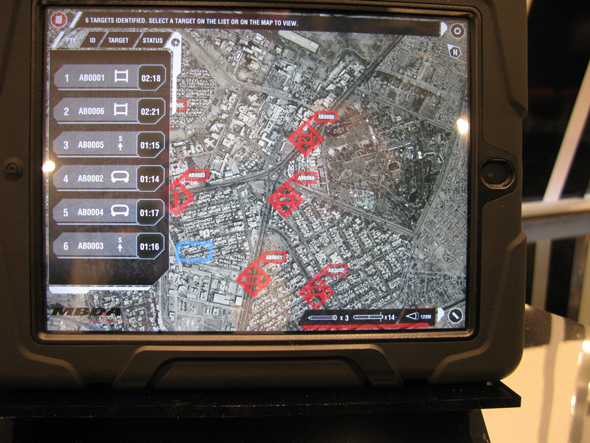
    Vigilus missile engagement control unit, to be operated by the supporting forces. Photo: Tamir Eshel, Defense-Update

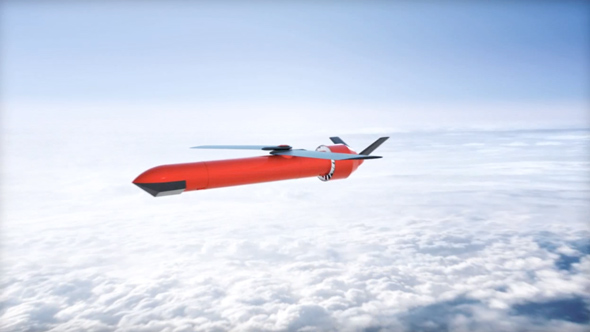
    The Concept Vision CVS301 ‘Vigilus’ system comprises a common ‘intelligent launcher’ and several types of effectors (guided weapons) – the first two include a rocket boosted glider and electrically powered, ducted fan propelled optionally armed expendable loitering ‘scout’. Both weapons will be designed to enable direct (man in the loop) control from the ground, by the UAV operator or by the supported element.

    The Vigilus weapon system comprises an integrated launcher and communications unit called ‘Armatus’. Each such carrier weighs 70 – 100 kg and will be configured to be carried by platforms flying at low to medium speed carrying any combination of small, medium or large weapons. MBDA visionary scientists see Armatus as an ‘intelligence launcher’ providing a seamless interface between the platform and weapons. Among the unique approaches MBDA is working on are connectionless interface between the launcher and weapons, and live, on-board mission planning capability. MBDA envisions employing an innovative new 3D model generation for target identification and tracking as part of its futuristic ‘intelligent launcher’ concept.

    ‘Caelus’ loitering scout missile. Photo: Tamir Eshel, Defense-Update

    The basic Armatus configuration can also carry a single medium weight ‘Caelus’ loitering scout missile, weighing about 30 kg. Its wingspan will be about two meters, the length will be about 1.80 meters. This electrically propelled vehicle is designed as ‘persistent target identification and tracking system’, flying low above enemy area undetected, thanks to its low acoustic and thermal signatures. It will be able to throttle from loiter speed to high dash or attack velocity, and tune its warhead to match the type of target to be engaged (armored vehicles, soft targets etc.) Caelus will provide close-in view of targets,supporting the UAV operator by descending below clouds, and loiter for up to two hours. It will have a payload capacity of one kilogram, comprising of extra battery, enhanced ISTAR payload or a small warhead.

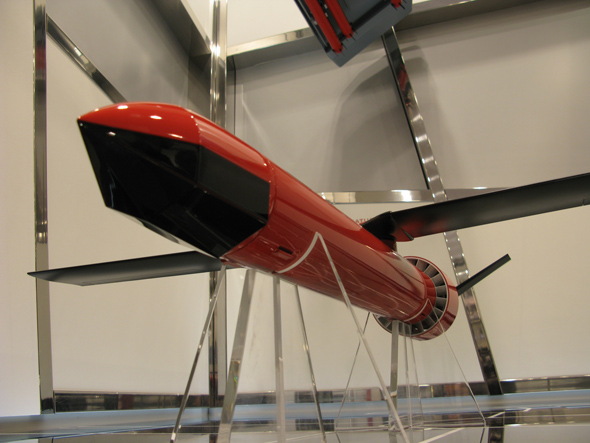
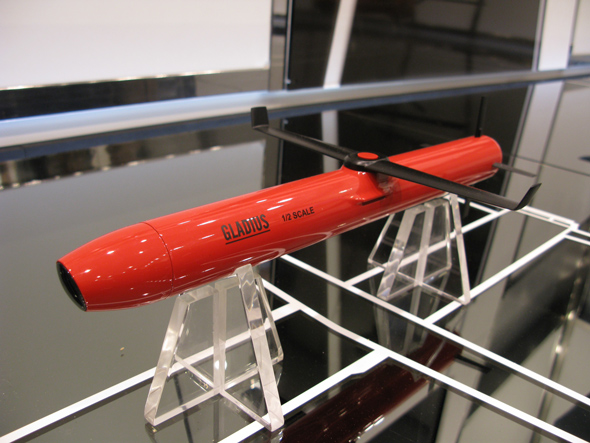
    The weapon of the CVS301 system is the 80mm ‘Gladius’ type miniature gliders weapons. The Armatus launcher will be able to carry eight Gladius weapons along with a single Caelus. After being released from the launcher, the 80 cm long Gladius will be boosted to subsonic speed and expand the wings over 44 cm span, to continue on an unpowered glide to the target up to 30 km range. Each Gladius will weigh up to seven kg and be equipped with an Explosively Formed Projectile (EFP) weighing up to one kilogram. Up to four Gladius weapons would be targeted simultaneously from each Armatus launcher, at different targets (a MALE platform will be able to carry multiple launchers with different weapon configurations).The missiles will be controlled from the UAV mission control center (GCS) or directly by the supported element calling the attack (and often having the target in sight). For such control ground forces will be equipped with a standard console that will employ the CVS301 target engagement software. The weapon will employ a jam-resistant Global Navigation System (GNSS), enabling the weapon to home in on the target’s coordinates with high level of precision.

    The Armatus launcher will also have room to carry up to three relatively heavier guided missiles (yet unnamed), each weighing about 100 kg.

    ‘Gladius’ miniature glider weapon. Photo: Tamir Eshel, Defense-Update

    Iran Introduces a Locally Produced Kornet-E Copy

    Dehlaviyeh guided missiles manufactured locally by Iranian defense industry. Photo: Itan MOD
    The lightweight launcher enables the Dehlaviyeh to be used by dismounted units. Photo: Iran MOD

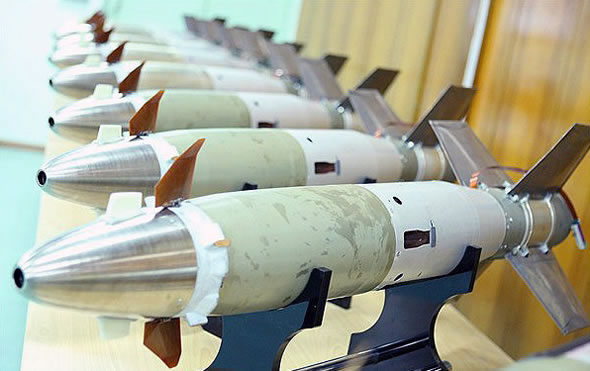
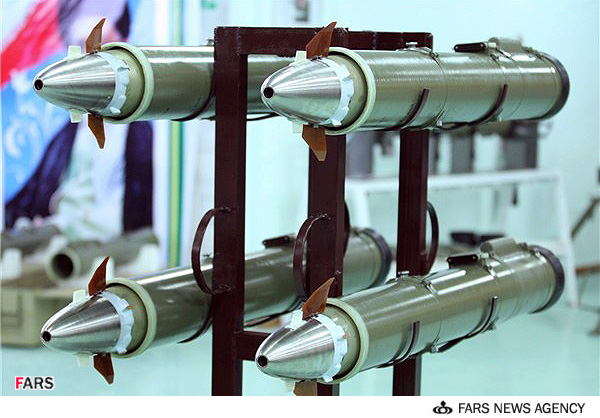
    On his visit to the new production line of guided missiles, Iranian Defense Minister Ahmed Vahidi introduced a new missile called ‘Dehlaviyeh’ thought to be an Iranian ‘copycat’ of the Russian KBM 9M133 Kornet missile. Vahidi said the missile is of the most advanced anti-armor and anti-material weapons, capable of destroying stationary or moving main battle tanks equipped with reactive armor. The missile is equally effective against non-armored targets, such as bunkers or buildings, as well as low-flying and naval targets, Vahidi said. He added the missile’s guidance employs an advanced guidance system that makes it immune to current electronic countermeasures.

    Although Iran had not directly procured the 9M133, it had access to the missiles obtained by Hezbollah from Syria. In 2010 intelligence reports indicated that such missiles leaked to the Gaza strip. Soon after Kornets were used at least twice, targeting an Israeli Merkava tank and a civilian bus. Back then Israel claimed Iran was the source of the missiles. Apparently, the Iranians have either obtained shipments from KBP or reversed engineered the missile.

    The Dehlaviyeh missile is believed to be a reversed engineered version of the Russian Kornet-E laser beam-riding anti-tank guided missile. Photo: Iran MOD

    Iran has already demonstrated the capability to locally produce anti-tank missiles, reverse engineering the wire-guided American TOW-2 missile and the Russian 9M113 Konkurs (both were exported to the Hezbollah in Lebanon and used against the Israelis in 2006). This Kornet copy represents the first use of laser beam-riding Semi-Active Command-Line Of Sight (SACLOS) technology. The beam-riding concept employs a low-power laser beam transmitted by the launcher, to communicates with the missile, replacing the need of wireless or wires for guidance. The missile’s sensor ‘looks backwards’ to lock on the beam center, thus unaffected by countermeasures employed by the target. As a seekerless missile, the Kornet is considered a low-cost round.

    The original Kornet-E was first introduced in 1994, built by the Russian company KBP Instrument Design Bureau. It has an effective range of 100 – 5500 meters and a tandem warhead capable of penetrating of 1000-1200 mm steel armor (RHA) with reactive protection. A thermobaric warhead has also been introduced, to be used against bunkers and structures. The Kornet weighs 27 kg, its diameter is 152 mm and the length is 1200mm.

    Dehlaviyeh guided missiles manufactured locally by Iranian defense industry. Photo: Itan MOD

    South Korea Announces Evaluation of F-X Fighter Bids to Begin Next Week

    FX3
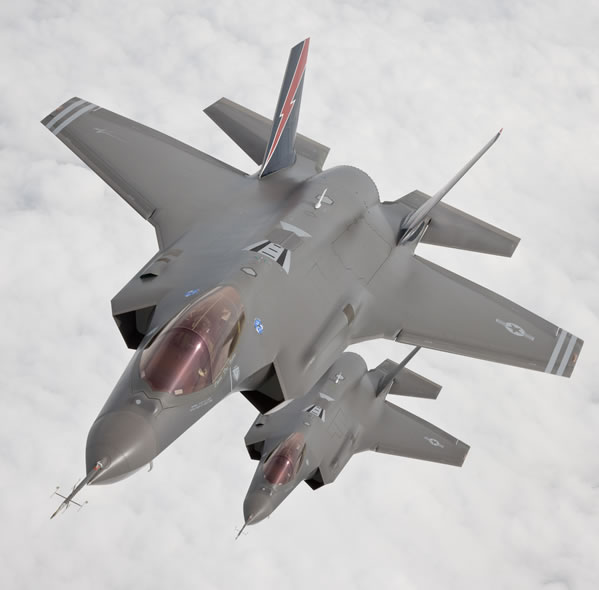
    The FX3 tender in South Korea is the first competition the F-35 is facing in the international market. Photo: Lockheed Martin

    South Korea’s primary defense acquisition agency, the Defense Acquisition Program Administration (DAPA), announced that evaluations would begin next week to select the winning bid in the competition for a $7.3 billion contract for 60 advanced fighter aircraft. Previously submitted bids from three defense contractors were found to be lacking relevant details and were resubmitted, at South Korea’s request, on 5 July.

    Lockheed Martin’s F-35 Lightning II, Boeing’s F-15SE Silent Eagle, and EADS’ Eurofighter Typhoon are all in competition for the multi-billion deal. The winning aircraft is intended as a replacement for the aging fighters now in South Korea’s inventory. In 2002, Seoul contracted to procure 60 Boeing F-15s as part of an extensive modernization effort and the present deal is a continuation of that program.

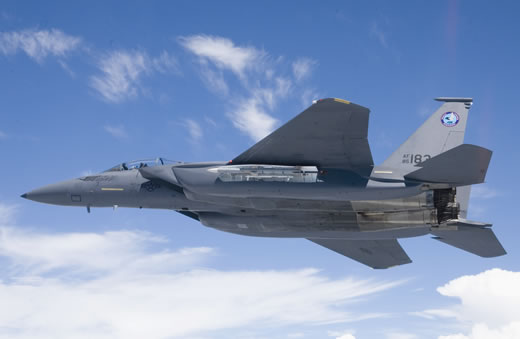
    F-15 ‘Silent Eagle’ flight demonstrator. South Korea is a leading partner in what is considered the final upgrade for the F-15. Photo: Boeing

    A DAPA statement of 5 July announced that the bids would be evaluated “in accordance with due process.” The statement also guaranteed “fair competition” and a “thorough evaluation” to select the aircraft that “most benefits our national interest.”

    According to DAPA, a hand-picked team of 15 expert analysts will review each of the three bids in an evaluation that assesses 300 different categories. These evaluations will review and grade the operational capability of the three contenders as well as their levels of compatibility and interoperability with existing South Korean forces. This assessment process is scheduled to be conducted between 9 and 14 July.

    Beginning in late July, following the technical evaluation, an elite team of 45 Republic of Korea Air Force (ROKAF) experts will conduct flight tests designed to evaluate 500 performance features of the three competitors. These tests will further evaluate each aircraft’s performance and will measure how well they fit into the existing South Korean military framework and add measurable value to the nation’s warfighting capability.

    DAPA announced in June that some evaluations would be performed on simulators since the F-35 Lightning II is still in development. EADS and Boeing are also working on enhancements to the Typhoon and the F-15SE as well.

    In earlier statements, DAPA said that final selection of the next-generation fighter would be announced sometime in October. Now, DAPA admits that October is only an optimistic initial target date and the final selection may not be announced until early 2013. DAPA’s director of program management told reporters on 5 July that “the final decision may be put off until into the next administration,” indicating a date sometime in 2013.

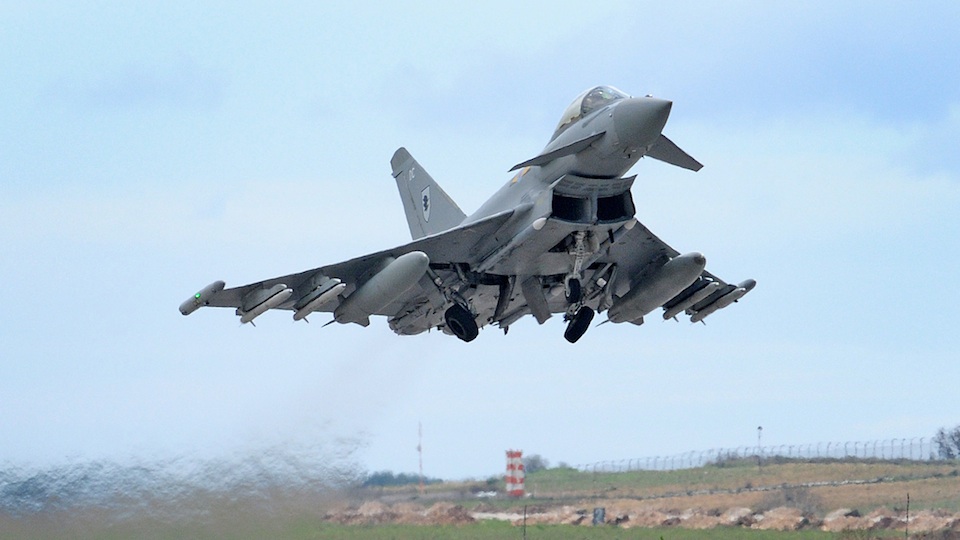
    For the Eurofighter groop, FX3 provides an opportunity to bring their Typhoon back to the center stage, after losing the Indian MMRCA bid to Dassault. Photo: Cpl Babs Robinson, RAF

    From a purely practical standpoint, the Eurofighter Typhoon is a long shot in this competition. However, EADS is highly motivated to nail this deal down having lost out in several recent high-value contracts. And, with India’s recent decision to buy the French Dassault Rafale, hope continues to spring eternal. With this in mind, it’s probable to suspect that EADS will heat up the competition with an offer that will be very difficult for Seoul to ignore. In EADS’ favor is the Typhoon’s proven performance record and the F-35’s lack of real-world experience.

    Boeing’s F-15SE is a strong contender in this competition. The ROKAF currently operates F-16 Falcons and F-15K Slam Eagles as well as other American-made aircraft. South Korea has a long history of flying American aircraft dating back to the Korean Conflict. Saudi Arabia’s recent decision to go with a new variant of the F-15 also bodes well for Boeing. Boeing also is planning to introduce an attractive array of new enhancements to make the Eagle deadlier, stealthier, and more tempting since South Korean forces already have accumulated several years of experience operating the F-15.

    As for the F-35 Lightning II, as advertised it is a dream machine of claimed performance that would be unmatched by any other fifth-generation combat aircraft in the world today. Although unproven and plagued by technical problems and cost overruns, the F-35 still has strong support from an impressive list of customer nations and still enjoys the backing of the United States. If the F-35 performs as designed, it would give Seoul an immense performance edge over Pyongyang and possibly even Beijing. Selecting the F-35 would also give South Korea a long-term warfighting machine that shares a common airframe with the US, Japan, Australia, and other Western nations. Weapon’s commonality and interoperability may also prove to be factors that weigh heavily in Lockheed Martin’s favor.

    Was Seoul’s F-X Fighter Evaluation Criteria Modified in Favor of the F-35?

    A key representative with South Korea’s Defense Acquisition Program Administration (DAPA) announced on 28 June that Lockheed Martin’s F-35 may be disqualified from Seoul’s fighter acquisition competition.  Oh Tae-shik, head of DAPA’s Program Management Agency, stated that the F-35 might be eliminated from contract contention “if Lockheed Martin does not comply with our demands.”

    DAPA claims that the competition was delayed until this month because Lockheed Martin could not provide a functional aircraft for flight testing and failed to provide the Korean-language documentation required before bid evaluations could begin.  Lockheed Martin has been quoted as saying “the F-35 fleet of 36 flying aircraft is fully occupied with test, training, and delivery activities” and not a single aircraft can be readied for flight testing by potential customers at present.

    EADS, also in contention for the multi-billion dollar deal, failed to provide the necessary Korean-language bid documents in support of its contender, the Eurofighter Typhoon.  Only Boeing, touting its F-15SE Silent Eagle, delivered the required bid documents on time.

    Rumors have circulated that the evaluation criteria might be modified to allow testing to be completed using flight simulators to accommodate Lockheed Martin.  Some sources claim that South Korean President Lee Myung-bak promised the United States that the F-35 would be the designated winner of the competition.  DAPA representatives have adamantly denied these claims and insist that the selection process will be fair, unbiased, and based solely on performance results.

    Boeing’s F-15SE has not entered production yet and is also not available for flight testing.  Boeing is relying on the production-model F-15K to serve as a surrogate in the flight testing phase of the evaluation.  Reports indicate that South Korean pilots will travel to Europe to conduct flight testing of the Typhoon when that phase of the evaluation begins.

    It appears that the evaluation criterion has been changed although the reasons behind the change haven’t been addressed publicly.  Flight testing will be conducted on simulators according to Seoul’s 5 July announcement that testing will begin next week.  No specific mention was made regarding the Typhoon and it is now not known if the aircraft will be subjected to actual flight testing or if evaluation of the Typhoon will also be conducted on a simulator to “even the playing field.”

    All three defense contractors have a lot riding on this competition. They all need orders to keep their combat aviation production lines humming along in a time of increasingly austere economic forecasts. Let the games begin.

    RIMPAC 2012 – Naval Forces Roaming in the Pacific

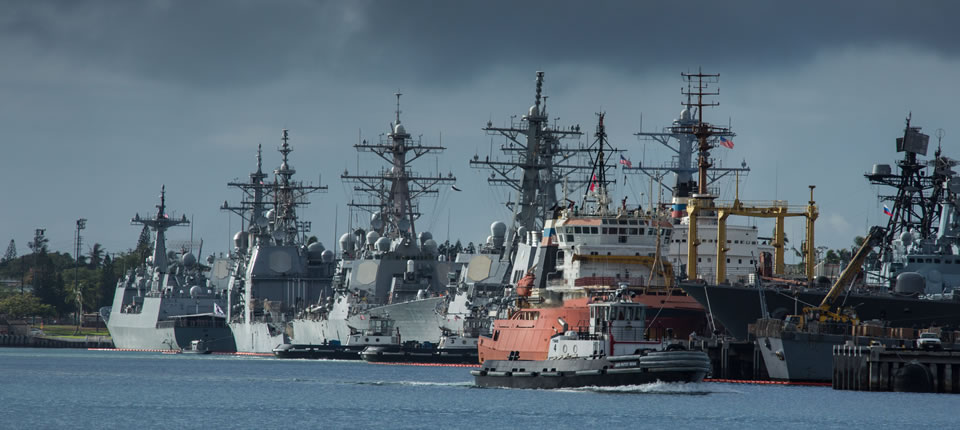
    United States Navy Base Pearl Harbor-Hickam during the Rim of the Pacific (RIMPAC) 2012 exercise. Twenty-two nations, more than 40 ships and submarines, more than 200 aircraft and 25,000 personnel are participating in RIMPAC exercise from June 29 to Aug. 3, in and around the Hawaiian Islands. The world's largest international maritime exercise, RIMPAC provides a unique training opportunity that helps participants foster and sustain the cooperative relationships that are critical to ensuring the safety of sea lanes and security on the world's oceans. RIMPAC 2012 is the 23rd exercise in the series that began in 1971. Photo Jacek Szymanski DNPA
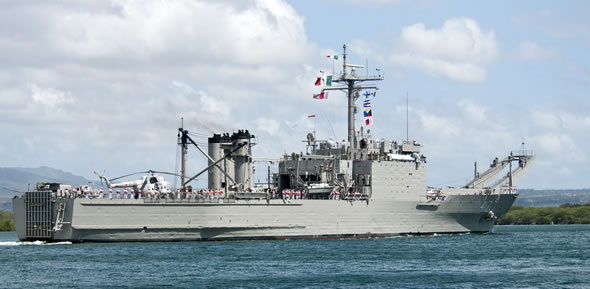
    Hawaii became the focus of the largest Pacific naval exercise on 29 June as international navies converged on the islands to begin Rim of the Pacific 2012. This is the 23rd exercise in the RIMPAC series and promises to be the largest ever.

    The US Pacific Fleet hosts the RIMPAC exercise every two years in Hawaiian waters and the surrounding environs. The series began back in 1971 and has grown in size every year since.
    RIMPAC is the largest and most comprehensive maritime warfare exercise in the world. Asian-Pacific nations are routinely invited to participate as a means of improving the coordination, cooperation, and interoperability of Pacific naval forces. The exercise is designed to enhance regional stability, encourage cultural understanding, maximize training opportunities, and promote Pacific maritime relationships.

    United States Navy Base Pearl Harbor-Hickam during the Rim of the Pacific (RIMPAC) 2012 exercise.
    Twenty-two nations, more than 40 ships and submarines, more than 200 aircraft and 25,000 personnel are participating in RIMPAC exercise from June 29 to Aug. 3, in and around the Hawaiian Islands. The world’s largest international maritime exercise, RIMPAC provides a unique training opportunity that helps participants foster and sustain the cooperative relationships that are critical to ensuring the safety of sea lanes and security on the world’s oceans. RIMPAC 2012 is the 23rd exercise in the series that began in 1971. Photo Jacek Szymanski DNPA

    With 42 ships from five nations forming the seaborne element, the aircraft carrier USS Nimitz (CVN 68) and other ships of Carrier Group 11 form the centerpiece of this year’s exercise. Also participating are six submarines and more than 200 aircraft as well as personnel and units from 22 nations in all.

    And for the first time, many of the American ships will be powered by a 50/50 biofuel blend of regular fuel oil and a select mixture of hydro-processed fuel derived from cooking oil and algae. The US Navy is reported to have bought some 425,000 gallons of this biofuel at a cost of $12 million for use in this year’s exercise, the largest single biofuel buy in history. Some aircraft are also expected to be fueled with an aviation-grade biofuel blend as well. The US Navy has invested considerable funds in emerging technologies using algae, recycled cooking oil, sugar, corn, and other staple crops to produce biofuels that could help reduce the Navy’s dependence on fossil fuels.

    Another first being introduced in this year’s exercise is the placing of naval and air commands under the leadership of international partners. Russia is also making its debut appearance in this year’s exercise, a decision that may have been prompted by growing concerns regarding China’s growth and military modernization.

    Exercise participants will conduct training in mine clearing, explosive ordnance disposal (EOD), humanitarian relief, and disaster response. Humanitarian relief and disaster response exercises are also new to this year’s event and will include responders and medical personnel from disaster relief teams located in Hawaii.

    Other scheduled exercises include ship-sinking operations, torpedo training, and experiments with new seaborne vessel designs. RIMPAC 2012 is scheduled to wrap up on 5 August.

    Following is a photo collection congratulating the foreign visitors, some regulars other – first timers, in Pearl Harbour.

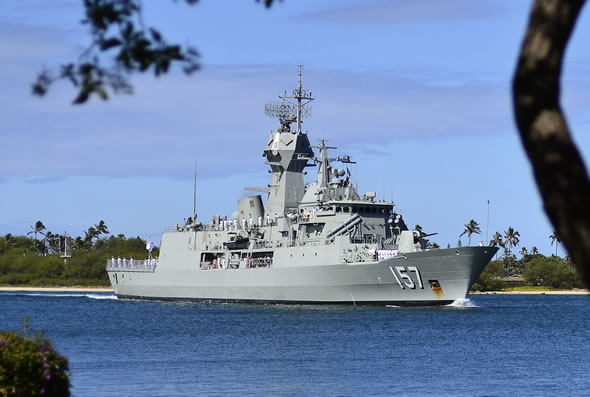
    Anzac class frigate HMAS Perth (FFH 157), of the Royal Australian Navy transits the waters of Joint Base Pearl Harbor-Hickam upon arrival for the biennial Rim of the Pacific (RIMPAC) exercise. U.S. Navy photo by Daniel Barker
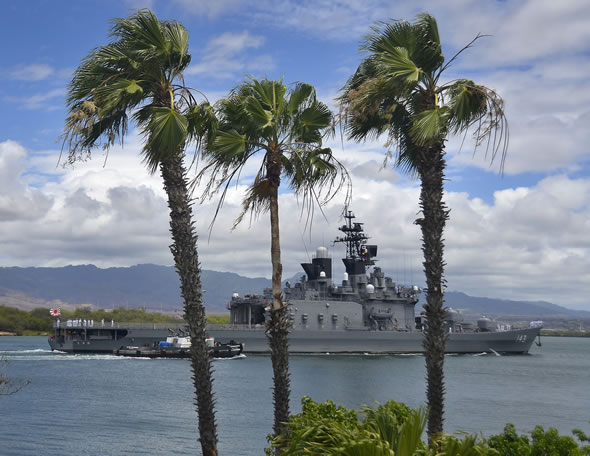
    Back at Pearl Harbour – JS Shirane (DDH 143), of the Japan Maritime Self-Defense Force, transits the waters of Joint Base Pearl Harbor-Hickam for RIMPAC 2012. Photo: US Navy, Daniel Barker.
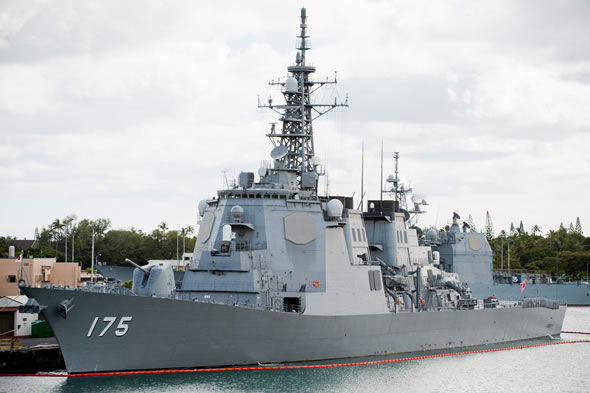
    Japan Maritime Self-Defense Force ship JS Myoko (DDG 175) sits pierside at Joint Base Pearl Harbor Hickam during exercise Rim of the Pacific (RIMPAC) 2012. Photo by: NZDF Amanda McErlich
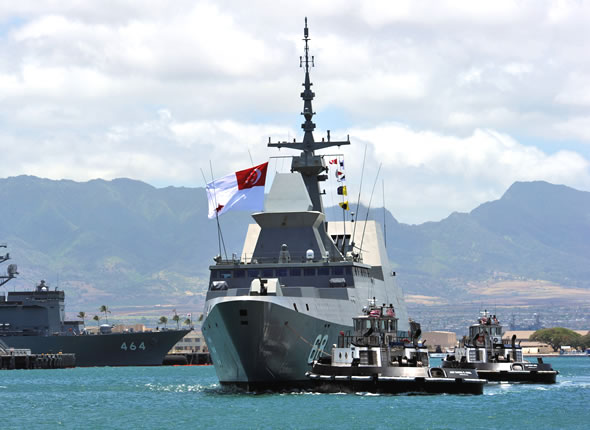
    Singapore Naval frigate RSS Formidable (68) arrives at Joint Base Pearl Harbor-Hickam for the Rim of the Pacific (RIMPAC) Exercise 2012. US Navy photo by Sean Furey
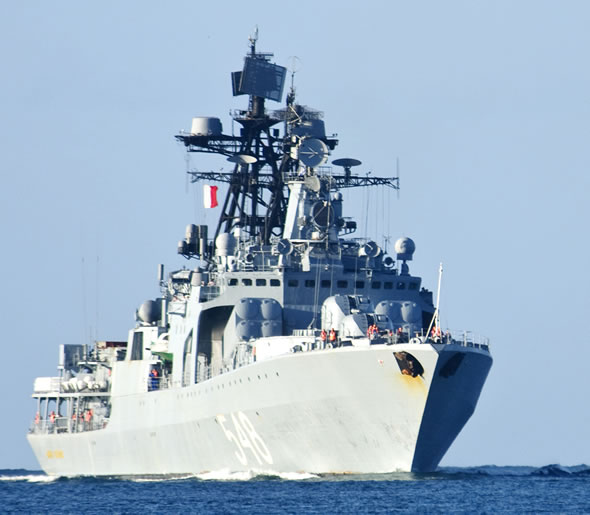
    The Russian Navy Udaloy-class destroyer RFS Admiral Panteleyev (BPK 548) arrives at Joint Base Pearl Harbor-Hickam. US Navy Photo, by Sean Furey
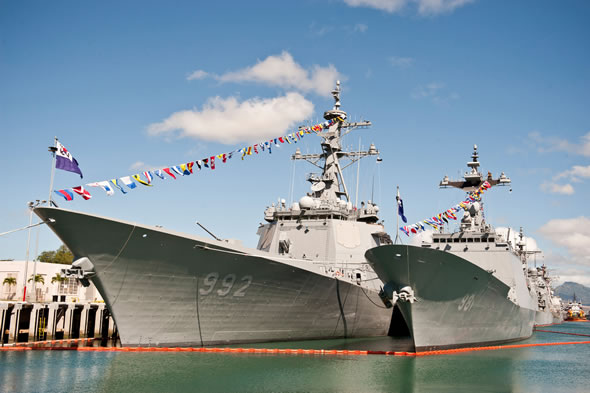
    The South Korean ships ROKS Yolgok Yi-l (DDG 992) and the ROKS Choi Young (DDH 981) are decorated to celebrate the 4th of July during Rim of the Pacific (RIMPAC 2012) exercise. Photo: NZDF, by Amanda McErlich
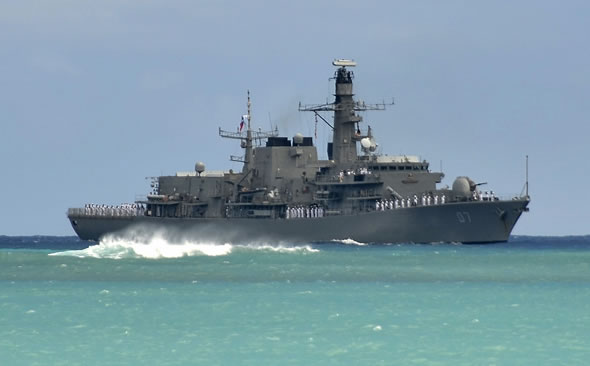
    The Chilean Navy frigate Almirante Lynch (FF 07) pulls into Joint Base Pearl Harbor-Hickam. US Navy photo by Daniel Barker
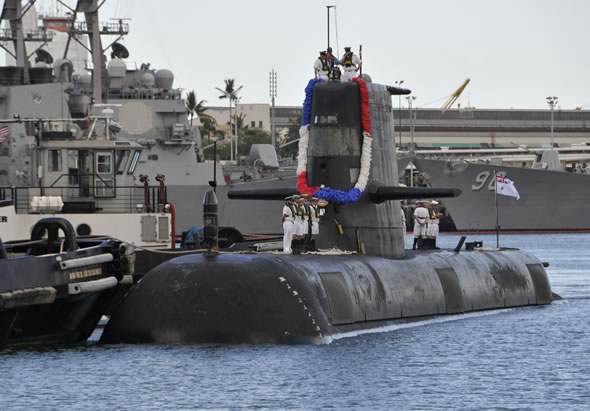
    Australian Navy Collins-class submarine HMAS Farncomb (SSG 74). US Navy photo by Daniel Barker
    Canadian long-range hunter-killer submarine HMCS Victoria (SSK 876) arrives at Joint Base Pearl Harbor-Hickam to participate in the Rim of the Pacific (RIMPAC) exercise 2012. US Navy photo by Sean Furey
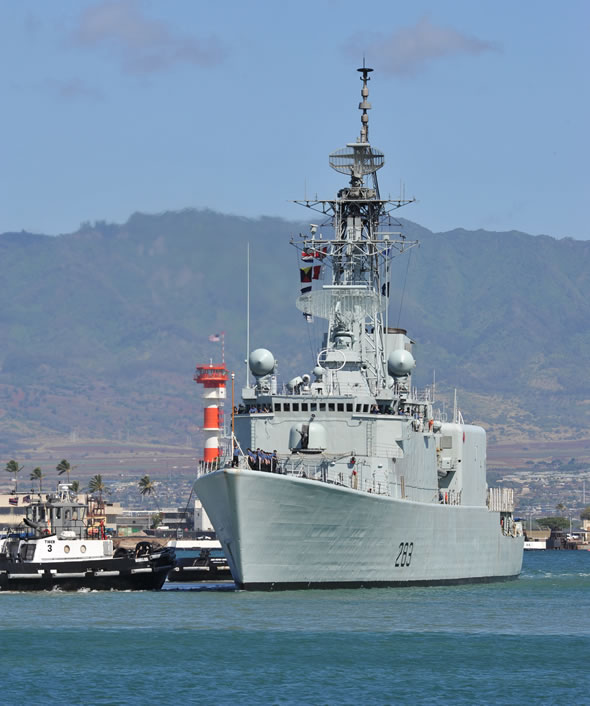
    Canadian Navy warship HMCS Algonquin (DDG 283) arrives at Pearl Harbour for RIMPAC 2012. Japan Navy photo by Tetsuya Sekino
    The Mexican Navy ship Usumacinta (A-412), formerly the USS Fredrick (LST-1184). US Navy photo by Sean Furey

    Poland Buys More C-295s while the Czech Struggle to Fix theirs

    16 Airbus Military C295 are to be operated by Poland in 2013.
    16 Airbus Military C295 are to be operated by Poland in 2013.

    After The Polish Air Force has signed a contract with Airbus Military to deliver five additional C-295 transport aircraft, to be delivered in 2012-2013, bringing the fleet of C-295 in service with the Polish Air Force to 16.
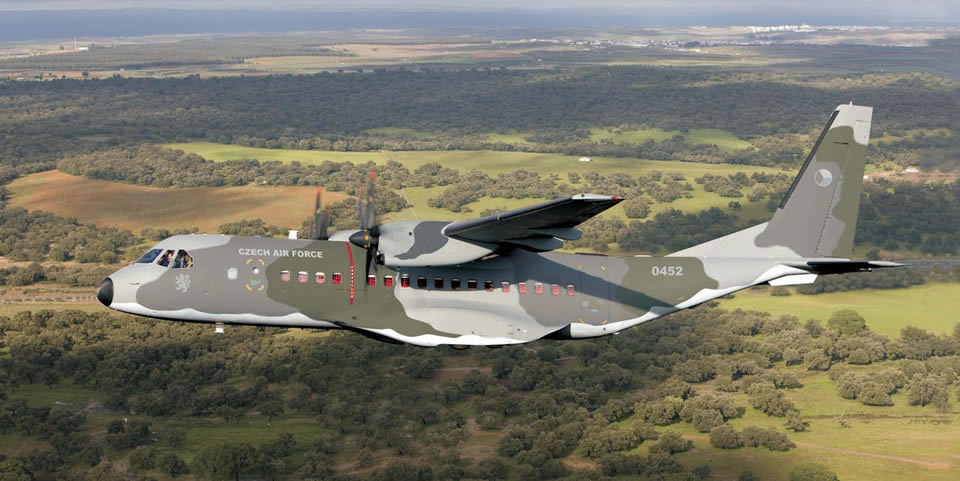
    Unlike the Polish satisfaction with the aircraft, five C-295M ordered by the Czech Republic in 2009 became the focus of a political conflict in Prague. Since the delivery of four of the aircraft in 2011 the C-295M faced repeated rejection by the Czech Air Force, over technical problems with the navigation systems, engine failures and self-protection Defensive Aids Systems (DAS).

    Earlier in 2012 the Czech MOD renegotiated the terms of the contract, with Airbus Military and Omnipol, the Polish trading company agree to deliver the planes for €132, in return for four L-159 trainers to be handed over by the Czech Republic. (Originally, five aircraft were to be delivered but one would be returned the Czech Air Force).

    Airbus Military agreed to fix all rejects raised by the Air Force by the end of May 2012 but the Czech Defense Ministry said early July that the C-295M DAS has met 10 of the rejects wile 7 remained unsolved. Apparently the Czech defense would seek compensation from the Omnipol for the delay but is no longer threatening to cancel the deal. The Polish company faced corruption allegation for its role in the Czech acquisition process, made without an open tender, as required by European Union ruling.

    One of four Airbus Military C295M the Czech Air Force is still rejecting acceptance, over technical problems. Photo: Airbus Military

    Second Australian LHD Launched

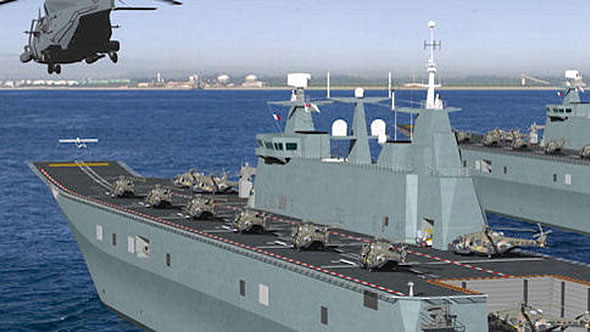
    Artist impression of the Canberra Class LHD. BAE Systems Australia
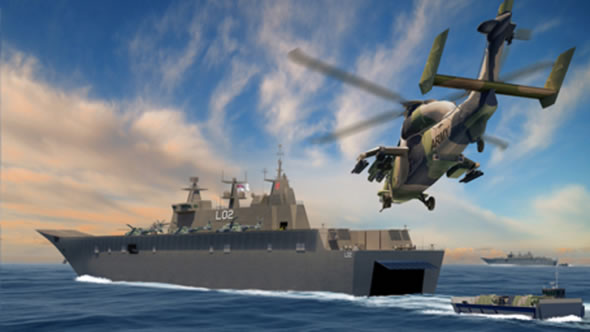
    Artist concept of the Australian Canberra Class LHD. Image: BAE Systems Australia

    The second Landing Helicopter Dock (LHD) HMAS Adelaide ship was launched at the Navantia  Ferrol-Fene shipyard in Spain. According to Navantia, this milestone was achieved four and half months ahead of schedule. This early launch provides additional time, until early 2014, to complete the outfitting and testing of the ship, when the hull will be transported to Australia for completion and delivery by BAE Systems Australia in Williamstown.

    Australia is acquiring two amphibious ships for the Australian Defence Force (ADF). The Spanish shipbuilder Navantia has constructed and is fitting out the hulls of both amphibious ships as a subcontractor to BAE Systems Australia.

    The superstructure, combat and communications systems will be consolidated with the hulls in Australia at the BAE Systems shipyard in Williamstown, Victoria. The arrival of the first amphibious ship hull at BAE’s Williamstown dockyard is expected later this year. The first ship HMAS Canberra is expected to join the Australian Defence Force in 2014 with HMAS Adelaide to follow in 2015.

    The 27,800 ton Canberra Class LHDs are the largest ships ever built for the Royal Australian Navy and will provide the ADF with one of the most capable and sophisticated amphibious deployment systems in the world. The Canberra Class LHDs are bigger than Australia’s last aircraft carrier HMAS Melbourne. When completed they will be more than 230 meters long, 27.5 meters high and weigh around 27,800 tones. Each vessel can carry a combined armed battlegroup of more than 1,100 personnel, 100 armored vehicles and 12 helicopters and features a 40-bed hospital. The design of the Australian LHDs is based on the “Juan Carlos I”, delivered by Navantia to the Spanish Navy in 2011.

    As the Prime Contractor and leader in naval systems integration, amphibious platforms and capability, BAE Systems will manage the overall project in close cooperation with subcontractors Navantia, Saab and L-3 Communications.

    Artist impression of the Canberra Class LHD. BAE Systems Australia

    Skunk Works and XTEND Simplify Multi-Drone Command

    0
    Lockheed Martin Skunk Works® and XTEND have achieved a major milestone in JADC2 by integrating the XOS operating system with the MDCX™ autonomy platform. This technical breakthrough enables a single operator to simultaneously command multiple drone classes, eliminating the friction of mission handoffs. From "marsupial" drone deployments to operating in GPS-denied environments, explore how this collaboration is abbreviating the data-to-decision timeline and redefining autonomous mission execution.

    From Ukraine to Taiwan: The Global Race to Dominate the New Defense Tech Frontier

    0
    As traditional defense primes face mounting competition from agile “neoprimes” such as Anduril, Palantir and Helsing, the balance of innovation is shifting toward software-defined warfare and scalable, dual-use technologies, while global industry consolidation—marked by Boeing’s integration of Spirit AeroSystems and other strategic mergers—signals an intensified race to secure control over the defense technology value chain. Our Defense-Tech weekly report highlights these trends.

    Europe’s “Drone Wall”

    0
    In early October 2025, a coordinated wave of unmanned aerial system (UAS) incursions—widely attributed to Russia—targeted critical infrastructure across at least ten European nations. The unprecedented campaign exposed the fragility of Europe’s air defenses...

    Weekly Defense Update & Global Security Assessment

    0
    Executive Summary The past week (September 18-25, 2025) represents an inflection point where strategic defense concepts have transitioned from doctrine to tangible reality. An analysis of global events reveals four primary, interconnected trends shaping an...

    U.S. Air and Space Forces Push Next-Gen Programs at the AS&C 2025 Conference and...

    0
    At the 2025 Air, Space & Cyber Conference, U.S. Air Force and Space Force leaders unveiled major updates on next-generation fighters, bombers, unmanned systems, and space initiatives, highlighting both rapid innovation and critical readiness challenges as the services race to outpace global competitors. A short version is available here, with a more detailed version for subscribers.

    TADTE 2025: Reflecting Taiwan’s Strategic Themes

    0
    The Taipei Aerospace & Defense Technology Exhibition (TADTE) 2025 crystallized around four dominant strategic themes that collectively illustrate Taiwan's comprehensive approach to defense modernization amid escalating regional tensions. Based on a detailed report by Pleronix (available upon request). Includes a Podcast discussion on TADTE 2025's highlighting Taiwan's four strategic themes beyond the post's coverage.

    Iron Beam 450 Completes Testing, Soon to Join With Operational Air Defense Units

    0
    Israel’s Iron Beam 450 high-power laser system has completed final testing, marking a major leap in air defense. Developed by Rafael, it offers precise, cost-effective interception of rockets, UAVs, and mortars, and is set for IDF deployment by 2025.