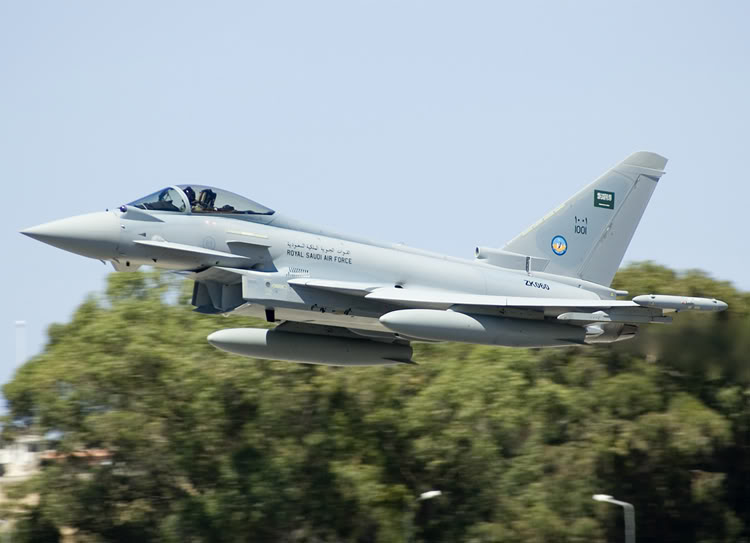
The first Typhoon was delivered to the RSAF in 2009.
The first Typhoon was delivered to the RSAF in 2009.
Britain’s BAE Systems Plc is close to selling 12 Eurofighter Typhoon fighter jets to equip the Royal Air Force of Oman. According to the Reuters news agency the sale could be worth up to $2 billion. Oman already has 12 F-16C/D, and last December placed an order for additional 12 Block 50 falcons, to be delivered beginning in 2013. The request for proposal for the British Typhoon Tranch 3 version fighters was made after the signature of the F-16 contract. These new F-16s or Typhoons are likely to replace the 18 Jaguar fighters currently in service. Originally Oman operated two Jaguar equipped air-defense squadrons, No 8 and No 20, both based at Thumrait Air Base.
BAE is also in talks to supply 60 Eurofighters to the United Arab Emirates (UAE) if the Gulf Arab state’s deal with France’s Dassault falls through. The UAE was expected to finalize the $10 billion deal with French aircraft manufacturer Dassault last year but stalled after the UAE claimed the French terms were uncompetitive. Oman has been a loyal customer for British aircraft, being one of the first international users of the Jaguar Anglo-French fighter, BAE Hawk trainer, as well as the Agusta-Westland Lynx.
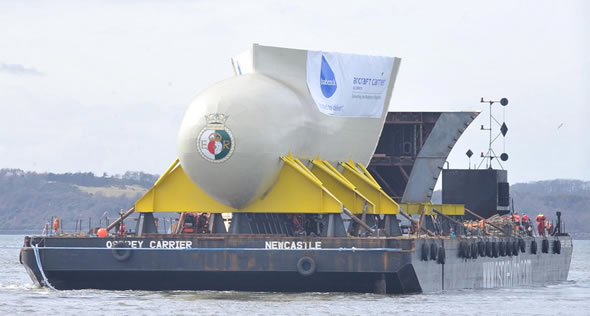
The Devon-built part of the future HMS Prince of Wales aircraft carrier bows out of Appledore on its way to be constructed in Rosysth
Shipping the 6,000 tonne LB02 hull section of HMS Queen Elizabeth
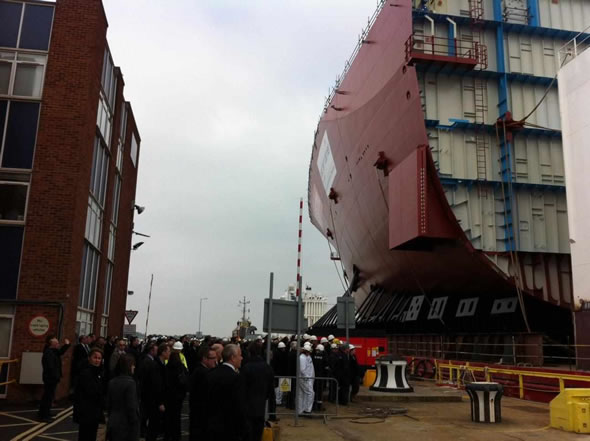
Assembly of the first new Queen Elizabeth Class aircraft carrier for the Royal Navy has marked another milestone at Rosyth, as the third massive Super Block (SB03) and second Lower Block (LB02) are positioned at one location, as part of the Assembly Cycle B – the second of three cycles undertaken by prime contractor Babcock.
According to Babcock, the assembly of the first carrier at Rosyth is progressing well, and to schedule. The docking of LB02 (measuring some 60 meters long by 38 meters wide and 21 meters deep and comprising predominantly accommodation compartments with some auxiliary machinery spaces), which arrived from BAE Systems in Portsmouth at the beginning of June, marked the start of Assembly Cycle B. In this second cycle Babcock will integrate LB02 with Lower Block 01 (the forward sections from the keel up to the flight deck, including the bulbous bow), previously built by Babcock at its Appledore shipyard in Devon, and Super Block 03 (SB03) already assembled in the dock.
This cycle will continue until spring 2013, to be followed by Assembly Cycle C for the remaining blocks, including the stern sections and island structures, with the hull fully assembled by 2014.
Assembly Cycle A, successfully completed to schedule by Babcock in May, saw the assembly of Super Block 03, comprising the mid-hull section (LB03) and four sections making up Centre Block 03 (CB03) plus associated sponsons. Outfitting of the nine major upper blocks integrated with LB03 in this cycle, including installation of electrical cabling, mechanical pipe systems, ventilation and fittings and equipment, is scheduled to complete later this year.
The Devon-built part of the future HMS Prince of Wales aircraft carrier bows out of Appledore on its way to be constructed in Rosysth
The Aircraft Carrier Alliance (ACA), a partnering, is building the two carriers, HMS Queen Elizabeth and HMS Prince of Wales. Partnering this alliance are BAE Systems, Babcock Thales and the Ministry of Defence. Six shipyards around the UK are constructing the large individual blocks that will be joined to assemble the final vessel. This work is shared between BAE Systems and Babcock. After completion of each of the blocks they are transported to Babcock’s Rosyth facility for final assembly and integration.
The 65,000 ton QE Class aircraft carriers will be the UK’s largest (280 meters long, 74 meters wide, and 56 meters high) and most powerful warships, providing the armed forces with four acre military operating bases that can be deployed worldwide.
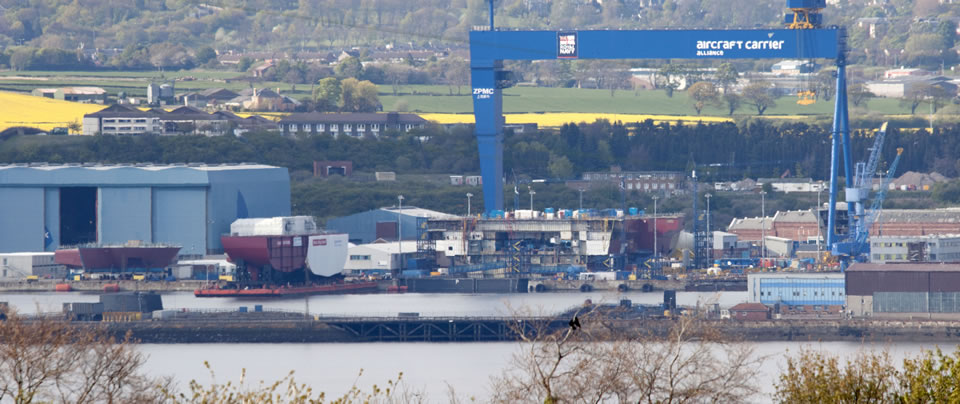
A panoramic view of the aircraft carrier construction site in Rosysth. Photo: Alan Pratt
The Marine Corps plans to deploy the V22 to Japan in August 2012
On 29 June, the US Department of Defense (DoD) announced that a squadron of Marine Corps MV-22 Ospreys will be deployed to Okinawa as planned, but will not engage in flight operations until investigations into two recent crashes are completed. The joint announcement emphasized that “Japan will be the only location worldwide where the United States will suspend MV-22 flight operations.”
This announcement came on the same day two MV-22s began a journey from North Carolina to England to participate in two international air shows. The MV-22s will be featured at the Royal International Air Tattoo and the Farnborough Air Show. The Pentagon has been clear that the Marine’s MV-22s and the Air Force’s CV-22s will continue “uninterrupted flight operations” in all worldwide locations including the continental United States.
The Marine Corps and aircraft builders Boeing and Bell Helicopter Textron hope that air show demonstrations will be a major step towards building international interest in the MV-22, interest they hope will lead to an acceptable level of lucrative international sales.
The Pentagon announcement indicated that Japanese officials were fully briefed on the results of the preliminary investigations into an MV-22 crash in Morocco and a CV-22 crash in Florida. After the briefing, the announcement continued, Japanese officials agreed that the MV-22 deployment should proceed.
A preliminary investigation into the 11 April Marine MV-22 crash in Morocco determined that the aircraft performed as designed and mechanical failure was not the proximate cause of the crash. Preliminary results of the investigation into the 13 June crash of a US Air Force CV-22 in Florida reached the same conclusion, a mechanical failure did not contribute to the crash.
Pentagon officials expect to have the final crash reports in time to deliver them to Japan sometime in August. Until then, the Pentagon has promised that the MV-22s will not conduct flight operations in Japan. The aircraft will first be sent to Marine Corps Air Station Iwakuni in the southwest prefecture of Yamaguchi in late July to undergo full assembly and ground testing.
Deployment of the MV-22 Ospreys to Okinawa is needed to replace the aging Marine Corps CH-46E Sea Knight helicopters now operating from Marine Corps Air Station (MCAS) Futenma in Okinawa. The MV-22 has been selected as the Marine Corps’ medium-lift vertical transport of the future delivering a combination of range, speed, and lift capability the current crop of helicopters cannot match.
Despite the 29 June announcement that the Ospreys would be deployed to Okinawa, the governor of Okinawa Prefecture declared that the Prefectural government would not accept the decision to locate the MV-22s at MCAS Futenma. Japanese news sources are reporting that Governor Hirokazu Nakaima informed Japan’s Minister of Defense Satoshi Morimoto on 1 July that he rejected the planned deployment in recognition of issues that cast doubt on the Osprey’s safety record.
Although local jurisdictions have no legal means of rejecting the deployment of US forces, Okinawa residents have long opposed the continued presence of large numbers of US forces on the island leading to growing distrust of the Tokyo government. Governor Nakaima reportedly warned Minister Morimoto that deploying the MV-22s to Futenma could lead to mass protests and further strain relations between Okinawa residents and the central government.
Despite the MV-22s lingering reputation as the “Widow Maker,” the aircraft has accumulated a rather impressive safety record. Since 2001, the Osprey has proved to be one of the military’s safest rotorcraft in the inventory. In that time, three Ospreys have crashed at the cost of six lives while 414 helicopters have been lost at the cost of 606 lives during the same time frame. Of course, the helicopters have racked-up more flight hours in more diverse environments and under more trying circumstances in general.
The Marine Corps considers the MV-22 to be essential to the future of amphibious operations and the nation’s ability to successfully project power from over the horizon and in doing so, offer amphibious shipping enhanced protection. The aircraft is also claimed to be essential to the successful execution of humanitarian missions and disaster relief efforts. The CH-46E Sea Knight helicopters will be retired regardless of the situation in Japan and the only viable replacement available now is the MV-22.
What will happen when the Ospreys arrive in Japan is still unknown, but the fact remains that the Marines need vertical lift and the MV-22 is that lift, a fact that is not likely to change anytime soon.
Japan’s Ministry of Defense (MoD) announced that it has agreed to buy 4 Lockheed Martin F-35A Joint Strike Fighters (JSF) at a cost of $128.61 million each, an increase of $3.7 million over the $124.83 million price negotiated last December. The four aircraft are scheduled for delivery in Fiscal Year 2016.
A formal letter of offer and acceptance (LOA) was signed in Japan on 29 June and includes four conventional take-off and landing (CTOL) variants of the F-35, spare parts, and two simulators for a total of $756.53 million. Although the base price of the aircraft itself increased, the cost of the spare parts and two simulators dropped from an initial estimate of $258.48 million to $240.83 million, a significant savings for Japan.
The Japanese government’s decision to buy the fifth-generation F-35 while rejecting the less expensive battle-proven Boeing F/A-18E/F Super Hornet and Eurofighter Typhoon was a volatile and contentious decision from the very beginning. With South Korea soon to announce its choice for its next generation fighter, the F-35 continues to spawn disagreement among experts and analysts.
Japan’s leaders opted for the F-35 after reportedly receiving a classified briefing that touted the impressive capabilities of the aircraft. This briefing was obviously enough to sway the Japanese to buy the F-35 at a time when China’s J-20 became the object of some flattering media reports that fueled Japan’s concerns about the offensive capabilities of its Asian neighbor.
Former Japanese Defense Minister Naoki Tanaka publicly threatened to cancel the entire 42 aircraft buy if costs continued to rise and delays became problematic. A decision on the remaining 38 aircraft has not been finalized yet.
Price increases were considered inevitable when the United States reduced its 2013 order by 13 aircraft and 179 total units between 2013 and 2017 in January. Budget restraints and unresolved development difficulties were cited as contributing factors behind these reductions. The US Department of Defense (DoD) is buying the F-35 at the same time the aircraft is still being developed, a process commonly referred to as concurrency.
A major criticism leveled at this process is the prospect that early model production aircraft may require extensive modifications at a later date as design flaws are identified and require correction.
The DoD previously announced revised cost estimates that indicate the overall cost of the F-35 program could be expected to rise $17 billion above a 2011 estimate of $396 billion. Slowing production over the next five years added as much as $6.2 billion to procurement and development costs alone.
Lockheed Martin and Pentagon officials working in the F-35 project office have stated that the eventual cost of the F-35A would bottom out at $78.7 million per aircraft. That estimate is based on a projected US buy of 2,443 aircraft, 716 international orders, and does not include all costs of development.
The Japanese Air Self-Defense Force (JASDF) hopes to procure a total of 42 Lightning IIs to replace its aging fleet of McDonnell Douglas F-4J Kai Phantoms. Japanese news sources have estimated that the overall lifecycle cost of 42 aircraft would be nearly $13 billion while the US Defense Security Cooperation Agency (DSCA) has offered an estimate of approximately $10 billion.
An anonymous Japanese MoD source has been quoted as saying that the price increase was explained by US representatives as based primarily on the Pentagon’s decision to delay US procurement and was entirely unavoidable. Apparently, Japanese leaders were satisfied with the explanation and accepted the cost increase. This source stated that Japanese leaders felt the situation was “understandable” and Japan could not expect an offer of a lower cost when those nations involved in the cooperative development of the F-35 would likely be paying a higher price.
Japanese defense analyst Shinichi Kiyotani has been quoted as saying he believes Japan came away with a pretty good deal when “compared to the price rises that might come later.” Technical problems, initial order cancellations, or lengthy production delays would undoubtedly cause further price increases.
While the US continues to trumpet the F-35 as the most capable and versatile fifth-generation aircraft in the world, questions remain regarding the aircraft’s design and performance.
Lockheed Martin was relieved and pleased with news of the signing saying that the company “is honored Japan’s Ministry of Defense and the United States Government have signed a Letter of Offer and Acceptance (LOA) for the first four of 42 F-35A Lightning II 5th Generation multirole fighters.”
Lockheed Martin, looking to the future, considers the sale of the F-35 to Japan as a means of gaining an edge in the competitive environment now surrounding high-tech weapon’s sales worldwide. Lockheed is hopeful that the signing of this LOA will help to convince South Korea to select the JSF as its next generation fighter and may even lead to a deal to eventually replace Japan’s F-15 Eagles with later variants of the F-35.
With national budgets shrinking and F-35 development costs rising, the door will remain open for other competitors at least in the foreseeable future.
India’s defense minister Shri AK Antony directed the completion of the first phase of the nation’s coastal radar network on the east and west coasts. The radars are part of a surveillance systems providing maritime traffic monitoring. The plan integrates with the modernization of naval and coast guards assets, including fast patrol boats, command, control and communications network and vessel traffic management systems to be implemented on India’s the coastline.
As part of this effort, Saab has recently marked the successful implementation the National Automatic Identification System (NAIS) along the Indian coastline. The system was established in cooperation with its Indian partner Elcome Marine Services. The system is incorporated in 74 lighthouses along the Indian coast. NAIS sensors are integrated with existing radar, cameras and other sensors, to provide merchant traffic information in real time, over the internet. The project was established by India’s Directorate General of Lighthouses and Lightships (DGLL), in support of the Indian Navy, Coast Guard and DG Shipping. “Correlating AIS with coastal radar data provide operators with a Common Operating Picture (COP)” said Mandus Persson, VP Operations at Saab Transponder Technology. Saab and Elcom have been working on the system for the past two years. The contract also provides for maintenance and support of the system over a 10 year period.
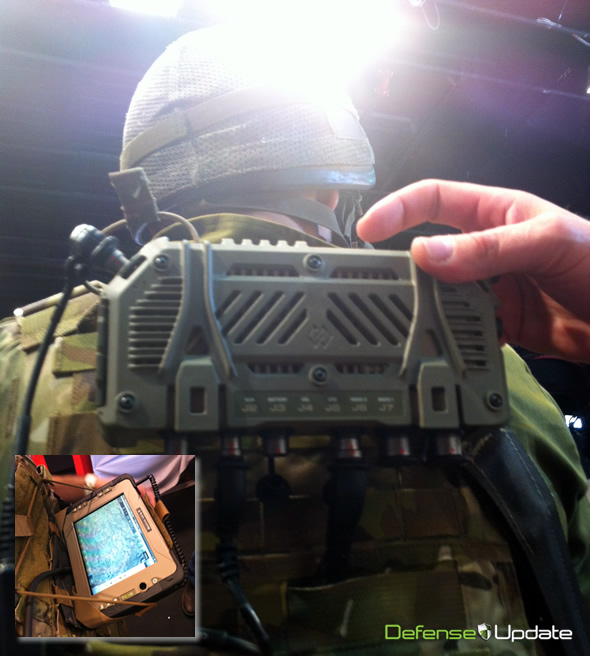
The Modular Tactical System (MTS) is already operational with various special forces and is one of the candidates for the US Army Nett Warrior (NW) soldier system wearable computer. Photo: Tamir Eshel, Defense-Update
The U.S. Air Force is fielding equip enhanced wearable command and control systems to enable dismounted elements to guide and control close air support operations. The Black Diamond Advanced Technology company was selected by Air Force Special Operations Command (AFSOC) to develop a specially configured version of its Modular Tactical System (MTS) wearable system. The company will deliver the new systems under a Firm Fixed-Price Contract awarded by the Air Force Materiel Command (AFMC) Aeronautical Systems Center.
The system, designated Battlefield Air Operations (BAO) Operator Control System (OCS), is a dismounted, precision-strike and communications-control solution primarily used by Special Operations Forces (SOF). Likely users of the new BAO kit are AFSOC Special Tactics Squadrons, Combat Control Teams, Tactical Air Control Party, and Guardian Angel pararescue personnel.
The BAO kit will upgrade the current equipment suite of the Battlefield Airmen in five areas: communications, computers, human input/output, power generation and management, and software. The OCS consists of a wearable vest with cable runs, cables, power manager and computer.
The Modular Tactical System (MTS) is already operational with various special forces and is one of the candidates for the US Army Nett Warrior (NW) soldier system wearable computer. Photo: Tamir Eshel, Defense-Update
MTS first fielded by special forces in Afghanistan in 2010 is a wearable multi-mission system that funnels control of mission-critical peripherals to a central display, to eliminate battery and equipment redundancies and lighten load-out. As an off-the-shelf solution with a patent-pending cable-management cummerbund system, the MTS allows the Air Force to fulfill its OCS requirements and field a truly foot-mobile solution.
SOF personnel are already using MTS for other applications, including precision targeting, C4ISR, situational awareness, explosive ordnance disposal, and unmanned systems operations and control.
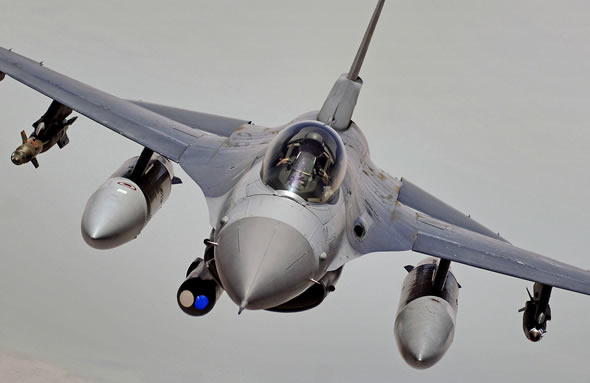
The Danish Ministry of Defence announced that it has selected Northrop Grumman’s LITENING G4 targeting system for its F-16 fighter aircraft. First deliveries are expected in August 2013. The Litening G4 pods will be supplied with datalinks and full logistics support package.
LITENING G4 Advanced Targeting Pod is the latest version of the Litening targeting pod developed by Israel’s Rafael Advanced Defense Systems. Rafael has teamed with Northrop Grumman to develop and market the pods in the US and international market. The team has successfully won contracts in a number of key markets in the United States, with F/A-18 operators including Australia, Finland and Spain, Italy, the Netherlands, Portugal and Israel as users of the Northrop Grumman LITENING family of targeting pods.
The G4 version delivers the latest advancements in sensor, laser imaging and data link technology. The G4’s technologies include true megapixel (1kx1k) forward-looking infrared and charge-coupled device sensors, short wave infrared laser imaging sensor, color symbology, tracker improvements and enhanced zoom. These advancements deliver more accurate target identification and location at longer ranges than previous generations of LITENING targeting pod systems while reducing pilot workload.
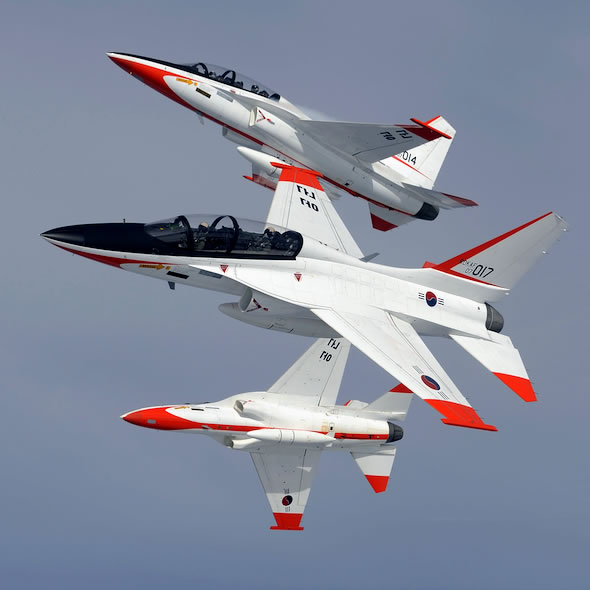
With new territorial challenges facing the Philippines and an antiquated military force riddled with inefficiencies, the Philippine’s ABS-CBN news released a report on 20 June that the Philippine Air Force (PAF) has decided to acquire twelve South Korean TA-50 trainer/fighter jets.
The news report indicates that the aircraft are being offered at a price of $29.8 million per unit with a total package cost of $591.3 million. This purchase is part of a Filipino modernization program estimated to cost a total of $1.5 billion. This acquisition will include spare and replacement parts, training, necessary technical support, and other necessities required to get the aircraft operational.
Philippine Defense Secretary Voltaire Gazmin told ABS-CBN news that modernizing the PAF’s air defense capabilities is an urgent priority in light of recent territorial disputes with China and is needed to polish the nation’s international image.
Renewed tensions with China have arisen in recent months over territorial disputes that have served to highlight weaknesses in the Philippine’s self-defense capabilities creating a heightened unease in the minds of the Filipino leadership. This unease has spurred Filipino leaders to shop around for affordable military hardware to modernize the island nation’s military forces.
The ABS-CBN report indicated that a firm contract was expected to be finalized by the end of this year with delivery of the twelve aircraft to be completed by the end of 2013. At the present time, Filipino neighbor Indonesia is the only other export customer destined to receive the TA-50, but Seoul has hopes that the TA-50 will eventually prove to be a very attractive buy because of its performance and affordability.
Despite the media report, South Korea’s Defense Acquisition Program Administration (DAPA) has publicly stated that although efforts to export the TA-50 to the Philippines were ongoing, they have not yet received a firm commitment for the reported sale.
In purchasing the TA-50, the Philippines will be able to restore jet combat capability to the PAF that has been mostly lacking since the nation’s ten F-5 jets were retired from active service in 2005. The Vietnam-era F-5s were expensive to maintain and no real match against modern aircraft. Back in 2008, the Philippines bought an additional 18 Italian SF-260F trainers for $812,000 each, but the design is decades old and has proven only marginally effective in the light attack role. Most of the other SF-260s in the Philippine inventory have seen hard service and only twenty remain operational. The PAF’s Italian-made S211 jet trainers were replaced by the SF-260s.
Intense efforts by the Philippine government to buy used F-16 aircraft from the United States have so far failed to receive the required clearance from the Defense Security Cooperation Agency (DSCA). The plan to buy used F-16s has now pretty much been dropped in consideration of the high cost of reconditioning and maintenance that would be required.
KAI TA-50 jet trainer. Photo: KAI
In April, Manila requested US assistance in creating a “minimum credible defense” through the acquisition of upgraded aircraft, radar systems, and patrol boats. In May, President Benigno Aquino announced that his government was looking at obtaining jet aircraft from sources other than the United States, affordable aircraft that could be delivered quickly.
The Korea Aerospace Industries (KAI) TA-50 Golden Eagle is a combat-capable version of the T-50 jet trainer. It is a light fighter/attack aircraft of supersonic speed equipped with a 20 millimeter automatic gun and the ability to carry as much as 4.5 tons of missiles and bombs. The aircraft was designed to serve as a lead-in fighter trainer and light fighter attack. When fitted with the Israeli EL/M-2032 radar, the TA-50 can carry a variety of precision-guided munitions, air-to-ground missiles, and air-to-air missiles as well as electronic warfare and reconnaissance pods on external hardpoints.
It is reported that the TA-50 has a level of operational performance equaling that delivered by the South Korean KF-16 aircraft. The TA-50 is equipped with the same F404-GE102 engine that powers the F-16. KAI developed the T-50 in cooperation with Lockheed Martin and both companies are actively involved in promoting the sale and export of the aircraft.
The PAF is also looking to replace its aging fleet of OV-10 Bronco counter-insurgency aircraft. Along with the announcement about the purchase of the TA-50s, the PAF is said to have selected Brazil’s Embraer EMB 314 Super Tucano to replace the Broncos. The reported deal would deliver six Super Tucanos at an estimated cost of $115 million.
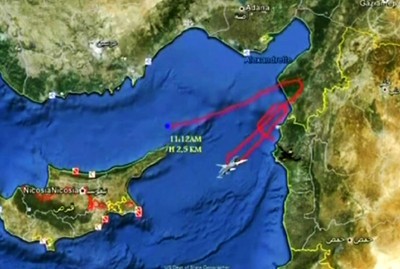
The Syrian news agency SANA published this map showing the tracks of the Turkish aircraft before it was shot down by its anti-aircraft artillery seven kilometers off the Lattakia coastline. Photo: SANA
The Syrian news agency SANA confirmed yesterday (June 23, 2012) that on 11:40 AM on Friday (June 22, 2012) the Syrian air defense forces have downed an ‘unidentified target’ that violated Syrian airspace coming from the west (seaside) at a very low altitude and at high speed over Syrian territorial waters. After spotting the aircraft Syrian air defense artillery units opened fire, hitting the target about one kilometer from the coastline, causing it to crash into Syrian territorial waters about seven kilometers west of the Om al-Tuyour village in the Latakia province. The two crewmen are still missing.
Apparently, the target headed west before crashing, hitting the water about ten kilometers from the coastline. The Syrian agency released a map showing the target’s route before the intercept. Syria has tried to play down the incident. Syrian foreign ministry spokesman Jihad Makdissi said the incident was “not an attack”. “There was no hostile act against Turkey whatsoever. It was just an act of defense for our sovereignty.” he said.
The Syrian news agency SANA published this map showing the tracks of the Turkish aircraft before it was shot down by its anti-aircraft artillery seven kilometers off the Latakia coastline. Photo: SANA
According to the map released by the SANA agency, the Turkish aircraft, apparently an unarmed reconnaissance version of the Turkish Air Force F-4E, was circling at higher altitude in Turkish airspace north of the area, possibly using Long Range Oblique Photography (LOROP) payloads (similar to the system Turkey bought in Israel few years ago). LOROP provides high quality imagery form very long range (up to 100 km), when taken from high altitude. However, it is less suitable for fast, low-altitude tactical recce missions characteristic of the final dash the Phantom performed just before it was shot down. What drew the pilot to act this way? One possible explanation for the Turkish maneuver is an Electronic Intelligence (ELINT) gathering mission.
The Turks confirmed that two Phantom fighters (the type was not identified) have left the Erhac Air Base at around 09:30 local time, one of these planes disappeared from the radar screen about one and half hour later. Turkish authorities said the plane was flying in international airspace but crashed in Syrian waters near Latakia. They admitted the plane had entered Syrian airspace but quickly left when warned by Turkey and was shot down in international airspace several minutes later.
Officially, Turkey said the planes were on a training mission but more likely they were on a reconnaissance mission, peeking along the Syrian Mediterranean coastline, where Syria is known to maintain a strong anti-aircraft, coastal defense and radar coverage. Based on the flight profile (if the Syrian description is correct) the Turks could have performed a ‘teasing’ game, in an attempt to stimulate the Syrian air defenses to activate their fire control radars, therefore give away critical data that could be used to optimize electronic countermeasures if NATO decides to involve in the situation and enforce a ‘no fly zone’ over Syria, similar to what the alliance did in Libya in 2011. Apparently, the Syrians weren’t tempted, and challenged the intruder with anti-aircraft fire rather than surface-to-air missiles. Under these circumstances, the downing of the Turkish jet could have been a miscalculated unlucky rather than lucky shot.
Indeed, Turkish foreign minister, Ahmet Davutoglu said the plane was “on a training flight to test Turkey’s radar capabilities and had no covert mission related to Syria”. Davutoglu, said Ankara would formally present the incident to its NATO allies to prepare a response under article four of the organization’s founding treaty. The article provides for states to “consult together whenever, in the opinion of any of them, the territorial integrity, political independence or security of any of the parties is threatened”. It stops short of the explicit mention of possible armed responses cited in article five.
The Libyan and Syrian air defense systems are similar in terms of hardware – SA-5, 6, 3 and 2, linked through an advanced command and control network and backed by a dense radar surveillance network. For the low level air defense, Syria uses the SA-8, and more recently deployed the SA-22 Pantsir S1, an integrated, autonomous missile and air defense artillery unit. The Syrian air defense is believed to be maintained at higher alert levels and better equipped with more modern equipment, including the new Pantsir (recently demonstrated on official video firing on a nearby coastal range), likely to be deployed in the western region. NATO is also concerned about the Russian intentions to beef up its garrison maintaining and protecting a small facility established recently at the port of Tartus, south of Latakia. Currently the base is manned my about 100 sailors and marines, but the Russians were reportedly preparing two landing ships loaded with Marines at Sevastopol on high alert, to be sent to protect the base if required.
Having a stronger Russian footprint in Syria could further complicate plans for NATO, if a decision to act is taken.
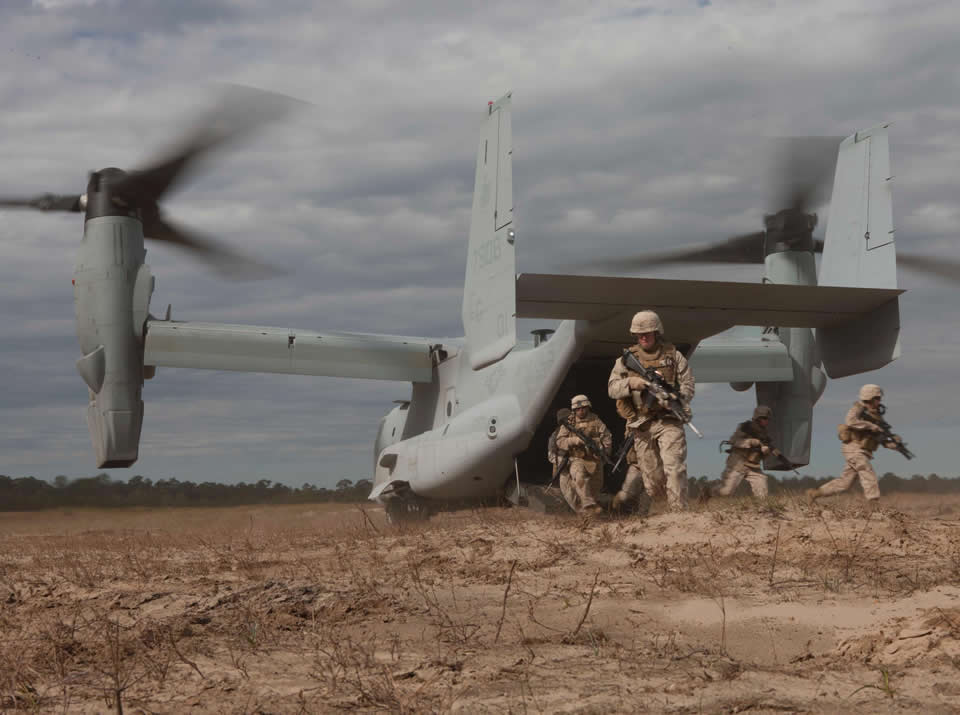
Marines disembark from an MV-22B Osprey on a training mission. Photo: USMC
The planned deployment of US Marine Corps MV-22B Osprey tiltrotor transport aircraft to Okinawa has run into some rather intense opposition from local Japanese officials and created new headaches for Japanese Prime Minister Toshihiko Noda. Two Japanese prefectural governors, along with local community leaders, have adopted a stance of direct opposition to the planned deployment of the Osprey.
The untimely crash of a US Air Force Special Operations Command (AFSOC) CV-22B in Florida earlier this week that left five servicemembers injured and an April crash of a Marine MV-22B in Morocco that killed two Marines have left many Japanese doubting the safety of the aircraft. According to the Pentagon, preliminary accident reports indicate that mechanical failure was not the cause of either accident.
As a tiltrotor aircraft capable of vertical/short take-off and landing (VSTOL) operations, the Bell Boeing V-22 was designed to integrate the features of a conventional helicopter with those of a turboprop aircraft. This innovative combination of functionality gives the Marine Corps a long-range, high-speed aircraft that outperforms existing medium-lift helicopters currently in active service. The Osprey is able to carry as many as 24 combat-loaded Marines at twice the speed and five times the distance of operational helicopters of comparable lift capacity.
The MV-22B is a medium-lift transport aircraft and has been employed as a combat transport in a battlefield environment in both Iraq and Afghanistan since 2007. Having encountered both shoulder-launched missiles and antiaircraft fire on combat-lift missions, not a single aircraft has been lost to enemy fire.
As a hybrid, the MV-22B features the maneuverability, speed, and range of a turboprop transport while offering the VTOL capabilities of a conventional helicopter. It gives the US Navy and Marines a medium-lift capability that can be launched against a hostile shore from a greater distance to enhance the survivability of amphibious assault shipping, a consideration that may become a significant concern in the Asia-Pacific region.
In the early stages of development the V-22 was plagued by a series of technical difficulties, glitches the Marine Corps says were little more than initial teething problems that have since been identified and corrected.
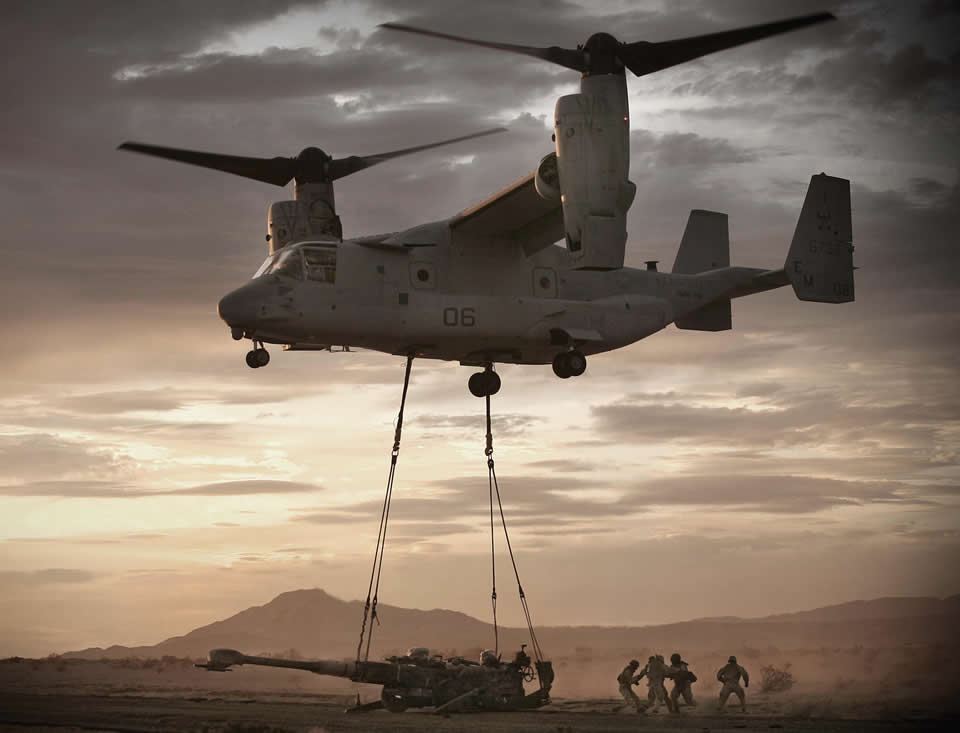
MV-22B lifts an M198 towed howitzer with a sling load. Photo: USMC
Added to the technical complications was the unfortunate nickname of “widow-maker” the Osprey was tagged with as a result of a series of accidents that occurred during flight testing. The aircraft suffered four serious crashes during flight testing between 1991 and 2000 costing the lives of 30 people aboard the aircraft. Since the Osprey became operational in 2007, six people have died in three accidents and several others were injured.
It is this safety record, a media favorite and always accorded front-page coverage, which has rattled Japanese leaders and inflamed an already tense situation with respect to the US military presence in Japan, especially among the Okinawan populace.
Following the CV-22B crash in Florida on 13 June, Japan’s newly-appointed Minister of Defense, Satoshi Morimoto representing the Japanese government, requested the Pentagon provide a detailed briefing to explain the causes of the Florida accident and the 22 April crash of the Marine MV-22B in Morocco. Japanese national leaders are under unrelenting pressure to assure community leaders and the general public that the Osprey can be operated safely in japan.
In response to this request, Pentagon officials and military officers gave a presentation to Japanese representatives on 22 June to provide an update on the details of the most recent Osprey accidents and to assure the Japanese that the MV-22B’s safety record equals that of any active aircraft in the military’s inventory.
During the high-level meeting, held in a Washington suburb, Defense Department representatives defended the safety record of the Osprey and shared preliminary investigation findings concerning the two most recent Osprey accidents with their Japanese counterparts.
Department of Defense (DoD) Press Secretary George Little said in a statement that the meeting offered US officials an opportunity to provide Japanese representatives an update “on the status of the investigations into recent aircraft mishaps.” The purpose, of course, is to reassure the Japanese that the Osprey, although a new and innovative aircraft, can be operated from multiple platforms with greater safety than can be achieved with helicopters.
Mr. Little told reporters that the Pentagon “takes the inquiries made by the Japanese government very seriously and provided relevant information to the extent currently possible, and will continue to do so.” He went on to say that the “Osprey is a highly capable aircraft with an excellent operational safety record, which includes more than five years of worldwide deployments and 140,000 flight hours.” The Pentagon stands behind its decision to deploy the MV-22B to Okinawa and insists that there are no plans in the works to cancel this deployment. Mr. Little was quoted as saying that the United States expects “to continue our deployment of MV-22 Ospreys to Okinawa.”
Japanese representatives were also informed that the Lieutenant Colonel responsible for CV-22B training in Florida was relieved of his duties following the USAF Osprey crash on 13 June, a seeming reference to a training failure and not a design flaw.
The original deployment plan called for the Ospreys to be assembled and undergo flight testing at the Marine Corps Air Station (MCAS) in Iwakuni, Yamaguchi Prefecture before being sent on to MCAS Futenma in Okinawa. On 19 June, Okinawa Governor Hirokazu Nakaima met with Foreign Minister Koichiro Genba and Defense Minister Satoshi Morimoto to ask the central government to encourage the Pentagon to cancel deployment of the twenty-four Ospreys to Futenma.
Iwakuni City Mayor Yoshihiko Fukuda announced on 12 June that the city was forbidding the temporary flight testing of the MV-22Bs at MCAS Iwakuni due to safety concerns highlighted by the Osprey crash in Morocco. With the CV-22 crash in Florida on 13 June, Mayor Fukuda convinced the City Assembly to endorse a formal nonbinding motion strongly opposing the temporary basing of the Ospreys at MCAS Iwakuni on 22 June. Yamaguchi Governor Sekinari Nii has lent his support to the Iwakuni opposition as well. Also on 22 June, Naha Mayor Takeshi Onaga and other Okinawa community officials traveled to Tokyo to present their opposition to the Osprey deployment and to request the Foreign Ministry also pressure the US government to cancel the deployment.
Earlier this year, the United States and Japan agreed to a new plan that calls for the Marine Corps to permanently remove 9,000 Marines from Okinawa and redeploy them to Hawaii and other Pacific locations. Both nations agreed to continue plans to relocate MCAS Futenma operations to another site with the latest idea to move the air facility to an offshore location in a less-inhabited area of Okinawa still the first choice.
Despite these efforts, the US military presence in Japan remains a contentious issue that frequently inspires mass public protests in Okinawa. The proposed relocation of the Futenma facility is a matter that remains unresolved and is likely to fuel future protests regardless of what alternative site is selected for the relocation.
While it is not necessary for local communities to approve of the Osprey move, the hostile opposition the plan has generated represents a serious loss of face for the national government and Prime Minister Noda. The opposition also complicates the Pentagon’s ongoing project to upgrade Marine Corps air assets. The MV-22B/C is projected to replace the aging fleet of CH-46 Sea Knight medium-lift helicopters now operational with an estimated completion date of 2019.
The last Marine CH-46 pilot completed training this year and no additional pilot training is scheduled. The Marine Corps is committed to the Osprey and, barring any extraordinary developments, it is the transport of the future. No alternative aircraft are available to replace the Osprey and it is not practical to believe that production could be increased on a conventional helicopter model to perform the Marine’s transport mission.
Should the Marines in Japan be denied the Osprey, it would deprive them of a critical component in their warfighting capabilities, power projection abilities, and would cripple their humanitarian relief efforts. Unit and personnel rotation from other regions of the world would be rendered impossible since the CH-46 will be retired and the Marines already have twelve squadrons flying the MV-22. Simply put, without the Osprey the Marines will be unable to perform their mission from Japanese installations. Either the Japanese accept the Osprey or the Marines may be forced to begin looking for another base of operations, a time-consuming and extremely difficult option.
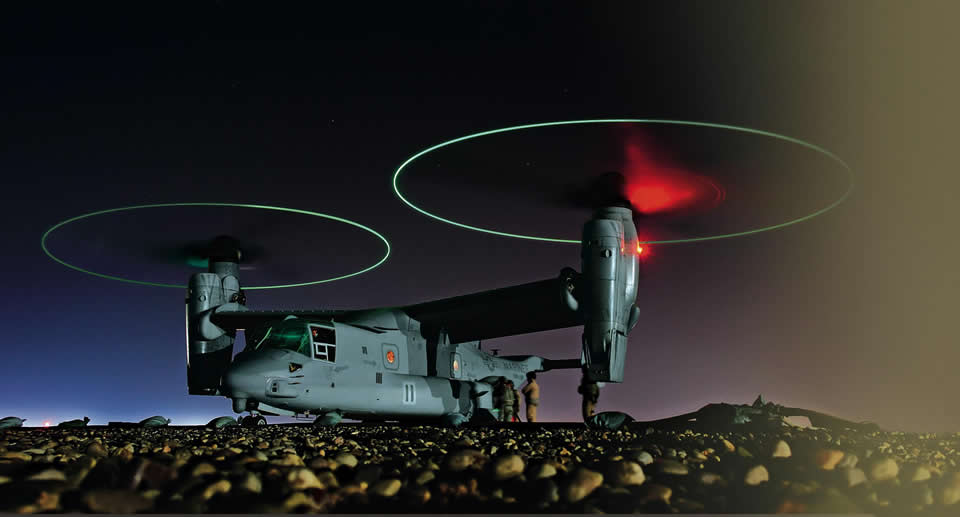
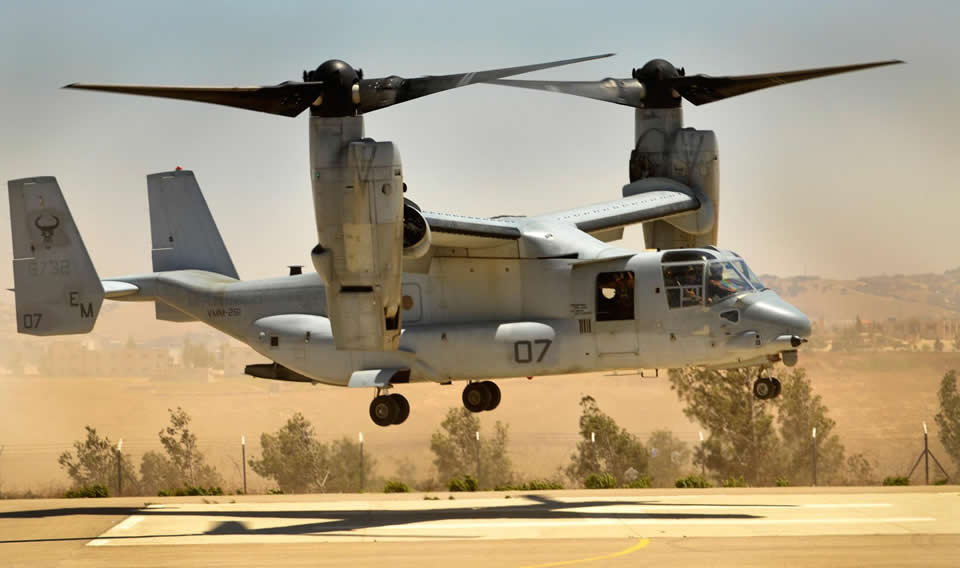
MV-22 Osprey tit rotor aircraft of the US Marine Corps VMM-261 deployed to the Jordanian special operations training center near Amman Jordan, May 2012, as part of exercise Eager Lion. Photo: CENTCOM
INSS Insight – Asculai, Ephraim: The Istanbul-Baghdad-Moscow talks on Iran’s nuclear program are over. As expected, they did not achieve anything of significance, besides deciding on further, lower level talks. Indeed, the P5+1 and the Iranian delegations shared one objective: they did not want the process to end, thereby necessitating a decision on different tracks. The Iranians are successfully playing for time, as they have done for so many years, and the members of the P5+1 group are also trying to delay any inconvenient decisions, each group member for its own reasons. Most noticeably, the US delegation would like to postpone any major decision until after the November 2012 presidential elections. For their part, the Iranians need time to advance their nuclear program and produce as much enriched uranium as possible. Although according to many reports the sanctions are hurting Iran, they are still not hurting Iran badly enough, and the Iranians are able to bear them.
The ultimate aims of both sides are, of course, diametrically opposite. The Iranians want to retain the capability to enrich uranium to military-grade levels and to gain the ability to produce several nuclear weapons in short order, should the Islamic Republic’s authorities so decide. The Iranian strategy is very simple: they want the world to recognize the legitimacy of the Iranian uranium enrichment program. Even under limited conditions, such recognition would enable Iran to retain its technical capabilities, to perfect the enrichment process, and to leave them a potential for a breakout (defined as the start of the process to produce military-grade enriched uranium), whenever they decide to do so. In addition, the Iranians could well construct concealed facilities and secretly produce enriched uranium to whatever levels they choose to achieve.
The P5+1 want to prevent this possibility, but their remaining options are few. It is nearly impossible to envision the Security Council taking any further action against Iran, because Russia and China would likely vote against it. The first and most probable option for the West (the P5+1 minus Russia and China) is to impose the July sanctions on oil and hope for the best. The next option is to increase the sanctions considerably and wait for the Iranians to blink. The third option is military action against Iran’s nuclear facilities.
What would the Iranians do? Although the present sanctions have hurt Iran considerably, there are those who think that Iran can shoulder them indefinitely and will therefore continue with its present tactics of preventing a showdown while enriching uranium. Should the sanctions be increased considerably, Iran could be willing to forgo the enrichment to 20 percent. This would be a political victory for the West, more than a practical victory, since Iran could still break out and produce nuclear weapons within a relatively short time. At this time, it is impossible to see Iran surrendering all enrichment activities. Too much is at stake internally, and any such action would be viewed by the population as defeat and perhaps cause a regime upheaval. Another Iranian option to break the impasse of sanctions vs. enrichment is to move ahead and take actions towards the production of nuclear weapons. These actions would include, inter alia, suspending unilaterally the IAEA safeguards activities in Iran, withdrawing from the NPT, and carrying out a nuclear underground test (contrary to its CTBT obligations). Any of these actions could materialize either because of Iran’s frustrations or its wounded national pride, or because Iran would feel cocky, having, in its own assessment, won all previous rounds. Iran could also be encouraged by the North Korean precedent, where nothing of major consequence happened to it following its first underground nuclear test. An Iranian underground test would perhaps be seen by the world as a casus belli condoning military action, but even this is uncertain.
How Israel would view the developments in Iran is a different matter. A nuclear Iran is certainly seen in Israel as an unacceptable threat. While the US views an Iranian breakout as a red line, mandating strong action, Israel views the potential to produce nuclear weapons in a very short time as its red line. Should Iran withdraw from the NPT or even from its safeguards obligations, there are those who would take this as a casus belli. This red line is not so well defined, and even a significant amount of further enrichment could be viewed as a trigger for military action. It is therefore very important to go back and rethink the whole diplomatic process if military action is to be avoided.
Strangely enough, the Iranians have a case in their derision of the P5+1 offer, in return for stopping the 20 percent enrichment, closing down Fordow, and sending the enriched uranium abroad. What the West offered, (airplane parts, etc.) was termed by the Iranians as “peanuts” and “chocolates” in return for “diamonds.” What should have been offered is the suspension of the forthcoming July oil sanctions. This should be in effect for, say, six months, after which these sanctions would automatically return if no further agreement was reached. None of the existing sanctions would be suspended, and the pressure on Iran would be as great as it is now.
In the next stage of negotiations, should the negotiators agree on this first step, the Security Council demands of Iran concerning the suspension of uranium enrichment and plutonium production activities must be met. The final step must be dismantling and stopping completely all activities related to fissile material production. Before the Moscow talks began, President Ahmadinejad said that Iran would be willing to forgo enrichment to 20 percent, in return for fuel for the Tehran research reactor. It is certain that Iran could obtain the same deal for the supply, most probably from Russia, of the 3.5 percent fuel for its Bushehr nuclear power reactor. It could then abandon the need for indigenous uranium enrichment. Although at this stage a very far-fetched dream, this would be the only way to defuse a very dangerous situation that could cause much regional and universal damage if allowed to develop further.
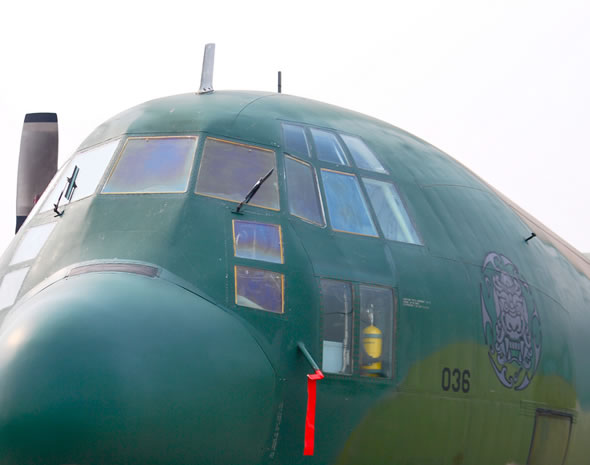
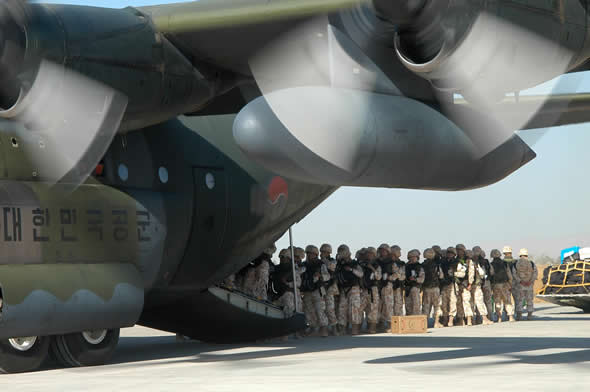
ROKAF C-130H on display at Seoul Airshow 2009. Photo: Ciaran Hickey
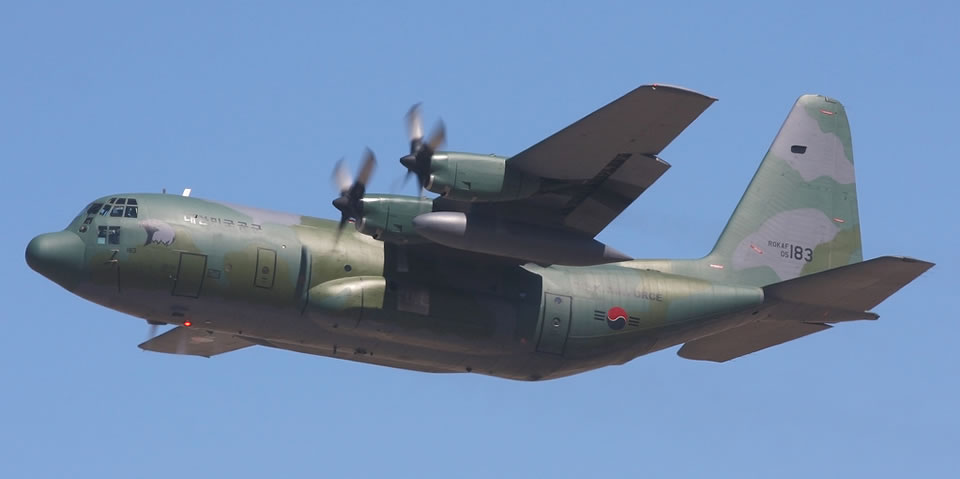
ROKAF C-130H on a low-level flight. Photo: Jon Wright
Elbit Systems announced it has been awarded a contract valued at US$62 million to upgrade the Korean Air Force C-130 transport aircraft. Under the four year contract, the C-130 aircraft will be installed with advanced electronic systems replacing part of the existing, mechanical-analog cockpit instrumentation. The modernized system will use electronic, digital multifunction displays in a “Glass-Cockpit” style, using Elbit Systems’ cutting-edge digital flight displays and integrated computers.
The Israeli company will deliver the project over four years, in cooperation with Korea Aerospace Industries Ltd. (KAI), who is the leading local aircraft manufacturer in Korea.
The Republic of Korea Air Force (ROKAF) currently operates 12 C-130H Hercules transport aircraft, along with 20 Airbus Military C-235. In 2010 Korea has ordered four new C-130J from the USA, and is expecting to receive these aircraft by 2014.
ROKAF C-130H on display at Seoul Airshow 2009. Photo: Ciaran Hickey
These new ‘Super Hercules’ tactical transport planes will offer improved range, speed and increased payload capabilities with higher reliability over the existing H models. However, in avionic terms, the upgraded and new aircraft will have similar (though not common) features. With the upgraded C-130H and new C-130Js, ROKAF expects to maintain a fully modernized tactical transport fleet by 2016.
According to Yoram Shmuely, Co-General Manager of Elbit Systems’ Aerospace Division, the recent win marks a new milestone in company’s collaboration Korean Air Force and Korea Aerospace Industries. Shmuely said the experience the company have gained in performing previous C-130 upgrades in South Korea and Romania, as well as the upgrading of the Brazilian C-95 Brazilian C-95 transport aircraft, position it in a favorable position to win similar projects evolving with the growing demand for transport aircraft upgrades.
Low Earth orbit is the region of space within 2,000 kilometers of the Earth's surface. It is the most concentrated area for orbital debris. Illustration: NASA
Millions of small debris orbiting earth at Low Earth Orbit (LEO – at altitudes of 2,000 kilometers and below) are posing serious risk to manned and unmanned spacecraft. Scientists at the U.S. Naval Research Laboratory (NRL) are evaluating the feasibility of dispersing tons of dust to ‘sweep’ these objects from their LEO orbit, slowing and lowering them into the upper atmosphere, where they will decay the heat generated from drag induced by the upper earth atmosphere.
The National Aeronautical and Space Administration (NASA) Orbital Debris Program Office estimates there are more than 21,000 orbital debris objects larger than 10 centimeters (roughly 4 inches) in diameter in LEO, and approximately 500,000 object particles between 1 and 10 centimeters, with the number of debris particles smaller than 1 centimeter in excess of 100 million. Traveling at speeds in excess of 8 kilometers per second, or greater than 17,000 miles per hour, even miniature debris would wreak havoc on invaluable space assets like the International Space Station (ISS), Hubble Space Telescope and numerous weather satellites, damaging solar arrays, instrument panels and solar shields.
In 2011, the National Research Council (NRC) conducted an exhaustive study to assess NASA’s meteoroid and orbital debris program. The report concludes that LEO orbital debris is at the ‘tipping point’ – the threshold for collisional cascade, or Kessler effect, in which the number of objects in LEO is dense enough that collision between objects, could cause a cascade. This exponentially increases the likelihood of further collisions and makes it increasingly risky to maintain space assets without clearing the debris population.
“Hundreds of near-misses occur each year between orbital debris and operational satellites,” says Gurudas Ganguli, head, NRL Space Analysis and Application Section at the Plasma Physics Division. “Dust, similar to that which naturally fills the near-Earth environment, can be deployed artificially in a narrow altitude band to enhance drag on debris and force re-entry.”
About 100 tons of cosmic dust is introduced daily in the Earth’s environment naturally in the form of micrometeorites. In addition to this natural source, human space activity also introduces large quantities of dust in space regularly. However, this dust is distributed over a very large volume, making it too widely dispersed to affect orbital debris.
Physicist and Engineers at the U.S. Naval Research Laboratory Plasma Physics Division and Naval Center for Space Technology are researching a technique to ‘sweep’ Low Earth Orbit (LEO) debris from space using an Active Debris Removal (ADR) system of deployed micron-scale dust.
As Ganguli explains it, the essential idea is that dust, if artificially deployed on orbit in opposite direction to the debris trajectory, can induce an enhanced drag on the debris. The novelty is that by choosing the dust characteristics, for instance, mass density, size, etc., it is possible to synchronize the rate of dust and debris descent. This offers the possibility to clear a very large volume of small debris by deploying a modest amount of dust, 20 to 40 tons, in a narrow layer and “sweeping” of the debris volume by the dust layer.
“It is well known that the natural drag due to neutral atmosphere decays satellite orbits,” adds Ganguli. “We use the natural atmospheric drag to decay the deployed dust orbits and simultaneously use the dust to induce enhanced drag on the orbital debris. Like the natural dust, most of the deployed dust as well as the small orbital debris will incinerate while reentering the Earth’s dense atmosphere. So the environmental effect of releasing the dust is expected to be benign.”
Research indicates that the dust based ADR system can be a cost effective means to clear deadly untrackable small orbital debris with manageable risks to existing space assets and can be developed with off-the-shelf type technologies in the near term. This same concept can be utilized for removing larger debris with a suborbital dust deployment. Preliminary analysis suggests tungsten be a prime candidate for the dust because of its high density, relative abundance, availability in powder form and modest cost, all contributing factors to the efficiency and economy of the system. (Source: NRL)
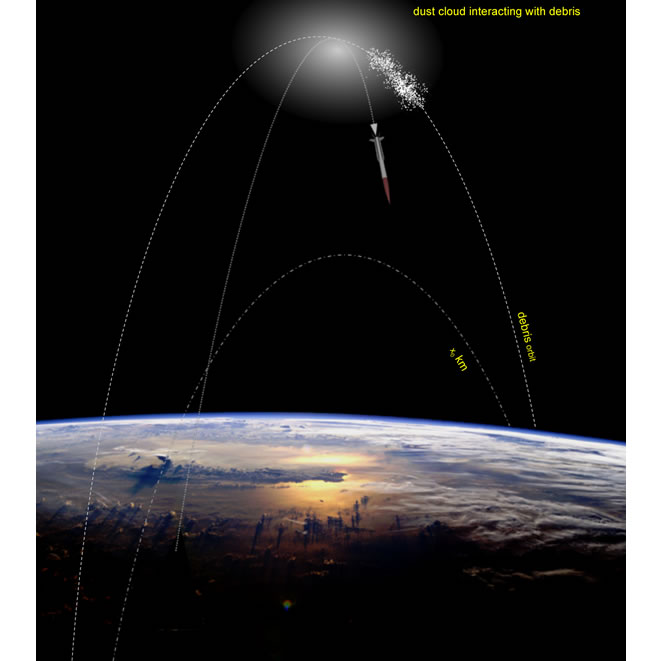
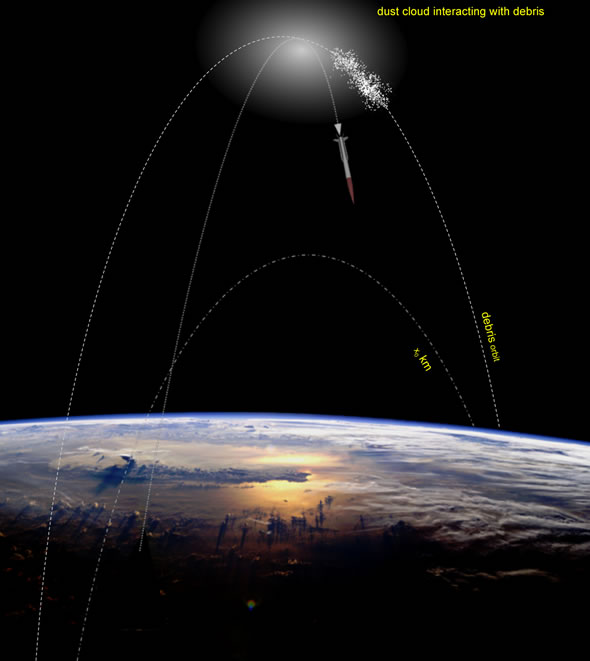
Schematic illustration of the suborbital dust deployment: A ballistic rocket is used to release dust in the path of debris fragments. The debris population is engulfed by the dust cloud, experiencing enhanced drag and results in the loss of debris altitude. The debris population descends to an altitude of X0 kilometers, within one debris revolution time, below which Earth's natural drag is sufficient to force reentry within a desired time. The dust cloud also descends under gravity and re-enters the atmosphere. Illustration: NRL
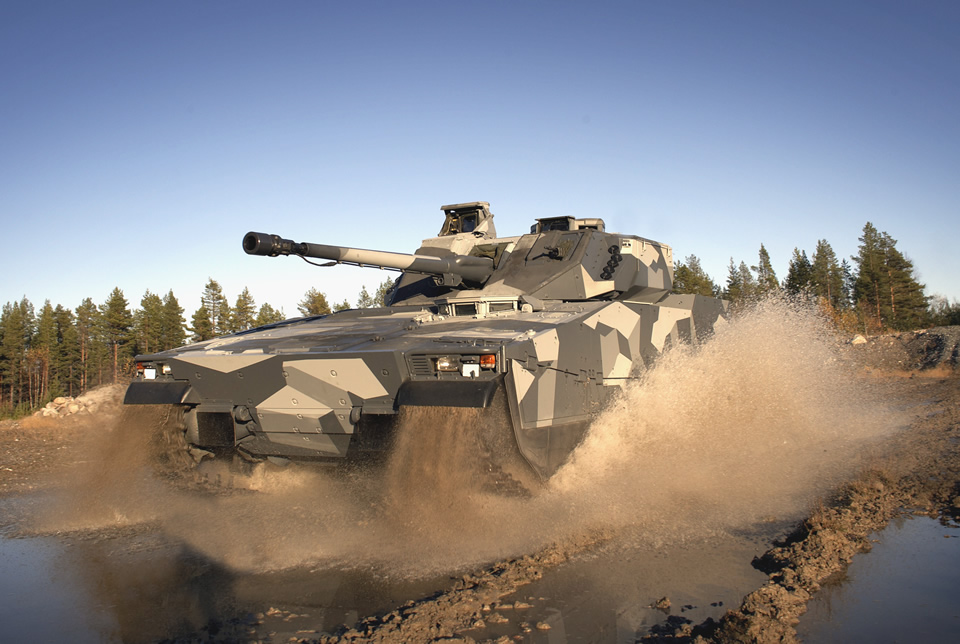
The latest-generation CV90, a multi-role vehicle, features a wide range of enhancements from earlier models. Among these developments are significantly enhanced protection, survivability, situational awareness, intelligence and interoperability, incorporating lessons learned from operations in Afghanistan by Norwegian and other forces. (Photo: BAE Systems)
BAE Systems is offering this latest modernized version of the CV9030. Photo: BAE Systems
Updated June 22, 2012: The Norwegian Government awarded BAE Systems a contract worth over US$750 million (£500 M.) for the upgrading and manufacturing of 144 CV90 armored combat vehicles for the Norwegian Army. This number will include the upgrading of all 103 CV9030s, currently operational with the Norwegian Army since the mid 1990s, and the production of 41 new chassis, bringing all future Norwegian CV90s to a common configuration by 2017.
The Norwegian Defense Logistics Organization (NDLO) stated the program’s budget is about US$1 billion, about two thirds of a $1.6 billion allocated for the program, the difference will be allocated for the provision of Government Furnished Equipment (GFE) including remote controlled weapon stations (RWS), unmanned air and ground vehicles (UAV/UGV), spare parts, training and communication.
“This is one of the largest investments ever made in the Army. Delivery will take place between 2015 and 2017, and forms an important part of our overall modernization efforts and will provide the Armed Forces and the Army with the capabilities they need to carry out future operations both domestically and internationally.” says Rear Admiral Morten Jacobsen of the NDLO.
The vehicles will be delivered in different configurations, the most common will be 74 infantry fighting vehicles providing protected transport for the two mechanized battalions of the Norwegian Army. Among other variants to be built are 21 new reconnaissance vehicles, to be equipped with a sensor suite for improved surveillance capability.
The new CV90 fleet is therefore intended to replace some of the existing M113 vehicles in support roles. These platforms will include 15 command vehicles, 16 engineering specialist vehicles and 16 multi-role platforms that will be able to fulfill different functions, including mortar carrier and logistics transport. Two vehicles will be used for driver training. Delivery of all vehicles is expected to complete within five years (2017).
Incorporating lessons learned from Norwegian operations in Afghanistan, the new vehicle fleet will have significantly enhanced protection, survivability, situational awareness, intelligence and interoperability. “We have had a long and excellent experience with CV90, and have built up considerable expertise about the system, which we have chosen to further develop together with our supplier in Sweden,” said Petter Jansen, managing director at the Norwegian Defence Logistics Organisation. “This is one of the largest Army investments and an important part of the Norwegian Army modernization plan.”
The Norwegian group Kongsberg is the leading domestic partner in the program, leading an industry team that also include Thales Norway and Vinghøg. The team is responsible for the Integrated Combat Solution to the Norwegian CV90. According to Kongsberg, the system will be based on open standards for connectivity and integration of sensors, weapons, communication networks and security systems. The system increases crew situational awareness and ability to operate swiftly and efficiently. As part of the current upgrade Kongsberg was awarded about US$68 million contract for the supply of the CV90 combat systems. The Norwegian Army’s upgrade program of the CV90 also includes installations of Kongsberg’s Protector Remote Weapon Stations (RWS) on all vehicles. The RWS will be delivered through the PROTECTOR “Nordic” contract, awarded separately by the Norwegian defense ministry in December 2011. Under these contracts valued about US$78 million, the company will develop and produce some Protector RWS in a common configuration, to be adapted for CV90s in service with the armies of Norway and Sweden. The total value of the production lots for both countries could reach US$160 million over several years.
The Swedish CV90 has been selected by the Nordic nations (Norway, Sweden, Denmark and Finland), Switzerland and The Netherlands. The first CV90 was delivered to Sweden in 1993, and this program will increase the number of vehicles ordered to more than 1,200.
The latest-generation CV90, a multi-role vehicle, features a wide range of enhancements from earlier models. Among these developments are significantly enhanced protection, survivability, situational awareness, intelligence and interoperability, incorporating lessons learned from operations in Afghanistan by Norwegian and other forces. (Photo: BAE Systems)
Lockheed Martin Skunk Works® and XTEND have achieved a major milestone in JADC2 by integrating the XOS operating system with the MDCX™ autonomy platform. This technical breakthrough enables a single operator to simultaneously command multiple drone classes, eliminating the friction of mission handoffs. From "marsupial" drone deployments to operating in GPS-denied environments, explore how this collaboration is abbreviating the data-to-decision timeline and redefining autonomous mission execution.
As traditional defense primes face mounting competition from agile “neoprimes” such as Anduril, Palantir and Helsing, the balance of innovation is shifting toward software-defined warfare and scalable, dual-use technologies, while global industry consolidation—marked by Boeing’s integration of Spirit AeroSystems and other strategic mergers—signals an intensified race to secure control over the defense technology value chain. Our Defense-Tech weekly report highlights these trends.
In early October 2025, a coordinated wave of unmanned aerial system (UAS) incursions—widely attributed to Russia—targeted critical infrastructure across at least ten European nations. The unprecedented campaign exposed the fragility of Europe’s air defenses...
Executive Summary
The past week (September 18-25, 2025) represents an inflection point where strategic defense concepts have transitioned from doctrine to tangible reality. An analysis of global events reveals four primary, interconnected trends shaping an...
At the 2025 Air, Space & Cyber Conference, U.S. Air Force and Space Force leaders unveiled major updates on next-generation fighters, bombers, unmanned systems, and space initiatives, highlighting both rapid innovation and critical readiness challenges as the services race to outpace global competitors. A short version is available here, with a more detailed version for subscribers.
The Taipei Aerospace & Defense Technology Exhibition (TADTE) 2025 crystallized around four dominant strategic themes that collectively illustrate Taiwan's comprehensive approach to defense modernization amid escalating regional tensions. Based on a detailed report by Pleronix (available upon request). Includes a Podcast discussion on TADTE 2025's highlighting Taiwan's four strategic themes beyond the post's coverage.
Israel’s Iron Beam 450 high-power laser system has completed final testing, marking a major leap in air defense. Developed by Rafael, it offers precise, cost-effective interception of rockets, UAVs, and mortars, and is set for IDF deployment by 2025.