The Pentagon’s Missile Defense Agency (MDA) Lockheed Martin (NYSE: LMT) has received a production contract totaling $789.8 million For launch units and interceptors destined for Terminal High Altitude Area Defense (THAAD) Batteries 3 and 4 for the U.S. Army. The two units are expected to be fully equipped in 2013.
The contract covers the production of 48 THAAD interceptors, six THAAD launchers, four fire control units and additional support equipment for a total of $694.9 million. An option for additional launchers in the amount of $94.8 million was also included, bringing the total award to $789.8 million. Two THAAD batteries have been activated at Fort Bliss, Texas. The first (A-4 ADA Battery) was activated in May 2008 and the second (A-2 ADA Battery) activated October 2009. Unit training for this Battery began earlier this year.
The contract for the delivery of the first two U.S. Army Batteries was awarded to Lockheed Martin in late 2006. Since 2005, the THAAD development program has completed 11 flight tests, with seven intercepts in seven attempts. THAAD is the only missile defense system with the operational flexibility to intercept in both the endo- and exo-atmospheres to provide versatile capability to the warfighter.
The Missile Defense Agency has added $321 million to fund the manufacturing of 24 Standard Missile-3 Block IB missiles over the next 27 months. In parallel, the agency trimmed a parallel production contract related to the current Standard Missile-3 Block 1A, reducing production from 24 to 18, to be completed within a year (by April 2012). In total, the Block 1B program received $321 million while the Block 1A funding was reduced by $72 million to $157 million. These funding plans reflect a unit cost of $8.7 million per missile on the remaining Block 1A, down from 9.7 million in 2008. The Block 1B cost per round is significantly higher, at $13 million per round, reflecting the more complex seeker, and lower production volume. The current producion lot for the Block 1A is due to complete inext year. It was awarded in 2008 with $1.015 billion fundingd for the production of 102 missiles for the U.S. and Japanese navies.
Tichonderoga class missile cruiser CG 67 Shiloh fires a Standard Missile 3 on a missile defense test. Photo: US NavyRaytheon Standard-Missile 3 Planned Variants. Source: BMD
Both missiles are part of the U.S. Navy AEGIS BMD ballistic missile defense capability. Raytheon is developing SM-3 as part of the Missile Defense Agency’s Aegis Ballistic Missile Defense System, and more than 130 SM-3s have been delivered to date. The missiles are deployed with both the U.S. and Japanese navies to defend against short- to intermediate-range ballistic missile threats in the ascent and midcourse phases of flight.
Raytheon’s next-generation SM-3 Block IB maintains the reliability of the Block IA variant while incorporating an advanced two-color infrared seeker, an advanced signal processor and a new Throttleabl Divert and Attitude Control System (TDACS). SM-3 Block IB will be deployed in both sea-based and land-based modes as part of phase two of the current administration’s Phased Adaptive Approach for missile defense.
The Block 1B is currently maturing; earlier in 2011 Raytheon Company and Aerojet, a GenCorp company, completed a kinetic warhead system integration test for Standard Missile-3 Block IB. The test verified the ability of the warhead to detect, track and intercept a moving ballistic missile target in a zero-gravity environment.
During the test, a fully operational, flight-weight kinetic warhead operated on an air-bearing test stand and performed in a high-altitude chamber at Aerojet’s Sacramento, Calif., facility. The kinetic warhead’s seeker tracked a simulated target while the guidance computer sent information to the new Throttleable Divert and Attitude Control System. Once the TDACS received the information, the system fired its divert and attitude control thrusters and maintained aim on the target during the entire test sequence, simulating an actual flight mission.
“The test demonstrated the fire control loop of the kinetic warhead on the ground, which is a key indicator that we’re on track for the first SM-3 Block IB intercept in space this year,” said Frank Wyatt, vice president of Raytheon’s Air and Missile Defense Systems product line, indicating the program is on track to deliver this critical capability to the fleet in 2012.
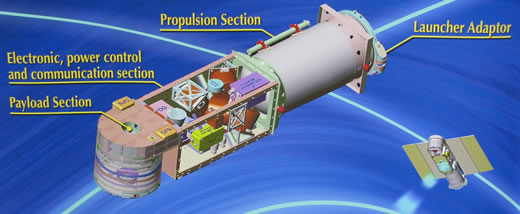
RAFAEL is offering the LiteSat, a micro-satellite weighing less than 100 kg to be used for 'Responsive Space Operations' by deploying reconnaissance satellites by airborne or ground launched satellites on missions supporting operational requirements on quick notice. Drawing: Rafaelf
Rafael Advanced Defense Systems is developing a new micro-satellite concept optimized for future ‘responsive space’ operations, offering tactical users rapid access to high resolution satellite imagery, augmenting aerial recce obtained by aircraft and UAVs.
The core of the system is based on Rafael’s LiteSat design, a new micro-satellite platform designed for a maximum weight of 100kg, facilitating airborne launch methods. Leveraging on relatively low-cost airborne launch (from aircraft such as teh F-15) the concept calls for the deployment of several satellites in a constellation enabling high revisit frequency and rapid ‘Operationally Responsive Space’ deployment ORS.
RAFAEL’s LiteSat, a micro-satellite will weigh less than 100 kg to be used for ‘Responsive Space Operations’ by deploying reconnaissance satellites by airborne or ground launched satellites on missions supporting operational requirements on quick notice. Drawing: Rafael
The satellite is designed to operate in a Low earth Orbit (LEO) at an altitude of 300-350 km for missions lasting up to seven years. Rafael is planning to equip the LiteSat with an EO payload offering ‘sub-metric’ resolution, with the same mission management, image processing, enhancement and optimization handled by field deployable IMILITE imagery processing systems currently supporting aerial recce and UAV platforms.
The Litesat platform is designed with ultra-light structures manufactured by Rafael’s space qualified composite material labs. The company has also developed lightweight propulsion methods, based on cold gas and elctrical propulsion (HAL effect), facilitating long operation using minimal fuel storage.
Anatoly Perminov, head of the Russian Space Agency Roscosmos. Photo: Novosti
Anatoly Perminov, head of the Russian Space Agency Roscosmos. Photo: Novosti
Microsatellite technology developed by Israel’s aerospace and defense industries is one of several fields of interest to Russia Space s is one of the areas the Russians are interested in – said Anatoly Perminov, head of the Russian Space Agency Roscosmos headon a visit to Israel last week. “Bilateral cooperation in outer space was at the initial stage and involved efforts to establish contacts between Russian and Israeli companies in the rocket and space industry.” Perminov arrived in Israel to sign a cooperation agreement on the exploration and use of outer space.
The framework agreement is meant to foster joint research programs and other collaborations in areas like astrophysical and planetary research, space biology and medicine, navigational satellites and launching services and technology. It also outlines guidelines for cooperation in intellectual property and scientific exchanges. Israel has already embarked on similar agreements with the European Space Agency (ESA) and the space agencies of France and Italy.
Israeli-Russian cooperation in space has already taken place with several programs in recent years, including the launch of two EROS commercial reconnaissance satellites operated by Imagesat and three communications satellites. Israel’s satellite communications company Spacecom will also use a Russian built communications satellite Amos 5 to extend its services over the Middle East and Africa.
IAI and Rafael are both developing ‘mini’ and ‘micro’ satellites, the Mini satellites weighing around 250-300 kg each with ‘microsatellites’ weighing up to 100 kg each. Development of remote sensing for earth explorations using ‘advanced resolution’ imagery is also an area of interest for the Russians.
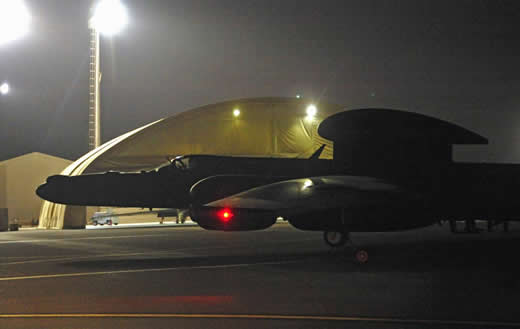
Maj. Patrick Hudson, 99th Expeditionary Reconnaissance Squadron, taxis a U-2 aircraft to a parking spot Aug. 24. Major Hudson completed his 1000th hour of flight in the U-2 aircraft. U.S. Air Force photo/Tech. Sgt. Charles Larkin Sr.
Goodrich Corp. is upgrading the two Senior Year Electro-Optical Reconnaissance Sensors (SYERS) currently used on U.S. Air Force Lockheed Martin U-2 ‘Dragon Lady’ platforms operated by the 9th Reconnaissance Wing. In addition to SYERS, the U-2 also carries a 30-inch Optical Bar Camera (OBC) and a 24-inch IRIS camera offering high resolution, panoramic imaging sensors and the Advanced Synthetic Aperture Radar System (ASARS-2) providing all-weather radar imaging capability.
Maj. Patrick Hudson, 99th Expeditionary Reconnaissance Squadron, taxis a U-2 aircraft to a parking spot Aug. 24. Major Hudson completed his 1000th hour of flight in the U-2 aircraft. U.S. Air Force photo/Tech. Sgt. Charles Larkin Sr.SYERS ISR EO Payload – Goodrich
Originally developed as a top-classified ‘black’ program SYERS but with the declassification of the U-2 program, this sensor was also declassified. The original SYERS used the DB-110 EO system (currently configured in tactical recce pods). The DB-110 platform provides the rotating nose section which aims the sensor’s line of sight at the required area of interest, enabling automatic scan using automatically scan methods, including continuous, push broom, or still-frame.
The original dual-band SYERS sensor flown on the U-2 ISR platform was manufactured by Goodrich ISR Systems. The SYERS sensor flown on the U-2 ISR platform was manufactured by Goodrich ISR Systems. The upgraded sensors, designated SYERS-2A, will enhance U-2 functionality by adding additional multi-spectral imaging capability to the platform, providing more utility in discerning imagery. Multi-spectral sensors capture images at specific frequencies across the electromagnetic spectrum enhancing the sensor’s capability to obtain high resolution imagery under adverse weather conditions of haze and light fog. Multi-spectral enhanced images provided by the payload are used for targeting, threat analysis, and situational assessment, by evaluating changes in images taken in different times, showing differences not readily apparent to the human eye.
The current SYERS-2 system collects imagery in seven wavelength bands simultaneously (green, red, near Infra-Red (IR – visible), two short-wave IR and a mid-wave IR band), all are transmitted to a ground exploitation system and viewed in real-time. Imagery analysts combine the separate spectral bands in different combinations in order to highlight the characteristics of different objects. This spectral collection capability enables a variety of enhanced imagery information outputs including false color composites, optical moving target indication, providing optical data supporting Measurement And Signature INTelligence (MASINT).
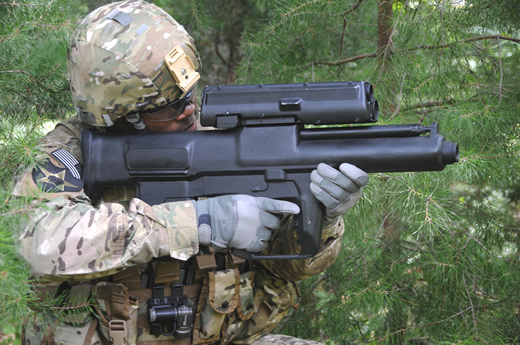
Several prototypes of the XM25 Counter Defilade Target Engagement (CDTE) weapon Systems were recently deployed to Afghanistan for operational evaluation with combat units. Production weapons could be fielded by 2014. Photo: US Army PEO SOldeir
ATK won a $65.8 million contract for engineering and manufacturing development (EMD) of the XM25, an Individual Semi-Automatic Airburst System.
The current 30-month contract funds the continued design, integration, production, and testing of the systems. ATK is the prime contractor, systems integrator and ammunition provider for the XM25 program. Program partners include Heckler & Koch delivering the weapon and L-3 Brashear providing the integrated fire control system, comprising thermal capability with direct-view optics, laser rangefinder, compass, fuze-setter, ballistic computer, laser pointer, and illuminator. The XM25 consists of a rifle that fires a 25-millimeter airbursting round programmed by the weapon’s integrated target acquisition and fire control system to detonate directly above an intended target.
Several prototypes of the XM25 Counter Defilade Target Engagement (CDTE) weapon Systems were recently deployed to Afghanistan for operational evaluation with combat units. Production weapons could be fielded by 2014. Photo: US Army PEO SOldeir
The Army is currently conducting a forward operational assessment, which began in Nov. 2010, with pre-production prototype weapons equipping troops in Afghanistan. The weapons are actively carried on patrols and in various combat outposts in areas that are experiencing high levels of enemy activity. Soldier feedback from this assessment will assist future decisions regarding budget, tactics, basis of issue, and improvements soldiers want to see in the weapon’s fielded version.
EADS is offering technology licensing associated with the company’s patented Vacuum Assisted Process (VAP), including a preform manufacturing machine that is highly automated and self-adaptable. VAP provides an optimized out-of-autoclave manufacturing process the makes the production of large, lightweight parts more cost effective and provides high quality finished products.
Other technologies offered by EADS include production methods for single and multi-layer preforms using tailored fibre placement. The company unveiled the licensing initiative this week at the s JEC Composites 2011 exposition in Paris. The company offer licensees the experience and support of experts from across the company, providing expertise and lessons learned in composites production. The first such forum meeting will be held during the second half of 2011 with Airbus in Toulouse, France.
Adm. James G. Sravridis, US Navy, NATO Supreme Allied Commander Europe
U.S. Navy and Air Force units operating with Joint Task Force’ Odyssey Dawn’ fired at Libyan Navy and Coast Guards boats at the Bay of Misrata on Monday, Gaddafi’s loyalists were fighting rebels at the area. On Monday, U.S. Navy P-3C Orion maritime surveillance aircraft fired Maverick AGM-65F air-to-surface missiles at a Libyan patrol craft, after the 12-meter Libyan boat Vittoria was suspected of attacking merchant vessels in the port city of Misrata. An Air Force A-10 Thunderbolt II fired at two smaller craft, destroying one and forcing the crew to abandon the other vessel. The Navy said the strike was prompted by “confirmed reports that Vittoria and accompanying craft were firing indiscriminately at merchant vessels” near Misrata. The engagement was managed from the USS Barry DDG-52 Guided Missile Destroyer which handled maritime and air traffic control in the area.
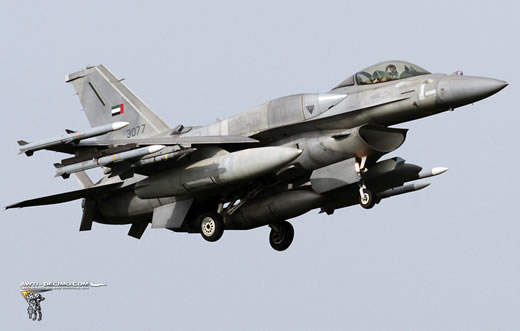
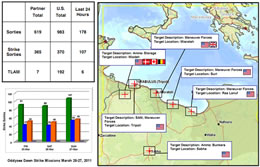
This UAE F-16 Block 60 'Desert Eagle' or 1st Shaheen Squadron is part of a 12 aircraft UAE Air Force detachment deployed to Decimomannu Air Base in Sardinia, Italy. The F-16s arrived with Mirage-20009EAD fighters. It is seen here on arrival, carrying full load of four AMRAAM missiles, two Sidewinders, three external fuel tanks and Sniper Advanced Targeting Pod. Photo: Massimo PieranunziStrike missions flown by coalition air forces and cruise missiles over Libya March 25-27, 2011. Source: Pentagon Briefing
In an effort to decimate Moamar Gaddafi’s staying power, Coalition forces aimed launched their attacks yesterday on known ammunition storage sites near Tripoli. The Barry launched 22 Tomahawk cruise missiles at weapon-storage sites near the Libyan capital, believed to store surface-to-surface rockets and missiles. Coalition strike fighters have also struck at ammunition-storage depots and other military targets in western Libya. The attack came after the rebel’s advance westward crumbled as their advancing forces encountered effective military opposition by Gaddafi loyalist forces defending the ruler’s home town Sirte.
Adm. James G. Stavridis, USN. Commander, U.S. European Command and NATO Supreme Allied Commander Europe
The notion that the rebels had ties to al-Qaida surfaced again Tuesday (March 29) as NATO Supreme Allied Commander Europe Adm. James G. Stavridis admitted in briefing at the U.S. Senate Armed Services Committee some “flickers” of intelligence indicated the presence of al-Qaida and Hezbollah members among the rebels. However, Stavridis said he didn’t have enough intelligence to say al-Qaida had a “significant” presence in the Libyan opposition.
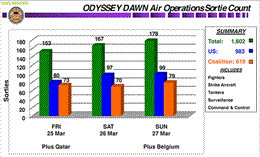
The Pentagon said there were 119 strikes on Monday, up from 107 on Sunday and 88 on Saturday. Overall the U.S. have fired 214 Tomahawk missiles since March 19. The coalition carried out 1,802 sorties, at an average of 200 per day.
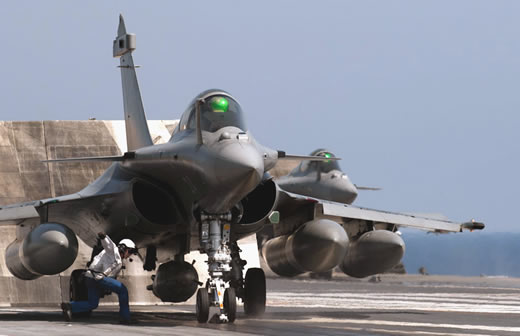
This Rafale F3 about to be launched on a mission from the French Carrier Charles DeGaulle, carries five fuel tanks performing aerial refuelling support for other carreir based aircraft operating over Libya. Photo: EMA, French NavySorties flown by coalition air forces over Libya, March 25-27, 2011. Source: Pentagon Briefing
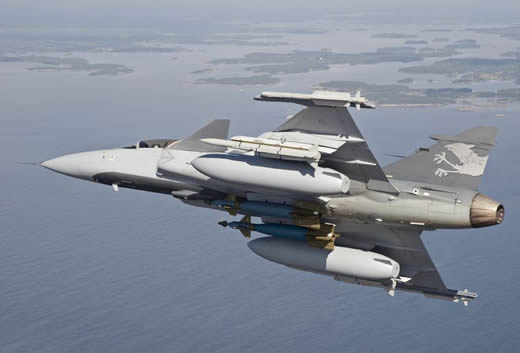
Enforcing a no-fly zone over Libya requires four sorties by NATO aircraft in the past 24 hours, four no-fly zone sorties were flown by Canada and Spain, using F-18 fighters. Other nations participating in this mission include France, U.K., Qatar, UAE and Denmark flying F-16s, Typhoon, Mirage 2000-5 and Rafale. Sweden could be joining the operation soon, with eight Gripen fighters.
The Swedish government is expected to approve the mission on Friday, following a formal request from NATO. Sweden is leading the ‘Nordic Battlegroup’ rapid reaction force, to which the F17 fighter squadron at Kallinge is assigned. Sweden has not sent its aircraft to a war zone in over 50 years, the last time Swedish air force fighters were involved in combat operations was in 1961 when nine J-29 Tunnan fighters operated under the U.N. peacekeeping force in Congo flown by volunteer pilots. This time, a detachment including eight Gripens, a C-130 transport plane, reconnaissance support, and 130 personnel including 10 pilots, command and control, operations, intelligence, technical support and security personnel. The Swedish detachment will operate from Sigonella in Sicily or Suda in Crete.
Gripen showing a new multi-mission weapon configuration comprising two 450 gal. fuel tanks, two Meteor (BVR) and two IRST (short range) air/air missiles, plus two laser guided bombs. The Swedish Government is planning to deploy eight Gripens to Italy or Greece to support the operation in Libya. Photo: Saab
Sofar the U.S. military intervention in Libya has cost the United States “about $550 million” in extra spending, Cmdr. Kathleen Kesler, a Defense Department spokeswoman said yesterday, providing the first official estimate of the mission’s price tag. She added that future costs are expected to run about $40 million over the next three weeks as the U.S. military scales back its activity in the operation. Almost 60 percent of the total cost has been for munitions, the most expensive of which are Tomahawk missiles, which cost more than $1 million each.
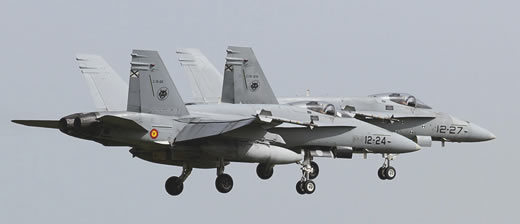
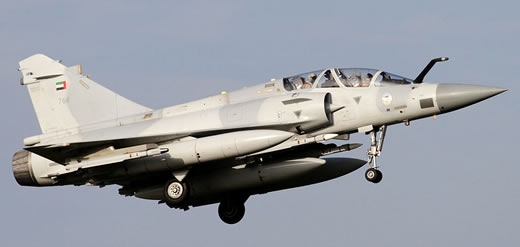
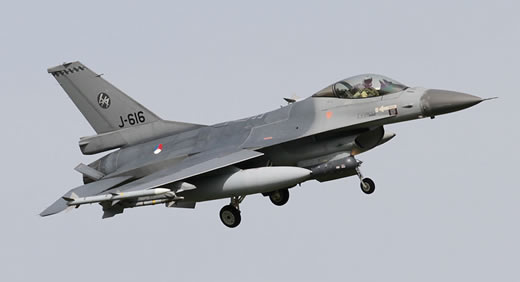
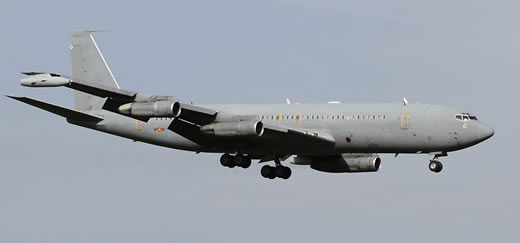
A pair of Spanish Air Force F/A-18 C landing at Decimomannu airbase in Sardinia, Italy. The aircraft carry Sidewinder short range AAM and Sparrow medium range BVR missiles, and Reccelite reconnaissance pods. Photo: Massimo Pieranunzi Two-seater Mirage 2000-9EAD of the UAE Air Force arriving at teh Decimomannu airbase in Sardinia. The aircraft deployed with full armmament load comprising IR and radar (active) guided MICA air/air missiles. Photo: Massimo PieranunziDutch RNLAF F-16A MLU on final approach to Decimomannu, Sardinia. This aircraft is equipped for combat patrol and recce mission, carrying Sidewinder, AMRAAM and Reccelite recce pod. Photo: Massimo PieranunziSpain sent five aircraft on March 22, including four F-18's and a Boeing 707 tanker to participated in the current military operation over Libya. The Boeing 707 tanker is shown here with one of two pylons containing the fuelk drough mounted near the wingtip. Photo: Massimo Pieranunzi
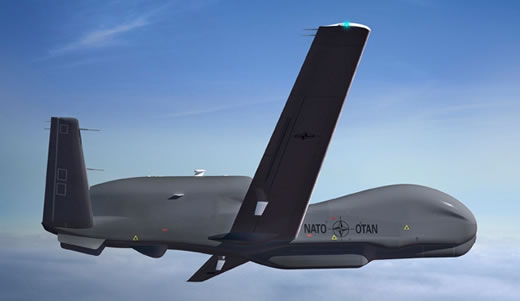
An artist concept showing the Global Hawk RQ-4B Block 40 configured for the NATO AGS core capability. Photo: Northrop Grumman
Northrop Grumman Corporation submitted its final proposal for the NATO Alliance Ground Surveillance (AGS) core capability. NATO AGS system will employ an air segment consisting of six Northrop Grumman Block 40 Global Hawks specially missionized to provide persistent intelligence, surveillance and reconnaissance to ground, maritime and air commanders, anytime and anywhere in the world. These Global hawks will be equipped with Northrop Grumman’s Multi-Platform Radar Technology Insertion Program (MP-RTIP) ground surveillance radar sensor, which will be capable of detecting and tracking moving objects throughout the observed areas, as well as providing radar imagery of target locations and stationary objects.
An artist concept showing the Global Hawk RQ-4B Block 40 configured for the NATO AGS core capability. Photo: Northrop Grumman
The primary ground segment component will consist of a number of ground stations in different configurations, such as mobile and transportable configurations, which will provide data link connectivity, data processing and exploitation capabilities, and interfaces for interoperability with Command, Control Intelligence, Surveillance and Reconnaissance(C2ISR) systems. The AGS Core ground segment will also include dedicated mission support facilities at the AGS Main Operating Bases (MOB), and ground stations for flight control of the UAVs. The Main Operating Base will be located at Sigonella Air Base, Italy. The Core system will be supplemented by interoperable national airborne stand-off ground surveillance systems from NATO countries, thus forming a system of systems.
NATO AGS program was approved by European heads of state and government as a priority capability initiative at the 2010 Lisbon Summit. In support of the new strategic concept, system will establish a network-enabled sensor system, supporting interoperability with national systems in support of all possible missions, including force protection, border and maritime security, counter- and anti-terrorism, crisis management, peacekeeping and enforcement, and natural disaster relief.
The current proposal is based on refinements introduced by the team to meet NATO requirements. “Our updated proposal offers an affordable, executable program that will provide an operationally relevant system to the Alliance,” said Pat McMahon, sector vice president of Northrop Grumman Aerospace Systems’ Battle Management & Engagement Systems Division. Northrop Grumman is expecting contract award by July 2011.
NATO embarked on the AGS program in 1995, when the NATO Defence Ministers agreed to develop a pooled NATO asset, consisting of both manned and unmanned platforms, as well as ground control stations in various configurations. The manned platform was to be based on the Airbus A321 commercial airliner, and the unmanned platform on the Global Hawk high altitude long endurance UAV. Both the manned and unmanned platforms were to carry the Transatlantic Cooperative AGS Radar (TCAR). In November 2007, however, due to declining European defense budgets, NATO chose to move forward with a UAV-only solution based on the Global Hawk RQ-4B and the multi-platform radar technology insertion program (MP-RTIP). With this revision, the number of cooperating nations was reduced from 24 to 14.
NATO AGS is the first international sale of the Block 40 Global Hawk. The ground element, which provides real-time data, intelligence and target identification to commanders within and beyond line of sight, will be wholly produced by the team’s European industry partners, offering the potential for national re-use in other programs as well as direct work in the program for the participating nations. Northrop Grumman is the prime contractor for the program, leading a team which includes companies from each of nations participating in the acquisition.
The program is managed by NATO Alliance Ground Surveillance Management Agency (NAGSMA) and being implemented by the AGS Implementation Office (AGS IO) at Supreme Headquarters Allied Powers Europe (SHAPE). The agency was established in September 2009 after all participating nations signed the AGS Program Memorandum of Understanding. NAGSMA, was chartered to acquire the NATO-owned and operated core capability, and is responsible for the procurement of the NATO AGS capability until it has reached full operational capability at the NATO AGS main operating base in Italy.
A two-shot launcher developed for the South Korean Active Protection System (APS) protecting the K-2 main battle tank. Photo: South Korea Agency for Defense Development (ADD)
A two-shot launcher developed for the South Korean Active Protection System (APS) protecting the K-2 main battle tank. Photo: South Korea Agency for Defense Development (ADD)
South Korea is developing an Active Protection System (APS) for the K-2 tank augmenting the tank’s protection against anti-tank rockets and missiles. The system uses dual sensor detection and tracking system comprising a 3D radar and infrared system, control computer and countermeasure launchers firing specially designed rockets. According to Korean officials the system’s response rate is about 0.2 to 0.3 second from target detection, through to the interception.
The South Korean Agency for Defense Development (ADD) unveiled the system which has been under development since 2006, at a defense and technology exhibition held by the U.S. Pacific Command in Hawaii earlier this month. According to ADD the development of the new system was $36 million. The development is scheduled to be completed next year.
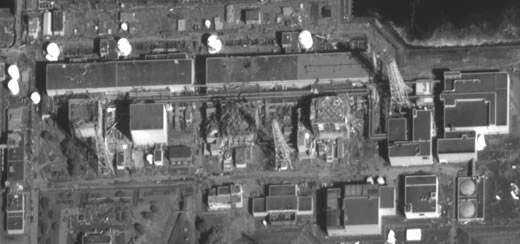
This image of the Japan's Fukushima nuclear power station was taken on March 26 by the Israeli Eros B satellite, after all personnel were evacuated from the area as radiation levels spiked 10,000 times higher than the average at the site, as the #2 reactor was undergoing partial meltdown. Later it was announced that the high reading was taken by error. Photo: Imagesat
Fires, explosions and radiation leaks have repeatedly forced Japanese rescue workers at the nuclear power plant to suspend work, including on Sunday when radiation levels spiked to 100,000 times above normal in water inside reactor No. 2 at the Tokyo Electric Power Co (TEPCO) plant. A partial meltdown of fuel rods inside the reactor vessel was responsible for the high levels of radiation at reactor No. 2, but the radiation had mainly been contained in the reactor building. Following the spike in radiation over the weekend, the reactor cores appeared to be cooling down. The plan now is to dry out the plant, get power restored and start cooling it down.]
A satellite image of the Fukushima 3 and 4 nuclear power plant units, taken March 18, 2011, showing the damaged reactor buildings. Photo: Digitalglobe.Another image of Fukushima #2 reactor, taken by Eros B on March 26,, showing a close-up view of the damaged site. Photo: ImagesatThis image of the Japan's Fukushima nuclear power station was taken on March 26 by the Israeli Eros B satellite, after all personnel were evacuated from the area as radiation levels spiked 10,000 times higher than the average at the site, as the #2 reactor was undergoing partial meltdown. Later it was announced that the high reading was taken by error. Photo: Imagesat
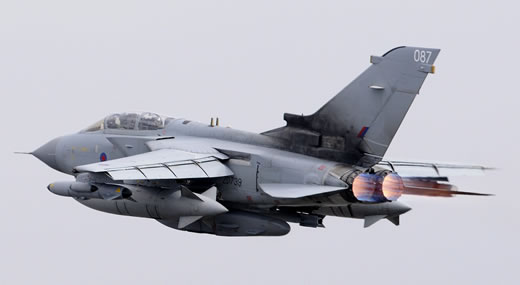
RAF Tornado GR4 and Typhoon fighters are currently deployed in Italy, operating from the forward base here. Photo: MOD, Crown Copyright
The UN mandated operation against Libya has evolved in recent days into three parallel efforts – the enforcement of the ‘no fly zone’ over the country, ground attacks supporting and stimulating a rebel campaign repelling Gaddafi supporters, and a ‘drying’ Gaddafi’s military sustainment by enforcing a naval blockade, preventing reinforcements, weapons and ammunition shipments from reaching Libyan ports. In recent days NATO agreed to take over the enforcement of the No Fly Zone and UN mandated naval blockade under ‘Operation Unified Protector’, enforcing an arms embargo on Libya, an effort aiming to prevent arms being delivered to Libya from the Mediterranean. Canadian air force Lt. Gen. Charles Bouchard was assigned lead the operation. The NATO alliance is expected to take control of the operation by March 30.
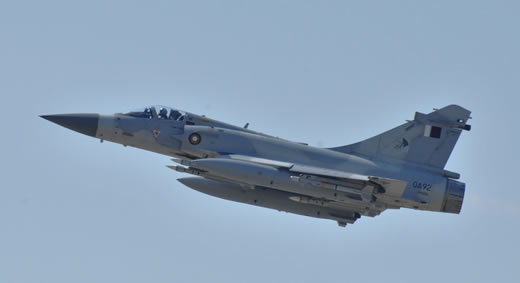
A Qatar Emiri Air Force Dassault Mirage 2000-5 fighter jet takes off as part of a Joint Task Force Odyssey Dawn mission, Souda Bay, Crete (Greece), March 25, 2011. French and Qatari Air Forces Mirage 2000-5 fighters are operating from the Souda Bay, flying joint air combat patrols and interdiction missions over Libya. The first Qatar Air Force Mirage detachment arrived here last week with additional four Mirage 2000-5 deployed over the weekend. In total six Qatari Mirages have been deployed, marking the first participation of Arab League member in the coalition against Libya. Photo: U.S. Navy, by Paul Farley
Under ‘Unified protector’, NATO maritime forces will conduct operations to monitor, report and, if needed, interdict vessels suspected of carrying illegal arms or mercenaries. This will be done in close co-ordination with commercial shipping and regional organizations. The blockade could potentially assist in reducing the flow of illegal immigrants reaching accross the Mediterranean from Libya to Southern Italy. The flow of immigrants is expected to increase after the fall of the former regime. Since Thursday, coalition raids appear to have intensified and became more effective.
Rebel sources claim that after Libyan Army officers who joined the rebellion established contact with the coalition, improving coordination of support operations. Backed by the coalition support, Libyan rebels continued their rapid advance west, have captured today (March 27) the oil terminals of Ras Lanuf, about 210 km west of the city of Ajdabiya, which fell to the ebels a day earlier. The next objective on the rebels advance is Sirte, Gaddafi’s home-town stronghold. Coalition air forces has conducted extensive raids on the coastal road between Ajdabiya and Sirte.
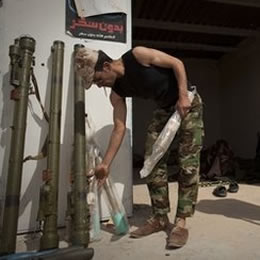
Libyan SA-7 man portable air defense missiles (MANPADS) siezed by rebels at Ras Lanouf 27 March, 2011. Many such missiles are believed to have fallen to the hands of Al-Qaeda in the Maghreb terror organization. Photo: AP via Yahoo
Rebels are not the only element celebrating on the chaos in Libya. Islamist elements affiliated with al-Qaeda in the Maghreb (AQIM) seized Libyan Army weapons stockpiles abandoned near Benghazi and other areas taken by Libyan rebels to obtain weapons they did not have access to in the past.
According to a report in Jeune Afrique, quoting Chad’s President Idriss Deby Itno. The magazine quotes the president as “100 per cent sure” of his assertion. He said the weapons, including man-portable surface-to-air missiles (MANPADS) were smuggled into AQIM sanctuaries in Tenere, a desert region of the Sahara that stretches from northeast Niger to western Chad. The extremist Islamic movement operates mainly in Algeria, Mauritania, Mali and Niger, where it has attacked military targets and taken civilian hostages, particularly Europeans, some of whom it has killed. Col. Gaddafi accused AQIM to be the driving force behind the rebelion.
On March 19, 2011, following UN Security Council resolution 1973 the U.S. led coalition started out small, but quickly established the no-fly zone, obtained maritime superiority, put the embargo in place, interdicted ground forces, suppressed enemy air defenses and put humanitarian operations in place. In the recent days, the operation evolved a series of strike campaign against the Libyan ground forces. “This is a multi-phased operation. Our coalition partners are assuming more and more responsibility.” Navy Rear Adm. Gerard P. Hueber said.
Libyan forces have not used surface-to-air missiles in four days, he added. The airstrikes have rendered Libya’s air defense ‘severely degraded or destroyed’ the admiral said. In the planning, Libyan air force and air defenses were not taken easy. U.S. Navy Chief of Operations, Adm. Gary Roughead said he was particularly concerned about Moammar Gaddafi’s integrated air and missile defense system. Though the system was old, he said, “I don’t take any of that for granted. If someone is going to put a missile in the air, you don’t say, ‘Oh, it’s an old one, I’ll worry about it later.’”
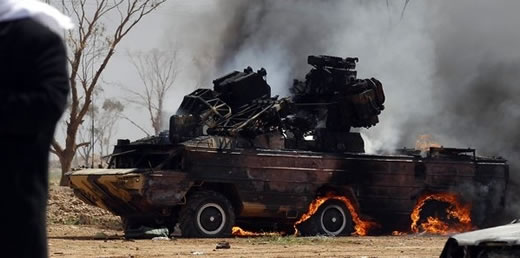
An SA-8 GECKO of the Libyan Armed Forces destroyed by coalition strike fighters near the city of Ajdabiya. Libyan Mobile Air defense remain the main risk to coalition air forces, after the integrated air defenses and air force fighters have been eliminated by the first waves of the attack.RAF Tornado GR4 and Typhoon fighters are currently deployed in Italy, operating from the forward base here. Photo: MOD, Crown Copyright
While Libyan air and air defense activity were taken down, forces loyal to Gaddafi continue to advance on Benghazi on Libya’s northeastern coast, and are not pulling back from Misurata on the northwestern coast and Ajdabiya, just south of Benghazi. “We are now applying sustained, unrelenting pressure on the Libyan Armed Forces.” Said RAF Commander of the air operations over Libya, Air Vice-Marshal Greg Bagwell. “Their air force no longer exists as a fighting force, and its integrated air defense system and command and control networks are severely degraded to the point that we can operate over [Libyan] airspace with impunity.” Bagwell continued, “We have the Libyan ground forces under constant observation, and we attack them whenever they threaten or attack civilians or population centers.”
With the arrival on Monday night (March 21) of the RAF Tornado GR4 jets at Gioia del Colle air base, all UK fast jets currently assigned to Operation Ellamy were in place. The presence of the Tornados together with the Typhoon fighters means that the UK can strike both air and ground targets as required, as part of the co-ordinated international operation. Coalition air forces continue to pound Libyan ground. On the night of the 23-24 March ten aircraft of the Air Force and Navy were engaged in night strikes against Libyan forces grouped at the remote airfield Al-Jufra, 250 km south in Benghazi. The French fighters included two Mirage 2000D and two naval Rafales, they engaged their targets with SCALP cruise missiles. Tornado GR4s launched from Gioia del Colle that night engaged Libyan ground forces with Brimstone anti-tank guided missiles, destroying armored vehicles and artillery units near the city of Ajdabiya.
According to U.S. director of the Joint Staff Navy Vice Adm. William E. Gortney, other strikes went after Gadhafi regime armored forces outside Ajdabiyah. The coalition also hit more command and control facilities in and around Tripoli and launched 16 more Tomahawk strikes against targets that included Scud missile garrisons in Tripoli and air defense systems around Sabha. 96 of the 153 sorties flown in the past 24 hours were strike missions, “Slightly more than half of those strike missions were flown by U.S. pilots,” the admiral said.
Over the weekend (March 25) Qatari Air Force and UAE Air Forces deployed aircraft to join the coalition forces. Qatari Mirage 2000-5 joined the coalition air forces flying the no-fly zone enforcement missions. On Sunday (March 27) Twelve F-16s and Mirage 2000s from the UAE have landed at the Italian base of Decimomannu on the island of Sardinia.“Partner nations are taking on more missions, and the division of labor between U.S. and partner nations has evened out” admiral Gortney said. “As operations continue, the United States will fly most refueling, surveillance, information operations and jamming missions,” he added.
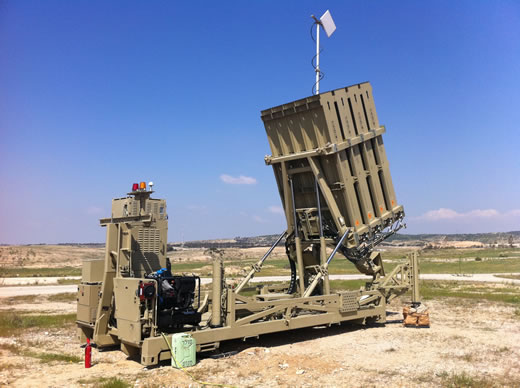
The first Iron Dome anti-rocket system, deployed on itsf first 'operational evaluation' near Beersheva in the Israeli Negev desert. Photo: Noam Eshel, Defense Update.,
Reluctant to embark on a major retaliatory campaign against Gaza, the Israel Air Force was directed to pre-deploy the ‘Iron Dome’ counter-rocket, artillery and mortar (C-RAM) defense system, despite the military reluctance for such move, before the unit is fully prepared. The current fielding is defined as an ‘operational evaluation’ prior to becoming ‘fully operational capable’.
The first Iron Dome anti-rocket system, deployed on itsf first 'operational evaluation' near Beer Sheva in the Israeli Negev desert. Photo: Noam Eshel, Defense Update.,
Israeli decision makers are aware that deploying this defensive capability could encourage Palestinian attempts to challenge the system, in an effort to demoralize the Israeli population (Similar to the Palestinian attempts to hit Israel’s hetherto ‘undefeated’ Merkava tanks in the Gaza strip in the early 2000s, which led to destroying three merkava tanks by Palestinian ‘mega IEDs’.) Prime minister netanyahu announced tha the defensive capability alone will not be sufficient and an effective defense requires a combination of offensive, defensive means maintaining effective deterrance, strength and resolve of the population and government’ However, if the Palestinians will cease their attacks at this point, the deployment could achieve its purpuse in stemming the current escalation without excessive use of force.
A Tamir interceptor about to hit a Grad-type rocket on one of the Iron Dome intercept test, January 2010. Photo: Rafael
The first ‘Iron Dome’ unit, one of two batteries operating with IAF 947 Battalion ‘Iron Dome’ was deployed in the outskirts of the Negev capital Beer Sheva; the second battery is said to be deployed near Ashkelon, north of Gaza.
Iron Dome was designed by Rafael Advanced Defense Systems, as a defensive short-range rocket interceptor, operating with extremely short response time. The system has selective target engagement capability, enabling the system to automatically engage targets posing significant risk while ignoring targets which are aimed to hit empty areas. The system relies on threat warning systems providing early warning for the civil population in the area. It also accurately localizes the launch point of all rockets and mortars fired, providing the IDF an accurate targeting data for counter-attack.
The first Iron Dome unit was fielded today at the outskirts of Beer Sheva protecting the Negev Capital. Photo: Noam Eshel, Defense-Update.
While Iron Dome has repeatedly demonstrated its capability in operational testing, the full system has not been fielded operationally yet, although elements of the network have been located in the area for evaluation.
Although the system was designed to cover a relatively wide area, the current deployment is not meant to provide a broad defense in the area, sites could be relocated often to match operational requirements. the Iron Dome battery comprises a radar, command, control and communications battle management module and remotely operated launch units, positioned at different locations to provide the best coverage of the defensed area.
The Israelis hesitated about deploying the system prior to possessing adequate quantities of systems, to prevent Palestinian challenging the system, by firing salvos of rockets thus rapidly escalating the situation which is quite fragile as is.
According to Brigadier General Doron Gavish, commander, Air Defense Forces, the active defense is a part of a new concept the air defense and the IDF is evaluating. “The first part of this concept is attacking capabilities, the second is alert capabilities. Obviously passive defense is very important, as well as the active defense phase. Gavish said the current ‘Iron Dome’ deployment is part of the comprehensive response in dealing with continuous ballistic rocket attacks, and an important part of its ‘active defense’ capability. ”We are accelerating this operational test in order to be ready as fast as we can with the first systems that will be deployed in the next few weeks.” Gavish said. In the recent tests conducted by the air defense forces last month the units themselves performed the firing and scored impressive results. “During these tests we were shooting against variety of threats, some of them represented those we saw lately being shot at Israel.”
“We are moving from testing and training on the system to evaluating the system operational conditions.” Gavish said. “The evaluation test taking place in the southern part of Israel began today and will last for several weeks” general Gavish said. The units will practice deployment at several sites, with movement between positions being part of the evaluation itself. Testing Iron Dome against real threats, in stressing combat conditions will place the unit, and the entire new C-RAM active-defense in the limelight of the media, political and in fact, the entire world.
Gavish tried to play down the role of this event in the current fragile situation with the Palestinians ”This evaluation test was planned anyhow. Because of what we saw in recent weeks we decided to accelerate this phases; from what we saw in testing, Iron Dome is a very capable system. But it is important to highlight that that for the next weeks we are still in the evaluation phase. This system is designed to defend Israel for next coming years as we build this capability, buy more fire units and enhance its capabilities in order to defend the Israeli population.”
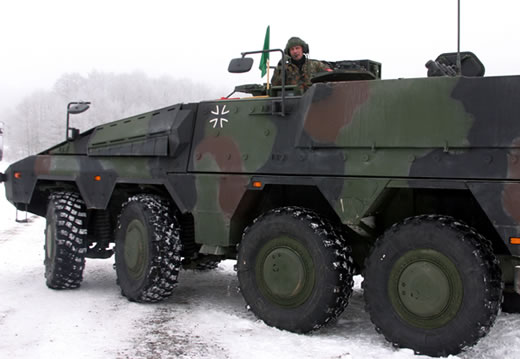
The Boxer's drive train features selectable differential locks and two steerable front axles. The tires are equipped with run flat, and with central tire inflating system adapting the tire pressure to optimally traverse difficult terrain (sand, snow, mud etc). Independent suspension allows both speeding on roads and high mobility off-road. Photo: German Army, Volker Jung.
The first Boxer armored personnel carriers (Gepanzertes Transport-Kraftfahrzeug – GTK) have arrived at Donaueschingen Germany in February 2011 to equip the 292 Jägerbattalion (light infantry battalion), in preparation for the unit’s deployment to Afghanistan by August this year. The battalion will dispatch a platoon with four vehicles to be deployed to Mazar-e-Sharif in Northern Afghanistan, as part of the German training and protection battalion. Last year the Boxer went through a successful operational evaluation in Australia, which paved the way for the deployment decision.
The first German Army unit equipped with Boxer armored vehicles is undergoing training prior to its first deployment in Afghanistan, this year. Photo: German Army, Volker Jung
According to infantry officers training with the vehicles, the first experience with the Boxer is positive with the vehicle described as ‘robust, impressive and offering a high level of protection and mobility’. Driver orientation courses are currently underway at the driver training school in Dornstadt, where seven Driver Training Vehicles (DTV) were received in 2010.
The 292 Jägerbattalion is receiving the infantry carries, each carrying seven troops in addition to three crew members – the driver, gunner and Commander. Eight of the vehicles have been delivered to the Infantry school to start the infantry training with the unit. The unit holds a daily evaluation of the training activities to further improve training, deliver operational feedback, and report technical and operational issues to the program office, vehicle developer and industry on technical problems.
Aninternal view of the Boxer, showing individual blast-protected seat for the crew, and operating consoles for the commander and gunner. Photo: German Army, Volker Jung,
The Boxer offers high level of safety and relative comfort to the occupants. Troops are seated in individual blast protected seats, while crew members are provided with adjustable blast protected seats designed for each position. An air conditioner which also supports Chemical, Biological and Radiological-Nuclear (CBRN) filtration is also provided. Water heater and toilet facility make a long stay in the vehicle more comfortable.
The power pack consists of a militarized MTU model 8V199 TE20 diesel developing 530 kW coupled with Allison model HD4070 fully automatic transmission with seven forward and three reverse gears, torque converter and an integrated cooling. The drive train features selectable differential locks and two steerable front axles. The tires are equipped with run flat, and with central tire inflating system adapting the tire pressure to optimally traverse difficult terrain (sand, snow, mud etc). Independent suspension allows both speeding on roads and high mobility off-road. The vehicle has a passive protection system comprising modular base armor and applique composite modules. The FLW 200 Remotely controlled light weapon station provides the primary weapon for the Boxer, controlled by the gunner from inside the vehicle. The station mounts a 12.7 or 40mm automatic grenade launcher.
The Boxer's drive train features selectable differential locks and two steerable front axles. The tires are equipped with run flat, and with central tire inflating system adapting the tire pressure to optimally traverse difficult terrain (sand, snow, mud etc). Independent suspension allows both speeding on roads and high mobility off-road. Photo: German Army, Volker Jung.
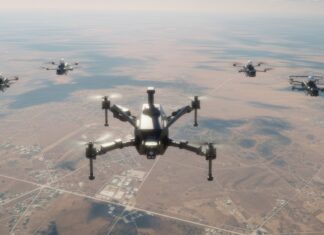
Lockheed Martin Skunk Works® and XTEND have achieved a major milestone in JADC2 by integrating the XOS operating system with the MDCX™ autonomy platform. This technical breakthrough enables a single operator to simultaneously command multiple drone classes, eliminating the friction of mission handoffs. From "marsupial" drone deployments to operating in GPS-denied environments, explore how this collaboration is abbreviating the data-to-decision timeline and redefining autonomous mission execution.
As traditional defense primes face mounting competition from agile “neoprimes” such as Anduril, Palantir and Helsing, the balance of innovation is shifting toward software-defined warfare and scalable, dual-use technologies, while global industry consolidation—marked by Boeing’s integration of Spirit AeroSystems and other strategic mergers—signals an intensified race to secure control over the defense technology value chain. Our Defense-Tech weekly report highlights these trends.
In early October 2025, a coordinated wave of unmanned aerial system (UAS) incursions—widely attributed to Russia—targeted critical infrastructure across at least ten European nations. The unprecedented campaign exposed the fragility of Europe’s air defenses...
Executive Summary
The past week (September 18-25, 2025) represents an inflection point where strategic defense concepts have transitioned from doctrine to tangible reality. An analysis of global events reveals four primary, interconnected trends shaping an...
At the 2025 Air, Space & Cyber Conference, U.S. Air Force and Space Force leaders unveiled major updates on next-generation fighters, bombers, unmanned systems, and space initiatives, highlighting both rapid innovation and critical readiness challenges as the services race to outpace global competitors. A short version is available here, with a more detailed version for subscribers.
The Taipei Aerospace & Defense Technology Exhibition (TADTE) 2025 crystallized around four dominant strategic themes that collectively illustrate Taiwan's comprehensive approach to defense modernization amid escalating regional tensions. Based on a detailed report by Pleronix (available upon request). Includes a Podcast discussion on TADTE 2025's highlighting Taiwan's four strategic themes beyond the post's coverage.
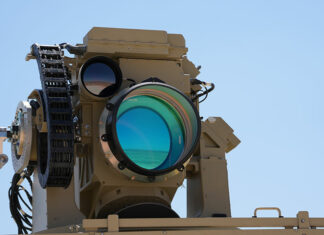
Israel’s Iron Beam 450 high-power laser system has completed final testing, marking a major leap in air defense. Developed by Rafael, it offers precise, cost-effective interception of rockets, UAVs, and mortars, and is set for IDF deployment by 2025.


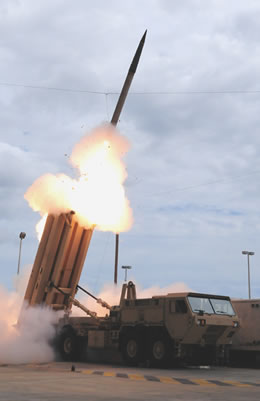
 The Pentagon’s Missile Defense Agency (MDA) Lockheed Martin (NYSE: LMT) has received a production contract totaling $789.8 million For launch units and interceptors destined for Terminal High Altitude Area Defense (THAAD) Batteries 3 and 4 for the U.S. Army. The two units are expected to be fully equipped in 2013.