Finland has selected Israel’s Advanced Naval Attack Missile to replace its current MTO85M system, a derivative of Swedish RBS15 that will reach the end of its life cycle in the 2020s. IAI’s Gabriel has beaten four other competitors evaluated by Finland’s MOD, including Kongsberg’s NSM, MBDA’s Exocet, Boeing’s Harpoon and Saab’s RBS15. The initial contract is worth EUR162 million, with an option worth EUR 193 million.
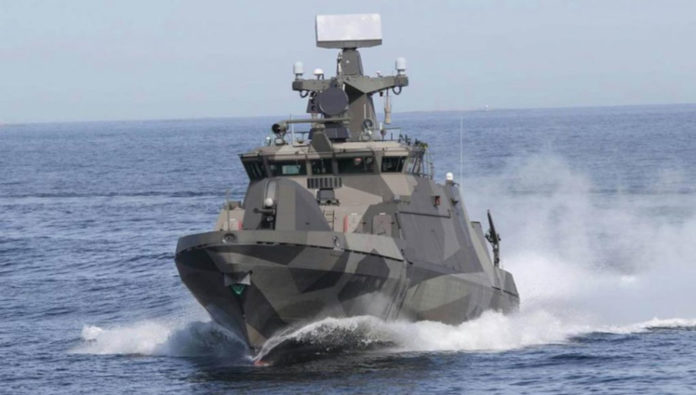
IAI Gabriel 5 Advanced Naval Attack Missile is heading to Finland next year, replacing RBS15 on the Hamina-class missile boats and future Squadron 2020 corvettes. Image: IAI
The selection of Israel’s Advanced Naval Attack Missile marks an important achievement for IAI, representing the first sale of such strategic system to a European Navy. Also known as Gabriel 5, the weapon is the latest member of a family of naval attack missiles developed by IAI. Little is known about the weapon, that is believed to be operational on Israel Navy missile boats and with some foreign navies.
With a size roughly as the American Harpoon and French Exocet, the Israeli missile covers longer ranges and can complete its mission even in a highly restrictive environment. Using a modern and advanced active radar seeker and a sophisticated weapon control designed to overcome target selectivity problems, the system achieves very high operational effectiveness, particularly in littoral waters. As such it is optimized for operation in congested waters, and under heavy electronic warfare and against sophisticated countermeasures, typical of scenarios that might be encountered in the Baltic Sea. The missile has an estimated range of 200-400 km and, according to some reports, a version of the missile is equipped with a two-way datalink. According to the Finnish MOD, the missile will also be usable from vehicular platforms on land and against land targets.
As an advanced attack missile, Gabriel 5 could penetrate the target’s protection, both soft- and hard-kill defenses. It was designed with sophisticated electronic counter-countermeasures (ECCM) dealing with chaff, advanced decoys, and active ECM. Gabriel 5 and Barak 8 were described as part of a combined, offensive and defensive system suite built by IAI’s Missiles and Space division for the Israeli navy and for export.
The main selection criteria weighed the weapon’s performance along with acquisition costs and schedule, lifecycle costs and security of supply. Compatibility with existing infrastructure and defense system was also considered.
The new missile will be installed on existing Hamina-class missile boats and the new Squadron 2020 vessels, the first will be launched in 2019. The Hamina is undergoing a midlife upgrade program lead by Patria. The SMM2020 will also be installed on a vehicle platform, introducing a first known coastal defense variant for the Gabriel. Deliveries will start in 2019 and continue through 2025. The Finnish Navy is expected to maintain the new missile in service for a period of 30 years. The purchase will include launchers, missiles, simulators, test equipment, spare parts, and training. The SSM2020 will be maintained in Finland.
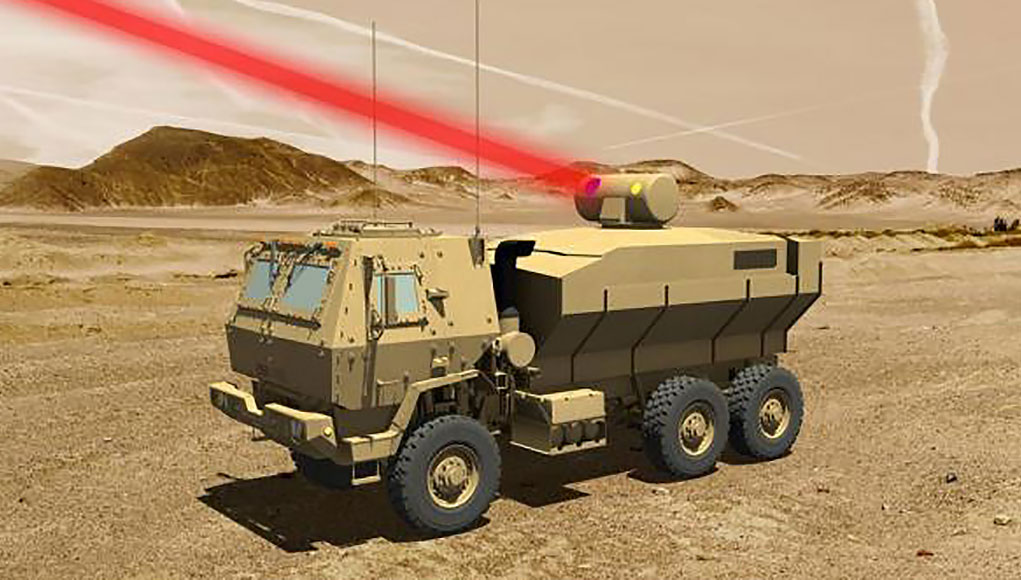
In February 2018 Lockheed Martin announced the production of a single-beam 60 kW laser for the Army High Energy Laser program. Image: Lockheed martin
The Raytheon Company and Dynetics are both developing laser weapon prototypes that will utilize 100 kW class laser weapons. One of the prototypes will be tested by the Army in 2022.
Each company received $10 million from the U.S. Army recently, to build a High Energy Laser Tactical Vehicle Demonstrator (HEL TVD) prototype based on the Army Oshkosh tactical FMTV truck. The winning contractor will be awarded a contract option to finish the design, build and integrate the laser weapon system onto an Army FMTV platform and conduct field testing at White Sands Missile Range in New Mexico.
The science and technology demonstration program is part of the Army’s Indirect Fire Protection Capability (IFPC) Increment 2 Block 2 (IFPC 2-I Blk 2) initiative designed to defeat drones, rockets, artillery, and mortars (C-RAM/UAS).
The Army’s Indirect Fire Protection Capability, Increment 2 — Intercept (IFPC Inc 2-I) is an acquisition program designed to provide a material solution to protect troops from cruise missiles, unmanned aerial systems (UAS), and rockets, artillery, and mortars (RAM). IFPC Inc 2-I has a Block 2 milestone decision in FY24 to add the counter-RAM capability to the program. To date, the program tested lasers at various intensities, from 2kW to 50 kW. In February this year, Lockheed Martin announced it completed the development of a single-beam 60 kW laser for the program. Lockheed Martin has teamed with Dynetics to mount a 100 kW laser on its HEL TVD. The laser uses Lockheed’s spectral beam-combined fiber laser that leverages know-how and experience gained from another vehicle-based laser – the Army’s Robust Electric Laser Initiative (RELI) program.
Raytheon’s 100 kW laser will be based on multi-beam fiber-laser design. The next phase will test the system with 100kW lasers, deemed adequate to defeat C-RAM targets in a timely manner.
Following the conclusion of the test and evaluation phase in early 2019 the Army plans to award a three-year system development, and demonstration contract estimated at $130 million, to build and integrate a weapon system. By the Fiscal year 2022, the HEL TVD will be demonstrated against a variety of targets, including lethal engagements.
This capability is managed in parallel to the Interim Mobile-SHORAD (IM-SHORAD) that will equip the Stryker brigades beginning 2020, but the two programs could be merges sometime in the future as the Army considers adding HEL capability to IM-SHORAD in the future.
The first mission is to protect U.S. and allied forces at fixed and semi-fixed bases. High energy lasers will complement conventional offensive and defensive weapons at a significantly lower cost per engagement than current systems. The high energy laser system represents very low operating costs, as it requires only fuel to complete its mission, with an average cost per kill of approximately $30. There is no ordnance logistics burden, as with conventional weapons.
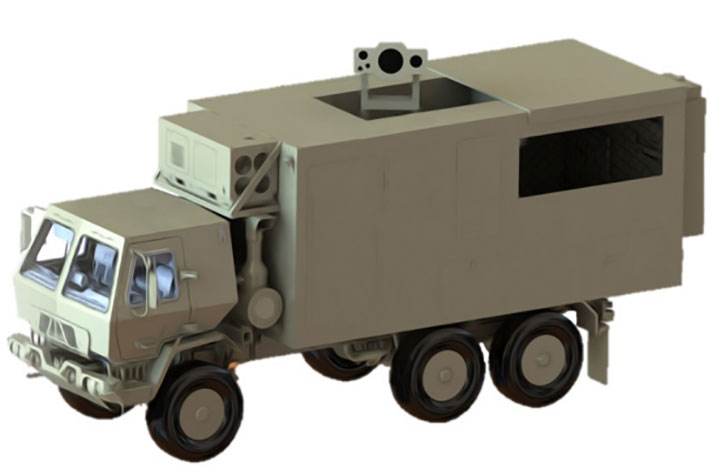
The HEL-TVD is designed as a self-contained unit that integrates multi-spectral targeting sensors, fiber-combined lasers, power and thermal sub-systems, all incorporated in a single package. Image: US Army SMDC
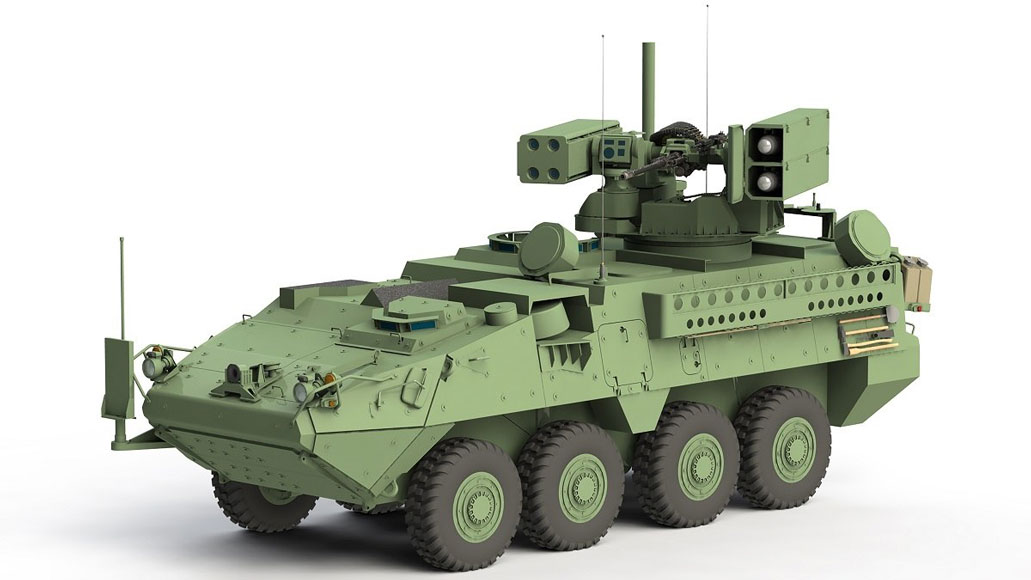
The US Army down selected Leonardo DRS to provide the Stryker A1 based interim, mobile short range air defense for the Stryker brigade teams. Illustration: Leonardo DRS
Facing a growing aerial threat from unmanned systems, rockets, artillery, and mortars, the U.S. Army is accelerating the fielding of an Interim, Mobile Short Air Defense (IM-SHORAD) system to complement the tactical formations of its Stryker brigades. Leonardo DRS, Inc. was selected to provide such IM-SHORAD Mission Equipment Package (MEP) for installation Stryker A1 vehicles. The package includes onboard radar system, a turreted weapon system mounting missiles, guns, and non-kinetic (jammers and Electronic attack) capabilities. This system will provide the “detect-identify-track-defeat” capability required to defeat UAS, rotary-wing and fixed-wing threats.
The system, developed by Leonardo DRS’s Land Systems business unit, integrates mature technologies from industry teammates and partners, including Moog’s Reconfigurable Integrated-weapons Platform (RIwP), Raytheon’s Stinger missiles and Rada’s Multi-mission Hemispheric Radar (MHR). The IM-SHORAD solution provides both hard and soft kill capabilities to the warfighter while minimizing impacts on the mobility of the Stryker. Leonardo DRS expects to receive the prototype contract in August of this year.
“We understand the challenges associated with an accelerated acquisition strategy and will leverage our recent successes with counter-UAS to meet the Army’s schedule,” said Aaron Hankins, Vice President, and General Manager, DRS Land Systems. This down-select decision is part of the Army’s IM-SHORAD effort to deliver prototypes in 2019. Nine prototype systems will inform a future production decision buying of 144 IM-SHORAD systems by fiscal 2022, enough to equip up to four Stryker battalion task forces.
The MHR radar, when integrated on the Stryker A1 platform, meets the US Army’s onboard sensor requirements and provides 360-degree aerial surveillance to detect and track Unmanned Airborne Systems (UAS), rotary wing and fixed wing threats at desired ranges. Each IM-SHORAD MEP includes four MHR radars which provide persistent surveillance, can execute at the short halt and operate on-the-move. The MHR has already been integrated to performed with high energy laser in counter-UAS applications.
The unique RIwP turret supports multiple weapon configurations to give tactical commanders flexibility to use the IM-SHORAD for ground-to-air lethality as well as the precision ground-to-ground fire, necessary to fight across a multi-domain battlefield. The weapons considered for the IM-SHORAD MEP include Stinger VSHORAD guided missiles, Hellfire/Longbow guided missiles and direct fire weapons – an M230 30mm chain gun and 7.62mm machine gun.
Through the assessment phase, the Army also evaluated a hybrid of a Stryker with a Boeing Avenger turret but favored the more compact, protected and versatile MEP offered by Leonardo DRS.
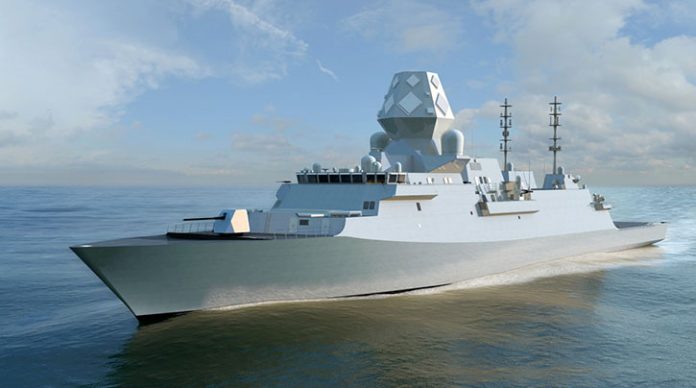
BAE Systems is offering the Global Combat Ship design for the future Australian submarine. A selection is expected in 2018. The frigates will be built in Adelaide, South Australia and will incorporate the Australian-developed CEA Phased-Array Radar. Image: BAE Systems
A 150 meter long, and 8,800 tons displacement the Hunter class frigates will be operated by a crew of 180 personnel. The Future Frigates will replace the eight ANZAC class frigates currently in service. The ANZAC’s entered service in 1996 and are expected to be maintained until the 2040s, when the youngest ship, HMAS Perth, will have been in service for more than 35 years.
The Hunter Class frigates will be built by ASC Shipbuilding at the Osborne Naval Shipyard. ASC Shipbuilding, currently wholly owned by the Commonwealth, will become a subsidiary of BAE Systems during the build.
Hull designed for low acoustic signature, combined with advanced sonar systems and the MH-60R combat helicopter results in a highly capable antisubmarine platform. The flexible mission bay provides the capacity to embark containerized stores, unmanned boats and an additional helicopter. For its anti-submarine role, the vessel will use an Ultra S2150 hull-mounted sonar, The S2087 Towed Array and Variable Depth Sonar system from Thales. Its primary anti-submarine weapon is the MU90 Torpedo that also provides a limited anti-torpedo (hard kill) capability.
The vessel will use a version of the U.S. Aegis for its combat management system, integrated with Australian built CEA CEAFAR2 phased array radar along with networked and highly capable in electronic warfare, the integration will be done by Lockheed Martin and Saab Australia. The combat system combines the ship’s navigation systems, internal and external communications systems, and various sensors and weapons capabilities with an associated computer network, integrated by the combat management system. Integration between the combat management system and the sensors and weapons of the vessel allows for the greatest capability that can be derived from the system. The CMS will incorporate the latest U.S. Navy Cooperative Engagement Capability (CEC) protocols, enabling the Australian Navy to improve network-centric warfare capability with U.S. forces operating in the region.
A Mk45 Mod4 127mm gun, 30 mm close-in weapon systems, and anti-ship missiles will provide the primary offensive system, able to support surface warfare and amphibious operations. The defensive systems will rely on the Mk41 Vertical Launch System (VLS) loaded with Standard Missile II (SM-2) and Evolved Sea Sparrow Missiles (ESSM), and short-range guns and close in weapons systems will enable self-defense and counter-air capabilities. As with other Australian naval vessels, the Nulka missile decoy system will also be integrated on board.
The frigate will be powered by a Combined Diesel Electric or Gas (CODLOG), using a single Rolls Royce MT30 Gas Turbine and two electric motors driving fixed pitch propellers, accelerating the ship to 27 knots top speed. At a cruising speed, the ship will have a range more than 7000 nautical. Electrical power is supplied by four MTU Diesel Generators.
BAE Systems is offering the Global Combat Ship design for the future Australian submarine. A selection is expected in 2018. The frigates will be built in Adelaide, South Australia and will incorporate the Australian-developed CEA Phased-Array Radar. Image: BAE Systems
The Australian Government selected BAE Systems to build nine new frigates for the Australian Navy under the Australian Navy SEA 5000 Phase 1 Future Frigate project. The new Hunter Class frigates will replace the current ANZAC class frigates and will be optimized for anti-submarine warfare (ASW). The new vessels. The new warships are based on the Global Combat Ship design pioneered by BAE Systems, which was also selected for the Royal Navy Type 26 frigate.
The AU$35 billion program is part of a massive $200 billion continuous shipbuilding program that will deliver 54 new vessels – surface ships and submarines – over the next decade. The frigate program will secure 4,00 Australian jobs across the continent.
By 2030, over half of the world’s submarines will be operating in the Indo-Pacific region where Australia’s interests are most engaged. The primary purpose of the Hunter Class frigates is to detect, track and, if required, destroy enemy submarines. The first Hunter class frigate will be introduced into service from the late 2020s.
A 150 meter long, and 8,800 tons displacement the Hunter class frigates will be operated by a crew of 180 personnel. The Future Frigates will replace the eight ANZAC class frigates currently in service. The ANZAC’s entered service in 1996 and are expected to be maintained until the 2040s, when the youngest ship, HMAS Perth, will have been in service for more than 35 years.
The $35 billion spending is expected to have 65-75 percent local share, with the construction of the ships done in Adelaide, southern Australia. The program also includes infrastructure investment, $130 million at Osborne Naval Shipyard, South Australia, for the land-based test facility and at Henderson, at HMAS Sterling in Western Australia, along with $670 million for the Ship Zero training school for the Hunter class.
In this selection, BAE Systems has beaten its two European competitors, the Italian Fincantieri and Spanish Navantia. Both offered designs based on existing vessels. Although Australia selected a vessel that exists only on paper, the Navy is confident the selection was the right one. “The evaluation was quite stringent and strict against the requirements that we had. By the time that the first of these are built, there will already be four other hulls in the water.” Vice Admiral Barrett Chief of the Australian Navy said. “It has also been designed and is being built by a nation which has, on a regular basis in the North Atlantic and elsewhere, been chasing submarines as a matter of course on a day by day proposition. We’ve evaluated and studied extensively how they intend to do it and we believe – and I spoke as recently as last night to the First Sea Lord, my equivalent in the Royal Navy – and I am assured by his comments, of just how far and how successful this platform will be as the world’s most advanced ASW frigate.” Adm. Barrett added.
The Hunter Class frigates will be built by ASC Shipbuilding at the Osborne Naval Shipyard. ASC Shipbuilding, currently wholly owned by the Commonwealth, will become a subsidiary of BAE Systems during the build.
The $35 billion spending is expected to have 65-75 percent local share, with the construction of the ships done in Adelaide, southern Australia. The program also includes infrastructure investment, $130 million at Osborne Naval Shipyard, South Australia, for the land-based test facility and at Henderson, at HMAS Sterling in Western Australia, along with $670 million for the Ship Zero training school for the Hunter class.
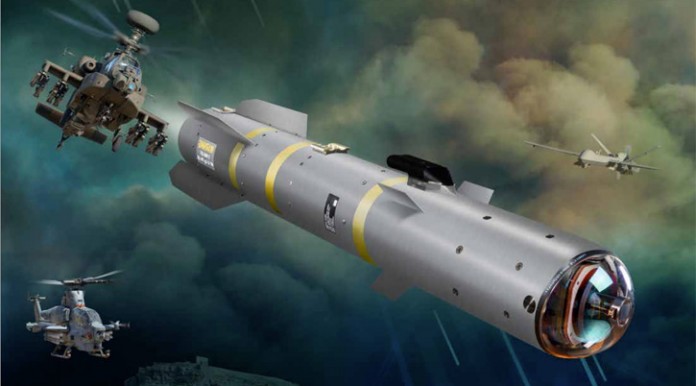
Lockheed Martin’s Joint Air-to-Ground Missile (JAGM) system has successfully passed its Defense Acquisition Board review and achieved milestone C. The signed Acquisition Decision Memorandum approves the JAGM system to enter into Low-Rate Initial Production (LRIP). JAGM flight tests, including ten Limited User Test flights, were completed across the performance envelope and target requirements over a period of months leading up to the successful Milestone C decision.
JAGM is a multi-sensor air-to-ground missile that is the successor to the combat-proven HELLFIRE Romeo and HELLFIRE Longbow missiles. Backward compatible with all rotary wing and fixed wing platforms that fire the HELLFIRE family of missiles, JAGM employs a multi-mode guidance section that offers enhanced performance on the battlefield. The multimode seeker combines improved Semi-Active Laser and millimeter wave radar sensors providing precision strike and fire-and-forget capability against stationary and moving land and maritime targets in adverse weather and obscured battlefield conditions.
The recent tests followed comprehensive evaluations of the missile’s hardening against cyber attack after vulnerabilities of the seeker and guidance systems were realized in previous tests last year. According to the manufacturer, those issues were dealt with and the recent tests demonstrated the system’s combat effectiveness and technical maturity. Additionally, the program successfully conducted supplier and prime contractor production readiness reviews establishing the program’s readiness to move into LRIP.
The U.S. Army and U.S. Navy awarded Lockheed Martin a 24-month contract for the Engineering and Manufacturing Development (EMD) phase of the JAGM program which included JAGM production, test qualification and integration on the AH-64E Apache and AH-1Z Viper attack helicopters. The EMD phase also established an initial low-rate manufacturing capability in support of three follow-on LRIP options, with U.S. Army Initial Operational Capability expected early 2019.
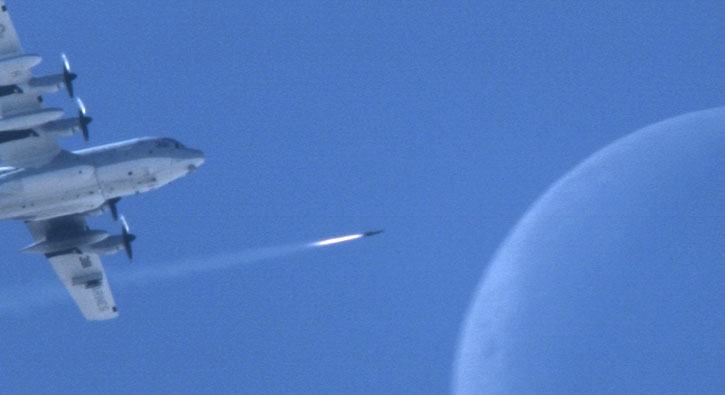
A KC-130J configured with the Marine Corps Harvest HAWK Plus weapons system fires a Hellfire missile during a developmental and operational test at Naval Air Weapons Station, China Lake CA, April 2018. Photo: US Navy/ NAVAIR
The U.S. Navy is testing an upgraded weapon kit for the KC-130J Harvest HAWK to provide close support for Marine and special operations forces. In a recent test event, the U.S. Navy Tactical Airlift Program Office (PMA-207) Integrated Warfighting Capability (IWC) weapons team tested a newly configured KC-130J with the Harvest Hercules Airborne Weapons Kit (HAWK) Plus (HH+) installed. According to the Navy announcement the aircraft flawlessly completed multiple sorties, demonstrating successful strikes on both fixed and moving targets. “The HH+ weapons kit will provide a significant combat multiplier to the Marine Air Ground Task Force,” said CAPT Steve Nassau, PMA-207 Program Manager.
The HH+ mission is to provide the U.S. Marine Corps with extended endurance multi-sensor imagery, reconnaissance, and on-call close air support capabilities. The HH+ is an upgrade to the original Harvest HAWK roll-on, roll-off precision strike package weapons system. The team also develops an engineering change proposal (ECP) to improve the Hellfire weapons capacity on the aircraft and ensure the KJ platform is sensor-shooter, electronic warfare and digitally interoperable capable.
A KC-130J configured with the Marine Corps Harvest HAWK Plus weapons system fires a Hellfire missile during a developmental and operational test at Naval Air Weapons Station, China Lake CA, April 2018. Photo: US Navy/ NAVAIR
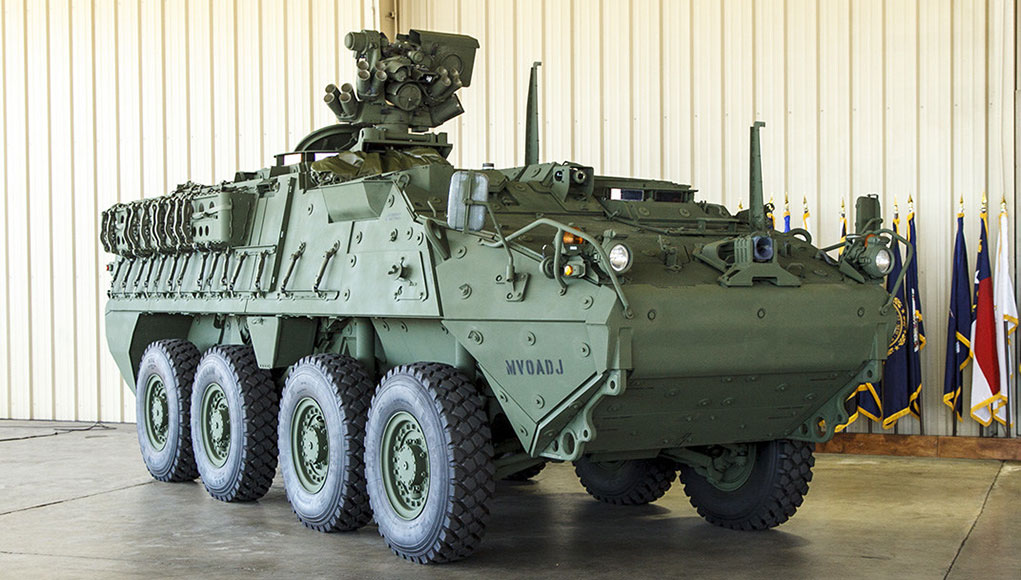
In addition to the improved survivability offered by the newly designed hull the Stryker A1 provides a 450-horsepower engine, 60,000-pound suspension, 910-amp alternator and in-vehicle network. Photo: GDLS
General Dynamics Land Systems was awarded last week $258 million contract modification to upgrade 116 Stryker flat-bottom vehicles to the Stryker A1 configuration. The upgrade includes the installation of Double-V Hull (DVH), improving the vehicle’s survivability against mines and improvised explosive devices (IED). In addition to the DVH survivability, the Stryker A1 provides a 450-horsepower engine, 60,000-pound suspension, 910-amp alternator and in-vehicle network. All vehicles will be delivered by March 31, 2020. The company already received several orders as part of an acquisition to equip the 4th Stryker Brigade with some 330 modernized vehicles by 2020.
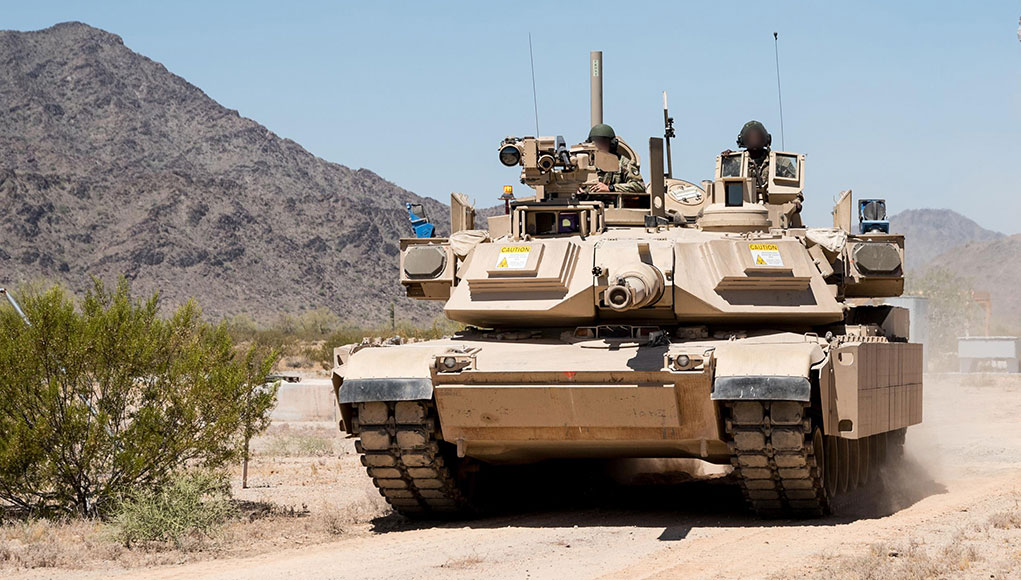
M-1A2 Abrams undergoing testing with TROPHY APS systems. Photo: US Army via DRS
Leonardo DRS, Inc. announced today that it has been awarded a contract worth $193M to provide the U.S. Army with TROPHY active protection systems (APS) for its Abrams tanks in support of immediate operational requirements. The Army selected the TROPHY APS to equip tank battalions of two armored brigades operating M-1A2 SEP2 tanks, following extensive tests that proved the maturity and readiness of the system. Under the terms of the contract, Leonardo DRS will provide the Army with APS systems, countermeasures, and maintenance kits. “We are actively investing to ensure TROPHY provides a solid, American-made foundation for the Army’s coming Vehicle Protection Suite program,” said Aaron Hankins, Vice President and General Manager of the Leonardo DRS Land Systems division.
TROPHY, a combat-proven APS was developed in Israel by Rafael Advanced Defense Systems Ltd. and is currently fielded with several armored and infantry brigades under an ongoing large-scale fielding plan that will include about a thousand systems, protecting all major current and future ground combat platforms.
The establishment of a production facility in the USA opens new opportunities for Israel, for continued acquisition of APS with US military aid, once the new agreement comes into effect. This agreement grants $38 billion military aid to Israel over the next 10 years but precludes Israel’s from using US$500 million in local defense spending, that was part of the previous agreement. The new reality is a great concern to Israel’s defense industries, that are required to establish manufacturing facilities and employ American workforce to win US-funded contracts.
“The majority of TROPHY components are manufactured by the American defense industry and we are excited by the opportunity to increase manufacturing in the U.S., including for Israeli systems, as the U.S. acquires additional systems,” said Moshe Elazar, Executive Vice President and Head of Rafael’s Land and Naval Division.
Australia plans to field six Northrop Gruman MQ-4C Triton maritime surveillance drones by 2025. The Australian Government announced today its plans to invest $1.4 billion and acquire the first six drones under the Project AIR 7000 Phase 1B. The Triton, based on the Global Hawk remotely piloted aircraft is procured and will be operated through a cooperative program with the United States Navy that operates the same assets. As part of its investment, Australia will also allocate $200 million to the cooperative program with the U.S. Navy, for the development, production, and sustainment of the MQ-4C Triton.
Australia also invests $364 million developing new facilities at the drone’s home base at RAAF Edinburgh, and forward operating base, RAAF Tindal, as well the necessary ground control systems, support and training required to implement the project.
The Triton will complement the surveillance role of the Boeing P-8A Poseidon manned maritime surveillance aircraft, that replace the P-3C Orion in this role. Performing sustained long ranges patrols over vast oceans, these assets will also be able to undertake Intelligence, Surveillance, and Reconnaissance tasks. “Together these aircraft will significantly enhance our anti-submarine warfare and maritime strike capability, as well as our search and rescue capability,” a joint statement by Prime Minister Turnbull, Defence Minister Senator Marise Payne and Defence Industry Christopher Pyne reads.
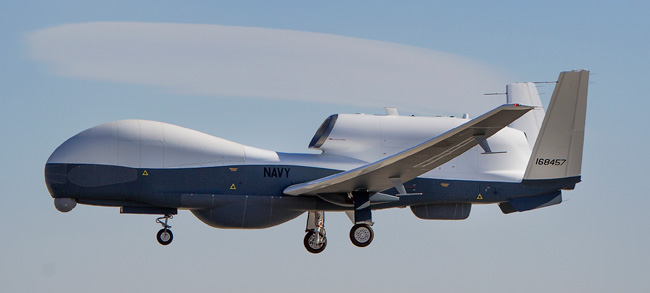
The Triton unmanned aircraft system completes its first flight May 22, 2013 from the Northrop Grumman manufacturing facility in Palmdale, Calif. The 80-minute flight successfully demonstrated control systems that allow Triton to operate autonomously. Triton is designed to fly surveillance missions up to 24-hours at altitudes of more than 10 miles, allowing coverage out to 2,000 nautical miles. The system’s advanced suite of sensors can detect and automatically classify different types of ships. Photo: Northrop Grumman
Australia has already taken delivery of seven Poseidon aircraft under Project AIR 7000 Phase 2B and achieved Initial Operational Capability (IOC) earlier this year. The full fleet of 12 Poseidon aircraft is expected to be delivered and in operation by 2022. The first of the Triton aircraft is expected to be introduced into service in mid-2023 with all six aircraft planned to be delivered and in operation by late 2025, based at RAAF Base, Edinburgh in South Australia. From these bases, a single Triton mission can cover well up into the South China Sea or most of Australia’s Antarctic coastal area of interest in a single mission.
The Australian announcement came few weeks after the U.S. Navy officially commenced operations of its Northrop Grumman MQ-4C Triton Broad Area Maritime System (BAMS) unmanned aerial vehicle (UAV) on June 1, 2018, with Unmanned Patrol Squadron (VUP)-19 – the Navy’s first unmanned patrol squadron that currently operates two Triton drones.
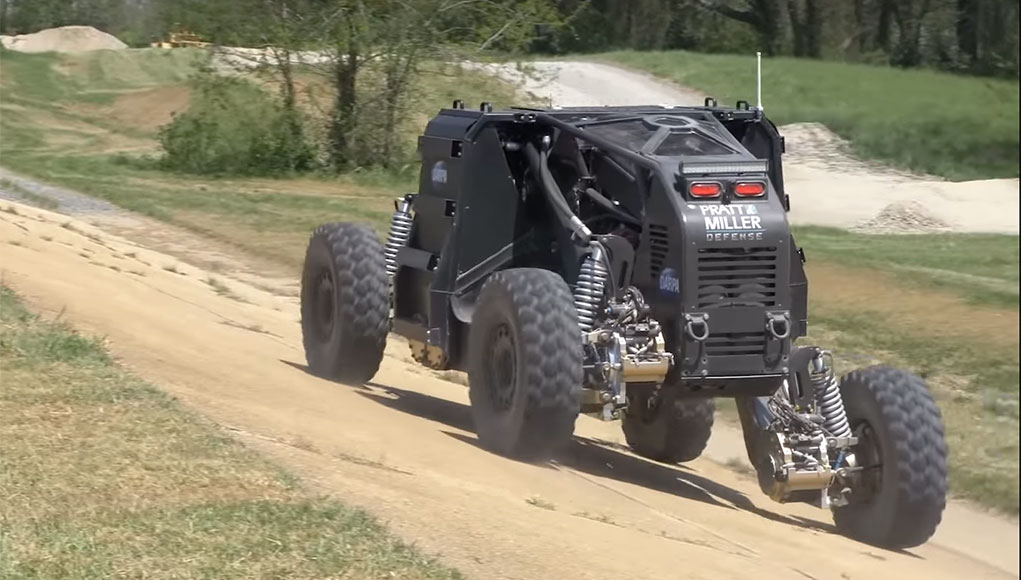
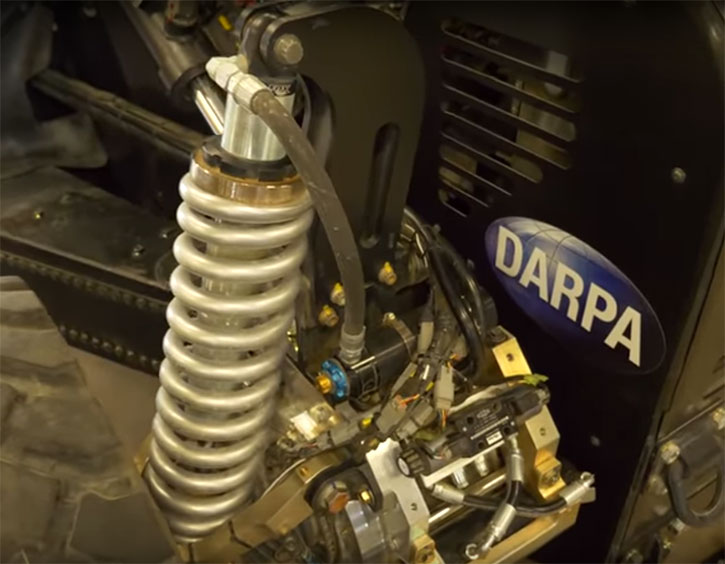
Multi-mode Extreme Travel Suspension (METS) developed by Pratt & Miller enable vehicles to move over extremely rough terrain ensuring vehicle stability and crew comfort. Photo: DARPA
Maj. Amber Walker, program manager for GXV-T in DARPA’s Tactical Technology Office. Photo: DARPA
Several contracts awarded recently marked significant progress in DARPA’s Ground X-Vehicle Technologies (GXV-T) program with field demonstrations of projects developed by teams and companies under the Phase 2 of the R&D program. Among the technologies showing much progress are extreme mobility projects and crew augmentation technologies.
The GXV-T program aims to demonstrate how future combat vehicles could improve mobility, survivability, safety, and effectiveness without increasing their armor.
“We’re looking at how to enhance survivability by buttoning up the cockpit and augmenting the crew through driver-assistance aids,” said Maj. Amber Walker, the program manager for GXV-T in DARPA’s Tactical Technology Office (TTO). “For mobility, we’ve taken a radically different approach by avoiding armor and developing options to move quickly and be agile over all terrain.”
Demonstrations, such as those performed in May at the Aberdeen Test Center, have given potential military service transition partners an opportunity to observe technical progress on the GXV-T program. Among the technologies recently demonstrated by GXV-T participants are:
Radically Enhanced Mobility
GXV-T envisions future combat vehicles that could traverse up to 95 percent of off-road terrain, including slopes and various elevations. Capabilities include revolutionary wheel-to-track and suspension technologies that would enable access and faster travel both on- and off-road, compared to existing ground vehicles.
Reconfigurable Wheel-Track (RWT)
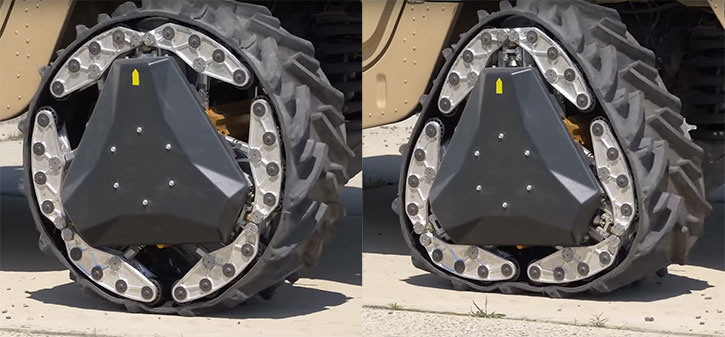
Reconfigurable Wheel and Track (RWT) developed by Carnegie Mellon University National Robotics & Engineering Center can change from wheels to tracks in two seconds, on the move.
Wheels permit fast travel on hard surfaces while tracks perform better on soft surfaces. A team from Carnegie Mellon University National Robotics Engineering Center (CMU NREC) demonstrated shape-shifting wheel-track mechanisms that transition from a round wheel to a triangular track and back again while the vehicle is on the move, for instant improvements to tactical mobility and maneuverability on diverse terrains.
Electric In-hub Motor
Qinetiq demonstrated an electric hub motor that fits into a standard 20 inch rim, The system integrates a 100 kW continious traction, three-speed gear, celtral inflation and braking and thermal management which functions as part of a future E-drive system. Photo: Qinetiq.
Putting motors directly inside the wheels offers numerous potential benefits for combat vehicles, such as heightened acceleration and maneuverability with optimal torque, traction, power, and speed over rough or smooth terrain. In an earlier demonstration, QinetiQ demonstrated a unique approach, incorporating three gear stages and a complex thermal management design into a system small enough to fit a standard military 20-inch rim.
Multi-mode Extreme Travel Suspension (METS)
Pratt & Miller’s METS system aims to enable high-speed travel over rough terrain while keeping the vehicle upright and minimizing occupant discomfort.
Multi-mode Extreme Travel Suspension (METS) developed by Pratt & Miller enable vehicles to move over extremely rough terrain ensuring vehicle stability and crew comfort. Photo: DARPA
The vehicle demonstrator incorporates standard military 20-inch wheels, advanced short-travel suspension of four-to-six inches, and a novel high-travel suspension that extends up to six feet – 42 inches upward and 30 inches downward. The demonstration in May showed off its ability to tackle steep slopes and grades by actively and independently adjusting the hydraulic suspension on each wheel of the vehicle.
Crew Augmentation
Traditional combat vehicle designs have small windows that improve protection but limit visibility. GXV-T sought solutions with multiple onboard sensors and technologies to provide high-resolution, 360-degree situational awareness while keeping the vehicle enclosed.
Enhanced 360-degree Awareness with Virtual Windows
Honeywell International demonstrated its windowless cockpit in an all-terrain vehicle (ATV) with an opaque canopy. The 3-D near-to-eye goggles, optical head-tracker, and wrap-around Active Window Display screens provide real-time, high-resolution views outside the vehicle. In off-road courses, drivers have completed numerous tests using the system in roughly the same time as drivers in All Terrain Vehicles (ATVs) with full visibility.
Virtual Perspectives Augmenting Natural Experience (V-PANE) developed by Raytheon BBN for Darpa’s GXV-T program.
A tactical vehicle offers limited visibility and data for decision-making, especially when moving rapidly through unfamiliar territory. Raytheon BBN Technologies’ V-PANE technology demonstrator fuses data from multiple vehicle-mounted video and LIDAR cameras to create a real-time 3-D model of the vehicle and its nearby surroundings. In a final Phase 2 demonstration, drivers and commanders in a windowless recreational vehicle successfully switched among multiple virtual perspectives to accurately maneuver the vehicle and detect targets of interest during both low- and high-speed travel.
Off-Road Crew Augmentation (ORCA)
A second CMU NREC technology demonstration, ORCA aims to predict in real time the safest and fastest route and when necessary, enable a vehicle to drive itself off-road – even around obstacles. In Phase 2 testing, drivers using the ORCA aids and visual overlays traveled faster between waypoints and eliminated nearly all pauses to determine their routes. The team found autonomy improved either vehicle speed or risk posture, and sometimes both.
Walker said GXV-T performers are pursuing a variety of transition paths for the new technologies. “DARPA is excited about the progress made to date on the GXV-T program and we look forward to working with the Services to transition these technologies into ground vehicle technologies of the future,” said Walker.
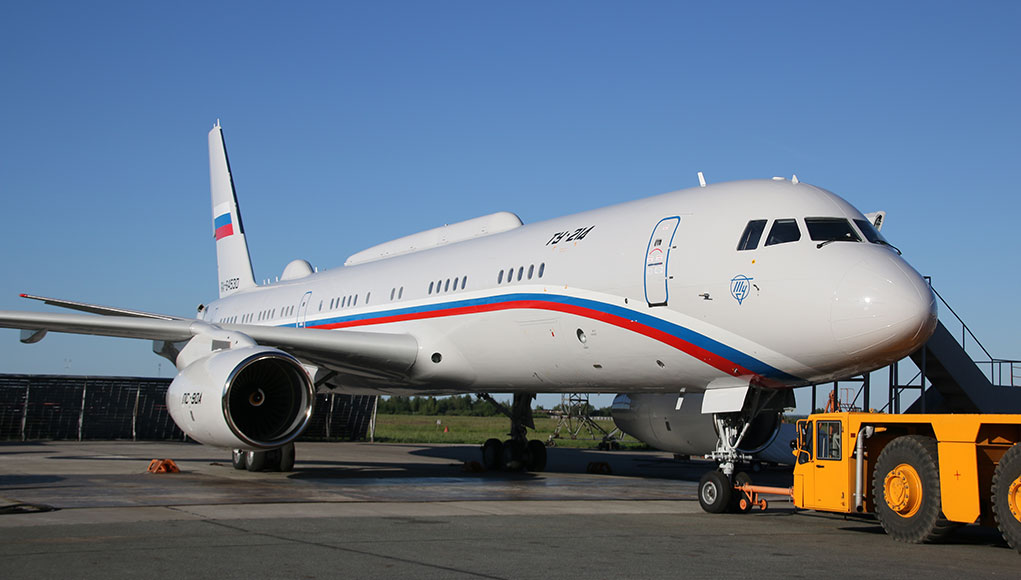
The second Tu-214PU-SBUS aircraft entered service with the Russian Ministry of Defense in June. Photo: UAC
The Russian aerospace company United Aircraft Corporation (UAC) delivered the second of two Tupolev Tu-214 PU-SBUS communications support special mission aircraft (ПУ-СБУС) ordered by the Russian Ministry of Defense. The aircraft was deivered on June 18, 2018. The first aircraft was delivered in March 26 this year. The two aircraft provide a communications support platform, carrying the SBUS-214 carried the communication node payload, housed in a large ventral fairing and SATCOM dome. Since the aircraft relies strictly on domestic subsystems and technologies it meets the basic requirement of government customers and avoids operational limitations which could be imposed by international sanctions.
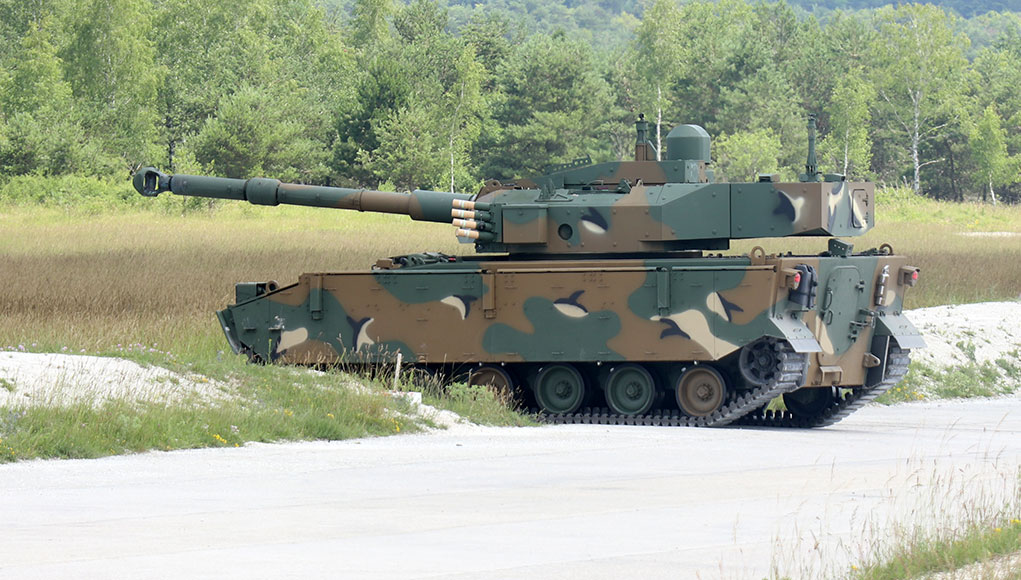
The heaviest platform on display was the Korean Hanwha K21 light tank equipped with Cockerill 3105 integrated weapon system. Photo: Defense-Update
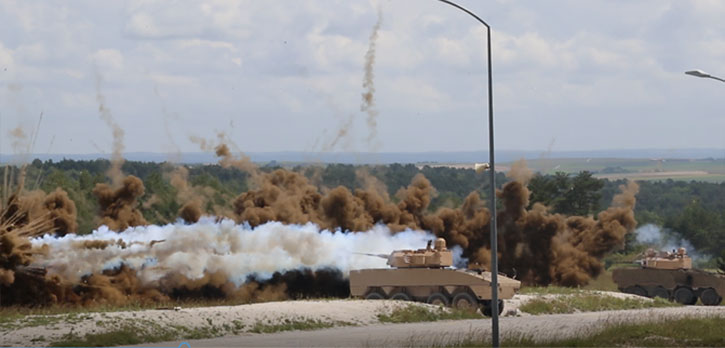
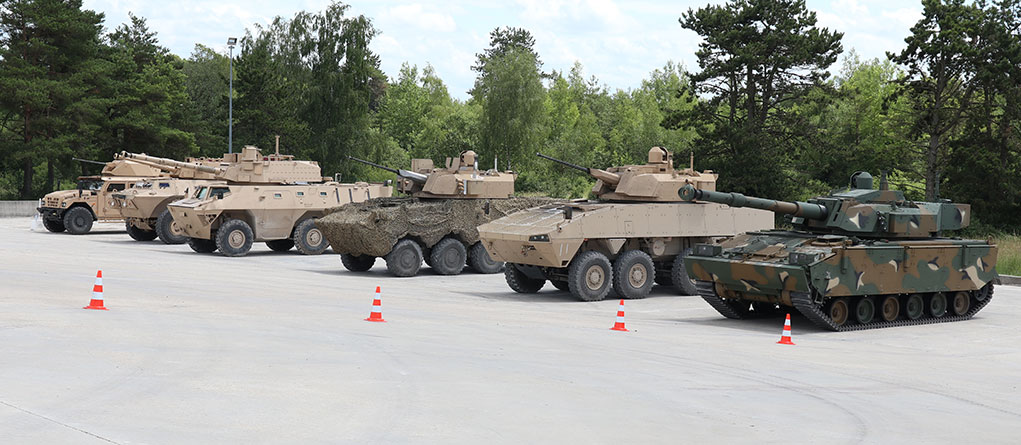
In a fire demonstration that took place on the Suippes firing range in Northern France last week CMI Defence displayed an impressive lineup of combat vehicles weaponized with the company’s latest versions of Cockerill turrets. The first Cockerill Firepower Symposium included a dynamic live firing demonstration, in front of dozens of military officers, official delegations and media representatives from around the world. The firing demonstrations included the live firing of 12.7, 25, 30, 90 and 105 mm guns mounted on various turrets, on medium and long-range engagement, from manned and unmanned, remotely operated turrets. Other live displays included the deployment of Galix self-protection instantaneous smoke screens.
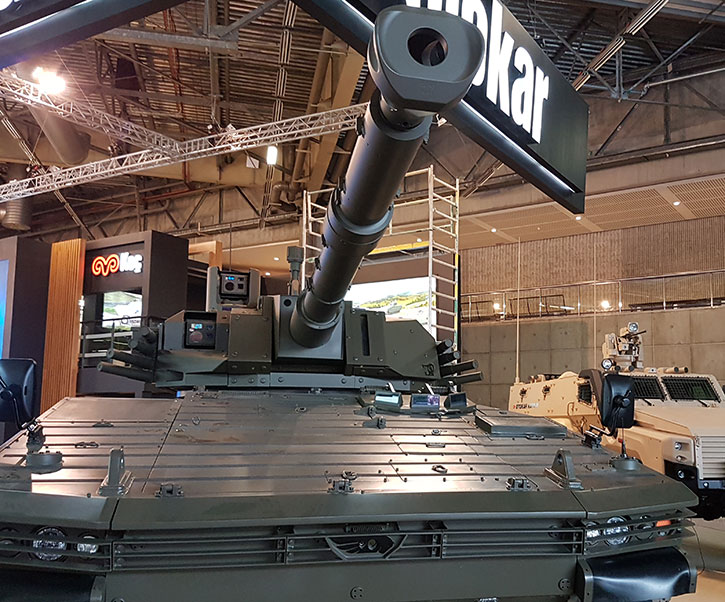
The new Turkish Kaplan tank from Otokar also mounts the Cockerill 3105 turret. Photo: Tamir Eshel, Defense-Update
The performance of Cockerill 3000 Series turrets was among the event’s highlights. This series represents a single platform enabling a turret to accommodate guns of different calibers and their corresponding technical modules, including automatic 25 mm, 30 mm, 30/40 mm, 35 mm and 50 mm cannons, along with direct fire guns of 90 and 105 mm caliber. These systems can also fire missiles. The 3000 series is one of the most successful product lines at CMI Defence. According to CMI sources, more than 130 Cockerill 3000 Series turrets and more than 30 Cockerill 105 mm guns were delivered to date.
At Eurosatory CMI displayed the second generation for the Cockerill Protected Weapon Station (CPWS), representing a new design approach to protected, light and multi-role turret that mounts various automatic guns including the M242 25mm chain gun, or M230LF 30mm guns with under-armor reloading capability. “After the successful Cockerill 3000 Series modular turret, we believe that our multi-role turret concept, which combines lightweight, versatility and protection, will meet the evolving needs of land forces in terms of flexibility and mobility.” Thierry Renaudin, President of CMI Defence said.
CPWS Gen.2 uses a configurable hatch that can be adapted to different user’s operational requirements, with a closed hatch that allows the crew to operate in a hostile environment with a maximum level of protection, an elevated hatch that provides 360° direct observation, and use of individual weapons. Third and fourth options include the use of a large open hatch that allows the rapid egress or removed hatch that provides an open space that allows the crew to patrol in an exposed position, ideally for security operations in a low threat environment. (situations other than war). The lightweight turret retains remote control operational capability and fits on all types of tracked or wheeled vehicles, such as 8×8, 6×6 and 4×4. At the Cockerill fire demonstration, the CPWS was displayed with M242 25mm automatic cannon, mounted on a Sherpa 4×4 light armored vehicle.
The Galix Automatic Obscurant System (AOS) launched from an 8×8 AMV mounting the Cockerill 3030 turret. Galix, from Lacroix can be installed on all types of platforms, including remotely controlled turrets. It can be operated manually or integrated with the vehicle’s battle management system (BMS) and be triggered automatically by different sensors on board. A unique capability of the system enables the deployment of an effective smoke screen that automatically masks the moving vehicle, instructing the driver to move, turn, accelerate or halt to gain maximum concealment by the smoke screen. Photo: Defense-UpdateThe CPWS Gen 2 turret was unveiled by CMI Defence at the Eurosatory 2018 expo. Photo: Tamir Eshel, Defense-Update
At Eurosatory CMI displayed the second generation for the Cockerill Protected Weapon Station (CPWS), representing a new design approach to protected, light and multi-role turret that mounts various automatic guns including the M242 25mm chain gun, or M230LF 30mm guns with under-armor reloading capability. “After the successful Cockerill 3000 Series modular turret, we believe that our multi-role turret concept, which combines lightweight, versatility and protection, will meet the evolving needs of land forces in terms of flexibility and mobility.” Thierry Renaudin, President of CMI Defence said.
The full lineup of turrets taking part in the demonstration including the Cockerill 3105 on the K21, manned and unmanned versions of the 3030 system mounted on AMV and Piranha 8×8 vehicles, Belgian SIMBAS (6×6) with LTCS 90MP, Commando Select (4×4) with CSE 90LP mounted and the CPWS on a Sherpa Light 4×4. Photo: Defense-Update
The heaviest platform on display was the Korean Hanwha K21 light tank equipped with Cockerill 3105 integrated weapon system. the main advantage of the 3000 series is its modularity, “Providing caliber interchangeability and manned or unmanned configurations, the Cockerill 3000 Series represents a unique answer to our customers’ present and future requirements.” Renaudin said, adding that this modularity leads to a high commonality in terms of training, maintenance, and spare parts, significantly enhancing manpower, system readiness resulting in lower cost of ownership.
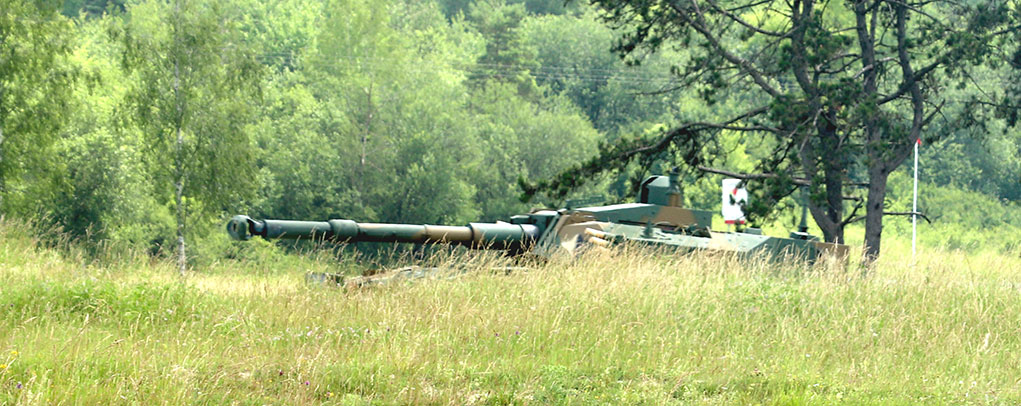
The 3105 is a fully stabilized turret constructed of welded ballistic aluminum, offering protection level up to STANAG 4569 Level 5. Self-protection measures also include eight smoke canisters, hostile fire detection, laser warning system and defensive aids (soft kill) measures. The turret mounts a NATO standard Cockerill 105mm HP canon, COAX and pintle-mounted 7.62mm machine guns. An automatic loader carrying 12-16 ready rounds enable operation by two men. Two identical sights for the gunner and commander enable independent operation. This canon is one of the candidates considered for the U.S. Army future, lightweight mounted gun system.
The Korean K-21 showing the distinctive low silhouette the Cockerill 3105 turret achieves in a hull down position, demonstrating at the French Army Suippes firing range, June 15, 2018. Photo: Defense-Update
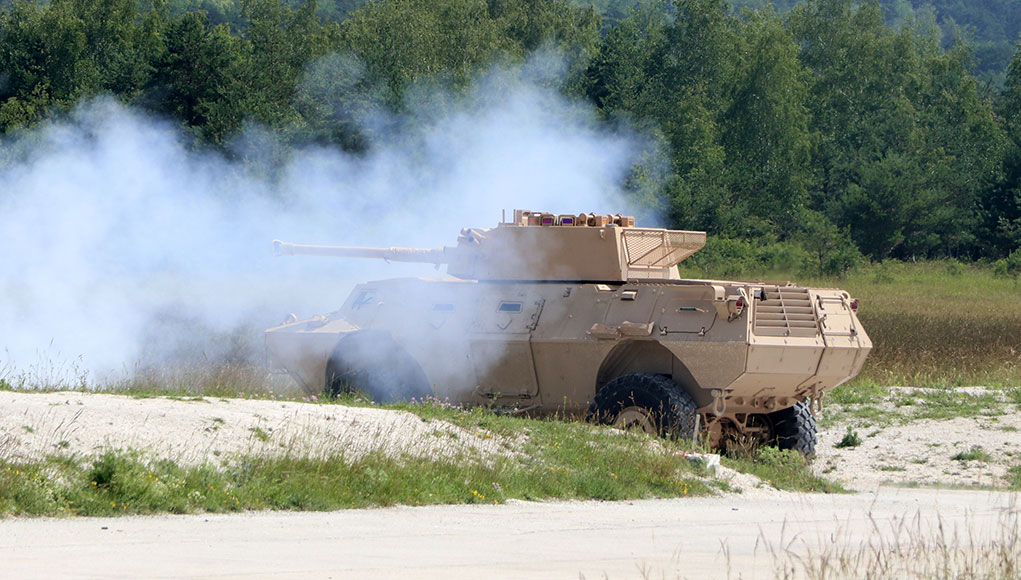
The CES 90LP was also demonstrated in live fire, armed with the low-pressure variant of CMI’s 90mm gun that can be mounted on armored cars such as the Textron Systems’ Commando Select vehicle shown here. This gun fires APFSDS-T kinetic projectiles at 1,200 m/sec and HEAT at 865 m/sec, perforating 100 mm and 130mm RHA steel NATO targets (respectively). Indirect firing capability: 6km range at 30° elevation High Explosive and High-Explosive Smash (HESH) rounds are also available against personnel, buildings, and fortifications, while a ‘shotgun’ style canister is used against personnel at close range. A smoke screen round is also available.
Commando Select direct fire armored vehicle participates in a live fire demonstration at the French Army Suippes firing range, June 15, 2018. Photo: Defense-Update
The Cockerill CSE 90LP turret incorporates a gunner’s day sight as standard, with night vision (image intensifying or thermal imaging) as an option. The weapon is aimed at the target using an electro-mechanical gun and turret drive system. This permits fast movement of gun and turret during normal operation and excellent slow speed target-tracking for precision engagement. A laser range finder and ballistic computer permit precise target engagement. The gunner’s sight image may be displayed at the commander’s station to permit full command and control.
Cockerill 90mm MP gun turret is designed for vehicles in the 10-20 ton GVW class, the LCTS 90MP incorporates a more powerful Cockerill 90mm gun variant with an advanced autoloader and uses an advanced digital, stabilized, day/night weapon control system. Developing higher pressure than the LP variant, the MP develops muzzle velocity of 1,345 m/sec for the APFSDS-T round, achieving 150mm RHA steel target penetration from 2,000-meter range. The effective indirect firing range is the 7.8km range at 20° elevation.
Photo-op of CMI, Lacroix and Hanwha executives at the Cockerill Firing Demonstration 2018. Note the Piranha with CPWS Mk 2 and SIMBAS with LCTS 90MP in the background. Photo: Defense-Update
In the past year, the two companies practiced such cooperation building a Main Battle Tank (MBT) based on a KMW Leopard 2 chassis and a Leclerc turret provided by Nexter. The future Franco-German tank has not been defined yet, but is already known as the 'Main Ground Combat System' (MGCS). Photo: Tamir Eshel, Defense-Update
Germany agreed to join the French lead European Intervention Initiative (IEI). The project brings together a dozen European countries, capable militarily and politically willing to face evolving security challenges, and better able to protect its citizens. France, UK, Netherlands, and Germany were among the first to endorse the project. The Letter Of Intent signed yesterday is a significant step forward in the defense cooperation between the two countries and in Europe. This close cooperation was the key motivation for the foundation of KNDS in 2015, where Nexter and KMW cooperate as national system houses for land systems.
The two companies embarked on the joint development of a future main battle tank and artillery systems for the armies of the two countries. The German tank manufacturer KMW and French defense conglomerate Nexter which already merged under the KNDS brand in 2015 welcomed the announcement. In the past year, the two companies practiced such cooperation building a European Main Battle Tank (EMBT) based on a KMW Leopard 2A7 chassis and a Leclerc turret with its integral auto-loader, provided by Nexter. The EMBT uses the standard systems delivered with the current Leopard 2 and Leclerc models, to provide the same firepower, performance and protection levels, at a gross vehicle weight of 62 tons. According to program officials, the vehicle has about six tons of growth potential, for future evolution. The joint project was displayed at the recent Eurosatory 2018 exhibition.
The future Franco-German tank has not been defined yet but is already known as the ‘Main Ground Combat System’ (MGCS). Another combat system is the future self-propelled artillery unit – known as Common Indirect Fire System (CIFS). MGCS will develop a new generation of Main Battle Tanks, providing their users enhanced, innovative, and best-in-class systems with the most advanced technologies. Germany is designated the lead country in the MGCS, the program is set to begin a joint demonstration phase in mid-2019, leading to a detailed operational need statement by the two countries, by 2024.
Following a French initiative launched by President Emmanuel Macron in 2017, IEI foresees the formation of a joint, European intervention force. The new formation will operate in parallel to the current European multilateral organizations (the North Atlantic Treaty Organization NATO, and the European Union – EU), that will provide the continent an independent military intervention capability, which will be based on common doctrine and funding supported by the participating countries. The formation of the new force is planned for years 2019-2024 to establish a “shared strategic culture”, according to Emmanuel Macron.
Another collaborative program signed by the two defense ministries is the Future Air Combat System (SCAF). France will act as the leading nation in that program, that will define a common successor for the Rafale and the Eurofighter fighter jets, to be introduced in 2040.
The future multi-purpose combat aircraft will exploit network-based combat capabilities and artificial intelligence and will employ manned and unmanned capabilities. Dassault, the manufacturer of the Rafale, and Eurofighter, of the Airbus consortium, are both participants in the program, expected to begin as a concept study later in 2018.
IEI is expected to strengthen the links between the armed forces of the member countries, with the aim of developing a common strategic culture and European strategic autonomy. A separate NATO and EU member, the IEI will contribute to the efforts undertaken within these two institutions, in particular, those of the Permanent Structured Cooperation (SPC), with which the IEI will maintain close links.
The defense ministers of the representative countries will sign a Letter of Intent in the next week, to formally launch the initiative. This commitment will be translated in the coming weeks and months by a ministerial orientation meeting, followed by the first military strategic meeting that will bring together the staffs of the participating countries, as well as the launch of the first operational activities of the IEI.
The opening week of 2026 has been defined by a singular, paradigmatic shift in modern warfare: the "catastrophic failure" of Venezuela's integrated air defense network during a U.S. special operation. The operation succeeded not through brute force, but by rendering Venezuela's Russian S-300VM and Chinese "anti-stealth" radars effectively blind, validating the supremacy of advanced electronic warfare over legacy kinetic defenses. This failure has sent shockwaves through the global defense market, underscoring why nations like Spain and Germany are rushing to modernize their air defense architectures with Western alternatives, while massive procurement programs exceeding $301 billion signal an accelerated transformation toward unmanned systems, directed energy weapons, and indigenous production capabilities.
Turkey's defense industry transformation extends far beyond its celebrated drones. Now ranking 11th globally in defense exports, Turkey is executing a comprehensive strategy to become a top-tier arms supplier. With 75% of exports flowing to Western markets and five firms in Defense News' Top 100, Turkey is methodically building a complete defense ecosystem through combat-proven systems, integrated defense diplomacy, strategic self-reliance, and real-world R&D in active conflict zones.
Lockheed Martin Skunk Works® and XTEND have achieved a major milestone in JADC2 by integrating the XOS operating system with the MDCX™ autonomy platform. This technical breakthrough enables a single operator to simultaneously command multiple drone classes, eliminating the friction of mission handoffs. From "marsupial" drone deployments to operating in GPS-denied environments, explore how this collaboration is abbreviating the data-to-decision timeline and redefining autonomous mission execution.
As traditional defense primes face mounting competition from agile “neoprimes” such as Anduril, Palantir and Helsing, the balance of innovation is shifting toward software-defined warfare and scalable, dual-use technologies, while global industry consolidation—marked by Boeing’s integration of Spirit AeroSystems and other strategic mergers—signals an intensified race to secure control over the defense technology value chain. Our Defense-Tech weekly report highlights these trends.
In early October 2025, a coordinated wave of unmanned aerial system (UAS) incursions—widely attributed to Russia—targeted critical infrastructure across at least ten European nations. The unprecedented campaign exposed the fragility of Europe’s air defenses...
Executive Summary
The past week (September 18-25, 2025) represents an inflection point where strategic defense concepts have transitioned from doctrine to tangible reality. An analysis of global events reveals four primary, interconnected trends shaping an...
At the 2025 Air, Space & Cyber Conference, U.S. Air Force and Space Force leaders unveiled major updates on next-generation fighters, bombers, unmanned systems, and space initiatives, highlighting both rapid innovation and critical readiness challenges as the services race to outpace global competitors. A short version is available here, with a more detailed version for subscribers.