Tuesday, December 23, 2025
More
    Home Blog Page 81

    Israel, India set to Conduct Multiple Barak 8 / LRSAM Tests Soon

    The intercept sequence Barak 8 missile of impact with a drone target on the first system's test, November 2014. Photo: IMOD

    India and Israel are likely to conduct the first at-sea trial of the Barak 8 medium range surface to air missile system (MRSAM), on board an Israeli Navy vessel. Jointly developed by the two countries, the weapon provides an area air defense protecting vessels against any adversary weapons the Indian or israeli may face, including missiles, aircraft and drones.

    Upon a successful completion of the test in Israel, another test would be conducted on board the Indian P-15 destroyer Kolkata in September, leading to the induction of the system with Barak 8 / MRSAM missiles on Indian and Israeli Navy surface ships in 2016.

    The system was jointly developed by IAI in Israel and DRDO in India, under a cooperation of IAI Missile and Space Division, IAI Elta, responsible for the radar, the Indian Bharat Dynamics Limited (BDL) responsible for certain propulsion systems and Rafael, developing the missile interceptor. For the production phase BDL is will produce the missile in a new plant established near the city of Hyderabad. Full rate production is likely to begin in 2016.

    Once cleared for operations, the LRSAM will be fitted on the P-15 A Kolkata Class guided-missile destroyers of the Indian Navy, and Eilat Class (Saar V) corvettes of the israeli Navy. It will also be integrated on the new Saar 6 corvettes being built in Germany, expected to join the Israel Navy towards the end of the decade. The Kolkata already has the radar, fire controls and launchers for 32 missiles. One of the Israeli Saar V boats has received the MF-STAR radar to support the new missiles and is likely to be equipped with other elements of the system to support the upcoming test.

    The missile’s first ballistic flight test (short-range) was successfully conducted in Israel in May 2010. The first control navigation test of the missile was conducted in 2012. The missile had undergone successful full-system trials in Israel in November 2014, testing both land and naval missile system during a single test series. As per the original plan, the short-range tests at sea are to be held in Israel and the long-range tests in India.

    The core of the MRSAM/Barak-8 system is the MF-STAR active phased array radar, providing search, track, target acquisition and fire control for the vessel’s weapon systems, including air-defense functions. Some of the system’s capabilities are featured in the following video:

    Skynet Constellation Expands to Cover the Asia-Pacific

    Skynet 5A deploys over Asia

    Airbus Defence and Space announced this week that it is moving the SkyNet 5A military satellite to the Asia Pacific region to extend its coverage in this area. The move will provide worldwide coverage for the first time. The SkyNet 5 constellation of eight is operated on behalf of the UK Ministry of Defence by Airbus Defence and Space. SkyNet 5A has begun its planned 67,000 km move and will reach its new location in the autumn. It will expand the capability to provide protected and secure military satcom services to allied governments in the Asia-Pacific region. It will also mark the first time that the satellite will not be visible from the UK.

    “The Skynet 5 constellation consists of the world’s most powerful, nuclear hardened and protected, military X-band and UHF satellites,” said Colin Paynter, Head of Airbus Defence and Space UK. “With the move of Skynet 5A, we will expand the availability of our premium secure MILSATCOM services to allied nations in the region who need high grade resilient and secure communications services to complement their existing systems.”

    Typhoons and Su-30MKI Joined for Training in the UK

    indian_british_pilots425
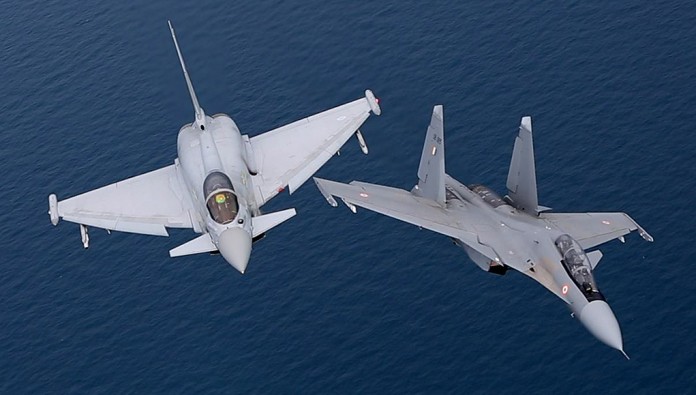
    Indian Air Force Su-30MKI and RAF Typhoon aircraft are operating in mixed formations as part of the fourth Indradhanush exercise, a 10 day deployment demonstrating trans continental air power projection. This year the deployment includes 190 personnel operating Su-30 fighters, IL-78 tankers, C-17 strategic and C-130J tactical airlift aircraft. Photo: RAF

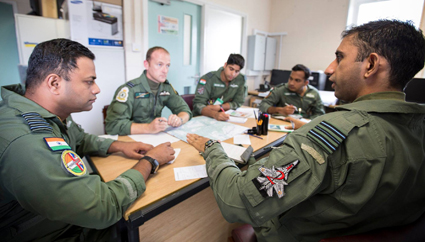
    A 190-member Indian Air Force contingent, operating four Su-30 fighters, an IL-78 tankers, one C-17 strategic transport aircraft and one C-130J tactical airlifter, is training in the UK this week as part of a ten-day long bilateral exercise ‘Indradhanush’.

    The exercise began July 21 and will last through the end of JUly. The goal of the exercise is to project air power in transcontinental deployment, as part of a task force comprising Su-30 MKI fighters, IL-78 tankers, C-17 strategic and C-130J tactical airlift aircraft.

    The exercise takes place in three air bases – Su-30 MKI are operating with the UK Royal Air Force (RAF) at RAF Coningsby, the C-17 and IL-78 transport aircraft are hosted at RAF Brize Norton and GARUD Special Forces C-130J operates from RAF Honington.

    The Su-30MKI from No. 2 Sqn (Winged Arrows) joined 3(F) Squadron at RAF Coningsby and fly with RAF Typhoon fighter aircraft, operating in mixed formations under various near-realistic scenarios.

    No. 2 Squadron is based at Kalaikunda Air Force Station, and specializes in close air support.

    The IL-78 and C-130J will also be inducted in missions along with the fighters. The C-130Js are operating with their RAF counterparts carrying out paradrops and tactical air supply missions.

    Jordan Received 16 AH-1F Cobra Gunship helicopters from Israeli Surplus

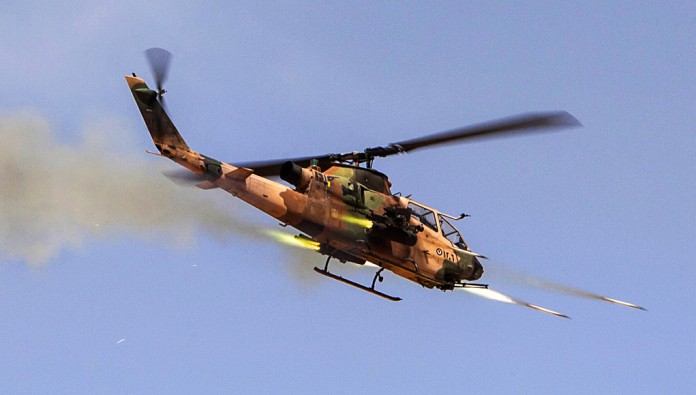
    A Royal Jordanian Air Force Bell AH-1F Cobra helicopter attacks targets during combined arms, live-fire training with U.S. Marines taking part in exercise Eager Lion 2014 held in Jordan, June 3, 2014. Photo: U.S. Marine Corps, by Sgt. Austin Hazard

    Israel has delivered 16 Cobra helicopter gunships to Jordan to help the Hashemite kingdom deal with the threat of Islamic State (ISIS) which currently control large areas along its borders with Syria and Iraq. The transfer provided at no cost was kept in secret since last year but was recently leaked by an unnamed U.S. official and published by Reuters. Jordanian and Israeli officials declined comment, as did the Pentagon.

    The handover of helicopters was approved by Washington, after blocking an earlier Israeli plan to sell the surplus helicopters to Nigeria, which is also battling Islamic insurgents in Central Africa. The Israeli helicopters were refurbished by the US Army before their transfer to Jordan.

    Israel Ministry of Defense placed those helicopters on its surplus list since 2013, after the Israeli Air Force retired the AH-1F in favor of unmanned aircraft. Jordan is currently operating 32 Bell AH-1F Cobra gunships. Jordan is frequently modernizing its armed forces with surplus aircraft – many of the F-16s operated by the RJAF were acquired from European air forces, including the Netherlands and Portugal. As part of these transactions some of the aircraft are maintained in flying conditions and others are used for spares.

    Jordan itself hand over its aging aircraft to other countries. In 2010 the Royal Jordanian Air Force transferred 16 of its older AH-1F gunships to Pakistan, under a US sponsored support program that provided Islamabad with 40 refurbished helicopters. Only 20 of the 40 helicopters were intended for operational use, while the remaining helicopters were cannibalized for spare parts.

    Israel originally had two Cobra squadrons – each consisting of around 30 of the aircraft. One of the squadrons was disbanded in the mid-2000s and the other in 2013, as the Israel Air Force transferred most of their missions to pilotless drones.

    Russia Maintains a Squadron of 10 Ships in the Mediterranean

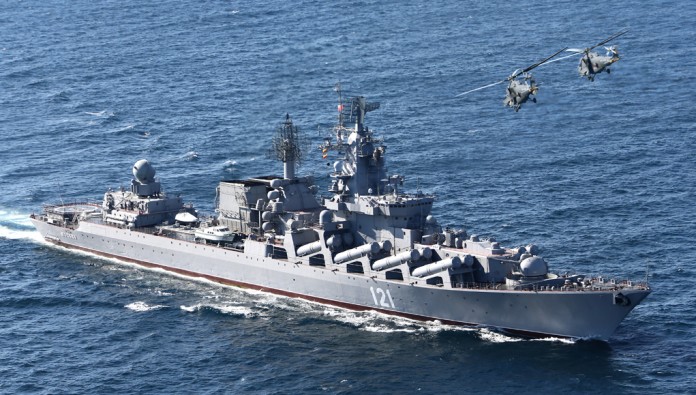
    The Russian Navy has squadron of ten vessels permanently patrolling the Mediterranean Sea, Russian Black Sea Fleet Commander Admiral Alexander Vitko told reporters on Thursday in Sevastopol. Ships of the Pacific, Northern, Baltic and Black Sea fleets make up the squadron on a rotation basis.

    “Since the end of 2012, an average of 10 ships and auxiliary vessels from the Black Sea, Baltic and Northern fleets are permanently in the Mediterranean Sea” Vitko said. These operations are commanded by the Black Sea Fleet, supporting this operation with warships and auxiliary vessels, Vitko said. The squadron is supported from the naval facilities located in the Black Sea (Novorossiysk and Sevastopol) and the port of Tartus in Syria. A recent agreement with Cyprus paves the way for Russian naval ships to use Cypriot ports as well.

    Last month four Russian naval vessels conducted a joint exercise with the Egyptian Navy, under the ‘Friendship Bridge 2015’ exercise that involved the Moskva guided missile cruiser and the Samum guided missile corvette, and Egyptian frigates Taba and Sharm El-Sheikh. The Egyptians also deployed F-16 jet fighters to simulate air attacks.

    SM-2 Missile Explodes Shortly After Launch from a Guided Missile Destroyer

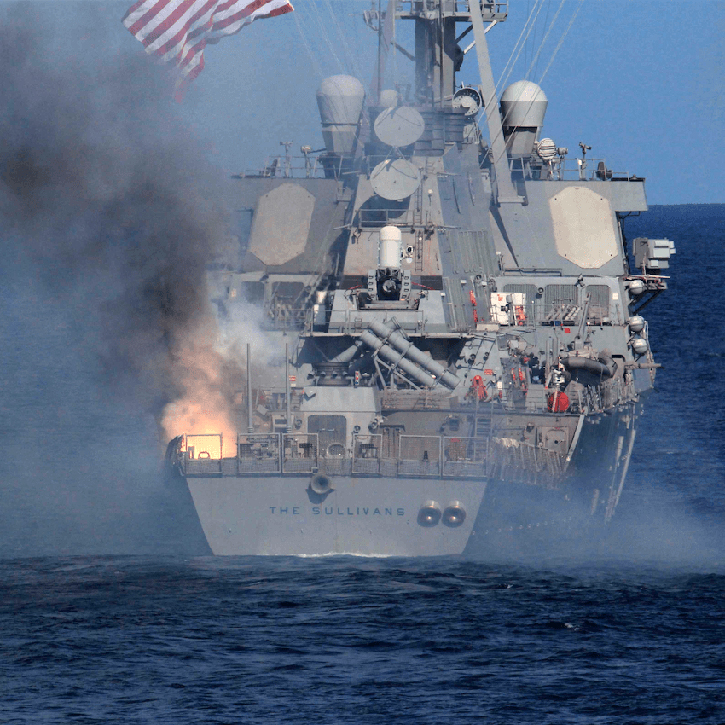
    The resulting fire on USS The Sullivans (DDG-68) following the explosion of a Raytheon SM-2 Block IIIA guided missile. Photo: US Navy, courtesy of USNI News
    The resulting fire on USS The Sullivans (DDG-68) following the explosion of a Raytheon SM-2 Block IIIA guided missile. Photo: US Navy, courtesy of USNI News

    A US Navy guided missile destroyer was damaged by a surface-to-air missile that exploded shortly after launch during an exercise off the U.S. Atlantic coast on Saturday USNI Reports.

    The US Navy confirmed that a Raytheon made Standard Missile-2 (SM-2) test missile exploded after suffering a malfunction as it was fired from the guided-missile destroyer USS The Sullivans (DDG 68) during a planned missile exercise off the coast of Virginia. There were no injuries and only minor damage to the port side of the ship resulting from missile debris. The ship returned to Naval Station Norfolk for assessment.

    The Navy said an investigation into the malfunction has been ordered and is being conducted by the Navy’s Program Executive Office for Integrated Warfare Systems, which is part of Naval Sea Systems Command. It is too early to determine what, if any, effect this will have on the ship’s schedule.

    Network Provides Common Vision for Sensors, Aircraft and Weapons

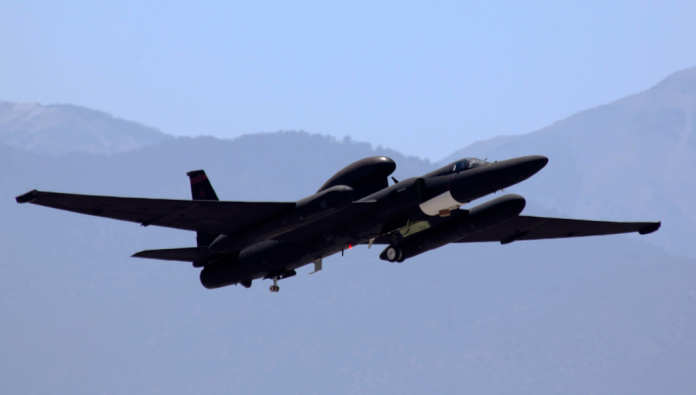
    A mission-ready U-2 Dragon Lady acts as the airborne communications gateway between multiple assets during a recent Lockheed Martin Open Mission Systems flight test demonstration. Photo: Lockheed Martin

    Lockheed Martin successfully integrated and flight tested seven Open Mission Systems (OMS) payloads in a span of less than three months into a  U-2 Dragon Lady , marking the corporation’s sixth demonstration flight in support of the U.S. Air Force’s OMS vision.

    “This demonstration focused on communications relay capabilities and dynamic weapon retargeting within an OMS integration methodology,” said   John Clark , director of Lockheed Martin’s Advanced Development Programs (the Skunk Works). “This demonstration showed our ability to integrate mission capability rapidly and affordably while highlighting how the OMS standard provides the Air Force a mechanism to own the technical baseline for their future systems.”

    This demonstration focused on communications relay capabilities, dynamic weapon retargeting and methodology. Multiple radios and associated waveforms were integrated with the U-2, which served as a communications gateway between an F-22, F-18s and a Long Range Anti-Ship Missile (LRASM) surrogate platform. Furthermore, fifth and fourth generation fighter data and U-2 onboard Intelligence, Surveillance and Reconnaissance and Electronic Warfare systems data were relayed to both a Rover ground terminal and the Common Mission Control Center, allowing the LRASM surrogate to be dynamically retargeted in midflight.

    Additionally, the U.S. Air Force’s 76th Software Maintenance Group developed and flight tested a software application designed to operate in the Skunk Works   mission management software suite.

    This flight test is part of a series of tests that demonstrate the power of the Lockheed Martin Open Architecture approach combined with the Air Force OMS standards. The stability of the entire OMS mission package was proven, as no software or subsystem resets were required during the flight.

    The flight’s success is a significant step toward risk reduction for future system-of-systems hardware and software developed to follow OMS standards.

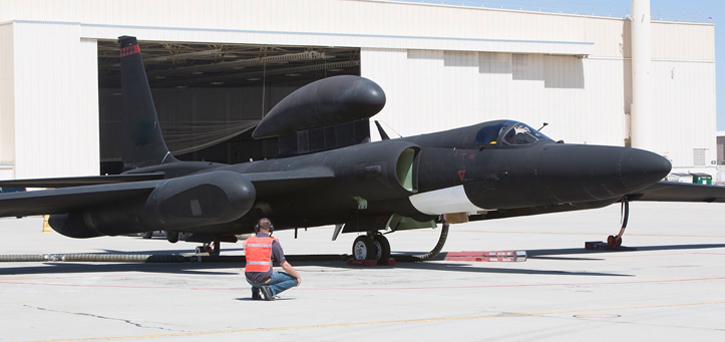
    A technician completes final pre-flight checks on a U-2 Dragon Lady before an Open Mission Systems demonstration flight in which fighter aircraft from multiple generations and services exchange penetrating Intelligence, Surveillance, and Reconnaissance, Electronic Warfare and signals intelligence data. Photo: Lockheed Martin
    A technician completes final pre-flight checks on a U-2 Dragon Lady before an Open Mission Systems demonstration flight in which fighter aircraft from multiple generations and services exchange penetrating Intelligence, Surveillance, and Reconnaissance, Electronic Warfare and signals intelligence data. Photo: Lockheed Martin

    Egypt Receives First Delivery of Three Rafales

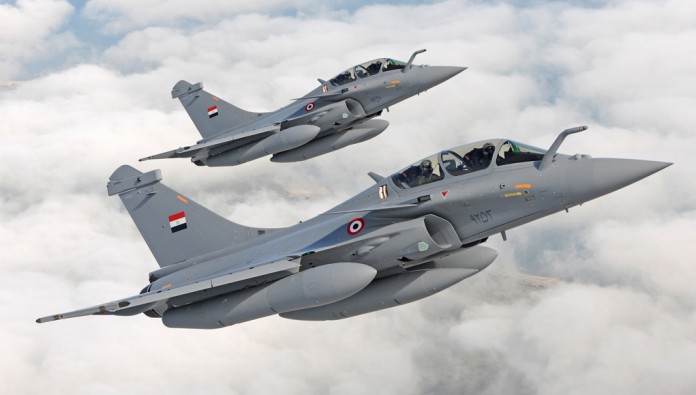
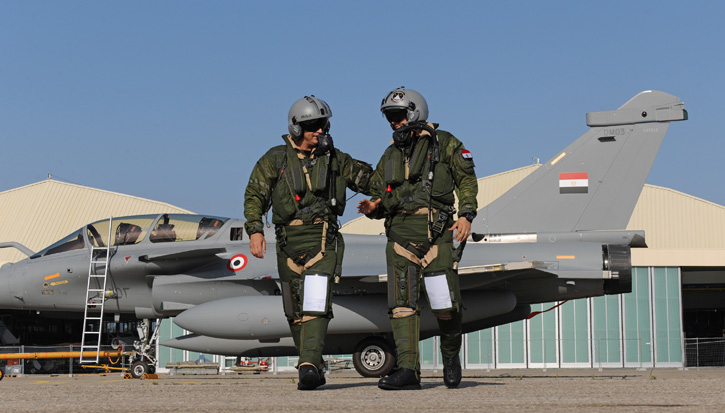
    Dassault Aviation officially delivered today to the Egyptian Air Force the first three Rafale fighter jets. The official ceremony was held today at the Dassault Aviation flight test center in Istres. This first delivery comes just five months after the Egyptian decision to acquire 24 Rafales (16 two-seaters and 8 single-seaters) in order to equip its Air Force with a latest-generation multi-role fighter capable of meeting the country’s operational requirements and enabling Egypt, with full sovereignty, to secure its geostrategic position in the region. Egyptian pilots, trained by the French Air Force, will fly the three two-seater aircraft to Cairo. The new fighters are expected to take part in the inauguration of the expanded Suez Canal, August 6th.

    The Rafale continues a long tradition of French aircraft serving in the Egyptian Air Force. “This contract constitutes a new milestone in the cooperation between Dassault Aviation and Egypt since the 1970s – more than 40 years of an exemplary partnership marked by commitment and mutual trust. After the Mirage 5, the Alpha Jet and the Mirage 2000, the Rafale is the fourth Dassault aircraft to fly in Egyptian colors,” said Dassault Chairman and CEO Eric Trappier.

    “Egypt is the first export customer for the Rafale, as it was for the Mirage 2000. We are very pleased with this partnership, which over time has shown its solidity and ensured the durability of the historical links between our two countries.” Trappier continued.

    For Egypt, the agreement is also a show of support for President Abdel Fattah al-Sisi, who overthrew his Islamist predecessor in 2013 and wants to break a US monopoly over arms sales to Cairo. The overall deal with Egypt also includes contracts for missiles and for an FREMM multi-mission frigate from naval group DCNS.

    Trappier said the number of annual Rafale deliveries would increase from 2018, adding that the rate could at least double from a current 11. He reaffirmed that he expected to sign a contract for 36 Rafale jets with India in coming months after negotiations began in April.

    Egyptian pilots, trained by the French Air Force, will fly the first three aircraft to Cairo. The new fighters are expected to take part in the inauguration of the expanded Suez Canal, August 6th. Photo: Dassault Aviation
    Egyptian pilots, trained by the French Air Force, will fly the first three aircraft to Cairo. The new fighters are expected to take part in the inauguration of the expanded Suez Canal, August 6th. Photo: Dassault Aviation

    Cyber Intelligence Report – July 15, 2015

    cyber_report

    ISRAEL

    Israel-US to Cooperate on Cybersecurity

    The Deputy Secretary of the US Department of Homeland Security, Alejandro Mayorkas, announced he will work to promote the US-Israeli cybersecurity relationship. At a signing ceremony to be held in Tel Aviv, Mayorkas will sign a new agreement to expand cooperation, research, and development between the two countries in the area of cybersecurity. In addition, law enforcement cooperation and aviation security measures will also be discussed between the parties.

    Israel Police, Defense Ministry mulled buying spyware, Hacking Team leak reveals

    Officials in the Israel Police, Defense Ministry, and Israeli defense electronics firm Elta were looking into purchasing spyware from the Italian firm Hacking Team, documents revealed Wednesday after Hacking Team itself was hacked. It is not clear whether the programs were purchased or used.

    Cyber security company SafeBreach raises $4m

    Israel cyber security company SafeBreach has raised $4 million from Sequoia Capital and serial entrepreneur and angel Shlomo Kramer. Following the investment, Sequoia partner Gili Raanan will join SafeBreach’s board of directors. The investment is the first for SafeBreach, which plans to use the money from the financing round to expand its development in Israel and its North American business.


    USA & Canada

    FBI disapproves encryption of commercial products

    James Comey, the director of the Federal Bureau of Investigation (FBI), recently expressed his disapproval in Silicon Valley’s hesitance to comply with the government in regards to encryption on products. A number of these leading firms have opted to encrypt their products in the interest of their clients’ privacy. With privacy being one of the outstanding social issues within the US, Comey defended the government’s shadowing by example of the Islamic State’s use of recruitment through social media, new platform, and encryption through smartphones. While traditional cell phone companies do not provide encryption for their products, iPhones and Androids have automatic data encryption tools. The government is seeking a “back-door” into these encrypted products. Comey suggested that if action is not taken by these companies, the US Congress will take action. The FBI is not the only government agency searching to secure the cyber world.

    US Senate bill would make social media report ‘terrorist activity’

    Twitter, Facebook, YouTube, and other social media operators would have to notify federal authorities of online “terrorist activity,” according to the text of a bill approved by the Senate Intelligence Committee and seen by Reuters on July 8th. The types of communication include postings related to “explosives, destructive devices, and weapons of mass destruction,” according to the text.  The main purpose is to give social media companies additional legal protection if they reported to the government on traffic circulated by their users (to prevent the use of their systems by violent militants), rather than coerce them to spy on users. It is unclear when the Senate might vote on the bill and whether the House of Representatives would pursue similar legislation, which would be necessary for the proposed requirement to become law. “We share the government’s goal of keeping terrorist content off our site,” Facebook’s Head of Policy Management Monika Bickert said in a statement. A representative of Twitter saidt her company had not taken a position on the legislation. Google did not immediately respond to requests for comment.


    RUSSIA

    New hacking spyware systems for Russian intelligence agencies

    Russian government intelligence agencies acquire hacking spyware systems in open markets. As it became known to Forbes magazine, among the buyers of spyware “Remote Control System,” developed by “Hacking Team” appeared Russian Government Agencies. Recently, unidentified hackers broke into the company’s customer database, and among its customers were Russian Security Services. As it became known, the Russian Security Services, in order to hide their identity, were acquiring the software products through surrogates. In this case, the Services used company named “Quantum,” which is owned by Russian defense giant “Rostec.”


    MIDDLE-EAST

    UAE and US launch center for anti-IS online propaganda in Abu Dhabi

    On July 8th, the US and Emirati governments launched a new Mideast digital communications center focused on using social media to counter the Islamic State group’s messaging online for recruiting and drawing support from plugged-in young Muslims. The new Sawab Center is based in Abu Dhabi, the capital of the United Arab Emirates, a key American ally and a member of the US-led coalition against the IS group. The center’s aim is to support coalition efforts, challenge IS propaganda, and amplify moderate and tolerant voices from across the region. It could also serve as a template for similar centers elsewhere. The center released YouTube videos and Twitter messages in Arabic and English announcing its launch. The United States has also been expanding an existing US State Department division set up in 2011 known as the Center for Strategic Counterterrorism Communications. Its responsibilities include countering jihadist messages online and coordinating American counterterrorism messaging efforts.


    CHINA and APAC

    Draft of Chinese cybersecurity law

    On July 6th, China’s Parliament published a draft cybersecurity law that consolidates Beijing’s control over data, with potentially significant consequences for Internet service providers and multinational firms doing business in the country. This law strengthens user privacy protection from hackers and data resellers but simultaneously elevates the government’s power to access, obtain records, and block dissemination of private information deemed illegal under Chinese law. Internet service providers and companies must store data collected within China on Chinese territory, and this could make it hard for foreign hardware vendors to do business; data stored overseas for business purposes must be government-approved. Network equipment must also be approved under testing standards issued by China’s cabinet. The government also reiterated its longstanding objective of requiring Internet users to log in with their real names to services like messaging apps – though such drives have failed in the past. Parliament will take feedback on the proposed legislation until August 5th.

    Australia’s first Cyber Security Summit with business leaders

    The Prime Minister chaired Australia’s first Cyber Security Summit with CEOs and Chairmen on July 8, 2015, in Sydney, hosted by the Business Council of Australia. The Prime Minister, business leaders, and members of the Review’s Expert Panel discussed cyber threats affecting Australia and what can be done about them. A focus was on the importance of leadership – cyber security is an issue for executives and boards, not just an IT issue for technical experts. The Summit also discussed some of the ideas for practical improvement to Australia’s cyber security. This included the government and businesses working together to improve cyber threat sharing, address Australia’s cyber security skills shortages, and increase opportunities for Australia’s businesses online, including growing Australia’s cyber security industry. The Government’s Cyber Security Strategy will be released in the coming months and is an important step toward building a secure online economy for all Australians.


    EUROPE

    German-owned Patriot missiles stationed in Turkey briefly taken over by hackers

    The attack took place on anti-aircraft ‘Patriot’ missiles on the Syrian border. The American-made weapons had been stationed there by the Bundeswehr (German army) to protect NATO ally Turkey. According to the civil service magazine, the missile system carried out “unexplained” orders. It was not immediately clear when these orders were carried out and what they were. The magazine speculates about two weak spots in the missile system, which could be exploited by hackers. One such weakness is the Sensor-Shooter-Interoperability (SSI), which exchanges real time information between the missile launcher and its control system. The second exposed point is a computer chip that controls the guidance of the weapon. Attackers might have gained access in two different ways, one that takes over the operating of the missile system and one that steals data from it.

    UK intelligence agencies used hacking to counter Northern Ireland terrorism

    The British government has recently admitted that the intelligence agencies including MI5 and MI6 have used hacking techniques in order to investigate computer systems and phones of dissident republicanism regarding the 20 terrorist attacks in 2014. Furthermore in a report published by the Independent Reviewer of Terrorism Legislation, it has been explained that the Darknet is a great network for dissidents, including the Irish and Chinese. The report also claims that several authorities are intercepting citizens’ communications and data by using legal ways not related to the Regulation of Investigatory Powers Act 2000, which was supposed to regulate these kinds of operations. Out of the 20 terrorist attacks attempts in 2014, only a few were successful. However, the Director General of MI5 Andrew Parker has said that “for every one of those attacks, we and our colleagues in the police have stopped three or four others coming to fruition.” Like the United States, the UK is using cyber methodologies in order to counter threats and found ways of bypassing the surveillance act regulation. Similar to the United States, the UK is allowed to perform surveillance on UK citizen but only in specific circumstances.

    Germany launches new National Cyber Security Policy

    In order to increase the level of its cyber security, Germany has recently decided to pass a new legislation regarding the level of information security in the country. This new law, which will be fully approved by the German Parliament on July 16th, will request the 2000 service providers in the country to implement a minimum information security policy or get a $111,000 fine if they do not do it within two years. Furthermore, the Bundesrat will obligate companies and federal agencies to certify a certain level of cyber-security standards and obtain Federal Office of Information Security clearance. The companies will also have to report any suspected cyber-attacks on their systems. This legislation is a decision taken by the German government in order to counter cyber threats. Indeed after having been victim of several cyber-attacks against its critical infrastructures, including Parliament, industrial, and financial systems, Germany needs to increase the level of its cyber security and take such measures to protect its critical infrastructures and ensure better security to the country.


    inss150About the Cyber Intelligence Report:

    This document was prepared by The Institute for National Security Studies (INSS) – Israel and The Cyber Security Forum Initiative (CSFI) – USA to create better cyber situational awareness (Cyber SA) of the nature and scope of threats and hazards to national security worldwide in the domains of cyberspace and open source intelligence. It is provided to Federal, State, Local, Tribal, Territorial and private sector officials to aid in the identification and development of appropriate actions, priorities, and follow-on measures. This product may contain U.S. person information that has been deemed necessary for the intended recipient to understand, assess, or act on the information provided. It should be handled in accordance with the recipient’s intelligence oversight and/or information handling procedures. Some content may be copyrighted. These materials, including copyrighted materials, are intended for “fair use” as permitted under Title 17, Section 107 of the United States Code (“The Copyright Law”). Use of copyrighted material for unauthorized purposes requires permission from the copyright owner. Any feedback regarding this report or requests for changes to the distribution list should be directed to the Open Source Enterprise via unclassified e-mail at: [email protected]. CSFI and the INSS would like to thank the Cyber Intelligence Analysts who worked on collecting and summarizing this report.


    Explosion in Turkey, Close to the Syrian Border Kills 27

    A still taken from a video shot at the moment of the detonation in Suruc. Photo via Daily Telegraph
    A still taken from a video shot at the moment of the detonation in Suruc. Photo via Daily Telegraph
    A still taken from a video shot at the moment of the detonation in Suruc.

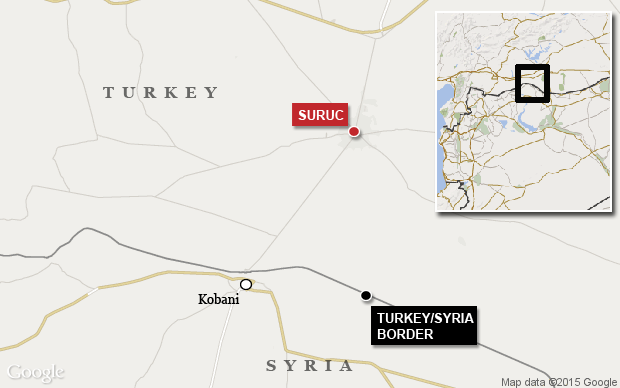
    An explosion ripped through a rally Monday in the Turkish border town of Suruc, leaving at least 27 people dead and wounding 100 others Authorities blamed the attack was a terrorist attack but did not specify which terror group was behind it, the country’s Interior Ministry said. Turkish officials have said the evidence they have suggests the attack was a suicide bombing carried out by Islamic State, Reuters reported.

    The location of the attack is close to the town of Kobani on the Syrian border, where Druze managed to drive ISIS out of the beleaguered town few months ago.
    The location of the attack is close to the town of Kobani on the Syrian border, where Druze managed to drive ISIS out of the beleaguered town few months ago.

    The explosion occurred at midday at the Amara Cultural Park in Suruc, where a group had gathered Suruc is across the border from that Syrian city, which was the scene of intense fighting between Syrian rebels and Kurdish forces and ISIS.

    Lockheed Martin to Buy Sikorsky Aircraft for US$7.1 Bn

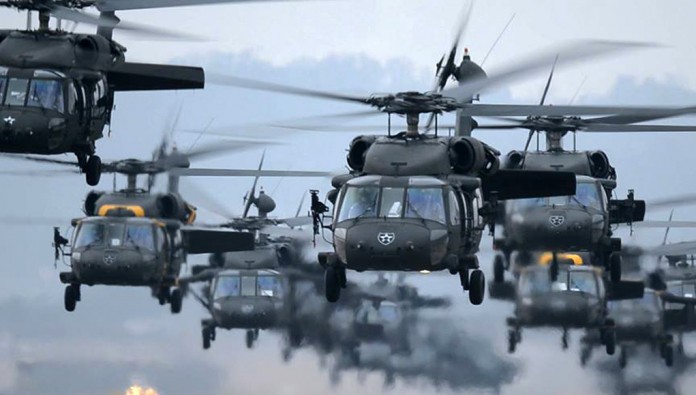
    25 UH-60 Black Hawk helicopters from 2nd Battalion (Assault), 2nd Aviation Regiment and 3rd General Support Aviation Battalion, practice an air assault in South Korea. Photo: Christopher Bodin

    Lockheed Martin Corp has agreed to buy United Technologies Corp’s (UTC) Sikorsky Aircraft for over $7.1 billion, US news agency Reuters reported on Sunday. Such a deal would enhance Lockheed Martin’s dominance in the aerospace market, while adding a civil element to its defense-oriented portfolio. The demand for military and civil helicopters has softened in recent years, primarily due to reduction in demand from the military and offshore operators in the oil and gas business.

    next_generation_raider725
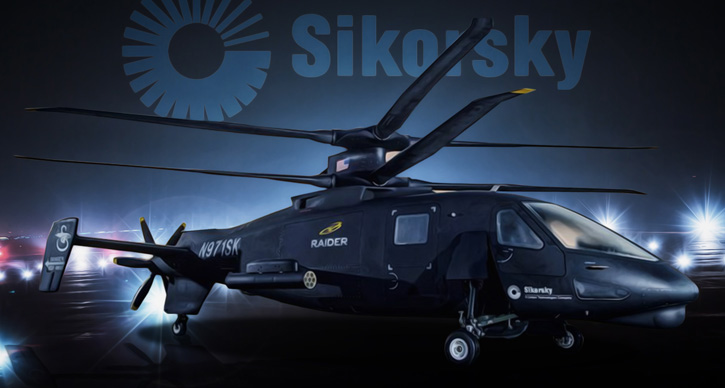
    Lockheed’s main competitor Boeing, which also competes with Sikorsky with its heavy lift and tilt-rotor aircraft, has teamed up with Sikorsky to develop a next-generation helicopter for the U.S. military.

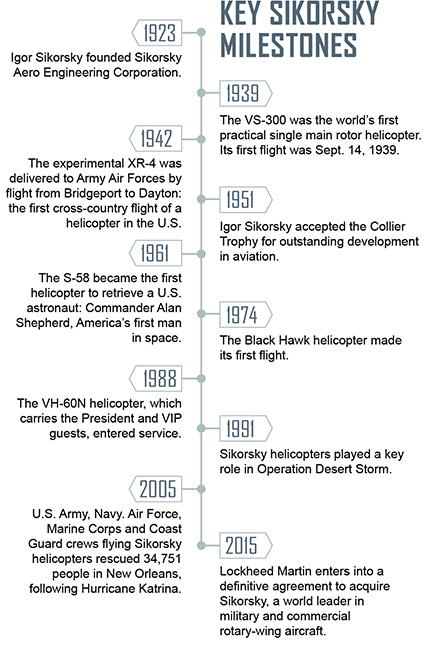
    sikorsky-timeline

    Lockheed is likely to preserve the Sikorsky brand and business operation instead of integrating it into its already huge Aeronautics division, which had revenues of over $14 billion last year.
    United Technologies and Lockheed officials declined comment. If approved, it will be the largest acquisition of Lockheed martin since it bought Martin Marietta Corp for about $10 billion two decades ago.

    UTC in March said it would explore alternatives for Sikorsky, which accounted for $7.5 billion in sales last year out of total UTC revenues of $65 billion. In June, it said it would exit the helicopter business and sell or spin off Sikorsky, which expects slower revenue growth and has lower profit margins than other UTC divisions. Sikorsky’s first-quarter operating profit dropped 11 percent on a 7 percent fall in sales. In June, the unit announced 1,400 job cuts and said it would consolidate facilities.

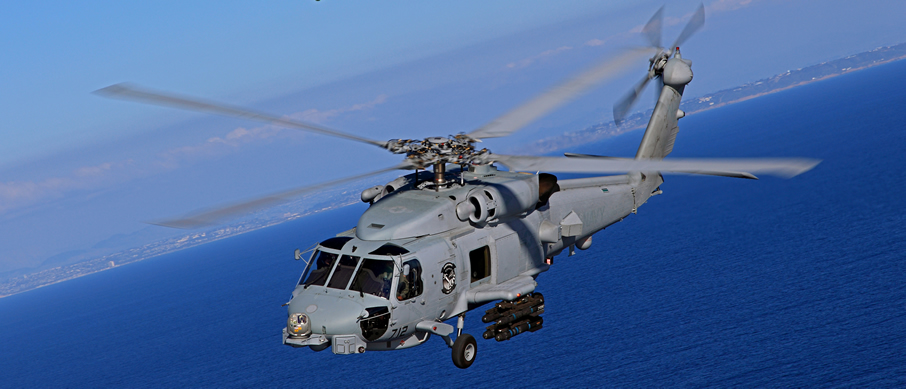
    Lockheed Martin and Sikorsky Aircraft have already cooperated in several projects, primarily the naval Anti Submarine and Surface Warfare (ASuW) MH-60R program for the US Navy. Lockheed’s main competitor Boeing, which also competes with Sikorsky with its heavy lift and tilt-rotor aircraft, has teamed up with Sikorsky to develop a next-generation helicopter for the U.S. military.

    As for UTC, Cutting ties to Sikorsky will let the company focus on divisions making jet engines, air conditioners and elevators while exiting the very different business of supplying rotary-wing aircraft to the U.S. and foreign armed forces.

    Lockheed Martin expects to deliver the first two completed MH-60R aircraft of an eventual 24 to the Australian Navy in the first quarter of 2014. Photo: Lockheed Martin
    Lockheed Martin and Sikorsky teamed to deliver the MH-60R Anti Submarine and Anti Surface Warfare helicopterAustralia was the first foreign customer to receive the helicopter in 2014. Photo: Lockheed Martin

    Machines Making Machines: Printing Missiles

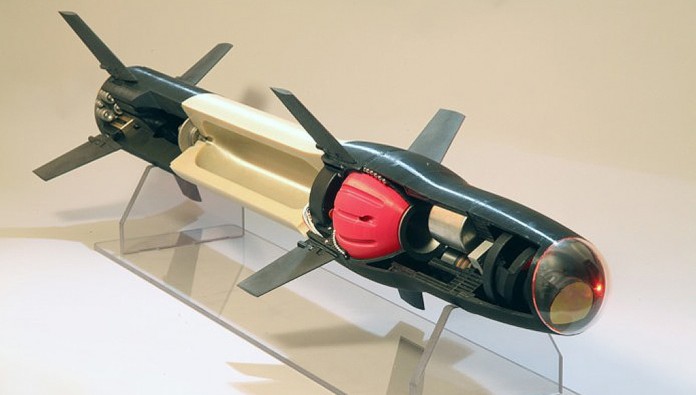
    A cutaway model showing the printable components of a small missile. Photo: Raytheon

    Researchers at Raytheon Missile Systems say they have already created nearly every component of a guided weapon using additive manufacturing, more commonly known as 3-D printing. With commercially available high-end equipment and specially modified versions of low-cost 3-D printers, company researchers have created nearly every component of a guided weapon using 3-D printing, including rocket engines, fins, parts for the guidance and control systems, and more.

    “You could potentially have these in the field,” said Jeremy Danforth, a Raytheon engineer who has printed working rocket motors. “Machines making machines. The user could [print on demand]. That’s the vision.”

    The progress is part of a company wide push into additive manufacturing and 3-D printing, including projects meant to supplement traditional manufacturing processes. Engineers are exploring the use of 3-D printing to lay down conductive materials for electrical circuits, create housings for the company’s revolutionary gallium nitride transmitters, and fabricate fins for guided artillery shells.

    The process may reduce costs associated with traditional manufacturing, such as machining of parts. It allows for quick design and rapid changes because engineers only need change the digital model representing the part. As long as they stay within set parameters, they can have new parts in hours instead of weeks.

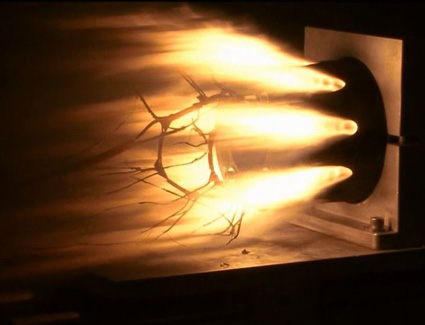
    An array of mid-missile rocket boosters built with 3-D printing fire in this image taken from video. Photo: US Army
    An array of mid-missile rocket boosters built with 3-D printing fire in this image taken from video. Photo: Raytheon

    “You can design internal features that might be impossible to machine,” said Raytheon engineer Travis Mayberry, who is researching future uses of additive manufacturing and 3-D printing. “We’re trying new designs for thermal improvements and lightweight structures, things we couldn’t achieve with any other manufacturing method.”

    One of the new areas in weapon 3D printing is warhead design and manufacturing. Warhead designers attempt to create blast effects that meet specific criteria. “Once you get into detonation physics you open up a whole new universe,” James Zunino, a materials engineer for the U.S. Army Armament Research, Development and Engineering Center (ARDEC) said.

    The limits on what can be produced using machine tools limit warhead shapes. By lifting limitations through the expanded capabilities that come with additive manufacturing, space is used more efficiently. “The real value you get is you can get more safety, lethality or operational capability from the same space,” Zunino said.

    These innovative additive manufacturing processes bring together printed metals, printed energetics and other materials, layered onto substrates into the components that comprise an “initiation train” in explosive warheads. “You can vastly simplify the manufacturing of energetic materials by printing them,” Zunino said.

    A major contribution of 3-D printing is its potential to streamline the manufacturing process, said Leah Hull, additive manufacturing manager for Raytheon.

    “When we print something, we have fewer piece parts, so your supply chain becomes simpler,” Hull said. “Your development cycles are shorter; you’re getting parts much faster. You can get a lot more complex with your design because [you can design] angles you can’t machine into metal.”

    “Ensuring consistent production integrity will be part of the next steps to realize this vision,” said Dr. Teresa Clement, a Raytheon materials expert who also serves as the chair of the executive committee of America Makes, an initiative of the National Additive Manufacturing Innovation Institute.

    Other printed elements include complex electronic circuits – Engineers at the Raytheon University of Massachusetts Lowell Research Institute are developing ways to print such circuits, particularly microwave components – the building blocks of sophisticated radars. The current method of building microscopic circuits involves removing material to create a circuit pathway. In contrast, 3-D printing lays down just the material needed to build the electronic pathway.

    “The word ‘printing’ implies lower cost,” said Chris McCarroll, Raytheon director for the institute. “It’s additive manufacturing. When we make integrated circuits [now], it’s all subtractive. We put down very expensive materials and wash away everything we don’t need.”

    Circuits can already be printed with inkjet printers. The goal is to print more complicated circuits in three dimensions, with the very high resolution and performance of silicon.

    “There’s currently a hierarchy in our manufacturing. We make the structures, the housings, the circuit cards, with the right materials, and then we integrate them into a system,” said McCarroll. “What we see in the near future is printing the electronics and printing the structures, but still integrating. Eventually, we want to print everything together. An integrated system.”

    Engineers at the research institute are already able to lay down the conductors and dielectrics needed for printed electronics. They can even lay down carbon nanotubes, tiny structures made of linked carbon atoms, and are working to align them to build futuristic circuits, according to McCarroll.

    So could soldiers someday print and assemble missiles on the spot, in the same way that artillery crews custom-load their rounds or weapons handlers mount guidance kits on some types of bombs? McCarroll said that’s still a ways off.

    “Before a warfighter can print a missile in the field,” he said, “you need quality, controlled processes to fabricate all the component materials: the metallic strongbacks, and the plastic connectors, the semiconductors for processors, and the energetics and propulsion systems. The hard part is then making the connections between these components, as an example, the integrated control circuit that receives the command to light the fuse. At some relatively near-term point you may have to place chips down and interconnect them with printing. Or, in the future, maybe you’ll just print them.”

    “We are printing demos of many of the seeker components. And we demonstrated a printed rocket motor. We’ve already printed 80 percent of what would go into a missile” said Danforth.

    3D printing of missiles and warheads will allow engineers to utilize complex geometries and patterns that previously could not be produced or manufactured, driving missiles and warheads to be lighter, smaller, more compact and more affordable. It will also enable focused lethality, rendering warheads more effective, thus reducing collateral damage risk.

    Gaza Blast Hit Hamas, Islamic Jihad Vehicles

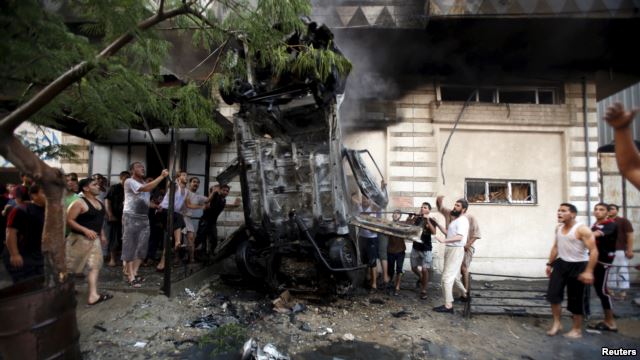
    A blast that rocked Gaza today is likely part of a power struggle in Gaza, between Hamas, Islamic Jihad militants and new factions affiliated with ISIS, infiltrating the Gaza strip from neighboring Sinai. Photo: Reuters

    A blast that rocked Gaza today is likely part of a power struggle in Gaza, between Hamas, Islamic Jihad militants and new factions affiliated with ISIS, infiltrating the Gaza strip from neighboring Sinai. Photo: Reuters
    A blast that rocked Gaza today is likely part of a power struggle in Gaza, between Hamas, Islamic Jihad militants and new factions affiliated with ISIS, infiltrating the Gaza strip from neighboring Sinai. Photo: Reuters
    A series of blasts rocked the Gaza district of Sheikh Radwan, a Hamas stronghold. The blasts wounded two people and destroyed at least five cars belonging to Hamas and Islamic Jihad militants.

    There was no immediate claim of responsibility. However, pictures at the scene of one of the blasts showed the Islamic State group’s flag painted on a wall.

    The blasts come amid a power struggle between Hamas and Islamist extremist groups in Gaza.

    Police Arrests Three Frenchmen for Plotting an Attack on a Commando Base

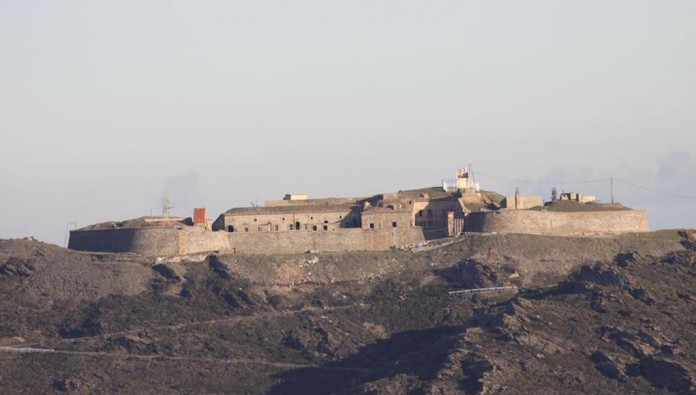
    Built in the nineteenth century, Fort Béar provides a training facility for the French Naval Commandos.
    Built in the nineteenth century, Fort Béar,  overlooking the town of provides a training facility for the French Naval Commandos.
    Built in the nineteenth century, Fort Béar, overlooking the town of Port-Vendres provides a training facility for the French Naval Commandos.

    The French police interrupted plans of four Frenchmen who plotted to attack Fort Béar a French naval commando base near Port-Vendres. The perpetrators planned to capture and behead a military officer at the base. The team planned their attack after viewing Islamic State (IS) videos on the web and contacting an ISIS fighter in Syria. One of the suspects was released after being questioned, officials said. The others are detained and await trial, after having confessed to plotting the attack, the French authorities said.

    The selection of target seems odd, given the fortification and strong garrison at the base, which is the French national commando training center (CNEC), providing a training site for the French naval commandos. The investigation will look into the intentions of the attackers, assessing whether personal grudge was part and the motivation for the attack.

    The elder member of the group served at the base for one year, as a member of the French Navy. He was discharged in January 2015. According to French authorities, there was no suggestion at the time that he showed extremist tendencies. The youngest member of the team, a teenager, did enter the watch list after his mother reported his radicalization – he was spotted on social media for his “activism on social networks.” French officials noted.

    “The group became ‘strongly radicalized’, in particular by viewing I.S. videos.” the French prosecutor said. Living hundreds of kilometers apart, the four individuals joined together as a group online, where they were instructed by a Syrian member of the Islamic Republic to ‘hit targets in France’.

    Although the target and overall plan were set, the group has not obtained weapons and other means to carry out the attack at the time of their arrest. (Le Figaro)

    Skunk Works and XTEND Simplify Multi-Drone Command

    0
    Lockheed Martin Skunk Works® and XTEND have achieved a major milestone in JADC2 by integrating the XOS operating system with the MDCX™ autonomy platform. This technical breakthrough enables a single operator to simultaneously command multiple drone classes, eliminating the friction of mission handoffs. From "marsupial" drone deployments to operating in GPS-denied environments, explore how this collaboration is abbreviating the data-to-decision timeline and redefining autonomous mission execution.
    From Ukraine to Taiwan: The Global Race to Dominate the New Defense Tech Frontier

    0
    As traditional defense primes face mounting competition from agile “neoprimes” such as Anduril, Palantir and Helsing, the balance of innovation is shifting toward software-defined warfare and scalable, dual-use technologies, while global industry consolidation—marked by Boeing’s integration of Spirit AeroSystems and other strategic mergers—signals an intensified race to secure control over the defense technology value chain. Our Defense-Tech weekly report highlights these trends.

    Europe’s “Drone Wall”

    0
    In early October 2025, a coordinated wave of unmanned aerial system (UAS) incursions—widely attributed to Russia—targeted critical infrastructure across at least ten European nations. The unprecedented campaign exposed the fragility of Europe’s air defenses...

    Weekly Defense Update & Global Security Assessment

    0
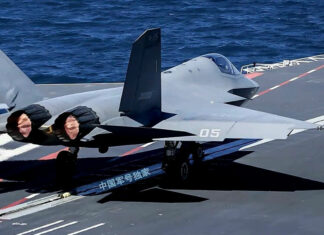
    Executive Summary The past week (September 18-25, 2025) represents an inflection point where strategic defense concepts have transitioned from doctrine to tangible reality. An analysis of global events reveals four primary, interconnected trends shaping an...

    U.S. Air and Space Forces Push Next-Gen Programs at the AS&C 2025 Conference and...

    0
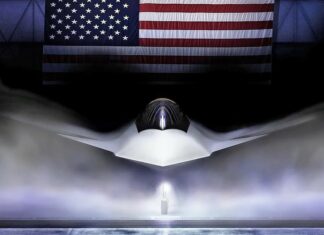
    At the 2025 Air, Space & Cyber Conference, U.S. Air Force and Space Force leaders unveiled major updates on next-generation fighters, bombers, unmanned systems, and space initiatives, highlighting both rapid innovation and critical readiness challenges as the services race to outpace global competitors. A short version is available here, with a more detailed version for subscribers.

    TADTE 2025: Reflecting Taiwan’s Strategic Themes

    0
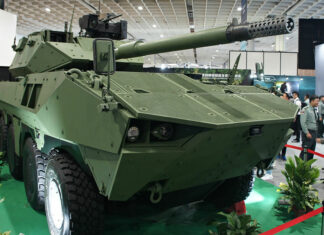
    The Taipei Aerospace & Defense Technology Exhibition (TADTE) 2025 crystallized around four dominant strategic themes that collectively illustrate Taiwan's comprehensive approach to defense modernization amid escalating regional tensions. Based on a detailed report by Pleronix (available upon request). Includes a Podcast discussion on TADTE 2025's highlighting Taiwan's four strategic themes beyond the post's coverage.

    Iron Beam 450 Completes Testing, Soon to Join With Operational Air Defense Units

    0
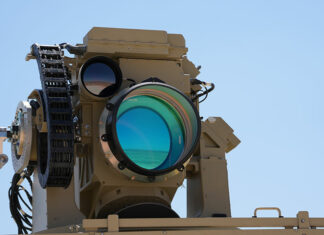
    Israel’s Iron Beam 450 high-power laser system has completed final testing, marking a major leap in air defense. Developed by Rafael, it offers precise, cost-effective interception of rockets, UAVs, and mortars, and is set for IDF deployment by 2025.