Elbit Systems JMUSIC DIRCM and PAWS EW systems. Photo: Tamir Eshel, Defense-Update
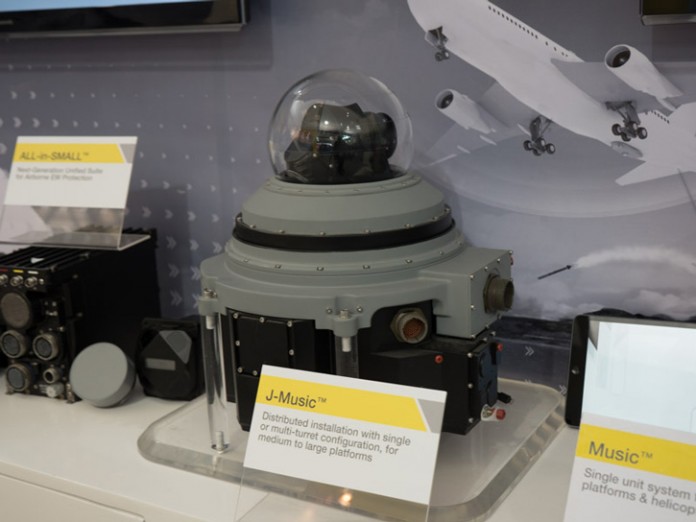
The new Mini-MUSIC is the newest member of the DIRCM family. Photo: Elbit SystemsElbit Systems Ltd. announced today that it recently was awarded two contracts for its MUSIC family of Directed Infra-Red Countermeasures (DIRCM) airborne multi-spectral self-protection systems, protecting aircraft and helicopters against IR guided air-to-air missiles (AAM) and infra-red guided Man Portable Air Defense missiles (MANPADS).
One of the orders, received from a NATO member European country, calls for the supply of C-MUSIC systems for an unspecified platform. “This new contract with the European NATO member country extends the number of platforms that will be equipped with our systems. We see a growing global demand for our DIRCM systems, which we believe address a strategic need for our customers”. Elad Aharonson, General Manager of Elbit Systems ISTAR Division commented.
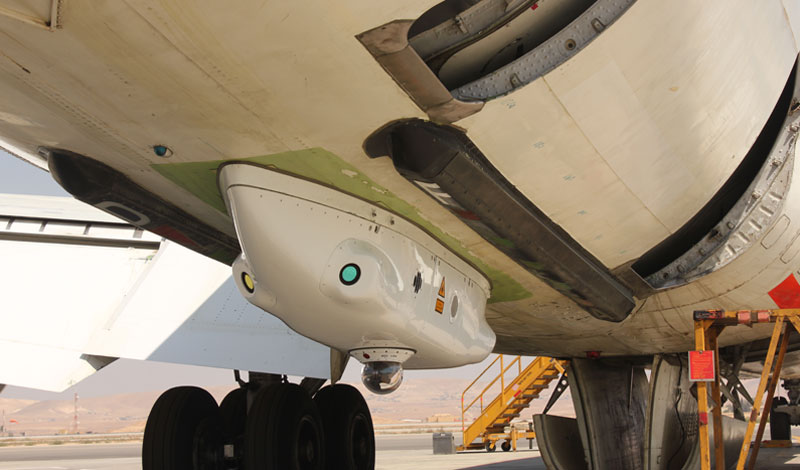
C-MUSIC was developed by Elbit Systems as a podded version of the DIRCM, that can be installed or dismounted from an aircraft on demand. The system is operational with Israel’s airlines, protecting aircraft flying to destinations where Israeli airliners could face potential threat of MANPADS.
The other is a follow-on contract from an Asian customer, acquiring the Mini MUSIC systems for the customer’s Blackhawk helicopter fleet. This is the second order awarded by this customer this year. Elbit Systems plan to deliver both systems this year.
Elbit Systems’ MUSIC family of DIRCM systems are under contract for numerous customers worldwide including the Israeli national program for protection of the commercial fleet for platforms such as the B747, B737, B757, B767, B777 and A320; the Italian Air Force for the C130J, C27J and CSAR AW101; the KC-390 for Embraer and the Brazilian Air Force; the German Air Force’s Airbus A400; Blackhawk helicopters for Asian customers, VIP helicopters and other aircraft.
C-MUSIC DIRCM pod installed on an IAF Boeing 707 tanker. Photo: IMOD
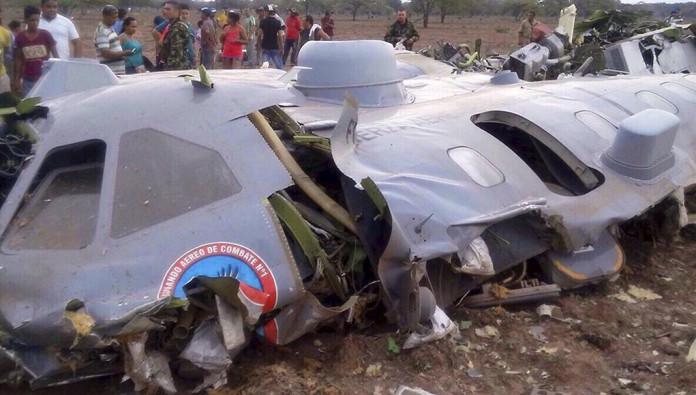
11 crew members that were on board the Colombian ECN235 ELINT aircraft on Friday killed when the aircraft crashed, after developing an engine problem. Photo: Colombian Air Force
A Colombian Air-Force ECN235 special-mission aircraft plane crashed on Friday in the north of the country, killing all 11 of those on board. The twin-engined transport plane came down in a rural area near the town of Codazzi, in Cesar province, having reported engine difficulties. Colombian media reported that local residents said the plane had been struck by lightning. An investigation into the cause of the crash has been ordered, says the commander of Colombia’s air force, Gen Carlos Bueno.
Colombia’s President Juan Manuel Santos described the victims as heroes. All of those killed were members of the Colombian air force.
The CN235 is manufactured by Airbus; the plane was produced in 1998 in Seville, Spain and was one of several aircraft converted to carry out Electronic Warfare missions (thus re-designated ECN-235). The disaster comes almost three months after a new Airbus A400M military transport plane crashed during a test flight in Spain, killing three people. That mishape was attributed to human errors related to engine control software issues.
Six bidders are likely to replay in the endless game -the 'mother of all defense deals' - can anyone say NO to the chance to win a $30 billion jackpot?
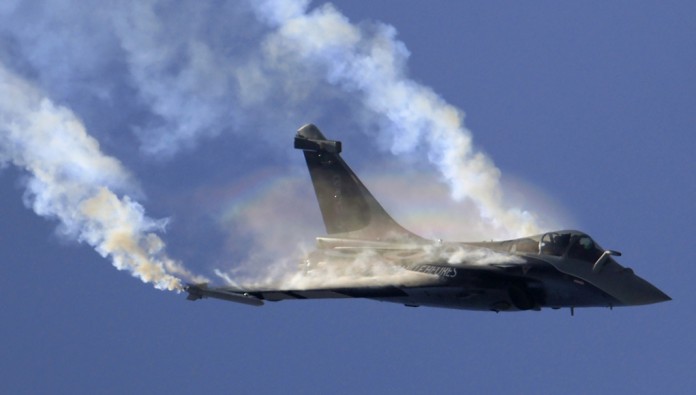
After selecting the Rafale in a direct buy from France and scrapping the Medium Multi-Role Combat Aircraft (MMRCA) tender for 126 aircraft, India is likely to recompete the program, inviting bidders to compete on the production of 90 fighter jets for the Indian Air Force. The Air Force requires at least 126 aircraft to replace aging fighter jets to be withdrawn from service in the coming decade. Although India agreed to buy 36 Rafales directly from France, the air force needs the remaining 90 aircraft to replace hundreds of its MiG-21, 27 and Jaguars reaching the end of their service life.
A Request for Proposal (RFP) is expected to be drafted soon after the new Defence Procurement Procedure (DPP) comes in place.
Although not as big as the original 126 aircraft MMRCA tender, the new program is expected to be one of the biggest projects under the ‘Make in India’ campaign, as the cost of the programme is expected to be around $30 billion. Out of the 90 aircraft, 54 will be single-seaters and the remaining 36 tandem-seaters. The base order will be for 90 aircraft with an option for 45 additional fighters as a follow-on order.
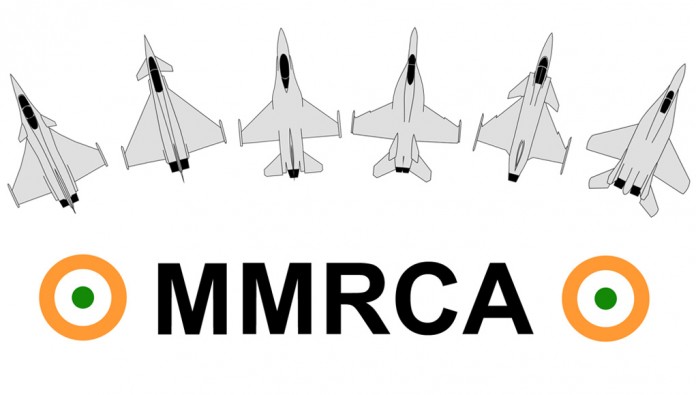
According to the sources, the RFP will recompete the types that have already been evaluated by the IAF. These included Russia’s MIG-35 (RAC MiG), Swedish Gripen, French Dassault Rafale, American Lockheed Martin F-16IN and Boeing’s F/A-18IN Super Hornet and Typhoon made by the European Eurofighter consortium.
BAE Systems has cut its production cost by 20 per cent while upgrading some features. Saab has also said there are chances for the re-introduction of Gripen in India, with Gripens offered under ‘Make-in-India’ or as new and assembled aircraft to India, to replenish obsolete fighters. Russian sources also claim Moscow is willing to put the Fifth Generation Fighter Aircraft FGFA) on the fast track, anticipating orders from New Delhi toward the end of the decade.
While the president of France and Indian Prime Minister agreed in principle on the supply of 36 French Dassault Aviation Rafale fighter jets to India, the contract nas not been signed yet, as the sides have not reached an agreement on the share of offset India will receive. France insists that the offset clause would raise the cost and delay deliveries. India demands a higher than regular level of 50 percent, rather that the standard 30 percent reinvestment required for large deals.
The multi-billion dollar tender for the 126 Medium Multi Role Combat Aircraft (MMRCA), for which Rafale was shortlisted in 2012, has been withdrawn by the government, after New delhi committed to buy only 36 of the aircraft in April this year. Defence sources said that a letter was sent out to the six vendors shortlisted for the RFP, informing that the tender stands withdrawn.
“In the multi-vendor procurement case, the Rafale aircraft met all the performance characteristics stipulated in the RFP during the evaluation conducted by the Indian Air Force,” defence minister Manohar Parrikar said in a written reply to Rajya Sabha. In April Parrikar indicated that the over $20 billion MMRCA tender has virtually been scrapped after the government decided to purchase 36 Rafales under a government-to-government contract.
India planned to buy 126 jet fighters for the replacement of its aging MiG-27, MiG-27 and Jaguar fighter jets. According to the plans, 108 of the aircraft would be produced in India and 18 to be imported. The procurement of 36 Rafales, to be built in France will meet only a small part of gap the Indian Air Force has in its fighter jet fleet. This gap is likely to be fulfilled by additional procurement of French Rafales, and Russian supplied, locally built Su-30MKI and Indigenous designed and built Tejas Light Combat Aircraft.
“The delivery [of the 36 Rafales being ordered directly from France under government – to – government G2G procurement] would be in a time frame that would be compatible with the operational requirement of IAF” Parrikar said. “The aircraft and associated systems and weapons would be delivered on the same configuration as had been tested and approved by Indian Air Force, and with a longer maintenance responsibility by France,” Parrikar confirmed.
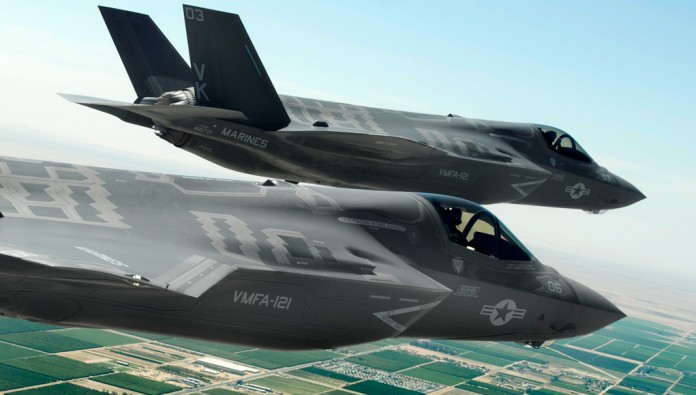
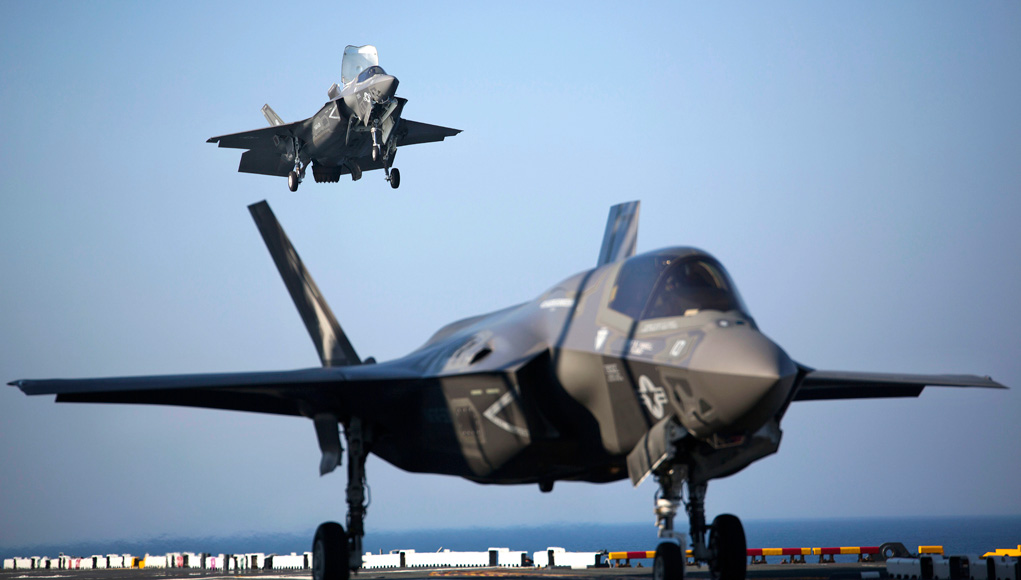
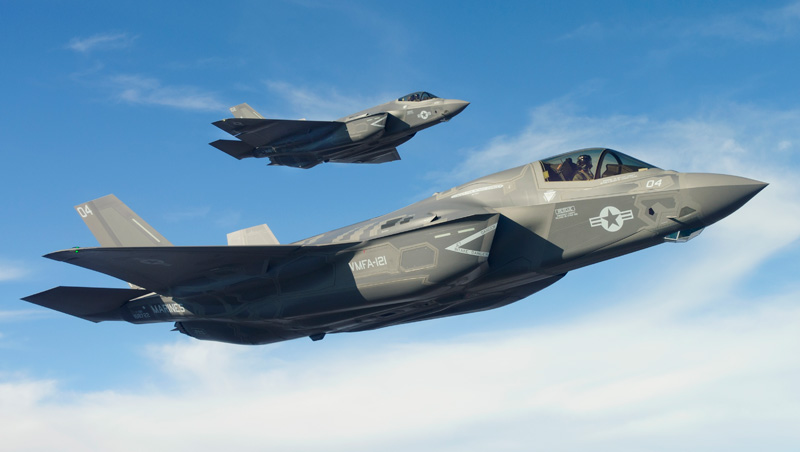
The U.S. Marine Corps’ F-35B Lightning II aircraft reached initial operational capability today with a squadron of 10 F-35Bs ready for world-wide deployment. Marine Fighter Attack Squadron 121 (VMFA-121), based in Yuma, Arizona, is the first squadron in military history to become operational with an F-35 variant, following a five-day Operational Readiness Inspection (ORI), which concluded July 17.
“I am pleased to announce that VMFA-121 has achieved Initial Operational Capability (IOC) in the F-35B, as defined by requirements outlined in the June 2014 Joint Report to Congressional Defense Committees,” said Gen. Joseph Dunford, Commandant of the Marine Corps. “VMFA-121 has ten aircraft in the Block 2B configuration with the requisite performance envelope and weapons clearances, to include the training, sustainment capabilities, and infrastructure to deploy to an austere site or a ship. It is capable of conducting Close Air Support, Offensive and Defensive Counter-Air, Air Interdiction, Assault Support Escort and Armed Reconnaissance as part of a Marine Air Ground Task Force, or in support of the Joint Force.” Dunford stated that he has his full confidence in the F-35B’s ability to support Marines in combat, predicated on years of concurrent developmental testing and operational flying. (See our 14/6 article “F-35 – Beyond Stealth“)
“Prior to declaring IOC, we have conducted flight operations for seven weeks at sea aboard an L-Class carrier, participated in multiple large force exercises, and executed a recent operational evaluation which included multiple live ordnance sorties, said Dunford.” The F-35B’s ability to conduct operations from expeditionary airstrips or sea-based carriers provides our Nation with its first 5th generation strike fighter, which will transform the way we fight and win.”
Six of the US Marine Corps F-35B deployed on board USS Wasp for OT-1. Photo: US Marine Corps
As the future of Marine Corps tactical aviation, the F-35 will eventually replace three legacy platforms: the AV-8B Harrier, the F/A-18 Hornet, and the EA-6B Prowler.
“The success of VMFA-121 is a reflection of the hard work and effort by the Marines in the squadron, those involved in the program over many years, and the support we have received from across the Department of the Navy, the Joint Program Office, our industry partners, and the Under Secretary of Defense. Achieving IOC has truly been a team effort,” concluded Dunford.
The U.S. Marine Corps has trained and qualified more than 50 Marine F-35B pilots and certified about 500 maintenance personnel to assume autonomous, organic-level maintenance support for the F-35B. The F-35 Program Executive Officer Lt. General Christopher C. Bogdan congratulated the Marines for their achievement, saying: “The fact the Marines reached IOC at the beginning of their six-month window is a testament to the professionalism and dedication of the entire F-35 enterprise.”
VMFA-121’s transition will be followed by Marine Attack Squadron 211 (VMA-211), an AV-8B squadron, which is scheduled to transition next to the F-35B in fiscal year 2016. In 2018, Marine Fighter Attack Squadron 122 (VMFA-122), an F-18 Hornet squadron, will conduct its transition.
Two F-35B Joint Strike Fighters flying in a close formation over Marine Corps Air Station Yuma, Az. Photo: Liz Kaszynski, Lockheed Martin.
“The performance of the VMFA-121 during the ORI in all evaluated maintenance, flight operations, and exams was exceptional.” said Lt. Gen. Jon Davis, Deputy Commandant for Aviation, “The squadron’s aircraft performed well in all five IOC operational scenarios: Close Air Support, Air Interdiction, Armed Reconnaissance, Offensive Counter Air and Defensive Counter Air. This included live ordnance deliveries. The demonstrated capability of the squadron in the ORI, and in their run up to it, have given me the confidence that they meet our IOC criteria and, if required, could respond to a contingency, giving our nation its first sea-based 5th generation strike fighter capability. As such, the Commandant of the Marine Corps has decided to declare VMFA-121 initial operationally capable.” Davis said.
“As we field the F-35, we must remain vigilant in the forging of a sustainment system which supports readiness rates required to train for and conduct sustained combat operations.” Davis added, “If I have any concern at this point, it is that the spare parts available to extract maximum value from this exceptional warfighting asset will be shy of what we will truly need. In our legacy fleet, we resource our sustainment accounts in order to achieve between 70 and 75% readiness. I think we have that wrong, and I want to see if we can do better with this new platform. The F-35B has so much potential. Per the Commandant’s guidance, I’ve asked my staff to see why we can’t resource this jet to achieve a significantly higher readiness rate.” Davis said.
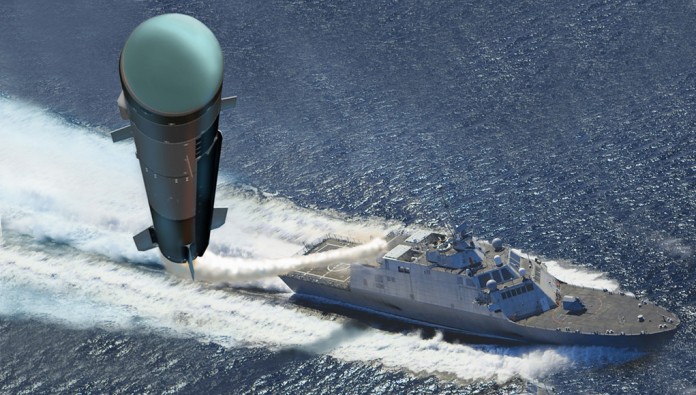
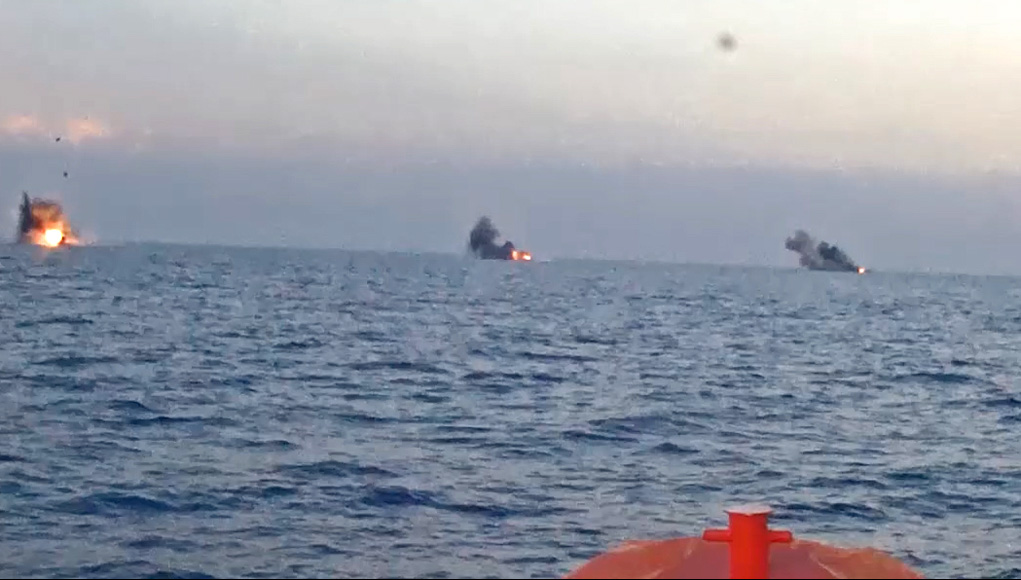
In a recent test series performed by the US Navy, eight Army/Lockheed martin AGM-114L ‘Longbow Hellfire’ missiles destroyed seven fast naval craft simulating fast attack craft performing swarm attacks, similar to those practiced by the Iranian navy in the Arabian Sea and the Persian Gulf. The test was part of the engineering development test of the Surface-to-Surface Missile Module (SSMM), for use on littoral combat ships (LCS).
The tests, that took place in June 2015 in the Atlantic Ocean, off the coast of Virginia, evaluated the integration of the vertically-launched AGM-114L Longbow Hellfire missile system for the SSMM solution. In this application the missile receives initial target data from a surface search radar or an airborne radar on a helicopter, before launch. After launch, it activates the onboard millimeter wave seeker to find the target. The system has an initial range of eight kilometers and features fire-and-forget and multi-mode capability. The multi-purpose warhead ensures effectiveness against various types of attacking craft.
Integration of the “fire-and-forget” Longbow Hellfire missile on LCS represents the next evolution in capability being developed for inclusion in the Increment 3 version of the surface warfare mission package for LCS. When fully integrated and tested, each 24-shot missile module will bring added firepower to complement the LCS’s existing 57mm gun, SEARAM missiles and armed MH-60 Sea Hawk helicopter.
The SSMM is expected to be fully integrated and ready to deploy on LCS missions in late 2017 and to increase the lethality of the Navy’s fleet of littoral combat ships.
The test scenarios included hitting targets at both maximum and minimum missile ranges. After a stationary target was engaged, subsequent targets, conducting serpentine maneuvers, were engaged. The tests culminated in a three-target “raid” scenario. During this scenario all missiles from a three-shot “ripple fire” response struck their individual targets.
The ‘Guided Test Vehicle-1’ test was designed to test the launcher, the missile, and its seeker versus high speed, maneuvering surface targets that represented fast inshore attack craft that are a potential threat to Navy ships worldwide. “This test was very successful and, overall, represents a big step forward in SSMM development for LCS,” said Capt. Casey Moton, LCS Mission Modules program manager.
The Navy evaluated several solutions for the SSMM capability, including EO and semi-active laser guided weapons such as the Griffin IIB missile. The Longbow was selected, in part, for its ability to conduct simultaneous attacks on different targets. Another aspect was affordability, as thousands of AGM-114L are already in stock with the US Army.
In 2011 the Navy originally favored the Griffin IIB missile developed by Raytheon to be the follow-on missile, after the cancellation of the Non-Line of Sight Launch (N-LOS) missile system originally planned to be the primary surface weapon for the LCS. When the threat of Fast Attack Craft/ Fast Inshore Attack Craft (FAC/FIAC) became acute, primarily in the Persian Gulf, the Arabian Sea and the Western Indian Ocean, the capability of simultaneous target engagement became top priority, positioning the Longbow as the Navy’s favorite weapon for short- range Surface Warfare (SuW).
During the mid-June tests off the coast of Virginia, the modified Longbow Hellfire missiles successfully destroyed a series of maneuvering small boat targets. The system “hit” seven of eight targets engaged, with the lone miss attributed to a target issue not related to the missile’s capability. The shots were launched from the Navy’s research vessel Relentless. Photo: US Navy
The French defense company Nexter Systems and German Krauss-Maffei Wegmann, two of Europe’s leading manufacturers of military land defence systems, signed today a merger agreement that intends to share
their future road ahead. The merger of KMW and Nexter will enter into effect at the end of 2015.
The alliance of the two groups under the umbrella of a joint holding company creates a Franco-German defence technology group with a current annual turnover nearing 2 billion euro, an order book of around 9 billion euro and more than 6,000 employees.
KMW, Nexter and their owners view this step as decisive for the consolidation of the defence technology industry in Europe. The product portfolios of the two companies and their regional presences on the world market complement each other.
The alliance of KMW and Nexter creates group with the momentum and innovative force required to succeed and prosper in international competition. In addition, it offers to its European and NATO customers the opportunity of increased standardisation and interoperability for their defence equipment, with a dependable industrial base.
Nexter S. A. had been in the sole ownership of the French State holding company GIAT Industries S.A.; Krauss-Maffei Wegmann GmbH & Co. KG had been in the sole ownership of Wegmann GmbH & Co. in Kassel. For the unification of the two companies, the sole owners are contributing their shares into a newly incorporated joint holding company based in the Netherlands. They will each receive 50 per cent of the shares of this holding company, which will become the sole shareholder in KMW and Nexter. The governance of the holding company will reflect the equal balance between the two shareholders with a long-term industrial perspective.
The creation of new group will have no social consequence or impact neither on employment nor on the collective agreements in place, the CEOs ofthe two companies confirmed. The new strategic alignment makes it possible to retain jobs and skills in the heart of the European Union.
According to the merger agreement, any consolidation project inthe future would be based on the preservation of the balance between the two operational companies as well as the protection of their related key technologies, know-how and competences, in full compliance with the export regulations.
The alliance project will be subject to legal and customary regulation approvals. As part of the French law for “activity, growth and equality of economic opportunities”, article 47 allows the privatisation of GIAT Industries SA and its subsidiaries.
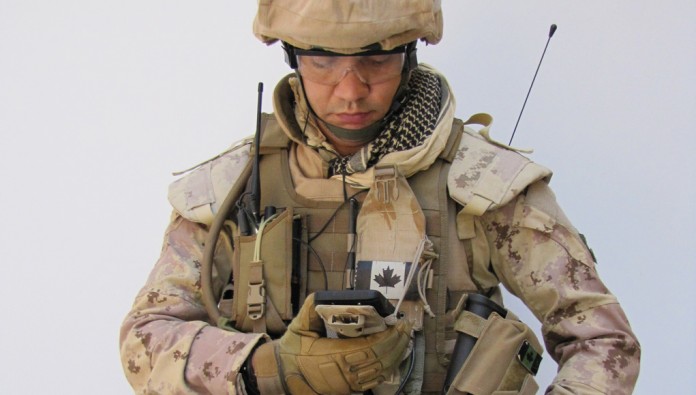
Packed with state-of-the-art secure communications and navigation technology, the modular Integrated Soldier System (ISS) greatly improves the situational awareness of the individual soldier. Photo: Rheinmetall Defence
The Canadian government has awarded Rheinmetall Canada an initial contract worth CAD 7 million (US$5.4) for the qualification of Integrated Soldier Systems (ISS) for Canadian military use. This phase will span over four years. The contract has an option for a follow on procurement of 4,144 systems to equip the Canadian infantry combat teams.
The Canadian Integrated Soldier System Project (ISSP) is a suite of military equipment that soldiers wear as part of their combat load. It includes weapon accessories and electronics that allow soldiers to stay connected with their teams after exiting vehicles on the battlefield. It also features a radio, a smartphone-like computer to run battle management software, a GPS, and a communications headset.
The ISS combines those devices into an ensemble of system that greatly improves the situational awareness of the individual soldier. According to Rheinmetall Canada the ISS can be integrated into the Canadian military’s Land Command Support System.
Following the qualification phase the Canadian government has an option, under this contract, to buy up to 4,144 systems, and award a second contract for related support. The total value of both contracts could reach CAD 250 million ($193 million).
Rheinmetall Canada is supplying the ISS in cooperation with Saab AB of Sweden As prime contractor, Rheinmetall’s Canadian subsidiary is responsible for system development and integration, programme management, and integrated logistics. The Group is already producing similar systems for the the modular Future Soldier – Expanded System on behalf of the German Bundeswehr, as well as various systems and component solutions for other NATO partners.
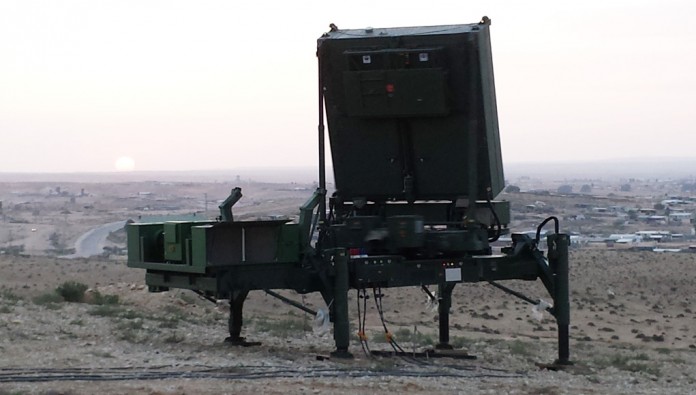
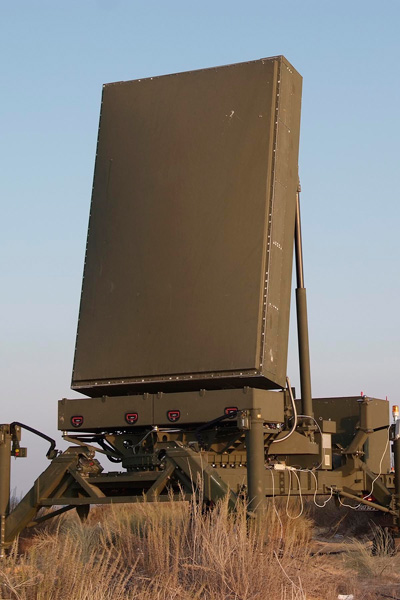
this is the smallest derivative of Elta's EL/M-2084 Multi-Mission Radar (MMR), used with Israel's Iron Dome C-RAM system. Photo via Rheinmetall Defence
Rheinmetall defence and IAI’s Elta Systems have teamed to supply Elta’s ELM-2084 for the Medium Range radar program. Photo: IAIThe Canadian Department of National Defence has selected Rheinmetall Canada to supply 10 Medium Range Radar systems for the Canadian Army. The combat proven radars developed and produced by Israel Aerospace Industries (IAI) Elta Systems are capable of detecting hostile rocket, artillery and mortar fire. The new radars will are able to project the impact point and locate the sources of fire, thus providing early warning to combat forces and enabling rapid counter action to suppress the enemy.
The MRR order runs for a period of three years and encompasses procurement of ten Medium-Range Radar systems together with the associated logistical support, at a worth of CAD130 million (€95 million). The agreement covers in-service support, with an option for extension that could increase the potential value of both contracts to CAD 243 million (€175 million).
Ongoing since 2008, the program reached the final phase in 2014 with the publication of an international tender that attracted many competitors, including Lockheed Martin, Saab, Raytheon Canada, Thales Canada, and a team lead by Rheinmetall Canada and IAI Elta. The two companies teamed in 2013 to market integrated solutions based on the Elta radar.
With the selection of the Rheinmetall-IAI team the program is expected to reach initial operational capability in June 2017 and become fully operational by the end of 2017. The two companies announced they will implement a technology transfer program in full conformity with the intent of Canada’s recently announced Defence Procurement Strategy, to create local jobs and capabilities and help spur economic growth.
Jazeera Palace hotel in Mogadishu targeted today by a Vehicle Borne IED, killing 13 persons on the site.
A suicide attacker drove a vehicle loaded with explosives into the gate of the Jazeera Palace Hotel in Mogadishu, Somalia, earlier today, killing 13 people. The car bomb exploded at the hotel’s main gate. The bomb destroyed part of the hotel and caused damage to nearby structures.
The attack follows a series of assaults July 10 on two Mogadishu hotels and a stadium housing peacekeepers. Al-Shabaab also took responsibility for those attacks.
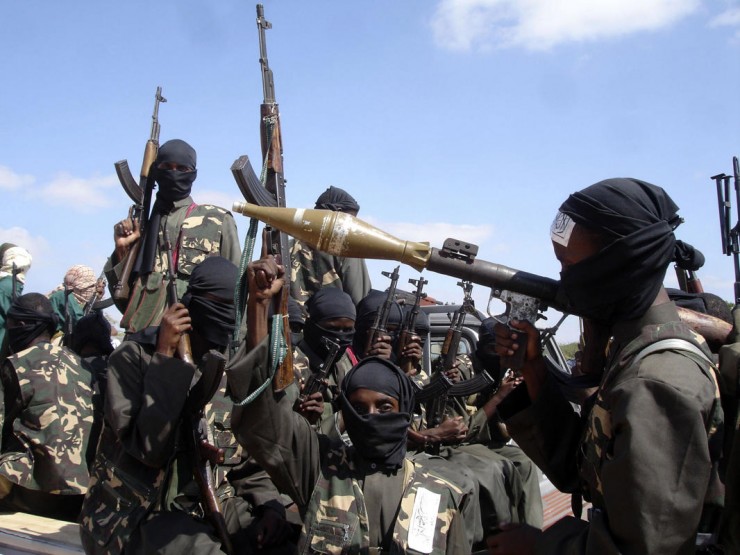
The Al-Shabaab terror group took responsibility for the attack, saying it was targeting Western diplomats. The luxury hotel houses the diplomatic missions for several nations, including China.
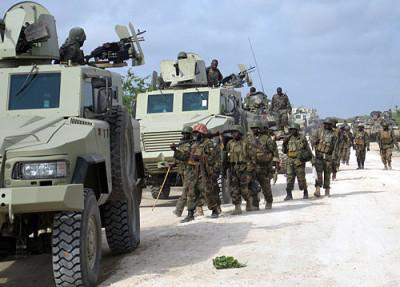
A convoy of AMISOM forces preparing to move to South Western Somalia on operation.
The attack comes a week after the African Union Mission in Somalia (AMISOM) renewed its active military offensive against Al Shabaab. Code named Operation ‘Juba Corridor’, the offensive aims to degrade Al Shabaab by removing them from their strongholds in the Gedo, Bakool and Bay regions of Somalia.
The Operation involves troops from the Ethiopian National Defence Forces (ENDF) and Kenya Defence Forces (KDF) contingents of AMISOM, and supporting units of the Somalia National Army (SNA). According to an AMISOM update, AMISOM and SNA troops killed 72 Al Shabaab fighters, while 24 were wounded and 9 others were captured.
Independent news reports claim many of the killed were civilians that have fled the fighting. Yesterday an air-attack directed at Al-Shabaab checkpoint k
Al Shabaab in Somalia
illed 11 civilians travelling in vehicles thought to be used by Al-Shabaab. Last week another attack took the lives of 20 civilians, reporters said.
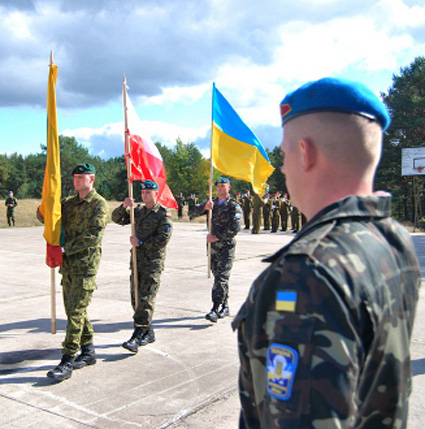
LitPolUkrBrig emblemDefence Ministers of of Poland, Lithuania and Ukraine have agreed to establish an international brigade manned with units from the three armies, following the LITPOLUKRBRIG formation agreement signed in September 2014.
The brigade will be manned with 4,500 soldiers from the three member states; its structure will follow the combat groups in other European armies, will be established and become operational within a year. Headquartered in Lublin, Poland the brigade will command three infantry battalions – one from each country- to be based in each of the member countries, along with support elements. The brigade is expected to conduct its first exercise this year.
An agreement on its creation was signed on November 16, 2009. but its implementation was repeatedly delayed from 2011. The unit was finally formed on September 19, 2014 and is expected to become operational in 2016.
The Brigade will be tasked with peacekeeping and stabilization operations, as directed by the European Union and United Nations. The international brigade will increase Kiev’s cooperation with Eastern European countries. The new formation will help infuse western standards and methodologies into the Ukrainian military, paving the way to closer integration of NATO standards. (Excerpts from article published in Polish by Defence 24)
The Taliban has focused their attacks on Afghan police and security forces. In May and June dozens have been killed in the attacks, although until now, the Taliban failed to gain terrain in their 'summer campaign'.
Authorities in northeastern Afghanistan confirmed Sunday the Taliban has captured a key military base in Tirgaran, at the Badakhshan province in the mountainous region of northeastern Afghanistan, bordering China and Tajikistan. The fall of the base happened after more than 100 Afghan security forces surrendered to the Taliban overnight. Badakhshan borders China and Tajikistan and has been the scene of major clashes between Taliban and Afghan security forces in recent weeks.
Fighting in the Tirgaran area erupted Friday night with coordinated attacks staged by the Taliban on several security outposts. The border police force personnel at the base surrendered to the Taliban because they were besieged and did not get reinforcement from the government. Some officials reportedly said that the commanders at the base “made a deal” with the Taliban, and surrendered all the weapons and equipment and joined the Taliban. This is the largest mass surrender and desertion since U.S. led NATO forces have withdrawn from war torn Afghanistan. The Taliban has focused their attacks on Afghan police and security forces. In May and June dozens have been killed in the attacks, although until now, the Taliban failed to gain terrain in their ‘summer campaign’.
Conflicts in this once peaceful province have escalated in recent weeks, as remote bases and checkpoints are becoming increasingly isolated and targeted by Taliban and other fighters, leading to increased casualties among Afghan security forces, AP reported.
The fall of Tirgaran comes after lines of communications have eroded in the region, due to repeated attacks as well as landslides and floods. Last month, repeated assaults on security checkpoints in the provinces’ Yagman district, that forced police to abandon the route. Last month The police base in the Wardoj, another town in the province, had been cut off as heavy rains destroyed roads into the area, but reinforcement or assistance failed to arrive. provinceWhile the Taliban has so far in this fighting season failed to maintain control over territories it has captured, the militants have inflicted heavy battlefield casualties on Afghan security forces. Voice
The New York Times reported Wednesday a more than 50 percent rise in the casualty rate among Afghan security forces this year compared with the first six months of 2014. It quoted officials with the US-led military coalition as saying that about 4,100 Afghan soldiers and police officers have been killed and around 8,000 wounded.
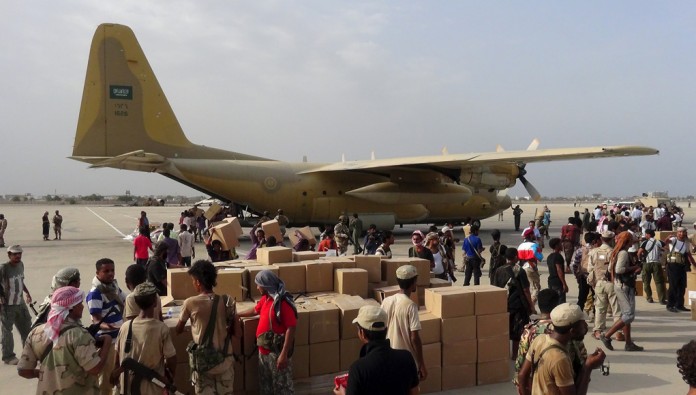
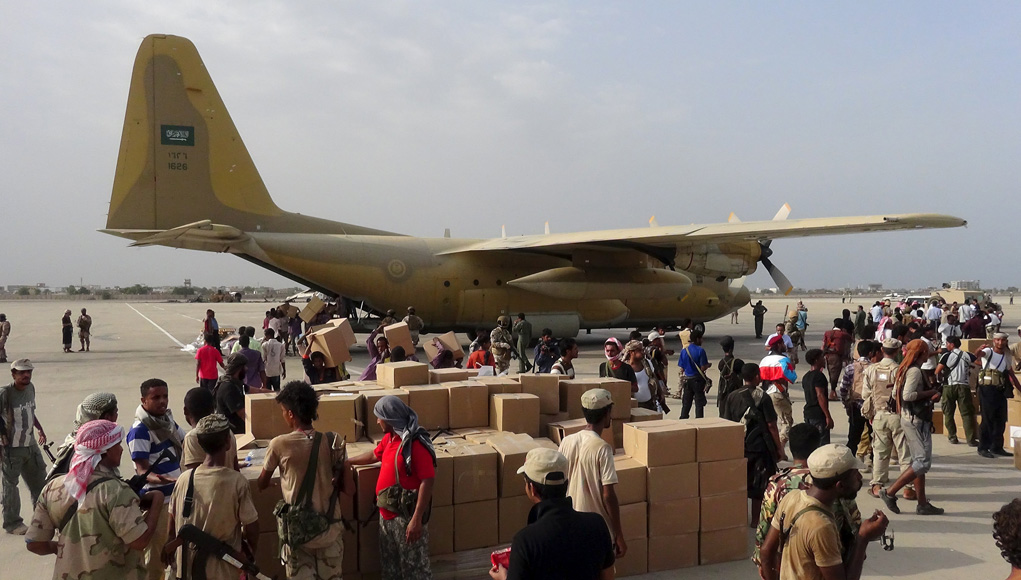
Royal Saudi Air Force C-130 delivers supplies to the International airport of Aden, Yemen, recently taken by Yemeni forces loyal to ousted president Abd Rabbuh Mansur Hadi
Fighters loyal to Yemen’s government-in-exile on Friday clashed with Houthis inside the rebel-held Al Anad Air Base, the country’s largest, after capturing most of the surrounding area. Asharq Al-Awsat reported from Aden, Yemen.
The pro-government forces, known as the Popular Resistance, have set their sights on the air base since they captured the southern city of Aden earlier this month in a closely coordinated operation with Saudi-led coalition forces.
The base is located in the southern Lahej province, 35 miles (60 kilometers) north of the newly captured Aden. It served as the headquarters for US counterterrorism operations in southern Yemen until Houthi insurgents consolidated their control of Sana’a in late 2014.
On the same day two Saudi planes arrived in Aden on Friday bringing equipment to reopen the city’s international airport following four months of fighting, Saudi-owned Al-Arabiya TV reported. Fighters loyal to President Royal Saudi Air Force C-130 delivers supplies to the International airport of Aden, Yemen, recently taken by Yemeni forces loyal to ousted president Abd Rabbuh Mansur Hadi, backed by Saudi-led coalition forces, captured the strategic city of Aden and its airport from Houthis on July 14.
Houthis entered Aden in late March, prompting Hadi to seek refuge in Saudi Arabia and call on the Kingdom to intervene militarily in Yemen. In response to his call, Riyadh has been bombarding Houthi positions for more than three months in an effort to restore the beleaguered president to power.
Meanwhile, ISIS’ Aden Province – a militant terror organization in Yemen affiliated with the Islamic State (ISIS) – released a series of photos over the weekend, claiming the group has renewed operations at a training base near Yemen’s coastal city of Aden.
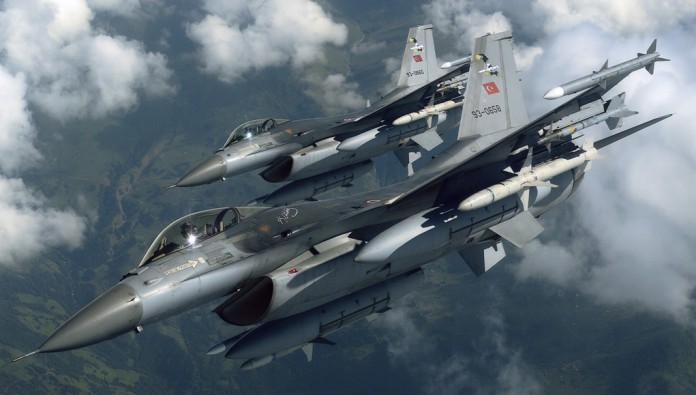
Turkish fighter jets have struck Kurdistan Workers’ Party (PKK) and Islamic State (ISIS) targets in Syria and Iraq yesterday. This action was followed by the detention of hundreds of suspected Kurdish militants, in a coordinated crackdown, as Ankara deployed military force for the first time against the terrorist group.
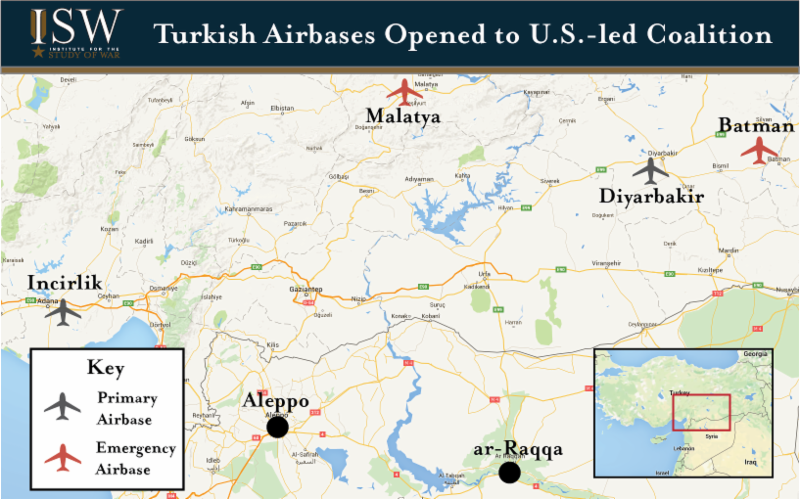
Official Turkish sources confirmed Turkish F-16 warplanes based in Diyarbakır, Incirlik and Adana had attacked five bases of the in Iraq and two ISIS targets in the towns of Hatay and Kilis in Syria as part of the operation.
The main strike force that numbered 20 F-16s struck PKK positions in northern Iraq. The PKK has been fighting against Turkey for more than three decades but in recent months have obeyed to a truce with Ankara. The leadership of Iraq’s Kurdish Regional Government (KRG) has condemned Turkish air strikes against positions of Kurdish fighters in its autonomous region, echoing the remarks of the leadership earlier.
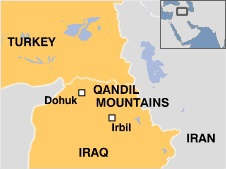
PKK targets attacked by the Turkish Air Force in Northern Iraq 24 July 2015. Source: Daily Sabah
In the operation, five PKK camps were attacked: Zap, Basyan, Gare, Avashin and Metina in Northern Iraq. The Turkish air force said that PKK’s training facilities, shelters and anti-aircraft batteries were targeted in the five camps. PKK’s headquarters located on Qandil Mountains in Northern Iraq were reportedly targeted in the attacks as well.
In a coordinated move, Turkish police have been rounding up hundreds of suspected Kurdish fighters in cities and towns across the country, detaining nearly 600 people. Turkish police fired water cannon and teargas to disperse about 1,000 demonstrators who had gathered in the capital Ankara to protest against military strikes in Syria and northern Iraq.
The strike Targets attacked included what was described as the group’s headquarters and an assembly point. While the airstrikes were launched, Turkish heavy artillery located in the border province of Kilis fired at ISIS positions in Syria.
Turkey is also to allow the US-led coalition to use its Incirlik airbase and other bases in the south of the country to conduct strikes against Isis. According to media sources allied combat missions from the base could begin in August. Additional airbases in the nearby cities of Diyarbakır and Batman will be opened to allied planes for emergencies. Coalition air forces that have been ongoing for almost a year are operating from bases in Cyprus and the Persian Gulf, because until now Turkey has refused to authorise offensive operations from its bases against its neighbours. Apparently, the devastating ISIS linked suicide attacks and PKK-linked assassinations of Turkish policemen last week have changed Ankara’s attitude.
The US military flatly denied reports in the Turkish media that the deal with the US included the establishment of a no-fly zone in northern Syria, a longstanding demand of the Turkish government which the US had resisted.
Turkey has also been planning to create a buffer zone in Syria, along its border with Syria, where it planned to settle the Syrian refugees that have fled across the border since the beginning of the Syrian Civil War but the coalition partners have objected such move.
The Turkish move could also be a sign of Ankara’s resentment of the U.S. resorted backing for the PKK-affiliated People’s Protection Units (YPG), the Kurdish fighters group operating against ISIS inside northern Syria.
“The conclusion of an agreement between Turkey and the U.S.-led anti-ISIS coalition to open Turkish airbases for coalition aircraft conducting sorties against the Islamic State of Iraq and al-Sham (ISIS) marks a major shift in Turkish policy which will provide immediate boost to U.S. efforts to degrade and ultimately defeat ISIS.” Christopher Kozak wrote in understandingwar.org.
Turkey’s decision to escalate against both militant groups suggests that Turkey intends to leverage the coalition’s calls for further action against ISIS in order to assert its own strategic interest in limiting the expansion of armed Kurdish groups along the Turkish border.
The government of Turkish President Recep Erdogan may also seek to utilize these security threats to increase its own political standing amidst ongoing negotiations to form a coalition government and a potential call for early elections. Over the near-term Turkey will face an expanded domestic threat from both ISIS and PKK militancy in the form of persistent violence against the Turkish state.
Nonetheless, a sustained Turkish effort against ISIS’s networks in Turkey and northern Syria combined with the efforts of local anti-ISIS Syrian opposition forces has the potential to significantly disrupt the foreign fighter flows which provide ISIS with a key source of reinforcements, suicide bombers, and legitimacy as a global caliphate.
Lockheed Martin Skunk Works® and XTEND have achieved a major milestone in JADC2 by integrating the XOS operating system with the MDCX™ autonomy platform. This technical breakthrough enables a single operator to simultaneously command multiple drone classes, eliminating the friction of mission handoffs. From "marsupial" drone deployments to operating in GPS-denied environments, explore how this collaboration is abbreviating the data-to-decision timeline and redefining autonomous mission execution.
As traditional defense primes face mounting competition from agile “neoprimes” such as Anduril, Palantir and Helsing, the balance of innovation is shifting toward software-defined warfare and scalable, dual-use technologies, while global industry consolidation—marked by Boeing’s integration of Spirit AeroSystems and other strategic mergers—signals an intensified race to secure control over the defense technology value chain. Our Defense-Tech weekly report highlights these trends.
In early October 2025, a coordinated wave of unmanned aerial system (UAS) incursions—widely attributed to Russia—targeted critical infrastructure across at least ten European nations. The unprecedented campaign exposed the fragility of Europe’s air defenses...
Executive Summary
The past week (September 18-25, 2025) represents an inflection point where strategic defense concepts have transitioned from doctrine to tangible reality. An analysis of global events reveals four primary, interconnected trends shaping an...
At the 2025 Air, Space & Cyber Conference, U.S. Air Force and Space Force leaders unveiled major updates on next-generation fighters, bombers, unmanned systems, and space initiatives, highlighting both rapid innovation and critical readiness challenges as the services race to outpace global competitors. A short version is available here, with a more detailed version for subscribers.
The Taipei Aerospace & Defense Technology Exhibition (TADTE) 2025 crystallized around four dominant strategic themes that collectively illustrate Taiwan's comprehensive approach to defense modernization amid escalating regional tensions. Based on a detailed report by Pleronix (available upon request). Includes a Podcast discussion on TADTE 2025's highlighting Taiwan's four strategic themes beyond the post's coverage.
Israel’s Iron Beam 450 high-power laser system has completed final testing, marking a major leap in air defense. Developed by Rafael, it offers precise, cost-effective interception of rockets, UAVs, and mortars, and is set for IDF deployment by 2025.



 The Canadian government has awarded Rheinmetall Canada an initial contract worth CAD 7 million (US$5.4) for the qualification of Integrated Soldier Systems (ISS) for Canadian military use. This phase will span over four years. The contract has an option for a follow on procurement of 4,144 systems to equip the Canadian infantry combat teams.