Saturday, December 27, 2025
More
    Home Blog Page 135

    Return of the Russian Missile Trains

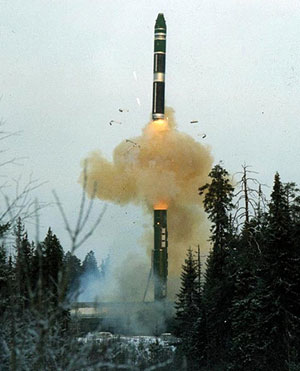
    The SS-24 was designed for deployment by railcar for mobility. For movement this missile required three locomotives.
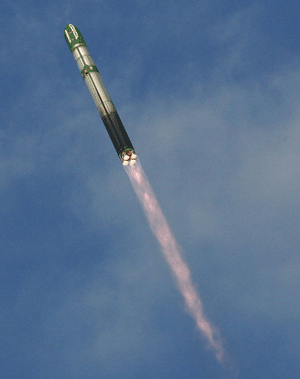
    Liquid Propelled (LP) SS-18 Satan Intercontinental Ballistic Missile (ICBM) launched on a test flight. The clean burn of the LP is distinctive, compared to the smoke trail generated by solid propellant. LP is more efficient and thus offers higher payload to weight ratio. Nevertheless, such missiles require lengthy pre-flight preparations and are often limited to silo-based static sites.
    Liquid Propelled (LP) SS-18 Satan Intercontinental Ballistic Missile (ICBM) launched on a test flight. The clean burn of the LP is distinctive, compared to the smoke trail generated by solid propellant. LP is more efficient and thus offers higher payload to weight ratio. Nevertheless, such missiles require lengthy pre-flight preparations and are often limited to silo-based static sites.

    Moving to decommission almost all liquid-propelled ballistic missiles by 2020, the Russian Strategic Missile Force is planning to pursue a new liquid-propelled missile by that time, maintaining high payload to weight capability that only liquid propulsion can offer. A future liquid-propelled heavy ICBM currently under preliminary design, is expected to enter service by the year 2020, and replace the remaining SS-18 Satan. The Russian defense ministry announced its plans to develop such missile in 2011. Construction of the 100-ton prototype would begin in 2014, and an operational missile could be ready for testing in four years, in time to replace the SS-18, which have been in service since 1967.

    Another move, and somewhat peculiar ambition by Moscow is the restart of development and production of railway-based ICBM, of which a first prototype could be deployed by 2020. The new missile will be about half the weight of the SS-24 Scalpel, which weighed 104 tons and required three locomotives to move on the rails. The MITT is also developing the new missile. It will be half the weight of the decommissioned SS-24, allowing them to fit into one railcar. The missiles were based on trains in order to make them harder to find than stationary launchers, complicating a counter-strike.

    Click here for the full coverage of the Russian Strategic Missile Force Modernization.

    The Soviet military deployed its first rail-portable long-range missile in 1987, and had 12 of them by 1991. Rail-mobile missiles were removed from service in 2002 and the last base dismantled in 2007 under the START II arms reduction treaty with the United States. However, the New START agreement from 2010 does not prohibit development of rail-mobile ICBMs. The return to missile trains is an apparent response to US plans to position elements of its missile defense system in Eastern Europe.

    Launching of the SS-24 from a railcar.
    Launching of the SS-24 from a railcar.

    Russia’s Strategic Missile Forces commander Col. Gen. Sergei Karakayev said that this heavy missile would offer better payload-to-launch-weight ratio than in a solid-fuel missile. As a result, the missile would carry more powerful warheads, including MIRVs with decoy elements. “The higher energy provided by liquid fuels gives it more varied and effective methods of countermeasures against global missile defense screens including space-based elements of those systems,” Karakayev explained.

    He added that the high payload capacity could also be considered by Moscow to produce a conventionally armed ICBM, based on this platform, making it an attractive counterbalance to the US ambition to field its “prompt global strike” (PGS) conventional global attack capability. “The availability of a powerful liquid-fueled ICBM allows us the capability of creating a strategic high-accuracy weapons system with a conventional payload with practically global range, if the US does not pull back from its program for creating such missile systems,” he said. In 2010 the US has tested a PGS prototype based on a Minuteman III ICBM, but have since opted to pursue hypersonic glider as the delivery means for PGS. Despite this test, US officials have stated their reservations from using a sea- or land-based ICBM system for Prompt Global Strike, as they would be expensive to develop and potentially “dangerous” to deploy, with enemy potentially confusing their launch to a nuclear attack.


    Layered Multi-Ply Armor Enhances Ballistic Protection

    The Naval Research Laboratory (NRL) has developed new methods to enhance the ballistic performance and penetration resistance of ballistic armor by the application of multiple layers of hard and soft materials in a process called ‘multi-ply’ armor.

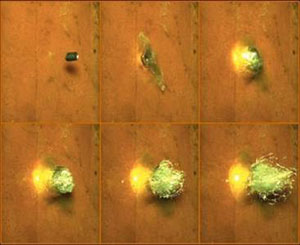
    A sequence of six photos showing the impact of a projectile on the strike face of an armor module enhanced with multi-ply layers. The new concept can increase ballistic performance by up to 50%, by adding alternating layers of elastomers and hard materials. Photo: NRL
    A sequence of six photos showing the impact of a projectile on the strike face of an armor module enhanced with multi-ply layers. The new concept can increase ballistic performance by up to 50%, by adding alternating layers of elastomers and hard materials. Photo: NRL

    The new armor consists of alternating layers of ‘elastomer’ (elastic polymer) and a harder material such as aluminum, ceramic, or hard polymer. Elastomeric coatings have been found to substantially increase the ballistic limit of underlying steel substrates. The benefits of such composition is the transition of impact from the elastomer rubber to the metal or ceramic glassy state.

    The multi-ply armor performance is enhanced with as few as six alternating layers. The layers can be attached to a thicker face plate or backplane, for additional protection. According to NRL researchers, the topographically structured front surface rotates pointed projectiles, combining projectile break up and pressure wave dissipation, thus enhancing penetration resistance.

    By increasing ballistic resistance, protection element using multi-ply armor can become lighter than conventional armor, both as stand-alone armor or enhancement of existing armor. Overall, the multi-ply armor enhances ballistic resistance by 50% over standard steel armor at equal areal density. Therefore, it is significantly lighter than conventional armor with equal or better performance. Other advantages of the new armor are its modularity, flexibility and repairability, enabling body armor and and vehicle protection designers to tailor and optimize armor protection solutions to meet the specific user requirements.

    Washington Seek Interoperability with Seoul’s Evolving Missile Defense

    South Korea’s Air and Missile Defense (KAMD) system is becoming a key issue in discussions on the transfer of wartime operational command (OPCON) from the US. Seoul’s Hankyoreh reports. The incorporation of South Korea’s system into the one led by the US stands to trigger objections from China, which sees itself a target.

    The two countries discussed preparing a response to North Korea’s increased nuclear and missile capabilities on Oct. 2, 2013. “The South Korean and US missile defense systems don’t have to be identical as long as they are interoperable.” US Secretary of Defense Chuck Hagel said. His remarks suggested that South Korea is not obliged to take part in the US system, but that the two countries’ systems should allow for linkages and interoperation.

    The KAMD, which is now in the planning stages, would be in place and capable of intercepting North Korean missiles by 2022 at the latest. Officials in Seoul expressed reservation from the thrust to integrate the two missile defense systems, leaving the door open for ‘exchange information on North Korean missile launches.’, particularly concerning low-altitude defense, which is the most prevalent task in the Korean Peninsula.

    Both South and North Korea have maximum firing ranges of just 1,000 km. The US missile defense system, in contrast, would be designed mainly to intercept intercontinental ballistic missiles.

    Japan and U.S. Agree to Broaden Military Alliance

    us0japan
    us0japan
    U.S. and Japanese officials said they will position a second early-warning radar in Japan within the next year and deploy new long-range surveillance drones to help monitor disputed islands in the East China Sea by next spring.

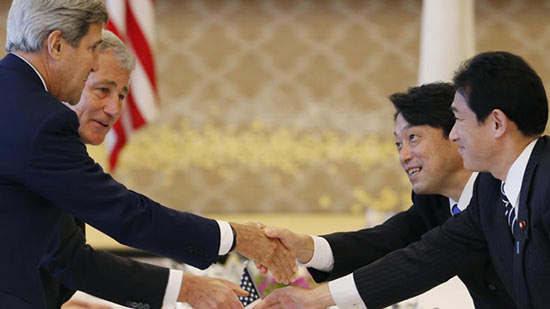
    Against the backdrop of pressing regional tensions, the United States and Japan agreed Thursday to broaden their military alliance, including by adding a new missile defense radar system in Japan and cooperating to combat cyberthreats. The New York Times reports today.

    Most significantly, the United States will deploy a new X-band radar system in Kyogamisaki over the next year to better protect both nations against military threats from North Korea.

    For the first time, the two countries will work on specific cyberdefense projects to increase cybersecurity in both countries. Further, the United States Marine Corps will replace aging helicopters here with two squadrons of MV-22 aircraft, and will deploy surveillance drones to be based in Japan for the first time. And the P-8, a cutting-edge highly advanced manned reconnaissance airplane, will be deployed for the first time to Japan to help the United States and its allies monitor maritime activities in the Pacific, where Japan and China both claim the same disputed islands.

    The Japanese also agreed to offer better military support in global humanitarian relief efforts.

    “Our relationship has never been stronger or better than it is today,” Mr. Kerry said. “We are continuing to adapt, however, to confront the different challenges of the 21st century.”

    The agreement, signed during a joint visit in Tokyo by Secretary of State John Kerry and Defense Secretary Chuck Hagel in a meeting with their Japanese counterparts, signals the United States’ increased military, economic and diplomatic focus on Asia, and it is likely to alarm China, which has had increasingly testy relations with Tokyo.

    The deal comes at a time when the Japanese government is seeking to greatly enhance its own military capabilities and to revise its pacifist Constitution, drafted after World War II, paving the way for it to become a more equal partner with the United States in times of conflict.

    “Our bilateral defense cooperation, including America’s commitment to the security of Japan, is a critical component of our overall relationship,” Mr. Hagel said during a news conference in Tokyo on Thursday afternoon, “and to the Obama administration’s rebalance to Asia-Pacific.”

    Read Jennifer Steinhauer’s article on the New York times.

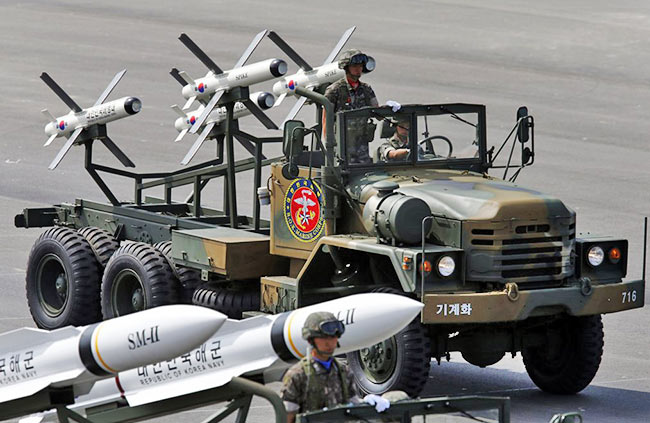
    Spike NLOS, Hyumu-2,3 showcased on South Korea’s Parade

    South Korea's Israeli-made Spike NLOS missiles were seen during events to mark the 65th anniversary of Armed Forces Day, in Seongnam
    Hyeonmu-3
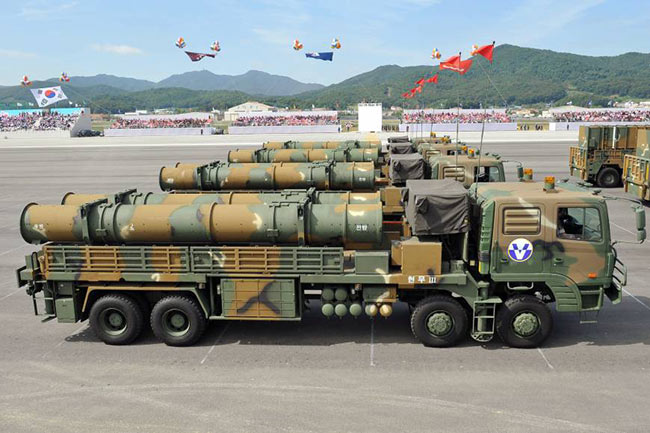
    The Hyunmu-3c, a cruise missile with a range of more than 1,000 km (620 miles) were put on public display for the first time in a rare South Korean military parade. (Reuters)

    South Korea’s Armed Forces Day on Tuesday, October 1st, saw the first public display of two new home-grown missiles. The Chosun Ilbo reports.

    The Country’s Hyunmu-3C cruise missile, which has a range of 1,000-1,500 km, could hit most strategic targets in China and Japan as well as in North Korea. Officials claim it is as accurate as the U.S.’ Tomahawk cruise missile, i.e. within a three meter radius. Hyunmu-2, a ballistic missile, has a shorter range than that of North Korea’s ballistic missiles with 300 km but can hit targets within about 10 m. Mobile launch vehicles for the missiles were also unveiled in the parade.

    Also on show were the RAFAEL Spike-NLOS missiles and a remote-controlled quadruped robotic vehicle.

    The Spike NLOS missiles were bought from Israel after the North shelled Yeonpyeong Island in November 2010 and are supposedly capable of destroying North Korean artillery kept in underground bunkers. They were deployed warfare-ready on the five north-westernmost islands in May.

    South Korea's Israeli-made Spike NLOS missiles were seen during events to mark the 65th anniversary of Armed Forces Day, in Seongnam
    South Korea’s Israeli-made Spike NLOS missiles were seen during events to mark the 65th anniversary of Armed Forces Day, in Seongnam. (Rueters)

    Spike NLOS can carry the entire family of warheads designed for the Spike, including the shaped-charge anti-tank, and penetration blast fragmentation (PBR), enabling the missile to effectively strike targets beyond line of sight.

    The missile integrates a dual EO seeker, effectively engaging targets in day and night, utilizing ‘fire and forget’ or ‘fire and update’ operating modes, enabling the operator to home in precisely on a pinpoint target as the missile closes-in on the terminal phase of its flight, just prior to the attack, thus maximizing the missile’s effect while minimizing collateral damage, even under highly dynamic battle conditions. The communications between the missile and operator is conducted over a two-way wireless communications.

    The Spike family of missiles is considered as the most mature and versatile multi-platform electro-optical precision attack missile in the market. Spike missiles are currently operating in several countries, including Israel, several Asian and Latin American countries, as well as a wide number of NATO countries.

    Disarming Syria’s Chemical Hydra Seems “Mission Impossible”

    For years, Israel has sounded the alarm about the misuse of Syria’s chemical weapons stockpile amid the civil war. The new U.S.-Russian initiative to disarm Syria of its chemical weapons is a mixed bag for the Jewish state.

    On the one hand, if the initiative is implemented in full, it would remove one of the Middle East’s largest caches of non-conventional weapons — a longtime strategic threat to Israel that sent residents here scurrying to get gas masks just a few weeks ago in case of war. On the other hand, numerous experts cautioned that the prospects for implementing such a disarmament deal are far from certain.

    Implementing chemical disarmament in Syria will be an enormous challenge, and the prospects for accomplishing it are doubtful. Appreciable portions of the chemical weapons arsenal have been trans-located, in part untraceably. Syria possesses a huge chemical warfare alignment, with dozens of multiform facilities and installations. Just an up-to-date mapping of this alignment is a very complex mission. The plausible possibility that various Iraqi chemical and biological weapons were added to the Syrian CBW inventory significantly complicates the situation. Moreover, Syria is likely to methodically further develop biological weapons as a powerful alternative to chemical weapons; and the US-Russia accord does not deal with this.

    “It is a good agreement if it will be implemented as written,” said Amos Yadlin, the former head of the Israeli army intelligence branch, who said the initiative represents a positive development for Israel regarding Syria’s chemical weapons. “But we have to take it a step further, and to ask ourselves what are the chances this agreement will be implemented? Unfortunately, I think the chances are low,.

    Dr. Dore Gold, a former foreign policy adviser to Prime Minister Benjamin Netanyahu, said that the track record on disarmament of rogue regimes in the Middle East is far from impressive. Gold warned that Syria is likely to try to avoid full disclosure on its chemical weapons program, allowing it to move part of it outside of the country to places like Lebanon.

    “The key to making this work is the threat of military force by the U.S.,” he said, noting that means keeping U.S. warships armed with cruise missiles stationed in the eastern Mediterranean within range of Syria. “Once the naval presence is removed — without the sense of urgency, Assad is likely to move to get out of the agreement.

    A complicated and high-stakes game is playing out in efforts to force Syria to give up its chemical weapons. It’s a diplomatic initiative that has major implications not just for Syria, but for Iran, which has a large stake in the continuing conflict in Syria, as well as its own difficult negotiations with the international community over its nuclear program.

    The next phase will see the US and Russia try to move the chemical stockpiles and warheads out of Syria (probably to Russia, which has a lot of experience in such projects) for the purpose of destroying them. At the same time, chemical weapons that cannot be moved out of Syria should be destroyed. All this seems very promising, but it is safe to assume that the tight schedule will be extended and that the inspectors will encounter difficulties from both the Assad regime and the rebels. They will constantly be in danger and will have to be protected by a special force. This requires a lot of preparations and funding. A top secret Syrian military unit had been given responsibility to move the arsenal of poison gas and munitions, raising questions about the feasibility of the Russian plan to secure the weapons. The weapons, which used to be concentrated in the country’s west, have already been deposited by Syria’s special unit 450 in over 50 sites in Syria’s north, west and south, according to Israeli intelligence sources.

    Identifying and eliminating Syria’s chemical weapons stockpiles while the country is enmeshed in a civil war is an unprecedented challenge, made even riskier by rebel groups who may oppose the effort, analysts say. There has never been an effort to disarm an entire country of its chemical weapons during a civil war, Historically, eliminating chemical weapons programs could take years, even when a regime is fully cooperative. After Libyan leader Moammar Gadhafi agreed to relinquish his weapons of mass destruction it took a decade to remove its chemical stockpiles.

    The U.S-Russian agreement makes provisions for removing the weapons and shipping them outside Syria for destruction, which could expedite the process. Still, that might require moving dangerous chemicals through unstable regions of the country. Eli Carmon, expert at the International Institute for Counter-Terrorism at the Herzliya Interdisciplinary Center warned that transferring out chemical weapons and destroying them is “impossible in the short term.” “There is great difficulty to take control of this arsenal, to check how large it is, how and where to transfer it, and how to destroy it,” Carmon said.

    Syria is known to store chemical agents in “binary” form, where two components of the chemical agent are stored separately and only mixed before being loaded into munitions. This makes transport safer and simpler but can vastly expand the number of secret depots that need to be located and makes them easier to conceal.

    Retired Lt Colonel Dany Shoham, an expert on chemical and biological weapons at the Israel-based Begin-Sadat Center for Strategic Studies, said in a study, that chemical weapons agents could be removed by air or by sea in a carefully coordinated mission. Those carrying it out would have to ensure that the weapons are not stolen and that there is no threat of an explosion or leak underway. According to his report, Syria is believed to have mustard, sarin and nerve agents such as VX, along with aerial bombs, artillery shells, rockets and ballistic missiles that can deliver chemical weapons. Destruction of the arsenal is also problematic, requiring a secure destruction facility to be developed and commissioned. Israeli experts say nerve gas has to be disposed of properly in locations with high temperatures and controls to keep gas from escaping to minimize the risk of accidentally gassing innocent people. The deadly effect of the chemical warfare agents produced at the el-Safir military complex near Haleb (Allepo) was demonstrated on the night of July 25, 2007, apparently by an accident, which happened while Syrian engineers working on a Scud C warhead. 15 syrians were reportedly killed in the explosion that, according to official Syrian sources, was caused by sympathetic explosion due to an uncommon summer heat wave.

    One option reportedly being considered is moving the stockpile to a Russian naval base in Tartous, a regime stronghold on the Mediterranean, for eventual destruction. But chemical experts say that may not be feasible. The rail and road network passess through difficult mountain terrain, which is highly vulnerable to rebel ambush and hidden roadside explosives, which could create havoc with such highly lethal cargo, as chemical agents. Moreover, seen by Google Earth satellite photos, these transports have to pass also through dense population centers before entering into a safe environment specially prepared at the port for such dangerous shipment. “It is unlikely that the site would be able to house such huge quantities,” an Israeli weapons expert warned. But to implement the plan, Syria’s chemical arsenal must be moved out of the war-torn country. Analysts say there are only two countries, the United States and Russia, that have facilities that can deal with such large amounts.

    The care America takes in eliminating its own chemical weapons reflects how dangerous the process is, even when it’s done in a safe and controlled environment. Since 1986, the protocol has been to incinerate the agent at temperatures above 2,000 degrees Fahrenheit or to neutralize it using hot water and a caustic compound. After the destructive phase, the next step involves extensive monitoring and testing of air, water, and soil to ensure no residual release. disposal was simply to dump munitions at sea. The United States did so until the early 1970s, when a global treaty outlawed such practices.

    Incineration is controlled ignition of materials that converts them to ash, water vapor, carbon dioxide, and other products formed by combustion. Some types of chemical munitions contain propellants or explosives in addition to chemical warfare agents. After the contents of these weapons are drained, their empty casings might contain leftover materials that could be hazardous.

    The nerve agent known as VX which is stockpiled in Syrian depots is the most dangerous substance to destroy safely. At Newport, Indiana VX has to be drained into a chemical agent transfer system.
    The VX is then pumped into a reactor inside a contained and monitored area. Inside the reactor, the VX is hydrolyzed by adding a 200°F solution of water and sodium hydroxide. The empty ton containers are then washed and decontaminated by using a high-temperature heat treatment. This treatment is similar to that used to destroy waste material at the incineration sites.
    The problem is that according to the US- Russian plan, Syria has been given until the middle of 2014 to destroy its chemical weapons stockpile. But in a country torn apart by civil war, the disposal process is likely to be fraught with difficulties

    Major Russian chemical agent disposal facilites are located at Leonidovka in Khansakstan, recycling “complex weapons” that contain both toxic agents and bursting charges. Their disposal requires the use of complex and costly technologies The Maradykovsky chemical weapons disposal plant in the Kirov region disposed of over 6,900 tonnes of toxic agents kept in its arsenals and finished destroying 232.6 tonnes of sarin and more than 150 tonnes of yperite-lewisite mixtures. The Pochep site in the Bryansk region stored over 7,500 tonnes of nerve gases and plaid a special role in the final stage of the federal chemical disarmament programme.

    All these complex facilities may be viable to cope with Bashar Assad’s lethal arsenal. However, The according to the US-Russian plan Syria has been given until the middle of 2014 to destroy its chemical weapons stockpile, which under mentioned circumstances seems dubius at best, id not a “mission impossible in a country torn apart by civil war.


    Armor Technology 2014: Combat Vehicles Survivability

    Armor Technology 2014

    an International forum for Combat Vehicle professionals

    Save the date: June 6-8, 2014

    The Armor Technology 2014 International event provides armor professionals an insight into the latest trends in combat survivability and force protection technology.

    Topics to be covered at Armor Technology 2014 include:

    • The Evolution of the Asymmetric Threat – modern military forces are facing new threats today, as military forces, insurgents and terror groups are adapting new capabilities and operational techniques evolved through years of combat
    • Maintaining a credible combat force – how different military forces view the roles and composition of armor protected elements within their land forces component
    • Advanced structural armor – innovations in materials and processes, offering superior, multi-functional protection at lower cost
    • Improving design and manufacturing processes – affordably building and upgrading combat vehicles
    • Complex materials for better protection – Advanced composites, metals, ceramics and hybrids are improving ballistic and blast protection
    • Surviving mines and IEDs – Dealing and mitigating blasts effects
    • Hit avoidance – improving situational awareness and rapid response, employing soft and hard kill active protection systems

    Participants at the Armor Technology 2014 International forum include leading experts from military services, prime contractors, integrators, OEMs as well as scholars and researchers from the world’s leading R&D institutions and academy. Due to the sensitivity of this topic, all participants are required to pre-qualification as approved members.

    Forum membership includes web access to the full agenda of Armor Technology 2014. Membership also provides forum members an access to discussion threads, addressing specific presentations, and open topics suggested by members.

    Additional privileges include a full year subscription to Defense-Update, with access to premium content, personalized information updates via email or other feeds (RSS), enhanced search, events listings, international defense industry index and more. (This bonus available free of charge to forum members, has an annual value of $96.-)

    Attending the web-based Armor Technology 2014 seminar is open to qualified and approved members at special rate of $120.-

    Defense-Update members who qualify for the forum, benefit from a discounted rate of of $59.95.

    To request access to Armor Technology 2014 forum and seminar, please fill this application form. Payment instructions will follow upon approval by the organizers.

    Pentagon Awards F-35 Orders Under LRIP6, 7

    The Pentagon on Friday awarded Lockheed Martin and the F-35 team two contracts worth about US$7 billion, for 71 more F-35 fighter jets. For the US Air Force, Marine Corps, Navy and the air forces of Norway, Italy, Australia, and the UK.

    The U.S. Defense Department said it signed a $3.7 billion contracts for a sixth Low Rate Initial Production (LRIP 6) batch of 36 F-35 aircraft, with the average cost of the planes down 2.5 percent from the previous deal. All but $743 million of that amount had already been awarded to the company under a preliminary contract. The two sides also signed a $3.4 billion contract for the production of 35 aircraft in a seventh batch (LRIP 7), which reflected a 6 percent drop in the average price from the fifth group (LRIP 5), the Pentagon said in a statement. The Pentagon has projected it will spend $392 billion to buy a total of 2,443 stealthy F-35 fighter jets over the next few decades to replace F-16, F-15, F/A-18 and other warplanes used by the U.S. Air Force, Navy and Marine Corps.

    The Pentagon’s F-35 program office said the cost of each F-35 conventional takeoff A-model jet would drop to $98 million in LRIP 7, excluding the engine, from $103 million in LRIP 6. It marks the first time the price of the jet will have dipped below $100 million. The U.S. government buys the engines directly from Pratt & Whitney, a unit of United Technologies Corp., under a separate contract. Lockheed and the Pentagon announced an agreement in principle for the next 71 jets on July 30.

    The Pentagon said the price of the B-model that Lockheed is building for the Marine Corps, would drop to $104 million in LRIP 7, from $109 million in the LRIP 6. It said the cost of the C-model variant, which will be able to land and take off from aircraft carriers, would drop to $116 million a jet from $120 million in LRIP 6.

    LRIP 6 modifications included $742 million modification covering the manufacture and delivery of two F-35A for Australia and three F-35A for Italy. The LRIP 7 award covers 19 F-35A aircraft for the Air Force, six Short Take-Off and Vertical Landing (STOVL) F-35B variants for the U.S. Marine Corps; and four F-35C Carrier Variant (CV) aircraft for the U.S. Navy. In addition, this award also allocates $612 million for the production of six foreign fighters – two F-35As for Norway; three F-35As CTOL aircraft for Italy and one F-35B for the United Kingdom. Aircraft deliveries are expected to be completed in October 2016. The F-35 also remains in the running for a 60-jet South Korean fighter competition after Seoul this week rejected a bid by Boeing Co involving its F-15 Silent Eagle fighter jet

    Updated: China’s CPMIEC Selected for Turkish Missile Defense program

    HQ9 on display at the Army Day in Beijing

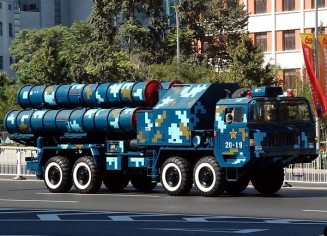
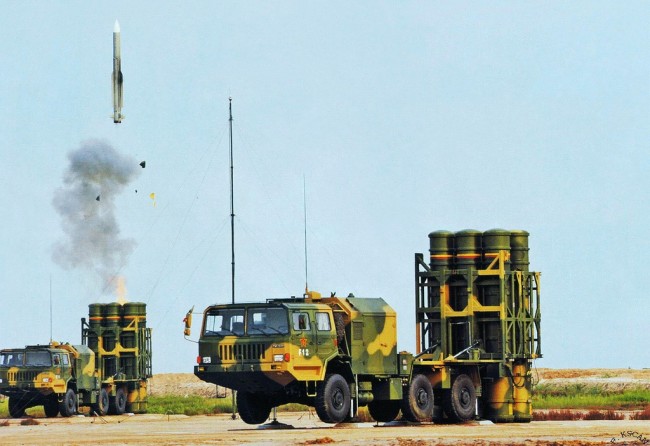
    Ankara has selected China’s missile developer CPMIEC to deliver the strategic US$3.44 billion missile defense shield for Turkey. China’s Precision Machinery Import Export Company (CPIMEC) was selected a winer on an international tender, The winning Chinese FD-2000 system beat the Patriot, the Russian S-400 and the French-Italian Eurosam Samp-T. The Turkish defense minister announced the decision to award the contract in a statement on Thursday, September 26, 2013.

    FD2000 is the export version of the HQ-9 (dubbed the Chinese S300). FD2000 provides improved anti-stealth capability by incorporating the Type 120 low altitude search radar, and Type 305A AESA search radar for full anti ballistic missile capability, and YLC-20 passive sensor, improving counter-stealth capability.

    The Chinese company has beaten US, Russian and European competitors despite being restricted by sanctions. In February 2013 the United States announced sanctions on CPMIEC for violations of the Iran, North Korea and Syria Nonproliferation Act. NATO has deployed the U.S.-built Patriot air and missile defense system there since 2012.

    FD2000 is the export version of the HQ-9 (dubbed the Chinese S300). FD2000 provides improved anti-stealth capability by incorporating the Type 120 low altitude search radar, and Type 305A AESA search radar for full anti ballistic missile capability, and YLC-20 passive sensor, improving counter-stealth capability.
    FD2000 is the export version of the HQ-9 (dubbed the Chinese S300). FD2000 provides improved anti-stealth capability by incorporating the Type 120 low altitude search radar, and Type 305A AESA search radar for full anti ballistic missile capability, and YLC-20 passive sensor, improving counter-stealth capability.

    Murad Bayar, head of the Undersecretariat for Defense Procurement, told the Hürriyet Daily News that full integration with NATO assets was an explicit condition in the contract for the planned air defense system. “As part of this program, a Turkish defense company will be tasked with integrating the air defense system into a network operated by the Turkish Air Force. That integration will mean integration with NATO assets, too, since the Turkish system is fully integrated with the NATO system,” Bayar said.

    Bayar said the Chinese bid came in at $3.44 billion; the initial contract price was estimated at $4 billion. Under the program, dubbed T-LORAMIDS, Turkey will start contract negotiations with CPMIEC, the front-runner of the competition and, if these talked failed, with the Eurosam consortium, the second best offer according to a grading of bids. The U.S. Patriot system was ranked third. Bayar said the Russian option had been eliminated entirely.

    Foreign Legal Threat – an Unknown Regulatory Risk

    Dr. Shuki Friedman
    Dr. Shuki Friedman

    Commentary by Dr. Shuki Friedman:
    Approximately two years ago, an Israeli company with extensive international operations found itself in a precarious, unusual crisis: blacklisted by the U.S. for violating US – Iran sanctions. Such a designation can severely undermine the reputation of a company and can have economic and criminal ramifications, both for the company and its directors. Other companies and banks absorbed large fines in the sums of hundreds of millions of dollars for violations of regulatory laws, mainly U.S.

    This risk is not only the consequence for Israeli giants, nor is it solely related to trade with Iran. Every company or financial institution with international operations is predisposed to lengthy international and exterritorial legislation that exists in many countries.

    Keeping track of possible exposure to sanctions regulations, money-laundering, terrorism and proliferation financing, export-control regimes and the prevention of corruption often falls between the cracks. This is because compliance mechanisms or a company’s legal counsels are not always aware of the regime in question or do not specialize in meeting the specific risks created by it.

    Although many are unfamiliar with the regulations in these contexts, they are fraught with significant risks, including: financial risk in the form of huge fines of hundreds of millions of dollars, in the U.S. in particular, even if the action was not executed on U.S. soil; penal liability of managers and directors; and the considerable risk to a company’s reputation that can result from negative publicity or blacklisting, an action that can naturally also have dramatic financial repercussions, for instance a negative impact on stock prices.

    It is important to remember that these risks do not necessarily stem from Israeli legislation and regulations. In many cases, the claim that the company met the demands of the Israeli law will be simply irrelevant. Therefore, even if a local legal counsel declares that “All is well”, it is entirely possible that this is not the case. These risks place heavy responsibility on the board of directors and company executives. They are the parties in charge of risk management in the company and they are the ones who will be held responsible for any economic or legal liabilities should the company fail. Therefore, they are obliged to take mandatory and all other possible actions to reduce these risks.

    What do company executives and the board of directors have to do in order to reduce these risks? In truth, the response to the risks can be both simple and inexpensive and can prevent costly and serious harm to the company.

    A full response covering the majority of risks would include a risk survey, the building of a compliance program, the creation of a system to support the compliance program and the company’s implementation of said program.

    Risk Survey: Every company has its own uniquely characteristic areas of activity, and target markets where it operates and to which it is exposed. The aim of the risk survey is to show the company executives its exposure resulting from its global operations and point out the areas and markets more sensitive to international and exterritorial compliance regulations.

    The Creation of a Compliance Program: A compliance program is never a generic product. A compliance program must be tailored to the company’s field of operation, its target market, and its exposure as revealed by the risk survey. A comprehensive compliance program would include reference to the company’s business management, while weighing up the risks and their implications on operations. The program would suggest procedures that the company should implement to avoid regulatory violations.

    A System to Ensure Implementation of the Compliance Program: In accordance with the nature of its operations, the company must create a basic database to identify problematic contacts. Alternatively, or in cases where the internal due diligence process of the entities that the company works with (clients, intermediaries, and partners) is insufficient, the company must refer these reviews to a company that specializes in the subject. In certain cases, a basic review, for example of blacklisting, is a minimal requirement and the company must create internal or external tools in order to meet these needs.

    Implementation of the Compliance Program: Compliance program can never replace an employee’s discretion. To incorporate and implement a compliance program, the company should recognize and absorb the rationale behind the compliance program. This applies particularly to groups of employees that deal with operations identified as having higher risks. Only a correctly deployed effective compliance program can hope to achieve its goal and reduce the company’s exposure to risk.

    Taking these steps does not provide total protection from mistakes. However, it will fully protect the company from a legal standpoint. Even if the company unwittingly misled someone, causing them to perform an illegal action, no measures are likely to be taken against it, as it did everything in its power to act correctly and as required by law.

    From the Israeli viewpoint, these risks appear distant in many cases.
    In practice, they are closer than we think and their realization could cost the company its very existence.

    imageDr. Shuki Friedman is a lecturer on international law at the Peres Academic Center and VP Compliance Solutions at Terrogence Ltd.

    Iran’s Shahed-129 Combat Drone to Enter Serial Production

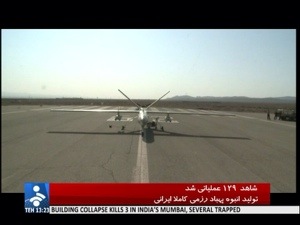
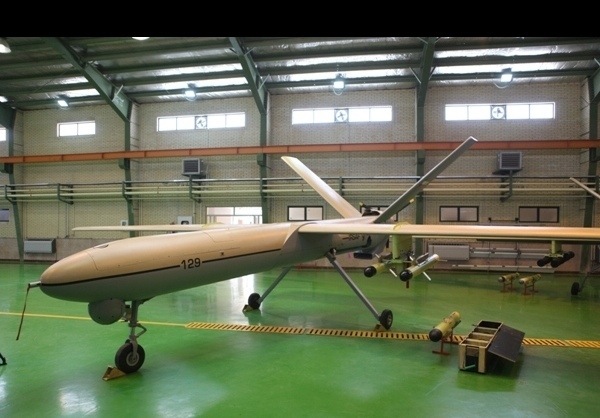
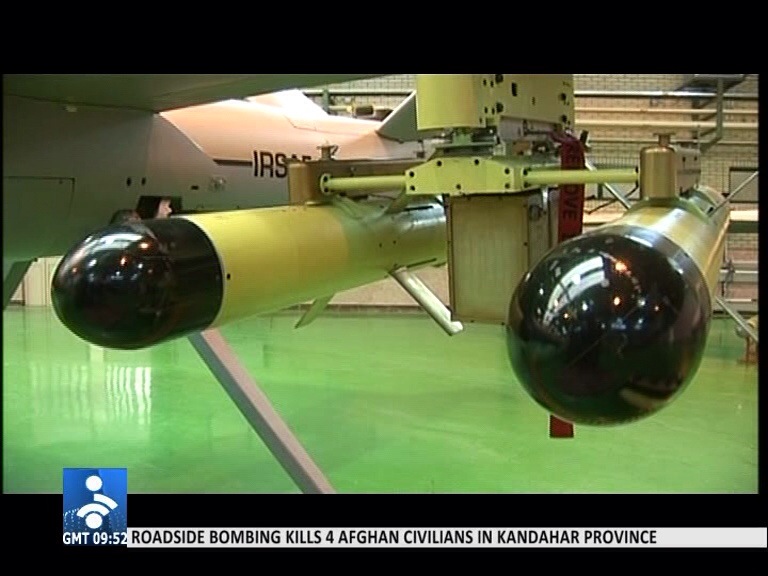
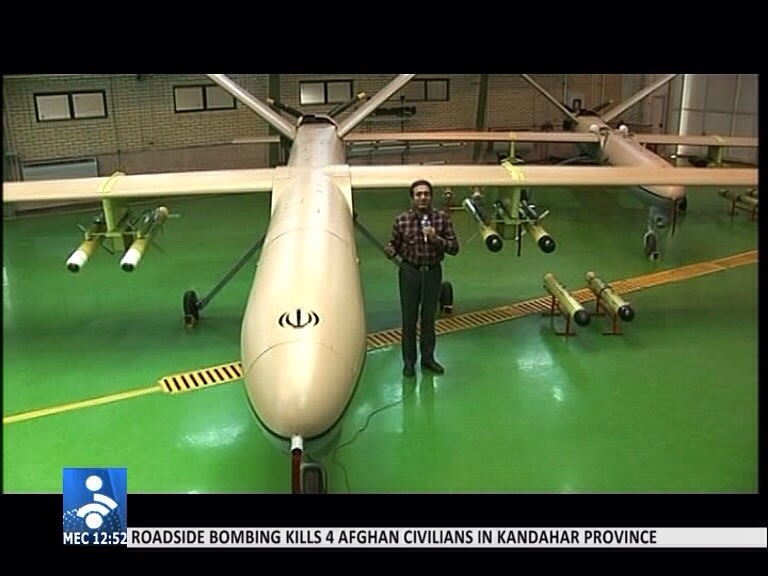
    The Islamic Republic of Iran has launched the mass-production of the indigenously developed Shahed 129 unmanned aerial vehicle (UAV), which was unveiled in September 2012, the Islamic Revolution Guards Corps (IRGC) announced. The drone was displayed recently in an armed configuration, carrying four guided missiles (Sadid) loaded on two twin-launchers, carried underwing. Iranian sources stated the drone can carry up to eight ‘weapons’, designed to hit stationary and mobile targets alike. The specifications referred to by Iranian sources mention an effective operational radius of 1,700 km, datalink range (LOS?) of 200 km, flight endurance of 24 hours, and a flight ceiling of 24,000 feet. It has a monitoring capability of 200 km radius.

    20130928-105818.jpg
    The indigenously developed Shahed 129 unmanned aerial vehicle (UAV)

    External stores are carried on underwing pylons, with sensor payloads installed under the nose in the front and at a payload bay at the drones’ center of gravity (CG), presumably for heavier payloads. The drones shown publicly did not have visible directional antennae or Satellite communicants terminals, hinting of other (less sophisticated and secure, probably commercial off the shelve satellite links for extended range comms).

    Shahed 129 follows the Israeli Hermes 450 design, but given the performance quoted by the Iranians, is a more powerful platform with significant more payload capacity, compared to the Israeli drone. It’s external shape reflects significant advancement in composite materials fabrication, including the production of large airframe and structural elements. Strike missions employing guided weapons also indicate the evolution of compact yet capable sensors and datalinks, enabling the relay of target images and engagement of such targets in real time, over considerable distances.

    In addition to the development of Shahed 129 Iran is accelerating its effort to verse engineer the U s secret RQ-170 Sentinel it captured in 2011, IRGC Brigadier General Hossein Salami confirmed. “All the memories and computer systems of this plane have been decoded and some good news will be announced in the near future not just about the RQ-170 and the optimizations that our forces have done on the reversed engineered model of this drone, but also in area of other important defense achievements,” General Salami said.

    20130928-105831.jpg
    The drone was displayed recently in an armed configuration, carrying four guided missiles (Sadid) loaded on two twin-launchers, carried underwing.

    The unmanned surveillance plane lost by the United States in Iran was a stealth aircraft being used for secret missions by the CIA, US officials admitted almost a week after Iran captured the plane. The aircraft was among the highly sensitive surveillance platform in the CIA’s fleet that was shaped and designed to evade enemy defenses.

    20130928-105838.jpg
    Shahed 129 follows the Israeli Hermes 450 design, but given the performance quoted by the Iranians, is a more powerful platform with significant more payload capacity, compared to the Israeli drone.

    Iran has also uneiled a reverse-engineered version of the Insitu Scan-Eagle operated in support of the US Navy, and captured by the Iranian authorities. The drone displayed officially for the first time this week, uses the fuselage of the Scan-Eagle, with clipped wings, twin boom similar to the new RQ-21A intertor and inverted V-tail, similar to the one used on the RQ-7 Shadow.

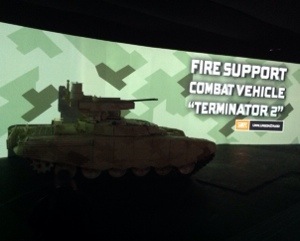
    BMPT72 Unveiled at RAE-2013

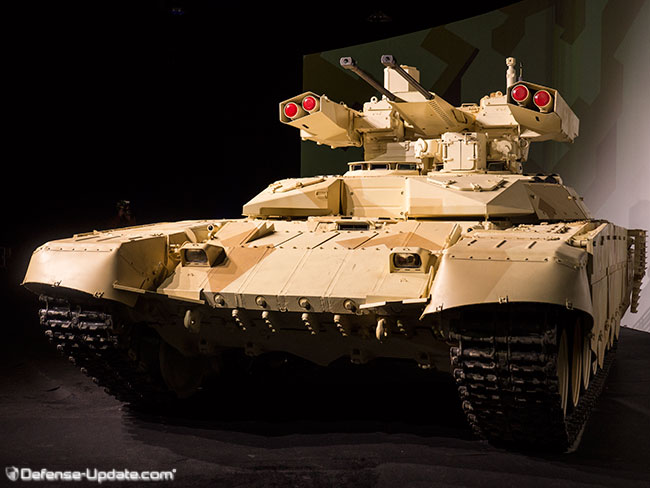
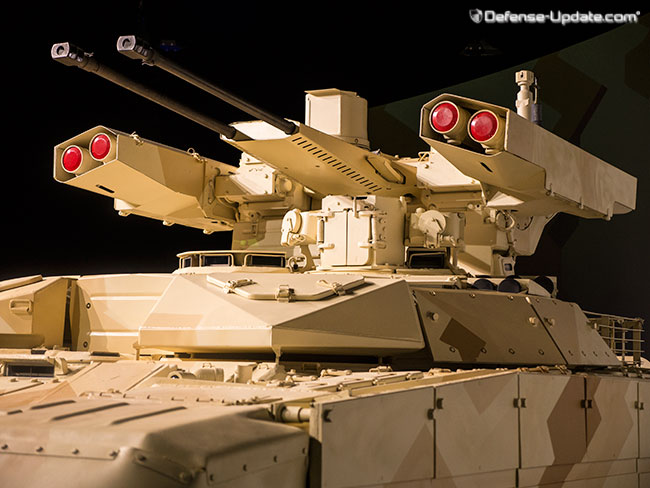
    Among the improvements introduced with the new BMPT72 is a redesigned turret, with lower profile and better protection, including armored shields for the missiles, protecting the missiles from splinters and small arms fire. Photo: Noam Eshel, Defense-Update

    Uralvagonzavod unveiled today the new BMPT72 (also dubbed Terminator 2) combat support vehicle in public on the third day of the Russian Arms Expo RAE-2013 at Nizhny Tagil. Defense-Update reports. Unlike the first generation BMPT that was produced as a new vehicles, rolling off the T-72 production line, BMPT72 is converted from the T-72 platforms that are withdrawn from service,thus offering a cost effective solution for military forces that are already operating over 20,000 T-72 platforms. BMPT has introduced a new concept in combat support, which was not fully comprehended by users. The designers are confident that the new configuration that better integrates with the operational procedures. Under this approach, a BMPT replaces one of the squad’s tanks, thus enabling the whole unit to bring its firepower to maximum effect.

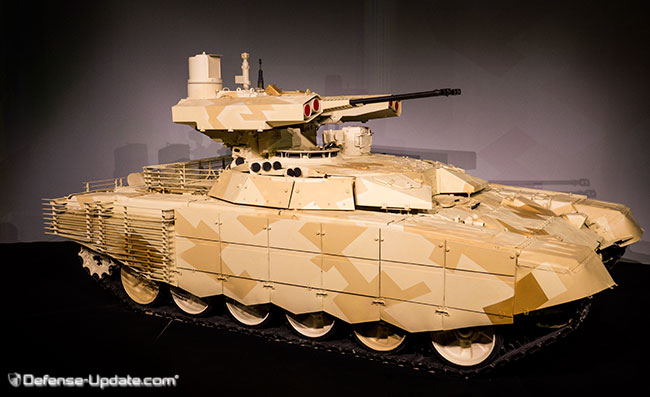
    The new BMPT72 (also dubbed Terminator 2) combat support vehicle. Photo: Noam Eshel, Defense-Update
    The new BMPT72 (also dubbed Terminator 2) combat support vehicle. Photo: Noam Eshel, Defense-Update

    20130927-110317.jpg

    The fire support combat vehicle supporting the team with target acquisition, close and medium range fire support and anti-tank team suppression. It is also highly effective in urban operations, offering elevations and depression angles for both main weapons and sights.

    The vehicle features extremely effective firepower, high Level of protection, high mobility and improved mission endurance. As the first generation BMPT it is designed to engage a wide target set, from enemy tanks, infantry fighting vehicles and other armored vehicles, dismounted infantry, and guided missile teams. The weight of the BMPT72 was reduced by four tons to 44 tons. The crew count was also reduced, from five to three, with the removal of two grenade launching positions. Besides the elimination of 2,100 grenades, the ammunition count remained unchanged – four laser guided ATAKA missiles effective against armor, helicopters or infantry targets at ranges up to 6,000 meters and remotely controlled dual 2A42 gun platform, firing 30mm projectiles. The turret contains 850 rounds of APRS-T, HEF-I, AP-T, KE rounds.

    The vehicle features extremely effective firepower, high Level of protection, high mobility and improved mission endurance. Photo: Noam Eshel, Defense-Update
    The vehicle features extremely effective firepower, high Level of protection, high mobility and improved mission endurance. Photo: Noam Eshel, Defense-Update

    Among the improvements introduced with the new BMPT72 is a redesigned turret, with lower profile and better protection, including armored shields for the missiles, protecting the missiles from splinters and small arms fire. The launchers are positioned oblique side by side rather than the previous stack configuration. The vehicle also uses improved fire control and navigation systems, utilizing video, thermal and laser rangefinder sights for both commander and gunner. The standard T72 hull received a remodeling with add-on armor, reactive armor modules and slat armor, protecting the rear area. Customers will be able to have a choice of two engines – the original 850 hp B84MC or the new 1000 hp B92C2 power plants, both are 12 cylinder V type multi fuel, liquid cooled Diesel engines. The main difference is the replacement if the centrifugal-type supercharger with a turbo supercharger for higher power and efficiency. An auxiliary power unit is used to extend the BMPT72 mission endurance, running all systems on silent watch.

    Among the improvements introduced with the new BMPT72 is a redesigned turret, with lower profile and better protection, including armored shields for the missiles, protecting the missiles from splinters and small arms fire. Photo: Noam Eshel, Defense-Update
    Among the improvements introduced with the new BMPT72 is a redesigned turret, with lower profile and better protection, including armored shields for the missiles, protecting the missiles from splinters and small arms fire. Photo: Noam Eshel, Defense-Update

    Franco-Russian ATOM Wheeled Combat Vehicle Debut at RAE-2013

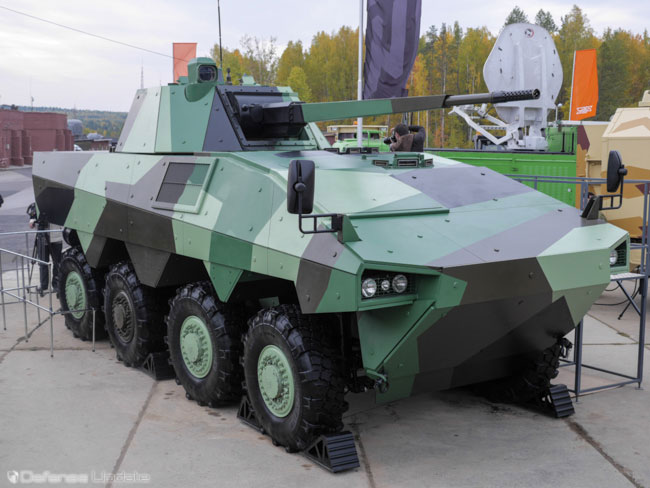
    Uralvagonzavod-Renault new A t oM heavy IFV. Photo: Noam Eshel, Defense-Update
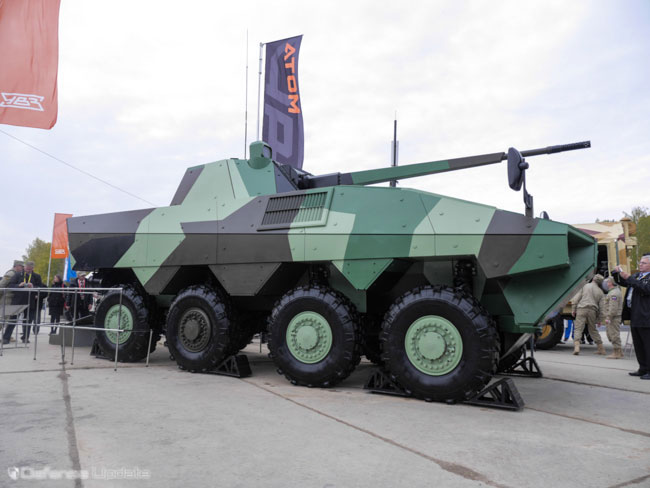
    A side view of the ATOM prototype, unveiled by UralVagonzavod and Renault at RAE-2013. Photo: Noam Eshel, Defense-Update
    A side view of the ATOM prototype, unveiled by UralVagonzavod and Renault at RAE-2013. Photo: Noam Eshel, Defense-Update

    Russian Tracked vehicle manufacturer UralVagonzavod and Renault Trucks Defense of France have unveiled a collaboration program the two companies are pursuing since February 2013, to develop a heavy armored wheeled vehicle, responding to domestic and international requirements.

    The ATOM heavy Infantry Fighting Vehicle (IFV) unveiled here at Nizhny Tagil on Wednesday was produced on the chassis similar to the one Renault is producing for the Nexter VBCI, manufacturer for the French Army.

    The ATOM represent UralVagonzavod’s first entry into the wheeled armored vehicle market, reflecting the company’s strategy in strengthening its traditional tracked vehicle production base with wheeled vehicle platforms, for which demand is stable (unlike tracked vehicles). As a heavy vehicle platform, ATOM will be able to adapt to a number of applications, all based on a common chassis. These include troop carriers, command vehicles, combat electronic vehicle, combat engineering and recovery, and fire support platforms, mounting various weapon systems, from the 57mm cannon shown here to the 120mm gun-mortar.

    Allowing UralVagonzavod to proceed with this prototype and show it publicly at the exhibition could hint on the Ministry of Defense’ interest in encouraging more competition in an area that was traditionally highly regulated.

    UralVagonzavod’s move is see as a direct challenge to the traditional Russian Wheeled AFV manufacturer AMZ, which is currently geared to produce hundreds of BTR-82 per year. However, the future of this line unclear, as the BTR-82 is in the last variant of the BTR-60 platform that has lasted almost 60 years in service. AMZ is expected to release a future APC platform, either 6×6 or 8×8, in the upcoming years. However, at RAE-2013 the company have shown the Wolk (Wolf), a future tactical utility vehicle that will succeed the TIGR.

    Unlike the French VBCI, the ATOM shown here is equipped with an unmanned gun turret mounting a 57mm cannon of a Russian production. The cannon is delivering a firing rate of 120-140 rounds per minute, wit effective Irving range of up to six kilometers. The turret stores 80-100 rounds.

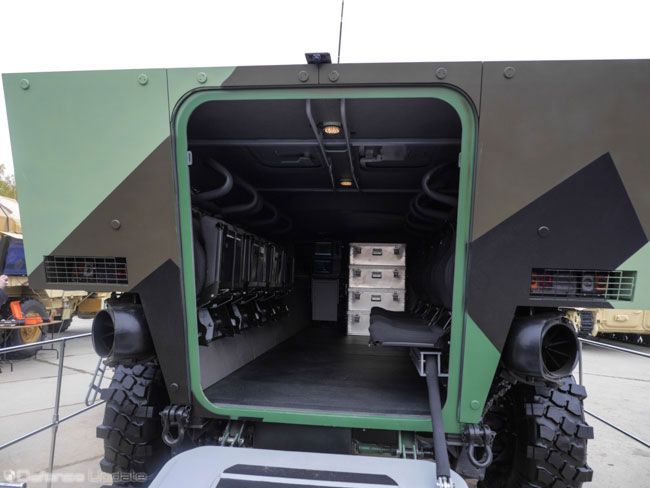
    The turret is not penetrating the hull, leaving the entire 10.7 cubic meter cabin space for carrying eight troops (a typical squad) and a crew of three, plus equipment. The cabin has four roof hatches and a rear ramp for access and disembarkation. ATOM will be able to travel on road at a speed of 100km/h and have an operational un refueled range of 750km,

    The spacious cabin accommodates eight troops and three crew members. The overhead unmanned turret is mounting the 57mm cannon and up to 100 rounds of ammo. Four containers shown here will provide reloads for the gun. Photo: Noam Eshel, Defense-Update
    The spacious cabin accommodates eight troops and three crew members. The overhead unmanned turret is mounting the 57mm cannon and up to 100 rounds of ammo. Four containers shown here will provide reloads for the gun. The vehicles amphibious propulsion propellers can be seen on both sides. Photo: Noam Eshel, Defense-Update
    Uralvagonzavod-Renault new A t oM heavy IFV. Photo: Noam Eshel, Defense-Update
    Uralvagonzavod-Renault new A t oM heavy IFV. Photo: Noam Eshel, Defense-Update

    According to a joint statement released by the two companies, the cooperation between RTD and Ural Vagon Zavod was launched in February 2013 at the last edition of the IDEX exhibit in the United Arab Emirates. “This partnership has resulted in this initial project, which aims to replace the BTR-80s in service in the Russian Army.” The statement said. In terms of mobility, certain versions will be amphibious and air-transportable by Il-76.

    RAE-2013 Photo Report

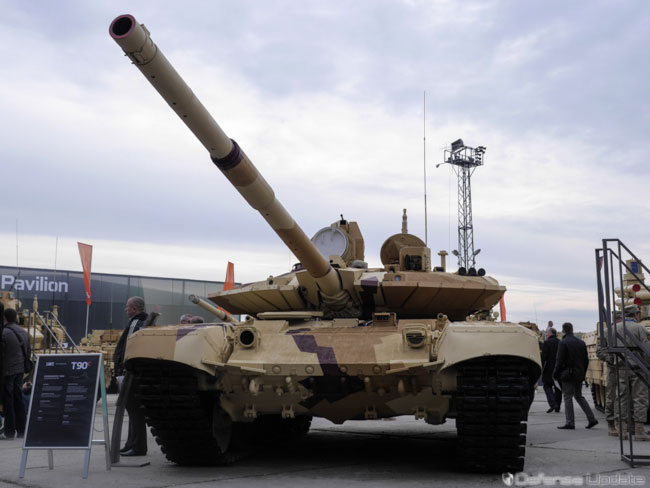
    Several tanks of the T-72/T-90 series were displayed here in live demos, among them two modernized variants of the T-72, the type designed for urban warfare and another, fitted with an Active Protection System. Photo:Noam Eshel, Defense-Update
    Several tanks of the T-72/T-90 series were displayed here in live demos, among them two modernized variants of the T-72, the type designed for urban warfare and another, fitted with an Active Protection System. Photo:Noam Eshel, Defense-Update
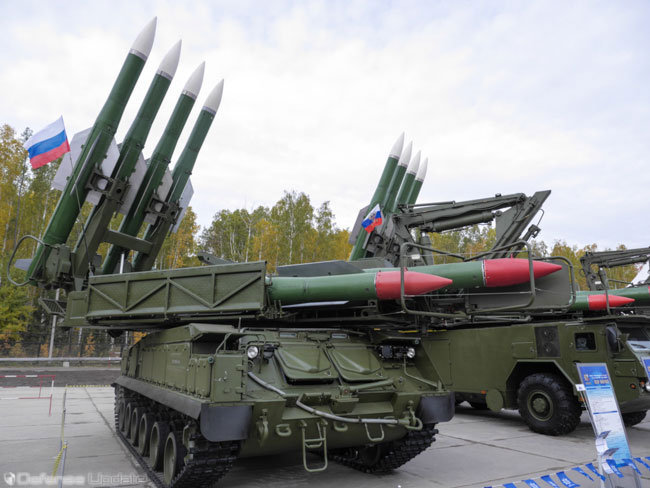
    BUK-2M was displayed in the tracked and wheeled versions. Photo: Noam Eshel, Defense-Update
    BUK-2M was displayed in the tracked and wheeled versions. Photo: Noam Eshel, Defense-Update
    A formation of Su-27 fighters opened the display on the VIP day of the 25 September, 2913. Photo: Noam Eshel, defense-update
    A formation of Su-27 fighters opened the display on the VIP day of the 25 September, 2913. Photo: Noam Eshel, defense-update
    The 'Forpost' unmanned aerial vehicle, From Oboronprom, is actually an Israeli Searcher 2 UAV was seen on patrol during thdelivered by IAI under an arms transfer package with Russia in 2010. The drone, operated by Oboromprom in support of the Ministry of Defense, was following the firing display, assisting target acquisition and battle damage assessment. Imaging from UAS were displayed on the screens in front of the audience throughout the display. Photo: Noam. Eshel, Defense-Update
    The ‘Forpost’ unmanned aerial vehicle, From Oboronprom, is actually an Israeli Searcher 2 UAV was seen on patrol during thdelivered by IAI under an arms transfer package with Russia in 2010. The drone, operated by Oboromprom in support of the Ministry of Defense, was following the firing display, assisting target acquisition and battle damage assessment. Imaging from UAS were displayed on the screens in front of the audience throughout the display. The payload seen under the wing is supporting the automatic landing system. Photo: Noam. Eshel, Defense-Update
    The BMPT fire support combat vehicle was displayed in the firing demonstration, as part of a new tank squad formation, maximizing maneuverability, firepower and flexibility of an armored force. This variant is actually a limited production prototype built around a Tank chassis. The new BMPT72 unveiled at the show utilizes standard T-72 chassis withdrawn from active service. Photo: Noam Eshel, Defense-Update
    The BMPT fire support combat vehicle was displayed in the firing demonstration, as part of a new tank squad formation, maximizing maneuverability, firepower and flexibility of an armored force. This variant is actually a limited production prototype built around a Tank chassis. The new BMPT72 unveiled at the show utilizes standard T-72 chassis withdrawn from active service. Photo: Noam Eshel, Defense-Update

    Skunk Works and XTEND Simplify Multi-Drone Command

    0
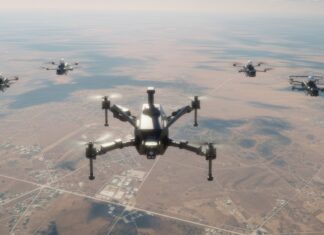
    Lockheed Martin Skunk Works® and XTEND have achieved a major milestone in JADC2 by integrating the XOS operating system with the MDCX™ autonomy platform. This technical breakthrough enables a single operator to simultaneously command multiple drone classes, eliminating the friction of mission handoffs. From "marsupial" drone deployments to operating in GPS-denied environments, explore how this collaboration is abbreviating the data-to-decision timeline and redefining autonomous mission execution.

    From Ukraine to Taiwan: The Global Race to Dominate the New Defense Tech Frontier

    0
    As traditional defense primes face mounting competition from agile “neoprimes” such as Anduril, Palantir and Helsing, the balance of innovation is shifting toward software-defined warfare and scalable, dual-use technologies, while global industry consolidation—marked by Boeing’s integration of Spirit AeroSystems and other strategic mergers—signals an intensified race to secure control over the defense technology value chain. Our Defense-Tech weekly report highlights these trends.

    Europe’s “Drone Wall”

    0
    In early October 2025, a coordinated wave of unmanned aerial system (UAS) incursions—widely attributed to Russia—targeted critical infrastructure across at least ten European nations. The unprecedented campaign exposed the fragility of Europe’s air defenses...

    Weekly Defense Update & Global Security Assessment

    0
    Executive Summary The past week (September 18-25, 2025) represents an inflection point where strategic defense concepts have transitioned from doctrine to tangible reality. An analysis of global events reveals four primary, interconnected trends shaping an...

    U.S. Air and Space Forces Push Next-Gen Programs at the AS&C 2025 Conference and...

    0
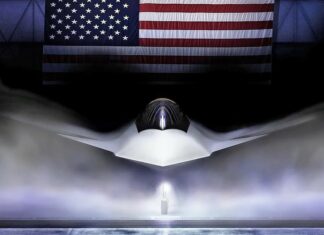
    At the 2025 Air, Space & Cyber Conference, U.S. Air Force and Space Force leaders unveiled major updates on next-generation fighters, bombers, unmanned systems, and space initiatives, highlighting both rapid innovation and critical readiness challenges as the services race to outpace global competitors. A short version is available here, with a more detailed version for subscribers.

    TADTE 2025: Reflecting Taiwan’s Strategic Themes

    0
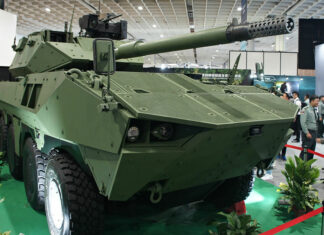
    The Taipei Aerospace & Defense Technology Exhibition (TADTE) 2025 crystallized around four dominant strategic themes that collectively illustrate Taiwan's comprehensive approach to defense modernization amid escalating regional tensions. Based on a detailed report by Pleronix (available upon request). Includes a Podcast discussion on TADTE 2025's highlighting Taiwan's four strategic themes beyond the post's coverage.

    Iron Beam 450 Completes Testing, Soon to Join With Operational Air Defense Units

    0
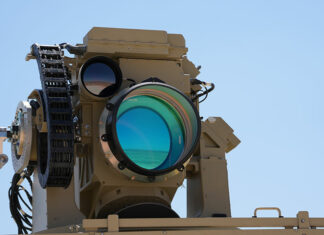
    Israel’s Iron Beam 450 high-power laser system has completed final testing, marking a major leap in air defense. Developed by Rafael, it offers precise, cost-effective interception of rockets, UAVs, and mortars, and is set for IDF deployment by 2025.