Sunday, December 28, 2025
More
    Home Blog Page 155

    Lockheed Martin Unveils Concept Design for a Carrier-Based Drone (UCLASS)

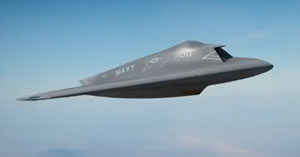
    A forward view of the UCLASS concept design by Lockheed Martin's Skunk Works.
    A forward view of the UCLASS concept design by Lockheed Martin’s Skunk Works.
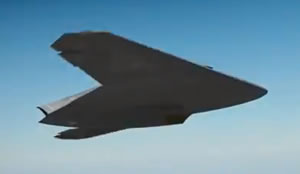
    A side view of the concept design by Lockheed Martin's Skunk Works. Image: Lockheed Martin
    A side view of the concept design by Lockheed Martin’s Skunk Works. Image: Lockheed Martin

    Lockheed Martin unveiled today the concept design of the company’s Unmanned Carrier Launched Airborne Surveillance and Strike (UCLASS) air vehicle, that integrates technologies from F-35C, RQ-170 and other systems to provide persistent ISR and light strike capabilities. The company said its UCLASS design will balance endurance, early operational capability, and inherent growth that will enable operations in any environment or threat scenario. The US Navy foresee the UCLASS type drones assume operational roles in full-spectrum operations – supporting operations from asymmetric warfare and counter terrorism to carrier-based ISR and strike missions.

    The company said the new vehicle being developed by its Skunks Works operation will integrate proven technologies leveraging manned and unmanned operational systems providing the carrier air group persistent 24/7 Intelligence, Surveillance and Reconnaissance support for full spectrum operations. Lockheed Martin is planning to equip the new unmanned aircraft with high level of autonomy, enabling a single operator to control and operate multiple drones.

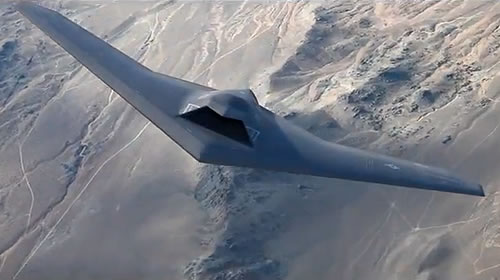
    This lower side view clearly shows the payload bay with the low-observable aperture covering the EO/IR sensors.
    This lower side view clearly shows the payload bay with the low-observable aperture covering the EO/IR sensors.

    Skunk Works is designing the stealthy drone to feature advanced signature control, featuring cutting edge multi-spectral stealth, communications and bandwidth management, to defeat detection and enable operations in access denied environment. According to Lockheed Martin, the new drone will leverage open system architecture to achieve rapid integration and system upgrading, maximize the reuse of hardware, software, payloads, comms and subsystems  and reduce manpower demands.

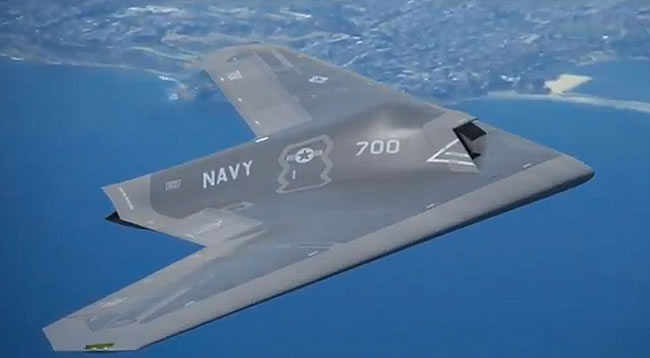
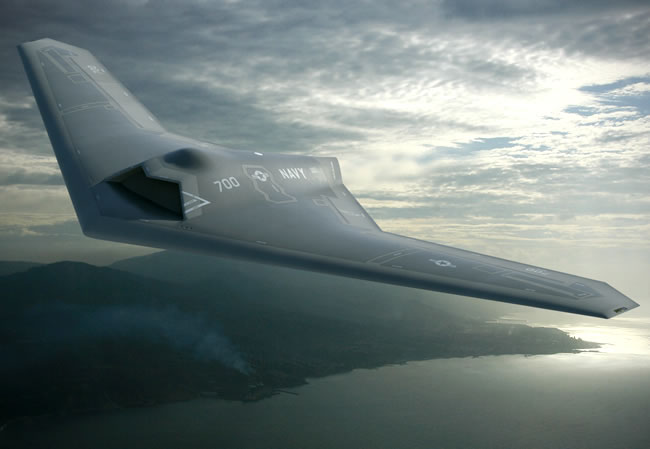
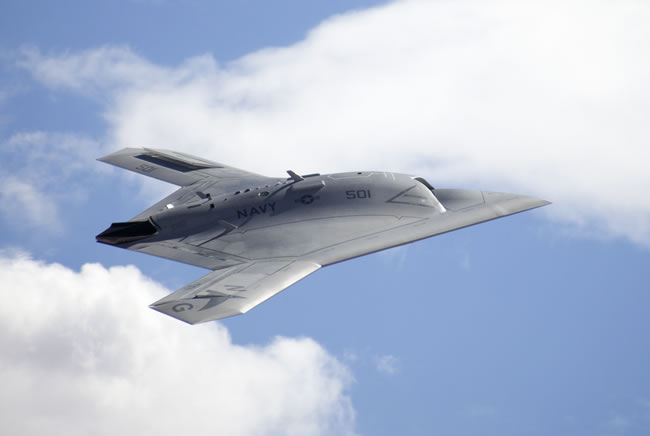
    Among the stealth elements visible in these concept drawings are the engine exhaust tailpipe, recessed and blended into the trailing edge to improve thermal emission and radar reflection – a design already used to a limited extent in the RQ-170. A serrated panel seen on both sides of the fuselage could be an auxiliary air intake, augmenting power for carrier catapult launch and full-power landing approach. The main payload bay combines a low-profile installation similar to that of the F-35, employing an EO/IR and Infra-Red Search and Track (IRST) sensors positioned behind specially coated aperture that masks the payloads to eliminate radar reflections. Additional space for more payloads and weapons could be located at the wing roots, but no indication is provided by the video or photos. Radar and electronic sensors are likely located along the leading edge, similar to the F-22, F-35 or B-2, but there are no indications for such.  A bulge above the air intake seems to be a radome covering the satellite communications terminal, providing low-probability of intercept connectivity. High level of autonomy designed into the vehicle possibly means the SATCOM link can be shut down completely, to reduce signature emission in critical mission phases.

    The company said its proposed approach supports the Navy’s efforts to develop an operational UCLASS capability within the current schedule and budget.

    A forward view of the concept design by Lockheed Martin's Skunk Works.  Image: Lockheed Martin
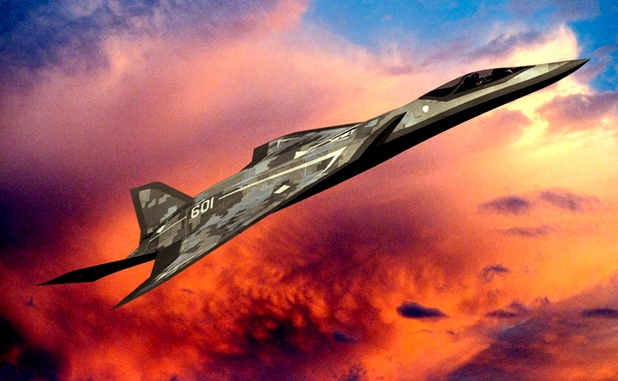
    The UCLASS concept design proposed by by Lockheed Martin’s Skunk Works. The tailless, flying wing design features classical intake and recessed exhaust for signature reduction. Image: Lockheed Martin

    Japan’s AEGIS Destroyers Ordered to Shoot Down North Korean Missiles Overflying Japan

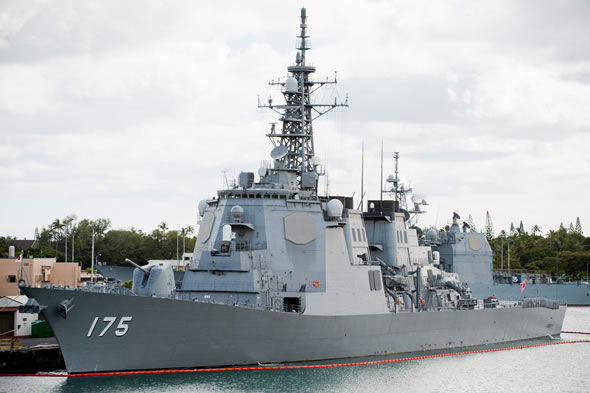
    Japan Maritime Self-Defense Force ship JS Myoko (DDG 175) sits pierside at Joint Base Pearl Harbor Hickam during exercise Rim of the Pacific (RIMPAC) 2012. Photo by: NZDF Amanda McErlich

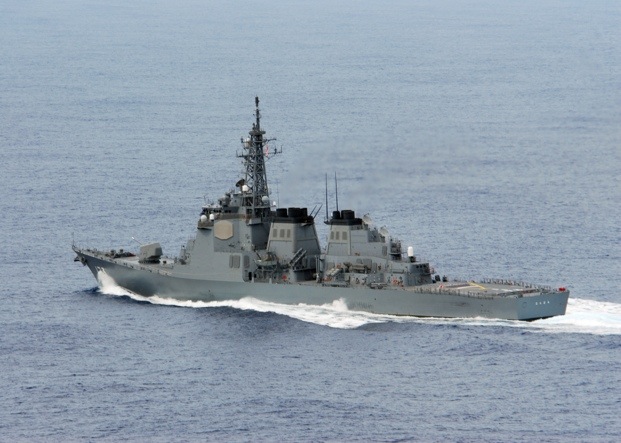
    Japan has ordered its armed forces to shoot down any North Korean missile headed towards its territory, a defence ministry spokesman says. Japan’s Navy operates four Kongo class destroyers equipped with AEGIS-BMD type anti-air and missile systems, and SM-3 Block IA interceptors, capable of defeating ballistic missiles.

    japan’s Defence Minister Itsunori Onodera issued the order, which will see these Aegis destroyers deployed in the Sea of Japan, the defence official said. The official said the order, which was issued on Sunday, was routine and was being kept low-key. “We won’t hold press conferences on this order because of Japan’s policy principle that we will not be swayed by North Korean provocations.

    The order followed intelligence indications about North Korea preparations for testsing ballistic missiles soon, tests that could further escalate the tension in the Korean peninsula. The US has already delayed its own missile test because of soaring tensions in Korea.

    Kim Jang-Soo, chief national security adviser to South Korean President Park Geun-Hye, said a test-launch by the North, or other provocation, could happen any day now, as Western diplomates were orderred to leave Pyongyang before Wednesday, April 10.

    20130408-135855.jpg

    Boeing’s Concept Design for a Naval Manned/Unmanned Strike Fighter

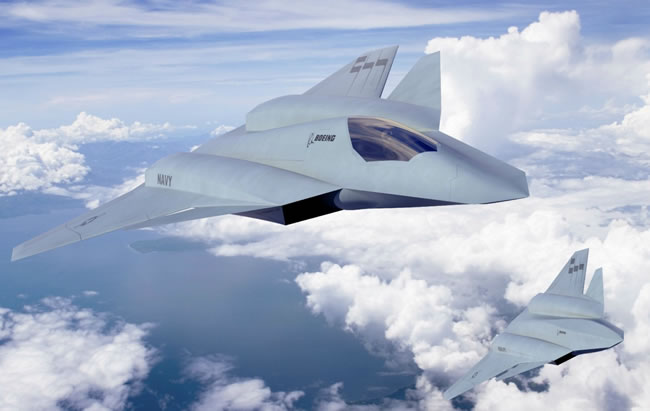
    Boeing's next generation multi-role strike fighter could be built in manned or unmanned versions. The F/A-XX is addressing a US Navy requirement for a future fighter that will be designed for anti-access/area denied (A2AD) operational environment. Illustration: Boeing
    Boeing's next generation multi-role strike fighter could be built in manned or unmanned versions. The F/A-XX is addressing a US Navy requirement for a future fighter that will be designed for anti-access/area denied (A2AD) operational environment. Illustration: Boeing
    Boeing’s next generation multi-role strike fighter could be built in manned or unmanned versions. The F/A-XX is addressing a US Navy requirement for a future fighter that will be designed for anti-access/area denied (A2AD) operational environment. Illustration: Boeing

    For decades, naval aviation has been the traditional hunting ground for Boeing. Since the U.S. Navy decision to back the F-35C as their future stealth fighter, even before the Fifth Generation fighter took to the air, Boeing has pushed for adopting a ‘Sixth Generation’ solution. This week at the Navy League Sea-Air-Space Exposition in Washington DC, Boeing is unveiling an updated version of its F/A-XX sixth-generation fighter concept, Dave Majumdar reports in his DEW Line blog. Boeing presented this design to the US Navy in response to the US Navy request for concepts for a future ‘F/A-XX’ – an aircraft that will replace the current  fighters in the 2030 timeframe, as the Super Hornet and Growler begin reaching their lifespan limit. Through this decade and the 2020s the Navy plans to phase out its ageing Boeing F/A-18A to D-model jets, with Lockheed Martin F-35C. but the Super Hornets are expected to remain in service through the 2030s. With the F/A-XX the Navy is seeking to extend its air defense and strike capability beyond the capabilities currently achieved with the F/A-18 and F-35.

    Boeing suggests this next generation multi-role strike fighter could be built in manned or unmanned versions, designed for the anti-access/area denied (A2AD) operational environment. Overall, it is a tail-less, twin-engine stealth fighter. Unlike contemporary stealth designs (B2, F-22, F-35) the Boeing F/A-XX shape features canard wings, which could potentially compromise the aircraft stealth capability. In the case of this tailless aircraft, additional radar reflections from the horizontal canard planes would be offset by elimination of reflections that would be generated by the vertical and horizontal tail planes used in the F-35 and F-22. The Boeing design also features diverterless supersonic inlets reminiscent of those found on the Lockheed Martin F-35 Joint Strike Fighter. According to Majumdar, the lack of vertical tail surfaces suggests the aircraft would be optimized for all-aspect broadband stealth, which would be needed for operations in the most challenging anti-access/area denial environments.

    For Lockheed martin, focusing on delivering the F-35 on schedule and cost remains the biggest challenge, but the company is also looking at the future generation, the company also released an artist concept depicting how such ‘next generation fighter’ could look like.

    A concept illustration of Lockheed Martin 'Next Generation Fighter'.
    A concept illustration of Lockheed Martin ‘Next Generation Fighter’.

    Brazil’s Defense Industry – Market Report 2012-2017

    Brazil is expected to spend US$20.83 billion on arms procurements in the next five years.
    Brazil is expected to spend US$20.83 billion on arms procurements in the next five years.

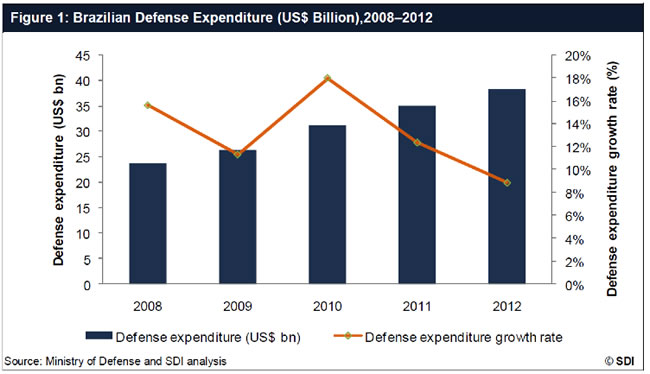
    Brazil maintains stable and amicable relationships with its neighboring countries, and has not engaged in any major armed conflict with another nation in over 50 years. Nevertheless, as a regional power Brazil is investing significantly in defense and security. Currently modernizing its defense equipment, Brazil is expected to spend US$241.41 billion on defense during the period 2012-2017.The country is vast and geographically diverse and is home to the Amazon River and rainforests. It also has large reserves of several natural resources, and has recently discovered substantial oil reserves. The country‘s defense procurements are largely focused on the protection of its substantial resources from illegal mining, deforestation, and drug trafficking.

    The Brazilian Ministry of Defense aims to decrease its dependence on foreign OEMs (original equipment manufacturers) and enhancing its domestic defense capabilities. As such, it prefers to procure defense technology from foreign OEMs, which is then constructed by domestic defense companies. This provides domestic defense firms with technology and equipment which they can integrate into their existing systems. The technology procured has assisted the development of the country‘s aeronautical industry, and continues to provide the Brazilian defense forces advanced attack helicopters, light attack aircraft, and air cargo transport systems.

    According to The Brazilian Defense IndustryMarket Opportunities and Entry Strategies Analyses and Forecasts to 2017  published by SDI “The total Brazilian defense expenditure is expected to grow at a CAGR of 6.6% during the forecast period. The country is expected to spend 1.5% of its gross domestic product (GDP) on defense during the forecast period, with an average per capita defense expenditure of US$234, which indicates the country‘s commitment towards protecting its civilians and natural resources. Throughout the forecast period, the country is expected to spend US$20.83 billion on arms procurements. Brazil is expected to allocate as much as 91.4% of its defense budget towards revenue expenditure, of which almost 50% will be used to pay pension allowances to its retired military personnel.

    There are attractive opportunities expected to emerge during the forecast period in the Brazilian defense industry, as Brazil will seek to procure fighter jets and components for the development of its indigenous transport aircrafts, submarines, and satellite-based imaging systems to help protect the Amazon region.

    brazil

    Brazil is expected to increase its aircraft exports, supported by increased technology and component procurements from Europe

    Although Brazil is currently a net importer of arms, it has focused considerable attention on developing its indigenous defense manufacturing capabilities through offset-enabled technology transfer. Germany is the leading supplier of arms to Brazil, and it mostly supplies components for the manufacture of aircraft and submarines. During the forecast period, the country will continue to focus on the indigenous development of its aerial refueling, air cargo transport aircraft, and diesel-electric submarines, which will lead to an increased demand for importing components.

    The Brazilian defense export market is expected to expand, fueled by the sale of its indigenous air cargo transport aircraft, in which a number of countries have expressed an interest. The Brazilian manufacturing companies Embraer and Helibras, which specialize in the manufacture of light attack aircraft and helicopters, are global leaders in defense production. These firms specialize in the creation of superior quality customized defense systems, and are a popular choice for developing countries as they provide an affordable alternative to advanced fighter planes.

    Defense deals are secured through competitive bidding and stringent offset obligations

    Brazil adopts a competitive bidding approach for both domestic and international acquisitions. In addition to compliance with the defense requirements, a bidder must offer the lowest price with the maximum technology transfer to win a defense contract from the country. Any defense deal worth more than US$5 million has an offset obligation equivalent to 100% of the contract value. The main entry strategy for foreign OEMs is through the direct offset route, which entails the transfer of technology to local companies and the manufacture and assembly of systems in Brazil. However, a number of foreign OEMs have established manufacturing bases in Brazil, in order to capitalize on its low labor costs and availability of raw materials. As such, Brazil is considered to be an export hub for Latin America.

    The key challenges for foreign OEMs are the extensive requirements for technology transfer coupled with the delay in the country’s approval of defense deals

    In order to promote Brazil‘s domestic defense industry, the majority of its arms imports deals include technology transfer obligations. However, a number of defense firms are either reluctant to share proprietary information or are prohibited by their country’s policy on the transfer of technology. This requirement has been a key deterrent for foreign OEMs entering the Brazilian industry. Foreign OEMs have also been deterred by Brazil‘s relatively low defense budget allocation for arms procurements, set at 7.5% of the total defense budget in 2012.

    Order your copy of 'Brazil Defense Industry' 2012-2017 market report
    Order your copy of ‘Brazil Defense Industry’ 2012-2017 market report

    Foreign suppliers also face significant delays in the approval of defense deals, as the Brazilian Ministry of Defense takes a considerable amount of time in evaluating offset agreements. This results in constant revisions of offset agreements by bidders attempting to win contracts, which leads to further delays in contract approvals.

    Order your copy of ‘The Brazilian defense Industry’ market research

    About Strategic Defence Intelligence 

    Strategic Defence Intelligence’s unique monitoring platform tracks global defence activity for over 2,500 companies and 65 product categories in real time and in a highly structured manner, giving a comprehensive and easily-searchable picture of all defence industry activity. The site features: daily updated analysis, comment and news, company and customer profiles, defence spending, tenders and contracts, product and technology intelligence, a research and analysis database providing access to industry and competitor reports to enable business and market planning, and fully customizable tools, including instant personalized report generation and custom alerts.

    SDI reports are available for purchasing online fron Defense-Update Industry Reports section.

    US Reinforcing Pacific Defenses to Counter North Korean Threats

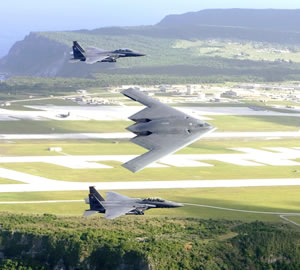
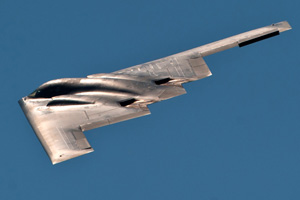
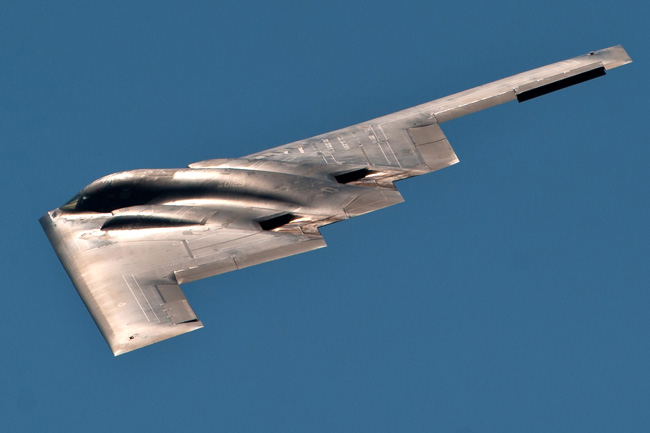
    B2 Spirit escorted by two F-22A Raptors flying over Anderson AFB, Guam. US Air Force photo
    B2 Spirit escorted by two F-22A Raptors flying over Anderson AFB, Guam. US Air Force photo

    After weeks of listening to war-like threats from North Korea, the United States has embarked on a campaign to ensure Pyongyang is painfully aware of America’s military superiority and the nation’s willingness to defend the South from military attack. Washington has also recently decided to strengthen its missile-defense posture in the Pacific in response to Pyongyang’s continual threats to launch ballistic missile attacks against US targets in the region and targets as far away as the US mainland.

    On 8 March and again on 26 March, the United States dispatched B-52 bombers from Andersen Air Force Base in Guam to overfly South Korean territory as part of the ongoing joint US-South Korean Foal Eagle military exercise. These flights were, according to US Department of Defense sources, routine flights intended to demonstrate America’s capability of maintaining a “continuous bomber presence” in the region.

    In a second operation highlighting America’s ability to conduct long-range airborne bombing missions, two United States Air Force (USAF) B-2 Spirit stealth bombers flew roundtrip from Whiteman Air Force Base to the skies over the Korean Peninsula where they unloaded inert munitions on a South Korean bombing range on 28 March. Flying nonstop with the assistance of in-flight refuelers, Pentagon officials called this mission a clear demonstration of “the United States’ ability to conduct long range, precision strikes quickly and at will.” Under less ouvert mission, a flight of seven B-1B bombers was deployed over the Pacific, using open communications to transmit their destination of interest – Guam. Although it was not clear if their destination Guam, the use of open comms channel to deliver what would be considered classified information could have been a signal to Pyongyang. (Foreign Policy)

    In a third demonstration of US airborne might, two F-22 Raptor stealth fighters were deployed to Osan Air Force Base in South Korea from their base of operations in Okinawa on 31 March. A US Forces Korea (USFK) announcement referred to this deployment as a routine mission in support of Foal Eagle and not a response to North Korean threats. The Pentagon’s decision to send only two Raptors to South Korea appears to be Washington’s attempt to cultivate a razor-thin balance between demonstrating America’s commitment to regional allies and limiting the potential for provoking a confrontation with Pyongyang. This deployment is the fourth time the US has deployed F-22 Raptors to South Korea and it appears these two aircraft are now being used primarily as a centerpiece in a static display.

    The matrix of T/R elements mounted on the plannar array of the Active Electronically Steering Array of the SBX-1 radar. Photo: MDA
    The matrix of T/R elements mounted on the plannar array of the Active Electronically Steering Array of the SBX-1 radar. Photo: MDA

    Sailing out of its berth in Hawaii on 23 March, the US Military Sealift Command’s Sea-based X-Band Radar vessel (SBX-1) embarked on what the Department of Defense (DoD) claims to be routine sea trials, but is believed to be enroute to the Pacific as additional radar defense to counter potential North Korean missile launches. The SBX-1’s active electronically scanned array (AESA) radar is mounted on a Russian-built fifth generation CS-50 twin-hulled semi-submersible drilling rig designed to function in the type of adverse conditions often encountered in ocean operations.

    A US land-based X-Band Radar system, positioned in northern Japan, has been operational since 2006 and a second installation is scheduled to be emplaced in central Japan soon, but is not likely to be fully functional for several more months to come. The land-based systems have been tasked with monitoring missile launches in the region, but lack the mobility of the SBX-1.

    The SBX-1 is part of the US Missile Defense Agency’s (MDA) Ground-based Midcourse Defense (GMD) project and forms a vital link in the Ballistic Missile Defense System (BMDS). The SBX-1 can locate, identify, and track suspicious missiles at a range of 4,700 kilometers while feeding targeting data to land-based and seaborne anti-missile batteries. Traveling at an average speed of nine knots, it takes approximately 16 days for the SBX-1 to reach the western Pacific.

    In addition to other assets moving closer to North Korea, the United States Navy has also dispatched two guided-missile destroyers to the region on 1 April. According to George Little, US Assistant Secretary of Defense for Public Affairs, the USS John S. McCain (DDG-56) and the USS Decatur (DDG-73) “have arrived at predetermined positions in the western Pacific, where they will be poised to respond to any missile threats to our allies or our territory.”

    The USS Fitzgerald (DDG-62) is also believed to be prowling the waters of the region after completing a training mission as part of the Foal Eagle exercise. These three warships are Arleigh Burke-class destroyers fitted with the Aegis Ballistic Missile Defense System (ABMD) designed to shoot down enemy ballistic missiles using Lockheed Martin’s Aegis Weapon System and the Raytheon RIM-161 Standard Missile 3 (SM-3).

    On 3 April, in light of Pyongyang’s specific threats against Guam and Hawaii, the Pentagon also announced plans to deploy a Terminal High-Altitude Area Defense System (THAAD) ballistic missile defense battery to Guam within the next few weeks. The Pentagon said this move is a precautionary measure intended to reinforce US defense capabilities in the region.

    The THAAD system is a land-based ballistic missile defense system featuring an integrated fire control unit, a truck-mounted launcher, an enhanced AN/TPY-2 tracking radar, and a healthy supply of interceptor missiles. THAAD batteries are designed to detect, track, and intercept potentially hostile missiles.

    The island of Guam is a key US territory in the Pacific located approximately 3,380 kilometers southeast of the Korean Peninsula. It is home to more than 10,000 US military personnel, civilians, and military dependents. Naval Base Guam and Andersen Air Force Base provide extensive facilities in support of US Navy submarines, US Coast Guard surface vessels, and forward deployed USAF strategic bombers.

    Shortly after the Pentagon announced the deployment of the THAAD battery to Guam, the Korean People’s Army (KPA) announced that “final approval” had been received authorizing Army commands to initiate a nuclear attack against the United States.

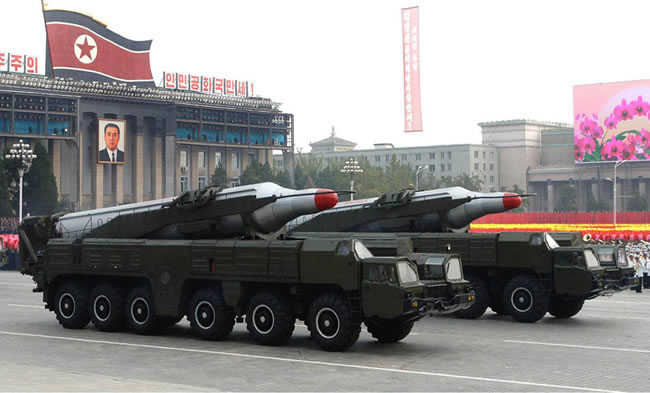
    North Korea has moved Musudon (BM25) ballistic missiles to a launch site at the east coast, from where it could launch such missiles on a test flight that could fly over Japan.
    North Korea has moved Musudan (BM25) ballistic missiles to a launch site at the east coast, from where it could launch such missiles on a test flight that could fly over Japan.

    On 5 April, South Korea’s Yonhap News Service filed a story quoting an unnamed South Korean official as saying Pyongyang had redeployed two intermediate-range missiles, loaded aboard mobile launchers, to the east coast of the Peninsula. The missiles are believed to be BM25 Musudan mid-range missiles with an estimated range of 3,000 to 4,000 kilometers. These missiles bring Japan and possibly Guam within range of an attack. Many analysts speculate that the missiles are being positioned for a test launch, but no announcements have been received from Pyongyang explaining the purpose of the redeployment. Some sources indicated such test could take place by April 14. Anticipating the upcoming test the US is set to deploy a Global Hawk unmanned spy plane in Japan to boost surveillance capabilities over North korea. The Global Hawk will be stationed at the US airbase in Misawa, in northern Japan. This will be the first ever deployment of the aircraft in the country, the Sankei Shimbun reported, quoting government sources. Two years ago Global hawk drones were assigned surveillance missions over japan, 48 hours after earthquake and tsunami devastated Japan’s east coast. On that mission the drones flew from Guam, maintaining continuous coverage of the Japanese coastline for 21 days, spending 300 hours on-station and 500 hours in the air including transit time to Japan. The US military informed Japan last month about plans to deploy the plane between June and September but may bring the date forward, it said, following reports about North Korea’s preparations for missile launches.

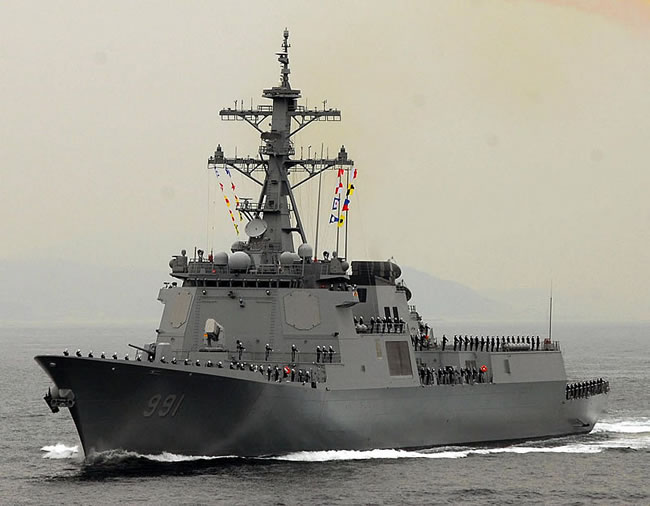
    Seoul, in a precautionary move, has dispatched two Aegis destroyers to monitor any missile launch that may be forthcoming. The 7,600-ton warships are outfitted with SPY-1 radar giving them the capability to track multiple airborne targets at a distance of up to 1,000 kilometers. One ship has been posted to the east of the Peninsula and one to the west.

    Republic of Korea Navy Sejong the Great (DDG-991) KDX-III class AEGIS destroyer
    Republic of Korea Navy Sejong the Great (DDG-991) KDX-III class AEGIS destroyer

    Unfortunately, the public display of all this firepower and warfighting capability appears to have failed to intimidate Pyongyang. On 5 April North Korea began notifying foreign diplomatic missions that the regime could no longer guarantee their safety and advised them to remove their personnel. The following day, Pyongyang announced that foreign missions in the North had a deadline of 10 April to evacuate.

    While most experts believe the North does not possess the military might required to carry-out many of its threats, the fear that Pyongyang will initiate local attacks aimed at South Korea is shared by many and would be in keeping with the North’s historical pattern of armed intervention. Some experts have noted that Pyongyang has engaged in some form of military provocation following every South Korean presidential inauguration to date.

    Some sources are making much of the possibility the North may initiate some provocation to commemorate the birthday of the North’s founder, Kim Il-sung, on 15 April or some action might be scheduled to mark the founding of the KPA on 25 April. Given the illogical rhetoric emanating from Pyongyang, just about anything seems possible.

    South Korea Selects the Taurus KEPD 350 Cruise Missile

    Two Taurus KEPD 350 missiles can be carried on the Boeing F-15K.
    Two Taurus KEPD 350 missiles can be carried on the Boeing F-15K.

    South Korea will likely buy the Taurus KEPD 350 long-range air-to-surface cruise missiles next year. “We intend to choose the Taurus missiles and integrate them,” Kim Kwan-jin said at a parliamentary meeting of the defences committee in Seoul. “U.S. missiles were one of the options we were considering, but because it is difficult for them to be sold to Korea, the only option we have is the Taurus,” Kim added (Reuters). A military officer confirmed Wednesday price negotiations with the German-Swedish Taurus Systems joint venture are due to start soon. Seoul is seeking to equip the next batch of fighter aircraft it intends to buy with the new missile. The Taurus would be the first strategic weapon Seoul has imported from Europe rather than the U.S.

    South Korea also considered buying the AGM-159 JASSM made in the US by Lockheed Martin, but the export of this missile was not cleared by Congress. The only long-range missiles in the Air Force’s inventory are the SLAM-ER missiles built by Boeing. SLAM-ER was delivered with the recent batch of F-15K Slam Eagle, also built by Boeing. SLAM-ER has a range of 278 km. Taurus Systems is offering two versions of the missile – one at the Taurus KEPD 350MR with a range of 300 km and the KEPD 350 with a range ‘exceeding 500km’. South Korea is likely opt for the extended range version as it seek to extend the range of its strike weapons, in order to cover the entire area of its rival in the north, particularly medium-range ballistic missiles bases located in the North East, and out of reach of the South.

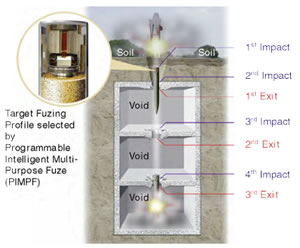
    Assisted by the PIMPF counter fuze technology, KEPD's  MEPHISTO warhead can destroy underground bunkers with high effectiveness and minimum collateral risk. Photo: Taurus Systems
    Assisted by the PIMPF counter fuze technology, KEPD’s MEPHISTO warhead can destroy underground bunkers with high effectiveness and minimum collateral risk. Photo: Taurus Systems

    Since the KEPD 350 exceeds the range limit imposed by the Missile Technology Control Regime (MTCR) Taurus Systems maintained its warhead weight below the MTCR threshold of 500 kg. The 480 kg warhead known as Mephisto (Multi-Effect Penetrator, HIgh Sophisticated and Target Optimised (MEPHISTO) combines effective penetration for hard and deeply buried targets (HDBT) with blast-and-fragmentation capabilities against point and area targets. Using the Programmable Intelligent Multi-Purpose Fuze (PIMPF) the missile is capable of penetrating up to six meters of reinforced concrete and perforate several concrete floor levels on its way, exploding exactly at the level required by the mission planners.

    The missile uses a combination of navigation methods, including Terrain Referenced Navigation (TRN) and Image Based Navigation (IBN), Inertial Navigation System/Global Positioning System (INS/GPS) delivering a target error rate of 2 to 3 meters over 500km flight.

    Taurus Systems GmbH is a joint venture set by the European Aeronautic Defence and Space Company (EADS) and Sweden’s Saab Bofors Dynamics. The Taurus is currently in service with the German and Spanish Air Forces, deployed on Tornado and Eurofighter Typhoon fighter jets. It is also being offered to several international customers, including India.

    The country is expected to buy 200 such missiles, to be integrated with F-15K and and KF-16 fighter jets. The new missile is also likely to be carried by the next generation strike fighter (FX-3) Seoul is planning to buy – this could be F-15SE, F-35 or Eurofighter Typhoon.

    F-22 Raptor Resume Airspace Control Alert Missions After Restrictions Are Lifted

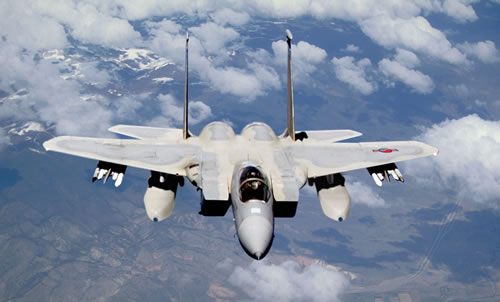
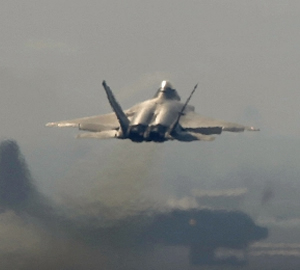
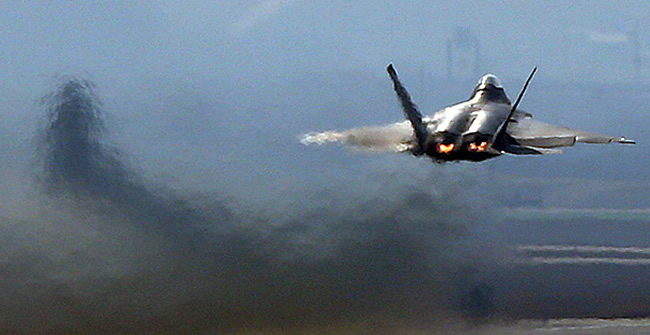
    USAF F-22 Raptor taking off for Osan, South Korea. The stealth fighters are currently participating in exercise Foal Eagle, amid growing tension with North Korea.
    USAF F-22 Raptor taking off for Osan, South Korea. The stealth fighters are currently participating in exercise Foal Eagle, amid growing tension with North Korea.

    The U.S. Air Force announced the F-22 Raptor has resumed normal flight operations after modifications to aircrew life-support equipment were completed across the fleet, including the upper pressure garment and related hoses, valves and connectors. Completion of this task eliminates the need to restrict flight operations to remain within a 30-minute flying distance from an airfield suitable for landing. As part of their growing role abroad Japan based F-22s are taking in Operation Foal Eagle in South Korea. While their participation was planned months in advance, and was preceded by three previous visits, the current deployment is positioned as a tough signal to Pyongyang’s under the ongoing sabre rattling between North Korea and the USA.

    F-22 crews have also resumed their aerospace control alert mission in Alaska after the Automatic Back-up Oxygen System was installed in aircraft based at Joint Base Elmendorf-Richardson, Alaska. Altitude restrictions have also been incrementally removed for F-22s that have received the ABOS modification. Altitude restrictions for training flights remain for non-ABOS equipped F-22 aircraft; however, those restrictions will be removed as each aircraft is modified.

    The return to normal flight operations hinged on completing eight near-term actions identified by the Air Force Scientific Advisory Board, successful fielding of the modified Combat Edge upper pressure garment valve and fielding of the automatic backup oxygen system. All actions identified by the SAB were completed in December 2012. Fielding of the modified Combat Edge upper pressure garment valve and related pieces was completed in January.

    f22gear
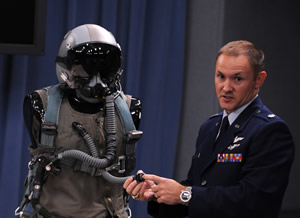
    Lt. Col. Jay Flottmann explains how a valve in the upper pressure garment and the shape and size of oxygen-delivery hoses and connection points contributed to previously unexplained physiological issues during F-22 Raptor flights. He spoke during a press conference in Washington, D.C., July 31, 2012. Flottmann is a flight surgeon and 325th Fighter Wing chief of flight safety. (USAF Photo by Senior Airman Christina Brownlow)
    The fielding of the ABOS provides additional protection to F-22 pilots while flying at high altitudes and in the most demanding oxygen-delivery scenarios. The first combat aircraft was modified in January at Nellis AFB, Nev. Elmendorf-assigned Raptors began modifications in February and officials expect combat fleet completion by July 2014.

    In May 2011, Air Force officials stood-down the F-22 fleet for four months. This operational pause enabled the Air Force to accelerate efforts to study, define and fix the cause of the reported incidents. After the SAB completed its investigative actions in January 2012, the F-22 Life Support Systems Task Force formed a multiservice, multiagency team of government, industry and academic experts to review previous recommendations and findings. This increased breadth of experience, enhanced scope of knowledge, and additional impartial expert analysis led to the conclusion that a lack of oxygen quantity was causing the physiological incidents. The task force also determined the quality of oxygen was not causing the physiological symptoms reported by F-22 pilots and ground crew.

    The Air Force said F-22 aircrews have flown more than 22,270 sorties and more than 27,500 hours since the last previously unexplained incident in March 2012.

    Air Force officials will continue to leverage lessons learned throughout the F-22 investigative process and will invest in characterizing and better understanding the high-performance aircraft environment to improve pilot safety and performance in the F-22 and in all current and future weapon systems.

    Nothing Stealth About This

    Riki Ellison, Chairman & Founder, Missile Defense Advocacy Alliance
    Riki Ellison, Chairman & Founder, Missile Defense Advocacy Alliance
    Riki Ellison, Chairman & Founder, Missile Defense Advocacy Alliance

    The United States conveyed a strong demonstration of power in its support of South Korea and Japan during this week’s joint United States-South Korea military exercises. The massive coordination and integration of United States’ air, land, and sea military capabilities, on the Korean Peninsula, with its strong hosting ally, the Republic of South Korea, clearly shows the United States’ commitment to assure our allies, of this region, against the North Korean threat.

    The United States has no intention to strike first against a nuclear armed nation such as North Korea, largely because the United States can defend against a North Korean nuclear missile attack.

    As a small part of this large exercise, two United States’ nuclear-capable B-2 stealth bombers were flown over South Korea. This fly over demonstrated the B-2 stealth bombers’ capability to deliver payloads that would clearly devastate the North Korean regime if they were irrational enough to go through with their threats and attack the United States, South Korea, territories in the Pacific and Japan.

    The strategic message this week is much more powerful than two B-2 stealth bombers, it is the United States’ ultimate assurance to South Korea, Japan and all those who are witnessing, in this region, the placement of thousands upon thousands of American lives, in front, arm in arm, and together with the South Koreans against the North Korean’s aggression and threats. To the South Koreans and Japanese who live with and face the North Korean threat daily, this is the ultimate symbol of assurance.

    The United States has no intention to strike first against a nuclear armed nation such as North Korea, largely because the United States can defend against a North Korean nuclear missile attack. The United States’ intention and policy is to prevent South Korea and Japan from striking first against a North Korean nuclear power that will provoke, threaten, and continue to increase its rhetoric and political agenda. Having joint exercises such as these and joint missile defense capability defeats the threatening belligerent provoking government of North Korea, and significantly helps reduce South Korean and Japan’s consideration of preemptive or striking back at North Korea and lighting the fuse to a devastating war.

    The massive display of offensive capability along with missile defense, in and around the Korean Peninsula, including the flights of nuclear capable B-2 stealth bombers, is an absolute necessity for South Korea, Japan, and United States as we work to assure that millions of innocent lives are defended and that this offensive capability is able to survive a first strike by North Korea

    The massive display of offensive capability along with missile defense, in and around the Korean Peninsula, including the flights of nuclear capable B-2 stealth bombers, is an absolute necessity for South Korea, Japan, and United States as we work to assure that millions of innocent lives are defended and that this offensive capability is able to survive a first strike by North Korea, including the territories and states of the United States. This capability will further deter North Korea as they decide if they should rationally strike or not strike, and defend if they irrationally decide to strike.

    Credit and recognition should go towards the unheralded participants in this past week of exercises, our nation’s missile defense war fighters and their systems as well as their respective missile defense teammates from South Korea and Japan as they are all a critical part of this week’s necessary exercises.

    The United States Missile Defense participants are as follows:

    • The men and women of the United States 35th Air Defense Artillery Brigade, based in Osan Air Force Base, Korea, command the two U.S. Patriot 3 Battalions located in Korea.
    • The men and women of the United States Aegis BMD ships from the 7thFleet, based out of Yokosuka, Japan, with AN/SPY radars and SM-3 Block IA interceptor missiles.
    • The men and women of the United States Army First Space Brigade managing the JTAG satellite warning system in Osan, Korea and the AN/TPY-2 radar in Japan.
    • The men and women of the 7th Air Force and the 607th Air Operations Center (AOC) in Osan Air Base, Korea and the 94th AAMDC in Hawaii with the 613th AOC that commands the fire control and integration of the missile defense assets in the region.
    • The men and women of the Army’s 100th Missile Defense Brigade out of Colorado Springs, Alaska and California and the 49th Missile Defense Battalion out of Fort Greely, Alaska that command the defense of the United States with the 30 deployed Ground Based Interceptors.
    • The men and women of the Air Force 460th Space Wing that command our early warning Satellites out of Fort Buckley, Colorado and those that command our land-based radars in Shemya and Clear Alaska as well as Beale Air Force Base in California.

    Having a combination of joint defensive and offensive forces is much more lethal, effective, and sound to deter and prevent conflict than relying on offensive forces alone. Defensive capability provides more flexibility in response as well as more assurance.

    Even with all of the significant and integrated capability that was demonstrated this week, there is concern that we are not doing all that we can in the defensive preparation of Korea and the protection of the American citizens in the Pacific Islands including Hawaii, Guam, Wake, and the Mariana Islands from a North Korean nuclear ballistic missile first strike. Two major missile defense assets and platforms that have been bought and paid for with billions of U.S. Tax dollars remain not deployed and inactive in this region.

    • The Sea-Based X-Band (SBX) Radar, currently berthed in Pearl Harbor, Hawaii is a floating platform that can be towed out to any part of the Pacific, between Hawaii and North Korea to track and provide fire control data to our Aegis BMD Ships and to all of our long-range ballistic missile interceptors in Alaska and California. Deployment of the SBX would provide additional protection to Hawaii, territories in the Pacific and the United States Homeland.
    • The Alpha 4-THAAD Battery is a fully operational missile defense system currently based in Fort Bliss, Texas. The THAAD is able to track, discriminate and fire interceptors at multiple salvos of incoming ballistic missiles in high altitude and in low space providing an exponentially greater amount of defended area than the deployed Patriot systems. Deployment of the Alpha-4 THAAD Battery in Korea would enhance our missile defense systems deployed there greatly to protect more people and more assets as well as to increase the threshold of deterrence towards North Korea and provide more assurance to our allies in the region.

    We look forward to seeing these two great systems deployed as they would make the Pacific Region, including Hawaii and the Korean Peninsula, safer than it is today.

    We rest assured that we, as a nation, have a proven demonstrated missile defense capability deployed in Alaska and California to shoot down any and all of today’s North Korean Missiles targeting American cities.

    There is nothing stealth about this.

    Riki Ellison is the Chairman & Founder, Missile Defense Advocacy Alliance

    North Korea Declares “A State of War” Exists

    nok

    North Korea’s enigmatic leader, Kim Jong-un, seems intent on taking tensions on the Korean Peninsula to unprecedented new heights with each passing day. After weeks of bombastic warmongering and public proclamations threatening to destroy the South and annihilate the United States, Pyongyang has now proclaimed that a “state of war” exists between the North and the South.

    On 26 March, North Korea’s Central News Agency (KCNA) announced that Kim and the Supreme Command of the Korean People’s Army (KPA) had placed units of the KPA on the highest level of combat readiness, a move that has not been undertaken since the Ceasefire Armistice was signed in 1953. The heightened state of readiness placed the North’s field artillery units, long-range artillery batteries, and strategic rocket units on a war footing with orders to prepare to strike select targets in Guam, Japan, Hawaii, and the US mainland.

    A day later, Pyongyang announced that it was severing a key military communication line with Seoul. Earlier in the month, the North disconnected a Red Cross hotline frequently used by the two Koreas to communicate since the two nations have no formal diplomatic relations.

    During an emergency meeting with military leaders in the early morning hours of 29 March, according to reports released by KCNA, Kim approved a directive placing the KPA’s strategic missile units on standby with orders to prepare for strikes against targets in the US mainland and against US military installations in South Korea, Hawaii, Guam, and Japan.

    KCNA quoted Kim as stating that the North was fully prepared “to settle accounts with the US imperialists.” Kim is also quoted as commanding the KPA’s rocket units to be “on standby so that our forces can shoot and strike targets at any time.”

    Pyongyang’s recent threats of war followed on the heels of a US announcement, released on 28 March, that two B-2 Spirit stealth bombers flew from the US mainland to a South Korean bombing range as part of the annual Foal Eagle training exercise now occupying the attention of US and Republic of Korea (ROK) military forces in the South.

    US Forces Korea (USFK) publicly announced that two B-2 nuclear-capable bombers flew from Whiteman Air Force Base in Missouri to South Korea where they simulated a bombing run with inert munitions on South Korea’s Jik Do Bombing Range, an uninhabited islet used frequently by US and ROK forces for bomber training. The two bombers, assigned to the 509th Bomb Wing at Whiteman AFB, flew more than 20,000 kilometers roundtrip, using in-flight refueling, enroute to the bombing range. The B-2 is capable of carrying up to 23 tons of nuclear and conventional munitions and is designed to penetrate deep into enemy-held territory while evading hostile radar to deliver a devastating strike on critical targets such as command and control facilities. After delivering their dummy munitions, the two bombers flew safely back to their home base in Missouri. Although the B-2s have participated in past exercises, including flights over South Korea in 2000, this is the first time the bomber crews delivered inert munitions on target.

    A prepared Defense Department statement said the B-2 mission “demonstrates the United States’ ability to conduct long-range, precision strikes quickly and at will.” US Secretary of Defense, Chuck Hagel, told reporters at the Pentagon that General Martin Dempsey, Chairman of the US Joint Chiefs of Staff, characterized the B-2 operation as a clear-cut message of support for American allies and was not intended as a provocation or a veiled threat directed at the North.

    The announcement of the B-2 flight followed an earlier announcement that the United States Air Force (USAF) flew two B-52 training flights over the South in March, one aircraft overflew the South on 8 March and a second conducted a low-altitude flight on 19 March. According to USAF sources, the two B-52s were not carrying munitions on these flights although they are capable of carrying a massive load of conventional and nuclear ordnance.

    News of the B-52 flights is reported to have infuriated Kim Jong-un compelling him to place KPA artillery and rocket forces on combat alert. The B-2 flight appears to be the source of Kim’s decision to put KPA rocket forces on wartime standby and his rationale for declaring that a “state of war” exists with the South.
    South Korea’s Yonhap News Service released a report quoting an unnamed ROK military official as saying a “sharp increase” in vehicular and personnel traffic has been detected in the areas surrounding Pyongyang’s long-range missile sites. South Korea’s Ministry of Defense has so far failed to confirm this report and admits only that US and ROK intelligence sources are engaged in intense surveillance of all strategic sites in the North.

    Pyongyang also threatened on 29 March to close a joint North/South industrial complex located in North Korea some six kilometers north of the Demilitarized Zone (DMZ). The site is responsible for as much as $2 billion in trade each year for the North and is a vital source of unsanctioned income that Pyongyang is desperately in need of.

    The Kaesong Industrial Zone has so far remained open although Pyongyang has closed it in the past in response to heightened tensions only to reopen it once tempers had cooled. The Kaesong site appears to be operating normally even though a communication link used to coordinate the movement of South Korean workers to the site has been disconnected.

    While Pyongyang’s threats and bombast are worrisome, nearly all analysts agree that the North does not currently have the means of striking targets in the continental United States and there is grave doubt that the KPA is capable of hitting targets in Guam or Hawaii.

    While wholesale warfare is an unlikely prospect, many experts are concerned that even a limited confrontation of a localized nature could escalate beyond the point of no return and embroil the Pacific in a conflict that could endanger tens of thousands and disrupt the political stability of the region.

    However, the North has demonstrated that its Rodong-1 medium-range missiles can reach a distance of approximately 1,300 kilometers and are capable of hitting US installations in Japan. These missiles are believed to be fully operational and represent a credible threat to Japan-based forces.

    Logic would naturally dictate that Kim Jong-un would be foolish beyond all reason to launch an attack aimed directly at US forces in the Pacific region. To do so would constitute a willful act of suicide on the part of the North. While the North could possibly inflict severe damage on Pacific-based American forces, Pyongyang could never withstand the wrath of an incensed and overwhelming American response.

    At present, the most anyone can hope for is that Kim quickly satisfies his need to impress the North Korean populace and then reconsiders the path of destruction he has chosen for his nation and his people.


    Washington Steps Up Warning: Sending Two Stealth Bombers over South Korea

    Following North Korean escalating tension with the South,  Washington is stepping up warning. Today the Air Forces’ Strategic Command said it is sending two B-2 Spirit strategic bombers over the peninsula. In retaliation, North Korean leader Kim Jong Un ordered his rocket units to target US bases in the south. “the time has come to settle accounts with the U.S. imperialists in view of the prevailing situation” North Korean news agency announcement said, “The US has entered a reckless phase, going beyond the phase of threat and blackmail,” the announcement quoted KIm saying.

    While chances of a full scale war with the South seem unlikely, there are fears of a localized conflict, such as a naval skirmish in disputed Yellow Sea waters. Such naval clashes have happened three times since 1999.

    Amid tensions over the North’s third nuclear test last month and ensuing United Nations sanctions, North Korea had already shut down Red Cross hot lines with South Korea and a communication line with the American military command in South Korea. Yesterday, Pyongyang terminated the last remaining link with the South, accusing the South’ new President Park Geun-hye of pursuing the same hard-line policy of her predecessor that the North blamed for a prolonged chill in inter-Korean relations. “Under the situation where a war may break out any moment, there is no need to keep North-South military communications,” the North said on Wednesday.

    U.S. Strategic Command officials sent two B-2 Spirit bombers for a long-duration, round-trip training mission from Whiteman Air Force Base, Mo., to South Korea March 28 as part of the ongoing bilateral Foal Eagle training exercise. The stealth bomber’s mission followed two deployment of B-52H missions over South Korea last week, which drew fierce response from North Korea. “The United States is steadfast in its alliance commitment to the defense of South Korea, to deterring aggression, and to ensuring peace and stability in the region. The B-2 bomber is an important element of America’s enduring and robust extended deterrence capability in the Asia-Pacific region.” United States Forces Korea communique responded.

    This mission by two B-2 Spirit bombers assigned to 509th Bomb Wing, which demonstrates the United States’ ability to conduct long range, precision strikes quickly and at will, involved flying more than 6,500 miles to the Korean Peninsula, dropping inert munitions on the Jik Do Range, and returning to the continental U.S. in a single, continuous mission. “Exercise Foal Eagle demonstrates the commitment of the United States and its capability to defend South Korea and to provide extended deterrence to our allies in the Asia-Pacific region.”

    North Korea announced yesterday it is planning substantial military actions, including pre-emptive nuclear strikes against the United States and South Korea. Pyongyang also claimed it is targeting US territories in Guam and Hawaii, however, despite the clear threat, North Korea does not currently have the means to carry out such threat.

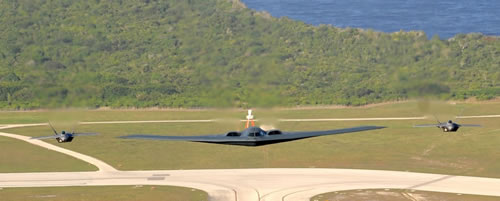
    Northrop Grumman B-2B 'Spirit' stealth bomber operational with the US Air Force Strategic Command. Photo: US Air Force
    Northrop Grumman B-2 ‘Spirit’ stealth bomber operational with the US Air Force Strategic Command. Photo: US Air Force

    Fact or Fiction? Russian Arm’s Sale to China

    In response to a 25 March Chinese CCTV News Agency and People’s Daily report announcing a major arm’s deal between Moscow and Beijing, Russia’s ITAR-TASS News Agency published a denial the same day claiming no such deal was made. The denial was first announced by DefenseNews. The Chinese news media reports claim that an agreement was signed just prior to Chinese President Xi Jinping’s weekend visit to Russia. The reported deal would provide China with 24 Sukhoi Su-35 fighters and four Amur-class diesel submarines. An agreement of this magnitude, if confirmed, would represent the first major arm’s deal between Moscow and Beijing in more than ten years.

    The ITAR-TASS news story, as reported by DefenseNews, insists that Moscow and Beijing did not engage in any discussions related to military hardware, weapon’s transfers, or technology cooperation immediately prior to or during President Jinping’s weekend visit.

    The Sukhoi Su-35 (codenamed the Flanker-B by NATO) is a highly-maneuverable twin-engine, single-seat, multirole fighter aircraft. China and Russia have engaged in several discussions since the 1990s regarding a possible sale of Su-35s. Since 1998, several reports have surfaced announcing sales of Su-35s to China, deals that never materialized. Reports announcing the sale of Tupolev Tu-22M bombers were also met by immediate Russian denials in January 2013.

    Some well-placed analysts believe Russian officials are reluctant to execute a Memorandum of Understanding (MoU) Moscow and Beijing signed in December 2012 laying the foundation for negotiations that might eventually culminate in a firm deal for the submarines and the Su-35s.
    It is widely believed that previous negotiations were scuttled due to concerns within Russia’s ruling hierarchy that, given Beijing’s track record for reverse-engineering vital technology, China would use the Su-35 as a model to construct a new Chinese aircraft in violation of Russia’s International Property Rights (IPRs).

    Concerns have also been voiced in some circles that Beijing hopes to gain access to the Saturn AL-1175 engines used to power the Su-35 to be used as a model for a domestically-produced copy. The AL-1175 also powers Russia’s T-50 prototype for its fifth-generation stealth fighter, the Sukhoi PAK FA.

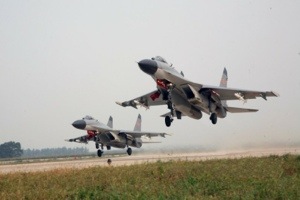
    Russian officials have long claimed that Beijing used a 1995 production-licensing agreement to build 200 Sukhoi Su-27SK air superiority fighters to secretly create an indigenous aircraft, the Shenyang J-11B, in violation of IPR requirements. Russia cancelled the agreement in 2006 after 95 aircraft had been produced insisting that the J-11B represented a reverse-engineered copy of the Su-27SK equipped with Chinese avionics and engines.

    Some analysts speculate that Russia is also reluctant to go ahead with the sale of the Amur-class diesel submarines as fears abound that Beijing will also attempt to secretly reverse-engineer the boats in an effort to manufacture an indigenous Chinese copy.

    The Amur-class is one of Russia’s latest designs, often called an export example of the Lada-class, and is advertised as being a modernized version of the Kilo-class submarines. The Russians claim the Amurs feature advanced combat capabilities, innovative acoustics that enhance stealth operations, and an optional Air-Independent Propulsion (AIP) system.

    According to some experts, China’s prospects for reverse-engineering the Amur subs or the Su-35s are not as promising as they may appear. With the Su-27SK, Beijing took advantage of favorable technological exchanges with the Ukraine to obtain the data required to overcome engineering challenges. Now, the Ukraine has no access to the latest, more advanced Russian aircraft or naval designs and no secrets to trade with the Chinese.

    Given the rapid technological advances China has demonstrated in recent years, not all analysts believe Beijing is bent on reverse-engineering entire systems. Some argue that any future copying would likely be limited to adapting separate components for inclusion in new indigenous models.
    The Russian newspaper Kommersant claims the deal, if consummated, would be worth approximately $2 billion. A deal of this nature would be a major boost to China’s military posture. Weapons like the Su-35 and the Amur-class subs would give Beijing a significant edge in its continuing territorial disputes with its Pacific neighbors.

    With its domestic stealth aircraft still being tested and not yet in production, the Su-35 represents a significant strengthening of China’s airborne combat force that is certain to create concern in the minds of China’s Pacific adversaries.

    With Japan scheduled to receive its first batch of F-35 Joint Strike Fighters (JSF) in late 2016 and China’s highly-touted J-20 and J-31 stealth fighters are not likely to become operational until sometime in 2017 at the earliest, acquisition of the Su-35 would help Beijing fill a perceived gap in its ability to defend its territorial airspace.

    As for the Amur submarines, it seems logical that Russian officials would be well-disposed to making a deal with China. Since this model is not a vessel of strategic value, equipping China with these boats would make America’s “Pivot to the Pacific” a more challenging endeavor and might go far in helping Russia keep the United States off-balance.

    We can only speculate as to the validity of the Chinese claims that the deal was signed and will soon become a reality. It is uncertain if the Russian denial is a firm fact, a temporary postponement, or a ruse designed to mislead for unknown reasons.

    US Navy to Review Four Designs for UCLASS; Plans Fielding Within 3-6 Years

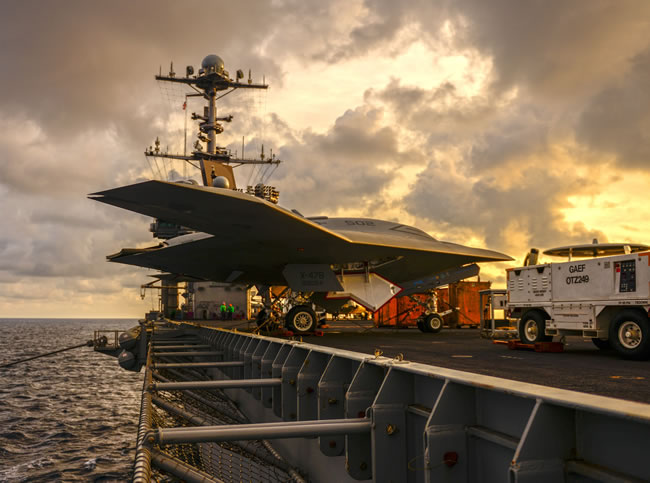
    In December 2012 Northrop Grumman and the U.S. Navy conducted deck handling trials of the X-47B Unmanned Combat Air System aboard the USS Harry S. Truman (CVN-75). Trials were designed to demonstrate the aircraft's ability to integrate smoothly with carrier operations. Photo: Northrop Grumman
    Northrop Grumman X-47B Unmanned Combat Air System selected by the US Navy to demonstrate carrier operations of an unmanned aircraft. Photo: Northrop Grumman
    Northrop Grumman X-47B Unmanned Combat Air System selected by the US Navy to demonstrate carrier operations of an unmanned aircraft. Photo: Northrop Grumman

    The Naval Air Systems Command (NAVAIR) intends to issue four firm-fixed-price contracts for Preliminary Design Reviews (PDR) for the Unmanned Carrier Launched Airborne Surveillance and Strike (UCLASS) Air Vehicle. The contracts are expected to be issued by the summer of 2013, supporting up to two years of work. This new unmanned combat unmanned aerial vehicle (UCAV) system will provide the US Navy persistent unmanned semi-autonomous, carrier-based, Intelligence, Surveillance, Reconnaissance and Targeting, and strike capability to support 24/7 carrier operational coverage.The system to be reviews include three principal elements – the unmanned aerial vehicle (platform), datalink for communications and control and the carrier-based segment, including the handling and operation on-board the carrier, which will also provide the human interface of the entire system. Each of the four contracts will cover two years work (2013-15) and will include funding for post-PDR design maturation and follow-on engineering efforts to advance the designs.
    Contracts are expected to be awarded to four companies – the Boeing Company, Northrop Grumman Systems Corporation, General Atomics Aeronautical Systems Inc. and Lockheed Martin, the four companies are expected to be ready for PDR-level NAVAIR evaluation by the third quarter of FY14. Based on this review the Navy plans to select a single proposal for full scale development, anticipating the UCLASS capability could be fielded within three to six years.

    All four companies have solid plans for a carrier-based UCLASS type system. Boeing and Lockheed Martin have concept designs of stealth UAVs designed for carrier operation and General Atomics have flown the jet-powered stealthy Predator C (Avenger) that could assume that role. Only Northrop Grumman has a flying vehicle designed to operate on board aircraft carriers – the X-47B, scheduled for carrier testing next year.
    China’s Mighty Dragon Grows Teeth

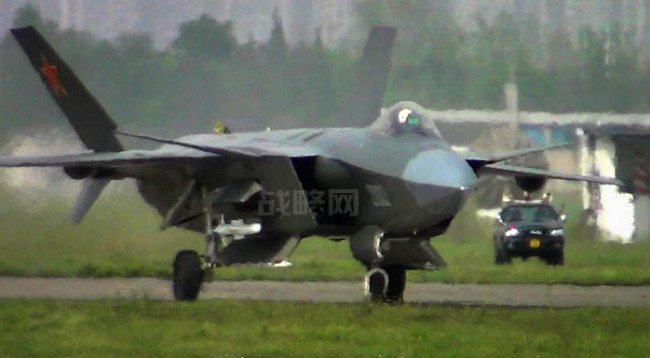
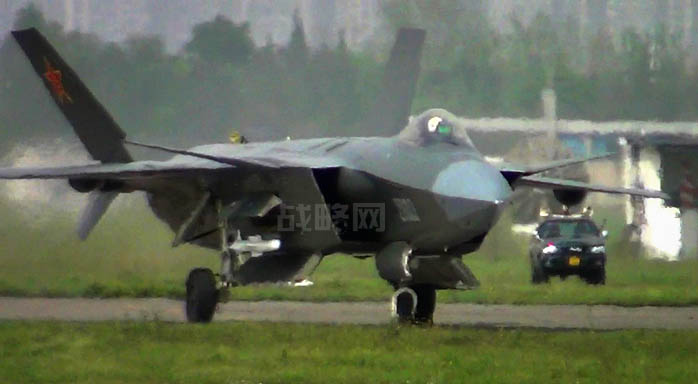
    J20 preparing to a flight test carrying a dummy missile in its starboard weapon bay.
    J-20_msl
    Chengdu J-20 ‘Mighty Dragon’ seen on a test flight March 13, 2013 carrying a dummy missile.

    Recent photos of the second ‘Technology Demonstrator” Fifth Generation Chengdu J20 ‘Mighty Dragon’ stealth fighter depict a recent flight testing what seems to be an R-77 missile dummy carried on the starboard (right side) weapons bay.

    An open canopy of the first J20 prototypes shows some details of the HUD.
    An open canopy of the first J20 prototypes shows some details of the HUD.

    From the photos published on several Chinese websites it isn’t clear whether the aircraft flew the entire flight with an open bay, as all photos, including the one showing the J-20 in flight show the missile in the extracted position.

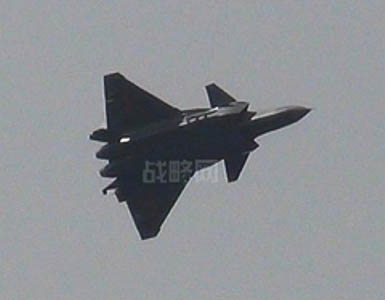
    The J-20 uses two side-mounted weapon bays carrying four missiles, in addition to a large belly weapon bay carrying additional, larger air/air missiles. It is assumed the J-20 will also be able to carry the PL-10, PL-12 and PL-21 air/air missiles.

    Chinese Military Review

    J20 preparing to a flight test carrying a dummy missile in its starboard weapon bay.
    J20 preparing to a flight test carrying a dummy missile in its starboard weapon bay.

    EAPS Miniature Missile Successful in the First Guided Flight

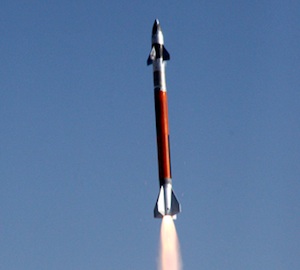
    At less than 1 meter long, less than 50 millimeters in diameter and less than 3 kilograms mass at launch, the MHTK is extremely compact and very agile in flight. Photo: Lockheed martin
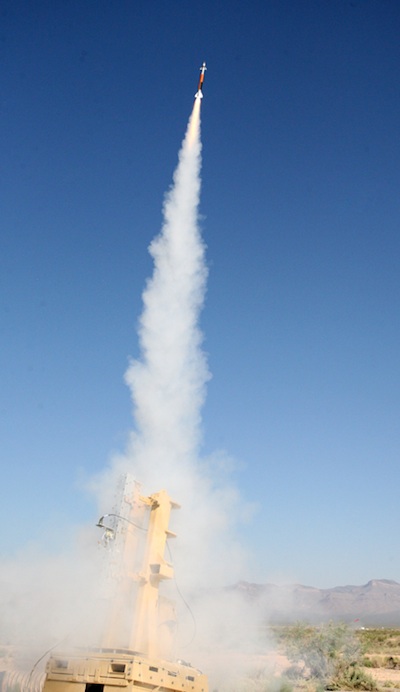
    Miniature Hit-To-Kill (MHTK) interceptor launched on an EAPS test flight - May 2012. Photo: Lockheed Martin
    Miniature Hit-To-Kill (MHTK) interceptor launched on an EAPS test flight – May 2012. Photo: Lockheed Martin

    On March 22, 2013 Lockheed Martin completed the first successful flight test of the Miniature Hit-To-Kill missile, part of the Extended Area Protection and Survivability (EAPS) systems. The flight provided data about the weapon’s seeker, guidance, navigation and control system performance. This very small and agile interceptor is designed to defeat Rocket, Artillery and Mortar (RAM) targets at ranges greatly exceeding those of current systems. This test is another milestone in a series of technically challenging events completed under the EAPS Integrated Demonstration Science and Technology program.

    The test closely replicated a tactical situation in which an enemy launches a mortar at an area protected by the MHTK intercept system. A radar successfully detected and tracked the threat in flight. The tactically configured MHTK interceptor launched vertically and flew a trajectory positioning it to detect energy from a ground illuminator reflected off the mortar target. Responding to the reflected energy, the MHTK interceptor maneuvered to fly very close to the target and gather data through its seeker as it passed the mortar in flight. Intercepting the target was not an objective of this flight test. In addition to gathering data to characterize the interceptor’s performance, this test integrated and exercised the entire intercept system for the first time. The data collected will support an intercept flight test planned for later this year.

    At less than 1 meter long, less than 50 millimeters in diameter and less than 3 kilograms mass at launch, the MHTK is extremely compact and very agile in flight. Photo: Lockheed martin
    At less than 1 meter long, less than 50 millimeters in diameter and less than 3 kilograms mass at launch, the MHTK is extremely compact and very agile in flight. Photo: Lockheed martin

    At less than 1 meter long, less than 50 millimeters in diameter and less than 3 kilograms mass at launch, the MHTK is extremely compact and very agile in flight. Paired with a fire control sensor capable of providing illumination, the MHTK provides robust defeat of RAM targets through body-to-body impact at tactically significant ranges, greatly increasing the protected volume in which our soldiers operate and offering commanders more flexibility than legacy and interim systems.

    The test was conducted at White Sands Missile Range, N.M., in collaboration with the U.S. Army Research Development & Engineering Command/Aviation Missile Research Development & Engineering Center (RDECOM/AMRDEC). “We are very pleased with the initial review of the test data” Loretta Painter, AMRDEC EAPS Program Director said, noting the collected data will be used to reduce risks and improve the system prior to the next flight.

    The Lockheed Martin MHTK interceptor is on track to meet the AMRDEC Average Unit Production Cost goal of $16,000 per interceptor in 2006 dollars at specified quantities, making it much more affordable than systems such as the counter-rocket ‘Centurion’ gun it will replace.

    Skunk Works and XTEND Simplify Multi-Drone Command

    0
    Lockheed Martin Skunk Works® and XTEND have achieved a major milestone in JADC2 by integrating the XOS operating system with the MDCX™ autonomy platform. This technical breakthrough enables a single operator to simultaneously command multiple drone classes, eliminating the friction of mission handoffs. From "marsupial" drone deployments to operating in GPS-denied environments, explore how this collaboration is abbreviating the data-to-decision timeline and redefining autonomous mission execution.

    From Ukraine to Taiwan: The Global Race to Dominate the New Defense Tech Frontier

    0
    As traditional defense primes face mounting competition from agile “neoprimes” such as Anduril, Palantir and Helsing, the balance of innovation is shifting toward software-defined warfare and scalable, dual-use technologies, while global industry consolidation—marked by Boeing’s integration of Spirit AeroSystems and other strategic mergers—signals an intensified race to secure control over the defense technology value chain. Our Defense-Tech weekly report highlights these trends.

    Europe’s “Drone Wall”

    0
    In early October 2025, a coordinated wave of unmanned aerial system (UAS) incursions—widely attributed to Russia—targeted critical infrastructure across at least ten European nations. The unprecedented campaign exposed the fragility of Europe’s air defenses...

    Weekly Defense Update & Global Security Assessment

    0
    Executive Summary The past week (September 18-25, 2025) represents an inflection point where strategic defense concepts have transitioned from doctrine to tangible reality. An analysis of global events reveals four primary, interconnected trends shaping an...

    U.S. Air and Space Forces Push Next-Gen Programs at the AS&C 2025 Conference and...

    0
    At the 2025 Air, Space & Cyber Conference, U.S. Air Force and Space Force leaders unveiled major updates on next-generation fighters, bombers, unmanned systems, and space initiatives, highlighting both rapid innovation and critical readiness challenges as the services race to outpace global competitors. A short version is available here, with a more detailed version for subscribers.

    TADTE 2025: Reflecting Taiwan’s Strategic Themes

    0
    The Taipei Aerospace & Defense Technology Exhibition (TADTE) 2025 crystallized around four dominant strategic themes that collectively illustrate Taiwan's comprehensive approach to defense modernization amid escalating regional tensions. Based on a detailed report by Pleronix (available upon request). Includes a Podcast discussion on TADTE 2025's highlighting Taiwan's four strategic themes beyond the post's coverage.

    Iron Beam 450 Completes Testing, Soon to Join With Operational Air Defense Units

    0
    Israel’s Iron Beam 450 high-power laser system has completed final testing, marking a major leap in air defense. Developed by Rafael, it offers precise, cost-effective interception of rockets, UAVs, and mortars, and is set for IDF deployment by 2025.