

Thursday, January 1, 2026
More
    Home Blog Page 196

    JLTV Programs Enters the Final Phase

    Oshkosh is proposing its recently developed Light All-Terrain Vehicle (L-ATV) for the US Army/Marine Corps JLTV. Photo: Oshkosh

    Preparing for the next phase in the Joint Light Tactical vehicle (JLTV) program, the U.S. Army Tacom Life Cycle Management Command in Warren Michigan gathered six proposals yesterday, for the upcoming 27 month Engineering and Manufacturing Development (EMD) phase.

    Up to three bidders will be picked for this phase awarded contracts worth up to $65 million for the final element of the development program, leading to the selection of the prime contractor sometime in the summer of 2014. The winner will pocket a multi-year contract worth six billion dollars, production orders spread over the next seven years could call for the delivery of at least 52,500 tactical vehicles worth up to $250,000 each, for the Army and Marine Corps.

    The government plans to award up to three EMD contracts in June of this year. Each contractor will deliver 22 vehicles and other test articles for evaluation. Two JLTV variants will be built under the EMD phase, a Combat Tactical Vehicle that can carry four troops (or 3,500 pounds) and the Combat Support Vehicle that carries two, with additional 1,600 pounds payload (total 5,100 pounds).
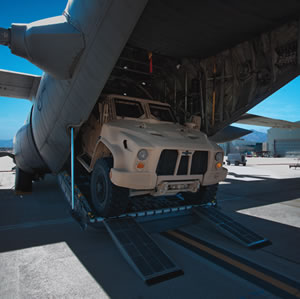
    The Oshkosh L-ATV is designed to be light enough for air transportation in a C-130. Photo: Oshkosh defense

    Opening the EMD phase to new bidders, as the Army planned, provided an opportunity for Oshkosh Defense, who waited patiently after losing the previous Technology Demonstration (TD) phase. In the past two years Oshkosh has developed and tested its own version of JLTV, called ‘Light Tactical All-Terrain Vehicle’ (L-ATV), bringing the new design to a maturity level required by the Army. According to Oshkosh the lightweight, air transportable L-ATV offers MRAP-level protection with high off-road mobility – capabilities currently offered by the heavier and larger M-ATV. “Through disciplined engineering and extensive testing, the L-ATV is proved to meet or exceed JLTV requirements”, Oshkosh said in a statement. The vehicle is fitted with the TAK-4i intelligent independent suspension system delivering high performance and agility on and off road, in rough or urban terrain. According to Oshkosh, the vehicle can be equipped with the ProPulse hybrid diesel-electric drive train providing 70 kW of exportable power to save fuel consumption and support deployed units.
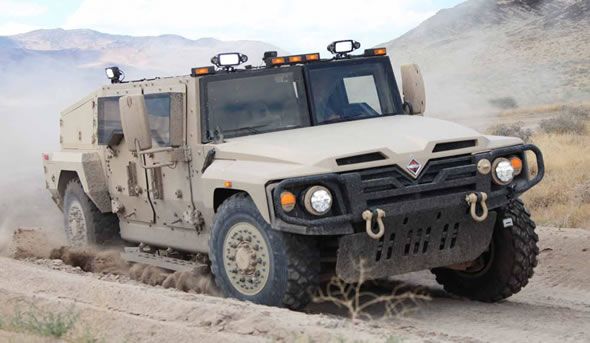
    Navistar's new Saratoga, light tactical armored vehicle is now proposed for the JLTV program. Photo: Navistar Defense

    JLTV is becoming the first market test for the Navistar’s new ‘Saratoga’. This lightweight vehicle was designed from baseline to offer flexible, modular growth, supporting different levels of protection and high mobility. The basic version is powered by a MaxxForce 6D V8 diesel developing 340 HP and 660 lb-ft of torque. It is built to withstand ballistic small arms fire, mines and IED blasts, without sacrificing mobility or payload capability. “We made a significant investment in developing the Saratoga on our own nickel because that’s what we do commercially – it is part of our DNA,” said Archie Massicotte, president, Navistar Defense. “The Saratoga is a solid design and now that we have seen the requirements of the JLTV migrate toward our vehicle capabilities, we are in a position to modify the Saratoga to fit those requirements.”

    Sofar the Saratoga has not been part of the JLTV evaluation program. Navistar launched in October after conducting its own automotive and blast testing, Saratoga was originally designed to target a gap in the light tactical vehicle market. It was designed as a flexible platform, derived from an integration strategy that allows the company to rapidly develop new vehicle variants to meet different customer needs while keeping investment costs low.

    The split between Sterling Heights, Michigan BAE Systems and Navistar that created two competing teams was revealed days prior the deadline, but was written on the wall for months. It followed Navistar Defense decision in October last year, to develop its own light tactical vehicle called Saratoga. BAE System remained with the Valanx vehicle developed with its former partner, but without Navistar’s MaxxForce engine, BAE had to shop for another source for an engine. As a result, it has struck a deal with the Ford Company, integrating the commercially proven Power Stroke 6.7-liter turbocharged diesel engine to power the Valanx. The same engine powers many of the Ford truck F-Series Super Duty truck family, used for military, security and specialty vehicles.

    Another division of BAE Systems, based in Sealy Texas, is partnered with Lockheed Martin and Meritor Defense, offering a new family for the JLTV. Lockheed Martin established its JLTV department in 2005 and has been testing the vehicle for several years now, under a company funded testing plan conducted in parallel to the Army-Marine Corps plan. According to Scott Greene, vice president of ground vehicles at Lockheed Martin’s Missiles and Fire Control business, many improvements were implemented following the lessons learned through the TD phase. “These improvements removed hundreds of pounds of weight from our TD design, which was already proven in helicopter lift tests,” said Greene. “With more than 160,000 combined testing miles behind us, we’ve demonstrated our JLTV can reliably meet protection standards of many existing mine-resistant vehicles in combat today. This vehicle is ready to meet our customers’ needs with lower-cost materials at full-rate production.”
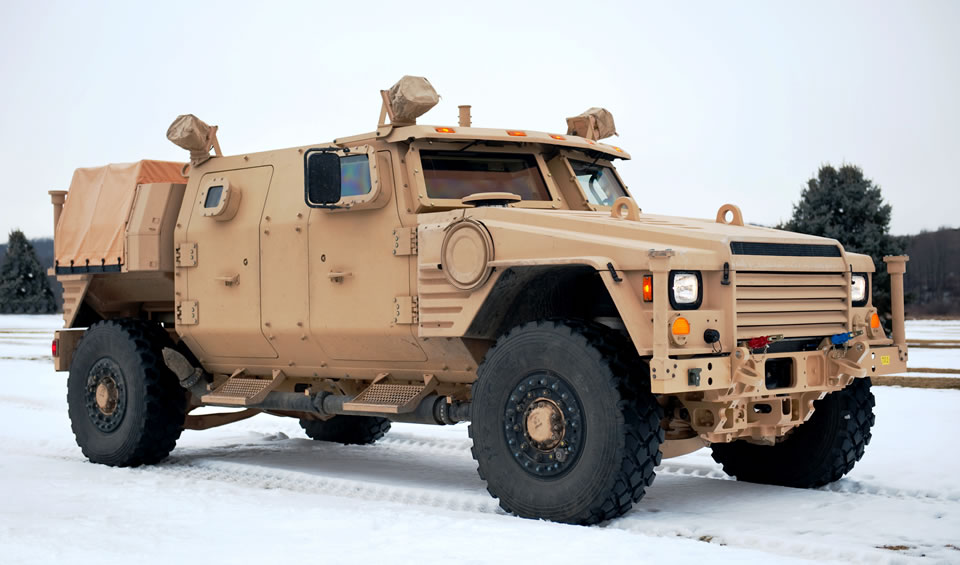
    Category B variant of the JLTV was built by Lockheed Matin for the technology Demonstration phase. The vehicle has now been modified to become more affordable and lighter, to meet the current requirements set by the military. Photo: Lockheed Martin

    Throughout 2010 and 2011, the team took lessons learned from JLTV’s extensive testing and applied them to an evolved design. The team accomplished this through digital engineering analysis, virtual design builds, component tests and physical stress testing. “Our EMD design lowers the cost of each vehicle, and not just through economies of scale,” said Kathryn Hasse, JLTV program director at Lockheed Martin. “We have incorporated more affordable materials and reduced exotic metals such as titanium. This was accomplished while maintaining the significant blast protection and vehicle capability already demonstrated.” According to Hasse, the current design proposed for the EMD uses a diesel engine but future configurations could also use alternative propulsion systems such as hybrid diesel-electric systems, if and when they become mature for military use. The core Lockheed Martin-led JLTV team includes the tactical wheeled vehicles team at BAE Systems in Sealy, Texas, complemented by numerous Tier 1 automotive suppliers, including: Cummins Engine, Allison Transmission, Bosch, Meritor Defense, Lotus Engineering, L3 Combat Propulsion Systems and Vehma International of America.

    The joint venture between General Dynamics Land Systems and AM General has also continued to the EMD phase, competing now for an EMD contract. The team offers the Eagle, which uses a Double-V hull design to beef up belly protection from mines and IEDs. According to Mark Roualet, president of General Dynamics Land Systems, the Eagle represents a low risk choice that builds on the company’s heritage of large-scale military production programs.
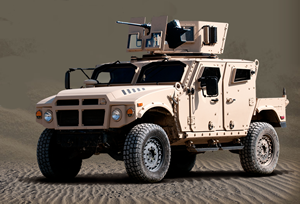
    AM General is offering the BRV-O, a JLTV developed independently from the Eagle built jointly with General Dynamics for the JLTV program. Photo: AM General

    AM General is also pursuing a unilateral path, offering the ‘Blast Resistant Vehicle Off-Road’ (BRV-O in short). According to AM General, the vehicle meets or exceeds all JLTV program evaluation criteria It in off-road mobility, proven blast and ballistic protection through capsule and modular armor and capability to deploy by land, air and sea with 3,500 pound payload., and surpasses requirements for speed, range and on-board electrical power and stowage. The vehicle has matured through more than 300,000 miles of testing and use of production-stage critical components.

    In addition to the JLTV the US Army is also pursuing a new program to replace the M-113. The vehicle known as Armored Multi-Purpose Vehicle (AMPV), this will most probably be a tracked vehicle, one of the considerations is to use the M2/M3 Bradley chassis or its derivatives to replace the M-113s in the heavy brigades. AMPV is expected to offer better mobility and survivability, compared with the M113 armored personnel carrier. A request for proposals is expected to be issued in early 2013.
    Israeli Multi-Purpose Tank Ammo Redesigned to Fit the 125mm Gun of the T-90S

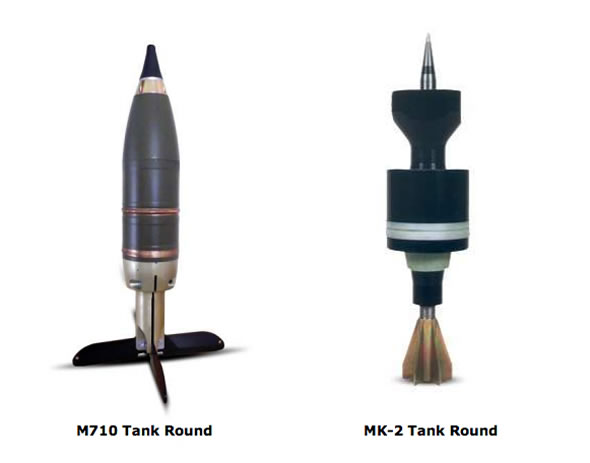
    Two new 125mm tank rounds from IMI: M710 MP and Mk-2 APFSDS-T
    Two new 125mm tank rounds from IMI: M710 MP and Mk-2 APFSDS-T

    IMI is unveiling two new 125mm tank rounds at the Defexpo 2012 this week. The new types of ammunition can enhance the combat capabilities and survivability of the Indian T-90S and T-72M Main Battle Tanks, improving their armor penetration capability as well as efficiency against anti-tank teams and fortified targets. The new multi-purpose tank round is based on IMI’s Multi-Purpose round technology that has won the 2011 Israel Defense Award. This technology has now been ported to the 125mm caliber, to make it available for the Indian Army.
    IMI is introducing a multi-purpose 125mm tank round designed for the T-90, T-80 and T-72 class of Main Battle Tanks (MBT). The High-Explosive Multi-Purpose Tracered (HE-MP-T) tank round designated M710 is the latest of IMI’s family of Multi-Purpose (MP) tank ammunition.

    The M710 is optimized to defeat targets typically encountered in asymmetric and urban scenarios, including buildings and bunkers, light armored vehicles and fortifications. This round is also effective against Anti-Tank (AT) squads and infantry in the open, in a foxhole or behind a corner.

    M710 uses an electronic fuzing system that has three different modes of operation: PDD (Point Detonation Delayed), PD (Point Detonation/ Super Quick) and Air Burst. The tank’s Fire Control System (FCS) feeds the target information and the programmable electronic fuze is set by wireless data link while the round is in the chamber.

    In PDD mode, the M710 is designed to penetrate and explode inside targets, such as double reinforced concrete walls; bunkers field fortifications or Light Armored Vehicles (LAVs). In PD (Super Quick) mode the round breaches a hole in double reinforced concrete walls, creating a passageway for infantry soldiers. The Air Burst mode is used for effectively engaging AT or infantry squads, operating in the open or hiding behind defilade and walls.

    Another newly developed tank round is the 125mm MK-2 Armor Piercing, fin Stabilized, Discarding Sabot-Tracer (APFSDS-T) – a second-generation, high-velocity, Kinetic Energy (KE) armor defeating round. The MK-2 improves the accuracy of the penetrator at all combat ranges, lowers barrel wear and enhances armor penetration capability when fired with existing 125 barrels. The round contains a tungsten-based alloy penetrator and is also type classified for the 125mm smoothbore tank guns.

    IMI’s MP rounds family also includes the M117/1, designed for the 105mm rifled guns of the M-60 and Merkava Mk 1 & 2 tanks. The combat proven M329 was later developed for the modern 120mm smoothbore gun used with current Merkava Mk 3 & Mk 4. M329 is also compatible with NATO 120mm smoothbore tank guns. An additional MP round, the M339, has been developed primarily for western tanks using NATO 120mm smoothbore guns, such as the M1A1, Ariete, Leopard 2 or Arjun. IMI’s MP capabilities have been awarded recognition as its M329 tank round has recently received the 2011 ISRAEL DEFENSE AWARD for its distinctive contribution to the defense of Israel.

    IMI is participating at the defense show despite its recent inclusion among six companies blacklisted by the Ministry of Defense.

    100 New Howitzers is but a Drop in the Sea of Indian Artillery Modernization

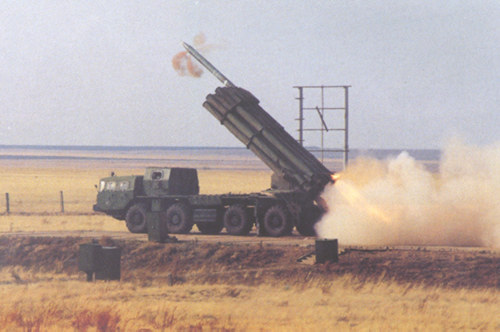
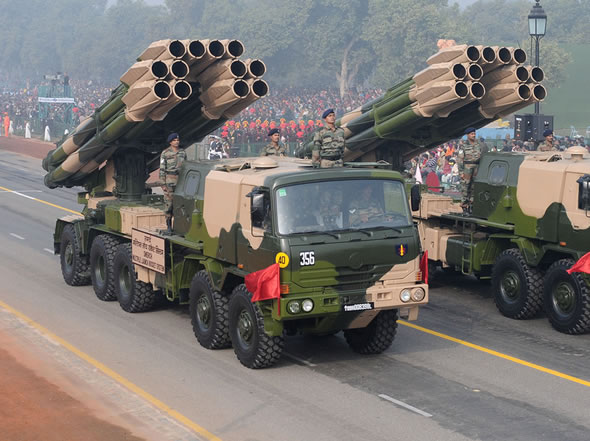
    BM30 SMERCH - soon to be locally produced in India?
    THe Indian OFB will finally embark on local production of the FH-55B Howitzers

    Indian Army Chief General V.K. Singh complained recently to his superior, defense minister A.K. Antony, about delays in setting up the national counter-insurgency school, shortfall of quality ammunition and ordnance, lack of potent cyber warfare units, failure to modernize T-72 tanks delay to upgrade Arjun tanks, lack of modernization in artillery and delay in procurement of infantry weapons.

    The delay in modernizing the Indian Army artillery for over two decades is of significant concern. By late February, the Army placed an order with the OFB for 100 artillery FH-77B guns of 155mm/ 52 caliber, after having failed to acquire howitzers for two decades following the Boforse scandal. The Army issued several tenders for procuring different types of howitzers but has failed to follow-on with selection and contracts. The Indian authorities admitted Bofors has provided all the documentation related to the transfer of technology for local production of these guns, but the Army and OFB did not pursue local production, due to the suspension of the Swedish company. This matter has recently settled, at an investment of 376 Crore ($75 million) in the artillery production line at OFB factory unit in Jabalpur, central India, paving the way for the establishment of local production capability at OFB. OFB is required to Build 6 prototypes of the new 155/52 howitzer and deliver them to Indian Army by the end of next year (2013) for evaluation.

    According to Minister of state for defense, M M Pallam Raju, the current order is for Boforse guns to be locally produced by the OFB. He said the Army will continue alongside the indigenous development and production of these howitzers. OFB is locally producing most of the gun’s components, including the barrel, breach mechanism, muzzle break, loading trough, recoil system and elevation and traversing cylinders.

    As part of the artillery modernization, nine artillery regiments were already upgraded to the 155mm, as part of the Artillery Profile 2027.

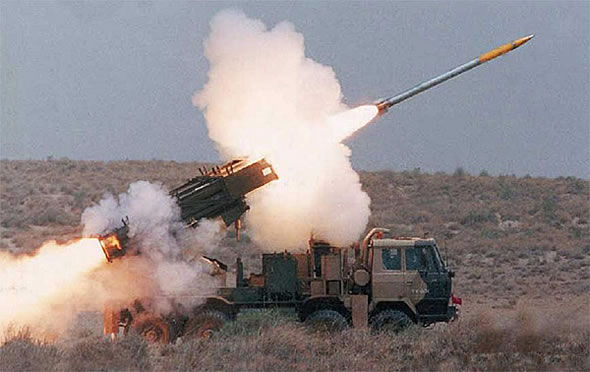
    The Indian Pinaka multiple-launch rocket system

    Multiple launch rocket systems are being fielded, including the indigenously developed Pinaka system. The fielding of the Pinaka regiment has been stalled last year due to lack of funding. In parallel, local production of the 300mm SMERCH rocket system is expected to begin in India in the coming months. The Smerch rockets are capable of striking targets at a range of 90km. Ordnance Factory Ambajhari (OFAJ) of the government run OFB received an order to manufacture Smerch rockets with a range up to 90km. The group is seeking permission from the MOD to enter into a joint venture (JV) with the Russian partner. The Army is also inducting the land-mobile version of the BrahMos missile.

    Under the planned 20,000 crore modernization, India is currently planning to buy about 145 ultra light weight howitzers, 180 self propelled howitzers and 400 towed howitzers. Initially the Indian Army considered buying light howitzers from Singapore Technology Kinetics, but this plan failed following the restriction and later blacklisting of ST/K.

    Russian BM30 at the firing range.

    The Indian Navy is Pressing for Foreign Construction of Next Generation Submarines

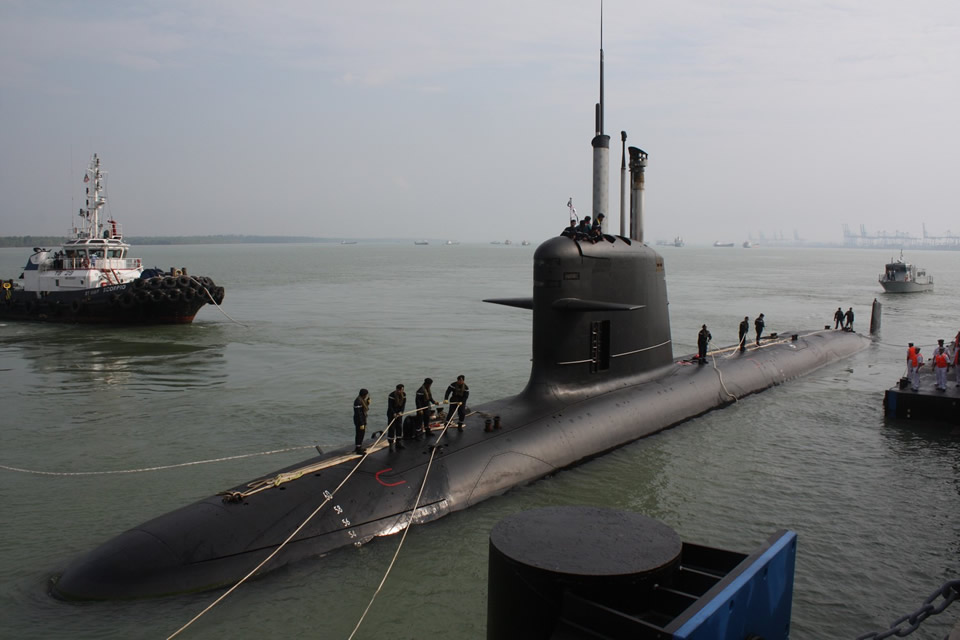
    Scorpene Class submarine

    Bowed to pressure from the Navy, India’s ministry of defense (MoD) has ruled that foreign and government owned shipyards will be allowed to compete for the construction of new Project 75I submarines. In contrast to previous policy, MoD determined that no private sector shipyard in the country has the infrastructure and capability required for building the next generation conventional submarines that the Indian Navy wants. As a result, the long-delayed plan to build six conventional submarines for an estimated Rs 30,000-35,000 crore (about US$6 billion) will be divided between foreign shipyards and the defense public sector.

    According to Secretary of Defence for Production, Shekhar Agarwal, two Project 75I submarines will be built abroad by the foreign vendor that wins the MoD contract with the follow-on four vessels to be constructed in India, by the Mazagon Dock Limited, Mumbai (MDL) and Hindustan Shipyard Ltd, Visakhapatnam (HSL).

    This decision is a blow to the private sector shipyards. Larsen & Turbo (L&T) shipyard. The company is playing a major role in building the Arihant-class nuclear submarines. ABG Shipyard and Pipavav Shipyard have also invested on infrastructure in preparation for major defense contracts. According to the long-term Submarine Construction Plan introduced in 1999, Indian shipyards would build 24 conventional submarines by 2030. The latest MoD decision to build two submarines abroad runs contrary to this plan.

    The Indian Navy insists that the lead Project 75I submarines will be built abroad, preventing the delays it is experiencing with its current Project 75 (Scorpene) class. Project 75 involves the construction of six Scorpene submarines in MDL, in partnership with Franco-Spanish consortium DCNS. The first Scorpene, which was to be delivered this year, will only be completed in 2015. With P75 subs delayed, the next Project 75I project is still in RFI phase, with both French (AIP Scorpene) and the Russian (Amur 1650 class) being considered though the massive technology transfer expected to deliver through the current phase will make Scorpene significantly more competitive in a future competition.

    In 2005 India and French firm DCNS have signed the contract for the construction of the six submarines and transfer of technology from DCNS. The cost of the program is worth over project Rs 23,000 crore ($4.6 billion).

    The program encountered significant delays in qualifying local subcontractors and suppliers to deliver parts for the submarines. Last month, seven years after the contract was signed DCNS has announced the supply of the first lot of India-made equipment to MDL, for installation on these Scorpene submarines. The equipment was manufactured by Indian firm Flash Forge India Pvt Ltd based out of Vishakhapatnam. “We are providing know-how and technical assistance to our Indian partners, and with MDL, we are qualifying suitable companies which are meeting the specifications needed for the submarines” explained Bernard Buisson, Managing Director of DCNS India. He acknowledged that due to delays in procurement of MDL-purchased items, the delivery schedule of the Scorpenes has been adversely affected and the first of it is commissioned only in 2015.

    The Scorpene is a 1,700-tonne submarine that can remain at sea for 40-50 days. India has an option to install Air Independent Propulsion (AIP) systems in the last two Scorpenes that MDL builds, and then retrofit AIP into the other four Scorpenes as well.

    The submarine designer, the French company DCNS is displaying at Defexpo 2012 two new technologies addressing this submarine – the SUBTICS integrated combat system and the MESMA – an Autonomous Submarine Energy Module (also referred to as AIP).

    SUBTICS combines long-range capabilities in all navigation conditions with powerful weapons (torpedoes, anti-ship missile, counter-measures, land-attack capability). As a fully-integrated system, all functions are operated from Multifunction Common Consoles and its open architecture and modularity guarantee that the system can be adapted to every type of submarines and configured according to operational requirements. It can also be upgraded during its lifetime to fulfill new missions and keep its operational superiority.

    The MESMA is an electrical energy production module designed specifically for conventional submarines. As well as supplying electricity to the vessel and to the propulsion system, it can also be used to recharge the batteries without the need to surface. Together with a MESMA section, a Scorpene will be able to carry out extended missions with an over 3 weeks submerged endurance. The 10 meters’ MESMA module can be considered as a new-build option or installed during an upgrade.

    Buy Indian, Make Indian

    With India planning to invest over US$80 billion in defense procurement in upcoming years, the majority of the spending – 65-70 percent will be directed to imports. “We have to reverse this trend.” Shri A.K, Antony, Indian Defense Minister, said, “Our aim is to have a strong defense industrial base in India, because a country like India cannot indefinitely depend on foreign suppliers for majority of our equipment.” While support for Defense Public Sector Units (DPSU) continues, the government realizes the public sector will not be able to transform the industrial base on its own. A point in case is the Indian Navy procurement, for which Antony outlined a new strategy. “We are formulating a new policy, where both public sector shipyards will have to compete with the Indian private shipyards to get projects for the Indian Navy.” Antony explained, adding that in future, the Indian navy will be from ‘Buy Indian, Make Indian’, where public sector ad private sector shipyards compete on naval shipbuilding rather than Indian shipbuilders competing against foreign suppliers. According to Antony, ‘Buy Indian and Make Indian’ is going to be the major component of our procurement policy.

    Offsets were introduced with the Defense Procurement Procedure (DPP) of 2005, requiring manufacturers in the category of ‘Buy’ and ‘Make and Buy’ for acquisitions over and above Rs. 300 crore, (US$60 million) to invest 30 per cent of the estimated cost in indigenous defense industries.

    Three years later, the government further tightened its offset demands, reflected in DPP 2008, that restricted foreign procurement of locally produced goods related only to defense and aerospace products as applicable for offset investments. These requirements encountered increasing objection among foreign suppliers, raising concern within the administration, about the validity of the entire system, since the local market could not produce enough goods to fulfill the huge offset requirements derived from the growing defense imports.

    DPP 2011 introduced significant changes in this offsets policy, making civil aviation, internal security and training products and services eligible for defense offsets. In 2012 commercial shipbuilding is expected to be added to the approved industries eligible for offset transactions. Moreover, it has also relaxed insistence on foreign direct investment (FDI) only in domestic defense industries. It also recognized offsets accrued by through investment into defense JVs set up in India; or through investment into Indian R&D organizations. Against these relaxed rules, India is expected to increase the level of offset to 40 or most major acquisitions and even 60 percent on certain acquisitions such as shipbuilding, where Indian suppliers are well positioned to act as major subcontractors.

    Additional concessions are also being evaluated, including the recognition of technology transfer and introducing ‘offset multipliers’ for investments in priority fields, including investments in small and medium enterprises (SME).

    The new offset policy provides more opportunities for foreign enterprises doing business in India while preventing cash outflows by mandating foreign firms that bag major defense contracts in India to reinvest a part of the total contract value, by entering into local tie-ups in the local defense industry, developing local human resources and skills, technology and infrastructure. The new DPP includes training services or equipment like simulators that were not part of the previous DPP. This change is significant with India embarking on large-scale acquisition, including the 126 Medium Multi Role Combat Aircraft, military jet and helicopter trainers and tank upgrading programs, where simulators are becoming an important component.

    The Minister of State for Defence Dr. M Pallam Raju has stated that the scope and potential of the Indian defense industry has significantly increased due to reforms in the Defense Offset Policy. Dr. Pallam Raju has announced that the Indian defense offsets contracts worth US$3.3 billion have been signed and more such deals worth $10 billion are in the pipeline.

    The policy change is likely to give a huge fillip to these two sectors as investments worth billions of dollars are expected to be made in view of the large number of offsets deals to be signed in the near future as India looks to spend over $ 80 billion for defense acquisitions.

    The introduction of the “Buy and Make (Indian)” category in the defense acquisition process aims to increase participation by the Indian Industry for meeting India’s requirements for state-of-the-art defense systems and platforms. The procedure will enable Indian defense sector firms to get into tie-ups with technology providers through the mode of technology transfer and joint ventures.

    According to defense industry analysts, India’s private sector in aerospace and defense sector needs to become more effective and may currently lack the scope and scale. However, entering into foreign collaboration will result in greater innovation. The defense offsets policy is a powerful tool to ensure that large purchases from foreign vendors are matched by investments domestically, thereby enabling the private sector to boost its capabilities. It also charts out innovative ways of doing business, leading to partnerships and joint development plan. The defense offset policy aims to enable the Indian defense sector to build long-term capability.

    In view of above policy changes, it is imperative for Indian companies from Defense sector to engage with Indian PSU as well as international firms interested to invest in India.

    Indian Offset Policy on a Crossroad

    Production delays and cost overruns have slowed down India’s defense preparedness considerably. More importantly, despite decades of effort and several specialized design and development organizations, gas turbine research establishment and aeronautical development establishment, India still does not have the capacity to research and design, prototype, produce, service and upgrade aircraft without depending on imports of components, major sub-assemblies and significant number of complete aircraft.

    Therefore there is a pressing need to build green field capability to widen the base of India’s aerospace industry and attain higher efficiencies, cost cutback and faster outputs. Public sector capability requires to be complemented by new private sector, both foreign and domestic contribution, involving joint ventures and co-production, to guarantee higher levels of technology transfer and to substantially improve the level and cost of after-sales support. This will not only take India’s technological competence to an even higher plane, but will also have a positive spin-off on our civil aerospace needs.

    India’s venerable obsession with equity caps has yielded very little in foreign direct investment flows since 2002. If India can purchase entire equipment manufactured by a wholly foreign-owned company located in another country, why cannot India receive the same from that company’s wholly owned Indian subsidiary? Allowing majority foreign ownership in high-technology field will also in part reduce convoluted issues associated with intellectual property rights and export-control regimes.

    India should establish a level playing field for a vibrant national defense sector, whether public or private. Many private sector companies are by now playing a consequential role in India’s defense manufacturing and are waiting for an opportunity to contribute more, on their own or through collaboration with foreign companies.

    In it’s current form India’s defense offset procedure is below an optimum level. It is designed mainly as countertrade to augment exports of PSU products related to defense and civilian aerospace and internal security.

    This offset policy lacks the essential focus to link acquisitions to collaborative models involving joint production, technology transfer and manufacturing capacity that develops self-reliance. Countertrade is the least meaningful element of defense offsets. Transfer of technology (ToT) is the most valuable. While it is debatable whether such huge (50%) offsets can even be fulfilled — not least because of the lack of product capacity of India’s Public Sector Units (PSU) or the existing aviation industry — it is more than likely that this requirement will inevitably increase costs. Surely that outcome cannot be justified.

    A more realistic approach would be to renovate India’s present offset policy to facilitate the entrée of high-technology aerospace manufacturing and services through a multi-tiered vendor base. This can be incentivized by offering flexible share-holding options for the setting up of local manufacturing units by foreign companies linked to proposed acquisitions under the umbrella of the primary supplier. Offsets should provide for the progressive localization of sub-assembly manufacturing by vendors under a phased manufacturing programme. This would mean transparently designating cutting edge technology vendors as long-term suppliers without obliging them to tender for every subsequent order. That is the only way to ensure that the risks and costs of rapid technological development are shared. An inclusive new offset policy that reduces costs and at the same time strengthens defense capability deserves consideration.

    India needs to leverage its current and future defense aerospace purchases to create an indigenous high-technology aerospace industrial base that will underpin its national security and economic strength. For this to happen, the need for structural and regulatory reforms of this sector cannot be exaggerated.

    Aerospace & Defense Growth to be Driven by India’s Private Sector

    Defexpo 2012 is providing the international corporations an opportunity to take a look into the Indian defense industry – a bazar of government operated, publicly traded or privately owned companies awaiting their big opportunities to get a piece of the billions the Indian government intends to spend over the next decade. All the big names are nere, along with many medium and small companies from abroad. They are here seeking partners, source new suppliers, and find facilities and personnel to carry out local support, there were many private sector companies to choose from.

    Through the years India has established an impressive infrastructure of aerospace and defense research, development and manufacturing base, yet – except of strategic programs, for which India could depend only on itself, the defense sector failed to provide modern, effective military hardware that would par with the systems and technologies the Indian military deserve.

    Part of the blame is in the Indian ‘obsession’ for ‘indigenous’ development and production regardless of its technological maturity, and lack of local manufacturing infrastructure, training and work discipline, matching modern weapon systems technologies. Like many third world societies, based on low-cost labor, Indian industry was slow to adapt automation, robotics and lean manufacturing, processes considered a must for modern aerospace and defense production. This drawback has also limited India’s industry mastering new processes, providing the precision and processing of advanced materials, based on highly accurate, repetitive or progressive automatic processes, in addition to developing and maintaining expert human skills.

    With limited access to international market, and reliance on internal development of skills and capabilities, Defense Public Sector Undertaking (DPSU) companies were slow to adapt to the new world. Being government owned organizations, these large and strong organizations pose a difficult partner for international companies trying to enter the Indian market. With Indian regulations limiting foreign ownership below 25% of such Joint Venture (JV) enterprises, foreign companies required to transfer technology to those organizations fear such technology could get ‘out of control’ in such large and diversified organization.

    The opening of India’s defense market for the private sector is bound to change that. Until now, the private sector companies being involved in defense production were mostly in the automotive sector – vehicle manufacturers Ashok Leyland and Mahindra, Tata Advanced Systems Ltd, Larsen and Turbo (L&T) being the most established brands. Yet the private sector has a minor share of the local defense market. With about 70 percent of Indian defense procurement coming from abroad, of the remaining volume estimated at $700 million annual domestic procurement, only about $100 million is sourced directly and indirectly (subcontracting to DPSU) to the private sector.

    India’s private sector is positioned to benefit the most of the offset requirements foreign suppliers are required to spend in India, for every major defense sale they win. As the new contracts currently in the pipeline are signed, small and large Indian companies are preparing for a flood of orders, partly in direct support of the programs bound for India and others, by entering the supply chain of major international defense manufacturers. The small industries understand this opportunity and prepare to rapidly grasp it wholeheartedly.

    Different companies are using different strategies to attract new business and sustain long-term growth.

    PSC are taking different approaches to tap this new opportunity. Some are investing in in sophisticated manufacturing infrastructure, certification and qualification by major prime contractors, appreciating the added value provided by the offsets could pave their way to growth. Others focus on developing and retaining their manpower skills, networking and computerized design technologies, to obtain a growing workshare of major programs. Others are licensing technologies, absorb knowhow and develop production capabilities aiming to master specific areas to become major players in the international market.

    The role of DPSU

    While India has all the rights to be proud of its strategic missile technology, satellite launchers and nuclear sciences, its conventional weapons programs are far from impressive. Tejas Light Combat Aircraft, Akash medium range missile system, Arjun main battle tank or the Dhruv Light Advanced Helicopter are symbols of national pride in India, being considered ‘indigenous military systems’. Unfortunately, these locally developed systems rarely match India’s top military requirements, demanding much higher capabilities they can buy overseas.

    Lacking the urgency, determination and clear goals set by the government, and absence of user enthusiasm to deploy the systems, development of Indian indigenous systems is often dragged along for decades, as the country’s eight Defense Public Sector Undertaking (DPSU) while the military comfortably acquired the latest arms from Russia.

    For years, these DPSU were tasks with the development and production of India’s strategic weapons – considered a must for India’s survival against nuclear armed China and Pakistan. In parallel they were also engaged in the development of other weapon systems India could get abroad, but opted to develop at home, as symbols of national pride.

    These government owned defense manufacturers being responsible for the research, development, production and integration of all types of systems. In those years, fed with steady funding for their activities, DPSUs continued their activity without clear commitment to schedule, since the military services have already obtained the weapons they needed on parallel acquisition abroad.

    Now, after decades of development, programs are maturing only to become obsolete; those currently being proudly inducted into active service are actually 1980 designs that can hardly match those already fielded by the military, let alone the weapon systems obtained and operated by adversaries across the borders.

    What’s missing in the Indian defense R&D process? The differences between Indian indigenous systems and those imported from abroad are clear – outdated designs styles derived by absence of advanced materials and modern manufacturing capabilities, resulting in heavier, less performing platforms. Indigenously developed electronic systems are also usually larger, less power efficient and therefore prone to failure.

    The limited Indian access to modern technology required great investment in basic and applied science, metallurgy, composite materials and electronics. While Indian scientists and engineers are innovating throughout the world, leading great technological achievements elsewhere, indigenous military programs have yet to benefit from these talents.

    FORT – An Armored Vehicle Tailored for Urban Missions

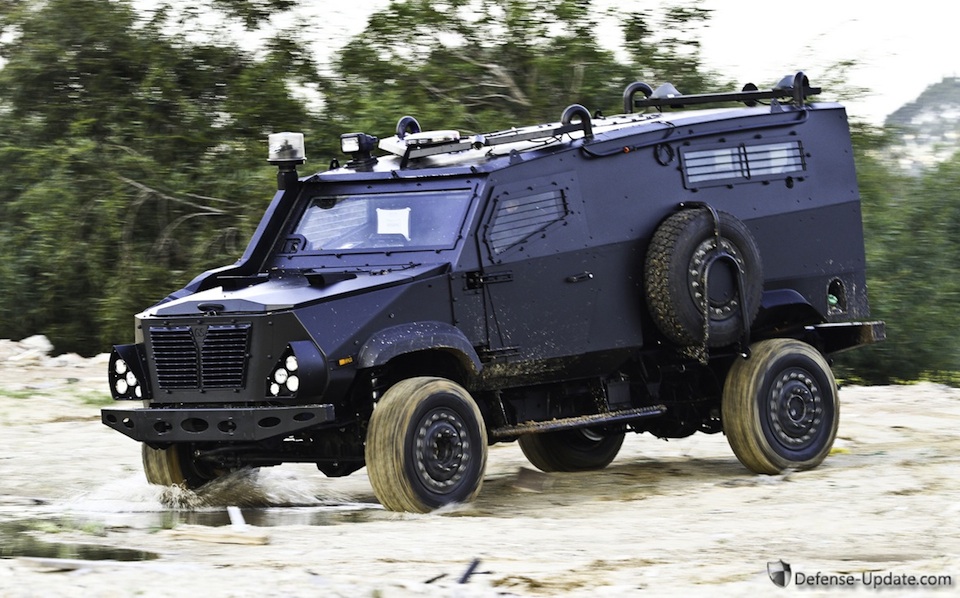
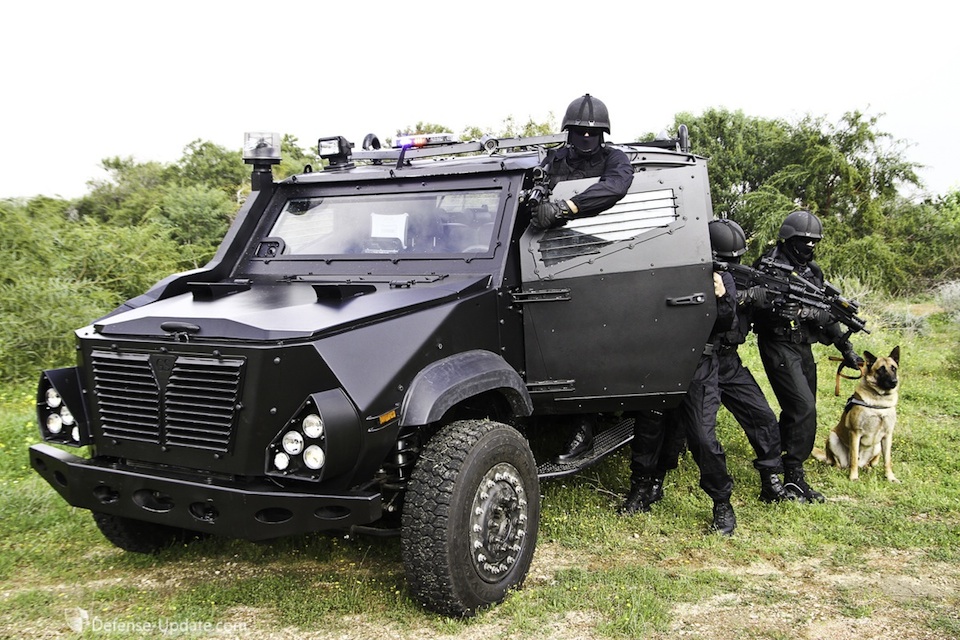
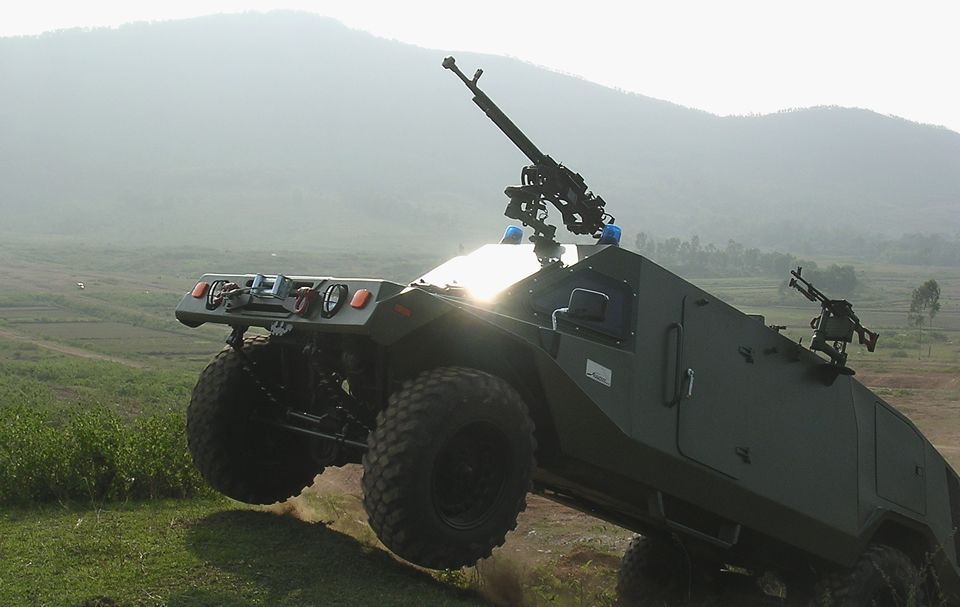
    ISDS/GS Fort 1 Urban Assault & Security Vehicle. Photo: Noam Eshel, Defense Update
    Fort 1 provides good ballistic protection for the crew and combat team, in travel and disembarkation. Photo: Noam Eshel, Defense Update

    ISDS is introducing the Fort 1 armored combat vehicle at LAAD Security 2012; the vehicle was developed under a joint venture of two Israeli companies, ISDS and Global Shield, and it reflects the latest mission requirements drafted by Brazil’s special forces as well as following requests from other clients all responsible for maintaining law and citizen security many times under strenuous circumstances and adversarial environments. The prototype vehicle is expected to be used in the next months by several Brazilian special. This vehicle will be tailored specifically to the customer’s requirements and be ready for delivery ‘within months’.

    ISDS designed the Fort 1 as the ultimate combat vehicle for operations in all terrains and areas, including dense, mountainous urban areas. In fact, its modular design can configure to vehicle for a different missions, meeting customer requirement in a quick and economical way. “The Fort1’s practicality, ease of assembly, and efficiency were clearly demonstrated by the ISDS-Global Shield team experienced leadership, preparing the Fort 1 prototype, from concept to completion, in under three months.” Tomer Fulman, Chief Executive Officer at ISDS told Defense Update.

    ISDS/GS Fort 1 Urban Assault & Security Vehicle. Photo: Noam Eshel, Defense Update
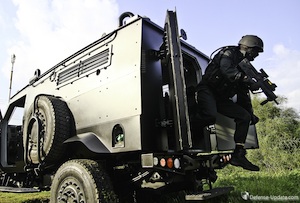
    As a vehicle designed (to operate in all situations including narrow and inclined urban environments) the Fort 1 is relatively narrow, yet maintains spacious internal space for the combat team. Its turning radius is 7 meters. To be able to overcome obstacles such as oil spills or barricades, the Fort 1 is equipped with an anti-skid mechanism enabling it to cross slippery patches of road; the vehicle it can also be fitted with an obstacle breeching blade. The powerful engine and high power to weight ratio ensures that the vehicle maintains traction even on steep slopes. The capsule has 360 degree protection against ballistic threats, blast, or impact (of stones or other objects thrown at it from rooftops). The armored transparent windows are fitted with unique firing ports designed by Global Shield, offering unrestricted firing angles. The vehicle has two rear doors, enabling rapid exit. The vehicle also has two side doors equipped with armored protection to guard dismounting team members.

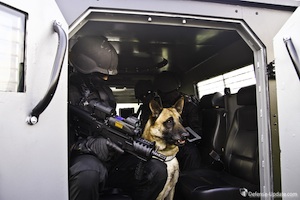
    An inside view into the Fort 1 armored assault vehicle. Photo: Noam Eshel, Defense-Update
    The Fort 1 is ready to be fitted with a network-ready system of connecting computers, on-board sensors, soldier gear, and communications links to the forward command element. The network, sensors, and electronic systems were developed especially by the RAD-BYNET group, a leading Israeli technology group. The vehicle’s network supports a number of laptop computers, and provides a communication service that extends wireless connectivity beyond the vehicle itself, thus enabling the team to dismount while maintaining full connectivity with the vehicle and the tactical command post. The vehicle can be fitted with panoramic video cameras covering 360 degrees, offering the team a situational picture from inside the vehicle.

    Team leaders and team members have the possibility to carry wearable computers, helmet mounted cameras, and headphones, and to maintain constant communications within the unit, command, and the mounted support element remaining in the vehicle. A recording system tracks all communications for after-action debriefing.

    The cabin is designed with two rear doors providing quick egress with full load. Photo: Noam Eshel, Defense Update
    The vehicle can be equipped with various weapon systems, including non-lethal munitions and active acoustic devices for crowd dispersal. Other configurations could include surveillance and homeland security vehicles, for port or border security.

    Following the Fort 1’s public debut at LAAD Security 2012 in Riocentro, ISDS plans to use the vehicle under different institutions. Brazil’s special units will evaluate its performance. “We already began production in several countries and are assessing delivery methods. The vehicle has been tested by law enforcement groups and has the approval of the Israeli Ministry of Defense (MOD)” said ISDS’ CEO, Tomer Fulman.

    RAM MkIII Armored Vehicle: Rough and Tough

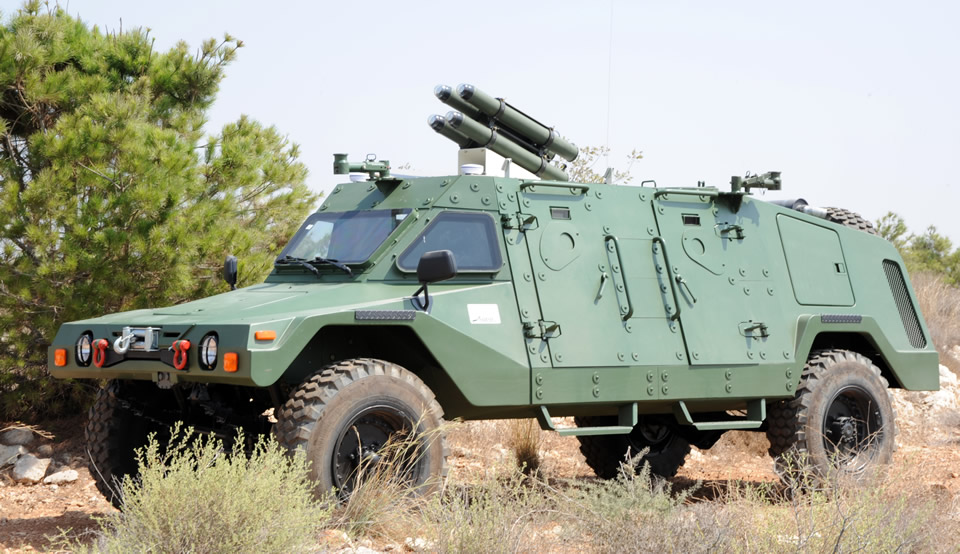
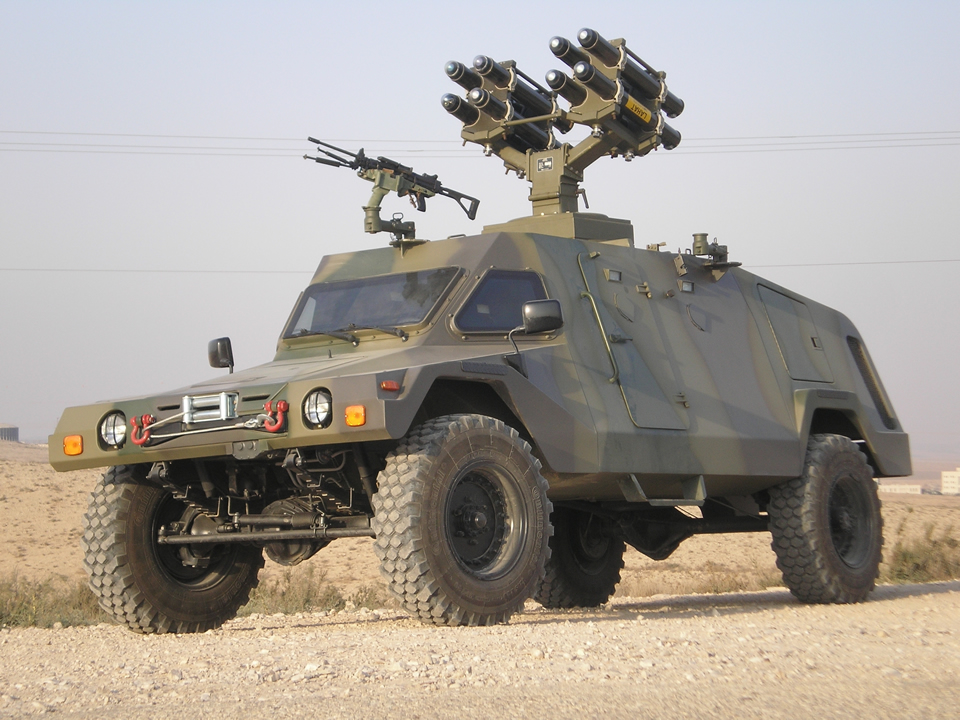
    RAM Mk3 AT Photo: IAI
    RAM Mk3 AT Photo: IAI

    High performance, air-mobile armored combat vehicle combining extreme off-road mobility, high reliability and affordability, the RAM from IAI/RAMTA has been delivering those attributes for more than 30 years, proving its worth as a multi-mission combat proven platform in service with numerous military forces throughout the world.

    At the FIDAE 2012 airshow IAI/RAMTA is unveiling the latest version of the vehicle, configured as an anti-tank weapon carrier. The RAM Mk3 AT is equipped with a weapon station carrying four laser guided anti-tank missiles (the LAHAT, renamed Nimrod SR for the Latin American market). The missiles are mounted on the recessed ramp, elevated into position just before firing, thus maintaining the anti-tank vehicle an undistinguished silhouette, contributing to the vehicle’s survivability and combat efficiency.

    The RAM MkIII is the third generation of the RAM design, which is rooted to the pioneering concept of the mine-protected RBY platform, developed by Israel Aerospace Industries (IAI) during the early 1970s. A few years later the RAMTA Division of IAI adapted the basic design, and modified it into a multi-mission armored personnel carrier and versatile weapon-carrying platform known as the RAM.

    The requirements defining this innovative platform are relevant today – a versatile platform offering adequate off-road mobility, basic and enhanced ballistic mine protection, high reliability and cost effective life cycle cost.

    The RAM has been ordered and has been proven on real world and combat operations with more than a dozen military, paramilitary and police forces in Asia, Latin America and Africa, as well as supporting United Nations (UN) peacekeeping operations throughout the world. Among the recent RAM operators are the security forces of Vietnam and the Republic of Gabon.

    The Vietnamese Army and security forces are operating 150 RAM 2000 vehicles bought from Israel in recent years. Photo: IAI

    Versatile Combat Platform

    The vehicle, currently produced in its third generation RAM MkIII version, is maintaining all these attributes, with additional features added, adapting it to new missions. As a true combat vehicle, RAM MkIII features ballistic armor, counter-mine blast protection techniques and a firewall bulkhead, separating the engine compartment and fuel tank from the crew compartment, protecting the crew, weapon system and power-pack. The vehicle maintains a low silhouette and reduced weight, offering superior battlefield survivability, land and air mobility necessary for special insert missions. The basic RAM maintains an integral blast-protected belly design and all-round ballistic protection, employing the ‘diamond shape’ for deflecting mine blasts away from the vehicle and defeating 7.62mm AP and 0.5” ball threats. The vehicle is offered in two ballistic versions and over 20 configurations, tailored for customer-specific requirements.

    In the event of a mine blast, the armored hull remains intact; being virtually separate from automotive section and the wheels. The geometric profile of the hull also enhances the vehicle’s resistance to such a mine blast. Once the wheel of the vehicle activates a mine, the explosion damage cuts the respective axles and the fiberglass fenders disintegrate, allowing the force of the blast to be directed outward and away from the crew cabin.

    Advantages of the Rear Mounted Engine

    The rear engine compartment represents a unique feature of the RAM. Unlike other armored vehicles, which have the engine at the front or under the protected cabin, RAM places the entire power-pack – engine, automatic transmission and transfer cases at the rear. Forward or central engine placement has significant implications for an armored vehicle, potentially increasing vehicle height, exposing the vulnerable power-pack to physical and ballistic threats and adding complexity to the cooling system.

    The RAM’s rear-mounted air-cooled engine solves these problems, offering additional benefits, especially in facilitating field maintenance by providing simple and quick access to the engine, gearbox and drive train.

    An armor-protected forward engine would often require complex support systems, employing spring-loaded lifting systems, or special tools and support, complicating routine maintenance activities. “Throughout their generations, RAM vehicles have demonstrated low Life Cycle Cost (LCC) and delivered reliable service throughout its operational service. It requires low maintenance support, which can be provided in the field by non-specialist crews” said Rafi Jahn, the Project Manager.

    The air-cooled diesel engine demonstrates remarkable performance with very high reliability, requiring minimal logistic support. The absence of complex and vulnerable water-cooling system components, and quick access to the armor-protected engine compartment means that the entire power-pack can be replaced by the crew in the field in less than two hours.

    The Deutz air-cooled engine has provided the heart of the RAM automotive system since the 1980s. This power-pack has demonstrated very high reliability in continuous and extensive operation under extreme field conditions. It offers many advantages for military operators, particularly its operational endurance in extreme tropical and/or desert temperatures, high mean-time-between-failure (MTBF) and low maintenance requirements.

    Maintaining a 28.3:1 power-to-weight ratio with the powerful engine provides a major factor in the RAM’s cross-country mobility. The large wheel size complements this power to deliver superior agility. “To maintain its high mobility at the level required for the RAM we chose the largest tires we could use,” explained RAM project engineer Zvi Zuk, “We selected the 12.5X20 MPT – considerably larger than those used on most other vehicles of this type. They deliver extremely high mobility over rough terrain, in mud, snow and sand, without the use of heavy, complex and expensive independent suspension. Approach and departure angles, and low center of gravity with high ground clearance provide the vehicles with high maneuverability and stability”.

    Another unique attribute of the RAM MKIII is its undercarriage design. Unlike many conventional armored vehicles built on commercial chassis, the RAM forms around a structural skin (Monocoque hull), which is built of two pieces of diamond-shaped ballistic steel. This hull renders the fully bulletproof, mine-protected cabin, to which the driveline and automotive systems are attached.

    RAMTA offers the RAM MKIII exclusively with automatic transmission, selectable 2×4 / 4×4 drive modes, with or without differential locking, depending on customer requirements. Ramta maintains this flexibility to meet requirements for ultimate simplicity, in order to support customers in developing markets, where the users seek to minimize the skills needed to operate and support its vehicles.

    The vehicle is offered in open or closed cabin versions, configured in Armored Personnel Carrier, Command Vehicle, Scout Vehicle, Weapon & Missile Carrier, Air Defense vehicle, Mortar Carrier, and is even offered with a Special Weapons And Tactics (SWAT) configuration, complete with Tactical Assault Ladders for multi-story breaching operations.

    The RAM has also been manufactured in both full and short configurations per customer demands.

    A different version of the RAM AT platform, loaded with eight LAHAT missiles. Photo: IAI

    Tailored Solutions

    “By minimizing the part count required for each production kit, IAI RAMTA maintains a lean production line able to quickly and efficiently modify, adapt and produce the platforms to meet specific customer requirements, even for small production quantities” explains Rafi Jahn. “By relying on our plant’s computerized CAD/CAM and NASTRAN programs, these modifications can be tested, verified and approved by our vehicle designers and automotive engineers prior to the production of the modified platforms.”

    The RAM MKIII is designed for air mobility in medium transports including the Antonov 12 and C-130, both of which can carry two long vehicles or three short versions.

    “So far we have designed and produced over 20 different models of the RAM” said Hagai Shmuel, Ramta’s Marketing Manager. “We developed our production line to support small to medium quantities, characteristic of typical military orders. We can quickly gear up to produce the RAM MKIII in small batches in a short period of time, delivering dozens of vehicles within a period of a few months.”

    IAI Ramta displayed at Latrun a stretched version of the RAM armored vehicle, fitted with an assault or rapid evacuation ramp designed to enable access to higher floors in urban areas. Photo: Noam Eshel, Defense-Update
    RAM 2000 shown in the ISR configuration. Photo: IAI

    “We can easily adapt our hull to specific customer requirements without the risk of exceeding the limitations imposed by conventional chassis and vehicle frames.” explains Zvi Zuk. “When we design the hull, we adapt the automotive systems to meet the loads and deliver the performance without the handling problems and excessive wear and tear typically resulting from overload. For example, recent models of the RAM received additional ceramic armor layers to be able to withstand 0.5” ball ammunition, without exceeding the vehicle’s load limit.” Zuk added.The basic design offers mine protection meeting STANAG 2A and 2B level, and ballistic protection conforming to STANAG 2 or 3, depending on customer requirement.

    Because the entire vehicle and its ballistic protection package are designed, integrated and manufactured by the same group, Ramta has the flexibility enabling it to increase the level of armored protection with add on armor kits without unknown variables potentially compromising performance.

    This holistic approach to the vehicle has allowed Ramta to develop and successfully test protection kits specifically designed to defeat a wide range of threats (IED, mines, small arms, etc.).

    The protection kit is also rounded out with a complete suite of armored glass, and Runflat tires to allow the vehicle to extricate itself while under attack.

    RAM MkIII Specifications:

    • Combat weight 6.5 tons for the basic version,
      7.2 tons for the configuration with add-on armored kit.
    • Fuel capacity of 160 litres
    • Engine: 6.472 liter Deutz 189 hp @2500 rpm
    • Automatic transmission
    • Power assist steering
    • Hydraulic power assist brakes
    • Overall length: 5,950mm (including spare wheel)
    • Overall height: 2,120mm
    • Overall width: 2,080mm

    RAM MKIII Performance:

    • Cruising speed: 100 km/h (0n-road)
    • Cruising range: 800 km
    • Seating: 1+7
    • Fording: 1m (w/o preparations)
    • Grade: 60%
    • Side slope: 30%
    • Vertical obstacle: 0.60m
    • Ground clearance: 0.53m

    Visionmap Unveils a Wide-Area Surveillance & Mapping Payload at AUVSI-Israel

    VisionMap Mist
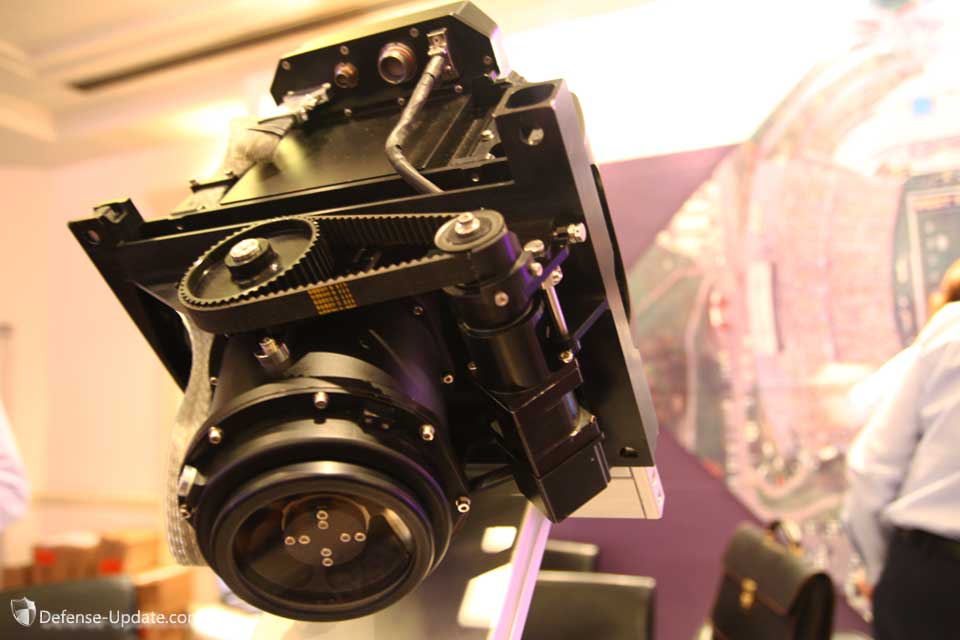
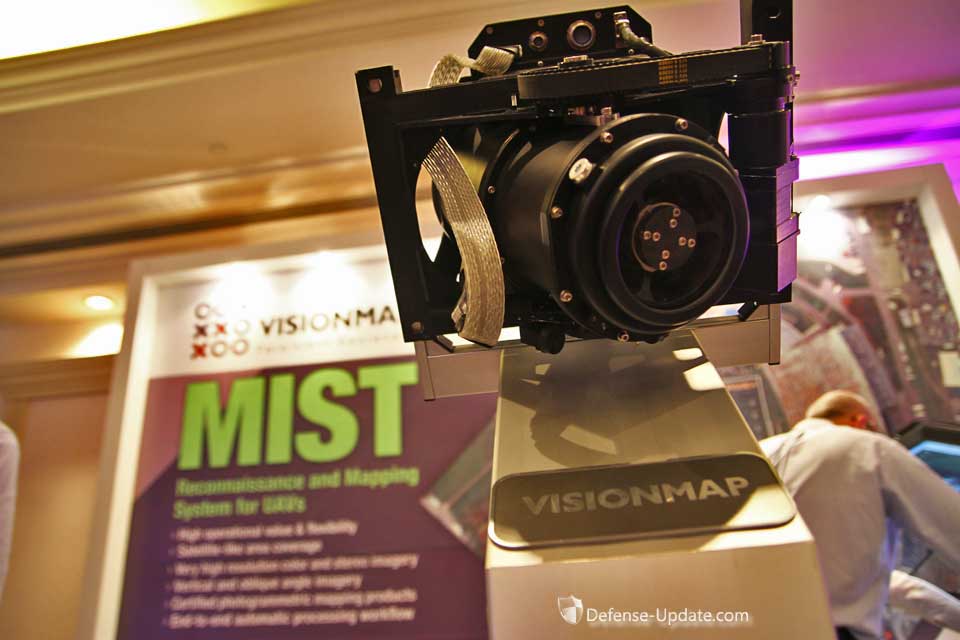
    VisionMap Mist - High Resolution Ground Surveillance Camera. Photo: Noam Eshel, Defense Update
    VisionMap Mist
    VisionMap Mist - High Resolution Ground Surveillance Camera. Photo: Noam Eshel, Defense Update

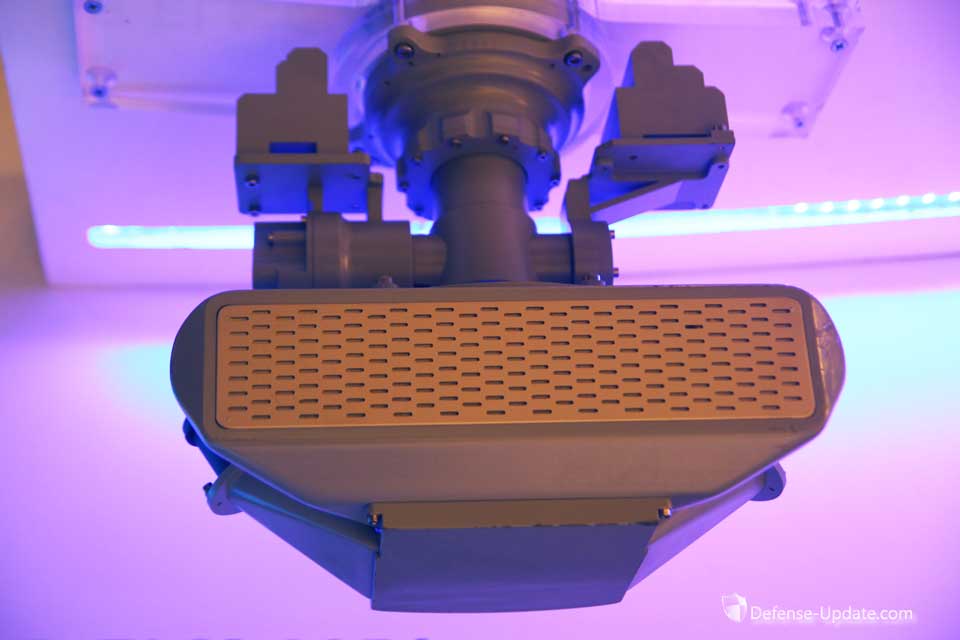
    MIST, an advanced EO payload designed for mapping and wide area aerial surveillance was displayed for the first time today at the AUVSI Israel event in Tel Aviv. A military version of the camera was designed for unmanned aerial systems and has entered operational service in 2006, just in time for the Second Lebanon War. It has since proved itself in continuous operation over thousands of hours on a number of UAV systems.

    MIST provides a compact and effective mapping and persistent surveillance payload that can support elements at the tactical echelon. The developer, Visionmap Ltd. established in 2004, introduced a compact payload that replaced a 40kg heavy mapping camera with a system weighing less than 11kg, that offers faster area coverage, providing exceptional quality and details from both low and high altitudes. The MIST payload is designed to provide both mapping and wide area surveillance products on a single mission. It employs sophisticated optical and EO digital imaging techniques. For this development Visionmap won the Israel Ministry of defense awarded the prestigious Israel Defense Award.

    Employed on a number of UAS, including Hermes 450 and Heron, the MIST can operate at altitudes of 3,000 to 25,000 ft. The payload uses a 300 mm camera equipped with innovative scanning mirror assembly that compensates for movement, contributing to obtaining sharper details and faster scanning without the need heavy and for complex gimbals and stabilization techniques. The payload has an integral GPS and automatic geo-referencing system generating providing automatic 3D imaging and pixel-based sub-metric location accuracy. The mission can be stored on a 1TB digital disk that contains highly detailed images of hundreds of square kilometers.

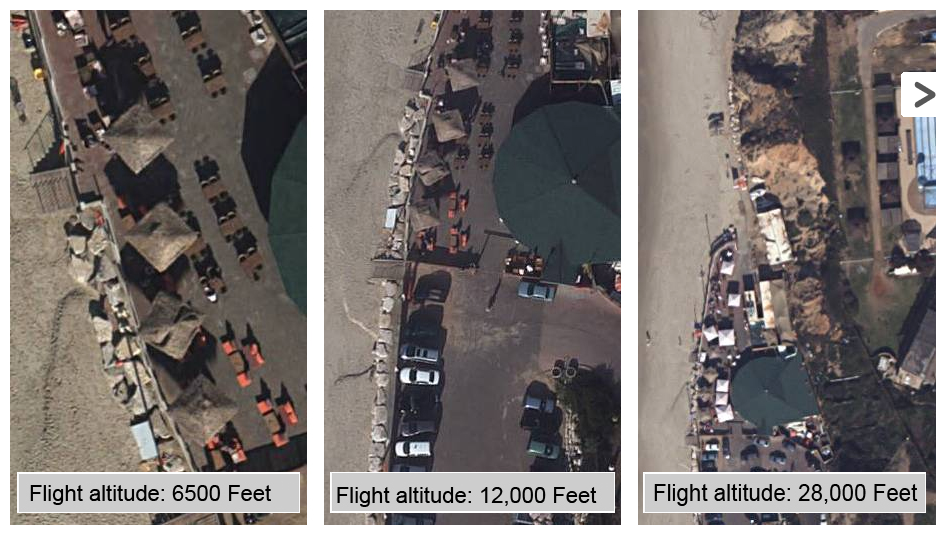
    Typical coverage and resolution of the A3 camera from altitudes of 6,500, 12 and 28,000 ft. Poto: Visionmap.

    For example, operating at an altitude of 15,000 ft., MIST cover a  strip several kilometers long in less than a second, processing hundreds of images at a rate of 80 megapixel per second, with 15 cm resolution. On a single mission the drone can cover an area thousands square kilometer large, producing detailed images for photogrammetric and stereo imagery from vertical or oblique angles, generating an image bank for persistent surveillance mission.

    The MIST system comprises a compact and an autonomous airborne payload and ground segment, designed with intuitive planning application, debriefing module and automatic image processing producing standard output formats.

    Visionmap has been offering the A3, a commercial application of its unique camera technology for several years. According to the company, in a typical mapping project, A3 cut at least 50 percent of the acquisition time and 50-75 percent of the processing time, compared to commonly available systems.

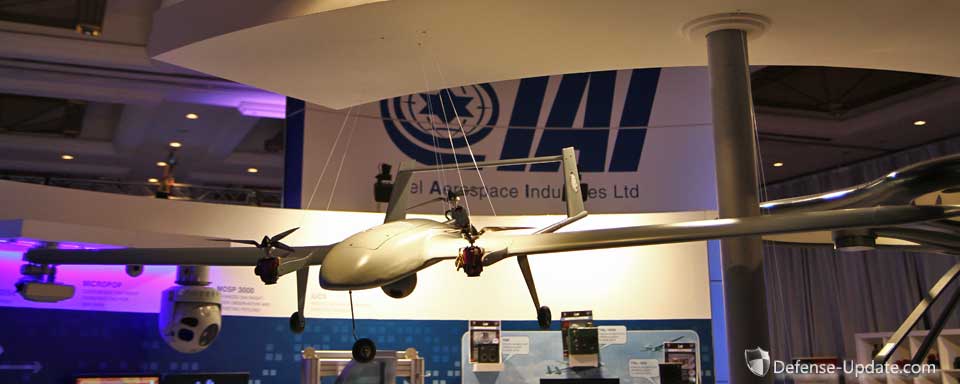
    AUVSI 2012 Photo Report

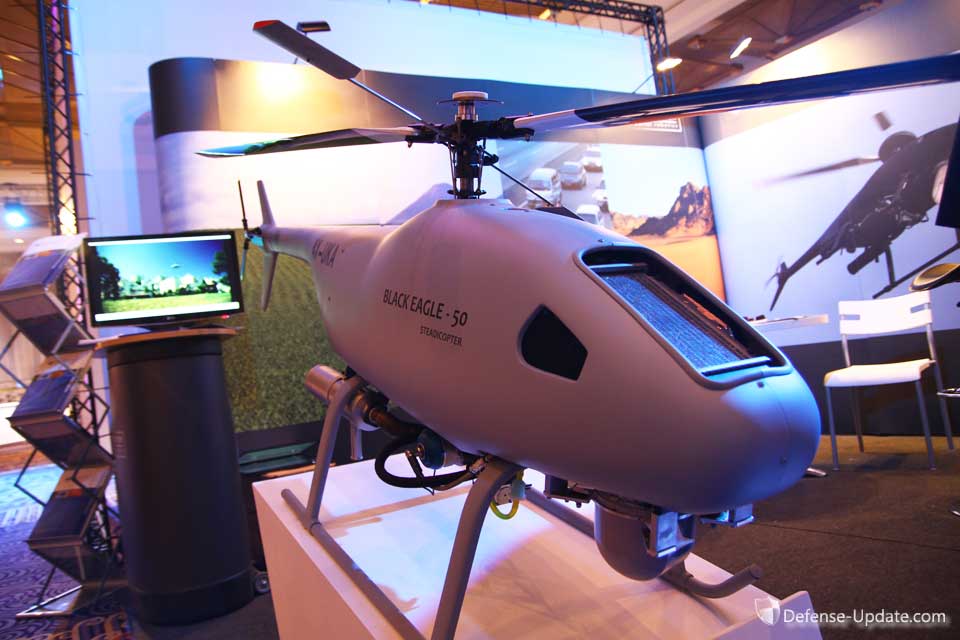
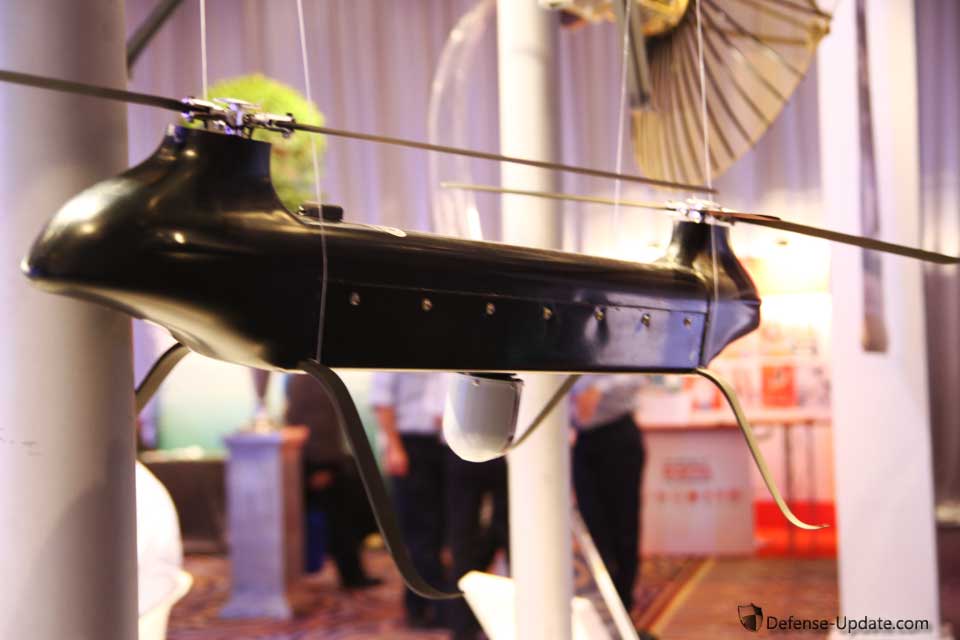
    Steadycopter Black eagle 50 - Lightweight Unmanned Helicopter. Photo: Noam Eshel, Defense Update

    AUVSI Israel 2012 opened in Tel Aviv today, gathering over 500 participants, 43 exhibitors and an impressive roster of speakers and presenters from across all industry and military branches. Among the highlights of today’s presentations were the head of Directorate of defense Research and Development (DDR&D), RADM Ophir Shoham presenting the roadmap for Israel’s UVS developments, and guest speakers Charles E. Thorpe, from the White House Office of Science and Technology policy, and Maj,. Mark Whittle, from the british Army, that provided the perspectives from the U.S. and U.K.

    Members of the IDF land, air and naval forces highlighting the three services priorities and directions. In the exhibit halls, a number of new systems were displayed for the first time, some are depicted in the following photo report. A more detailed review on some of the systems will follow soon.

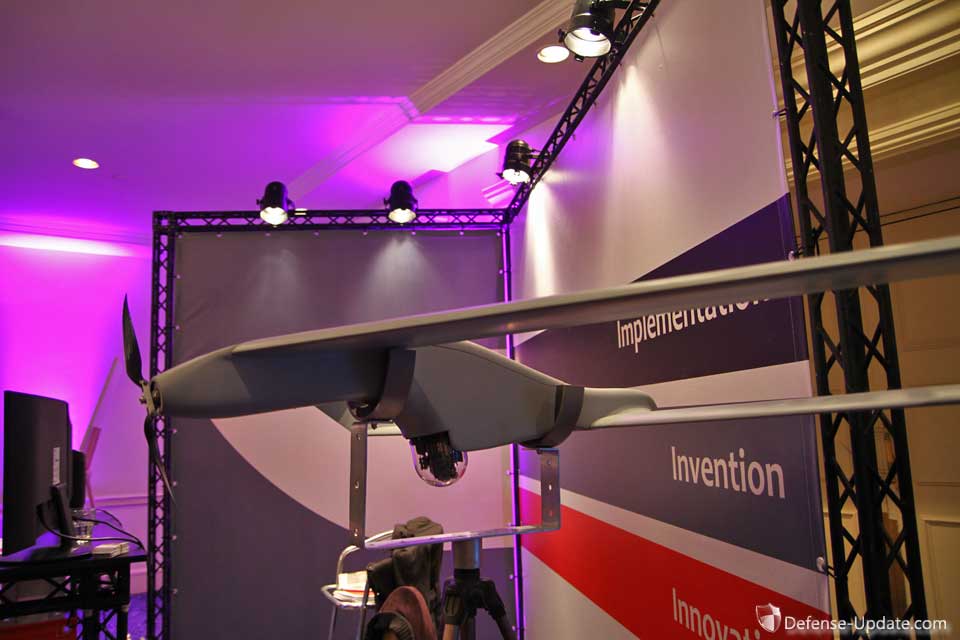
    UVision Wasp Mini UAV. Photo: Noam Eshel, Defense Update
    Innocon MicroFalcon UAV. Photo: Noam Eshel, Defense Update
    Steadycopter Black Eagle 50 - a Lightweight Unmanned Helicopter. Photo: Noam Eshel, Defense Update
    IAI REX - Autonomous Infantry Support Vehicle. Photo: Noam Eshel, Defense Update
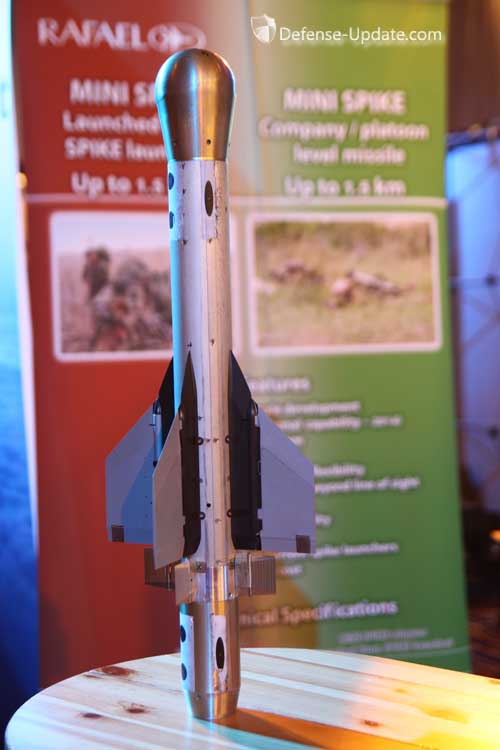
    AUVSI 2012 International debut: Rafael Mini Spike launcher and compact operator module. Photo: Noam Eshel, Defense Update
    Rafael Mini-Spike Kit - six missiles carried by two team members. Photo: Noam Eshel, Defense Update
    Rafael Mini Spike was shown in a slightly improved configuration. Photo: Noam Eshel, Defense Update
    AUVSI 2012 International debut: VisionMap MIST - High resolution UAV camera for wide area surveillance & mapping applications. Photo: Noam Eshel, Defense Update

    Read our review

    IAI Mini Panther UAV. Photo: Noam Eshel, Defense Update
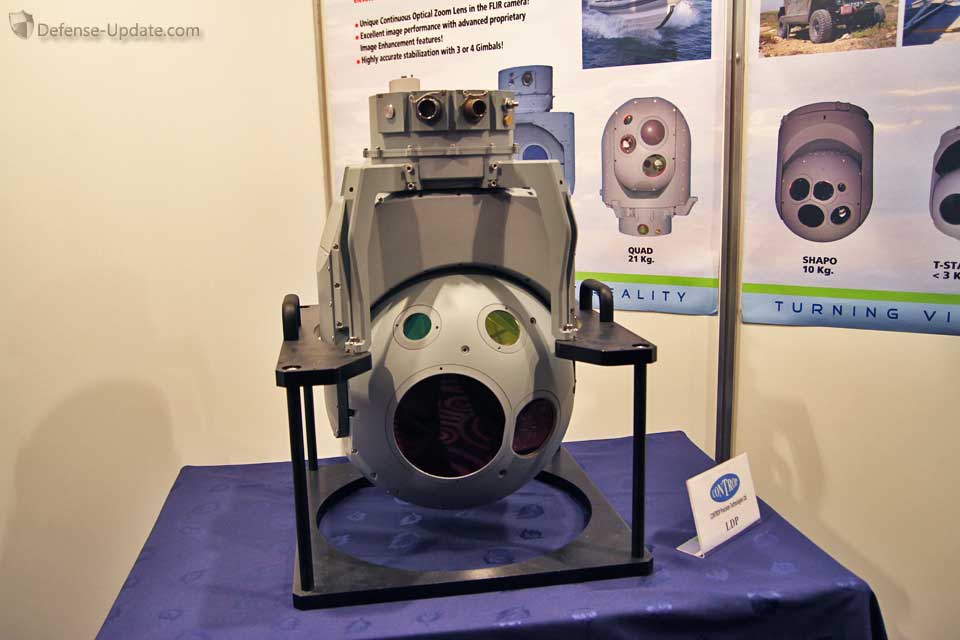
    Controp LDP - Laser Designator Payload. Photo: Noam Eshel, Defense Update
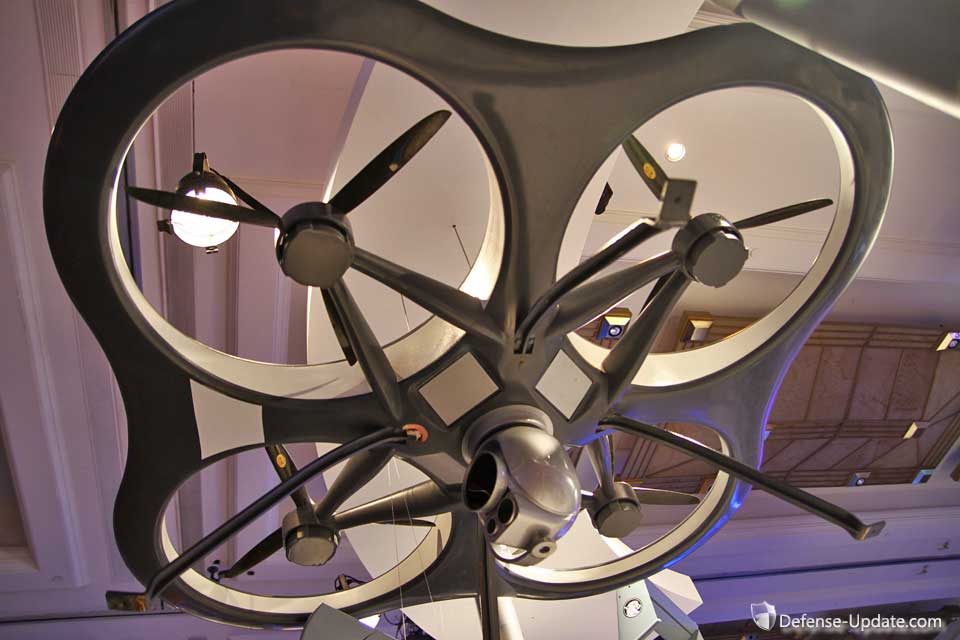
    AUVSI 2012 International Debut: SkySapience HoverMast Autonomous Hovering Platform. Photo: Noam Eshel, Defense Update

    IAI Ghost- Rotary Mini UAV System. Photo: Noam Eshel, Defense Update
    IAI ETOP - Tethered Hovering Surveillance Platform. Photo: Noam Eshel, Defense Update
    IAI ELM-2054 Lightweight Airborne SAR/GMTI Payload. Photo: Noam Eshel, Defense Update
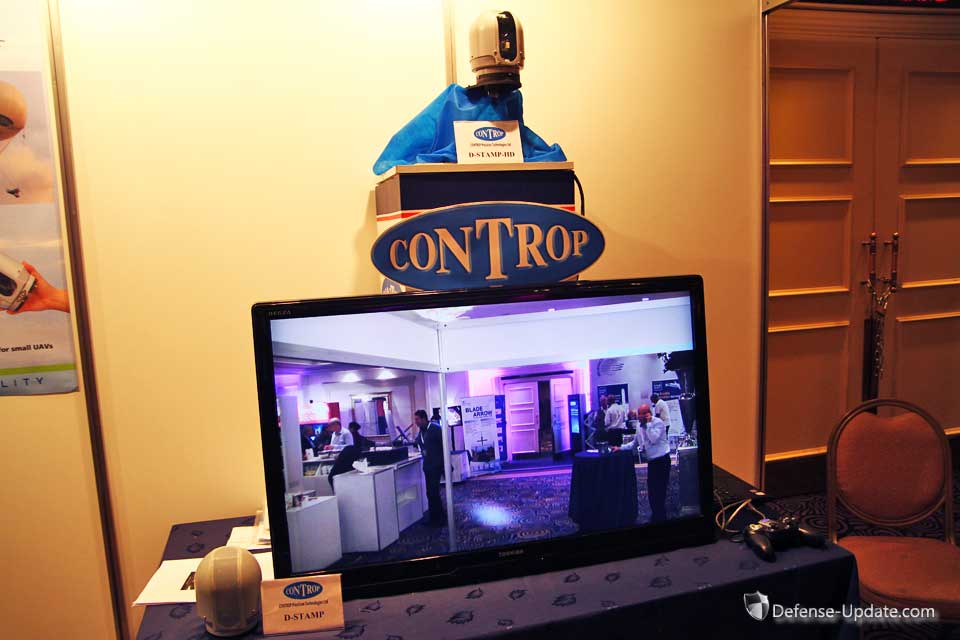
    Controp D-Stamp HD UAV Payload. Photo: Noam Eshel, Defense Update
    UVision Blade Arrow - Precision Attack Munition (PAM). Photo: Noam Eshel, Defense Update
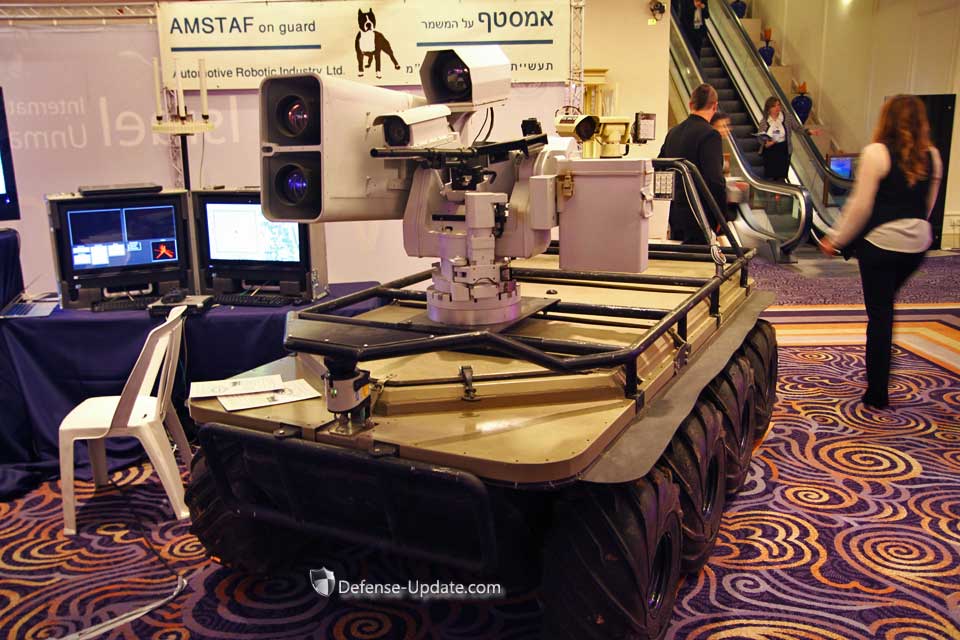
    Amstaf UGV with Rafael Typhoon RWS. Photo: Noam Eshel, Defense Update

    IWI to Make First Appearance of the UZI PRO at DefExpo, FIDAE and LAAD

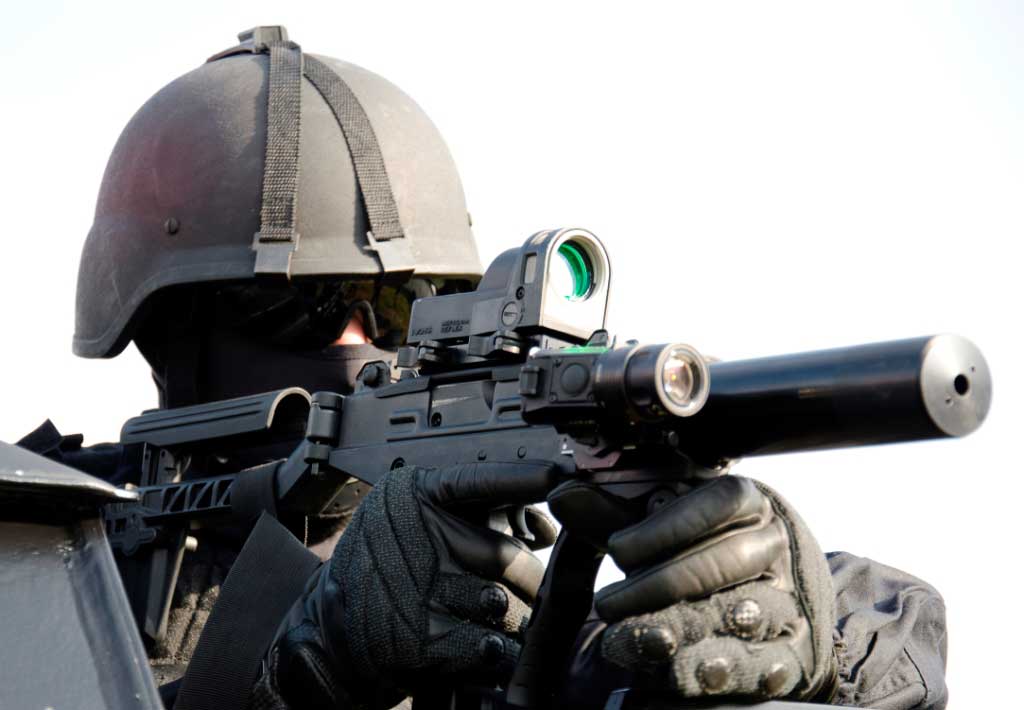
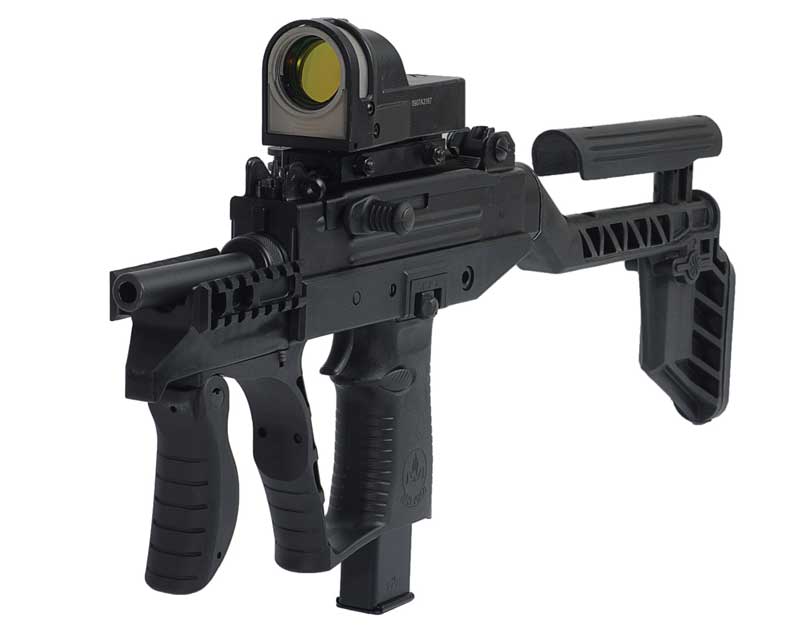
    IWI (Israel Weapon Industries) will showcase the newest UZI Submachine Gun (SMG), the 9mm UZI PRO, at DefExpo India 2012 (New Delhi, March 29-April 1) , FIDAE International Air & Space Fair (Santiago, Chile, March 27-April 1), and LAAD Security (Rio de Janeiro, Brazil, April 10-12). These are the first appearances of the actual weapon at major exhibitions.

    Developed in cooperation with the Israel Defense Forces (IDF), the 9 mm UZI PRO SMG is the newest member of the UZI family – one of the most popular weapon families in the world, with millions of units sold around the globe. Lightweight and compact, the UZI PRO is a solution for both concealed or openly carried use – for law enforcement, VIP protection and Special Forces.
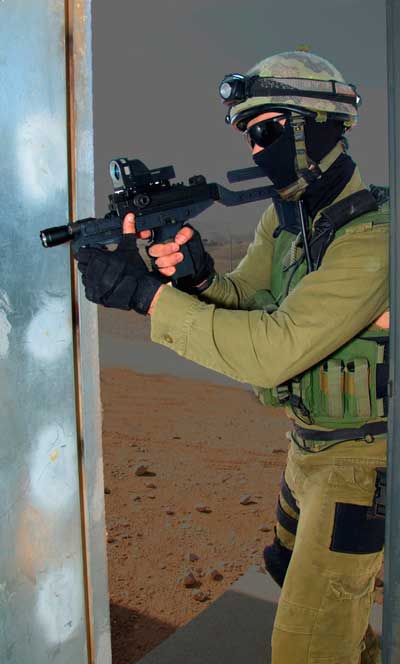
    Ergonomically designed and easy to use by right or left-handed users, it offers closed bolt operation for maximum accuracy and safety. With many of its components made of advanced polymeric materials, the UZI PRO’s features include Picatinny rails, ergonomic butt, built-in foldable assault handle and pistol-type magazine release button. It also provides a quick fitting suppressor (Photo at top), full auto and single shot and adjustable shoulder stock with mounted cheek rest.

    According to Uri Amit, CEO of IWI, “We are happy to present the next generation UZI – possibly the best-known and most widely sold weapon family in the world – following meticulous development in cooperation with the Israel Defense Forces (IDF). Our goal was to incorporate the latest technological advances without compromising the extremely reliable, globally recognized UZI, in order to make it more ergonomic and user-friendly, and equipped to handle the full range of scenarios faced in modern warfare. This goal has been fully achieved. Despite our having only recently introduced it to the market, we are already seeing great interest expressed by our customers, and believe this year will see thousands of units being sold around the world .”

    IWI is a member of the SK Group, which is composed of companies that develop and manufacture a wide array of military products for governmental entities, armies, and law enforcement agencies around the world. IWI’s most-known products include the TAVOR and GALIL ACE families of Assault Rifles, the NEGEV Light Machine Gun, the UZI SMG (Mini Micro and UZI PRO) and the JERICHO family of pistols.

    All Photos: IWI

    The F-35 – the UK’s Last Manned Combat Aircraft Procurement?

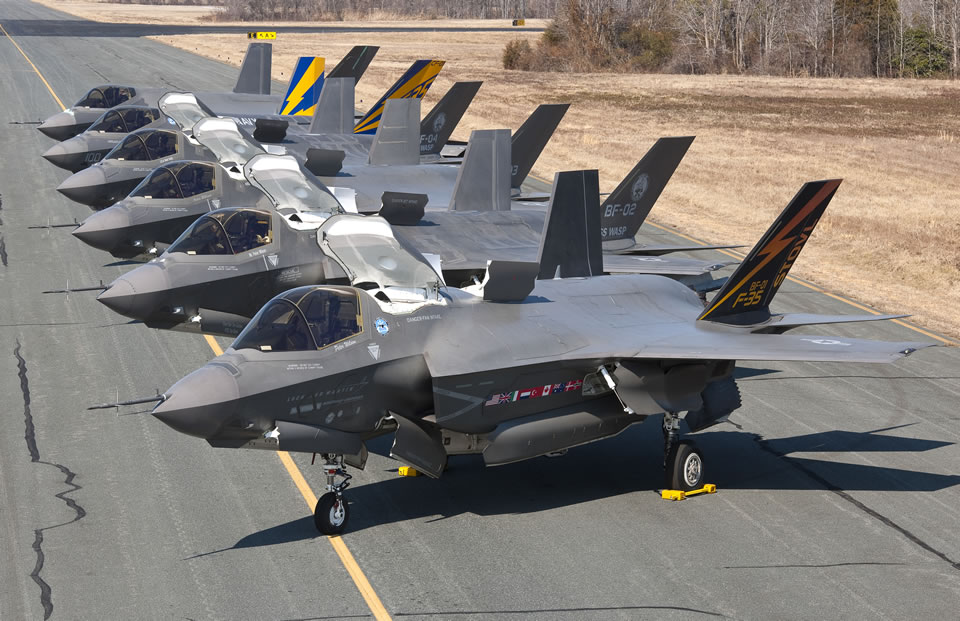
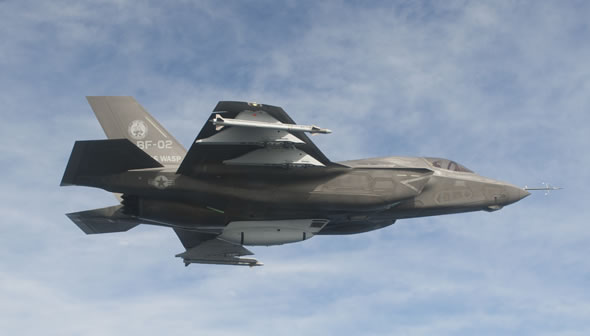
    Five F-35Bs and one F-35C line up at Patuxent River for a photo op. Photo Lockheed martin

    Recently, the UK Ministry of Defence announced that it was changing its Procurement decision on the Joint Strike Fighter, the Lockheed F-35 Lightning II, from the STOVL F-35B to the CV F-35C, with a planned order of 50 aircraft.

    It was deemed that the extra payload and range capability of the F-35C, coupled with the larger deck size of the new carrier provided a cost-effective procurement compared with the F-35B. Both options have risks – for the carrier, the Brits have yet to integrate either electromagnetic rail launch and conventional arrester gear or the CATOBAR (Catapult Assisted Take Off But Arrested Recovery. As for the STOVL option, currently, only the United States Marine Corps (USMC) is definitely (if there is such a word in Defence Procurement) slated to receive this model.

    Facing the growing cost of the carrier program, partly because the UK MOD ‘forgot’ about the ski jumps on the Queen Elizabeth carrier, costing £1.2BN to remove, and the difficulties experienced with catapult launch, there is a new ‘Plan’ to revert back to the F-35B! This is on top of the dismal FAILURE of the F-35A to carry out its first sortie from Eglin AFB, owing to (yet another issue) a fuel leak.

    2012 should have seen the arrival in the UK of a limited quantity of F-35C aircraft, for evaluation. The Planned In-Service Date (ISD) for the Queen Elizabeth carrier and the ‘stealth’ F-35C aircraft is 2020, but this might be at risk because of programme delays in the F-35C, not least of all in the arrester hook problems, and the likely inability of the F-35C to fire the UK’s standard Advanced Short-Range Air-to-Air Missile (ASRAAM), as will be fitted to the UK fleet of Eurofighter Typhoon aircraft.

    The F-35 Procurement is the US DoD’s largest procurement programme (with an individual aircraft costing in excess of US$150M, more likely US$280M for the complete production run) the program represents a Total Fleet Life-Cycle Cost Estimate of possibly in excess of US$1Trilion (US$1,000Bn). This, for what was advertised as an affordable, capable, stealth fighter for the US and its allies, has now been revealed to be the most expensive fighter aircraft ever developed, with increased size and weight (and consequently reduced capability), and “stealth” compromised by the design and also the external ordnance hard points as fitted to earlier aircraft (certainly not in the league of the F-117 stealth fighter).  This is such a change that it could almost be regarded as an update to an F-16, or the F-22 Raptor – only noisier. Now, being a Radar and EW Engineer by background, I have to confess that the JSF F-35 looks anything BUT a ‘stealth fighter’.

    Can the UK afford such procurements? It is understood that even the offsets originally envisaged have been ‘blown’, with the F-35 using Pratt and Whitney F135 engines instead of the Rolls-Royce/GE consortium F136 engines.  What’s more, as the ‘all-knowing’ UK MoD has now decided that the first new Carrier will be mothballed immediately after production, and the second Carrier will only carry one wing (not even a Squadron) of F-35’s (plus 2 in reserve), what is the point of the UK MoD’s Carrier ‘Fleet’? No wonder that the UK and Japan are in discussions about Joint Production/Procurement – after all, the Japanese know that the UK can manufacture good products, hence the plan for Nissan to produce its new car series in the UK.

    However, contrast this with the UK’s current demonstrator Unmanned Air Vehicles, Taranis (a large stealth UCAV), about which BAE Systems are keeping the details a closely-guarded secret,  and the European (German-led) Baracuda,; and then there is the BAE Systems Mantis, the European Neuron UCAV, the Talarion Medium Altitude Long Endurance (MALE) surveillance UAV. To my mind, most of these appear to be ‘Stealth’ designs. (Having seen, at extremely close quarters the last flying Avro Vulcan bomber… which overflew my house not too long ago, I think that I know ‘stealth’ when I see it.*)

    In addition, there is the Thales/Elbit Watchkeeper, for the UK Army which is a joint UK/Israel UAV intended for airborne surveillance of the battlefield which is entering service. In addition, as seen, there are the existing and future European UAV/UCAV programmes and also the US programmes… and just about every ‘developed’ nation with defence needs and strategies have commenced their own UAV/UCAV programmes.

    The UK has long been participating in Unmanned Aircraft programmes, including the Unmanned Combat Aircraft (UCAV) and is proceeding ahead of many other nations, via the auspices of the Civil Aviation Authority in programme ASTRAEA (Autonomous Systems Technology Related Airborne Evaluation & Assessment), running from 2006 until 2013 with a £62M budget, to de-risk the operational use of UAVs/UCAVs operating in (Civil) Controlled Airspace.

    This programme, which involves the cooperation of Industry and Government, has the following key industrial members: Agent Oriented Software (AOS), BAE Systems, Cassidian, Cobham, QinetiQ, Rolls-Royce and Thales. In addition, many of the most innovative small companies in the sector, leading academic minds and the UK regulatory authorities are integral to the programme.

    The two principal areas being addressed are:

    Separation Assurance & Control – the particular technologies required to control the flying vehicle in the airspace from the ground control station the spectrum, security and integrity of the communication system and the vehicle’s sense and avoid sensor system.

    Autonomy & Decision Making – providing the intelligence in the vehicle through a ‘variable autonomy system’, that shares decision making for the mission and contingency management with the human operator.

    Integral to these project areas are “Autonomous Sense and Avoid”, a ‘first’ in aviation technology.

    ASTRAEA has already been successful in terms of government/industry collaboration, which has resulted in the UK being recognised as the leading national authority on future autonomous UAV operations in controlled airspace.

    So, what will be the impact upon future (UK) combat aircraft procurement? There is already a precedence set in the USA – in 2005, the percentage of UAVs deployed was just 5% of the US Military Aircraft. At the beginning of 2012, that number had risen to 31% (according to a US Congressional Research Service report).

    Given that the UK has set a strategy to keep operational all new air systems for circa 40–50 years, what value can be seen in further expensive manned combat aircraft? The UK has demonstrated its ability to monitor, and if necessary, control the flight of an unmanned aircraft from the console of an accompanying manned aircraft (QinetiQ with a BAC-1-11 and a manned Tornado, using AOS agent software). The UCAV and UAV demonstrator programmes will evaluate remote monitoring via satellite links. So, in 2070, an Interceptor/Attack squadron could conceivably be formed entirely from UCAVs with a stand-off Mission Control aircraft. Cheaper Procurement, more versatile attack profiles (no need to worry about a pilot ‘blacking out’ at high g manoeuvres, fewer pilots required (with major impact on training budget), greatly reduced ‘body-bag’ count …

    … has somebody got a calculator? This seems to be an extremely cost effective Future Air Force – or is there something that we don’t know about? Most importantly, it would seem that the US DoD and the UK MoD simply just don’t know what to do. Having read a Defence Procurement paper recently, I was just about to say, “Just as I expected” when I realised that it was a Defense (USA) Procurement paper.  Oh, **** !

    Meanwhile, China continues to expand its forces, with Chinese warships operating new UAVs at sea, back in 2011, and with anticipated ‘carbon copies of the US Predator and Global Hawk’, it doesn’t take a genius to anticipate that China will soon have UCAV technologies, flying, to accompany their extremely large fleet. China has been offering for sale helicopter UAVs (such as the U8E), China also offers fixed wing UAVs, which are currently about a generation behind Western models (which is the usual Western policy, so no change, there!). The Chinese are willing to compete on price, but most heavy UAV users still prefer American or Israeli models – at present.

    No wonder that the USA now plans to virtually leave the Atlantic ocean, and concentrate on the Pacific ocean.

    About the author: Peter L. Hartley, MSc, CAET, MInstP, MIET

    With 41+ years experience in defense electronics (radar, electronic warfare, C3I and CIS and mission systems) and associated activities, Peter Hartley offers a wide range of skills and capabilities in the field of Systems including System Architecture, Bid Management, Bid Reviews at national/international levels, Business Development (and Business Creation), Customer Liaison, Contract Negotiation, Marketing Support, Engineering Management, Design Authority, Team Building, and Research.

    (Particularly as a UK Engineer ran the US Stealth Aircraft programmes – as I was informed by Cranfield College of Aeronautics, who trained the person concerned.)

    The Last Round in Gaza – and the Next

    RAFAEL Iron Dome anti-rocket system

    The recent round of inconclusive fighting across the Gaza-Israel border prompts several observations about the outcome and possible implications for the future. Mark A. Heller, Principal Research Associate at the Tel-Aviv based Institute for National Security Studies (INSS) discusses some of the highlights of recent events in the recent edition of INSS Insight.

    Iron Dome

    Israel’s Iron Dome rocket interception system underwent its first operational test and achieved some notable successes. It was able to discriminate between rockets likely to land in open areas and those headed for population centers, and to refrain from wasting itself on the former while intercepting about 80 percent of the latter. As a result, many Israeli fatalities and injuries were undoubtedly prevented and extensive property damage was avoided. That result validates the economic rationale of the project, despite the huge cost imbalance between cheap rockets and missiles coming out of Gaza and expensive interceptors sent up to destroy them.

    Notwithstanding these successes, however, Iron Dome is not a strategic game-changer. Because the “leakage” rate remained close to 20 percent, warnings of hostile rockets and missiles still sent the civilian population into shelters and obliged the authorities to cancel public events and close schools, thereby forcing worried parents to stay away from work. Unless active defense is 100 percent effective, it will not eliminate the need for passive defense or prevent massive disruption of normal life inside the envelope of the rockets. Nor will it spare the government the need to take weighty strategic decisions that it would prefer to avoid. That was the result this time, not because Iron Dome destroyed 80 percent of the incoming rockets and missiles, but because the 20 percent that got through did not land on exposed concentrations of civilians. In other words, only sheer luck stood between government reluctance to embark on large scale escalation and irresistible domestic pressure to do so.

    Finally, 80 percent success is not enough to persuade those who launch rocket attacks from Gaza that there is no point in continuing (or in trying again on another occasion). Just as Iron Dome does not eliminate the need for passive defenses, neither does it provide deterrence by denial. Palestinian rocket attacks were ended this time (and will perhaps be deterred next time) only by offensive operations that kill or threaten to kill those directly involved and constitute a threat of unacceptable disruption or damage to the lives of their relevant constituents – the Palestinian public. In other words, coercion/deterrence by punishment remains the dominant motif in this discourse. In the last round, Israel retained a credible threat of escalation because large scale Palestinian civilian damage and casualties had not yet been inflicted and because international attention to this part of the world was distracted by Syrian President Bashar al-Assad and Iranian Supreme Leader Ali Khamenei. Circumstances might be different in a future round.

    Egypt as Intermediary

    Even if Israeli actions prompt those Palestinian elements involved in rocket attacks to conclude that the time has come to call a halt to hostilities, some kind of communication is needed to achieve an understanding on the timing and terms of the ceasefire. On this occasion, as in the past, the only functioning intermediary was the Egyptian security establishment, which acted as it did because it understood that Egypt’s own interests were not served by a continuation and possible escalation of the fighting. However, political volatility in Egypt means that the Egyptian security establishment may not be able to go on playing this role in the future, even if its world-view remains unchanged. Presidential elections in Egypt are scheduled to be held in May, with a run-off (if necessary) the following month. Unlike in the past, the outcome of this Egyptian presidential election cannot be known in advance.

    More critically, a new Egyptian constitution remains to be written and there is therefore no clear sense of what the president’s authority will be, hence, of the balance of power between the president, the parliament, and the armed forces. Most observers expect that the security establishment will retain considerable influence on foreign and defense policy (and on defining its own institutional prerogatives) and that there will be no quick political emasculation of the armed forces along the lines of what has happened in Turkey in recent years. Nevertheless, it is conceivable that an Islamist or Nasserist/nationalist president, together with an Islamist-dominated parliament, will strengthen the view that Egypt’s proper role in a future round of Gaza-based conflict will not be to promote a cessation of fighting but rather to support Islamists in Gaza by word and deed.

    Who Sets the Agenda?

    Despite that fact that Hamas has effectively controlled Gaza since 2007, recent events were dictated not by Hamas, but rather by the PIJ (Palestinian Islamic Jihad) and the Popular Resistance Committees (PRC). Hamas not only did not initiate the rocket attacks, it publicly endorsed a quick return to calm. But while Hamas has had no qualms about suppressing Fatah by any means necessary, it has been unwilling to do the same to PIJ/PRC, and the latter were therefore able on this occasion to hijack the public agenda and do to Hamas what Hamas did for many years to Fatah (and what Hizbollah did to Lebanon in 2006).

    There is clearly a political dynamic in conditions of unresolved conflict that confers legitimacy on more confrontational rhetoric and action. That makes it uncomfortable if not impossible for those with the burden of power to crack down on those freer to indulge their ideological predilections vis-à-vis Israel without much concern for the broader consequences of their posture. Hamas has never compromised on the content of its extremist ideology, but its circumstances often oblige it to exhibit some pragmatism in its behavior (which has already earned it the scorn of Ayman al-Zawahiri, Osama bin Laden’s successor as head of al-Qaeda) and it has therefore fallen victim (though so far only to a small degree) to the familiar phenomenon of extremists tempered by reality being outflanked by other extremists of a purer sort. If PIJ/PRC agree to ceasefires with Israel too often or for too long, they may suffer the same fate.

    Skunk Works and XTEND Simplify Multi-Drone Command

    0
    Lockheed Martin Skunk Works® and XTEND have achieved a major milestone in JADC2 by integrating the XOS operating system with the MDCX™ autonomy platform. This technical breakthrough enables a single operator to simultaneously command multiple drone classes, eliminating the friction of mission handoffs. From "marsupial" drone deployments to operating in GPS-denied environments, explore how this collaboration is abbreviating the data-to-decision timeline and redefining autonomous mission execution.

    From Ukraine to Taiwan: The Global Race to Dominate the New Defense Tech Frontier

    0
    As traditional defense primes face mounting competition from agile “neoprimes” such as Anduril, Palantir and Helsing, the balance of innovation is shifting toward software-defined warfare and scalable, dual-use technologies, while global industry consolidation—marked by Boeing’s integration of Spirit AeroSystems and other strategic mergers—signals an intensified race to secure control over the defense technology value chain. Our Defense-Tech weekly report highlights these trends.

    Europe’s “Drone Wall”

    0
    In early October 2025, a coordinated wave of unmanned aerial system (UAS) incursions—widely attributed to Russia—targeted critical infrastructure across at least ten European nations. The unprecedented campaign exposed the fragility of Europe’s air defenses...

    Weekly Defense Update & Global Security Assessment

    0
    Executive Summary The past week (September 18-25, 2025) represents an inflection point where strategic defense concepts have transitioned from doctrine to tangible reality. An analysis of global events reveals four primary, interconnected trends shaping an...

    U.S. Air and Space Forces Push Next-Gen Programs at the AS&C 2025 Conference and...

    0
    At the 2025 Air, Space & Cyber Conference, U.S. Air Force and Space Force leaders unveiled major updates on next-generation fighters, bombers, unmanned systems, and space initiatives, highlighting both rapid innovation and critical readiness challenges as the services race to outpace global competitors. A short version is available here, with a more detailed version for subscribers.

    TADTE 2025: Reflecting Taiwan’s Strategic Themes

    0
    The Taipei Aerospace & Defense Technology Exhibition (TADTE) 2025 crystallized around four dominant strategic themes that collectively illustrate Taiwan's comprehensive approach to defense modernization amid escalating regional tensions. Based on a detailed report by Pleronix (available upon request). Includes a Podcast discussion on TADTE 2025's highlighting Taiwan's four strategic themes beyond the post's coverage.

    Iron Beam 450 Completes Testing, Soon to Join With Operational Air Defense Units

    0
    Israel’s Iron Beam 450 high-power laser system has completed final testing, marking a major leap in air defense. Developed by Rafael, it offers precise, cost-effective interception of rockets, UAVs, and mortars, and is set for IDF deployment by 2025.