
Thursday, January 1, 2026
More
    Home Blog Page 197

    North Korea Announces Plan To Launch Long-Range Rocket

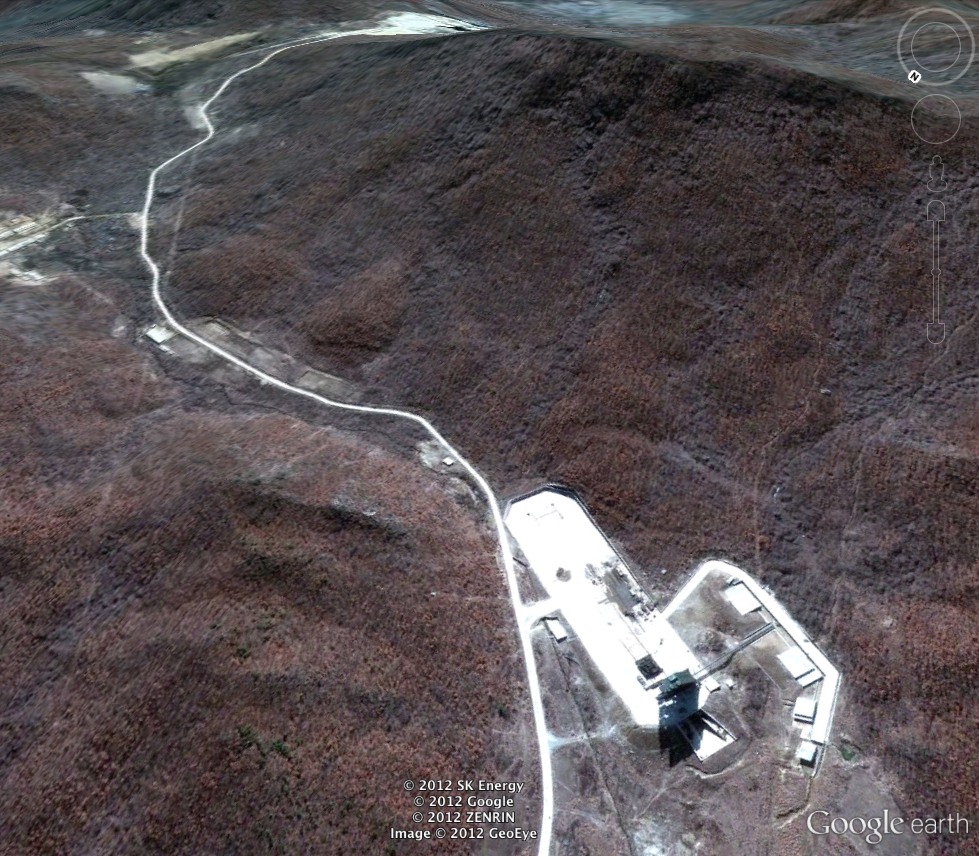
    The new launch site at Sohae Station south of the town of Cholsan in North Korea. Photo: Google Earth
    The new launch site at Sohae Station south of the town of Cholsan in North Korea. Photo: Google Earth

    On Friday North Korea announced plans to launch a long-range rocket carrying a functional satellite as part of Pyongyang’s scheduled commemorations to honor Kim Il Sung’s April 15 birthday.  As the nation’s founder, Kim Il Sung is passionately celebrated in the North to a degree of reverence rarely seen in modern times.

    North Korean leaders have been planning massive nationwide celebrations to mark Kim Il Sung’s birth for many years.  These leaders also plan the event as a signal to the international community that the nation deserves to be recognized as a modern power of worldwide influence and prestige.

    The launch announcement, reported by the New York Times, is attributed to North Korea’s Committee for Space Technology and stated that the launch is planned to take place between 12 and 16 April.  The announcement identified Sohae Station in Cholsan County located in North Pyongan Province as the projected launch site.  The launch site is believed to be a new facility near the Chinese border and is believed to be larger than other launch sites and better equipped with enhanced capabilities.

    The Committee also said that the projected flight path will be aimed southward to ensure that any debris resulting from the launch will not fall on any regional neighbors.  Timing of the launch will coincide with parliamentary elections scheduled to be held in South Korea.  A Nuclear Security Summit is also scheduled to be held in South Korea in two weeks where North Korea’s nuclear development program is expected to be a topic of lengthy discussion.

    The satellite being launched is named Kwangmyongsong-3, translated to mean “Bright Star” and will be mounted atop an Unha-3 rocket.  This is the same name given to the satellite launches of 1998 and 2009.  The North claims the satellite was manufactured solely in North Korea using indigenous technology.

    North Korean leaders have long stated their belief that they have the same right as other sovereign nations to explore the safe, peaceful use of existing space technology.  Many defense analysts believe that the North’s satellite program is little more than a front to obscure the real purpose of the launches, testing of intercontinental ballistic missile (ICBM) capabilities.

    The launch of a similar rocket in April 2009, widely considered to be a failure, led to severe United Nations’ sanctions that resulted in considerable economic hardship for the North.  This latest announcement has drawn almost immediate public censure from South Korea, Japan, the United States, and other nations.  Another launch is widely viewed as a danger to regional stability and a serious provocation that could jeopardize agreements to provide the North with food aid.

    Such a launch is also considered to be in direct violation of a UN Security Council resolution prohibiting North Korean long-range ballistic rocket launches, a measure that was adopted in response to the North’s 2009 rocket launch.

    In contrast, North Korean leaders contend that satellite launches, as a necessary extension of the nation’s peaceful space program, are not subject to UN sanctions and do not violate any agreements tied to disarmament.

    News of this new launch comes as somewhat of a surprise since the North only recently agreed to suspend long-range rocket testing using ballistic missile technology as part of its ongoing negotiations with the United States.  Only two weeks ago, the North agreed to suspend its weapon’s development programs in exchange for food aid.

    Only a week ago, US Special Envoy Robert King met with North Korean representatives in Beijing to develop a framework for the delivery of 240,000 metric-tons of food to the North.  This latest announcement from the North places this aid package in serious jeopardy only weeks before the aid was scheduled to be shipped.  Now, the North Korean announcement may make it politically impossible for the US to deliver this aid.

    Many aerospace experts believe North Korea plans to ultimately develop and manufacture a nuclear device small enough to fit atop a rocket capable of reaching the United States.  Such a possibility is at the heart of negotiations to eventually bring a halt to the North’s rocket and missile efforts.
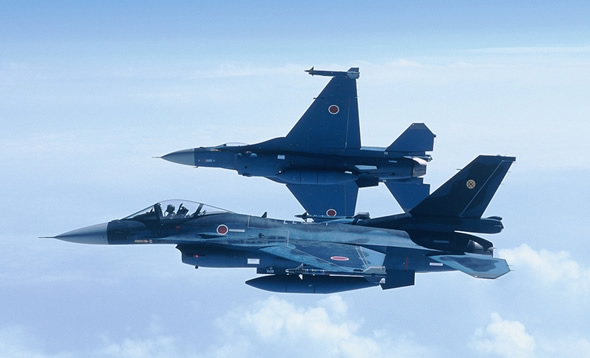
    Japan Making Its F-2 Fighter Fleet More Lethal

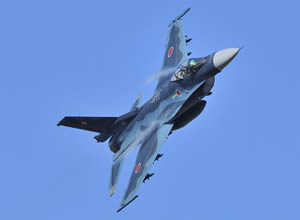
    In a move destined to give Japanese defense manufacturers hope for the future, Aviation Week reported in late February that Japan plans to upgrade 60 F-2 fighters with Mitsubishi Electric Corporation’s AAM-4B missile, a $468 million deal.  This enhancement is expected to dramatically improve the lethality of the F-2 when engaging enemy aircraft.

    A number of Japan’s Boeing F-15J fighter aircraft were equipped with AAM-4 missiles in 2007.  This version of the missile featured an advanced active radar seeker and integrated data link that allowed the pilot to fire and guide the missile to the target until the missile seeker took over allowing the aircraft to begin evasive maneuvers much earlier than in the past.

    This deal will go far in helping Japan’s struggling aviation/military industry to continue operating in an environment of intense competition from international rivals.

    The AAM-4B is fitted with a missile seeker featuring Active Electronically-Scanned Array (AESA) radar and a greatly improved data link.  The AAM-4B will be coupled with enhanced J/APG-2 radar that gives pilots a detection range far superior to what they have now.  Analysts believe that the AAM-4B will be deployed as a replacement for the Mitsubishi Electric license- built AIM-7F/M Sparrow’s now in service, a missile that was still in production as late as 2010.

    With the AAM-4B’s active search capability, coupled to an upgraded J/APG-2 radar system, modified F-2’s are expected to be able to engage multiple airborne targets from medium range without having to close to visual range, greatly improving the aircraft’s survivability and deadliness.

    The AAM-4B is reported to be the same size as the AIM-7F/M Sparrow missile, but its AESA radar seeker head will provide an active homing capability and after launch target lock affording pilots the flexibility to begin evasive maneuvers or focus on other threats sooner than is now possible.

    By incorporating AESA capabilities into the AAM-4B, it seems possible that Japan has designed a uniquely capable air-to-air missile.  While most front-line fighters of today are outfitted with AESA, no known air-to-air missiles are similarly equipped.

    In the 1980s, Japan began development work on the AAM-4, partly as a means of bolstering Japan’s domestic arm’s manufacturers and to expand the nation’s missile technology capability.  It is not known if the early AAM-4’s ever entered active service.

    In the early stages of planning and development, Japan’s Defense Ministry’s Technical Research and Development Institute indicated that the AAM-4B could be launched from a far greater distance than the AAM-4, an increase in range of as much as 20 percent.  The Institute also stated that activation of the AAM-4B’s autonomous guidance system would be possible from a range 40 percent greater than that possible with the AIM-120B AMRAAM.  Also, the AAM-4B was reportedly designed to match or outperform the Russian AA-12 Adder.  The enhanced performance of the AAM-4B is claimed to be partly the result of an increase in the level of power transmission incorporated in the AESA.

    It is expected that a modified F-2 launching AAM-4Bs would be able to discontinue tracking a target much earlier and from a greater distance than can be achieved with an unmodified F-2.  With the missile’s improved autonomous guidance system giving the aircraft extended firing range, the pilot will be able to target, fire, and execute evasive maneuvers sooner than is now possible.  The upgraded AESA is also believed to improve the F-2’s ability to locate, track, and target “crossing targets,” a scenario where an air threat is flying at a right angle creating a signal of the same frequency as that of the ground.

    No information has been provided to indicate how the AAM-4B compares with Raytheon’s AIM-120D AMRAAM.  Some sources have expressed the opinion that the AIM-4B’s performance will hinge on the level of technology incorporated into the control and guidance systems and may not match the performance of Raytheon’s AIM-120C-7 variant, a missile that is eligible for export.

    Japan also has an inventory of Raytheon AIM-120 AMRAAMS available for use.  Japanese corporate heavyweights, Mitsubishi Heavy Industries and Mitsubishi Electric, also had a hand in the design and development of the AAM-4B.  Mitsubishi Heavy managed the missile integration phase of the project and Mitsubishi Electric focused on upgrading the radar systems.  Japan’s Ministry of Defense reported that development was completed successfully.

    It is not known how many, if any, operating F-2’s are presently equipped to carry the AAM-4B, but Japan’s FY2012 budget submission does include funding for radar upgrades for 40 aircraft and fire-control upgrades for 16 aircraft.  Funding for the AAM-4B enhancements for 60 aircraft is expected to appear in future budget submissions, possibly to coincide with extensive maintenance plans.

    Japan’s Ministry of Defense also confirmed that the modified F-2’s will be capable of launching and coordinating several missiles aimed at more than one target simultaneously.  The Ministry would not reveal the exact number of targets that may be fired upon at the same time, but the modified F-2’s will be configured to mount four AAM-4B’s.

    Operational F-2’s are already equipped with AESA and the modified F-2’s will be similarly equipped.  Comparable aircraft fitted with AESA employ a data link that transmits signals from the aircraft to an airborne missile using radar.  The modified F-2’s will be outfitted with a separate data link transmitter, the J/ARG-1.

    Additional guidance system modifications will include upgrading the existing J/APG-1 AESA radar to a J/APG-2 standard.  The J/APG-2 is expected to maximize the capabilities of the AAM-4B by allowing for target detection at much longer ranges and to increase the probabilities of scoring a hit.  The J/APG-2 is known to be capable of generating significantly greater power and incorporates a signal processor that is faster and more reliable.  Japanese officials remain secretive regarding the specific J/APG-2 capabilities and have stated that they have not made any comparison with foreign-built radar systems.  Some sources speculate that the J/APG-2 might be comparable to Raytheon’s APG-79 carried on US F/A-18E/F Super Hornets.

    The upgraded F-2’s are a critical part of Japan’s air defense system and can be expected to continue in an operational flying status, alongside Japan’s existing fleet of F-15J’s, for many years to come.  It is still uncertain if Japan will continue with its plans to acquire the Lockheed Martin F-35 Joint Strike Fighters or if they will select a competing aircraft to beef-up their air fleet.  What is known, with production of the F-2 now completed and discontinued, is that Japan is looking at a future that is getting ever more dangerous by the day.

    JSDAF Mitsubishi F-2 fighters will receive the high performance AAM-4 missile as part of a major upgrade program. Photo: JSDAF

    Lockheed Martin and BAE Expect To Battle For South Korean And Taiwanese F-16 Upgrades

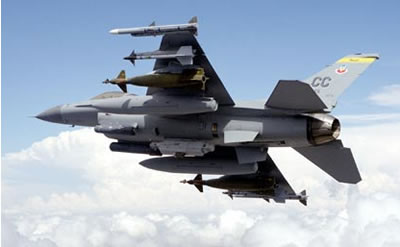
    Romania is buying a squadron of F-16s from Portugal. These aircraft will replace its existing MiG-21 Lancer by 2017.

    With the United States and many other nations cutting back on their plans to commit money to new aircraft designs while looking to extend the operational life of their existing aircraft, the intensity of international competition in providing weapon’s upgrades has reached new heights in recent months.

    BAE Systems, looking for new opportunities to increase revenues, has been quietly challenging Lockheed Martin’s dominance of the international market providing F-16 upgrades.  BAE’s moves have not been so quiet as to escape Lockheed Martin’s increasingly concerned attention.

    In capturing deals to provide F-16 upgrades for the Turkish Air Force and the US Air National Guard, BAE has placed other international providers on notice that they are a serious contender for lucrative opportunities wherever they may be found.  The US Air National Guard deal, providing fire-control upgrades and enhanced Ethernet capabilities for some 270 aircraft, was a major coup and a warning to Lockheed Martin that they should prepare themselves for battle in other markets.

    Now, the focus of both companies is on the upgrade offers announced by Taiwan and South Korea.  South Korea is looking to sign a $1.6 billion agreement to upgrade 134 RF-16 fighters and Taiwan’s proposal amounts to $4 to $5 billion for upgrades to 146 F-16C/D Block 20 fighters.  In addition, Singapore is expected to solicit bids for upgrades to 70 F-16C/D Block 52 aircraft in the near future.

    Lockheed Martin has not let BAE’s challenge go unanswered.  The company is stressing the fact that they are the original equipment manufacturer (OEM) and are the best choice to provide upgrades for avionics, electrical systems, structural components, and recertification of weapon’s systems.

    In the past, Lockheed Martin successfully delivered more than 1,000 upgrade kits to customers worldwide.  The company has also been the prime contractor in the integration of Active Electronically Scanned Array (AESA) radars into F-16, F-22, and F-35 aircraft.  Historically, once upgrades are completed, the company performing the upgrades becomes the logical choice to incorporate future modifications and enhancements.

    In South Korea, the Defense Acquisition Program Administration (DAPA) has responsibility for managing the F-16 upgrade competition.  DAPA has accepted bids from BAE and Lockheed Martin and is expected to render a decision sometime in June of this year.  Once a contractor is selected, DAPA will then request that the US government negotiate a deal with the winning bidder under the umbrella of the Foreign Military Sales (FMS) Program.  In this way, South Korea gains a guarantee of proposed service and hopes the intensity of the competition drives the cost down.

    While the United States remains South Korea’s largest arms supplier, DAPA is intensely interested in gaining access to advanced technical knowledge about enhanced avionics and AESA radar manufacture.  Such knowledge would be of great value as South Korea continues to pursue plans to develop, in cooperation with foreign allies, an advanced FF-X fighter of its own.  Of concern is the restrictive American policy regarding the transfer of technology.

    Taiwan’s Ministry of National Defense (MINDEF) is already proving to be somewhat of a headache for BAE.  Taiwan has enjoyed a long and comfortable relationship with Lockheed Martin, a relationship the Taiwanese do not wish to jeopardize.  MINDEF is also concerned that broader competition might create critical delays that Taiwan can ill afford.

    BAE’s answer to the cozy relationship Lockheed Martin enjoys with Taiwan is to do whatever is necessary to force a bidding war that drives the cost down to a level that Lockheed Martin will be unable to match.  Also, some members of MINDEF are quite anxious to incorporate an Ethernet option into their aircraft.  Lockheed Martin has only recently begun developing such an option while BAE has considerably more experience in this arena.

    Only time will tell which company can manage to gain the upper hand and, time is running against BAE at the moment.  MINDEF has been specific in their desire to have a Letter of Acceptance (LOA) in hand by May of this year, a deadline that BAE may find difficult to meet.

    Satellite Imagery Uncovers New S-300 Sites in Algeria

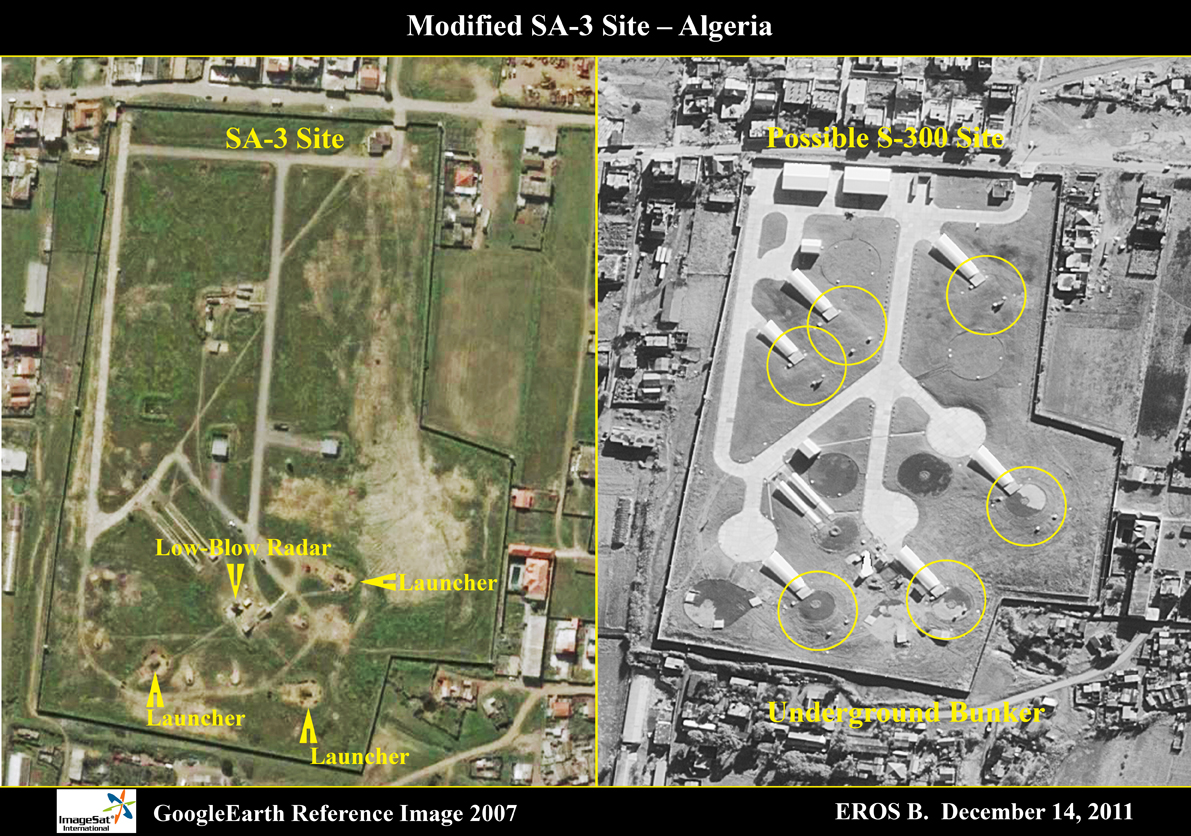
    Following the delivery of the first four batteries of S-300 PMU2 surface to air missiles from Russia, Algeria has begun inducting the systems, partly replacing former S-125 (SA-3) systems. In the following satellite images taken recently by the Eros B spy satellite operated by the geospatial services company ImageSat International, two of the SA-3 sites are seen converted to serve the S-300.

    In 2010 Algeria also has acquired the S-300 PMU2 from Russi as part of $7.5 billion arms package struck between the prime minister of Algeria and Russian president Vladimir Putin in 2006. Other elements of this arms package included Su-30 multirole fighters and modern submarines. The Air Defense command received the first unit in 2008; four units are currently delivered. The delivery of the remaining four is included under the original contract options.

    The SA-3 SAM site at Ouled Fayet has been upgraded into a S-300 PMU2 site in the past 3 years. The color image shows the SA-3 site as it was seen in 2007 while the larger image shows the completed upgraded infrastructure prepared to deploy the new S-300 PMU2. Photos: Google Earth and Imagesat International.

    When compared to past images available on Google Earth, the scope of the Algerian preparations can be appreciated. These images show the Algerians spent significant efforts in upgrading and protecting their new sites, with infrastructure preparations previously unfamiliar with similar sites in other countries. The sites apparently being fortified with underground installations and overhead shields hiding each launcher position from aerial or space observation.

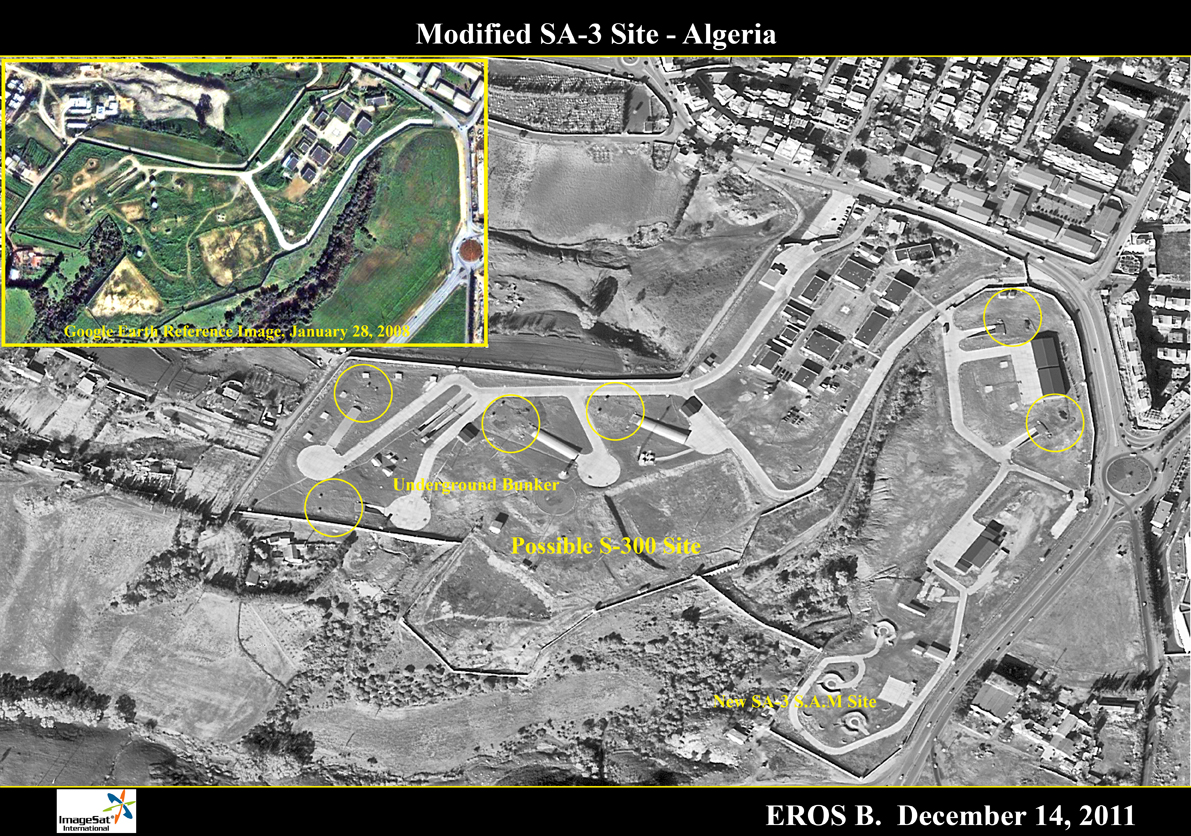
    The SA-3 site at Reghaia, east of Algiers was converted into S-300 PMU2 between 2008 and 2011. Photos: Google Earth

    The four images that appears on the right shows how the empty SA-3 site at Reghaia, east of Algiers, as it was in 2007. The following images record its transformation into the modern, highly protected S-300 PMU2 site. The second image shows the same site as seen on August 2008, The third image shows the same site a year later, in August 2009 with another image taken two years later, by September 2011. This exclusive Eros B photo shown here shows the completed site, with the six bunkers protecting the launchers completely buried underground, along with sheltered exits, leading to adjacent lunch pads. All launch pads are interlinked, enabling rapid access and relocation of launchers.

    Another SA-3 site located west of Algires at the suburb of Ouled Fayet, has been upgraded into a S-300 PMU2 site in the past 3 years. The extent of the fortification works is visible in this Google Earth satellite view from April 2009, showing the erection of four concrete bunkers that were buried in the ground, with little visible signs on the massive buildings underground.

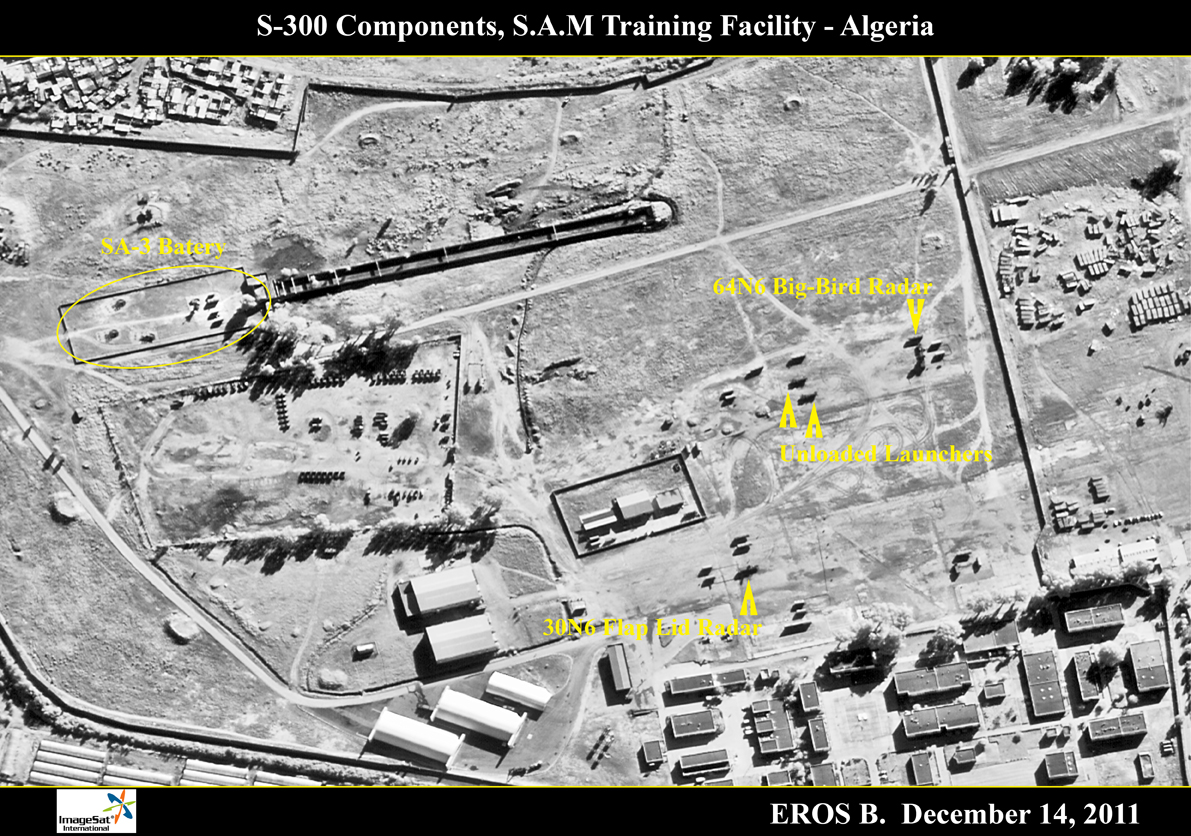
    Training activity has also been identified at Boudouaou, few kilometers to the east. The image shows an S-300 PMU2 unit training with 64N6 Big-Bird and 30N6 Flap Lid radar systems deployed separately from the S-300 launchers. This feature is enabled by the radio-link, connecting the fire units to the radars and fire control, enabling more flexible dispersal of firing units and improved survivability for the entire site. In fact, a possible deployment technique would be to keep the radars apart from the site and move launchers out of shelters for firing, thus maintaining the majority of the unit protected underground.

    Training activity has also been identified at Boudouaou, few kilometers to the east. The image shows an S-300 PMU2 unit training with 64N6 Big-Bird and 30N6 Flap Lid radar systems deployed separately from the S-300 launchers. Photo: Imagesat International

    The sites retain the launch positions for other SAM assets, obviously some S-125 capablities. However, another possibility is that these positions could be occupied by the new SA-22 (Pantsir 1), protecting the bunkers from attacks by precision guided weapons.

    In May 2010 Algeria and Russia concluded another contract for the delivery of 22 SA-22 Pantsir-S mobile air defense systems. The system has already been delivered to Syria and the UAE. The Pantsir-S unit combines 12 surface-to-air guided missiles with two 30mm air defense automatic guns. Pantsir-S is an autonomous, tracked low-level, mobile air-defense system that can protect mobile forces or augment the defense of strategic sites and medium-long range SAM sites with low-to-medium altitude air defense. The weapon is considered effective against guided weapons as well as unmanned aerial vehicles (UAV).

    New Orders for AIM-9X Block II

    Kuwait considers equipping its F/A-18C/D Hornet fighters with the latest generation air/air passive (IR) missile – the AIM-9X-2 Sidewinder Block II missile. Kuwait plans requested U.S. approval to but 80 such missiles, at the cost of US$105 million. The AIM-9X-2 has recently been requested by a number of foreign customers, including the UAE, Poland, Malaysia and Morocco. Raytheon has already launched production of the AIM-9X Block II with formal Initial Operational Test & Evaluation (IOTE) scheduled for April 2012, following the completion of the ongoing Operational Test Readiness Review (OTRR)

    Block II.

    According to the U.S. defense security cooperation agency (DSCA) the sale will enhance Kuwait’s interoperability with the U.S. and among other Central Command nations, making it a more valuable partner in an increasingly important area of the world.

    Despite Drought, Plasan Prepares for Future Demand Acquiring Control of US APS Developer Artis

    Iron Curtain applied on a Ridgback MRAP type vehcile. Photo: Artis
    Iron Curtain applied on a Ridgback MRAP type vehcile. Photo: Artis

    Israel’s armor protection company Plasan announced today the acquisition of controlling interest in Artis LLC, a Virginia-based engineering company. Iron Curtain is a vehicle active protection system developed under a DARPA contract. The system has been demonstrated on live firing tests on the HMMWV and is currently being integrated on the M-ATV. Iron Curtain was one of seven systems demonstrated on live firing tests sponsored by the Office of Secretary of Defense (OSD). The system should be ready for production by the end of this year.

    The Iron Curtain is designed to defeat shaped charge threats including projectiles, missiles and rockets. The sensors used to activate the system are C-Band radars detecting and tracking the inbound threat, alerting the crew and arming the APS. As the threat reaches a distance several inches from the vehicle, a distributed optical sensor classifies the threat to select the aimpoint and determines which countermeasure to fire.

    Once triggered, the countermeasure unit explodes, sending a steel slab straight down, killing the threat with minimal collateral damage to personnel in the vehicle or in close proximity to it. During the DARPA tests Artis has demonstrated the system on a HMMWV, defeating RPG class threats fired at close range.

    Designed to protect tactical vehicles with 360 degrees coverage, (the system can also be configured to protect the vehicle’s top area) the system offers multi-shot capability against a wide spectrum of threats. The combination of radar and optical sensors contribute to low false alarm rate. With low overall weight, Iron Curtain is compact and requires minimal internal space, thus making it an effective add-on protection for medium-heavy wheeled tactical vehicles, such as the HMMWV, MRAP or M-ATV, as well as the JLTV type vehicles. Iron Curtains’ ability to classify targets, along with its array of countermeasures enable it to effectively address new and emerging threats by evolutionary software changes. This level of flexibility will enable users to continuously customize their reaction to threat changes, as part of the protection systems upgrade, even between major armor upgrades.

    The Artis acquisition is the latest in a series of moves by Plasan to consolidate its position as the leading developer of survivability solutions for tactical wheeled vehicles used in the defense and homeland security markets. Plasan’s recent efforts include Armored Chariots LLC, a joint venture with TPI Composites Inc. of Scottsdale, Arizona to produce next-generation crew compartments for U.S. military vehicles at a facility in Warren, Rhode Island.

    In recent years Plasan has invested in a advanced technologies related to several applications of ballistic protection, including lightweight protection materials using nano materials and lightweight counter RPG protection using flexible structures. The acquisition of Artis positions the company in the field of yet another advanced protection technology, offering state of the art active protection solutions.

    Iron Curtain defeats an RPG on a DARPA sponsored test. Photo: ARTIS

    The common denominator of these investments is the demand for increasing protection while decreasing weight. With the acquisition of Artis Plasan remains focused on the core business of tactical vehicles, as the Artis developed solution pertains mostly to vehicles designed with vertical walls, where lines of active countermeasures firing downward surround the frame.

    U.K. to Set Standards for Maritime Private Security Companies by the 2012 Year’s End

    Private Security Companies operating in a maritime environment would be required to meet certain standards expected to be instated before the end of 2012, according to Chris Sanderson the Chairman of the Conference of the Security in Complex Environments Group (SCEG) taking place this week in London. The SCEG has been working on standards, and will shortly be consulting with government officials, client groups and others such as intergovernmental bodies and certification bodies. The draft standards will be then submitted to government Ministers.

    The high levels of risk of piracy in the seas off Somalia makes the development of maritime standards and independent accreditation a high priority, to reduce risks to private security companies and their employees, to ship owners and seamen, and to ship and cargo insurers and brokers. It is intended that the government will play an important role in the selection of independent certification bodies that will audit individual private security companies against the standards, when they are finalised.

    SCEG is a Special Interest Group within the British ‘Aerospace, Defence, Security’ (ADS) group. SCEG brings together private security companies operating on land and sea around a common agenda of raising standards and introducing robust and independent accreditation for companies operating in complex and high-risk environments. “Our intention is to have an independent accreditation process in place by the end of 2012” Sanderson said, adding “this will also address accreditation for private security companies operating in complex or high-risk land environments such as Iraq and Afghanistan.”

    “The human and financial costs to ship owners and companies are potentially very high. Having a set of standards endorsed by the UK government and implemented by independent accrediting bodies will reduce levels of uncertainty and risk,” said Rees Ward, CEO at ADS. ADS was appointed by UK Ministers as the government’s industry partner for the regulation and accreditation of private security companies in June 2011, and an announcement was made in Parliament.


    US Navy Receives the First P-8A Poseidon

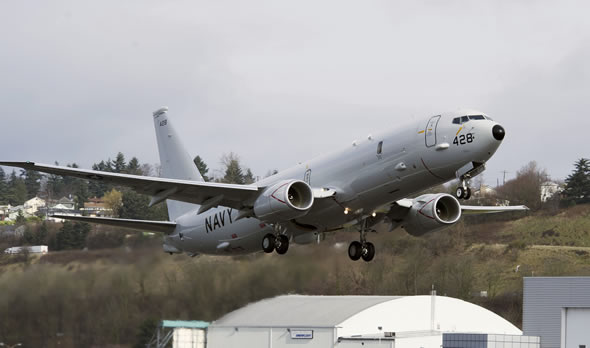
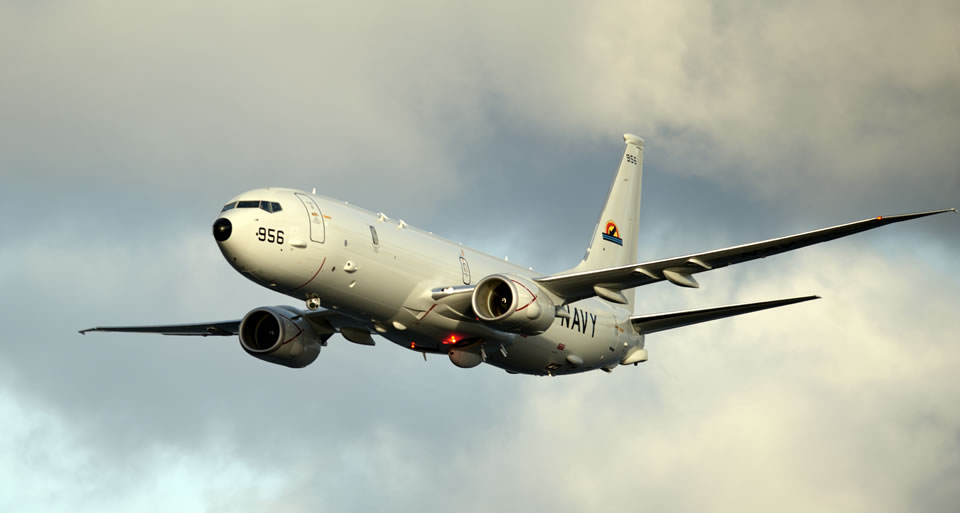
    Boeing has delivered the first production P-8A Poseidon maritime surveillance aircraft to the U.S. Navy. This aircraft is the first of 13 anti-submarine warfare, anti-surface warfare, intelligence, surveillance and reconnaissance aircraft Boeing will deliver as part of a low-rate initial production (LRIP) contract awarded in 2011. The aircraft was flown to Naval Air Station Jacksonville, Fla., where it will be used for aircrew training.

    Along with production aircraft, the P-8A team also has built and is testing six flight-test and two ground-test aircraft. The flight-test aircraft are based at Naval Air Station Patuxent River, Md., and have completed more than 1,500 flight hours. The Navy plans to purchase 117 Boeing 737-based P-8A aircraft to replace its P-3 fleet. Initial operational capability is planned for 2013.

    A derivative of the Next-Generation 737-800, the Poseidon is built by a Boeing-led industry team that includes CFM International, Northrop Grumman, Raytheon, Spirit AeroSystems, BAE Systems and GE Aviation. The Poseidon team is using a first-in-industry in-line production process that draws on Boeing’s Next-Generation 737 production system. All P-8A-unique aircraft modifications are made in sequence during fabrication and assembly.

    A P-8A Poseidon conducts flyovers above the Enterprise Carrier Strike Group during exercise Bold Alligator 2012. Bold Alligator was the largest naval amphibious exercise in the past 10 years . It represented the Navy and Marine Corps' revitalization of the full range of amphibious operations. (U.S. Navy photo by Daniel J. Meshel)

    Embarked on Flight Training, F-35A Aborts First Flight after 15 Minutes

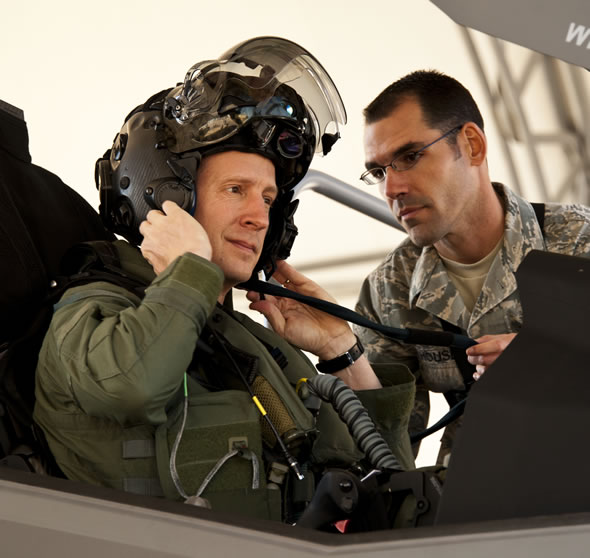
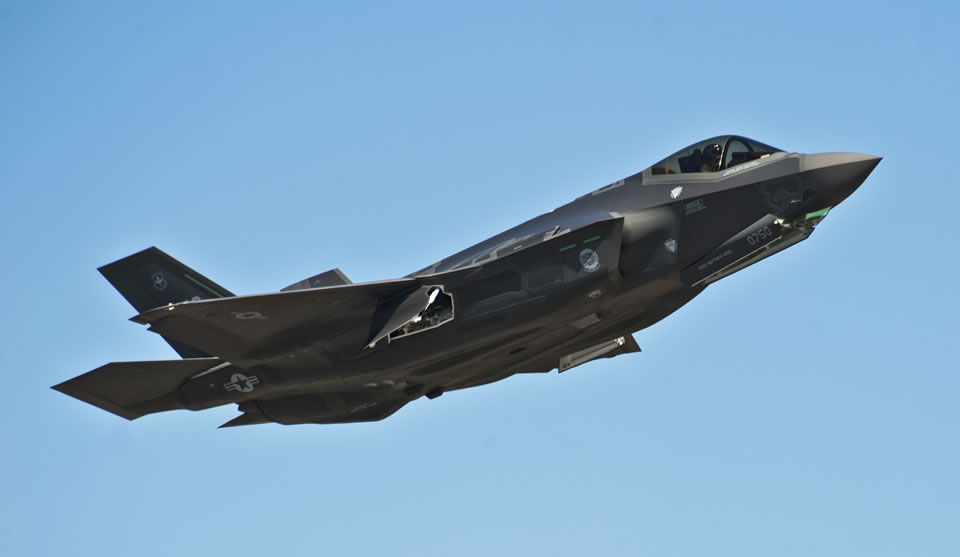
    Lt. Col. Eric Smith, the 58th Fighter Squadron director of operations prepares for takeoff on the F-35A first training mission. Photo: USAF
    Lt. Col. Eric Smith, the 58th Fighter Squadron director of operations prepares for takeoff on the F-35A first training mission. Photo: USAF

    Initiating F-35A training flights before the fighter completed flight testing has been in hot debate for months; this issue encountered a symbolic misfortune yesterday, as the F-35A taken on a 90 minute check flight that marked the first training sortie of the new fighter was aborted 15 minutes after takeoff due what was described as a ‘fuel leak’ warning. According to a Lockheed Martin press release, early in the flight, F-16 chase pilots observed a small amount of fluid venting from the F-35 aircraft. The pilot, following standard operating procedures, returned the aircraft safely back to the base after an approximate 20 minute flight.

    “We met both objectives today; get the aircraft airborne and start local area operations,” said Lt. Col. Eric Smith, the Air Force’s first F-35 pilot who tested the aircraft at Edwards AFB, Calif. “Our team did the most conservative thing by deciding to bring the plane back. We trained for this many times in the simulator for this exact reason.”

    “We didn’t want it to happen today but we were prepared. Our pilot did the exact right thing in returning the jet back to Eglin” said Col. Andrew Toth, 33rd FW commander “Although there were issues we are doing whatever we can to move the program forward safely and effectively.” Pilots and maintainers discussed the potential fuel leak finding that caused the precautionary end of the sortie.

    According to Air Education and Training Command, they are taking an event-driven approach to assess when to begin transitioning the entire JSF training system, including the aircraft, to a point where the wing can initiate the training syllabus.

    “We will continue to make steady progress towards our goal of standing up a world class training program at Eglin,” said Gen. Edward Rice Jr., commander of AETC, who approved F-35 flight operations to begin shortly after the Air Force Aeronautical Systems Center awarded an airworthiness certificate to the service for their variant of the joint strike fighter. The 33rd FW focuses on preparing for an anticipated 2,200 students a year and 900 “on campus” at any given time at full capacity.

    The F-35A Lightning II joint strike fighter lifts off for its first training sortie March 6 at Eglin Air Force Base, Fla. It’s the first flight of any 33rd Fighter Wing F-35 since their arrival to the base. (U.S. Air Force photo/Randy Gon)

    Civilian Pilot Killed on a Kfir C-2 Crash in Nevada

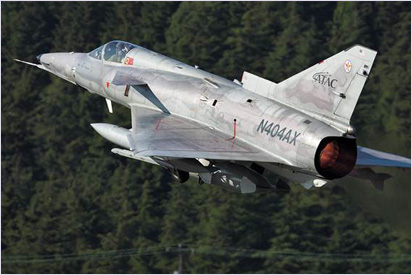
    Kfir C-2 (F-21) Operated by ATAC. Photo: ATAC
    Kfir C-2 (F-21) Operated by ATAC. Photo: ATAC

    51-year-old Carroll LeFon a pilot of the Airborne Tactical Advantage Company was killed after his F-21 Kfir fighter jet crashed at Fallon Naval Air Station in northern Nevada, USA. Approaching Fallon, the base was blanketed in snow. LeFon then diverted to Reno, 60 miles to the west, which was also covered with snow. “The pilot then turned back toward Fallon and stated to air traffic controllers that he was in a critical fuel state,” the NTSB reported. “The pilot descended and maneuvered first toward runway 31, then toward runway 13” On 09:15 the Kfir struck the ground.

    The aircraft built by the Israel Aerospace Industries was supporting naval aviation training operations at the base, where the defense contractor provided adversary simulation and target towing for U.S. Navy fighter pilots.

    The crash raises questions about the safety of air operations at Fallon, which is home to TOPGUN and other Navy air training despite being plagued by nasty weather. Those conditions contributed to the death of LeFon, a retired Navy captain, a former instructor at TOPGUN

    India Bans six Companies from MOD Contracts

    Former OFM Director General, Sudipta Ghosh

    The Indian Ministry of Defence decided to debar six defense firms from further business dealings with the Ordnance Factory Board, Department of Defence Production, MoD, for a period of ten years. These companies have been blacklisted by the Indian authorities pending formal MOD decision.

    The four foreign companies listed in this case are: Israel Military Industries Ltd. (IMI) of Ramat Hasharon, Israel; Singapore Technologies Kinetics Ltd. (STK) from Singapore, Rheinmetall Air Defence (RAD) from Zurich, the Swiss subsidiary of the Rheinmetall defense group and Corporation Defence, Russia (CDR), also known in Russia as ‘Corporation Zashchita’. Two Indian domestic companies are also included, TS Kisan & Co. Pvt. Ltd., from New Delhi and RK Machine Tools Ltd., from Ludhiana.

    The action follows the Central Bureau of Investigation (CBI) chargesheet against former Ordnance Factory Board (OFB) chief Sudipto Ghosh, and the probe agency’s recommendation for blacklisting the six firms. The suspension will be in effect for 10 years, beginning 2012.

    IMI is assumed to be the company worst hit by the Indian decision. Consequently, the decision could stymie the Israeli government’s efforts to privatize IMI, as India has been one of its primary customers. Singapore Technologies (ST) said the Indian decision has no impact on ST Kinetics’ defence business as India has not been a market for its defense export sales. Nevertheless, ST said it will seek legal advice as it intend to vigorously take actions to clear its name and defend its reputation. ST claimed the Indian MoD repeatedly stated that ST Kinetics is not blacklisted, and that the “putting on hold” of ST Kinetics’ defense business activities in India was but an interim arrangement only.

    China, Russia Negotiate a $4 billion Sale of 48 Flanker-E (Su-35)

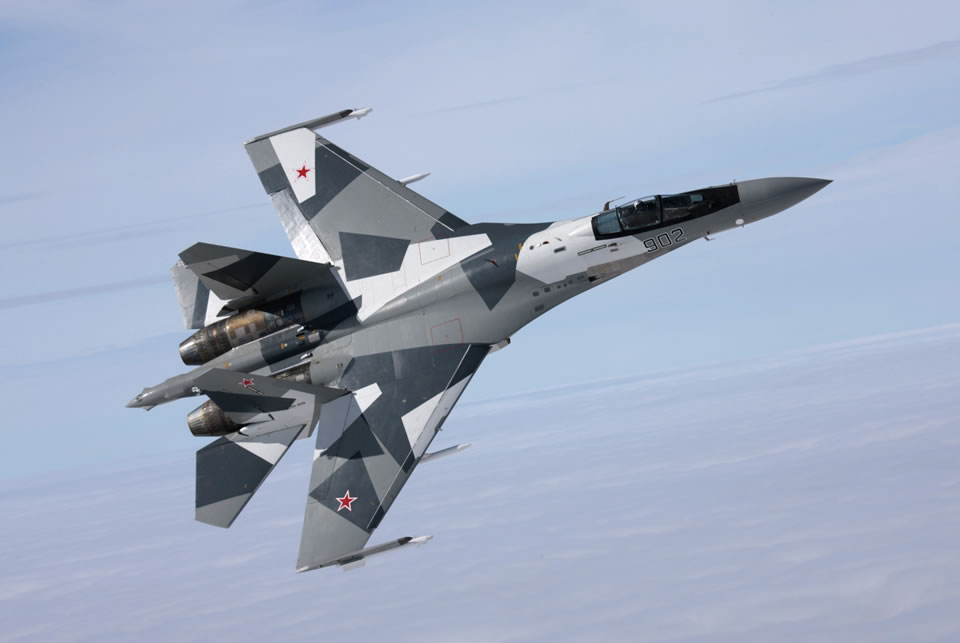
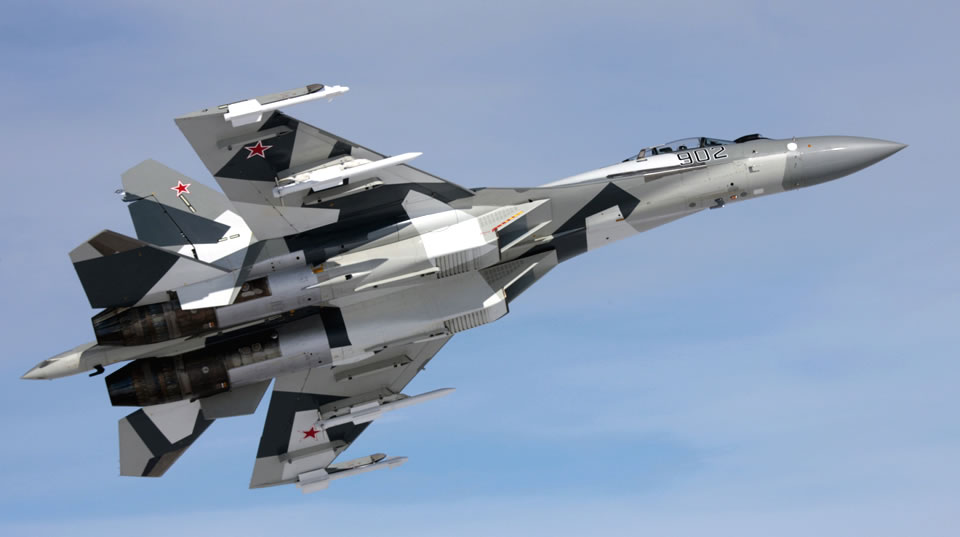
    The second Su-35 prototype seen on demonstration flights. Photo: Sukhoi
    The second Su-35 prototype on tone of the est flights. Photo: Sukhoi

    Russia and China are negotiating a US$4 billion arms package covering the delivery of 48 Russian Su-35 Flanker-E fighter jets to the Chinese Air Force. The Moscow based Kommersant newspaper reports. According to the Russian source, both sides have already agreed on the financial terms, but the protection of intellectual property (preventing reverse engineering) remains unsettled. “Moscow is not only aiming to ensure its presence on the Chinese market, but also attempting to prevent the potential copycat production of Russian aircraft for subsequent sales to third parties with predatory pricing” the Kommersant quoted a Russian government source saying. The Su-35 is considered the latest derivative of the Flanker platform, which dates back to the mid-1970s (the T-10 prototype flew on May 10, 2977). Su-35 is superior even to the Su-30 currently representing the latest member of this family.

    In the past, most of the Chinese fighter planes were based on foreign designs, primarily of Russian origin. These include the MiG-17 (J-5), MiG-19 (J-6), MiG-21 (J-7), Su-27 (J-11) and Su-33 (J-15). The original fighters were initially bought from the Soviet Union, and later copied and produced in China primarily for local use. Some of these designs were altered significantly resulting in new aircraft carrying similar designations. These included the A-5, and F-8II. China has also developed completely new designs, including the FC-1, J-17 and the latest J-20.

    The Russian Su-35 is a new Generation 4++ fighter. With three prototypes currently performing flight-testing, the aircraft is expected to enter service with the Russian Air Force in 2014. The Russian Air Force has ordered 48 aircraft. Two 117S engines with thrust vectoring power this multi-role air superiority fighter that weighs up to 14.5 tons on takeoff. With an operational range of 3,600 km, 59,000 foot ceiling and Mach 2.25 top speed Su-35 can effectively engage several air targets simultaneously, employing the latest avionics systems and sensors available for a Russian made platform.

    Elbit Systems Large Area Display Selected for Boeing’s Advanced Cockpit Technology

    Elbit Systems Cockpit NG concept (Photo: Elbit Systems)

    The Boeing Company has selected Elbit Systems to provide advanced avionics systems for its fighter aircraft, including the upgraded versions of the F/A-18E/F Super Hornet and F-15SE Silent Eagle. Both are currently competing in several modern fighter tenders in Asia and Latin America.

    Elbit Systems Large Area Display (formerly known as Cockpit NG) was unveiled at the Farnborough Air Show 2010. The system will become the basis for advanced cockpit systems, to be integrated with modern or modernized fighter aircraft offered by Boeing. The F/A-18E/F Super Hornet is one of three contenders for the Brazilian FX-2 program, and the F-15 family of aircraft, including the Silent Eagle currently competing for the FX-3 program in South Korea. The advanced cockpit forms part of Boeing’s F-15 modernization roadmap, which is also considered for the new and modernized Saudi Arabian F-15SA fighters.

    For Elbit Systems, the MOU marks an excellent opportunity to strengthens its position a strategic Tier 1 supplier for Boeing’s upgrading programs, including the projected modernization of the US Air Force F-15C/D/E fighter aircraft. Bound by the current austerity measures, air forces are realizing upgrading programs as a viable option in expanding operational capabilities of existing systems within limited budget constraints.

    Comprehensive avionic upgrades will be required for these fighters, following the integration of AESA radars and modernized communications, enabling the aircrew to gain maximum benefit of the new sensors. The advanced cockpit is expected to be ready for production by 2015. The Air Force is currently testing the new Raytheon AN/APG-82(V)2 AESA radar which already demonstrated target detection capability farther away than ever before. The Air Force plans to deploy the new radar on the F-15E in 2014. The Singapore Air Force F-15SG employs the Raytheon AN/APG-63(V)3 AESA radar. The Saudi Arabian new and modernized Eagle is also expected to use the AN/APG-63(V)3.

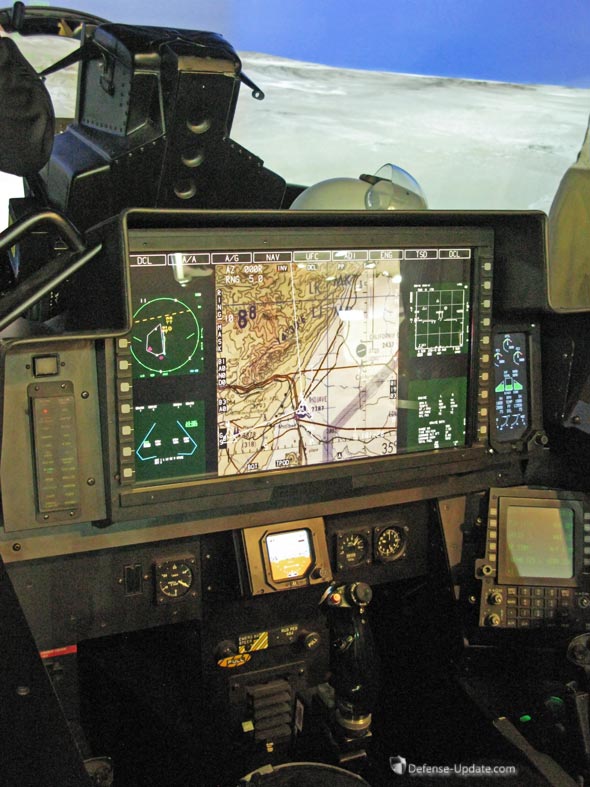
    The new Large Area Display was presented by Boeing at the Singapore Airshow 2012. Photo: Tamir Eshel, Defense Update

    Large Area Display Technology
    The system employs 11-inch by 19-inch (27.9 x 48.2 cm) Large Area Display (LAD) integrating tactical data, mission planning and flight information into a complete situational picture responding to specific mission phase and pilot controls. LAD is designed to operate in synch with the Boeing JHMCS II helmet mounted display, also developed by VSI (Elbit Systems also shares 50% of the ownership of VSI). The advanced cockpit system will improve the way the pilot interacts with the aircraft and will enable growth to next-generation visual cueing, improving situational awareness and increasing aircraft effectiveness.

    Opportunities in Latin America
    In addition to the cooperation between the Boeing Company and Elbit Systems of America, the Memorandum of Understanding (MOU) signed between the two companies supports the development of advanced avionics capabilities in Brazil, through Elbit Systems’ Brazilian subsidiary AEL Sistemas S.A. of Porto Alegre. Boeing is expecting the activities proposed for AEL Sistemas will enhance it’s industrial participation offer on the F-X2 fighter program.

    The MOU outlines opportunities for AEL Sistemas, to participate in the design, development, production and support of some Large Area Display software and hardware. It is expected the knowledge and capabilities gained from this work also will support Elbit Systems and AEL Sistemas’ efforts to establish an Advanced Cockpit Technology Center of Excellence in Brazil, expanding their advanced cockpit avionics market reach to other fixed-wing platforms, as well as rotorcraft. Elbit Systems has committed to invest in the development of advanced cockpit avionics capabilities at AEL.

    “Boeing and its Tier 1 supplier-partners are committed to bringing key technologies to Brazil,” said Boeing Military Aircraft President Chris Chadwick. “We are focused on building long-lasting opportunities for Brazilian industry in the development and production of key technologies as Boeing continues to enhance its family of tactical fighter aircraft to meet the emerging needs of our customers around the globe.” The scope of opportunities for AEL Sistemas could reach beyond the FX-2 program, to modernization, upgrading and new fighter acquisition programs throughout Latin America.

    Program Partners Confirm Support for F-35 Joint Strike Fighter

    Amidst growing concern and criticism about the rising cost and delays, the F-35 Joint Strike Fighter (JSF) program received a welcome vote of confidence last week from the United States and eight other nations during an international meeting sponsored by Canada. The attendees made it known that they fully support the continued development of the controversial aircraft.

    Inside sources reported that Canada’s Associate Minister of National Defense, Julian Fantino, sponsored a dinner and a day-long meeting in the Canadian Embassy in Washington D.C. with the intent of improving communications between the nine partner nations sharing development of the stealth fighter.

    Canada, the United States, Britain, Turkey, Australia, Italy, the Netherlands, Norway, and Denmark are the partner nations working with Lockheed Martin in developing three variants of the F-35. With frequent criticism being leveled at the program, technical problems receiving widespread news coverage, and the United States’ decision to stretch its orders for 179 aircraft out over a five-year plan of acquisition, the project is in much need of just such a confidence vote.

    Meeting participants were given a presentation updating them on the status of the project by Vice Admiral David Venlet, the Pentagon’s Program Manager, and by representatives of Lockheed Martin. The United States also reiterated its firm commitment to the program.

    Last month, Italy announced its decision to reduce its initial order for 131 aircraft by 30 percent and Britain announced that it would postpone until 2015 a decision on the total number of aircraft it would acquire. Initially, Britain planned to purchase 138 F-35s and has placed a firm order for three aircraft costing a total of $632 million with the first scheduled to be delivered in June. Australia is also reviewing its previous decision to buy 12 F-35s and Turkey has decided to delay its purchase of two planes until a date to be announced later.

    Canada’s governing party is facing severe criticism from the opposition party regarding the decision to purchase 65 F-35s. The opposition party in Canada is demanding the ruling party make the acquisition process publicly transparent and not make a firm commitment to numbers without considering other options.

    The United States has followed a policy of briefing senior leaders of partner nations on a bilateral basis in the past and military representative from all nine nations meet at least twice each year with the next meeting scheduled for March 14-15 in Australia. The Canadian-sponsored meeting appears to have been arranged for the purpose of offsetting all the negative press attention the F-35 program is receiving now.

    Skunk Works and XTEND Simplify Multi-Drone Command

    0
    Lockheed Martin Skunk Works® and XTEND have achieved a major milestone in JADC2 by integrating the XOS operating system with the MDCX™ autonomy platform. This technical breakthrough enables a single operator to simultaneously command multiple drone classes, eliminating the friction of mission handoffs. From "marsupial" drone deployments to operating in GPS-denied environments, explore how this collaboration is abbreviating the data-to-decision timeline and redefining autonomous mission execution.

    From Ukraine to Taiwan: The Global Race to Dominate the New Defense Tech Frontier

    0
    As traditional defense primes face mounting competition from agile “neoprimes” such as Anduril, Palantir and Helsing, the balance of innovation is shifting toward software-defined warfare and scalable, dual-use technologies, while global industry consolidation—marked by Boeing’s integration of Spirit AeroSystems and other strategic mergers—signals an intensified race to secure control over the defense technology value chain. Our Defense-Tech weekly report highlights these trends.

    Europe’s “Drone Wall”

    0
    In early October 2025, a coordinated wave of unmanned aerial system (UAS) incursions—widely attributed to Russia—targeted critical infrastructure across at least ten European nations. The unprecedented campaign exposed the fragility of Europe’s air defenses...

    Weekly Defense Update & Global Security Assessment

    0
    Executive Summary The past week (September 18-25, 2025) represents an inflection point where strategic defense concepts have transitioned from doctrine to tangible reality. An analysis of global events reveals four primary, interconnected trends shaping an...

    U.S. Air and Space Forces Push Next-Gen Programs at the AS&C 2025 Conference and...

    0
    At the 2025 Air, Space & Cyber Conference, U.S. Air Force and Space Force leaders unveiled major updates on next-generation fighters, bombers, unmanned systems, and space initiatives, highlighting both rapid innovation and critical readiness challenges as the services race to outpace global competitors. A short version is available here, with a more detailed version for subscribers.

    TADTE 2025: Reflecting Taiwan’s Strategic Themes

    0
    The Taipei Aerospace & Defense Technology Exhibition (TADTE) 2025 crystallized around four dominant strategic themes that collectively illustrate Taiwan's comprehensive approach to defense modernization amid escalating regional tensions. Based on a detailed report by Pleronix (available upon request). Includes a Podcast discussion on TADTE 2025's highlighting Taiwan's four strategic themes beyond the post's coverage.

    Iron Beam 450 Completes Testing, Soon to Join With Operational Air Defense Units

    0
    Israel’s Iron Beam 450 high-power laser system has completed final testing, marking a major leap in air defense. Developed by Rafael, it offers precise, cost-effective interception of rockets, UAVs, and mortars, and is set for IDF deployment by 2025.