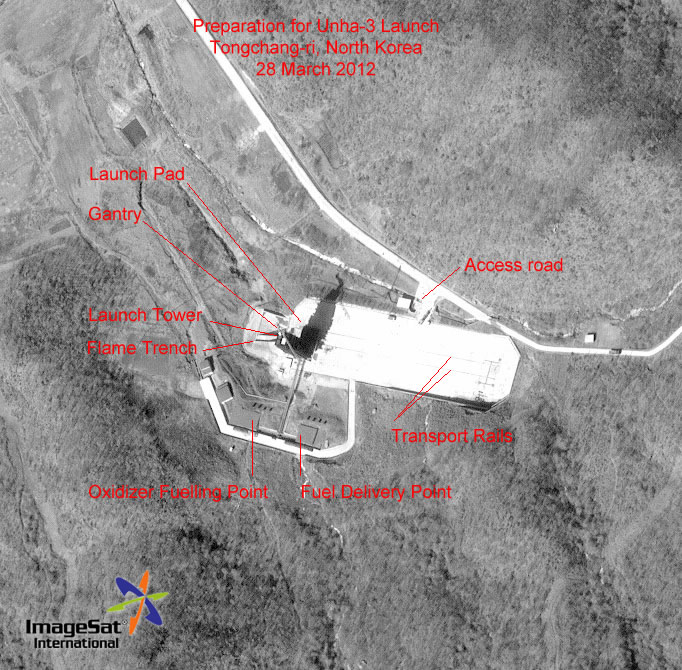
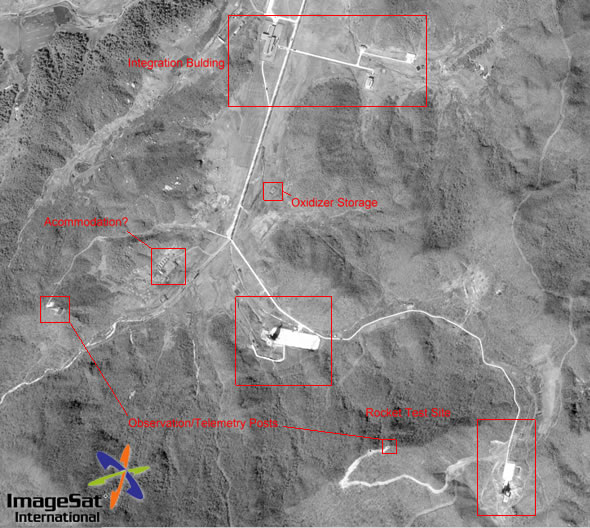
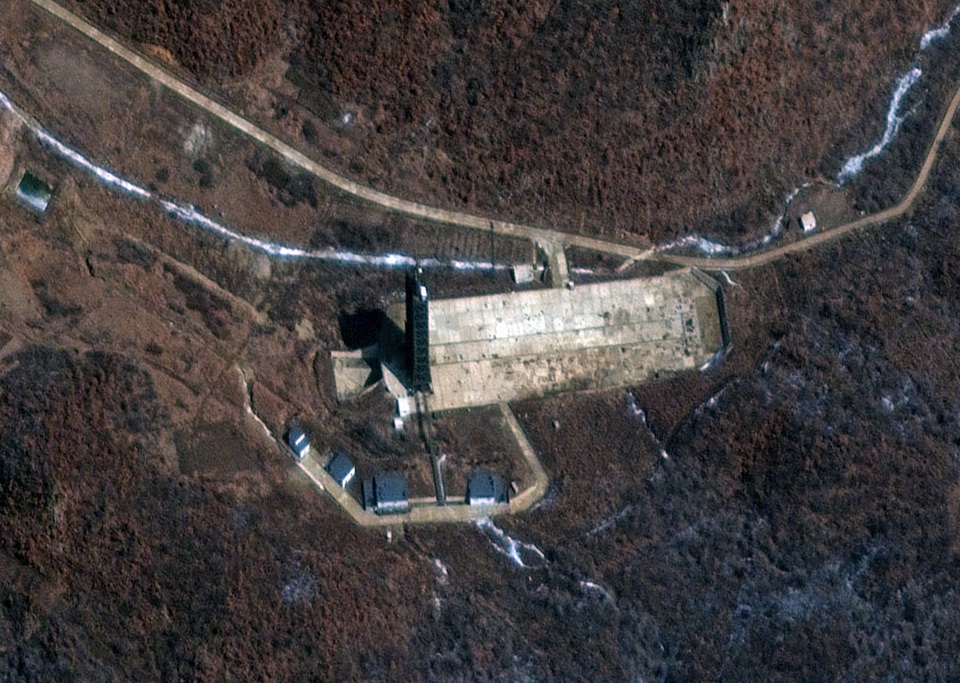
Satellite imagery captured by the Israeli EROS-B satellite on March 28, 2012 show the North Korean preparations for the planned April launch of a North Korean satellite. The test is widely believed to be an opportunity for PyongYang to test its long range ballistic missile technology. The launch is expected to take place at the Sohae Satellite Launching Station, also known as Tongchang-dong Space Launch Center between April 11-16. These exclusive images were provided to Defense Update for analysis, courtesy by Imagesat International.
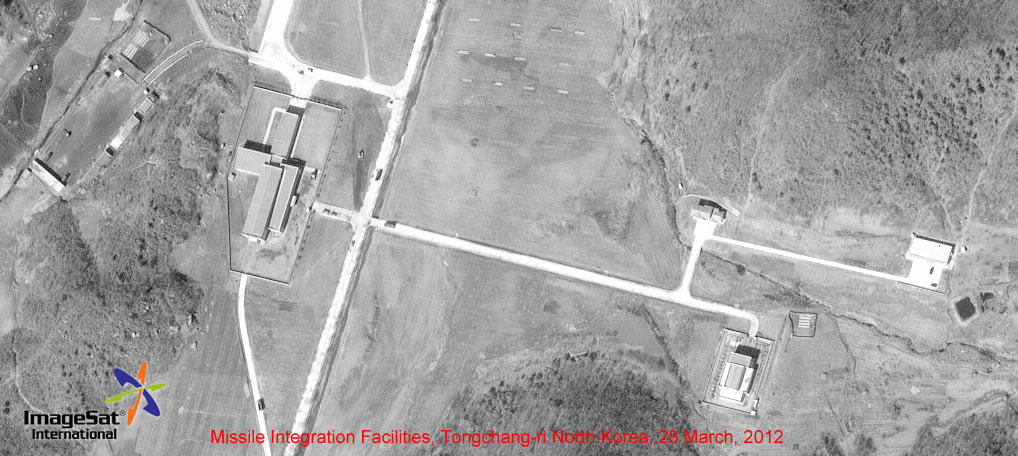
28 March 2012, satellite image shows activity at the Tongchang-ri, missile and space research center in North Korea, in preparation of Unha-3 launch. Photo: Imagesat InternationalThe Unha-3 satellite launch vehicle was assembled in this building, where final integration of the launcher is performed and final chencks are made before it will be transported to the launch site. Photo: Imagesat International
Few days before the planned launch, the Unha-3 launcher will leave the integration center (below) and be transported to be loaded onto the launch pad, located about one kilometer to the east. This mobile launch pad is already located at the basis of the launch tower, equipped with a gantry to help secure the first and second stages in place. More analysis based on Digitalglobe images from the same day is available at the 38 North website
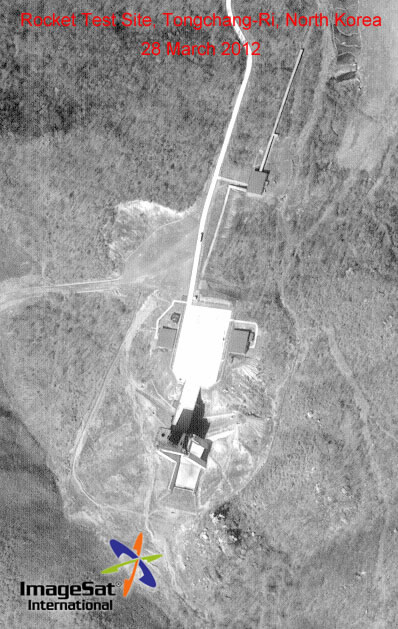
The newrby rocket test site was recently renovated, providing testing facility for larger, more powerful missile propulsion systems. Eros-B satellite Photo, courtesy of Imagesat International
Meanwhile, the U.S. intelligence is suspecting North Korea is building a missile that is even bigger than the long-range missile it is preparing to launch the satellite with, the chosun reports from Seoul. South Korean and U.S. officials believe the North will unveil the missile at a military parade on April 15, nation founder Kim Il-sung’s centenary, or on April 25, which marks the founding day of the North’s Army.
A government source here said U.S. reconnaissance satellites recently spotted a 40-m missile at a research and development facility in Pyongyang that is larger than the existing Taepodong-2 missile. “It remains uncertain whether this missile is functional or is just a life-sized mock-up,” the official added.
The rocket North Korea is preparing to launch soon is apparently 32 m long, the same as the Taepodong-2 that was launched in April 2009 with a maximum range of 6,700 km. The new missile is believed to be larger and equipped with a bigger booster that gives it a maximum range of more than 10,000 km, making it capable of reaching the continental U.S.
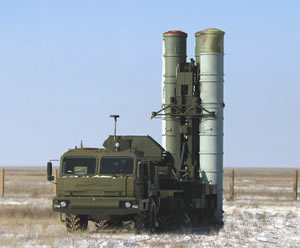
S400 deployed with Russian army regiment. Photo: RIA Novosty
Almaz Antey has recently received a multi-year order for the S-400 Triumf surface-air missiles (SAM), equipping the Russian defense forces with several regiments of the advanced SAMs. For the near term the company is likely to be focusing on domestic deliveries. However, despite the Russian Defense Ministry claim that there are no plans so far to export the S-400 Triumph, Russia is already pitching its top-of-the-line air defense system for export. At DefExpo 2012 in India this week, Almaz Antey officials were promoting the Triumph air and missile defense system.
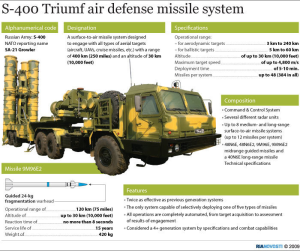
S-400 Triumf infographic created by RIA Novosty.
Defense Update spoke with Sushin Yury, Chief of Department at Almaz Antey the corporation that designed and built the missile, about the possibility of Russia selling the S-400 Triumph to India. In the words of Mr. Sushin, “if India shows interest in the purchase of the S-400, Russia can definitely provide India with all the information it needs about the system.” While Russia has offered the system to several countries, to date the S-400 has not been exported by Russia to any other country.
Triumf is widely regarded as one of the most advanced SAM systems in the world and one considered an important element in the Russian air defense for the next generations. It was further revealed to Defense-Update that the S-500 is not an upgrade of the S-400 and both these systems will have pivotal albeit different roles in Air-Defense. The S-400 causes much concern among western air forces, as none of the existing 4++ generation fighter aircraft, nor the F-35 JSF, are designed to penetrate areas defended by the Triumf. The system can simultaneously engage 36 targets, controlling up to 72 ready to fire missiles of four different types, providing an integrated multi-layered air defense system.
Typical unstealthy, or partially stealthy combat aircraft will have more difficulty surviving within the coverage of the S-400 systems. Its high transmit power, large radar and missile seeker apertures, low side lobes, generous use of monopulse angle tracking and extensive ECCM features make these systems difficult to jam effectively. Self protection jammers commonly used against other surface-to-air missiles will need to produce relatively high X-band power output, and exploit monopulse angle tracking deception techniques, where Digital RF Memory (DRFM) techniques with high signal fidelity are nearly essential. Even so the challenges in defeating these systems with a self protection jammer are not trivial – raw power-aperture does matter in this game.
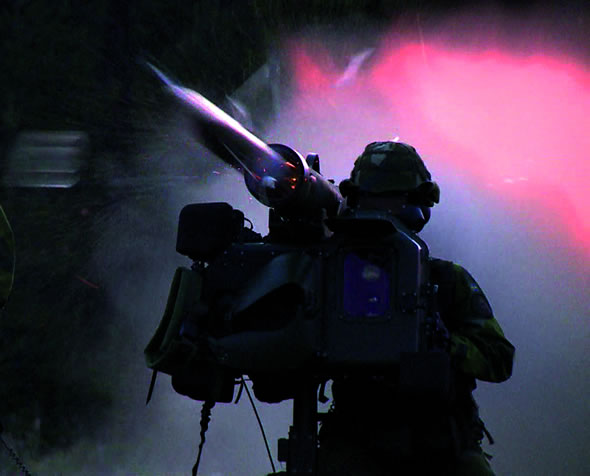
RBS-70 Man Portable Air Defense Missile launched on a test. Photo: Saab
Thales Starstreak, on display at Defexpo 2012. Photo: Binny Winson
The Chief of the Indian Army has recently warned that 97 % of India’s Air Defense is obsolete. Given the fact that the Indian Armed Forces fully realize that they might have to fight a two-pronged war in the near future against China and Pakistan this claim of the Army Chief cannot be taken lightly. To make matters worse Israel’s IMI and Germany’s Rheinmetall Air Defense, both offering advanced air defense systems, have been banned from conducting business with the Indian Defense Ministry for the next 10 years.
India has to therefore seriously augment its Air Defense capabilities. Several ongoing programs include the replacement of SA-18 Very Short Range Air Defense Systems (VSHORAD), with modern weapons. The cost of the replacement, as anything in India – is huge: over replacement of about 800 launchers and initial delivery of 5,000 missiles, at a cost of 27,000 Crore (US$5.2 billion). Evaluations of some of the candidates are expected to commence in May–June this year. The ongoing DefExpo 2012 provides India with a unique opportunity to take a look at some of the most cutting edge Air Defense Systems that are on display.
RBS-70 Man Portable Air Defense Missile launched on a test. Photo: Saab
In contrast to the passive (UV/IR) guided weapons currently in operation, two VSHORAD systems employing laser-beam riding semi-active command to line of sight (SACLOS) guidance technique stood out in this year’s DefExpo. While such systems are presumably heavier and more complex, the more affordable cost of their seekerless missiles is bound to come to effect in the evaluating the total cost of ownership (including missiles, test and practice rounds).
RBS 70/NG – SAAB’s RBS 70 comprises the missile in a launch container, a tripod firing stand and an optical sight. It is operable by one, and portable by three persons. The missile is outfitted with a solid propellant booster motor. When the operator fires the missile, the booster motor is ignited inside the launch tube and the missile is accelerated out of the tube. The control surfaces and the four fins open into position as the missile leaves the tube. The sustainer motor ignites after the missile has travelled a safe distance from the launch position.
The booster is subsequently jettisoned. The RBS 70 has laser beam riding guidance, riding a laser signal being beamed from its own launch station, rather than being guided from the front towards the reflected signal from a laser designated target. The missile operator can locate a hostile target visually or the target can be detected by a search radar. When the target is acquired, the operator tracks the target and the Raytheon Cossor IFF880 friend or foe system interrogates the target. If the target is identified as friendly, a warning light in the sight is illuminated and the firing sequence is halted. The operator aims the missile towards the target, fires and tracks the target, thus aiming the laser guidance beam continuously at the target until the moment of impact. Speaking to Defense Update Saab’s spokesperson stated that as the laser beam riding guidance of the RBS 70 is located in the tail of the missile, it is extremely difficult to jam it, since the missile has no seeker head at the front.
In 2011 Saab has introduced an improved version of the system, designated RBS 70NG (new generation), which is comprised of a new sight module, integrating a high resolution thermal imager allowing 24/7 operational capability.
The new module enables advanced cueing and an auto tracker, to improve reaction times and target acquisition, and engagement, thus increasing the hit probability throughout the missile range. Improved guidance has also been introduced, to further increase performance both for manual and auto-tracker engagements. The system has a built-in video recorder for after-action review. With these improvements RBS 70NG offers a flexible and scalable evolution to meet evolving Ground Based Air Defense requirements with Man-Portable Air Defense System (MANPADS) as well as with remote-controlled or vehicular applications.
The Starstreak's warhead combines three 'darts' each guided at the target and each inflicting heavy damage for maximum lethality. Photo: Thales
StarStreak – Starstreak developed by the Thales group is a close-range anti-aircraft guided-weapon system designed for use against enemy helicopters and ground attack aircraft. Starstreak contains a two-stage solid propellant rocket motor, a separation system and three high-density darts. A pulse of power from the missile-firing unit sets off the first-stage motor that ignites and therefore increases the speed of the missile. The missile enters into a spin due the Canted nozzles. The efferent force of the roll causes the fins to unfold for aerodynamic stability in flight. Once clear of the canister, the motor is thrown out. The second-stage motor ignites and accelerates the missile to a velocity of Mach 4.
A severance system at the front end of the motor holds three darts. When the second stage motor is burnt out, the propulsion triggers the three darts to automatically break up. The darts sustain a high kinetic energy as they are steered to the same target. Each dart includes guidance and control circuitry, a thermal battery and a high-density penetrating warhead with fuse. The severance of the darts kicks off the arming of the specific warheads. Each dart is steered independently using a double laser beam riding system. As the dart collides with the target, the inertial forces trigger the delay fuse, allowing the warhead to penetrate before detonation.
MISTRAL-2 – Another competitor seeking the future Indian VSHORAD contract is the European company MBDA, offering the Mistral. This missile has already been selected to equip the Indian Dhruv Helicopter; therefore MBDA does have an advantage in terms of logistics and ordinance management. Moreover, the company has a production line for MILAN missiles established in India by Bharat Dynamics Limited (BDL), where Mistral missiles could be produced, if the company wins this program. Other contenders include Rosoboronexport, offering a modern version of the IGLA-S (SA-24) and South Korean LIG Nex1, offering the Chiron.
IGLA-S (SA-24) from KBM is the latest model of Russian MANPADS technology.
IGLA-S (SA-24) – Similar to the Mistral, a major advantage of IGLA-S is its capability to use existing infrastructure, including DJIGHIT launchers and STERLETS command and control modules, or mobile carriers such as the SA-9 and SA-13 mobile air defense systems. IGLA-S offers superior performance over the IGLA / STRELA missiles, particularly in its immunity to countermeasures (conventional heat flares are useless against its IR seeker flares). According to Russian sources, it is also effective against fast, low flying cruise missiles or high flying but slow unmanned aerial vehicles (UAV). With a warhead 1.5 times larger than its predecessors, IGLA-S also offers 20 percent range increase, able to hit targets at a distance of six kilometers.
CHIRON – The Korean LIG Nex1 Company has also entered the Indian VSHORAD, yet its product, the Chiron stands the lowest chance to win the technical or commercial phases. Although it uses elements of the Mistral missile to offer increased range over the Russian missile, its seeker, implementing Russian technology is considered less advanced than that of the SA-24. Reportedly, the Koreans are asking $175,000 per unit, which is more than double the cost of an IGLA-S.
India’s Air Defense guns like the L-70 and ZU-23 are 40 years old and missile systems like the SA-2 have also become obsolete. This coupled with the fact that there are huge loopholes in the radar network means that the sky’s above India are completely insecure. Corrective measures need to be taken immediately and this year’s Defense Expo has certainly provided the answer to India’s quest for a modern air defense system.
Japan’s Minister of Defense, Naoki Tanaka, issued orders on 30 March authorizing the Japanese Self-Defense Force (SDF) to shoot down a North Korean rocket, scheduled for launch in mid-April, should the rocket or rocket debris appear to pose a danger to Japanese life or property.
Japan's Minister of Defense, Naoki-Tanaka
The shoot-down order was announced on the same day that South Korean sources reported that the North had test fired two short-range missiles from a site on the North’s west coast.
North Korea is reportedly fueling the three-stage Uhna-3 rocket for launch sometime between 12 and 16 April in honor of the nation’s founder’s 100th birthday.
Japanese defense sources consider the likelihood of the rocket or debris from the launch actually threatening Japan to be relatively low, but the Defense Ministry has repeatedly stated that Japan will be prepared to protect property and lives.
Japan has prepared plans to deploy three Aegis-capable destroyers to strategic sea lanes to intercept the rocket and has also issued directives authorizing deployment of Patriot PAC-3 missile batteries to areas best suited to improve the odds of actually bringing down the rocket should that become necessary.
The shoot-down order was issued following a meeting of Japan’s Security Council convened by Prime Minister Yoshiko Noda. With this order now in hand, the Japanese Self-Defense Force can execute the deployment plans developed earlier in March. Japanese leaders issued a similar order when North Korea launched a long-range ballistic missile in 2009, but Japanese forces did not fire on that missile when it became obvious it was not a threat to Japan.
Current plans call for one Japanese destroyer to be deployed to the Sea of Japan and the other two warships will take up station in the East China Sea. All three destroyers are equipped with Aegis Standard Missile-3 (SM-3) interceptors.
Japan’s Ground Self-Defense Force (GSDF) is also under orders to deploy Patriot PAC-3 missile batteries in close proximity to the Defense Ministry’s headquarters in Tokyo, on the main island of Okinawa, and on Okinawa’s southwestern islands of Miyako and Ishigaki.
Defense plans call for the Aegis SM-3 missiles to intercept and destroy any airborne threat outside the Earth’s atmosphere. If this fails, the PAC-3 missiles will be fired at a target as it reenters the Earth’s atmosphere.
North Korea previously notified the International Maritime Organization of its planned rocket launch. The North has announced that the rocket’s planned trajectory will release the rocket’s first stage west of South Korea and the second stage will be dropped east of Luzon Island in the Philippines after flying over Japan’s Sakishima Island chain in the extreme southwestern part of Okinawa Prefecture.
In addition, the GSDF will mobilize helicopters, disaster response teams, and rescue teams to deal with any casualties that might result from the rocket striking Japanese territory. Japan’s Coast Guard, firefighters, and national police members will also be mobilized in those areas considered to be in greatest danger.
While North Korea continues to ignore international calls for a cancellation of the scheduled launch, insisting that the operation is designed to place a weather observation satellite in orbit, Defense Minister Tanaka told members of the press that Japan will be cooperating closely with the United States and South Korea in their endeavor to protect life and property.
South Korea has also made public announcements of its intent to bring down the rocket should it appear to be a threat to South Korean citizens or property.
This satellite image taken March 17, 2012 shows the launch site at the North Korean space center at Tongchangri is being prepared for the Unha-3 missile launch around April 11-16. Image (c) 2012 DigitalGlobe, Inc.
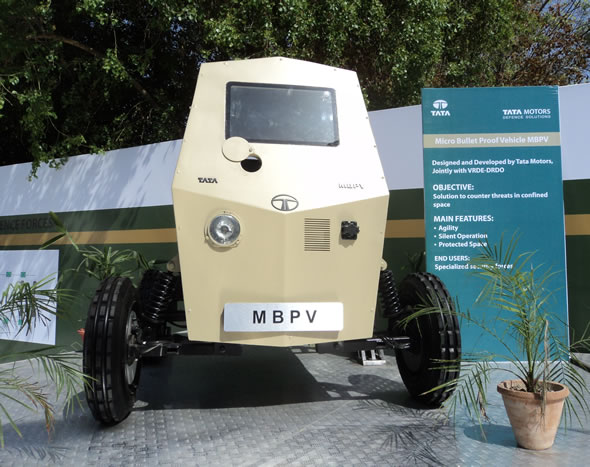
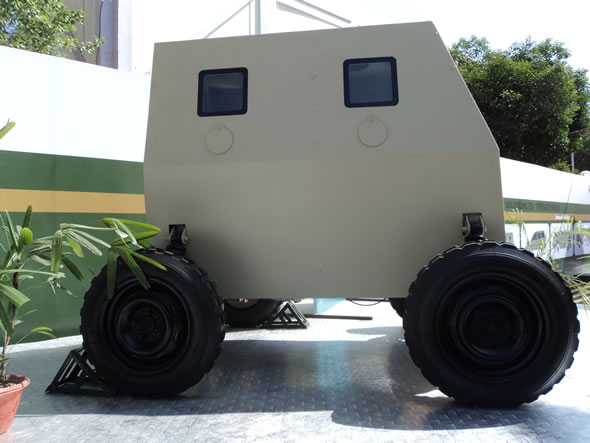
Tata Motors unveiled at DefExpo 2012 the Micro Bullet-Proof Vehicle (MBPV), a small vehicle jointly developed by VRDE-DRDO and Tata
Motors, responding to new requirements set by the Indian elite commando forces (NSG, Marine Commandos, Para Battalions & Force One). The vehicle provides assault teams with protected mobility solutions, assisting operations indoors.
According to Tata Motors, commando units that have fought insurgents, terrorists and engaged in hostage situations in urban areas have raised the need for gaining protected mobility. Tata designed the MBPV for such indoor combat in mind, offering width, wheelbase and four-wheel steering enabling access and maneuvering indoors. High power-to-weight ratio enables fast and agile movement across obstacles, including climbing stairs. Ballistic protection panels and armored transparent windows provide protection for the combat teams, while firing ports enable effective retaliatory action.
It remains to be seen if elite units will actually ‘buy’ this solution…
How many elite troops will be willing to enter a building in such an armored golf cart? Tata Motors' MBPV on display at DefExpo 2012. Photo: Binny Winson, Defense Update
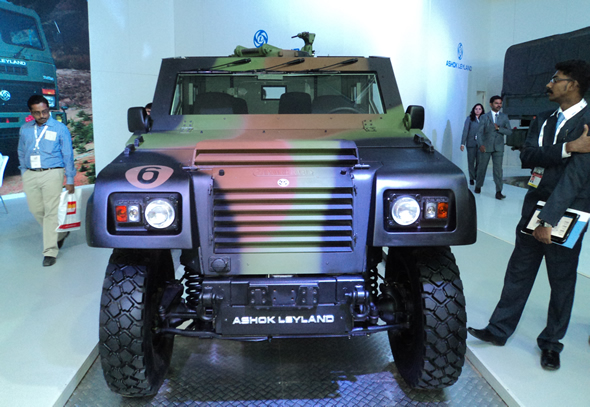
Panhard PVP was displayed at DefExpo 2012 under the Ashok Leyland label. Photo: Binny Winson
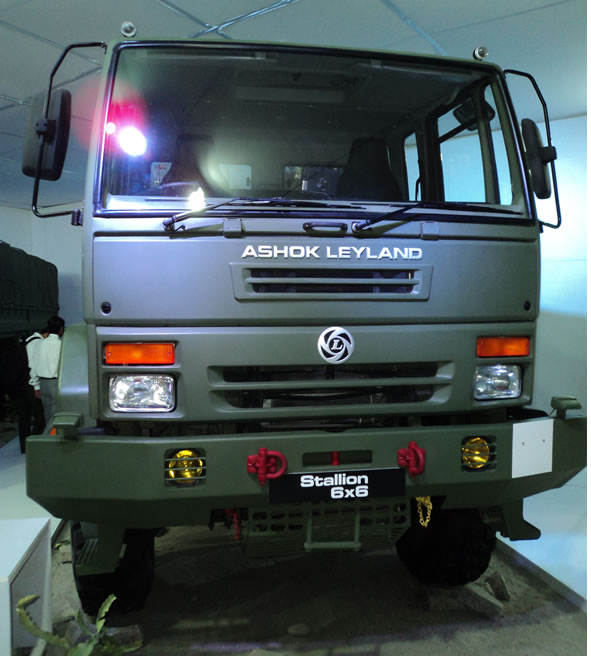
Ashok Leyland is aims expand from the traditional trucks to armored vehicles business. Photo: Binny Winson, Defense Updateoffer armored vehicles
The Indian Army has a fleet of more than 150,000 vehicles. The services buy around 7,000 new trucks every year, a volume attracting commercial vehicle manufacturers to invest in meeting peculiar military standards. This year at DefExpo 2012, traditional truck manufacturers Tata Motors and Ashok Leyland were joined by the new competitor Asia Motor Works, each taking aim at specific segments of this huge market.
Almost half of these trucks are the old model Stallion workhorses built by Ashok Leyland, the company is now offering the stronger Super Stallion 6×6 truck. Other opportunities are with the smaller tactical trucks and special purpose vehicles. AMW is displaying At DefExpo some of their specialty trucks, including firefighting trucks and 6X4 Heavy Duty Recovery Vehicles. AMW is positioned as India’s third largest manufacturer of heavy commercial vehicles. AMW is manufacturing its vehicles at their plant in Bhuj in Gujarat. Anirudh Bhuwalka, Managing Director and CEO of AMW said his company has entered this market offering a portfolio of vehicles range from 4X4 general service and logistics trucks, offered with engines ranging from 180 bhp to 270 bhp.
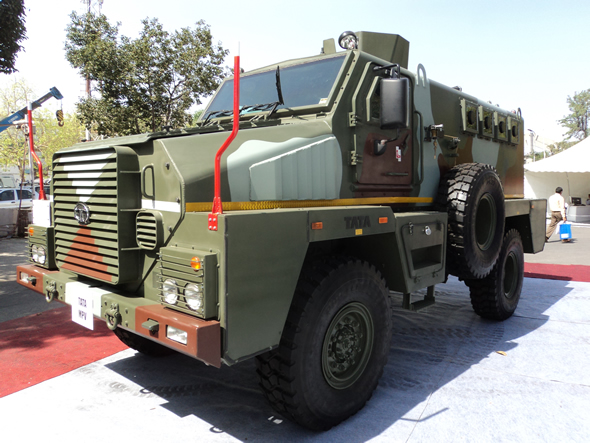
The TATA MPV displayed at DefExpo 2012. Photo: Binny Winson, Defense Update
Tata Motors is displaying here a range of military vehicles. “The launch of our new combat & tactical vehicles and equipment, leveraged from our strength in design and development of a wide range of commercial vehicles, now enables us to cover the entire defense mobility spectrum.” Said P. M. Telang, Managing Director – India Operations, Tata Motors. According to Telang, the company’s defense solutions already cover the complete range of logistics and armord vehicles that have also been popular in supporting the police and paramilitary forces in counter insurgency operations. The company launched four new military platforms – a specialized 12×12 Prahaar Missile Carrier, a light armored vehicle, a ‘Mobile Bunker’ and the Tata 6×6 7kI refueler. The Indian Armed Forces are currently looking at procuring a four-wheel drive, high mobility platform, for use as a general-purpose vehicle. Tata is positioning the Safari Storme GS 800 in standard and armored configurations to meet this requirement.
At the exhibition Tata Motors displayed scaled models of its concept Futuristic Infantry Combat Vehicle (FICV) to be designed in tracked and wheeled configurations. Tata Motors is one of the four Indian companies, which has been issued the Expression of Interest (EoI) by the Indian Army, for the FICV – a ‘Make Indian’ project. Tata Motors has accordingly responded to the EoI based on indigenous design and development in association with key technology partners and submitted their response in October 2010.
Tata’s 12×12 missile carrier is an indigenous high mobility, all-terrain and all-wheel drive, based on the LPTA 5252-12 X12 vehicle
developed specifically for missile launcher carrier applications, in close coordination with the Indian Defense Research & Development Organization (DRDO). The platform can be integrated with different missiles, including the Prahar, BrahMos and Nirbhay missiles. The vehicle is equipped with a state of the art Electronic Controlled heavy duty engine and automatic transmission, has high mobility features like Anti-Locking Braking System (ABS), Central Tyre Inflation System (CTIS), Auxiliary Gear box with High and low speed mode and differential locks system. The vehicle is operable normally in 12×8 mode and can be driven in 12×10 and 12×12 modes as per terrain requirements. Tata Motors has also developed an indigenous high mobility, all-terrain and all-wheel drive designated LPTA 3138. This 8×8 vehicle is specifically designed for various all terrain application like command and control shelter carrier, missile launcher and carrier, mobile radar station etc.
Among the armored and mine protected vehicles developed to secure India’s paramilitary and military forces, the new ‘Mobile Bunker’ was introduced here. This robust vehicle is designed on the LPA 713 four wheel drive platform, to ensure fast and safe movement of troops in Naxal infested states and to act as a platform for retaliatory action. The Mobile Bunker offers protection against gunfire, corresponding to ballistic protection of NIJ Level III. As a mobile platform it can be used as a base for various protected applications like troop carriers, ambulances and buses. Tata’s Mine Protected Vehicles (MPV) also offering ballistic protection of NIJ Level III.
Ashok Leyland is also entering the armored vehicles segment, under a cooperation with foreign companies from germany and France. A year ago, at the IDEX defense show, Ashok Leyland signed a Memorandum of Understanding (MoU) with the German Krauss Mafaeii Wegman (KMW), for the development and support of of KMW produced vehicles throughout India and South-East Asian markets. The Indian company plans to build armored trucks based on chassis supplied by KMW. SOme of the models on display here had a striking resemblance to the Dingo, but such a cooperation has not been confirmed. Ashok Leyland is also negotiating a similar MoU with the French company Panhard, which is expected to be signed soon. The PVP, a light armored vehicle developed under a Franco-German cooperation was displayed at Ashok Leyland.
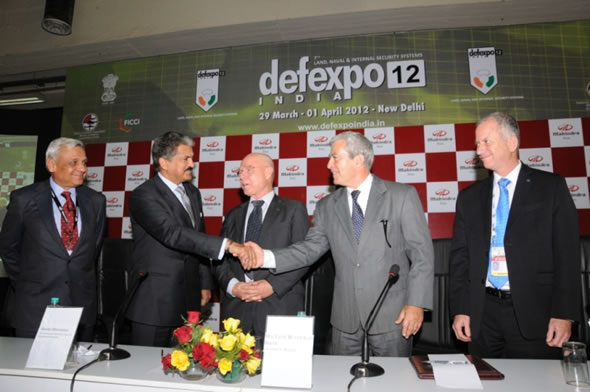
From left: Brig (RETD) K.A. Hai Chief Executive, Mahindra Defence Systems, Mr. Anand MahindraVice Chairman & Managing Director, Mahindra & Mahindra Ltd., V Admiral (Retd) Yedida YaariCEO, Rafael, Maj Gen (Retd.) Ilan Biran Chairman, Rafael & Giora Katz- VP GM land & Naval Systems Sector, Rafael. Photo: PR Newswire
Aiming to become a leading defense systems integrator in India, Mahindra & Mahindra has partnered with Israel’s defense company Rafael Advanced Defense Systems, to establish a Joint Venture (JV) company to develop and manufacture products such as Anti Torpedo Defense Systems, Electronic Warfare Systems, Advanced Armoring Solutions and remotely operated weapon stations for Futuristic Infantry Combat Vehicles (FICV).
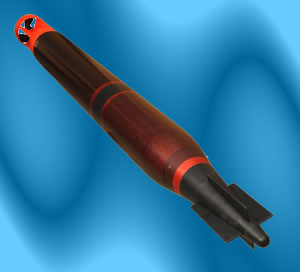
Rafael offers a line of torpedo countermeasures, designed to protect surface vessels and submarines, using reactive, active and 'hard kill' systems such as the Torbuster. Photo: RAFAEL or active and from active
The company has approached the Foreign Investment Promotion Board (FIPB) for the creation of the JV company, where Indian ownership 74 percent will be maintained. Rafael will make investments in Mahindra’s existing Naval Systems division in Pune which will also be the location of a production facility which will be set up to meet the long-term requirements of the JV company.
Brig (Retd) KA Hai, Chief Executive, Mahindra Defence Systems, said “This JV will enable Mahindra Defence Systems to further leverage its innovative solutions in the maritime domain, enhance its product offerings, and present it with new avenues for growth. We intend to further expand into air, land, and aerospace defence solutions.”
Maj Gen (Retd) Ilan Biran, Chairman of Rafael added: “As part of our global strategy, we form alliances to develop military applications based on our proprietary technologies and in Mahindra we see a lot of synergy and opportunities for growth in new markets and especially in India which is a strategic market for us.”
Rafael has an ongoing dialog with Bharat Electronics Limited, one of India’s largest public sector defense companies, about setting up a joint venture related to electro-optics and missile electronics.
The two partners have been looking for a private company to join the team for sometime, to enable the future JV to be incorporated as a private sector company. The new JV with Mahindra could pave the way for this long awaited ‘BEL-RAFAEL’ marriage.
Five months after announcing the Memorandum of Understanding (MoU) in October 2011 the Indian Mahindra & Mahindra group and U.S. radar manufacturer Telephonics Corporation are launching a Joint Venture company in India, aimed to provide radar and surveillance systems to the Indian Ministry of Defense and civil sector. The companies have filed to clear the planned JV with the Government Foreign Investment Promotion Board and are expecting approval for this request soon.
The JV will be the first in India to manufacture airborne and maritime radars utilizing licensed technology. It will focus on maritime surveillance radars, Identification Friend or Foe (IFF) devices and communication systems produced by Telephonics and could also expand to offer systems for Air Traffic Management services, Homeland Security and other emerging surveillance requirements. The JV will license technology from Telephonics for use on a wide range of products that have both defense and civil applications. According to plans, the JV expects to reach nearly 100 per cent indigenous capability ‘in the near future’. The JV plans to establish a production plant that would manufacture and service airborne radar systems that are already being operated or scheduled for future delivery to the Indian Navy and Coast Guard.
Telephonics supplies RDR-1400 weather avoidance radar systems for Indian helicopters being built in Bangalore, India. The APS – 143C (V) 3 Multi-Mode Radars (MMR) was also selected for the Indian Navy P-8i Maritime Surveillance aircraft. Telephonics is also responsible for installation of a sophisticated intercommunication system for the C-17 Globemaster contracted for by the Indian Air Force.
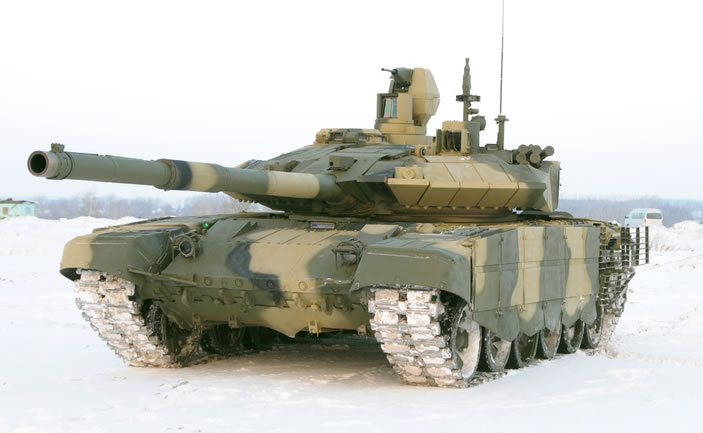
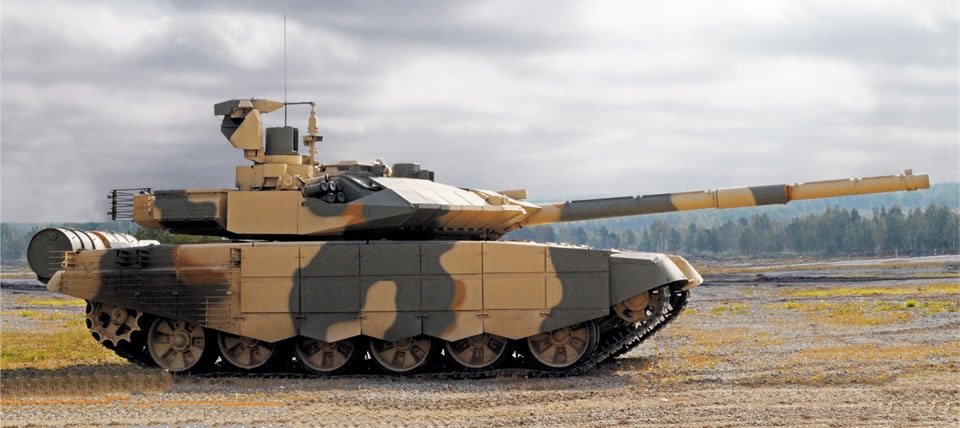
The centerpiece of the Russian display at Defexpo 2012 is undoubtedly the T-90MS upgrade program developed by the Russian Uralvagonzavod corporation. The T-90MS upgrade was unveiled August 2011 at Nizhny Tagil, Russia following the demise of the T-95 program. It is making its international debut here in New Delhi. India is likely to be the most interested in the the Russian upgrade, put forward by Russian arms exporter Rosoboronexport as a possible upgrade path for the Indian ‘Brishna’ (T-90S) tanks.
India is the largest operator of the T-90S, along with Russia. The Indian Army has fielded about 450 of these tanks, with 300 more on order. Other T-90 operators are Azerbaijan, Cyprus (45) and Venezuela (92). Earlier in 2012 it was announced that Algeria has bought 120 of these tanks.Additional 30 were acquired by Turkmenistan. These small deliveries could be the result of the collapse of the Libyan order, which was never fulfilled.
The Indian Army had planned to equip its 59 armored regiments with 1,657 T-90S main battle tanks, 1,000 of which were to be Indian-made. However, production and import of T-90S tanks has been slow, hence, the opportunity to improve the T-90 through the manufacturing line, maintaining the T-90 effectiveness for upcoming years. The T-90MS offers improvements in every important element – protection, mobility and firepower, in addition to improving sustainability and reliability while reducing operating cost. Since the contract was signed back in 2001 the Indian Heavy Vehicle Factory (HVF) in Avadi, Chennai has assembled only 150 T-90S (of a thousand planned). Implementing the T-90MS package will enable future production series to deliver better, more capable main battle tanks instead of gradually obsoleting platforms.
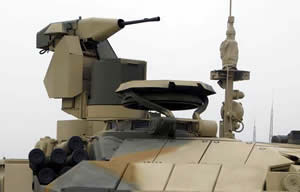
The proposed tank upgrades include improved automotive components, enhanced protection by reactive, passive and countermeasure systems improving the tank’s protection against guided missiles; the firepower enhancements rely on comprehensive modernization of the turret systems, including a new automatic fire control system, stabilized day/night sights and auto-tracking capability, and the use of the 2A46-M5 improved 125mm gun offering better accuracy and reliability, compared to existing 125mm guns. It also has a remotely controlled 7.62mm machine gun.
Automotive improvements include the high efficiency V-92S2F diesel engine and automatic transmission and steering wheel control linkage. The upgrade kit includes attachments for a new type of add-on protection armor, including turret and hull frontal and side reactive panels and slat armor grills protecting the exhaust, filters and sprockets. An aramid liner is also employed to reduce internal damage from splinters and flux in case a penetration occurs.
The T-90MS commanders' new independent panoramic sight is coupled with the UDP T05BV-1 elevated, remotely controlled weapon station mounting a 7.62mm machinegun.
The tank uses early warning threat sensors and countermeasure to protect the tank over 360 degrees. The system relies on two types of detectors, offering coarse threat detection over 270 degrees (sides and rear of the turret), employing instant multi-spectral smoke screen, while the fine threat detectors are employed over the turret’s frontal 90 degree arc, driving electro-optical countermeasures.
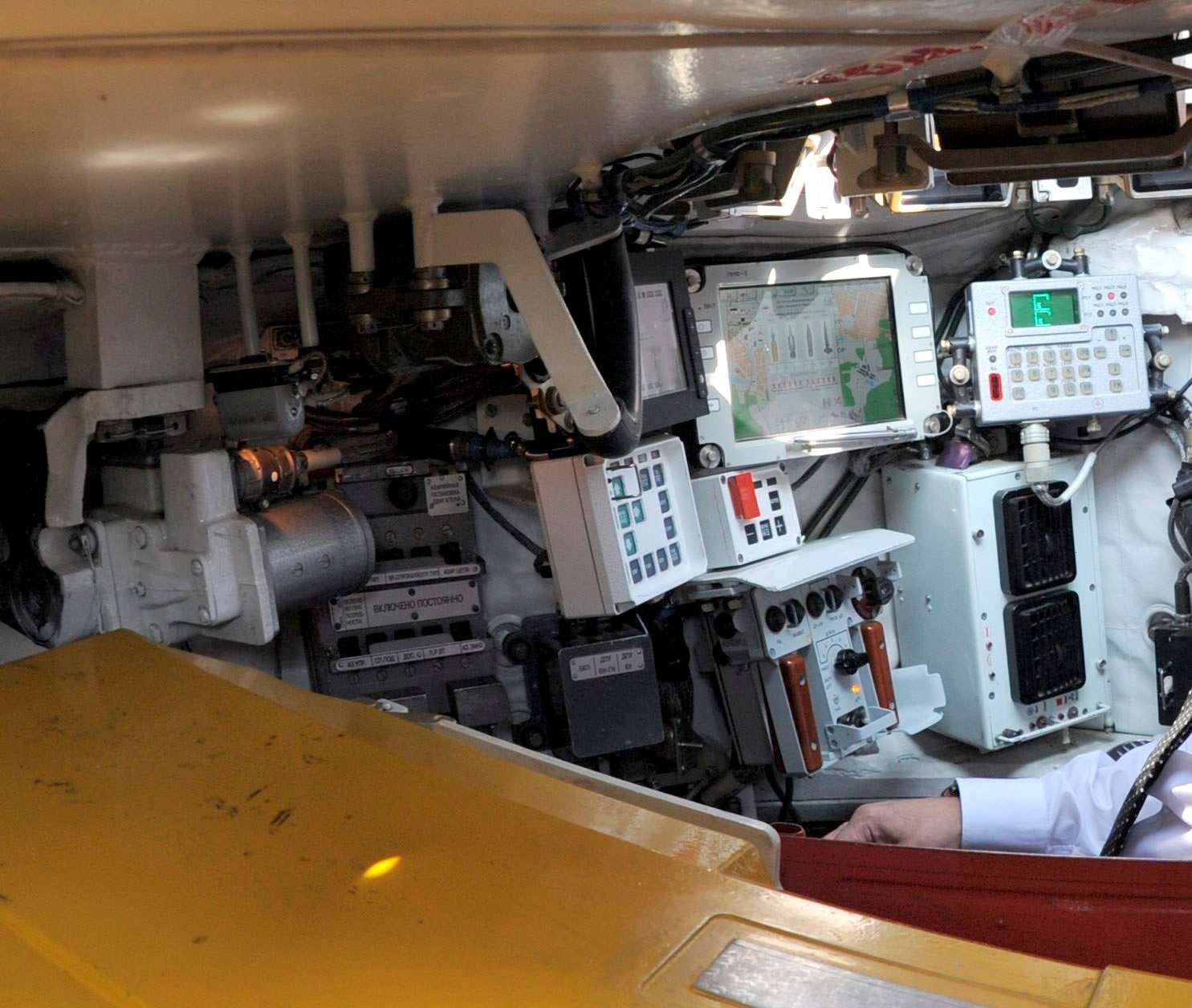
The T-90MS Kalina fire control system comprises improved fire control computing modules and modern, stabilized optronics.
Another feature contributing to the T-90MS survivability is the separation of ammunition from the fighting compartment. Part of the ammunition is stowed in special compartments separated from the turret by a blast door. The ammunition is manually loaded into the magazines, from where they are automatically served by the autoloader.
The ‘Kalina’ optronics system features three new EO devices – the gunner’s sight has a two-axis stabilized field of view, integrating multiple optical channels including a dual mode (day/night) CCD and thermal channels, a laser rangefinder (LRF) and another laser channel supporting missile guidance. The EO system is coupled with a video processing system, performing automatic target tracking to improve moving target engagement. The commander position is equipped with a new independent panoramic sight featuring two-axis field of view stabilization integrating the daylight, thermal and LRF channels. The panoramic sight also provides target acquisition and control for a new, remotely operated weapon mounted on top. A backup parallel sight fixed on the cannon line of sight and optional peripheral video surveillance system covering 360 degrees of the tank’s perimeter. The optical muzzle reference unit further augments the weapon’s accuracy.
T-90MS offers an upgrade path for the Russian T-90 tank offering a balanced improvement in firepower, mobility and protection.
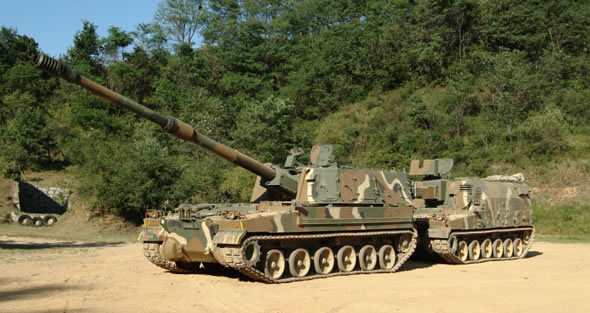
The South Korean Samsung Techwin (STW) and its Indian partner Larsen & Turbo Ltd. (L&T) announced today a teaming agreement addressing the development and production of the ‘K9 Thunder’ self-propelled artillery system (SPG) in India. According to the announcement, the K-9 is ready to enter the Indian Army’s User Evaluation trials expected to commence shortly. L&T is displaying the Korean ‘K9 Thunder’ this week at DefExpo 2012.
Samsung Techwin is the OEM for the South Korean ‘K9 Thunder’ Self Propelled Howitzer, considered the largest, most successful 155/52 Calibre Self Propelled Artillery Systems currently in production. As part of the co-operation agreement between the two companies, STW will provide key technologies to L&T for the localization of the ‘K9 Thunder’.
During the production phase of the Indian tracked artillery program, the joint offering would have over 50% indigenous content including components like fire control system, communication system, NBC & AC, APU, life support system, etc which have already been used in India. This phase will also include significant localization of hull and turret structures and major subsystems. L&T plans to set up the integration and testing facility at its existing facility in Talegaon, near Pune.
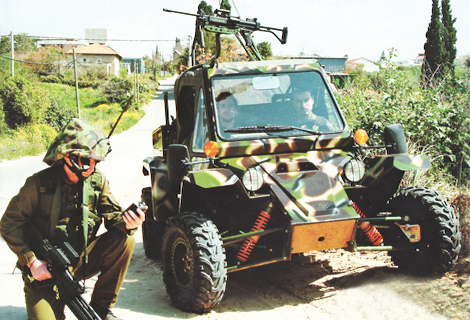
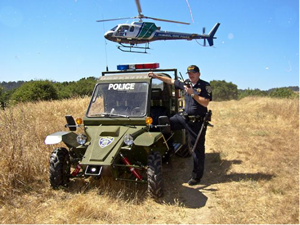
TOMCAR is already operated by military and low enforcement forces.
The Indian Maini Group acquired a majority stake in TOMCAR, a company based in Israel engaged in design and manufacture of high performance off road vehicles. At Defexpo 2012 the Indian automotive group is launching the TOMCAR in India. “With the Indian Defence, Paramilitary and Homeland Security scouting aggressively for All Terrain Vehicles, we intend to promote TOMCAR amongst them as part of their modernization drive.” Said Sandeep Maini, Chairman of Maini Group. The Maini Group has created a manufacturing facility in Bangalore to cater for both domestic and overseas customers.
Designed in Israel and built in Israel and the USA, TOMCAR is a military grade, high-performance all-terrain vehicle designed for military, order patrol and first responder use. TOMCAR is deployed by the Israeli Military, the US Customs and Border Patrol and supports the British Army in Afghanistan as a combat support and replenishment vehicle. The Israeli military has also deployed the vehicle on border patrol missions, in an unmanned configuration known as Guardium.
TOMCAR has been customized for special operations, recce and surveillance, military and border forces. In the light strike version TOMCAR can carry Heavy Machine Gun, Anti-Tank guided missile launcher, or Automatic Grenade Launcher. It can also be fitted with a winch for self-recovery. TOMCAR has an option of being customized for both armored and unmanned versions. The vehicle is also air transportable and para-droppable.
TOMCAR all- terrain vehicles feature strong, fully-welded steel tube chassis and heavy duty four-wheel independent suspension. These vehicles are designed to be safe, rugged and extremely dependable.
The Maini Group is engaged in high precision and innovative engineering products for the last four decades and has a strong presence in diverse industry segments. Core capabilities of Maini Group include high precision components for Aerospace and Automative applications, Materials Handling Equipments, Electric Buggies for People and Cargo Movement, Storage and Shelving Systems and Plastics and Composites.
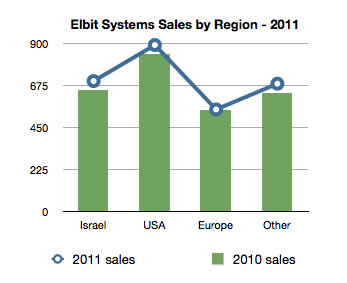
The financial reports published in the recent week by Israel’s top three defense companies reflect a solid year in defense business, despite the slow-down in global economy and the ‘soft’ European market. The combined sales of IAI, Elbit Systems and Rafael Advanced Defense Systems to the defense market were $7.296 Billion, representing 6% growth over the combined sales of $6,871 in 2010.
The total backlog accumulated by Israel’s top three companies has exceeded $17 billion at the end of last year, securing almost two years of operation. Both IAI and Elbit Systems were hit by the cancellation of a sale of an advanced intelligence gathering system to Turkey, following the decision of Israel’s Ministry of Defense to block the delivery of certain sensitive technologies to Ankara. The decision caused both companies to withdraw about $150 million from their fourth quarter books and backlogs.
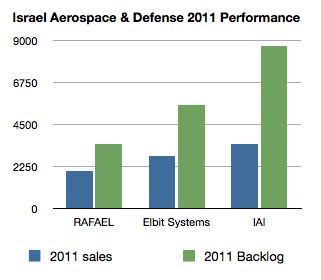
Elbit Systems remains the largest defense company in Israel, reporting $2,817 in sales in the past year, followed by IAI, reporting $2.5 billion in defense sales and RAFAEL in third place, with $1,979 million in sales for 2011. With commercial aviation activity added to IAI’s report, the company is still positioned as Israel’s largest Aerospace & Defense group, with sales of $3,436 million in 2011, up from 3,148 in the previous year.
In terms of net profit, RAFAEL is surprisingly positioned well ahead, reporting $111 million for 2011. This profit was $70 million lower than 2010, which included RAFAEL’s share of the sale of an affiliated non-defense company. The net profit of publicly traded Elbit Systems was $90 million – slashed by half compared to 2010, with IAI’s net profit reported at $83 million, slightly lower the $94 million reported in 2010.
The backlog reported by the companies shows a modest increase, despite the slow down in the world market. IAI’s order backlog includes aviation and defense related contract amounting to $8.7 billion, 87% of which relate to export orders. Rafael, reported an order backlog of $3,465 million, including over one billion US$ in domestic orders. Rafael is relying increasingly on domestic contracts delivering the Iron Dome counter-rocket systems, Trophy active protection systems and various guided weapons to Israel Defense Forces. Elbit Systems also reported an increase in backlog, $5,528 million, compared to $5,446 in 2010. About $1.3 billion of Elbit Systems order book represent business received in Israel.
The NOA NYX sight mounted on a Tavor light machine-gun. Photo: Meprolight
Defexpo India 2012, the country’s biggest-ever land, naval and homeland security systems exhibition, will open today in New Delhi. The biennial event has grown since 2010 and will host 567 exhibitors, up from 425 in 2010. All major public sector companies (PSU and domestic shipyards) are here, along with hundreds of large and small private sector companies – 335 Indian exhibitors in total. The exhibitors will include 232 foreign companies from 32 countries, grouped in several national pavilions; the largest are those of the US, Russia, France, Israel, the UK and Germany.
India is the world’s largest importer of defense systems. The annual Indian defense budget is currently set at $16 billion, and, with projected annual growth of 15 percent, the total capital market for defense could reach over 100 billion.
Some of the companies exhibiting here announced new products for the show. Few of these items are included below.
Among the major exhibitors at the show are the Russian arms export agency Rosoboronexport, launching here a modernization package for the T-90S tank. Another Russian exhibitor KBP is displaying the Kornet-EM guided missile offered in a new low-signature vehicular version, firing anti-tank or thermobaric missiles at ranges of up to 10 km.
BAE Systems is displaying a range of land systems, including the CV90 light tank and M777 ultra-lightweight howitzer. Both are addressing ongoing procurement programs for a new armored combat vehicle and lightweight artillery systems. The company also displays the BvS10 armored all-terrain vehicle, which can meet evolving requirements for improved mobility of military units deployed along the northeast frontier and the Himalayan range.
Mk54 torpedo dropped from a Boeing/US Navy P-8I on a recent weapon test. Photo: US Navy
Raytheon is displaying a range of weapon systems for military and homeland defense. Javelin and the SMAW II Serpent shoulder-launched weapon system are two of the representative systems awaiting procurement decision at the Indian MOD. Raytheon is also discussing the Mk-54 lightweight torpedo as an optional weapon for the Indian Navy P-8I. The Italian torpedo maker WASS is displaying here a new light torpedo dubbed ‘Flash Black’, offering extended range and speed and better precision over previous models. The new torpedo has a range of 12-mile range and a tops speed of 57-mph speed. The company launched the new development late last year and is expecting to complete development in 30 months time. WAAS’ new torpedo is headed to compete directly with Raytheon’s MK54.
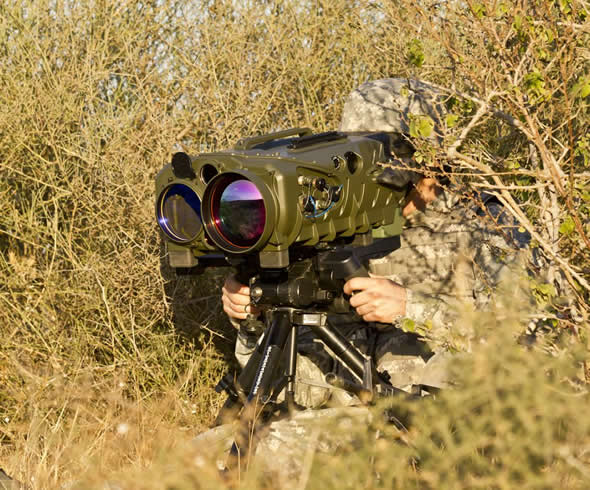
Elbit Debut the LongView CR portable target acquisition system at Defexpo. Photo: Elbit Systems
Sagem DS, one of the leading French defense contractors is promoting the Hammer precision-guided weapon, providing the primary land attack weapon on the Rafale, recently selected for the Indian MMRCA. Available in 1000, 500 and 250 weight classes, Hammer can be fitted with GPS, Laser-GPS or IR-GPS guidance. The company is also promoting here the Felin infantry combat suite, along with the different components, including Sword weapon sights and viewers, as well as display systems.
Elbit Systems’ ElOp is launching the LongView CR long-range observation and target acquisition system. This high-end system combines a continuous zoom FLIR, telescopic daylight cameras, integral eyesafe laser range finder, GPS and magnetic compass. The system weighs only 12.5 kg and mounts on a compact electronic goniometer enabling highly accurate reading of azimuth and elevation data.
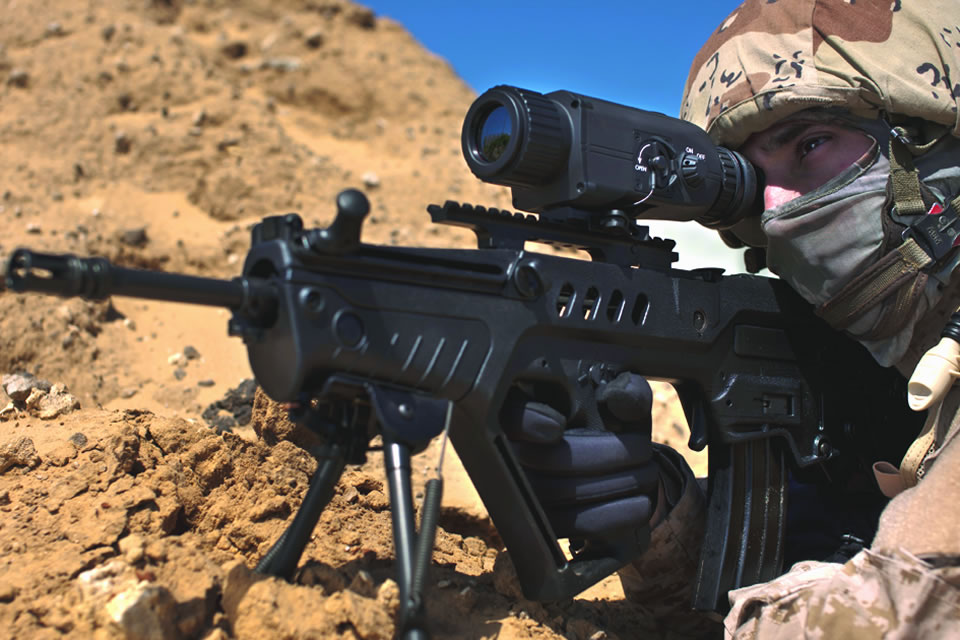
Meprolight displays the latest member of the NOA family of thermal weapon sights – NOA NYX uncooled thermal weapon sight for assault rifles.
The NOA NYX sight mounted on a Tavor light machine-gun. Photo: Meprolight
The sight weighs less than 1 Kg, and uses high-resolution microbolometer technology to provide clear and consistent view of targets at an effective combat range. The unit can be used as a hand-held monocular device or fitted to light machine guns, assault rifles, and submachine guns. NOANYX can be fitted on long-range weapons including sharpshooter rifles, detecting man-sized targets at up to 900m. Output can be fed to a remote screen or recording equipment via its “video out” feed. The system stores up to 3 user-configured sighting reticules and requiring a warm-up time of less than 5 seconds, the NOA NYX can operate continuously for 7 hours using 4 “AA” batteries.
BAE Systems Detica and The John Grieve Centre have unveiled a major piece of research revealing that 80 per cent of all digital crime now originates from organised crime groups. On and offline crime worlds are converging and perpetrators are now just as likely to be street gangs, drug traffickers or established crime families as those traditionally associated with digital crime such as ID fraudsters or hacking syndicates.
The Report, ‘Organised Crime in the Digital Age’ examines the nature of criminal organisation in the digital domain, the types of crime being committed and how digital technologies are being deployed, in order to aid the development of new policy and operational responses to tackling digital crime. It has been carried out by criminologist Dr. Michael McGuire of The John Grieve Centre on behalf of BAE Systems Detica, which works extensively with Government and law enforcement to combat cyber crime.
The report challenges existing assumptions about the make-up of organised crime groups. Whereas one might expect online crime to be the preserve of the younger generation, the research reveals that nearly half (43 per cent) of organised digital crime group members are over 35 years of age, whereas only one third (29 per cent) are under 25 and many in fact have only basic IT knowledge. Thanks to off-the-shelf software and the adoption of ‘lower’ technology by criminals – such as pre-pay mobiles – the accessibility and appeal of digital crime has greatly increased.
These trends suggest that the world has entered a ‘fourth great era’ of organised crime, which began first with the racketeering of the 1920s, followed by the post-World War II black market growth, and thirdly the global drug market expansion of the 1970s and 1980s. In this new ‘fourth’ era, organized activity combines both on and offline elements, as well as the emergence of disorganized offline groups with a common purpose – such as the UK rioters in 2011 – using digital tools to enable criminal activity: the “age of digital crime”.
Key findings from ‘Organised Crime in the Digital Age’ include:
• More organized digital crime members are over 35 years of age than are under 25 years of age.
• Half of groups comprise six individuals or more, with one quarter comprising 11 or more
• 25 percent of active groups have operated for less than six months
• Groups are using digital tools for unethical purposes that serve as an entry-point to offline criminal behaviour, such as incitement to riot or gang member recruitment
Kenny McKenzie, Head of Law Enforcement at BAE Systems Detica said: “Organised criminal activity has now moved from being an emerging aspect of cyber crime to become a central feature of the digital crime landscape. Our report shows that more and more criminal activities now rely upon the online world and that a significant proportion – 80 per cent – of the volume of serious crime now occurring online has clear associations with groups which display various levels of collective co-ordination, purpose and capacity… As digital crime continues to grow, increased partnership between law enforcement and technical experts – as well as the private sector – will be critical.”
Professor John Grieve, founder of the John Grieve Centre for Policing and Community Safety, added: “To tackle the problem of digital crime and intervene successfully, we need to move away from traditional models and embrace this new information about how organised criminals operate in a digital context… The research found evidence of many cases where there has been real success in closing down digital criminal operations. Growth in the digital economy will inevitably cause an increase in organised digital crime, however this need not be seen as an insurmountable problem. Rather, it is a predictable problem that – by better understanding the perpetrators and their working methods – we can meet head on.”
Lockheed Martin Skunk Works® and XTEND have achieved a major milestone in JADC2 by integrating the XOS operating system with the MDCX™ autonomy platform. This technical breakthrough enables a single operator to simultaneously command multiple drone classes, eliminating the friction of mission handoffs. From "marsupial" drone deployments to operating in GPS-denied environments, explore how this collaboration is abbreviating the data-to-decision timeline and redefining autonomous mission execution.
As traditional defense primes face mounting competition from agile “neoprimes” such as Anduril, Palantir and Helsing, the balance of innovation is shifting toward software-defined warfare and scalable, dual-use technologies, while global industry consolidation—marked by Boeing’s integration of Spirit AeroSystems and other strategic mergers—signals an intensified race to secure control over the defense technology value chain. Our Defense-Tech weekly report highlights these trends.
In early October 2025, a coordinated wave of unmanned aerial system (UAS) incursions—widely attributed to Russia—targeted critical infrastructure across at least ten European nations. The unprecedented campaign exposed the fragility of Europe’s air defenses...
Executive Summary
The past week (September 18-25, 2025) represents an inflection point where strategic defense concepts have transitioned from doctrine to tangible reality. An analysis of global events reveals four primary, interconnected trends shaping an...
At the 2025 Air, Space & Cyber Conference, U.S. Air Force and Space Force leaders unveiled major updates on next-generation fighters, bombers, unmanned systems, and space initiatives, highlighting both rapid innovation and critical readiness challenges as the services race to outpace global competitors. A short version is available here, with a more detailed version for subscribers.
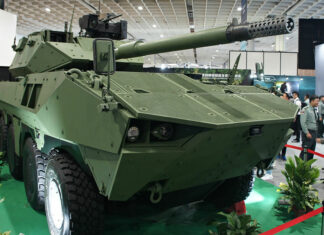
The Taipei Aerospace & Defense Technology Exhibition (TADTE) 2025 crystallized around four dominant strategic themes that collectively illustrate Taiwan's comprehensive approach to defense modernization amid escalating regional tensions. Based on a detailed report by Pleronix (available upon request). Includes a Podcast discussion on TADTE 2025's highlighting Taiwan's four strategic themes beyond the post's coverage.
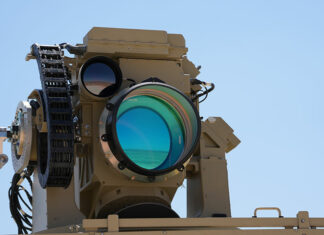
Israel’s Iron Beam 450 high-power laser system has completed final testing, marking a major leap in air defense. Developed by Rafael, it offers precise, cost-effective interception of rockets, UAVs, and mortars, and is set for IDF deployment by 2025.