Media sources are reporting that Japan and Britain may soon begin negotiations to create a joint project for the development of weapons to reinforce each nation’s domestic weapon’s industries. Prime Minister Yoshihiko Noda of Japan is anxious to form lucrative partnerships with foreign nations to offset the decline in Japan’s domestic defense manufacturing sector.
International defense firms have placed increasing pressure on Japanese manufacturers, hogtied by Japan’s decades-old ban on arm’s exports, as they have raced far ahead of Japan’s capability to remain competitive in a market dominated by multinational firms.
Now that Japan has decided to rescind portions of its ban on arm’s exports, the way ahead is open for a resurrection of Japan’s ailing arms industry. Prime Minister Noda is hopeful that removing the export ban will help to ease Japan’s burgeoning spending on defense, spending that has contributed to increasing Japan’s huge national debt.
By lifting portions of the arm’s export ban, Japan hopes to establish partnerships with the United States and European nations leading to the development and production of military goods that may be exported to customers engaged in UN peacekeeping operations and similar activities. Such partnerships are expected to boost Japan’s economic posture.
Prime Minister Noda is scheduled to meet with Britain’s Prime Minister, David Cameron, in April to discuss partnership proposals already presented by the British. Britain previously proposed the two nations collaborate in the development of an autoloading mechanism for 155-milimeter howitzers and three other defense systems.
The strength of multinational arm’s producers has placed Japanese firms in a decidedly weak position, a trend the Japanese fervently hope they can reverse through an aggressive plan of partnership building.
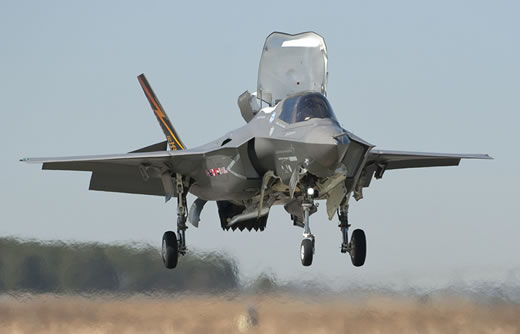
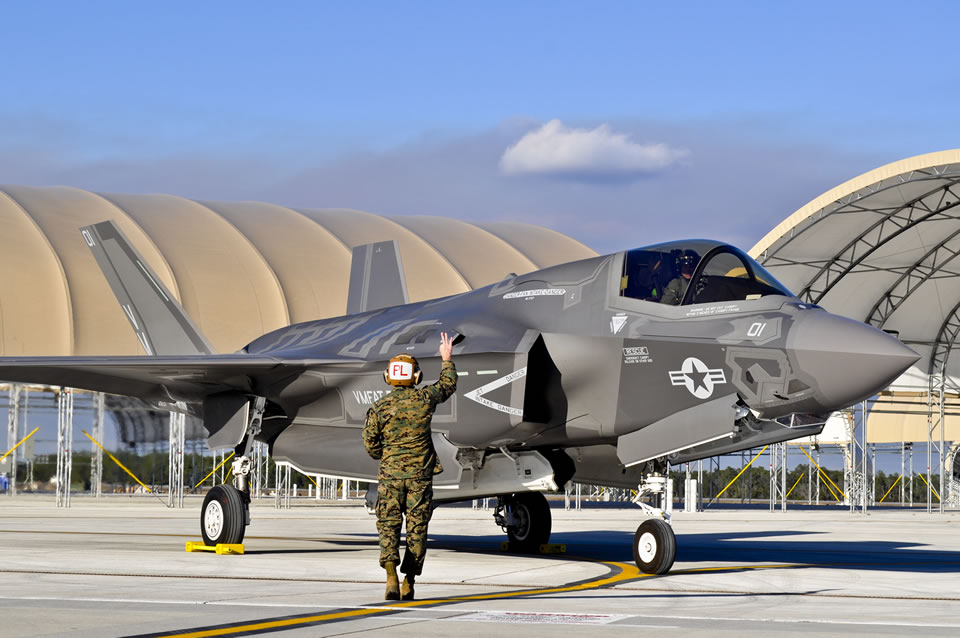
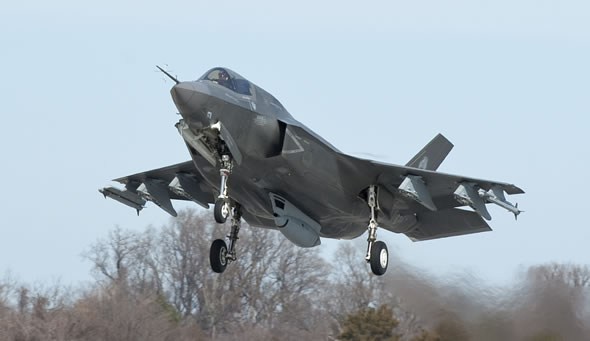
F-35B performs vertical landing at Patuxent River naval air base. Photo: Lockheed Martin
Media sources are reporting that the United Kingdom might possibly be revisiting its previous decision to abandon the use of carrier-based STOVL aircraft. The United Kingdom’s opposition Labour Party reportedly delivered a letter to the Ministry of Defence questioning the governing Conservative Party’s ongoing defense review that supposedly may result in a reinstatement of budgetary request authority to procure the F-35B STOVL variant of the Joint Strike Fighter as part of the FY2012/13 budget request.
In the 2010 Strategic Defence and Security Review (SDSR), the Ministry of Defence announced its decision to abandon the F-35B STOVL in favor of the conventional carrier-launched F-35C variant for deployment as early as 2020. The SDSR stated that the F-35C variant was better suited to meet the needs of the Royal Air Force and Royal Navy and would prove to be a better economic fit than the F-35B STOVL variant. At the time the SDSR was being finalized, the F-35B was at serious risk of being cancelled. That threat has since been eliminated.
Speculation has been rife for many weeks regarding the possibility of high-level discussions being conducted between the US Department of Defense and the United Kingdom concerning the F-35 variant to be acquired for carrier operations.
Labour Party concerns appear to revolve around the rising costs and difficulties recently associated with the F-35 program and additional costs necessitated by a redesign of the new Queen Elizabeth-class carriers. The governing Conservative Party has admitted publicly that all aspects of the FY2012/13 budget submission are under review and a decision would be delivered to Parliament this spring.
The UK’s Future Force 2020 military reorganization blueprint includes a decision to reestablish a carrier-strike force as part of the Royal Navy’s modernization project. A reversal of the government’s decision not to deploy the F-35B STOVL variant would have a significant impact on the construction of the Queen Elizabeth-class aircraft carriers. A government study reviewing plans to redesign the new carrier force is examining the costs related to changing the designs to accommodate conventional-takeoff aircraft instead of STOVL-capable aircraft with a detailed report expected to be published later this year.
The first Queen Elizabeth-class carrier, now under construction, would require removal of the STOVL ramp if the F-35C does in fact become the aircraft variant of choice. The cost of this work is estimated to be at least $1.9 billion, an amount that could eventually be a critical factor in deciding the variant to be purchased. This first carrier, when delivered in 2016, may actually be mothballed or be sold. The second carrier is expected to be delivered sometime in 2018 and would not be placed into operation until 2020 with a projected aviation element consisting of only six aircraft.
The 2010 SDSR outlined the need to fit at least one of the new carriers with arresting gear and catapults to accommodate the F-35C variant should the F-35B STOVL variant be abandoned. The redesigned carrier is planned to be equipped with Atomics’ electromagnetic launch system, a concept that would further enhance the Royal Navy’s ability to more completely meet interoperability requirements when conducting joint operations with the United States and France.
It does appear likely that a return to the F-35B may be more of a response to the burgeoning costs of the redesign, maintenance, and operation of the aircraft carrier itself. The UK’s final decision on which variant to buy may be predicated on a reevaluation of fiscal reality and the cost of redesigning the Queen-Elizabeth-class carrier.
The Chinese government announced plans to increase defense spending to $106.4 billion in 2012 on Sunday, an increase of 11.2 percent over the 2011 defense budget. This is the first time China’s defense spending officially exceeded $100 billion, but is somewhat less than the 12.7 percent increase implemented for 2011.
During a Sunday press conference, Li Zhaoxing, a spokesman for China’s National People’s Congress, briefly outlined the spending plan with assurances that China remains committed to a national policy of peaceful intent. In his comments, Li noted that China’s per capita military outlays are “relatively low compared to other major countries.”
Li emphasized the point that China’s official level of military-related spending in 2011 represented only 1.28 percent of the nation’s GDP while US defense spending equaled 4.8 percent of GDP in 2010 and UK outlays exceeded 2 percent of that nation’s GDP. China’s military spending may, as some analysts forecast, far outdistance the defense budgets of all China’s Asia-Pacific neighbors by 2015.
Most foreign defense analysts are of the opinion that China’s actual defense spending is significantly higher than the official numbers announced by the Chinese government, some analysts expressing the viewpoint that the “official” numbers are as much as 50 percent below actual expenditures. China rarely includes planned expenditures for nuclear missile forces or space activities, two high-end programs other nations routinely include in their defense budget projections. If these two programs were to be included in the official Chinese budget announcements, actual expenditures could be greater than 2 percent of China’s GDP.
While China’s overall military spending is second only to that of the United States, it may be as some analysts insist, a mere reflection of the nation’s explosive economic growth and a perception that this growth must be protected. However, the US Department of Defense estimates that China’s defense spending in 2010 equaled $160 billion, an amount much greater than required to guarantee China’s national sovereignty.
The Chinese military has been blessed with almost two decades of double-digit budget increases that has created a force that other nations in the Asia-Pacific region frequently view as a serious threat to the future peace and stability of the region.
The 2012 Chinese spending increase is a long-term extension of China’s desire to build a modern, technologically-advanced force capable of meeting any challenge, especially any challenge an American shift in focus to Asia might engender. China can now boast of having an imposing military presence in the region, a fact that is driving neighboring nations to increase their own defense spending and raising fears that China’s intentions are not purely defensive or peaceful.
Chinese leaders have expressed their displeasure with President Obama’s new policy of redirecting American resources to the region as a means of protecting the continued freedom of the sea lanes and the increasing efforts of the United States to strengthen existing defense alliances while creating new alliances among those nations at odds with China’s growing influence.
In recent years, China has added some very impressive new assets to its growing inventory of military weaponry. China’s J-20 stealth fighter, first aircraft carrier, Anti-Ship Ballistic Missile (ASBM) project, and an aggressive shipbuilding schedule have caused considerable unease among neighboring nations in the region. Much of this military expansion appears to have a double-edged purpose – to field a force capable of projecting China’s power far beyond its home shores and, development of an integrated defense network capable of denying outsiders access to the region.
Japan, India, Taiwan, Vietnam, the Philippines, and other Asia-Pacific nations have experienced some very tense encounters with China in recent years that have fostered an atmosphere of distrust of Chinese intentions. Recent disputes centered around the sovereignty of the South China Sea and the vulnerability of the Straits of Malacca have been contentious and intensely volatile for all nations in the region. China’s military build-up has further exacerbated these tensions.
China’s growing military power, expanding economy, and aggressive claims to disputed territories are likely to intensify the atmosphere of unease that preys on the minds of the leaders of all other Asian-Pacific nations. Another year of increases in China’s defense spending will undoubtedly increase the existing feelings of discomfort.
On Wednesday, Feb 29, 2012 Japan’s Minister of Defense announced that Japan may be compelled to cancel its $4.7 billion order for 42 Lockheed Martin F-35 fifth-generation Joint Strike Fighters unless the manufacturer and the United States government can guarantee that the proposed deadlines will be met and deliver assurances that proposed costs are confirmed. A formal contract is scheduled to be signed this summer or earlier.
Japanese Defense Minister, Naoki Tanaka
In an address to the Japanese Diet, Defense Minister Naoki Tanaka expressed concerns that the United States may not be able to finalize specific contract details as scheduled and any significant delays would jeopardize Japan’s defense capabilities. Should the proposed cost factors or the delivery schedule be compromised, Tanaka indicated that the contract might be cancelled and Japan would need to consider selecting an alternate aircraft model. Japan is struggling with a national debt equal to double its GDP, a factor that weighs heavily on the selection of the nation’s next generation fighter.
The F-35, a fifth-generation stealth fighter, is being manufactured by Lockheed Martin in a joint project with BAE Systems and Northrop Grumman. The United States previously announced it remains committed to its initial plan to acquire 2,443 F-35s. Technical difficulties, development delays, and production challenges have raised the initial program cost from $233 billion to over $385 billion. Some experts believe the actual cost may exceed $1 trillion over the projected lifespan of the fighter.
Japan decided to purchase the F-35 in December as a replacement for its aging fleet of operational fighters despite reports of technical problems, production delays, and cost overruns that have plagued the program. At approximately $113 million per aircraft, the F-35 has proven to be the most costly weapon’s system undertaken in DoD history.
Japan plans to pay $122.96 million per aircraft for four F-35s scheduled for delivery in March 2017. Tanaka indicated in his comments that Japan might be required to initiate a new round of competitive review to select an alternative aircraft should Lockheed Martin be unable to confirm their initial proposal by the time the formal contract is scheduled to be signed.
Earlier this year, Japan’s Defense Ministry sent the US Department of Defense a letter requesting confirmation of the proposed cost projections and asked for assurances that the proposed delivery schedule would be met.
Minister Tanaka’s public address places the purchase in some doubt and is the first public pronouncement mentioning the possibility that the order might be cancelled.
The Department of Defense previously announced that the US contract with Lockheed Martin for the acquisition of 179 F-35s would be stretched out over a five-year cycle as a cost-saving measure that could save the US government some $15.1 billion. As a result of this DoD announcement, Lockheed Martin stated that this delay could increase the single-unit cost of the aircraft and might cause delays in deliveries to foreign buyers.
Lockheed Martin has publicly committed itself to meeting the needs of the Japanese government in statements declaring that the company would make every possible effort to meet the cost estimates, manufacturing expectations, and proposed delivery schedule. However, the company also pointed out that cost factors would be determined primarily through government negotiations between Japan and the United States.
Japanese cancellation of its F-35 order would deal a serious blow to future prospects for additional foreign sales and would cloak the entire program in a cloud of uncertainty.
Based on DefenceIQ’s successful ‘International Fighter’ event, the region-specific ‘Air Power Middle East 2012‘ will take place in Muscat Oman on the 26th – 27th of March. Similar to the International Fighter which was sponsored by Defense Update, the agenda covers a wide range of topics related to the latest trends and operational lessons learned in air combat, including:
A look at how in the aftermath of Operation Unified Protector
Middle Eastern air forces plans to advance into future fighter capabilities to maintain the tactical edge, including 4.5 and 5 generation fighters and cost effective upgrades.
Air Vice Marshal Stuart Atha (Air Officer Commanding, Number One Group Royal Air Force) will also come along to offer the UK prospective on Libyan operations as well as the role that the Arab states played
The Royal Jordanian Air Force who participated in that mission will be joining us with the participation of Brigadier General Mansour Al Jobour, Deputy Commander, Air Operations & Air Defense
Keynote Air Force representatives joining Air Power Middle East 2012 will also include senior officers from:
Oman
Morocco
Lebanon
Bahrain
Pakistan
Iraq
For more information about Air Power Middle East 2012
The Japanese defense budget is the fifth-largest in the world. Tokyo is rated among the top military spenders in Asia, along with China and India. Japan’s defense spending recorded a CAGR of 10.04% in the years 2007-2011. Japan has capped its defense budget at 1% of GDP, and is expected to continue to do so over the forecast period. The Japanese MoD spends the majority of its defense budget on revenue expenditure, which includes the salaries of personnel and maintenance of infrastructure. In terms of the armed forces, the Japanese army receives 37% of the budget, while the navy and air force receive respective shares of 23% and 24%. The Japanese defense budget is primarily driven by the perceived threat from North Korea’s missile tests and the security of sea trade routes, as the country imports the majority of its minerals and food from foreign countries.
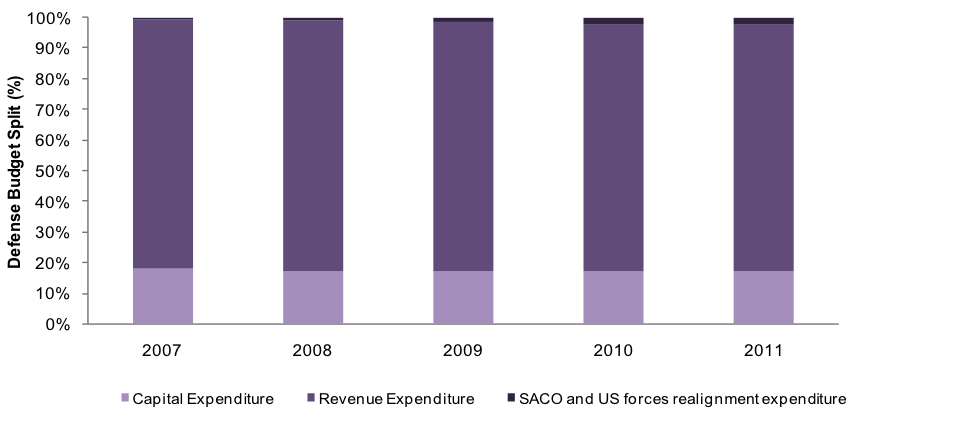
During the review period (2007-2011) an average of 81.2% of the defense budget was spent on the revenue expenses of the armed forces, which includes the salaries of armed personnel, food expenses, facility improvements and maintenance. However, over the forecast period this is expected to decline to 80.4%, as the government is projected to increase its expenditure on the realignment of Special Action Committee on Okinawa (SACO) and US forces (reference see graph).
Japan Self-Defense Forces Spending 2007-2011
The Japanese government’s policy to ban arms exports to other countries makes it difficult for defense companies in Japan to maintain profitability. Since 2003, 20 companies have discontinued their participation in the fighter jet manufacturing business. Furthermore, as the Japanese government makes a minimal amount of procurements domestic companies may diversify from the defense industry and enter other civilian industries.
As the government has a defense procurement policy that gives priority to indigenously manufactured goods, the establishment of a subsidiary in Japan can provide an opportunity for defense companies to supply to the Japanese MoD.
The Japanese defense investment policy insists on the government’s prior approval for investment in the defense industry. If the foreign company fails to notify the government about the investment, this may be considered to be a criminal offence and can lead to imprisonment of up to three years and/or a fine of three times the investment or YEN1 million (US$0.01 million), whichever is the larger amount.
Japan has a well-developed domestic industry, which is supported by government procurement. The domestic defense industry also procures production licenses of technology that is unavailable domestically, in order to supply the Japanese MoD with the most advanced equipment available. Japanese defense imports are expected to increase over the forecast period, partly due to government plans to procure fighter aircraft.
About ICD Research
The Country Report: “The Japanese Defense Industry – Market Opportunities and Entry Strategies, Analyses and Forecasts to 2016″ released in February 2012 is published by ICD.
To order this report please fill the form below or contact us directly at Tel: +972 54-450-8028
[box type=”download” style=”rounded” border=”full”]Order this report
[/box]
About ICD Research
ICD Research is a full-service global market research agency and premium business information brand specializing in industry analysis in a wide set of B2B and B2C markets. ICD Research has access to over 400 in-house analysts and journalists and a global media presence in over 30 professional markets enabling us to conduct unique and insightful research via our trusted business communities. Through its unique B2B and B2C research panels and access to key industry bodies, ICD Research delivers insightful and actionable analysis. The ICD Research survey capabilities grant readers access to the opinions and strategies of key business decision makers, industry experts and competitors as well as examining their actions surrounding business priorities.
The US military spending as a percentage of GDP is expected to decline to an average of 4.0% over the next five years (2012-2016), down from 4.6% during the past five years (2007-2011), due to government efforts reduce its fiscal deficit from the 2010 value(reference see graph below).
The US has the largest defense market in the world. Due to its high levels of military spending, a large number of opportunities are available to companies keen to supply the nation with defense equipment. However, the US defense budget, which grew at a CAGR of 4.19% during the years 2007-2011, is expected to grow only by 0.63% CAGR over the forecast period, largely due to the financial constraints caused by the global financial crisis.
By 2016, the US is expected to invest in the modernization of its existing weapons systems and acquire advanced defense systems capable of enhancing interoperability among the armed forces. Furthermore, although homeland security expenditure is expected to decline at a CAGR of 0.36% over the forecast period, the country is expected to invest in homeland security products such as biosensors, explosive detection machines and surveillance equipment.
US Defense Spending as % of GDP 2007-2011
Challenges to Foreign Investments
The US encourages foreign direct investment (FDI) in its defense sector. However, investments thought to pose a risk to national security are barred using the Exon-Florio provision, which consists of three steps for reviewing proposed, or pending, foreign mergers, acquisitions or takeovers. According to this provision, the Committee on Foreign Investment in the United States (CFIUS) conducts and submits a review on the foreign investment to the president. The president is then authorized to approve or ban the investment depending on whether it is determined to be a risk to national security.
The ongoing global economic slowdown has had a significant impact on many US defense companies. As a result, defense firms such as Lockheed Martin and Northrop Grumman are keen to sell off certain non-profitable units or have them acquired by foreign companies.
The US is keen to modernize its existing weapon systems, but the rising unit cost of defense systems conflict with the country’s plans to decrease its procurement budget. Indeed, the cost of military hardware is increasing due to the rising cost of R&D and skilled labor shortages, particularly in the design, engineering and manufacturing sectors.
Although the US’s total defense spending is likely to decrease, factors such as the potential nuclear threats posed by North Korea and Iran, modernization initiatives, ongoing military operations and strategies to maintain military supremacy and protect its allies will continue to drive the US defense budget.
During 2005–2010, the US emerged as the largest exporter of defense equipment in the world. Moreover, the nation is expected to dominate the global arms export market over the forecast period, due to the increasing defense budgets of a number of its allies, such as South Korea, Israel and Australia. The country possesses a diverse consumer base and, during the review period, South Korea emerged as the largest consumer of US-manufactured defense goods.
Many countries, such as Spain, Israel, Poland, France and Italy, possess well-developed domestic defense industries, however, these countries continue to rely on US defense equipment for advanced military hardware such as missiles and fighter aircraft, as the US has the most advanced defense industry in the world.
The Country Report: “”The U.S. Defense Industry – Market Opportunities and Entry Strategies, Analyses and Forecasts to 2016″ was released in February 2012 by ICD.
To order this report please fill the form below or contact us directly at Tel: +972 54-450-8028
[box type=”download” style=”rounded” border=”full”]Order this report
[/box]
About ICD Research
ICD Research is a full-service global market research agency and premium business information brand specializing in industry analysis in a wide set of B2B and B2C markets. ICD Research has access to over 400 in-house analysts and journalists and a global media presence in over 30 professional markets enabling us to conduct unique and insightful research via our trusted business communities. Through its unique B2B and B2C research panels and access to key industry bodies, ICD Research delivers insightful and actionable analysis. The ICD Research survey capabilities grant readers access to the opinions and strategies of key business decision makers, industry experts and competitors as well as examining their actions surrounding business priorities.
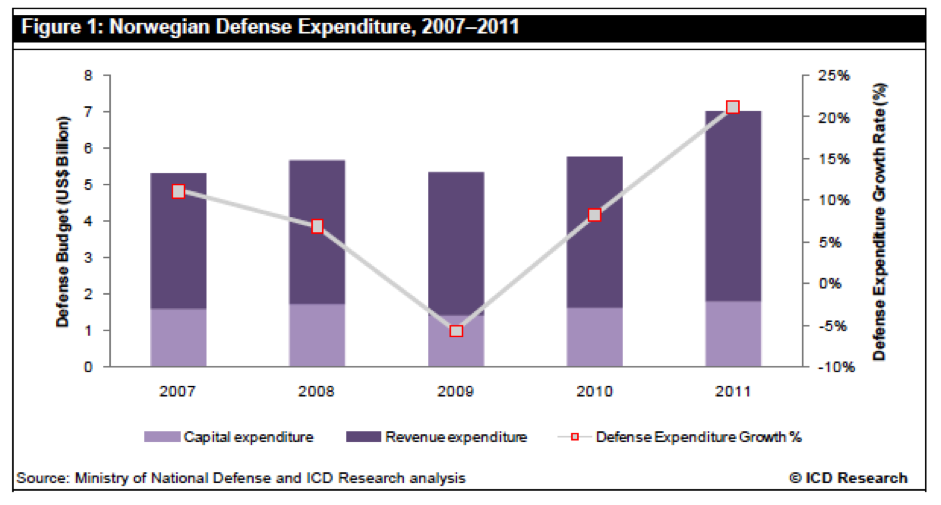
Defense expenditure in Norway is expected to drop in Norway, representing only 2.51% real growth in the next four years (2012-2016). This growth level represents about 60% reduction compared to the 7.22% growth recoded over the past four years. Overall, the Norwegian defense expenditure as part of the national GDP is expected to increase to 1.5%, up from an average of 1.4%, as a result of stronger economic growth.
Areas in which defense spending is expected to be maintained include:
Support for international peacekeeping missions
border surveillance, security and protection; where Norway has border disputes with Russia and the expected expansion of home guard training activities.
Homeland security expenditure is expected to record a CAGR of 8.0% during the forecast period, driven by the increased perceived threat from radical and foreign terrorist organizations such as al-Qaeda. The country is also expected to invest in the modernization and strengthening of its home guard over the forecast period.
The Norwegian defense Expenditure 2007-2011
Offset Opportunities
In Norway, offsets are mandatory for all defense procurements equal to or exceeding US$82.2 million, with foreign investors required to invest 100% of the contract value back into the Norwegian economy. The offset project must also cater to defense related, security related or dual use products. If an investor is unable to fulfil their offset obligation within 10 years of the agreement, they are liable to pay a penalty of at least 10% of the outstanding value. Furthermore, the country’s offset program has offset multipliers, which vary from 1 to 5, depending upon the sector the offset agreement caters to.
Foreign OEMs predominantly enter the Norwegian defense industry through the formation of joint ventures or strategic alliances with domestic defense firms. During the last 25 years, firms such as Thales Australia, BAE Systems and Raytheon have entered the market through these routes, with such methods favored as they allow both companies to capitalize on each other’s capabilities. Additionally, the government also encourages investors to enter the market by collaborating on research and development programs, as this involves the extensive transfer of technology and therefore enhances the capabilities of the domestic defense industry.
Although Norway allows foreign investors to enter its defense industry, and foreign and domestic investments are treated equally by law, regulations, standards, and practices often favor Norwegian, Scandinavian and European Economic Area (EEA) investors. This makes the entry of non-European investors more challenging. Furthermore, as the country completed the modernization of its armed forces during the review period, market opportunities are now limited for future investors.
As one of the founding members of NATO, Norway is an active contributor to the UN-led international operations in Afghanistan and Iraq, with the country’s main international commitment during the review period having been its involvement in the International Security Assistance Force (ISAF), a NATO-led security mission in Afghanistan established by the United Nations Security Council. Although Norway is also involved in other UN-led missions in Lebanon (UNIFIL), Darfur (UNAMID), Sudan (UNMIS), the Middle East (UNTSO), Ethiopia and Eritrea (UNMEE), and Kosovo (UNMIK), Afghanistan remains Norway’s main international commitment and the country contributed US$10 million to the Afghan Nation Army (ANA) Trust Fund in 2011.
[box type=”download” style=”rounded” border=”full”]Order this report
[/box]
About ICD Research
The Country Report: “The Norwegian Defense Industry – Market Opportunities and Entry Strategies, Analyses and Forecasts to 2016″ released in February 2012 is published by ICD.
To order this report please fill the form below or contact us directly at Tel: +972 54-450-8028
ICD Research is a full-service global market research agency and premium business information brand specializing in industry analysis in a wide set of B2B and B2C markets. ICD Research has access to over 400 in-house analysts and journalists and a global media presence in over 30 professional markets enabling us to conduct unique and insightful research via our trusted business communities. Through its unique B2B and B2C research panels and access to key industry bodies, ICD Research delivers insightful and actionable analysis. The ICD Research survey capabilities grant readers access to the opinions and strategies of key business decision makers, industry experts and competitors as well as examining their actions surrounding business priorities.
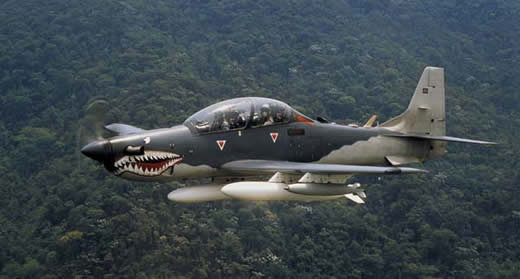
The U.S. Air Force selects A-29 Super Tucano for the Light Attack Aircraft Program. Photo: Embraer
AT6 performing a strafing pass. HBC
The US Air Force is moving to cancel the disputed $355 million Light Air Support (LAS) contract awarded in December 2011 to Sierra Nevada Corp., (SNC). This contract awarded SNC to 20 Brazilian AT-29 Super Tucano light attack aircraft made by Embraer Defence. The Afghan Air Force slated these aircraft for light air strike operation supporting Afghan security operations and coalition forces.
The second bidder, Hawker Beechcraft Corp. protested the decision to award SNC immediately after the decision was announced, after the Air Force disqualified HBC disqualified it from the competition days before the announcement, leaving SNC as a single bidder in this tender. Following HBC’s protest the Air Force suspended the contract January 4, 2012. The case was scheduled for hearing next week. The Air Force said advised the Department of Justice yesterday that it will take corrective action and set aside the contract to Sierra Nevada effective March 2.
HBC said in a statement it received notice Feb. 28 that the U.S. Air Force will set aside the contract, effective March 2, 2012, and reinstate Hawker Beechcraft Defense Company to the competitive range under the procurement.
“This LAS competition is about much more than 20 aircraft for Afghanistan or a billion dollar contract,” said Bill Boisture, Chairman, Hawker Beechcraft Corporation. “It is about the U.S. Air Force’s ability to build relationships with U.S. partner nations around the world for a generation to come. We continue to believe the American manufactured AT-6 is the right aircraft for this critical United States mission.” The LAS contract ultimately could be worth nearly $1 billion, depending on future orders.
Gen. Donald J Hoffman Commander, US Air Force Materiel Command has initiated an investigation into the procurement, with the first report due March 12.
On Tuesday February 28 officials at the US Air Force Aeronautical Systems Center issued a Military Flight Release (MFR) that will allow the F-35A Lightning II fighter to begin initial operations at the joint training center at Eglin AFB, Fla.
Until this MFR all F-35 flights were restricted to test flights, conducted only by qualified test pilots, at the California based Edwards Air Force Base and Naval Air Station Patuxent River flight test centers. All F-35s delivered to Eglin since summer 2011 were practically grounded at the base, awaiting the MFR clearance. With MFR now in place, qualified Air Force, Navy and Marine Corps pilots and later, also trainee pilots will be able to fly the F-35, beginning with the Conventional Take-Off and Landing (CTOL) F-35A variant. Until now, these pilots were restricted to perform taxi tests and simulator flights but could not take to their fighters to the air. According to Defense News, Eglin currently has two test pilots who are qualified to fly the jet: Air Force Lt. Col. Eric Smith and Marine Maj. Joseph Bachmann.
The decision was reached after an airworthiness board conducted an assessment that evaluated potential risks and the corresponding mitigation actions to conduct unmonitored flights. The Air Force consideres flying the Air Force variant of the Joint Strike Fighter will increase pilot and maintainer familiarity with the aircraft, exercise the logistics infrastructure and continue to develop aircraft maturity. These initial F-35A flights will be limited, scripted, conducted within the restrictions and stipulations of the MFR and flown by qualified pilots, the announcement said.
“The Air Force, Joint Strike Fighter Program Office and other stakeholders have painstakingly followed established risk acceptance and mitigation processes to ensure the F-35A is ready. This is an important step for the F-35A and we are confident the team has diligently balanced the scope of initial operations with system maturity,” said General Donald Hoffman, commander of Air Force Materiel Command, the parent organization of ASC.
The assessment was conducted with airworthiness engineering subject matter experts within ASC and was fully coordinated with the F-35 joint Strike Fighter Program Office, Air Education and Training Command, and other expert participants. The Air Force is confident the aircraft is ready to fly in a safe and efficient manner, Hoffman said.
Smith and Bachmann will act as the initial instructors for the rest of the cadre at the 33rd Fighter Wing. The three services have selected some of the best, most experienced pilots to form the initial batch of instructors at Eglin. The Marine Corps expects pilots to start flying the F-35B in late March after the Naval Air Systems Command completes an independent safety audit.
The contract was announced in January 2012 by Israel Aerospace Industries, without disclosing the identity of the customer. According to reports published in the foreign press, the arms package included in the two contracts include the Green Pine missile defense radar, which also provides the main sensor for the Israeli Arrow missile defense system, various air defense radars and missile systems, as well as ship-launched missiles, supporting the small Azeri Caspian Navy vessels which consists mostly with fast patrol boats, with more powerful firepower.
Azerbaijan, a Muslim country that became independent with the disintegration of the Soviet Union. Azerbaijan populated mostly by Shiite Muslims, shares land and sea borders with Iran.
According to foreign sources, the warming of relations between Israel and Azerbaijan follow mutual political and commercial interests between the two countries, and particularly by their mutual concern of the rising threat of Iran, and Tehran’s thrust to achieve nuclear weapon capability. Israel’s relations with Azerbaijan have grown as its once-strong strategic relationship with another Iranian neighbor, Turkey, has deteriorated.
Iran accused Israeli Mossad agents to have assassinated Iranian nuclear scientists and are thought to have retaliated against Israeli targets in Azerbaijan in the past. In February 2012 Azeri authorities foiled what is said to be an Iranian-sponsored attacks against Israeli targets in Azerbaijan. In 2008, Azeri officials said they thwarted a plot to explode car bombs near the Israeli Embassy. A year earlier, Azerbaijan convicted 15 people in connection with an alleged Iranian-linked spy network accused of passing intelligence on Western and Israeli activities.
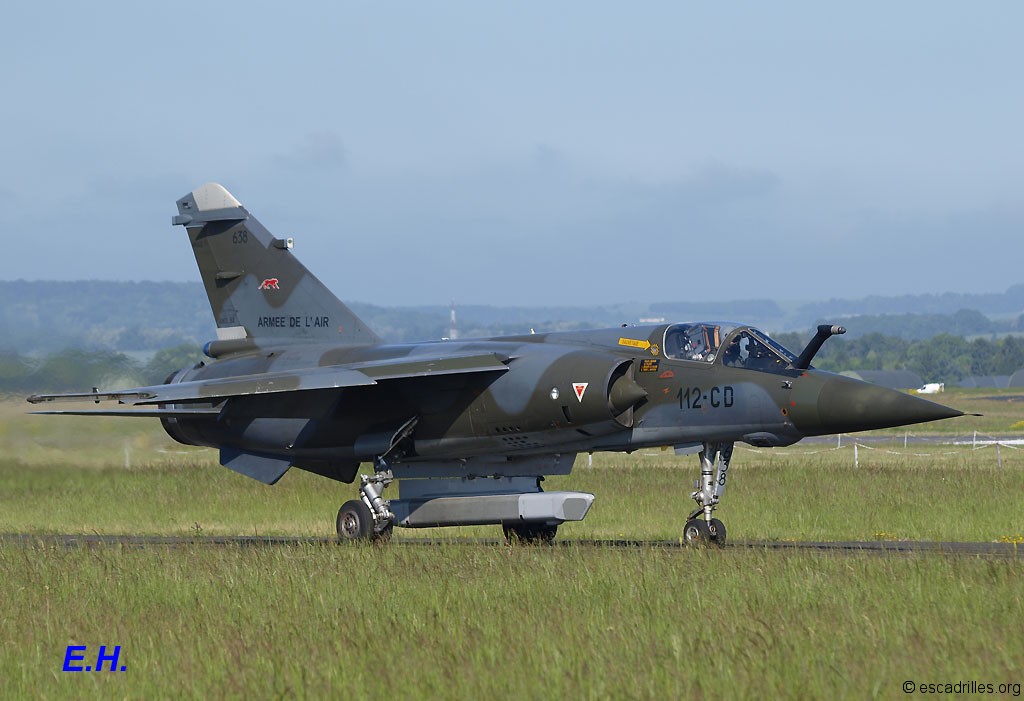
Mirage F-1CR carrying the ASTAC ELINT pod. Photo: Escadrilles.org
With the planned retirement of the French Mirage F1CR, the French Air Force is planning to shift part of its missions to the Mirage 200D fleet. As part of this program, the French defence procurement agency (DGA) has awarded Thales a contract to adapt ASTAC tactical electronic reconnaissance pods for the Mirage 2000D. The process is due to complete by 2014, when the Mirage F1CR is expected to phase out of active service. Mirage F-1CR carrying the ASTAC ELINT pod. Photo: Escadrilles.orgThe ASTAC (Analyseur de Signaux TACTiques) pod was designed to be carried under the fuselage of F4 Phantom, Mirage F1 and Mirage 2000 combat aircraft to provide an electronic intelligence (ELINT) and tactical reconnaissance capability, including updating the overall situation and generating the electronic order of battle.
The contract includes all the modifications required to interface the ASTAC pods with the Mirage 2000D, including adaptation to the platform and adjustments to the countermeasures systems housed inside the pod.
ASTAC is designed to operate in dense electromagnetic environments, offering high-precision direction of arrival estimation and uses sophisticated algorithms to determine the location of the signals intercepted. Key parameters of signal sources are measured with high precision in any electromagnetic environment, irrespective of the transmission techniques employed.
In recent years the French Air Force deployed ASTAC in different theatres of operations. Most recently, in Libya, French Air Force Mirage F1CRs carried it in support of during Operation Harmattan
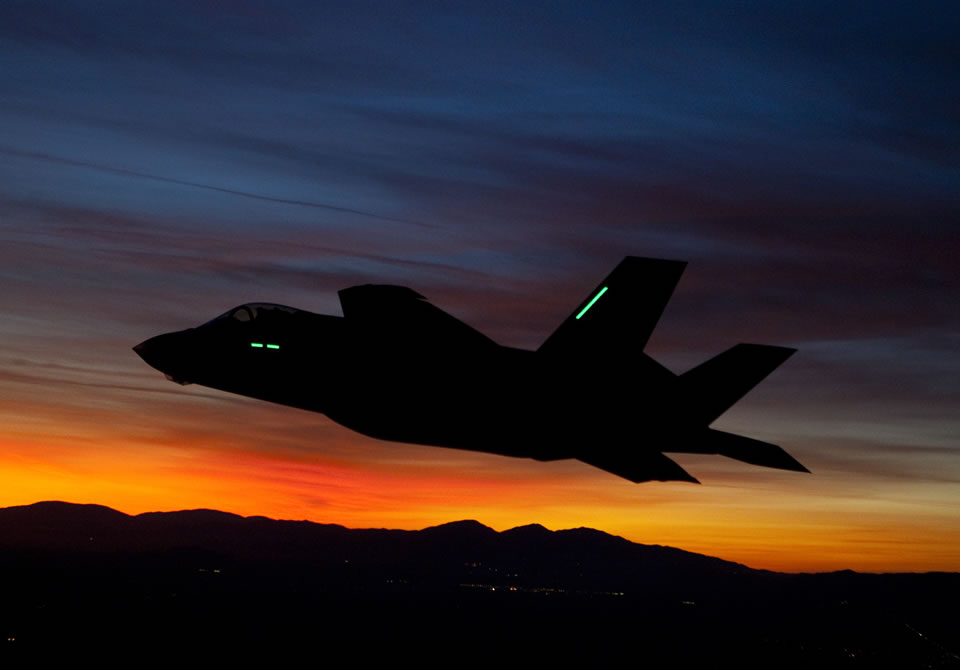
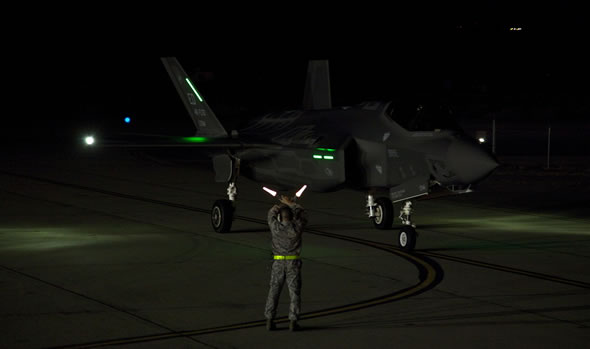
Back at Edwards after the first night flight. Photo: Lockheed Martin
Lockheed Martin released today the flight test summary for the first two months of 2012. According to the company, as of Feb. 20, 2012 the F-35 program accumulated 114 flight tests and achieved 773 test points this year, representing roughly 10 percent of the System Development and Demonstration (SDD) flight test plan for 2012, which calls for the accumulation of 1,001 test flights and 7,873 test points.
However, the manufacturer anticipates that test point requirements throughout the year will grow, given the changes and restructuring of the program. A portion of the earned test points came from work added to the flight test baseline plan.
F-35A Conventional Take Off and Landing (CTOL) jets have flown 46 times, the F-35B short takeoff vertical landing (STOVL) variant vertical flew 45 missions and the carrier variant flew 23 times. From the beginning of the flight-testing program in December 2006, F-35s have flown 1,704 times, including the production-model flights and AA-1, the original flight test aircraft. On January 25 this year this aircraft (AA-1) crossed the 2,500 flight hour threshold.
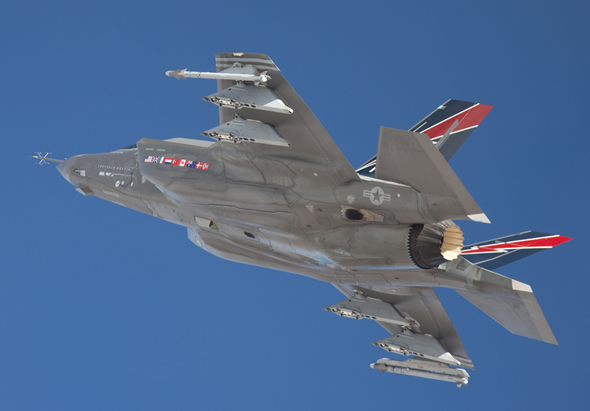
On Feb. 16, 2012, the first external weapons test mission was flown by an F-35A Conventional Takeoff and Landing (CTOL) aircraft at Edwards Air Force Base, Calif. Photo: Lockheed Martin
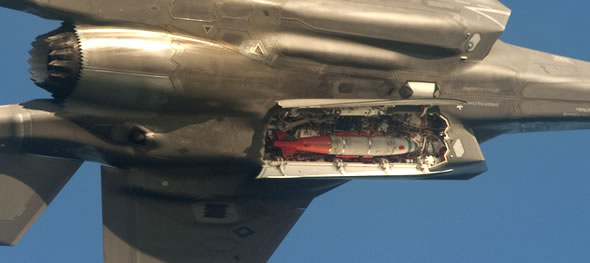
F-35B test aircraft BF-3 flies with the weapon bay doors open on Dec. 19, 2011. Photo: Lockheed Martin
Among the milestones recorded by the F-35 test program this year are the highest altitude flown by the F-35 to date, with AF-4, the F-35A reaching an altitude of 43,000 feet Mean Sea Level (MSL) On Jan. 9. Another F-35A test aircraft, AF-3, completed the first low approach with the Distributed Aperture System (DAS) approach on Jan. 17, Demonstrating the ongoing maturation of the F-35 integrated sensor suite. The next day, AF-6 performed the first night flight and landing, the F-35A CTOL test jet, took off at 5:05 p.m. PST and landed at Edwards AFB, Calif. after sunset at 6:22 p.m. Weapons carrying flight tests are also progressing, on February 16, an the AF-1 (F-35A CTOL) flew the first test flights with external weapons, these mission also included ordnance carried in the internal weapons bays.
Last week, over an Atlantic test range, the F-35B test aircraft BF-2 began flight testing with external weapons pylons. The Feb. 22. test measured flying qualities with external pylons, inert AIM-9X Sidewinder air-to-air missiles and centerline 25 mm gun pod. Significant weapons testing for the F-35B and F-35C variants is scheduled for 2012, including fit checks, captive carriage, pit drop and aerial drop tests.
Performance issues associated with DAS have limited the use of the F-35 unique helmet display and sight, developed for the program by VSI. The sight was designed to use DAS live image feeds to display the outside view for the pilot, alleviating the need for night vision goggles for night flight. BAE Systems and VSI were asked to work on temporary solutions using NVG, to provide a near-term solution. However, using NVG on top of the standard helmet will limit the use of the sophisticated display and information fusion capabilities that make the F-35 unique. Therefore, it is anticipated that the objective helmet will be reinstated once DAS will deliver imaging within the required spec. Among the fix being considered are fixed camera mounted in the cockpit, and another, coupled to the helmet, both reducing the latency of night imagery imported from the DAS.
F-35B test aircraft BF-2 flies by the tower at Naval Air Station Patuxent River, Md., in short takeoff/vertical landing (STOVL) mode during a test flight Jan. 31, 2012. Photo: Lockheed Martin
Eglin AFB, Fla., where the F-35 training force is based has become home of the largest F-35 fleet. The 2nd marine Aircraft Wing Fighter/Attack training squadron 501 received three more aircraft in January – BF6, BF8 and BF7. The delivery of BF7 on January 19th marked the 23rd Lightning II delivered to the DOD. While the Eglin fleet keep growing, F-35s are still grounded as flight operations and training await military flight clearance which is expected in few weeks.
Over an Atlantic test range, Lockheed Martin test pilot Dan Levin flies F-35B test aircraft BF-2 with external weapons pylons for the first time Feb. 22. (Photo: Lockheed Martin)
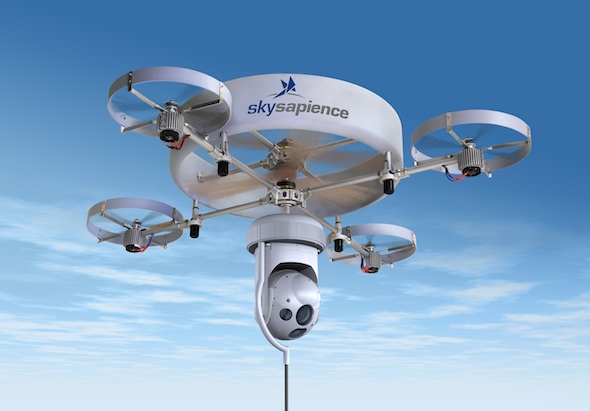
The HoverMast a lightweight thetered autonomous platform from Sky Sapience. Photo: Sky Sapience
The ‘HoverMast’ developed by the Israeli start-up company Sky Sapience is scheduled to go on an operational demonstration in the upcoming months, demonstrating the system’s capability to expand the surveillance coverage of unmanned ground vehicles. The payload currently integrated on the HoverMast is the T-Stamp from Controp, a stabilized multi-sensor payload. The HoverMast will be unveiled at the upcoming AUVSI Conference and Exhibition to be held in Tel-Aviv next month.
Sky Sapience developed HoverMast in the past two years, in response to an Israel Ministry of Defense (MOD) requirement for a lightweight tethered hovering platform. The system was one of several concepts evaluated by the MOD Research and Development Directorate (DDRD), which eventually selected the HoverMast for the sole developer of the tethered platform technology. Under the partnership with DRDD Sky Sapience developed the platform and conducted a series of prototype flight tests. HoverMast is positioned as an effective platform for military surveillance, observation and target acquisition applications, as well as deployment of communications gear, communications intelligence (COMINT) and other electronic devices. It will also offer an affordable application for border surveillance, urban security, crowd control and other civil applications.
According to Brig. General (IAF Ret.) Gabriel Shachor, CEO and Founder of Sky Sapience the HoverMast was developed specifically for small vehicles such as the Guardium-LS from G-Nius, the vehicle selected for integration with the HoverMast. Other applications include the Zibar light reconnaissance vehicle. According to Shachor, the platform is due to enter production toward the autumn this year. Sky Sapience has strategic partnerships with DRDD (MAFAT) – the IMOD research and development agency and G-NIUS Unmanned Ground Systems Ltd.
Shachor claims the HoverMast favorably compares to the 7-5m’ telescopic masts currently mounted on surveillance vehicles, offering faster response, lighter weight, and the capability to operate on the move. Furthermore, the new platform alleviates the need to operate from a horizontal surface and is less sensitive to wind gusts. According to Shachor, the HoverMast would also be more affordable than mast mounted systems.
The deployment is fully automatic, with HoverMast deploying from the stowed position to an elevation of 30-50 meters in just 15 seconds. A cable that also provides power supply and wide-band data link tethers the vehicle. The platform uses a coaxial counter-rotating ducted fan for lift generation, with four thrusters providing station keeping, maneuvering and stabilization. At a 10kg net platform weight HoverMast can carry up to 9 kg of payload, comprising electro-optic sensors, laser designators, radar, or signals intelligence sensors. Sensor data can be transmitted to remote clients or fed through the tether datalink to the base station.
In the stowed position the HoverMast automatically folds into a compact 72 cm diameter container, carried on a vehicle flatbed or roof, mounted on UGVs or All Terrain Vehicles (ATV), or small naval craft; making the system especially suited for Special Forces, border and port protection, and infantry missions.
Lockheed Martin Skunk Works® and XTEND have achieved a major milestone in JADC2 by integrating the XOS operating system with the MDCX™ autonomy platform. This technical breakthrough enables a single operator to simultaneously command multiple drone classes, eliminating the friction of mission handoffs. From "marsupial" drone deployments to operating in GPS-denied environments, explore how this collaboration is abbreviating the data-to-decision timeline and redefining autonomous mission execution.
As traditional defense primes face mounting competition from agile “neoprimes” such as Anduril, Palantir and Helsing, the balance of innovation is shifting toward software-defined warfare and scalable, dual-use technologies, while global industry consolidation—marked by Boeing’s integration of Spirit AeroSystems and other strategic mergers—signals an intensified race to secure control over the defense technology value chain. Our Defense-Tech weekly report highlights these trends.
In early October 2025, a coordinated wave of unmanned aerial system (UAS) incursions—widely attributed to Russia—targeted critical infrastructure across at least ten European nations. The unprecedented campaign exposed the fragility of Europe’s air defenses...
Executive Summary
The past week (September 18-25, 2025) represents an inflection point where strategic defense concepts have transitioned from doctrine to tangible reality. An analysis of global events reveals four primary, interconnected trends shaping an...
At the 2025 Air, Space & Cyber Conference, U.S. Air Force and Space Force leaders unveiled major updates on next-generation fighters, bombers, unmanned systems, and space initiatives, highlighting both rapid innovation and critical readiness challenges as the services race to outpace global competitors. A short version is available here, with a more detailed version for subscribers.
The Taipei Aerospace & Defense Technology Exhibition (TADTE) 2025 crystallized around four dominant strategic themes that collectively illustrate Taiwan's comprehensive approach to defense modernization amid escalating regional tensions. Based on a detailed report by Pleronix (available upon request). Includes a Podcast discussion on TADTE 2025's highlighting Taiwan's four strategic themes beyond the post's coverage.
Israel’s Iron Beam 450 high-power laser system has completed final testing, marking a major leap in air defense. Developed by Rafael, it offers precise, cost-effective interception of rockets, UAVs, and mortars, and is set for IDF deployment by 2025.