
Friday, December 26, 2025
More
    Home Blog Page 261

    North Korea Accelerates Nuclear Plans

    North Korea Construct Foundations for a New Light Water Reactor at Yongbyon. EROS B satellite photo, (Imagesat Intd.)

    Reveal Construction Of Light Water Reactor, Uranium Enrichment Facilities At Yongbyon

    The scope of the North Korean nuclear program is much larger than previously estimated by the west, as the North develops new nuclear capabilities at an alarming pace. In fact, Pyongyang is not trying to hide its activities, but openly invites U.S. nuclear scientists to witness the advanced state of the program, creating substential deterrence.
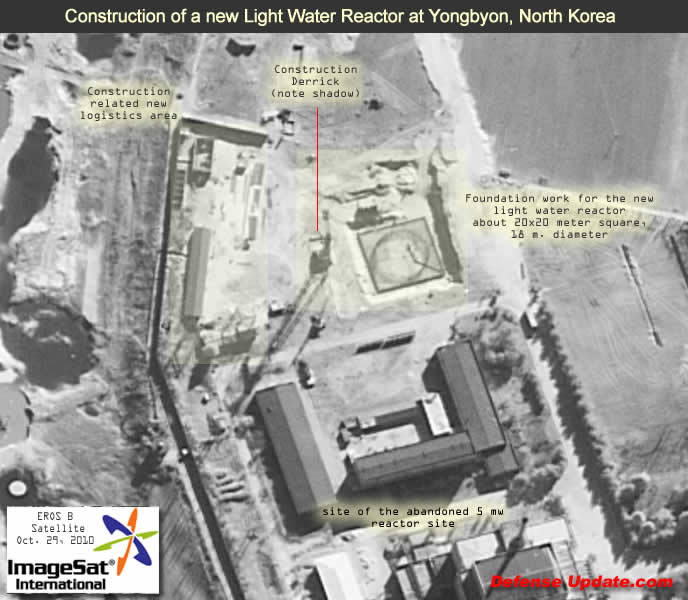
    North Korea Construct Foundations for a New Light Water Reactor at Yongbyon. EROS B satellite photo, (Imagesat Intd.)

    U.S. nuclear scientists invited to North Korea’s Yongbyon nuclear facility recently had the opportunity to witness the constrcution of a new light water reactor and new uranium enrichment facility accommodating thousands of centrifuges. One of the U.S. scientists, Jack Pritchard, a specialist on North Korea and retired US Army officer, reported upon his return the new reactor at Yongbyon, located near the location of the demolished cooling tower constructed to support the 5MW reactor constructed by the North in the 1990s. The site is visible in the image above, taken by the Israeli EROS B satellite on October 29, 2010.


    “What they told us is that they are building a light-water reactor at Yongbyon,” Pritchard told reporters. “Physically, it is slightly in front of where the old cooling tower was located. We observed for ourselves the relatively early stage…” he said they were told North Korean wants to complete the construction of a 100-megawatt light-water reactor by 2012. This reactor will provide electricity for the immediate area of Yongbyon. The new facility was described as ‘experimental’. “They are trying to build on their own a relatively small light-water reactor to ensure that they can build one. If it is successful, from there, they intend to build a larger one.” Pritchard explained. A successful North Korean light water power reactor design could find a huge and ready market in Asia and Africa. While low enriched uranium cannot be used as weapon grade material, it can be further enriched to be used for weapons; it just takes longer and costs more to produce. But Albright said he thinks the program could be used to produce weapons-grade, highly enriched uranium. While North Korea already has tested two atomic bombs and produced other nuclear weapons, those were made from plutonium recovered from spent fuel harvested from a nuclear reactor, not from enriched uranium.

    Lacking energy resources and pressed by international sanctions, North Korea is starving for energy and light water reactors which feed on low enriched uranium for fuel seem to be more accessible for the country.

    Pritchard report confirmed earlier reports that appeared in 2010, about new construction at Yongbyon. Such reports were based on satellite imagery, and were unable to identify the nature and purpose of the construction. He estimated the size of the reactor being built at a 21-23 m’ to (70 to 75 ft) square and 18 m’ (“60 ft.) in diameter. The reactor is roughly one tenth the size that was originally being built at Kumho-Sinpo on the east coast of North Korea by the defunct, US and South Korean-backed Korean Peninsula Energy Development Organization (KEDO).

    KEDO, a now-defunct international consortium, was established to oversee construction of two 1,000-megawatt light-water reactors in North Korea in exchange for Pyongyang’s nuclear freeze. It stopped the project in 2003 after the U.S. accused North Korea of running a clandestine uranium-based nuclear program. Up to that point, during the Bush administration, the North had honored its freeze of the reactor at Yongbyon for ten years; launched no ballistic missiles and detonated no nuclear tests.

    The new reactor under construction is only part of Pyongyang’s revamped nuclear technology development. According to Robert Carlin, one of the three scientists visiting Yongbyon recently, the Yongbyon facility also includes a large uranium enrichment facility. “The North Koreans say it was 2,000 [centrifuges]. It was a lot.” said Carlin. “None of the experts that I knew predicted the North Koreans could build anything like this number… Everybody predicted they were at a very early stage,” Carlin said.

    The centrifuges appear similar in design to those used at Natanz, the Iranian nuclear-fuel-production site, but North Korea described them as higher-efficiency machines. The new plant’s modernistic technology, rich collection of centrifuges and up-to-date control room, did not exist in the spring of 2009, just before international weapons inspectors were evicted from the country.

    Diplomats and scientists alike largely agree that the latest developments are a game-changer. A military attack is unthinkable, but so is allowing a runaway nuclear program. In a report on the meeting, Carlin’s colleague Siegfried Hecker concluded: “The only hope appears to be engagement.” That means restarting stalled negotiations with North Korean leaders, whose hand appears to have been dramatically strengthened.

    Right Photo: The Seattle Times reports: U.S. sees N. Korea plant as step toward nuclear arms. This photo combination of two satellite images shows, top, heavy construction equipment at the Yongbyon nuclear complex in North Korea on Sept. 29. 2010 The image from Nov. 4, 2010 bottom, shows a rectangular structure being built. Satellite Photos via AP.

    Above: Danger Room reports the new uranium enrichment facility in Yongbyon has been built in barely a year, suggesting a big crash program to build more-powerful bombs than the plutonium ones currently in the North’s arsenal – even while United Nations sanctions against the North have grown more severe.
    China Challenges the U.S. for the the World’s Most Powerful Supercomputer Title

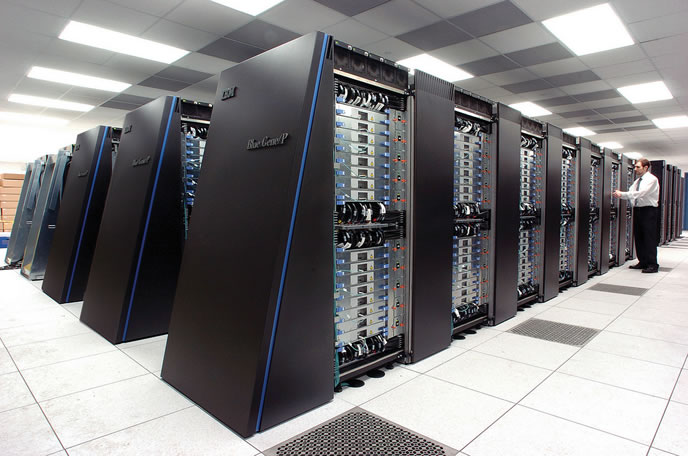
    Interpid is the most pwoerful HPC machine at Argonne’s Argonne Leadership Computing Facility (ALCF). This IBM Blue Gene/P machine that is capable of more than 500 trillion calculations a second. In 2012 the facility will get an even more powerful computer, a 10-petaFLOPS IBM Blue Gene/Q supercomputer called Mira. It will be being 20 times faster than Interpid, running programs at 10 quadrillion calculations a second. Photo: Argonne

    U.S. Scientists Introduce Tougher Benchmarks To Gain Back The Lost Title

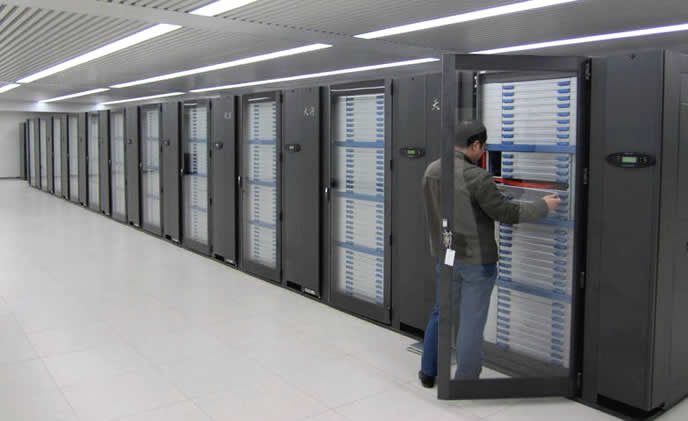
    China’s super computer Tianhe-1A revealed last month at HPC 2010 China, has set a new performance record of 2.507 petaflops, as measured by the LINPACK benchmark, making it the fastest system in China and in the world today. Tianhe-1A surpassed the U.S. ‘Jaguar’ made by Cray which held the first place until June this year. The China’s National University of Defence technology at Changsha developed the Tianhe-1A utilizing ‘heterogeneous computing’. This modern architecture couples massively parallel Graphics Processing Units (GPU) with multi-core Central Processing Units (CPU) to improve performance, reduce size and power consumption. The system uses 7,168 Nvidia Tesla M2050 GPUs and 14,336 CPUs; According to GPU manufacturer Nvidia, it would require more than 50,000 CPUs and twice as much floor space to deliver the same performance using CPUs alone. “The performance and efficiency of Tianhe-1A was simply not possible without GPUs,” said Guangming Liu, chief of National Supercomputer Center in Tianjin. “The scientific research that is now possible with a system of this scale is almost without limits.”

    The Tianhe-1A Supercomputer, located at National Supercomputer Center, Tianjin Photo: NVidia

    Top Rank – Top500 HPC List

    #1 Tianhe-1A China  – National Supercomputing Center in Tianjin China
    #2 Jaguar – Cray/U.S.A. – DOE/SC/Oak Ridge National Laboratory
    #3 Nebula 2.0 China – National Supercomputing Centre in Shenzhen (NSCS) China
    #4 TSUBAME 2.0 – GSIC Center, Tokyo Institute of Technology Japan
    #5 Hopper – Cray/U.S.A. – DOE/SC/LBNL/NERSC
    #6 Tera-100 – Commissariat a l’Energie Atomique (CEA) France
    #7 Roadrunner – DOE/NNSA/LANL
    #8 Kraken XT5 Cray/U.S.A. – National Institute for Computational Sciences/University of Tennessee
    #9 JUGENE – Forschungszentrum Juelich (FZJ) Germany
    Despite being an important tool for the development of nuclear weapons, super computers have become an essential tool for commercial applications, including for medical drugs research, industrial, logistics and financial applications. However, the most powerful machines are still employed by government establishments, for advanced research, energy and defense applications.

    The Chinese achievement is impressive, but U.S. expert argue that speed alone is not sufficient to rate best in High Performance Computing. Data intensive supercomputer applications are increasingly important HPC workloads, but are ill suited for platforms designed for 3D physics simulations. Current benchmarks and performance metrics do not provide useful information on the suitability of supercomputing systems for data intensive applications.

    To gain back their leading position, U.S. scientists have changing the rules, introducing more challenging tasks as benchmarks. “Some, whose supercomputers placed very highly on simpler tests like the Linpack, also tested them on the Graph500, but decided not to submit results because their machines would shine much less brightly,” said Sandia computer scientist Richard Murphy, a lead researcher in creating and maintaining the test. The new Graph500 benchmark was developed by a team led by researchers from Sandia Labs, the Georgia Institute of Technology, University of Illinois at Urbana-Champaign, and Indiana University. Sofar nine supercomputers have been tested, validated and ranked by the new “Graph500” challenge, first introduced last week by an international team led by Sandia National Laboratories. The machines were tested for their ability to solve complex problems involving random-appearing graphs, rather than for their speed in solving a basic numerical problem, today’s popular method for ranking top systems.

    Interpid is the most pwoerful HPC machine at Argonne’s Argonne Leadership Computing Facility (ALCF). This IBM Blue Gene/P machine that is capable of more than 500 trillion calculations a second. In 2012 the facility will get an even more powerful computer, a 10-petaFLOPS IBM Blue Gene/Q supercomputer called Mira. It will be being 20 times faster than Interpid, running programs at 10 quadrillion calculations a second. Photo: Argonne

    Complex problems involving huge numbers of related data points are found in the medical world where large numbers of medical entries must be correlated, in the analysis of social networks with their huge numbers of electronically related participants, or in international security where numerous containers on ships roaming the world and their ports of call must be tracked.

    Such problems are solved by creating large, complex graphs with vertices that represent the data points — say, people on Facebook – and edges that represent relations between the data points – say, friends on Facebook. These problems stress the ability of computing systems to store and communicate large amounts of data in irregular, fast-changing communication patterns, rather than the ability to perform many arithmetic operations. The Graph500 benchmarks are indicative of the ability of supercomputers to handle such complex problems. The new team has developed specific benchmarks to address three application kernels: concurrent search, optimization (single source shortest path), and edge-oriented (maximal independent set). Five additional graph-related business areas are being addressed, including Cybersecurity, Medical Informatics, Data Enrichment, Social Networks, and Symbolic Networks.

    The Graph500 benchmarks present problems in different input sizes. These are described as huge, large, medium, small, mini and toy. No machine proved capable of handling problems in the huge or large categories. “I consider that a success,” Murphy said. “We posed a really hard challenge and I think people are going to have to work to do ‘large’ or ‘huge’ problems in the available time.”  More memory, he said, might help.

    The abbreviations “GE/s” and “ME/s” represented in the table below describe each machine’s capabilities in giga-edges per second and mega-edges per second — a billion and million edges traversed in a second, respectively. Competitors were ranked first by the size of the problem attempted and then by edges per second.

    Top ranks – Graph500 HPC Challenge:

    #1Intrepid, Argonne National Laboratory – 6.6 GE/s on scale 36 (Medium)
    #2Franklin, National Energy Research Scientific Computing Center – 5.22 GE/s on Scale 32 (Small)
    #3cougarxmt, Pacific Northwest National Laboratory – 1.22 GE/s on Scale 29 (Mini)
    #4graphstorm, Sandia National Laboratories’ – 1.17 GE/s on Scale 29 (Mini)
    #5Endeavor, Intel Corporation, 533 ME/s on Scale 29 (Mini)
    #6Erdos, Oak Ridge National Laboratory – 50.5 ME/s on Scale 29 (Mini)
    #7Red Sky, Sandia National Laboratories – 477.5 ME/s on Scale 28 (Toy++)
    #8Jaguar, Oak Ridge National Laboratory – 800 ME/s on Scale 27 (Toy+)
    #9Endeavor, Intel Corporation – 615.8 ME/s on Scale 26 (Toy)

    Interpid is the most pwoerful HPC machine at Argonne’s Argonne Leadership Computing Facility (ALCF). This IBM Blue Gene/P machine that is capable of more than 500 trillion calculations a second. In 2012 the facility will get an even more powerful computer, a 10-petaFLOPS IBM Blue Gene/Q supercomputer called Mira. It will be being 20 times faster than Interpid, running programs at 10 quadrillion calculations a second.

    Saudi Arabia to Buy Javelin Anti-Tank Missiles

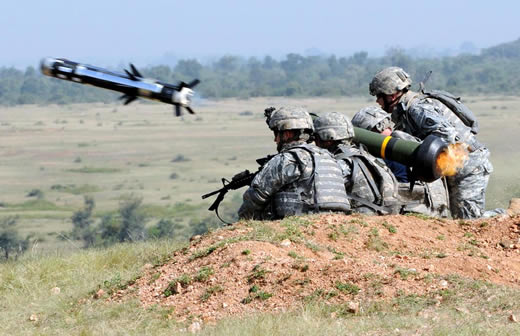
    Saudi Arabia is buying FGM-148 Javelin missiles to replace the Dragon weapons still in use. Photo: U.S. Army

    Saudi Arabia is buying a small batch of FGM-148 Javelin guided missiles, in what seems a precursor for a larger buy of this infantry guided weapon for the Saudi military. The current $71 million sale announced last week by the U.S. Defense Security Cooperation Agency (DSCA) includes 150 missiles and 20 Command Launch Units (CLUs) and day/night thermal sights, a number that could equip about one infantry battalion.

    The Saudi Arabian Land Forces currently have about 1,000 obsolete Dragon anti-tank missiles which are due for replacement by the new Javelins. The new combined arms battalions fielded with the Royal Saudi National Guard could also be equipped with the new weapons. Other Middle-Eastern armies already operating the Javelin include Jordan, UAE and Bahrain.

    Saudi Arabia is buying FGM-148 Javelin missiles to replace the Dragon weapons still in use. Photo: U.S. Army

    New Missiles to Extend Offensive, Defensive Capabilities of the U.S. Navy

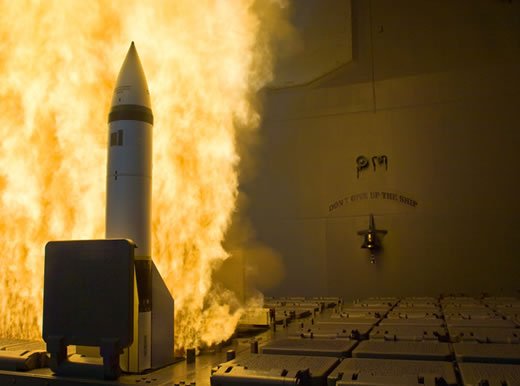
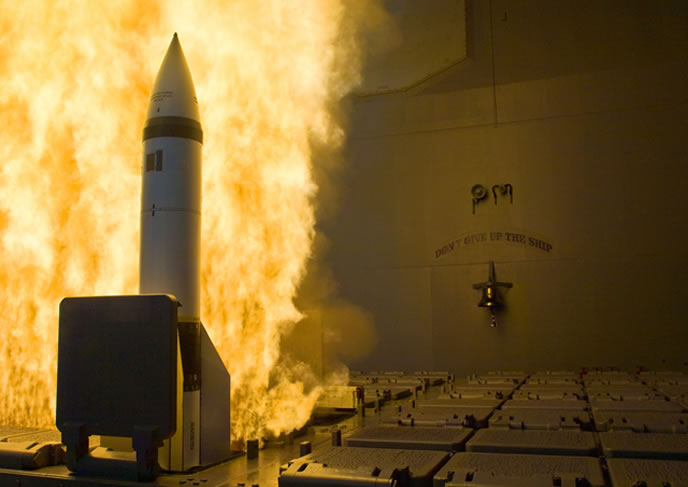
    The U.S. Missile Defense Agency (MDA) has launched the development of next generation Aegis missiles, to enhance sea and land-based missile defense systems toward the next decade. Photo" MDA

    The U.S. military is embarking on several new missile development programs promising to change the rules of air- and naval warfare as it is fought today. Many of the new programs are tailored for forward deployment with the naval surface fleet, with the majority of new missiles to be deployed in and fired from Vertical Launch Systems used on U.S. Navy surface ships, introducing new capabilities and extended reach for surface combatants. With these innovations the VLS is proving once again the success of the modular design approach pursued by the Navy, enabling the service to extend the life of its combatants without major changes to the hardware and with minimal down time for the vessels.

    The U.S. Missile Defense Agency (MDA) has launched the development of next generation Aegis missiles, to enhance sea and land-based missile defense systems toward the next decade. Photo" MDA

    The U.S. Missile defense Agency has developed the Phased Adaptive Approach concept to establish a credible defense against short, medium and long range ballistic missile threats through decade.missile.While being developed as a naval weapon system, Next Generation AEGIS Missile (NGAM) is about to become the mainstay of the missile defense network to protect the European continent. The recent decision by NATO members to extend current radars and future missile defense capabilities into a European-wide network will rely initially on U.S. navy assets and at a later phase, on land-based AEGIS systems. Contracts for early development phases of the Standard Missile 3 Block IIB (SM-3 IIB) were awarded in November by the U.S. Missile Defense Agency (MDA). The new missile will enhance the capabilities of future AEGIS cruisers and land-based Aegis systems, defeating ballistic missiles at extended ranges. Three companies were awarded contracts to demonstrate NGAM conceptual designs – Boeing, Northrop Grumman and Lockheed Martin. While Raytheon, the original manufacturer of all Standard Missiles was absent from the list of vendors it is expected to partner with Lockheed Martin, as it did on many other programs, the most recent is the support for ground based mid-course interceptor missiles. The SM-3 IIB is scheduled for fielding by 2018.

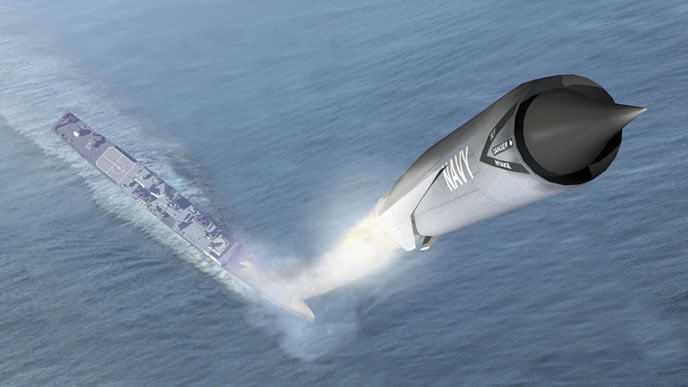
    The Long Range Surface Attack Missile (LRASM) is intended to defeat surface targets well beyond the enemy's offensive or defensive weapons' range. The main adversary currently threatening U.S. naval superiority with extended range weapons is China.

    Another new missile being developed for U.S. Navy AEGIS cruisers and missile destroyers is the Long Range Anti-Ship Missile (LRASM). Part of DARPA’s Advanced Weapon Systems initiatives, LRASM has moves into the second phase of development this month, with the award of $157 million to Lockheed martin for the development of a successor for the current Boeing RGM-84 Harpoon. The new missile is required to counter the perceived threat from China, equipped with land based or naval ballistic missiles capable of targeting U.S. Carrier groups from a distance of hundreds of kilometers away. After the completion of the current demonstration phase LRASM is expected to transition to the U.S. Navy for full scale development. Another, more ambitious development currently at an early conceptual phase at DARPA is ArcLight, a missile system designed to engage surface ships or other targets at ranges of 3,000 miles. The missile’s terminal stage will be accelerated by a rocket booster to the edge of the atmosphere where it will reach hypervelocity speed, gliding over thousands of kilometers to reenter the atmosphere and reach its target in less than half an hour. A similar concept will be demonstrated early next year by the second test of the DARPA/U.S. Air Forces’ Falcon HTV-2.

    The Triple Target Terminator (T3) is a DARPA sponsored program demonstrating next generation air dominance weapon. Concept Photo: via DARPA

    A different mission also pursued under DARPA’s advanced weapons program is the Triple Target Terminator (T3) air dominance weapon. With this program the agency is developing a high speed, long-range missile that can engage enemy aircraft, cruise missile and air defense targets. It will be designed for internal carriage on stealth aircraft like the F-35, F-22 and F-15SE, or externally on fighters, bombers and UAVs. T3 would allow strike fighter aircraft to rapidly switch between air-to-air and air-to-surface (counter-air) capabilities. Both Raytheon and Boeing were each awarded $21.3 million contracts to develop the new missile, which is expected to enter flight testing in 2014.

    Lockheed Martin to Deliver 31 F-35s by 2013, Under $3.5 Billion first ‘Firm Target’ Lot IV LRIP Contract

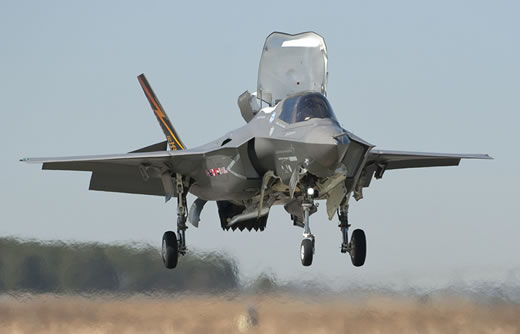
    F-35B performs vertical landing at Patuxent River naval air base. Photo: Lockheed Martin

    The delays in development and testing have increased the cost of the aircraft. In an effort to control the escalating cost the Pentagon negotiated a shift from previous cost-plus-incentive fee which was optimized for the development phase, into price incentive scheme, challenging the manufacturer with more responsibility of cost controll.

    Lockheed Martin has agreed to modify the current low rate initial production Lot IV Low-Rate Initial Production (LRIP) aircraft contract to a fixed-price-incentive (firm target). Under the new arrangement, Lockheed and the Pentagon share on a 50-50 basis all overruns topping the F-35’s “target price.” Lockheed would be required to absorb the entire overrun once the price exceeds an upper-limit “ceiling.”

    F-35B performs vertical landing at Patuxent River naval air base. Photo: Lockheed Martin

    Subsequently the company was awarded about $3.5 billion modification covering the procurement of 31 aircraft. Including the long-lead funding previously received, the total contract value for LRIP 4 is $3.9 billion. This contract represents an average cost of $105-109 million per A and B type aircraft, excluding long lead funding, or $125 per aircraft on average, including all costs. This cost is well above the Pentagon estimated rate, yet, this amount allocates the necessary funding for flight testing, and other developmental activities that may not be necessary in future procurement.


    The current lot includes 10 conventional take-off and landing aircraft for the U.S. Air Force (31.6% of the cost); 16 short take-off vertical landing (STOVL) aircraft for the U.S. Marine Corps (48.4%); one STOVL aircraft for the United Kingdom Royal Navy (3.4%); and four carrier variant aircraft for the U.S. Navy (16.6%).  The LRIP 4 order is in addition to 31 F-35s contracted under LRIPs 1-3, three of which already have exited Lockheed Martin’s mile-long factory in Fort Worth. Nineteen test aircraft also have rolled out. The U.S. and eight nations partnering in the project plan, in addition to Israel, plan to acquire more than 3,100 F-35 fighters.

    With more aircraft joining the combined test force, the F-35 flight test program gained momentum and, compared to the delays of past years, is now exceeding schedule. Overall, the program has completed 321 flights this year, and is working toward the total of 394 test flight this year. Particularly impressive is the status of the Conventional Takeoff and Landing (CTOL) variant and the carrier variant (CV). The Short Takeoff and Vertical Landing (STOVL) variant F-35B is still behind schedule. The F-35B recently performed the first supersonic flight at Mach 1.3, this variant also achieved 7 g’s, the highest load condition to date and maximum design g’s for the STOVL.

    However, a significant issue that could further delay this type’s progress are cracks developing in the rear bulkhead of the F-35B. Cracks developed on an F-35B ground test plane undergoing fatigue testing after the plane had been subjected to stresses equivalent to about 1,500 hours of flight time. This level is significantly short of the 8,000 hour fatigue limit these structures are designed to withstand.

    On a parallel path, the first F-35B Lightning II fitted with ‘Block 1’ avionics software flew on its first flight November 5, 2011. This fourth pre-production aircraft (BF-4) uses the ‘Block 1’ avionic software, enabling most of the primary sensors on the F-35. This software forms the foundation of all subsequent software blocks for the F-35.It enables information fusion from the F-35’s radar, electronic warfare system, distributed aperture system, electro-optical targeting system and other sensors, and provides initial weapons-release capability.

    Prior to the integration in the F-35 the new software has been undergoing airborne testing since May on the Cooperative Avionics Test Bed (CAT-bird) Boeing 737 modified to simulate the new fighter plane. This fully equipped fighter will now be able to test and validate the full avionic system in flight.

    More F-35 recent news: New prospects for F-35?

    F-35 Testing: Catching Up with Schedule

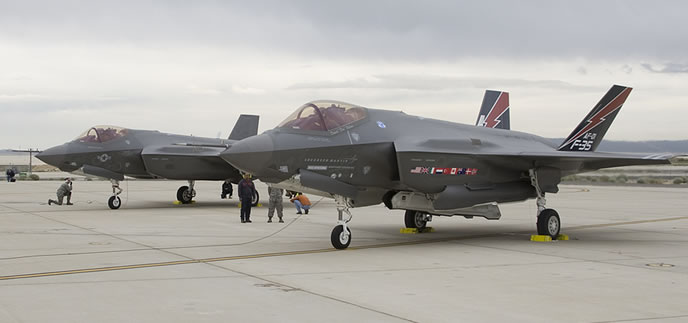
    Above: F-35 AF-1 and AF-2 Arrived at Edwards Air Force Base in May 2010. The F-35A (CTOL) variant is 66 flights ahead of the planned flight testing this year. Last month AF-2 performed the 300th flight flying on a 2.05 hour mission from Edwards AFB. Below, F-35B performs a vertical landing. Photos: Lockheed Martin

    Lockheed Martin F-35C - CF1 First Flight 1 Jeff (SLIM) Knowles Pilot Photo: Lockheed Martin

    With more aircraft joining the combined test force, the F-35 flight testing program gained momentum and, compared to the delays of past years, is now exceeding schedule. Overall, the program has completed 321 flights this year, and is working toward the total of 394 test flight for 2010. The program has logged 460 flights by early November 2010. Particularly impressive is the status of the Conventional Takeoff and Landing (CTOL) variant and the carrier variant (CV). The Short Takeoff and Vertical Landing (STOVL) variant F-35B is still behind schedule.

    Unfortunately, a significant issue recently uncovered with the F-35B STOVL type are cracks developing in the rear bulkhead. Cracks developed on an F-35B ground test plane undergoing fatigue testing after the plane had been subjected to stresses equivalent to about 1,500 hours of flight time. This level is significantly short of the 8,000 hour fatigue limit these structures are designed to withstand.

    Among the recent achievements recorded recently were supersonic flight at Mach 1.3 has recorded by the F-35B, this variant also achieved 7 g’s, the highest load condition to date and maximum design g’s for the STOVL.


    Another ‘first’ recorded with the F-35B was the delivery of the fourth pre-production aircraft (BF-4), the first ‘Lightning II’ equipped with the ‘Block 1’ avionic software, enabling most of the primary sensors on the F-35. This software forms the foundation of all subsequent software blocks for the F-35. It enables information fusion from the F-35’s radar, electronic warfare system, Distributed Aperture System, electro-optical targeting system and other sensors, and provides initial weapons-release capability. Prior to the integration in the F-35 the new software has flown for several months on the Cooperative Avionics Test Bed (CAT-bird), the airborne integration lab flying in a modified Boeing 737, simulating the new fighter plane.

    The delays in development and testing have increased the cost of the aircraft. In an effort to control the escalating cost the Pentagon negotiated a shift from previous cost-plus-incentive fee which was optimized for the development phase, into price incentive scheme, challenging the manufacturer with more responsibility of cost controll. Lockheed Martin has agreed to modify the current low rate initial production Lot IV aircraft contract to a fixed-price-incentive (firm target).  Under the new arrangement, Lockheed and the Pentagon share on a 50-50 basis all overruns topping the F-35’s “target price.” Lockheed would be required to absorb the entire overrun once the price exceeds an upper-limit “ceiling.”

    The Pentagon announced Nov. 19, 2010 the awarded about $3.5 billion modification covering the procurement of 31 aircraft. This contract represents an average cost of $105-109 million, slightly above Pentagon estimated rate, this amount allocates the necessary funding for flight testing, and other developmental activities. The current lot includes 10 conventional take-off and landing aircraft for the U.S. Air Force (31.6% of the cost); 16 short take-off vertical landing (STOVL) aircraft for the U.S. Marine Corps (48.4%); one STOVL aircraft for the United Kingdom Royal Navy (3.4%); and four carrier variant aircraft for the U.S. Navy (16.6%). 

    Parallel to this progress, F-35 is also gathering momentum in the world market. Japan is likely to consider the aircraft in favor of the development of an indigenous 5th generation fighter. The U.S. administration is moving to clear the sale of a second squadron of 20 F-35s aircraft to Israel, given an agreement from Jerusalem for foreign policy concessions demanded by the White House. Lockheed Martin is also hopeful that the U.S. administration will approve its request to offer the F-35B or F-35C carrier version to India, replacing the Indian Navy fleet of Sea Harrier. India had already floated a request for information (RFI) for a carrier based fighter plane earlier this year. India is planning to launch several new aircraft carriers through the decade. For the near term, MiG-29K was selected as the principal naval aviation fighter aircraft.

    Russian Air Force to Get more Su-34s by Year’s End

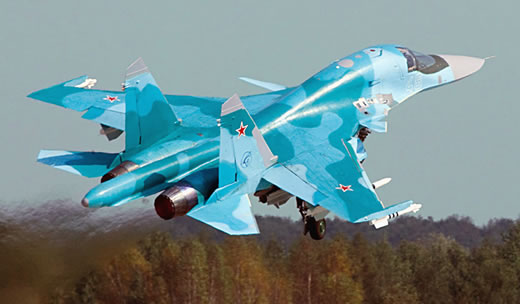
    Su-34 Taking off, the Russian Air Force could receive a new batch of these long range fighters by the end of 2010. Photo: Sukhoi

    Sukhoi Company conducted flight tests of serial Su-34 fighter bombers at the Chkalov Aviation Production Association (NAPO) flight testing station in Novosibirsk, prior to entering serial production of the aircraft at the company’s NAPO plant. The Russian Air Force has already received initial deliveries of Su-34s, with another delivery expected until the end of 2010.

    Su-34 Taking off, the Russian Air Force could receive a new batch of these long range fighters by the end of 2010. Photo: Sukhoi

    The Su-34 can effectively attack land-based, sea- and airborne targets by day and night in all weathers using the entire suite of its airborne munitions, including high-precision types. In terms of operational capabilities this is a 4+ aircraft. Its active safety system, along with the newest computers, provides extra capabilities for the pilot and navigator to perform aimed bombing and to maneuver under enemy fire. Su-34’s combat potential will be enhanced soon by the introduction of new aerial weapons.

    A +4th Generation strike fighter, Su-34 offers outstanding range and payload performance, provided by fuel-efficient bypass engines, large internal fuel capacity and in-flight refueling capability enable the aircraft to fly long distances close to those of medium strategic bombers. The aircraft carries a wide range of weaponry and is fitted with an armored cockpit for increased crew survival.

    Last July Su-34s proved their high combat capabilities and flight performance at the Vostok-2010 military exercises. The aircraft successfully hit mock targets in the Russian Far East after flying non-stop all the way from a base in the European part of Russia, using mid-air refueling.

    New Composite to Improve B-2 Durability

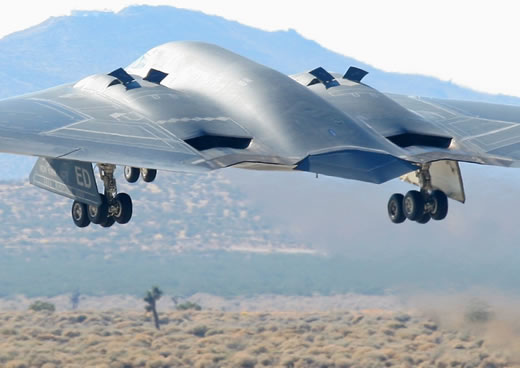
    Northrop Grumman B-2 Spirit stealth bomber takes off. The hot trailing edge are seen as dark surfaces on the wing trailing edge, just behind the engines.

    The U.S. Air Forces’ Research Laboratory (AFRL) has implemented Hot Trailing Edge (HTE) skin composed of AFR-PE-4 composite material on the B-2 stealth bomber. Through the implementation of the new composite AFRL expects to virtually eliminate field repairs, reduce downtime, and achieve higher mission capability rates for the bomber.

    Northrop Grumman B-2 Spirit stealth bomber takes off. The hot trailing edge are seen as dark surfaces on the wing trailing edge, just behind the engines.

    Located behind the exhaust nozzles on the aircraft’s upper surface, the B-2 HTE experiences repeated thermal and vibro-acoustic stress. The polyimide material presently used for HTEs degrades quickly in this operational environment; as the incessant exposure to heat and engine exhaust exceeds its capabilities, the material cracks and the resin disintegrates. Recognizing the need for a more resilient material in late 1990s, AFRL commenced its design of a new application based on AFR PE 4. Through the recent demonstration the new skin was confirmed to be more durable, higher-performing material, compared to the HTE material currently used on B-2s. Following the recent tests, future AFRL activities will include preparation of the demonstrated materials for flight evaluation on the B-2.

    Next Generation AEGIS Missile – Missile Defense Roadmap

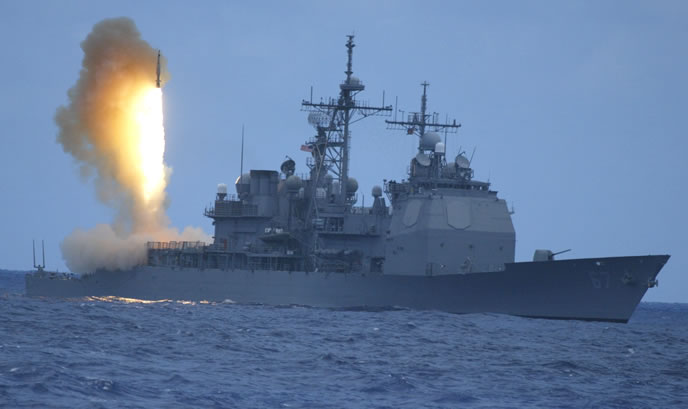
    Photo above: Tichonderoga class missile cruiser CG 67 Shiloh fires a Standard Missile 3 on a missile defense test. Photo: US Navy

    In recent years the U.S. has increased its missile defense capability, with the introduction of enhanced capability Patriot (PAC-3) missiles, offering improved point defense against Short Range Ballistic Missiles. Sensors are also improved with AN/TPY-2 X-band radars providing detection and tracking of ballistic missiles at very long ranges andspace-based sensors – increasing early warning of missile launches. Limited trajectory tracking demonstrated by new sensors offer great opportunities for the future. Theater High Altitude Air Defense (THAAD) missile batteries will soon be deployed, improving defense against short-and medium-range ballistic missiles. While Standard Missile 3 Block IA missiles are transforming naval vessels into rapidly deployed, forward positioned sea-based Aegis systems, providing surveillance, tracking, and engagement.

    The new policy on missile defense announced by the Obama administration increased the procurement of proven systems, investing in mobile and relocatable assets offering flexible and adaptable deployment options to meet changing threats. This policy has focused research and development (R&D) on enhancing the capabilities of current interceptor variants – sea based and land based, improving command, control, and battle management, and deploying more capable sensors, including Precision Tracking Space Sensor (PTSS), enabling defensive systems to establish target track and perform an intercept as early as possible.

    Part of the U.S. Phased Adaptive Approach for theater missile defense, is increasing current capabilities in 2-3 year increments. An initial capability provided today by Patriot and Aegis ships at sea is being fielded now and, according to NATO spokesman James Appathurai, will be operational within weeks.

    NATO’s leaders meeting this week in Lisbon will decide whether the alliance should build a missile defense for Europe, enhancing the system already being established supporting theater defense system at an investment of €800 million. According to the alliance officials, the additional budget required to enhance the system to extend its coverage to Europe is only €200 million.

    2010: Today’s Missile Defense

    Current deployable missile defense system is geared against short and medium range ballistic missile threats, primarily those posed by Iran. The systems consist of AN/TPY-2 forward based radars and AEGIS BMD cruisers equipped with Standard Missile 3 Block IA, all linked to linked to the command, control and battle management center (C2BMC) operations center located at Ramstein Air Force base in Germany.

    2012: ALTBMD Integrates NATO Assets

    A new capability to be introduced by NATO in 2012 is the Active Layered Theatre Ballistic Missile Defence (ALTBMD), a distributed network linking various radars and sensors operated by different NATO countries, embarked by NATO in 2005. The new network building on the current capabilities, expected to launch in 2012, to enable each member nation to better employ its own missile defenses assets against incoming threats. Four European nations will contribute weapons systems and sensors for ALTBMD interim capability – Germany providing Patriot Advanced Capability (PAC 3) missiles, France offering SAMP/T missiles; Italy, contributing Horizon-class frigates and the Netherlands linking its PAC-3 missiles and Air Defense Command (ADCF) frigates. The United States will allocate Aegis cruisers, Patriot missiles, and space early warning to support the European missile shield.

    2015: Initial Deployment

    By 2015 the current and ALTBMD capability will be enhanced with the introduction of the Next Generation Aegis 5.0 system, in land based units and naval platforms. The new Aegis version will employ SM-3 IB missiles, along with land based THAAD.

    2017: Increased NATO Participation

    More NATO members are expected to share their assets supporting ALTBMD in its full capability deployment, as NATO will plans to extend the system to cover ‘upper tier’ engagements, increasing detection range beyond 3,000 km. Hopefully, by that time, the new Medium Extended Air Defense System (MEADS) missile weapon systems are expected to be operational with the U.S., Germany and Italy; employing SAMP/T weapon systems and TPS 77 radars. Spain is expected to join, with Greece contributing Patriot systems, Patriot and F100 frigates, while Germany bringing new assets including the F124 frigates and Global Hawk unmanned systems online. Toward the end of the decade the U.S. will also dedicate more assets to ALTBMD, including new AN/TPY 2 radar sites in Eastern Europe and Land based Aegis and THAAD systems.


    2018: Enabling Early Intercept

    By 2018 the U.S. is planning to establish improved area coverage against medium and intermediate range ballistic missiles (MRBM/IRBM), with the introduction of two sites of Aegis Ashore 5.1 each equipped with SM-3 Block IB or IIA interceptors. With the Next Generation Aegis Missile (NGAM) fielded by 2020, the alliance will also have the interceptors capable of engaging targets at greater distances, extending the alliance defense against intercontinental ballistic missiles (ICBM). The distributed, deployment of defensive assets will not depend on a central operating center and rely on the distributed assets for engagement command and control.

    More on the Next Generation Missiles:

    Next Generation AEGIS Missile – Introducing SM-3 IIB

    Boeing, Northrop Grumman and Lockheed Martin are competing on the technology development phase of the next generation Standard Missile-3 Block IIB (SM-3 IIB) ballistic missile interceptor. Designated ‘Next Generation Aegis Missile’ (NGAM), the new missile will be developed for the U.S. Missile Defense Agency, becoming a key component of the Obama administration’s Phased Adaptive Approach for missile defense in Europe.

    The new missile will be optimized for such early intercept engagements, increase the area defended by each vessel or ground based interceptor site. In addition, the new missile will introduce early intercept capability against Intercontinental Ballistic Missiles (ICBM).

    By early 2011 the agency is planning to award up to three NGAM contracts next year for a 32 month concept definition and program planning phase. Therefore, all three teams could remain in the game at least until the missile development phase starting 2013.

    This initial phase will focus on defining design objectives, conducting trade studies to establish a technical baseline, reducing technology risk and developing an executable program plan. A competitive product development phase will follow. The new missile is scheduled to enter service around 2020.

    The new interceptor will be designed to provide early intercept capability against some short range ballistic missiles, all medium range ballistic missiles, all intermediate range ballistic missiles and non-advanced intercontinental ballistic missiles. The Next-Generation Aegis Missile will provide early intercept capability against intermediate- and long-range ballistic missile threats as a key element of the Phased Adaptive Approach, which will provide robust defensive capabilities against regional threats on a global basis. The new missile will integrate into the Aegis Weapon System – on land and at sea, it will become part of the Aegis BMD 5.1 and be compatible with existing MK 41 Vertical Launching System. MDA also requires the new missile to maximize High Altitude Exo-Atmospheric Nuclear Survivability (HAENS) and use multi-frequency data link providing highly survivable connectivity during intercept.

    More on the Next Generation Missiles:

    Next Generation Missiles – LRASM

    Long Range Strike Missile

    The Defense Advanced Research Project Agency (DARPA) has awarded Lockheed Martin a contract worth $157 million for the development of an advanced long range anti ship missile (LRASM). The new anti-ship missile and its associated systems will extend the effective attack range of Navy warships beyond current or projected enemy anti-air and anti-ship capabilities. The new missile is required to counter the perceived threat from China, equipped with land based or shipborne ballistic missiles capable of targeting U.S. Carrier groups from a distance of hundreds of kilometers away.

    Unlike current anti-ship missiles LRASM be capable of conducting autonomous targeting, relying on on-board targeting systems to independently acquire the target without the presence of prior, precision intelligence, or supporting services like Global Positioning Satellite navigation and data-links. As an autonomous weapon LRASM will rely exclusively on on-board sensors and processing systems. According to DARPA, these capabilities will enable positive target identification, precision engagement of moving ships and establishing of initial target cueing in extremely hostile environment. The missile will be designed with advanced counter-countermeasures,to effectively evade hostile active defense systems.


    LRASM will comply with existing weapon launchers and storage systems, fitted to match existing the VL-41 Vertical Launch System carried on board all modern U.S. Navy combat ships. There are currently 8,500 VLS tubes in the US Navy including those based on cruisers (CG-47), destroyers (DDG-51) and submarines (SSN, SSGN).

    Since 2009 Lockheed Martin has completed trade studies, system performance analysis, and passed preliminary design review and operational effectiveness assessment through the first phase. Two LRASM concepts were assessed – LRASM B, a high altitude, supersonic, ramjet-powered cruise missile. This design leverages prior ramjet development activities and a suite of supporting sensors and avionics to achieve a with balanced speed and stealth for robust performance. The second LRASM design is stealthier, low-level cruise-missile designated LRASM A. This design utilizing the Joint Air to Surface Standoff Missile Extended Range (JASSM-ER) airframe, added with additional sensors and systems to achieve a stealthy and survivable subsonic cruise missile. LRASM A is considered more suitable for air launched applications.

    Phase 1 ended successfully and provided sufficient confidence in the two designs to support further investment for flight testing. The current 27 month second phase will refine these concepts, culminating in flight testing and a critical design review of the chosen design. As part of this second phase, LRASM-A will execute two air-launched demonstrations leveraging its JASSM-ER heritage and demonstrating applicability to Navy and Air Force tactical aircraft employment, while LRASM-B will complete four Vertical Launch System (VLS) demonstrations proving applicability to Navy surface combatant employment. Both LRASM-A and LRASM-B designs plan to support air-launch and VLS-launch configurations.

    DARPA has selected three vendors to complete the design and flight demonstration of the two LRASM variants as well as deliver common sensor technology. Lockheed Martin Missiles and Fire Control Strike Weapons, based in Orlando, Fla., will demonstrate the LRASM-A prototype weapon system while Lockheed Martin Missile and Fire Control Tactical Missiles, based in Grand Prairie, Texas, will demonstrate the LRASM-B prototype weapon system. BAE Systems, Information and Electronic Systems Integration, based in Nashua, N.H., will design and deliver the onboard sensor systems to support both LRASM variants.

    While LRASM is positioned as a direct successor for the Harpoon, the development of a more ambitious weapon known as ArcLight is also under evaluation at DARPA as a quick reaction weapon hitting time critical targets at a distance of 2,000 nautical miles within 30 minutes. ArcLight will employ a rocket booster, sustainer accelerating the weapon to hypersonic speed, from where the strike vehicle will glide at high speed, carrying a warhead weighing 100-200 pounds to strike the target with pinpoint accuracy. ArcLight, like LRASM, will also be stored in, and launched from existing Mk 41 VLS.

    “ArcLight will offer a game changing warfare capability.” DARPA explained, “The ability to hit targets worldwide from several ships reduces the need for having less capable strike assets forward deployed and enables tactical and political flexibility. The cost of launching a comparable strike from Continental US (CONUS) is significant, likely to limit use of such a system and provides an opportunity for adversaries to observe launches from fixed sites” the agency explained. A major challenge for ArcLight designers is the design of a wing assembly able to transform from storage, through acceleration to high speed gliding formation. According to DARPA, such wings would likely use shape changing or harden post launch formations to withstand the flight environment.

    Another design known as RATTLR (seen in the image above) was also studied by the US Navy in past years but has not matured into a full scale development program.

    More on the Next Generation Missiles:

    Early Intercept Calls For Kills At Extended Range

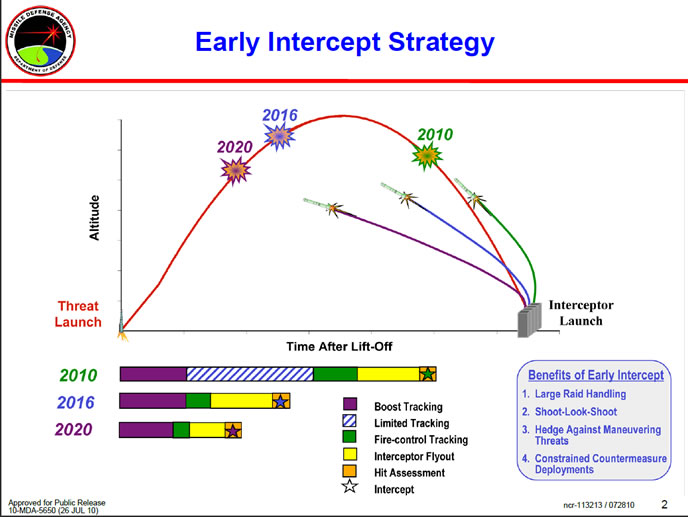
    The integration of new sensors, longer range missiles and whole new battle management system will enable the U.S. Navy and NATO to conduct ‘Early Intercept’ – engaging ballistic missile targets at their ascent phase, before enemy missiles reach apogee. There are many benefits to this method, including the ability of the defender to handle large raids (salvos), engage target missiles before they can take evasive maneuvers or deploy countermeasure decoys. The early intercept also offers more effective shoot – look – shoot strategy.

    The new missile will be designed to achieve earlier intercepts by maintaining higher velocity, and increased divert energy management, enabling the Aegis 5 system to launch interceptor missile during the target’s boost phase, updating the intercept plan and sending it to the missile enroot to its target.

    The main challenge of early intercept capability is the limited tracking provided by current sensors, where a tracking gap exists between targets detection by heat signature, during the boost phase, and tracking it by radar and fire control during mid-course and terminal phase. This gap is expected to be eliminated around 2016, when new sensors – radar and space based sensors will be able to continuously track enemy missiles from launch to impact. By 2020 direct handoff between boost phase and fire control tracking will enable interceptors to fly out shortly after a hostile launch is confirmed, hitting their targets during ascent, at lower altitude, sometime when the missile is still over enemy territory.

    More on the Next Generation Missiles:

    Next Generation AEGIS Missile

    Three companies were awarded development contracts in 2010 to demonstrate conceptual designs for the Next Generation Aegis Missile (NGAM) – Boeing, Northrop Grumman and Lockheed Martin. While Raytheon, the manufacturer of all Standard Missiles has not been mentioned in relation to this future program it is likely that they will again partner with Lockheed Martin for this development. The two companies have recently extended their AEGIS cooperation to support the Ground Based Interceptor missile.

    NGAM has entered preliminary development phase in November 2010. This new capability will rely on the ‘Standard Missile 3 Block IIB’ (SM-3 Block IIB) sponsored by the U.S. Missile defense Agency. The new missile will enhance the capabilities of future AEGIS cruisers to defeat ballistic missiles by extending their range and sensor capability to target ballistic missiles on the ascent phase of their flight.

    The missiles currently used for missile defense are SM-3 Block IA, first generation Aegis BMD missiles. These missiles are deployed on 24 Aegis BMD-equipped warships – 20 in the U.S. Navy and four in the Japanese Maritime Self-Defense. Twelve additional ships have been identified for modification to perform ballistic missile defense in the next 3 years. These vessels are all operating the Aegis version 3.61 weapon system.

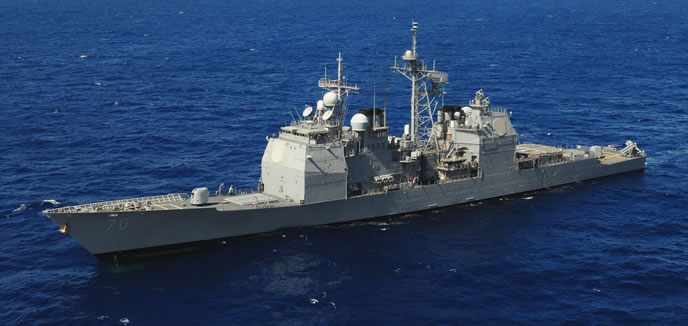
    The second-generation Aegis BMD Weapon System (Version 4.0.1) is already integrated on CG-70 Lake Erie. This system is designed to defeat more complex ballistic missile threats. Aegis BMD 4.0.1 includes the BMD signal processor, which improves target identification. The new version marks the beginning of the transition to the Navy’s open architecture – a transition that will be complete with software upgrades, known as Advanced Capability Build 12. Certification and deployment of the new system is scheduled for September 2011.

    More on the Next Generation Missiles:

    CG 70 Lake Erie is the first Tichonderoga class missile cruiser fitted with AEGIS BMD version 4.1optimized for missile defense. Photo: U.S. Navy

    U.S. Army set for Operational Testing of Ground, Foliage Penetrating Airborne Radar

    Lockheed Martin is discussing potential operational deployment of airborne, synthetic aperture radar (SAR) foliage penetrating radar next year. The UHF-band Tactical Reconnaissance and Counter-Concealment-Enabled Radar (Tracer) has completed 15 months testing on an Army C-12 aircraft and is currently undergoing flight testing on a NASA-operated Predator B unmanned aircraft. That can spot targets under camouflage or buried underground objects.

    The initial operational application of TRACER would be on a manned aircraft, designed to perform automated, wide area surveillance detecting changes in the scene being inspected. By the end of 2010 the company is expected to deliver the last of four radars ordered under the U.S. Army contract. One of the four systems will be deployed for operational evaluation. Pending positive results of the evaluation, Lockheed Martin could enter low-rate production under a new contract.

    The company also considers introducing certain enhancements to TRACER, including ground moving-target indication (GMTI) and a “circle-SAR” feature, enabling the radar to sharpen the image processed from a target through frequently repeating scans. Tracer was developed as a dual-band system, enabling effective ground and foliage penetration using UHF and VHF frequencies. The compact UHF antenna has been integrated on the unmanned aircraft while the VHF antenna began flying on a surrogate manned platform in October 2010. Packing the antenna into more compact module is already underway, matching medium size platforms such as the C-12, Predator and Gray Eagle UAVs.

    Skunk Works and XTEND Simplify Multi-Drone Command

    0
    Lockheed Martin Skunk Works® and XTEND have achieved a major milestone in JADC2 by integrating the XOS operating system with the MDCX™ autonomy platform. This technical breakthrough enables a single operator to simultaneously command multiple drone classes, eliminating the friction of mission handoffs. From "marsupial" drone deployments to operating in GPS-denied environments, explore how this collaboration is abbreviating the data-to-decision timeline and redefining autonomous mission execution.

    From Ukraine to Taiwan: The Global Race to Dominate the New Defense Tech Frontier

    0
    As traditional defense primes face mounting competition from agile “neoprimes” such as Anduril, Palantir and Helsing, the balance of innovation is shifting toward software-defined warfare and scalable, dual-use technologies, while global industry consolidation—marked by Boeing’s integration of Spirit AeroSystems and other strategic mergers—signals an intensified race to secure control over the defense technology value chain. Our Defense-Tech weekly report highlights these trends.

    Europe’s “Drone Wall”

    0
    In early October 2025, a coordinated wave of unmanned aerial system (UAS) incursions—widely attributed to Russia—targeted critical infrastructure across at least ten European nations. The unprecedented campaign exposed the fragility of Europe’s air defenses...

    Weekly Defense Update & Global Security Assessment

    0
    Executive Summary The past week (September 18-25, 2025) represents an inflection point where strategic defense concepts have transitioned from doctrine to tangible reality. An analysis of global events reveals four primary, interconnected trends shaping an...

    U.S. Air and Space Forces Push Next-Gen Programs at the AS&C 2025 Conference and...

    0
    At the 2025 Air, Space & Cyber Conference, U.S. Air Force and Space Force leaders unveiled major updates on next-generation fighters, bombers, unmanned systems, and space initiatives, highlighting both rapid innovation and critical readiness challenges as the services race to outpace global competitors. A short version is available here, with a more detailed version for subscribers.

    TADTE 2025: Reflecting Taiwan’s Strategic Themes

    0
    The Taipei Aerospace & Defense Technology Exhibition (TADTE) 2025 crystallized around four dominant strategic themes that collectively illustrate Taiwan's comprehensive approach to defense modernization amid escalating regional tensions. Based on a detailed report by Pleronix (available upon request). Includes a Podcast discussion on TADTE 2025's highlighting Taiwan's four strategic themes beyond the post's coverage.

    Iron Beam 450 Completes Testing, Soon to Join With Operational Air Defense Units

    0
    Israel’s Iron Beam 450 high-power laser system has completed final testing, marking a major leap in air defense. Developed by Rafael, it offers precise, cost-effective interception of rockets, UAVs, and mortars, and is set for IDF deployment by 2025.