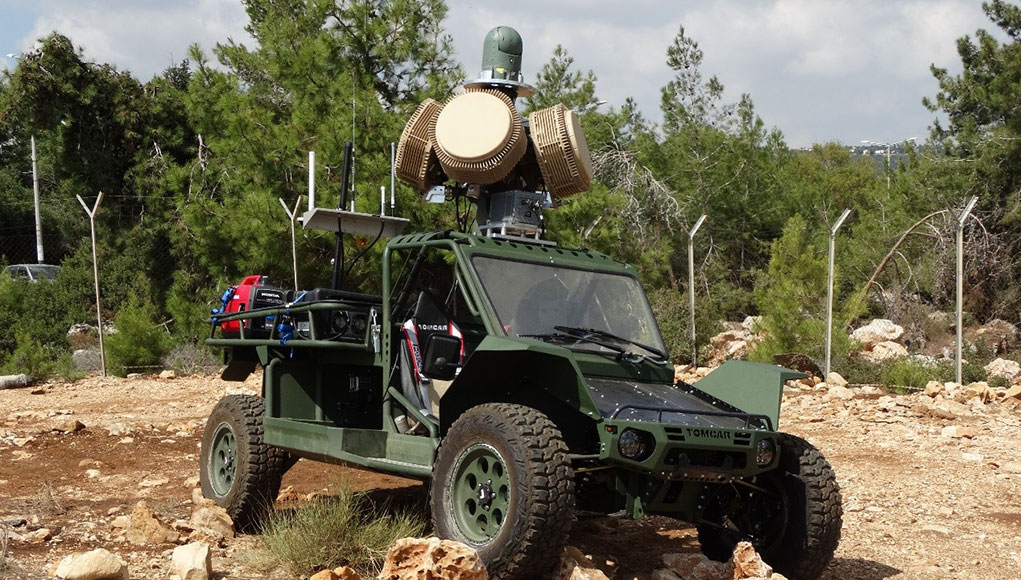
A complete Drone Dome is compact and light enough to mount on an All Terrain Vehicle such as the Tomcar (known as Springer in service with the British Army).
The United Kingdom has ordered six Drone Dome from Israel’s RAFAEL company under an Urgent Capability Requirement (UCR) program, providing quick reaction counter-unmanned aircraft systems (C-UAS) capability. The first phase of the deal is worth US$20 million and will be delivered this year. The British Army is the launch customer for the Drone Dome system.
The UK interest is focused on engaging small drone targets (2-22kg) at distances 500 m or closer. To fulfill this Urgent capability requirement (UCR) the UK restricted the tender to mature systems (TRL8 or higher). The order came only eight months after RAFAEL demonstrated the Drone Dome’s capability to the UK government in January 2018.
Each system includes radars, electro-optical (EO) identification and signals intelligence systems and electronic jammers that disable the drone’s datalink or navigation systems. The systems will be used to protect from airborne drones some sensitive facilities and sites on which British armed forces are deployed.
A complete Drone Dome is compact and light enough to mount on an All Terrain Vehicle such as the Tomcar (known as Springer in service with the British Army).
RAFAEL’s Drone Dome integrates four RPS-42 pMHR S-band multimission 90° hemispheric radars from RADA, and provides early warning and target tracks at ranges of 5 to 3 km. The MEOS electro-optical/infrared (EO/IR) surveillance sensor from Controp, and Netline’s NetSense Wideband RF detection sensors provide target identification. Target engagement by ‘soft kill’ is performed with electronic jamming, using the C-Guard RD jammer, system integration, command, and control. The system also uses a high power laser effector for ‘hard kill’, but, according to RAFAEL, such effectors were not included in the system destined to Great Britain.
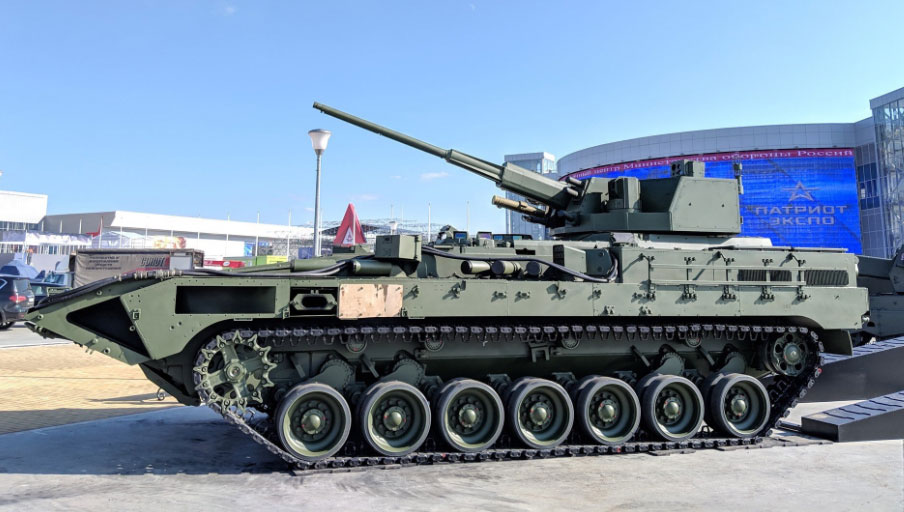
T-15 with a new 57mm turret, on display at Army 2018 #Армия2018
The T-15 and T-14 Armata family tanks and heavy APC are also on display at Army Forum 2018. According to UVZ, the new vehicles will be accessible to all visitors for the first time. Previously displayed with the 30mm turret, the T-15 was shown here for the first time with a 57mm cannon and two missile launchers on the side. The tank on display retains its Afganit active protection system but is shown without the special side armor, showing a full view of the tracks and suspensions.
The turret seems to be a variant of UVZ AY-220M that was already displayed on other platforms. In this configuration, the T-15 adds a more powerful and versatile direct fire weapon that can be used to defeat heavy APCs, as well as against aircraft and drones. It also retains the anti-tank weapons (guided missiles).
UralVagonZavod (UVZ) has developed two variants of the 57mm automatic cannon weapon system. The two configurations – 2S38 and AY-220M share a common automatic gun, firing 57mm high explosive, airburst or kinetic ammunition.
The 2S38, seen here mounted on a BMP-3 chassis is displayed at the Army Forum 2018 opening tomorrow at the Kubinka Patriot Park near Moscow.
The 2S38 is designed for mobile anti-aircraft, anti-UAV, and naval gun. At a weight of five tons, the unmanned turret packs 148 rounds, sustaining a rate of fire of 120 rounds per minute. The installation of the gun enables elevation of +75 and depression of -7 degrees, to enable engagement of targets at higher angles, and naval targets from elevated positions on the coastline. The picture shows the fuse time setter placed at the muzzle, used with airburst ammunition.
The AU-220M has also been demonstrated on a BMP-3. This weapon system is optimized for infantry support. At a gross weight 3.6 tons, the AY-220M turret is significantly lighter than the 2S38. Due to its smaller sizes, the AY-220M can be fitted to smaller vehicles. So far it was mounted on BMP-3 and Paramount’s MBOMBE 8×8 vehicle. The smaller size leaves less space for ammunition (80 rounds) and offers lower freedom of movement (elevation +60 / -5). While the horizontal firing range remains the same on both turrets (14.5 km maximum range) the vertical firing range is reduced to 7.5 km and rate of fire is set to 80 RPM.
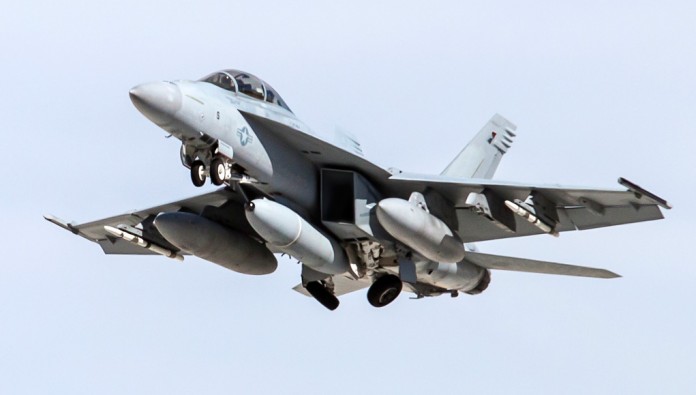
The IRST21 flew for the first time on an F/A-18F in April 2014.
The US Navy awarded the Boeing company a $152 million contract to complete the design, development, integration, and testing of the Infra-Red Search Track (IRST) system for the F/A-18E/F Block III aircraft, the latest variant of the Super Hornet. A few days later the company received another $208 million contract to integrate and produce Lockheed Martin’s Legion Pod IRST for the US Air Force F-15C/D fleet.
The new Block II IRST will replace the Block I system which did not meet the Navy’s requirements. This “see first, strike first” capability empowers pilots with greater reaction time, improving survivability. Development and testing are expected to conclude in 2021, in time for expected Super Hornet Block III deliveries. The first part of this program was an $89 million order awarded in June 2017. In October, the sensor’s manufacturer, Lockheed Martin was awarded $100 to upgrade the IRST21 sensor for the new Block II standard.
The IRST will enable the Navy fighters to target adversaries beyond visual and radar range, and enhance survivability in radar denied environment, operate against existing and emerging air threats. While the US services have yet to embrace IRST technology, some of NATO air forces, as well as Russia and China are employing such systems for many years, as well as Singapore and South Korea, that integrated the US IRST21 on their F-15s. The introduction of high performance, networked IRST utilized as a passive radar rekindled the interest in the technology in the USA.
IRST relies on the thermal signature emitted by the target, tracked from a very long distance. While these tracks are affected by clouds and humidity, the high sensitivity of the Long Wave sensors is optimized for operations even under adverse visibility conditions. The Navy intends to produce a total of 170 IRST systems, produce 152 new Block II systems and retrofit 18 Block I systems currently used for testing.
The IRST consists of a passive long-wave infrared (LWIR) receiver, a signal processor, inertial measurement unit and environmental control unit packed into a section of a fuel tank attached to the belly of the Super Hornet. The Block I IRST of this type used components from the F-15K/SG which are based on the system first used with the F-14A Tomcat since the 1980s. At the time those systems were used to augment the radar and enable the Navy fighters to better identify targets and engage them at extended range. An improved version of the original IRST21 system is designed as a long-range counter-stealth sensor.
The US Air Forces’ F-15 will also receive podded IRST in the near future. Using Lockheed Martin’s IRST21 sensor, similar to that used on the Super Hornet Block III, the pod will also include fast networking and advanced processing to deliver high-fidelity detection and tracking of air-to-air targets. Photo: Lockheed Martin
The IRST will be part of an avionics upgrade that will prepare the Super Hornet to fight modern adversaries. Other elements of that upgrade include the Distributed Targeting Processor – Networked computer (DTP-N), a new, powerful processor that will increase the capability to process multiple tracks, from on board and remote sources, in real time. Remote tracks will be delivered over a new, high speed data link known as the Tactical Targeting Network Technology (TTNT), that enable several Super Hornets flying a loose formation to share many tracks picked by their IRSTs, to passively ‘fix’, geolocate, and determine the range and heading of each target, just like a radar – something a single IRST cannot do.
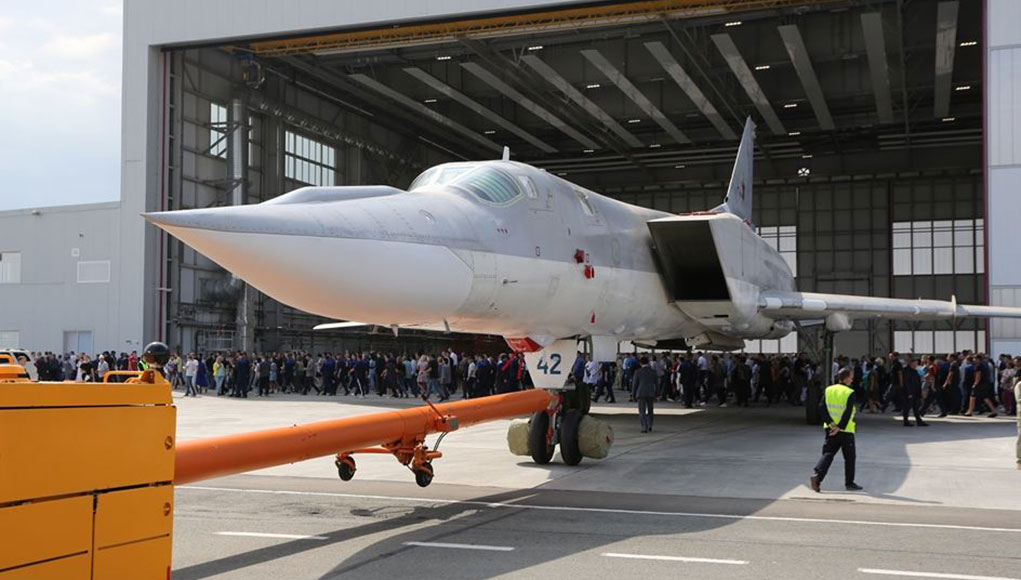
Tupolev Tu-22M3M rolled out at Kazan Aircraft Plant, August 16, 2018. Note the new fairing above the nose, possibly providing housing for a refueling probe. Photo: Tupolev
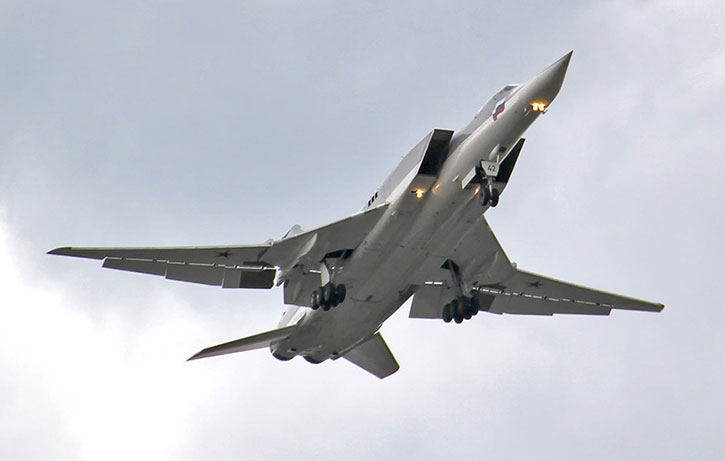
Kazan, Russia – The Tupolev company (part of the United Aircraft Corp.) has rolled out an upgraded version of the Tu-22M (NATO reporting name ‘Backfire’), a supersonic, variable-geometry strike aircraft. Designated Tu-22M3M, the upgraded bomber features updated avionics, navigation, communication and weapon systems improvements. The new avionics improve navigation accuracy and automation on board, thus reducing pilot workload before and during the flight.
The modernization will deal with the obsolescence of the outdated avionics on the Tu-22M, bringing it to the same level as the Tu-160, thus improving spare parts availability. The remaining fleet of Tu-22M operated by the Russian Air Force currently stands around 60 aircraft. It is not clear how many of the aircraft will be modernized to the M3M standard.
It is unclear how many of the Russian air force’s remaining fleet of around 60 Tu-22M3s will be upgraded to M3M standard. According to the company, since the introduction of the Tu-22M in 1989 the Kazan aviation plant has built about 500 such aircraft of different versions.
The modernized aircraft differs from the Tu-22M by the absence of the tail gun position. A new fairing on the nose has been placed, possibly preparing for the integration of a refueling probe. Further upgrades could include the installation of missile pylons that would carry Dagger hypersonic missiles. Each Tu-22M3M will be able to carry four such missiles, compared to a single missile carried by the MiG-31.
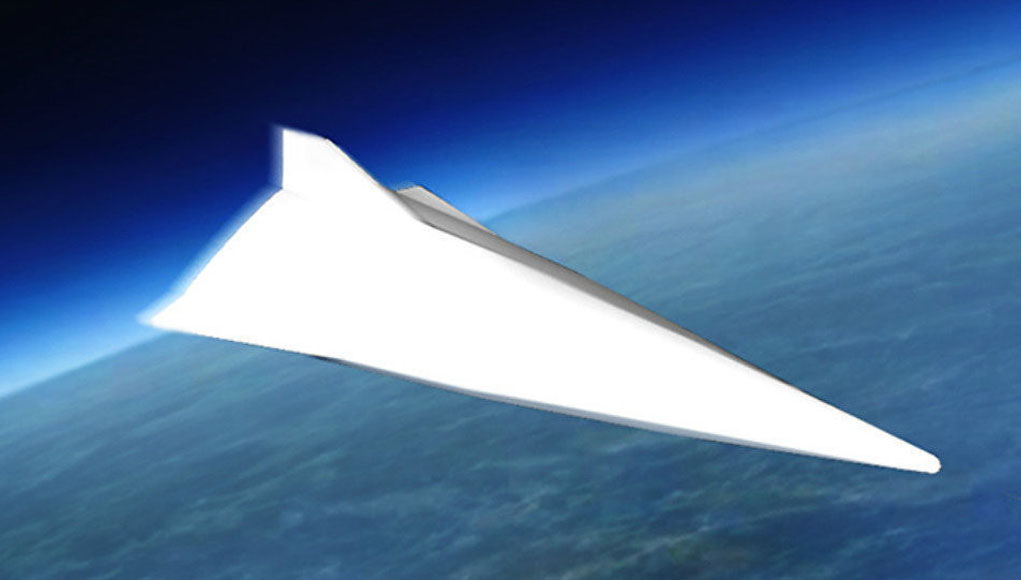
The wedge-shaped waverider bounces on the edge of the stratosphere, to maintain high speed and unpredictable trajectory path that makes it difficult for intercept by missile defenses.
China has successfully tested a hypersonic waverider air vehicle for the first time. The vehicle flew and maneuvered at a speed of Mach 6. The Xingkong-2 waverider type vehicle was launched on a missile and after separation from the rocket launcher the Xingkong-2 (Sky Star) accelerated to the hypersonic speed and performed several maneuvers before it dropped to the surface and recovered.
Flying at the edge of the atmosphere waveriders use the shockwaves generated by their own hypersonic flight to glide at high speed. The test flight took place at the target range located in Northwest China on Friday, August 3, 2018.
According to the China Academy of Aerospace Aerodynamics that conducted the test flight Xingkong-2 was launched on a rocket and was released into the air. After separation it ascended to an altitude of 30 kilometers flying at Mach 5.5-6, (7,344km/h) speed for more six minutes, turning and making high-altitude maneuvers, according to the academy. At the end of the test, the flight vehicle was successfully recovered.
The wedge-shaped waverider bounces on the edge of the stratosphere, to maintain high speed and unpredictable trajectory path that makes it difficult for intercept by missile defenses. Designed by the China Academy of Aerospace Aerodynamics under China Aerospace Science and Technology Corporation, the Xingkong-2 design could be adapted to carry conventional or nuclear weapons in the future.
Similar designs are in development in Russia and the USA. Russia is expected to mature a hypersonic reentry vehicle and integrate it with the new Saramat intercontinental ballistic missiles by 2019. The USA is also pursuing hypersonic weapons but their development is not as mature as the Russians or Chinese systems.
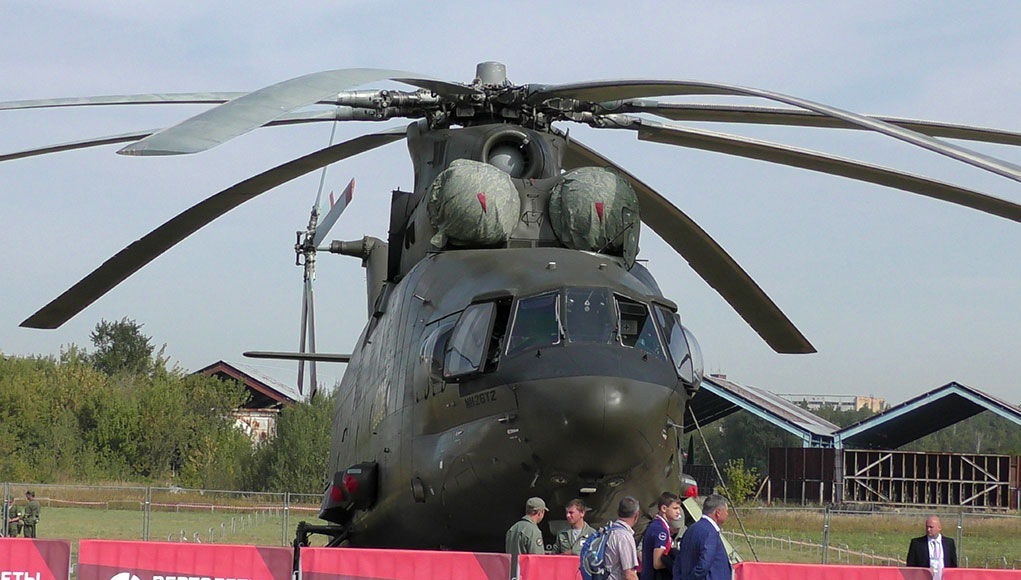
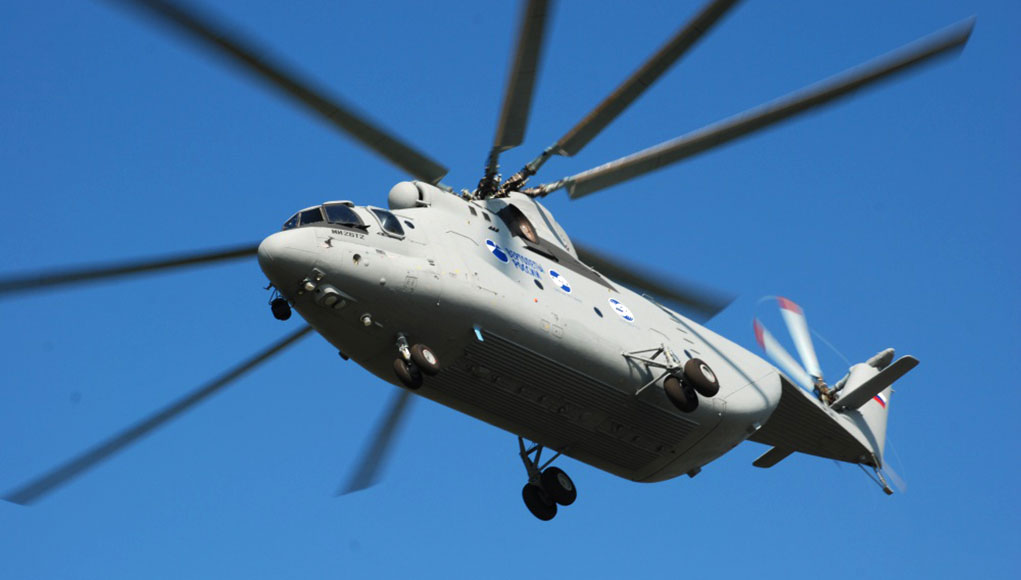
Mi-26T2 is the latest production version of the Russian giant helicopter. The modernized version will offer improved avionics, flight automation, communications and survivability. Photo: Tamir Eshel, Defense-Update
Russian Helicopters Plans to begin test flights of the new, modernized variant of the Mil Mi-26 helicopter and fly its new helicopter to the Army 2018 exhibition near Moscow by the end of the month. Following the manufacturer’s flight tests the helicopter will be handed over to the government for operational tests. It will be the heaviest variant of the Mi-26 to be operated by the Russian forces. “Mi-26T2V will be even more efficient and reliable, even when used in bad weather and difficult terrain,” said Russian Helicopters CEO Andrey Boginsky.
The Mi-26T2 is the current variant, has a maximum takeoff weight of 56,000 kg (112,000 lbs), with payloads up to 20 tons (40,000 lbs.) The new helicopter will offer the same performance. As a modernized version it will bring earlier models to the T2 standard. The Mi-26 is operated by a crew of five but the improvements introduced by the BREO-26 avionics suite enables most missions to reduce the to crew to 2-3 persons.
The Russian military customer required the Mi-26T2V to complete tasks in regions with complex physical, geographical and adverse climatic conditions, at any time of the day, in civil airspace and routes or uncharted terrain and airspace, including featureless terrain. It will be equipped to survive enemy fire and air defenses as well as electronic jamming and countermeasures.
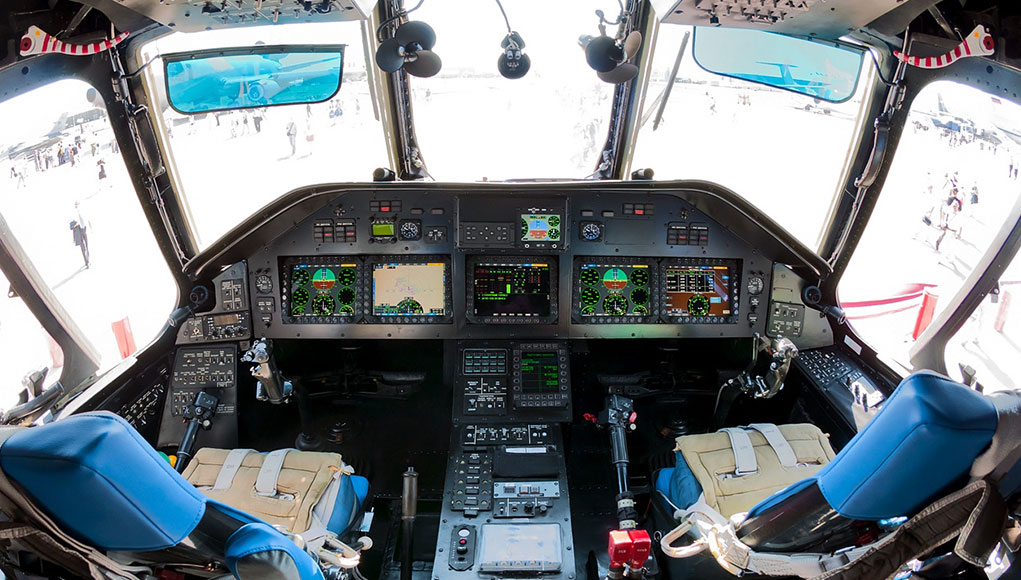
The new version differs from the current Mi-26 in its new modern NPK90-2V (BREO-26) integrated avionics, which significantly simplifies the piloting of the helicopter.
The new version differs from the current Mi-26 in its new modern NPK90-2V (BREO) integrated avionics, which significantly simplifies the piloting of the helicopter. The avionics suite features a new digital flight computer and mission management that enable the crew to fly fully automatic modes, follow predefined routes, arrive at a preset point, perform approach and final approach maneuvers, and return to the main or alternate aerodrome. The navigation and communications systems were improved, with NAVSTAR/GLONASS support and the introduction of satellite communications terminal. The interface with the crew uses a digital cockpit and multifunction color displays and indicators that significantly reduce crew workload.
The new variant will have the Vitebsk airborne defensive suite detects threats, enables the crew to take evasive maneuvers and deploy countermeasures against threats. Other safety and survivability enhancements include improved night operations, employing night vision goggles (NVG) compatible infrared lighting, crash worthy seating for the crew.
Reaching a maximum speed of 295 km/h (183 mph) and cruise at 255 (158 mph) the Mi-26T2 has a range of 800 km (497 miles). When equipped with four additional fuel it can ferry up to 905 km (562 miles). The extra fuel can also support aerial refueling of other helicopters or fixed wing aircraft. The service ceiling is 4,600 m (15,000 ft) with hovering ceiling of 1,520 m. (5,000 ft).
The Mi-26T2V can lift 20 tons and hover (out of ground effect) at 5,000 ft. Photo: Russian Helicopters
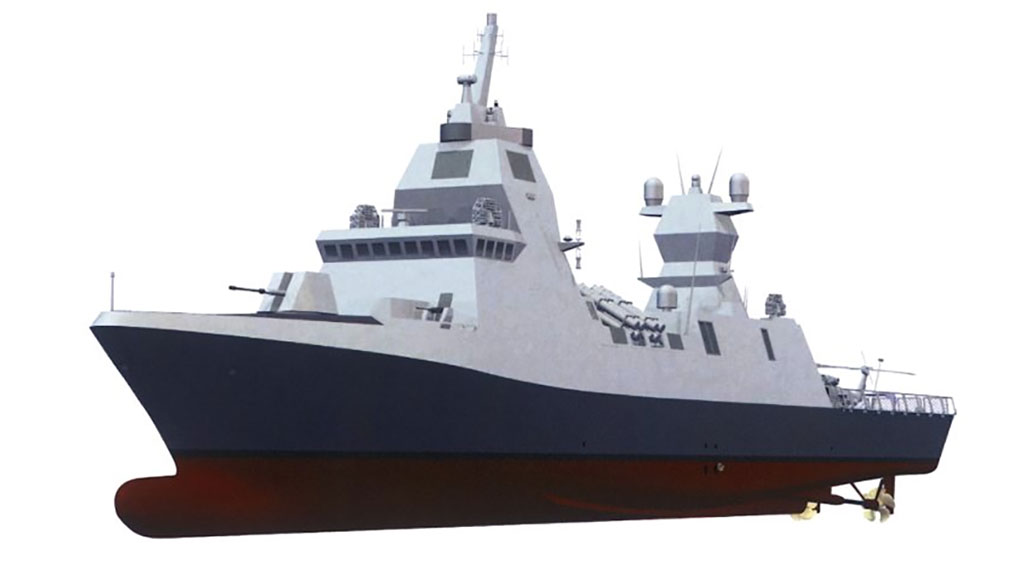
With the first of four Magen Class corvettes under construction at the ThyssenKrupp Marine Systems shipyard in Kiel, Germany, Israel’s Ministry of Defense (IMOD) is preparing the systems to be installed on those ships as they arrive in Israel, beginning in the next year.
As they arrive in Israel those vessels will be fitted with sensors, weapons and combat management systems, most of them from indigenous suppliers.
Israel Ministry of Defense (IMOD) began placing orders for the combat systems for those vessels.
Oמ August 14 Israel Aerospace Industries (IAI) announced it has entered an agreement to provide part of the air and missile defense systems to of the Sa’ar-6 corvettes. “The procurement of Barak-8 System for the Sa’ar-6 corvettes will expand the operational capabilities of the Israeli navy, including the defense of Israel’s territorial and exclusive economic zone.”
A week earlier Elbit Systems announced the receipt of an Israel Ministry of Defense (IMOD) order worth US$85 for electronic warfare systems destined for those ships. The contract will be performed over a 10-year period.
The EW systems to be supplied under the contract include digital receivers, signal processing technologies and analysis tools that are all of an open system architecture, thus enabling effective operational capabilities while maintaining flexibility to cope with both current and future threats.
“The increasing demand for our EW solutions is a clear indication for the growing operational importance of advanced and combat-proven EW capabilities in all domains of operational engagement – maritime, land and air.” Edgar Maimon, Executive Vice President and General Manager of Elbit Systems EW and SIGINT – Elisra, commented.
According to IMOD, the first ship will be delivered in 2019 and all four ships are expected to be delivered by 2021. The vessels will be called INS Magen (Defense), Oz (Courage), Atzmaut (Independence) and Nizachon (Victory). “We will receive the ships in about two years, each one a few months after the last,” Commander of the Israel Navy, Major General Eli Sharvit said. “The arrival of the ships is expected to significantly change the face of the Navy and particularly our surface flotilla.”
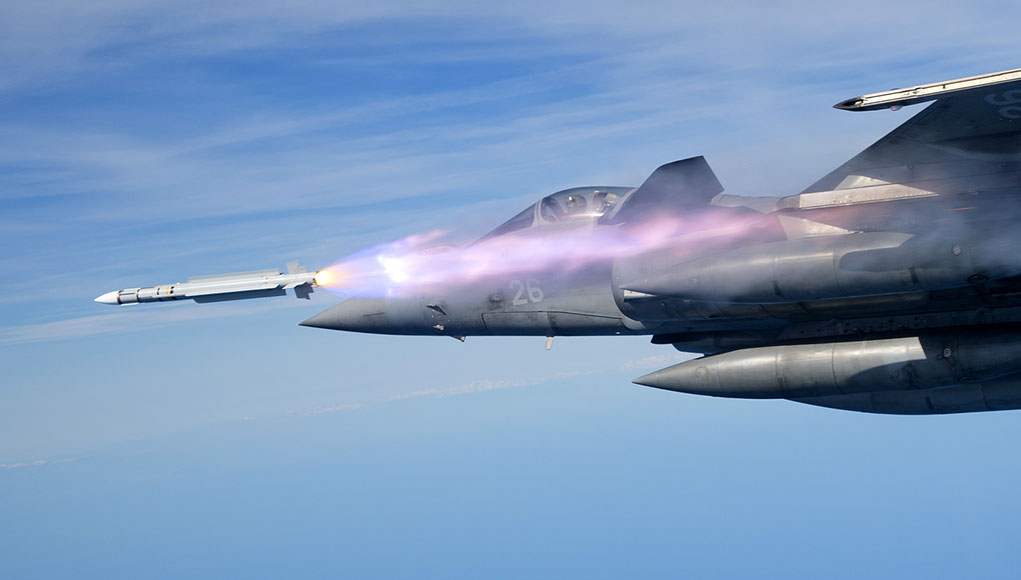
MICA RF-guided variant launched from a French Rafale fighter jet. Photo: C.COSMAO, AIr & Cosmos via MBDA
Updated November 9, 2018: The French armament directorate (DGA) has launched a development program that will modernize the MICA air/air and surface/air missile, introducing a new generation of the weapon (MICA NG). “The upgrading of the MICA family will enable us to support the armed forces throughout the remaining operational life of the Rafale”, MBDA CEO Antoine Bouvier said.
The need for modernization is determined by the obsolescence of the current MICA that was first introduced in 1996. All current missiles of this family are planned to be phased out of service by 2030. The missile development will continue through 2026. Production and initial deliveries to the French Air Force and Navy are expected to continue through 2031.
Maintaining the size, weight and electronic interfaces of the current missile, MICA NG will provide the most effective successor to MICA. With an improved seeker and new propulsion, it will have the agility and performance to cope with modern threats and countermeasures. This includes targets with reduced infrared and electromagnetic signatures, atypical targets (UAVs and small aircraft), in addition to the threats normally countered by air-to-air missiles (combat aircraft and helicopters).
The new generation will maintain the same MICA versions – a passive (infra-red homing) and active (RF seeker). Among the enhancements to the MICA NG are the use of a new infrared seeker that uses a matrix sensor providing greater sensitivity. The radio frequency seeker will use an AESA (Active Electronically Scanned Antenna) antenna, enabling smart detection strategies. The reduced volume of electronic components within MICA NG will allow it to carry a larger quantity of propellant, thereby significantly extending the range of the missile. Utilizing a new double-pulse rocket motor will also provide additional energy to the missile at the end of its flight to improve maneuverability and the ability to intercept long-range targets. The missile’s health will be monitored continuously by internal sensors, through the weapon’s life, in storage, transport and in flight. This function will contribute to reduce maintenance requirements and cost of ownership.
Rheinmetall to supply 1256 additional Argus soldier systems to the Canadian Armed Forces. Photo: Canadian Forces
The Canadian Armed Forces have exercised options under the Integrated Soldier System
Project (ISSP) to procure an additional 1,256 Rheinmetall Argus soldier systems, which will be delivered next year. This second order is worth CAD22 million (€14.3 million).
The Canadian government initially contracted with Rheinmetall to start the qualification phase of the Canadian Army’s Integrated Soldier System (ISS) in 2015, which it has successfully completed in the meantime. The final production phase of the first Argus Soldier System contract is now underway, with 1,632 units (worth CAD38 million) slated for delivery in 2018.
A Venezuelan officer wounded by the drone attack in Caracas, August 4, 2018.
The failed assassination attempt in Caracas, Venezuela highlight the potential of drones as a weapon and a tool of terror, and the vulnerability of critical assets, even where drone countermeasures are active.
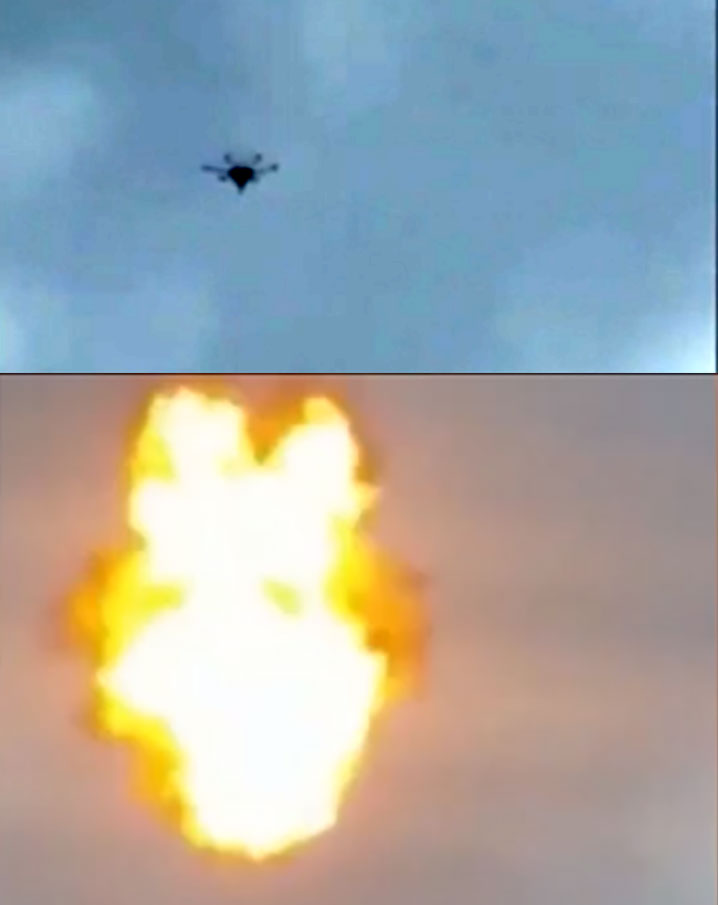
Two frames taken from the video published on CNN claimed to depict the second of the explosion of the drone. CNN could not authenticate the source. Photo: CNN Video
The incident happened during a ceremony celebrating the 81st anniversary of the Venezuelan National Guard in Caracas on August 4, 2018. As President Nicolas Maduro addressed a military parade, a loud bang sounded. The surprised president paused and started to the sky for a second, his bodyguards soon responded and rushed to shield him. A few seconds later the soldiers on parade began to scatter, fearing a drone they have seen above them. That drone soon crashed into a nearby building and exploded.
The information released by the Venezuelan authorities indicate that two drones were involved in the attack. According to a video released few hours after the incident, at least one of the drones was a commercial, remotely controlled ‘hexarotor’ drone (six rotors) – the model reported to be the DJI M600 drones that can carry a payload of 5.5 kg. According to Venezuelan sources it carried one kilogram (2.2 pounds) of explosives. This payload was likely high explosive, having the potential to cause effective damage within a 50-meter radius.
According to Interior and Justice Minister Nestor Reverol one drone flew over the tribune where the president stood. However, it did not explode over its target since it lost contact with its operator by a ‘signal inhibiting equipment’ that supported the event. The drone was activated as it moved beyond that ‘protective bubble’, and exploded outside the target’s effective perimeter. The drone’s lethality was clearly demonstrated by the casualty toll – seven wounded, three of them in critical conditions.
The second drone went out of control and crashed into a nearby building causing a fire. The cause could be the operator abandoning it, or due to loss of control because of anti-drone countermeasures.
Authorities in Caracas arrested six perpetrators accused in the assassination attempt. A local unknown rebel group calling itself the “National Movement of Soldiers in T-Shirts” claimed responsibility but provided no proof for that claim. Venezuela blamed Colombia and the USA for sponsoring the attack, but both nations flatly denied those accusations.
Navigation signal denial and jamming of control are two of the most common practices in counter-drone operations. Such actions cause a drone to halt, or go back to its point of origin. Nevertheless, control jamming is power dependent and therefore has a limited effective range, particularly where operators are near. Some reports claimed the drone was ‘disguised’ as a TV camera covering the event, which could explain how it managed to get as close to the target as it did, despite the presence of counter-drone measures.
“The security of any asset whose perimeter is protected two-dimensionally on the ground will need to be also protected in the third dimension – from attacks from the air.” Oleg Vornik, CEO and Managing Director of DroneShield commented. DroneShield is one of the pioneer developers of man-portable counter-drone systems. The company has recently received multi-million dollar orders for anti-drone equipment from a Middle Eastern Ministry of Defense.
“We expect that this latest incident involving a head of state will result in governments around the world accelerating their implementation of anti-drone mitigation measures,” Vornik added.
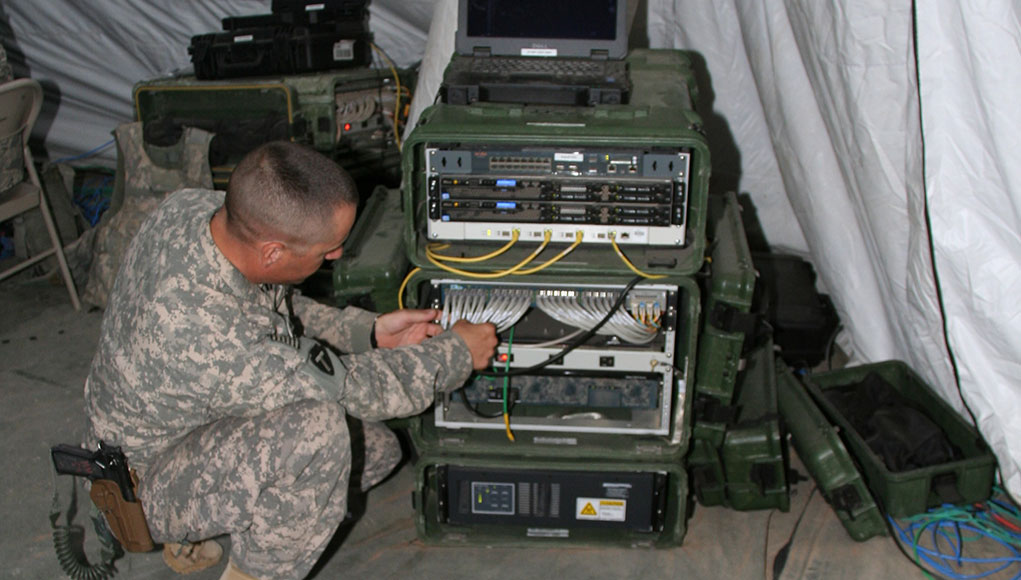
General Dynamics Missions Systems (GDMS) was awarded a US$3.9 billion sole-source contract by the U.S. Army, for the supply of Common Hardware Systems-5 (CHS-5) over the next five years. Products included in the CHS program include servers, storage, clients, networking devices, ruggedized platforms, hand-held end devices, Operational Transit Cases (OTC) and peripherals devices, all tested and proved to meet the program’s requirements.
Under the new contract, GDMS establishes a Public-Private Partnership (P3) with Tobyhanna Army Depot (TYAD), that acts as a centralized programs procurement core for the hardware, and address logistics requirements for the user. The new scheme implements a pre-negotiation pricing schedule for the life of the contract, and introduce warranty options beyond the life of the program (up to eight years of coverage). The program incentives suppliers to offer hardware at the lowest prices and offer technical data packages based on competitive pricing.
CHS is a “one-stop shop” for tactical Information Technology (IT) hardware solutions supporting more than 120 Army and U.S. Department of Defense program offices (including the Navy and the Marine Corps). The program provides a rapid acquisition channel, as orders processed in 90 days or less, delivering commercial-off-the-shelf IT hardware and services.
Approximately 75,000 to 100,000 pieces of hardware are acquired through the contract from General Dynamics Mission Systems and its partners, which includes dozens of small and large businesses. The new program’s baseline products leverage the current commercial technology and industry investments and provide repair and replacement supporting users worldwide.
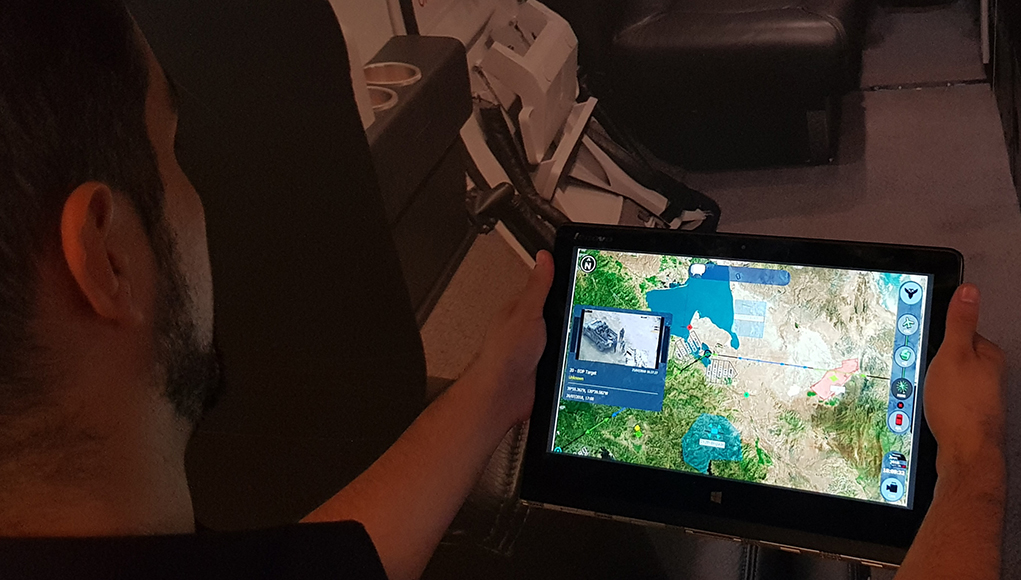
ELTA Systems (a subsidiary of Israel Aerospace Industries (IAI) is developing a drone-based version of its RES-Q-CELL system. The development is done in cooperation with TLC Solutions of the USA. This search and rescue system detects the location of cellular devices of victims trapped under rubbles and in disaster areas.
“Operating RES-Q-CELL with drones introduces a dramatic increase in operational flexibility because its deployment is not restricted by the delivery of vehicle or access,” Esti Peshin VP General Manager, IAI’s Cyber Division told Defense-Update. The initiative is IAI’s response to customer’s requests to improve the system’s agility and response to emergencies. The system will be able to locate victims of earthquakes, storms, floods, or fires.
The cooperation with TLC provides IAI with market entry to the US market, considered the most mature for such systems.
The project is supported by a grant from the Israel-U.S. Binational Industrial Research and Development (BIRD) Foundation, by U.S. Department of Homeland Security (DHS) Science and Technology Directorate (S&T) and the Israeli Ministry of Public Security (MOPS). In addition to the grants from BIRD, the project is also expected to access private sector funding.
“With drones, we can access an emergency area even when all roads are blocked, and using tethered platforms means our mission endurance is virtually unlimited,” Peshin said. She said that, by utilizing three interlinked tethered drones, the system will also offer increased detection resolution.
The new system is a lightweight derivative of IAI’s RES-Q-CELL, a field-proven survivor’s location system. The system is designed to detect survivors in disaster areas, using accurate geo-location of the survivor’s cellular devices in order to rescue them as quickly as possible. Several RES-Q-CELL systems were delivered to customers in Israel and abroad.
The sensor enhancements will improve target tracking precision, and, with the introducing of advanced mission management algorithms, the system is expected to increase performance and reduce operator workload, especially with a small crew. The cabin accommodates a single workstations, with additional mobile units added on demand. Photo: BIRD Aerosystems
Expanding the capabilities of a fleet of special mission aircraft (SMA) currently operational in Central America, BIRD Aerosystems will enhance the performance of ASIO SMA already operated by the customer, by upgrading their Mission Management System (MSIS), adding sensor enhancements, and improving connectivity and data sharing within the task force.
The sensor enhancements will improve target tracking precision, and, with the introducing of advanced mission management algorithms, the system is expected to increase performance and reduce operator workload, especially with a small crew. As part of the upgrade, the system will increase the utilization of satellite communications, in data and high-resolution video transfer.
According to Ronen Factor, Co-Chief Executive Officer and Founder at BIRD Aerosystems, the company is provided the ASIO as a turn-key solution tailored for the needs of each customer. “The enhanced operational capabilities will allow the customer to manage its missions in the most efficient way,” Factor added.
One of the aircraft will be modified to operate as a flying command post for the task force, leveraging real-time command and control of the task forces’ operational teams, and extending the operational flexibility and responsiveness of the land-based command center.
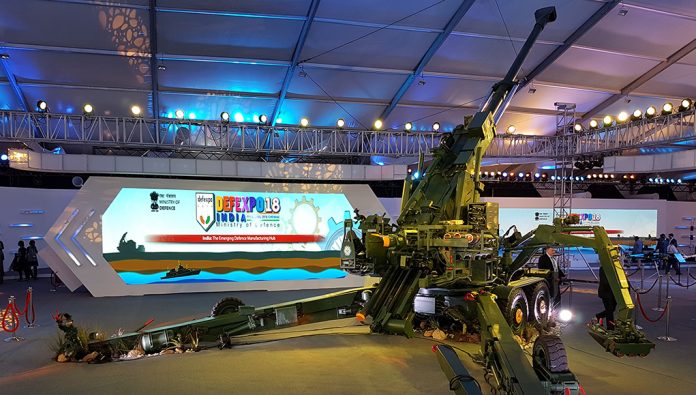
155X52 CAL Advanced Towed Artillery Gun System (ATAGS) displayed at DEFEXPO 2018 by DRDO Armmament Research & Development Establishment (ARDE). ATAGS achieved the longest range of tube artillery among Indian manufactured guns, scoring 45km. Is uses all-electric servo drives for laying, breech, ramming and crane operation, supporting a rate of fire of five rounds per minute. Photo: Tamir Eshel, Defense-Update
The opening week of 2026 has been defined by a singular, paradigmatic shift in modern warfare: the "catastrophic failure" of Venezuela's integrated air defense network during a U.S. special operation. The operation succeeded not through brute force, but by rendering Venezuela's Russian S-300VM and Chinese "anti-stealth" radars effectively blind, validating the supremacy of advanced electronic warfare over legacy kinetic defenses. This failure has sent shockwaves through the global defense market, underscoring why nations like Spain and Germany are rushing to modernize their air defense architectures with Western alternatives, while massive procurement programs exceeding $301 billion signal an accelerated transformation toward unmanned systems, directed energy weapons, and indigenous production capabilities.
Turkey's defense industry transformation extends far beyond its celebrated drones. Now ranking 11th globally in defense exports, Turkey is executing a comprehensive strategy to become a top-tier arms supplier. With 75% of exports flowing to Western markets and five firms in Defense News' Top 100, Turkey is methodically building a complete defense ecosystem through combat-proven systems, integrated defense diplomacy, strategic self-reliance, and real-world R&D in active conflict zones.
Lockheed Martin Skunk Works® and XTEND have achieved a major milestone in JADC2 by integrating the XOS operating system with the MDCX™ autonomy platform. This technical breakthrough enables a single operator to simultaneously command multiple drone classes, eliminating the friction of mission handoffs. From "marsupial" drone deployments to operating in GPS-denied environments, explore how this collaboration is abbreviating the data-to-decision timeline and redefining autonomous mission execution.
As traditional defense primes face mounting competition from agile “neoprimes” such as Anduril, Palantir and Helsing, the balance of innovation is shifting toward software-defined warfare and scalable, dual-use technologies, while global industry consolidation—marked by Boeing’s integration of Spirit AeroSystems and other strategic mergers—signals an intensified race to secure control over the defense technology value chain. Our Defense-Tech weekly report highlights these trends.
In early October 2025, a coordinated wave of unmanned aerial system (UAS) incursions—widely attributed to Russia—targeted critical infrastructure across at least ten European nations. The unprecedented campaign exposed the fragility of Europe’s air defenses...
Executive Summary
The past week (September 18-25, 2025) represents an inflection point where strategic defense concepts have transitioned from doctrine to tangible reality. An analysis of global events reveals four primary, interconnected trends shaping an...
At the 2025 Air, Space & Cyber Conference, U.S. Air Force and Space Force leaders unveiled major updates on next-generation fighters, bombers, unmanned systems, and space initiatives, highlighting both rapid innovation and critical readiness challenges as the services race to outpace global competitors. A short version is available here, with a more detailed version for subscribers.





 Subscribe to access the full version of this article