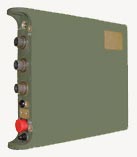
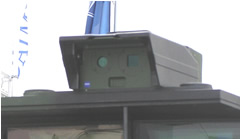
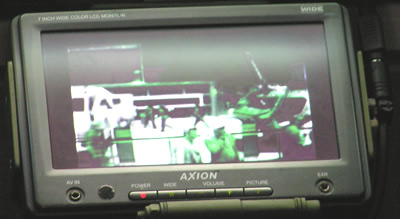
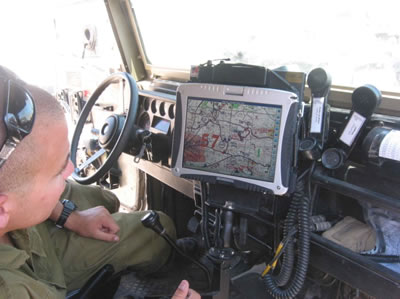
The IDF decided to field a LIC oriented Command and Control version of DAP using the standard interface of the future system. Therefore, TORC2H provides valuable field experience for commanders and important feedback for the system’s designers. TORC2H has an embedded battle command system, both vertical and horizontal. It Support all command and control processes, including planning, execution and debriefing for all modes of operation.
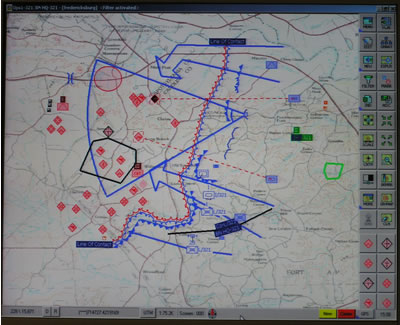
The information layers provide the heart of the system. Targets and relevant intelligence is presented on the “red” layer. Blue and red situational pictures and Course Of Action (COA) are displayed with locations of friendly forces, order of battle strengths (depicted over a combat effectiveness overlay). Gant charts showing actual progress compared according to plans The battle management overlay supports operations, combat support, fire support, reconnaissance and surveillance, logistics and communications. Information entered by each user can be reflected over all relevant remote displays that have “need to know”, regardless to their location.
The system is not limited to helping commanders and staff with the workflow. When fully matured, it will be able to perform simple and automatic decisions, such as target acquisition, waypoint and situational reporting, navigation guidance. However, current technology is not yet sufficient to implement complex decisions. These are left to the user, who can pick-up the favored option from a list of recommended courses of action.
TORC2H systems are supported by Elbit’s Battlefield Enhanced Smart Training (BEST) architecture providing integral training of simultaneous and synchronized training of live, skeleton exercises and virtual units. BEST gateway is implemented at each C3I system, to enable collaborative training mode of operation with the operational systems. BEST is also implemented with real sensors, integrating and facilitating realistic training of air force elements, UAVs and ground sensors. As part of this training support, the IDF is planning to deploy a ‘virtual battalion”, which will provide intensive training for commanders, without the need to recruit the rest of their troops. The system also supports the IDF battle lab.
New C4 application systems, including the Common Battlefield Applications Toolset (ComBAT), and Platform Battlefield Information Systems Application (P-BISA), collectively known as CIP are part of the British Army Bowman system. One such application is the integration of Bowman with vetconics under the Challenger 2 main battle tank Digitization program.
The program includes the installation of Processor Unit (PDPU link) and Commander’s Crew Station (CCS). Both consist of DRS supplied equipment. The CCS will display both battle management and real-time systems information while the PDPU will host applications that effectively digitize the tanks’ systems, These PDPUs will provide a firewall between the real time high-speed weapon system of the Challenger 2 and the near real-time world of the BOWMAN program. Together, these systems will command, control, intelligence and fire coordination capabilities,, enhance interoperability and situational awareness, assuring a seamless flow of battle command information.
The new man-portable THERMITE wearable PC provides realtime 2D/3D tactical visual computing specifically designed for embedded training, mission rehearsals and deployed C4ISR applications. The system supports Linux and Windows XP, capable of running a wide range of C4ISR applications, battlefield visualization and embedded training applications.
The system is powered by Transmeta Crusoe 1GHz processor with 512Kb Level 2 cache and 512 MB DDR memory. It also packed with a Nivida GeForceFX Go 5200 graphical processor unit with 64 MB DDR memory, 20 GB shock resistant hard drive or 10 GB flash memory for extended endurance. Packed with solid state memory configuration THERMITE meets Mil-Std 810F enduring shocks of up to 1500 g and vibrations of 16.3G RMS and temperature ranges between -40 to +85 degrees celsios.
THERIMITE unit can be set for maximum computing and graphics performance, balanced computing and economy mode, maximizing battery life. THERMITE weighs one kg (without batteries), and measures 102 by 172 by 63 mm.
Multi-channel radio (MCR) / line of sight radio relay systems are used for high-rate, digital data (telephony, video, multimedia) transmission over radio links. The system provides high- capacity data wireless communications. Tadiran’s Multi-Channel Radio product line include the GRC-408E (offering 8 Mb/s, ECCM capable radio system), and the GRC-2000, Band IV (4,400-5,000 MHz fast frequency-hopping, radio system). The most recent model, the GRC-408E, evolved from the GRC-408A and the GRC-408HC+, providing 8 Mb/s data capabilities and spectral efficiency over the extended frequency Band III (1350-2690 MHz), while maintaining full backward compatibility with earlier models. The GRC-2000, a frequency hopping line-of-sight multi-channel radio system, emerged as the fourth generation radio relay out of Tadiran Communications’ line of sight multi-channel radio legacy. It provides ultimate ECCM capabilities for the 21st century’s digitized battlespace.
WiMAX, a standards-based wireless technology provides high-throughput broadband connections over long distances. Commercial WiMAX applications including “last mile” broadband connections, hotspots and cellular backhaul, and high-speed enterprise connectivity for business.
WiMAX broadband wireless technology, defined by the IEEE 802.16 standard is derived from the wireless fidelity (IEEE 802.11 Wi-Fi standard) which currently serves hotspots and wireless local area networks throughout the globe and has also been widely accepted by the military. Unlike the WiFi, which covers few hundred meters at best, and has difficulty to propagate in an urban area, WiMAX, which can operate at higher frequencies, can serve subscribers over distances of up to 50 km when using stationary, line-of-sight connections. The network supports up to 50 Mbps data transfer rates, offering sustained user data rates of 0.5 – 2Mbps, allowing for simultaneous transfer of data (including high definition imagery), voice (VoIP) and video. This technology also provides effective services at distances 5 – 8 km for mobile users (without a direct line of sight).
As WiMAX uses higher frequencies than current military and commercial communications, existing antennas towers can “share” a WiMAX cell tower without compromising the current communications services. Such implementation can be used to deploy WiMax to increase bandwidth for specific data-intensive applications within an existing network. Furthermore, integration of WiMAX waveforms are already developed for future Software Defined Radios (SDR) and could be introduced in a future spirals of of the future JTRS radio – currently, this radio is planned to support Soldier Radio Waveforms covering the Wi-Fi at 2.4Ghz. WiMAX can also be used to support training areas, providing an infrastructure for realistic integration of live training and wargames simulation. An initial deployment of WiMAX has already been constructed by the US Army Fort Dix. The U.S. Army is testing prestandard WiMAX gear and Xacta Secure Wireless system from Telos Corp. in Fort Carson in Colorado for point-to-point and point-to-multipoint communications. Eventually, WiMAX or one of the standard’s future derivatives, is expected to provide the foundation of future ad hoc Mobile Area Network (MANET) mesh networks.
first commercial deployments of fully certified WiMAX will occur in 2006 and that significant progress will be made in establishing the 802.16e standard for mobile WiMAX.
Wireless Local Area Network (WLAN), also known as Wi-Fi (short for Wireless fidelity) are shard by communications equipment following the various versions of the IEEE 802.11 standard implemented at the 2.4Ghz (unlicensed) frequency band uses Direct Sequence Spread Spectrum (DSSS) to support data transfer at 1, 2, 5.5 and 11 Mbps. Such networks are providing wireless connectivity for various computing devices such as laptop computers, Personal Digital Assistants (PDA), digital camera, and even desktop PCs equipped with a wireless network adapter. Future JTRS radio will support waveforms to seamlessly connect with 802.11 standard devices.
Wi-Fi equipped devices can establish an ad-hoc network, when grouped at close range or be served from a “hot-spot” service point, located at a central area. Typical coverage of such access point is 45 m (150 ft) indoors and 90 m (300 ft) outdoors. To perform at higher data rates and at longer range, especially in difficult terrain, systems use dual diversity antennas (two or four antenna arrays) and radio amplifiers and directional antennas, coverage can be extended to several kilometers, over line of sight connections.
WLAN technologies are widely used for military applications, primarily in vehicular applications, command posts, ad-hoc networking for special forces and small teams using “Personnel Role radios” (PRR) . Future applications are currently evaluated, including the use of Wi-Fi communications to communicate between team members, deploying integrated Infantry Combat Suits. Other applications include the networking of unattended ground sensors for surveillance, force protection and intelligence gathering.
The Warrior Compact Targeter (WACT) wireless network links commanders, sensors, target acquisition equipment including weapon’s sights and binoculars. The system tracks every member via personal location reporting unit generating a detailed situational awareness (SA) picture in real time. The common situational picture is distributed to each of the members and displayed to the warrior on an individual control and display units (PDA, MPRS weapon’s sight or helmet mounted display unit).
At the system level, WACT incorporates command and control aids, including a mobile computer or large screen, where commanders can watch 3D views, perform planning, real-time tracking and conduct after-action reviews. An urban communications environment is provided supported by wireless communications relay facilitating efficient coverage of the area of operation.
The system provides situational awareness for the small taskforce, by providing 3D terrain analysis of an urban area, for mission planning, by calculating visibility options from various points of view, evaluating potential routes. The system provides target acquisition and dissemination based location, bearing and range data received from multiple sensors including binoculars and weapon’s sights. The system also processes video streams from sensors including cameras and weapons sights. Images can be disseminated to other team members, displayed on PDAs or helmet mounted sight displays.
One of the challenging aspects of Israel Defense Forces’ Digital Army Program (DAP, also known as Zayad) is the network. The IDF evaluated ad-hoc networking to support high capacity mobile communications. At present conventional multi-tier broadband network is used for the program. To support the needs of combat elements from the division down to the lowest echelon, a network different from the typical divisional combat radio network is established. The new wide area wireless network covers the entire divisional area and links all elements down to the lowest echelon. The network should be able to bridge communications gaps over long distances, in situations where related elements are situated far ahead or behind the area of operation.
The DAP network combines several layers – WiMAX COTS based wireless broadband network (using Giga Ethernet switches and routers) will use microwave links to establish the backbone connecting between command posts and higher echelons. Tactical Very Small Aperture Terminal (T/VSAT) will provide backup for users, particularly in deep operations and where line of sight communication does not provide reliable links. Satellite will provide strategic broadband on demand. Data radios will provide up to 13 Mbps for deployed locations. Division and brigade command posts use wireless LAN networking to replace current physical line connectivity.
At the division and brigade levels, MAXESS enhanced wireless LANs could be used to support command posts, (Military Wireless LAN) providing secure 1-11 Mbps data rates ad-hoc over 5 km. Such networks will be capable of hosting up to 60 members with low (4 watt) power transmission. Same WLAN, but without the amplifier, will provide up to 500 m coverage, with low signature, supporting deployed or on-the-move connectivity between combat elements or command vehicles. High capacity data radios carry data down to the battalion level supporting up to 13 MBps data rates in stationary positions and up to 1 Mbps in mobile deployments.
At the battalion level and below, software-based Future Tactical Combat Radio (FTCR) currently developed by Tadiran Communications will be used to drive much higher data rates than currently available by CNR (64 up to 115Kbps). FTCRs will provide the standard tactical radio equipment at Brigade and below. Battalion commanders are to be equipped with data radios, providing the gateway between the WINBMS and brigade and divisional elements of DPA.
The U.S. National Security Agency (NSA) awarded General Dynamics C4 Systems a $18 million contract for the design and development of a secure mobile telephone integrated in a personal digital assistant (PDA). The product will provide secure voice and data communications, including e-mail, web access, and file viewing. The award is part of the Secure Mobile Environment (SME) program, which calls for a single device for government users requiring “Type I” security that also provides wireless access to the government’s Secure Internet Protocol Router Network (SIPRNet) for secure web-browsing and messaging. The new phone will interoperate with General Dynamics’ Sectera® Wireline Terminal and Sectera Secure Wireless Phone for GSM. Delivery of the first Secure PDA Phone is expected in the second quarter of 2007.
The Secure PDA Phone will operate via existing commercial cellular networks and will have modular architecture for connectivity to a wide array of wireless protocols such as the Global System for Mobile Communications and Code Division Multiple Access (CDMA). The Secure PDA Phone will interface with the Department of Defense Public Key Infrastructure using the government’s standard Common Access Card.
According to John Cole, vice president of Information Assurance for General Dynamics C4 Systems, the new device will integrate in the emerging battlefield communications network, by integrating with the US Defense Department’s global information grid and support emerging secure communications standards for homeland security and coalition government and military requirements.
Virtus is an advanced dual band driver’s sight system, jointly developed by Barco, Krauss Maffei Wegmann and Zeiss Optronik. The system provides unlimited sight under difficulty visibility conditions such as dark nights, hard rain, fog, heavy dust etc, without the need for active illumination. The system combines dual-band (visual Imaging Infrared TV (I2CCD) and thermal IR sensor head covering 40×30 deg. Field of view produced by Zeiss Optronik with the 10″ Vector driver’s display, produced by Barco (up to 12″ displays are also available). A special algorithm combines the two images into an enhanced picture. Color coding is used to highlight specific objects and obstacles in the driver’s display. Virtus can be used effectively both driving with open or closed hatches. An initial implementation of the system was demonstrated in Krauss Maffei Wegmann’s Boxer APC prototype.
SecNet 11 Plus is a family of encrypted 802.11b wi-fi networking products, comprising Network Interface Card (NIC) Wireless Bridges and Access Points, providing secure ad-hoc networking or wireless communications infrastructure supporting point-to-point and point-to-multipoint connectivity at a “secret” level. SecNet 11 Plus is certified as Type 1 security by the US National Security Agency (NSA).
Using such high security measures, mobile, field users can share standard-based wireless means and ad-hoc networking for the transfer of secure data, video and voice (VOIP) at a “secret” level.
SecNet 11 Plus employs Harris Sierra I encryption module using the Intersil PRISM chipset running BATON – an NSA Type 1 encryption algorithm to secure the RF link. The system encrypts both data (COMSEC) as well as the source and destination address (NETSEC), preventing traffic analysis on transmitted data. The key is loaded manually. This solution enable users to employ COTS based hardware at a highly secure environment anywhere in the world.
Mission planning and rehearsal in the modern battlefield and Military Operations in Urban terrain (MOUT) require in depth knowledge and familiarity with the battle zones down to the basic details. MPRDS provides a “digital sand table” supporting operations from company to brigade level. The system enables the planners and participating forces to prepare the mission and choose battle positions and rehearse on the enemy’s virtual territory before the mission. The system enables users to observe and study the area from friendly or enemy point of view. The system can be integrated with Computer Generated Forces (CGF) to take part in war-games at any level.
The MPDRS is designed and build especially to satisfy these demands. Mission planning superimposed on digital 2D maps and viewing the battlezone topography in realistic 3D synthetic view enable the commander to plan, rehearse and perfect the mission planning and execution. The planning products can be used as the Common Operating Picture (COP) for real-time operational assessment and for After Action Reviews (AAR) and debriefing.
Friendly and hostile troops and vehicles can be positioned on the map enabling the commander to plan, brief, debrief and analyze operational missions, training sessions and safety aspects of routine activities. Rehearsal of raids and missions through the various phases of ingress, attack and egress can be examined, inspecting friendly and hostile suspected locations, concealment, avoiding potential kill zones and obstacles, ensuring mutual support and lines of sight for the relevant forces. Specific locations such as observations, advance routes etc. can be inspected in 3D views showing topographical features and reference points to assist orientation.
MPRDS uses a based COTS laptop PC operating under Windows operating system.
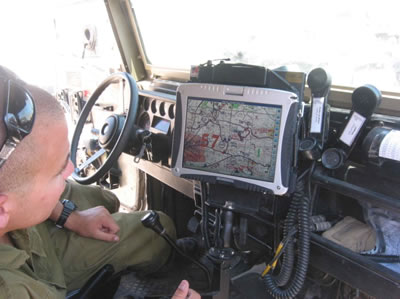
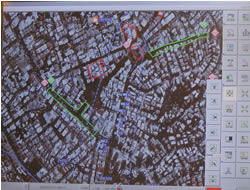
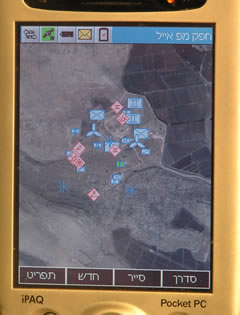
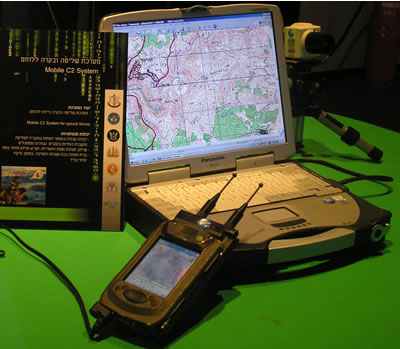
Advanced wireless communications integrated with command, control and computer systems are combined with the IDF new Tactical Operational Command and Control Headquarters system (TORC2H) deployed by the for border security was integrated by Elbit Systems, unifying sensors, security forces and command centers into the regional security C2 system. The system utilizes C2 and GIS software tools provided by ARCNet, to facilitate direct wireless communications, over ToughBook PCs and PDAs, sharing situational picture and rapidly transferring reports and decisions between commanders in Command Post and in the filed, to and from forward elements. between sensors and field units. Geographical Information Systems (GIS) displayed relevant data with geographical features, over 3D or 2D digital maps. It also supports virtual presentation of the target and situation, as viewed by each of the different forces. TORC2H uses vehicular mounted as well as dismounted, units, facilitating continuous monitoring of situations via sensors images, visualization of unit deployment, location and status, rapid and transparent messaging of command, reports and situational reports, etc. The system was selected by the IDF for border protection command and control and is deployed along the lines separating the Israeli and Palestinian authority controlled area.
Stand-alone command, control, communications, computers and intelligence (C4I) network developed by Ness technologies is already deployed by Special Operations units, including the Israel Navy Special Forces (Naval Commandos). The system is an adaptation of Ness technologies’ Ness Control system running on laptop PCs and PDAs enabling teams to prepare, distribute and receive live videos, images and digital maps from sensors, and between the network’s PCs. The system utilizes various types of communication links including tactical HF/VHF radio, WiFi (IEEE 802.3 – IEEE 802.5), wireless LAN/WAN, cellular and Ethernet. Future evolution could migrate to include evolving commercial high speed networking standards including WiMAX (IEEE 802.16).
The use of distributed databases, powerful geographical information, and 2D / 3D presentation systems enable commanders to make decisions based on updated situational assessment. In addition to its basic functions, the system provides real time monitoring of force positions and movements, improving coordination among neighboring forces.
A mobile command center developed for the Israeli Digital Army Program (Zayad)
The Israel Defense Forces (IDF) “Ground Forces Digitalization” Program (Hebrew acronym ZAYAD) aims at linking the “sensors” and “shooters” across all command levels, down to the single soldier. The program will improve inter-networking of task forces and units operating throughout the theater of operation, enable flexible formation of combined task forces and improve the coordination and situational awareness at all levels of operations. The program will integrate to existing systems, including the strategic command, and battle management systems, currently available below the brigade level. The program will also integrate with the IDF future infantry combat system, currently under development at Elbit.
ZAYAD at the Division Level
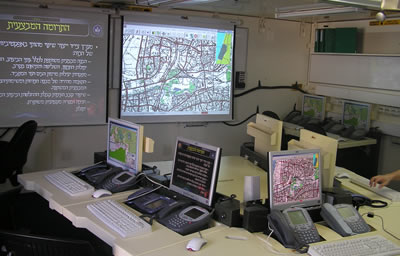
At the division level, the program will implement dramatic changes, with the introduction of shelter-based computerized tactical operations centers, which will enable commanders to effectively monitor the situation in real time. These centers are fully equipped with all communications, processing, display, power distribution, and wiring required for operations. For voice communications digital communications will utilize Voice over IP technology, for maximum flexibility and optimal use of the spectrum. This technology offers automatic routing of calls to the most efficient channel and prioritization of high priority calls to maintain reliable links at the most critical phases of combat. Below the division level, high capacity data radios are expected to provide support for digital communications, both for stationary and on-the-move applications. Multiple Line-Of-Sight communication systems, currently supporting the division’s communications channels to higher echelons and subordinate units, are also expected to be replaced by broadband satellite terminal, to facilitate seamless connectivity over a wide geographic area. Terrestrial LOS systems will continue to provide broadband data networking at much larger capacities (up to 155 MBps) using new mobile SDH communications terminals.
Computerized TOC
The computerized TOC is designed for rapid setup and could be fully operational within 30 minutes of deployment. Other assets are used for command on the move. The system will also enhance the IDF capability to create flexible, task oriented forces. It is based on advanced hardware and software C4I technologies. The Program will enable coordination between forces at different command levels, provide situational awareness to maneuvering forces, improve the overall operational capabilities, including survivability and accuracy, while efficiently utilizing manpower and other resources.
Tactical Internet Implementation An important requirement of the new network is the capability every authorized user to transmit, receive and view high resolution still format, as well as live video from any sensors (including ground observations, BMS sight views, UAVs etc). This capability requires an optimized distribution of data, and the economical utilization of available spectrum. One of the solutions considered for this requirement is the implementation of the Tactical Internet Geographic Dissemination concept (TIGER) developed by Elbit Systems. Subscribers to the TIGER system automatically receive, store and distribute information, based on various parameters, including their geographical location and hierarchical placement in the command system. TIGER automatically update the communications channels and C2 systems of units when they are moving into a new area, or as ad-hoc task force are formed. Furthermore, the redundancy and survivability of the system are improved, as every subscriber is also a node, there is no “single point of failure”, and the entire system can continue to function even under degraded conditions (countermeasures, interference or attack).
Under the Program, the existing ground forces Command, Control and Communications systems of the ground forces will be integrated, combining systems and applications developed and matured by Elbit Systems, the prime contractor as well as other subcontractors, including Tadiran Systems and Rafael. The Program includes development, supply and support of software and hardware, such as command and control consoles and terminals as well as information and image processing and dissemination systems. The cost of the multi-year program is estimated at over $200 million. Additional funding is expected to be added in US Foreign Military Sales, for the procurement of hardware systems for the program. Elbit received the contract on December 2004 and is expected to deliver the full system within ten years.
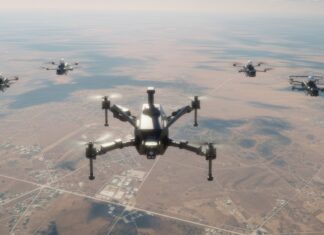
Lockheed Martin Skunk Works® and XTEND have achieved a major milestone in JADC2 by integrating the XOS operating system with the MDCX™ autonomy platform. This technical breakthrough enables a single operator to simultaneously command multiple drone classes, eliminating the friction of mission handoffs. From "marsupial" drone deployments to operating in GPS-denied environments, explore how this collaboration is abbreviating the data-to-decision timeline and redefining autonomous mission execution.
As traditional defense primes face mounting competition from agile “neoprimes” such as Anduril, Palantir and Helsing, the balance of innovation is shifting toward software-defined warfare and scalable, dual-use technologies, while global industry consolidation—marked by Boeing’s integration of Spirit AeroSystems and other strategic mergers—signals an intensified race to secure control over the defense technology value chain. Our Defense-Tech weekly report highlights these trends.
In early October 2025, a coordinated wave of unmanned aerial system (UAS) incursions—widely attributed to Russia—targeted critical infrastructure across at least ten European nations. The unprecedented campaign exposed the fragility of Europe’s air defenses...
Executive Summary
The past week (September 18-25, 2025) represents an inflection point where strategic defense concepts have transitioned from doctrine to tangible reality. An analysis of global events reveals four primary, interconnected trends shaping an...
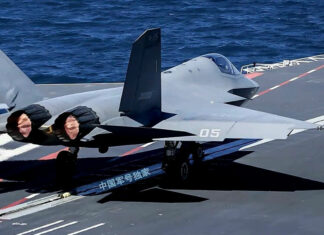
At the 2025 Air, Space & Cyber Conference, U.S. Air Force and Space Force leaders unveiled major updates on next-generation fighters, bombers, unmanned systems, and space initiatives, highlighting both rapid innovation and critical readiness challenges as the services race to outpace global competitors. A short version is available here, with a more detailed version for subscribers.
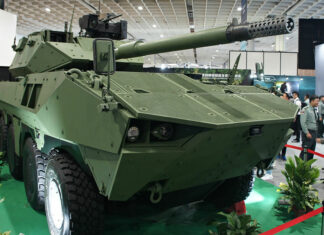
The Taipei Aerospace & Defense Technology Exhibition (TADTE) 2025 crystallized around four dominant strategic themes that collectively illustrate Taiwan's comprehensive approach to defense modernization amid escalating regional tensions. Based on a detailed report by Pleronix (available upon request). Includes a Podcast discussion on TADTE 2025's highlighting Taiwan's four strategic themes beyond the post's coverage.
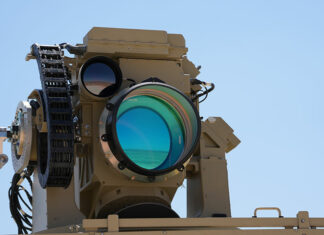
Israel’s Iron Beam 450 high-power laser system has completed final testing, marking a major leap in air defense. Developed by Rafael, it offers precise, cost-effective interception of rockets, UAVs, and mortars, and is set for IDF deployment by 2025.