
Tuesday, December 23, 2025
More
    Home Blog Page 79

    Reaper ER Extends RPA Missions to +33 Hours

    An extended range variant of the MQ-9 Predator B (Reaper ER) remotely piloted aircraft (RPA) has been operationally fielded by the U.S. Air Force (USAF) last month, General Atomics Aeronautical Systems, Inc. announced.

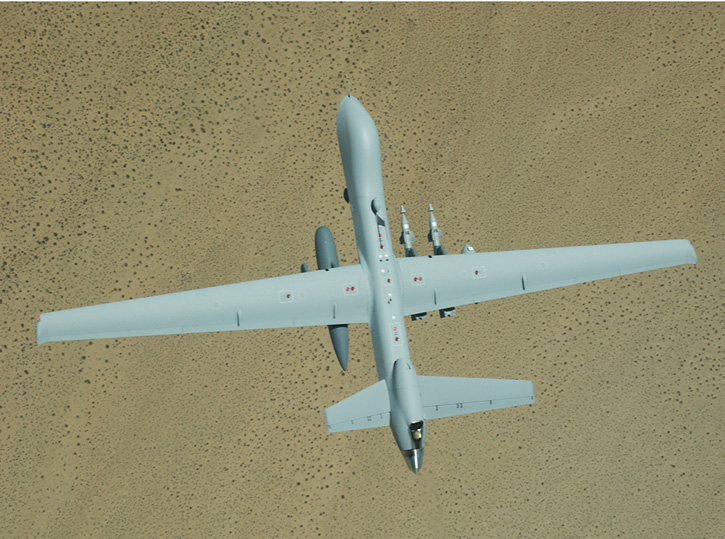
    A Reaper can be transformed into a Reaper ER through the integration of a field-retrofittable modification package consisting of two wing-mounted fuel tanks which significantly extend the aircraft’s maximum endurance. Reaper’s original external payload carriage configuration remains unchanged, providing the aircraft with a “mix and match” capability that allows it to carry both fuel tanks and an assortment of external payloads.

    To increase thrust and improve takeoff performance at higher gross weights, an alcohol/water injection system and a four-bladed propeller were incorporated, along with a heavyweight trailing arm landing gear system that enables safe ground operations at the heavier gross weight. The new kit increases the mission endurance of the Reaper ER from 27 to 33-35 hours. GA-ASI is also investing in further increasing the ER capabilities, extending endurance to 42 hours, on ISR-only missions, by replacing the current fuel-filled 66-foot (20 m’) wings with 79-foot (24 m’) wings.

    A Quick Reaction Capability [QRC] requirement, the Reaper ER program delivers 38 Reaper ER aircraft in 13 months. The customer required the new capability to be operational 18 months following contract award. the conversion process is expected to continue through mid 2016 and could be extended to include more RPAs. The ER modification package was designed to be field-retrofittable so that fuel tanks and associated equipment could be installed quickly and conveniently on current Reapers at worldwide locations.

    “Reaper ER provides a tremendous capability increase in both range and endurance, and achieving this major program milestone wouldn’t have been possible without the dedication and commitment of our employees,” said Frank W. Pace, president, Aircraft Systems, GA-ASI. “We are pleased that the Reaper ER program has met the expectations of our Air Force customer and satisfied the enormous challenge of their QRC schedule requirement.”
    reaper_er_725
    A Reaper can be transformed into a Reaper ER through the integration of a field-retrofittable modification package consisting of two wing-mounted fuel tanks which significantly extend the aircraft’s maximum endurance. To increase thrust and improve takeoff performance at higher gross weights, an alcohol/water injection system and a four-bladed propeller were incorporated. Photo: General Atomics ASI

    DSEI 2015 – Photo Report (I)

    The new brigades will be equipped with about 600 Ajax vehicles of six different variants.
    ajax_tct_725
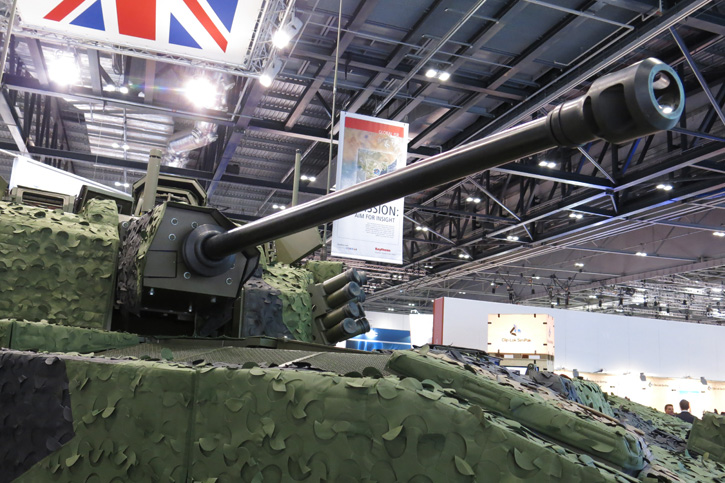
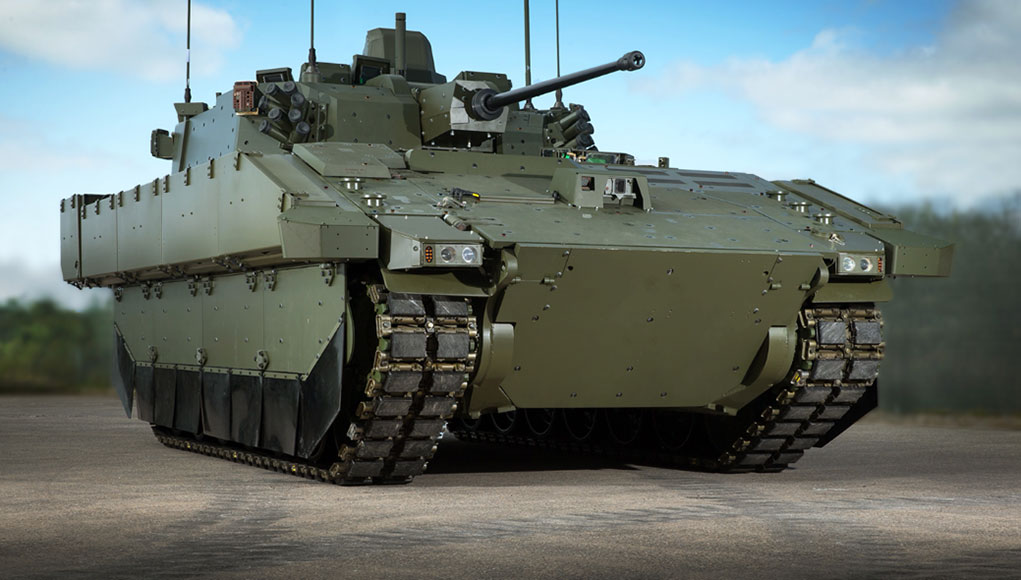
    The new Ajax (Scout SV) armed with the 40mm Case Telescopic Cannon (CTC). Photo: Tamir Eshel, Defense-Update
    cta40_725
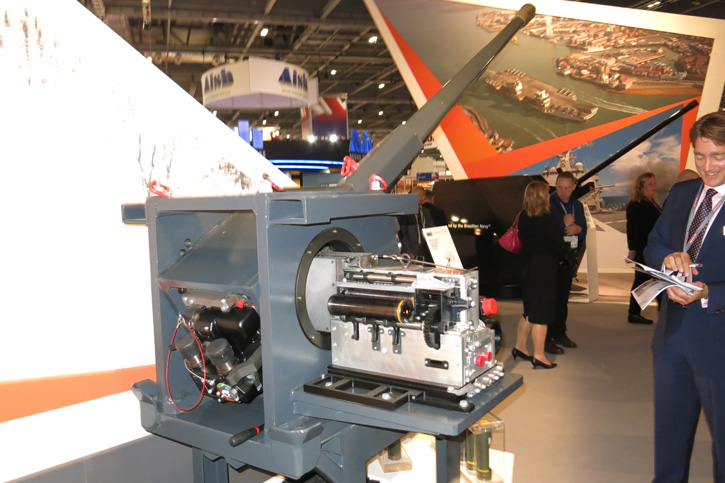
    The 40mm CTC was displayed on several platforms at DSEI 2015, including the General Dynamics UK Ajax, and an upgraded French VBCI 2 with a new turret, displayed by Nexter on VBCI II. Photo: Tamir Eshel, Defense-Update
    desi_level6armor725
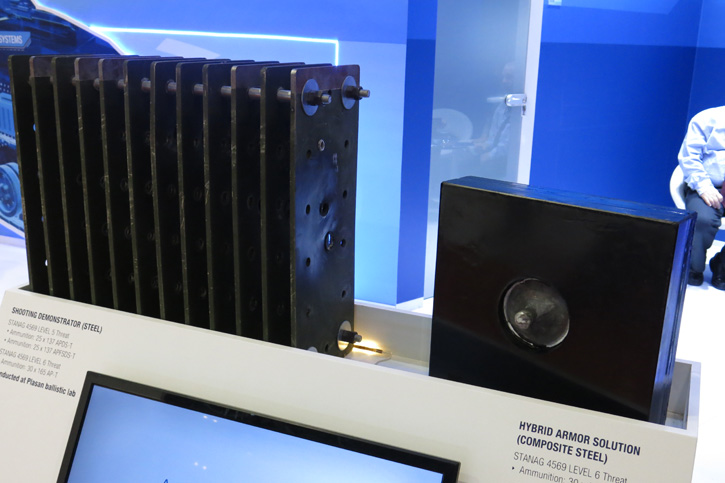
    Israel’s armor specialist Plasan unveiled a hybrid composite armor solution conforming to ‘Level 5-6’ protection standard, providing protection equivalent to 12 layers of gapped steel. Photo: Tamir Eshel, Defense-Update
    nexter_vbci_2_tct
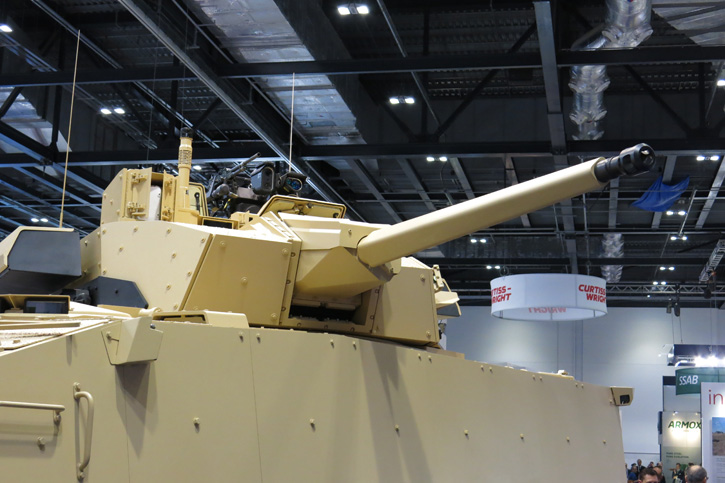
    The 40mm turret being added to the VBCI-2 provides much higher lethality to the French AFV. The turret is manned by a crew of two, seated in the spacious capsule, surrounded by the vehicle’s sensor displays that provide enhanced situational awareness in combat. The turret also mounts the 40mm CTC gun. Photo: Tamir Eshel, Defense-Update
    rheinmetall_aps725
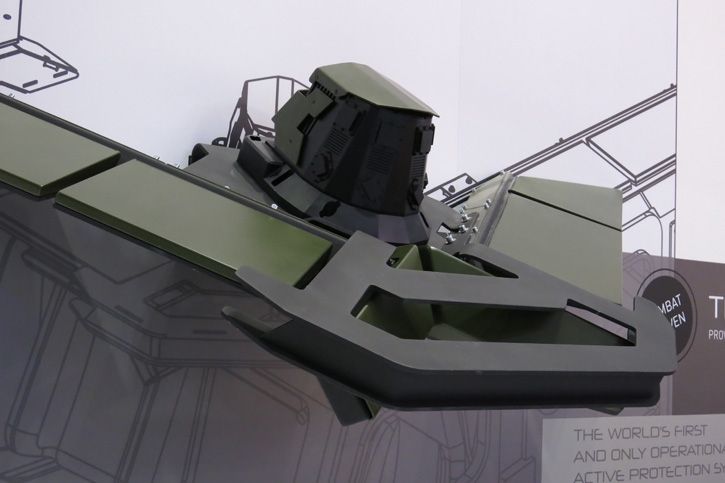
    Rheinmetall Defence unveiled the latest configuration of active protection systems, comprising a hybrid solution made of passive and active protection means, an infra-red smoke dispenser, skirts made of composite materials  and blast-based active protection module, triggered by four sets of sensors – two are covering the lower approach angles and two are covering the vehicle from side and top attacks. This specific solution is configured to match the CV-3095. Another solution displayed is matching the integrated armored cabin for trucks. Photo: Tamir Eshel, Defense-Update
    rheinmetall_laser_725
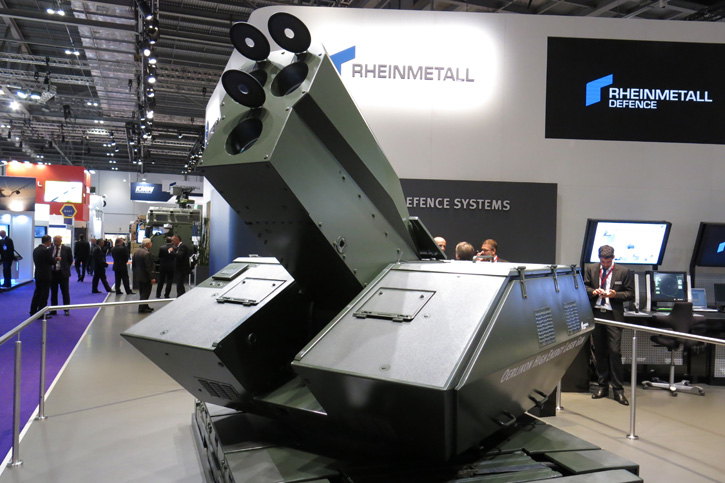
    Another innovative weapon system approach from Rheinmetall Defense. These four 20kW lasers modules are coupled into a multi-effector system emitting 80 kW, where all lasers operate in synch, to yield the higher overall emission. More laser emitters can be stacked to create a hundred kW class laser effector, utilizing an effective and proven beam concentration. These lasers have already demonstrated the capability to defeat mortar rounds at a distance of few kilometers, in two seconds, and multiple unmanned aerial vehicles at distances of 500 meters. Photo: Tamir Eshel, Defense-Update
    rheinmetall_laser_skyguard725
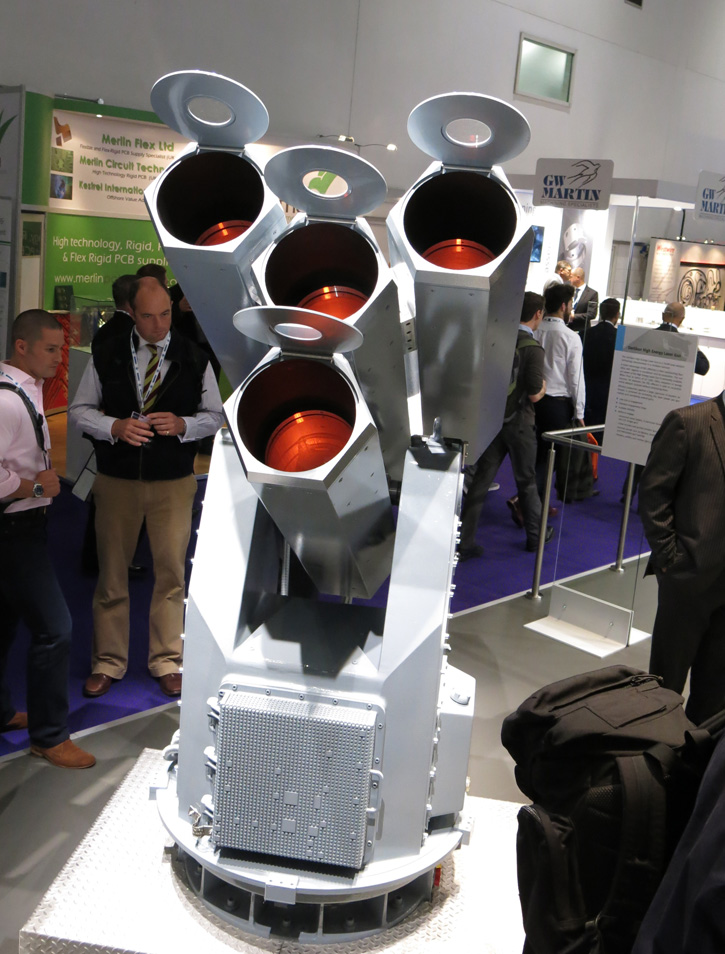
    The laser interceptor from Rheinmetall could one day provide a central effector for Skyguard air defense systems. This specific interceptor packs three 20kW lasers enabling defeat of fast flying aerial target such as mini UAVs. Photo: Tamir Eshel, Defense-Update
    seal_delivery_vehicle_725
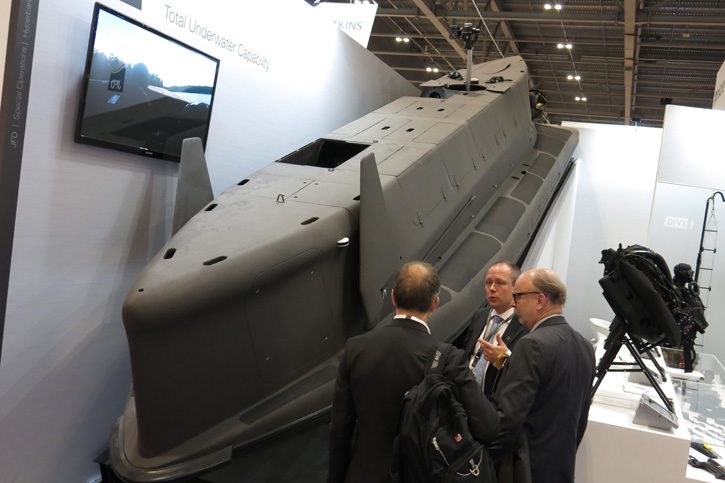
    This Seal Delivery vehicle can carry two operators and six divers along with their crews, supporting target surveillance, infiltration and extraction. The complete unit can be dropped into theater by parachute. Photo: Tamir Eshel, Defense-Update
    trophy_lv725
    Among the few active protection systems (APS) which are on display was the Trophy LV. This APS IS is designed to operate on light protected vehicles. Photo: Tamir Eshel, Defense-Update


    Turreted Ajax Unveiled at DSEI

    IMG_8919-small

    London, U.K. – General Dynamics UK has today unveiled the turreted AJAX prototype platform (formerly known as SCOUT SV) at DSEI 2015.

    The company displayed the troop carrier variant of the family last year. The flagship variant of the AJAX programme, the turreted variant is the second prototype to be unveiled by General Dynamics UK, and the first to feature the Lockheed Martin UK-developed turret, which is designed to meet the needs of the modern British soldier.

    The first British Army squadron will be equipped by mid-2019 to allow conversion to begin with a brigade ready to deploy from the end of 2020.

    The AJAX platform is one of six variants to be delivered to the British Army by General Dynamics UK from 2017 through 2024. It represents the future of Armoured Fighting Vehicles (AFV) for the British Army, providing best-in-class protection and survivability, reliability and mobility and advanced ISTAR capabilities.

    The AJAX platform will be the ‘eyes and ears’ of the British Army on the battlefields of the future. It will be effective in the most difficult terrains around the world, providing all-weather intelligence, surveillance, target acquisition and reconnaissance (ISTAR) capabilities.

    Commenting on the unveiling of the AJAX platform, MoD Armoured Vehicles Head of Programmes, Major General Talbot-Rice, said: “We are committed to supplying the Armed Forces with the very best equipment possible and are delivering on this by supplying the AJAX platform which will become their first fully digitised armoured fighting vehicle.”

    The range of AJAX variants will allow the British Army to conduct sustained, expeditionary, full-spectrum and network-enabled operations with a reduced logistics footprint. It can operate in combined-arms and multinational situations across a wide-range of future operating environments.

    AJAX has been designed and developed at General Dynamics UK’s AFV design and engineering centre in Oakdale, South Wales.

    New Delhi Nods +$400 Million Israeli Mega Drone Procurement

    India has cleared the purchase of 10 Heron TP drones from Israel.
    India has cleared the purchase of 10 Heron TP drones from Israel.

    The Indian government recently approved a plan to procure ten new missile-armed drones from Israel. “The $400-million proposal for buying armed Heron TP drones from Israel was cleared last week,” The Economic Times reported.

    These new drones will be operated by the Indian Air Force (IAF), which already has a large fleet of Searcher and Heron I reconnaissance drones. Both are produced by Israel Aircraft Industries (IAI). The IAF also has a fleet of Harpy UAVs from Israel – designed as loitering radar-supression weapons. In addition,India operates the HAROP, a spin-off variant of the loitering weapon, designed to attack other surface targets. (Both Harpy and Harop are also made by IAI).

    The proposed sale of the Heron TP to India had been on the table since 2012, but, only after the election of the new Modi government, did it receive the necessary political backing.

    The IAF has been seeking an unmanned, precision attack capability as a matter of high priority. But the transfer of such systems from foreign suppliers has been blocked by article II of the Missile Technology Control Regime (MTCR), which limits the transfer of unmanned means of delivery capable of carrying payloads of 300 kg. or more across distances exceeding 500 km.

    The Indian Defense Research and Development Organization (DRDO) has been working on the development of an indigenous, armed reconnaissance drone for several years, but its Rostum II has been delayed and isn’t expected to reach operational status in the foreseeable future.

    In a recent clarification of MTCR Article II, some drones were excluded from the list of forbidden systems, partly due to the fact that they cannot carry a single payload of this size. This clarification paved the way for the the export of Israeli Heron TP and US Predator B (Reaper) drones to foreign customers, as well as some Chinese drones capable of similar performance. Such drones can be operated on armed reconnaissance missions with a full sensor suite, enabling operations in day, night and adverse weather conditions.

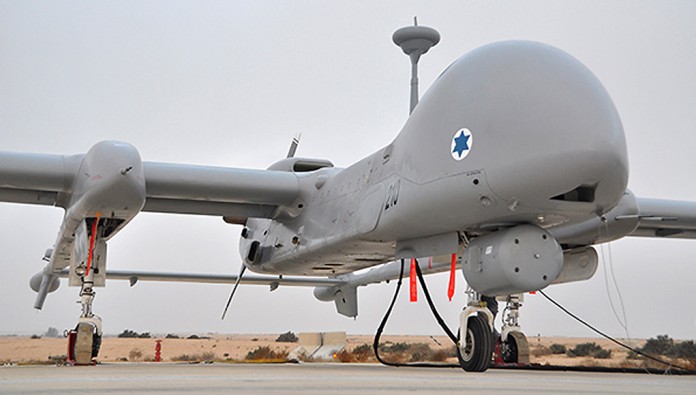
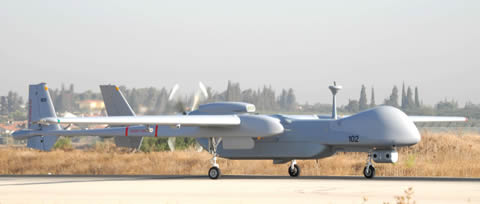
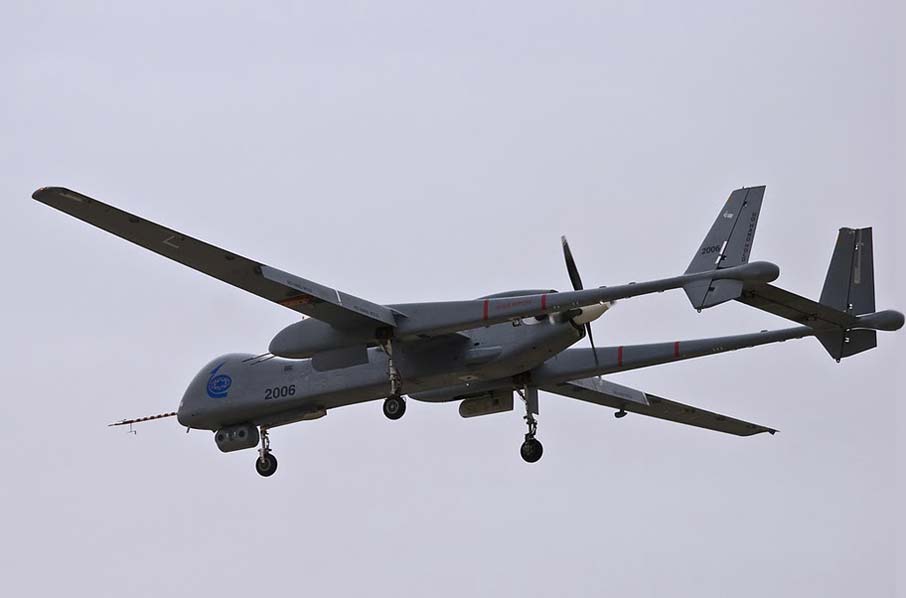
    IAI Heron TP preparing for take off from Ben Gurion Airport, 2011. Photo: IAI
    IAI Heron TP preparing for take off. Photo: IAI

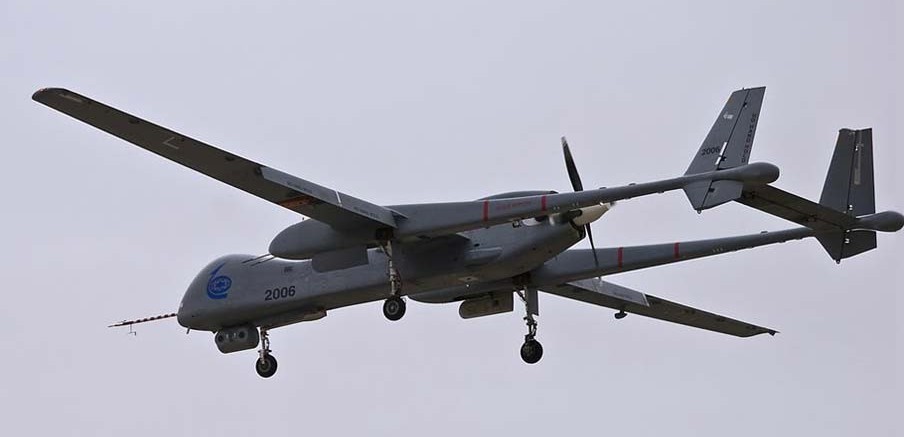
    Heron TP has been operational with the Israel Air Force since 2012, but has not been exported so far. It can carry a payload of 1,000 kg., both internally and on under-wing hardpoints. Its payload options include the new M19HD long-range electro-optical payload, enabling surveillance and target acquisition at stand-off range and high altitude. The Heron TP can also carry a ground- surveillance radar to provide similar capabilities under all weather conditions, enabling the drone to locate and strike targets even through dense clouds.

    IAI also offers an extended-range version of Heron I, already operational with the Indian Air Force, Army and Navy. This ‘Super Heron’ is also configured to carry external payloads, although less than the larger TP.

    The Indian Military has suffered repeated cross-border attacks in the Himalayan mountainous region in Northern India, where the Army and Air Force lack deterrence or retaliation capabilities. One recent attack in Manipur in June 2015 took the lives of 18 Indian soldiers. The Indian Military considers armed drones to be an appropriate means of deterring such attacks. Pakistan has recently fielded its own weaponized unmanned aerial vehicle called Burraq, which recently have been deployed on its first combat mission against Taliban forces in Northern Pakistan. China is also using a weaponized version of its Wing Loong UAVs, equivalent to the U.S. MQ-1 Predator class.

    IAI has pitched Heron TP to a number of international customers, the most recent being the Royal Australian Air Force, currently operating Heron I drones. Australia is considering to upgrade its unmanned systems capability, with the deployment of Medium Altitude-Long Endurance MALE) type system, and is currently considering the Israeli Heron TP and US Predator B as two possible alternatives. Germany and Poland are also considering the Heron TP as a future MALE system.

    Heron-tp_flight

    Russian Fighters Fly High at MAKS 2015

    Facing the pressure of economic sanctions imposed by Western countries, the Russian civilian aviation market has experienced reduced business volume, due to dropping demand from domestic airlines. Against this background the military aviation market took center stage at the MAKS 2015 airshow at Zhukhovsky near Moscow, Russia. Despite the absence of new military aircraft, Russian manufacturers unveiled a number of new systems and capabilities at the airshow, positioned as the largest aerospace event of the Eastern bloc.

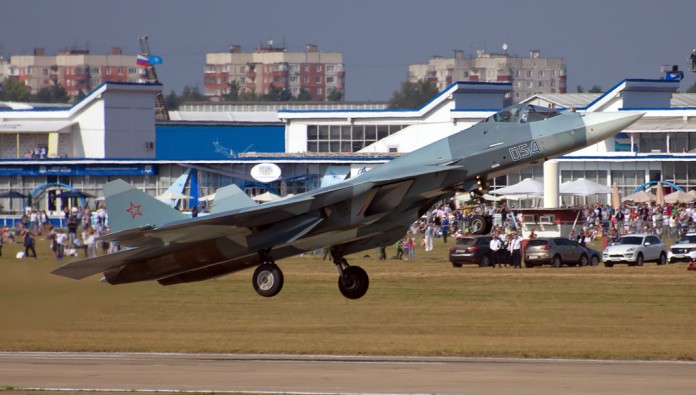
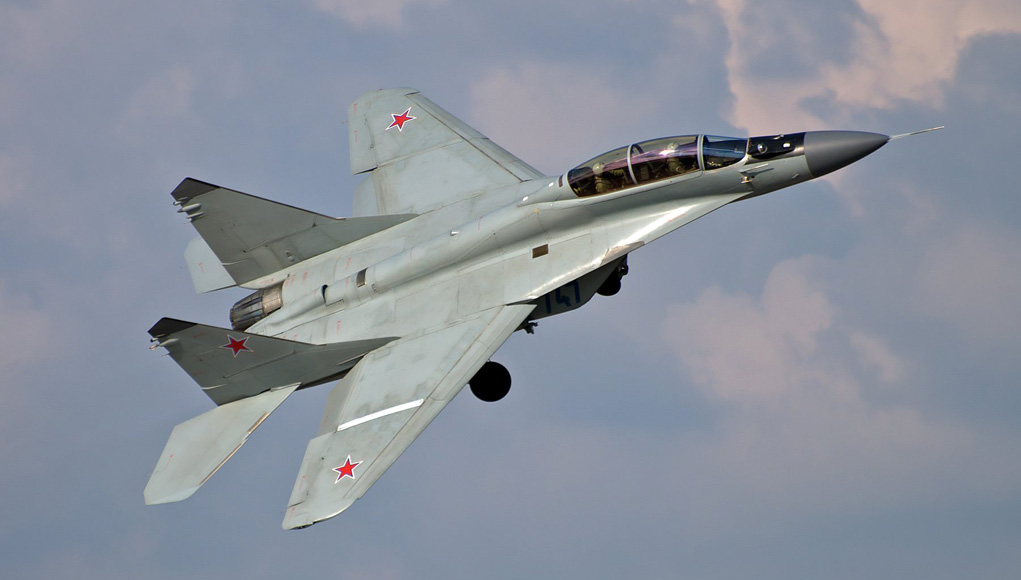
    Some of the new Russian aircraft – the MiG-35 and the T-50 have yet to reach operational service, but are already attracting customer attention. Traditional platforms, such as the Su-27 and the MiG-29, remain the hottest sales items in the Russian inventory, although they are all based on 1980s technology – developed by the old-school Soviet designers in the last years of the Communist USSR.

    Surprisingly, these old designs are facing the same opponents they had thirty years ago – the F-16s, F-15s and F-18s. Although Russia has lagged behind in the past two decades – as the USA developed and fielded the fifth-generation F-22 Raptor – Russia is now nearing the operational introduction of the T-50, one or two years after the second fifth-generation U.S. fighter (F-35) is reaching initial operational capability.

    Although in terms of electronic systems the F-35 is more sophisticated and capable, the Russian fighter shows much better performance, in terms of super maneuverability and combat potential, with a superior flight envelope and an increased weapons load. In fact, given the problematic performance of the F-35, some analysts consider the introduction of the Russian Advanced Fighter Aircraft (PAKFA or T-50) will actually open a gap in favor of the Russians, rather than having the Russians closing the gap opened by the Americans in the past 20 years.
    mig292442

    Invisible Drones Could Become Reality with New Meta Material

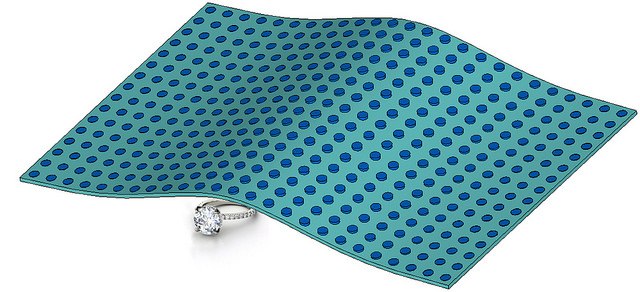
    Electrical engineers at the University of California in San Diego have created a new design for a cloaking device, using an ultra-thin Teflon substrate, studded with cylinders of ceramic, that can ‘bend’ light weaves around objects coated with it, creating a cloak. The Teflon has a low refractive index, while the ceramic’s refractive index is higher, a combination which allows light to be dispersed through the sheet without any absorption.

    Kante150
    Prof. Boubacar Kanté, senior author of the study “Extremely Thin Dielectric Metasurface for Carpet Cloaking”

    “Invisibility may seem like magic at first, but its underlying concepts are familiar to everyone. All it requires is a clever manipulation of our perception,” said Boubacar Kanté, a professor in the Department of Electrical and Computer Engineering at the UC San Diego Jacobs School of Engineering and the senior author of the study. “Full invisibility still seems beyond reach today, but it might become a reality in the near future thanks to recent progress in cloaking devices.”

    Up to now, the main theoretical tool used for designing invisibility cloaks has been transformation optics / conformal mapping – according to Fermat’s principle, an electromagnetic wave will travel between two points along the path of least time. In a homogeneous material, this path is just a straight line. However, in an inhomogeneous material, the path becomes a curve because waves travel at different speeds at different points. Thus, one can control the path of waves by appropriately designing the material parameters (electric permittivity and magnetic permeability).

    An extremely thin cloaking devise is designed using dielectric materials. The cloak is a thin Teflon sheet (light blue) embedded with many small, cylindrical ceramic particles (dark blue). (Photo courtesy of Li-Yi Hsu/University of California, San Diego)
    An extremely thin cloaking devise is designed using dielectric materials. The cloak is a thin Teflon sheet (light blue) embedded with many small, cylindrical ceramic particles (dark blue). (Photo courtesy of Li-Yi Hsu/University of California, San Diego)

    By scattering the electromagnetic radiation – in the visible, infrared or radar spectrum, such Metamaterial will be able to render a coated object undetectable in these wave frequencies, by forcing light or radar waves to bypass the object surface through the coating, which effectively “cloaks” the object.

    Prior developments to this technology required many layers in order to cover an object, resulting in a very thick layer that enclosed the object. The new, super-thin metamaterial has the capability to better hide the three-dimensionality of objects while addressing the issue of shadows and background matching. The University of California has achieved a cloak that won’t reduce any intensity when light is reflected from the coated, so the concealed object will remain undetectable and will appear completely flat to an observer’s eyes.

    Having the ability to create ultimate stealth protection for anything over a battlefield or warzone provides enormous military advantage over the adversary. In theory, creating a cloaking device would be used to conceal larger objects. This cloaking device would be valuable to many technologies, including unmanned air vehicles (UAVs) due to the capability to disappear from view and leaving no visual, electronic or infrared signature for an enemy to detect.

    Creating the effect of an invisibility cloak offers a real-world solution to concealment, which can provide the military with air superiority. While this cloak has numerous applications for the military, this technology will create a ripple effect beyond the battlefield that will improve the performance of other diverse applications.

    Compared to an invisibility cloak, this technology has not only the ability to conceal, but the ability to increase optical communication signal speed and to collect solar energy. “Doing whatever we want with light waves is really exciting,” said Kanté. “Using this technology, we can do more than make things invisible. We can change the way light waves are being reflected at will and ultimately focus a large area of sunlight onto a solar power tower, like what a solar concentrator does. We also expect this technology to have applications in optics, interior design and art.”
    First published in: HDIAC Spotlight: Bringing Invisibility Cloaking to reality (August, 2015)

    Russian Stealth Ship Killers Debut at MAKS 2015

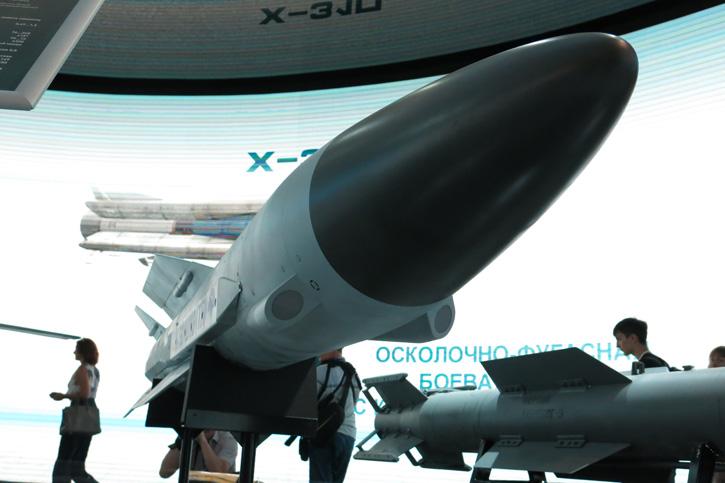
    The following photos are showing some of the new missiles on display. More photos are accessible to ‘Gold Members‘ as part of Defense-Update premium edition.

    IMG_0647rev
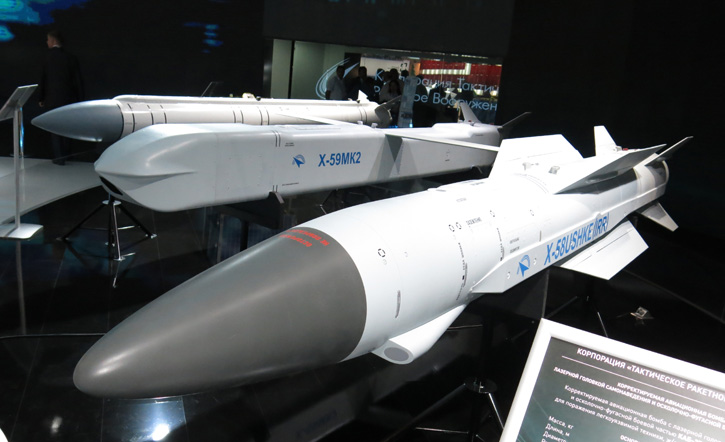
    Three of the four new aerial ordnance weapons displayed by the Tactical Missiles Corporation – GROM E1/E2 guided, standoff weapon, X-59Mk2 cruise missile and X-58USHKE/IIR stand-off anti-radiation attack missile. Photo: Tamir Eshel, Defense-Update
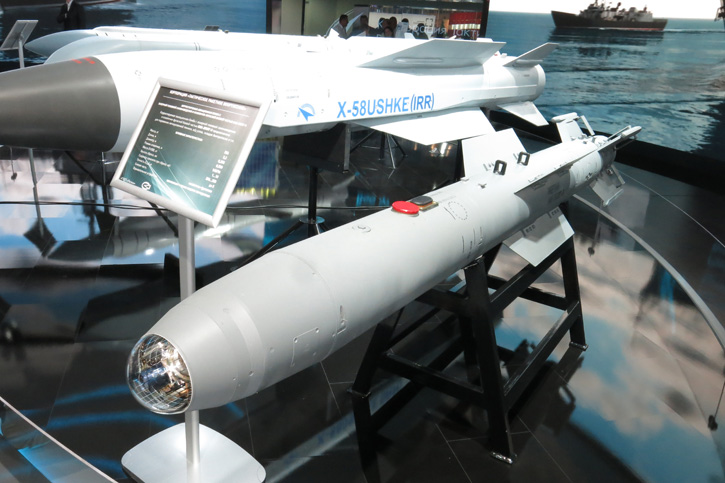
    IMG_0803
    X-58USHKE/IIR is a modified variant of the weapon unveiled in 2011, designed for internal carriage in T-50 or external carriage on Su-35, 34 and 30. The IIR variant uses two infra-red imaging sensors enabling the missile to prosecute non-emitting targets that have shut down their radar to avoid attack. Photo: Tamir Eshel, Defense-Update

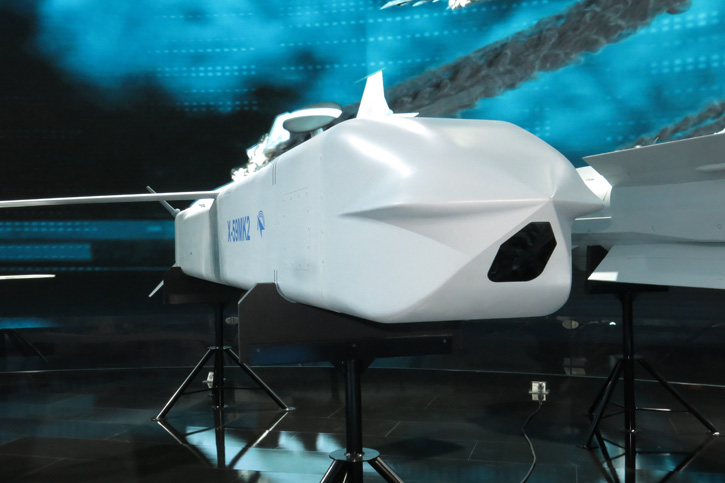
    X59mk2_1
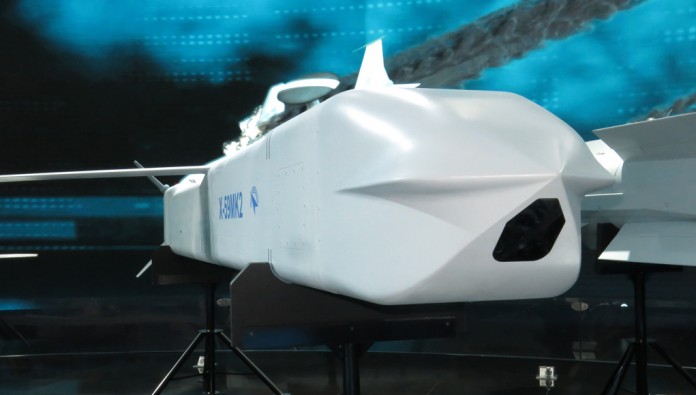
    A new appearance at MAKS 2015 was the X-59Mk2 cruise missile. Flying at high subsonic speed, the weapon is designed for air-ground attack at ranges of 290 km. The missile carries a warhead weighing 300-700 kg. Its length is 4.2 meters and the wingspan is 2.45 meters. Although pursuing low flight altitude, X59Mk2 can hit its target at angle of 45 degrees at a terminal speed of 1,000 km/h and an accuracy of 3-5 meters. Typical targets for the weapon are ships and fixed land-based targets. Photo: Tamir Eshel, Defense-Update

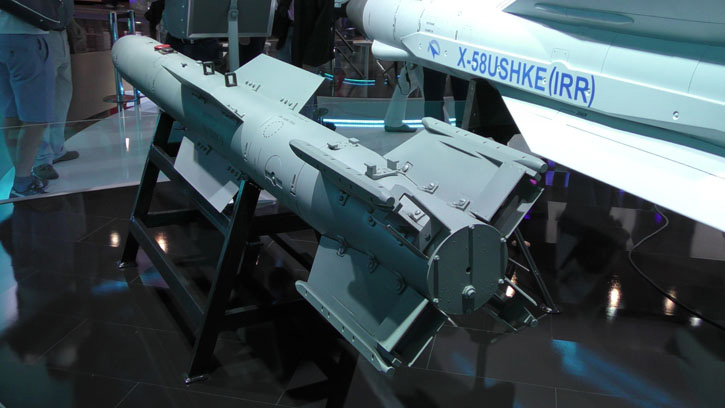
    IMG_0648
    Another new guided weapon displayed by the Tactical Missiles Corporation was the 256 kg guided bomb. The weapon uses a GLONASS/SAL guidance kit enabling it to hit targets with an accuracy of less than five meters. The bomb uses three-mode fusing enabling impact, delay (penetration) or air-burst effects. Photo: Tamir Eshel, Defense-Update
    S1130089
    The guided weapon comes at a length of 3.2 meters and diameter of 255mm, with height of tails and stabilizers minimized by using four twin-blade rudders, providing roll and pitch for the weapon guidance, while maintaining the width and height compatible with internal carriage. Photo: Tamir Eshel, Defense-Update

    IMG_0404
    Both use extracted wings for gliding, to extend the weapon’s range. Extracted tail fins are also used, enabling the weapon to be carried internally. The GROM weighs about 600 kg. The rocket powered variant (GROM E1) carries a warhead at a weight of 300 kg while the unpowered Grom-E2 has a warhead weight of 450 kg. weight. Photo: Tamir Eshel, Defense-Update
    IMG_0329
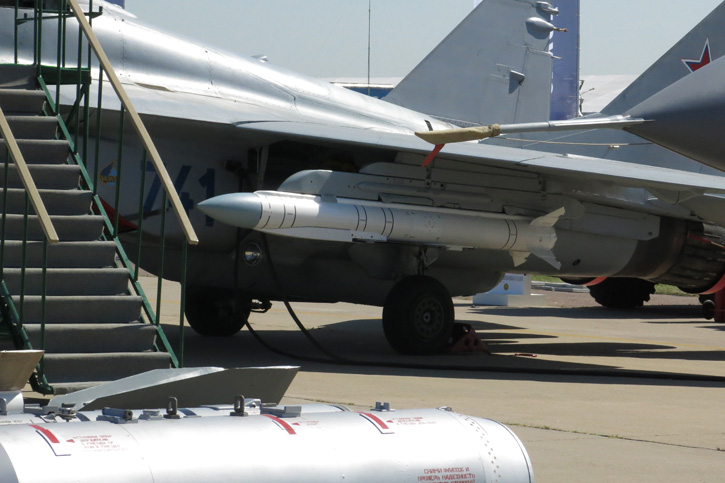
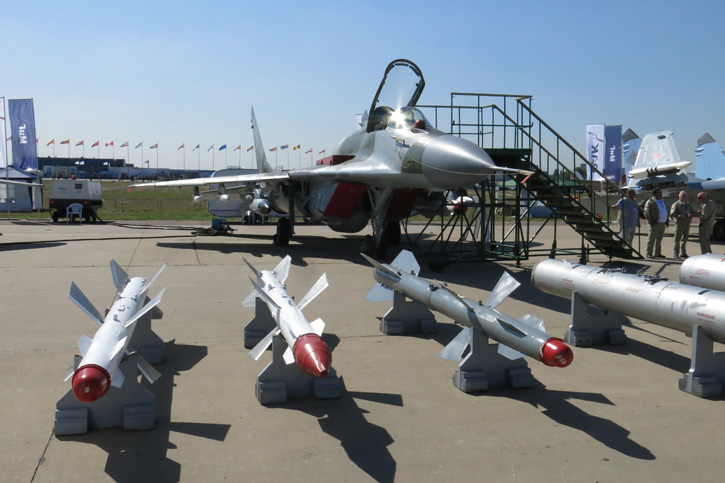
    A selection of air/air and air/surface weapons displayed on the MiG-29SMT. The mighty Kh31 (AS-17 Krypton under the right wing) and Kh29TE (left wing) is seen underwing, along with two air/air missiles. R77 (RVV-AE) underwing and R-27 in front. Photo: Tamir Eshel, Defense-Update

    To view more reports, photos and videos from MAKS 2015 – Join Defense-Update as a Gold member

    Oshkosh Wins JLTV Contract, to deliver 17,000 Combat Vehicles to US Army and Marine Corps

    Oshkosh, Wisconsin Based Oshkosh Defense company was awarded yesterday $114 million firm-fixed-price contract for two-year low-rate initial production of Joint Light Tactical Vehicle (JLTV) for the U.S. army and U.S. Marine Corps. The company is likely to win follow-on orders under options of that contract, worth over $6.7 billion, under the  and full-rate production phase expected to open in 2018 and carry the program through 2024, producing 17,000 vehicles. The full scope of the program will span over 25 years, producing 55,000 vehicles, worth well over $22 billion.

    Oshkosh grabbed the contract after a long competition with Lockheed Martin and AM General, the manufacturer of the current HMMWV tactical vehicle. Unlike its competitors that received government funding for their prototype development, Oshkosh entered the race at the Engineering Manufacturing and Development (EMD) with a vehicle based on its Light Armored Tactical Vehicle, based on the combat proven and matured MIne Resistant Ambush Protected All Terrain Vehicle (M-ATV), over 9,000 of these vehicles are currently operational with the Army.

    Oshkosh JLTV is 30 percent lighter than the M-ATV, while offering similar level of protection. Other key improvements the JLTV has over HMMWV and M-ATV, are significant improvement in power to weight ratio, better power availability and payload reserve, and integral electronic architecture, while offering superior protection, at a level similar to the current M-ATV, also produced by Oshkosh. 

    When JLTV becomes operational in 2018 it will improve the mobility, survivability and energy efficiency of Army and Marine Corps vehicles, allowing combat forces to operate more effectively in modern battle. It will also be able to be air lifted by current CH-47 and CH-53, something the current, heavy protected vehicles could not do.

    Iran Doubles ‘Fateh’ Guided Missile’s Range to 500km

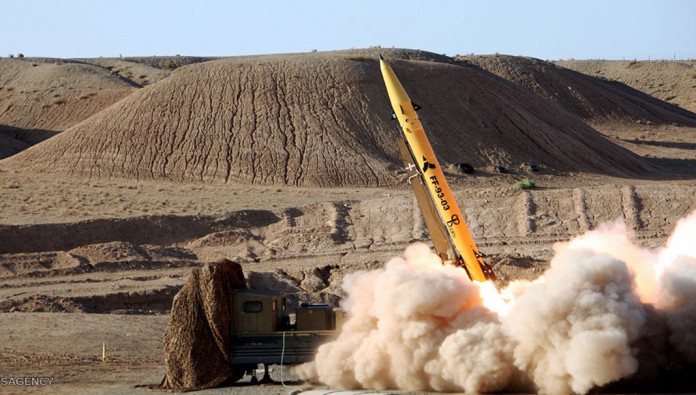
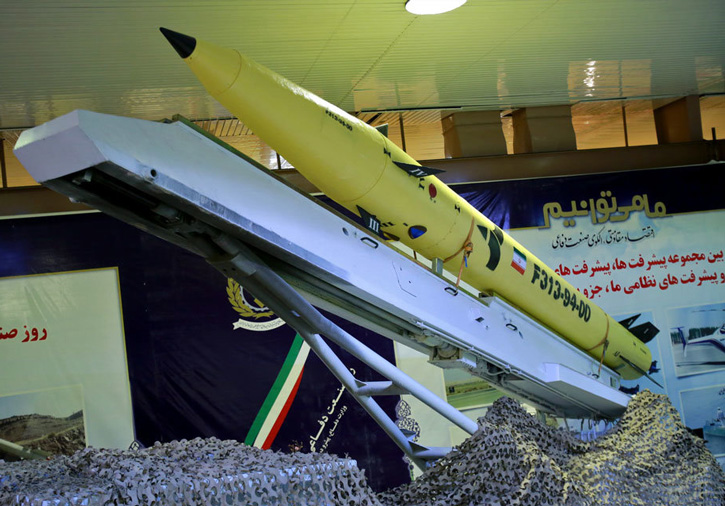
    Fateh 313 ballistic guided missile on a recent test firing.

    Fateh 313 ballistic guided missile on a recent test firing.
    Fateh 313 ballistic guided missile on a recent test firing.
    Iran unveiled today (saturday) a new member of the Fateh ballistic guided missile family. The new Fateh 313 missile has a range of 500 km – twice the range of the former Fateh 110 version. According to Iranian sources the new missile will enter production soon, following a recent successful test flight. The current Fateh 110 weighs 3.45 tons and its warhead weight is 450-650 kg. (according to the variant). The warhead weight of the new version was not released, nor the missile’s total weight. Since its range is longer, it is expected to reach a higher terminal speed.

    However, from the inspection of the images released by the Iranians it seems the missile’s envelope remains intact, hinting of the use of improved propellant, which also increases the speed of the missile, requiring heavier thermal protection, as indicated by the ablative surface around the nose.

    Iran is planning a major modernization of its missile force, replacing Fateh 110 and Qiam ballistic missiles and Qadr air-launched precision guided missiles with new generations. Fateh 313 seems to be the successor for the 110.

    The liquid-propelled Qadr F is being replaced with two-stage solid-rocket propelled Sejjil that has a range of 2,000 km, which entered production in 2013.

    As for the air-launched missiles, Iran is developing air-launched cruise missiles with a strike range of 700 km. Iran also developed a different, surface-launched cruise missile – the Soumar – has the potential to attack targets at ranges beyond 2,000 km.

    Fateh 313 short-range ballistic guided missile has a range of 500 km.
    Fateh 313 short-range ballistic guided missile has a range of 500 km.

    DARPA Awards $20 Million for Continued Development of a Military Space Plane

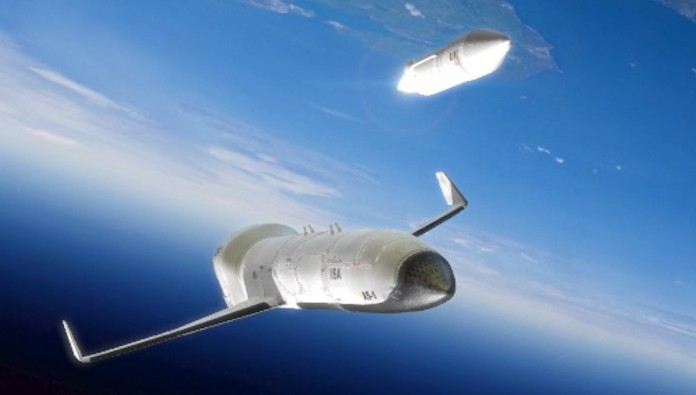
    Boeing, Northrop Grumman and Masten Space Systems have won additional funding from the US Defense Advanced Research Projects Agency (DARPA), to continue developing their concepts for the United States military’s XS-1 robotic space plane under the program’s second phase (Phase 1B).

    The current phase funds the “development of the XS-1 demonstration concept, substantiating identified core component technologies, mitigating risk, developing a Technology Maturation Plan (TMP), and performing several demonstration tasks,” DARPA said. Completion of Phase 1B is expected by August 2016. All three companies had received money in the summer of 2014 for initial “Phase 1” design work. The first XS-1 orbital mission could take place as early as 2018, DARPA said.

    The objective of the Experimental Spaceplane XS-1 program is to demonstrate relevant technologies and then fabricate and fly a reusable, unmanned aircraft to the edge of space. The XS-1 would then deploy a small expendable upper stage able to launch a 3,000-pound spacecraft to Earth orbit at a cost of no more than $5M, or about one-tenth the cost of today’s launch systems.

    The experiment will demonstrate the XS-1’s “aircraft-like” operability, cost efficiency and reliability, agency officials have said. Key anticipated characteristics of the XS-1 aircraft include a physical size and dry weight typical of today’s business jets.

    The XS-1 will likely feature a reusable first stage and one or more expendable upper stages. The first stage will fly to suborbital space and then return to Earth, while the upper stages will deploy the space plane’s payloads.

    The three companies have teamed with private ventures already seeking commercial space flight vehicles. space. Boeing teamed up with Blue Origin; Northrop Grumman partnered with Virgin Galactic and Masten cooperated with XCOR Aerospace.

    Boeing already has experience building robotic space planes for the U.S. military. The company constructed the Air Force’s two X-37B space planes, which have launched on a total of four mystery missions over the past five years. In addition, DARPA is exploring another concept for launching small satellites to orbit from an F-15 – under Airborne Launch Assist Space Access (ALASA). The first in-air ALASA test could occur later this year.

    Spain Allocates €171 Million to Buy Four ‘Megadrones’

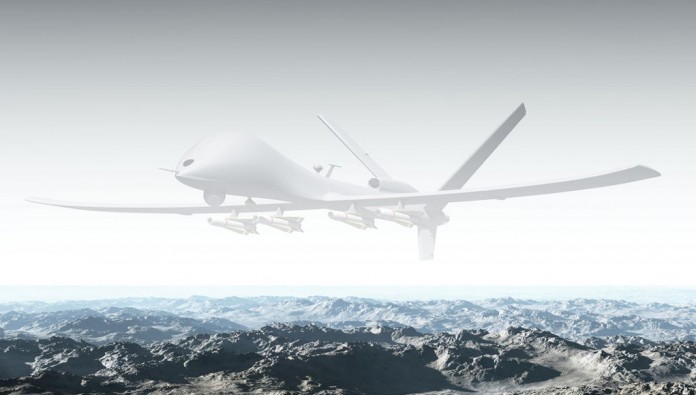
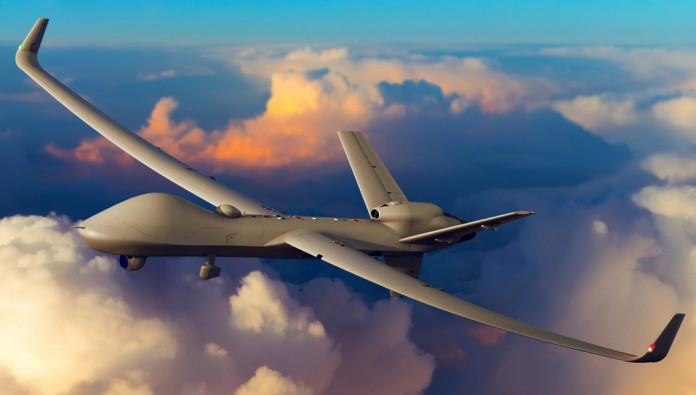
    General Atomics Aeronautical Systems Inc. (GA-ASI) is developing a variant of the Predator B Remotely Piloted Aircraft (RPA) to be certified for flight according to the NATO Airworthiness Standard for unmanned aircraft. The new variant will fly in 2017, GA-ASI said. Illustration Photo: GA-ASI

    Spain has decided to buy four Medium Altitude Long Endurance (MALE) drones for its air force. According to the Ministry of Defense announcement made on thursday in Madrid, the Government allocated €25 million ($27 million) in the 2016 budget to fund the acquisition of the first system. The entire five-year program is expected to cost about €171 million ($187 million) and include four aircraft and two ground control stations – one fixed and one deployable overseas. Delivery of the new aircraft is expected in 2017.

    Although media reports crowned the MQ-9 Reaper made by General Atomics as the winner, the Spanish announcement included no specific selection of one of the two bidders. Two companies answered the Spanish tender for MALE UAS – a team lead by General Atomics and Spanish partner Sener offering the MQ-9 Reaper (Predator B), and Israel Aerospace Industries (IAI) teamed with Spanish company Indra offering the Heron TP.

    According to defense sources the selection leans toward the American offer, as Spain could benefit from logistical support and availability of five Reaper operators currently available within NATO – UK, France, Italy, Netherlands and the USA. The final selection of MALE could be influenced by the results of elections to be held in Spain next month.

    Heron-tp_flight
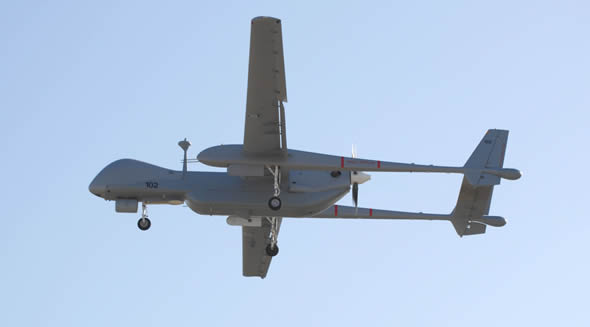
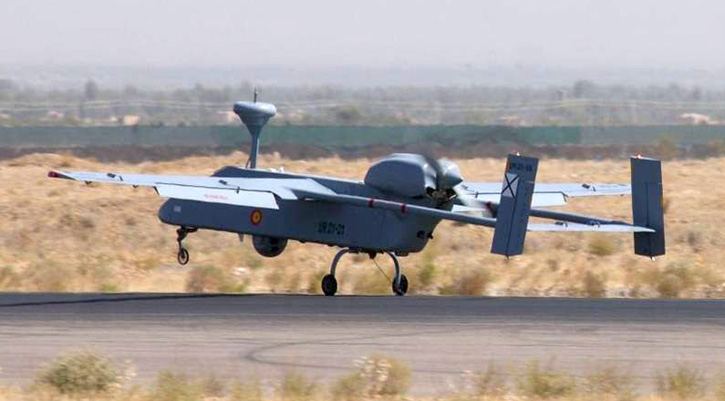
    IAI’s Heron TP made its first flight in 2009 and entered operational service in 2011. The drone is currently in service with the Israel Air Force and is evaluated by several international customers in Europe and Asia. Photo: Noam Eshel, Defense-Update

    Spain has been operating the Israeli Searcher MkII tactical drone since 2008, and evaluated the larger Heron I platform in maritime surveillance missions. Madrid also acquired ‘mini-drones’ – the RQ-11 Raven made by the US company Aerovironment. Therefore, the next acquisition refers to the platform as ‘Mega-Drone’, the first unmanned platform in Spanish service to be able to operate at an altitude of 30,000 ft for missions lasting over 24 hours. Although these Megadrones can carry weapons, the Spanish military intends to use them unarmed – strictly for reconnaissance and surveillance.

    One of the main concerns for European UAV operators is the inability of the Reaper to meet European aviation certification to be able to fly in the crowded European airspace. Israel’s drones were more responsive to such requirements, as Heron platforms are operating with special permissions over parts of the continent for years. In June 2015 General Atomics announced it is expecting to fly a ‘Certifiable Predator B’ in 2017. According to GA-ASI, certification of delivered systems will be granted by the responsible agencies within each country.

    Whatever the final decision be, the current procurement is regarded as a stopgap, buying time and developing operational capabilities until Spain joins the future European MALE project. The program was launched earlier this year in Brussels, when France, Germany and Italy signed the cooperation program to develop the system under an initial €60 million investment.


    Spain has been operating Israeli Searcher Mk II tactical UAS acquired from IAI since 2008. These drones were acquired to support the Spanish deployment in Afghanistan.
    Spain has been operating Israeli Searcher Mk II tactical UAS acquired from IAI since 2008. These drones were acquired to support the Spanish deployment in Afghanistan.

    RAF to Retain Tornado Strike Fighters for Another Year

    The Royal Air Force ( RAF) will extend the service of no. 12 (Bober) Squadron operating   Tornado GR4, which currently takes part in the air campaign against ISIL in Iraq. The squadron’s Tornados will will be maintained in service for an additional year, until March 2017 the British Defence Secretary has announced during a recent visit in Baghdad.

    The squadron will continue to offer the essential precision firepower, intelligence and surveillance needed for the counter-ISIL international coalition to provide vital support to Iraqi ground forces, Defence Secretary Michael Fallon said.

    The unit maintains eight Tornados flying daily missions over Iraq.

    “Our aircraft have flown thousands of missions and   RAF   Tornados have carried out hundreds of strikes, helping Iraqi forces push back ISIL from the Kurdish region and out of key towns such as Tikrit and Bayji.” Fallon said .
    The Tornado GR4 provides coalition forces he capability to operate day or night and in poor weather, employing advanced reconnaissance, targeting and precision strike weapons.

    “The decision to retain the third Tornado GR4 squadron for a further year is welcome news. It is clear that the requirement for fast jet precision strike and intelligence gathering shows no sign of diminishing,”  the Chief of the Air Staff, Air Chief Marshal Sir Andrew Pulford said,  “Extending the life of Number 12 (Bomber) Squadron will allow the Royal Air Force to continue to provide a unique and hugely valuable contribution to the coalition fight against Da’esh.” Pulford added.
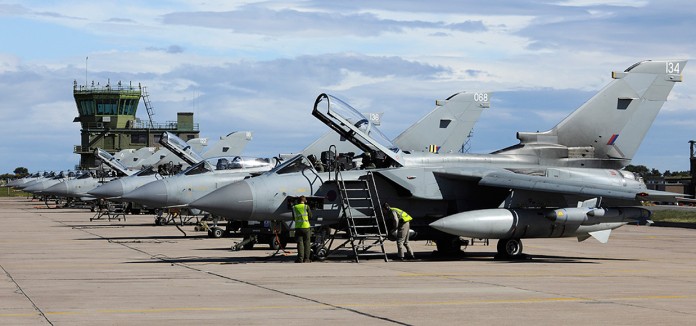
    RAF to Retain Tornado Strike Fighters for Another Year

    The Royal Air Force ( RAF) will extend the service of no. 12 (Bomber) Squadron operating Tornado GR4, which currently takes part in the air campaign against ISIL in Iraq. The squadron’s Tornados will be maintained in service for an additional year, until March 2017 the British Defence Secretary has announced during a recent visit in Baghdad.

    The squadron will continue to offer the essential precision firepower, intelligence and surveillance needed for the counter-ISIL international coalition to provide vital support to Iraqi ground forces, Defence Secretary Michael Fallon said.

    The unit maintains eight Tornados flying daily missions over Iraq.

    “Our aircraft have flown thousands of missions and   RAF   Tornados have carried out hundreds of strikes, helping Iraqi forces push back ISIL from the Kurdish region and out of key towns such as Tikrit and Bayji.” Fallon said .

    The Tornado GR4 provides coalition forces he capability to operate day or night and in poor weather, employing advanced reconnaissance, targeting and precision strike weapons.

    “The decision to retain the third Tornado GR4 squadron for a further year is welcome news. It is clear that the requirement for fast jet precision strike and intelligence gathering shows no sign of diminishing,”  the Chief of the Air Staff, Air Chief Marshal Sir Andrew Pulford said,  “Extending the life of Number 12 (Bomber) Squadron will allow the Royal Air Force to continue to provide a unique and hugely valuable contribution to the coalition fight against Da’esh.” Pulford added.

    No. 12 Squadron Royal Flying Corps was formed in February 1915 and moved at the same year to France, to join operations over the Western Front. On its 99th anniversary the unit was disbanded at its operating base at RAF Lossiemouth, only to reform a year later at RAF Marham, operating the Tornados of No.2 Squadron. The began supporting the coalition campaign against ISIL in January 2015, operating from Akrotiri in Cyprus.

    SM-6 ‘Dual 1’ Defeats Ballistic and Cruise Missiles on a Live Firing Test

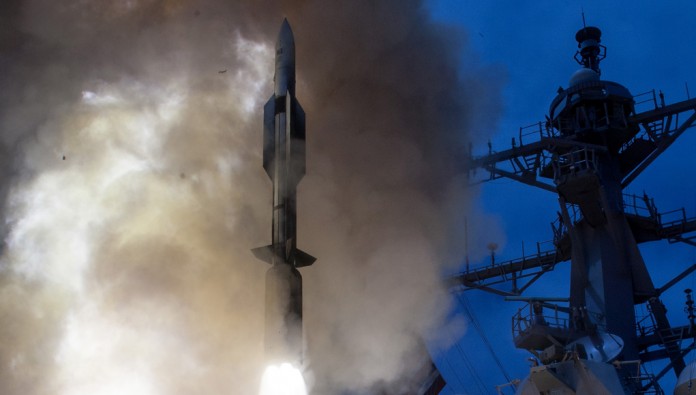
    The US Missile Defense Agency (MDA) and US Navy conducted a successful series of missile intercepts in the Pacific Ocean last week, demonstrating the capability of a newly modified missile interceptor to defeat short range ballistic missiles and cruise missiles with the same weapon. The SM-6 was designed from the start to defeat air breathing targets such as cruise missiles, but the recent test was the first to demonstrate the modified variant’s capability to defeat ballistic threat missiles in their final seconds of flight.

    This ‘Multi-Mission Warfare (MMW) Events’ was the first live fire test of the new SM-6 Dual I missile. During two follow-on flights additional ‘SM-6 Dual I’ missiles were used against targets simulating air launched and surface launched cruise missiles, demonstrating the multi-mission capability of the new SM-6 variant. Part of the U.S. ballistic missile defense, MDA’s Sea-Based Terminal (SBT) program will protect against ballistic threats in their terminal phase of flight using SM-6 missiles integrated into the Aegis Weapon System. Called SM-6 Dual 1, it’s on track to achieve initial operating capability in 2016.

    The missiles were fired from the AEGIS BMD destroyer USS John Paul Jones (DDG 53), configured with the latest Aegis Baseline 9.C1 (BMD 5.0 Capability Upgrade) version, and using Standard Missile SM-6 Dual I and SM-2 Block IV interceptor missiles. This test marked the first endo-atmospheric (lower atmosphere) engagement of a Ballistic Missile target to demonstrate a Baseline 9.C1 capability. This capability allows Aegis to engage ballistic missiles in their terminal phase. “This important test campaign not only demonstrated an additional terminal defense layer of the BMDS” said MDA Director Vice Adm. James D. Syring, “it also proved the robustness of the multi-use SM-6 missile on-board a Navy destroyer, further reinforcing the dynamic capability of the Aegis Baseline 9 weapon system.” Syring added.

    “SM-6 is the only missile in the world that can do both anti-air warfare and ballistic missile defense from sea,” said Dr. Taylor W. Lawrence, president of Raytheon Missile Systems. “U.S. Navy commanders want both capability and flexibility to meet a wide variety of missions, and that’s exactly what SM-6 offers.”

    SM-6 delivers a proven over-the-horizon, air defense capability by leveraging the time-tested advantages of the Standard Missile’s airframe and propulsion. The missile incorporates the advanced signal processing and guidance control capabilities from Raytheon’s Advanced Medium-Range Air-to-Air Missile (AMRAAM), and employs both active and semi-active guidance modes and advanced fuzing techniques to defeat air breathing and ballistic missile targets.

    Skunk Works and XTEND Simplify Multi-Drone Command

    0
    Lockheed Martin Skunk Works® and XTEND have achieved a major milestone in JADC2 by integrating the XOS operating system with the MDCX™ autonomy platform. This technical breakthrough enables a single operator to simultaneously command multiple drone classes, eliminating the friction of mission handoffs. From "marsupial" drone deployments to operating in GPS-denied environments, explore how this collaboration is abbreviating the data-to-decision timeline and redefining autonomous mission execution.

    From Ukraine to Taiwan: The Global Race to Dominate the New Defense Tech Frontier

    0
    As traditional defense primes face mounting competition from agile “neoprimes” such as Anduril, Palantir and Helsing, the balance of innovation is shifting toward software-defined warfare and scalable, dual-use technologies, while global industry consolidation—marked by Boeing’s integration of Spirit AeroSystems and other strategic mergers—signals an intensified race to secure control over the defense technology value chain. Our Defense-Tech weekly report highlights these trends.

    Europe’s “Drone Wall”

    0
    In early October 2025, a coordinated wave of unmanned aerial system (UAS) incursions—widely attributed to Russia—targeted critical infrastructure across at least ten European nations. The unprecedented campaign exposed the fragility of Europe’s air defenses...

    Weekly Defense Update & Global Security Assessment

    0
    Executive Summary The past week (September 18-25, 2025) represents an inflection point where strategic defense concepts have transitioned from doctrine to tangible reality. An analysis of global events reveals four primary, interconnected trends shaping an...

    U.S. Air and Space Forces Push Next-Gen Programs at the AS&C 2025 Conference and...

    0
    At the 2025 Air, Space & Cyber Conference, U.S. Air Force and Space Force leaders unveiled major updates on next-generation fighters, bombers, unmanned systems, and space initiatives, highlighting both rapid innovation and critical readiness challenges as the services race to outpace global competitors. A short version is available here, with a more detailed version for subscribers.

    TADTE 2025: Reflecting Taiwan’s Strategic Themes

    0
    The Taipei Aerospace & Defense Technology Exhibition (TADTE) 2025 crystallized around four dominant strategic themes that collectively illustrate Taiwan's comprehensive approach to defense modernization amid escalating regional tensions. Based on a detailed report by Pleronix (available upon request). Includes a Podcast discussion on TADTE 2025's highlighting Taiwan's four strategic themes beyond the post's coverage.

    Iron Beam 450 Completes Testing, Soon to Join With Operational Air Defense Units

    0
    Israel’s Iron Beam 450 high-power laser system has completed final testing, marking a major leap in air defense. Developed by Rafael, it offers precise, cost-effective interception of rockets, UAVs, and mortars, and is set for IDF deployment by 2025.