
Wednesday, December 24, 2025
More
    Home Blog Page 94

    India mulls switching from Rafale to Su30MKIs

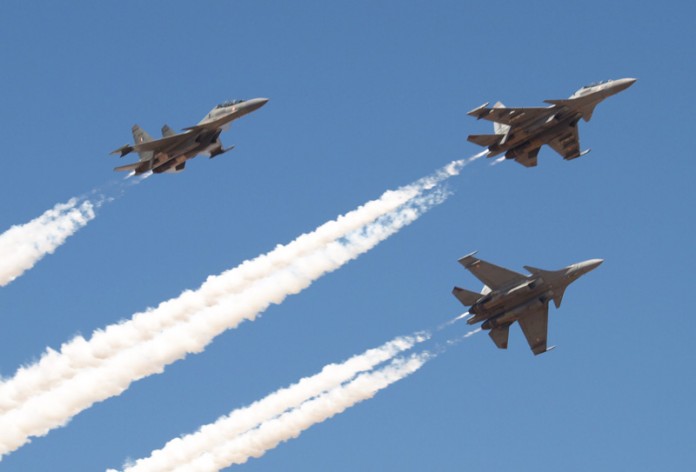
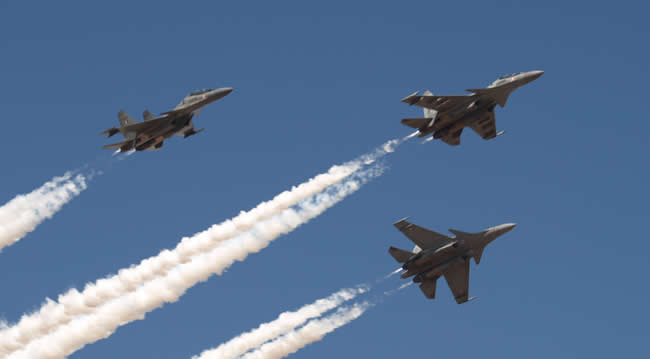
    The Indian Air Force is planning to field over 270 Su-30MKI fighters in 14 squadrons. Photo: Tamir Eshel, Defense-Update
    The Indian Air Force is planning to field over 270 Su-30MKI fighters in 14 squadrons. Photo: Tamir Eshel, Defense-Update

    For the first time since January 31, 2012, when the French Rafale fighter was chosen as the future medium multi-role combat aircraft (MMRCA) for the Indian Air Force (IAF), it has been officially admitted that there are serious problems in negotiating the purchase with the French vendor, Dassault. the Indian Business Standard reports.
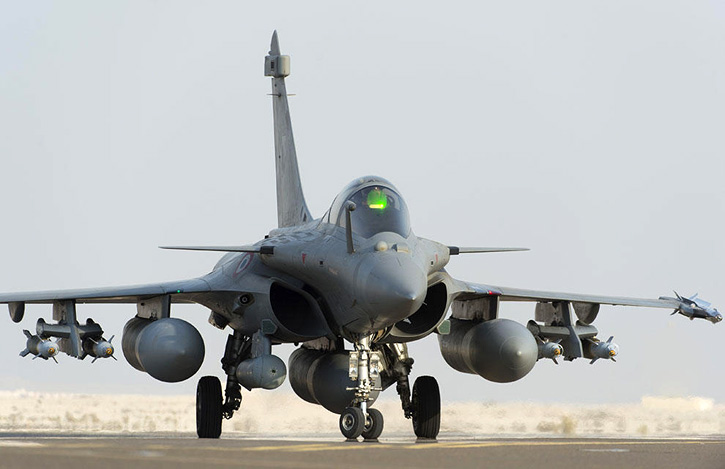

    The French Rafales performed the strike with GBU-12 laser guided, marking their targets with Damocles targeting pods. Photo: French Air Force, SIRPA
    The French Rafales performed the strike with GBU-12 laser guided, marking their targets with Damocles targeting pods. Photo: French Air Force, SIRPA
    India's defence minister Manohar Parrikar
    India’s defence minister Manohar Parrikar

    Speaking to the media on Tuesday evening, Defence Minister Manohar Parrikar said there were “complications” in the negotiations, already on for almost three years, with the French side reluctant to meet commitments that IAF had specified in the tender. Parrikar mentioned that local production of Su-30 MKI by HAL would be adequate for the Indian Air Force (IAF) in case India will not procure the Rafale.

    Past reports cited the reluctance of the French side to assume responsibility for the local production of 108 Rafales by Hindustan Aeronautics Ltd (HAL), mandated by the tender. Unnamed sources told the Times of India the Indian MoD is also upset with Dassault’s attempts to “change the price line”, which led to its selection over the Eurofighter Typhoon as the L-1 (lowest bidder) three years ago, by deciding the “costing” for HAL on its own. “It will amount to a de facto hike in the L-1 price”.

    The IAF currently plans to have 272 Su-30MKI fighters by about 2018. HAL’s Nashik production line is building the fighter at $56 million each (358 crore Inr.), less than half the estimated cost of the Rafale.

    In another reversal of previous ruling, Parrikar reiterated his intention to permit foreign arms companies to station “representatives or technical consultants” in India. India imposed a ban on ‘agents’ that after the Bofors gun scandal of 1987-88.

    “Changes will be made to the Defence Procurement Policy. Company representatives will be allowed but commission, or percentage of profit for the deals will not be allowed.” Parrikar said, adding that representatives have to be registered with the ministry and remuneration shall be declared by the company.

    According to The Tribune, a draft of the changed policy is ready and the final draft will be ready in the next few days and the process will be completed in 45 days. “The interests of the military would be taken care off” Parrikar declared.

    Parrikar also indicated that may opt to lift lift the ban on blacklisted firms if the equipment they supply is crucial to the armed forces. The Minister made it clear that “success fees will not be allowed”. The Minister gave an example that Bharat Earth Movers Ltd (BEML) has been allowed to deal with the original Tatra company but not Tatra UK, which was banned following allegations of kick-backs.

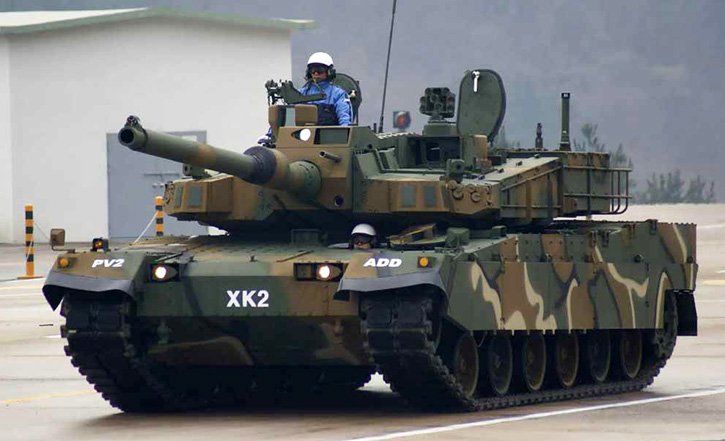
    Korea to bolster its land forces with 100 new Black Panther tanks by 2017

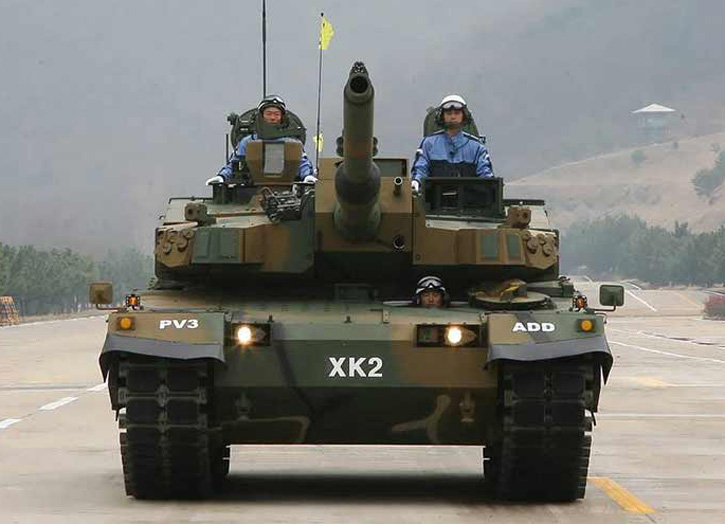
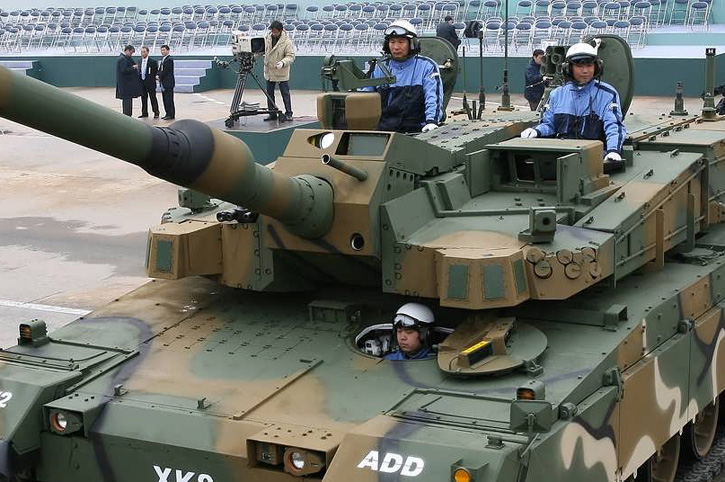
    The Black Panther weighs 55 tons and is operated by a crew of three. It is armed with a locally produced variant of the L55 120 mm smoothbore gun manufactured by World Industries Ace Corporation. Photo: Hyundai Techwin

    The K2 was selected by the Turkish Ministry of Defense as the basis for the indigenous Turkish MBT Altay. The company is planning to demonstrate the new tank at the upcoming IDEX 2015 exhibition in Dubai, as it considers countries in the Middle East and Africa to be potential export customers for the new tank.

    The Korean automotive industrial giant Hyundai Rotem Co. has signed a contract worth US$820.29 million (901.5 billion won) with the Korean Defense Acquisition and Procurement Agency (DAPA) to deliver K2 Main Battle Tanks (MBT) to the South Korean Army. The initial order is believed to be for 100 tanks, with follow-on requirement for additional 400. The first production of pre-production models of the tank, powered by German MTU engines were delivered to DAPA and the Army in June 2014 for evaluations. Serial production of full production version with a Korean made powerpack is expected to begin in the first half of 2015. The K2 will replace the K1 tanks currently in service.
    The contract was signed after the Committee on the Defense Acquisition Program cleared the acquisition. Under the contract Hyundai Rotem will deliver the new ‘Black Panther’ tanks by 2017. The original initial operational capability foreseen for the new tank was 2016.

    The K2 was selected by the Turkish Ministry of Defense as the basis for the indigenous Turkish MBT Altay. The company is planning to demonstrate the new tank at the upcoming IDEX 2015 exhibition in Dubai, as it considers countries in the Middle East and Africa to be potential export customers for the new tank.

    The initial order is believed to be for 100 tanks, with follow-on requirement for additional 400. First pre-production models of the tank, were delivered to DAPA in June for evaluations. Serial production is expected to begin in the first half of 2015 with deliveries expected in 2017.
    The initial order is believed to be for 100 tanks, with follow-on requirement for additional 400. First pre-production models of the tank, were delivered to DAPA in June for evaluations. Serial production is expected to begin in the first half of 2015 with deliveries expected in 2017.
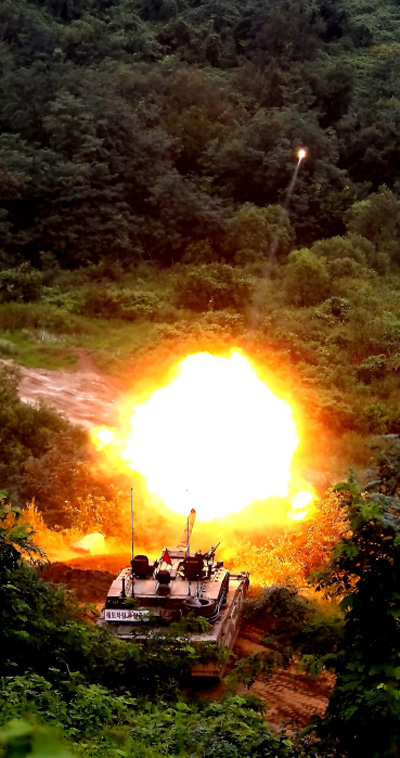
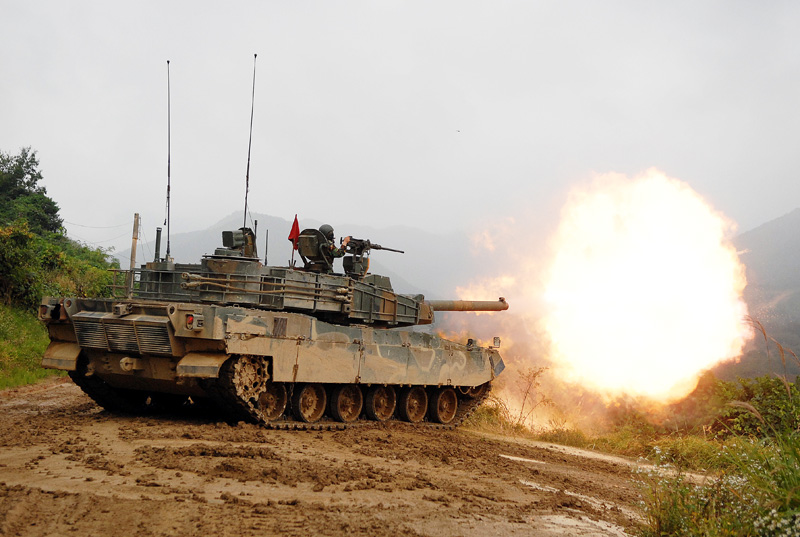
    The K2 is armed with a smoothbore 120mm gun, coupled with an autoloader supported by a 16 round magazine, enabling the crew to fire rounds in quick succession of 3 second intervals. the total ammunition capacity is 40 rounds; including APFSDS, HEAT MP-T and a smart munition designed to hit targets in top-attack (KSTAM).
    The K2 is armed with a smoothbore 120mm gun, coupled with an autoloader supported by a 16 round magazine, enabling the crew to fire rounds in quick succession of 3 second intervals. the total ammunition capacity is 40 rounds; including APFSDS, HEAT MP-T and a smart munition designed to hit targets in top-attack (KSTAM).

    The development of a locally designed engine was one of the main reasons for the delayed introduction of the new tank, as the compact power pack did not produce enough power and moment to achieve the necessary acceleration.

    Despite some controversy, the Joint Chiefs of Staff lowered the bar for its acceleration performance, paving the way for its deployment, Yonhap said. In addition to the main engine the K2 has an integrated auxiliary power unit delivering 100w of electrical power when the main engine is shut down. The APU is driven by a small gas turbine.

    The new model is powered by a 1500-horsepower engine and transmission developed and produced by the Korean company Doosan Infracore Co. The transmission is made by S&T Dynamics.

    The Black Panther weighs 55 tons and is operated by a crew of three. It is armed with a locally produced variant of the L55 120 mm smoothbore gun manufactured by World Industries Ace Corporation. An autoloader supported by a 16 round magazine is used, enabling the crew to fire rounds in quick succession of 3 second intervals. the total ammunition capacity is 40 rounds; including APFSDS, HEAT MP-T and a smart munition designed to hit targets in top-attack (KSTAM).

    The tank is equipped with day camera, thermal and milimeter-wave sensors, support automatic target detection and tracking under all weather conditions. The tank is well protected with passive and reactive armor suite; additional protection could be added by the integration of a Korean developed Active protection System designed to defeat shaped-charge rounds from close-in distance (10-15 m’). The tank is also provided with radar and laser detecting sensors, that could be coupled with soft-kill countermeasures.

    The K2 was selected by the Turkish Ministry of Defense as the basis for the indigenous Turkish MBT Altay. The company is planning to demonstrate the new tank at the upcoming IDEX 2015 exhibition in Dubai, as it considers countries in the Middle East and Africa to be potential export customers for the new tank.

    The tank is equipped with day camera, thermal and milimeter-wave sensors, support automatic target detection and tracking under all weather conditions. The tank is well protected with passive and reactive armor suite; additional protection could be added by the integration of a Korean developed Active protection System designed to defeat shaped-charge rounds from close-in distance (10-15 m’). The tank is also provided with radar and laser detecting sensors, that could be coupled with soft-kill countermeasures.
    The tank is equipped with day camera, thermal and milimeter-wave sensors, support automatic target detection and tracking under all weather conditions. The tank is well protected with passive and reactive armor suite; additional protection could be added by the integration of a Korean developed Active protection System designed to defeat shaped-charge rounds from close-in distance (10-15 m’). The tank is also provided with radar and laser detecting sensors, that could be coupled with soft-kill countermeasures.
    The Black Panther weighs 55 tons and is operated by a crew of three. It is armed with a locally produced variant of the L55 120 mm smoothbore gun manufactured by World Industries Ace Corporation. Photo: Hyundai Techwin
    The Black Panther weighs 55 tons and is operated by a crew of three. It is armed with a locally produced variant of the L55 120 mm smoothbore gun manufactured by World Industries Ace Corporation. Photo: Hyundai Techwin

    FLIR Systems awarded CBRNE reconnaissance sensor contract

    FLIR Systems has been awarded $27.1 million to deliver dismounted sensors for the  Nuclear, Biological, and Chemical Dismounted Reconnaissance Sets, Kits, and Outfits (DR SKO) program. These are  the first full-rate production orders under a five-year indefinite delivery, indefinite quantity (IDIQ) contract from the U.S. Department of Defense under the new DR SKO program. In development since 2008, DR SKO  is a joint-service, Department of Defense initiative centered on CBRNE threat detection systems that will be utilized by the Army, Navy, Air Force, Marines, and Civil Support Teams. The systems to be developed by FLIR provide an integrated set of CBRNE detection, identification, sample collection, testing, and personal safety kits that allow personnel to perform site assessment and consequence management missions. Production under the contract is expected to be performed out of FLIR’s facility in Elkridge, MD, and fulfillment of these delivery orders is expected to occur throughout 2015.

    Iranian general killed by ISIS sniper in Iraq

    Iran’s Revolutionary Guard  Brigadier General Hamid Taqavi has been killed Saturday near the town of Samara in Iraq,  while fighting the Islamic State in Iraq. Reuters reported that General Taqavi was killed by Islamic State sniper fire which also wounded several people who were with him. A veteran of the eight-year Iran-Iraq War in the 1980s Taqavi was serving in an advisory role to the Iraqi Army defending Samarra. The town of Samarra is home to the Al Askari Shrine, one of the most important Shi’ite shrines.

    Shi’ite Iran has recently increased its role in combating Islamic State militants by providing military advice and training to the Iraqi army. It has denied sending combat troops.

    However, Iran confirmed sending unmanned aircraft to assist Iraqi forces fighting against ISIS. One of these drones was reportedly downed by ISIS today (Monday). The aircraft, reportedly a “Mojaher” type, was downed in  al-Diyala province in eastern Iraq. Iran has lost several drones of this type over Iraq, some were captured by ISIS and Kurdish forces.  Iran also suppled Yasir UAVs to the Harakat Hizballah al-Nujaba (HHN). The Yasir is a version of the  Scan-Eagle Iran cloned from US drones captured in the persian Gulf.

    Pegasus is airborne!

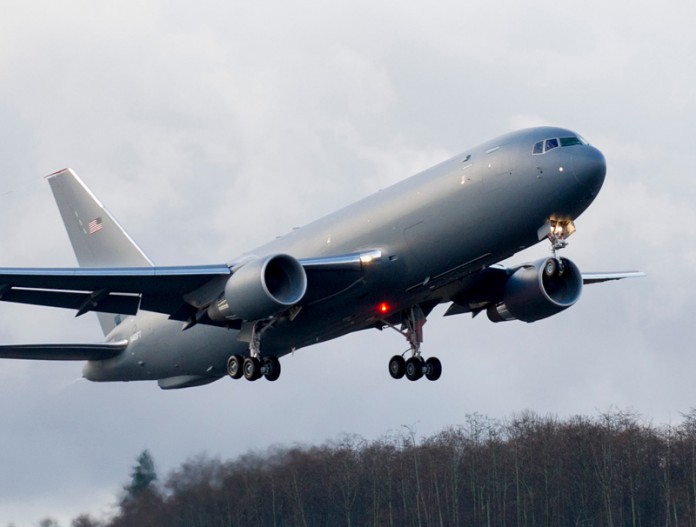
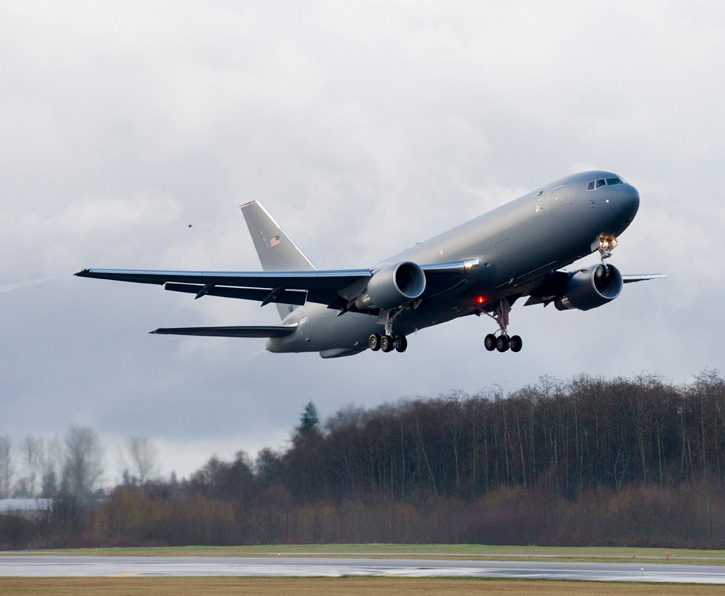
    The KC-46 Pegasus development program completed its first flight of Engineering, Manufacturing and Development (EMD) aircraft #1 Dec. 28, 2014. The maiden flight took off at 9:29 AM PST from Paine Field in Everett, Washington, and landed at 1:01 PM PST at Boeing Field in Seattle.EMD #1 is a provisioned 767-2C freighter and the critical building block for the KC-46 missionized aerial refueler. Photo: Boeing
    The KC-46 Pegasus development program completed its first flight of Engineering, Manufacturing and Development (EMD) aircraft #1 Dec. 28, 2014. The maiden flight took off at 9:29 AM PST from Paine Field in Everett, Washington, and landed at 1:01 PM PST at Boeing Field in Seattle.EMD #1 is a provisioned 767-2C freighter and the critical building block for the KC-46 missionized aerial refueller. Photo: Boeing

    Boeing and the U.S. Air Force successfully completed the first flight of the KC-46 tanker test program Sunday 28 December 2014. The plane, a Boeing 767-2C, took off from Paine Field, Wash., at 9:29 a.m. (PST) and landed three hours and 32 minutes later at Boeing Field. The first two 767-2Cs enter flight test as commercial freighters prior to receiving their aerial refuelling systems, while the KC-46s will fly as fully equipped tankers through the FAA and military certification process.

    This ‘Pegasus’, as the KC-46 is now designated by the Air Force, is designed to be the first Engineering, Manufacturing and Development (EMD) aircraft which will receive its military systems following certification. The 767-2C freighter is the initial step toward producing a KC-46. The aircraft will undergo additional finishing work s at the Boeing facility such as installing the refuelling boom and other military specific equipment. The first flight of a KC-46 (EMD #2) is expected in the Spring of 2015.

    The Air Force contracted with Boeing in February 2011 to acquire 179 KC-46 refuelling tankers to begin recapitalizing the aging tanker fleet. As part of a contract awarded in 2011 to design and develop the Air Force’s next-generation tanker aircraft, Boeing is building four test aircraft – two 767-2Cs and two KC-46A Tankers. One of the program’s milestones is the first unit initial operational capability, requiring 18 KC-46 aircraft and all necessary support equipment to be on the ramp, ready to support warfighter needs, by the August 2017 timeframe.

    Egypt concerned over growing Da’ish (ISIS) presence on its borders (Part II)

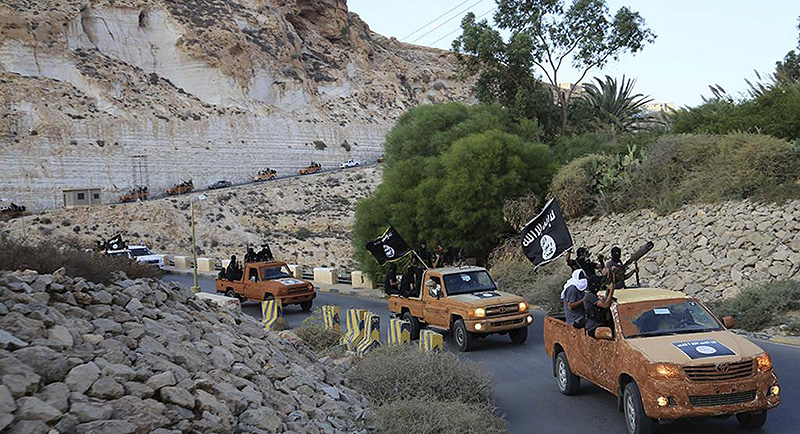
    ISIS loyalists close in on the city of Derna, in eastern Libya. ISIS loyalists in Libya, assisted by bout 300 Libyan jihadists returning from Syria and Iraq managed to take over the city of Derna. The opposition they faced was minimal, after the removal of Al-Qaeda forces in June, following a US special forces action. ISIS fighters have benefited from political chaos to gain territories rapidly along the Libyan coast.
    ISIS loyalists close in on the city of Derna, in eastern Libya. ISIS loyalists in Libya, assisted by bout 300 Libyan jihadists returning from Syria and Iraq managed to take over the city of Derna. The opposition they faced was minimal, after the removal of Al-Qaeda forces in June, following a US special forces action. ISIS fighters have benefited from political chaos to gain territories rapidly along the Libyan coast.

    Libya and its ongoing battle between Islamists and non-Islamist forces presents a nearby breeding ground for ISIS. Egypt’s President Abdel Fattah al-Sisi is facing one of his biggest foreign policy problems with the Libyan civil war.

    The Egyptian leader is convinced, that Egypt’s struggle against radical Islamic forces is not limited to Sinai, or even robbing bands of Islamists from the Muslim Brotherhood inside the homeland. His main concern, threatening Egypt comes from the growing potential building up on his western frontier, Libya, or rather the coastal region of Cyrenaica, which in modern military terms is only a stone throw away from the Egyptian border.

    It is because of this threat, that leads Sisi from committing substantial military power into the active US sponsored fight against ISIS, although, this radical faction provides Egypt’s foremost threat. By reactivating the Muslim Brotherhood, or even more extremist Islamic forces could try and topple Sisi’s rule, or hamper his ongoing effort to re-stabilize Egypt’s failing Economy. The danger is acute, and imminent.

    And this threat is already building up. At the rally held in Derna earlier this month, Ansar al Shariah’s commanders declared their full allegiance to ISIS in Eastern Lybia. This is the same group which is responsible for most brutal acts, killing the US Ambassador in Bengazi in 2012 and also blamed by Egyptian military intelligence for a cross-border raid last summer against an Egyptian army post resulting in the murder of 22 Egyptian soldiers.

    Probably the biggest coup for ISIS has so far happened in the coastal town of Derna, Libya, where ISIS has simply taken over the town of 100,000 people. Fighters returning from Syria and Iraq formed the muscle behind this coup.

    Now the Libyan branch of ISIS has a tight grip on the city, controlling the courts, all aspects of administration, education, and the local radio. “Derna today already looks identical to Raqqa, the ISIS headquarters town in Syria. Videos of militants in Derna brandishing the ISIS flag have also surfaced on the Internet.

    UN Envoy for Libya Bernardino Leon said that “the self-proclaimed Islamic State organization (Da’ish) is already operating in Libya, which is plagued by violence. The return to Libya of up to 300 Libyan jihadists who were part of ISIS’ al Battar Brigade ñ deployed at first in Deir Ezzor in Syria and then Mosul in Iraq. These Libyans who had fought in Syria and Iraq are now back in their country, and the present chaos is the ideal condition for their establishment.”

    Libya has become a hotbed for extremism – a threat that could persuade Egypt to take a more active stance in the broader war on terror.

    ISIS’s actions toward the Gulf could push Egypt to pursue military action as well. Recent reports indicate ISIS having established an Islamic controlled enclave at the border town of Derna, in Cyrenaica, the eastern coastal region of Libya, close to the Egyptian border. Two months ago ISIS leader Baghdadi helped orchestrate the take-over of Derna by dispatching one of his senior aides, Abu Nabil al Anbari, an Iraqi ISIS veteran who had spent time with Baghdadi.

    Libya has been a threat to Egypt since the Qaddafi regime was toppled, particularly due to the country’s 1,115 km long, porous and unsecured borders with the Nile country. These borders now allow for an unencumbered flow of fighters and weapons, which eventually reach the Sinai Peninsula and contribute to the already highly unstable situation. ISIS is already planning links between militants in both Libya and Egypt, saying Libyan-based Egyptian militants dream of creating an ISIS-style empire in their homeland.

    Smoke pillars over the town of Derna in Eastern Libya, after an air attack targeting ISIS aligned terrorist groups took over the city. Photo: AFP
    Smoke pillars over the town of Derna in Eastern Libya, after an air attack targeting ISIS aligned terrorist groups seized the city. Photo: AFP

    Iran tests new drones, air defense missiles during wargames

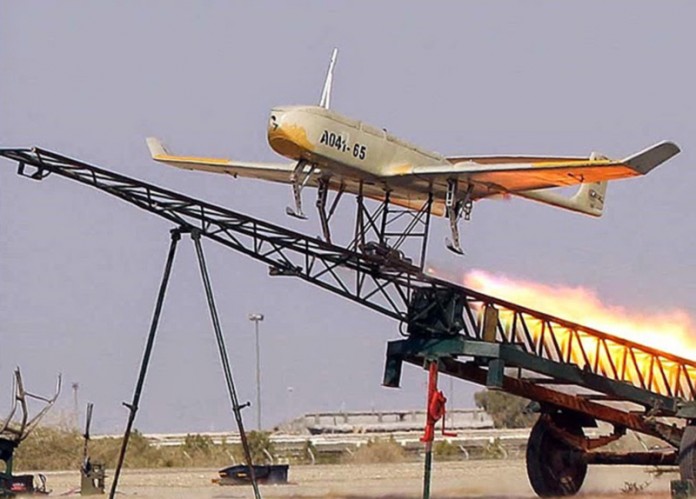
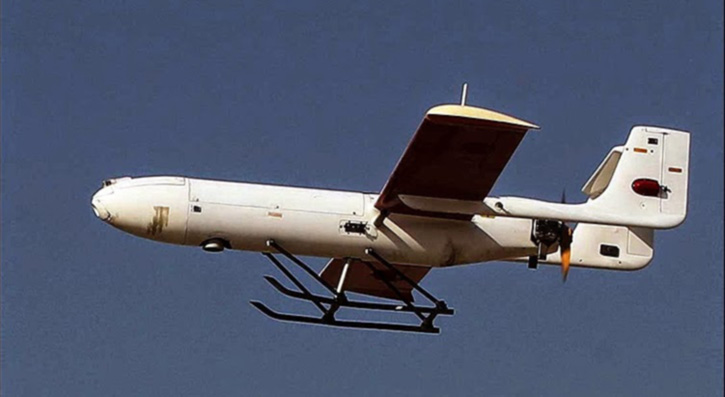
    Mohajer-4 reconnaissance unmanned aerial vehicle (UAV) using Rocket-assisted rail launch. The vehicle has a forward looking nose camera and is designed to carry an EO payload under the nose, but this unit on a training mission does not carry this module. Photo: Chavosh Homavandi.
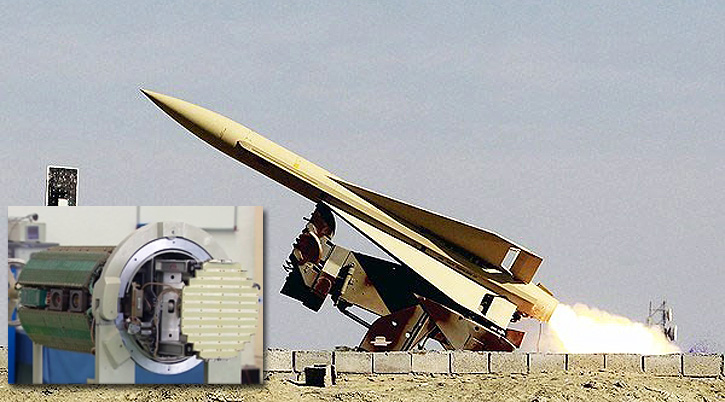
    Iranian Shalamcheh missile launched from the Khatam al-Anbia Air Defense Base in Southern Iran.  Shalamcheh is the third phase of the an indiginously produced clone of the American Hawk missile, reverse engineered by the Iranians. Shalamcheh is equipped with a modern, digital seeker developed in Iran (insert).
    Iranian Shalamcheh missile launched from the Khatam al-Anbia Air Defense Base in Southern Iran. Shalamcheh is the third phase of the an indiginously produced clone of the American Hawk missile, reverse engineered by the Iranians. Shalamcheh is equipped with a modern, digital seeker developed in Iran (insert).

    The Iranian air defense command has introduced a third generation evolution of the Hawk missile, locally designated ‘Shalamcheh’. The missile was presented publicly at the Khatam al-Anbia, taking part in a firing demonstration, as part of the six-day ‘Muhammad Rasullullah’ week long joint forces exercise undergoing in Southern Iran.

    Drones integrated in combat operations

    Iran’s air defense command is also concerned with the threat of drones and cruise missiles. During the exercise several air defense systems were deployed, some performed missions in front of the media, demonstrating how domestically improved Hawk missile systems shoot down target drones. Locally produced in Iran under the designation Shalamcheh, the missile represents the third evolution of the locally produced Raytheon MIM-23 Hawk air defense missile clone.

    Subscribe to read more…

    Some of the radar systems developed and deployed by the Iranian air defense command are already capable of detecting and tracking unmanned aerial systems, including such drones designed with stealth capabilities. Iran gained an insight into those capabilities after its forces managed to seize a US RQ-170 Sentinel stealth drone in 2011. The drone went down intact and enabled the Iranians to reverse engineer a version of the Sentinel, which recently began flight testing. (seen in the video below)

    In addition, the Iranian military have tested two new home grown variants of the ’Mohajer’ (Migrant) unmanned aerial systems during the exercise. According to commander of the Iranian army ground force Brigadier General Ahmad-Reza Pourdastan, the Iranian ground force employed Unmanned Aerial Vehicles (UAVs) in the ongoing drill in two phases – supporting both on the friendly and enemy sides.

    Ghods Mohajer-2 reconnaissance unmanned aerial vehicle UAV. Photo: Chavosh Homavandi.
    Ghods Mohajer-2 reconnaissance unmanned aerial vehicle UAV. Photo: Chavosh Homavandi.

    Two new drones named Mohajer 2-N (M2-N) and Mohajer 4 (M4) were tested in the recent exercise for the first time. Both are designed for reconnaissance missions. The drones were unveiled last month at the bi-annual arms expo at Kish Island.

    During the exercise the drones support ground and artillery units providing intelligence and targeting data. Both M2-N and M4 carry a nose mounted camera. the M4 also has a belly mounted EO payload. On armed missions they can carry weapons on launching racks installed underneath the wings.

    According to Iranian media, the new drone can be employed for a range of military and civil operations, including aerial reconnaissance and patrol missions, traffic control, rescue and relief, cartography and oil pollution control at the sea.

    The M2-N weighs 90 kg and has a wing span of 3.8 meters. The operational radius of M2-N been extended to 150 kilometers and the flight endurance has reached 6 hours (x4 increase over the previous model). Mohair has an operational flight ceiling of 11,000 feet, and a maximum speed of 180 km/h.

    The drone uses skids or parachute for landing, while takeoff is assisted by pneumatic catapult or a rocket booster. Another drone recently unveiled by Iran at the Kish exhibition is an unmanned rotorcraft called Yasin. According to media sources Yasin can carry a payload of 15 kilograms and reach an altitude up to 3,000-feet on missions lasting up to 70 minutes.

    Bradley based armored vehicles to replace M113s in US Army service

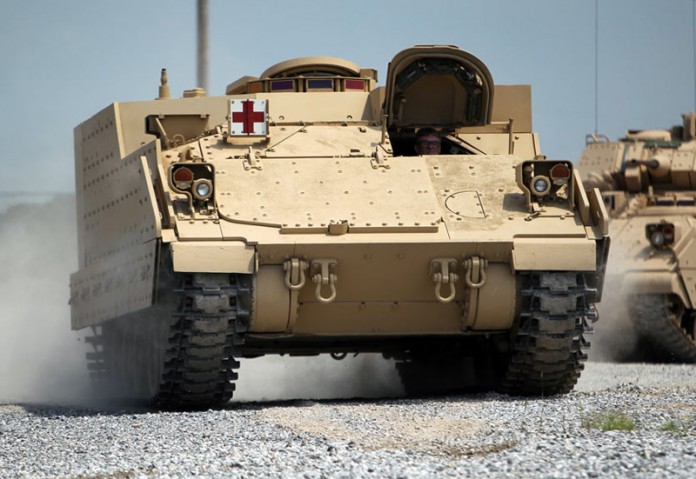
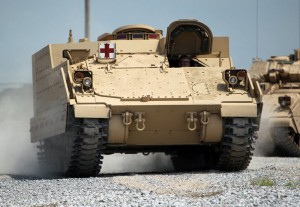
    The AMPV will be delivered in several variants, including a troop carrier, command vehicle, mortar carrier and medical evacuation configurations. Photo: BAE Systems
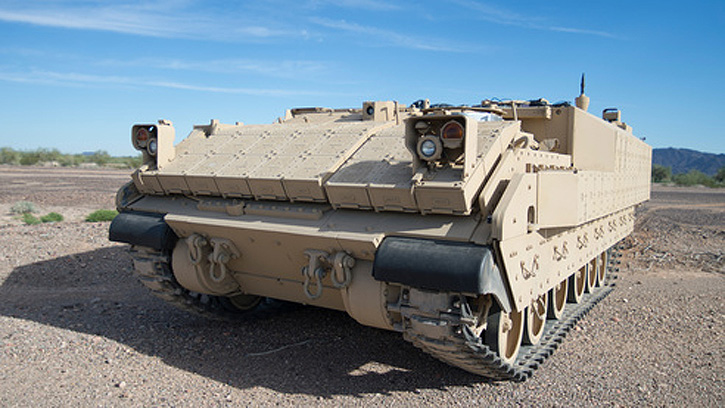
    The Bradley based Armored Multi-Purpose Vehicle (AMPV) will replace the M-113s in US Army service. Photo: BAE Systems
    The Bradley based Armored Multi-Purpose Vehicle (AMPV) will replace the M-113s in US Army service. Photo: BAE Systems

    The U.S. Army has awarded BAE Systems $1.2 billion contract develop and produce Armored Multi-Purpose Vehicles (AMPV) based on Bradley chassis to replace the 50 year old M-113 Armored Personnel Carriers that haved served the army since the Vietnam War. The award was expected for several months. Following the Army decision to opt for the Bradley as the baseline platform for AMPV. BAE is the original manufacturer for the Bradley.

    The AMPV will be delivered in several variants, including a troop carrier, command vehicle, mortar carrier and medical evacuation configurations. Photo: BAE Systems
    The AMPV will be delivered in several variants, including a troop carrier, command vehicle, mortar carrier and medical evacuation configurations. Photo: BAE Systems

    The Engineering, Manufacturing, and Development (EMD) and Low-Rate Initial Production (LRIP) of the Armored Multi-Purpose Vehicle (AMPV) contract features a 52-month base term worth $383 million and an option to begin the vehicles’ low-rate initial production phase for another 289 vehicles.

    Under the development and Low Rate Initial Production phase funded by the initial contract the company will design and build 26 AMPVS vehicles in several variants including mortar carrier, mission command, medical evacuation, medical treatment and general purpose.

    These AMPVs leverage the design of the Bradley Fighting Vehicle and M109A7 designs, to meet the Army’s force protection and all-terrain mobility requirements being able to maneuver with Armored Brigade Combat Teams (ABCT).

    The BAE Systems AMPV team includes DRS Technologies, responsible for power management, distribution, and integration; Northrop Grumman Corporation, responsible for Mission Command Mission Equipment Package design and integration; Air Methods Corporation, responsible for the design and integration of medical evacuation and treatment subsystems; and Red River Army Depot, responsible for vehicle teardown and component remanufacture. The company’s offering includes proven powertrain and drivetrain components from Cummins, L3 Communications, and LOC Performance that supports the ABCT industrial base .

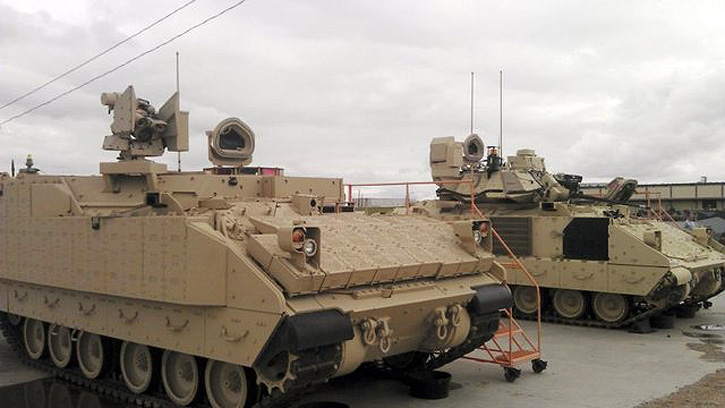
    As part of its assessment of future combat vehicles the US Army compared its M2A3 Bradley Fighting Vehicle, with a turret-less Bradley (seen in the picture), Double V-Hull Stryker, Swedish CV9035 vehicle and the Israeli Namer. Each vehicle was evaluated for durability, capacity, modularity, lethality, interior space and operational capability. Photo: US Army.
    As part of its assessment of future combat vehicles the US Army compared its M2A3 Bradley Fighting Vehicle, with a turret-less Bradley (seen in the picture), Double V-Hull Stryker, Swedish CV9035 vehicle and the Israeli Namer. Each vehicle was evaluated for durability, capacity, modularity, lethality, interior space and operational capability. Photo: US Army.

    Aberdeen based aerostat in position to protect Washington from cruise missile attack

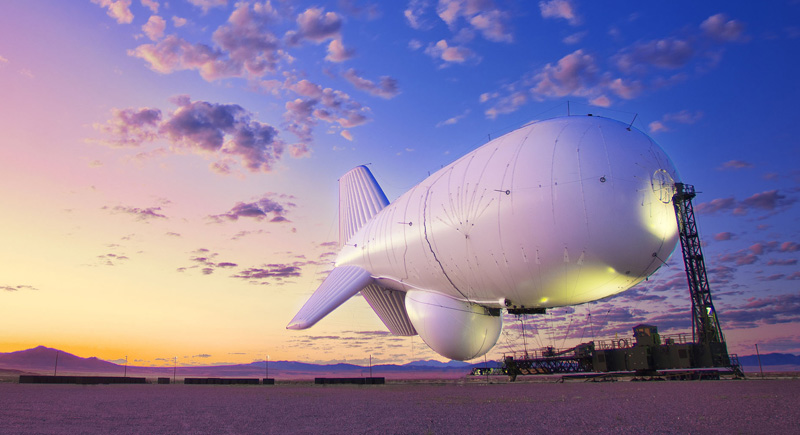
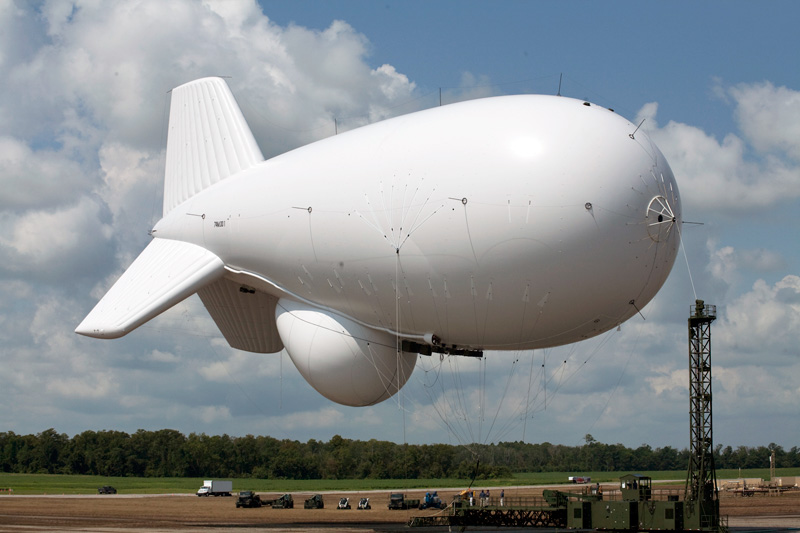
    The 74 meter aerostat (243 foot) carries an air-surveillance radar that provides precise location data of airborne targets, such as cruise missiles, aircraft, unmanned aerial vehicles, and large-caliber rockets, as well as maritime surface moving targets.
    JLENS completed developmental testing in December, 2013 after demonstrating its ability to integrate with missile  systems such as Army Patriot and Naval SM6.
    JLENS completed developmental testing in December, 2013 after demonstrating its ability to integrate with missile systems such as Army Patriot and Naval SM6.

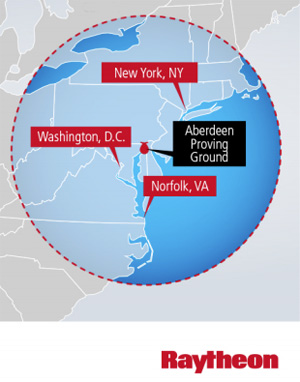
    The U.S. Army lofted today the first JLENS – Joint Land Attack Elevated netted Sensor aerostat system at the Aberdeen Proving Ground in Maryland. This large aerostat blimp is equipped with a radar system optimzed to detect low-level targets, such as cruise missiles and drones. It will cover a wide airspace from Virginia, Maryland, and Pennsylvania up to New York and New Jersey.

    Similar aerostat-based radars are already operational in India and Israel; Singapore is also planning to deploy such system next year. Deployment in the Continental US (CONUS) followed due to the US military concern about the risk of rough states or terrorist groups potential to attacks the US capital using cruise missiles launched from cargo ships moving deep in the Atlantic Ocean. Such missiles often fly too low to be detected by conventional radar. Airborne radars such as AWACS or Hawkeye aircraft can detect such threats but they are not airborne 24/7, due to the high operating cost of such airborne assets.

    The 74 meter helium filled aerostat (243 foot) carries an air-surveillance radar that provides precise location data of airborne targets, such as cruise missiles, aircraft, unmanned aerial vehicles, and large-caliber rockets, as well as maritime surface moving targets. The JLENS system, also referred to as ‘orbit’ consists of two unmanned aerostats with radar systems.

    The test is part of a three-year operational evaluation conducted by the North-American Aerospace Defense (NORAD) Command beginning in 2015. The second aerostat of the Aberdeen orbit is scheduled to go aloft in early 2015. Another JLENS system is in strategic reserve, ready to be deployed anywhere in the world at the request of combatant commanders, should they require comprehensive cruise missile defense capability.

    From its position 10,000 ft above Aberdeen Proving Ground in Maryland, JLENS radar will be able to detect targets over distances 340 km away.
    From its position 10,000 ft above Aberdeen Proving Ground in Maryland, JLENS radar will be able to detect targets over distances 340 miles away.

    The radar equipped JLENS aerostat will fly at an altitude up to 10,000 feet above sea level, giving it a much longer detection range than ground-based radars, providing radar coverage up to 340 miles – an area which includes the National Capital Region (NCR). Input from JLENS will also feed to the 263rd Army Air and Missile Defense Command, to increase decision time in defending the airspace over the NCR. The aerostats will fly 24 hours a day, except in times of severe weather or required maintenance. The system’s ground elements include a mobile mooring station, radar and communications payloads, a processing station, and associated ground support equipment.

    Aberdeen Proving Ground was chosen as the exercise location because it provides coverage over the NCR, has sufficient ground area for the two JLENS aerostat sites, and controls its FAA approved restricted airspace, which supports the exercise without interfering with the mid-Atlantic coast air traffic corridors.

    Developed by Raytheon, JLENS completed developmental testing in December, 2013 after demonstrating its ability to integrate with defensive systems and help Patriot, AMRAAM, NASAMS and Standard Missile 6 intercept cruise missile targets.

    “JLENS is strategically emplaced to help defend Washington D.C. and a Texas-sized portion of the East Coast from cruise missiles, drones and hostile aircraft,” said Dave Gulla, vice president of Raytheon Integrated Defense Systems’ Global Integrated Sensors business. “JLENS can detect potential threats at extremely long ranges, giving North American Aerospace Defense Command more time to make decisions and more space to react appropriately. Once the system becomes operational it will be operated by soldiers of the U.S. Army’s A Battery, 3rd Air Defense Artillery.

    The data collected during the operational exercise will be used to assess JLENS capabilities and its integration into the existing homeland defense architecture. This will enable senior defense officials to support a determination whether to transition JLENS capabilities to an enduring mission at the conclusion of the three-year operational exercise.

    The 74 meter aerostat (243 foot) carries an air-surveillance radar that provides precise location data of airborne targets, such as cruise missiles, aircraft, unmanned aerial vehicles, and large-caliber rockets, as well as maritime surface moving targets.
    The 74 meter aerostat (243 foot) carries an air-surveillance radar that provides precise location data of airborne targets, such as cruise missiles, aircraft, unmanned aerial vehicles, and large-caliber rockets, as well as maritime surface moving targets.

    Jordanian F-16 crash in Raqqa, Pilot captured by ISIS

    A Jordanian pilot was captured yesterday by Islamic State gunmen after his F-16 jet fighter crashed during an air strike over the town of Raqqa in the ISIS ruled Dir E’Zor region in South Eastern Syria.

    It was the second loss of an F-16 operated by the US lead coalition, The first was a US Air Force F-16 that crashed over Jordan after taking off for a strike mission over Syria. The American pilot was killed.
    ISIS claimed their troops shot down the aircraft but US Central Command officials denied this claim. “Evidence clearly indicates” that the terrorist group “did not down the aircraft,” U.S. Central Command said in a statement.
    Jordan is one of several nations taking part in the US lead coalition, which also includes other Western and Middle eastern nations. The air campaign has recently stepped up against Raqqa,  as well as against ISIS forces combating Iraqi security forces in West-central Iraq.

    New Navy drone gets its feet wet flying off a Navy destroyer

    mq8c_first_flight_at_sea_72530917
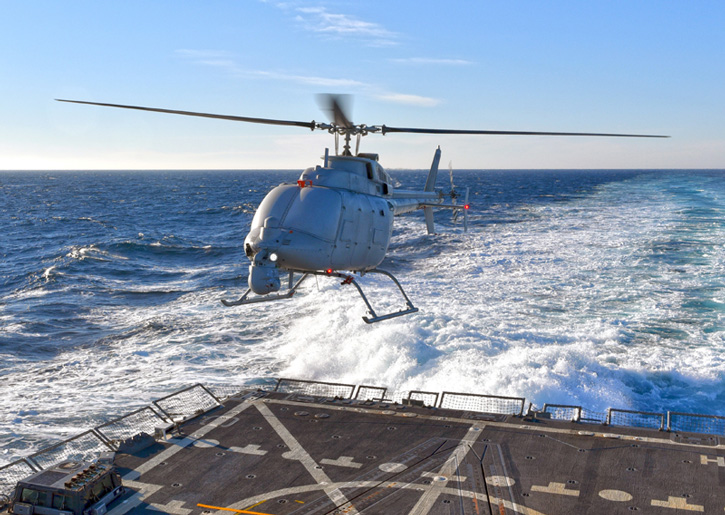
    MQ-8C Fire Scout, the newest naval drone being developed for the U.S. Navy by Northrop Grumman successfully flew the system for the first time off the guided-missile destroyer, USS Jason Dunham (DDG 109), Dec. 16, off the Virginia coast. Photo: Northrop Grumman

    MQ-8C Fire Scout, the newest naval drone being developed for the U.S. Navy by Northrop Grumman successfully flew the system for the first time off the guided-missile destroyer, USS Jason Dunham (DDG 109), Dec. 16, off the Virginia coast.

    After more than a year of land-based testing at Point Mugu, California, the MQ-8C Fire Scout grew its sea legs, making 22 takeoffs and 22 precision landings while being controlled from the ship’s ground control station.

    “The MQ-8C Fire Scout’s flights from the USS Dunham represent a significant Navy milestone. This is the first sea-based flight of the MQ-8C and the first time an unmanned helicopter has operated from a destroyer,” said Capt. Jeff Dodge, Fire Scout program manager at Naval Air Systems Command. “The extended capabilities will offer the Navy a dynamic, multipurpose unmanned helicopter with increased endurance, allowing for our ship commanders and pilots to have a longer on station presence.”

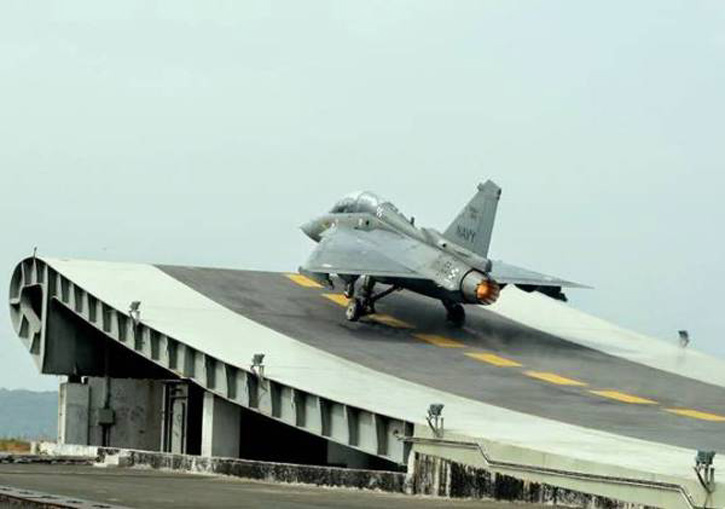
    LCA completes first ski-jump takeoff

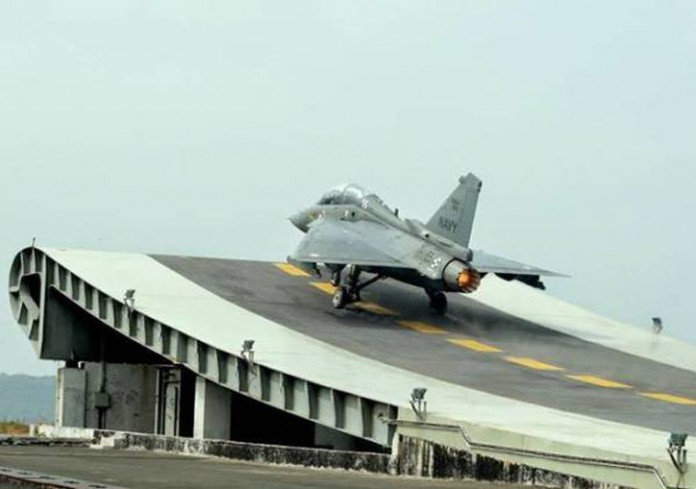
    The LCA Naval prototype takes off from the ski jump.
    The LCA Naval prototype takes off from the ski jump.
    The LCA Naval prototype takes off from the ski jump.

    The first prototype of the Navalaized Tejas Indigenous Combat Aircraft (LCA) developed for the Indian Navy has took off saturday (December 20, 2014) from the Ski-Jump facility of Shore Based Test Facility (SBTF) at INS Hansa in Goa. LCA (Navy) is designed with stronger landing gears to absorb forces exerted by the ski jump ramp during take-off, and cable arrested landing.

    The ski-jump enables the aircraft to become airborne within 200 m, compared to 1000m required for normal runways. Its special flight control law mode allows hands-free take-off relieving the pilot workload, as the aircraft leaps from the ramp and automatically puts the aircraft in an ascending trajectory. The SBTF has been created to replicate the aircraft carrier with a Ski Jump for take-off and arresting gear cable for arrested landing.

    The facility is supported by ADA with the participation of the Indian Navy, Goa shipyard, CCE (R&D) West, Pune, R&D Engg (E) Pune and the Russian agencies providing the design support and specialized equipment. The LCA Mk I achieved Initial Operational Clearance with the Indian Air Force in December 2013, the novelised variant and advanced Mk-II version for the air force are under development.

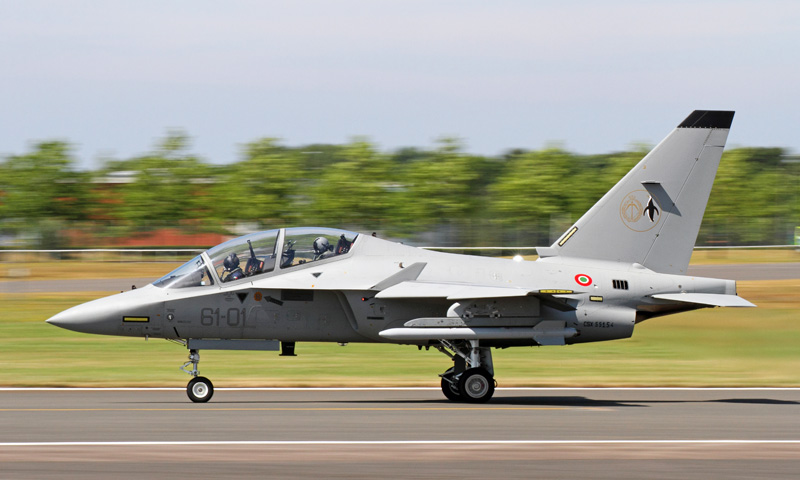
    Additional M-346 trainers for the Italian Air Force

    T346M - photo credit: Treflyn Lloyd-Roberts
    Alenia Aermacchi T-346A of the Italian Aeronautica Militare (Italian Air Force) taking off on its aerial display at the Farnborough Air Show, 2014. Photo: Treflyn Lloyd-Roberts

    Finmeccanica-Alenia Aermacchi and ARMAEREO (Italian National Armaments Directorate) signed a contract worth 120 million Euros to provide the Italian Air Force with three additional T-346A advanced trainers. (The T-346A is the Italian variant of the M-346 Master).

    The contract is part of the framework agreement signed in 2009, to equip the Italian Air Force with 15 such aircraft. At that time, a contract for a first tranche of six aircraft and related flight simulators had been signed.
    The aircraft will be operated by 61° Stormo in Lecce, where the Italian Air Force flight school is based.

    The M-346’s Integrated Training System (ITS) operating in Lecce military Air Base, includes, further to the aircraft, flight simulators and ground based training systems. The school trains the Italian combat pilots as well as foreign pilots.

    To date the M-346 has won orders for 59 aircraft from Italy, Singapore, Israel and Poland.

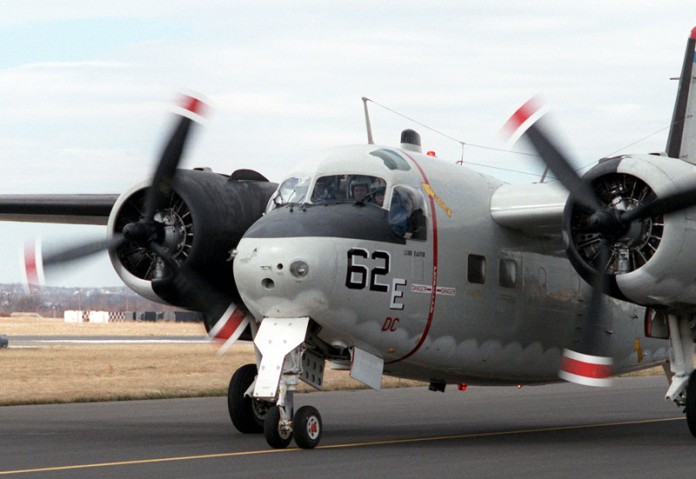
    Resurrected US Navy Traders to serve on Brazilian aircraft carrier

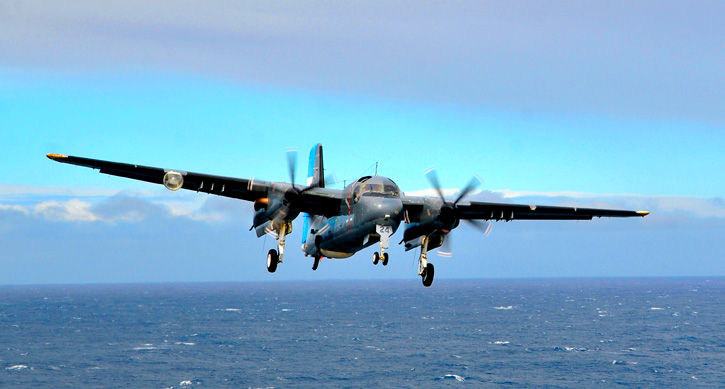
    Argentinian Navy is the only navy currently maintaining the Grumman S-2T Turbo Tracker in operational use. The Brazilian Navy will also field the Tracker's cousin - the Trader on its new aircraft carrier Sao Paolo.
    Argentinian Navy is the only navy currently maintaining the Grumman S-2T Turbo Tracker in operational use. The Brazilian Navy will also field the Tracker’s cousin – the Trader on its new aircraft carrier São Paulo.
    The S-2 Tracker and C-1 Trader were the only transport and multi-mission aircraft designed to fit the constrains of aircraft carriers of the 1950's.
    The S-2 Tracker and C-1 Trader were the only transport and multi-mission aircraft designed to fit the constrains of aircraft carriers of the 1950’s.

    Over a thousand C1/S2 aircraft were produced by Grumman between 1952 and served on board US Navy Carriers for three decades, from the mid 50s through the 1980s. A total of 83 C-1A models were produced, used as the Navy’s Carrier On-Board Delivery (COD) aircraft. In 1988 the Traders were retired and sent to the Davis Monthan Boneyard outside Tucson, Arizona.
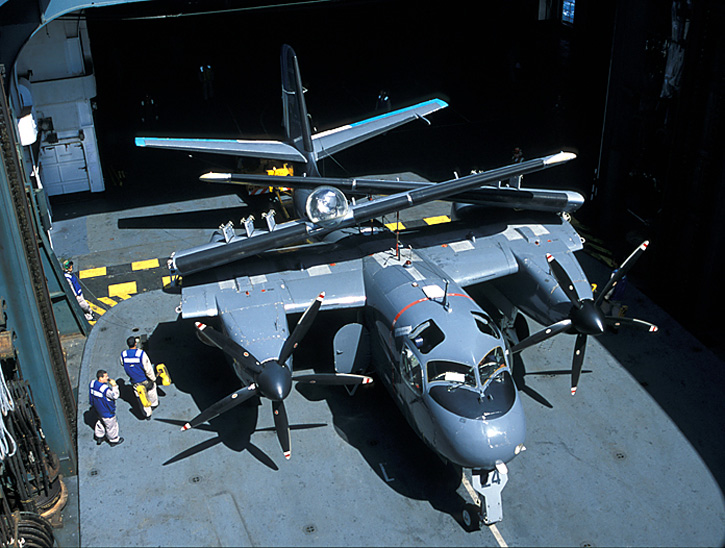
    Unlike the US and French Navies, that operate the E-2C/D Hawkeye and C-2 Greyhound from larger aircraft carriers, the Brazilian Navy’s only aircraft carrier NAe São Paulo is constrained in catapult strength and deck size, limiting their choice of aircraft to the smaller, lighter Tracker/Trader.

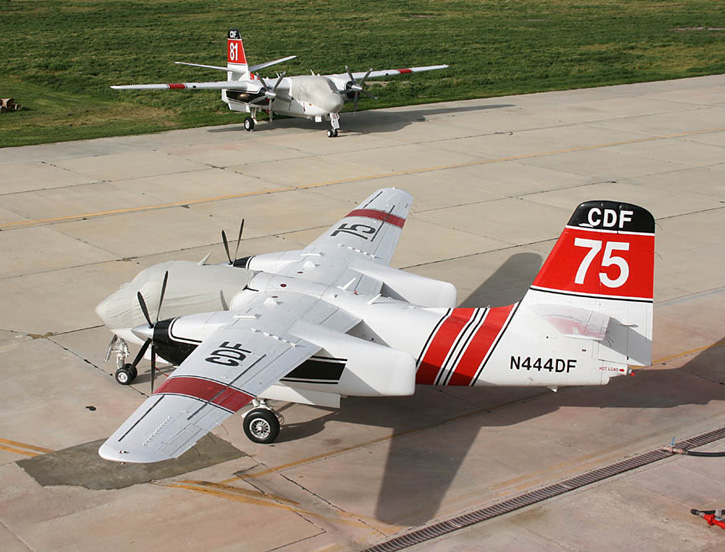
    Marsh Aviation certified and implemented the conversion of 26 ex-US Navy C-1 Trader into Turbo Trader firefighters for the California Forestry and force.
    Marsh Aviation certified and implemented the conversion of 26 ex-US Navy C-1 Trader into Turbo Trader aerial firefighters for the California Department of Forestry and Fire protection.

    Among the last fleets to operate the S-2, the Brazilians turned to Arizona based Marsh Aviation of Mesa Arizona to modernize the eight aircraft retrieved from the nearby boneyard. Marsh had experience in such refurbishing jobs, as the company refurbished 26 ex-Navy tankers into S-2T aerial firefighters for the California Department of Forestry and Fire protection (CDF). Israel Aerospace Industries (IAI) performed a similar job in the 1990s, replacing the piston-engined Trackers operated by the Argentinian Navy with turboprops.

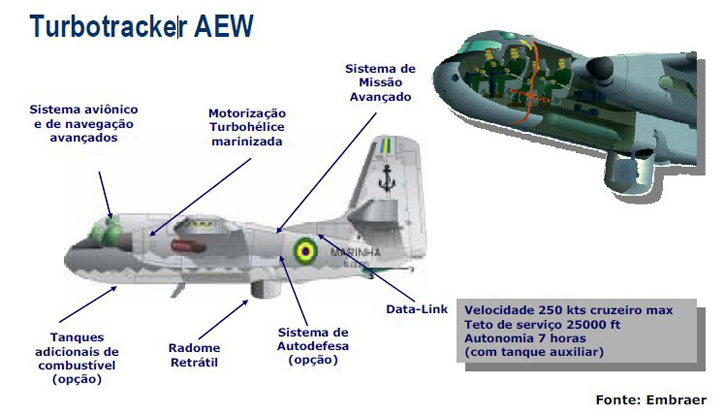
    The Brazilians opted to refurbish the Trader carrier transport variants, from aircraft they selected at the boneyards. Originally the Brazilian Navy was planning to convert eight aircraft – four into S-2T Airborne Early Warning configuration, at present, four C-1As are to be converted into Turbo Traders, re-designated KC-2 COD/AAR (Carrier-On-Board/ Air-to-Air Refueling). They will be used as COD and aerial refueling aircraft on board the Brazilian Navy’s aircraft carrier, the NAe São Paulo.

    As with the S-2T, the original rotary piston engines will be replaced Honeywell TPE-331 turbo-prop engines, the KC-2 will also get a modern Glass Cockpit, new communication systems, Environmental Control Systems (ECS), as well as integration of air to air refueling capabilities.

    turbotracker_brazil_725

    Originally signed four years ago, in October 2011, the upgrade was delayed due legal difficulties encountered by Marsh. Last month, the Brazilian navy’s directorate of aeronautics and Marsh Aviation revived the program, with the introduction of M7 Aviation, of San Antonio, Texas, as a subcontractor and facilitator.

    One of eight C-1A Trader airframes salvaged from Davis Montana boneyard in 2011.
    One of eight C-1A Trader airframes salvaged from Davis Monthan boneyard in 2011.

    While the eight airframes were bought at a ‘bargain’ price of $32,000 each, the entire refurbishment, re-engining and upgrading program would cost $167 million, according to the original contract awarded to Marsh back in 2011. M7 would receive $106 million for its part in the five-year project. The upgrade work will be performed in San Antonio, Texas, at the facilities of M7 Aerospace, an Elbit Systems of America subsidiary, under the supervision of Brazilian Navy officers who are currently deployed to San Antonio.

    Originally scheduled for delivery by 2015, the first KC-2 prototype flight is expected for November 2017 and the delivery of the first operational aircraft to the Brazilian Navy is scheduled for December 2018. The aircraft will be operated by the 1st Transport and Early Warning Squadron (VEC-1) based in the Sao Pedro d’Aldeia Naval Air Station.

    Skunk Works and XTEND Simplify Multi-Drone Command

    0
    Lockheed Martin Skunk Works® and XTEND have achieved a major milestone in JADC2 by integrating the XOS operating system with the MDCX™ autonomy platform. This technical breakthrough enables a single operator to simultaneously command multiple drone classes, eliminating the friction of mission handoffs. From "marsupial" drone deployments to operating in GPS-denied environments, explore how this collaboration is abbreviating the data-to-decision timeline and redefining autonomous mission execution.

    From Ukraine to Taiwan: The Global Race to Dominate the New Defense Tech Frontier

    0
    As traditional defense primes face mounting competition from agile “neoprimes” such as Anduril, Palantir and Helsing, the balance of innovation is shifting toward software-defined warfare and scalable, dual-use technologies, while global industry consolidation—marked by Boeing’s integration of Spirit AeroSystems and other strategic mergers—signals an intensified race to secure control over the defense technology value chain. Our Defense-Tech weekly report highlights these trends.

    Europe’s “Drone Wall”

    0
    In early October 2025, a coordinated wave of unmanned aerial system (UAS) incursions—widely attributed to Russia—targeted critical infrastructure across at least ten European nations. The unprecedented campaign exposed the fragility of Europe’s air defenses...

    Weekly Defense Update & Global Security Assessment

    0
    Executive Summary The past week (September 18-25, 2025) represents an inflection point where strategic defense concepts have transitioned from doctrine to tangible reality. An analysis of global events reveals four primary, interconnected trends shaping an...

    U.S. Air and Space Forces Push Next-Gen Programs at the AS&C 2025 Conference and...

    0
    At the 2025 Air, Space & Cyber Conference, U.S. Air Force and Space Force leaders unveiled major updates on next-generation fighters, bombers, unmanned systems, and space initiatives, highlighting both rapid innovation and critical readiness challenges as the services race to outpace global competitors. A short version is available here, with a more detailed version for subscribers.

    TADTE 2025: Reflecting Taiwan’s Strategic Themes

    0
    The Taipei Aerospace & Defense Technology Exhibition (TADTE) 2025 crystallized around four dominant strategic themes that collectively illustrate Taiwan's comprehensive approach to defense modernization amid escalating regional tensions. Based on a detailed report by Pleronix (available upon request). Includes a Podcast discussion on TADTE 2025's highlighting Taiwan's four strategic themes beyond the post's coverage.

    Iron Beam 450 Completes Testing, Soon to Join With Operational Air Defense Units

    0
    Israel’s Iron Beam 450 high-power laser system has completed final testing, marking a major leap in air defense. Developed by Rafael, it offers precise, cost-effective interception of rockets, UAVs, and mortars, and is set for IDF deployment by 2025.