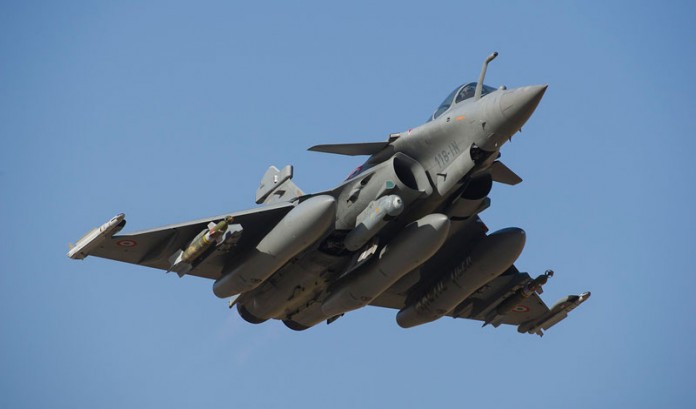
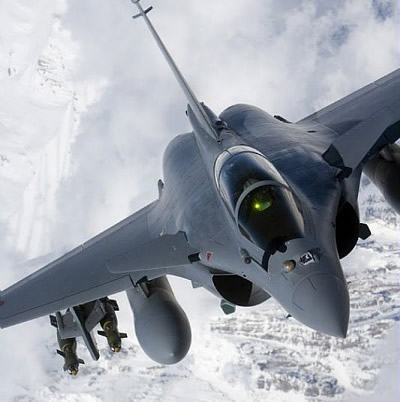
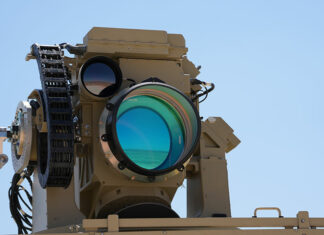
RAFAEL and Mirage 2000 fighter jets operating with the French Air Force and Navy are currently employed with laser designation pods and DAMOCLES targeting pods, both produced by Thales. The company is now contracted to develop the next generation targeting pod for these aircraft. Photo: French Air Force
Rafale – India’s Choice for the MMRCAPhoto: Dassault AviationIndian Defence Minister Manohar Parrikar and visiting French Defence Minister Yves Le Drian held a “positive meeting” on the issue yesterday, the Indian Express reports. On that meeting, the defense ministers of France and India agreed to put the issue on the “fast track”.
While the French Rafale was declared as the lowest bidder and therefore the preferred fighter for the Indian Air Force MMRCA program, final approval of the program and contract signing have been delayed for two years. During that period the cost of the 126 fighters has also escalated (as expected) from six billion US$ originally set aside for the program, to more than $20 billion, what triggered speculations of scrapping the entire program.
Part of the disagreement between India and Dassault is based on license manufacturing of the Rafale by HAL. This issue has been a major concern for France, at the time when the Brazilian procurement of the aircraft was likely, but since the selection of the Gripen, India remains the only export customer for the French Rafale. (although there are indications that Qatar could be interested in buying Rafales, but the emirate does not pretend to be able to locally produce the aircraft).
Signs of improving prospects for concluding the MMRCA deal with France surfaces in October, when Indian Air Chief Marshal Arup Raha confirmed the contract is in the final stage of negotiations with all the agencies involved, including Hindustan Aeronautics Limited (HAL). The final contract will be signed only after a clearance from Cabinet Committee on Security (CCS). Raha expressed hope that the first squadron of Rafale jets would be ready within three to four years.
A U.S. Air Force pilot was killed when an F-16 Fighting Falcon crashed in a non-combat-related incident Sunday, according to the military.
The aircraft was taking off to conduct a combat run in support of Operation Inherent Resolve, as the operations against ISIS is called. The crash happened as the pilot was returning to its base in Jordan, today at dawn, at about 6 a.m. local time, shortly after take-off, according to a release from Central Command.
Pentagon spokesman Col. Steve Warren told CNN the plane suffered a technical problem after takeoff and then crashed as it attempted to return. Although it was a noncombat incident, the jet was headed to a combat mission, Warren said.
The location of the crash was not disclosed due to host nation sensitivities. According to unconfirmed sources The 77th Fighter Squadron from Shaw left for an undisclosed location in the Middle East in October to conduct combat missions against ISIS.
Presently, the 77th Fighter Squadron based at Shaw Air Force Base in Sumter is conducting combat operations in Syria and Iraq against the Islamic State of Iraq and Syria (ISIS). Neither U.S. Central Command in Tampa or officials at Shaw would identify the pilot or confirm if he was with the 77th.
Preparing our 2015 editorial plan we would like to better align our topics with our reader’s interest.
Thank you for participating in the following survey about yourself and your interests. Your answers will help us tailor defense-Update to your interests.
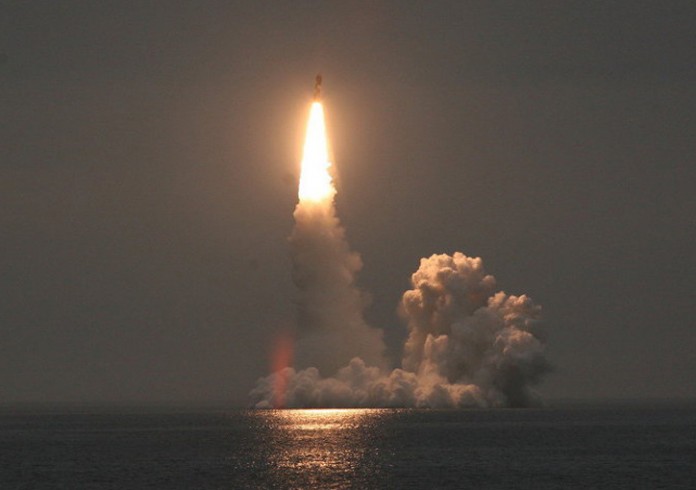
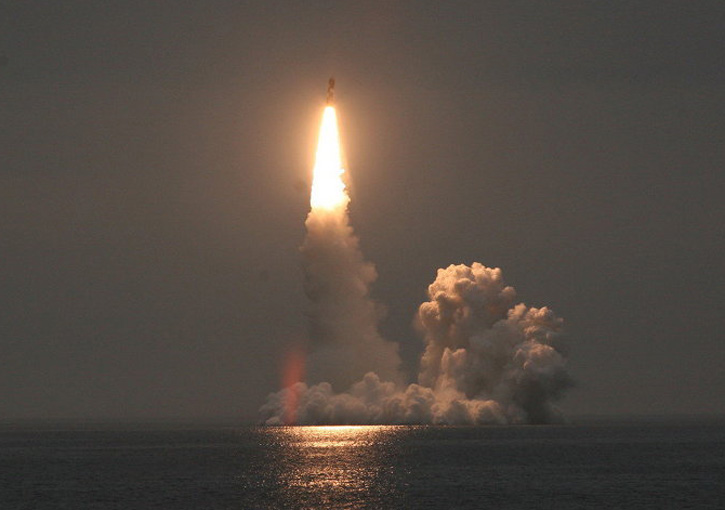
An RSM-56 Bulava missile fired from Borei class submarine Alexander Nevsky at the Barnets sea. Photo: Russian northern fleet
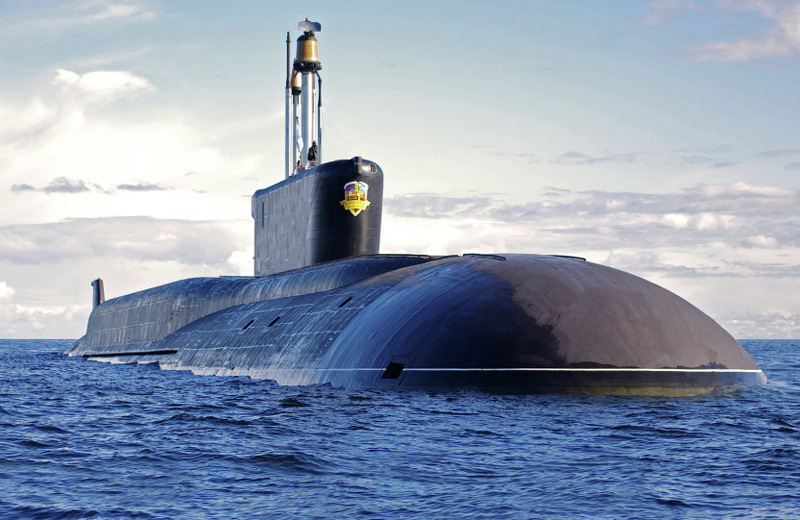
The second Borei class submarine K550 Alexander Nevsky, in service with the Russian Navy strategic force.
The Russian Navy successfully test-fired a Bulava intercontinental ballistic missile for a second time in two months, proving the new Russian submarine launched ballistic missile (SLBM) has improved its reliability and is now ready for deployment. The test was performed at night, on Friday November 28, 2014 was the third successful flight in a series of five developmental testing designed to verify the missile’s reliability after it suffered a series of failures in earlier flights. The Russians plan to launch two additional Bulava missiles next year as part of their routine operational readiness testing plan.
An RSM-56 Bulava missile fired from Borei class submarine Alexander Nevsky at the Barnets sea. Photo: Russian northern fleet
Another imminent test expected in the upcoming days is the last test launch of the solid propellant inter-continental ballistic missile RS-26 (also known as Avangard and Rubezh). On this test the missile will be launched from a mobile surface vehicle. There are no plans for its silo deployment.
RS-26 is designed as a derivative of the operational RS-24 Yars missile. The next test, announced to be the ‘last in the test series’ has been scheduled for December, Russian news agency Tass reports. According to the current plans the new missile is to enter duty in 2015. RS-26 offers improved combat capabilities over previous Russian ICBMs. It also carries multiple warheads, and is lighter than its predecessor RS-24 Yars.
The Defense Ministry said the Alexander Nevsky nuclear submarine test-fired a Bulava missile from an submerged position in the Barents Sea. The missile’s warheads reached designated targets at the Kura testing range in Russia’s far eastern Kamchatka Peninsula. On this test the submarine was loaded with a single Bulava missile. In October the lead submarine of this class, Yuri Dolgoruky carried out a similar test launch with a full load of Bulava missiles on board. Yuri Dolgoruky was the lead ship of the Borei class – the 4th generation ballistic missile submarine of the Russian Navy.
Bulava’s recent series of successful test flights seems to indicate that the missile’s problems have been solved.
The Russian Navy now has two operational Borei-class nuclear submarines armed with the Bulava SLBM. Alexander Nevsky is this is the first serial ship of Project 955 “Borey” after the commissioning of lead ship Yuri Dolgoruky. It was built by the Sevmash shipyard in Severodvinsk and commissioned into service on December 23, 2013. The third one – Vladimir Monomakh, has been completed and is waiting to be formally commissioned by the Navy. Two additional submarines of this class are currently under construction. Overall, eight Borei-class submarines are set to be built.
With Soviet-built nuclear submarines approaching the end of their lifetime, the Kremlin has made replacing them a top priority in the arms modernization program. The Bulava has a range of more than 8,000 kilometers (nearly 5,000 miles) and is capable of carrying up to 10 independently targeted nuclear warheads.
Bulava testing has encountered several failures in the past. In September 2013, during trials of the Aleksander Nevsky nuclear submarine a Bulava rocket engine malfunctioned two minutes after launch. Following this incident, Russian Defense Minister Sergei Shoigu ordered five additional launches of Bulava missiles. All recent missions were successful. Two additional missions are set for 2015. Despite the test failures, the Russian military insisted there was no alternative to the Bulava as the main armament for Russia’s new Borey-class strategic missile submarines that are expected to become the backbone of the Russian Navy’s strategic nuclear deterrent force.
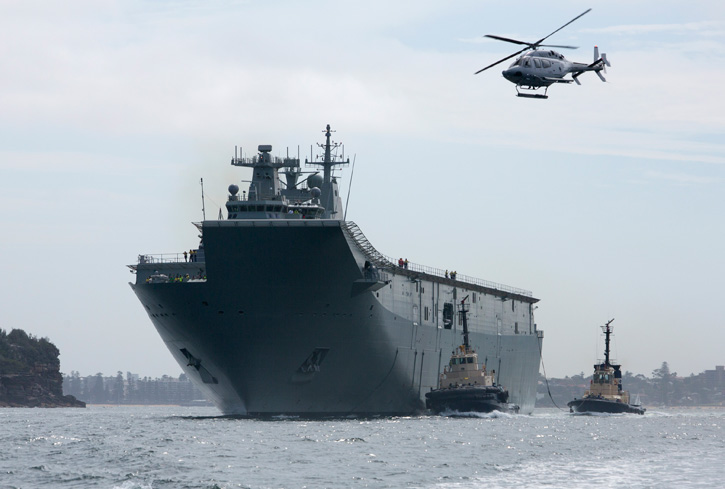
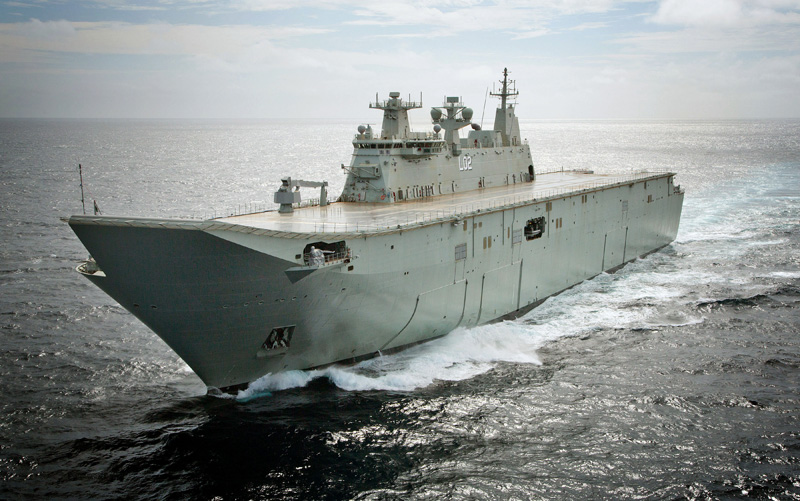
The largest ship ever built for the Royal Australian Navy, Landing Helicopter Dock NUSHIP Canberra, passes through Sydney Heads for the first time. Photo: RAN by Tom Gibson
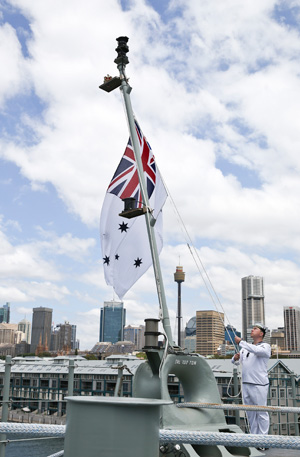
Landing Helicopter Dock NUSHIP Canberra, entered Sydney Harbour for the first time during the contractor sea trials and testing program. Photo: RAN by Steven ThomsonThe Australian White Ensign raised onboard HMAS Canberra during the commissioning ceremony, Fleet Base East, Sydney. Photo: RAN by Helen Frank
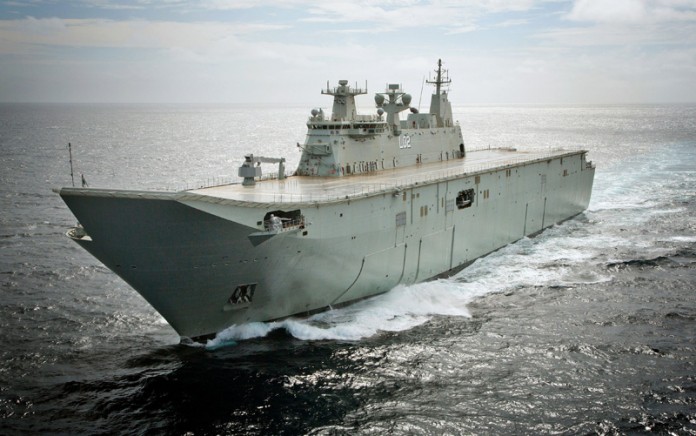
The Royal Australian Navy has commissioned HMAS Canberra today at Fleet Base East at Sidney. HMAS Canberra will proceed to sea in the coming weeks for a period of training and assessment for the crew. HMS Canberra is the first of two 27,000 tonne Landing Helicopter Dock (LHD) vessels designed by the Spanish shipbuilder Navantia. HMAS Canberra was the largest warship ever built for the RAN. HMAS Canberra is the first of two LHDs, a collaboration between the Defence Materiel Organisation (DMO), Spanish shipbuilder Navantia and BAE Systems – Maritime. The second LHD, NUSHIP Adelaide is planned to commission in 2016. The Canberra will be based at Sidney, its commanding officer is Captain Jonathan Sadleir.
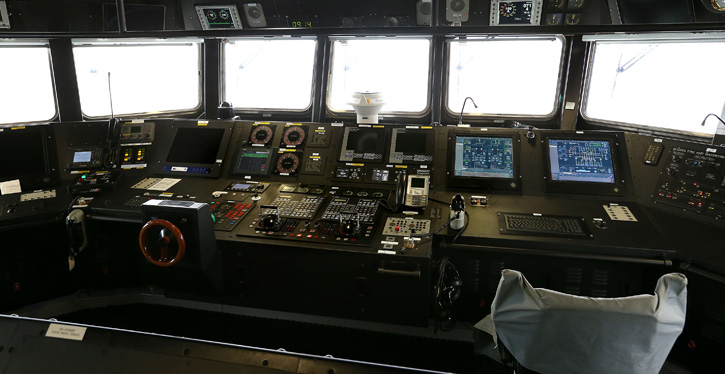
The modern bridge onboard NUSHIP Canberra. PhotoL RAN by Helen Frank
The LHD is a multi-purpose warship configured to carry out humanitarian assistance or transport an embarked force complete with their equipment and aviation assets for a peacekeeping mission. Each of the two ships will be able land a force of more than 1000 personnel by helicopter and water craft, along with all their weapons, ammunition, vehicles and stores. The warship will be jointly crewed with personnel from Navy, Army and Air Force forming the ship’s company.
Both warships have state of the art medical facilities including operating theatres, an eight bed Critical Care Unit, a variety of wards, pathology and radiology services, an x-ray, pharmacy and dental facilities.
HMAS Canberra has a conventional steel mono hull design employed with the superstructure located on the starboard side of the flight deck. The ship is designed with the shallowest possible draft to operate in secondary ports and harbours as well as manoeuvre in the shallow waters common in the littoral regions. The hull has four main decks; heavy vehicle, accommodation, hangar and light vehicles and flight decks. The flight deck space can accommodate six medium-size helicopters such as the MRH 90 Taipan or Black Hawk, and can support a mix of helicopter operations ranging from the smaller Tiger armed reconnaissance helicopter through to the much larger CH-47 Chinook heavy lift helicopters.
The largest ship ever built for the Royal Australian Navy, Landing Helicopter Dock NUSHIP Canberra, passes through Sydney Heads for the first time. Photo: RAN by Tom Gibson
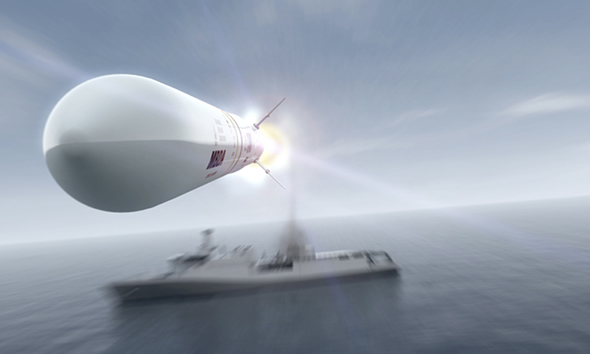
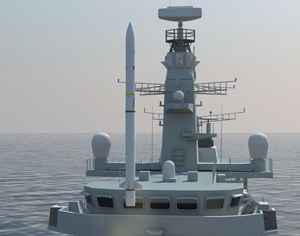
The new Sea Ceptor Mach 3 naval air defense missile will replace the Vertical Launch SeaWolf on Type 23 frigates and extend the vessel's defense against supersonic attack missiles. Photo: MBDA
Brazil selects MBDA’s Sea Ceptor air defense system for its new corvettesMBDA has announced the selection of its Sea Ceptor naval air defense system by the Brazilian Navy. The weapon will provide local area air defence for the Brazilian next generation Tamandaré class corvettes. Brazil’s is now the third navy to have chosen Sea Ceptor following the selection of the system for the UK’s Royal Navy (RN) and the Royal New Zealand Navy (RNZN).
A production contract was awarded by the UK MoD in September 2013 for Sea Ceptor to provide the next generation Air Defence capability and so replace the Seawolf system on the Royal Navy’s Type 23 frigates from 2016 onwards. Sea Ceptor will subsequently be transferred to the Royal Navy’s new ships as they start entering service, when the Type 23s are replaced by the future Type 26s. This long term commitment to Sea Ceptor by the Royal Navy is a solid assurance to each new member of the weapon’s user community of the longevity of this new system over the years to come.
Sea Ceptor provides all-weather, night and day, 360° local area air defence coverage against multiple simultaneous targets including sea-skimming anti-ship missiles, helicopters and fast combat jets. In facing saturating attacks posed by a range of diverse threats, Sea Ceptor has a clear advantage thanks to its advanced technology, active radar seeker. The weapon is also capable of engaging surface targets.
A major feature lies in Sea Ceptor’s soft launch technology which does away with the need for a launcher efflux management system, thereby reducing overall mass and onboard footprint characteristics. This allows greater flexibility for the customer in choosing the weapon’s installation position, a particularly important feature for smaller vessels. It also allows for easy installation as a retrofit on older ships.
With so many copycats in third world markets, Kalashnikov counts on developing demand for the real thing. Photo: Reuters
The Russian arms conglomerate “Kalashnikov” has partnered with distributors in Malaysia and Thailand as part of the group expansion into the Asia-Pacific region. According to the parent company Rostec, these two agreements are the largest since the foundation of the group two years ago. Kalashnikov executives are hopeful that the expansion into Asia-Pacific, Africa and Latin America will help neutralise the the negative impact of the US imposed sanctions.
Kalashnikov Concern (Izhmash) has been supplying a whole range of its firearms to the US, both for sports and hunting. Targeted by US sectoral sanctions over events in Ukraine, Americans have been ordered to discontinue any deals with the Russian gun maker due to economic sanctions imposed on Russia by the US.
Contracting with the countries of Asia-Pacific will help position the group overcome sanctions and aligning with the globalization of world markets
The US remains the world’s largest consumer of civilian arms, which is why most of the civilian guns sold by the Kalashnikov Group abroad have been sold in America. Kalashnikov products became popular and sales have exceeded a million firearms a year.
Cheap, reliable and accurate, Russian shotguns have become a serious rival to similar guns available on the US arms market. However, in international markets they are facing fierce competition, primarily by local retailers offering copies of the Kalashnikov assault rifles. The rifles have been widely used in Africa, Latin America and in Asia, primarily in countries loyal to the former Soviet Union. As many such arms were delivered to terror groups and insurgents, they are widely used by criminal elements but not as much with government forces, which are now making the primary target for the company’s expansion.
“Expansion in the Asia-Pacific region, Africa and Latin America as part of a new strategy for the group. Part of these markets were closed to Russian arms suppliers due to the predominance of US products.” company officials said. With the introduction of arms intended for use by civilian and law enforcement authorities, the situation has changed, allowing to start expanding the presence of Izhevsk arms in the region.
In recent years, the increase in exports of civilian products Concern is on the rise, which corresponds to the general tendency to strengthen Russia’s position in the global arms market. This year Concern “Kalashnikov” continues to actively explore new, promising markets for themselves.
“Contracting with the countries of the Asia-Pacific region will help position the group, overcoming sanctions and aligning with the globalization of world markets” said General Director of Concern” Kalashnikov “Alexei Krivoruchko.
Founded in 1807 as NGO “Izhmash”, the group changed its name, the “Kalashnikov” group is Russia’s largest producer of automatic weapons and sniper rifles. The concern also produces guided artillery projectiles, as well as a wide range of civil products – shotguns, sporting rifles, machines and tools. As the largest state-owned Russian infantry arms producer, the group also exports its products to 27 countries, including the US, UK, Germany, Norway, Italy, Canada, Kazakhstan and Thailand.
The AK and its variants remain the most widely used and popular assault rifle in the world, because of their durability, low production cost, availability and ease of use. Image: Defendingrussia.ru
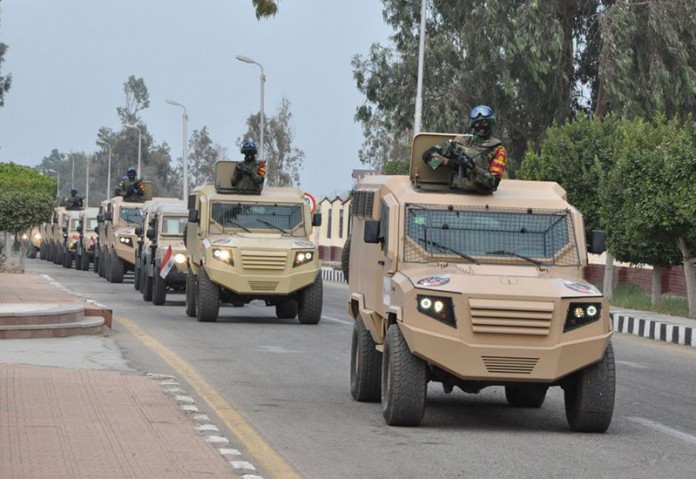
Egyptian military units were deployed yesterday (Thursday 27 November) in preparation anti-government demonstrations called by the Salafist front. The authorities have arrested more than 100 people in advance of planned demonstration. Photo: Egyptian Government
Ansar Beit al-Maqdis, an active Islamic salafi group operating against the Egyptian army in Sinai has recently pledged allegiance to ISIS.
As the war against ISIS rages in Syria and Iraq, Egypt is fighting its own war on terror. On October 24, the Sinai Peninsula witnessed the deadliest attack on Egypt’s military in years. Twenty-eight soldiers were killed and another 30 injured when a car bomb exploded at the Karm al-Qawadis security checkpoint in Sheikh Zuweid in North Sinai.
Hours later, three security personnel were killed when militants opened fire at a checkpoint in nearby El Arish.
Following the attack, Egyptian President Abdul-Fattah el-Sisi declared on State television that “‘foreign hands’ were behind the violence,” and government sources have indicated that violence in Egypt — including Sinai — is linked to the Islamic State of Iraq and Sham (ISIS, also known as Da’ish or ISIL – as it is called by the US).
Intelligence reports have already indicated that Ansar Beit al-Maqdis, an active Islamic salafi group operating against the Egyptian army in Sinai, recently pledged allegiance to ISIS. Intelligence reports indicate that the Islamic State, made up of Iraqis, other Arabs and foreign fighters, has been busy coaching the Sinai-based Ansar militants on how to operate more effectively.
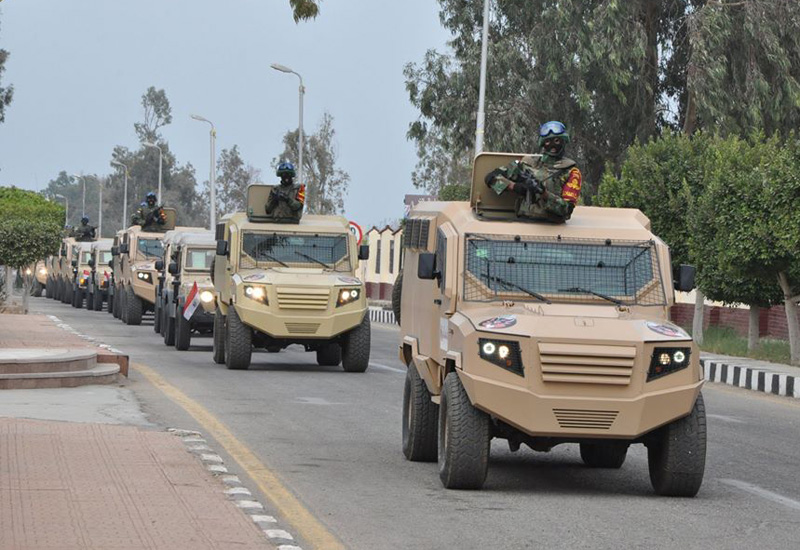
Egyptian military units were deployed yesterday (Thursday 27 November) in preparation anti-government demonstrations called by the Salafist front. The authorities have arrested more than 100 people in advance of planned demonstration. Photo: Egyptian Government
Indeed, Egypt recently had a tumultuous 48 hours: An explosion in a Cairo metro station injured 16 people; terror attacks in Sinai killed five; a bomb exploded at the Egyptian Embassy in Libya’s capital Tripoli; and 13 military servicemen are missing or wounded, following an attack by militants on an Egyptian navy ship off the northern port of Damietta. It was the first time such a naval attack had taken place. Four fishing boats were used in the assault, allegedly carried out by unidentified “terrorists,” four of whom were killed, military sources said. They identified the attackers were smugglers, caught as they entered Egyptian waters. But could it be that the Islamists from Libya were behind this action?
More recently, it was announced that an Egyptian military brigadier-general has been killed, and at least two other soldiers injured in a drive-by shooting in the suburb city of Abu Zaabal in the Qalubiya, north of Cairo. The assassination came after security forces have arrested more than 100 people in advance of planned anti-government demonstrations called by the Egyptian Salafist front for Friday, November 28. Local media reports of multiple bombs have been defused in Fayoum and Alexandria. In Suez, reports indicate gunmen opened fire on the Judges’ Club, while a bomb explosion led to the suspension of the Zagazig-Ismailiya train line.
The rising tension is also part of the preparation for acts of violence that might occur on Friday, as the Egyptian Salafist front is calling for protests on Friday November 28, calling on people to take to the streets.
As it seems, Egypt is already involved in a “full-fledged war” against Islamist groups. President al-Sisi expanded his anti-terrorism campaign to enforce brutal crackdowns on the Muslim Brotherhood opposition. The Egyptian government actually declared the group a terrorist organization earlier this year — but Egypt is still facing an escalation of extremist activity.
The Libyan civil war to the west and the allure of the Islamic State group have fuelled Egypt’s own militant groups and made the country vulnerable to spillover from the region’s other conflicts. A major conflict is evolving in northern Sinai, close to the Hamas-Gaza border and Israel. The lawless mountainous centre of Sinai Peninsula has for years been a hotbed for radical Islamists and a safe-house for a weapons arsenal hidden in the caves.
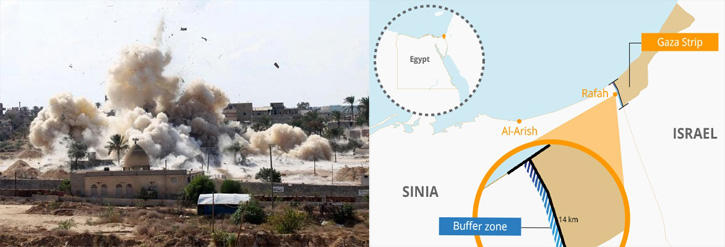
As part of its effort to separate Sinai from the influence of Hamas in the Gaza Strip, Egyptian military is clearing a ‘sterile’ buffer zone, by evacuating the population and demolishing all buildings in a 1000 meter wide strip strebetween the Gaza strip and Northern SInai, in an effort to eliminate most of the tunnels linking Gaza with Sinai.
Located between the Suez Canal and the Arabian Peninsula, the Sinai Peninsula is geographically isolated, but virtually links key states of Egypt, Palestine, Jordan, Israel, and Saudi Arabia. Owing to its geo-political importance, it was a battleground in every war between Egypt and Israel, from 1948 until 1973.
The 1979 peace treaty between Egypt and Israel returned Sinai to Egypt, with a substantially limited Egyptian presence and international military supervision. These have undoubtedly played a significant role in turning this large peninsula into a buffer zone that has helped to prevent large-scale Egyptian-Israeli military confrontations for more than 30 years.
Egyptian officials, including the country’s foreign minister, have acknowledged that coordination exists between Islamic State and other militant groups, including some inside Egypt. The country has faced growingIslamist insurgent activity, since the army toppled President Mohamed Morsi of the Muslim Brotherhood last year. Tempers rise constantly, as the Brotherhood and other Islamic factions issue calls for unrest.
Bagdadi’s “Islamic State” called for some of these attacks, urging Sinai insurgents to press ahead with violence against Egyptian security forces. “Rig the roads with explosives for them. Attack their bases. Raid their homes. Cut off their heads. Do not let them feel secure,” Islamic State spokesman Abu Muhammad al-Adnani said in a statement to Egyptian militants released online. Following suit, the Sinai-based militant group Ansar Beit al-Maqdis has already beheaded seven Egyptians since August.
Sisi, who as army chief led Morsi’s ouster following protests against his rule, has expressed his concerns about militant Islamist activity in Egypt and the Middle East. He has backed Washington’s call for global action to counter the threat from Islamic State. However, Foreign Minister Sameh Shukri has stated that Cairo might not provide direct military assistance to the United States in its battle against the group, saying that the army was fully focused on the home front. The challenge of containing militancy has become more complex since Islamic State militants have expanded their influence by declaring a caliphate in the area, inspiring other militant groups, including some based along Egypt’s border with chaotic Libya, though Egyptian security forces had appeared to be making some progress against Islamist insurgents in Sinai over recent weeks. The Ansar commander said pressure from the army had forced some fighters to flee the area for other places inside Egypt.
This wave of terrorism is not foreign to the Sinai Peninsula, which witnessed massive terrorist attacks in 2004 and 2006. But, currently, the conditions in Sinai have become highly volatile, with attacks and bombings occurring on a regular basis. This calls for determined action by the Egyptian military, requiring Israel’s agreement, to a temporary adjustment of the of the Egyptian military limitations of the 1979 Peace Agreement.
ISIS is also recruiting members in Egypt itself—and rather successfully. In October, an ISIS recruitment cell comprised of eight members was uncovered in the City of Port Said. In an off-the-record conversation with an Egyptian official, a foreign author was informed that no fewer than 5,000 Egyptians, most of whom are radical Salafis, are now fighting in Syria.
Similar to Egyptians fighting with the Mujahideen in Afghanistan and returning to Egypt, the regime could soon face a serious problem with radicalized Egyptians returning from Syria and Iraq with the intention of carrying out domestic terror attacks.
The flow of Egyptian fighters to Syria should come as no surprise. Under the previous regime, President Mohamed Morsi encouraged Egyptians to participate in the jihad in Syria against the Assad regime.
The flow obviously did not stop once Morsi was ousted. Last month, ISIS claimed that a former Egyptian police officer had died in one of its sponsored suicide attacks inside Iraq. This shows that ISIS’s sphere of influence in Egypt has become wider. According to a survey conducted by the Fikra Forum Project of the Washington Institute for Near East Policy, 3% of Egyptians (some 2.5 million) already support ISIS.
Yet, despite its unwillingness to get involved directly in military operations beyond its borders, Egypt can still contribute logistics, intelligence, and ideological support to the anti-ISIS conflict.
Logistically, Egypt can revitalize the military relationship it previously had with the United States by allowing coalition members to use Egyptian air space and by expediting coalition-related traffic through the Suez Canal.
From the intelligence perspective, Egypt has a long history of confronting terrorist organizations, both domestically and abroad. Egypt has been a reliable ally in the American war on global terrorism in terms of intelligence sharing, investigations and interrogations, and tracking suspects; such activities can ultimately aid the coalition considerably.
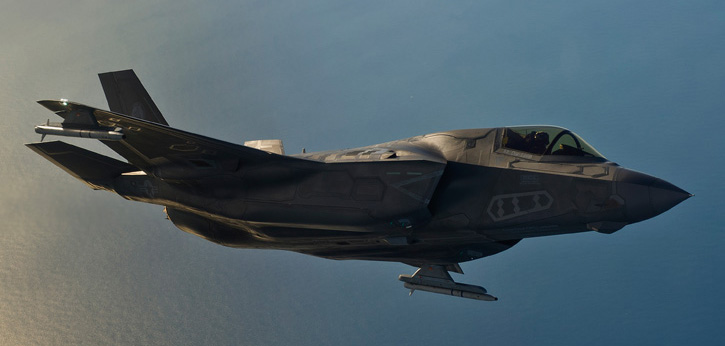
The F-35B carrying two ASRAAM missiles on outboard pylons. Photo: BAE Systems
In recent test series, US Marine Corps F-35B Lightning II the combined test force configured to carry weapons load operated by the Royal Air Force completed initial aircraft handling trials carrying ASRAAM and Paveway IV weapons. The tests were carried out at Patuxent River Naval Air Station, MD in the USA by a test team including personnel from the UK BAE Systems.
Two F-35B Short Take Off / Vertical Landing (STOVL) aircraft, flown by Billie Flynn, Lockheed Martin’s F-35 test pilot, and Squadron Leader Andy Edgell from the RAF, completed nine flights with MBDA’s ASRAAM missiles and Raytheon’s Paveway IV enhanced laser guided bombs. The flights involved different configurations of both weapon types on the aircraft.
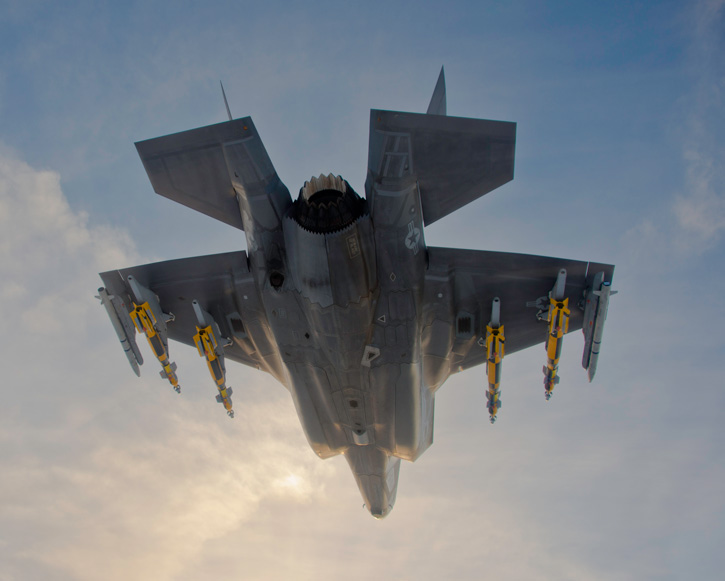
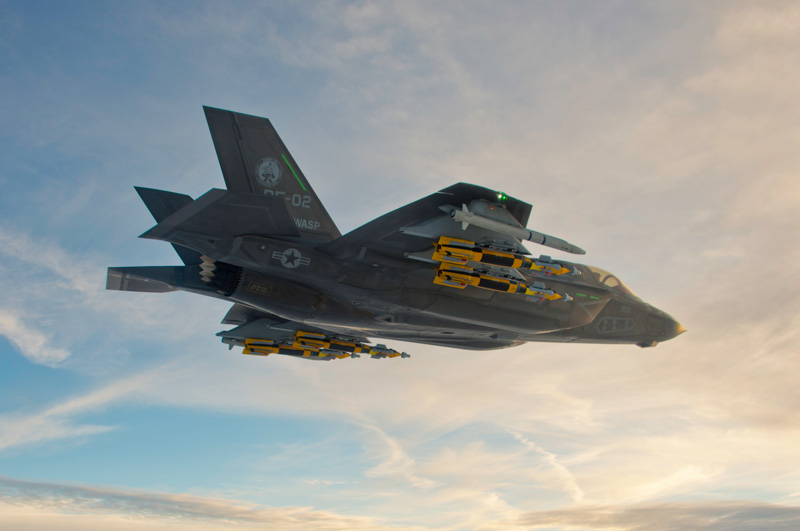
The test used ‘dummy’ weapons rounds, which are identical in fit and form to the operational weapons. The aircraft loaded with the weapons were tested on the STOVL aircraft. The initial tests are an important step in integrating weapons onto the F-35B, allowing test pilots to understand how they affect the way the aircraft performs and handles.
The next stage of weapons testing is due to begin early in 2015 and to involve weapon separation,followed by guided releases of both ASRAAM and Paveway IV.
The UK’s Royal Air Force (RAF) already uses ASRAAM and Paveway IV on the Eurofighter Typhoon and Panavia Tornado GR4. The successful tests are a step towards full interoperability between the current and future fast jets that will be used by the RAF and the UK’s Royal Navy from 2018.
Earlier this week the British Ministry of Defence (MOD) signed a contract for the first production batch of four Lightning II stealth combat aircraft, which will operate from both the Royal Navy’s new aircraft carriers and RAF land bases. The contract for the F-35B aircraft forms part of the MOD’s investment in Lightning II over the next five years to procure an initial 14 of these multi-role fifth-generation aircraft, as well as putting in place the necessary support arrangements and infrastructure.
Further contracts will cover the procurement of a range of equipment, including engines. Bernard Gray, the MOD’s Chief of Defence Materiel, confirmed that “the MOD remains on target for achieving both operational capability from land bases and the start of flying trials aboard the carrier HMS Queen Elizabeth in 2018 for this highly-advanced multi-role stealth combat aircraft.” The agreement is part of the 43 aircraft Low Rate Initial Production Block VIII contract awarded by the Joint Strike Fighter Program Office (JPO) last week.
The ASRAAM missile seen here in the internal payload bay of an F-35B model displayed at Farnborough. The can be cued by aircraft sensors, such as the radar or helmet mounted display but can also act as an autonomous infrared search and track system. Supporting Lock On After Launch (LOAL) capability the missile can be fired from the internal weapons bay of the F-35, thus maintaining full stealth mode. To acquire the target designated by the pilot on the radar or helmet display, without the missile’s seeker having to ‘see’ the target prior to launch. Photo: MBDA
Advanced weapons fit
The ASRAAM air/air missile developed and produced by MBDA is in service with the Royal Air Force on their Typhoon and Tornado aircraft. The weapon is also in service with the Royal Australian Air Force on their F/A-18 Hornet. ASRAAM is a Within Visual Range (WVR) Dominance weapon and is guided by a passive-imaging infra-red sensor. The missile can be cued by aircraft sensors, such as the radar or helmet mounted-display, but can also act as an autonomous infra-red search and track system. Supporting Lock On After Launch (LOAL) capability allows the the missile to be fired from the internal weapons bay of the F-35, by acquiring the target designated by the pilot on the radar or helmet display, without the missile’s seeker having to ‘see’ the target prior to launch. Its large rocket motor provides high-speed interception and this, coupled with its accurate-imaging infra-red guidance system and highly effective warhead, ensure high kill probability against any target.
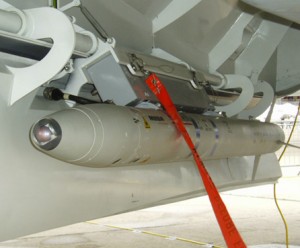
The Paveway IV is a GPS/INS enhanced laser guided bomb, enabling precision attack of point targets from high altitude, using a combination of GPS/INS guidance to attack stationary targets and laser designation to achieve very high precision or engaging of moving targets. This combined guidance capability enables operators to increase operational flexibility, decreasing the required sortie count and weapon inventory, while simultaneously increasing the mission success rate.
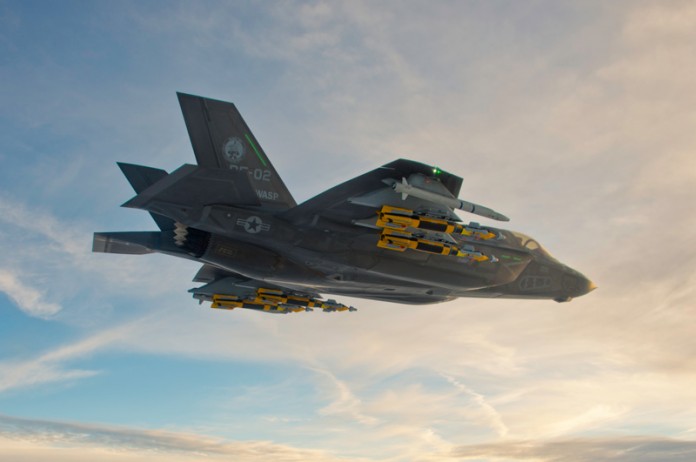
The F-35B loaded with a load of dummy weapons including four Paveway IV laser guided bombs and two ASRAAM air/air missiles. The dummy weapon load allowed test pilots to understand how they affect the way the aircraft performs and handles. Photo: BAE Systems
ATLAS North America LLC. (ANA) has acquired the business of Marine Sonic Technology (MSTL), Ltd., based in Yorktown, Virginia, USA, via an asset deal. Terms of the transaction were not disclosed. ANA is a wholly owned subsidiary of ATLAS ELEKTRONIK GmbH, Germany.
“MSTL’s core competencies with high resolution sonar technology are highly synergistic to the ATLAS Group’s existing capabilities and with the addition of these new side scan products, expand ATLAS’ total sonar product offerings.” explained Sergio Diehl, President and Chief Executive Officer of ATLAS North America LLC.
The initial focus is on ATLAS line of Remotely Operated and Autonomous Underwater Vehicles (ROVs/AUVs) i.e. SeaFox, SeaCat and SeaOtter. ANA is currently executing mine neutralization contracts with the SeaFox UUV based on an urgent operational need statement (UONS) for the US NAVY. The installations are in the AVENGER CLASS mine countermeasure vessel, the MH-53E mine countermeasure helicopters and with the US Navy Explosive Ordnance Disposal community.
“ATLAS North America’s acquisition of Marine Sonic Technology creates for the ATLAS Group a greater worldwide stake within the sonar survey, mine warfare and the fast growing autonomous vehicle markets.”
For ANA, the new combined facility provides the critical U.S. based production and manufacturing facility required to affix the “Made in the USA” label on SeaFox Mine Neutralization Vehicles, and other planned products for the U.S. Navy Mine Warfare Forces.”
Marine Sonic Technology, offers the highest resolution currently available at 1800 kHz, from the early Sonic High-Accuracy Ranging and Positioning System (SHARPS) to the latest ARC Scout which is the smallest dual-simultaneous digital CHIRP embedded system capable of producing near photographic imaging. Servicing industries around the globe such as Oil & Gas, Oceanic & Marine Construction, Search & Rescue, Law Enforcement, Military & Defense.
Singapore based Advanced Material Engineering Pte Ltd (AME) is teaming with US industry giant General Dynamics to produce manufacture 40mm Air Burst Ammunition for the U.S. military.
GD announced today that its Ordnance and Tactical Systems (OTS) subsidiary has entered into a strategic agreement with AME, the ammunition and small arms subsidiary of Singaporean defence firm ST Kinetics. The agreement licenses the manufacturing of the new ammo for the US market.
Airburst ammunition is highly effective against concealed and defilade targets. The 40mm ammunition can be fired from existing U.S. Army grenade launchers such as the Mk19 and MK47.
Uniquely different from conventional ammunition, the 40mm airburst uses a programmable, time-based fuse technology that computes and programs the detonation time into the fuze. Once fired, the fuze counts down to zero detonating at the intended target point.
This ammunition will provide the warfighter with the capability to program ammunition to detonate at a specific distance, greatly increasing the effectiveness, flexibility and lethality of their weapon systems.
Providing these handheld computing devices is one of the growth areas GD is aiming at. “By integrating programmable ammunition with innovative products, such as our Next Generation Fire Control System, we can provide the warfighter with versatility and overmatch capability that is fully interoperable with our weapon systems currently in service,” said Tim McAuliffe, vice president and general manager of medium caliber ammunition and weapons for General Dynamics Ordnance and Tactical Systems.
AME is one of the leading suppliers of 40mm ammunition in the world. AME’s 40mm ammunition is currently in service in Europe , Canada , Africa and Asia Pacific.
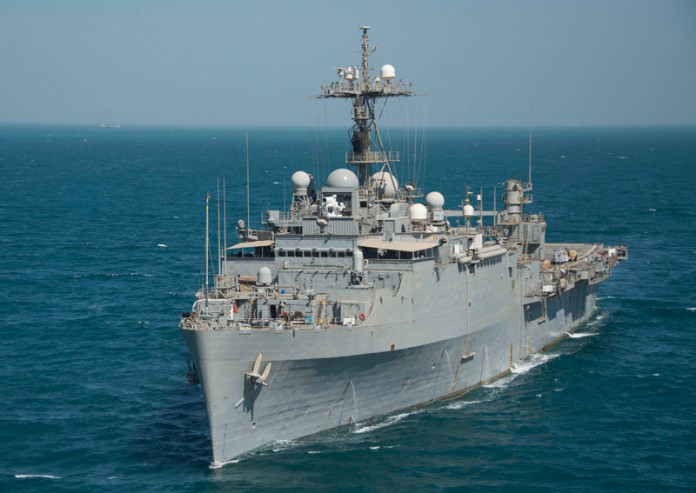
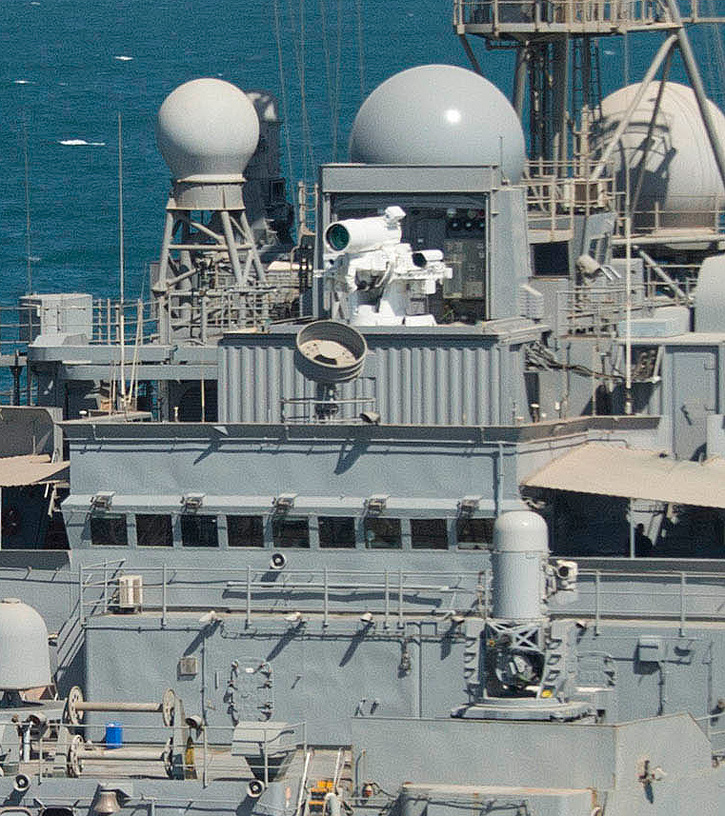
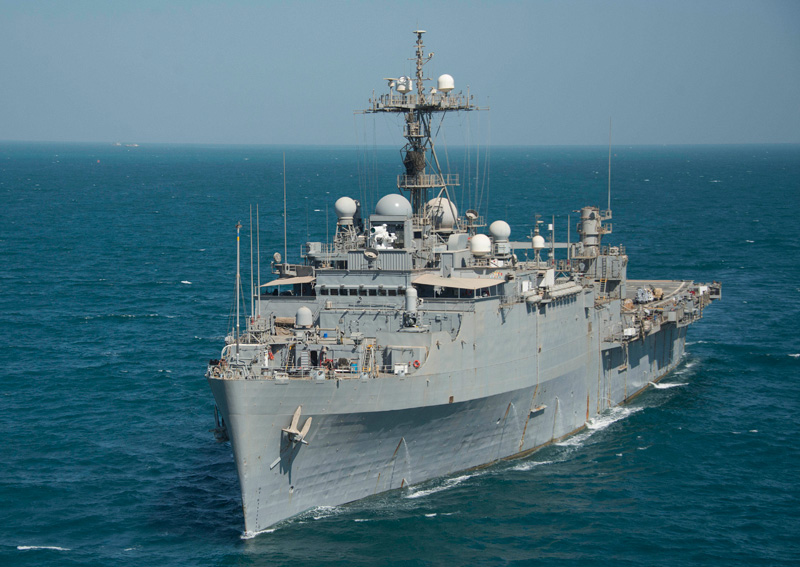
The afloat forward staging base (interim) USS Ponce (AFSB(I) 15) transits the Arabian Gulf. Ponce is equipped with the Laser Weapon System (LaWS), a technology demonstrator built by Naval Sea Systems Command from commercial fiber solid-state lasers. The system utilizes combination methods developed at the Naval Research Laboratory to successfully shoot down a target. LaWS (the white assembly visible at the center of the photo) can be directed onto targets from the radar track obtained from an MK 15 Phalanx Close-In Weapon System (seen below the laser assembly) or other targeting source. This capability provides ships with a method to easily defeat small boat threats and aerial targets without using bullets. (U.S. Navy photo by Daniel M. Young)
The US Navy has been operating a High Energy Laser (HEL) weapon in the Persian Gulf and Arabian Sea since the summer of 2014. The system, afloat on the forward staging base (interim) – USS Ponce (AFSB(I) 15) is the first laser weapon system operationally deployed by the US military. Currently at a prototype stage, the system has been fielded to evaluate the capabilities of Solid State Laser-(SSL) in a Quick Reaction Capability (QRC) demonstration.
According to navy plans HEL will equip U.S. ships with a high depth-of-fire delivered at the speed of light, with seconds dwell time and a deep magazine for more powerful means of self-defense.
The SSL prototype is a 30 kW-class solid-state laser weapon system developed under the leadership of the Naval Sea Systems Command (NAVSEA). The system integrates six commercial 5.4 kW fibre lasers with a beam combiner developed for the Naval Research Laboratory. Final integration and testing of the system were performed at the Naval Surface Warfare Center Dahlgren Division, with land-based testing performed on the Potomac River Test Range.
An Iranian Navy drill practicing swarm attack by small and fast boats, equipped with short range rockets.
The US Navy is exploring several directed energy and laser weapon programs for its current and future force. Future HEL weapons delivering peak power of 100-150 kW are considered as cost effective means for protection against anti-ship missiles, guided weapons and swarms of fast attack boats. In particular, the service is attracted by the low cost-per-shot offered by the laser, particularly on electrically powered vessels such as the new DDG-1000 (USS Zumwalt), for which powerful free electron lasers are being developed.
Different laser weapons would be compatible with existing vessels such as the Littoral Combat Ships (LCS) and DDG-51 guided missile destroyers. These lasers currently evaluated by the Office of Naval Research are expected to be available for testing at sea by 2016.
A miniaturized version of the HEL Weapon System or HELWS is a high energy fiber laser, evaluated by ONR to equip naval helicopters. The Concept of Employment for a HELWS, is to operate the airborne laser from a rotary wing platforms such as the MH-60 or MQ-8C unmanned helicopter, enabling the platform to engage light targets such as fast swarms of boats, unmanned surface vehicles or anti-aircraft missiles. The concept of operation, as in operating lasers on surface vessels, will be to employ the lasers against low-end asymmetric threats, thus free the limited load-out of the vessel’s advanced kinetic weapons to strike advanced high-end threats.
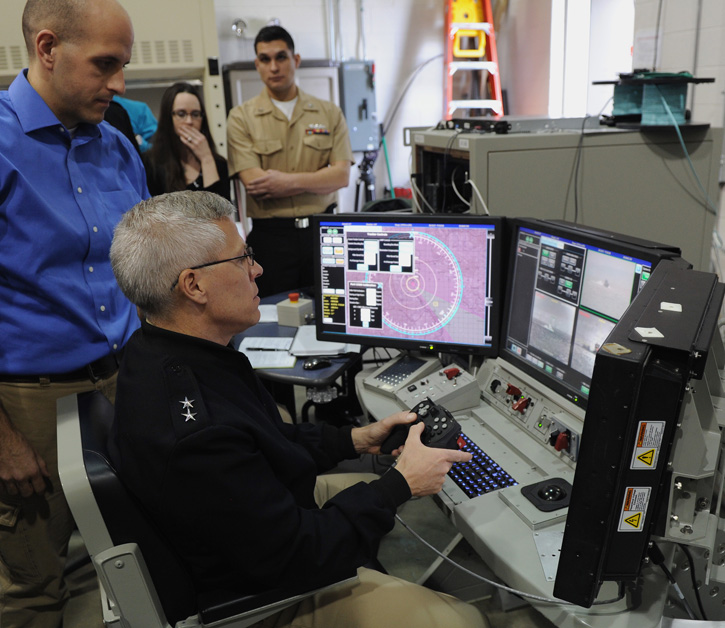
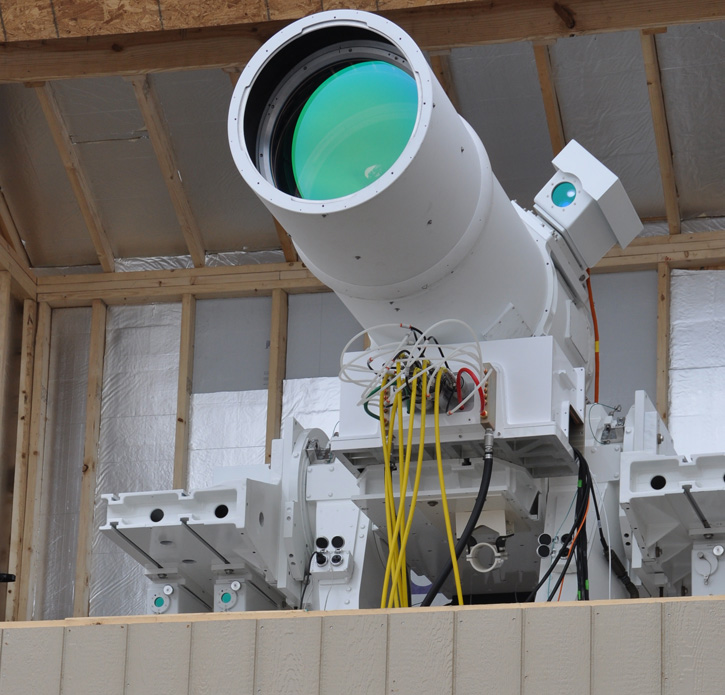
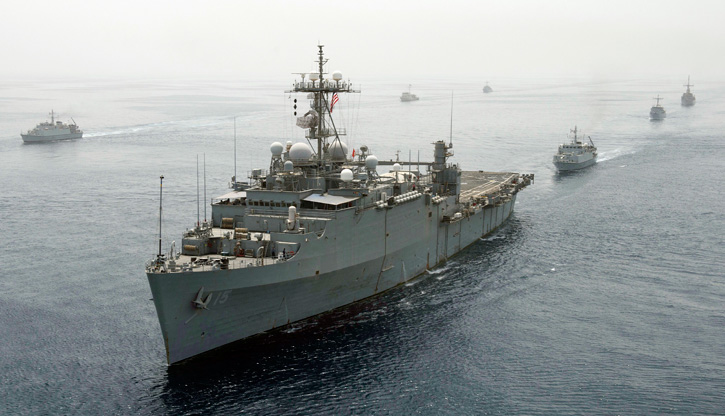
Rear Adm. Matthew Klunder, chief of naval research, tracks targets during a tour of Naval Directed Energy Center and the Office of Naval Research’s (ONR) Laser Weapons System (LaWS) program at Dahlgren in March 2014. (U.S. Navy photo by John F. Williams)The A/N SEQ-3(XN-1) Solid State Laser-Quick Reaction Capability system’s beam director and tracking mount undergoing tests before deployment on USS Ponce. (U.S. Navy photo by John Joyce)The afloat forward staging base (interim) USS Ponce (AFSB(I) 15) transits the Arabian Gulf. Ponce is equipped with the Laser Weapon System (LaWS). The vessel is leading the annual mine countermeasure exercise IMCMEX 2014. (U.S. Navy photo by Daniel M. Young)The Ponce without laser – The Arabian Sea, 2013 – USS Ponce leads a formation of ships participating in International Mine Countermeasures Exercise (IMCMEX) 2013. Photo: U.S. Navy photo by Michael Sandberg.
The North Atlantic Treaty Organization (NATO) is establishing a multinational fleet of Multinational, Multi Role Tanker Transport Fleet (MMF), the acquisition of the fleet will be lead by the Netherlands. The decision followed the principal approval of ten European countries which signed the letter of intent to jointly purchase and operate the tanker fleet on November 2012.
The decision to launch the acquisition phase was taken on 21 November 2014, based on a cooperation agreement signed between the NATO Support Organisation and the Organisation for Joint Armament Cooperation (OCCAR) who will oversee the acquisition. OCCAR is also managing two other aviation programs for NATO – the A400M tactical airlifter as part of a joint acquisition program supporting 170 aircraft for Germany, France, Spain, Turkey, UK, Belgium and Luxembourg. Another OCCAR program is the Tiger attack helicopter, supporting French, German and Spanish acquisitions of 184 attack helicopters of various models. Both programs are produced by Airbus Defense and Space.
While the Airbus MRTT is expected to be the favorite, the type and number of aircraft to be procured have yet to be announced. The A330 MRTT is already in service with the UK, where 14 are operated under a private funded initiative (PFI). Last week the French MOD announced the order of 12 “Phoenix” MRTT of a similar model for the French Air Force.
The initiative will increase the air-to-air refuelling capability available for European Nations. The current participating nations include the Netherlands and Norway, both will oversee the acquisition and operational sustainment of the MMF aircraft. The other countries supporting the program are Belgium, France, Greece, Hungary, Luxembourg, Poland, Portugal and Spain. NATO is currently maintaining a fleet of three Boeing C-17A Globemaster III transport aircraft under the Strategic Airlift Capability program launched in 2006.
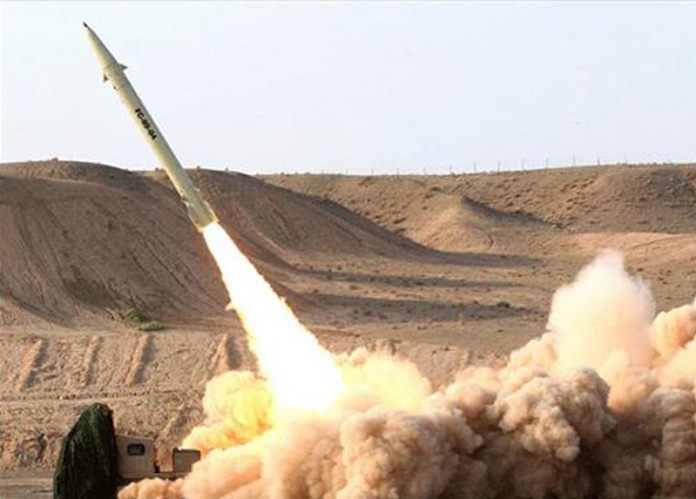
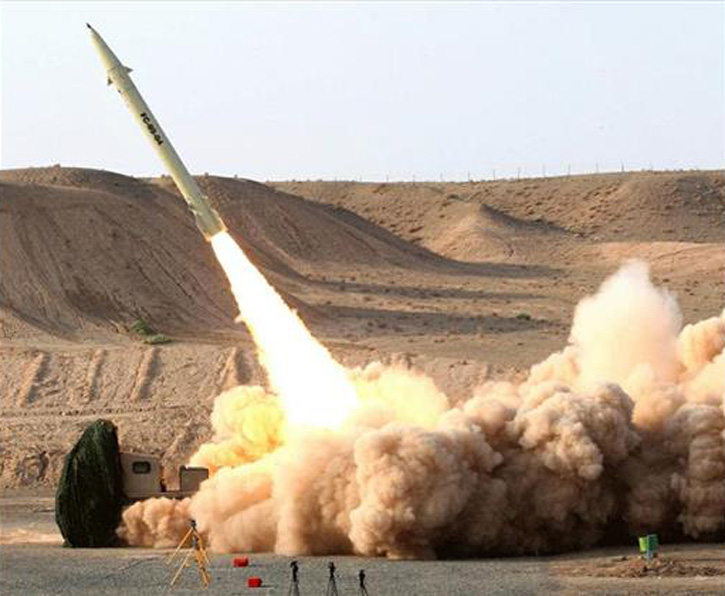
Fateh 110 missile launched on the first flight in 2010. The missile has recently been delivered to Hezbollah in Lebanon. Photo: Fars news
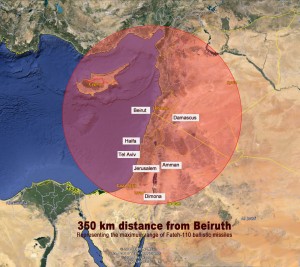
Iranian and Lebanese sources have recently confirmed that the Iranian backed Lebanese group Hezbollah has received the Iranian Fateh-110 guided ballistic missiles, and inducted the weapon into its missile arsenal. With a range of 250-350 km the new missile can hit targets provides the group with a capability to hit any target in Israel up to the northern Negev.
Brigadier General Seyed Majid Moussavi Lieutenant Commander of the IRGC Aerospace Force, confirmed last week that the ‘Lebanese and Palestinian resistance groups’ are in possession of Fateh-class missiles which were developed by Iran a few years ago. “Considering the range of their missiles, they are able now to attack all targets from Southern to Northern parts of the occupied territories,” he said.
The range of 350km from Beirut, depicting the maximum range of Fateh 110 missiles. Map layer: Google Earth
In another interview the Commander of the IRGC Aerospace Force Brigadier General Amir Ali Hajizadeh confirmed Syria’s missile-production plants had been built by Iran. “The missile production plants in Syria have been built by Iran and the missiles designed by Iran are being produced there,” Hajizadeh said, adding that “The Lebanese Hezbollah and the Palestinian resistance have grown highly powerful in this field (missile production) now.”
Deliveries of such missiles has been regarded by Israel as a ‘red line’, triggering preemptive response. In 2013 the Israel Air Force attacked a shipment of similar missiles near the airport in Damascus. In the past year, Israel is said to have attacked six missile-laden convoys, as well as missile storage sites, both in Syria and Lebanon, in a bid to prevent Syria from delivering ballistic missiles, anti-ship and anti-aircraft to Hezbollah.
You are invited to join our Gold Membership to gain access to the full version of this analysis
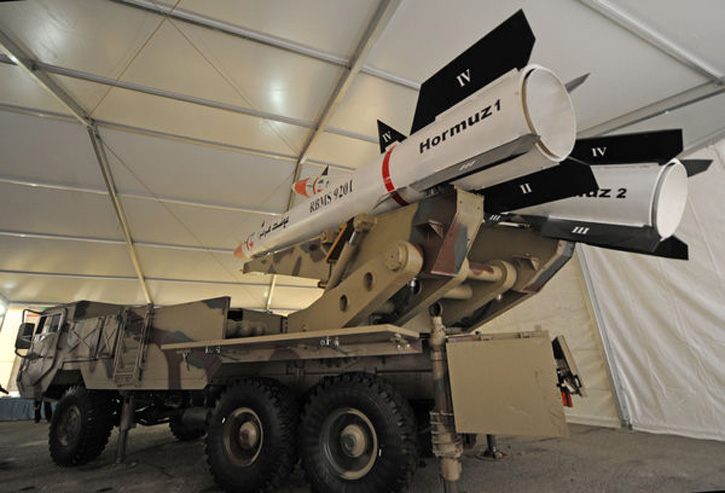
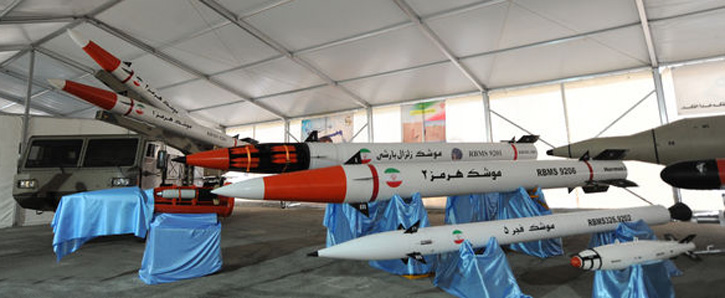
Hormoz missiles introduced in 2014 are variants of the Fateh 110 missile using passive RF guidance to hit radar emitting targets. As such they could be used effectively as counter-radar weapons. Photo: Iran’s president websiteAnother new version of the missile unveiled by the Iranian IRGC in 2014 is a cargo variant, loaded with 30 submunitions, each weighing 17 kg. The white rocket on the right, a 330mm Fajr 5 is also fitted with canards, hinting on this relatively simple weapon enhancement with INS/GPS guidance, bringing the rocket near to ‘precision attack’ capability. Photo: Iran’s president website
Lockheed Martin Skunk Works® and XTEND have achieved a major milestone in JADC2 by integrating the XOS operating system with the MDCX™ autonomy platform. This technical breakthrough enables a single operator to simultaneously command multiple drone classes, eliminating the friction of mission handoffs. From "marsupial" drone deployments to operating in GPS-denied environments, explore how this collaboration is abbreviating the data-to-decision timeline and redefining autonomous mission execution.
As traditional defense primes face mounting competition from agile “neoprimes” such as Anduril, Palantir and Helsing, the balance of innovation is shifting toward software-defined warfare and scalable, dual-use technologies, while global industry consolidation—marked by Boeing’s integration of Spirit AeroSystems and other strategic mergers—signals an intensified race to secure control over the defense technology value chain. Our Defense-Tech weekly report highlights these trends.
In early October 2025, a coordinated wave of unmanned aerial system (UAS) incursions—widely attributed to Russia—targeted critical infrastructure across at least ten European nations. The unprecedented campaign exposed the fragility of Europe’s air defenses...
Executive Summary
The past week (September 18-25, 2025) represents an inflection point where strategic defense concepts have transitioned from doctrine to tangible reality. An analysis of global events reveals four primary, interconnected trends shaping an...
At the 2025 Air, Space & Cyber Conference, U.S. Air Force and Space Force leaders unveiled major updates on next-generation fighters, bombers, unmanned systems, and space initiatives, highlighting both rapid innovation and critical readiness challenges as the services race to outpace global competitors. A short version is available here, with a more detailed version for subscribers.
The Taipei Aerospace & Defense Technology Exhibition (TADTE) 2025 crystallized around four dominant strategic themes that collectively illustrate Taiwan's comprehensive approach to defense modernization amid escalating regional tensions. Based on a detailed report by Pleronix (available upon request). Includes a Podcast discussion on TADTE 2025's highlighting Taiwan's four strategic themes beyond the post's coverage.
Israel’s Iron Beam 450 high-power laser system has completed final testing, marking a major leap in air defense. Developed by Rafael, it offers precise, cost-effective interception of rockets, UAVs, and mortars, and is set for IDF deployment by 2025.