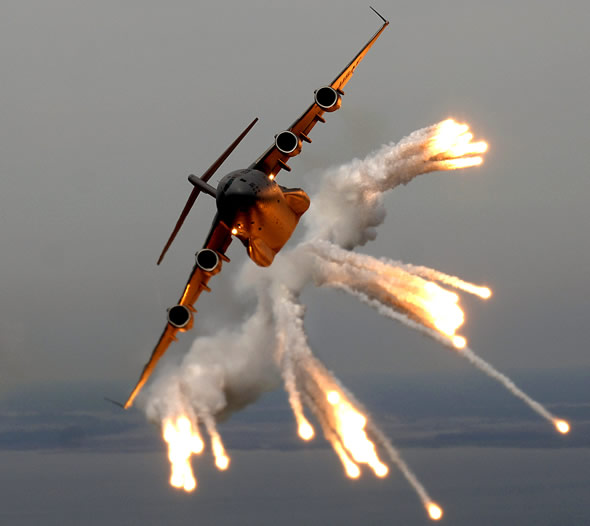
The new heavy-lift aircraft will play a leading role providing strategic lift capabilities, mobilizing military assets within India and abroad. The C-17 is also used throughout the world, supporting disaster relief operations. Photo: Boeing
The purchase of ten Boeing C-17 Globmaster III aircraft for $4.1 billion received the green light from the government yesterday, paving the way for formal approval of the largest Indian acquisition program through the U.S. Foreign Military Sales. A Letter of Acceptance to the US government is expected to follow soon, followed by formal signing of the contract. Deliveries of the aircraft are expected to start 24 months after the signing of the contract. The heavy-lift aircraft will play a leading role providing strategic lift capabilities, mobilizing military assets within India and abroad and supporting disaster relief operations throughout the region.
Boeing's C-17 Production Line at Long Beach is expected to takes off again, producing at least ten Globemaster III heavy lift jets for India. Photo: Boeing
The IAF currently operate a dozen Russian built Ilyushin IL-76 aircraft providing heavy-lift transport and about 100 Antonov AN-32 medium-lift planes. The first of six new Lockheed Martin C-130J arrived earlier this year, forming a new transport capability supporting rapid deployment special operations units.
Chris Chadwick, president, Boeing Military Aircraft said that the acquisition of ten aircraft is not the final step in this program, as the Indians could be interested in purchasing six additional aircraft. The Indian order comes as a relief for Boeing’s C-17 Long Beach production line, which could have dried out by 2012, lacking new orders. “Without the order by the Indian government, the last of the plant’s current orders would be delivered in December 2012. The order has a $5.8 billion annual economic impact and the jobs of about 25,000 workers in 44 states depend on the C-17 planes,” a Boeing spokesperson said. The deal will also offer significant opportunity for India’s aerospace manufacturers, as it comes with an offset requirement valued at $1.2 billion.
The new heavy-lift aircraft will play a leading role providing strategic lift capabilities, mobilizing military assets within India and abroad. The C-17 is also used throughout the world, supporting disaster relief operations. Photo: Boeing
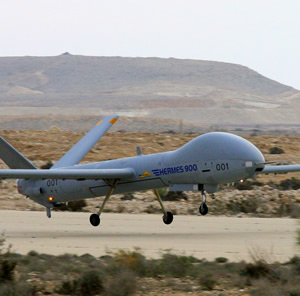
Elbit Systems reported today the first export sale of its Hermes 900 UAV to a customer in Latin America (although the identity of the country has not been confirmed, the country is believed to be Chile). The UAV system selected by Chile also includes DCoMPASS payload systems and an unidentified radar systems.
Hermes 900 has already been selected by the Israeli and Chilean defense forces. Photo: Elbit Systems
The Chileans have developed their military requirement for UAS for several years but only after the earthquake that devastated the country in 2010 the need for advanced, rapid response aerial surveillance system received a high priority.
The Chilean choice followed evaluation of two classes of UAS. At the high end were the Hermes 900 and Heron from IAI, both already were selected by the Israel Defense Forces. At the lower (tactical) level were Hermes 450, and Aerostar from Aeronautics Defense Systems. The Hermes 900 will be operated by the Chilean Air Force (Fuerza Aérea de Chile – FACH).
Hermes 900 builds on the vast operational experience of the Hermes 450, the backbone of the Israel Defense Forces’ UAS fleet. The system uses unified ground control station (UGCS) that shares software architecture and training programs with other Hermes family platforms, allowing the Hermes 900 users seamless integration with Hermes 450 systems, enhancing operational flexibility, infrastructure, training and system life cycle cost.
Hermes 900 offers a range of enhanced capabilities, from higher flight altitude (over 30,000 ft) to longer endurance and larger payload capacity. The system’s unique multipurpose payload bay enables it to carry a wide variety of payloads in different shapes and sizes for quick “conversion” between various payload configurations.
Hermes 900 offers a high level of commonality with other Hermes family platforms, with extended range, mission endurance and payload weight, and volume capacity. Photo: Elbit Systems.
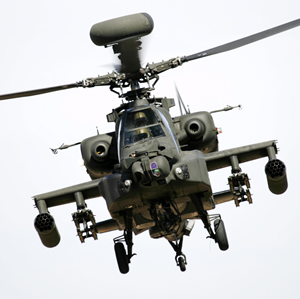
WAH 64 operating from HMS Ocean. Photo: MOD, Crown Copyright
Attack helicopters under NATO command were used for the first time on 4 Jun 2011 in military operations over Libya as part of Operation Unified Protector. The helicopters struck at a radar station and a military checkpoint around Berga, military vehicles and ‘command buildings’ in another, unspecified location. “This successful engagement demonstrates the unique capabilities brought to bear by attack helicopters,” said Canadian Lt. Gen. Charles Bouchard, commander of NATO’s Operation Unified Protector. “We will continue to use these assets whenever and wherever needed, using the same precision as we do in all of our missions.”
British army WAH-64 Apache firing its 30mm cannon on sea trials off HMS Ocean last week. The rapid preparation of the Apache for maritime operations was seen as a stop-gap following the phasing out of Royal Navy Sea Harriers and RAF Harrier GR9 aircraft, along with their aircraft carriers. Unlike the fast jet fighters, Apaches although well protected, are more vulnerable to enemy fire as they often operate at low altitude, within the range of enemy fire. Photo: MOD, Crown Copyright
Following the rapid preparation and successful testing of British Army Air Corps WHA-64 Apache operations from naval platforms, British Apache attack helicopters joined the French Tiger combat helicopters and Gazelle scout helicopters to conduct the first operational sorties over Libya on Friday night. The Apaches were tasked with precision strikes against a regime radar installation and a military checkpoint, both located around Brega. Hellfire missiles and 30mm cannon were used to destroy the targets.In the same area, Royal Air Force ground attack aircraft destroyed another military installation, whilst a separate RAF mission successfully attacked two ammunition bunkers at the large Waddan depot in central Libya. The French helicopters attacked 15 military vehicles and five command buildings.
NATO has not released the locations of these attacks. The helicopters deployed from the British helicopter carrier HMS Ocean, and were coordinated with other allied air missions by NATO’s air operations centre, located at Poggio in Italy. The British mission, part of Operation Unified Protector, was planned alongside an operation by French Tiger helicopters from the ‘Mistral’ Class helicopter assault ship Tonnerre. The French Army is using the HAP version of the Tiger, carrying 68mm rockets and a 30mm. However, unlike the Apache, the HAP model lacks precision guided weapons, and can only deploy with air-to-air Mistral missiles for self defense. Other Tiger operators (Germany, Australia and Spain have guided weapons capability – namely PARS 3LR, Hellfire II and Spike LR, respectively.)
Two WAH-64 Apaches ready for take off, on the deck of HMS Ocean. The two helicopters currently supporting the operation in Libya are expected to be joined by four additional Apaches to deploy from England. Photo: MOD, Crown CopyrightWAH 64 operating from HMS Ocean. Photo: MOD, Crown Copyright
The timing and locations of targets for this coordinated attack were carefully selected, amid growing criticism about the collateral damage caused by NATO air attacks. “The use of attack helicopters provides the NATO operation with additional flexibility to track and engage pro-Qadhafi forces who deliberately target civilians and attempt to hide in populated areas” said the official NATO announcement. “NATO forces are constantly reviewing their operations and use of available assets, including attack helicopters, to best maintain the momentum and increase the pressure on pro-Qadhafi forces.” “Our understanding of the detailed disposition of Colonel Qadhafi’s forces has been improving in a very satisfactory manner, despite their efforts to conceal themselves” the British MOD announcement added. “Operations to date have made good progress in securing the No Fly Zone and preventing serious loss of life in Misratah and Benghazi.
While yesterday’s operations demonstrate the capabilities of the Apache complement well the precision strike and reconnaissance missions flown by NATO fast jets, deploying the helicopters from the maritime platforms and exposing these low flying helicopters to enemy fire could be avoided, if the RAF and Royal Navy would keep their Harrier and Sea Harrier fleet for few more years, until these assets are replaced, as planned, by the F-35B. According to British news media sources, the Apaches participating in the attack on Friday night have encountered counterfire from AK-47.
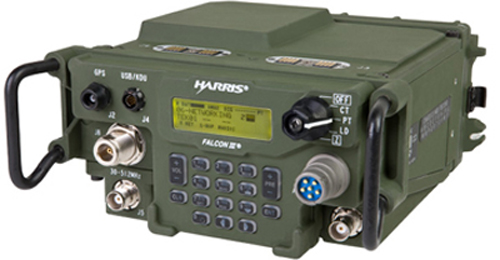
The latest software release for the Falcon III AN/PRC-117G multiband manpack radio system significantly broadens the radio’s network-enabled mission capabilities by introducing a new ‘Sky Mode’, for airborne applications and expanding network support to 30 individual nodes. The new capabilities were added to the Adaptive Wideband Networking Waveform (ANW2), which is currently deployed to Afghanistan in the AN/PRC-117G by various branches of the U.S. Department of Defense.
The software upgrade expands the size of a single wideband tactical radio sub-network to 30 individual nodes. This increase gives tactical commanders greater flexibility in planning and managing their missions on a single, integrated network. The availability of 30-node networks dramatically expands the area of network coverage in the field, providing greater communications range and leading to improved command and control and collaboration.
JTRS SCA compliant AN/PRC-117G tactical radio set employs Harris
According to the company, the ANW2 30-node networking mode is ideal for voice, situational awareness, and short messaging services. For instance, commanders who have real-time information about where their personnel are located become more effective in critical situations, such as fires de-confliction – directing artillery away from friendly forces.
The novel “Sky Mode” is used for airborne applications, allowing key leaders in aircraft to exchange data, including video, with units on the ground while a mission is underway. Sky Mode provides greater range and is optimized for airborne ISR and range extension applications.
“The continued success of the AN/PRC-117G and its robust wideband networking capabilities has allowed us to make these enhancements to the ANW2 waveform,” said Brendan O’Connell, president, Department of Defense business, Harris RF Communications. “These enhancements will deliver more mission flexibility, broader collaboration and enhanced situational awareness to the tactical edge.” O’Connell said the Army is planning to deploy the AN/PRC-117G and the 30-node capabilities of ANW2 at this summer’s Network Integration Evaluation at Fort Bliss.
The House Appropriations Defense Subcommittee (HAC-D) marked up the FY2012 Department of Defense (DoD) Appropriations bill today, providing $530 billion for DoD (excluding Military Construction), almost $9 billion below the president’s request but $17 billion over last year’s level. In addition, the bill contains $119 billion in emergency spending for Defense activities related to the Global War on Terror – $39 billion less than last year due to the drawdown of U.S. forces overseas. The full House Appropriations Committee will vote on the FY2012 DoD appropriations bill on June 14. In total, the bill provides $530 billion in non-emergency funding, an increase of $17 billion over last year’s level and a decrease of $9 billion from the President’s request. “Given the nation’s fiscal crisis, the legislation also targets appropriate savings in areas that will not impair the safety of our troops or the success of our military actions,” House Appropriations Chairman Hal Rogers said.
“Despite being $9 billion below the request, this bill fulfills our obligation to the brave men and women who selflessly serve our country, as well as their families,. My long-standing commitment is that we will not adversely affect any soldier or have an adverse effect on our nation’s readiness.” Subcommittee Chairman C.W. Bill Young said. “While making sensible, rational reductions, we have provided the Department the resources it needs to continue our overseas commitments. It also allows us to continue to modernize and maintain readiness at the levels needed for our military to preserve its standing as the most capable and superior armed forces in the world.” Young added.
Weapon Procurement Cuts
The HAC-D bill would provide $107.6 billion, a $3.5 billion cut from requested procurement programs. Included in the bill’s approved procurement level are funds to build 10 new ships, 32 F-35 (Joint Strike Fighter) and 11 C-130J aircraft, 116 H-60 Blackhawk and 47 Chinook helicopters. The HAC-D bill did not include funding for an F-35 (JSF) alternative engine program. This is contrary to the House-passed FY2012 Defense Authorization bill, which would reopen competition for the engine if DoD asks Congress for more funds because the contractor failed to meet performance goals. Production delays in the Advanced Medium-Range Air-to-Air Missile (AMRAAM) resulted in savings of $435 million and program delays allowed the committee to reduce Enhanced Medium Altitude Reconnaissance and Surveillance System (EMAARS) funding by $524 million.
The continuous support for the development and production of missile defense systems for Israel is sending a strong message of urgency and resolve – according to said Congressman Steve Rothman (D-NJ), the Subcommittee has appropriated $235.7 million in funding for joint U.S.-Israel missile defense programs for the coming year, supporting Arrow 2, Arrow 3, and David’s Sling at record high levels.
$14 Billions for Training Afghans, Fighting Insurgency in Pakistan
The bill contains $119 billion – $841 million above the President’s request and $39 billion below last year – for ongoing military operations in Iraq and Afghanistan. This will provide critical resources for our troops in the field, including funding for personnel requirements, operational needs, and maintenance of facilities and equipment. This also includes $13 billion in funding for the training and equipping of Afghan Security forces, and $1.1 billion for the Pakistan Counter-insurgency Capability Fund (PCCF). However, the bill includes language to withhold 75% of PCCF funds until the Secretary of Defense provides a report to Congress on a strategy and metrics for the use of these funds.
Continued support for Unmanned systems
Funding for research and development in the bill would be $73 billion, $2.3 billion below the request. The committee points out that the bill would fully fund the tanker replacement program and R&D for the Broad Area Maritime Surveillance (BAMS) UAV, the Navy Combat Air Vehicle, and the CH-53K helicopter.
Funding for Operations and Maintenance (O&M) programs would be $780 million below the request, but according to the committee the bill includes funding for “key readiness programs, flight operations, training, maintenance, and base operations.
According to preliminary information released by the committee, the bill funds a 1.6 percent military pay raise proposed by the president and authorized in the House version of the FY2012 Defense Authorization bill. The bill would also provide $32.3 billion for Defense Health programs ($119 million above the request) and $2.3 billion for family support programs.
the bill mandates a number of general reductions that are not expected to affect the safety of success of mission operations. These include $500 million for unjustified supply increases, $400 million for logistic support contract savings, $1.3 billion due to improved economic assumptions, and $1.7 billion in rescissions to prior year programs.
Last week the full House Appropriations Committee approved $14 billion for military construction appropriations ($750 million less than the request) in the Military Construction/Veterans Affairs FY2012 appropriations bill. The HAC-D bill also provides $118.6 billion for Overseas Contingency Operations (OCO) in FY2012, $800 million above the request.
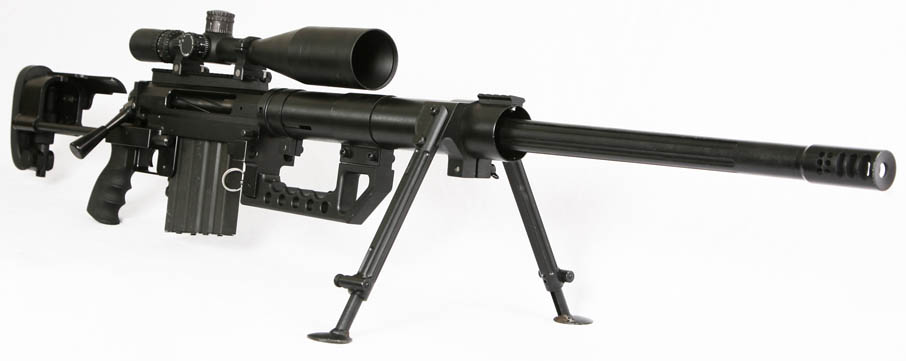
THOR Global Defense Group, has introduced two models of the premier.408 ultra-long range sniper system, the XM408, and M408 (XM408ASA). Military applications of this bolt-action rifle are anti-personnel, anti-sniper and anti-material utilization. The M408 features accuracy improvement offering an overall more stable shooting platform and accurate assembly. Overall, the new weapon offers superior performance and overmatch over .308 or .338 or .338 Lapua Magnum weapons, while offering warfighters a significantly lightweight and more compact alternative to traditional .50 CAL BMG anti-material rifles. An attractive advantage of the .408 caliber is its suitability for long and short range applications, common in urban warfare, where its high penetration does not conflict with the level of over penetration experienced with rifles firing .50 BMG ammunition.
The accuracy of the XM408 is greatly enhanced with its high quality KRIEGER barrel as well as recoil reduction, employing the ASA model substantially reducing recoil, allowing for quicker follow up shots among other system enhancements. Photo: THOR
The accuracy of the XM408 is greatly enhanced with its high quality KRIEGER barrel as well as recoil reduction, employing the ASA model substantially reducing recoil, allowing for quicker follow up shots among other system enhancements.
The rifle is designed to fire .408 Chey-tac bullets weighing 419gr. This ammo is fired through the 30” (76.2 cm) K&P fluted match grade barrel with 1:13 twist rate, developing muzzle velocity of 2900 fps. Effective range is about 1,500 yards.
With stock extended the XM408 length is 54.5” (138 cm), gross weight is 26 lbs (11.79 kg). The rifle loads a magazine of seven cartridges. The XM408 features a CNC & EDM machined 42 Rockwell hardened receiver and bolt, fully adjustable hardened aluminum stock with sliding mechanism and adjustable mono-pod.
The THOR XM408 is designed to fire .408 Chey-tac bullets weighing 419gr. This ammo is fired through the 30” (76.2 cm) K&P fluted match grade barrel with 1:13 twist rate, developing muzzle velocity of 2900 fps. Effective range is about 1,500 yards.
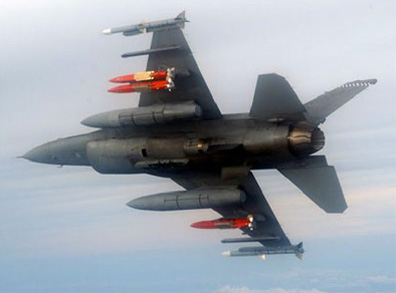
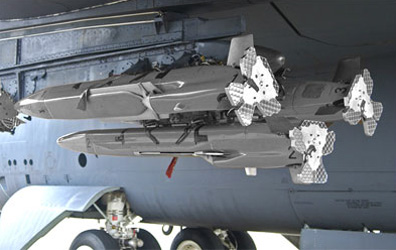
Raytheon Company launched two Miniature Air Launched Decoy instrumented shapes from the ramp of a C-130 Hercules equipped with the new Raytheon-funded MALD Cargo Air Launched System (MCALS). This test marked the first deployment of a MALD airframe from a cargo aircraft. “Dispensing the MALD family of weapons from cargo aircraft gives warfighters an important new capability they currently don’t have in today’s high-threat environment,” explains Harry Schulte, vice president of Raytheon Missile Systems’ Air Warfare Systems product line. “MCALS opens the door for the non-traditional use of a high-capacity aircraft to deliver hundreds of MALDs during a single combat sortie.”
MALD is a state-of-the-art, low-cost flight vehicle that is modular, air-launched and programmable. It weighs less than 300 pounds and has a range of approximately 500 nautical miles (about 575 statute miles). The current MALD family includes both the baseline MALD and a stand-in jammer variant called the MALD-J.
MCALS has a steel, birdcage-like framework body that can hold as many as eight MALDs. MCALS is loaded on a standard cargo pallet, placed on a transport aircraft, and at a pre-determined altitude rapidly ejects the MALDs, which then initiate a standard wing deployment and engine ignition sequence.
“MCALS is another example of the innovative and affordable technologies Raytheon engineers are developing to support the warfighter,” said Bob Francois, vice president of Raytheon Advanced Missiles and Unmanned Systems. The baseline MALD, which is currently in production, protects aircrew and airborne systems by mimicking the signatures and combat flight profiles of U.S. and allied aircraft. The MALD-J protects aircrew and airborne systems by reducing or eliminating the need for manned stand-in jamming aircraft.
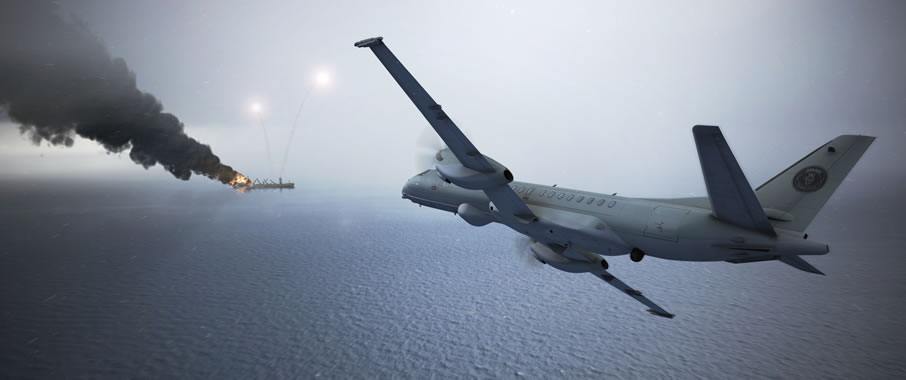
Saab is offering the Saab 2000 Maritime Patrol Aircraft for the Indian Medium Range Maritime Recce (MRMR) Program. Photo: Saab Group
After failing the MMRCA competition, Saab is now aiming at another Indian program Medium range Maritime recce (MRMR). The company is offering the Saab 2000 platform, equipped with a new phased array maritime search radar and RBS-15 missiles.
Saab is offering the Saab 2000 Maritime Patrol Aircraft for the Indian Medium Range Maritime Recce (MRMR) Program. Photo: Saab Group
The aircraft is currently operational in neighboring Pakistan, where it performs the Airborne early Warning and Control role. According to the company, Saab 2000 is an ideal partner for the Indian Navy’s requirement of an aircraft with long range, extended time on station, fast response, long service life and anti surface warfare capabilities.In its MPA role, the aircraft maintains a cruising speed of 350 knots, it can climb to an altitude of 20,000 ft in 10 minutes, reaching operating area 1,000 nautical miles afar within three hours. It can operate from high altitude airfields, taking off with maximum load and fuel even at very hot temperatures. The Saab 2000 MPA can operate at a maximum range exceeding 2,000 nautical miles, with mission endurance exceeding 9.5 hours.
The Saab 2000 MPA can carry out a mission covering a 200 nm Exclusive Economic Zone (EEZ) for 5.5 hours at an altitude of 2,000 ft, or longer patrol times at higher altitudes even up to 31,000 ft.
The Saab 2000 MPA can be equipped with Saab RBS15 anti-ship missile system and its associated Command & Control (C2) system supporting mission planning of missile launching zones, trajectories and target seeking activities.
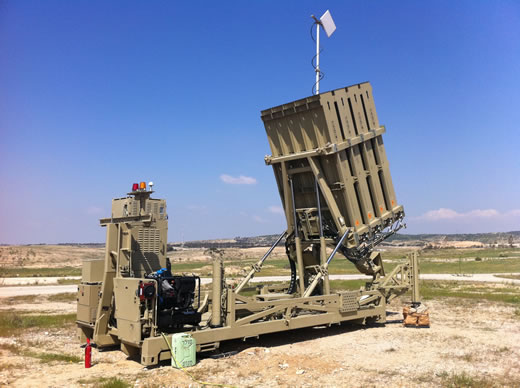
The first Iron Dome anti-rocket system, deployed on itsf first 'operational evaluation' near Beersheva in the Israeli Negev desert. Photo: Noam Eshel, Defense Update.,
The U.S. is funding the production of four more batteries of Iron Dome missile systems, to assist Israel in defending against short-range anti-rocket attacks from Gaza and South Lebanon. According to the director of the U.S. Missile defense Agency, Army Lieutenant General Patrick O’Reilly, speaking to the the US Senate Appropriations Defense subcommittee, the proposed MDA budget includes funding for the procurement of four more batteries.
O’Reilly was referring to fiscal 2011 funding of $203.8 million added last June at the request of President Barack Obama. This funding was first direct US investment in the production phase of the project. Two Iron Dome units are currently deployed in the Southern area of Israel, near the Gaza strip. The combat tested system demonstrated its capability on April 7, 2011 intercepting eight rockets fired at the city of Ashkelon and Ashdod, during a recent series of hostilities between the Palestinians and Israelis. Over 50 rockets were fired at Israel through these engagements, most of them fell outside populated areas. Iron Dome’s battle management system tracked each of the rockets, determining which rocket could pose a threat and which provides low collateral risk that did not justify an intercept. the system also tacked back each of the launching points, assisting IDF suppression attacks.
The Israel Air Force is standing up the third Iron Dome unit, which is expected to become operational by year’s end. Three additional units are scheduled to deploy with the systems by the end of 2012, enabling the IAF to position defensive systems in the northern sector, along the Lebanese border and southern Israel while additionally protecting its air bases from missile and rocket attacks. Rafael is currently modifying the system to be truck mounted, thus becoming more responsive, capable of redeploying quickly between different positions. The truck mounted configuration will be unveiled at the Paris Air Show next month.
After half a century of service, and numerous upgrades, the Israeli air force is finally considering phasing out the Raytheon MIM-23 Hawk surface-to-air missiles, replacing it with with David’s Sling, an air defense missile system being developed in Israel and the U.S., by a joint venture between Raytheon and Rafael Advances Defense Systems. Israel has 17 operational batteries of MIM-23B Improved Hawk missiles. Each battery has three launchers carrying three missiles each. Each David’s Sling launcher holds 16 missiles. The battery also relies on a complex network of target acquisition, tracking and guidance radars. Davis’d sling can be operated with networked, distributed assets, relying on two multi-role phased-array radars and command section, supporting a number of fire units.
According to Israeli news sources, the Israel Air Force is expecting to receive the first elements of a David’s Sling unit in 2012, and deploy the new systems in a phased program in the following years. David Sling is being developed as part of the country’s multi-layered air and missile defense system, comprising the Iron Dome and David’s Sling, designed to intercept short and medium range rockets, and Arrow II and Arrow III, tasked against ballistic missile threats. David’s Sling will also provide secondary air defense capability, alongside the Raytheon MIM-104 Patriot air defense missiles.
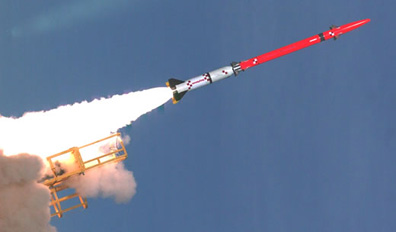
David’s Sling employs the new Stunner interceptor missile developed by Rafael. According to company sources, the Stunner, currently undergoing flight testing, will introduce new capabilities in terms of maneuverability, range and versatility, as it was designed to defeat both air breathing (aircraft/cruise missiles) and maneuvering or ballistic threats (missiles, long range rockets), thus combining high speed, long range and end-game maneuverability. The original requirement of the Israel Ministry of Defense was for a missile capable of defeating ballistic missiles and rockets launched from ranges of 70 – 300 km. Among the missiles falling under this category are the Iranian/Syrian M600, Zelzal, Fajr and Fateh 110, all are deployed with Hezbollah in Lebanon.
In addition to the advanced rocket motor, the missile uses an unique multi-modal seeker providing the missile superior counter-countermeasures, all-weather capability and maintains precision aim-point selection at end-game. The built-in datalink communications enables the missile to receive targeting updates and retasking in flight while the warhead is uniquely designed to destroy the wide target set it was designed to defeat. The Stunner was designed from the baseline to be used as an air/air missile, sized and weighed for internal carriage inside the F-35 weapon’s bay. However, the cooperation agreement between Rafael and Raytheon is yet to cover this application.
The integration of David’s Sling into the nation-wide multi-layered missile defense system represents a departure from current air defense network, whereas the ‘active defense’ component will have to ‘coexist’ with military and civil aviation airspace, rather than control restricted airspaces. To enable such integration, Rafael is developing an integrated command and control center that integrating the ‘air picture’ of friendly and hostile aircraft, threat missile tracks, and feed from the airspace management system, developing full situation control for managing and allocating targets for multiple units, operating different types of missiles (Iron Dome, David’s Sling or other assets). Rafael will demonstrate this new concept and the David’s Sling, at the Paris Air Show next month.
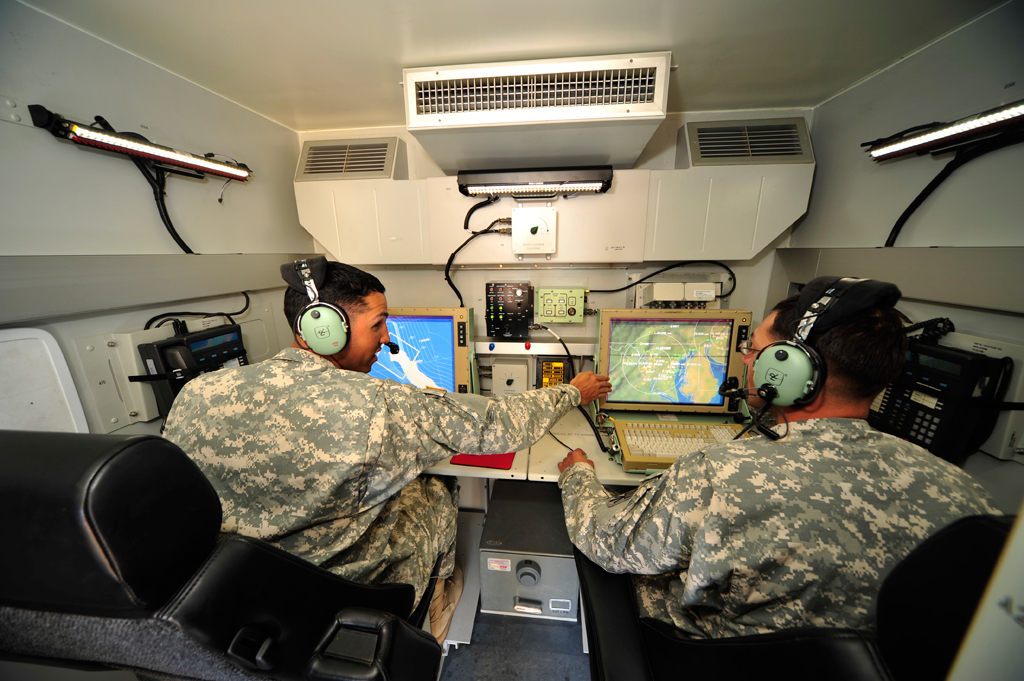
An internal view of the THAAD Tactical Operations Station (TOS), seen during a training exercise of the first THAAD battery at Ft. Bliss. Photo: MDA
The US Army has received the first two Terminal High Altitude Area Defense (THAAD) missiles from Lockheed Martin at the Anniston Defense Munitions Center, May 16, 2011 capping off years of planning and development. Two Army units are currently being equipped with the missile, both are located at Ft. Bliss, TX. the first battery was activated in May 2008 and the second in October 2009, currently undergoing training and certification.
A Terminal High Altitude Area Defense Missile is off-loaded from its transfer truck May 16 by a forklift in Anniston Army Depot's Ammunition Limited Area. The missile is one of the first two THAAD missiles. Photo: Mr Jeremy W Guthrie (AMC)
The THAAD missile is designed to intercept short, medium and intermediate ballistic missiles. The missile uses ‘hit-to-kill’ mechanism to destroy its targets, using kinetic energy developed through impact, rather than the explosion of a warhead in a proximity to the target. This concept has been proven more efficient against missiles, which follow a more predictable trajectory, compared to aircraft and cruise missiles.
ADMC will be responsible for maintaining, shipping and escorting the missiles to their destination. The two missiles have arrived at Anniston Defence Munitions Center of the US Army and will be there until the need arises to ship them to the war-fighter.
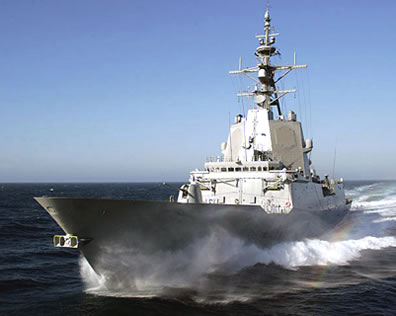
The AWD Project is an important element of Force 2030. The AWD is based on Navantia’s F-100 design, similar to the AEGIS equipped vessels operated by the Spanish Navy.
Facing growing delays in the parallel construction of three Air Warfare Destroyers (AWD) and two Landing Helicopter Dock Ships (LHD), the Australian Ministry of defense and program manager AWD Alliance decided to redistribute the construction work among three Australian shipyards currently involved in the program, and transfer part of the work to the Navantia shipyard in Spain. This move will relieve the pressure from the BAE Systems Shipyard in Melbourne. The new plan will enable the consortium to minimize delay of the completion of the first ship by up to 12 months, and of all three AWDs by up to 12 months.
The Australian Air Warfare Destroyer (AWD) is based on the F100 design from Navantia, operational with the Spanish Navy.
The recent decision follows the relocation of nine steel blocks constructions, from BAE Systems’ Melbourne to the Forgacs Shipyard in Newcastle, Australia. According to Australian Minister for Defence Stephen Smith and the Minister for Defence Materiel Jason Clare announcing the plan today, the construction of 18 steel blocks related to the first two ships will reduce the schedule risk to both this project and to the two LHD ships project currently underway in Australia. Up to 13 steel blocks will be reallocated among the three Australian shipyards in Adelaide, Melbourne and Newcastle. Seven blocks will be for advanced fit out and six for construction. Up to five steel blocks will be reallocated to Navantia in Ferrol, Spain. A decision on the reallocation of blocks on the third AWD will be made later in the project.
The AWD program encountered engineering and construction delays, related to some of the hull blocks. It seems that the delays resulted in the Melbourne BAE Systems shipyard, stretched over two major projects at the same time – constructing steel blocks for the Air Warfare Destroyers and 14 steel blocks for the superstructure of the two 27,500 ton LHD Ships, due to delivery in 2014 and 2015. According to the AWD Alliance, the industry consortium managing the program, these obstacles could push back the delivery of the first AWD ship by two years. Under the new plan, BAE will complete the structural steel and initial outfitting work on the seven steel blocks for the AWD, it is currently working on, as well as all its work on the 14 blocks for the superstructure of the Landing Helicopter Dock Ships and the integration work. The LHD ships were due to be delivered from December 2014.
The AWD Project is an important element of Force 2030. The AWD is based on Navantia’s F-100 design, similar to the AEGIS equipped vessels operated by the Spanish Navy. According to the Australian Defense, when complete, the AWD will be one of the more capable types of warship of its size in the world. Overall, the AWD program involves the construction of 90 separate steel blocks, being built at three Australian shipyards – in Adelaide (ASC), Melbourne (BAE Systems) and Newcastle (Forgacs). Three additional sonar block assemblies are being built in Spain and the United Kingdom. The total cost of the program is estimated at A$8 billion. The AWD Alliance consists of ASC, the Defence Materiel Organisation (DMO) and Raytheon.
The AWD Project is an important element of Force 2030. The AWD is based on Navantia’s F-100 design, similar to the AEGIS equipped vessels operated by the Spanish Navy.
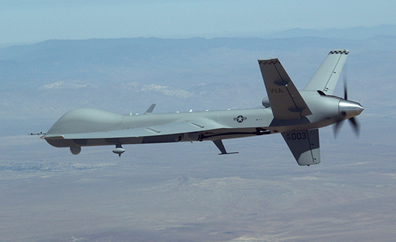
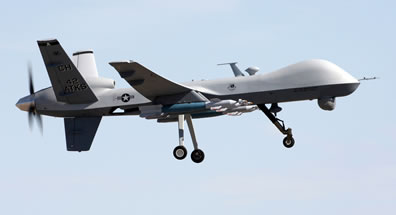
General Atomics and CAE are teaming to offer the Canadian Air Force the Predator B UAS. The aircraft has a maximum gross takeoff weight of 10,500 lb (4,763 kg), is powered by a Honeywell turboprop engine, has a maximum altitude of 50,000 feet (15,240 m'), and can stay aloft for up to 30 hours. Photo: GA-ASI
Unmanned Aircraft Systems (UAS) specialist General Atomics Aeronautical Systems (GA‑ASI) announced yesterday a teaming agreement with one of Canada’s leading defense companies CAE, to offer the Predator B UAS to Canada. GA-ASI and CAE will jointly compete for this program, with GA-ASI serving as the prime contractor supporting a U.S. Foreign Military Sale (FMS) procurement.
An MQ-9 Reaper operating with the 42nd Attack Squadron at Creech AFB takes off on a training mission. Photo: US Air Force
CAE will act as the leading Canadian partner for the team, responsible for assembling a pan-Canadian team of companies to develop and support any Canadian-specific requirements and content for Canada’s national ISTAR capabilities. CAE will also be the Tier-I Canadian subcontractor for GA-ASI, with overall responsibility for In-Service Support (ISS) solution, including operator and mission training systems; integration with Canada’s existing Command, Control, Communications, Computers, Intelligence, Surveillance and Reconnaissance (C4ISR) infrastructure; systems engineering support; and lifecycle and integrated logistics support services.
This Medium/High Altitude Long Endurance (MALE) is ccurrently operational as ‘MQ-9 Reaper’ with the U.S. Air Force and Royal Air Force and as MQ-9 with the Italian Air Force. Canadians forces in Afghanistan are currently supported by IAI Heron I MALE UAS, operated by the MDA Company. Under the program presently referred to as the JUSTAS program, the Canadian Government will establish a requirement to field and support interoperable, network-enabled UASs to provide Intelligence, Surveillance, Target Acquisition, and Reconnaissance (ISTAR) and all-weather precision-strike capabilities in support of its operations worldwide.
“CAE has transformed itself in recent years as much more than a flight simulation company,” said Martin Gagne, CAE’s group president, Military Products, Training and Services. “Our experience and expertise in operational and in-service support, as well as modeling and simulation for both manned and unmanned systems, makes CAE the ideal Canadian partner for GA-ASI, and well-positioned to support the Canadian Government as our country acquires a critical UAS capability.” As part of its expansion plan, CAE has recently joined Force Protection in its bid for the Canadian TAPV program, playing the in-country team leader for the program.
General Atomics and CAE are teaming to offer the Canadian Air Force the Predator B UAS. The aircraft has a maximum gross takeoff weight of 10,500 lb (4,763 kg), is powered by a Honeywell turboprop engine, has a maximum altitude of 50,000 feet (15,240 m'), and can stay aloft for up to 30 hours. Photo: GA-ASI
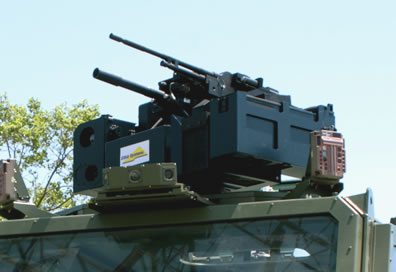
Elbit Systems' Dual Remote Weapon Station (DRWS). Photo: Elbit Systems.
Force Protection Industries is strengthening the international industry team it is leading in bidding for the Canadian TAPV program. The company announced today the addition of Lockheed Martin Canada as the provider of integrated C4ISR systems for the program, and Elbit Systems, to provide the Dual Remote Weapon Station (DRWS). CAE was announced recently as Force Protection’s main Canadian partner with responsibility for providing the in-service support solution. Force Protection is offering the Canadian military variants of the Cougar wheeled armored vehicles to meet TAPV requirements. The Canadian Department of National Defence (DND) expects to award a contract to the final selected bidder by early 2012.
The Cougar is currently operated by the U.S. marine Corps, as well as the British Army. Both servcies are using several variants of the 4x4 and 6x6 vehicles. Photo: MOD
Force Protection Industries is one of several competitors shortlisted to compete for the supply of up to 600 wheeled combat vehicles expected to replace patrol and recce vehicles currently serving the Canadian land forces. Both Elbit Systems and Lockheed Martin Canada will rely on local manufacturing, further contributing to the team’s economic proposition. The DRWS, developed by Elbit Systems Land and C4I, will be produced in Nova Scotia Canada, creating high-tech, high-value jobs in that region. Elbit has already competed in the previous round of the TAPV program, as a member of an international team led by L3.
Elbit Systems' Dual Remote Weapon Station (DRWS). Photo: Elbit Systems.
Lockheed Martin Skunk Works® and XTEND have achieved a major milestone in JADC2 by integrating the XOS operating system with the MDCX™ autonomy platform. This technical breakthrough enables a single operator to simultaneously command multiple drone classes, eliminating the friction of mission handoffs. From "marsupial" drone deployments to operating in GPS-denied environments, explore how this collaboration is abbreviating the data-to-decision timeline and redefining autonomous mission execution.
As traditional defense primes face mounting competition from agile “neoprimes” such as Anduril, Palantir and Helsing, the balance of innovation is shifting toward software-defined warfare and scalable, dual-use technologies, while global industry consolidation—marked by Boeing’s integration of Spirit AeroSystems and other strategic mergers—signals an intensified race to secure control over the defense technology value chain. Our Defense-Tech weekly report highlights these trends.
In early October 2025, a coordinated wave of unmanned aerial system (UAS) incursions—widely attributed to Russia—targeted critical infrastructure across at least ten European nations. The unprecedented campaign exposed the fragility of Europe’s air defenses...
Executive Summary
The past week (September 18-25, 2025) represents an inflection point where strategic defense concepts have transitioned from doctrine to tangible reality. An analysis of global events reveals four primary, interconnected trends shaping an...
At the 2025 Air, Space & Cyber Conference, U.S. Air Force and Space Force leaders unveiled major updates on next-generation fighters, bombers, unmanned systems, and space initiatives, highlighting both rapid innovation and critical readiness challenges as the services race to outpace global competitors. A short version is available here, with a more detailed version for subscribers.
The Taipei Aerospace & Defense Technology Exhibition (TADTE) 2025 crystallized around four dominant strategic themes that collectively illustrate Taiwan's comprehensive approach to defense modernization amid escalating regional tensions. Based on a detailed report by Pleronix (available upon request). Includes a Podcast discussion on TADTE 2025's highlighting Taiwan's four strategic themes beyond the post's coverage.
Israel’s Iron Beam 450 high-power laser system has completed final testing, marking a major leap in air defense. Developed by Rafael, it offers precise, cost-effective interception of rockets, UAVs, and mortars, and is set for IDF deployment by 2025.