Sunday, December 21, 2025
More
    Home Blog Page 373

    Israel Air Force Receives First Strategic UAV from IAI/Malat

    The Israel Air Force (IAF) received this week the medium-altitude, long endurance Heron Unmanned Aerial Vehicle (UAV) system developed and produced by Israel Aerospace Industries (IAI). The Heron UAV (IAF designation “Shoval”) has already been operational with the IAF through since the 2006 conflict in Lebanon, when an IAI owned Heron was employed by joint IAI / IAF teams throughout the conflict. Its performance, endurance, payload capacity and multi-sensor carrying capability introduce new potential for the multi-task usage of UAVs. Heron is the largest and heaviest of the IAF’s UAV fleet, capable of carrying the largest payloads, introducing more flexible payload mix, compared to other UAVs in IAF service.


    The Heron can fly at an altitude of 30,000 feet, and has an endurance of over 40 hours. It can carry and operate a number of payloads and sensors simultaneously. Powered by a quiet engine Heron uses redundant systems, providing very high mission reliability.
    The UAV has a wingspan of 16.6 meters, a maximum takeoff weight of 1200 kg, a mission radius of hundreds of kilometers, and a capability of flying under any weather conditions. The Heron incorporates fully automatic launch, flight and recovery capabilities. During test flights it demonstrated mission endurance of 52 hours with maximum fuel load; on standard missions Heron can perform missions of up to 35 hours endurance, carrying a full assembly of multiple mission payloads.

    The IAF is also expected to field a larger strategic UAV platform known as Heron II in the coming months. The IAF is also evaluate options to provide aerial refueling for long-endurance systems such as Heron and Heron II, utilizing manned or unmanned platforms.

    Thales, BAE Systems to Pursue Battlefield Combat ID Opportunities

    BAE Systems and Thales have formed a teaming arrangement to provide combat identification technologies for ground vehicles. Such capabilities are pursued by NATO forces as well as the US Army and Marine Corps. The U.S. Army is expected to seek proposals later this year.

    The team plans to offer the battlefield target identification (BTID) device that combines a millimeter-wave CID technology developed by Thales. BAE Systems will provide vehicle and network integration services, based on its extensive experience with the US Army. Direct fire elements equipped with the BTID will be fitted with combined interrogators and transponders, while non firing elements will receive transponder-only devices. BTID will be employed prior to firing a direct-fire weapon. The interrogator can “ask” platforms within its field of view to identify themselves, with the transponders replying to identify vehicles as friendly. The system will use digital data link technology that allows real-time position information to be transferred to other platforms and small units, including dismounted forces, and to be seen in the tactical situational awareness picture. / C4ISR, Armor, FCS.

    U-ADD Completes First Test Flight

    Textron Systems Universal Aerial Delivery Dispenser (U-ADD) guided dispenser was flown through a full mission for the first time during a demonstration held by the US Air force UAV Battlelab in October 2006. U-ADD was controlled throughout its flight by the GuideStar flight control system, developed by Athena Technologies. Upon reaching the designated delivery latitude, longitude and altitude position, the guided dispenser deployed a 64-lb BLU-108 Sensor Fuzed submunition. The inert BLU-108 deployed its drogue and main parachute as intended over the target area. As part of a first phase program, Athena provided guidance and control of the U-ADD with its GuideStar 111m – a miniaturized (0.5 pound) integrated flight control and navigation software and hardware solution. A U-ADD Product Improvement activity will be ongoing starting in 2007 with the US Air Force’s UAV Battlelab, Creech AFB, NV.


    BAE Systems Unveil Vehicle Power Management System

    BAE Systems has developed a prototype advanced power management system designed to provide military tactical wheeled vehicles with substantial capacity to generate electric power, addressing a critical warfighter need. When installed in a standard HMMWV the new power system delivers sufficient electricity to operate electronic mission systems on board combat vehicles, including subsystems such as electronic warfare, situational awareness, communications, and vehicle prognostics and diagnostics, eliminating the need to operate dedicated generators to power the mission equipment.

    Using a permanent-magnet generator, the system delivers up to 400 amps of 28-volt DC electric power at low engine speed. Its primary purpose is to provide enough on-board power to operate significant self-defense, weapon, countermeasures, and route-clearing systems. Additionally, it provides power for electrified automotive accessory systems (water pump, engine fans, power steering pump and, in the future, air conditioning) that previously were belt-driven. The system produces 400 of 28-volt DC power across the entire engine operating range, and 30kW of optional 208-volt power at higher engine speeds.

    Elbit Systems Unveils VIPeR a Portable Combat Robot

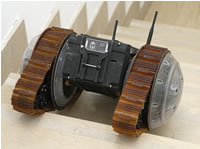
    Elbit Systems Ltd. (NASDAQ: ESLT) introducing at AUSA Winter the Versatile, Intelligent, Portable Robot (VIPeR), the newest member of its unmanned systems family. The new robot is displayed at the company’s booth at the USA Winter Symposium and Exhibition. VIPeR was developed for the Israel Defense Forces (IDF) within the framework of its Portable Unmanned Ground Vehicle (PUGV) program, and in close cooperation with The Israeli Ministry of Defence’s Directorate of Defense R&D (DDR&D). Following operational evaluation, the IDF plans on fielding VIPeR in its infantry platoons.

    VIPeR miniature robot, weighs 11 kg, developed by Elbit Systems. The IPeR in the photo carries a device to counter and dismantle IEDs.

    This portable, lightweight robot is operated by a single operator, and is designed to negotiate obstacles typical of an urban environment, such as climbing stairs and rubbles, when performing surveillance, reconnaissance and support troops in urban warfare missions. The vehicle uses the “Galileo Wheel”, a patented system developed by Galileo Mobility Instruments ltd. that allows automatic back and forth conversion among a wheel configuration, a track configuration and a special stair climbing configuration. (View a video showing the performance of the Galileo robot prototype).

    VIPeR is designed to reduce the danger to the dismounted force during different phases of combat, employing various payloads including weapons, add-on sensors, modules and task oriented payloads. The robotic vehicle weighs 25 lbs (11.4 kg). It measures compact system measures 18″L x 18″W x 9″H (46 x 46 x 23 cm).

    The intelligent, small-signature VIPeR can also be configured with weapons capability comprising a 9 mm mini-Uzi with scope and pointer, or grenade launcher. The system is remotely controlled via a control harness and helmet mounted display. Optional payloads include: P&T, FLIR, observation day/night zoom camera, explosives sniffer, disrupter, 4-foot robotic arm, gripper, in-building mapping and more.

    New Missile to Launch High Precision Strikes From 70 km

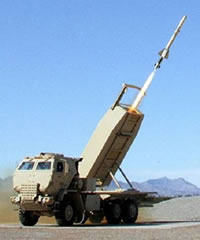
    Lockheed Martin (NYSE:LMT) unveiled a new missile designated P44, designed to demonstrate a long range high precision strike capability. The P44 is designed for quick precision strike against moving surface targets under any battlefield conditions without minimum range limitations. It is designed to fill the gap in the ability to effectively engage and neutralize long-range artillery, particularly mobile rocket launchers. This compact missile (7-inch (17.8 cm) diameter) weighs 220-pound (100 kg)). It will have an effective range from zero to more than 70 kilometers. It will be launched from an MLRS multiple launch platform, such as the tracked MLRSGMLRS or therapidly deployable wheeled HIMARS platforms.

    The missile uses a fast boost-sustain motor, and terminal seeker capable of operating under adverse weather conditions. The projected warheads for P44 are either a 28-pound Hellfire II Metal Augmented Charge (MAC) or a 17-pound shaped charge with precursor. Ten missiles can be loaded into MLRS rocket pods, stored with their wings folded. The missile uses a mature tri-mode terminal seeker with semi-active laser (SAL) for designated targets; Doppler millimeter-wave radar (MMW) for weather penetration and detection of moving targets; and cooled imaging infrared (IIR) for imaging and discrimination, augmented by Global Positioning System -aided inertial guidance (GPS-INS) for mid-course guidance and.

    The P44 missile completed its first flight February 15, 2007 launched from a surrogate HIMARS launcher. Further tests are planned in the near future, demonstrating confirming rocket motor performance, maneuvering and aeroballistics. On April 6th, 2007 P44 made its second test flight last week. In this test Lockheed Martin validated the operation of the missile’s control actuation system and GPS-aided inertial guidance mode for P44. Sofar, the missile successfully demonstrated both boost and sustain operations, stability in cruise mode GPS guidance modes.

    F-22A Begins SDB Weapon Integration Test Flights

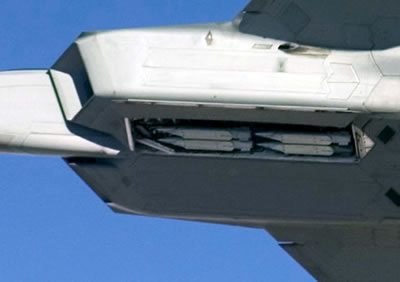
    An F-22A Raptor flies Feb. 2, 2007, with four Small Diameter Bombs on board. Pilots and engineers from the F-22 Combined Test Force were performing load tests to ensure the GBU-39/B Small Diameter Bomb system does not exceed structural load boundaries for the Raptor. (Photo by Darin Russell)

    The US Air Force began integration testing of the F-22A Raptor and the GBU-39/B Small-Diameter Bomb (SDB). Testing is conducted since February 2007 by the 411th Flight Test Squadron at Edwards. The weapon is a low-cost, stand-off, next generation precision strike weapon, capable of flying autonomously. Integrating the F-22’s stealth and speed and the weapon at a stand-off distance of up to 60 nautical miles (111 km). The 250-pound (114 kg) class small-diameter bomb takes target information from the aircraft and flies using an onboard computer after release from the aircraft. Four SDBs and its BRU-61 carriage can be loaded in each weapon bay of the Raptor, enabling the F-22 to carry a total of eight SDB weapons in addition to two AMRAAMs.

    An F-22A Raptor flies Feb. 2, 2007, with four Small Diameter Bombs on board. Pilots and engineers from the F-22 Combined Test Force were performing load tests to ensure the GBU-39/B Small Diameter Bomb system does not exceed structural load boundaries for the Raptor. (Photo by Darin Russell)

    Ethnic Opposition on the rise in Iran

    Two bombings in mid February near Zahedan in southeastern Iran are the latest in a series of high profile incidents involving armed opposition groups based among the country’s ethnic minorities. The most recent attacks again raise questions about the activities of Iranian clandestine groups, seeking a regime change, with, or without US assistance. Zahedan is the capital of Sistan-Baluchistan province, which borders Pakistan and Afghanistan and is home to Iran’s estimated 1-2 million ethnic Sunni Baluchis. The first blast killed at least 11 members of Iran’s Islamic Revolutionary Guards Corps (IRGC) who were travelling in a bus from their housing compound to a nearby military base. A further bombing, followed by sustained clashes between police and an armed group, named Jundallah, a Sunni extremist organisation based among Iran’s Baluch minority. Sistan va Baluchistan straddles the main drug-trafficking route from Afghanistan and Pakistan to Europe and is among the poorest and the most lawless provinces in the country. Many locals resort to drug trafficking and smuggling in order to survive.
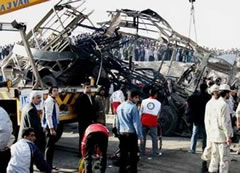
    The Provincial police commander Brigadier General Mohammad Ghafari said a total of 65 suspects had been detained over the Zahedan attack, including three who were believed to have actually carried it out. He renewed Iranian accusations that Jundullah was receiving support from British and US forces in neighboring Afghanistan for its campaign of violence in Sistan-Baluchestan. A man identified as Nasrollah Shanbe Zehi was executed at the site of the attack in Zahedan, after having confessed on Iranian state TV to be involved in the bomb attack.

    The Sunni militant group Jundullah (army of god), operating in Baluchistan seems to be an offshoot of a terrorist network based in Pakistan and is allegedly fighting to establish a unified, independent Baluchistan. Formed in 2003 it is led by Abdul Malik Rigi, who in his mid-twenties, goes by the title ‘Emir Abdul Malik Baluch. In March 2006 members of the group dressed in police uniforms attacked the motorcade of the governor of Zahedan, killing 22 members of his entourage on the spot and abducting 12 more. The governor himself was badly wounded but survived.

    While no definite proof has surfaced over any direct, or indirect involvement of American intelligence agencies in the latest bombing in Zahedan, the US should certainly be interested inflaming ethnic and political opposition inside Iran.

    Analiysts estimate that sectors of the Baluch elite who, like their counterparts among Iran’s Azeri, Kurdish, Arab and other minorities, are considered having potential benefits of aligning themselves with Washington in a future military conflict with Iran. US support for such layers could create an even greater catastrophe than in neighbouring Iraq, where the American-led invasion has triggered an escalating sectarian civil war.

    In fact by his own undoing, President Mahmoud Ahmadinejad is building up the growing ethnic opposition camp against the centralist cleric Shiite rule in Tehran. According to James Woolsey, former director of CIA, a bare majority of Persians rule restive minorities of Arabs, Azeris, Kurds, Baluch, and others. Just as is needed to exploit the resistance to the regime among the younger people, reformers, and women, Washington should also need to pay attention to its geographic and ethnic fissures – for example, a large share of Iran’s oil is located in the restive Arab-populated regions in Iran’s south.

    An Azeri protestor arrested in Iran.Although Iran’s state religion is Shiite Islam and the majority of its population is ethnically Persian, millions of minorities from various ethnic, religious, and linguistic backgrounds also reside in Iran. Among these groups are ethnic Kurds, Baluchis, and Azeris. Many of them face discrimination and live in underdeveloped regions. Though they have held protests in the past, they mostly agitate for greater rights, not greater autonomy. But this could change, if a US sponsored regime change is forseen.

    Roughly one out of every four Iranians is Azeri, making it Iran’s largest ethnic minority at over eighteen million. The Turkic-speaking Azeri community is Shiite and resides mainly in northwest Iran along the border with Azerbaijan.

    The Azeri minority is based predominately in the country’s northwest, what is called the Northern Tier of the Middle East, where Iran shares borders with Turkey and with the South Caucasus states of Azerbaijan and Armenia. The ethnic links between the Azeri of northern Iran and Azerbaijan were long exploited by the Soviet Union during the Cold War, and this vehicle for internal manipulation has been seized upon by CIA paramilitary operatives and US Special Operations units who are training with Azerbaijan forces to form special units capable of operating inside Iran for the purpose of intelligence gathering, direct action, and mobilising indigenous opposition to the Mullahs in Tehran.

    But there are more foreboding signals already in store. Last May, rioting started in the northern Iranian city of Tabriz allegedly sparked off by a state-run newspaper publishing a cartoon depicting a cockroach speaking Azeri. Despite official efforts to stem discontent by punishing the newspaper editors, fighting quickly escalated following the usual strongarm response by Iranian Revolutionary Guard Corps’ anti-riot units and Basij militias against the Azeri protesters. Soon after, Iranian security forces cracked down on tens thousands of offended Azeris, taking to the streets in Tehran and in the major northwestern Iranian cities such as Tabriz, Urumieh, Ardebil, Maragheh, and Zenjan. A massive detention campaign followed, but failed to calm the outrage, which spread like bushfire, with nearly 100 Azeris beeing killed in the town of Sulduz. The Tehran central government, was quick to accuse foreign elements stirring up the unrest, in effort to undermine Tehran’s nuclear program.


    In spite of this and other incidents, leading analysts estimate, that while Iranian Azeris may seek greater cultural rights, few Iranian Azeris sofar display serious separatist tendencies, or serious aspirations toward an all out uprising against the Tehranj Mullah rule. Still, the central government is extremely sensitive over possible changes of attitudes among the Azeris. Last June an attempt to hold rally at Bazz (Babek) Castle in northwestern Iran to commemorate the birthday of the Azeri national hero, Babek, who organized resistance against Arab invaders in the 9th century, prompted an unprecedented wave of arrests among Azeris in a number of Iranian cities.

    Unlike other ethnic groups in Iran such as Sunni Kurds and Khuzestan Arabs, the Azeri Turks are Shiites like the ruling Persians. Having been separated from their kin in Azerbaijan by the 1828 Treaty of Turkmanchai, which gave northern Azerbaijan to Russia, it is interesting to note, that in spite of influential figures in the establishment, even such as Supreme Leader Ayatollah Ali Khamenei, being of Azeri descent, the Tehran mullahs do not hesitate to crack down hard on Azeri- Turkish nationalism. An Azeri secret organisation named Azerbaijan National Awakening Movement (Gamoh), is regarded officially as a subversive element, its leaders often arrested and sometimes even executed without trial.

    The plight of Iranian Azeris is followed closely by their neighboring kin in Azerbaijan and Turkey. However, officially, the Azerbaijani and Turkish governments are extremely cautious not to damage their sensitive relations with the Iranian government. eBut to the north, to the north, in neighbouring Azerbaijan, strange things are happening already. Unofficial reports indicate the US military preparing a base of operations for a massive military presence that could foretell a major land-based campaign designed to infiltrate into Iranian territory when the time is ripe for action. While Secretary of Defence Donald Rumsfeld’s interest in Azerbaijan may have escaped the Western media, Russia and the Caucasus nations understand only too well that the die has been cast regarding Azerbaijan’s role in the upcoming war with Iran.

    Meanwhile, another source of ethnic unrest in Iran is building up among the Kurds. Persisting reports, by news networks, indicate that US intelligence teams, operating with Kurdish groups are training infiltrators to gather information on potential targets inside Iran and encourage armed opposition among the Kurdish minority. A little-known clandestine organization based in the mountains of Iraq’s Kurdish north is already emerging as a serious threat to the Iranian government, allegedly staging cross-border attacks and claiming tens of thousands of supporters among Iran’s 4 million Kurds. Identified as Partiya Jiyana Azad a Kurdistanê (“Party for a Free Life in Kurdistan”), but better known by the local acronym PEJAK or PJAK, is considered to be a splinter group of the PKK, the Kurdistan Workers Party. The group claimed to have killed 24 Iranian soldiers from Iran’s elite Republican Guard in three raids against army bases last year, all staged in retaliation for the killing of 10 Iranian Kurds during a peaceful demonstration in the city of Maku. The present leader of the organisation is Haji Ahmadi. According to intelligence reports, over half the members of PJAK are women, many of them still in their teens. One of the female members of the leadership council goes by the name of Gulistan Dugan, a psychology graduate from the University of Tehran. Analysts claim, that the greater threat to the Tehran regime may come from the group’s underground effort to promote a sense of identity among Iranian Kurds, who make up 7 percent of that country’s population. PEJAK leaders predict that their effort is already spreading quickly among students, intellectuals and businessmen. It is interesting to note that unlike most other rebel groups in the Middle East, PEJAK is secular and Western-oriented. However, the group’s leaders insist that while they have had sofar no contact with the United States, they would be willing to work with Europe or America against the Tehran government.

    Another source of unrest seems to be flaring up in a remote area of Iran, where central official control is faltering. Last month and armed revolt instigated by Bakhtiari, Lor and Ghashghai tribes comprising over three million, against the Islamic Regime was reported by clandestine news networks. There were claims of freedom seeking tribal fighters in the Isfahan and surrounding provinces which began fighting local Islamic Regime forces in an attempt to free their villages from the Islamic Regime’s control. According to these reports, the Semirom area, some 590km from Tehran, which is on the Ghashghai tribal migrations route, apparently saw heavy fighting occurred in between Isfahan Province and Yassooj further south, which is the center of the Boyer-Ahmadi tribal territory. Local fighters from the various tribes, confronted Islamic Regime paramilitary forces – the IRGC (Islamic Revolutionary Guard Corps) and the Bassij . The heaviest fighting took place apparently at a point around Yassooj and in the Province of Fars which was labeled the Red Line which was not to be crossed by the central Regime forces.
    Much of the unrest is said to stem from the Islamic Regime’s on-going efforts to disarm the tribes and put religious leaders in charge of them instead of their traditional Khans. The rough and difficult mountainous terrain, which severely limits mobile forces and the stiff resistance put up by the tribes, have prevented government militias from penetrating into Bakhtiari and Ghashghai tribal areas The tribe leaders hope, perhaps somewhat premature, that their uprising will spread south to Shiraz and Masjid Soleiman in the Khuzestan oil province ( link to our story) and even become a national uprising across the country.


    Australia Launch A$6 Billion Super Hornet Acquisition

    Australia decided to acquire 24 F/A-18F Block II Super Hornet multi role aircraft to close a potential air combat capability gap that could have opened in 2010, when current F-111 are retired and 2015, when JSF fighters are expected to be fully operational in Australia. A dozen Super Hornets will be delivered starting in 2009. The remaining twelve will be delivered in 2011. Full Operational Capability is expected to be achieved by the end of 2012, including full indigenous training, EW support, logistics and full deployment capability.

    The Australian government will not divert money from JSF or other defense programs, but support this acquisition by a special supplemental funding. The projected spending will amount to approximately A$6 billion over 10 years, including the aircraft acquisition cost, training and logistical support. While stressing full support for the JSF program, the Australian MOD explained its decision by ‘eliminating the risk to air combat and strike capability during the transition to the JSF’. Current planning is for Australia to acquire its first JSF in 2013, pending on final Australian government approval expected in 2008. Will Australia keep these Super Hornets or acquire a fourth JSF squadron, thus streamlining its Air Force fleet? A final decision will be made during the next decade.

    Korea Unveils Main Battle Tank to Competing for Turkish Program

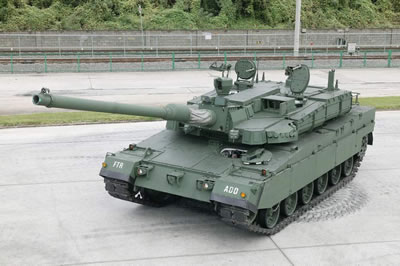
    The Republic of Korea is planning to field new XK2 tanks in 2011, gradually replacing the K1 tanks current in service. ADD is one of two finalists competing for a Turkish main battle tank acquisition tender, where it is competing against a version of the French Leclerc tank offered by GIAT. Given traditionally stressed relations between Turkey and France, Korea’s chances to win the program are considerably high. Turkey plans to select one of its domestic companies to lead the next-generation tank project in the spring of 2007. According to ADD officials, as the tank enters production in 2009, it is expected to cost about 8.3 billion won (US$7.9 million) a piece.

    The new Korean tank was unveiled by the Korean Agency for Defense Development (ADD) last week. The development of the new tank began in 1995. About 240 billion won ($230 million) have been invested in the program so far. The 55-tons tank is armed with a smoothbore 120mm 52 caliber gun, and an autoloader. It has a road speed of 70 km/h and can cross water obstacles up to 4.1 meter in depth. The tank is equipped with advanced optroncis, communications and command and control systems.

    (Check original Image here)

    France to Deploy Broadband Tactical Wireless Access to Defense Intranet

    The French Army is planning to employ commercial-based WiMAX system to support high capacity wireless data communications (broadband connectivity) in support of deployed forces. The system will support the transfer of classified information up to the ‘restricted’ level, thus allowing direct access from the field level to INTRADEF, the Intranet of the French Ministry of Defence.

    The first implementation of this technology is scheduled for testing by late summer 2007, to be followed by deployment of initial cells, each covering about 15km x 15km area, supporting 440 terminals. A total acquisition of up to 30 cells is planned.

    The system is being developed under a EUR 12.5 million contract signed between the French Army central materiel directorate, DCMAT and a team formed between EADS Defence and Communications Systems (DCS) Business Unit – and TDF.

    Market for Over 7,600 New Tanks is Expected in the Next Decade

    The tank is not dead. In its annual analysis “The Market for Tanks,” the Forecast International (FI) Weapons Group projects that the international market will produce over 7,600 new main battle tanks, worth in excess of $31.5 billion, through 2016. Significant spending is also directed to retrofits and upgrades.

    According to FI analyst Dean Lockwood, “in 2006, U.S. Department of Defense contract awards for the maintenance, RESET, and upgrade of the existing M1 Abrams inventories carried a total value in excess of $2.514 billion, equivalent to a staggering 79% of the total value of all new-production main battle tanks entering the international market in 2006 (nearly $3.176 billion).


    The expense associated with the modernization and retrofit of high-end main battle tanks pales in comparison with the prospect of new tank procurement. Thus, FI believes new production of high-end tanks will remain relatively low, accounting for 13.96 percent of all production, worth 20.14 percent of the market, through the forecast period. In terms of sheer numbers, Forecast believes Pakistan’s Al Khalid, the Type 98 of the People’s Republic of China, and the Russian Federation’s T-90 will maintain their combined market share, accounting for 44.96 percent of all new tanks rolling out worldwide, worth 39.86 percent of the market, through 2016.

    Last year, the Chinese Type 98 program maintained its position as the single largest new-production program. Yet, with a total value of $375.32 million (for 110 new-production tanks), the Type 98 program was worth less than 15 percent what the U.S. DoD spent on the M1 Abrams in 2006. In the international market for main battle tanks, the days of U.S. and European domination of new production appear to be long gone. Nevertheless, the established U.S. and European players continue to make their presence felt. The 120mm Reinmetall 120 smoothbore ordnance, the state-of-the-art Leopard 2, and the combat-proven M1A1/A2 Abrams continue to set the standard for main battle tank design worldwide.

    Bobcat Based EOD Robot Sees First Action in Gaza

    Autonomous Solutions, Inc., (ASI), a designer and manufacturer of unmanned vehicle systems, software, and components for industrial and military clients, today announced that their Scorpion Explosive Ordinance Disposal (EOD) robotic platform was recently used by the Israeli Police in its first combat mission. ASI supplied six Scorpions to the Israeli Police last year.

    The Israeli police recently employed its newly acquired Scorpion EOD robots in a combat mission. According to the manufacturer, Utah based Autonomous Solutions, Inc., (ASI), the Scorpion was employed in a recent mission in Gaza, where it was used to remove a large steel cage where a canister of C4 explosives was hidden under an innocent looking load of agricultural goods. The canister was detected during a routine port security x-ray scan. The Scorpion’s gripper attached to the unit’s excavator arm was used to cut open the targeted cage bars, constructed of tube steel, allowing a smaller robotic arm to remove the C4 canister and safely dispose of it. Scorpion is a Bobcat mini-excavator converted for remote-control operations and outfitted with ASI’s robotic command and control system. The Israeli Police have been training with the ASI’s systems since June 2006 and recently deployed them for active duty. The Scorpion’s size, strength, and its ability to cut through steel introduces new capabilities which are changing the way the Israeli Police plan and execute their explosive ordnance disposal operations.

    Plasan Sasa Unveils Blast and Mine Protection System

    Plasan Sasa, an Israeli expert in armor protection, is introducing at the AUSA Winter symposium at Ft. Lauderdale this week its blast and mine protection system designed to reduce damage and injury from land mines and ground charges.

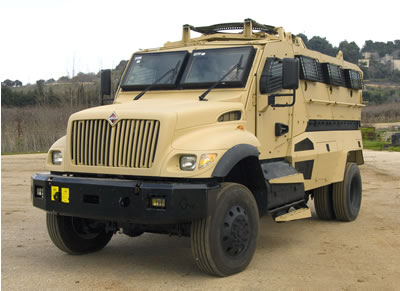
    The MaxxPro design positions the v-shaped crew compartment on top of International’s proven heavy-duty truck chassis. The v-shaped hull is designed to deflect blasts away from the truck to minimize impact around the crew area.


    Plasan is introducing a multi-stage system including various design concepts and materials designed to mitigate the damage from blast and fragmentation. These measures include the creation of a buffer between the floor and the vehicle’s armor, the attachment of flooring to the vehicle’s body in order to disperse blast effects, a shock-absorbent foam floor, a patented collapsible seat, and a Suspended Mine Blast Resistant Seat (patent pending) that isolates the seat occupant from direct shockwaves. These designs have been extensively tested in the US and Israel – both in testing facilities and in actual conflict situations – and has significantly increased the survivability of vehicle occupants.

    The armor suite was recently implemented in the MaxxPro model Mine Resistant Ambush Protected (MRAP) vehicle developed by International Trucks for the USMC MRAP program. In January 29 International was awarded an initial contract to supply four test vehicles for the USMC MRAP program. A first view of the MRAP Category I vehicle was released by Plasan Sasa, the team’s Israeli armor designer. International plans to assemble the armor kits at its armor integration center in Mississippi. By February 2008 International is expected to deliver close to 2,000 MaxxPro MRAPs under a US Marine Corps contract worth over one billion US$.

    With specialization covering four of today’s major ballistic technologies – Metal Composite Armor, Composite Ceramic Armor, high performance Polyethylene armor and SMART, Plasan offers a unique expertise in the armor industry. Its SMART modular matrix based armor is used in various solutions including personal protection and vehicle platforms. This lightweight armor is made of ceramic segments that allow optimal protection, including three dimensional curved shapes, enhancing crew survivability, improving multi-hit performance and weather sealing, and enabling comfort and agility.

    Skunk Works and XTEND Simplify Multi-Drone Command

    0
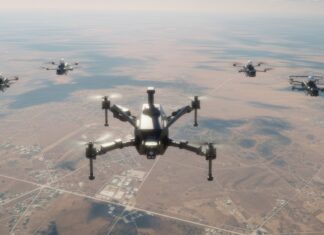
    Lockheed Martin Skunk Works® and XTEND have achieved a major milestone in JADC2 by integrating the XOS operating system with the MDCX™ autonomy platform. This technical breakthrough enables a single operator to simultaneously command multiple drone classes, eliminating the friction of mission handoffs. From "marsupial" drone deployments to operating in GPS-denied environments, explore how this collaboration is abbreviating the data-to-decision timeline and redefining autonomous mission execution.

    From Ukraine to Taiwan: The Global Race to Dominate the New Defense Tech Frontier

    0
    As traditional defense primes face mounting competition from agile “neoprimes” such as Anduril, Palantir and Helsing, the balance of innovation is shifting toward software-defined warfare and scalable, dual-use technologies, while global industry consolidation—marked by Boeing’s integration of Spirit AeroSystems and other strategic mergers—signals an intensified race to secure control over the defense technology value chain. Our Defense-Tech weekly report highlights these trends.

    Europe’s “Drone Wall”

    0
    In early October 2025, a coordinated wave of unmanned aerial system (UAS) incursions—widely attributed to Russia—targeted critical infrastructure across at least ten European nations. The unprecedented campaign exposed the fragility of Europe’s air defenses...

    Weekly Defense Update & Global Security Assessment

    0
    Executive Summary The past week (September 18-25, 2025) represents an inflection point where strategic defense concepts have transitioned from doctrine to tangible reality. An analysis of global events reveals four primary, interconnected trends shaping an...

    U.S. Air and Space Forces Push Next-Gen Programs at the AS&C 2025 Conference and...

    0
    At the 2025 Air, Space & Cyber Conference, U.S. Air Force and Space Force leaders unveiled major updates on next-generation fighters, bombers, unmanned systems, and space initiatives, highlighting both rapid innovation and critical readiness challenges as the services race to outpace global competitors. A short version is available here, with a more detailed version for subscribers.

    TADTE 2025: Reflecting Taiwan’s Strategic Themes

    0
    The Taipei Aerospace & Defense Technology Exhibition (TADTE) 2025 crystallized around four dominant strategic themes that collectively illustrate Taiwan's comprehensive approach to defense modernization amid escalating regional tensions. Based on a detailed report by Pleronix (available upon request). Includes a Podcast discussion on TADTE 2025's highlighting Taiwan's four strategic themes beyond the post's coverage.

    Iron Beam 450 Completes Testing, Soon to Join With Operational Air Defense Units

    0
    Israel’s Iron Beam 450 high-power laser system has completed final testing, marking a major leap in air defense. Developed by Rafael, it offers precise, cost-effective interception of rockets, UAVs, and mortars, and is set for IDF deployment by 2025.