
“Since BAE Systems purchased a major share in the company in 2004, Land Systems South Africa’s annual turnover has quadrupled from 300 million Rand (US$40.6 million) to over 1.2 billion Rand ($120 million) in 2006.” said Johan Steyn, managing director of BAE Systems Land Systems South Africa. New contracts from the US Army and Sweden have helped BAE Systems Land Systems OMC achieve record growth. During the past two years the company has recorded international sales worth 900 million Rand ($121 million), for its mine protected armored and peacekeeping vehicles. The company won two major export contracts for 267 vehicles worth more than 630 million Rand ($85.3 million) including $63 million (453 million Rand) order for 169 RG31 Mk5s and an a follow-on order for 98 RG32M vehicles received from Sweden, worth €21 million ($27.5 million / 196 million Rand), following an initial order for 102 vehicles received from Sweden in 2005.
Through BAE Systems’ re-investment, Land Systems South Africa has strengthened its capacity and capabilities for both local and international customers, expanded its under-roof factory space at the Benoni plant by 20 percent, upgraded facilities, installed new machines at its Gear Ratio plant in Alrode and created about 200 jobs.
South African OMC Quadruples Turnover After BAE Systems’ Acquisition
Industry Groups Urge for Revision in US Export Control System
Export control systems should be modernized to improve performance and competitiveness in the world defense markets by implementing a modern system that will be more efficient, predictable and transparent. In an open letter to President George W. Bush, the newly formed Coalition for Security and Competitiveness outlined several proposals to modernize the export regulation process.
The coalition recommended the implementation of more efficient export control regulatory management, by identifying and safeguarding the sensitive and militarily critical technologies essential for US defense, facilitating defense trade and technological exchange with allies and trusted partners, promote greater multilateral cooperation on mutually agreed export control.
According to the letter, these proposals can be implemented by the Executive Branch under existing statutory authorities. “Security and competitiveness go hand in hand,” said National Association of Manufacturers President and CEO John Engler, “The international marketplace is changing rapidly with new competitors emerging in both developed and transitioning economies. We need a modern export control system that recognizes this new environment and enables U.S. companies to compete and continue their technological leadership.” Said Engler.
The current system regulating the export of defense and “dual-use” items (i.e., those with both civil and military application) is administered by the U.S. Departments of State and Commerce, respectively, but often involves other federal agencies. The Commerce Department processes more than 18,000 authorizations per year. The State Department processes more than 65,000 licenses each year, a figure that has been increasing about 8 percent annually. Some cases take months to process, causing a detrimental impact on allies, trading partners, and exporters in general. Last year, the State Department had a 10,000-case backlog that is still being whittled down. Among the coalition’s recommendations to improve the current system, while maintaining effective controls on sensitive items, are hiring additional licensing and agreements officers to ease processing delays and developing new types of authorizations for exports.
Tank Crews will be able to ‘Check Six” with new Rear View Camera
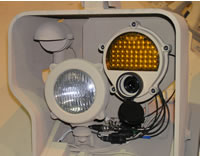
US Army tank crews will soon be able to ‘watch their back’ using new rear-view cameras to be delivered by BAE Systems. The Driver’s Rear View Camera (DRVC) system uses a thermal imager to monitor the area behind the tank day, night and through dust and smoke. The system is part of the U.S. Army’s Abrams Tank Urban Survivability Kit, fits into taillight housings common to more than 200,000 military vehicles. General Dynamics awarded BAE Systems $950,000 contract to integrate and test the system in preparation for an expected initial production contract for 505 systems.
The DRVC system is derived from BAE Systems’ Check-6 infrared situational awareness capability. The camera is contained completely within the taillight housing and can be readily installed on most current and future U.S. Army vehicles with no drilling or welding. The Army is targeting the system initially for the M1 Abrams Main Battle Tank. DRVC also will fit other vehicle types within the Army’s Heavy Brigade Combat Team, including the Bradley Combat Systems, the M113, M88, and M109.
US Army to Enhance Cerberus Security Sensor Towers
ICx New Heights, a business unit of ICx Technologies, has been awarded a contract by the United States Army to develop short-, mid- and long-range security sensor platforms based on the Army’s Cerberus unmanned mobile security towers.
These towers will be equipped with additional sensor and surveillance systems, including a security operating system to monitor and control sensors, imagers and power systems both on the tower and dispersed remotely over a wide spectrum of ranges. The Cerberus platforms will also be equipped with alternative power options and enhanced resistance to harsh external environments. Cerberus provides a fully customizable mobile sensor tower suitable for rapid deployment wherever unmanned surveillance or communication is required.
Australia Launch A$6 Billion Super Hornet Acquisition
Australia decided to acquire 24 F/A-18F Block II Super Hornet multi role aircraft to close a potential air combat capability gap that could have opened in 2010, when current F-111 are retired and 2015, when JSF fighters are expected to be fully operational in Australia. A dozen Super Hornets will be delivered starting in 2009. The remaining twelve will be delivered in 2011. Full Operational Capability is expected to be achieved by the end of 2012, including full indigenous training, EW support, logistics and full deployment capability.
The Australian government will not divert money from JSF or other defense programs, but support this acquisition by a special supplemental funding. The projected spending will amount to approximately A$6 billion over 10 years, including the aircraft acquisition cost, training and logistical support. While stressing full support for the JSF program, the Australian MOD explained its decision by ‘eliminating the risk to air combat and strike capability during the transition to the JSF’. Current planning is for Australia to acquire its first JSF in 2013, pending on final Australian government approval expected in 2008. Will Australia keep these Super Hornets or acquire a fourth JSF squadron, thus streamlining its Air Force fleet? A final decision will be made during the next decade.
Weaponizing Unmanned Combat Helicopters
Developers of VTOL UAVS are looking beyond 2.75″ rockets, designing their vertiflight platforms as flying remotely controlled weapon stations. The concept is to keep the warfighter out of harms way and let the machines take all the risk. Ultimately, such system could provide expeditionary forces and front line warfighter with a portable compact attack helicopter. The unmanned helicopter will provide the ability to approach the target at high speed, from any direction and deliver a contained lethal salvo into the specific target, regardless of elevation or how well it is defended from ground approach. This is especially important as today’s conflicts waged at urban settings.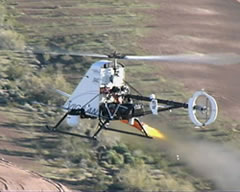
An example of such system is the Tactical Aerospace Group (TAG) is introducing recoilless weapons package for their aircraft as part of ongoing UCAV weaponization programs, integrating a new recoilless technology developed by Recoilless Technologies International of Australia. Initially, the new mounts will be built to carry 7.62mm machine guns, but future versions will be designed for different calibers, including grenade launchers.
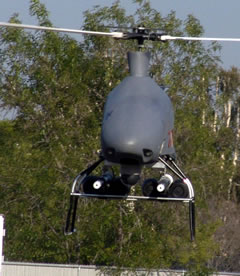 Another weapon recently demonstrated in live firing is the Metal-Storm 40mm weapon system which flew on the DP-5X prototype Vertical Take Off and Landing (VTOL) Unmanned Aerial Vehicle last autumn (2006). This weapon is optimized for UAV applications, by its inherent high firepower to weight ratio resulting in a lighter weapon with greater firepower, compared to other weapons. During recent tests the vehicle fired the lightweight electronic weapon from hovering position and through forward speed flights, performing “strafing” runs. The Metal Storm technology offers several advantages for arming UAVs, specifically for the smaller UAVs where payload weights and weapon size and shape are critical design factors, impacting on the mission endurance and payload capacity remaining for mission critical avionics. The electronic operation and low recoil generated by the Metal Storm launcher offers inherent weight advantages.
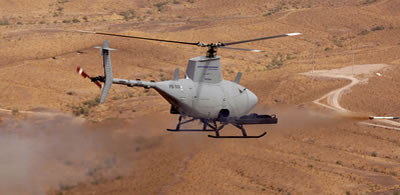
Northrop Grumman is developing the Fire Scout (MQ-8B) as a Vertical Takeoff UAV (VTUAV), operable on land or from surface vessels. The US Navy is acquiring the MQ-8B Fire Scout UAV to fulfill the service’s requirement for a tactical UAV capable of operating in the shipboard environment. With vehicle endurance greater than six hours, Fire Scout will be capable of continuous operations providing coverage over 110 nautical miles from the launch site. A baseline payload that includes electro-optical/infrared sensors and a laser designator, enables Fire Scout to perform different roles. These include finding tactical targets, tracking and designating these accurately, providing targeting data to strike platforms and perform battle damage assessment. FireScout was also selected for the US Army FCS Class IV UAV, offering future units of action a flexible, weaponized ISR and attack platform.
Read additional parts of this article:
- Smart Weapons for UAVs
- Weaponized UAVs
- Smart Weapons for UAVs
- Evolution of UAV Employed Missiles
- Lightweight Weapons for Autonomous Platforms
- Gravity Dropped Munitions for UAVs
- Targeting at the pixel
- Loitering Autonomous Weapons
- Grouping in Constellations
- Empowered by the Swarm
- Weaponizing Unmanned Combat Helicopters
Empowered by the Swarm
In the future, small UAVs could be programmed to adapt natural flock and swarm operational concepts, such as used by bees and hornets. Flocks of such small unmanned aerial vehicles (UAVs) are already helping engineers to develop smart swarming strategies for larger autonomous surveillance aircraft. Jonathan How, at the MIT is one of the pioneers in this new field, focusing on persistent surveillance. His team is working in collaboration with Boeing’s Phantom Works.
As an example of how such UAVs could perform, How says a swarm of surveillance UAVs could keep watch over a convoy, taking turns to land on one of the trucks for refueling. Working together as a team, they will ensure complete surveillance of the area around the convoy. Other applications include indoor surveillance. In recent tests up to five radio-controlled helicopters are being used to collaboratively track small ground vehicles and land on the back of small moving platforms.
A different approach is the Wolfpack ‘cooperative hunters’ concept, where a swarm of UAVs tasked with missions such as searching after one or more “smart targets”, moving in a predefined area while trying to avoid detection. By arranging themselves into an efficient flight configuration, the UAVs optimize their combined sensing thus capable of searching larger territories than a group of uncooperative UAVs. Swarm control algorithms can optimize flying patterns over familiar terrain and introduce fault tolerance to improve coverage of unfamiliar and difficult terrain.
Since the early 2000’s the US Navy is developing and testing swarm operating techniques for future UAVs. The Smart Warfighting Array of Reconfigurable Modules (SWARM) UAV project at the Naval Surface Warfare Center has already assembled a fleet of 10 small UAVs built by Advanced Ceramics Research (ACR), Tuscon, AZ. These ‘networked’ UAVs are designed to operate in a cooperative fashion, functioning together as a UAV ‘swarm’. They can communicate relevant information and reconfigure themselves, autonomously changing direction in response to sensor input to achieve the mission at hand. In 2003, some of these UAVs renamed Silver Fox” were deployed to Iraq to support USMC units in the field. In 2005 the navy awarded Alion Science & Technology Corp of Chicago a US$20 million contract to further develop an intelligent control system for swarming unmanned vehicles to demonstrate autonomous operations and cooperative behavior for persistent surveillance.
Read additional parts of this article:
- Smart Weapons for UAVs
- Weaponized UAVs
- Smart Weapons for UAVs
- Evolution of UAV Employed Missiles
- Lightweight Weapons for Autonomous Platforms
- Gravity Dropped Munitions for UAVs
- Targeting at the pixel
- Loitering Autonomous Weapons
- Grouping in Constellations
- Empowered by the Swarm
- Weaponizing Unmanned Combat Helicopters
Grouping in Constellations
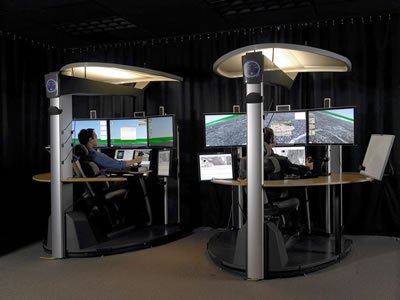
When employed in constellations of coordinated and interconnected multiple vehicles, UAVs offer much improved efficiency compared to current systems concept of operation. Multiple tasks can be dynamically allocated between the constellation’s platforms, assigning the most suitable sensor for every user and target; furthermore, several sensors can be harnessed to focus on a single, high priority target, ensuring continuous coverage under all visibility conditions, viewing the target from different angles and altitudes. The constellation also offers inherent redundancy, automatically arranging to back-up any sensor which fails, due to logistical (return to base), technical or operational circumstances (shot down). Such constellations are even more critical for weapons employment, since the position of each weapon carrying platform can be dynamically computed to ensure that any ‘time critical target’ within the area under surveillance could be engaged within the required response time by one or more weapons.
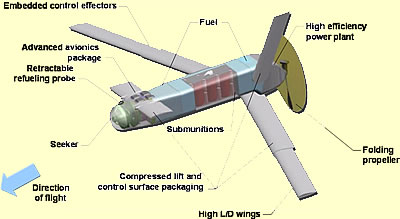
Other area domination concepts, currently under development consider the deployment of persistent constellations of network-centric intelligent munitions. Each micro-platform will be fitted with a weapon datalink, feeding real-time video and Laser Detection and Ranging (LADAR) imagery, area surveillance and targeting and real-time Battle Damage Assessment (BDA) from the battlefield, over the Global Information Grid (GIG) to forward command and control centers. Unlike LOCAAS, these vehicles will be designed for multi-kill capability, and operate over open area as well as urban environment. Further evolved systems expected to be fielded toward 2030 will be optimized as layered systems, offering Total Urban Dominance Layered Systems (TUDLS) integrating various systems operating at different altitudes to dominate the vertical dimension denying enemy operations in all environments. These systems will be equipped with compact, directional and focused lethality warheads, featuring variable yield and advanced energetics, with sensors capable of locating camouflaged targets in cluttered terrain (urban) reducing collateral damage and minimizing risk to friendly forces.
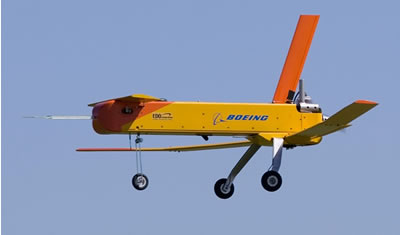
Persistent UAV constellation currently evaluated by the US Air Force is developed by Boeing, using low-cost expendable system called Dominator. It is designed for deployment from stealth bombers and fighters (such as the B2 or F-22), at the starting phase of a conflict, to dominate key battlefield areas with persistent unmanned, highly autonomous yet fully controllable constellation of aerial sensors, weapons and support elements.
The system will provide the air force with persistent battlefield presence, maintaining offensive capability against time sensitive targets and mobile targets in more immediate form. It enables target tracking and requires ‘permission to attack’ in an accelerated fashion. The program is evaluating various options for carriage, and fast aerial release of Dominators. The first flight of the Persistent Munition Technology Demonstrator (PMTD), a testbed for future unmanned air-domination vehicles was made in April 2006. The 60 pound vehicle has a wingspan of 12 feet was used to demonstrate the autonomous flight capabilities. Future tests will include sensor integration and enhanced weapon terminal guidance demonstrations as well as possible in-flight refueling and munitions dispensing.
Read additional parts of this article:
- Smart Weapons for UAVs
- Weaponized UAVs
- Smart Weapons for UAVs
- Evolution of UAV Employed Missiles
- Lightweight Weapons for Autonomous Platforms
- Gravity Dropped Munitions for UAVs
- Targeting at the pixel
- Loitering Autonomous Weapons
- Grouping in Constellations
- Empowered by the Swarm
- Weaponizing Unmanned Combat Helicopters
Loitering Autonomous Weapons
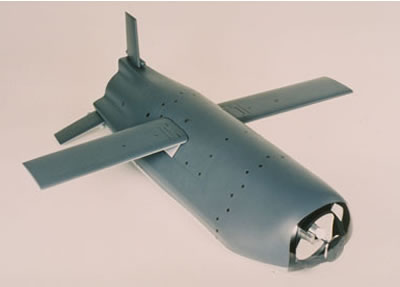
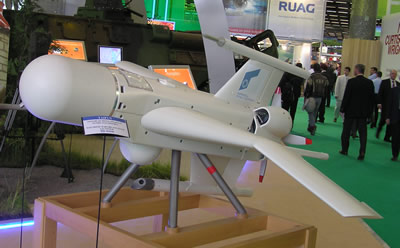
The theory of aerial dominating weapons is not new, but sofar its implementation remained limited by current technology to few, specific contingencies, such as the Suppression of Enemy Air Defense (SEAD), where targets could be clearly identified and pursued with radar homing weapons. Israel pioneered this field with the Harpy loitering SEAD weapon, developed by Israel Aerospace Industries. The system has been acquired by several countries including China, Turkey, South Korea and India. IMI is demonstrating a similar multipurpose warhead for their Delilah air launched missile, yet this weapon is quite large for conventional UAVs. A follow-on to Harpy, known as Cutlass was developed under a US-Israeli cooperation. While the program has not been officially concluded, Israel is known to have offered advanced Harpy systems to several customers, including the UK, where it was proposed as “White Hawk”, for the British Loitering Munition Capability Demonstration (LMCD) under cooperation with MBDA. Another Israeli company – RAFAEL – competed for the same program, offering the BLADE (Battlefield Loitering Artillery Direct Effect), based on a modified Sparrow M UAV designed and produced by EMIT.
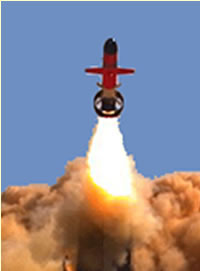 A different concept, developed for the US Army pursued area domination, by a combination of several types loitering Non-Line-of-Sight (NLOS) missiles. The original concept included ‘smart’ loitering weapons, which would provide area surveillance, target acquisition and pursuit of time critical attack, while other targets would be engaged by precision attack missiles (PAM), fitted with imaging infrared seekers. But this concept proved too costly and complex. The Army eliminated the loitering missile-sensor element, deploying the NLOS launch system with the PAM, provided as a weapon repository ready to support combat units, targeted by assets available to the unit over the network.
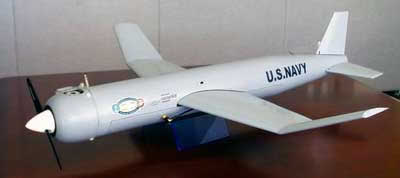
Various types of air domination systems are considered by the US Air Force, enabling a military force to dominate an area from the air for extended periods, denying enemy movements and maneuvering. Current systems considered for these tasks are standard weaponized UAVs, or small expendable loitering weapons, fitted with imaging sensors, such as the powered Low Cost Autonomous Attack System (LOCAAS). Operating in swarms of ‘intelligent munitions’ weapons, such as the LOCAAS can autonomously search for and destroy, aiming for critical mobile targets over a wide combat area. Recent enhancements of the LOCAAS concept introduced ‘man in the loop’ functionality enabling re-targeting as well as the ability to abort attack by a human controller when required. Further enhancements could integrate the LOCAAS into a Surveilling Miniature Attack Cruise Missile (SMACM) ‘mothership’ carrying four LOCAAS units. The mothership will be able to support thee units with targeting, surveillance and communications support, extending the range and persistence of the basic version beyond 250 nautical miles. LOCAAS and SMACM are designed to operate in open area, pursuing stationary and mobile targets of opportunities as soon as the are exposed in the open.
Read additional parts of this article:
- Smart Weapons for UAVs
- Weaponized UAVs
- Smart Weapons for UAVs
- Evolution of UAV Employed Missiles
- Lightweight Weapons for Autonomous Platforms
- Gravity Dropped Munitions for UAVs
- Targeting at the pixel
- Loitering Autonomous Weapons
- Grouping in Constellations
- Empowered by the Swarm
- Weaponizing Unmanned Combat Helicopters
Targeting at the pixel
Unlike laser guided munitions, which share a mutual electro-optical signal to coordinate the sensor and shooter, GPS guided weapons require precise target coordinated, which must be extracted through manual process, from aerial photos, maps and other sources, verified for accuracy, to eliminate potential collateral damage or risk to friendly forces. Such process is prone to calculation errors which could cost human lives. A computerized process which will transform live imagery into geospatial coordinates, interpreted by ‘coordinate seeking weapons’ (GPS guided, such as JDAM), could have a dramatic effect on the way such weapons are used, especially under limited visibility conditions, when the use of laser guided weapons is limited. Current ‘sensor to shooter’ systems are designed to pursue time critical targets within 10 minutes from detection, as semi-automatic processes enable to prioritize the most critical imagery, assisting target extraction and communications to the platform, enabling target prosecution within 3 minutes or less from detection.
This cycle requires the targeting process to operate in near-real-time rates, lasting less then three minutes. However, typical target life in asymmetric warfare is much shorter than that. One of the systems playing a key role in improving those rates is the Currently an Advanced Concept Technology Demonstration (ACTD) development Gridlock will provide position data, accurate to within 10 meters and shorten the time elapsing from sensor detection to weapon launch, to less than sixty seconds. Gridlock replaces current time-consuming manual imagery registration with an automated machine-to-machine process, embedding geopositioning data in each pixel. The system will transmit actionable information to a display in the field showing accurate coordinates and error estimates, by moving a cursor over the image of interest. Gridlock will then export selected coordinates into targeting tools. This technique will minimize the need for training and improve sensor-to-shooter response time.
Gridlock focuses on three ISR platforms used by the Air Force: the Predator, Global Hawk and the piloted U-2. The Air Force is expected to transition the technology to operational systems following conclusion development and demonstrations conducted through 2006.
Facing similar issues, the Israelis have pursued such solutions for heir targeting tasks. Few years ago, RAFAEL unveiled the Golden-Bay real-time imagery processing system. The system provides real-time, high throughput and high accuracy processing of reconnaissance imagery, yielding a dramatic increase in accurate target generation rate. The original system was housed in a field deployable shelter, yet keeping pace with computing technology, it can now be positioned much closer to the ‘sensor to shooter’ cycle, embedded into smaller processors and payload control systems, pursuing faster Time Critical Targeting paces.
Read additional parts of this article:
- Smart Weapons for UAVs
- Weaponized UAVs
- Smart Weapons for UAVs
- Evolution of UAV Employed Missiles
- Lightweight Weapons for Autonomous Platforms
- Gravity Dropped Munitions for UAVs
- Targeting at the pixel
- Loitering Autonomous Weapons
- Grouping in Constellations
- Empowered by the Swarm
- Weaponizing Unmanned Combat Helicopters
Lightweight Weapons for Autonomous Platforms
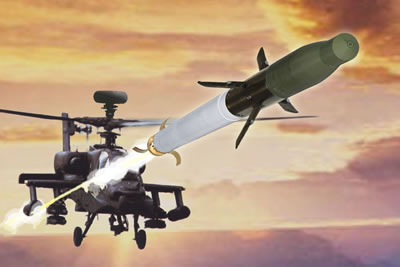 The introduction of remote video links, enabling operators to monitor the UAV’s payload view in real time, enables users to employ weaponized UAVs more flexibly and with improved confidence. Network enabled systems employing distributed command and control elements, with Intelligence, Surveillance and Reconnaissance (ISR) and armed airborne assets (either separate platforms or integrated into a single unit) benefit from progress made with UAVs and precision guided weapons. Typical weapons which could be adapted for UAV use include the Israeli LAHAT, designed by IAI subsidiary MBT to meet requirements of the Israeli armored corps. As early as 2004 this weapon was proposed for testing with US Hunter UAVs. Lahat utilizes the semi-active laser homing guidance method to accurately home in on targets from a distance beyond 10 km. Fitted with a shaped charge multi-purpose warhead, LAHAT can engage targets marked by laser designator mounted on the launching platform or by an indirect designation, from another unit located closer to the target. Each missile weighs about 13 kg and a complete launcher, with the four missiles weighs only 75kg, significantly less than any alternative weapon.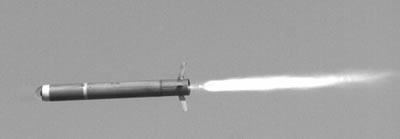
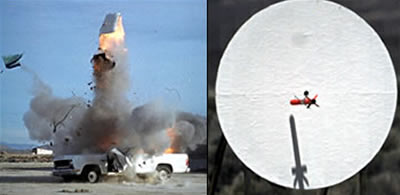 The laser Guided SPIKE was developed by the Weapons Division of the Naval Air Warfare Center, US Navy, with assistance of DRS Technologies. Originally designed as a man-portable weapon for the Marines and the Navy’s special operations force, Spike fills a critical niche for a low-cost, lightweight guided weapon for U.S. ground forces. It is also considered for tactical unmanned aerial vehicles and a force-protection weapon to defend surface ships from small-boat swarms or light aircraft. The missile uses Semi-Active Laser (SAL) seeker to engage laser designated targets from a distance of two miles. Each Spike missile weighs 5.3 lb (2.5 kg) and is 25 in.
 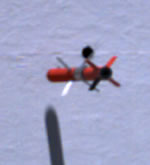 ( cm) long. The missile performed its first controlled flights in 2005. Spike missile is designed to be used on medium and lightweight UAVs. The missile has already been tested with the DRS Sentry HP drone at Eglin AFB, Florida, as part of US Air Force UAV Battlelab evaluation.
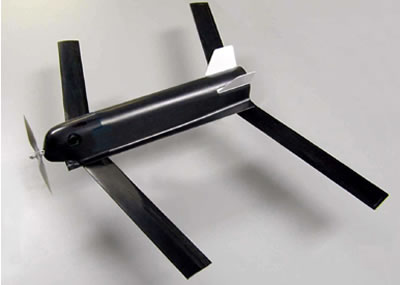
Another type of lightweight weapon considered for UAVs is the 2.75″ Hydra 70 rocket. In 2005, four 2.75-inch rockets were fired from Vigilante Unmanned Aerial Vehicle (UAV) testbed, demonstrating the weaponization potential of rotary wing UAVs. The tests evaluated the stability and flight control flight control adjustments necessary to compensate for excessive loads during the weapon’s firing. On these tests the Vigilante was controlled from a nearby UH-1 manned helicopter. Such tests will provide important data for the integration of Advanced Precision Kill Weapon System (APKWS II) with future rotary wing UAVs. APKWS II is intended to fill an aviation systems weapons gap between the Hellfire Missile and Unguided Hydra-70 2.75-Inch Rocket, introducing an affordable, lightweight, precision aerial guided rocket APKWS II weighs about 13 kg, integrating strap-down laser seeker (fixed in the wing roots) and guidance section onto the Hydra-70 Rocket, it will be effective against soft and lightly armored targets as well as urban operations. In April 2006 BAE Systems was contracted for the two year $45.7M system design and development phase, teamed with Northrop Grumman and General Dynamics. Production is expected to begin in 2008. The new design uses existing or new production rockets, fitted with a mid-body guidance approach that employs BAE Systems’ Distributed Aperture Semi-Active Laser Seeker (DASALS), the same element is also used in the Army’s Precision Guided Mortar Munitions Program. APKWS II will utilize the Hydra Universal Rail Launcher (HURL), a lightweight four-rail launcher originally developed for the Comanche attack helicopter but modified for use with UAVs. Designed as a ‘smart rocket launcher’, HURL can be linked to on-board avionics through Mil-Std-1760 and Mil-Std-1553 interfaces. Lockheed Martin also developed a version of 2.75″ laser guided rocket called Direct Attack Guided Rocket (DAGR) designed to be fully compatible with the Hellfire II system and 229 smart launcher system, therefore increasing the launcher load-out by up to four times. The rocket was flight tested in February 2007 and is expected to complete testing in 2007. The Russian company Basalt is offering the TBG-29 rocket propelled weapon, loaded with thermobaric warhead, to equip light aircraft and UAVs operating in close support operations. The weapon is designed to annihilate troops on open terrain, in trenches, field shelters, and inside buildings and destroy lightly armored and soft skinned targets. The round is fired from grenade launchers (RPG-29 and RPG-29N). Aircraft, helicopters or UAVs with a maximum takeoff weight of 1,000 kg or higher which can also carry the multiple launch rocket systems loading up to 7 rockets each. The 105mm diameter rocket measures 695mm in length, and weighs 6.7 kg. It can be fired at targets ranging from 50 to 2,000 meters. In enclosures, the thermobaric charge is effective within a volume of 300 square meters or at a radius of 10 meters from the detonation point, in open terrain. When fired near windows gun-ports etc, the detonation will kill any person within one meter from the detonation point or two meters, when fired at troops in trenches. Switchblade is another weapon, developed by AeroVironment, Inc. It is designed for hand, tube or aerial launch, and could provide the warfighter with a “magic bullet” delivering ‘instant’ Intelligence, Surveillance and Reconnaissance (ISR) on Beyond Line-of-Sight (BLOS) targets within minutes. Designed as an expendable system, Switchblade will also have an option to carry a small explosive charge to enable rapid prosecution of selected targets. The miniature, remotely-piloted or autonomous platform can either glide or propel itself via quiet, electric propulsion, providing real-time video for information gathering, targeting, or feature/object recognition. Read additional parts of this article:
- Smart Weapons for UAVs
- Weaponized UAVs
- Smart Weapons for UAVs
- Evolution of UAV Employed Missiles
- Lightweight Weapons for Autonomous Platforms
- Gravity Dropped Munitions for UAVs
- Targeting at the pixel
- Loitering Autonomous Weapons
- Grouping in Constellations
- Empowered by the Swarm
- Weaponizing Unmanned Combat Helicopters
Evolution of UAV Employed Missiles
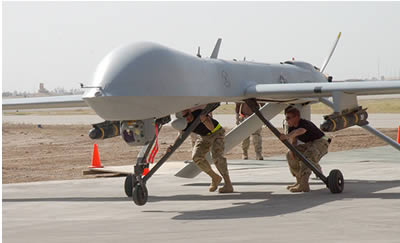
The first weaponized UAVs were armed with standard munitions, meeting payload weight restrictions of existing unmanned vehicles. At that time, the Lockheed Martin Hellfire II missile was found to be the most suitable weapon for such roles. However, in a parallel path, the US Air Force and Army have been evaluating other weapons, including the Northrop Grumman BAT munition and its derivatives, as well as other types. Among the weapons considered for testing were two Israeli weapons, the IAI/MBT Lahat laser guided missiles, and RAFAEL Spike LR electro-optical guided missiles, both are believed to have been deployed with UAVs.
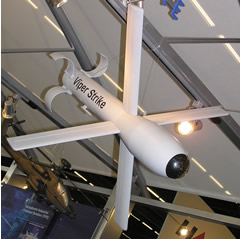 In the past, standard missiles and gravity dropped weapons were found inadequate for employment with UAVs. For example, the Hellfire, designed for launching from manned platforms, did not have adequate off-boresight flexibility to acquire unexpected target,s therefore limiting engagement profiles and increasing the potential for collateral damage. Launch signature and range have limited its suitability for surprise attacks. The stealthy, acoustically guided BAT proved useless for low intensity warfare, since typical target acoustics can hardly be defined in adequate resolution for an attack. The weapon was therefore modified with a new semi-active laser homing device. Designated Viper-Strike, it retained the Bat’s vertical dive capability, demonstrating excellent precision kill while reducing collateral damage. Few of these weapons are currently deployed in Iraq, flying on Hunter UAVs. Northrop Grumman is reportedly making efforts to reduce the weight of the Viper Strike to 11.3 kg, thus making it suitable for the 168 kg AAI RQ-7B Shadow 200. The new AGM-114P Hellfire version has already been optimized for the Predator UAV. Among the modifications are increased weapon engagement zone (WEZ), enabling the seeker to acquire targets off-boresight up to 90 degrees to each side. These missiles can be released from higher altitude (10,000 to 25,000 ft), eliminating the need to descend to lower altitude prior to weapon release. The AGM-114P was cleared for service in early 2005.
RAFAEL’s family of electro-optically guided missile, known as the Electro-Optically guided Spike is also proposed for weaponized UAV applications. It was publicly unveiled on UAVs when proposed by Sagem to arm their Sperwer B UAV for demonstrations for the French military. The French study required the UAV to be capable of delivering high terminal precision, especially in asymmetric conflicts, and maintain the controller in the loop from launch to impact in order to minimize operating risks. Two versions of Spike are proposed for airborne applications – the Spike LR, and extended range version (Spike ER), which can be fitted with blast-penetration warhead, designed to inflict maximum lethality inside buildings or vehicles but minimize collateral damage to the surrounding area. Utilizing a fiber-optical link, Spike offers unique fire and forget or fire-observe and update operating modes either autonomous guidance or maintaining a “man in the loop” option throughout the missile’s flight, as the missile relays the scene viewed by it’s seeker, enabling the controller to accurately select the point of impact or abort the mission when the conditions are not matching the rules of engagement (for example, presence of civilians). IMI is also working on reduced lethality warheads, designed to optimize the terminal effect against buildings, vehicles and other soft targets, characteristic of urban environment.
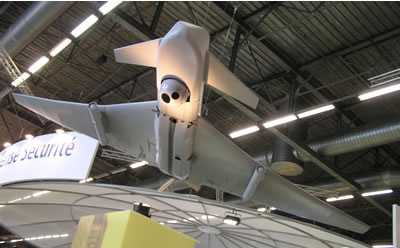
A similar trend is taking place in Europe. MBDA is developing a technology demonstrator, proposed as a follow-on to the HOT system, currently known as the Missile de Combat Terrestre (MCT), which could be utilized in the future for armed UAVs. The new missile will be able to engage targets at Non-Line Of Sight (NLOS) mode, where the missile’s seeker does not have to be aimed at the target before launch. The company is developing several variants for the missile, including medium and long range versions with range of up to 8 km and turbo-jet powered extended range versions, with a maximum range of 100km. The weapon considered for the missile will include “multi-effect” warhead, making it effective against a broad target set, including fortified constructions, bunkers, armored vehicles and soft targets. The warhead could be equipped with a programmable lethality package to create “scalable” effect, tailored for specific operating scenarios.
Read additional parts of this article:
- Smart Weapons for UAVs
- Weaponized UAVs
- Smart Weapons for UAVs
- Evolution of UAV Employed Missiles
- Lightweight Weapons for Autonomous Platforms
- Gravity Dropped Munitions for UAVs
- Targeting at the pixel
- Loitering Autonomous Weapons
- Grouping in Constellations
- Empowered by the Swarm
- Weaponizing Unmanned Combat Helicopters
Smart Weapons for UAVs
In recent years, weaponized UAVs have been used primarily by US forces as part of the global war on terror (GWOT). Predators were employed to support Special Forces operating over mountainous area in Afghanistan and Northern Iraq. Predators launched their Hellfired into a “basket”, where the missiles could lock on the target, illuminated by laser designators operated by Special Forces teams which roamed the area, tracking their targets on the ground, waiting for an opportunity to launch an attack. These teams could also benefit from imagery transmitted from the UAVs, patrolling the area at high altitude.
Evolving concepts of operation call for the simultaneous and coordinated operation of multiple UAVs, operated partly autonomously, while mutually supporting each other with ISR and weapons coverage. Such constellations of UAVs are providing warfighters with rapid response when engaging time critical targets (TCT) at reduced rate of response between target detection, targeting and engagement.
More covertly, such platforms were reportedly employed by the Israelis throughout their recent conflict with the Palestinians, performing many ‘targeted killings’, on terrorists as they were spotted by Israeli intelligence, moving openly in the streets of the Gaza strip. The types of weapons used by the Israeli UAVs have not been disclosed, but according to Palestinian reports, a gradual evolution of weapons has been encountered during the years since the beginning of the Intifada in 2000. In recent years, the damages inflicted by the Israeli aerial launched weapons became more focused, more lethal, indicating of smaller, accurate weapons, designed to minimize collateral damage while enabling accurate and effective engagement of mobile targets in complex urban environment. According to foreign sources, various constellations of weaponized UAV swarms were employed over South Lebanon during the 2nd Lebanon War in the summer of 2006, in effort to hunt Hezbollah rocket launchers scattered in hidden lairs around this area.
Read additional parts of this article:
- Smart Weapons for UAVs
- Weaponized UAVs
- Smart Weapons for UAVs
- Evolution of UAV Employed Missiles
- Lightweight Weapons for Autonomous Platforms
- Gravity Dropped Munitions for UAVs
- Targeting at the pixel
- Loitering Autonomous Weapons
- Grouping in Constellations
- Empowered by the Swarm
- Weaponizing Unmanned Combat Helicopters
Weaponized UAVs
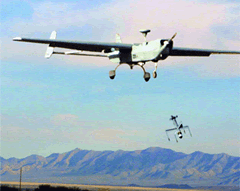
MQ-1B, the Armed configuration of the General Atomics Predator UAV operated by the US Air Force is now standard configuration for this unmanned aircraft, flown on routine missions from Balad air force base in Iraq. This UAV differs from the original Predator by the installation of two hard points carrying Hellfire missile launchers. These weapons are routinely used on armed reconnaissance missions. Another version of the Predator known as Warrior is currently under development for the US Army Extended Range / Multi Purpose (ER/MP) program. This aircraft will be fitted with four external carriage hardpoints loading four Hellfire missiles. The Army also considers adapting the Northrop Grumman Viper Strike and a unified dispenser which can carry various gravity dropped weapons, as well as supplies to support Special Forces deep inside enemy territory.
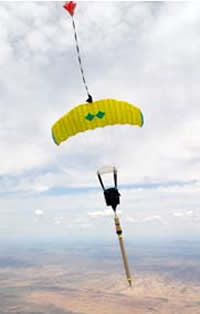
The USAF unmanned fleet will soon be augmented by a larger, more advanced system known as the Reaper MQ-9A. This UAV was designed from the beginning as a “Hunter-Killer” system. Compared with the limited strike capability of current UAVs flying at altitudes of 15,000-25,000 ft, the Reaper will be able to loiter at an altitude of up to 50,000 feet over a mission area, for up to 30 hours, armed with some 16 Hellfire II missiles or enhanced capability, with combination of Hellfires and precision guided bombs, such as GBU-38 JDAM or GBU-12 laser guided bombs (500lbs each). The aircraft will have a maximum gross takeoff weight of 10,000 pounds ( 5 Tons)s. It will be powered by a turbo-prop engine and have a wider fuselage, storing the fuel and payloads necessary for extended missions. Weapon guidance techniques can also utilize advanced parafoil decelerators, such as the Micro Onyx, which canguide a warhead to a hit a precise target, marked by GPS coordinates. The manufacturer claims this concept is more effective, lighter and costs less than conventional aerial guided weapons. Similar systems are already used within the Steel Eagle program, for the emplacement of aerial delivered unattended ground sensors (UGS).
 The US Air Force has requested funding of about $825 million for 74 Predators over the next six years, augmenting the 68 now in service. Thirty-two of those would be MQ-9 Reapers. In total, 15 squadrons will be operational. The USAF is currently testing more weapons with Predator and eventually Reaper, including the Viper Strike laser guided munition, small diameter bomb, laser guided munitions and Stinger air/air missile. Employment of air-to-air weapons like Raytheon’s AIM-9 Sidewinder and AIM-120 Advanced Medium-Range Air-to-Air Missile may also be evaluated at some point. Other weapons could include the PASSM, a more accurate and versatile precision attack missile proposed as a future alternative for the air-launched Hellfire II.
During the recent conflict in Lebanon and the ongoing conflict between Israel and the Palestinians, the IDF was reported to be using armed UAVs for attacking suspected terrorists in the West Bank and Gaza. The type of platforms or weapons used are classified, but according to industry briefings, several Israeli companies are involved in the development and fielding of lightweight, precision strike weapons and warheads designed specifically for operation in urban environments.
Read additional parts of this article:
- Smart Weapons for UAVs
- Weaponized UAVs
- Smart Weapons for UAVs
- Evolution of UAV Employed Missiles
- Lightweight Weapons for Autonomous Platforms
- Gravity Dropped Munitions for UAVs
- Targeting at the pixel
- Loitering Autonomous Weapons
- Grouping in Constellations
- Empowered by the Swarm
- Weaponizing Unmanned Combat Helicopters
Skunk Works and XTEND Simplify Multi-Drone Command

From Ukraine to Taiwan: The Global Race to Dominate the New Defense Tech Frontier

Europe’s “Drone Wall”
Weekly Defense Update & Global Security Assessment
U.S. Air and Space Forces Push Next-Gen Programs at the AS&C 2025 Conference and...
TADTE 2025: Reflecting Taiwan’s Strategic Themes